







 Chat with AI

Deck 4: Legal Liability of Cpas
Full screen (f)

Question

Question
Question
Question
Question
Question
Question
Question
Question
Question
Question
Question
Question
Question
Question
Question
Question
Question
Question
Question
Question
Question
Question
Question
Question
Question
Question
Question
Question
Question
Question
Question
Question
Question
Question
Question
Question
Question
Question
Question
Question
Question
Question
Question
Question
Question
Question
Question
Question
Question
Question
Question
Question
Question
Question
Question
Question
A plaintiff may elect to bring a lawsuit against auditors under applicable statutes-including the Securities Act of 1933 and the Securities Exchange Act of 1934-and under common law.For each circumstance,indicate the most likely source of CPA liability by placing the appropriate letter in the third column.
A.The Securities Act of 1933
B.The Securities Exchange Act of 1934
C.Common Law
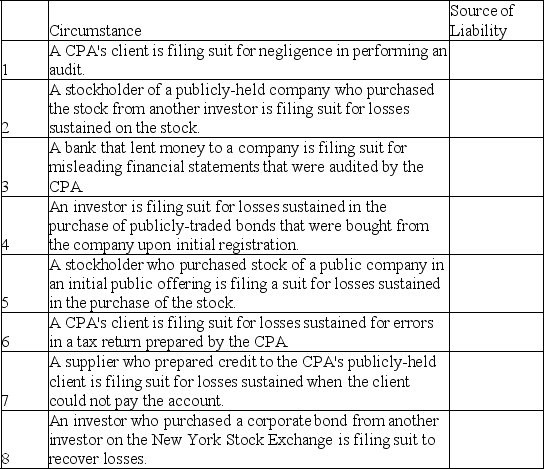
A.The Securities Act of 1933
B.The Securities Exchange Act of 1934
C.Common Law
Question
Question
Question
Question

Unlock Deck
Sign up to unlock the cards in this deck!
Unlock Deck
Unlock Deck
1/61

Play

Full screen (f)
Deck 4: Legal Liability of Cpas
1
Most of the burden of affirmative proof is on the defendant under common law.
False
2
An auditor knew that the purpose of her audit was to render reasonable assurance on financial statements that were to be used for the application for a loan;the auditor did not know the identity of the bank that would eventually give the loan.Under the Restatement of Torts approach to liability,the auditor is generally liable to the bank which subsequently grants the loan for:
A)Lack of due diligence.
B)Lack of good faith.
C)Gross negligence,but not ordinary negligence.
D)Either ordinary or gross negligence.
A)Lack of due diligence.
B)Lack of good faith.
C)Gross negligence,but not ordinary negligence.
D)Either ordinary or gross negligence.
D
3
Under which common law approach are auditors most likely to be held liable for ordinary negligence to a "reasonably foreseeable" third party?
A)Due Diligence Approach.
B)Ultramares Approach.
C)Restatement of Torts Approach.
D)Rosenblum Approach.
A)Due Diligence Approach.
B)Ultramares Approach.
C)Restatement of Torts Approach.
D)Rosenblum Approach.
D
4
Which of the following forms of organization is most likely to protect the personal assets of any partner,or shareholder who has not been involved on an engagement resulting in litigation?
A)Professional corporation.
B)Limited liability partnership.
C)Partnership.
D)Subchapter M Incorporation.
A)Professional corporation.
B)Limited liability partnership.
C)Partnership.
D)Subchapter M Incorporation.
Unlock Deck
Unlock for access to all 61 flashcards in this deck.
Unlock Deck
k this deck
5
The auditors can be held liable for negligence in audits of financial statements,but not in reviews of financial statements.
Unlock Deck
Unlock for access to all 61 flashcards in this deck.
Unlock Deck
k this deck
6
The precedent set by the Ernst & Ernst v.Hochfelder case is generally believed to have increased auditors' legal liability.
Unlock Deck
Unlock for access to all 61 flashcards in this deck.
Unlock Deck
k this deck
7
Under Section 10 of the 1934 Securities Exchange Act auditors are liable to security purchasers for:
A)Lack of due diligence.
B)Intent to deceive or defraud.
C)Ordinary negligence.
D)Auditors have no liability to security purchasers under this act.
A)Lack of due diligence.
B)Intent to deceive or defraud.
C)Ordinary negligence.
D)Auditors have no liability to security purchasers under this act.
Unlock Deck
Unlock for access to all 61 flashcards in this deck.
Unlock Deck
k this deck
8
The Ultramares v.Touche case established that auditors could be held liable to a known third party for ordinary negligence.
Unlock Deck
Unlock for access to all 61 flashcards in this deck.
Unlock Deck
k this deck
9
An auditor knew that the purpose of her audit was to render reasonable assurance on financial statements that were to be used for the application for a loan;the auditor did not know the identity of the bank that would eventually give the loan.Under the foreseeable third party approach,the auditor is generally liable to the bank which subsequently grants the loan for:
A)Lack of due diligence.
B)Lack of good faith.
C)Gross negligence,but not ordinary negligence.
D)Either ordinary or gross negligence.
A)Lack of due diligence.
B)Lack of good faith.
C)Gross negligence,but not ordinary negligence.
D)Either ordinary or gross negligence.
Unlock Deck
Unlock for access to all 61 flashcards in this deck.
Unlock Deck
k this deck
10
The use of engagement letters is generally designed to prevent lawsuits by third parties against the auditors.
Unlock Deck
Unlock for access to all 61 flashcards in this deck.
Unlock Deck
k this deck
11
Assume that $800,000 in damages are awarded to a plaintiff,and the CPA's percentage of responsibility established at 20%,while others are responsible for the other 80%.Assume the others have no financial resources.The CPA has been required to pay $160,000.The auditor's liability is most likely based upon which approach to assessing liability?
A)Absolute liability.
B)Contributory negligence.
C)Joint and several liability.
D)Proportional liability.
A)Absolute liability.
B)Contributory negligence.
C)Joint and several liability.
D)Proportional liability.
Unlock Deck
Unlock for access to all 61 flashcards in this deck.
Unlock Deck
k this deck
12
The results of the Continental Vending Corporation case did not result in the criminal prosecution of auditors for gross negligence.
Unlock Deck
Unlock for access to all 61 flashcards in this deck.
Unlock Deck
k this deck
13
The Securities Act of 1934 includes provisions for criminal charges against persons violating the Act.
Unlock Deck
Unlock for access to all 61 flashcards in this deck.
Unlock Deck
k this deck
14
Jones,CPA,is in court defending himself against a lawsuit filed under the 1933 Securities Act.The charges have been filed by purchasers of securities covered under that act.If the purchasers prove their required elements,in general,Jones will have to prove that:
A)He is not guilty of gross negligence.
B)He performed the audit with good faith.
C)He performed the audit with due diligence.
D)The plaintiffs did not show him to be negligent.
A)He is not guilty of gross negligence.
B)He performed the audit with good faith.
C)He performed the audit with due diligence.
D)The plaintiffs did not show him to be negligent.
Unlock Deck
Unlock for access to all 61 flashcards in this deck.
Unlock Deck
k this deck
15
The Securities Exchange Act of 1933 offers recourse against the auditors to a far greater number of investors than does the Securities Act of 1934.
Unlock Deck
Unlock for access to all 61 flashcards in this deck.
Unlock Deck
k this deck
16
Most charges made against auditors under common law are criminal.
Unlock Deck
Unlock for access to all 61 flashcards in this deck.
Unlock Deck
k this deck
17
Negligence is defined as failure to use reasonable care in the performance of services.
Unlock Deck
Unlock for access to all 61 flashcards in this deck.
Unlock Deck
k this deck
18
Which of the following is a correct statement related to CPA legal liability under common law?
A)CPAs are normally liable to their clients,the shareholders,for either ordinary or gross negligence.
B)CPAs are liable for either ordinary or gross negligence to identified third parties for whose benefit the audit was performed.
C)CPAs may escape all personal liability through incorporation as a limited liability corporation.
D)CPAs are guilty until they prove that they performed the audit with "good faith."
A)CPAs are normally liable to their clients,the shareholders,for either ordinary or gross negligence.
B)CPAs are liable for either ordinary or gross negligence to identified third parties for whose benefit the audit was performed.
C)CPAs may escape all personal liability through incorporation as a limited liability corporation.
D)CPAs are guilty until they prove that they performed the audit with "good faith."
Unlock Deck
Unlock for access to all 61 flashcards in this deck.
Unlock Deck
k this deck
19
A CPA issued an unqualified opinion on the financial statements of a company that sold common stock in a public offering subject to the Securities Act of 1933.Based on a misstatement in the financial statements,the CPA is being sued by an investor who purchased shares of this public offering.Which of the following represents a viable defense?
A)The investor has not proven CPA negligence.
B)The investor did not rely upon the financial statement.
C)The CPA detected the misstatement after the audit report date.
D)The audit work was adequate to support the CPA's opinion.
A)The investor has not proven CPA negligence.
B)The investor did not rely upon the financial statement.
C)The CPA detected the misstatement after the audit report date.
D)The audit work was adequate to support the CPA's opinion.
Unlock Deck
Unlock for access to all 61 flashcards in this deck.
Unlock Deck
k this deck
20
Assume that $800,000 in damages are awarded to a plaintiff,and the CPA's percentage of responsibility established at 20%,while others are responsible for the other 80%.Assume the others have no financial resources.As a result the CPA has been required to pay the entire $800,000.The auditor's liability is most likely based upon which approach to assessing liability?
A)Absolute liability.
B)Contributory negligence.
C)Joint and several liability.
D)Proportional liability.
A)Absolute liability.
B)Contributory negligence.
C)Joint and several liability.
D)Proportional liability.
Unlock Deck
Unlock for access to all 61 flashcards in this deck.
Unlock Deck
k this deck
21
The burden of proof that must be proven to recover losses from the auditors under the Securities Exchange Act of 1934 is generally considered to be:
A)Less than the Securities Act of 1933.
B)The same as the Securities Act of 1933.
C)Greater than the Securities Act of 1933.
D)Indeterminate in relation to the Securities Act of 1933.
A)Less than the Securities Act of 1933.
B)The same as the Securities Act of 1933.
C)Greater than the Securities Act of 1933.
D)Indeterminate in relation to the Securities Act of 1933.
Unlock Deck
Unlock for access to all 61 flashcards in this deck.
Unlock Deck
k this deck
22
A case by a client against its CPA firm alleging negligence would be brought under:
A)The Securities Act of 1933.
B)The Securities Exchange Act of 1934.
C)The state blue sky laws.
D)Common law.
A)The Securities Act of 1933.
B)The Securities Exchange Act of 1934.
C)The state blue sky laws.
D)Common law.
Unlock Deck
Unlock for access to all 61 flashcards in this deck.
Unlock Deck
k this deck
23
CPAs should not be liable to any party if they perform their services with:
A)Ordinary negligence.
B)Regulatory providence.
C)Due professional care.
D)Good faith.
A)Ordinary negligence.
B)Regulatory providence.
C)Due professional care.
D)Good faith.
Unlock Deck
Unlock for access to all 61 flashcards in this deck.
Unlock Deck
k this deck
24
In which of the following court cases was a precedent set increasing liability to third parties arising from audits under common law?
A)Rosenblum v.Adler.
B)Hochfelder v.Ernst.
C)1136 Tenants Corporation v.Rothenberg.
D)Continental Vending.
A)Rosenblum v.Adler.
B)Hochfelder v.Ernst.
C)1136 Tenants Corporation v.Rothenberg.
D)Continental Vending.
Unlock Deck
Unlock for access to all 61 flashcards in this deck.
Unlock Deck
k this deck
25
Under the Securities Act of 1933,the burden of proof that the plaintiff sustained a loss must be proven by the:
A)Plaintiff.
B)Defendant.
C)SEC.
D)Jury.
A)Plaintiff.
B)Defendant.
C)SEC.
D)Jury.
Unlock Deck
Unlock for access to all 61 flashcards in this deck.
Unlock Deck
k this deck
26
Assume that a client has encountered a $800,000 fraud and that the CPA's percentage of responsibility established at 20%,while the company itself was responsible for the other 80%.Under which approach to liability is the CPA most likely to avoid liability entirely?
A)Absolute negligence.
B)Comparative negligence.
C)Contributory negligence.
D)Joint Negligence.
A)Absolute negligence.
B)Comparative negligence.
C)Contributory negligence.
D)Joint Negligence.
Unlock Deck
Unlock for access to all 61 flashcards in this deck.
Unlock Deck
k this deck
27
The Second Restatement of the Law of Torts provides for auditor liability to a limited class of foreseen third parties for:
A)Only criminal acts.
B)Either ordinary or gross negligence.
C)Only gross negligence.
D)Only fraud.
A)Only criminal acts.
B)Either ordinary or gross negligence.
C)Only gross negligence.
D)Only fraud.
Unlock Deck
Unlock for access to all 61 flashcards in this deck.
Unlock Deck
k this deck
28
A limited liability partnership form of organization:
A)Decreases liability of all partners of a CPA firm.
B)Has similar liability requirements to that of a professional corporation.
C)Eliminates personal liability for some,but not all,partners.
D)Eliminates personal liability for all partners.
A)Decreases liability of all partners of a CPA firm.
B)Has similar liability requirements to that of a professional corporation.
C)Eliminates personal liability for some,but not all,partners.
D)Eliminates personal liability for all partners.
Unlock Deck
Unlock for access to all 61 flashcards in this deck.
Unlock Deck
k this deck
29
In which type of court case is proving "due diligence" essential to the auditors' defense?
A)Court cases brought under the Securities Exchange Act of 1934.
B)Court cases brought by clients under common law.
C)Court cases brought by third parties under common law.
D)Court cases brought under the Securities Act of 1933.
A)Court cases brought under the Securities Exchange Act of 1934.
B)Court cases brought by clients under common law.
C)Court cases brought by third parties under common law.
D)Court cases brought under the Securities Act of 1933.
Unlock Deck
Unlock for access to all 61 flashcards in this deck.
Unlock Deck
k this deck
30
The Private Securities Litigation Reform Act of 1995 imposes proportionate liability on the CPA who:
A)Unknowingly violates the 1934 Securities Exchange Act.
B)Knowingly or unknowingly violates the 1934 Securities Exchange Act.
C)Unknowingly violates the 1933 Securities Act.
D)Knowingly or unknowingly violates the 1933 Securities Act.
A)Unknowingly violates the 1934 Securities Exchange Act.
B)Knowingly or unknowingly violates the 1934 Securities Exchange Act.
C)Unknowingly violates the 1933 Securities Act.
D)Knowingly or unknowingly violates the 1933 Securities Act.
Unlock Deck
Unlock for access to all 61 flashcards in this deck.
Unlock Deck
k this deck
31
Which of the following is accurate with respect to litigation involving CPAs?
A)A CPA will not be found liable for an audit unless the CPA has audited all affiliates of that company.
B)A CPA may not successfully assert as a defense that the CPA had no motive to be part of a fraud.
C)A CPA may be exposed to criminal as well as civil liability.
D)A CPA is primarily responsible,while the client is secondarily responsible for the notes in an annual report filed with the SEC.
A)A CPA will not be found liable for an audit unless the CPA has audited all affiliates of that company.
B)A CPA may not successfully assert as a defense that the CPA had no motive to be part of a fraud.
C)A CPA may be exposed to criminal as well as civil liability.
D)A CPA is primarily responsible,while the client is secondarily responsible for the notes in an annual report filed with the SEC.
Unlock Deck
Unlock for access to all 61 flashcards in this deck.
Unlock Deck
k this deck
32
Which of the following court cases highlighted the need for obtaining engagement letters for professional services?
A)Ultramares v.Touche.
B)Rosenblum v.Adler.
C)Hochfelder v.Ernst.
D)1136 Tenants Corporation v.Rothenberg.
A)Ultramares v.Touche.
B)Rosenblum v.Adler.
C)Hochfelder v.Ernst.
D)1136 Tenants Corporation v.Rothenberg.
Unlock Deck
Unlock for access to all 61 flashcards in this deck.
Unlock Deck
k this deck
33
A CPA issued a standard unqualified audit report on the financial statements of a client that the CPA knew was in the process of obtaining a loan.In a suit by the bank issuing the loan,the CPA's best defense would be that the:
A)Audit complied with generally accepted auditing standards.
B)Client was aware of the misstatements.
C)Bank was not the CPA's client.
D)Bank's identity was known to the CPA prior to completion of the audit.
A)Audit complied with generally accepted auditing standards.
B)Client was aware of the misstatements.
C)Bank was not the CPA's client.
D)Bank's identity was known to the CPA prior to completion of the audit.
Unlock Deck
Unlock for access to all 61 flashcards in this deck.
Unlock Deck
k this deck
34
Which of the following is not correct relating to the Private Securities Litigation Reform Act of 1995?
A)It provides certain small investors better recovery rights than it does large investors.
B)It retains joint and several liability in certain circumstances.
C)It makes recovery against CPAs more difficult under common law litigation.
D)It eliminates securities fraud as an offense under civil RICO.
A)It provides certain small investors better recovery rights than it does large investors.
B)It retains joint and several liability in certain circumstances.
C)It makes recovery against CPAs more difficult under common law litigation.
D)It eliminates securities fraud as an offense under civil RICO.
Unlock Deck
Unlock for access to all 61 flashcards in this deck.
Unlock Deck
k this deck
35
Assume that a CPA firm was negligent but not grossly negligent in the performance of an engagement.Which of the following plaintiffs probably would not recover losses proximately caused by the auditors' negligence?
A)A loss sustained by a client in a suit brought under common law.
B)A loss sustained by a lender not in privity of contract in a suit brought in a state court which adheres to the Ultramares v.Touche precedent.
C)A loss sustained by initial purchasers of stock in a suit brought under the Securities Act of 1933.
D)A loss sustained by a bank named as a third-party beneficiary in the engagement letter in a suit brought under common law.
A)A loss sustained by a client in a suit brought under common law.
B)A loss sustained by a lender not in privity of contract in a suit brought in a state court which adheres to the Ultramares v.Touche precedent.
C)A loss sustained by initial purchasers of stock in a suit brought under the Securities Act of 1933.
D)A loss sustained by a bank named as a third-party beneficiary in the engagement letter in a suit brought under common law.
Unlock Deck
Unlock for access to all 61 flashcards in this deck.
Unlock Deck
k this deck
36
Which common law approach leads to increased CPA liability to "foreseeable" third parties for ordinary negligence?
A)Ultramares v.Touche.
B)Restatement of Torts.
C)Rule 10b-5.
D)Rosenblum v.Adler.
A)Ultramares v.Touche.
B)Restatement of Torts.
C)Rule 10b-5.
D)Rosenblum v.Adler.
Unlock Deck
Unlock for access to all 61 flashcards in this deck.
Unlock Deck
k this deck
37
Which of the following is the best defense that a CPA can assert against common law litigation by a stockholder claiming fraud based on an unqualified opinion on materially misstated financial statements?
A)Lack of due diligence.
B)Due professional care.
C)Contributory negligence on the part of the client.
D)A disclaimer contained in the engagement letter.
A)Lack of due diligence.
B)Due professional care.
C)Contributory negligence on the part of the client.
D)A disclaimer contained in the engagement letter.
Unlock Deck
Unlock for access to all 61 flashcards in this deck.
Unlock Deck
k this deck
38
Which of the following must be proven by the plaintiff in a case against a CPA under the Section 11 liability provisions of the Securities Act of 1933?
A)The CPA knew of the misstatement.
B)The CPA was negligent.
C)Material misstatements were contained in the financial statements.
D)The unqualified opinion contained in the registration statement was relied upon by the party suing the CPA.
A)The CPA knew of the misstatement.
B)The CPA was negligent.
C)Material misstatements were contained in the financial statements.
D)The unqualified opinion contained in the registration statement was relied upon by the party suing the CPA.
Unlock Deck
Unlock for access to all 61 flashcards in this deck.
Unlock Deck
k this deck
39
Bugle Corp.approved a plan of merger with Stanley Corp.One of the determining factors in approving the merger was the strong financial statements of Stanley which were audited by Dennis & Co. ,CPAs.Bugle had engaged Dennis to audit Stanley's financial statements.While performing the audit,Dennis failed to discover certain instances of fraud which have subsequently caused Bugle to suffer substantial losses.In order for Dennis to be liable under common law,Bugle,at a minimum,must prove that Dennis:
A)Acted recklessly or with lack of reasonable grounds for belief.
B)Knew of the instances of fraud.
C)Failed to exercise due care.
D)Was grossly negligent.
A)Acted recklessly or with lack of reasonable grounds for belief.
B)Knew of the instances of fraud.
C)Failed to exercise due care.
D)Was grossly negligent.
Unlock Deck
Unlock for access to all 61 flashcards in this deck.
Unlock Deck
k this deck
40
A principle that may reduce or entirely eliminate auditor liability to a client is:
A)Client constructive negligence.
B)Client contributory negligence.
C)Auditor ordinary negligence.
D)Auditor gross negligence.
A)Client constructive negligence.
B)Client contributory negligence.
C)Auditor ordinary negligence.
D)Auditor gross negligence.
Unlock Deck
Unlock for access to all 61 flashcards in this deck.
Unlock Deck
k this deck
41
In addition to proving a loss,which of the following must be proven by a third party suing a CPA under Section 11 of the 1933 Securities Act?
A)Option A
B)Option B
C)Option C
D)Option D
A)Option A
B)Option B
C)Option C
D)Option D
Unlock Deck
Unlock for access to all 61 flashcards in this deck.
Unlock Deck
k this deck
42
Section 11 of the Securities Act of 1933,and Section 10 of the Securities Exchange Act of 1934 make a CPA potentially liable to a purchaser of registered securities.For items a through f,place a checkmark (? )under the column if the plaintiff must prove its existence:
Unlock Deck
Unlock for access to all 61 flashcards in this deck.
Unlock Deck
k this deck
43
The Public Company Accounting Oversight Board may conduct investigations and disciplinary proceedings of:
A)Option A
B)Option B
C)Option C
D)Option D
A)Option A
B)Option B
C)Option C
D)Option D
Unlock Deck
Unlock for access to all 61 flashcards in this deck.
Unlock Deck
k this deck
44
Under which act (or acts)may criminal charges against a CPA be filed?
A)Option A
B)Option B
C)Option C
D)Option D
A)Option A
B)Option B
C)Option C
D)Option D
Unlock Deck
Unlock for access to all 61 flashcards in this deck.
Unlock Deck
k this deck
45
If a CPA recklessly departs from the standards of due care when conducting an audit,the CPA will be liable to third parties who are unknown to the CPA based on:
A)Ordinary negligence.
B)Gross negligence.
C)Strict liability.
D)Criminal deceit.
A)Ordinary negligence.
B)Gross negligence.
C)Strict liability.
D)Criminal deceit.
Unlock Deck
Unlock for access to all 61 flashcards in this deck.
Unlock Deck
k this deck
46
Under the Ultramares rule,to which of the following parties will an accountant be liable for ordinary negligence?
A)Option A
B)Option B
C)Option C
D)Option D
A)Option A
B)Option B
C)Option C
D)Option D
Unlock Deck
Unlock for access to all 61 flashcards in this deck.
Unlock Deck
k this deck
47
Under which act (or acts)may liability charges be filed against a CPA who has performed a financial statement review for a public company?
A)Option A
B)Option B
C)Option C
D)Option D
A)Option A
B)Option B
C)Option C
D)Option D
Unlock Deck
Unlock for access to all 61 flashcards in this deck.
Unlock Deck
k this deck
48
Bailey CPA,audited Lincoln Corporation.The shareholders sued both Lincoln and Bailey for securities fraud under the Federal Securities Exchange Act of 1934.The court determined that there was securities fraud and that Lincoln was 80% at fault and Bailey was 20% at fault due to her negligence in the audit.Both Lincoln and Bailey are solvent and the damages were determined to be $2 million.What is the maximum liability of Bailey?
A)$0
B)$400,000
C)$1,000,000
D)$2,000,000
A)$0
B)$400,000
C)$1,000,000
D)$2,000,000
Unlock Deck
Unlock for access to all 61 flashcards in this deck.
Unlock Deck
k this deck
49
Fleming and Co. ,CPAs,issued an unqualified opinion on the 20X3 financial statements of Walton Corp.Late in 20X4,Walton determined that its controller had embezzled over $2,000,000.Fleming was unaware of the embezzlement.Walton has decided to sue Fleming to recover the $2,000,000.Waltons suit is based upon Fleming's failure to discover the missing money while performing the audit.Which of the following is Fleming's best defense?
A)That the audit was performed in accordance with GAAS.
B)Fleming had no knowledge of the embezzlement.
C)The financial statements were presented in conformity with GAAP.
D)The controller was Walton's agent and as such had designed the controls which facilitated the embezzlement.
A)That the audit was performed in accordance with GAAS.
B)Fleming had no knowledge of the embezzlement.
C)The financial statements were presented in conformity with GAAP.
D)The controller was Walton's agent and as such had designed the controls which facilitated the embezzlement.
Unlock Deck
Unlock for access to all 61 flashcards in this deck.
Unlock Deck
k this deck
50
Wilson bought Zimmer Corp.common stock in an offering registered under the Securities Act of 1933.Baldridge & Co. ,CPAs,gave an unqualified opinion on Zimmer's financial statements that were included in the registration statement filed with the SEC.Wilson sued Baldridge under the provisions of the 1933 Act that deal with omission of facts required to be in the registration statement.Wilson must prove that:
A)There was fraudulent activity by Baldridge.
B)There was a material misstatement in the financial statements.
C)Wilson relied on Baldridge's opinion.
D)Wilson was in privity with Baldridge.
A)There was fraudulent activity by Baldridge.
B)There was a material misstatement in the financial statements.
C)Wilson relied on Baldridge's opinion.
D)Wilson was in privity with Baldridge.
Unlock Deck
Unlock for access to all 61 flashcards in this deck.
Unlock Deck
k this deck
51
Under common law,when performing an audit,a CPA:
A)Must exercise the level of care,skill,and judgment expected of a reasonably prudent CPA under the circumstances.
B)Must strictly adhere to generally accepted accounting principles.
C)Is strictly liable for failures to discover client fraud.
D)Is not liable unless the CPA commits gross negligence or intentionally disregards generally accepted auditing standards.
A)Must exercise the level of care,skill,and judgment expected of a reasonably prudent CPA under the circumstances.
B)Must strictly adhere to generally accepted accounting principles.
C)Is strictly liable for failures to discover client fraud.
D)Is not liable unless the CPA commits gross negligence or intentionally disregards generally accepted auditing standards.
Unlock Deck
Unlock for access to all 61 flashcards in this deck.
Unlock Deck
k this deck
52
In addition to proving a loss,which of the following must be proven by a third party suing a CPA under Section 10 of the 1934 Securities Exchange Act?
A)Option A
B)Option B
C)Option C
D)Option D
A)Option A
B)Option B
C)Option C
D)Option D
Unlock Deck
Unlock for access to all 61 flashcards in this deck.
Unlock Deck
k this deck
53
Under common law,which of the following statements most accurately reflects the liability of a CPA who fraudulently gives an opinion on an audit of a client's financial statements?
A)The CPA is liable only to third parties in privity of contract with the CPA.
B)The CPA is liable only to known users of the financial statements.
C)The CPA probably is liable to any person who suffered a loss as a result of the fraud.
D)The CPA probably is liable to the client even if the client was aware of the fraud and did not rely on the opinion.
A)The CPA is liable only to third parties in privity of contract with the CPA.
B)The CPA is liable only to known users of the financial statements.
C)The CPA probably is liable to any person who suffered a loss as a result of the fraud.
D)The CPA probably is liable to the client even if the client was aware of the fraud and did not rely on the opinion.
Unlock Deck
Unlock for access to all 61 flashcards in this deck.
Unlock Deck
k this deck
54
If a CPA recklessly departs from the standards of due care when conducting an audit,the CPA will be liable to third parties who are unknown to the CPA based on
A)Negligence.
B)Gross negligence.
C)Strict liability.
D)Criminal deceit.
A)Negligence.
B)Gross negligence.
C)Strict liability.
D)Criminal deceit.
Unlock Deck
Unlock for access to all 61 flashcards in this deck.
Unlock Deck
k this deck
55
A CPA's duty of due care to a client most likely will be breached when a CPA:
A)Gives a client an oral report instead of a written report.
B)Gives a client incorrect advice based on an honest error of judgment.
C)Fails to give tax advice that saves the client money.
D)Fails to follow generally accepted auditing standards.
A)Gives a client an oral report instead of a written report.
B)Gives a client incorrect advice based on an honest error of judgment.
C)Fails to give tax advice that saves the client money.
D)Fails to follow generally accepted auditing standards.
Unlock Deck
Unlock for access to all 61 flashcards in this deck.
Unlock Deck
k this deck
56
In a common law action against an accountant,lack of privity is a viable defense if the plaintiff:
A)Is the client's creditor who sues the accountant for negligence.
B)Can prove the presence of gross negligence that amounts to a reckless disregard for the truth.
C)Is the accountant's client.
D)Bases the action upon fraud.
A)Is the client's creditor who sues the accountant for negligence.
B)Can prove the presence of gross negligence that amounts to a reckless disregard for the truth.
C)Is the accountant's client.
D)Bases the action upon fraud.
Unlock Deck
Unlock for access to all 61 flashcards in this deck.
Unlock Deck
k this deck
57
A plaintiff may elect to bring a lawsuit against auditors under applicable statutes-including the Securities Act of 1933 and the Securities Exchange Act of 1934-and under common law.For each circumstance,indicate the most likely source of CPA liability by placing the appropriate letter in the third column.
A.The Securities Act of 1933
B.The Securities Exchange Act of 1934
C.Common Law
A.The Securities Act of 1933
B.The Securities Exchange Act of 1934
C.Common Law
Unlock Deck
Unlock for access to all 61 flashcards in this deck.
Unlock Deck
k this deck
58
Auditors may be held liable to both their clients and third parties under common law.
a.What must a client prove to recover its losses from the auditors under common law?
b.In a court that adheres to the precedent set by the Ultramares v.Touche case,what must an ordinary third party prove to recover losses from the auditors under common law?
a.What must a client prove to recover its losses from the auditors under common law?
b.In a court that adheres to the precedent set by the Ultramares v.Touche case,what must an ordinary third party prove to recover losses from the auditors under common law?
Unlock Deck
Unlock for access to all 61 flashcards in this deck.
Unlock Deck
k this deck
59
Hark,CPA,negligently failed to follow generally accepted auditing standards in auditing Long Corporation's financial statements.Long's president told Hark that the audited financial statements would be submitted to several,at this point undetermined,banks to obtain financing.Relying on the statements,Third Bank gave Long a loan.Long defaulted on the loan.In jurisdiction applying the Ultramares decision,if Third sues Hark,Hark will:
A)Win because there was no privity of contract between Hark and Third.
B)Lose because Hark knew that a bank would be relaying the financial statements.
C)Win because Third was contributory negligent in granting the loan.
D)Lose because Hark was negligent in performing the audit.
A)Win because there was no privity of contract between Hark and Third.
B)Lose because Hark knew that a bank would be relaying the financial statements.
C)Win because Third was contributory negligent in granting the loan.
D)Lose because Hark was negligent in performing the audit.
Unlock Deck
Unlock for access to all 61 flashcards in this deck.
Unlock Deck
k this deck
60
Under which act (or acts)must a client prove that a CPA has performed an audit with due diligence to establish that CPA's liability?
A)Option A
B)Option B
C)Option C
D)Option D
A)Option A
B)Option B
C)Option C
D)Option D
Unlock Deck
Unlock for access to all 61 flashcards in this deck.
Unlock Deck
k this deck
61
A CPA firm has audited the financial statements included in a Form S-1 filed with the SEC under the Securities Act of 1933.Shortly thereafter,the company went bankrupt and a class action lawsuit was filed by the initial investors against the CPA firm.
a.What should the plaintiff investors attempt to prove?
b.Must the plaintiffs prove that they relied on the financial statements included in the Form S-1?
c.What must the CPA firm prove in order to be successful with respect to the firm's defense?
a.What should the plaintiff investors attempt to prove?
b.Must the plaintiffs prove that they relied on the financial statements included in the Form S-1?
c.What must the CPA firm prove in order to be successful with respect to the firm's defense?
Unlock Deck
Unlock for access to all 61 flashcards in this deck.
Unlock Deck
k this deck
Unlock Deck
Unlock for access to all 61 flashcards in this deck.






