







 Chat with AI

Deck 37: Soil and Plant Nutrition
Full screen (f)

Question

Question
Figure 37.1 shows the results of a study to determine the effect of soil air spaces on plant growth.
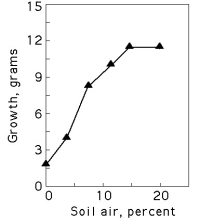
Figure 37.1
The data in Figure 37.1 indicate that that the plant
A)grows best at the lower levels of air in the soil.
B)grows about the same in 15% and 20% soil air percent.
C)grows best in soil air levels above 15%.
D)B and C only
E)A, B and C
Figure 37.1
The data in Figure 37.1 indicate that that the plant
A)grows best at the lower levels of air in the soil.
B)grows about the same in 15% and 20% soil air percent.
C)grows best in soil air levels above 15%.
D)B and C only
E)A, B and C
Question
In west Texas, cotton has become an important crop in the last several decades. However, in this hot, dry part of the country there is little rainfall, so farmers irrigate their cotton fields. They must also regularly fertilize the cotton fields because the soil is very sandy. Figure 37.2 shows the record of annual productivity (measured in kilograms of cotton per hectare of land) since 1960 in a west Texas cotton field. Use these data to answer the following questions.
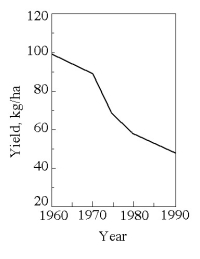
Figure 37.2
Based on the information provided above, what is the most likely cause of the decline in productivity?
A)The farmer used the wrong kind of fertilizer.
B)The cotton is developing a resistance to the fertilizer and to irrigation water.
C)Water has accumulated in the soil due to irrigation.
D)The soil water potential has become more negative due to salination.
E)The rate of photosynthesis has declined due to irrigation.
Figure 37.2
Based on the information provided above, what is the most likely cause of the decline in productivity?
A)The farmer used the wrong kind of fertilizer.
B)The cotton is developing a resistance to the fertilizer and to irrigation water.
C)Water has accumulated in the soil due to irrigation.
D)The soil water potential has become more negative due to salination.
E)The rate of photosynthesis has declined due to irrigation.
Question
Question
Question
In west Texas, cotton has become an important crop in the last several decades. However, in this hot, dry part of the country there is little rainfall, so farmers irrigate their cotton fields. They must also regularly fertilize the cotton fields because the soil is very sandy. Figure 37.2 shows the record of annual productivity (measured in kilograms of cotton per hectare of land) since 1960 in a west Texas cotton field. Use these data to answer the following questions.
Figure 37.2
If you were the county agriculture agent, what would be the best advice you could give the farmer who owns the field under study in Figure 37.2?
A)Plant a variety of cotton that requires less water and can tolerate salinity.
B)Continue to fertilize, but stop irrigating and rely on rainfall.
C)Continue to irrigate, but stop fertilizing and rely on organic nutrients in the soil.
D)Continue to fertilize and irrigate, but add the nitrogen-fixing bacteria Rhizobium to the irrigation water until the productivity increases.
E)Add acid to the soil and increase its cation exchange capabilities so more nutrients are retained in the soil.
Figure 37.2
If you were the county agriculture agent, what would be the best advice you could give the farmer who owns the field under study in Figure 37.2?
A)Plant a variety of cotton that requires less water and can tolerate salinity.
B)Continue to fertilize, but stop irrigating and rely on rainfall.
C)Continue to irrigate, but stop fertilizing and rely on organic nutrients in the soil.
D)Continue to fertilize and irrigate, but add the nitrogen-fixing bacteria Rhizobium to the irrigation water until the productivity increases.
E)Add acid to the soil and increase its cation exchange capabilities so more nutrients are retained in the soil.
Question
Question
Question
Question
Figure 37.1 shows the results of a study to determine the effect of soil air spaces on plant growth.
Figure 37.1
The best explanation for the shape of the growth response curve in figure 37.1 is that
A)the plant requires air in the soil for photosynthesis.
B)the roots are able to absorb more nitrogen (N2)in high levels of air.
C)most of the decrease in weight at low air levels is due to transpiration from the leaves.
D)increased soil air produces more root mass in the soil but does not affect the top stems and leaves.
E)the roots require oxygen for respiration and growth.
Figure 37.1
The best explanation for the shape of the growth response curve in figure 37.1 is that
A)the plant requires air in the soil for photosynthesis.
B)the roots are able to absorb more nitrogen (N2)in high levels of air.
C)most of the decrease in weight at low air levels is due to transpiration from the leaves.
D)increased soil air produces more root mass in the soil but does not affect the top stems and leaves.
E)the roots require oxygen for respiration and growth.
Question
Question
Question
Question
Question
Question
Question
Question
Question
Question
Figure 37.1 shows the results of a study to determine the effect of soil air spaces on plant growth.
Figure 37.1
The best conclusion from the data in Figure 37.1 is that the plant
A)grows best without air in the soil.
B)grows fastest in 5 to 10% air.
C)grows best at soil air levels above 15%.
D)does not respond differently to different levels of air in the soil.
E)would grow to 24 grams in 40% soil air.
Figure 37.1
The best conclusion from the data in Figure 37.1 is that the plant
A)grows best without air in the soil.
B)grows fastest in 5 to 10% air.
C)grows best at soil air levels above 15%.
D)does not respond differently to different levels of air in the soil.
E)would grow to 24 grams in 40% soil air.
Question
Question
Question
Question
Question
Question
Question
Question
Question
In west Texas, cotton has become an important crop in the last several decades. However, in this hot, dry part of the country there is little rainfall, so farmers irrigate their cotton fields. They must also regularly fertilize the cotton fields because the soil is very sandy. Figure 37.2 shows the record of annual productivity (measured in kilograms of cotton per hectare of land) since 1960 in a west Texas cotton field. Use these data to answer the following questions.
Figure 37.2
A young farmer purchases some land in a relatively arid area and is interested in earning a reasonable profit for many years. Which of the following strategies would best allow such a goal to be achieved?
A)establishing an extensive irrigation system
B)using plenty of the best fertilizers
C)finding a way to sell all parts of crop plants
D)selecting crops adapted to arid areas
E)converting hillsides into fields
Figure 37.2
A young farmer purchases some land in a relatively arid area and is interested in earning a reasonable profit for many years. Which of the following strategies would best allow such a goal to be achieved?
A)establishing an extensive irrigation system
B)using plenty of the best fertilizers
C)finding a way to sell all parts of crop plants
D)selecting crops adapted to arid areas
E)converting hillsides into fields
Question
Question
Question
Question
Question
Question
In west Texas, cotton has become an important crop in the last several decades. However, in this hot, dry part of the country there is little rainfall, so farmers irrigate their cotton fields. They must also regularly fertilize the cotton fields because the soil is very sandy. Figure 37.2 shows the record of annual productivity (measured in kilograms of cotton per hectare of land) since 1960 in a west Texas cotton field. Use these data to answer the following questions.
Figure 37.2
A farming commitment that embraces a variety of methods that are conservation-minded, environmentally safe, and profitable is called
A)hydroponics.
B)nitrogen fixation.
C)responsible irrigation.
D)genetic engineering.
E)sustainable agriculture.
Figure 37.2
A farming commitment that embraces a variety of methods that are conservation-minded, environmentally safe, and profitable is called
A)hydroponics.
B)nitrogen fixation.
C)responsible irrigation.
D)genetic engineering.
E)sustainable agriculture.
Question
Question
Question
Question
Question
Question
Question
Question
Question
Question
Question
Question
Question
Question
Question
Question
Question
Question
Question
Question
Question
Question
Question
Question
Question
Question
Question
Question
Question
Question
Question
Question
Question
Question
Question
Question
Question
Question
Question
Question
Question
Question
Question
Question
Question

Unlock Deck
Sign up to unlock the cards in this deck!
Unlock Deck
Unlock Deck
1/85

Play

Full screen (f)
Deck 37: Soil and Plant Nutrition
1
Which soil mineral is most likely leached away during a hard rain?
A)Na+
B)K+
C)Ca++
D)NO3-
E)H+
A)Na+
B)K+
C)Ca++
D)NO3-
E)H+
D
2
Figure 37.1 shows the results of a study to determine the effect of soil air spaces on plant growth.
Figure 37.1
The data in Figure 37.1 indicate that that the plant
A)grows best at the lower levels of air in the soil.
B)grows about the same in 15% and 20% soil air percent.
C)grows best in soil air levels above 15%.
D)B and C only
E)A, B and C
Figure 37.1
The data in Figure 37.1 indicate that that the plant
A)grows best at the lower levels of air in the soil.
B)grows about the same in 15% and 20% soil air percent.
C)grows best in soil air levels above 15%.
D)B and C only
E)A, B and C
D
3
In west Texas, cotton has become an important crop in the last several decades. However, in this hot, dry part of the country there is little rainfall, so farmers irrigate their cotton fields. They must also regularly fertilize the cotton fields because the soil is very sandy. Figure 37.2 shows the record of annual productivity (measured in kilograms of cotton per hectare of land) since 1960 in a west Texas cotton field. Use these data to answer the following questions.
Figure 37.2
Based on the information provided above, what is the most likely cause of the decline in productivity?
A)The farmer used the wrong kind of fertilizer.
B)The cotton is developing a resistance to the fertilizer and to irrigation water.
C)Water has accumulated in the soil due to irrigation.
D)The soil water potential has become more negative due to salination.
E)The rate of photosynthesis has declined due to irrigation.
Figure 37.2
Based on the information provided above, what is the most likely cause of the decline in productivity?
A)The farmer used the wrong kind of fertilizer.
B)The cotton is developing a resistance to the fertilizer and to irrigation water.
C)Water has accumulated in the soil due to irrigation.
D)The soil water potential has become more negative due to salination.
E)The rate of photosynthesis has declined due to irrigation.
D
4
Which of the following describes the fate of most of the water taken up by a plant?
A)It is used as a solvent.
B)It is used as a hydrogen source in photosynthesis.
C)It is lost during transpiration.
D)It makes cell elongation possible.
E)It is used to keep cells turgid.
A)It is used as a solvent.
B)It is used as a hydrogen source in photosynthesis.
C)It is lost during transpiration.
D)It makes cell elongation possible.
E)It is used to keep cells turgid.
Unlock Deck
Unlock for access to all 85 flashcards in this deck.
Unlock Deck
k this deck
5
There are several properties of a soil in which typical plants would grow well. Of the following, which would be the least conducive to plant growth?
A)abundant humus
B)numerous soil organisms
C)compacted soil
D)high porosity
E)high cation exchange capacity
A)abundant humus
B)numerous soil organisms
C)compacted soil
D)high porosity
E)high cation exchange capacity
Unlock Deck
Unlock for access to all 85 flashcards in this deck.
Unlock Deck
k this deck
6
In west Texas, cotton has become an important crop in the last several decades. However, in this hot, dry part of the country there is little rainfall, so farmers irrigate their cotton fields. They must also regularly fertilize the cotton fields because the soil is very sandy. Figure 37.2 shows the record of annual productivity (measured in kilograms of cotton per hectare of land) since 1960 in a west Texas cotton field. Use these data to answer the following questions.
Figure 37.2
If you were the county agriculture agent, what would be the best advice you could give the farmer who owns the field under study in Figure 37.2?
A)Plant a variety of cotton that requires less water and can tolerate salinity.
B)Continue to fertilize, but stop irrigating and rely on rainfall.
C)Continue to irrigate, but stop fertilizing and rely on organic nutrients in the soil.
D)Continue to fertilize and irrigate, but add the nitrogen-fixing bacteria Rhizobium to the irrigation water until the productivity increases.
E)Add acid to the soil and increase its cation exchange capabilities so more nutrients are retained in the soil.
Figure 37.2
If you were the county agriculture agent, what would be the best advice you could give the farmer who owns the field under study in Figure 37.2?
A)Plant a variety of cotton that requires less water and can tolerate salinity.
B)Continue to fertilize, but stop irrigating and rely on rainfall.
C)Continue to irrigate, but stop fertilizing and rely on organic nutrients in the soil.
D)Continue to fertilize and irrigate, but add the nitrogen-fixing bacteria Rhizobium to the irrigation water until the productivity increases.
E)Add acid to the soil and increase its cation exchange capabilities so more nutrients are retained in the soil.
Unlock Deck
Unlock for access to all 85 flashcards in this deck.
Unlock Deck
k this deck
7
For this pair of items, choose the option that best describes their relationship. (A)The average size of particles that constitute silt
(B)The average size of particles that constitute clay
A)Item (A)is greater than item (B).
B)Item (A)is less than item (B).
C)Item (A)is exactly or very approximately equal to item (B).
D)Item (A)may stand in more than one of the above relations to item (B).
(B)The average size of particles that constitute clay
A)Item (A)is greater than item (B).
B)Item (A)is less than item (B).
C)Item (A)is exactly or very approximately equal to item (B).
D)Item (A)may stand in more than one of the above relations to item (B).
Unlock Deck
Unlock for access to all 85 flashcards in this deck.
Unlock Deck
k this deck
8
Why does over-watering a plant kill it?
A)Water does not have all the necessary minerals a plant needs to grow.
B)Water neutralizes the pH of the soil.
C)The roots are deprived of oxygen.
D)Water supports the growth of root parasites.
E)Water lowers the water potential of the roots.
A)Water does not have all the necessary minerals a plant needs to grow.
B)Water neutralizes the pH of the soil.
C)The roots are deprived of oxygen.
D)Water supports the growth of root parasites.
E)Water lowers the water potential of the roots.
Unlock Deck
Unlock for access to all 85 flashcards in this deck.
Unlock Deck
k this deck
9
The N-P-K percentages on a package of fertilizer refer to the
A)total protein content of the three major ingredients of the fertilizer.
B)percentages of manure collected from different types of animals.
C)relative percentages of organic and inorganic nutrients in the fertilizer.
D)percentages of three important mineral nutrients.
E)proportions of three different nitrogen sources.
A)total protein content of the three major ingredients of the fertilizer.
B)percentages of manure collected from different types of animals.
C)relative percentages of organic and inorganic nutrients in the fertilizer.
D)percentages of three important mineral nutrients.
E)proportions of three different nitrogen sources.
Unlock Deck
Unlock for access to all 85 flashcards in this deck.
Unlock Deck
k this deck
10
Figure 37.1 shows the results of a study to determine the effect of soil air spaces on plant growth.
Figure 37.1
The best explanation for the shape of the growth response curve in figure 37.1 is that
A)the plant requires air in the soil for photosynthesis.
B)the roots are able to absorb more nitrogen (N2)in high levels of air.
C)most of the decrease in weight at low air levels is due to transpiration from the leaves.
D)increased soil air produces more root mass in the soil but does not affect the top stems and leaves.
E)the roots require oxygen for respiration and growth.
Figure 37.1
The best explanation for the shape of the growth response curve in figure 37.1 is that
A)the plant requires air in the soil for photosynthesis.
B)the roots are able to absorb more nitrogen (N2)in high levels of air.
C)most of the decrease in weight at low air levels is due to transpiration from the leaves.
D)increased soil air produces more root mass in the soil but does not affect the top stems and leaves.
E)the roots require oxygen for respiration and growth.
Unlock Deck
Unlock for access to all 85 flashcards in this deck.
Unlock Deck
k this deck
11
A soil well suited for the growth of most plants would have all of the following properties except
A)abundant humus.
B)air spaces.
C)good drainage.
D)high cation exchange capacity.
E)a high pH.
A)abundant humus.
B)air spaces.
C)good drainage.
D)high cation exchange capacity.
E)a high pH.
Unlock Deck
Unlock for access to all 85 flashcards in this deck.
Unlock Deck
k this deck
12
What should be added to soil to prevent minerals from leaching away?
A)humus
B)sand
C)mycorrhizae
D)nitrogen
E)silt
A)humus
B)sand
C)mycorrhizae
D)nitrogen
E)silt
Unlock Deck
Unlock for access to all 85 flashcards in this deck.
Unlock Deck
k this deck
13
What soil(s)is(are)the most fertile?
A)humus only
B)loam only
C)silt only
D)clay only
E)both humus and loam
A)humus only
B)loam only
C)silt only
D)clay only
E)both humus and loam
Unlock Deck
Unlock for access to all 85 flashcards in this deck.
Unlock Deck
k this deck
14
If you wanted to increase the cation exchange and water retention capacity of loamy soil, what should you do?
A)Adjust the soil pH to 7.9.
B)Add clay to the soil.
C)Practice no-till agriculture.
D)Add fertilizer containing potassium, calcium and magnesium to the soil.
E)Increase the number of sand particles in the soil.
A)Adjust the soil pH to 7.9.
B)Add clay to the soil.
C)Practice no-till agriculture.
D)Add fertilizer containing potassium, calcium and magnesium to the soil.
E)Increase the number of sand particles in the soil.
Unlock Deck
Unlock for access to all 85 flashcards in this deck.
Unlock Deck
k this deck
15
For this pair of items, choose the option that best describes their relationship. (A)The amount of nitrogen in a fertilizer marked "15-10-5"
(B)The amount of nitrogen in a fertilizer marked "15-5-5"
A)Item (A)is greater than item (B).
B)Item (A)is less than item (B).
C)Item (A)is exactly or very approximately equal to item (B).
D)Item (A)may stand in more than one of the above relations to item (B).
(B)The amount of nitrogen in a fertilizer marked "15-5-5"
A)Item (A)is greater than item (B).
B)Item (A)is less than item (B).
C)Item (A)is exactly or very approximately equal to item (B).
D)Item (A)may stand in more than one of the above relations to item (B).
Unlock Deck
Unlock for access to all 85 flashcards in this deck.
Unlock Deck
k this deck
16
For this pair of items, choose the option that best describes their relationship. (A)The percent of plant species that form ectomycorrhizae
(B)The percent of plant species that form arbuscular mycorrhizae
A)Item (A)is greater than item (B).
B)Item (A)is less than item (B).
C)Item (A)is exactly or very approximately equal to item (B).
D)Item (A)may stand in more than one of the above relations to item (B).
(B)The percent of plant species that form arbuscular mycorrhizae
A)Item (A)is greater than item (B).
B)Item (A)is less than item (B).
C)Item (A)is exactly or very approximately equal to item (B).
D)Item (A)may stand in more than one of the above relations to item (B).
Unlock Deck
Unlock for access to all 85 flashcards in this deck.
Unlock Deck
k this deck
17
All of the following contributed to the dust bowl in the American southwest during the 1930s except
A)overgrazing by cattle.
B)clear cutting of forest trees.
C)plowing of native grasses.
D)planting of field crops.
E)lack of soil moisture.
A)overgrazing by cattle.
B)clear cutting of forest trees.
C)plowing of native grasses.
D)planting of field crops.
E)lack of soil moisture.
Unlock Deck
Unlock for access to all 85 flashcards in this deck.
Unlock Deck
k this deck
18
For this pair of items, choose the option that best describes their relationship. (A)The amount of molybdenum in a gram of dried plant material
(B)The amount of sulfur in a gram of dried plant material
A)Item (A)is greater than item (B).
B)Item (A)is less than item (B).
C)Item (A)is exactly or very approximately equal to item (B).
D)Item (A)may stand in more than one of the above relations to item (B).
(B)The amount of sulfur in a gram of dried plant material
A)Item (A)is greater than item (B).
B)Item (A)is less than item (B).
C)Item (A)is exactly or very approximately equal to item (B).
D)Item (A)may stand in more than one of the above relations to item (B).
Unlock Deck
Unlock for access to all 85 flashcards in this deck.
Unlock Deck
k this deck
19
For this pair of items, choose the option that best describes their relationship. (A)The number of essential macronutrients required by plants
(B)The number of essential micronutrients required by plants
A)Item (A)is greater than item (B).
B)Item (A)is less than item (B).
C)Item (A)is exactly or very approximately equal to item (B).
D)Item (A)may stand in more than one of the above relations to item (B).
(B)The number of essential micronutrients required by plants
A)Item (A)is greater than item (B).
B)Item (A)is less than item (B).
C)Item (A)is exactly or very approximately equal to item (B).
D)Item (A)may stand in more than one of the above relations to item (B).
Unlock Deck
Unlock for access to all 85 flashcards in this deck.
Unlock Deck
k this deck
20
Figure 37.1 shows the results of a study to determine the effect of soil air spaces on plant growth.
Figure 37.1
The best conclusion from the data in Figure 37.1 is that the plant
A)grows best without air in the soil.
B)grows fastest in 5 to 10% air.
C)grows best at soil air levels above 15%.
D)does not respond differently to different levels of air in the soil.
E)would grow to 24 grams in 40% soil air.
Figure 37.1
The best conclusion from the data in Figure 37.1 is that the plant
A)grows best without air in the soil.
B)grows fastest in 5 to 10% air.
C)grows best at soil air levels above 15%.
D)does not respond differently to different levels of air in the soil.
E)would grow to 24 grams in 40% soil air.
Unlock Deck
Unlock for access to all 85 flashcards in this deck.
Unlock Deck
k this deck
21
Some plants extract and concentrate heavy metals from the soil. A current use for such plants is
A)to help locate suitable sites for toxic waste storage.
B)to concentrate rare metals for medicinal use.
C)to minimize soil erosion in arid lands.
D)nitrogen fixation by symbiotic bacteria in root nodules.
E)photoremediation of polluted sites.
A)to help locate suitable sites for toxic waste storage.
B)to concentrate rare metals for medicinal use.
C)to minimize soil erosion in arid lands.
D)nitrogen fixation by symbiotic bacteria in root nodules.
E)photoremediation of polluted sites.
Unlock Deck
Unlock for access to all 85 flashcards in this deck.
Unlock Deck
k this deck
22
What is the major function of sodium in plants?
A)component of lignin-biosynthetic enzymes
B)component of DNA and RNA
C)a component of chlorophyll
D)active in amino acid formation
E)required to regenerate phospophenolpyruvate in C4 and CAM plants
A)component of lignin-biosynthetic enzymes
B)component of DNA and RNA
C)a component of chlorophyll
D)active in amino acid formation
E)required to regenerate phospophenolpyruvate in C4 and CAM plants
Unlock Deck
Unlock for access to all 85 flashcards in this deck.
Unlock Deck
k this deck
23
Which two elements make up more than 90% of the dry weight of plants?
A)carbon and nitrogen
B)oxygen and hydrogen
C)nitrogen and oxygen
D)oxygen and carbon
E)carbon and potassium
A)carbon and nitrogen
B)oxygen and hydrogen
C)nitrogen and oxygen
D)oxygen and carbon
E)carbon and potassium
Unlock Deck
Unlock for access to all 85 flashcards in this deck.
Unlock Deck
k this deck
24
A growing plant exhibits chlorosis of the leaves of the entire plant. The chlorosis is probably due to a deficiency of which of the following macronutrients?
A)carbon
B)oxygen
C)nitrogen
D)calcium
E)hydrogen
A)carbon
B)oxygen
C)nitrogen
D)calcium
E)hydrogen
Unlock Deck
Unlock for access to all 85 flashcards in this deck.
Unlock Deck
k this deck
25
Which element is important in the formation and stability of cell walls?
A)zinc
B)chlorine
C)calcium
D)molybdenum
E)manganese
A)zinc
B)chlorine
C)calcium
D)molybdenum
E)manganese
Unlock Deck
Unlock for access to all 85 flashcards in this deck.
Unlock Deck
k this deck
26
In hydroponic culture, what is the purpose of bubbling air into the solute?
A)to keep dissolved nutrients evenly distributed
B)to provide oxygen to the root cells
C)to inhibit the growth of aerobic algae
D)to inhibit the growth of anaerobic bacteria
E)to provide CO2 for photosynthesis
A)to keep dissolved nutrients evenly distributed
B)to provide oxygen to the root cells
C)to inhibit the growth of aerobic algae
D)to inhibit the growth of anaerobic bacteria
E)to provide CO2 for photosynthesis
Unlock Deck
Unlock for access to all 85 flashcards in this deck.
Unlock Deck
k this deck
27
Organic molecules make up what percentage of the dry weight of a plant?
A)6%
B)17%
C)67%
D)81%
E)96%
A)6%
B)17%
C)67%
D)81%
E)96%
Unlock Deck
Unlock for access to all 85 flashcards in this deck.
Unlock Deck
k this deck
28
In the 1640s Jan Baptista van Helmont planted a small willow in a pot that contained 90.9 kg of soil. After five years, the plant weighed 76.8 kg, but only 0.06 kg of soil had disappeared from the pot. What did van Helmont conclude from this experiment?
A)80-90% of the tree's mass is the result of C3 photosynthesis.
B)The increase in the mass of the tree was from the water that he added over the five years.
C)Most of the increase in the mass of the tree was due to the uptake of CO2.
D)Soil simply provides physical support for the tree without providing any nutrients.
E)The 0.06 kg of soil was mainly nitrogen.
A)80-90% of the tree's mass is the result of C3 photosynthesis.
B)The increase in the mass of the tree was from the water that he added over the five years.
C)Most of the increase in the mass of the tree was due to the uptake of CO2.
D)Soil simply provides physical support for the tree without providing any nutrients.
E)The 0.06 kg of soil was mainly nitrogen.
Unlock Deck
Unlock for access to all 85 flashcards in this deck.
Unlock Deck
k this deck
29
In west Texas, cotton has become an important crop in the last several decades. However, in this hot, dry part of the country there is little rainfall, so farmers irrigate their cotton fields. They must also regularly fertilize the cotton fields because the soil is very sandy. Figure 37.2 shows the record of annual productivity (measured in kilograms of cotton per hectare of land) since 1960 in a west Texas cotton field. Use these data to answer the following questions.
Figure 37.2
A young farmer purchases some land in a relatively arid area and is interested in earning a reasonable profit for many years. Which of the following strategies would best allow such a goal to be achieved?
A)establishing an extensive irrigation system
B)using plenty of the best fertilizers
C)finding a way to sell all parts of crop plants
D)selecting crops adapted to arid areas
E)converting hillsides into fields
Figure 37.2
A young farmer purchases some land in a relatively arid area and is interested in earning a reasonable profit for many years. Which of the following strategies would best allow such a goal to be achieved?
A)establishing an extensive irrigation system
B)using plenty of the best fertilizers
C)finding a way to sell all parts of crop plants
D)selecting crops adapted to arid areas
E)converting hillsides into fields
Unlock Deck
Unlock for access to all 85 flashcards in this deck.
Unlock Deck
k this deck
30
Which of the following is of least concern to a researcher in a mineral nutrition experiment?
A)purity of the chemicals used to make the nutrient solutions
B)purity of the water used to make the nutrient solutions
C)chemical inertness of the container used to make and store the nutrient solutions
D)ability of a laboratory balance to weigh very small quantities of chemicals
E)medium in which the test seedlings were grown
A)purity of the chemicals used to make the nutrient solutions
B)purity of the water used to make the nutrient solutions
C)chemical inertness of the container used to make and store the nutrient solutions
D)ability of a laboratory balance to weigh very small quantities of chemicals
E)medium in which the test seedlings were grown
Unlock Deck
Unlock for access to all 85 flashcards in this deck.
Unlock Deck
k this deck
31
Most of the dry weight of a plant is the result of uptake of
A)water and minerals through root hairs.
B)water and minerals through mycorrhizae.
C)CO2 through stoma.
D)CO2 and O2 through stomata in leaves.
E)carbohydrates in the root hairs and concentration in the root cortex.
A)water and minerals through root hairs.
B)water and minerals through mycorrhizae.
C)CO2 through stoma.
D)CO2 and O2 through stomata in leaves.
E)carbohydrates in the root hairs and concentration in the root cortex.
Unlock Deck
Unlock for access to all 85 flashcards in this deck.
Unlock Deck
k this deck
32
You are conducting an experiment on plant growth. You take a plant fresh from the soil that weighs 5 kg. Then you dry the plant overnight and determine the dry weight to be 1 kg. Of this dry weight, how much would you expect to be made up of organic molecules?
A)1 gram
B)4 grams
C)40 grams
D)960 grams
E)1 kg
A)1 gram
B)4 grams
C)40 grams
D)960 grams
E)1 kg
Unlock Deck
Unlock for access to all 85 flashcards in this deck.
Unlock Deck
k this deck
33
The bulk of a plant's dry weight is derived from
A)soil minerals.
B)CO2.
C)the hydrogen from H₂O.
D)the oxygen from H₂O.
E)the uptake of organic nutrients from the soil.
A)soil minerals.
B)CO2.
C)the hydrogen from H₂O.
D)the oxygen from H₂O.
E)the uptake of organic nutrients from the soil.
Unlock Deck
Unlock for access to all 85 flashcards in this deck.
Unlock Deck
k this deck
34
Which of the following essential nutrients plays an essential role in the opening and closing of the stomatal aperture?
A)Fe
B)Bo
C)Mg
D)H
E)K
A)Fe
B)Bo
C)Mg
D)H
E)K
Unlock Deck
Unlock for access to all 85 flashcards in this deck.
Unlock Deck
k this deck
35
In west Texas, cotton has become an important crop in the last several decades. However, in this hot, dry part of the country there is little rainfall, so farmers irrigate their cotton fields. They must also regularly fertilize the cotton fields because the soil is very sandy. Figure 37.2 shows the record of annual productivity (measured in kilograms of cotton per hectare of land) since 1960 in a west Texas cotton field. Use these data to answer the following questions.
Figure 37.2
A farming commitment that embraces a variety of methods that are conservation-minded, environmentally safe, and profitable is called
A)hydroponics.
B)nitrogen fixation.
C)responsible irrigation.
D)genetic engineering.
E)sustainable agriculture.
Figure 37.2
A farming commitment that embraces a variety of methods that are conservation-minded, environmentally safe, and profitable is called
A)hydroponics.
B)nitrogen fixation.
C)responsible irrigation.
D)genetic engineering.
E)sustainable agriculture.
Unlock Deck
Unlock for access to all 85 flashcards in this deck.
Unlock Deck
k this deck
36
What is the major function of nitrogen in plants?
A)component of lignin-biosynthetic enzymes
B)component of DNA and RNA
C)a component of chlorophyll
D)active in amino acid formation
E)required to regenerate phospophenolpyruvate in C4 and CAM plants
A)component of lignin-biosynthetic enzymes
B)component of DNA and RNA
C)a component of chlorophyll
D)active in amino acid formation
E)required to regenerate phospophenolpyruvate in C4 and CAM plants
Unlock Deck
Unlock for access to all 85 flashcards in this deck.
Unlock Deck
k this deck
37
When performing a mineral nutrition experiment, researchers use water from a glass still. Why is it not a good idea to use regular distilled water from a stainless steel still?
A)With a steel still, lime deposits from hard water will build up too quickly.
B)Salts in the water corrode steel more quickly than glass.
C)Metal ions dissolving off the steel may serve as micronutrients.
D)A glass still allows the distillation process to be observed.
E)There is no difference; both kinds of stills produce distilled water.
A)With a steel still, lime deposits from hard water will build up too quickly.
B)Salts in the water corrode steel more quickly than glass.
C)Metal ions dissolving off the steel may serve as micronutrients.
D)A glass still allows the distillation process to be observed.
E)There is no difference; both kinds of stills produce distilled water.
Unlock Deck
Unlock for access to all 85 flashcards in this deck.
Unlock Deck
k this deck
38
What are the three main elements on which plant growth and development depend?
A)nitrogen; carbon; oxygen
B)potassium; carbon; oxygen
C)oxygen; carbon; hydrogen
D)phosphorus; nitrogen; oxygen
E)sulfur; nitrogen; phosphorus
A)nitrogen; carbon; oxygen
B)potassium; carbon; oxygen
C)oxygen; carbon; hydrogen
D)phosphorus; nitrogen; oxygen
E)sulfur; nitrogen; phosphorus
Unlock Deck
Unlock for access to all 85 flashcards in this deck.
Unlock Deck
k this deck
39
Which of the following elements is incorrectly paired with its function in a plant?
A)nitrogen component of nucleic acids, proteins, hormones, coenzymes
B)magnesium component of chlorophyll; activates many enzymes
C)phosphorus component of nucleic acids, phospholipids, ATP, several coenzymes
D)potassium cofactor functional in protein synthesis; osmosis; operation of stomata
E)sulfur component of DNA; activates some enzymes
A)nitrogen component of nucleic acids, proteins, hormones, coenzymes
B)magnesium component of chlorophyll; activates many enzymes
C)phosphorus component of nucleic acids, phospholipids, ATP, several coenzymes
D)potassium cofactor functional in protein synthesis; osmosis; operation of stomata
E)sulfur component of DNA; activates some enzymes
Unlock Deck
Unlock for access to all 85 flashcards in this deck.
Unlock Deck
k this deck
40
What is the major function of magnesium in plants?
A)component of lignin-biosynthetic enzymes
B)component of DNA and RNA
C)a component of chlorophyll
D)active in amino acid formation
E)required to regenerate phospophenolpyruvate in C4 and CAM plants
A)component of lignin-biosynthetic enzymes
B)component of DNA and RNA
C)a component of chlorophyll
D)active in amino acid formation
E)required to regenerate phospophenolpyruvate in C4 and CAM plants
Unlock Deck
Unlock for access to all 85 flashcards in this deck.
Unlock Deck
k this deck
41
In what way do nitrogen compounds differ from other minerals needed by plants?
A)Only nitrogen can be lost from the soil.
B)Only nitrogen requires the action of bacteria to be made available to plants.
C)Only nitrogen is needed for protein synthesis.
D)Only nitrogen is held by cation exchange capacity in the soil.
E)Only nitrogen can be absorbed by root hairs.
A)Only nitrogen can be lost from the soil.
B)Only nitrogen requires the action of bacteria to be made available to plants.
C)Only nitrogen is needed for protein synthesis.
D)Only nitrogen is held by cation exchange capacity in the soil.
E)Only nitrogen can be absorbed by root hairs.
Unlock Deck
Unlock for access to all 85 flashcards in this deck.
Unlock Deck
k this deck
42
Reddish-purple coloring of leaves, especially along the margins of young leaves, is a typical symptom of deficiency of which element?
A)C
B)M++
C)N
D)P
E)K+
A)C
B)M++
C)N
D)P
E)K+
Unlock Deck
Unlock for access to all 85 flashcards in this deck.
Unlock Deck
k this deck
43
Why is nitrogen fixation such an important process?
A)Nitrogen fixation can only be done by certain prokaryotes.
B)Fixed nitrogen is most often the limiting factor in plant growth.
C)Nitrogen fixation is very expensive in terms of metabolic energy.
D)Nitrogen fixers are sometimes symbiotic with legumes.
E)Nitrogen-fixing capacity can be genetically engineered.
A)Nitrogen fixation can only be done by certain prokaryotes.
B)Fixed nitrogen is most often the limiting factor in plant growth.
C)Nitrogen fixation is very expensive in terms of metabolic energy.
D)Nitrogen fixers are sometimes symbiotic with legumes.
E)Nitrogen-fixing capacity can be genetically engineered.
Unlock Deck
Unlock for access to all 85 flashcards in this deck.
Unlock Deck
k this deck
44
In a root nodule, the gene coding for nitrogenase
A)is inactivated by leghemoglobin.
B)is absent in active bacteroids.
C)is found in the cells of the pericycle.
D)protects the nodule from nitrogen.
E)is part of the Rhizobium chromosome.
A)is inactivated by leghemoglobin.
B)is absent in active bacteroids.
C)is found in the cells of the pericycle.
D)protects the nodule from nitrogen.
E)is part of the Rhizobium chromosome.
Unlock Deck
Unlock for access to all 85 flashcards in this deck.
Unlock Deck
k this deck
45
Nitrogen fixation is a process that
A)recycles nitrogen compounds from dead and decaying materials.
B)converts ammonia to nitrate.
C)releases nitrate from the rock substrate.
D)converts nitrogen gas into ammonia.
E)A and B
A)recycles nitrogen compounds from dead and decaying materials.
B)converts ammonia to nitrate.
C)releases nitrate from the rock substrate.
D)converts nitrogen gas into ammonia.
E)A and B
Unlock Deck
Unlock for access to all 85 flashcards in this deck.
Unlock Deck
k this deck
46
What is the function of a root nodule's leghemoglobin?
A)extract macronutrients from the soil.
B)regulate the supply of oxygen to Rhizobium.
C)promote ion exchange in the soil.
D)form a mutualistic relationship with insects.
E)supply the legume with fixed nitrogen.
A)extract macronutrients from the soil.
B)regulate the supply of oxygen to Rhizobium.
C)promote ion exchange in the soil.
D)form a mutualistic relationship with insects.
E)supply the legume with fixed nitrogen.
Unlock Deck
Unlock for access to all 85 flashcards in this deck.
Unlock Deck
k this deck
47
The enzyme complex nitrogenase catalyzes the reaction that reduces atmospheric nitrogen to
A)N2.
B)NH3.
C)NO2.
D)NO+.
E)NO-.
A)N2.
B)NH3.
C)NO2.
D)NO+.
E)NO-.
Unlock Deck
Unlock for access to all 85 flashcards in this deck.
Unlock Deck
k this deck
48
Among important crop plants, nitrogen-fixing root nodules are most commonly an attribute of
A)corn.
B)legumes.
C)wheat.
D)members of the potato family.
E)cabbage and other members of the brassica family.
A)corn.
B)legumes.
C)wheat.
D)members of the potato family.
E)cabbage and other members of the brassica family.
Unlock Deck
Unlock for access to all 85 flashcards in this deck.
Unlock Deck
k this deck
49
What is meant by the term chlorosis?
A)the uptake of the micronutrient chlorine by a plant
B)the formation of chlorophyll within the thylakoid membranes of a plant
C)the yellowing of leaves due to decreased chlorophyll production
D)a contamination of glassware in hydroponic culture
E)release of negatively charged minerals such as chloride from clay particles in soil
A)the uptake of the micronutrient chlorine by a plant
B)the formation of chlorophyll within the thylakoid membranes of a plant
C)the yellowing of leaves due to decreased chlorophyll production
D)a contamination of glassware in hydroponic culture
E)release of negatively charged minerals such as chloride from clay particles in soil
Unlock Deck
Unlock for access to all 85 flashcards in this deck.
Unlock Deck
k this deck
50
Which of the following best describes the general role of micronutrients in plants?
A)They are cofactors in enzymatic reactions.
B)They are necessary for essential regulatory functions.
C)They prevent chlorosis.
D)They are components of nucleic acids.
E)They are necessary for the formation of cell walls.
A)They are cofactors in enzymatic reactions.
B)They are necessary for essential regulatory functions.
C)They prevent chlorosis.
D)They are components of nucleic acids.
E)They are necessary for the formation of cell walls.
Unlock Deck
Unlock for access to all 85 flashcards in this deck.
Unlock Deck
k this deck
51
Which of the following is a True statement about nitrogen fixation in root nodules?
A)The plant contributes the nitrogenase enzyme.
B)The process is relatively inexpensive in terms of ATP costs.
C)Leghemoglobin helps maintain a low O2 concentration within the nodule.
D)The process tends to deplete nitrogen compounds in the soil.
E)The bacteria of the nodule are autotrophic.
A)The plant contributes the nitrogenase enzyme.
B)The process is relatively inexpensive in terms of ATP costs.
C)Leghemoglobin helps maintain a low O2 concentration within the nodule.
D)The process tends to deplete nitrogen compounds in the soil.
E)The bacteria of the nodule are autotrophic.
Unlock Deck
Unlock for access to all 85 flashcards in this deck.
Unlock Deck
k this deck
52
Which of the following is not a function of rhizobacteria?
A)produce hormones that stimulate plant growth
B)produce antibiotics that protect roots from disease
C)absorb toxic metals
D)carry out nitrogen fixation
E)supply growing roots with glucose
A)produce hormones that stimulate plant growth
B)produce antibiotics that protect roots from disease
C)absorb toxic metals
D)carry out nitrogen fixation
E)supply growing roots with glucose
Unlock Deck
Unlock for access to all 85 flashcards in this deck.
Unlock Deck
k this deck
53
Iron deficiency is often indicated by yellowing in newly formed leaves. This suggests that iron
A)is a relatively immobile nutrient in plants.
B)is tied up in formed chlorophyll molecules.
C)is concentrated in the xylem of older leaves.
D)is concentrated in older leaves.
E)is found in leghemoglobin and reduces the amount available to new plant parts.
A)is a relatively immobile nutrient in plants.
B)is tied up in formed chlorophyll molecules.
C)is concentrated in the xylem of older leaves.
D)is concentrated in older leaves.
E)is found in leghemoglobin and reduces the amount available to new plant parts.
Unlock Deck
Unlock for access to all 85 flashcards in this deck.
Unlock Deck
k this deck
54
Which of the following is not True of micronutrients in plants?
A)They are the elements required in relatively small amounts.
B)They are required for a plant to grow from a seed and complete its life cycle.
C)They generally help in catalytic functions in the plant.
D)They are the essential elements of small size and molecular weight.
E)Overdoses of them can be toxic.
A)They are the elements required in relatively small amounts.
B)They are required for a plant to grow from a seed and complete its life cycle.
C)They generally help in catalytic functions in the plant.
D)They are the essential elements of small size and molecular weight.
E)Overdoses of them can be toxic.
Unlock Deck
Unlock for access to all 85 flashcards in this deck.
Unlock Deck
k this deck
55
The most efficient way to increase essential amino acids in crop plants for human consumption is to
A)breed for higher yield of deficient amino acids.
B)increase the amount of fertilizer used on fields.
C)use 20-20-20 fertilizer instead of 20-5-5 fertilizer.
D)engineer nitrogen-fixing nodules into crop plants lacking them.
E)increase irrigation of nitrogen-fixing crops.
A)breed for higher yield of deficient amino acids.
B)increase the amount of fertilizer used on fields.
C)use 20-20-20 fertilizer instead of 20-5-5 fertilizer.
D)engineer nitrogen-fixing nodules into crop plants lacking them.
E)increase irrigation of nitrogen-fixing crops.
Unlock Deck
Unlock for access to all 85 flashcards in this deck.
Unlock Deck
k this deck
56
If an African violet has chlorosis, which of the following elements might be a useful addition to the soil?
A)chlorine
B)molybdenum
C)copper
D)iodine
E)magnesium
A)chlorine
B)molybdenum
C)copper
D)iodine
E)magnesium
Unlock Deck
Unlock for access to all 85 flashcards in this deck.
Unlock Deck
k this deck
57
You are weeding your garden when you accidentally expose some roots. You notice swellings (root nodules)on the roots. Most likely your plant
A)suffers from a mineral deficiency.
B)is infected with a parasite.
C)is benefiting from a mutualistic bacterium.
D)is developing offshoots from the root.
E)contains developing insect pupa.
A)suffers from a mineral deficiency.
B)is infected with a parasite.
C)is benefiting from a mutualistic bacterium.
D)is developing offshoots from the root.
E)contains developing insect pupa.
Unlock Deck
Unlock for access to all 85 flashcards in this deck.
Unlock Deck
k this deck
58
A woodlot was sprayed with a fungicide. What would be the most serious effect of such spraying?
A)a decrease in food for animals that eat mushrooms
B)an increase in rates of wood decay
C)a decrease in tree growth due to the death of mycorrhizae
D)an increase in the number of decomposing bacteria
E)A and B
A)a decrease in food for animals that eat mushrooms
B)an increase in rates of wood decay
C)a decrease in tree growth due to the death of mycorrhizae
D)an increase in the number of decomposing bacteria
E)A and B
Unlock Deck
Unlock for access to all 85 flashcards in this deck.
Unlock Deck
k this deck
59
Most crop plants acquire their nitrogen mainly in the form of
A)NH3.
B)N2.
C)CN2H2.
D)NO3..
E)amino acids absorbed from the soil.
A)NH3.
B)N2.
C)CN2H2.
D)NO3..
E)amino acids absorbed from the soil.
Unlock Deck
Unlock for access to all 85 flashcards in this deck.
Unlock Deck
k this deck
60
If a plant is infected with Rhizobium, what is the probable effect on the plant?
A)It gets chlorosis.
B)It dies.
C)It is supplied with phosphate from the soil.
D)It probably will grow faster
E)It becomes flaccid due to the loss of water from the roots
A)It gets chlorosis.
B)It dies.
C)It is supplied with phosphate from the soil.
D)It probably will grow faster
E)It becomes flaccid due to the loss of water from the roots
Unlock Deck
Unlock for access to all 85 flashcards in this deck.
Unlock Deck
k this deck
61
Young seedlings rarely show mineral deficiency symptoms because their mineral requirements are met largely by minerals released from stored reserves in the seed itself.
Unlock Deck
Unlock for access to all 85 flashcards in this deck.
Unlock Deck
k this deck
62
A mineral deficiency is likely to affect older leaves more than younger leaves if
A)the mineral is a micronutrient.
B)the mineral is very mobile within the plant.
C)the mineral is required for chlorophyll synthesis.
D)the mineral is a macronutrient.
E)the older leaves are in direct sunlight.
A)the mineral is a micronutrient.
B)the mineral is very mobile within the plant.
C)the mineral is required for chlorophyll synthesis.
D)the mineral is a macronutrient.
E)the older leaves are in direct sunlight.
Unlock Deck
Unlock for access to all 85 flashcards in this deck.
Unlock Deck
k this deck
63
Macronutrients, elements required in relatively large amounts, typically have catalytic functions as cofactors of enzymes.
Unlock Deck
Unlock for access to all 85 flashcards in this deck.
Unlock Deck
k this deck
64
Plant roots excrete substances that bind the soil particles and raise the soil pH.
Unlock Deck
Unlock for access to all 85 flashcards in this deck.
Unlock Deck
k this deck
65
Two groups of tomatoes were grown under laboratory conditions, one with humus added to the soil and one a control without the humus. The leaves of the plants grown without humus were yellowish (less green)compared with those of the plants grown in humus-enriched soil. The best explanation for this difference is that
A)the healthy plants used the food in the decomposing leaves of the humus for energy to make chlorophyll.
B)the humus made the soil more loosely packed, so water penetrated more easily to the roots.
C)the humus contained minerals such as magnesium and iron, needed for the synthesis of chlorophyll.
D)chlorophyll synthesis.
E)the healthy plants absorbed chlorophyll from the humus.
A)the healthy plants used the food in the decomposing leaves of the humus for energy to make chlorophyll.
B)the humus made the soil more loosely packed, so water penetrated more easily to the roots.
C)the humus contained minerals such as magnesium and iron, needed for the synthesis of chlorophyll.
D)chlorophyll synthesis.
E)the healthy plants absorbed chlorophyll from the humus.
Unlock Deck
Unlock for access to all 85 flashcards in this deck.
Unlock Deck
k this deck
66
Dwarf mistletoe grows on many pine trees in the Rockies. Although the mistletoe is green, it is probably not sufficiently active in photosynthesis to produce all the sugar it needs. The mistletoe also produces haustoria. Thus, dwarf mistletoe growing on pine trees is best classified as
A)an epiphyte.
B)a nitrogen-fixing plant.
C)a carnivorous plant.
D)a symbiotic plant.
E)a parasite.
A)an epiphyte.
B)a nitrogen-fixing plant.
C)a carnivorous plant.
D)a symbiotic plant.
E)a parasite.
Unlock Deck
Unlock for access to all 85 flashcards in this deck.
Unlock Deck
k this deck
67
Phytoremediation is a biotechnology that uses the ability of some plants to extract soil pollutants and concentrate them in portions of the plant that can be easily removed for safe disposal.
Unlock Deck
Unlock for access to all 85 flashcards in this deck.
Unlock Deck
k this deck
68
Plants acquire most of their nitrogen in the form of N2 that they obtain from rhizobacteria.
Unlock Deck
Unlock for access to all 85 flashcards in this deck.
Unlock Deck
k this deck
69
Some of the problems associated with intensive irrigation include all but
A)mineral runoff.
B)overfertilization.
C)land subsidence.
D)aquifer depletion.
E)soil salinization.
A)mineral runoff.
B)overfertilization.
C)land subsidence.
D)aquifer depletion.
E)soil salinization.
Unlock Deck
Unlock for access to all 85 flashcards in this deck.
Unlock Deck
k this deck
70
The rhizosphere would best be described as
A)legume root swellings that are involved in nitrogen fixation.
B)the part of the topsoil that supplies carbohydrates to plants.
C)soil that is bound to roots and differs from the surrounding soil in containing many more microbes.
D)the spherical soil horizon in which roots typically grow.
E)all of the living organisms that inhabit the soil.
A)legume root swellings that are involved in nitrogen fixation.
B)the part of the topsoil that supplies carbohydrates to plants.
C)soil that is bound to roots and differs from the surrounding soil in containing many more microbes.
D)the spherical soil horizon in which roots typically grow.
E)all of the living organisms that inhabit the soil.
Unlock Deck
Unlock for access to all 85 flashcards in this deck.
Unlock Deck
k this deck
71
Which of the following is a primary difference between ectomycorrhizae and endomycorrhizae?
A)Endomycorrhizae have thicker, shorter hyphae than ectomycorrhizae.
B)Endomycorrhizae, but not ectomycorrhizae, form a dense sheath over the surface of the root.
C)Ectomycorrhizae do not penetrate root cells, whereas endomycorrhizae grow into invaginations of the root cell membranes.
D)Ectomycorrhizae are found in woody plant species; about 85% of plant families form ectomycorrhizae.
E)There are no significant differences between ectomycorrhizae and endomycorrhizae.
A)Endomycorrhizae have thicker, shorter hyphae than ectomycorrhizae.
B)Endomycorrhizae, but not ectomycorrhizae, form a dense sheath over the surface of the root.
C)Ectomycorrhizae do not penetrate root cells, whereas endomycorrhizae grow into invaginations of the root cell membranes.
D)Ectomycorrhizae are found in woody plant species; about 85% of plant families form ectomycorrhizae.
E)There are no significant differences between ectomycorrhizae and endomycorrhizae.
Unlock Deck
Unlock for access to all 85 flashcards in this deck.
Unlock Deck
k this deck
72
The earliest vascular plants on land had underground stems (rhizomes)but no roots. Water and mineral nutrients were most likely obtained by
A)absorption by hairs and trichomes.
B)diffusion through stomata.
C)absorption by mycorrhizae.
D)osmosis through the root hairs.
E)diffusion across the cuticle of the rhizome.
A)absorption by hairs and trichomes.
B)diffusion through stomata.
C)absorption by mycorrhizae.
D)osmosis through the root hairs.
E)diffusion across the cuticle of the rhizome.
Unlock Deck
Unlock for access to all 85 flashcards in this deck.
Unlock Deck
k this deck
73
Most of the mass of organic material of a plant comes from
A)water.
B)carbon dioxide.
C)soil minerals.
D)atmospheric oxygen.
E)nitrogen.
A)water.
B)carbon dioxide.
C)soil minerals.
D)atmospheric oxygen.
E)nitrogen.
Unlock Deck
Unlock for access to all 85 flashcards in this deck.
Unlock Deck
k this deck
74
What are epiphytes?
A)aerial vines common in tropical regions
B)haustoria used for anchoring to host plants and obtaining xylem sap
C)plants that live in poor soil and digest insects to obtain nitrogen
D)plants that grow on other plants but do not obtain nutrients from their hosts
E)plants that have a symbiotic relationship with fungi
A)aerial vines common in tropical regions
B)haustoria used for anchoring to host plants and obtaining xylem sap
C)plants that live in poor soil and digest insects to obtain nitrogen
D)plants that grow on other plants but do not obtain nutrients from their hosts
E)plants that have a symbiotic relationship with fungi
Unlock Deck
Unlock for access to all 85 flashcards in this deck.
Unlock Deck
k this deck
75
Micronutrients are needed in very small amounts because
A)most of them are mobile in the plant.
B)most serve mainly as cofactors of enzymes.
C)most are supplied in large enough quantities in seeds.
D)they play only a minor role in the growth and health of the plant.
E)only the most actively growing regions of the plants require micronutrients.
A)most of them are mobile in the plant.
B)most serve mainly as cofactors of enzymes.
C)most are supplied in large enough quantities in seeds.
D)they play only a minor role in the growth and health of the plant.
E)only the most actively growing regions of the plants require micronutrients.
Unlock Deck
Unlock for access to all 85 flashcards in this deck.
Unlock Deck
k this deck
76
Carnivorous plants have evolved mechanisms that trap and digest small animals. The products of this digestion are used to supplement the plant's supply of
A)energy.
B)carbohydrates.
C)lipids and steroids.
D)minerals.
E)water.
A)energy.
B)carbohydrates.
C)lipids and steroids.
D)minerals.
E)water.
Unlock Deck
Unlock for access to all 85 flashcards in this deck.
Unlock Deck
k this deck
77
What is the mutualistic association between roots and fungi called?
A)nitrogen fixation
B)Rhizobium infection
C)mycorrhizae
D)parasitism
E)root hair enhancement
A)nitrogen fixation
B)Rhizobium infection
C)mycorrhizae
D)parasitism
E)root hair enhancement
Unlock Deck
Unlock for access to all 85 flashcards in this deck.
Unlock Deck
k this deck
78
The fungal hyphae of both ectomycorrhizae and arbuscular mycorrhizae absorb water and minerals, which they supply to their plant hosts.
Unlock Deck
Unlock for access to all 85 flashcards in this deck.
Unlock Deck
k this deck
79
Deficiency of a mobile nutrient usually affects older organs more than younger ones.
Unlock Deck
Unlock for access to all 85 flashcards in this deck.
Unlock Deck
k this deck
80
Hyphae form a covering over roots. Altogether, these hyphae create a large surface area that helps to do which of the following?
A)aid in absorbing minerals and ions
B)maintain cell shape
C)increase cellular respiration
D)anchor a plant
E)protect the roots from ultraviolet light
A)aid in absorbing minerals and ions
B)maintain cell shape
C)increase cellular respiration
D)anchor a plant
E)protect the roots from ultraviolet light
Unlock Deck
Unlock for access to all 85 flashcards in this deck.
Unlock Deck
k this deck
Unlock Deck
Unlock for access to all 85 flashcards in this deck.






