







 Chat with AI

Deck 10: Educational Reform: the Role of Incentives and Choice
Full screen (f)

Question

Question
Question
Question
Question
Question
Question
Question
Question
Question
Question
Question
Question
Question
Question
Question
Question
Question
Question
Question
Question
Question
Question
Question
Question
Question
Question
Question
Question
Question
Question
Question
Question
Question
Question
Question
Question
Question
Question
Question
Question
Question
Use the following diagram to answer the following questions.
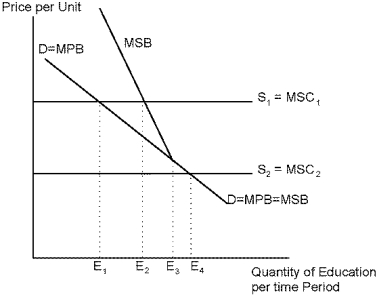
Refer to Diagram 10-1. If marginal social costs are equal toMSC1, what is the efficient quantity of education?
A) E4
B) E3
C) E2
D) E1
Refer to Diagram 10-1. If marginal social costs are equal toMSC1, what is the efficient quantity of education?
A) E4
B) E3
C) E2
D) E1
Question
Question
Use the following diagram to answer the following questions.
Refer to Diagram 10-1. If marginal social costs are equal to MSC1, what is the equilibrium quantity of education that will be chosen by individuals?
A) E2
B) E1
C) E4
D) E3
Refer to Diagram 10-1. If marginal social costs are equal to MSC1, what is the equilibrium quantity of education that will be chosen by individuals?
A) E2
B) E1
C) E4
D) E3
Question
Question
Question
Question
Question
Question
Use the following diagram to answer the following questions.
Refer to Diagram 10-1. External benefits exist for all levels of education less than quantity:
A) E1
B) E3
C) E2
D) E4
Refer to Diagram 10-1. External benefits exist for all levels of education less than quantity:
A) E1
B) E3
C) E2
D) E4
Question
Question
Question
Question
Question
Question
Question
Question
Question
Question
Question
Question
Question
Question
Question
Use the following diagram to answer the following questions.
Refer to Diagram 10-1. When marginal social costs are equal to MSC1:
A) the equilibrium quantity < socially efficient quantity.
B) the equilibrium quantity > socially efficient quantity.
C) the equilibrium quantity = socially efficient quantity.
D) the argument for government subsidization is weaker than it would be if marginal social costs were equal to MSC2.
Refer to Diagram 10-1. When marginal social costs are equal to MSC1:
A) the equilibrium quantity < socially efficient quantity.
B) the equilibrium quantity > socially efficient quantity.
C) the equilibrium quantity = socially efficient quantity.
D) the argument for government subsidization is weaker than it would be if marginal social costs were equal to MSC2.
Question
Question
Question
Use the following diagram to answer the following questions.
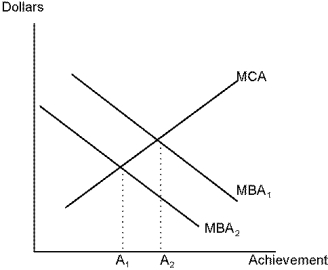
Refer to MBA. High-stakes testing is incorporated into public schools, what might be the expected result?
A) Marginal benefits shift from MBA1 to MBA2.
B) Achievement declines from A2 to A1.
C) No change is predicted.
D) Marginal benefits shift from MBA2 to MBA1.
Refer to MBA. High-stakes testing is incorporated into public schools, what might be the expected result?
A) Marginal benefits shift from MBA1 to MBA2.
B) Achievement declines from A2 to A1.
C) No change is predicted.
D) Marginal benefits shift from MBA2 to MBA1.
Question
Use the following diagram to answer the following questions.
Refer to MBA. Assume marginal social benefits are equal to MBA₁, the efficient level of achievement would be:
A) Somewhere between A1 and A2
B) A1
C) A2
D) There is no way to tell.
Refer to MBA. Assume marginal social benefits are equal to MBA₁, the efficient level of achievement would be:
A) Somewhere between A1 and A2
B) A1
C) A2
D) There is no way to tell.
Question
Question
Question
Use the following diagram to answer the following questions.
Refer to Diagram 10-1. When marginal social costs are equal to MSC2, which is true?
A) The socially efficient level of education = the equilibrium quantity of education.
B) There are no additional external benefits associated with more education.
C) There is not a compelling argument for government subsidization of education.
D) All of the above.
Refer to Diagram 10-1. When marginal social costs are equal to MSC2, which is true?
A) The socially efficient level of education = the equilibrium quantity of education.
B) There are no additional external benefits associated with more education.
C) There is not a compelling argument for government subsidization of education.
D) All of the above.
Question
Use the following diagram to answer the following questions.
Susie has been earning better grades this semester, but feels that any further improvements will cause her to have to reduce her hours worked at a part time job.
A) Susie believes that increasing her academic standing will increase her marginal costs.
B) Susie is not making a rational decision.
C) If the marginal benefits of achievement were to increase for Susie, she still would not attempt to improve her academic standing.
D) With respect to academic achievement, Susie's MB > MC.
Susie has been earning better grades this semester, but feels that any further improvements will cause her to have to reduce her hours worked at a part time job.
A) Susie believes that increasing her academic standing will increase her marginal costs.
B) Susie is not making a rational decision.
C) If the marginal benefits of achievement were to increase for Susie, she still would not attempt to improve her academic standing.
D) With respect to academic achievement, Susie's MB > MC.
Question
Question
Question
Question
Use the following diagram to answer the following questions.
Refer to Diagram 10-1. When marginal social costs are equal to MSC2, what is the equilibrium level of education?
A) E1
B) E2
C) E3
D) E4
Refer to Diagram 10-1. When marginal social costs are equal to MSC2, what is the equilibrium level of education?
A) E1
B) E2
C) E3
D) E4
Question
Question
Use the following diagram to answer the following questions.
Refer to MBA. If high-stakes testing is used by employers for the hiring decision:
A) Marginal benefits shift from MBA1 to MBA2.
B) Achievement declines from A2 to A1.
C) No change is predicted.
D) Marginal benefits shift from MBA2 to MBA1.
Refer to MBA. If high-stakes testing is used by employers for the hiring decision:
A) Marginal benefits shift from MBA1 to MBA2.
B) Achievement declines from A2 to A1.
C) No change is predicted.
D) Marginal benefits shift from MBA2 to MBA1.

Unlock Deck
Sign up to unlock the cards in this deck!
Unlock Deck
Unlock Deck
1/79

Play

Full screen (f)
Deck 10: Educational Reform: the Role of Incentives and Choice
1
In high stakes testing, student performance on achievement tests could affect grade promotion, high school graduation, and even employment.
True
2
If driving privileges were contingent on academic achievement, this would increase the perceived benefits of achievement.
True
3
It would be appropriate to grade a high-stakes test on a "curve".
False
4
At low rates of graduation, there are probably no external benefits associated with increasing the rate.
Unlock Deck
Unlock for access to all 79 flashcards in this deck.
Unlock Deck
k this deck
5
Learning how to ride a bicycle requires specific knowledge because it must be learned through trial and error.
Unlock Deck
Unlock for access to all 79 flashcards in this deck.
Unlock Deck
k this deck
6
The policy of requiring more courses as a condition of graduation has been politically popular, but economists don't expect it to raise achievement levels.
Unlock Deck
Unlock for access to all 79 flashcards in this deck.
Unlock Deck
k this deck
7
Using achievement scores to make grade promotion and graduation decisions raises the stakes associated with achievement from the teacher's point of view, but does not affect the perceived benefits for the student.
Unlock Deck
Unlock for access to all 79 flashcards in this deck.
Unlock Deck
k this deck
8
The U.S. outperforms most nations in science, but lags behind most nations in math.
Unlock Deck
Unlock for access to all 79 flashcards in this deck.
Unlock Deck
k this deck
9
Our society provides secondary education with no charge for tuition probably because of the ideal of equal opportunity.
Unlock Deck
Unlock for access to all 79 flashcards in this deck.
Unlock Deck
k this deck
10
Economists do not believe that students are capable of comparing the marginal benefits of academic achievement to the appropriate marginal costs of achievement.
Unlock Deck
Unlock for access to all 79 flashcards in this deck.
Unlock Deck
k this deck
11
Only Switzerland spends more per pupil than the U.S.
Unlock Deck
Unlock for access to all 79 flashcards in this deck.
Unlock Deck
k this deck
12
Lost wages from a part-time job might be one opportunity cost associated with academic achievement.
Unlock Deck
Unlock for access to all 79 flashcards in this deck.
Unlock Deck
k this deck
13
The TIMSS is a comparison of mathematics and science achievement in the participating nations.
Unlock Deck
Unlock for access to all 79 flashcards in this deck.
Unlock Deck
k this deck
14
According to Hanushek, a leading authority on the economics of education, there is widespread evidence that we should expand traditional resources to education.
Unlock Deck
Unlock for access to all 79 flashcards in this deck.
Unlock Deck
k this deck
15
Because large benefits are expected to be gained through high-stakes testing, the U.S. school system should definitely adopt the practice.
Unlock Deck
Unlock for access to all 79 flashcards in this deck.
Unlock Deck
k this deck
16
Aggregate student rewards from additional effort are subject to decreasing marginal benefits.
Unlock Deck
Unlock for access to all 79 flashcards in this deck.
Unlock Deck
k this deck
17
Since 1969, spending per pupil in the U.S. has remained constant, but achievement scores have fallen.
Unlock Deck
Unlock for access to all 79 flashcards in this deck.
Unlock Deck
k this deck
18
The equilibrium level of student achievement occurs when marginal benefits of achievement are greater than marginal costs of achievement.
Unlock Deck
Unlock for access to all 79 flashcards in this deck.
Unlock Deck
k this deck
19
Markets automatically reward good decisions with increased wealth.
Unlock Deck
Unlock for access to all 79 flashcards in this deck.
Unlock Deck
k this deck
20
General knowledge tends to be difficult or costly to transmit to another person.
Unlock Deck
Unlock for access to all 79 flashcards in this deck.
Unlock Deck
k this deck
21
Which best describes the beliefs of Thomas Jefferson and Adam Smith concerning public education?
A) Smith and Jefferson had not yet developed the ideas of achievement standards.
B) Smith and Jefferson believed that primary education should be free to all.
C) Both Smith and Jefferson believed that primary education should be compulsory.
D) Smith and Jefferson would probably have approved of a "mixed" K-12 system that included private and public schools, as well as home-schooling.
A) Smith and Jefferson had not yet developed the ideas of achievement standards.
B) Smith and Jefferson believed that primary education should be free to all.
C) Both Smith and Jefferson believed that primary education should be compulsory.
D) Smith and Jefferson would probably have approved of a "mixed" K-12 system that included private and public schools, as well as home-schooling.
Unlock Deck
Unlock for access to all 79 flashcards in this deck.
Unlock Deck
k this deck
22
Which is probably true about the U.S. educational system?
A) Graduation rates are so low, that large external benefits could be realized by increasing the rate.
B) Graduation rates are high enough that external benefits associated with increasing the rate even further are probably very small or non-existent.
C) External benefits are a strong argument for free secondary education in the U.S.
D) None of the above.
A) Graduation rates are so low, that large external benefits could be realized by increasing the rate.
B) Graduation rates are high enough that external benefits associated with increasing the rate even further are probably very small or non-existent.
C) External benefits are a strong argument for free secondary education in the U.S.
D) None of the above.
Unlock Deck
Unlock for access to all 79 flashcards in this deck.
Unlock Deck
k this deck
23
A state department of education (SDE) is apt to be politicized and be responsive to special interest groups as well as to school children and their parents.
Unlock Deck
Unlock for access to all 79 flashcards in this deck.
Unlock Deck
k this deck
24
An absolute grading scale for high stakes test:
A) is based on an external standard.
B) prevents teachers from judging students relative to their classmates.
C) would strengthen the incentive for students to perform well.
D) all of the above.
A) is based on an external standard.
B) prevents teachers from judging students relative to their classmates.
C) would strengthen the incentive for students to perform well.
D) all of the above.
Unlock Deck
Unlock for access to all 79 flashcards in this deck.
Unlock Deck
k this deck
25
The text compares state departments of education to state owned enterprises (SOEs).
Unlock Deck
Unlock for access to all 79 flashcards in this deck.
Unlock Deck
k this deck
26
Which of the following might students perceive as benefits from additional academic achievement?
A) promotion
B) graduation
C) college admission
D) all of the above
A) promotion
B) graduation
C) college admission
D) all of the above
Unlock Deck
Unlock for access to all 79 flashcards in this deck.
Unlock Deck
k this deck
27
Of the participating countries in the TIMSS study:
A) the Netherlands was ranked first and the U.S. was ranked last.
B) the U.S. was ranked near the bottom in both math and science.
C) the U.S. was ranked near the bottom in science but performed somewhat better in math.
D) the U.S. was ranked near the top in both math and science.
A) the Netherlands was ranked first and the U.S. was ranked last.
B) the U.S. was ranked near the bottom in both math and science.
C) the U.S. was ranked near the bottom in science but performed somewhat better in math.
D) the U.S. was ranked near the top in both math and science.
Unlock Deck
Unlock for access to all 79 flashcards in this deck.
Unlock Deck
k this deck
28
Which country spends more per pupil than the United States?
A) Switzerland
B) Netherlands
C) France
D) None, U.S. is the highest spending nation.
A) Switzerland
B) Netherlands
C) France
D) None, U.S. is the highest spending nation.
Unlock Deck
Unlock for access to all 79 flashcards in this deck.
Unlock Deck
k this deck
29
Many public colleges and universities base admissions on:
A) ACT scores
B) high school grade point average (GPA)
C) rank in high school graduating class
D) all of the above
A) ACT scores
B) high school grade point average (GPA)
C) rank in high school graduating class
D) all of the above
Unlock Deck
Unlock for access to all 79 flashcards in this deck.
Unlock Deck
k this deck
30
Justice that emerges from voluntary exchange is called:
A) commutative justice.
B) distributive justice.
C) equal opportunity.
D) the principle of economic organization.
A) commutative justice.
B) distributive justice.
C) equal opportunity.
D) the principle of economic organization.
Unlock Deck
Unlock for access to all 79 flashcards in this deck.
Unlock Deck
k this deck
31
The hope that equal opportunity combined with voluntary exchange will move people toward equality is called:
A) commutative justice.
B) the principle of economic organization.
C) distributive justice.
D) the automatic market response to inequality.
A) commutative justice.
B) the principle of economic organization.
C) distributive justice.
D) the automatic market response to inequality.
Unlock Deck
Unlock for access to all 79 flashcards in this deck.
Unlock Deck
k this deck
32
Why do achievement tests need to have their "stakes" risen?
A) The higher stakes create a prospect of greater rewards, which causes students to increase their effort toward academic achievement.
B) Higher stakes will mean bigger rewards for teachers whose students score high on achievement tests.
C) Actually, requiring more courses in math and science is a more promising policy for increasing achievement.
D) Higher stakes achievement tests will require that students only work a limited number of hours per week.
A) The higher stakes create a prospect of greater rewards, which causes students to increase their effort toward academic achievement.
B) Higher stakes will mean bigger rewards for teachers whose students score high on achievement tests.
C) Actually, requiring more courses in math and science is a more promising policy for increasing achievement.
D) Higher stakes achievement tests will require that students only work a limited number of hours per week.
Unlock Deck
Unlock for access to all 79 flashcards in this deck.
Unlock Deck
k this deck
33
Education special interest groups include the teachers' union, environmental organizations, and other organizations promoting ideological and religious ends.
Unlock Deck
Unlock for access to all 79 flashcards in this deck.
Unlock Deck
k this deck
34
Which is not a characteristic of high-stakes testing?
A) universal
B) based on absolute performance standards
C) based on memorization
D) internationally referenced
A) universal
B) based on absolute performance standards
C) based on memorization
D) internationally referenced
Unlock Deck
Unlock for access to all 79 flashcards in this deck.
Unlock Deck
k this deck
35
Teachers in the U.S. must operate in a system where government interferes with their professional judgment by imposing mandates and non-academic objectives.
Unlock Deck
Unlock for access to all 79 flashcards in this deck.
Unlock Deck
k this deck
36
Which statement best describes the conclusions of expert, Eric Hanushek?
A) Studies of class size and pupil-teacher ratios lend very little support to policies aimed at expanding these resources.
B) Studies of class size and pupil-teacher ratios indicate that these variables are currently at efficient levels in the U.S.
C) Studies indicate that funds should be spent in order to decrease pupil-teacher ratios even further in the U.S.
D) The problem of low achievement in the U.S. could be solved by reallocating resources from other government programs to public education.
A) Studies of class size and pupil-teacher ratios lend very little support to policies aimed at expanding these resources.
B) Studies of class size and pupil-teacher ratios indicate that these variables are currently at efficient levels in the U.S.
C) Studies indicate that funds should be spent in order to decrease pupil-teacher ratios even further in the U.S.
D) The problem of low achievement in the U.S. could be solved by reallocating resources from other government programs to public education.
Unlock Deck
Unlock for access to all 79 flashcards in this deck.
Unlock Deck
k this deck
37
Of the participating countries in the TIMSS study:
A) the Netherlands has the lowest spending per pupil but posted the highest scores in math.
B) spending per pupil appears to have an important positive impact on math scores.
C) only Switzerland spends more per pupil than the U.S.
D) Switzerland spends more per pupil in math and posted the highest scores in math.
A) the Netherlands has the lowest spending per pupil but posted the highest scores in math.
B) spending per pupil appears to have an important positive impact on math scores.
C) only Switzerland spends more per pupil than the U.S.
D) Switzerland spends more per pupil in math and posted the highest scores in math.
Unlock Deck
Unlock for access to all 79 flashcards in this deck.
Unlock Deck
k this deck
38
Which is a possible reason why the decline in the pupil-teacher ratio in the U.S. did not increase achievement?
A) Because of low salaries offered to teachers, the instruction was of low quality.
B) More instructional resources were devoted to special education.
C) Resources were shifted from instruction to capital improvements such as new buildings.
D) None of the above. The declining pupil-teacher ratio has had the desired effect of increasing achievement in the U.S.
A) Because of low salaries offered to teachers, the instruction was of low quality.
B) More instructional resources were devoted to special education.
C) Resources were shifted from instruction to capital improvements such as new buildings.
D) None of the above. The declining pupil-teacher ratio has had the desired effect of increasing achievement in the U.S.
Unlock Deck
Unlock for access to all 79 flashcards in this deck.
Unlock Deck
k this deck
39
Which of the following statements is correct?
A) Students will increase effort toward academic achievement as long as the marginal benefits of achievement are greater than the marginal costs.
B) In the aggregate, the marginal benefit of achievement will increase as more effort is devoted to achievement.
C) Students' effort toward achievement is not related to marginal benefits and costs.
D) Aggregate student achievement is not subject to increasing marginal costs.
A) Students will increase effort toward academic achievement as long as the marginal benefits of achievement are greater than the marginal costs.
B) In the aggregate, the marginal benefit of achievement will increase as more effort is devoted to achievement.
C) Students' effort toward achievement is not related to marginal benefits and costs.
D) Aggregate student achievement is not subject to increasing marginal costs.
Unlock Deck
Unlock for access to all 79 flashcards in this deck.
Unlock Deck
k this deck
40
Of the three principles of the economic approach to organization, the U.S. system of public education is consistent with just one of the principles.
Unlock Deck
Unlock for access to all 79 flashcards in this deck.
Unlock Deck
k this deck
41
A 1993 survey shows that parents of most of the students in private schools were:
A) not satisfied with the school and their academic standards.
B) somewhat satisfied with the school and their academic standards.
C) very satisfied with the school and their academic standards.
D) very unsatisfied with the school and their academic standards.
A) not satisfied with the school and their academic standards.
B) somewhat satisfied with the school and their academic standards.
C) very satisfied with the school and their academic standards.
D) very unsatisfied with the school and their academic standards.
Unlock Deck
Unlock for access to all 79 flashcards in this deck.
Unlock Deck
k this deck
42
Use the following diagram to answer the following questions.
Refer to Diagram 10-1. If marginal social costs are equal toMSC1, what is the efficient quantity of education?
A) E4
B) E3
C) E2
D) E1
Refer to Diagram 10-1. If marginal social costs are equal toMSC1, what is the efficient quantity of education?
A) E4
B) E3
C) E2
D) E1
Unlock Deck
Unlock for access to all 79 flashcards in this deck.
Unlock Deck
k this deck
43
Which statement is true?
A) School districts do not have many characteristics in common with a large organization.
B) School districts are consistent with the three principles of economic organization.
C) A state department of education can be thought of as the central planning office of a state-owned enterprise.
D) None of the above are true.
A) School districts do not have many characteristics in common with a large organization.
B) School districts are consistent with the three principles of economic organization.
C) A state department of education can be thought of as the central planning office of a state-owned enterprise.
D) None of the above are true.
Unlock Deck
Unlock for access to all 79 flashcards in this deck.
Unlock Deck
k this deck
44
Use the following diagram to answer the following questions.
Refer to Diagram 10-1. If marginal social costs are equal to MSC1, what is the equilibrium quantity of education that will be chosen by individuals?
A) E2
B) E1
C) E4
D) E3
Refer to Diagram 10-1. If marginal social costs are equal to MSC1, what is the equilibrium quantity of education that will be chosen by individuals?
A) E2
B) E1
C) E4
D) E3
Unlock Deck
Unlock for access to all 79 flashcards in this deck.
Unlock Deck
k this deck
45
Which is true about the policy of requiring more courses as a condition for graduation?
A) The policy is not politically popular.
B) Economists question whether the policy will be effective.
C) Economists believe government specified approaches are likely the most beneficial.
D) All of the above are true.
A) The policy is not politically popular.
B) Economists question whether the policy will be effective.
C) Economists believe government specified approaches are likely the most beneficial.
D) All of the above are true.
Unlock Deck
Unlock for access to all 79 flashcards in this deck.
Unlock Deck
k this deck
46
Increasing student achievement can be motivated by:
A) lowering the opportunity cost of studying.
B) raising the opportunity cost of studying.
C) decreasing the marginal benefit of achievement.
D) shifting the marginal benefit of achievement to the left.
A) lowering the opportunity cost of studying.
B) raising the opportunity cost of studying.
C) decreasing the marginal benefit of achievement.
D) shifting the marginal benefit of achievement to the left.
Unlock Deck
Unlock for access to all 79 flashcards in this deck.
Unlock Deck
k this deck
47
Which of the following is a non-academic objective that teachers are often expected to achieve?
A) school district population growth
B) national mathematics standards
C) developing a drug-free America
D) All of the above
A) school district population growth
B) national mathematics standards
C) developing a drug-free America
D) All of the above
Unlock Deck
Unlock for access to all 79 flashcards in this deck.
Unlock Deck
k this deck
48
What are some benefits of introducing competition into the public school system?
A) Schools would not have to respond to the demand of parents.
B) Schools would have to evaluate teachers based on their success with students.
C) Schools would not have to be concerned about over-spending.
D) All of the above.
A) Schools would not have to respond to the demand of parents.
B) Schools would have to evaluate teachers based on their success with students.
C) Schools would not have to be concerned about over-spending.
D) All of the above.
Unlock Deck
Unlock for access to all 79 flashcards in this deck.
Unlock Deck
k this deck
49
Knowledge that is gained as members of an organization interact is called:
A) general knowledge.
B) specific knowledge.
C) tacit knowledge.
D) assembled knowledge.
A) general knowledge.
B) specific knowledge.
C) tacit knowledge.
D) assembled knowledge.
Unlock Deck
Unlock for access to all 79 flashcards in this deck.
Unlock Deck
k this deck
50
Use the following diagram to answer the following questions.
Refer to Diagram 10-1. External benefits exist for all levels of education less than quantity:
A) E1
B) E3
C) E2
D) E4
Refer to Diagram 10-1. External benefits exist for all levels of education less than quantity:
A) E1
B) E3
C) E2
D) E4
Unlock Deck
Unlock for access to all 79 flashcards in this deck.
Unlock Deck
k this deck
51
According to economists, which policies have the potential to increase achievement in U.S. public schools?
A) competition among schools.
B) high-stakes testing.
C) requiring more courses in math and science.
D) both a and b
A) competition among schools.
B) high-stakes testing.
C) requiring more courses in math and science.
D) both a and b
Unlock Deck
Unlock for access to all 79 flashcards in this deck.
Unlock Deck
k this deck
52
The achievement measured by high stakes testing
A) is comparable to grade point averages.
B) provides benefits greater than costs.
C) is considered faulty and should not be used.
D) none of the above.
A) is comparable to grade point averages.
B) provides benefits greater than costs.
C) is considered faulty and should not be used.
D) none of the above.
Unlock Deck
Unlock for access to all 79 flashcards in this deck.
Unlock Deck
k this deck
53
Which is not a kind of specific knowledge discussed in the text?
A) historical knowledge
B) assembled knowledge
C) tacit knowledge
D) local knowledge
A) historical knowledge
B) assembled knowledge
C) tacit knowledge
D) local knowledge
Unlock Deck
Unlock for access to all 79 flashcards in this deck.
Unlock Deck
k this deck
54
Which of the following is a reason why estimates of additional earnings expected to be gained from high-stakes testing is probably understated?
A) The estimates already reflect earnings attributable to on-the-job training.
B) The estimates already reflect earnings differentials realized through college attendance.
C) The estimates are based on data from low-stakes environments.
D) All of the above are reasons.
A) The estimates already reflect earnings attributable to on-the-job training.
B) The estimates already reflect earnings differentials realized through college attendance.
C) The estimates are based on data from low-stakes environments.
D) All of the above are reasons.
Unlock Deck
Unlock for access to all 79 flashcards in this deck.
Unlock Deck
k this deck
55
Which of the following are benefits of introducing competition into the public school system?
A) Competition could cause schools to reduce costs.
B) Competition could cause schools to improve the schooling they offer.
C) Parents would be allowed to choose schools on the basis of their reputation in motivating students to succeed academically.
D) All of the above.
A) Competition could cause schools to reduce costs.
B) Competition could cause schools to improve the schooling they offer.
C) Parents would be allowed to choose schools on the basis of their reputation in motivating students to succeed academically.
D) All of the above.
Unlock Deck
Unlock for access to all 79 flashcards in this deck.
Unlock Deck
k this deck
56
Which of the following is true about privatization?
A) Privatizing public schools would increase the political influence in the education system.
B) Private incentives distort costs and benefits hence reduce efficiency.
C) Privatization would introduce market incentives into the U.S. educational system.
D) Privatization would not introduce market incentives into the U.S. educational system.
A) Privatizing public schools would increase the political influence in the education system.
B) Private incentives distort costs and benefits hence reduce efficiency.
C) Privatization would introduce market incentives into the U.S. educational system.
D) Privatization would not introduce market incentives into the U.S. educational system.
Unlock Deck
Unlock for access to all 79 flashcards in this deck.
Unlock Deck
k this deck
57
Like many other government protected monopolies, the U.S. educational system:
A) operates at minimum cost.
B) wastes a good deal of its resources.
C) does not want to increase output (achievement).
D) is consistent with the principles of economic organization.
A) operates at minimum cost.
B) wastes a good deal of its resources.
C) does not want to increase output (achievement).
D) is consistent with the principles of economic organization.
Unlock Deck
Unlock for access to all 79 flashcards in this deck.
Unlock Deck
k this deck
58
Which statement about the benefits and costs of high-stakes testing is correct?
A) Benefits clearly outweigh costs
B) The tests should be adopted on the basis of their high expected benefits.
C) The costs are believed to outweigh the benefits.
D) The size of benefits relative to costs is unknown.
A) Benefits clearly outweigh costs
B) The tests should be adopted on the basis of their high expected benefits.
C) The costs are believed to outweigh the benefits.
D) The size of benefits relative to costs is unknown.
Unlock Deck
Unlock for access to all 79 flashcards in this deck.
Unlock Deck
k this deck
59
Which is not a principle of economic organization?
A) Markets automatically assign decision rights to those with the most useful specific knowledge.
B) Markets automatically subsidize government owned enterprises.
C) Markets automatically evaluate decisions, using profitability as a performance measure.
D) Markets automatically reward good decisions.
A) Markets automatically assign decision rights to those with the most useful specific knowledge.
B) Markets automatically subsidize government owned enterprises.
C) Markets automatically evaluate decisions, using profitability as a performance measure.
D) Markets automatically reward good decisions.
Unlock Deck
Unlock for access to all 79 flashcards in this deck.
Unlock Deck
k this deck
60
Knowledge that can be easily transferred to another person is called:
A) general knowledge
B) specific knowledge.
C) tacit knowledge.
D) rewarded knowledge.
A) general knowledge
B) specific knowledge.
C) tacit knowledge.
D) rewarded knowledge.
Unlock Deck
Unlock for access to all 79 flashcards in this deck.
Unlock Deck
k this deck
61
Among the participating countries in the TIMSS study, discuss the relationship between per pupil spending and academic achievement.
Unlock Deck
Unlock for access to all 79 flashcards in this deck.
Unlock Deck
k this deck
62
David decides to market a new product. This is an example of how markets:
A) automatically decentralize decision making.
B) fail to out weed inferior products.
C) violate the principles of organization.
D) automatically reward those who make good decisions.
A) automatically decentralize decision making.
B) fail to out weed inferior products.
C) violate the principles of organization.
D) automatically reward those who make good decisions.
Unlock Deck
Unlock for access to all 79 flashcards in this deck.
Unlock Deck
k this deck
63
Teacher performance is often irrelevant in their salary determination.As a result:
A) teachers are motivated to help students achieve more.
B) few teachers work hard.
C) School test scores are increasing.
D) None of the above.
A) teachers are motivated to help students achieve more.
B) few teachers work hard.
C) School test scores are increasing.
D) None of the above.
Unlock Deck
Unlock for access to all 79 flashcards in this deck.
Unlock Deck
k this deck
64
Cindy says that she really has to work with a new software application for several weeks before she will understand it.This is a form of:
A) local knowledge.
B) assembled knowledge.
C) tacit knowledge.
D) general knowledge.
A) local knowledge.
B) assembled knowledge.
C) tacit knowledge.
D) general knowledge.
Unlock Deck
Unlock for access to all 79 flashcards in this deck.
Unlock Deck
k this deck
65
Use the following diagram to answer the following questions.
Refer to Diagram 10-1. When marginal social costs are equal to MSC1:
A) the equilibrium quantity < socially efficient quantity.
B) the equilibrium quantity > socially efficient quantity.
C) the equilibrium quantity = socially efficient quantity.
D) the argument for government subsidization is weaker than it would be if marginal social costs were equal to MSC2.
Refer to Diagram 10-1. When marginal social costs are equal to MSC1:
A) the equilibrium quantity < socially efficient quantity.
B) the equilibrium quantity > socially efficient quantity.
C) the equilibrium quantity = socially efficient quantity.
D) the argument for government subsidization is weaker than it would be if marginal social costs were equal to MSC2.
Unlock Deck
Unlock for access to all 79 flashcards in this deck.
Unlock Deck
k this deck
66
If the number of hours that teens could legally work per week was limited, the result would be:
A) increases in the opportunity cost of achievement.
B) reductions in the opportunity cost of achievement.
C) increases in the marginal benefit of achievement.
D) decreases in the marginal benefit of achievement.
A) increases in the opportunity cost of achievement.
B) reductions in the opportunity cost of achievement.
C) increases in the marginal benefit of achievement.
D) decreases in the marginal benefit of achievement.
Unlock Deck
Unlock for access to all 79 flashcards in this deck.
Unlock Deck
k this deck
67
Which of the following is considered a problem with multiple choice achievement tests?
A) They are limited in their ability to measure analytical skills.
B) They are easy to grade.
C) They are not subject to manipulation by teachers.
D) There are no major problems with multiple choice tests.
A) They are limited in their ability to measure analytical skills.
B) They are easy to grade.
C) They are not subject to manipulation by teachers.
D) There are no major problems with multiple choice tests.
Unlock Deck
Unlock for access to all 79 flashcards in this deck.
Unlock Deck
k this deck
68
Use the following diagram to answer the following questions.
Refer to MBA. High-stakes testing is incorporated into public schools, what might be the expected result?
A) Marginal benefits shift from MBA1 to MBA2.
B) Achievement declines from A2 to A1.
C) No change is predicted.
D) Marginal benefits shift from MBA2 to MBA1.
Refer to MBA. High-stakes testing is incorporated into public schools, what might be the expected result?
A) Marginal benefits shift from MBA1 to MBA2.
B) Achievement declines from A2 to A1.
C) No change is predicted.
D) Marginal benefits shift from MBA2 to MBA1.
Unlock Deck
Unlock for access to all 79 flashcards in this deck.
Unlock Deck
k this deck
69
Use the following diagram to answer the following questions.
Refer to MBA. Assume marginal social benefits are equal to MBA₁, the efficient level of achievement would be:
A) Somewhere between A1 and A2
B) A1
C) A2
D) There is no way to tell.
Refer to MBA. Assume marginal social benefits are equal to MBA₁, the efficient level of achievement would be:
A) Somewhere between A1 and A2
B) A1
C) A2
D) There is no way to tell.
Unlock Deck
Unlock for access to all 79 flashcards in this deck.
Unlock Deck
k this deck
70
Thomas is a college freshman, and this is his first day on campus. This is a form of:
A) local knowledge of the campus.
B) assembled knowledge of the campus.
C) scientific knowledge of the campus.
D) general knowledge of the campus.
A) local knowledge of the campus.
B) assembled knowledge of the campus.
C) scientific knowledge of the campus.
D) general knowledge of the campus.
Unlock Deck
Unlock for access to all 79 flashcards in this deck.
Unlock Deck
k this deck
71
Which of the following will make it more likely that a student will study harder?
A) Colleges are willing to correct deficiencies through remedial courses.
B) Graduation from high school, by itself, is sufficient for admission to most colleges.
C) Employers begin to use school performance as a criterion for hiring.
D) It is highly unlikely that students will be required to repeat a grade.
A) Colleges are willing to correct deficiencies through remedial courses.
B) Graduation from high school, by itself, is sufficient for admission to most colleges.
C) Employers begin to use school performance as a criterion for hiring.
D) It is highly unlikely that students will be required to repeat a grade.
Unlock Deck
Unlock for access to all 79 flashcards in this deck.
Unlock Deck
k this deck
72
Use the following diagram to answer the following questions.
Refer to Diagram 10-1. When marginal social costs are equal to MSC2, which is true?
A) The socially efficient level of education = the equilibrium quantity of education.
B) There are no additional external benefits associated with more education.
C) There is not a compelling argument for government subsidization of education.
D) All of the above.
Refer to Diagram 10-1. When marginal social costs are equal to MSC2, which is true?
A) The socially efficient level of education = the equilibrium quantity of education.
B) There are no additional external benefits associated with more education.
C) There is not a compelling argument for government subsidization of education.
D) All of the above.
Unlock Deck
Unlock for access to all 79 flashcards in this deck.
Unlock Deck
k this deck
73
Use the following diagram to answer the following questions.
Susie has been earning better grades this semester, but feels that any further improvements will cause her to have to reduce her hours worked at a part time job.
A) Susie believes that increasing her academic standing will increase her marginal costs.
B) Susie is not making a rational decision.
C) If the marginal benefits of achievement were to increase for Susie, she still would not attempt to improve her academic standing.
D) With respect to academic achievement, Susie's MB > MC.
Susie has been earning better grades this semester, but feels that any further improvements will cause her to have to reduce her hours worked at a part time job.
A) Susie believes that increasing her academic standing will increase her marginal costs.
B) Susie is not making a rational decision.
C) If the marginal benefits of achievement were to increase for Susie, she still would not attempt to improve her academic standing.
D) With respect to academic achievement, Susie's MB > MC.
Unlock Deck
Unlock for access to all 79 flashcards in this deck.
Unlock Deck
k this deck
74
Making driving privileges contingent upon academic performance:
A) will increase the marginal benefits of achievement.
B) will decrease the marginal benefit of achievement.
C) will probably not affect marginal benefit of achievement.
D) will likely cause achievement levels to fall.
A) will increase the marginal benefits of achievement.
B) will decrease the marginal benefit of achievement.
C) will probably not affect marginal benefit of achievement.
D) will likely cause achievement levels to fall.
Unlock Deck
Unlock for access to all 79 flashcards in this deck.
Unlock Deck
k this deck
75
Using examples, describe how the U.S. system of public education is inconsistent with each of the principles of organization.
Unlock Deck
Unlock for access to all 79 flashcards in this deck.
Unlock Deck
k this deck
76
What are the two arguments for government support of secondary education?
Unlock Deck
Unlock for access to all 79 flashcards in this deck.
Unlock Deck
k this deck
77
Use the following diagram to answer the following questions.
Refer to Diagram 10-1. When marginal social costs are equal to MSC2, what is the equilibrium level of education?
A) E1
B) E2
C) E3
D) E4
Refer to Diagram 10-1. When marginal social costs are equal to MSC2, what is the equilibrium level of education?
A) E1
B) E2
C) E3
D) E4
Unlock Deck
Unlock for access to all 79 flashcards in this deck.
Unlock Deck
k this deck
78
State departments of education typically establish ground rules for curriculum and textbooks. This violates which of the market organizing principles?
A) Markets automatically assign decision rights to those with the most useful specific information.
B) Market automatically evaluate decisions.
C) Markets automatically reward good decisions.
D) None of the above.
A) Markets automatically assign decision rights to those with the most useful specific information.
B) Market automatically evaluate decisions.
C) Markets automatically reward good decisions.
D) None of the above.
Unlock Deck
Unlock for access to all 79 flashcards in this deck.
Unlock Deck
k this deck
79
Use the following diagram to answer the following questions.
Refer to MBA. If high-stakes testing is used by employers for the hiring decision:
A) Marginal benefits shift from MBA1 to MBA2.
B) Achievement declines from A2 to A1.
C) No change is predicted.
D) Marginal benefits shift from MBA2 to MBA1.
Refer to MBA. If high-stakes testing is used by employers for the hiring decision:
A) Marginal benefits shift from MBA1 to MBA2.
B) Achievement declines from A2 to A1.
C) No change is predicted.
D) Marginal benefits shift from MBA2 to MBA1.
Unlock Deck
Unlock for access to all 79 flashcards in this deck.
Unlock Deck
k this deck
Unlock Deck
Unlock for access to all 79 flashcards in this deck.






