







 Chat with AI

Deck 17: International Trade: Beneficial, but Controversial
Full screen (f)

Question

Question
Question
Question
Question
Question
Question
Question
Question
Question
Question
Question
Question
Question
Question
Question
Question
Question
Question
Question
Question
Question
Question
Question
Question
Question
Question
Question
Question
Question
Question
Question
Question
Question
Question
Question
Question
Question
Question
Question
Question
Question
Use the following information to answer the following questions.

Refer to Steaks. Pure Water Country's opportunity cost of producing an additional steak is:
A) 3 beers.
B) 1 beer.
C) 1/3 beer.
D) 1/4 beer.
Refer to Steaks. Pure Water Country's opportunity cost of producing an additional steak is:
A) 3 beers.
B) 1 beer.
C) 1/3 beer.
D) 1/4 beer.
Question
Question
Use the following information to answer the following questions.
Refer to Steaks. Pure Water Country's opportunity cost of producing an additional beer is:
A) 3 steaks.
B) 1 steak.
C) 1/3 steak.
D) 1/4 steak.
Refer to Steaks. Pure Water Country's opportunity cost of producing an additional beer is:
A) 3 steaks.
B) 1 steak.
C) 1/3 steak.
D) 1/4 steak.
Question
Use the following information to answer the following questions.
Refer to Steaks. Big Sky Country's opportunity cost of producing an additional steak is:
A) 4 beers.
B) 2 beers.
C) 1/2 beers.
D) 1/4 beer.
Refer to Steaks. Big Sky Country's opportunity cost of producing an additional steak is:
A) 4 beers.
B) 2 beers.
C) 1/2 beers.
D) 1/4 beer.
Question
Use the following graph to answer the following questions.
A worker in France can produce 8 bottles of wine or 2 apples. A worker in Spain can produce 3 bottles of wine or 3 apples. France has the comparative advantage in:
A) apples
B) wine.
C) both goods.
D) neither good.
A worker in France can produce 8 bottles of wine or 2 apples. A worker in Spain can produce 3 bottles of wine or 3 apples. France has the comparative advantage in:
A) apples
B) wine.
C) both goods.
D) neither good.
Question
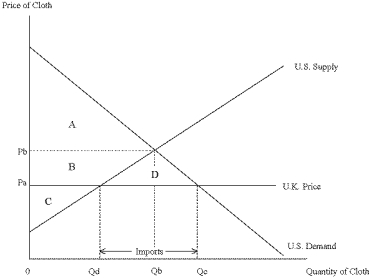
Use the following graph to answer the following questions.
Refer to Cloth. Given that the domestic equilibrium U.S. price of cloth is Pb and the U.K. price is Pₐ, trade will increase the net gain of consumers by area:
A) B+D
B) B
C) A+B
D) A+B+D
Refer to Cloth. Given that the domestic equilibrium U.S. price of cloth is Pb and the U.K. price is Pₐ, trade will increase the net gain of consumers by area:
A) B+D
B) B
C) A+B
D) A+B+D
Question
Question
Use the following information to answer the following questions.
Refer to Steaks. Big Sky Country has a (an):
A) absolute advantage in the production of steaks.
B) absolute advantage in the production of beer.
C) comparative advantage in the production of both steaks and beer.
D) comparative disadvantage in the production of both steaks and beer.
Refer to Steaks. Big Sky Country has a (an):
A) absolute advantage in the production of steaks.
B) absolute advantage in the production of beer.
C) comparative advantage in the production of both steaks and beer.
D) comparative disadvantage in the production of both steaks and beer.
Question
Use the following information to answer the following questions.
Refer to Steaks. Based on the above information, Pure Water Country should:
A) specialize in the production of steak.
B) specialize in the production of beer.
C) produce both goods for its own consumption because Pure Water will be unwilling to trade because it produces both goods more efficiently.
D) produce some of both goods to trade because it produces both goods more efficiently than Pure Water.
Refer to Steaks. Based on the above information, Pure Water Country should:
A) specialize in the production of steak.
B) specialize in the production of beer.
C) produce both goods for its own consumption because Pure Water will be unwilling to trade because it produces both goods more efficiently.
D) produce some of both goods to trade because it produces both goods more efficiently than Pure Water.
Question
Use the following graph to answer the following questions.
Refer to Cloth. Given that the domestic equilibrium U.S. price of cloth is Pb and the U.K. price is Pₐ, the net social gain from trade is represented by area:
A) D
B) B+D
C) A+B
D) A+B+D
Refer to Cloth. Given that the domestic equilibrium U.S. price of cloth is Pb and the U.K. price is Pₐ, the net social gain from trade is represented by area:
A) D
B) B+D
C) A+B
D) A+B+D
Question
Use the following graph to answer the following questions.
Refer to Cloth. Given that the domestic equilibrium U.S. price of cloth is Pb and the U.K. price is Pₐ, trade will reduce the net gain of producer by area:
A) B+D
B) B
C) A+B
D) A+B+D
Refer to Cloth. Given that the domestic equilibrium U.S. price of cloth is Pb and the U.K. price is Pₐ, trade will reduce the net gain of producer by area:
A) B+D
B) B
C) A+B
D) A+B+D
Question
Use the following information to answer the following questions.
Refer to Steaks. Pure Water Country has a (an):
A) absolute advantage in the production of steaks.
B) absolute advantage in the production of beer.
C) comparative advantage in the production of both steaks and beer.
D) comparative disadvantage in the production of both steaks and beer.
Refer to Steaks. Pure Water Country has a (an):
A) absolute advantage in the production of steaks.
B) absolute advantage in the production of beer.
C) comparative advantage in the production of both steaks and beer.
D) comparative disadvantage in the production of both steaks and beer.
Question
Use the following information to answer the following questions.
Refer to Steaks. Based on the above information, Big Sky Country should:
A) specialize in the production of steak.
B) specialize in the production of beer.
C) produce both goods for its own consumption because Pure Water will be unwilling to trade because it produces both goods more efficiently.
D) produce some of both goods to trade because it produces both goods more efficiently than Pure Water.
Refer to Steaks. Based on the above information, Big Sky Country should:
A) specialize in the production of steak.
B) specialize in the production of beer.
C) produce both goods for its own consumption because Pure Water will be unwilling to trade because it produces both goods more efficiently.
D) produce some of both goods to trade because it produces both goods more efficiently than Pure Water.
Question
Question
Question
Question
Question
Use the following information to answer the following questions.
Refer to Steaks. Big Sky Country's opportunity cost of producing an additional beer is:
A) 4 steaks.
B) 2 steaks.
C) 1/2 steak.
D) 1/4 steak.
Refer to Steaks. Big Sky Country's opportunity cost of producing an additional beer is:
A) 4 steaks.
B) 2 steaks.
C) 1/2 steak.
D) 1/4 steak.
Question
Question
Question
Question
Question
Question
Question
Question
Question
Question
Question
Question
Question
Question
Question
Question
Question
Question
Question
Question
Question

Unlock Deck
Sign up to unlock the cards in this deck!
Unlock Deck
Unlock Deck
1/88

Play

Full screen (f)
Deck 17: International Trade: Beneficial, but Controversial
1
Wages in the United States are high because worker productivity is high.
True
2
Tariffs decrease society's welfare because resources are directed into industries that have a comparative disadvantage.
True
3
Consumer surplus increases as a result of imports.
True
4
A quota restricts the quantity of imports that may enter a country.
Unlock Deck
Unlock for access to all 88 flashcards in this deck.
Unlock Deck
k this deck
5
Producer surplus increases as a result of imports.
Unlock Deck
Unlock for access to all 88 flashcards in this deck.
Unlock Deck
k this deck
6
Free trade results in increased competition that forces domestic producers to charge lower prices.
Unlock Deck
Unlock for access to all 88 flashcards in this deck.
Unlock Deck
k this deck
7
Like tariffs, quotas generate revenues for the federal government.
Unlock Deck
Unlock for access to all 88 flashcards in this deck.
Unlock Deck
k this deck
8
Under a voluntary export restraint (VER), exporting nations agree to limit the amounts of a good they ship to importing nations.
Unlock Deck
Unlock for access to all 88 flashcards in this deck.
Unlock Deck
k this deck
9
Suppose the opportunity cost of producing wheat is higher in the United States than in Brazil. This means that the United States should import wheat from Brazil.
Unlock Deck
Unlock for access to all 88 flashcards in this deck.
Unlock Deck
k this deck
10
If a country can produce a good with fewer resources, it has a comparative advantage in production.
Unlock Deck
Unlock for access to all 88 flashcards in this deck.
Unlock Deck
k this deck
11
The WTO uses a regional approach to lowering trade barriers.
Unlock Deck
Unlock for access to all 88 flashcards in this deck.
Unlock Deck
k this deck
12
For the United States, exports typically exceed imports.
Unlock Deck
Unlock for access to all 88 flashcards in this deck.
Unlock Deck
k this deck
13
A country has an absolute advantage if it can produce a good at a lower opportunity cost than its trading partner.
Unlock Deck
Unlock for access to all 88 flashcards in this deck.
Unlock Deck
k this deck
14
Tariffs benefit all of society.
Unlock Deck
Unlock for access to all 88 flashcards in this deck.
Unlock Deck
k this deck
15
Trade restrictions can increase the number of jobs available in the economy by maintaining jobs in the import sector.
Unlock Deck
Unlock for access to all 88 flashcards in this deck.
Unlock Deck
k this deck
16
Net gains from international trade are positive.
Unlock Deck
Unlock for access to all 88 flashcards in this deck.
Unlock Deck
k this deck
17
Free trade causes average costs to increase as industries expand output.
Unlock Deck
Unlock for access to all 88 flashcards in this deck.
Unlock Deck
k this deck
18
David Ricardo, a famous English economist, developed the concept of comparative advantage.
Unlock Deck
Unlock for access to all 88 flashcards in this deck.
Unlock Deck
k this deck
19
Prices tend to be higher under tariffs than under quotas.
Unlock Deck
Unlock for access to all 88 flashcards in this deck.
Unlock Deck
k this deck
20
Trade between two countries is based on comparative advantage.
Unlock Deck
Unlock for access to all 88 flashcards in this deck.
Unlock Deck
k this deck
21
Which economist developed the idea of comparative advantage:
A) John M. Keynes
B) David Ricardo
C) Adam Smith
D) Alfred Marshall
A) John M. Keynes
B) David Ricardo
C) Adam Smith
D) Alfred Marshall
Unlock Deck
Unlock for access to all 88 flashcards in this deck.
Unlock Deck
k this deck
22
Given that the import price of a commodity is lower than the equilibrium domestic price, international trade:
A) would not be beneficial to the society.
B) would not be beneficial to the consumers.
C) would be beneficial to the domestic producers.
D) would be beneficial to the society.
A) would not be beneficial to the society.
B) would not be beneficial to the consumers.
C) would be beneficial to the domestic producers.
D) would be beneficial to the society.
Unlock Deck
Unlock for access to all 88 flashcards in this deck.
Unlock Deck
k this deck
23
Arguments in support of protectionist measures include which of the following?
A) decreasing cost argument.
B) increased competitiveness argument.
C) increased diversity argument.
D) cheap foreign labor argument.
A) decreasing cost argument.
B) increased competitiveness argument.
C) increased diversity argument.
D) cheap foreign labor argument.
Unlock Deck
Unlock for access to all 88 flashcards in this deck.
Unlock Deck
k this deck
24
According to economists, trade is based on:
A) related advantage.
B) positive advantage.
C) absolute advantage.
D) comparative advantage.
A) related advantage.
B) positive advantage.
C) absolute advantage.
D) comparative advantage.
Unlock Deck
Unlock for access to all 88 flashcards in this deck.
Unlock Deck
k this deck
25
A country has an absolute advantage if:
A) it can produce a commodity at a lower opportunity cost than its trading partner.
B) it can produce more of a good or service with the same inputs as its trading partner.
C) it can produce a commodity at a lower average cost than its neighbor.
D) labor costs are, on average, less than the trading partner's labor costs.
A) it can produce a commodity at a lower opportunity cost than its trading partner.
B) it can produce more of a good or service with the same inputs as its trading partner.
C) it can produce a commodity at a lower average cost than its neighbor.
D) labor costs are, on average, less than the trading partner's labor costs.
Unlock Deck
Unlock for access to all 88 flashcards in this deck.
Unlock Deck
k this deck
26
In international trade based on the principle of comparative advantage:
A) only the partner with an absolute advantage is better off after the trade.
B) both trading partners are better off after the trade.
C) only one trading partner with a comparative advantage is better off after the trade.
D) neither trading partner is better off after the trade.
A) only the partner with an absolute advantage is better off after the trade.
B) both trading partners are better off after the trade.
C) only one trading partner with a comparative advantage is better off after the trade.
D) neither trading partner is better off after the trade.
Unlock Deck
Unlock for access to all 88 flashcards in this deck.
Unlock Deck
k this deck
27
Environmentalists have generally been pleased with rulings by the WTO against the policies of the United States.
Unlock Deck
Unlock for access to all 88 flashcards in this deck.
Unlock Deck
k this deck
28
An upper limit on the amount of goods that may be imported during any time period is knows a (an):
A) quota.
B) export tax.
C) tariff.
D) poll tax.
A) quota.
B) export tax.
C) tariff.
D) poll tax.
Unlock Deck
Unlock for access to all 88 flashcards in this deck.
Unlock Deck
k this deck
29
Which of the following statements is correct?
A) Since World War II, barriers to international trade have increased significantly.
B) The WTO uses a regional approach to lowering trade barriers.
C) The European Union has eliminated trade barriers between the United States and member European nations.
D) NAFTA created a free-trade area for the United States, Canada, and Mexico.
A) Since World War II, barriers to international trade have increased significantly.
B) The WTO uses a regional approach to lowering trade barriers.
C) The European Union has eliminated trade barriers between the United States and member European nations.
D) NAFTA created a free-trade area for the United States, Canada, and Mexico.
Unlock Deck
Unlock for access to all 88 flashcards in this deck.
Unlock Deck
k this deck
30
The main trading partner of the United States is:
A) Japan
B) Canada
C) Mexico
D) Russia
A) Japan
B) Canada
C) Mexico
D) Russia
Unlock Deck
Unlock for access to all 88 flashcards in this deck.
Unlock Deck
k this deck
31
Agreements whereby exporting nations limit the amounts of goods that they ship to importing nations are known as:
A) a negotiated tariff.
B) a quota.
C) a voluntary export restraint.
D) a limiting restraint.
A) a negotiated tariff.
B) a quota.
C) a voluntary export restraint.
D) a limiting restraint.
Unlock Deck
Unlock for access to all 88 flashcards in this deck.
Unlock Deck
k this deck
32
A country has a comparative advantage if:
A) it can produce a commodity at a lower opportunity cost than its trading partner.
B) it can produce more of a good or service with the same inputs as its trading partner.
C) it can produce a commodity at a lower average cost than its neighbor.
D) labor costs are, on average, less than the trading partner's labor costs.
A) it can produce a commodity at a lower opportunity cost than its trading partner.
B) it can produce more of a good or service with the same inputs as its trading partner.
C) it can produce a commodity at a lower average cost than its neighbor.
D) labor costs are, on average, less than the trading partner's labor costs.
Unlock Deck
Unlock for access to all 88 flashcards in this deck.
Unlock Deck
k this deck
33
Measured as a percentage of GDP, U.S. exports are much less important than in many other countries.
Unlock Deck
Unlock for access to all 88 flashcards in this deck.
Unlock Deck
k this deck
34
Which of the following might be used to justify increased trade restrictions?
A) Industry XYZ can compete with foreign firms even though it pays its workers a much higher wage because labor at XYZ is highly productive.
B) It is not vital to national security that Industry ABC is protected.
C) The New Industry should be protected until it matures.
D) All of the above are used as justifications to increase trade restrictions.
A) Industry XYZ can compete with foreign firms even though it pays its workers a much higher wage because labor at XYZ is highly productive.
B) It is not vital to national security that Industry ABC is protected.
C) The New Industry should be protected until it matures.
D) All of the above are used as justifications to increase trade restrictions.
Unlock Deck
Unlock for access to all 88 flashcards in this deck.
Unlock Deck
k this deck
35
In the future, economists expect multilateral trade negotiations to become even more complex and time consuming than they already are.
Unlock Deck
Unlock for access to all 88 flashcards in this deck.
Unlock Deck
k this deck
36
A tax levied upon a good when it crosses a nation's border is known as a (an):
A) quota.
B) export tax.
C) tariff.
D) poll tax.
A) quota.
B) export tax.
C) tariff.
D) poll tax.
Unlock Deck
Unlock for access to all 88 flashcards in this deck.
Unlock Deck
k this deck
37
Which of the following is used to support free trade?
A) Free trade can increase competition and thereby lower monopoly power that may exist in a nation.
B) Free trade may cause total production costs to rise.
C) Free trade limits diversity, thereby causing employees to work harder to achieve their goals.
D) Free trade can increase unemployment, thereby lowering wages as workers compete for a limited number of jobs.
A) Free trade can increase competition and thereby lower monopoly power that may exist in a nation.
B) Free trade may cause total production costs to rise.
C) Free trade limits diversity, thereby causing employees to work harder to achieve their goals.
D) Free trade can increase unemployment, thereby lowering wages as workers compete for a limited number of jobs.
Unlock Deck
Unlock for access to all 88 flashcards in this deck.
Unlock Deck
k this deck
38
Which of the following arguments is sometimes used in support of free trade?
A) Free trade allows firms to increase output and take advantage of lower average production costs.
B) Free trade can decrease the competition faced by domestic producers.
C) Free trade can decrease the diversity of products available to consumers.
D) Free trade is necessary to national security.
A) Free trade allows firms to increase output and take advantage of lower average production costs.
B) Free trade can decrease the competition faced by domestic producers.
C) Free trade can decrease the diversity of products available to consumers.
D) Free trade is necessary to national security.
Unlock Deck
Unlock for access to all 88 flashcards in this deck.
Unlock Deck
k this deck
39
Which of the following is used as a case for protectionism?
A) Protection from free trade will allow firms to expand output and thereby lower cost.
B) Protection from free trade will allow firms to develop monopoly power and thereby earn higher profits.
C) Protection from free trade will increase domestic competition.
D) Protection from free trade will save American jobs.
A) Protection from free trade will allow firms to expand output and thereby lower cost.
B) Protection from free trade will allow firms to develop monopoly power and thereby earn higher profits.
C) Protection from free trade will increase domestic competition.
D) Protection from free trade will save American jobs.
Unlock Deck
Unlock for access to all 88 flashcards in this deck.
Unlock Deck
k this deck
40
Suppose that high wages in the United States resulted in an absolute disadvantage in the production of all goods. This would mean that:
A) trade, based on comparative advantage, could still be beneficial to the economy.
B) the high price of domestic output would stifle other countries' willingness to trade with the United States.
C) trade restrictions in the form of voluntary export restraints would be beneficial to the economy.
D) government should impose a price ceiling on wages in order to control costs and make domestic goods competitive on world markets.
A) trade, based on comparative advantage, could still be beneficial to the economy.
B) the high price of domestic output would stifle other countries' willingness to trade with the United States.
C) trade restrictions in the form of voluntary export restraints would be beneficial to the economy.
D) government should impose a price ceiling on wages in order to control costs and make domestic goods competitive on world markets.
Unlock Deck
Unlock for access to all 88 flashcards in this deck.
Unlock Deck
k this deck
41
A tariff is placed on cloth imported from Thailand. The most likely effect of the tariff will be to:
A) increase the price domestic producers receive for cloth.
B) increase the quantity of cloth bought by domestic buyers.
C) decrease the price domestic producers receive for cloth.
D) increase the quantity of cloth imported into the country.
A) increase the price domestic producers receive for cloth.
B) increase the quantity of cloth bought by domestic buyers.
C) decrease the price domestic producers receive for cloth.
D) increase the quantity of cloth imported into the country.
Unlock Deck
Unlock for access to all 88 flashcards in this deck.
Unlock Deck
k this deck
42
Use the following information to answer the following questions.
Refer to Steaks. Pure Water Country's opportunity cost of producing an additional steak is:
A) 3 beers.
B) 1 beer.
C) 1/3 beer.
D) 1/4 beer.
Refer to Steaks. Pure Water Country's opportunity cost of producing an additional steak is:
A) 3 beers.
B) 1 beer.
C) 1/3 beer.
D) 1/4 beer.
Unlock Deck
Unlock for access to all 88 flashcards in this deck.
Unlock Deck
k this deck
43
Which statement is correct?
A) Society, in general, is better off because of quotas.
B) Free, unrestricted international trade is common.
C) Most countries, including the United States, impose barriers to international trade.
D) Quotas shift resources to industries that have a comparative advantage.
A) Society, in general, is better off because of quotas.
B) Free, unrestricted international trade is common.
C) Most countries, including the United States, impose barriers to international trade.
D) Quotas shift resources to industries that have a comparative advantage.
Unlock Deck
Unlock for access to all 88 flashcards in this deck.
Unlock Deck
k this deck
44
Use the following information to answer the following questions.
Refer to Steaks. Pure Water Country's opportunity cost of producing an additional beer is:
A) 3 steaks.
B) 1 steak.
C) 1/3 steak.
D) 1/4 steak.
Refer to Steaks. Pure Water Country's opportunity cost of producing an additional beer is:
A) 3 steaks.
B) 1 steak.
C) 1/3 steak.
D) 1/4 steak.
Unlock Deck
Unlock for access to all 88 flashcards in this deck.
Unlock Deck
k this deck
45
Use the following information to answer the following questions.
Refer to Steaks. Big Sky Country's opportunity cost of producing an additional steak is:
A) 4 beers.
B) 2 beers.
C) 1/2 beers.
D) 1/4 beer.
Refer to Steaks. Big Sky Country's opportunity cost of producing an additional steak is:
A) 4 beers.
B) 2 beers.
C) 1/2 beers.
D) 1/4 beer.
Unlock Deck
Unlock for access to all 88 flashcards in this deck.
Unlock Deck
k this deck
46
Use the following graph to answer the following questions.
A worker in France can produce 8 bottles of wine or 2 apples. A worker in Spain can produce 3 bottles of wine or 3 apples. France has the comparative advantage in:
A) apples
B) wine.
C) both goods.
D) neither good.
A worker in France can produce 8 bottles of wine or 2 apples. A worker in Spain can produce 3 bottles of wine or 3 apples. France has the comparative advantage in:
A) apples
B) wine.
C) both goods.
D) neither good.
Unlock Deck
Unlock for access to all 88 flashcards in this deck.
Unlock Deck
k this deck
47
Use the following graph to answer the following questions.
Refer to Cloth. Given that the domestic equilibrium U.S. price of cloth is Pb and the U.K. price is Pₐ, trade will increase the net gain of consumers by area:
A) B+D
B) B
C) A+B
D) A+B+D
Refer to Cloth. Given that the domestic equilibrium U.S. price of cloth is Pb and the U.K. price is Pₐ, trade will increase the net gain of consumers by area:
A) B+D
B) B
C) A+B
D) A+B+D
Unlock Deck
Unlock for access to all 88 flashcards in this deck.
Unlock Deck
k this deck
48
Which is not an argument for restricting trade?
A) Infant industries need to be protected.
B) Industries important to our national security need to be protected.
C) Restrictions will save American jobs.
D) Restrictions help increase competition.
A) Infant industries need to be protected.
B) Industries important to our national security need to be protected.
C) Restrictions will save American jobs.
D) Restrictions help increase competition.
Unlock Deck
Unlock for access to all 88 flashcards in this deck.
Unlock Deck
k this deck
49
Use the following information to answer the following questions.
Refer to Steaks. Big Sky Country has a (an):
A) absolute advantage in the production of steaks.
B) absolute advantage in the production of beer.
C) comparative advantage in the production of both steaks and beer.
D) comparative disadvantage in the production of both steaks and beer.
Refer to Steaks. Big Sky Country has a (an):
A) absolute advantage in the production of steaks.
B) absolute advantage in the production of beer.
C) comparative advantage in the production of both steaks and beer.
D) comparative disadvantage in the production of both steaks and beer.
Unlock Deck
Unlock for access to all 88 flashcards in this deck.
Unlock Deck
k this deck
50
Use the following information to answer the following questions.
Refer to Steaks. Based on the above information, Pure Water Country should:
A) specialize in the production of steak.
B) specialize in the production of beer.
C) produce both goods for its own consumption because Pure Water will be unwilling to trade because it produces both goods more efficiently.
D) produce some of both goods to trade because it produces both goods more efficiently than Pure Water.
Refer to Steaks. Based on the above information, Pure Water Country should:
A) specialize in the production of steak.
B) specialize in the production of beer.
C) produce both goods for its own consumption because Pure Water will be unwilling to trade because it produces both goods more efficiently.
D) produce some of both goods to trade because it produces both goods more efficiently than Pure Water.
Unlock Deck
Unlock for access to all 88 flashcards in this deck.
Unlock Deck
k this deck
51
Use the following graph to answer the following questions.
Refer to Cloth. Given that the domestic equilibrium U.S. price of cloth is Pb and the U.K. price is Pₐ, the net social gain from trade is represented by area:
A) D
B) B+D
C) A+B
D) A+B+D
Refer to Cloth. Given that the domestic equilibrium U.S. price of cloth is Pb and the U.K. price is Pₐ, the net social gain from trade is represented by area:
A) D
B) B+D
C) A+B
D) A+B+D
Unlock Deck
Unlock for access to all 88 flashcards in this deck.
Unlock Deck
k this deck
52
Use the following graph to answer the following questions.
Refer to Cloth. Given that the domestic equilibrium U.S. price of cloth is Pb and the U.K. price is Pₐ, trade will reduce the net gain of producer by area:
A) B+D
B) B
C) A+B
D) A+B+D
Refer to Cloth. Given that the domestic equilibrium U.S. price of cloth is Pb and the U.K. price is Pₐ, trade will reduce the net gain of producer by area:
A) B+D
B) B
C) A+B
D) A+B+D
Unlock Deck
Unlock for access to all 88 flashcards in this deck.
Unlock Deck
k this deck
53
Use the following information to answer the following questions.
Refer to Steaks. Pure Water Country has a (an):
A) absolute advantage in the production of steaks.
B) absolute advantage in the production of beer.
C) comparative advantage in the production of both steaks and beer.
D) comparative disadvantage in the production of both steaks and beer.
Refer to Steaks. Pure Water Country has a (an):
A) absolute advantage in the production of steaks.
B) absolute advantage in the production of beer.
C) comparative advantage in the production of both steaks and beer.
D) comparative disadvantage in the production of both steaks and beer.
Unlock Deck
Unlock for access to all 88 flashcards in this deck.
Unlock Deck
k this deck
54
Use the following information to answer the following questions.
Refer to Steaks. Based on the above information, Big Sky Country should:
A) specialize in the production of steak.
B) specialize in the production of beer.
C) produce both goods for its own consumption because Pure Water will be unwilling to trade because it produces both goods more efficiently.
D) produce some of both goods to trade because it produces both goods more efficiently than Pure Water.
Refer to Steaks. Based on the above information, Big Sky Country should:
A) specialize in the production of steak.
B) specialize in the production of beer.
C) produce both goods for its own consumption because Pure Water will be unwilling to trade because it produces both goods more efficiently.
D) produce some of both goods to trade because it produces both goods more efficiently than Pure Water.
Unlock Deck
Unlock for access to all 88 flashcards in this deck.
Unlock Deck
k this deck
55
Industries that use the infant industry argument often claim that:
A) the protection is only needed on a temporary basis.
B) they will use the time during which they are protected to modernize and become more competitive.
C) industries already established in other countries have a comparative advantage.
D) All of the above.
A) the protection is only needed on a temporary basis.
B) they will use the time during which they are protected to modernize and become more competitive.
C) industries already established in other countries have a comparative advantage.
D) All of the above.
Unlock Deck
Unlock for access to all 88 flashcards in this deck.
Unlock Deck
k this deck
56
Suppose a tariff on cars imported into the United States is eliminated. This will result in:
A) an increase in government revenues.
B) a decrease in the price paid by domestic buyers.
C) a decrease in the number of cars imported into the country.
D) an increase in the price received by domestic producers.
A) an increase in government revenues.
B) a decrease in the price paid by domestic buyers.
C) a decrease in the number of cars imported into the country.
D) an increase in the price received by domestic producers.
Unlock Deck
Unlock for access to all 88 flashcards in this deck.
Unlock Deck
k this deck
57
France can produce 2 bicycles or 6 units of wine. Italy can produce 1 bicycles or 6 units of wine. France is said to have:
A) a comparative advantage in the production of bicycles.
B) a comparative disadvantage in the production of bicycles.
C) an absolute advantage in the production of wine.
D) an absolute disadvantage in the production of bicycles.
A) a comparative advantage in the production of bicycles.
B) a comparative disadvantage in the production of bicycles.
C) an absolute advantage in the production of wine.
D) an absolute disadvantage in the production of bicycles.
Unlock Deck
Unlock for access to all 88 flashcards in this deck.
Unlock Deck
k this deck
58
Which statement is False?
A) Tariffs and quotas are valuable tools in helping to maintain full employment.
B) Imports can cause unemployment in import-competing industries.
C) Over time, some industries lose their comparative advantage and become vulnerable to foreign competition.
D) Government may need to help some workers who lose their jobs due to international trade upgrade their skills.
A) Tariffs and quotas are valuable tools in helping to maintain full employment.
B) Imports can cause unemployment in import-competing industries.
C) Over time, some industries lose their comparative advantage and become vulnerable to foreign competition.
D) Government may need to help some workers who lose their jobs due to international trade upgrade their skills.
Unlock Deck
Unlock for access to all 88 flashcards in this deck.
Unlock Deck
k this deck
59
Use the following information to answer the following questions.
Refer to Steaks. Big Sky Country's opportunity cost of producing an additional beer is:
A) 4 steaks.
B) 2 steaks.
C) 1/2 steak.
D) 1/4 steak.
Refer to Steaks. Big Sky Country's opportunity cost of producing an additional beer is:
A) 4 steaks.
B) 2 steaks.
C) 1/2 steak.
D) 1/4 steak.
Unlock Deck
Unlock for access to all 88 flashcards in this deck.
Unlock Deck
k this deck
60
Why are environmental groups critical of the World Trade Organization (WTO)?
A) The WTO sided in favor of trade restrictions imposed by the United States.
B) The WTO appears to participate in a conspiracy against the United States.
C) The WTO appears to participate in a conspiracy against third-world nations.
D) The WTO ruled against a U.S. embargo on tuna caught by foreign fishing fleets.
A) The WTO sided in favor of trade restrictions imposed by the United States.
B) The WTO appears to participate in a conspiracy against the United States.
C) The WTO appears to participate in a conspiracy against third-world nations.
D) The WTO ruled against a U.S. embargo on tuna caught by foreign fishing fleets.
Unlock Deck
Unlock for access to all 88 flashcards in this deck.
Unlock Deck
k this deck
61
Which barrier to international trade provides revenue to the federal government?
A) a quota
B) a tariff
C) a voluntary export restraint
D) all of the above
A) a quota
B) a tariff
C) a voluntary export restraint
D) all of the above
Unlock Deck
Unlock for access to all 88 flashcards in this deck.
Unlock Deck
k this deck
62
The U.S. government has agreed with the Rubber Thread Industry of America that a 15% tax should be levied on all rubber thread that enters the United States from foreign countries. This is an example of a:
A) quota.
B) tariff.
C) voluntary export restraint.
D) global approach to international trade agreements.
A) quota.
B) tariff.
C) voluntary export restraint.
D) global approach to international trade agreements.
Unlock Deck
Unlock for access to all 88 flashcards in this deck.
Unlock Deck
k this deck
63
Which statement about the commercial aircraft industry is False?
A) The industry would prefer to limit its sales to the United States.
B) By producing in the international market, this industry lowers its average costs and prices.
C) Producing in an international market allows this industry to produce more.
D) The industry would prefer to sell both internationally and domestically.
A) The industry would prefer to limit its sales to the United States.
B) By producing in the international market, this industry lowers its average costs and prices.
C) Producing in an international market allows this industry to produce more.
D) The industry would prefer to sell both internationally and domestically.
Unlock Deck
Unlock for access to all 88 flashcards in this deck.
Unlock Deck
k this deck
64
If a quota is in place, what will happen to the price of rubber thread if there is a large increase in demand for spandex clothing (a major user of rubber thread)?
A) Quantity will be limited, but price will not be affected.
B) Price will increase, but as it does so, the quantity imported will also increase. This will limit the price increase somewhat.
C) Because of the quantity restriction, the increased demand will cause prices to increase.
D) The impact on prices is not clear.
A) Quantity will be limited, but price will not be affected.
B) Price will increase, but as it does so, the quantity imported will also increase. This will limit the price increase somewhat.
C) Because of the quantity restriction, the increased demand will cause prices to increase.
D) The impact on prices is not clear.
Unlock Deck
Unlock for access to all 88 flashcards in this deck.
Unlock Deck
k this deck
65
The United States and Canada reach an agreement under which Canada volunteers to limit the number of automobile parts shipped to the U.S. This is an example of:
A) a negotiated tariff.
B) a quota.
C) a voluntary export restraint.
D) a limiting restraint.
A) a negotiated tariff.
B) a quota.
C) a voluntary export restraint.
D) a limiting restraint.
Unlock Deck
Unlock for access to all 88 flashcards in this deck.
Unlock Deck
k this deck
66
Which is true about wages in America?
A) Wages in the U.S. are no higher than in most foreign countries.
B) Wages in the U.S. are high because productivity is high.
C) Wages in the U.S. are high; therefore, U.S. firms must be operating with high costs.
D) High wages in the U.S. would mean that it would not be advantageous to the U.S. to trade with other nations.
A) Wages in the U.S. are no higher than in most foreign countries.
B) Wages in the U.S. are high because productivity is high.
C) Wages in the U.S. are high; therefore, U.S. firms must be operating with high costs.
D) High wages in the U.S. would mean that it would not be advantageous to the U.S. to trade with other nations.
Unlock Deck
Unlock for access to all 88 flashcards in this deck.
Unlock Deck
k this deck
67
Suppose a quota on electronic imports from Germany is lifted. This will result in:
A) a decrease in government revenues.
B) a decrease in the price paid by domestic buyers.
C) a decrease in the quantity of electronic equipment imported into the country.
D) an increase in the price received by domestic producers.
A) a decrease in government revenues.
B) a decrease in the price paid by domestic buyers.
C) a decrease in the quantity of electronic equipment imported into the country.
D) an increase in the price received by domestic producers.
Unlock Deck
Unlock for access to all 88 flashcards in this deck.
Unlock Deck
k this deck
68
Suppose the country of Oz has only one firm producing bicycles. In this instance:
A) lowering trade restrictions can result in increased competition for the firm and, hence, lower prices.
B) consumers will pay a lower price for the product because it is produced under monopoly conditions.
C) government will be forced to break up the firm in order to eliminate the monopoly and encourage competition in the economy.
D) Both b and c
A) lowering trade restrictions can result in increased competition for the firm and, hence, lower prices.
B) consumers will pay a lower price for the product because it is produced under monopoly conditions.
C) government will be forced to break up the firm in order to eliminate the monopoly and encourage competition in the economy.
D) Both b and c
Unlock Deck
Unlock for access to all 88 flashcards in this deck.
Unlock Deck
k this deck
69
Which is not a provision of the North American Free Trade Agreement?
A) Trade barriers with nonmember nations will be phased out within 25 years.
B) It is an agreement between Canada, the United States and Mexico.
C) Tariffs between the three nations will be eliminated within 15 years.
D) Members countries will open investment opportunities to other members.
A) Trade barriers with nonmember nations will be phased out within 25 years.
B) It is an agreement between Canada, the United States and Mexico.
C) Tariffs between the three nations will be eliminated within 15 years.
D) Members countries will open investment opportunities to other members.
Unlock Deck
Unlock for access to all 88 flashcards in this deck.
Unlock Deck
k this deck
70
Why would Japan agree to voluntarily limit the number of automobiles it shipped to the U.S.?
A) They feared military action by the United States.
B) They feared that even more stringent import restrictions might be imposed if they did not agree.
C) GATT agreed that they should do so.
D) Japanese auto firms put pressure on their government to abide by the voluntary restriction.
A) They feared military action by the United States.
B) They feared that even more stringent import restrictions might be imposed if they did not agree.
C) GATT agreed that they should do so.
D) Japanese auto firms put pressure on their government to abide by the voluntary restriction.
Unlock Deck
Unlock for access to all 88 flashcards in this deck.
Unlock Deck
k this deck
71
"If a country has an absolute advantage in the production of all goods, this means there is no reason for it to trade with other countries." Explain why this statement is incorrect.
Unlock Deck
Unlock for access to all 88 flashcards in this deck.
Unlock Deck
k this deck
72
Which of the following is incorrect about the World Trade Organization (WTO)?
A) Evidence seems to indicate that the WTO is involved in a conspiracy against the United States.
B) Under the agreement, many tariffs and other barriers will be reduced or eliminated.
C) The WTO was formed as a successor to the GATT.
D) The WTO monitors trade among numerous countries.
A) Evidence seems to indicate that the WTO is involved in a conspiracy against the United States.
B) Under the agreement, many tariffs and other barriers will be reduced or eliminated.
C) The WTO was formed as a successor to the GATT.
D) The WTO monitors trade among numerous countries.
Unlock Deck
Unlock for access to all 88 flashcards in this deck.
Unlock Deck
k this deck
73
Congressperson Smith argues that tariffs must be passed because American labor cannot compete with cheap foreign labor. This is an example of:
A) the national defense argument.
B) the infant industry argument.
C) the save American jobs argument.
D) the cheap foreign labor argument.
A) the national defense argument.
B) the infant industry argument.
C) the save American jobs argument.
D) the cheap foreign labor argument.
Unlock Deck
Unlock for access to all 88 flashcards in this deck.
Unlock Deck
k this deck
74
Which of the following is an example of trade negotiation on a global level?
A) The European Union
B) World Trade Organization
C) North American Free Trade Agreement
D) all of the above
A) The European Union
B) World Trade Organization
C) North American Free Trade Agreement
D) all of the above
Unlock Deck
Unlock for access to all 88 flashcards in this deck.
Unlock Deck
k this deck
75
Suppose protectionist measures are passed in attempts to save jobs in the automobile industry. The most likely result of this action will be to:
A) decrease the overall unemployment rate.
B) increase household income in the economy because more people will now have jobs.
C) increase employment in the automobile industry, but decrease employment in other industries.
D) The overall effect cannot be determined as some individuals will benefit from the policy while others will be harmed by it.
A) decrease the overall unemployment rate.
B) increase household income in the economy because more people will now have jobs.
C) increase employment in the automobile industry, but decrease employment in other industries.
D) The overall effect cannot be determined as some individuals will benefit from the policy while others will be harmed by it.
Unlock Deck
Unlock for access to all 88 flashcards in this deck.
Unlock Deck
k this deck
76
Some individuals believe that trade agreements should also contain linkages to negotiations relating to:
A) wages in less developed countries.
B) working conditions in less developed countries.
C) environmental standards.
D) all of the above
A) wages in less developed countries.
B) working conditions in less developed countries.
C) environmental standards.
D) all of the above
Unlock Deck
Unlock for access to all 88 flashcards in this deck.
Unlock Deck
k this deck
77
Congressperson Jones argues that tariffs must be passed to protect the aviation industry because this industry is necessary to national defense. This is an example of:
A) the national defense argument.
B) the infant industry argument.
C) the save American jobs argument.
D) the cheap foreign labor argument.
A) the national defense argument.
B) the infant industry argument.
C) the save American jobs argument.
D) the cheap foreign labor argument.
Unlock Deck
Unlock for access to all 88 flashcards in this deck.
Unlock Deck
k this deck
78
If Billington Company could increase production, its average cost of production would fall. Because domestic demand is so small, Billington is unable to take advantage of this opportunity. In this instance, free trade could:
A) allow Billington to increase its production and sell the additional output abroad; however, its profits will fall as a result of this action because this output will have to be sold at a lower price.
B) allow Billington to increase its production because it could sell the additional output abroad. This increased production should increase Billington's profits.
C) help the consumer because output will be sold at a lower price, but harm the producer because profits will fall.
D) harm the consumer because as output increases, Billington will charge a higher price.
A) allow Billington to increase its production and sell the additional output abroad; however, its profits will fall as a result of this action because this output will have to be sold at a lower price.
B) allow Billington to increase its production because it could sell the additional output abroad. This increased production should increase Billington's profits.
C) help the consumer because output will be sold at a lower price, but harm the producer because profits will fall.
D) harm the consumer because as output increases, Billington will charge a higher price.
Unlock Deck
Unlock for access to all 88 flashcards in this deck.
Unlock Deck
k this deck
79
International trade increases the diversity of products that we have available. Which of the following products would be very difficult for us to purchase if there was no international trade?
A) tobacco
B) milk
C) silk
D) wheat
A) tobacco
B) milk
C) silk
D) wheat
Unlock Deck
Unlock for access to all 88 flashcards in this deck.
Unlock Deck
k this deck
80
Suppose the U.S. demand for Japanese cars increases. Which of the following would most likely result in the greatest increase in price?
A) tariff.
B) quota.
C) export tax.
D) voluntary import restraint.
A) tariff.
B) quota.
C) export tax.
D) voluntary import restraint.
Unlock Deck
Unlock for access to all 88 flashcards in this deck.
Unlock Deck
k this deck
Unlock Deck
Unlock for access to all 88 flashcards in this deck.






