







 Chat with AI

Deck 9: College Education: Is It Worth the Cost
Full screen (f)

Question

Question
Question
Question
Question
Question
Question
Question
Question
Question
Question
Question
Question
Question
Question
Question
Question
Question
Question
Question
Question
Question
Question
Question
Question
Question
Question
Question
Question
Question
Question
Question
Question
Question
Question
Question
Question
Question
Question
Question
Question
Question
Question
Question
Question
Use the following table. What is the total lifetime earnings differential? 
A) $101,000.
B) $169,000.
C) $575,000.
D) $680,000.
A) $101,000.
B) $169,000.
C) $575,000.
D) $680,000.
Question
Question
Use the following diagram to answer the following questions.
Note that HH represents lifetime earnings with a high school education and CC represents lifetime earning with a college education.
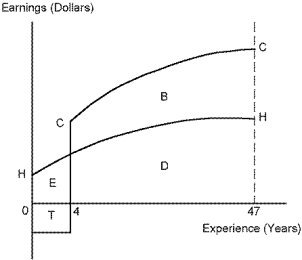
Refer to Education. The total cost of attending college is represented by area:
A) E.
B) T.
C) E + T.
D) B.
Note that HH represents lifetime earnings with a high school education and CC represents lifetime earning with a college education.
Refer to Education. The total cost of attending college is represented by area:
A) E.
B) T.
C) E + T.
D) B.
Question
Question
Use the following diagram to answer the following questions.
Note that HH represents lifetime earnings with a high school education and CC represents lifetime earning with a college education.
Refer to Education. Expenditures on tuition, books, and fees are represented by area:
A) E.
B) T.
C) E + T.
D) B.
Note that HH represents lifetime earnings with a high school education and CC represents lifetime earning with a college education.
Refer to Education. Expenditures on tuition, books, and fees are represented by area:
A) E.
B) T.
C) E + T.
D) B.
Question
Question
Question
Question
Question
Question
Use the following diagram to answer the following questions.
Note that HH represents lifetime earnings with a high school education and CC represents lifetime earning with a college education.
Refer to Education. The earnings foregone while attending college are represented by area:
A) E.
B) T.
C) E + T.
D) B.
Note that HH represents lifetime earnings with a high school education and CC represents lifetime earning with a college education.
Refer to Education. The earnings foregone while attending college are represented by area:
A) E.
B) T.
C) E + T.
D) B.
Question
Question
Use the following diagram to answer the following questions.
Note that HH represents lifetime earnings with a high school education and CC represents lifetime earning with a college education.
Refer to Education. If HH represents lifetime earnings with a high school education and CC represents lifetime earning with a college education, then what area represents the benefits of a college education that are easily valued in dollars?
A) B.
B) B + D.
C) E.
D) E + D.
Note that HH represents lifetime earnings with a high school education and CC represents lifetime earning with a college education.
Refer to Education. If HH represents lifetime earnings with a high school education and CC represents lifetime earning with a college education, then what area represents the benefits of a college education that are easily valued in dollars?
A) B.
B) B + D.
C) E.
D) E + D.
Question
Use the following diagram to answer the following questions.
Note that HH represents lifetime earnings with a high school education and CC represents lifetime earning with a college education.
Refer to Education. In order for the individual to invest in a college education:
A) area B must be greater than area E.
B) area B must be greater than area E + T.
C) area B + D must be greater than area E.
D) area B + D must be greater than area E + T.
Note that HH represents lifetime earnings with a high school education and CC represents lifetime earning with a college education.
Refer to Education. In order for the individual to invest in a college education:
A) area B must be greater than area E.
B) area B must be greater than area E + T.
C) area B + D must be greater than area E.
D) area B + D must be greater than area E + T.
Question
Question
Question
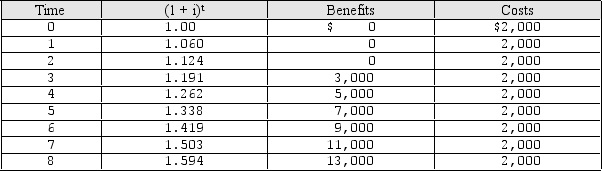
You are given the following information about an investment Tiffany is considering. At the current interest rate of 6 percent, should Tiffany undertake the investment? Calculate the sum of the present value of benefits and costs to aid you in making your decision. These benefits and costs should be calculated to the nearest dollar.

Question
Question
Question
Question
Question
Question
Question
Question
Question
Question

Unlock Deck
Sign up to unlock the cards in this deck!
Unlock Deck
Unlock Deck
1/71

Play

Full screen (f)
Deck 9: College Education: Is It Worth the Cost
1
The spillover benefits of a four-year college education are quite large.
False
2
Evidence indicate that Pell grants have had little impact on enrollment by low-income students due to their lack of means to finance the remainder of the costs.
True
3
Social rate of return for a four-year college education is slightly higher than the student rate of return.
True
4
The social benefit of a college education is greater than the individual student benefits.
Unlock Deck
Unlock for access to all 71 flashcards in this deck.
Unlock Deck
k this deck
5
Pell grants are an effective means of encouraging low-income individuals to enroll in college but have little effect on middle and high-income individuals.
Unlock Deck
Unlock for access to all 71 flashcards in this deck.
Unlock Deck
k this deck
6
Increased income is a benefit of a college education that is not easily valued in dollars.
Unlock Deck
Unlock for access to all 71 flashcards in this deck.
Unlock Deck
k this deck
7
State appropriations to state colleges and universities greatly benefit students in more comprehensive universities than in junior colleges.
Unlock Deck
Unlock for access to all 71 flashcards in this deck.
Unlock Deck
k this deck
8
The benefits of a college education that are not easily valued in dollars are estimated to be quite small.
Unlock Deck
Unlock for access to all 71 flashcards in this deck.
Unlock Deck
k this deck
9
The government guarantee on student loans helps to overcome credit market failure.
Unlock Deck
Unlock for access to all 71 flashcards in this deck.
Unlock Deck
k this deck
10
An investment is worthwhile if the sum of the present value of benefits exceeds the sum of the present value of costs.
Unlock Deck
Unlock for access to all 71 flashcards in this deck.
Unlock Deck
k this deck
11
In order for an investment to be worthwhile:
A) the present value of costs must exceed the present value of benefits.
B) the present value of benefits must exceed the present value of costs.
C) costs must exceed benefits.
D) benefits must exceed costs.
A) the present value of costs must exceed the present value of benefits.
B) the present value of benefits must exceed the present value of costs.
C) costs must exceed benefits.
D) benefits must exceed costs.
Unlock Deck
Unlock for access to all 71 flashcards in this deck.
Unlock Deck
k this deck
12
Money appropriated by state legislatures for instructional purposes is the largest source of subsidies to college students.
Unlock Deck
Unlock for access to all 71 flashcards in this deck.
Unlock Deck
k this deck
13
In order for an investment to be worthwhile:
A) benefits must exceed costs.
B) costs must exceed benefits.
C) the market rate of interest must exceed the rate of return on the investment.
D) the rate of return on the investment must exceed the market rate of interest.
A) benefits must exceed costs.
B) costs must exceed benefits.
C) the market rate of interest must exceed the rate of return on the investment.
D) the rate of return on the investment must exceed the market rate of interest.
Unlock Deck
Unlock for access to all 71 flashcards in this deck.
Unlock Deck
k this deck
14
The present value of a sum of money is greater than the future value of that sum.
Unlock Deck
Unlock for access to all 71 flashcards in this deck.
Unlock Deck
k this deck
15
The annual income that could have been earned by investing the funds that were used for a college education is part of the opportunity cost of attending college.
Unlock Deck
Unlock for access to all 71 flashcards in this deck.
Unlock Deck
k this deck
16
An investment should be undertaken if the market rate of interest exceeds the rate of return that can be earned on the investment.
Unlock Deck
Unlock for access to all 71 flashcards in this deck.
Unlock Deck
k this deck
17
Increased access for students from lower-income families is one of the arguments used to justify government financial support of higher education.
Unlock Deck
Unlock for access to all 71 flashcards in this deck.
Unlock Deck
k this deck
18
Spillover benefits can easily be value.
Unlock Deck
Unlock for access to all 71 flashcards in this deck.
Unlock Deck
k this deck
19
The principal costs a student incurs while pursuing an education are tuition, books, supplies and income foregone.
Unlock Deck
Unlock for access to all 71 flashcards in this deck.
Unlock Deck
k this deck
20
Overeducation occurs when college graduates believe they are overqualified for their jobs.
Unlock Deck
Unlock for access to all 71 flashcards in this deck.
Unlock Deck
k this deck
21
Which of the following is an example of a cost or benefit of college education that is not easily valued in dollars?
A) the increased earnings associated with a college education.
B) the earnings foregone while in college.
C) the enhanced value of leisure.
D) money paid for tuition.
A) the increased earnings associated with a college education.
B) the earnings foregone while in college.
C) the enhanced value of leisure.
D) money paid for tuition.
Unlock Deck
Unlock for access to all 71 flashcards in this deck.
Unlock Deck
k this deck
22
Which are two investment decision rules?
A) future value rule and present value rule
B) present value rule and rate of return rule
C) future value rule and rate of return rule
D) discount rule and rate of return rule
A) future value rule and present value rule
B) present value rule and rate of return rule
C) future value rule and rate of return rule
D) discount rule and rate of return rule
Unlock Deck
Unlock for access to all 71 flashcards in this deck.
Unlock Deck
k this deck
23
Which of the following are used to rationalize subsidies to college students?
A) College graduates are less likely to engage in criminal behavior.
B) Subsidies ensure low-income students greater access to higher education.
C) A college education may increase the value of one's leisure time.
D) Children of college graduates may experience greater levels of intellectual development.
A) College graduates are less likely to engage in criminal behavior.
B) Subsidies ensure low-income students greater access to higher education.
C) A college education may increase the value of one's leisure time.
D) Children of college graduates may experience greater levels of intellectual development.
Unlock Deck
Unlock for access to all 71 flashcards in this deck.
Unlock Deck
k this deck
24
The rate of return is defined as:
A) the discount rate that makes present value of costs equal to present value of benefits.
B) the discount rate that makes the present value of net benefits greater than 1.
C) the discount rate that makes present value of benefits greater than the present value of costs.
D) the discount rate that makes the present value of net benefits less than 1.
A) the discount rate that makes present value of costs equal to present value of benefits.
B) the discount rate that makes the present value of net benefits greater than 1.
C) the discount rate that makes present value of benefits greater than the present value of costs.
D) the discount rate that makes the present value of net benefits less than 1.
Unlock Deck
Unlock for access to all 71 flashcards in this deck.
Unlock Deck
k this deck
25
The steps for the student decision to invest in college are:
A) List expected costs and benefits; adjust benefits and costs for time of occurrence; and apply the 2 decision rules.
B) List expected costs and benefits; then decide if benefits are greater than costs.
C) List expected benefits and costs, then decide if rate of return on investment is greater than the market interest rate.
D) None of the above are correct.
A) List expected costs and benefits; adjust benefits and costs for time of occurrence; and apply the 2 decision rules.
B) List expected costs and benefits; then decide if benefits are greater than costs.
C) List expected benefits and costs, then decide if rate of return on investment is greater than the market interest rate.
D) None of the above are correct.
Unlock Deck
Unlock for access to all 71 flashcards in this deck.
Unlock Deck
k this deck
26
Which of the following are put forth as reasons to provide subsidies to college students?
A) Subsidies are needed to compensate students for the external benefits created by their college education.
B) Subsidies are needed to increase the access of low-income individuals to higher education.
C) Subsidies are needed to correct for capital market failures.
D) All of the above.
A) Subsidies are needed to compensate students for the external benefits created by their college education.
B) Subsidies are needed to increase the access of low-income individuals to higher education.
C) Subsidies are needed to correct for capital market failures.
D) All of the above.
Unlock Deck
Unlock for access to all 71 flashcards in this deck.
Unlock Deck
k this deck
27
Federal money awarded to college students on the basis of need is known as a(n):
A) tuition subsidy.
B) appropriation.
C) Pell grant.
D) guaranteed student loan.
A) tuition subsidy.
B) appropriation.
C) Pell grant.
D) guaranteed student loan.
Unlock Deck
Unlock for access to all 71 flashcards in this deck.
Unlock Deck
k this deck
28
Nonmonetary spillover benefits of a college education include:
A) Research spillover.
B) Knowledge spillover.
C) Community benefits spillover.
D) All of the above.
A) Research spillover.
B) Knowledge spillover.
C) Community benefits spillover.
D) All of the above.
Unlock Deck
Unlock for access to all 71 flashcards in this deck.
Unlock Deck
k this deck
29
In general state tuition subsidies tend to:
A) be directly related to family income.
B) be indirectly related to family income
C) be unrelated to family income.
D) provide more benefits to students from low-income families.
A) be directly related to family income.
B) be indirectly related to family income
C) be unrelated to family income.
D) provide more benefits to students from low-income families.
Unlock Deck
Unlock for access to all 71 flashcards in this deck.
Unlock Deck
k this deck
30
The major subsidy provided by states to college students is:
A) state appropriations to state colleges and universities.
B) grants.
C) guaranteed student loans.
D) state funded scholarships.
A) state appropriations to state colleges and universities.
B) grants.
C) guaranteed student loans.
D) state funded scholarships.
Unlock Deck
Unlock for access to all 71 flashcards in this deck.
Unlock Deck
k this deck
31
Pell Grants have:
A) been confined to students from low-income families.
B) discouraged students from higher-income families to establish independent status.
C) been available only to students entering comprehensive universities.
D) given larger amounts of money to students who attend relatively more expensive institutions.
A) been confined to students from low-income families.
B) discouraged students from higher-income families to establish independent status.
C) been available only to students entering comprehensive universities.
D) given larger amounts of money to students who attend relatively more expensive institutions.
Unlock Deck
Unlock for access to all 71 flashcards in this deck.
Unlock Deck
k this deck
32
Which of the following is an example of a benefit of college education that is easily valued in dollars?
A) reduced crime rates.
B) higher fringe benefits.
C) increased research and development.
D) increased earnings.
A) reduced crime rates.
B) higher fringe benefits.
C) increased research and development.
D) increased earnings.
Unlock Deck
Unlock for access to all 71 flashcards in this deck.
Unlock Deck
k this deck
33
Dawn estimates the present value of investing in a college education is $350,890 while the present value of cost is $236,784. In this case:
A) Dawn should invest in the education.
B) Dawn should not invest in the education.
C) Dawn would be indifferent to investing in the education.
D) Dawn must first estimate the rate of return before deciding whether or not to invest in the education.
A) Dawn should invest in the education.
B) Dawn should not invest in the education.
C) Dawn would be indifferent to investing in the education.
D) Dawn must first estimate the rate of return before deciding whether or not to invest in the education.
Unlock Deck
Unlock for access to all 71 flashcards in this deck.
Unlock Deck
k this deck
34
In general, economists feel that the external benefit of:
A) crime reduction that occurs as a result of a college education is quite large.
B) research is generated primarily from advanced degrees.
C) artistic events, such as plays, is nonexistent.
D) research undertaken by colleges outweighs the external benefit of crime reduction.
A) crime reduction that occurs as a result of a college education is quite large.
B) research is generated primarily from advanced degrees.
C) artistic events, such as plays, is nonexistent.
D) research undertaken by colleges outweighs the external benefit of crime reduction.
Unlock Deck
Unlock for access to all 71 flashcards in this deck.
Unlock Deck
k this deck
35
Studies indicate that the benefits of a college education that are not easily measured in dollars:
A) are negligible.
B) increase as the number of years in college increases.
C) may be as great as the benefits that are easily valued in dollars.
D) are more important for males than females.
A) are negligible.
B) increase as the number of years in college increases.
C) may be as great as the benefits that are easily valued in dollars.
D) are more important for males than females.
Unlock Deck
Unlock for access to all 71 flashcards in this deck.
Unlock Deck
k this deck
36
The external benefits of a college education:
A) are relatively small.
B) are relatively large.
C) are greater for undergraduate than graduate work.
D) are greater than the external benefits of a secondary education.
A) are relatively small.
B) are relatively large.
C) are greater for undergraduate than graduate work.
D) are greater than the external benefits of a secondary education.
Unlock Deck
Unlock for access to all 71 flashcards in this deck.
Unlock Deck
k this deck
37
A socially justified investment in college is defined as:
A) an investment that yields a ROR greater than or equal to the social ROR.
B) a predetermined level of enrollment as defined by the federal government.
C) a level of enrollment in higher education that maximizes social benefits.
D) All of the above are correct.
A) an investment that yields a ROR greater than or equal to the social ROR.
B) a predetermined level of enrollment as defined by the federal government.
C) a level of enrollment in higher education that maximizes social benefits.
D) All of the above are correct.
Unlock Deck
Unlock for access to all 71 flashcards in this deck.
Unlock Deck
k this deck
38
Which of the following is an example of a subsidy provided by student loans?
A) Interest is charged once the loan is made.
B) Government reimburses private lenders for defaulted loans.
C) Low-income students receive more money than higher-income students.
D) Interest rates on the loans are at least as great as the market rate of interest.
A) Interest is charged once the loan is made.
B) Government reimburses private lenders for defaulted loans.
C) Low-income students receive more money than higher-income students.
D) Interest rates on the loans are at least as great as the market rate of interest.
Unlock Deck
Unlock for access to all 71 flashcards in this deck.
Unlock Deck
k this deck
39
James estimates his rate of return on an investment to be 6 percent. The market rate of interest is 7.5%. We know that:
A) James should undertake the investment.
B) James should not undertake the investment.
C) James should be indifferent to the investment.
D) James must first calculate costs and benefits before deciding whether or not to invest.
A) James should undertake the investment.
B) James should not undertake the investment.
C) James should be indifferent to the investment.
D) James must first calculate costs and benefits before deciding whether or not to invest.
Unlock Deck
Unlock for access to all 71 flashcards in this deck.
Unlock Deck
k this deck
40
Which of the following is an example of an opportunity cost of attending college?
A) The money you pay for the books required in your college classes.
B) The annual earnings that could have been had by investing the money for college elsewhere.
C) The money you pay for tuition while attending college.
D) The part of your college fees that go to support the student health center on your campus.
A) The money you pay for the books required in your college classes.
B) The annual earnings that could have been had by investing the money for college elsewhere.
C) The money you pay for tuition while attending college.
D) The part of your college fees that go to support the student health center on your campus.
Unlock Deck
Unlock for access to all 71 flashcards in this deck.
Unlock Deck
k this deck
41
Which of the following would be the most legitimate reason for providing subsidies to college students?
A) There are large external costs associated with a college education.
B) Low-income individuals will not attend college without increased access to a college education.
C) College education enhances the value of leisure to the college graduate.
D) Individuals receive increased earnings as a result of a college education.
A) There are large external costs associated with a college education.
B) Low-income individuals will not attend college without increased access to a college education.
C) College education enhances the value of leisure to the college graduate.
D) Individuals receive increased earnings as a result of a college education.
Unlock Deck
Unlock for access to all 71 flashcards in this deck.
Unlock Deck
k this deck
42
Effects of a college education that go primarily to individuals other than students or their families are known as:
A) secondary benefits.
B) external benefits.
C) non-primary benefits.
D) indirect benefits.
A) secondary benefits.
B) external benefits.
C) non-primary benefits.
D) indirect benefits.
Unlock Deck
Unlock for access to all 71 flashcards in this deck.
Unlock Deck
k this deck
43
Which is not a nonmonetary benefit to the student?
A) better health
B) increased lifetime earnings
C) enhanced value of leisure
D) better decision making.
A) better health
B) increased lifetime earnings
C) enhanced value of leisure
D) better decision making.
Unlock Deck
Unlock for access to all 71 flashcards in this deck.
Unlock Deck
k this deck
44
Suppose private lenders are unwilling to provide loans for educational purposes. Government should:
A) provide grants.
B) provide loans at rates below the market rate of interest.
C) guarantee loans at the market rate of interest.
D) do nothing. In this case lenders are correctly perceiving risks, and government intervention will do nothing to increase society's well-being.
A) provide grants.
B) provide loans at rates below the market rate of interest.
C) guarantee loans at the market rate of interest.
D) do nothing. In this case lenders are correctly perceiving risks, and government intervention will do nothing to increase society's well-being.
Unlock Deck
Unlock for access to all 71 flashcards in this deck.
Unlock Deck
k this deck
45
Use the following table. What is the total lifetime earnings differential?
A) $101,000.
B) $169,000.
C) $575,000.
D) $680,000.
A) $101,000.
B) $169,000.
C) $575,000.
D) $680,000.
Unlock Deck
Unlock for access to all 71 flashcards in this deck.
Unlock Deck
k this deck
46
Which factors are determinants of the demand for public higher education?
A) tuition
B) income
C) price of private education
D) All of the above.
A) tuition
B) income
C) price of private education
D) All of the above.
Unlock Deck
Unlock for access to all 71 flashcards in this deck.
Unlock Deck
k this deck
47
Use the following diagram to answer the following questions.
Note that HH represents lifetime earnings with a high school education and CC represents lifetime earning with a college education.
Refer to Education. The total cost of attending college is represented by area:
A) E.
B) T.
C) E + T.
D) B.
Note that HH represents lifetime earnings with a high school education and CC represents lifetime earning with a college education.
Refer to Education. The total cost of attending college is represented by area:
A) E.
B) T.
C) E + T.
D) B.
Unlock Deck
Unlock for access to all 71 flashcards in this deck.
Unlock Deck
k this deck
48
Which statement is correct?
A) Higher education is subject to the law of demand.
B) Higher education is not subject to the law of demand.
C) Increases in tuition do not cause drops in enrollment.
D) Increased state income does not increase the demand for higher education.
A) Higher education is subject to the law of demand.
B) Higher education is not subject to the law of demand.
C) Increases in tuition do not cause drops in enrollment.
D) Increased state income does not increase the demand for higher education.
Unlock Deck
Unlock for access to all 71 flashcards in this deck.
Unlock Deck
k this deck
49
Use the following diagram to answer the following questions.
Note that HH represents lifetime earnings with a high school education and CC represents lifetime earning with a college education.
Refer to Education. Expenditures on tuition, books, and fees are represented by area:
A) E.
B) T.
C) E + T.
D) B.
Note that HH represents lifetime earnings with a high school education and CC represents lifetime earning with a college education.
Refer to Education. Expenditures on tuition, books, and fees are represented by area:
A) E.
B) T.
C) E + T.
D) B.
Unlock Deck
Unlock for access to all 71 flashcards in this deck.
Unlock Deck
k this deck
50
Suppose that you spend $3,000 for tuition, $850 on books, and sacrifice $16,000 in income during your first year in college. The total cost of attending college for this year is:
A) $3,000.
B) $3,850.
C) $16,000.
D) $19,850.
A) $3,000.
B) $3,850.
C) $16,000.
D) $19,850.
Unlock Deck
Unlock for access to all 71 flashcards in this deck.
Unlock Deck
k this deck
51
Which of the following statements is correct?
A) The market for student loans would not function as well if the government did not provide below-market interest rates.
B) Pell grants are rarely given to any individual that is not from a low-income family.
C) In the absence of government guarantees, the capital market would probably fail to provide students loans for educational purposes.
D) The money appropriated by state legislatures for instructional purposes provides only a relatively small subsidy to students.
A) The market for student loans would not function as well if the government did not provide below-market interest rates.
B) Pell grants are rarely given to any individual that is not from a low-income family.
C) In the absence of government guarantees, the capital market would probably fail to provide students loans for educational purposes.
D) The money appropriated by state legislatures for instructional purposes provides only a relatively small subsidy to students.
Unlock Deck
Unlock for access to all 71 flashcards in this deck.
Unlock Deck
k this deck
52
Which statement is true?
A) Choice of school provides a large advantage in later earnings.
B) Choice of school provides no advantage in later earnings.
C) Choice of school provides a slight advantage in later earnings only if one graduates from a selective private Eastern institution.
D) None of the above are true.
A) Choice of school provides a large advantage in later earnings.
B) Choice of school provides no advantage in later earnings.
C) Choice of school provides a slight advantage in later earnings only if one graduates from a selective private Eastern institution.
D) None of the above are true.
Unlock Deck
Unlock for access to all 71 flashcards in this deck.
Unlock Deck
k this deck
53
If you expect to receive $1,000 one year from now and the discount rate is 0.05, what is the present value of the future $1000?
A) $1050
B) $1000
C) $875.27
D) $952.38
A) $1050
B) $1000
C) $875.27
D) $952.38
Unlock Deck
Unlock for access to all 71 flashcards in this deck.
Unlock Deck
k this deck
54
Which is not considered a nonmonetary external benefit?
A) knowledge spillovers
B) community benefit spillovers
C) overeducation
D) research spillovers
A) knowledge spillovers
B) community benefit spillovers
C) overeducation
D) research spillovers
Unlock Deck
Unlock for access to all 71 flashcards in this deck.
Unlock Deck
k this deck
55
Use the following diagram to answer the following questions.
Note that HH represents lifetime earnings with a high school education and CC represents lifetime earning with a college education.
Refer to Education. The earnings foregone while attending college are represented by area:
A) E.
B) T.
C) E + T.
D) B.
Note that HH represents lifetime earnings with a high school education and CC represents lifetime earning with a college education.
Refer to Education. The earnings foregone while attending college are represented by area:
A) E.
B) T.
C) E + T.
D) B.
Unlock Deck
Unlock for access to all 71 flashcards in this deck.
Unlock Deck
k this deck
56
Which statement is correct?
A) Engineering majors tend to have an earnings advantage over education majors.
B) Taking lots of math improves the pay-off from college.
C) The biggest pay-off is for a high grade point average.
D) All of the above are true.
A) Engineering majors tend to have an earnings advantage over education majors.
B) Taking lots of math improves the pay-off from college.
C) The biggest pay-off is for a high grade point average.
D) All of the above are true.
Unlock Deck
Unlock for access to all 71 flashcards in this deck.
Unlock Deck
k this deck
57
Use the following diagram to answer the following questions.
Note that HH represents lifetime earnings with a high school education and CC represents lifetime earning with a college education.
Refer to Education. If HH represents lifetime earnings with a high school education and CC represents lifetime earning with a college education, then what area represents the benefits of a college education that are easily valued in dollars?
A) B.
B) B + D.
C) E.
D) E + D.
Note that HH represents lifetime earnings with a high school education and CC represents lifetime earning with a college education.
Refer to Education. If HH represents lifetime earnings with a high school education and CC represents lifetime earning with a college education, then what area represents the benefits of a college education that are easily valued in dollars?
A) B.
B) B + D.
C) E.
D) E + D.
Unlock Deck
Unlock for access to all 71 flashcards in this deck.
Unlock Deck
k this deck
58
Use the following diagram to answer the following questions.
Note that HH represents lifetime earnings with a high school education and CC represents lifetime earning with a college education.
Refer to Education. In order for the individual to invest in a college education:
A) area B must be greater than area E.
B) area B must be greater than area E + T.
C) area B + D must be greater than area E.
D) area B + D must be greater than area E + T.
Note that HH represents lifetime earnings with a high school education and CC represents lifetime earning with a college education.
Refer to Education. In order for the individual to invest in a college education:
A) area B must be greater than area E.
B) area B must be greater than area E + T.
C) area B + D must be greater than area E.
D) area B + D must be greater than area E + T.
Unlock Deck
Unlock for access to all 71 flashcards in this deck.
Unlock Deck
k this deck
59
Which are nonmonetary external benefits?
A) increased tax revenues
B) better individual health
C) higher lifetime earnings
D) community benefit spillovers
A) increased tax revenues
B) better individual health
C) higher lifetime earnings
D) community benefit spillovers
Unlock Deck
Unlock for access to all 71 flashcards in this deck.
Unlock Deck
k this deck
60
Greg enters the labor force as a sales person for Brown and Daughters Incorporated. He spends his days trying to get human resource managers to purchase his data base system. He hoped his degree would provide him with a more intellectually challenging job. Greg is experiencing:
A) overeducation.
B) wastage.
C) screening.
D) overemployment.
A) overeducation.
B) wastage.
C) screening.
D) overemployment.
Unlock Deck
Unlock for access to all 71 flashcards in this deck.
Unlock Deck
k this deck
61
You are given the following information about an investment Tiffany is considering. At the current interest rate of 6 percent, should Tiffany undertake the investment? Calculate the sum of the present value of benefits and costs to aid you in making your decision. These benefits and costs should be calculated to the nearest dollar.
Unlock Deck
Unlock for access to all 71 flashcards in this deck.
Unlock Deck
k this deck
62
Evaluate the following statement. "Since subsidies to higher education do not target low-income students, they should be eliminated. Increasing the access of these students to a higher education could then be accomplished by making available to them government loans at the market rate of interest."
Unlock Deck
Unlock for access to all 71 flashcards in this deck.
Unlock Deck
k this deck
63
Pell Grants are not confined to low-income families. Which is not a reason?
A) Students from middle class families are eligible for Pell Grants.
B) Grant awards tend to be larger for students attending more expensive schools.
C) The federal definition of "low income" is too high.
D) Students from high income families establish independent status in order to qualify for the grant.
A) Students from middle class families are eligible for Pell Grants.
B) Grant awards tend to be larger for students attending more expensive schools.
C) The federal definition of "low income" is too high.
D) Students from high income families establish independent status in order to qualify for the grant.
Unlock Deck
Unlock for access to all 71 flashcards in this deck.
Unlock Deck
k this deck
64
If you won the lottery and were offered to receive $50,000 a year from now or an alternate sum today, given that the interest rate is 5%, how much would you expect to receive today:
A) $47,619
B) $45,750
C) $43,946
D) $55,000
A) $47,619
B) $45,750
C) $43,946
D) $55,000
Unlock Deck
Unlock for access to all 71 flashcards in this deck.
Unlock Deck
k this deck
65
Suppose Paul would pay $15,000 per year for tuition at Intelligentsia University. Books are $2,500 per year and fees are $1,000. If Paul attends the University, he will only be able to work part time so instead of earning $18,000 per year he will earn only $5,000. What is Paul's opportunity cost of attending the university for four years?
Unlock Deck
Unlock for access to all 71 flashcards in this deck.
Unlock Deck
k this deck
66
Which statement is correct?
A) RORs to education probably justify investment in education throughout the world.
B) Investment in education is only justified in less-developed countries.
C) Investment in education is only justified in more-developed countries.
D) Investment in tertiary education is not a productive use of society's resources worldwide.
A) RORs to education probably justify investment in education throughout the world.
B) Investment in education is only justified in less-developed countries.
C) Investment in education is only justified in more-developed countries.
D) Investment in tertiary education is not a productive use of society's resources worldwide.
Unlock Deck
Unlock for access to all 71 flashcards in this deck.
Unlock Deck
k this deck
67
Often, subsidies to education are justified because of the external benefits created by education. Using this argument, do you think it would be easier to justify the subsidies going to secondary or higher education?
Unlock Deck
Unlock for access to all 71 flashcards in this deck.
Unlock Deck
k this deck
68
Some support for public spending on higher education stems from concern about the distributional aspects of private financing. Higher income individuals will be able to obtain more education for their offspring than will lower income individuals. Do you believe public spending on higher education has addressed this problem?
Unlock Deck
Unlock for access to all 71 flashcards in this deck.
Unlock Deck
k this deck
69
Suppose it would cost Kathleen $45,000 in tuition and fees to attend State University. She would give up $52,000 in earnings during her years of college attendance. If Kathleen's lifetime benefits from attending would amount to $278,000, should she consider attending State University?
Unlock Deck
Unlock for access to all 71 flashcards in this deck.
Unlock Deck
k this deck
70
If you won the lottery and were offered to receive $25,000 a year from now, and $25,000 two years from now, or to receive an alternate sum today, given that the interest rate is 5%, how much would you expect to receive today:
A) $46,485
B) $45,750
C) $43,946
D) $55,000
A) $46,485
B) $45,750
C) $43,946
D) $55,000
Unlock Deck
Unlock for access to all 71 flashcards in this deck.
Unlock Deck
k this deck
71
"The interest income that could have been earned on money invested in a college education is not relevant to the decision to attend college." Is this statement correct? Defend your answer.
Unlock Deck
Unlock for access to all 71 flashcards in this deck.
Unlock Deck
k this deck
Unlock Deck
Unlock for access to all 71 flashcards in this deck.






