







 Chat with AI

Deck 30: Nursing Management: Coronary Artery Disease and Acute Coronary Syndrome
Full screen (f)

Question

Question
Question
Question
Question
Question
Question
Question
Question
Question
Question
Question
Question
Question
Question
Question
Question
Question
Question
Question
Question
Question
Question
Question
Question
Question
Question
Question
Question
Question
Question
Question
Question
Question
Question
Question
Question
Question
Question
Question
Question
After reviewing a patient's history,vital signs,physical assessment,and laboratory data,which information shown in the accompanying figure is most important for the nurse to communicate to the health care provider? 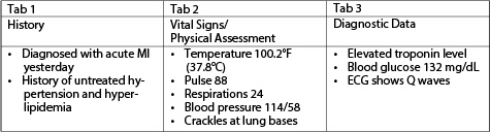
A) Q waves on ECG
B) Elevated troponin levels
C) Fever and hyperglycemia
D) Tachypnea and crackles in lungs
A) Q waves on ECG
B) Elevated troponin levels
C) Fever and hyperglycemia
D) Tachypnea and crackles in lungs
Question
After reviewing information shown in the accompanying figure from the medical records of a 43-year-old,which risk factor modification for coronary artery disease should the nurse include in patient teaching? 
A) Importance of daily physical activity
B) Effect of weight loss on blood pressure
C) Dietary changes to improve lipid levels
D) Ongoing cardiac risk associated with history of tobacco use
A) Importance of daily physical activity
B) Effect of weight loss on blood pressure
C) Dietary changes to improve lipid levels
D) Ongoing cardiac risk associated with history of tobacco use
Question

Unlock Deck
Sign up to unlock the cards in this deck!
Unlock Deck
Unlock Deck
1/43

Play

Full screen (f)
Deck 30: Nursing Management: Coronary Artery Disease and Acute Coronary Syndrome
1
After the nurse has finished teaching a patient about the use of sublingual nitroglycerin (Nitrostat),which patient statement indicates that the teaching has been effective?
A) "I can expect some nausea as a side effect of nitroglycerin."
B) "I should only take the nitroglycerin if I start to have chest pain."
C) "I will call an ambulance if I still have pain after taking 3 nitroglycerin 5 minutes apart."
D) "Nitroglycerin helps prevent a clot from forming and blocking blood flow to my heart."
A) "I can expect some nausea as a side effect of nitroglycerin."
B) "I should only take the nitroglycerin if I start to have chest pain."
C) "I will call an ambulance if I still have pain after taking 3 nitroglycerin 5 minutes apart."
D) "Nitroglycerin helps prevent a clot from forming and blocking blood flow to my heart."
"I will call an ambulance if I still have pain after taking 3 nitroglycerin 5 minutes apart."
2
When titrating IV nitroglycerin (Tridil)for a patient with a myocardial infarction (MI),which action will the nurse take to evaluate the effectiveness of the medication?
A) Monitor heart rate.
B) Ask about chest pain.
C) Check blood pressure.
D) Observe for dysrhythmias.
A) Monitor heart rate.
B) Ask about chest pain.
C) Check blood pressure.
D) Observe for dysrhythmias.
Ask about chest pain.
3
During the administration of the thrombolytic agent to a patient with an acute myocardial infarction (AMI),the nurse should stop the drug infusion if the patient experiences
A) bleeding from the gums.
B) increase in blood pressure.
C) a decrease in level of consciousness.
D) a nonsustained episode of ventricular tachycardia.
A) bleeding from the gums.
B) increase in blood pressure.
C) a decrease in level of consciousness.
D) a nonsustained episode of ventricular tachycardia.
a decrease in level of consciousness.
4
Diltiazem (Cardizem)is ordered for a patient with newly diagnosed Prinzmetal's (variant)angina.When teaching the patient,the nurse will include the information that diltiazem will
A) reduce heart palpitations.
B) decrease spasm of the coronary arteries.
C) increase the force of the heart contractions.
D) help prevent plaque from forming in the coronary arteries.
A) reduce heart palpitations.
B) decrease spasm of the coronary arteries.
C) increase the force of the heart contractions.
D) help prevent plaque from forming in the coronary arteries.
Unlock Deck
Unlock for access to all 43 flashcards in this deck.
Unlock Deck
k this deck
5
When developing a teaching plan for a 61-year-old man with the following risk factors for coronary artery disease (CAD),the nurse should focus on the
A) family history of coronary artery disease.
B) increased risk associated with the patient's gender.
C) increased risk of cardiovascular disease as people age.
D) elevation of the patient's low-density lipoprotein (LDL) level.
A) family history of coronary artery disease.
B) increased risk associated with the patient's gender.
C) increased risk of cardiovascular disease as people age.
D) elevation of the patient's low-density lipoprotein (LDL) level.
Unlock Deck
Unlock for access to all 43 flashcards in this deck.
Unlock Deck
k this deck
6
Nadolol (Corgard)is prescribed for a patient with chronic stable angina and left ventricular dysfunction.To determine whether the drug is effective,the nurse will monitor for
A) decreased blood pressure and heart rate.
B) fewer complaints of having cold hands and feet.
C) improvement in the strength of the distal pulses.
D) the ability to do daily activities without chest pain.
A) decreased blood pressure and heart rate.
B) fewer complaints of having cold hands and feet.
C) improvement in the strength of the distal pulses.
D) the ability to do daily activities without chest pain.
Unlock Deck
Unlock for access to all 43 flashcards in this deck.
Unlock Deck
k this deck
7
Heparin is ordered for a patient with a non-ST-segment-elevation myocardial infarction (NSTEMI).What is the purpose of the heparin?
A) Heparin enhances platelet aggregation.
B) Heparin decreases coronary artery plaque size.
C) Heparin prevents the development of new clots in the coronary arteries.
D) Heparin dissolves clots that are blocking blood flow in the coronary arteries.
A) Heparin enhances platelet aggregation.
B) Heparin decreases coronary artery plaque size.
C) Heparin prevents the development of new clots in the coronary arteries.
D) Heparin dissolves clots that are blocking blood flow in the coronary arteries.
Unlock Deck
Unlock for access to all 43 flashcards in this deck.
Unlock Deck
k this deck
8
Which assessment data collected by the nurse who is admitting a patient with chest pain suggest that the pain is caused by an acute myocardial infarction (AMI)?
A) The pain increases with deep breathing.
B) The pain has lasted longer than 30 minutes.
C) The pain is relieved after the patient takes nitroglycerin.
D) The pain is reproducible when the patient raises the arms.
A) The pain increases with deep breathing.
B) The pain has lasted longer than 30 minutes.
C) The pain is relieved after the patient takes nitroglycerin.
D) The pain is reproducible when the patient raises the arms.
Unlock Deck
Unlock for access to all 43 flashcards in this deck.
Unlock Deck
k this deck
9
A patient is recovering from a myocardial infarction (MI)and develops chest pain on day 3 that increases when taking a deep breath and is relieved by leaning forward.Which action should the nurse take next?
A) Assess the feet for pedal edema.
B) Palpate the radial pulses bilaterally.
C) Auscultate for a pericardial friction rub.
D) Check the heart monitor for dysrhythmias.
A) Assess the feet for pedal edema.
B) Palpate the radial pulses bilaterally.
C) Auscultate for a pericardial friction rub.
D) Check the heart monitor for dysrhythmias.
Unlock Deck
Unlock for access to all 43 flashcards in this deck.
Unlock Deck
k this deck
10
After the nurse teaches the patient about the use of carvedilol (Coreg)in preventing anginal episodes,which statement by a patient indicates that the teaching has been effective?
A) "Carvedilol will help my heart muscle work harder."
B) "It is important not to suddenly stop taking the carvedilol."
C) "I can expect to feel short of breath when taking carvedilol."
D) "Carvedilol will increase the blood flow to my heart muscle."
A) "Carvedilol will help my heart muscle work harder."
B) "It is important not to suddenly stop taking the carvedilol."
C) "I can expect to feel short of breath when taking carvedilol."
D) "Carvedilol will increase the blood flow to my heart muscle."
Unlock Deck
Unlock for access to all 43 flashcards in this deck.
Unlock Deck
k this deck
11
The nurse will suspect that the patient with stable angina is experiencing a side effect of the prescribed metoprolol (Lopressor)if the
A) patient is restless and agitated.
B) blood pressure is 90/54 mm Hg.
C) patient complains about feeling anxious.
D) cardiac monitor shows a heart rate of 61 beats/minute.
A) patient is restless and agitated.
B) blood pressure is 90/54 mm Hg.
C) patient complains about feeling anxious.
D) cardiac monitor shows a heart rate of 61 beats/minute.
Unlock Deck
Unlock for access to all 43 flashcards in this deck.
Unlock Deck
k this deck
12
A patient with ST-segment elevation in three contiguous electrocardiographic (ECG)leads is admitted to the emergency department (ED)and diagnosed as having an ST-segment-elevation myocardial infarction (STEMI).Which question should the nurse ask to determine whether the patient is a candidate for thrombolytic therapy?
A) "Do you have any allergies?"
B) "Do you take aspirin on a daily basis?"
C) "What time did your chest pain begin?"
D) "Can you rate your chest pain using a 0 to 10 scale?"
A) "Do you have any allergies?"
B) "Do you take aspirin on a daily basis?"
C) "What time did your chest pain begin?"
D) "Can you rate your chest pain using a 0 to 10 scale?"
Unlock Deck
Unlock for access to all 43 flashcards in this deck.
Unlock Deck
k this deck
13
When caring for a patient who is recovering from a sudden cardiac death (SCD)event and has no evidence of an acute myocardial infarction (AMI),the nurse will anticipate teaching the patient that
A) sudden cardiac death events rarely reoccur.
B) additional diagnostic testing will be required.
C) long-term anticoagulation therapy will be needed.
D) limited physical activity after discharge will be needed to prevent future events.
A) sudden cardiac death events rarely reoccur.
B) additional diagnostic testing will be required.
C) long-term anticoagulation therapy will be needed.
D) limited physical activity after discharge will be needed to prevent future events.
Unlock Deck
Unlock for access to all 43 flashcards in this deck.
Unlock Deck
k this deck
14
Which information given by a patient admitted with chronic stable angina will help the nurse confirm this diagnosis?
A) The patient states that the pain "wakes me up at night."
B) The patient rates the pain at a level 3 to 5 (0 to 10 scale).
C) The patient states that the pain has increased in frequency over the last week.
D) The patient states that the pain "goes away" with one sublingual nitroglycerin tablet.
A) The patient states that the pain "wakes me up at night."
B) The patient rates the pain at a level 3 to 5 (0 to 10 scale).
C) The patient states that the pain has increased in frequency over the last week.
D) The patient states that the pain "goes away" with one sublingual nitroglycerin tablet.
Unlock Deck
Unlock for access to all 43 flashcards in this deck.
Unlock Deck
k this deck
15
Which statement made by a patient with coronary artery disease after the nurse has completed teaching about therapeutic lifestyle changes (TLC)diet indicates that further teaching is needed?
A) "I will switch from whole milk to 1% milk."
B) "I like salmon and I will plan to eat it more often."
C) "I can have a glass of wine with dinner if I want one."
D) "I will miss being able to eat peanut butter sandwiches."
A) "I will switch from whole milk to 1% milk."
B) "I like salmon and I will plan to eat it more often."
C) "I can have a glass of wine with dinner if I want one."
D) "I will miss being able to eat peanut butter sandwiches."
Unlock Deck
Unlock for access to all 43 flashcards in this deck.
Unlock Deck
k this deck
16
A patient who has had chest pain for several hours is admitted with a diagnosis of rule out acute myocardial infarction (AMI).Which laboratory test should the nurse monitor to help determine whether the patient has had an AMI?
A) Myoglobin
B) Homocysteine
C) C-reactive protein
D) Cardiac-specific troponin
A) Myoglobin
B) Homocysteine
C) C-reactive protein
D) Cardiac-specific troponin
Unlock Deck
Unlock for access to all 43 flashcards in this deck.
Unlock Deck
k this deck
17
Following an acute myocardial infarction (AMI),a patient ambulates in the hospital hallway.When the nurse is evaluating the patient's response to the activity,which assessment data would indicate that the exercise level should be decreased?
A) Blood pressure (BP) changes from 118/60 to 126/68 mm Hg.
B) Oxygen saturation drops from 99% to 95%.
C) Heart rate increases from 66 to 92 beats/minute.
D) Respiratory rate goes from 14 to 20 breaths/minute.
A) Blood pressure (BP) changes from 118/60 to 126/68 mm Hg.
B) Oxygen saturation drops from 99% to 95%.
C) Heart rate increases from 66 to 92 beats/minute.
D) Respiratory rate goes from 14 to 20 breaths/minute.
Unlock Deck
Unlock for access to all 43 flashcards in this deck.
Unlock Deck
k this deck
18
Three days after experiencing a myocardial infarction (MI),a patient who is scheduled for discharge asks for assistance with hygiene activities,saying,"I am too nervous to take care of myself." Based on this information,which nursing diagnosis is appropriate?
A) Ineffective coping related to anxiety
B) Activity intolerance related to weakness
C) Denial related to lack of acceptance of the MI
D) Disturbed personal identity related to understanding of illness
A) Ineffective coping related to anxiety
B) Activity intolerance related to weakness
C) Denial related to lack of acceptance of the MI
D) Disturbed personal identity related to understanding of illness
Unlock Deck
Unlock for access to all 43 flashcards in this deck.
Unlock Deck
k this deck
19
Which nursing intervention will be most effective when assisting the patient with coronary artery disease (CAD)to make appropriate dietary changes?
A) Give the patient a list of low-sodium, low-cholesterol foods that should be included in the diet.
B) Emphasize the increased risk for heart problems unless the patient makes the dietary changes.
C) Help the patient modify favorite high-fat recipes by using monosaturated oils when possible.
D) Inform the patient that a diet containing no saturated fat and minimal salt will be necessary.
A) Give the patient a list of low-sodium, low-cholesterol foods that should be included in the diet.
B) Emphasize the increased risk for heart problems unless the patient makes the dietary changes.
C) Help the patient modify favorite high-fat recipes by using monosaturated oils when possible.
D) Inform the patient that a diet containing no saturated fat and minimal salt will be necessary.
Unlock Deck
Unlock for access to all 43 flashcards in this deck.
Unlock Deck
k this deck
20
In preparation for discharge,the nurse teaches a patient with chronic stable angina how to use the prescribed short-acting and long-acting nitrates.Which patient statement indicates that the teaching has been effective?
A) "I will check my pulse rate before I take any nitroglycerin tablets."
B) "I will put the nitroglycerin patch on as soon as I get any chest pain."
C) "I will stop what I am doing and sit down before I put the nitroglycerin under my tongue."
D) "I will be sure to remove the nitroglycerin patch before taking any sublingual nitroglycerin."
A) "I will check my pulse rate before I take any nitroglycerin tablets."
B) "I will put the nitroglycerin patch on as soon as I get any chest pain."
C) "I will stop what I am doing and sit down before I put the nitroglycerin under my tongue."
D) "I will be sure to remove the nitroglycerin patch before taking any sublingual nitroglycerin."
Unlock Deck
Unlock for access to all 43 flashcards in this deck.
Unlock Deck
k this deck
21
Which information about a patient who has been receiving thrombolytic therapy for an acute myocardial infarction (AMI)is most important for the nurse to communicate to the health care provider?
A) No change in the patient's chest pain
B) An increase in troponin levels from baseline
C) A large bruise at the patient's IV insertion site
D) A decrease in ST-segment elevation on the electrocardiogram
A) No change in the patient's chest pain
B) An increase in troponin levels from baseline
C) A large bruise at the patient's IV insertion site
D) A decrease in ST-segment elevation on the electrocardiogram
Unlock Deck
Unlock for access to all 43 flashcards in this deck.
Unlock Deck
k this deck
22
A patient who is recovering from an acute myocardial infarction (AMI)asks the nurse about when sexual intercourse can be resumed.Which response by the nurse is best?
A) "Most patients are able to enjoy intercourse without any complications."
B) "Sexual activity uses about as much energy as climbing two flights of stairs."
C) "The doctor will provide sexual guidelines when your heart is strong enough."
D) "Holding and cuddling are good ways to maintain intimacy after a heart attack."
A) "Most patients are able to enjoy intercourse without any complications."
B) "Sexual activity uses about as much energy as climbing two flights of stairs."
C) "The doctor will provide sexual guidelines when your heart is strong enough."
D) "Holding and cuddling are good ways to maintain intimacy after a heart attack."
Unlock Deck
Unlock for access to all 43 flashcards in this deck.
Unlock Deck
k this deck
23
After receiving change-of-shift report about the following four patients,which patient should the nurse assess first?
A) 39-year-old with pericarditis who is complaining of sharp, stabbing chest pain
B) 56-year-old with variant angina who is to receive a dose of nifedipine (Procardia)
C) 65-year-old who had a myocardial infarction (MI) 4 days ago and is anxious about the planned discharge
D) 59-year-old with unstable angina who has just returned to the unit after having a percutaneous coronary intervention (PCI)
A) 39-year-old with pericarditis who is complaining of sharp, stabbing chest pain
B) 56-year-old with variant angina who is to receive a dose of nifedipine (Procardia)
C) 65-year-old who had a myocardial infarction (MI) 4 days ago and is anxious about the planned discharge
D) 59-year-old with unstable angina who has just returned to the unit after having a percutaneous coronary intervention (PCI)
Unlock Deck
Unlock for access to all 43 flashcards in this deck.
Unlock Deck
k this deck
24
A few days after experiencing a myocardial infarction (MI)and successful percutaneous coronary intervention,the patient states,"I just had a little chest pain.As soon as I get out of here,I'm going for my vacation as planned." Which reply would be most appropriate for the nurse to make?
A) "What do you think caused your chest pain?"
B) "Where are you planning to go for your vacation?"
C) "Sometimes plans need to change after a heart attack."
D) "Recovery from a heart attack takes at least a few weeks."
A) "What do you think caused your chest pain?"
B) "Where are you planning to go for your vacation?"
C) "Sometimes plans need to change after a heart attack."
D) "Recovery from a heart attack takes at least a few weeks."
Unlock Deck
Unlock for access to all 43 flashcards in this deck.
Unlock Deck
k this deck
25
When caring for a patient with acute coronary syndrome who has returned to the coronary care unit after having angioplasty with stent placement,the nurse obtains the following assessment data.Which data indicate the need for immediate action by the nurse?
A) Heart rate 102 beats/min
B) Pedal pulses 1+ bilaterally
C) Blood pressure 103/54 mm Hg
D) Chest pain level 7 on a 0 to 10 point scale
A) Heart rate 102 beats/min
B) Pedal pulses 1+ bilaterally
C) Blood pressure 103/54 mm Hg
D) Chest pain level 7 on a 0 to 10 point scale
Unlock Deck
Unlock for access to all 43 flashcards in this deck.
Unlock Deck
k this deck
26
A patient admitted to the coronary care unit (CCU)with an ST-segment-elevation myocardial infarction (STEMI)is restless and anxious.The blood pressure is 86/40 and heart rate is 123.Based on this information,which nursing diagnosis is a priority for the patient?
A) Acute pain related to myocardial infarction
B) Anxiety related to perceived threat of death
C) Stress overload related to acute change in health
D) Decreased cardiac output related to cardiogenic shock
A) Acute pain related to myocardial infarction
B) Anxiety related to perceived threat of death
C) Stress overload related to acute change in health
D) Decreased cardiac output related to cardiogenic shock
Unlock Deck
Unlock for access to all 43 flashcards in this deck.
Unlock Deck
k this deck
27
The nurse is caring for a patient who was admitted to the coronary care unit following an acute myocardial infarction (AMI)and percutaneous coronary intervention the previous day.Teaching for this patient would include
A) when cardiac rehabilitation will begin.
B) the typical emotional responses to AMI.
C) information regarding discharge medications.
D) the pathophysiology of coronary artery disease.
A) when cardiac rehabilitation will begin.
B) the typical emotional responses to AMI.
C) information regarding discharge medications.
D) the pathophysiology of coronary artery disease.
Unlock Deck
Unlock for access to all 43 flashcards in this deck.
Unlock Deck
k this deck
28
A patient who has recently started taking pravastatin (Pravachol)and niacin (Nicobid)reports the following symptoms to the nurse.Which is most important to communicate to the health care provider?
A) Generalized muscle aches and pains
B) Dizziness when changing positions quickly
C) Nausea when taking the drugs before eating
D) Flushing and pruritus after taking the medications
A) Generalized muscle aches and pains
B) Dizziness when changing positions quickly
C) Nausea when taking the drugs before eating
D) Flushing and pruritus after taking the medications
Unlock Deck
Unlock for access to all 43 flashcards in this deck.
Unlock Deck
k this deck
29
A patient with hyperlipidemia has a new order for colesevelam (Welchol).Which nursing action is most appropriate when giving the medication?
A) Have the patient take this medication with an aspirin.
B) Administer the medication at the patient's usual bedtime.
C) Have the patient take the colesevelam with a sip of water.
D) Give the patient's other medications 2 hours after the colesevelam.
A) Have the patient take this medication with an aspirin.
B) Administer the medication at the patient's usual bedtime.
C) Have the patient take the colesevelam with a sip of water.
D) Give the patient's other medications 2 hours after the colesevelam.
Unlock Deck
Unlock for access to all 43 flashcards in this deck.
Unlock Deck
k this deck
30
Which patient at the cardiovascular clinic requires the most immediate action by the nurse?
A) Patient with type 2 diabetes whose current blood glucose level is 145 mg/dL
B) Patient with stable angina whose chest pain has recently increased in frequency
C) Patient with familial hypercholesterolemia and a total cholesterol of 465 mg/dL
D) Patient with chronic hypertension whose blood pressure today is 172/98 mm Hg
A) Patient with type 2 diabetes whose current blood glucose level is 145 mg/dL
B) Patient with stable angina whose chest pain has recently increased in frequency
C) Patient with familial hypercholesterolemia and a total cholesterol of 465 mg/dL
D) Patient with chronic hypertension whose blood pressure today is 172/98 mm Hg
Unlock Deck
Unlock for access to all 43 flashcards in this deck.
Unlock Deck
k this deck
31
The nurse obtains the following data when assessing a patient who experienced an ST-segment-elevation myocardial infarction (STEMI)2 days previously.Which information is most important to report to the health care provider?
A) The troponin level is elevated.
B) The patient denies ever having a heart attack.
C) Bilateral crackles are auscultated in the mid-lower lobes.
D) The patient has occasional premature atrial contractions (PACs).
A) The troponin level is elevated.
B) The patient denies ever having a heart attack.
C) Bilateral crackles are auscultated in the mid-lower lobes.
D) The patient has occasional premature atrial contractions (PACs).
Unlock Deck
Unlock for access to all 43 flashcards in this deck.
Unlock Deck
k this deck
32
Which electrocardiographic (ECG)change is most important for the nurse to report to the health care provider when caring for a patient with chest pain?
A) Inverted P wave
B) Sinus tachycardia
C) ST-segment elevation
D) First-degree atrioventricular block
A) Inverted P wave
B) Sinus tachycardia
C) ST-segment elevation
D) First-degree atrioventricular block
Unlock Deck
Unlock for access to all 43 flashcards in this deck.
Unlock Deck
k this deck
33
Which assessment finding by the nurse caring for a patient who has had coronary artery bypass grafting using a right radial artery graft is most important to communicate to the health care provider?
A) Complaints of incisional chest pain
B) Pallor and weakness of the right hand
C) Fine crackles heard at both lung bases
D) Redness on both sides of the sternal incision
A) Complaints of incisional chest pain
B) Pallor and weakness of the right hand
C) Fine crackles heard at both lung bases
D) Redness on both sides of the sternal incision
Unlock Deck
Unlock for access to all 43 flashcards in this deck.
Unlock Deck
k this deck
34
A patient had a non-ST-segment-elevation myocardial infarction (NSTEMI)3 days ago.Which nursing intervention included in the plan of care is most appropriate for the registered nurse (RN)to delegate to an experienced licensed practical/vocational nurse (LPN/LVN)?
A) Evaluation of the patient's response to walking in the hallway
B) Completion of the referral form for a home health nurse follow-up
C) Education of the patient about the pathophysiology of heart disease
D) Reinforcement of teaching about the purpose of prescribed medications
A) Evaluation of the patient's response to walking in the hallway
B) Completion of the referral form for a home health nurse follow-up
C) Education of the patient about the pathophysiology of heart disease
D) Reinforcement of teaching about the purpose of prescribed medications
Unlock Deck
Unlock for access to all 43 flashcards in this deck.
Unlock Deck
k this deck
35
When admitting a patient with a non-ST-segment-elevation myocardial infarction (NSTEMI)to the intensive care unit,which action should the nurse perform first?
A) Obtain the blood pressure.
B) Attach the cardiac monitor.
C) Assess the peripheral pulses.
D) Auscultate the breath sounds.
A) Obtain the blood pressure.
B) Attach the cardiac monitor.
C) Assess the peripheral pulses.
D) Auscultate the breath sounds.
Unlock Deck
Unlock for access to all 43 flashcards in this deck.
Unlock Deck
k this deck
36
When caring for a patient who has just arrived on the medical-surgical unit after having cardiac catheterization,which nursing intervention should the nurse delegate to a licensed practical/vocational nurse (LPN/LVN)?
A) Give the scheduled aspirin and lipid-lowering medication.
B) Perform the initial assessment of the catheter insertion site.
C) Teach the patient about the usual postprocedure plan of care.
D) Titrate the heparin infusion according to the agency protocol.
A) Give the scheduled aspirin and lipid-lowering medication.
B) Perform the initial assessment of the catheter insertion site.
C) Teach the patient about the usual postprocedure plan of care.
D) Titrate the heparin infusion according to the agency protocol.
Unlock Deck
Unlock for access to all 43 flashcards in this deck.
Unlock Deck
k this deck
37
To improve the physical activity level for a mildly obese 71-year-old patient,which action should the nurse plan to take?
A) Stress that weight loss is a major benefit of increased exercise.
B) Determine what kind of physical activities the patient usually enjoys.
C) Tell the patient that older adults should exercise for no more than 20 minutes at a time.
D) Teach the patient to include a short warm-up period at the beginning of physical activity.
A) Stress that weight loss is a major benefit of increased exercise.
B) Determine what kind of physical activities the patient usually enjoys.
C) Tell the patient that older adults should exercise for no more than 20 minutes at a time.
D) Teach the patient to include a short warm-up period at the beginning of physical activity.
Unlock Deck
Unlock for access to all 43 flashcards in this deck.
Unlock Deck
k this deck
38
A patient who is being admitted to the emergency department with intermittent chest pain gives the following list of medications to the nurse.Which medication has the most immediate implications for the patient's care?
A) Sildenafil (Viagra)
B) Furosemide (Lasix)
C) Captopril (Capoten)
D) Warfarin (Coumadin)
A) Sildenafil (Viagra)
B) Furosemide (Lasix)
C) Captopril (Capoten)
D) Warfarin (Coumadin)
Unlock Deck
Unlock for access to all 43 flashcards in this deck.
Unlock Deck
k this deck
39
When evaluating the effectiveness of preoperative teaching with a patient scheduled for coronary artery bypass graft (CABG)surgery using the internal mammary artery,the nurse determines that additional teaching is needed when the patient says which of the following?
A) "They will circulate my blood with a machine during the surgery."
B) "I will have small incisions in my leg where they will remove the vein."
C) "They will use an artery near my heart to go around the area that is blocked."
D) "I will need to take an aspirin every day after the surgery to keep the graft open."
A) "They will circulate my blood with a machine during the surgery."
B) "I will have small incisions in my leg where they will remove the vein."
C) "They will use an artery near my heart to go around the area that is blocked."
D) "I will need to take an aspirin every day after the surgery to keep the graft open."
Unlock Deck
Unlock for access to all 43 flashcards in this deck.
Unlock Deck
k this deck
40
A patient who has chest pain is admitted to the emergency department (ED)and all of the following are ordered.Which one should the nurse arrange to be completed first?
A) Chest x-ray
B) Troponin level
C) Electrocardiogram (ECG)
D) Insertion of a peripheral IV
A) Chest x-ray
B) Troponin level
C) Electrocardiogram (ECG)
D) Insertion of a peripheral IV
Unlock Deck
Unlock for access to all 43 flashcards in this deck.
Unlock Deck
k this deck
41
After reviewing a patient's history,vital signs,physical assessment,and laboratory data,which information shown in the accompanying figure is most important for the nurse to communicate to the health care provider?
A) Q waves on ECG
B) Elevated troponin levels
C) Fever and hyperglycemia
D) Tachypnea and crackles in lungs
A) Q waves on ECG
B) Elevated troponin levels
C) Fever and hyperglycemia
D) Tachypnea and crackles in lungs
Unlock Deck
Unlock for access to all 43 flashcards in this deck.
Unlock Deck
k this deck
42
After reviewing information shown in the accompanying figure from the medical records of a 43-year-old,which risk factor modification for coronary artery disease should the nurse include in patient teaching?
A) Importance of daily physical activity
B) Effect of weight loss on blood pressure
C) Dietary changes to improve lipid levels
D) Ongoing cardiac risk associated with history of tobacco use
A) Importance of daily physical activity
B) Effect of weight loss on blood pressure
C) Dietary changes to improve lipid levels
D) Ongoing cardiac risk associated with history of tobacco use
Unlock Deck
Unlock for access to all 43 flashcards in this deck.
Unlock Deck
k this deck
43
A patient with diabetes mellitus and chronic stable angina has a new order for captopril (Capoten).The nurse should teach the patient that the primary purpose of captopril is to
A) lower heart rate.
B) control blood glucose levels.
C) prevent changes in heart muscle.
D) reduce the frequency of chest pain.
A) lower heart rate.
B) control blood glucose levels.
C) prevent changes in heart muscle.
D) reduce the frequency of chest pain.
Unlock Deck
Unlock for access to all 43 flashcards in this deck.
Unlock Deck
k this deck
Unlock Deck
Unlock for access to all 43 flashcards in this deck.






