







 Chat with AI

Deck 51: Nursing Management: Male Reproductive Problems
Full screen (f)

Question

Question
Question
Question
Question
Question
Question
Question
Question
Question
Question
Question
Question
Question
Question
Question
Question
Question
Question
Question
Question
Question
After reviewing the electronic medical record shown in the accompanying figure for a patient who had transurethral resection of the prostate the previous day,which information requires the most rapid action by the nurse? 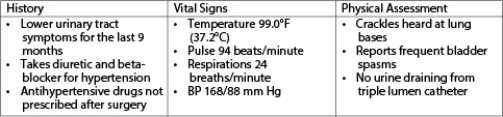
A) Elevated temperature
B) Respiratory rate and lung sounds
C) Bladder spasms and decreased urine output
D) No prescription for antihypertensive drugs
A) Elevated temperature
B) Respiratory rate and lung sounds
C) Bladder spasms and decreased urine output
D) No prescription for antihypertensive drugs
Question
Question
Question
Question
Question
Question
Question
Question
Question
Question
Question
Question
Question

Unlock Deck
Sign up to unlock the cards in this deck!
Unlock Deck
Unlock Deck
1/35

Play

Full screen (f)
Deck 51: Nursing Management: Male Reproductive Problems
1
A patient returning from surgery for a perineal radical prostatectomy will have a nursing diagnosis of risk for infection related to
A) urinary incontinence.
B) prolonged urinary stasis.
C) possible fecal wound contamination.
D) placement of a suprapubic bladder catheter.
A) urinary incontinence.
B) prolonged urinary stasis.
C) possible fecal wound contamination.
D) placement of a suprapubic bladder catheter.
possible fecal wound contamination.
2
When performing discharge teaching for a patient after a vasectomy,the nurse instructs the patient that he
A) should continue to use other methods of birth control for 6 weeks.
B) should not have sexual intercourse until his 6-week follow-up visit.
C) may have temporary erectile dysfunction (ED) because of swelling.
D) will notice a decrease in the appearance and volume of his ejaculate.
A) should continue to use other methods of birth control for 6 weeks.
B) should not have sexual intercourse until his 6-week follow-up visit.
C) may have temporary erectile dysfunction (ED) because of swelling.
D) will notice a decrease in the appearance and volume of his ejaculate.
should continue to use other methods of birth control for 6 weeks.
3
To determine the severity of the symptoms for a 68-year-old patient with benign prostatic hyperplasia (BPH)the nurse will ask the patient about
A) blood in the urine.
B) lower back or hip pain.
C) erectile dysfunction (ED).
D) force of the urinary stream.
A) blood in the urine.
B) lower back or hip pain.
C) erectile dysfunction (ED).
D) force of the urinary stream.
force of the urinary stream.
4
A patient with urinary obstruction from benign prostatic hyperplasia (BPH)tells the nurse,"My symptoms are much worse this week." Which response by the nurse is most appropriate?
A) "Have you been taking any over-the-counter (OTC) medications recently?"
B) "I will talk to the doctor about ordering a prostate specific antigen (PSA) test."
C) "Have you talked to the doctor about surgery such as transurethral resection of the prostate (TURP)?"
D) "The prostate gland changes in size from day to day, and this may be making your symptoms worse."
A) "Have you been taking any over-the-counter (OTC) medications recently?"
B) "I will talk to the doctor about ordering a prostate specific antigen (PSA) test."
C) "Have you talked to the doctor about surgery such as transurethral resection of the prostate (TURP)?"
D) "The prostate gland changes in size from day to day, and this may be making your symptoms worse."
Unlock Deck
Unlock for access to all 35 flashcards in this deck.
Unlock Deck
k this deck
5
The nurse will plan to teach the patient scheduled for photovaporization of the prostate (PVP)
A) that urine will appear bloody for several days.
B) how to care for an indwelling urinary catheter.
C) that symptom improvement takes 2 to 3 weeks.
D) about complications associated with urethral stenting.
A) that urine will appear bloody for several days.
B) how to care for an indwelling urinary catheter.
C) that symptom improvement takes 2 to 3 weeks.
D) about complications associated with urethral stenting.
Unlock Deck
Unlock for access to all 35 flashcards in this deck.
Unlock Deck
k this deck
6
A 58-year-old patient who has been recently diagnosed with benign prostatic hyperplasia (BPH)tells the nurse that he does not want to have a transurethral resection of the prostate (TURP)because it might affect his ability to maintain an erection during intercourse.Which action should the nurse take?
A) Provide teaching about medications for erectile dysfunction (ED).
B) Discuss that TURP does not commonly affect erectile function.
C) Offer reassurance that sperm production is not affected by TURP.
D) Discuss alternative methods of sexual expression besides intercourse.
A) Provide teaching about medications for erectile dysfunction (ED).
B) Discuss that TURP does not commonly affect erectile function.
C) Offer reassurance that sperm production is not affected by TURP.
D) Discuss alternative methods of sexual expression besides intercourse.
Unlock Deck
Unlock for access to all 35 flashcards in this deck.
Unlock Deck
k this deck
7
Which information about continuous bladder irrigation will the nurse teach to a patient who is being admitted for a transurethral resection of the prostate (TURP)?
A) Bladder irrigation decreases the risk of postoperative bleeding.
B) Hydration and urine output are maintained by bladder irrigation.
C) Antibiotics are infused continuously through the bladder irrigation.
D) Bladder irrigation prevents obstruction of the catheter after surgery.
A) Bladder irrigation decreases the risk of postoperative bleeding.
B) Hydration and urine output are maintained by bladder irrigation.
C) Antibiotics are infused continuously through the bladder irrigation.
D) Bladder irrigation prevents obstruction of the catheter after surgery.
Unlock Deck
Unlock for access to all 35 flashcards in this deck.
Unlock Deck
k this deck
8
The nurse performing a focused examination to determine possible causes of infertility will assess for
A) hydrocele.
B) varicocele.
C) epididymitis.
D) paraphimosis.
A) hydrocele.
B) varicocele.
C) epididymitis.
D) paraphimosis.
Unlock Deck
Unlock for access to all 35 flashcards in this deck.
Unlock Deck
k this deck
9
The nurse taking a focused health history for a patient with possible testicular cancer will ask the patient about a history of
A) testicular torsion.
B) testicular trauma.
C) undescended testicles.
D) sexually transmitted infection (STI).
A) testicular torsion.
B) testicular trauma.
C) undescended testicles.
D) sexually transmitted infection (STI).
Unlock Deck
Unlock for access to all 35 flashcards in this deck.
Unlock Deck
k this deck
10
A 70-year-old patient who has had a transurethral resection of the prostate (TURP)for benign prostatic hyperplasia (BPH)is being discharged from the hospital today,The nurse determines that additional instruction is needed when the patient says which of the following?
A) "I should call the doctor if I have incontinence at home."
B) "I will avoid driving until I get approval from my doctor."
C) "I will increase fiber and fluids in my diet to prevent constipation."
D) "I should continue to schedule yearly appointments for prostate exams."
A) "I should call the doctor if I have incontinence at home."
B) "I will avoid driving until I get approval from my doctor."
C) "I will increase fiber and fluids in my diet to prevent constipation."
D) "I should continue to schedule yearly appointments for prostate exams."
Unlock Deck
Unlock for access to all 35 flashcards in this deck.
Unlock Deck
k this deck
11
The nurse will anticipate that a 61-year-old patient who has an enlarged prostate detected by digital rectal examination (DRE)and an elevated prostate specific antigen (PSA)level will need teaching about
A) cystourethroscopy.
B) uroflowmetry studies.
C) magnetic resonance imaging (MRI).
D) transrectal ultrasonography (TRUS).
A) cystourethroscopy.
B) uroflowmetry studies.
C) magnetic resonance imaging (MRI).
D) transrectal ultrasonography (TRUS).
Unlock Deck
Unlock for access to all 35 flashcards in this deck.
Unlock Deck
k this deck
12
Which information will the nurse teach a patient who has chronic prostatitis?
A) Ibuprofen (Motrin) should provide good pain control.
B) Prescribed antibiotics should be taken for 7 to 10 days.
C) Intercourse or masturbation will help relieve symptoms.
D) Cold packs used every 4 hours will decrease inflammation.
A) Ibuprofen (Motrin) should provide good pain control.
B) Prescribed antibiotics should be taken for 7 to 10 days.
C) Intercourse or masturbation will help relieve symptoms.
D) Cold packs used every 4 hours will decrease inflammation.
Unlock Deck
Unlock for access to all 35 flashcards in this deck.
Unlock Deck
k this deck
13
Which information will the nurse plan to include when teaching a community health group about testicular self-examination?
A) Testicular self-examination should be done in a warm room.
B) The only structure normally felt in the scrotal sac is the testis.
C) Testicular self-examination should be done at least every week.
D) Call the health care provider if one testis is larger than the other.
A) Testicular self-examination should be done in a warm room.
B) The only structure normally felt in the scrotal sac is the testis.
C) Testicular self-examination should be done at least every week.
D) Call the health care provider if one testis is larger than the other.
Unlock Deck
Unlock for access to all 35 flashcards in this deck.
Unlock Deck
k this deck
14
The nurse will plan to provide teaching for a 67-year-old patient who has been diagnosed with orchitis about
A) pain management.
B) emergency surgical repair.
C) application of heat to the scrotum.
D) aspiration of fluid from the scrotal sac.
A) pain management.
B) emergency surgical repair.
C) application of heat to the scrotum.
D) aspiration of fluid from the scrotal sac.
Unlock Deck
Unlock for access to all 35 flashcards in this deck.
Unlock Deck
k this deck
15
A 53-year-old man is scheduled for an annual physical exam.The nurse will plan to teach the patient about the purpose of
A) urinalysis collection.
B) uroflowmetry studies.
C) prostate specific antigen (PSA) testing.
D) transrectal ultrasound scanning (TRUS).
A) urinalysis collection.
B) uroflowmetry studies.
C) prostate specific antigen (PSA) testing.
D) transrectal ultrasound scanning (TRUS).
Unlock Deck
Unlock for access to all 35 flashcards in this deck.
Unlock Deck
k this deck
16
A 27-year-old man who has testicular cancer is being admitted for a unilateral orchiectomy.The patient does not talk to his wife and speaks to the nurse only to answer the admission questions.Which action is best for the nurse to take?
A) Teach the patient and the wife that impotence is unlikely after unilateral orchiectomy.
B) Ask the patient if he has any questions or concerns about the diagnosis and treatment.
C) Document the patient's lack of communication on the chart and continue preoperative care.
D) Inform the patient's wife that concerns about sexual function are common with this diagnosis.
A) Teach the patient and the wife that impotence is unlikely after unilateral orchiectomy.
B) Ask the patient if he has any questions or concerns about the diagnosis and treatment.
C) Document the patient's lack of communication on the chart and continue preoperative care.
D) Inform the patient's wife that concerns about sexual function are common with this diagnosis.
Unlock Deck
Unlock for access to all 35 flashcards in this deck.
Unlock Deck
k this deck
17
A 52-year-old man tells the nurse that he decided to seek treatment for erectile dysfunction (ED)because his wife "is losing patience with the situation." The most appropriate nursing diagnosis for the patient is
A) situational low self-esteem related to effects of ED.
B) ineffective role performance related to effects of ED.
C) anxiety related to inability to have sexual intercourse.
D) ineffective sexuality patterns related to infrequent intercourse.
A) situational low self-esteem related to effects of ED.
B) ineffective role performance related to effects of ED.
C) anxiety related to inability to have sexual intercourse.
D) ineffective sexuality patterns related to infrequent intercourse.
Unlock Deck
Unlock for access to all 35 flashcards in this deck.
Unlock Deck
k this deck
18
A 57-year-old patient is incontinent of urine following a radical retropubic prostatectomy.The nurse will plan to teach the patient
A) to restrict oral fluid intake.
B) pelvic floor muscle exercises.
C) to perform intermittent self-catheterization.
D) the use of belladonna and opium suppositories.
A) to restrict oral fluid intake.
B) pelvic floor muscle exercises.
C) to perform intermittent self-catheterization.
D) the use of belladonna and opium suppositories.
Unlock Deck
Unlock for access to all 35 flashcards in this deck.
Unlock Deck
k this deck
19
The health care provider prescribes finasteride (Proscar)for a 67-year-old patient who has benign prostatic hyperplasia (BPH).When teaching the patient about the drug,the nurse informs him that
A) he should change position from lying to standing slowly to avoid dizziness.
B) his interest in sexual activity may decrease while he is taking the medication.
C) improvement in the obstructive symptoms should occur within about 2 weeks.
D) he will need to monitor his blood pressure frequently to assess for hypertension.
A) he should change position from lying to standing slowly to avoid dizziness.
B) his interest in sexual activity may decrease while he is taking the medication.
C) improvement in the obstructive symptoms should occur within about 2 weeks.
D) he will need to monitor his blood pressure frequently to assess for hypertension.
Unlock Deck
Unlock for access to all 35 flashcards in this deck.
Unlock Deck
k this deck
20
The nurse will inform a patient with cancer of the prostate that side effects of leuprolide (Lupron)may include
A) flushing.
B) dizziness.
C) infection.
D) incontinence.
A) flushing.
B) dizziness.
C) infection.
D) incontinence.
Unlock Deck
Unlock for access to all 35 flashcards in this deck.
Unlock Deck
k this deck
21
The nurse in a health clinic receives requests for appointments from several patients.Which patient should be seen by the health care provider first?
A) A 48-year-old man who has perineal pain and a temperature of 100.4° F
B) A 58-year-old man who has a painful erection that has lasted over 6 hours
C) A 38-year-old man who states he had difficulty maintaining an erection last night
D) A 68-year-old man who has pink urine after a transurethral resection of the prostate (TURP) 3 days ago
A) A 48-year-old man who has perineal pain and a temperature of 100.4° F
B) A 58-year-old man who has a painful erection that has lasted over 6 hours
C) A 38-year-old man who states he had difficulty maintaining an erection last night
D) A 68-year-old man who has pink urine after a transurethral resection of the prostate (TURP) 3 days ago
Unlock Deck
Unlock for access to all 35 flashcards in this deck.
Unlock Deck
k this deck
22
After reviewing the electronic medical record shown in the accompanying figure for a patient who had transurethral resection of the prostate the previous day,which information requires the most rapid action by the nurse?
A) Elevated temperature
B) Respiratory rate and lung sounds
C) Bladder spasms and decreased urine output
D) No prescription for antihypertensive drugs
A) Elevated temperature
B) Respiratory rate and lung sounds
C) Bladder spasms and decreased urine output
D) No prescription for antihypertensive drugs
Unlock Deck
Unlock for access to all 35 flashcards in this deck.
Unlock Deck
k this deck
23
The following male patients recently arrived in the emergency department.Which one should the nurse assess first?
A) 19-year-old who is complaining of severe scrotal pain
B) 60-year-old with a nontender ulceration of the glans penis
C) 22-year-old who has purulent urethral drainage and back pain
D) 64-year-old who has dysuria after brachytherapy for prostate cancer
A) 19-year-old who is complaining of severe scrotal pain
B) 60-year-old with a nontender ulceration of the glans penis
C) 22-year-old who has purulent urethral drainage and back pain
D) 64-year-old who has dysuria after brachytherapy for prostate cancer
Unlock Deck
Unlock for access to all 35 flashcards in this deck.
Unlock Deck
k this deck
24
A 58-year-old man with erectile dysfunction (ED)tells the nurse he is interested in using sildenafil (Viagra).Which action should the nurse take first?
A) Assure the patient that ED is common with aging.
B) Ask the patient about any prescription drugs he is taking.
C) Tell the patient that Viagra does not always work for ED.
D) Discuss the common adverse effects of erectogenic drugs.
A) Assure the patient that ED is common with aging.
B) Ask the patient about any prescription drugs he is taking.
C) Tell the patient that Viagra does not always work for ED.
D) Discuss the common adverse effects of erectogenic drugs.
Unlock Deck
Unlock for access to all 35 flashcards in this deck.
Unlock Deck
k this deck
25
When obtaining the pertinent health history for a man who is being evaluated for infertility,which question is most important for the nurse to ask?
A) "Are you circumcised?"
B) "Have you had surgery for phimosis?"
C) "Do you use medications to improve muscle mass?"
D) "Is there a history of prostate cancer in your family?"
A) "Are you circumcised?"
B) "Have you had surgery for phimosis?"
C) "Do you use medications to improve muscle mass?"
D) "Is there a history of prostate cancer in your family?"
Unlock Deck
Unlock for access to all 35 flashcards in this deck.
Unlock Deck
k this deck
26
A 22-year-old man tells the nurse at the health clinic that he has recently had some problems with erectile dysfunction.Which question should the nurse ask first to assess for possible etiologic factors?
A) "Do you experience an unusual amount of stress?"
B) "Do you use any recreational drugs or drink alcohol?"
C) "Do you have chronic cardiovascular or peripheral vascular disease?"
D) "Do you have a history of an erection that lasted for 6 hours or more?"
A) "Do you experience an unusual amount of stress?"
B) "Do you use any recreational drugs or drink alcohol?"
C) "Do you have chronic cardiovascular or peripheral vascular disease?"
D) "Do you have a history of an erection that lasted for 6 hours or more?"
Unlock Deck
Unlock for access to all 35 flashcards in this deck.
Unlock Deck
k this deck
27
Several patients call the urology clinic requesting appointments with the health care provider as soon as possible.Which patient will the nurse schedule to be seen first?
A) 22-year-old who has noticed a firm, nontender lump on his scrotum
B) 35-year-old who is concerned that his scrotum "feels like a bag of worms"
C) 40-year-old who has pelvic pain while being treated for chronic prostatitis
D) 70-year-old who is reporting frequent urinary dribbling after a prostatectomy
A) 22-year-old who has noticed a firm, nontender lump on his scrotum
B) 35-year-old who is concerned that his scrotum "feels like a bag of worms"
C) 40-year-old who has pelvic pain while being treated for chronic prostatitis
D) 70-year-old who is reporting frequent urinary dribbling after a prostatectomy
Unlock Deck
Unlock for access to all 35 flashcards in this deck.
Unlock Deck
k this deck
28
Which action by the unlicensed assistive personnel (UAP)who are assisting with the care of patients with male reproductive problems indicates that the nurse should provide more teaching?
A) The UAP apply a cold pack to the scrotum for a patient with mumps orchitis.
B) The UAP help a patient who has had a prostatectomy to put on antiembolism hose.
C) The UAP leave the foreskin pulled back after cleaning the glans of a patient who has a retention catheter.
D) The UAP encourage a high oral fluid intake for patient who had transurethral resection of the prostate yesterday.
A) The UAP apply a cold pack to the scrotum for a patient with mumps orchitis.
B) The UAP help a patient who has had a prostatectomy to put on antiembolism hose.
C) The UAP leave the foreskin pulled back after cleaning the glans of a patient who has a retention catheter.
D) The UAP encourage a high oral fluid intake for patient who had transurethral resection of the prostate yesterday.
Unlock Deck
Unlock for access to all 35 flashcards in this deck.
Unlock Deck
k this deck
29
A 71-year-old patient who has benign prostatic hyperplasia (BPH)with urinary retention is admitted to the hospital with elevated blood urea nitrogen (BUN)and creatinine.Which prescribed therapy should the nurse implement first?
A) Infuse normal saline at 50 mL/hr.
B) Insert a urinary retention catheter.
C) Draw blood for a complete blood count.
D) Schedule a pelvic computed tomography (CT) scan.
A) Infuse normal saline at 50 mL/hr.
B) Insert a urinary retention catheter.
C) Draw blood for a complete blood count.
D) Schedule a pelvic computed tomography (CT) scan.
Unlock Deck
Unlock for access to all 35 flashcards in this deck.
Unlock Deck
k this deck
30
A 76-year-old patient who has been diagnosed with stage 2 prostate cancer chooses the option of active surveillance.The nurse will plan to
A) vaccinate the patient with sipuleucel-T ( Provenge).
B) provide the patient with information about cryotherapy.
C) teach the patient about placement of intraurethral stents.
D) schedule the patient for annual prostate-specific antigen testing.
A) vaccinate the patient with sipuleucel-T ( Provenge).
B) provide the patient with information about cryotherapy.
C) teach the patient about placement of intraurethral stents.
D) schedule the patient for annual prostate-specific antigen testing.
Unlock Deck
Unlock for access to all 35 flashcards in this deck.
Unlock Deck
k this deck
31
Which assessment information is most important for the nurse to report to the health care provider when a patient asks for a prescription for testosterone replacement therapy (TRT)?
A) The patient has noticed a decrease in energy level for a few years.
B) The patient's symptoms have increased steadily over the last few years.
C) The patient has been using sildenafil (Viagra) several times every week.
D) The patient has had a gradual decrease in the force of his urinary stream.
A) The patient has noticed a decrease in energy level for a few years.
B) The patient's symptoms have increased steadily over the last few years.
C) The patient has been using sildenafil (Viagra) several times every week.
D) The patient has had a gradual decrease in the force of his urinary stream.
Unlock Deck
Unlock for access to all 35 flashcards in this deck.
Unlock Deck
k this deck
32
The nurse in the clinic notes elevated prostate specific antigen (PSA)levels in the laboratory results of these patients.Which patient's PSA result is most important to report to the health care provider?
A) A 38-year-old who is being treated for acute prostatitis
B) A 48-year-old whose father died of metastatic prostate cancer
C) A 52-year-old who goes on long bicycle rides every weekend
D) A 75-year-old who uses saw palmetto to treat benign prostatic hyperplasia (BPH)
A) A 38-year-old who is being treated for acute prostatitis
B) A 48-year-old whose father died of metastatic prostate cancer
C) A 52-year-old who goes on long bicycle rides every weekend
D) A 75-year-old who uses saw palmetto to treat benign prostatic hyperplasia (BPH)
Unlock Deck
Unlock for access to all 35 flashcards in this deck.
Unlock Deck
k this deck
33
The health care provider prescribes the following interventions for a patient with acute prostatitis caused by E.coli.Which intervention should the nurse question?
A) Instruct patient to avoid sexual intercourse until treatment is complete.
B) Administer ibuprofen (Advil) 400 mg every 8 hours as needed for pain.
C) Catheterize the patient as needed if symptoms of urinary retention develop.
D) Give trimethoprim/sulfamethoxazole (Bactrim) DS 1 tablet daily for 28 days.
A) Instruct patient to avoid sexual intercourse until treatment is complete.
B) Administer ibuprofen (Advil) 400 mg every 8 hours as needed for pain.
C) Catheterize the patient as needed if symptoms of urinary retention develop.
D) Give trimethoprim/sulfamethoxazole (Bactrim) DS 1 tablet daily for 28 days.
Unlock Deck
Unlock for access to all 35 flashcards in this deck.
Unlock Deck
k this deck
34
When caring for a patient with continuous bladder irrigation after having transurethral resection of the prostate,which action could the nurse delegate to unlicensed assistive personnel (UAP)?
A) Teach the patient how to perform Kegel exercises.
B) Report any complaints of pain or spasms to the nurse.
C) Monitor for increases in bleeding or presence of clots.
D) Increase the flow rate of the irrigation if clots are noted.
A) Teach the patient how to perform Kegel exercises.
B) Report any complaints of pain or spasms to the nurse.
C) Monitor for increases in bleeding or presence of clots.
D) Increase the flow rate of the irrigation if clots are noted.
Unlock Deck
Unlock for access to all 35 flashcards in this deck.
Unlock Deck
k this deck
35
After a transurethral resection of the prostate (TURP),a 64-year-old patient with continuous bladder irrigation complains of painful bladder spasms.The nurse observes clots in the urine.Which action should the nurse take first?
A) Increase the flow rate of the bladder irrigation.
B) Administer the prescribed IV morphine sulfate.
C) Give the patient the prescribed belladonna and opium suppository.
D) Manually instill and then withdraw 50 mL of saline into the catheter.
A) Increase the flow rate of the bladder irrigation.
B) Administer the prescribed IV morphine sulfate.
C) Give the patient the prescribed belladonna and opium suppository.
D) Manually instill and then withdraw 50 mL of saline into the catheter.
Unlock Deck
Unlock for access to all 35 flashcards in this deck.
Unlock Deck
k this deck
Unlock Deck
Unlock for access to all 35 flashcards in this deck.






