







 Chat with AI

Deck 31: Plant Structure, Growth, and Reproduction
Full screen (f)

Question

Question
Question
Question
Question
Question
Question
Question
Question
Question
Question
Question
Question
Question
Question
Question
Question
Question
Question
Question
Question
Question
Question
Question
Question
Question
Question
Question
Question
Question
Question
Question
Question
Question
Question
Question
Question
Question
Question
Question
Question
Question
Question
Question
Question
Question
Question
Question
Question
Question
Question
Question
Question
Question
Question
Question
Question
Question
Question
Question
Question
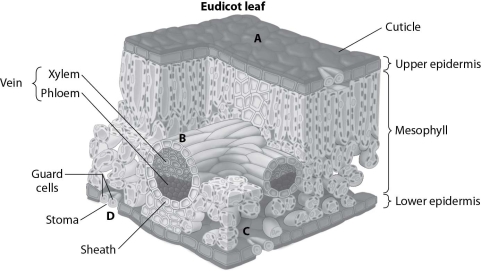
In the figure above, which structure allows sufficient water to enter the leaf?
A)structure A
B)structure B
C)structure C
D)structure D
Question
In the figure above, which structure can change to regulate the amount of CO₂ entering the leaf?
A)structure A
B)structure B
C)structure C
D)structure D
Question
In the figure above, which structure transports the products of photosynthesis?
A)structure A
B)structure B
C)structure C
D)structure D
Question
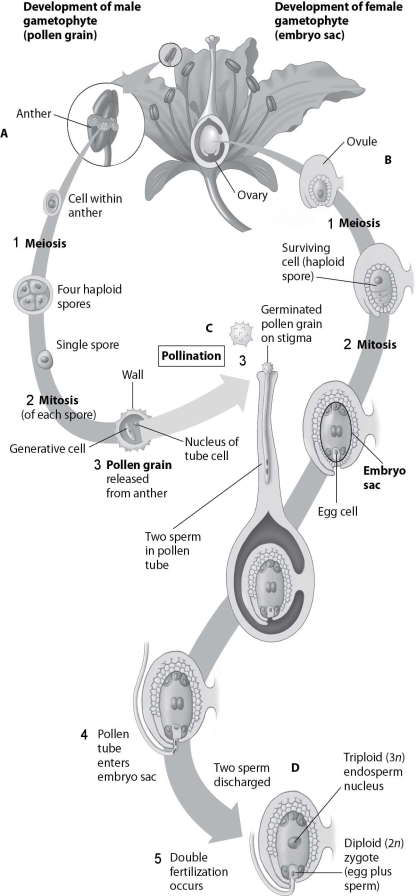
Which structure in the image has a different number of chromosomes than the others?
A)structure A
B)structure B
C)structure C
D)structure D
Question
Question
Question
Question
This image represents monocots and eudicots. Which column shows traits that are incorrectly categorized?
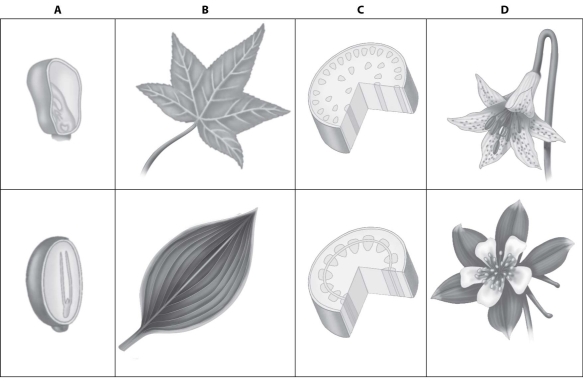
A)column A
B)column B
C)column C
D)column D
Question
Which part of this seed contains stored food that allows the seed to grow until it can perform photosynthesis? 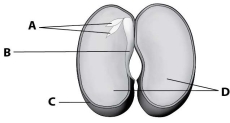
A)part A
B)part B
C)part C
D)part D
A)part A
B)part B
C)part C
D)part D
Question
In the figure above, which structures ensure that too much water does not leave the leaf?
A)structures A and B
B)structures B and C
C)structures C and D
D)structures D and A
Question
Question
Which part of this root tip is the apical meristem? 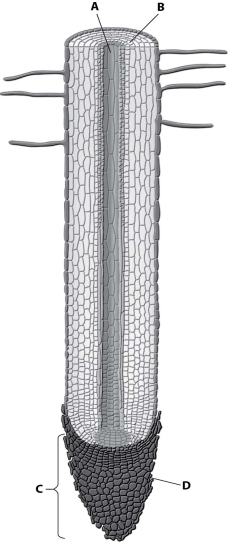
A)part A
B)part B
C)part C
D)part D
A)part A
B)part B
C)part C
D)part D
Question
In which structure will meiosis occur?
A)structure A
B)the petals of the flower
C)structure C
D)structure D
Question
Question
Question
Question
In the figure above, if the leaf is like a solar panel receiving light energy and converting it to another form of energy, structure A is like what part of the solar panel?
A)the clear covering that allows sunlight in where it can be converted to another type of energy
B)the wires leading the transformed energy to the point of energy use or storage
C)the point of attachment of the solar panel to a rooftop
D)the cells in the panel that trap light energy
Question
Which of the following statements, according to this figure, is true?
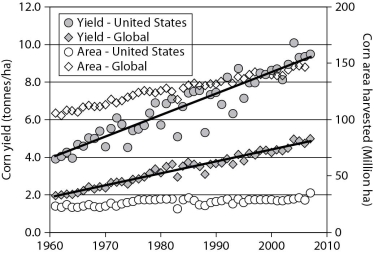
A)The efficiency of corn production (yield per area)in the United States has increased more than global efficiency.
B)The efficiency of global corn production (yield per area)has increased more than efficiency in the United States.
C)Global production efficiency was greater prior to 1980 than since 1980.
D)The efficiency of U.S. production has decreased.
Question
Which structure is the result of double fertilization?
A)structure A
B)structure B
C)structure C
D)structure D

Unlock Deck
Sign up to unlock the cards in this deck!
Unlock Deck
Unlock Deck
1/79

Play

Full screen (f)
Deck 31: Plant Structure, Growth, and Reproduction
1
A plant stem modified for storage of food such as starch is called a
A)bulb.
B)tuber.
C)taproot.
D)runner.
A)bulb.
B)tuber.
C)taproot.
D)runner.
B
2
Which of the following structures is found in both plant and animal cells?
A)chloroplasts
B)mitochondria
C)a large central vacuole containing fluid
D)cell wall surrounding the plasma membrane
A)chloroplasts
B)mitochondria
C)a large central vacuole containing fluid
D)cell wall surrounding the plasma membrane
B
3
Which of the following plant cells or tissues help regulate the movement of carbon dioxide into and out of a leaf?
A)guard cells
B)root hairs
C)sieve tubes
D)xylem
A)guard cells
B)root hairs
C)sieve tubes
D)xylem
A
4
Monocot floral parts usually occur in multiples of
A)five.
B)four.
C)two.
D)three.
A)five.
B)four.
C)two.
D)three.
Unlock Deck
Unlock for access to all 79 flashcards in this deck.
Unlock Deck
k this deck
5
Which type of vascular tissue cell in a plant is dead at maturity?
A)vessel elements
B)companion cells
C)sieve-tube cells
D)parenchyma cells
A)vessel elements
B)companion cells
C)sieve-tube cells
D)parenchyma cells
Unlock Deck
Unlock for access to all 79 flashcards in this deck.
Unlock Deck
k this deck
6
The tallest plant on Earth is
A)a 500-foot kelp living off the coast of California.
B)a 379-foot redwood tree in California.
C)a 740-foot white oak tree in Illinois.
D)a giant seed fern in southern Peru.
A)a 500-foot kelp living off the coast of California.
B)a 379-foot redwood tree in California.
C)a 740-foot white oak tree in Illinois.
D)a giant seed fern in southern Peru.
Unlock Deck
Unlock for access to all 79 flashcards in this deck.
Unlock Deck
k this deck
7
Photosynthesis occurs in which type of plant tissue?
A)parenchyma
B)vascular cambium
C)epidermal tissue
D)collenchyma
A)parenchyma
B)vascular cambium
C)epidermal tissue
D)collenchyma
Unlock Deck
Unlock for access to all 79 flashcards in this deck.
Unlock Deck
k this deck
8
Which of the following statements is false?
A)The ground tissue system of a leaf is called the mesophyll.
B)Each vein in a leaf is composed of either xylem or phloem, but not both.
C)The pith of a stem is often important in food storage.
D)Tissues that are neither dermal nor vascular are known as the ground tissue system.
A)The ground tissue system of a leaf is called the mesophyll.
B)Each vein in a leaf is composed of either xylem or phloem, but not both.
C)The pith of a stem is often important in food storage.
D)Tissues that are neither dermal nor vascular are known as the ground tissue system.
Unlock Deck
Unlock for access to all 79 flashcards in this deck.
Unlock Deck
k this deck
9
Sieve-tube elements are plant cells that are part of a plant tissue called
A)xylem.
B)tracheids.
C)phloem.
D)sclereids.
A)xylem.
B)tracheids.
C)phloem.
D)sclereids.
Unlock Deck
Unlock for access to all 79 flashcards in this deck.
Unlock Deck
k this deck
10
Removing the terminal bud of a plant that shows apical dominance will cause
A)an increase in the growth of the root system.
B)increased growth of the terminal bud.
C)increased growth of the axillary buds.
D)an immediate flowering of the plant.
A)an increase in the growth of the root system.
B)increased growth of the terminal bud.
C)increased growth of the axillary buds.
D)an immediate flowering of the plant.
Unlock Deck
Unlock for access to all 79 flashcards in this deck.
Unlock Deck
k this deck
11
Which of the following substances, by providing strength, allows sclerenchyma cells to provide support and play a role analogous to that of an animal's skeleton?
A)lignin
B)sucrose
C)starch
D)chlorophyll
A)lignin
B)sucrose
C)starch
D)chlorophyll
Unlock Deck
Unlock for access to all 79 flashcards in this deck.
Unlock Deck
k this deck
12
In general, plant dermal tissues are found
A)at the outer surface of a plant.
B)near the center of the plant stems and roots.
C)lining the vascular tissue.
D)throughout the plant body.
A)at the outer surface of a plant.
B)near the center of the plant stems and roots.
C)lining the vascular tissue.
D)throughout the plant body.
Unlock Deck
Unlock for access to all 79 flashcards in this deck.
Unlock Deck
k this deck
13
The cells that store starch in dicot roots are located between the
A)xylem and the phloem.
B)epidermis and the root hairs.
C)epidermis and the vascular cylinder.
D)epidermis and the cortex.
A)xylem and the phloem.
B)epidermis and the root hairs.
C)epidermis and the vascular cylinder.
D)epidermis and the cortex.
Unlock Deck
Unlock for access to all 79 flashcards in this deck.
Unlock Deck
k this deck
14
Most angiosperms are dicots, and most dicots are
A)cycads.
B)gymnosperms.
C)eudicots.
D)mosses.
A)cycads.
B)gymnosperms.
C)eudicots.
D)mosses.
Unlock Deck
Unlock for access to all 79 flashcards in this deck.
Unlock Deck
k this deck
15
Which of the following statements is false?
A)Stalks of celery are the petioles of the plant.
B)White potatoes are modified plant roots.
C)A carrot is an example of a taproot.
D)The layers of an onion are actually modified leaves.
A)Stalks of celery are the petioles of the plant.
B)White potatoes are modified plant roots.
C)A carrot is an example of a taproot.
D)The layers of an onion are actually modified leaves.
Unlock Deck
Unlock for access to all 79 flashcards in this deck.
Unlock Deck
k this deck
16
The chief function of root hairs is to
A)decrease the anchoring power of roots.
B)increase the surface area for absorption of water and minerals.
C)provide a direct passageway from the soil to the vascular cylinder.
D)provide a home for symbiotic bacteria.
A)decrease the anchoring power of roots.
B)increase the surface area for absorption of water and minerals.
C)provide a direct passageway from the soil to the vascular cylinder.
D)provide a home for symbiotic bacteria.
Unlock Deck
Unlock for access to all 79 flashcards in this deck.
Unlock Deck
k this deck
17
Which of the following statements is false?
A)Stems and leaves depend on the water and minerals absorbed by the roots.
B)Roots depend upon sugars produced in photosynthetic organs such as leaves.
C)Plant root hairs help to absorb carbon dioxide from the soil.
D)The shoot system of a plant consists of the stems, leaves, and adaptations for reproduction.
A)Stems and leaves depend on the water and minerals absorbed by the roots.
B)Roots depend upon sugars produced in photosynthetic organs such as leaves.
C)Plant root hairs help to absorb carbon dioxide from the soil.
D)The shoot system of a plant consists of the stems, leaves, and adaptations for reproduction.
Unlock Deck
Unlock for access to all 79 flashcards in this deck.
Unlock Deck
k this deck
18
Which of the following is a characteristic of eudicots?
A)parallel leaf venation
B)vascular bundles scattered throughout the stem
C)a flower with six petals
D)a taproot system
A)parallel leaf venation
B)vascular bundles scattered throughout the stem
C)a flower with six petals
D)a taproot system
Unlock Deck
Unlock for access to all 79 flashcards in this deck.
Unlock Deck
k this deck
19
What is the node of a plant stem?
A)the point of leaf attachment
B)the point of apical dominance
C)the area between the shoots and the roots
D)a small pore where gases are exchanged
A)the point of leaf attachment
B)the point of apical dominance
C)the area between the shoots and the roots
D)a small pore where gases are exchanged
Unlock Deck
Unlock for access to all 79 flashcards in this deck.
Unlock Deck
k this deck
20
What event that occurred around 10,000 years ago led to genetic changes in many of the plants we are most familiar with?
A)the beginning of agriculture
B)the domestication of animals
C)the invention of genetic engineering
D)the mass extinction of herbivores
A)the beginning of agriculture
B)the domestication of animals
C)the invention of genetic engineering
D)the mass extinction of herbivores
Unlock Deck
Unlock for access to all 79 flashcards in this deck.
Unlock Deck
k this deck
21
Which of the following flower parts produces female gametophytes?
A)anthers
B)ovules
C)stigmas
D)sepals
A)anthers
B)ovules
C)stigmas
D)sepals
Unlock Deck
Unlock for access to all 79 flashcards in this deck.
Unlock Deck
k this deck
22
Bark consists of
A)functioning xylem, secondary phloem, cork cambium, and cork.
B)secondary phloem, cork cambium, and cork.
C)cork cambium and cork.
D)cork only.
A)functioning xylem, secondary phloem, cork cambium, and cork.
B)secondary phloem, cork cambium, and cork.
C)cork cambium and cork.
D)cork only.
Unlock Deck
Unlock for access to all 79 flashcards in this deck.
Unlock Deck
k this deck
23
The growth that pushes a root down through the soil takes place through
A)cell elongation at the tip of the root cap.
B)cell division in the apical meristem.
C)cell elongation behind the root tip.
D)differentiation of xylem cells in the apical meristem.
A)cell elongation at the tip of the root cap.
B)cell division in the apical meristem.
C)cell elongation behind the root tip.
D)differentiation of xylem cells in the apical meristem.
Unlock Deck
Unlock for access to all 79 flashcards in this deck.
Unlock Deck
k this deck
24
Before it opens up into full blossom, the outer green layer of a rosebud consists of the leaflike
A)sepals.
B)stamen.
C)ovary.
D)petals.
A)sepals.
B)stamen.
C)ovary.
D)petals.
Unlock Deck
Unlock for access to all 79 flashcards in this deck.
Unlock Deck
k this deck
25
The increase in girth associated with production of wood and bark in trees occurs as a consequence of
A)primary growth.
B)secondary growth.
C)growth in apical meristems.
D)indeterminate growth.
A)primary growth.
B)secondary growth.
C)growth in apical meristems.
D)indeterminate growth.
Unlock Deck
Unlock for access to all 79 flashcards in this deck.
Unlock Deck
k this deck
26
Which of the following cells provide flexible support to the growing parts of plants?
A)collenchyma cells
B)sieve-tube elements
C)sclerenchyma cells
D)parenchyma cells
A)collenchyma cells
B)sieve-tube elements
C)sclerenchyma cells
D)parenchyma cells
Unlock Deck
Unlock for access to all 79 flashcards in this deck.
Unlock Deck
k this deck
27
How many chromosomes are there in a maize egg cell nucleus as compared to a maize pollen cell nucleus?
A)half as many
B)twice as many
C)the same number
D)half as many or the same number, depending on whether the pollen cell has divided to produce sperm or not
A)half as many
B)twice as many
C)the same number
D)half as many or the same number, depending on whether the pollen cell has divided to produce sperm or not
Unlock Deck
Unlock for access to all 79 flashcards in this deck.
Unlock Deck
k this deck
28
In a flowering plant, the cells that give rise to sperm undergo meiosis in the
A)ovaries.
B)sepals.
C)anthers.
D)stigma.
A)ovaries.
B)sepals.
C)anthers.
D)stigma.
Unlock Deck
Unlock for access to all 79 flashcards in this deck.
Unlock Deck
k this deck
29
Which of the following is a function of tracheids?
A)food storage
B)photosynthesis
C)production of sex cells
D)water conduction
A)food storage
B)photosynthesis
C)production of sex cells
D)water conduction
Unlock Deck
Unlock for access to all 79 flashcards in this deck.
Unlock Deck
k this deck
30
The male organ of a flower is the
A)style.
B)stamen.
C)sepal.
D)carpel.
A)style.
B)stamen.
C)sepal.
D)carpel.
Unlock Deck
Unlock for access to all 79 flashcards in this deck.
Unlock Deck
k this deck
31
How many layers of vascular cambium will there be in the trunk of a 10-year-old tree?
A)one
B)two
C)ten
D)thousands
A)one
B)two
C)ten
D)thousands
Unlock Deck
Unlock for access to all 79 flashcards in this deck.
Unlock Deck
k this deck
32
Flowers bear seeds that develop from ovules housed in protective chambers called
A)stamens.
B)sepals.
C)ovaries.
D)antheridia.
A)stamens.
B)sepals.
C)ovaries.
D)antheridia.
Unlock Deck
Unlock for access to all 79 flashcards in this deck.
Unlock Deck
k this deck
33
Most trees and shrubs continue to grow year after year. Such plants are known as
A)biennials.
B)perennials.
C)annuals.
D)superannuals.
A)biennials.
B)perennials.
C)annuals.
D)superannuals.
Unlock Deck
Unlock for access to all 79 flashcards in this deck.
Unlock Deck
k this deck
34
The three tissue systems of a mature plant root complete their development in the root zone of
A)elongation.
B)cell division.
C)differentiation.
D)vascularization.
A)elongation.
B)cell division.
C)differentiation.
D)vascularization.
Unlock Deck
Unlock for access to all 79 flashcards in this deck.
Unlock Deck
k this deck
35
A vascular cambium cell divides to produce an inner and an outer daughter cell. Which of the following represents the probable fate of these cells?
A)Both cells continue to divide to produce wood.
B)The inner cell will differentiate into xylem, and the outer cell will divide again.
C)The inner cell will differentiate into phloem, and the outer cell will differentiate into xylem.
D)Both cells will continue to divide without differentiating into specialized cells.
A)Both cells continue to divide to produce wood.
B)The inner cell will differentiate into xylem, and the outer cell will divide again.
C)The inner cell will differentiate into phloem, and the outer cell will differentiate into xylem.
D)Both cells will continue to divide without differentiating into specialized cells.
Unlock Deck
Unlock for access to all 79 flashcards in this deck.
Unlock Deck
k this deck
36
If you carve your initials in the trunk of a tree, will they move up as the tree grows?
A)Yes. A tree elongates from the ground up.
B)Yes. Secondary growth will cause them to move up.
C)No. Elongation occurs just below the tips of growing stems in the apical meristems.
D)Yes. Growth continues in all parts of a plant throughout its life.
A)Yes. A tree elongates from the ground up.
B)Yes. Secondary growth will cause them to move up.
C)No. Elongation occurs just below the tips of growing stems in the apical meristems.
D)Yes. Growth continues in all parts of a plant throughout its life.
Unlock Deck
Unlock for access to all 79 flashcards in this deck.
Unlock Deck
k this deck
37
New growth that increases stem length on a plant arises mainly from
A)the base of the stem.
B)apical meristems.
C)the tips of leaves.
D)the vascular cambium.
A)the base of the stem.
B)apical meristems.
C)the tips of leaves.
D)the vascular cambium.
Unlock Deck
Unlock for access to all 79 flashcards in this deck.
Unlock Deck
k this deck
38
What is the difference between the heartwood and sapwood of a tree?
A)Heartwood contains xylem, and sapwood contains phloem.
B)Sapwood contains xylem, and heartwood contains phloem.
C)Heartwood no longer transports water and minerals, and sapwood still conducts xylem sap.
D)Heartwood contains old phloem that no longer functions, and sapwood contains functioning phloem.
A)Heartwood contains xylem, and sapwood contains phloem.
B)Sapwood contains xylem, and heartwood contains phloem.
C)Heartwood no longer transports water and minerals, and sapwood still conducts xylem sap.
D)Heartwood contains old phloem that no longer functions, and sapwood contains functioning phloem.
Unlock Deck
Unlock for access to all 79 flashcards in this deck.
Unlock Deck
k this deck
39
A woody plant lives through five years of drought, followed by five years of good growing conditions. The ring of xylem cells formed during the five good years will
A)be thicker than those formed during the drought years.
B)be living, whereas those formed during the drought years will be dead.
C)be thinner than those formed during the drought years.
D)conduct a higher ratio of sugar to water than those formed during the drought years.
A)be thicker than those formed during the drought years.
B)be living, whereas those formed during the drought years will be dead.
C)be thinner than those formed during the drought years.
D)conduct a higher ratio of sugar to water than those formed during the drought years.
Unlock Deck
Unlock for access to all 79 flashcards in this deck.
Unlock Deck
k this deck
40
In a showy flower such as a magnolia or rose, the flower parts that play the main role in attracting the notice of animal pollinators are the
A)petals.
B)sepals.
C)fruits.
D)stigmas.
A)petals.
B)sepals.
C)fruits.
D)stigmas.
Unlock Deck
Unlock for access to all 79 flashcards in this deck.
Unlock Deck
k this deck
41
Which of the following is an advantage of cloning horticultural crops over sexual propagation?
A)Cloned plants are healthier and less susceptible to disease.
B)Cloning plants can allow growers to produce large numbers of plants with minimal effort and expense.
C)Cloned plants grow more slowly but have stronger stems.
D)Cloning provides more variation in flower color and size.
A)Cloned plants are healthier and less susceptible to disease.
B)Cloning plants can allow growers to produce large numbers of plants with minimal effort and expense.
C)Cloned plants grow more slowly but have stronger stems.
D)Cloning provides more variation in flower color and size.
Unlock Deck
Unlock for access to all 79 flashcards in this deck.
Unlock Deck
k this deck
42
Which of the following statements about germination is false?
A)The germination of a seed represents the beginning of life.
B)Germination usually begins when a seed takes up water.
C)A hydrated seed expands, rupturing its seed coat.
D)Germination usually takes place after a period of dormancy.
A)The germination of a seed represents the beginning of life.
B)Germination usually begins when a seed takes up water.
C)A hydrated seed expands, rupturing its seed coat.
D)Germination usually takes place after a period of dormancy.
Unlock Deck
Unlock for access to all 79 flashcards in this deck.
Unlock Deck
k this deck
43
The genetically identical organisms that result from asexual reproduction are called
A)clones.
B)seeds.
C)seedlings.
D)rootlets.
A)clones.
B)seeds.
C)seedlings.
D)rootlets.
Unlock Deck
Unlock for access to all 79 flashcards in this deck.
Unlock Deck
k this deck
44
The "halves" of an individual peanut, which represent its cotyledons, develop from the fertilized zygote and are composed of
A)triploid endosperm cells.
B)haploid endosperm cells.
C)diploid embryo sporophyte cells.
D)diploid maternal sporophyte cells.
A)triploid endosperm cells.
B)haploid endosperm cells.
C)diploid embryo sporophyte cells.
D)diploid maternal sporophyte cells.
Unlock Deck
Unlock for access to all 79 flashcards in this deck.
Unlock Deck
k this deck
45
A seed develops from a(n)
A)pollen grain.
B)fruit.
C)ovary.
D)ovule.
A)pollen grain.
B)fruit.
C)ovary.
D)ovule.
Unlock Deck
Unlock for access to all 79 flashcards in this deck.
Unlock Deck
k this deck
46
Which of the following is a function of fruits?
A)production of food for the developing embryo
B)pollen dispersal
C)seed dispersal
D)attracting pollinators
A)production of food for the developing embryo
B)pollen dispersal
C)seed dispersal
D)attracting pollinators
Unlock Deck
Unlock for access to all 79 flashcards in this deck.
Unlock Deck
k this deck
47
How does the sperm of an angiosperm reach the egg?
A)via the pollen tube that grows from the pollen grain through the carpel tissues to the ovule
B)via the pollen tube that grows from the ovule to reach the pollen grain on the stigma
C)usually via an insect, which places sperm in the ovary while probing for nectar
D)by actively swimming down through the style to the egg
A)via the pollen tube that grows from the pollen grain through the carpel tissues to the ovule
B)via the pollen tube that grows from the ovule to reach the pollen grain on the stigma
C)usually via an insect, which places sperm in the ovary while probing for nectar
D)by actively swimming down through the style to the egg
Unlock Deck
Unlock for access to all 79 flashcards in this deck.
Unlock Deck
k this deck
48
Which of the following plant parts commonly contributes to asexual reproduction?
A)seeds
B)roots
C)flowers
D)fruits
A)seeds
B)roots
C)flowers
D)fruits
Unlock Deck
Unlock for access to all 79 flashcards in this deck.
Unlock Deck
k this deck
49
Foreign genes can be inserted into a single plant cell that is then cultured to produce
A)a genetically modified plant.
B)genetically modified seeds.
C)a new plant species.
D)clones of the organisms from which the genes were taken.
A)a genetically modified plant.
B)genetically modified seeds.
C)a new plant species.
D)clones of the organisms from which the genes were taken.
Unlock Deck
Unlock for access to all 79 flashcards in this deck.
Unlock Deck
k this deck
50
Which of the following structures is the first to emerge from the germinating seed of a eudicot such as the garden bean?
A)the embryonic shoot hook
B)cotyledons
C)the embryonic root
D)the shoot sheath
A)the embryonic shoot hook
B)cotyledons
C)the embryonic root
D)the shoot sheath
Unlock Deck
Unlock for access to all 79 flashcards in this deck.
Unlock Deck
k this deck
51
In angiosperms, the process of ________ ensures that the endosperm will develop only in ovules containing a fertilized egg.
A)cytogenesis
B)meiosis
C)double fertilization
D)cytokinesis
A)cytogenesis
B)meiosis
C)double fertilization
D)cytokinesis
Unlock Deck
Unlock for access to all 79 flashcards in this deck.
Unlock Deck
k this deck
52
While cleaning out the attic, you find a packet of seeds that your grandmother gathered from her garden. You plant them outside, and some of them sprout. What was the condition of these germinating seeds while they were in the attic?
A)The endosperm cells were dead; the embryo cells were alive but inactive.
B)They were dead, but the embryo cells revived in response to water.
C)They were alive and very metabolically active.
D)They were alive but dormant.
A)The endosperm cells were dead; the embryo cells were alive but inactive.
B)They were dead, but the embryo cells revived in response to water.
C)They were alive and very metabolically active.
D)They were alive but dormant.
Unlock Deck
Unlock for access to all 79 flashcards in this deck.
Unlock Deck
k this deck
53
A number of studies have found that for many plants there is an increase in seed production under conditions of elevated carbon dioxide levels. Which of the following is a likely explanation for this phenomenon?
A)The energy needed to produce seeds comes from carbon dioxide.
B)The carbon needed to produce new plant molecules through photosynthesis requires carbon dioxide.
C)Increased carbon dioxide levels cause increased cell respiration, which is needed to produce more seeds.
D)Increased carbon dioxide causes increased plant heating, which speeds up seed production.
A)The energy needed to produce seeds comes from carbon dioxide.
B)The carbon needed to produce new plant molecules through photosynthesis requires carbon dioxide.
C)Increased carbon dioxide levels cause increased cell respiration, which is needed to produce more seeds.
D)Increased carbon dioxide causes increased plant heating, which speeds up seed production.
Unlock Deck
Unlock for access to all 79 flashcards in this deck.
Unlock Deck
k this deck
54
How many chromosomes are there in a maize embryo cell nucleus as compared to a maize endosperm cell nucleus?
A)half as many
B)two-thirds as many
C)the same number
D)twice as many
A)half as many
B)two-thirds as many
C)the same number
D)twice as many
Unlock Deck
Unlock for access to all 79 flashcards in this deck.
Unlock Deck
k this deck
55
In which of the following situations would plant reproduction be most likely to be pollinator-limited?
A)a very large field of a single crop covering a large area
B)a field of wildflowers in a very cold region
C)a species of plant with a very long growing season
D)plants that produce large fruits
A)a very large field of a single crop covering a large area
B)a field of wildflowers in a very cold region
C)a species of plant with a very long growing season
D)plants that produce large fruits
Unlock Deck
Unlock for access to all 79 flashcards in this deck.
Unlock Deck
k this deck
56
A mature ovary, specialized as a vessel that houses and protects seeds, is a
A)fruit.
B)ovule.
C)cotyledon.
D)seed coat.
A)fruit.
B)ovule.
C)cotyledon.
D)seed coat.
Unlock Deck
Unlock for access to all 79 flashcards in this deck.
Unlock Deck
k this deck
57
One assumption about plant reproduction is that because it requires so many resources (energy and molecules), reproductive output is resource-limited. Which of the following statements provides evidence that this assumption may be incorrect?
A)There is a correlation between the amount of sunlight a plant receives and how much fruit it produces.
B)Hand-pollinated plants produce more seeds than naturally pollinated plants.
C)Plants growing in moist conditions produce more flowers than plants growing in dry conditions.
D)Domesticated plants produce more seeds than wild plants.
A)There is a correlation between the amount of sunlight a plant receives and how much fruit it produces.
B)Hand-pollinated plants produce more seeds than naturally pollinated plants.
C)Plants growing in moist conditions produce more flowers than plants growing in dry conditions.
D)Domesticated plants produce more seeds than wild plants.
Unlock Deck
Unlock for access to all 79 flashcards in this deck.
Unlock Deck
k this deck
58
Which of the following is a disadvantage of cloning as a propagation technique?
A)Cloning produces monocultures that can potentially be wiped out by a single disease.
B)Cloning is more expensive and more difficult than growing from seeds.
C)Cloning is time-consuming, with slow results.
D)Cloned organisms are dangerous and unpredictable.
A)Cloning produces monocultures that can potentially be wiped out by a single disease.
B)Cloning is more expensive and more difficult than growing from seeds.
C)Cloning is time-consuming, with slow results.
D)Cloned organisms are dangerous and unpredictable.
Unlock Deck
Unlock for access to all 79 flashcards in this deck.
Unlock Deck
k this deck
59
What is the evolutionary advantage of the very long life span of some plants?
A)the ability to adapt to changing environments
B)the ability to develop resistance to many diseases
C)the ability to produce many offspring over many years
D)the ability to grow back after being damaged
A)the ability to adapt to changing environments
B)the ability to develop resistance to many diseases
C)the ability to produce many offspring over many years
D)the ability to grow back after being damaged
Unlock Deck
Unlock for access to all 79 flashcards in this deck.
Unlock Deck
k this deck
60
What happens to the cotyledons of pea and maize seeds?
A)They remain in the soil and decompose.
B)They form a protective sheath around the developing root system.
C)They surround the base of the shoot to provide additional strength.
D)They immediately begin to use the sun's energy in photosynthesis.
A)They remain in the soil and decompose.
B)They form a protective sheath around the developing root system.
C)They surround the base of the shoot to provide additional strength.
D)They immediately begin to use the sun's energy in photosynthesis.
Unlock Deck
Unlock for access to all 79 flashcards in this deck.
Unlock Deck
k this deck
61
In the figure above, which structure allows sufficient water to enter the leaf?
A)structure A
B)structure B
C)structure C
D)structure D
Unlock Deck
Unlock for access to all 79 flashcards in this deck.
Unlock Deck
k this deck
62
In the figure above, which structure can change to regulate the amount of CO₂ entering the leaf?
A)structure A
B)structure B
C)structure C
D)structure D
Unlock Deck
Unlock for access to all 79 flashcards in this deck.
Unlock Deck
k this deck
63
In the figure above, which structure transports the products of photosynthesis?
A)structure A
B)structure B
C)structure C
D)structure D
Unlock Deck
Unlock for access to all 79 flashcards in this deck.
Unlock Deck
k this deck
64
Which structure in the image has a different number of chromosomes than the others?
A)structure A
B)structure B
C)structure C
D)structure D
Unlock Deck
Unlock for access to all 79 flashcards in this deck.
Unlock Deck
k this deck
65
The part of corn that is used for fuel or food is the
A)fruit.
B)root.
C)zygote.
D)flower.
A)fruit.
B)root.
C)zygote.
D)flower.
Unlock Deck
Unlock for access to all 79 flashcards in this deck.
Unlock Deck
k this deck
66
After reading the paragraph below, answer the questions that follow
The redwood groves in Northern California are one of America's greatest natural resources. Redwoods can live more than 2,000 years and grow taller than 350 feet. When tourism became popular in the late 1800s, large tunnels were cut through the center of several of these giant trees to allow wagons to pass through (and to attract tourists to the location). Even today, visitors wait in line to be photographed driving their cars through a tunnel. When the groves were converted into national parks, the tunneling was discontinued, but several tunneled trees are still alive.
Which of the following correctly lists the sequence of tissues a tunnel would pass through (starting from the outer surface of the tree and passing through the central core)?
A)cork, cork cambium, secondary phloem, vascular cambium, sapwood, heartwood
B)epidermis, cortex, primary phloem, primary xylem, heartwood, sapwood
C)heartwood, wood rays, cork cambium, secondary xylem, secondary phloem, vascular cambium
D)bark, wood rays, growth rings, lateral meristems, primary phloem, secondary phloem
The redwood groves in Northern California are one of America's greatest natural resources. Redwoods can live more than 2,000 years and grow taller than 350 feet. When tourism became popular in the late 1800s, large tunnels were cut through the center of several of these giant trees to allow wagons to pass through (and to attract tourists to the location). Even today, visitors wait in line to be photographed driving their cars through a tunnel. When the groves were converted into national parks, the tunneling was discontinued, but several tunneled trees are still alive.
Which of the following correctly lists the sequence of tissues a tunnel would pass through (starting from the outer surface of the tree and passing through the central core)?
A)cork, cork cambium, secondary phloem, vascular cambium, sapwood, heartwood
B)epidermis, cortex, primary phloem, primary xylem, heartwood, sapwood
C)heartwood, wood rays, cork cambium, secondary xylem, secondary phloem, vascular cambium
D)bark, wood rays, growth rings, lateral meristems, primary phloem, secondary phloem
Unlock Deck
Unlock for access to all 79 flashcards in this deck.
Unlock Deck
k this deck
67
A 20-foot-tall tree that seemed to have stopped growing was cut down by the forester who had planted it 43 years earlier, who was concerned that it might be diseased. Measurements over the past 10 years had shown that the tree's height varied only 2 or 3 inches each year, some years with a height increase and some years with a height decrease. Other data indicated that the tree had 41 rings of similar width and had produced similar numbers of nuts every year for the last 30 years. Based on these data, which conclusion was most likely a part of the forester's report on the tree's health?
A)All growth in this tree stopped 10 years ago.
B)This was a healthy tree that had reached its mature height but otherwise continued normal growth.
C)Overactivity of the tree's apical meristems likely caused the stunted growth.
D)The tree did not grow taller because it was putting all of its energy production into nut production.
A)All growth in this tree stopped 10 years ago.
B)This was a healthy tree that had reached its mature height but otherwise continued normal growth.
C)Overactivity of the tree's apical meristems likely caused the stunted growth.
D)The tree did not grow taller because it was putting all of its energy production into nut production.
Unlock Deck
Unlock for access to all 79 flashcards in this deck.
Unlock Deck
k this deck
68
This image represents monocots and eudicots. Which column shows traits that are incorrectly categorized?
A)column A
B)column B
C)column C
D)column D
Unlock Deck
Unlock for access to all 79 flashcards in this deck.
Unlock Deck
k this deck
69
Which part of this seed contains stored food that allows the seed to grow until it can perform photosynthesis?
A)part A
B)part B
C)part C
D)part D
A)part A
B)part B
C)part C
D)part D
Unlock Deck
Unlock for access to all 79 flashcards in this deck.
Unlock Deck
k this deck
70
In the figure above, which structures ensure that too much water does not leave the leaf?
A)structures A and B
B)structures B and C
C)structures C and D
D)structures D and A
Unlock Deck
Unlock for access to all 79 flashcards in this deck.
Unlock Deck
k this deck
71
A florist assembles a bouquet of flowers from the following: 1. lilies, which have long leaves with parallel veins
2) Queen Anne's lace, also known as wild carrot because of its large taproot
3) buttercups, with their five lovely yellow petals
4) new shoots of daisies with two small cotyledons
This bunch of flowers contains
A)one eudicot and three monocots.
B)two eudicots and two monocots.
C)three eudicots and one monocot.
D)all eudicots and no monocots.
2) Queen Anne's lace, also known as wild carrot because of its large taproot
3) buttercups, with their five lovely yellow petals
4) new shoots of daisies with two small cotyledons
This bunch of flowers contains
A)one eudicot and three monocots.
B)two eudicots and two monocots.
C)three eudicots and one monocot.
D)all eudicots and no monocots.
Unlock Deck
Unlock for access to all 79 flashcards in this deck.
Unlock Deck
k this deck
72
Which part of this root tip is the apical meristem?
A)part A
B)part B
C)part C
D)part D
A)part A
B)part B
C)part C
D)part D
Unlock Deck
Unlock for access to all 79 flashcards in this deck.
Unlock Deck
k this deck
73
In which structure will meiosis occur?
A)structure A
B)the petals of the flower
C)structure C
D)structure D
Unlock Deck
Unlock for access to all 79 flashcards in this deck.
Unlock Deck
k this deck
74
In Utah there is a clone of aspen trees that covers over 100 acres. Such clones can be considered to be a single plant with many stems. It appears that the first stem of this clone originated over 80,000 years ago, even before there were humans in North America. Which of the following likely contributes most to the long-term survival (long life span)of aspens?
A)If parts of the organism (clone)are damaged, there are still other parts that can continue growing.
B)All parts of the clone carry the same genes.
C)A shared root system means that all stems receive the same nourishment.
D)Sexual reproduction can occur more frequently in clones.
A)If parts of the organism (clone)are damaged, there are still other parts that can continue growing.
B)All parts of the clone carry the same genes.
C)A shared root system means that all stems receive the same nourishment.
D)Sexual reproduction can occur more frequently in clones.
Unlock Deck
Unlock for access to all 79 flashcards in this deck.
Unlock Deck
k this deck
75
After reading the paragraph below, answer the questions that follow
The redwood groves in Northern California are one of America's greatest natural resources. Redwoods can live more than 2,000 years and grow taller than 350 feet. When tourism became popular in the late 1800s, large tunnels were cut through the center of several of these giant trees to allow wagons to pass through (and to attract tourists to the location). Even today, visitors wait in line to be photographed driving their cars through a tunnel. When the groves were converted into national parks, the tunneling was discontinued, but several tunneled trees are still alive.
When the redwood tunnels were first constructed, not much consideration was given to the long-term effects of a tunnel on a tree's health. Nevertheless, many trees have survived more than 100 years after a tunnel was cut through their trunks. This is possible because
A)the wood rays run laterally through the trunk, so water and nutrients can still travel to all the tree's tissues.
B)the remaining heartwood is able to transport water and nutrients through the trunk.
C)the secondary xylem and phloem run vertically on either side of the vascular cambium and are not completely disrupted by the tunnel.
D)mature cork cells are dead, so their loss does not disrupt nutrient and water transport.
The redwood groves in Northern California are one of America's greatest natural resources. Redwoods can live more than 2,000 years and grow taller than 350 feet. When tourism became popular in the late 1800s, large tunnels were cut through the center of several of these giant trees to allow wagons to pass through (and to attract tourists to the location). Even today, visitors wait in line to be photographed driving their cars through a tunnel. When the groves were converted into national parks, the tunneling was discontinued, but several tunneled trees are still alive.
When the redwood tunnels were first constructed, not much consideration was given to the long-term effects of a tunnel on a tree's health. Nevertheless, many trees have survived more than 100 years after a tunnel was cut through their trunks. This is possible because
A)the wood rays run laterally through the trunk, so water and nutrients can still travel to all the tree's tissues.
B)the remaining heartwood is able to transport water and nutrients through the trunk.
C)the secondary xylem and phloem run vertically on either side of the vascular cambium and are not completely disrupted by the tunnel.
D)mature cork cells are dead, so their loss does not disrupt nutrient and water transport.
Unlock Deck
Unlock for access to all 79 flashcards in this deck.
Unlock Deck
k this deck
76
Aspen trees are the most widely distributed tree in North America. A forest of many aspen trees, some of which may be tens of thousands of years old, is actually one single clone. Which of the following is likely to be the greatest threat to the long-term survival of aspen forests?
A)insects, which may bore holes in the stems of trees
B)climate change, which alters aspen trees' typical environment from the usual moist and cool to dry and warm
C)a fungus that is often found associated with roots of some trees in the stand
D)lack of pollinators
A)insects, which may bore holes in the stems of trees
B)climate change, which alters aspen trees' typical environment from the usual moist and cool to dry and warm
C)a fungus that is often found associated with roots of some trees in the stand
D)lack of pollinators
Unlock Deck
Unlock for access to all 79 flashcards in this deck.
Unlock Deck
k this deck
77
In the figure above, if the leaf is like a solar panel receiving light energy and converting it to another form of energy, structure A is like what part of the solar panel?
A)the clear covering that allows sunlight in where it can be converted to another type of energy
B)the wires leading the transformed energy to the point of energy use or storage
C)the point of attachment of the solar panel to a rooftop
D)the cells in the panel that trap light energy
Unlock Deck
Unlock for access to all 79 flashcards in this deck.
Unlock Deck
k this deck
78
Which of the following statements, according to this figure, is true?
A)The efficiency of corn production (yield per area)in the United States has increased more than global efficiency.
B)The efficiency of global corn production (yield per area)has increased more than efficiency in the United States.
C)Global production efficiency was greater prior to 1980 than since 1980.
D)The efficiency of U.S. production has decreased.
Unlock Deck
Unlock for access to all 79 flashcards in this deck.
Unlock Deck
k this deck
79
Which structure is the result of double fertilization?
A)structure A
B)structure B
C)structure C
D)structure D
Unlock Deck
Unlock for access to all 79 flashcards in this deck.
Unlock Deck
k this deck
Unlock Deck
Unlock for access to all 79 flashcards in this deck.






