







 Chat with AI

Deck 38: Conservation Biology
Full screen (f)

Question

Question
Question
Question
Question
Question
Question
Question
Question
Question
Question
Question
Question
Question
Question
Question
Question
Question
Question
Question
Question
Question
Question
Question
Question
Question
Question
Question
Question
Question
Question
Question
Question
Question
Question
Question
Question
Question
Question
Question
Question
Question
According to this figure, which organisms have the highest concentration of PCBs, and why? 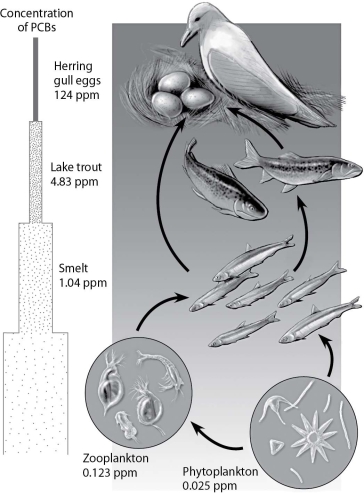
A)phytoplankton, because they are at the bottom of the food chain
B)herring gulls, because they are at the bottom of the food chain
C)herring gulls, because they are at the top of the food chain
D)smelt, because they are in the middle of the food chain
A)phytoplankton, because they are at the bottom of the food chain
B)herring gulls, because they are at the bottom of the food chain
C)herring gulls, because they are at the top of the food chain
D)smelt, because they are in the middle of the food chain
Question
Question
Question
The figure below depicts natural fluctuation of ozone levels in Switzerland between 1925 and 1976. Dobson units are a way to measure the total amount of atmospheric ozone above a point on the Earth's surface. 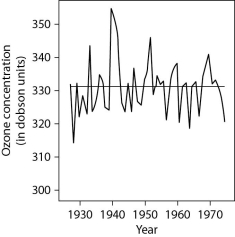
What can you conclude from this figure?
A)Natural fluctuation of ozone levels varies greatly year to year, so the average for this 50-year span was approximately 330 Dobson units.
B)Switzerland can be used as a model example of how to maintain safe ozone levels.
C)All small European countries will show fluctuations in ozone concentration levels.
D)Ozone levels show a distinct pattern of increasing by 10 Dobson units every 10 years.
What can you conclude from this figure?
A)Natural fluctuation of ozone levels varies greatly year to year, so the average for this 50-year span was approximately 330 Dobson units.
B)Switzerland can be used as a model example of how to maintain safe ozone levels.
C)All small European countries will show fluctuations in ozone concentration levels.
D)Ozone levels show a distinct pattern of increasing by 10 Dobson units every 10 years.
Question
Question
Question
Question
Question
Question
Question
According to this graph of changes in Earth's atmosphere, which of the following took place between the years 1800 and 2000? 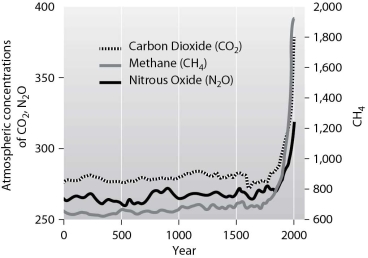
A)Nitrous oxide (N₂O)levels increased from 270 ppb to 390 ppb.
B)Carbon dioxide (CO₂)levels increased from 950 ppb to 1,800 ppb.
C)Carbon dioxide (CO₂)levels increased from 290 ppm to 380 ppm.
D)Methane (CH₄₎ levels increased from 270 ppm to almost 2,000 ppm.
A)Nitrous oxide (N₂O)levels increased from 270 ppb to 390 ppb.
B)Carbon dioxide (CO₂)levels increased from 950 ppb to 1,800 ppb.
C)Carbon dioxide (CO₂)levels increased from 290 ppm to 380 ppm.
D)Methane (CH₄₎ levels increased from 270 ppm to almost 2,000 ppm.
Question
Question
Question
Question
Question

Unlock Deck
Sign up to unlock the cards in this deck!
Unlock Deck
Unlock Deck
1/57

Play

Full screen (f)
Deck 38: Conservation Biology
1
Biodiversity considers
A)the genetic diversity within and between populations of a species.
B)the fate of water in the ecosystem.
C)commensal relationships between species.
D)the relationships of individuals to a food chain.
A)the genetic diversity within and between populations of a species.
B)the fate of water in the ecosystem.
C)commensal relationships between species.
D)the relationships of individuals to a food chain.
A
2
The average global temperature has risen ________ over the past 100 years.
A)3°C
B)10°C
C)5°C
D)0)8°C
A)3°C
B)10°C
C)5°C
D)0)8°C
D
3
Greenhouse gases include
A)nitrous oxide and oxygen.
B)nitrogen and oxygen.
C)carbon dioxide and nitrogen.
D)carbon dioxide and methane.
A)nitrous oxide and oxygen.
B)nitrogen and oxygen.
C)carbon dioxide and nitrogen.
D)carbon dioxide and methane.
D
4
Currently, the single greatest threat to biodiversity is
A)global warming.
B)habitat destruction due to humans.
C)the introduction of exotic species.
D)overexploitation of populations for food.
A)global warming.
B)habitat destruction due to humans.
C)the introduction of exotic species.
D)overexploitation of populations for food.
Unlock Deck
Unlock for access to all 57 flashcards in this deck.
Unlock Deck
k this deck
5
Which of the following is an invasive species?
A)mallard duck in the western United States
B)brown tree snake in Guam
C)elephant in India
D)carrier pigeon in the continental United States
A)mallard duck in the western United States
B)brown tree snake in Guam
C)elephant in India
D)carrier pigeon in the continental United States
Unlock Deck
Unlock for access to all 57 flashcards in this deck.
Unlock Deck
k this deck
6
You spray your lawn with a pesticide. The concentration of the pesticide in the tissues of the grass on your lawn is 10⁻⁶ parts per million (ppm). Grasshoppers eat the grass and are in turn eaten by rats, which are then eaten by owls. At each successive trophic level, the concentration of pesticides increases. The term for this process is
A)extirpation.
B)biological magnification.
C)habitat loss.
D)climate change.
A)extirpation.
B)biological magnification.
C)habitat loss.
D)climate change.
Unlock Deck
Unlock for access to all 57 flashcards in this deck.
Unlock Deck
k this deck
7
The primary goal of conservation biology is to
A)estimate the total number of species that exist.
B)maximize the land set aside for wildlife.
C)integrate human culture back into nature.
D)counter the loss of biodiversity.
A)estimate the total number of species that exist.
B)maximize the land set aside for wildlife.
C)integrate human culture back into nature.
D)counter the loss of biodiversity.
Unlock Deck
Unlock for access to all 57 flashcards in this deck.
Unlock Deck
k this deck
8
DDT and mercury
A)were once used as an energy source.
B)contribute to acid precipitation.
C)accumulate in the tissues of organisms.
D)deplete the ozone layer.
A)were once used as an energy source.
B)contribute to acid precipitation.
C)accumulate in the tissues of organisms.
D)deplete the ozone layer.
Unlock Deck
Unlock for access to all 57 flashcards in this deck.
Unlock Deck
k this deck
9
CO₂ in the atmosphere is absorbed by ________ and converted into biomass.
A)the ozone layer
B)other atmosphere gases
C)photosynthetic organisms
D)large land masses
A)the ozone layer
B)other atmosphere gases
C)photosynthetic organisms
D)large land masses
Unlock Deck
Unlock for access to all 57 flashcards in this deck.
Unlock Deck
k this deck
10
To decrease pollution from sulfur, your local power plant built very tall smokestacks. The ultimate consequence of this would most likely be
A)biological magnification.
B)to dilute the sulfur pollutants in the atmosphere and thus reduce their effects on the environment.
C)to create an environmental problem at a distance from the power plant.
D)a decrease in the pH of local lakes.
A)biological magnification.
B)to dilute the sulfur pollutants in the atmosphere and thus reduce their effects on the environment.
C)to create an environmental problem at a distance from the power plant.
D)a decrease in the pH of local lakes.
Unlock Deck
Unlock for access to all 57 flashcards in this deck.
Unlock Deck
k this deck
11
Global warming is the result of
A)rising ocean levels.
B)rising concentrations of greenhouse gases.
C)increased solar activity.
D)habitat loss.
A)rising ocean levels.
B)rising concentrations of greenhouse gases.
C)increased solar activity.
D)habitat loss.
Unlock Deck
Unlock for access to all 57 flashcards in this deck.
Unlock Deck
k this deck
12
Which of the following is a likely consequence of thinning of the ozone layer?
A)increases in skin cancer
B)increases in escape of heat from Earth
C)global warming
D)decreases in flying insect populations
A)increases in skin cancer
B)increases in escape of heat from Earth
C)global warming
D)decreases in flying insect populations
Unlock Deck
Unlock for access to all 57 flashcards in this deck.
Unlock Deck
k this deck
13
The ability to change phenotype in response to local environmental conditions is called
A)genetic drift.
B)mutation.
C)alteration of generations.
D)phenotypic plasticity.
A)genetic drift.
B)mutation.
C)alteration of generations.
D)phenotypic plasticity.
Unlock Deck
Unlock for access to all 57 flashcards in this deck.
Unlock Deck
k this deck
14
By the year 1980, a wolf species (Canis rufus)once common to the southeastern region of the United States disappeared from all areas except for one small part of eastern Texas. This is an example of
A)extirpation.
B)extinction.
C)an invasive species.
D)genetic diversity.
A)extirpation.
B)extinction.
C)an invasive species.
D)genetic diversity.
Unlock Deck
Unlock for access to all 57 flashcards in this deck.
Unlock Deck
k this deck
15
One way in which populations and species have been responding to climate change is by
A)changing their coat color.
B)shifting their distribution.
C)changing their metabolism.
D)evolving a flexible mode of reproduction.
A)changing their coat color.
B)shifting their distribution.
C)changing their metabolism.
D)evolving a flexible mode of reproduction.
Unlock Deck
Unlock for access to all 57 flashcards in this deck.
Unlock Deck
k this deck
16
The three greatest current threats to biodiversity, in order starting with the greatest, are
A)habitat loss, overharvesting, and invasive species.
B)habitat loss, invasive species, and overharvesting.
C)invasive species, habitat loss, and overharvesting.
D)invasive species, overharvesting, and habitat loss.
A)habitat loss, overharvesting, and invasive species.
B)habitat loss, invasive species, and overharvesting.
C)invasive species, habitat loss, and overharvesting.
D)invasive species, overharvesting, and habitat loss.
Unlock Deck
Unlock for access to all 57 flashcards in this deck.
Unlock Deck
k this deck
17
The current rate of extinction may be as much as ________ times higher than at any other time in the past 100,000 years.
A)10
B)100
C)1,000
D)10,000
A)10
B)100
C)1,000
D)10,000
Unlock Deck
Unlock for access to all 57 flashcards in this deck.
Unlock Deck
k this deck
18
You arrive back in the United States after a visit to a foreign country located on another continent. The customs agent stops the person in front of you and confiscates the fruit basket this person is bringing home. Being the knowledgeable person you are, you calmly explain to your enraged fellow traveler that the reason for the detainment is that the fruit basket may be
A)carrying endangered fruit.
B)carrying an exotic species that could damage North American ecosystems.
C)contaminated with chemicals that will damage the ozone layer above North America.
D)contaminated with sufficient DDT to cause serious harm to anyone who eats the fruit.
A)carrying endangered fruit.
B)carrying an exotic species that could damage North American ecosystems.
C)contaminated with chemicals that will damage the ozone layer above North America.
D)contaminated with sufficient DDT to cause serious harm to anyone who eats the fruit.
Unlock Deck
Unlock for access to all 57 flashcards in this deck.
Unlock Deck
k this deck
19
Scientists worry that global warming will result in the oceans
A)becoming more acidic.
B)becoming more basic.
C)containing less dissolved oxygen.
D)containing less dissolved carbon dioxide.
A)becoming more acidic.
B)becoming more basic.
C)containing less dissolved oxygen.
D)containing less dissolved carbon dioxide.
Unlock Deck
Unlock for access to all 57 flashcards in this deck.
Unlock Deck
k this deck
20
Which of the following is not an observed effect of global warming on organisms?
A)Some species of birds and frogs now begin their breeding seasons later in the year.
B)Corals "bleach" when increased water temperatures cause them to expel their symbiotic algae.
C)Many butterfly populations have shifted their ranges to the north.
D)Many polar bears show signs of starvation as their hunting grounds melt away.
A)Some species of birds and frogs now begin their breeding seasons later in the year.
B)Corals "bleach" when increased water temperatures cause them to expel their symbiotic algae.
C)Many butterfly populations have shifted their ranges to the north.
D)Many polar bears show signs of starvation as their hunting grounds melt away.
Unlock Deck
Unlock for access to all 57 flashcards in this deck.
Unlock Deck
k this deck
21
Captive breeding
A)has allowed for the reintroduction of many species to areas from which they had disappeared.
B)has advanced to the point where biologists believe it can be used to save most endangered species.
C)can work for animals but is generally not used for endangered plants.
D)is the main conservation technique used to try to save endangered species from extinction.
A)has allowed for the reintroduction of many species to areas from which they had disappeared.
B)has advanced to the point where biologists believe it can be used to save most endangered species.
C)can work for animals but is generally not used for endangered plants.
D)is the main conservation technique used to try to save endangered species from extinction.
Unlock Deck
Unlock for access to all 57 flashcards in this deck.
Unlock Deck
k this deck
22
Using living organisms to clean up polluted ecosystems is known as
A)migration.
B)restoration ecology.
C)bioremediation.
D)landscaping.
A)migration.
B)restoration ecology.
C)bioremediation.
D)landscaping.
Unlock Deck
Unlock for access to all 57 flashcards in this deck.
Unlock Deck
k this deck
23
Which of the following statements about movement corridors is true?
A)Movement corridors can connect otherwise isolated habitat patches.
B)Movement corridors can promote inbreeding in declining populations.
C)Movement corridors are detrimental to species that migrate between habitats seasonally.
D)Movement corridors can prevent the spread of disease.
A)Movement corridors can connect otherwise isolated habitat patches.
B)Movement corridors can promote inbreeding in declining populations.
C)Movement corridors are detrimental to species that migrate between habitats seasonally.
D)Movement corridors can prevent the spread of disease.
Unlock Deck
Unlock for access to all 57 flashcards in this deck.
Unlock Deck
k this deck
24
Movement corridors
A)increase inbreeding.
B)reduce dispersal.
C)can be harmful because they allow for the spread of disease.
D)can be harmful because they allow for gene flow.
A)increase inbreeding.
B)reduce dispersal.
C)can be harmful because they allow for the spread of disease.
D)can be harmful because they allow for gene flow.
Unlock Deck
Unlock for access to all 57 flashcards in this deck.
Unlock Deck
k this deck
25
Most biodiversity hot spots are found in ________ regions.
A)western
B)tropical
C)temperate
D)tundra
A)western
B)tropical
C)temperate
D)tundra
Unlock Deck
Unlock for access to all 57 flashcards in this deck.
Unlock Deck
k this deck
26
Small areas that are home to a large number of threatened species and an exceptional concentration of species found nowhere else on Earth are called
A)biomes.
B)movement corridors.
C)biodiversity hot spots.
D)local populations
A)biomes.
B)movement corridors.
C)biodiversity hot spots.
D)local populations
Unlock Deck
Unlock for access to all 57 flashcards in this deck.
Unlock Deck
k this deck
27
The Kissimmee River Restoration Project is intended to
A)drain natural wetlands in the central Florida region.
B)increase biodiversity of the region.
C)restrict ecotourism and other recreational usage in the impacted region.
D)provide areas for homes and businesses.
A)drain natural wetlands in the central Florida region.
B)increase biodiversity of the region.
C)restrict ecotourism and other recreational usage in the impacted region.
D)provide areas for homes and businesses.
Unlock Deck
Unlock for access to all 57 flashcards in this deck.
Unlock Deck
k this deck
28
Habitats with many edges
A)are the result of natural disasters.
B)favor animals that prefer large, open ranges.
C)often result from human activities.
D)result in a significant increase in diversity.
A)are the result of natural disasters.
B)favor animals that prefer large, open ranges.
C)often result from human activities.
D)result in a significant increase in diversity.
Unlock Deck
Unlock for access to all 57 flashcards in this deck.
Unlock Deck
k this deck
29
The Kissimmee River Restoration Project is an
A)example of large-scale bioremediation to clean up a mercury spill.
B)example of a dam that interrupted the breeding of salmon and other species.
C)attempt to restore the natural wetlands associated with the Kissimmee River.
D)effort to join two previously unconnected lakes to permit better drainage.
A)example of large-scale bioremediation to clean up a mercury spill.
B)example of a dam that interrupted the breeding of salmon and other species.
C)attempt to restore the natural wetlands associated with the Kissimmee River.
D)effort to join two previously unconnected lakes to permit better drainage.
Unlock Deck
Unlock for access to all 57 flashcards in this deck.
Unlock Deck
k this deck
30
If wolves were now removed from Yellowstone National Park,
A)elk populations would increase.
B)deer populations would decrease.
C)the vegetation would remain unchanged.
D)vegetation would increase, providing shelter for smaller animals.
A)elk populations would increase.
B)deer populations would decrease.
C)the vegetation would remain unchanged.
D)vegetation would increase, providing shelter for smaller animals.
Unlock Deck
Unlock for access to all 57 flashcards in this deck.
Unlock Deck
k this deck
31
Some populations, especially those with high genetic variability and short life spans, may avoid extinction as the climate changes through
A)enforcement of the Endangered Species Act.
B)bioprospecting.
C)distribution of populations.
D)evolutionary adaptation.
A)enforcement of the Endangered Species Act.
B)bioprospecting.
C)distribution of populations.
D)evolutionary adaptation.
Unlock Deck
Unlock for access to all 57 flashcards in this deck.
Unlock Deck
k this deck
32
The aspect of conservation ecology concerned with returning degraded ecosystems (as nearly as possible)to their natural state is
A)bioremediation.
B)sustainable development.
C)restoration ecology.
D)landscape ecology.
A)bioremediation.
B)sustainable development.
C)restoration ecology.
D)landscape ecology.
Unlock Deck
Unlock for access to all 57 flashcards in this deck.
Unlock Deck
k this deck
33
The Yellowstone to Yukon Conservation Initiative is a plan to
A)connect all of the national parks in the western United States.
B)connect all of the national parks in the United States.
C)connect parks in the United States and Canada with protected corridors where wildlife can travel safely.
D)create a giant, fenced private land area between the national parks in the United States to create a protected zone for wildlife.
A)connect all of the national parks in the western United States.
B)connect all of the national parks in the United States.
C)connect parks in the United States and Canada with protected corridors where wildlife can travel safely.
D)create a giant, fenced private land area between the national parks in the United States to create a protected zone for wildlife.
Unlock Deck
Unlock for access to all 57 flashcards in this deck.
Unlock Deck
k this deck
34
The greatest challenge facing the zoned reserve systems of Costa Rica is
A)high predation by jaguars.
B)forest fires.
C)soil erosion.
D)the growing human population.
A)high predation by jaguars.
B)forest fires.
C)soil erosion.
D)the growing human population.
Unlock Deck
Unlock for access to all 57 flashcards in this deck.
Unlock Deck
k this deck
35
A regional assemblage of interacting ecosystems is a
A)biome.
B)landscape.
C)corridor.
D)hot spot.
A)biome.
B)landscape.
C)corridor.
D)hot spot.
Unlock Deck
Unlock for access to all 57 flashcards in this deck.
Unlock Deck
k this deck
36
Species found in only one place on Earth are called ________ species.
A)hot spot
B)exotic
C)keystone
D)endemic
A)hot spot
B)exotic
C)keystone
D)endemic
Unlock Deck
Unlock for access to all 57 flashcards in this deck.
Unlock Deck
k this deck
37
The introduction of wolves into Yellowstone National Park in 1991 resulted in
A)a general decline in overall habitat
B)ecological changes involving numerous plant and animal species.
C)the migration of most of these wolves out of the park and back to Canada.
D)the death of all of the wolves, likely due to an insufficient amount of available prey.
A)a general decline in overall habitat
B)ecological changes involving numerous plant and animal species.
C)the migration of most of these wolves out of the park and back to Canada.
D)the death of all of the wolves, likely due to an insufficient amount of available prey.
Unlock Deck
Unlock for access to all 57 flashcards in this deck.
Unlock Deck
k this deck
38
About one-third of all animal and plant species are concentrated on ________ of Earth's land.
A)20%
B)10%
C)5%
D)1)5%
A)20%
B)10%
C)5%
D)1)5%
Unlock Deck
Unlock for access to all 57 flashcards in this deck.
Unlock Deck
k this deck
39
One result of Costa Rica's commitment to conservation is that
A)destructive practices such as massive logging and large-scale single-crop agriculture have been nearly eliminated.
B)both protected park areas and the buffer zones around them have suffered only negligible deforestation.
C)ecotourism generates many jobs and brings in a significant fraction of the country's revenue.
D)about 95% of the country's land is protected in some way.
A)destructive practices such as massive logging and large-scale single-crop agriculture have been nearly eliminated.
B)both protected park areas and the buffer zones around them have suffered only negligible deforestation.
C)ecotourism generates many jobs and brings in a significant fraction of the country's revenue.
D)about 95% of the country's land is protected in some way.
Unlock Deck
Unlock for access to all 57 flashcards in this deck.
Unlock Deck
k this deck
40
Protecting the endangered black-footed ferret from extinction involved
A)captive breeding and reintroduction.
B)collecting individuals from multiple small populations and combining them into a single large population.
C)vaccinating the remaining population against sylvatic plague.
D)providing food during harsh winters.
A)captive breeding and reintroduction.
B)collecting individuals from multiple small populations and combining them into a single large population.
C)vaccinating the remaining population against sylvatic plague.
D)providing food during harsh winters.
Unlock Deck
Unlock for access to all 57 flashcards in this deck.
Unlock Deck
k this deck
41
After reading the paragraph below, answer the question that follows.
Rice is a staple crop across Asia; it serves as a main nutritional source for Asia's high population. In the 1970s, a pathogen called the grassy-stunt virus greatly decreased cultivated rice plant populations. Scientists found one wild relative of the rice plant in India that was resistant to the grassy-stunt virus, and today hybrid rice plants with that resistant gene are grown across Asia. To find this one rice plant species, approximately 17,000 rice plants samples were tested over the course of four years.
If you were a scientist working on this project, how would you argue that the results of the research would be worth the time investment?
A)Finding the wild relative with disease resistance would help avoid extirpation of fungus that has a mutualistic relationship with the cultivated rice plants.
B)Finding the wild relative with disease resistance would protect the continent of Asia as a biodiversity hot spot.
C)Finding the wild relative with disease resistance would allow Asian farmers to continue to grow the crop they know.
D)Finding the wild relative with disease resistance would help deter invasive species of rice plants.
Rice is a staple crop across Asia; it serves as a main nutritional source for Asia's high population. In the 1970s, a pathogen called the grassy-stunt virus greatly decreased cultivated rice plant populations. Scientists found one wild relative of the rice plant in India that was resistant to the grassy-stunt virus, and today hybrid rice plants with that resistant gene are grown across Asia. To find this one rice plant species, approximately 17,000 rice plants samples were tested over the course of four years.
If you were a scientist working on this project, how would you argue that the results of the research would be worth the time investment?
A)Finding the wild relative with disease resistance would help avoid extirpation of fungus that has a mutualistic relationship with the cultivated rice plants.
B)Finding the wild relative with disease resistance would protect the continent of Asia as a biodiversity hot spot.
C)Finding the wild relative with disease resistance would allow Asian farmers to continue to grow the crop they know.
D)Finding the wild relative with disease resistance would help deter invasive species of rice plants.
Unlock Deck
Unlock for access to all 57 flashcards in this deck.
Unlock Deck
k this deck
42
According to this figure, which organisms have the highest concentration of PCBs, and why?
A)phytoplankton, because they are at the bottom of the food chain
B)herring gulls, because they are at the bottom of the food chain
C)herring gulls, because they are at the top of the food chain
D)smelt, because they are in the middle of the food chain
A)phytoplankton, because they are at the bottom of the food chain
B)herring gulls, because they are at the bottom of the food chain
C)herring gulls, because they are at the top of the food chain
D)smelt, because they are in the middle of the food chain
Unlock Deck
Unlock for access to all 57 flashcards in this deck.
Unlock Deck
k this deck
43
You are a climate scientist who wants to investigate climate change. Which of the following measurements would be the least useful?
A)rainfall in the southeastern United States from 20 years ago to the present day
B)a long-term (30-year)study of coral biodiversity in the Australian reef ecosystem
C)changes in carbon dioxide (CO₂)emission levels in China from 25 years ago to the present day
D)methane (CH₄)levels from dairy farms in Iowa during the years 2011 and 2012
A)rainfall in the southeastern United States from 20 years ago to the present day
B)a long-term (30-year)study of coral biodiversity in the Australian reef ecosystem
C)changes in carbon dioxide (CO₂)emission levels in China from 25 years ago to the present day
D)methane (CH₄)levels from dairy farms in Iowa during the years 2011 and 2012
Unlock Deck
Unlock for access to all 57 flashcards in this deck.
Unlock Deck
k this deck
44
While habitat destruction by humans creates fragmented ecosystems, fragmentation can also occur due to natural processes. Which of the following natural processes would most likely create a fragmented ecosystem?
A)thunderstorm
B)glacier movement
C)blizzard
D)volcanic eruption
A)thunderstorm
B)glacier movement
C)blizzard
D)volcanic eruption
Unlock Deck
Unlock for access to all 57 flashcards in this deck.
Unlock Deck
k this deck
45
The figure below depicts natural fluctuation of ozone levels in Switzerland between 1925 and 1976. Dobson units are a way to measure the total amount of atmospheric ozone above a point on the Earth's surface.
What can you conclude from this figure?
A)Natural fluctuation of ozone levels varies greatly year to year, so the average for this 50-year span was approximately 330 Dobson units.
B)Switzerland can be used as a model example of how to maintain safe ozone levels.
C)All small European countries will show fluctuations in ozone concentration levels.
D)Ozone levels show a distinct pattern of increasing by 10 Dobson units every 10 years.
What can you conclude from this figure?
A)Natural fluctuation of ozone levels varies greatly year to year, so the average for this 50-year span was approximately 330 Dobson units.
B)Switzerland can be used as a model example of how to maintain safe ozone levels.
C)All small European countries will show fluctuations in ozone concentration levels.
D)Ozone levels show a distinct pattern of increasing by 10 Dobson units every 10 years.
Unlock Deck
Unlock for access to all 57 flashcards in this deck.
Unlock Deck
k this deck
46
After reading the paragraph below, answer the questions that follow.
As the climate warms, organisms will shift their population ranges to different areas that are cooler. However, as humans continue to fragment large tracts of land, species will face increasing challenges in adapting their ranges to new climates. For example, movement corridors may not be able to be built if the amount of land needed for a species' range is fragmented due to cities and roads. One alternative to creating movement corridors is called managed relocation. This requires physically moving species to cooler climates.
Which of the following is an advantage of using managed relocation?
A)Scientists will be able to accurately predict how many members of a species will survive the relocation because they can start the process with a definite number of members being moved.
B)Purposefully moving species will allow scientists to put specific numbers of organisms in different areas so that the species population always maintains an even distribution of organisms across the area.
C)All species moved will be saved from extinction.
D)Governments will not face the large costs of maintaining conserved areas for corridors.
As the climate warms, organisms will shift their population ranges to different areas that are cooler. However, as humans continue to fragment large tracts of land, species will face increasing challenges in adapting their ranges to new climates. For example, movement corridors may not be able to be built if the amount of land needed for a species' range is fragmented due to cities and roads. One alternative to creating movement corridors is called managed relocation. This requires physically moving species to cooler climates.
Which of the following is an advantage of using managed relocation?
A)Scientists will be able to accurately predict how many members of a species will survive the relocation because they can start the process with a definite number of members being moved.
B)Purposefully moving species will allow scientists to put specific numbers of organisms in different areas so that the species population always maintains an even distribution of organisms across the area.
C)All species moved will be saved from extinction.
D)Governments will not face the large costs of maintaining conserved areas for corridors.
Unlock Deck
Unlock for access to all 57 flashcards in this deck.
Unlock Deck
k this deck
47
In Clackamas, Oregon, a stand of hybrid poplar trees was planted on an area of land that is contaminated with volatile organic compounds (VOCs). Why would someone purposely plant trees in an area with contaminated soil?
A)to use the trees as a means of phytoremediation
B)to use the trees as a means of eliminating insect species that consume nearby endemic plants
C)to use the trees for lumber for houses
D)to see if animals will make nests in trees that grow in contaminated soil.
A)to use the trees as a means of phytoremediation
B)to use the trees as a means of eliminating insect species that consume nearby endemic plants
C)to use the trees for lumber for houses
D)to see if animals will make nests in trees that grow in contaminated soil.
Unlock Deck
Unlock for access to all 57 flashcards in this deck.
Unlock Deck
k this deck
48
Which of the following is not an example of a predicted impact of climate change?
A)Wildfires in Colorado will increase in severity.
B)Wildflower diversity in northeastern United States will increase.
C)Spring seasonal temperatures will continue to increase.
D)Australian coral reefs will experience greater loss of marine life.
A)Wildfires in Colorado will increase in severity.
B)Wildflower diversity in northeastern United States will increase.
C)Spring seasonal temperatures will continue to increase.
D)Australian coral reefs will experience greater loss of marine life.
Unlock Deck
Unlock for access to all 57 flashcards in this deck.
Unlock Deck
k this deck
49
Suppose a species of wild boar (a type of pig)is actively hunted when it is at a young age because at that stage of its development the meat of the boar is particularly tender. What is a likely outcome if this species is overharvested?
A)The wild boar population will dwindle because their food source will disappear due to habitat loss.
B)The wild boar population will increase because older boars will continue to survive.
C)The wild boar population will dwindle and potentially go extinct if not enough boars that can reproduce are left to mate.
D)The wild boar population will increase because boundaries will help separate boars from humans.
A)The wild boar population will dwindle because their food source will disappear due to habitat loss.
B)The wild boar population will increase because older boars will continue to survive.
C)The wild boar population will dwindle and potentially go extinct if not enough boars that can reproduce are left to mate.
D)The wild boar population will increase because boundaries will help separate boars from humans.
Unlock Deck
Unlock for access to all 57 flashcards in this deck.
Unlock Deck
k this deck
50
After reading the paragraphs below, answer the questions that follow.
Introduced species are a problem all over the world, and there are many examples in the United States. Several years ago, a fisherman caught a northern snakehead fish in a pond in Crofton, Maryland (a suburb of Washington, DC). Snakeheads are a favorite food of immigrants from China, and live fish can frequently be found in Asian markets. It was suspected that the fish in the Crofton pond were purchased locally and then intentionally released.
Snakeheads are top predators, and 90% of the northern snakeheads' diet consists of other fishes. The northern snakehead can breathe out of water and travel short distances (about 100 feet) across land. They also breed rapidly. Females can lay more than 100,000 eggs per year. Juveniles have also been identified in the Potomac River and other rivers in Pennsylvania.
Based on the characteristics of the snakehead described, which of the following is most likely to be a productive strategy to reduce the spread of this species?
A)extending the fishing season for prey fishes
B)introducing a natural predator to feed on juvenile snakeheads
C)capturing breeding snakeheads and sterilizing them so that they cannot breed any longer
D)introducing algae and photosynthetic bacteria to reduce nutrient levels in the water
Introduced species are a problem all over the world, and there are many examples in the United States. Several years ago, a fisherman caught a northern snakehead fish in a pond in Crofton, Maryland (a suburb of Washington, DC). Snakeheads are a favorite food of immigrants from China, and live fish can frequently be found in Asian markets. It was suspected that the fish in the Crofton pond were purchased locally and then intentionally released.
Snakeheads are top predators, and 90% of the northern snakeheads' diet consists of other fishes. The northern snakehead can breathe out of water and travel short distances (about 100 feet) across land. They also breed rapidly. Females can lay more than 100,000 eggs per year. Juveniles have also been identified in the Potomac River and other rivers in Pennsylvania.
Based on the characteristics of the snakehead described, which of the following is most likely to be a productive strategy to reduce the spread of this species?
A)extending the fishing season for prey fishes
B)introducing a natural predator to feed on juvenile snakeheads
C)capturing breeding snakeheads and sterilizing them so that they cannot breed any longer
D)introducing algae and photosynthetic bacteria to reduce nutrient levels in the water
Unlock Deck
Unlock for access to all 57 flashcards in this deck.
Unlock Deck
k this deck
51
Araschnia levana is a species of butterfly that breeds several times a year. It has two distinctly colored pupae: Those that emerge in spring are orange and those that emerge in summer are brown. The seasonal color variations in pupae mean that the pupae blend into the colors in their environment. This is an example of
A)a threatened species.
B)an endemic species.
C)a keystone species.
D)phenotypic plasticity.
A)a threatened species.
B)an endemic species.
C)a keystone species.
D)phenotypic plasticity.
Unlock Deck
Unlock for access to all 57 flashcards in this deck.
Unlock Deck
k this deck
52
According to this graph of changes in Earth's atmosphere, which of the following took place between the years 1800 and 2000?
A)Nitrous oxide (N₂O)levels increased from 270 ppb to 390 ppb.
B)Carbon dioxide (CO₂)levels increased from 950 ppb to 1,800 ppb.
C)Carbon dioxide (CO₂)levels increased from 290 ppm to 380 ppm.
D)Methane (CH₄₎ levels increased from 270 ppm to almost 2,000 ppm.
A)Nitrous oxide (N₂O)levels increased from 270 ppb to 390 ppb.
B)Carbon dioxide (CO₂)levels increased from 950 ppb to 1,800 ppb.
C)Carbon dioxide (CO₂)levels increased from 290 ppm to 380 ppm.
D)Methane (CH₄₎ levels increased from 270 ppm to almost 2,000 ppm.
Unlock Deck
Unlock for access to all 57 flashcards in this deck.
Unlock Deck
k this deck
53
After reading the paragraph below, answer the questions that follow.
As the climate warms, organisms will shift their population ranges to different areas that are cooler. However, as humans continue to fragment large tracts of land, species will face increasing challenges in adapting their ranges to new climates. For example, movement corridors may not be able to be built if the amount of land needed for a species' range is fragmented due to cities and roads. One alternative to creating movement corridors is called managed relocation. This requires physically moving species to cooler climates.
Which of the following is a disadvantage of using managed relocation?
A)Many vehicles will be needed to transport the species, so CO₂ emissions from the vehicles will cause an increase in global greenhouse gas levels.
B)Governments will face long-term high fuel costs for the many vehicles that will be needed to move the species.
C)Scientists may move the species to ranges where they will become invasive.
D)Local economies will see an increase in jobs as many individuals will need to be hired to help move the species.
As the climate warms, organisms will shift their population ranges to different areas that are cooler. However, as humans continue to fragment large tracts of land, species will face increasing challenges in adapting their ranges to new climates. For example, movement corridors may not be able to be built if the amount of land needed for a species' range is fragmented due to cities and roads. One alternative to creating movement corridors is called managed relocation. This requires physically moving species to cooler climates.
Which of the following is a disadvantage of using managed relocation?
A)Many vehicles will be needed to transport the species, so CO₂ emissions from the vehicles will cause an increase in global greenhouse gas levels.
B)Governments will face long-term high fuel costs for the many vehicles that will be needed to move the species.
C)Scientists may move the species to ranges where they will become invasive.
D)Local economies will see an increase in jobs as many individuals will need to be hired to help move the species.
Unlock Deck
Unlock for access to all 57 flashcards in this deck.
Unlock Deck
k this deck
54
As global temperatures continue to rise, what is a likely outcome?
A)loss of populations of fish
B)greater overharvesting of medicinal plant species
C)less greenhouse gas emissions
D)formation of new glaciers
A)loss of populations of fish
B)greater overharvesting of medicinal plant species
C)less greenhouse gas emissions
D)formation of new glaciers
Unlock Deck
Unlock for access to all 57 flashcards in this deck.
Unlock Deck
k this deck
55
If current trends in global warming continue for the next 50 years, where will the greatest effects of global warming likely be felt?
A)the continental United States
B)the Pacific Ocean
C)the Mississippi River
D)Russia
A)the continental United States
B)the Pacific Ocean
C)the Mississippi River
D)Russia
Unlock Deck
Unlock for access to all 57 flashcards in this deck.
Unlock Deck
k this deck
56
After reading the paragraphs below, answer the questions that follow.
Introduced species are a problem all over the world, and there are many examples in the United States. Several years ago, a fisherman caught a northern snakehead fish in a pond in Crofton, Maryland (a suburb of Washington, DC). Snakeheads are a favorite food of immigrants from China, and live fish can frequently be found in Asian markets. It was suspected that the fish in the Crofton pond were purchased locally and then intentionally released.
Snakeheads are top predators, and 90% of the northern snakeheads' diet consists of other fishes. The northern snakehead can breathe out of water and travel short distances (about 100 feet) across land. They also breed rapidly. Females can lay more than 100,000 eggs per year. Juveniles have also been identified in the Potomac River and other rivers in Pennsylvania.
When snakeheads enter aquatic ecosystems, biodiversity in these ecosystems would most likely
A)increase, since another species has been added to the environment.
B)decrease, since the snakehead will prey on native species.
C)remain the same, since local species will prey on the snakeheads and remove them.
D)remain the same, because the snakeheads will merge without problems into established communities.
Introduced species are a problem all over the world, and there are many examples in the United States. Several years ago, a fisherman caught a northern snakehead fish in a pond in Crofton, Maryland (a suburb of Washington, DC). Snakeheads are a favorite food of immigrants from China, and live fish can frequently be found in Asian markets. It was suspected that the fish in the Crofton pond were purchased locally and then intentionally released.
Snakeheads are top predators, and 90% of the northern snakeheads' diet consists of other fishes. The northern snakehead can breathe out of water and travel short distances (about 100 feet) across land. They also breed rapidly. Females can lay more than 100,000 eggs per year. Juveniles have also been identified in the Potomac River and other rivers in Pennsylvania.
When snakeheads enter aquatic ecosystems, biodiversity in these ecosystems would most likely
A)increase, since another species has been added to the environment.
B)decrease, since the snakehead will prey on native species.
C)remain the same, since local species will prey on the snakeheads and remove them.
D)remain the same, because the snakeheads will merge without problems into established communities.
Unlock Deck
Unlock for access to all 57 flashcards in this deck.
Unlock Deck
k this deck
57
Sustainable development
A)will require making difficult decisions regarding travel to other planets.
B)will require many people to contribute financially.
C)will speed up evolution.
D)will require global, multinational cooperation.
A)will require making difficult decisions regarding travel to other planets.
B)will require many people to contribute financially.
C)will speed up evolution.
D)will require global, multinational cooperation.
Unlock Deck
Unlock for access to all 57 flashcards in this deck.
Unlock Deck
k this deck
Unlock Deck
Unlock for access to all 57 flashcards in this deck.






