







 Chat with AI

Deck 25: Cardiac Surgery
Full screen (f)

Question

Question
Question
Question
Question
Question
Question
Question
Question
In looking at the illustration below,which option most accurately defines its primary function? 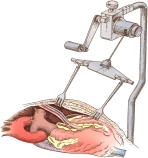
A) Exposes the internal mammary artery and facilitates dissection.
B) Exposes the aortic arch for cannulation.
C) Exposes the SVC and RA for cannulation.
D) Exposes the anterolateral coronary arteries for graft anastamosis.
A) Exposes the internal mammary artery and facilitates dissection.
B) Exposes the aortic arch for cannulation.
C) Exposes the SVC and RA for cannulation.
D) Exposes the anterolateral coronary arteries for graft anastamosis.
Question
Question
Question
Question
Question
Question
Question
Question
Question
Question
Question
Question
Question
Question
Question

Unlock Deck
Sign up to unlock the cards in this deck!
Unlock Deck
Unlock Deck
1/24

Play

Full screen (f)
Deck 25: Cardiac Surgery
1
An aneurysm of the LV can develop after a severe myocardial infarction.The affected area of the myocardium is replaced by thin scar tissue that can rupture.The LV undergoes remodeling when the scar stretches because of the left ventricular pressure and forms an aneurysm.Left ventricular aneurysmectomy (LVA)is the excision of an aneurysmal portion of the LV.LVA is a form of left ventricular reconstruction undertaken to optimize cardiac function.Select the appropriate nursing action in preparation for LVA surgery.
A) Place the patient in left lateral position.
B) Prepare for the procedure in the same manner as typical lung transplant surgery.
C) Have synthetic patch material and Teflon felt pledgets available.
D) Add 1, 2-0, and 4-0 cardiovascular sutures to set up.
A) Place the patient in left lateral position.
B) Prepare for the procedure in the same manner as typical lung transplant surgery.
C) Have synthetic patch material and Teflon felt pledgets available.
D) Add 1, 2-0, and 4-0 cardiovascular sutures to set up.
C
Patient positioning is supine.Setup is the same as that described for open-heart surgery,with the addition of synthetic patch material,Teflon felt pledgets,and 0,3-0,and 4-0 cardiovascular sutures.Occasionally additional Teflon felt strips bolster the suture lines.Patch closure of the ventriculotomy (endoaneurysmorrhaphy)is more common than traditional excision,plication,and oversewing of the ventricular tissue,because patch closure better preserves the geometry of the LV.
Patient positioning is supine.Setup is the same as that described for open-heart surgery,with the addition of synthetic patch material,Teflon felt pledgets,and 0,3-0,and 4-0 cardiovascular sutures.Occasionally additional Teflon felt strips bolster the suture lines.Patch closure of the ventriculotomy (endoaneurysmorrhaphy)is more common than traditional excision,plication,and oversewing of the ventricular tissue,because patch closure better preserves the geometry of the LV.
2
During the preoperative nursing assessment for a patient scheduled for cardiac surgery,the perioperative nurse reviews the patient's medication history with attention to medications that can affect the surgery or cause complications.Select the true statement about specific medications that can affect surgery or cause complications.
A) Aspirin may increase platelet levels.
B) Lipid-lowering drugs (statins) may promote new onset diabetes mellitus.
C) Herbal products may promote the development of thromboemboli.
D) Angiotensin converting enzyme inhibitors (ACEIs) may cause malignant hypertension.
A) Aspirin may increase platelet levels.
B) Lipid-lowering drugs (statins) may promote new onset diabetes mellitus.
C) Herbal products may promote the development of thromboemboli.
D) Angiotensin converting enzyme inhibitors (ACEIs) may cause malignant hypertension.
B
The perioperative nurse reviews patient medication history with attention to vasoactive drugs,anticoagulants,and other medications that can affect surgery.Nurses should note that patients taking aspirin and other antiplatelet drugs (such as 2b/IIIa inhibitors)may require intraoperative replacement of platelets.Lipid-lowering drugs (statins)have shown cardiovascular benefits,but in high doses (i.e.,80 mg,compared to moderate doses of 40 mg)they have been associated with new onset diabetes mellitus.Patients taking herbal medicines may be at risk for increased bleeding,hypoglycemia,or other complications,depending on the specific side effects of some herbal drugs.
The perioperative nurse reviews patient medication history with attention to vasoactive drugs,anticoagulants,and other medications that can affect surgery.Nurses should note that patients taking aspirin and other antiplatelet drugs (such as 2b/IIIa inhibitors)may require intraoperative replacement of platelets.Lipid-lowering drugs (statins)have shown cardiovascular benefits,but in high doses (i.e.,80 mg,compared to moderate doses of 40 mg)they have been associated with new onset diabetes mellitus.Patients taking herbal medicines may be at risk for increased bleeding,hypoglycemia,or other complications,depending on the specific side effects of some herbal drugs.
3
An implantable cardioverter defibrillator (ICD)is an electronic device designed to monitor cardiac electrical activity and deliver prompt defibrillation.Myocardial or thoracic subcutaneous patches may be added if the transvenous catheters alone do not adequately defibrillate the heart.Patients with previously implanted defibrillator patches may present for removal of a patch(es).Which nursing action would be appropriate during this procedure?
A) Be prepared for emergency intervention if there is pacing as well as defibrillating
B) Be prepared for emergency intervention if there is excessive bleeding
C) Be prepared for emergency intervention if there is a lethal dysrhythmia
D) Be prepared for emergency intervention if the transvenous catheter migrates
A) Be prepared for emergency intervention if there is pacing as well as defibrillating
B) Be prepared for emergency intervention if there is excessive bleeding
C) Be prepared for emergency intervention if there is a lethal dysrhythmia
D) Be prepared for emergency intervention if the transvenous catheter migrates
B,C
Perioperative nurses should prepare for emergency intervention if excessive bleeding or lethal dysrhythmia appears.EP studies performed before and after insertion enable diagnosis of the dysrhythmia and evaluation of device function,respectively.
Perioperative nurses should prepare for emergency intervention if excessive bleeding or lethal dysrhythmia appears.EP studies performed before and after insertion enable diagnosis of the dysrhythmia and evaluation of device function,respectively.
4
Among the treatment options for tricuspid valve disease are suture annuloplasty,ring annuloplasty,and valve replacement with either a biologic or a mechanical prosthesis.Patients with significant tricuspid stenosis,regurgitation,or failed tricuspid (suture or ring)annuloplasty may require insertion of a prosthetic biologic or mechanical valve.What type of prosthetic graft would be created or implanted?
A) An annuloplasty with a pledgetted suture technique
B) A tricuspid annular permanent dilator
C) A mitral prosthesis
D) An annuloplasty ring
A) An annuloplasty with a pledgetted suture technique
B) A tricuspid annular permanent dilator
C) A mitral prosthesis
D) An annuloplasty ring
Unlock Deck
Unlock for access to all 24 flashcards in this deck.
Unlock Deck
k this deck
5
Formerly,ventricular assist devices (VADs)were reserved for those patients who could not be weaned from CPB after open-heart operations,or who had end-stage cardiomyopathy.Current indications and choices have expanded,and a variety of active and passive devices are available to support circulation for short-,intermediate-,and long-term use.Select the statement that best reflects the implications for a patient with a VAD.
A) The newer devices have eliminated bleeding complications.
B) The VAD augments cardiac output from the right, left, or both ventricles.
C) Patients with VADs benefit from enhanced catabolism and cellular nutrition.
D) The artificial pump of the VAD increases the workload of the heart.
A) The newer devices have eliminated bleeding complications.
B) The VAD augments cardiac output from the right, left, or both ventricles.
C) Patients with VADs benefit from enhanced catabolism and cellular nutrition.
D) The artificial pump of the VAD increases the workload of the heart.
Unlock Deck
Unlock for access to all 24 flashcards in this deck.
Unlock Deck
k this deck
6
In traditional cardiopulmonary bypass (CPB),systemic venous return to the heart flows by gravity drainage through cannulae placed in the superior and inferior venae cavae or through a single two-stage cannula in the RA into tubing connected to the bypass machine.Blood is oxygenated,filtered,warmed or cooled,and pumped back into the systemic circulation through a cannula placed in the:
A) femoral artery.
B) axillary vein.
C) descending aorta.
D) femoral vein.
A) femoral artery.
B) axillary vein.
C) descending aorta.
D) femoral vein.
Unlock Deck
Unlock for access to all 24 flashcards in this deck.
Unlock Deck
k this deck
7
The blood is oxygenated in the lungs and returns to the LA through the pulmonary veins.Where does the blood flow after leaving the LA?
A) Through the AV (mitral) valve into the left ventricle (LV)
B) Through the tricuspid valve into the LV
C) Through the aortic valve into the LV
D) Through the aorta into the systemic circulation
A) Through the AV (mitral) valve into the left ventricle (LV)
B) Through the tricuspid valve into the LV
C) Through the aortic valve into the LV
D) Through the aorta into the systemic circulation
Unlock Deck
Unlock for access to all 24 flashcards in this deck.
Unlock Deck
k this deck
8
In the pulmonary circulatory system,blood is pumped from the right ventricle (RV)through the pulmonary valve into the main pulmonary artery (PA).The PA divides into the right and left pulmonary arteries,which further subdivide into the arterioles and capillaries of the lungs.Where does the blood from the lungs flow next?
A) Into the venules and veins
B) Into the alveoli
C) Through the pulmonary artery to the left atrium (LA)
D) Through the pulmonary veins to the LA
A) Into the venules and veins
B) Into the alveoli
C) Through the pulmonary artery to the left atrium (LA)
D) Through the pulmonary veins to the LA
Unlock Deck
Unlock for access to all 24 flashcards in this deck.
Unlock Deck
k this deck
9
In looking at the illustration below,which option most accurately defines its primary function?
A) Exposes the internal mammary artery and facilitates dissection.
B) Exposes the aortic arch for cannulation.
C) Exposes the SVC and RA for cannulation.
D) Exposes the anterolateral coronary arteries for graft anastamosis.
A) Exposes the internal mammary artery and facilitates dissection.
B) Exposes the aortic arch for cannulation.
C) Exposes the SVC and RA for cannulation.
D) Exposes the anterolateral coronary arteries for graft anastamosis.
Unlock Deck
Unlock for access to all 24 flashcards in this deck.
Unlock Deck
k this deck
10
A percutaneous method of instituting femoral vein-femoral artery CPB can be used for minimally invasive (or conventional open)procedures and in emergency situations where the environment is not conducive to traditional CPB methods.Select all the areas where percutaneous CPB would be indicated.
A) Renal dialysis unit
B) Neonatal intensive care unit
C) Cardiac catheterization unit
D) Emergency department
A) Renal dialysis unit
B) Neonatal intensive care unit
C) Cardiac catheterization unit
D) Emergency department
Unlock Deck
Unlock for access to all 24 flashcards in this deck.
Unlock Deck
k this deck
11
During the preoperative assessment of an adult with a previously corrected congenital heart defect,the perioperative nurse should be aware of anatomic anomalies associated with the original defect,or its subsequent repair,that may alter the current surgical plan for a patient who had prior pediatric cardiac surgery.What is an appropriate nursing response when the assessment reveals the adult patient has undergone prior pediatric cardiac surgery?
A) Prepare for endocardial injury if the heart is retracted or manipulated too forcefully.
B) Prepare to employ the current surgical plan, adding pediatric vascular clamps to the set.
C) Consult with the surgeon for specific alterations to the typical plan for care.
D) Alert the staff to anticipate altered anatomy, special supplies, and potential complications.
A) Prepare for endocardial injury if the heart is retracted or manipulated too forcefully.
B) Prepare to employ the current surgical plan, adding pediatric vascular clamps to the set.
C) Consult with the surgeon for specific alterations to the typical plan for care.
D) Alert the staff to anticipate altered anatomy, special supplies, and potential complications.
Unlock Deck
Unlock for access to all 24 flashcards in this deck.
Unlock Deck
k this deck
12
Which statements regarding vascular clamps are true?
A) Vascular clamps are designed to partially occlude blood flow.
B) Vascular clamps are designed to totally occlude blood flow.
C) Vascular clamps are designed to hold vessels securely without trauma.
D) Vascular clamps have similar angles, box locks, ring handles, and ratchets.
A) Vascular clamps are designed to partially occlude blood flow.
B) Vascular clamps are designed to totally occlude blood flow.
C) Vascular clamps are designed to hold vessels securely without trauma.
D) Vascular clamps have similar angles, box locks, ring handles, and ratchets.
Unlock Deck
Unlock for access to all 24 flashcards in this deck.
Unlock Deck
k this deck
13
Select the diagnostic test that represents an invasive cardiac study.
A) Resting multiple-gated acquisition (MUGA)
B) Exercise MUGA
C) Cardiac function
D) Electrophysiology studies
A) Resting multiple-gated acquisition (MUGA)
B) Exercise MUGA
C) Cardiac function
D) Electrophysiology studies
Unlock Deck
Unlock for access to all 24 flashcards in this deck.
Unlock Deck
k this deck
14
Select the noninvasive diagnostic test that illustrates heart wall motion and blood flow through the heart and quantifies cardiac function.
A) Radionuclide imaging
B) Cardiac catheterization
C) Echocardiography
D) Cardiac function studies
A) Radionuclide imaging
B) Cardiac catheterization
C) Echocardiography
D) Cardiac function studies
Unlock Deck
Unlock for access to all 24 flashcards in this deck.
Unlock Deck
k this deck
15
Identify the correct path of the cardiac conduction system.
A) From sinoatrial (SA) node to the anterior internodal tract of Bachman to the bundle of His to the right and left bundle branches to the Purkinje fibers.
B) From the atrioventricular (AV) node to the sinoatrial (SA) node to the bundle of His to the right and left bundle branches.
C) From the sinoatrial (SA) node to the atrioventricular (AV) node to the Bundle of His to the right and left bundle branches to the Purkinje system.
D) From the area where the sinoatrial (SA) node meets the right atrium to the AV junction to the right side of the interventricular system into a network of fibers by way of the right and left bundle branches.
A) From sinoatrial (SA) node to the anterior internodal tract of Bachman to the bundle of His to the right and left bundle branches to the Purkinje fibers.
B) From the atrioventricular (AV) node to the sinoatrial (SA) node to the bundle of His to the right and left bundle branches.
C) From the sinoatrial (SA) node to the atrioventricular (AV) node to the Bundle of His to the right and left bundle branches to the Purkinje system.
D) From the area where the sinoatrial (SA) node meets the right atrium to the AV junction to the right side of the interventricular system into a network of fibers by way of the right and left bundle branches.
Unlock Deck
Unlock for access to all 24 flashcards in this deck.
Unlock Deck
k this deck
16
Thoracic aortic aneurysmectomy is excision of an aneurysmal portion of the ascending aorta,aortic arch,or descending thoracic aorta and replacement with a prosthetic graft,valve-graft conduit,or intra-aortic prosthesis.Aneurysms may be caused by atherosclerosis,trauma,infection,or cystic medial degeneration.Which presenting conditions will indicate that surgical intervention is necessary?
A) Compromised circulation or danger of rupture
B) Circumferential involvement
C) Spindle-shaped morphology
D) Combined saccular and fusiform morphology without dissection
A) Compromised circulation or danger of rupture
B) Circumferential involvement
C) Spindle-shaped morphology
D) Combined saccular and fusiform morphology without dissection
Unlock Deck
Unlock for access to all 24 flashcards in this deck.
Unlock Deck
k this deck
17
Complete heart block and bradydysrhythmias are the most common indications for pacemaker implantation.A permanent pacemaker (pulse generator and electrodes)initiates atrial or ventricular contraction,or both.What therapy might be used for acute forms of heart block and dysrhythmias that occasionally occur during and after cardiac surgery?
A) Transvenous endocardial stimulation
B) A temporary pacemaker
C) Epicardial cardioversion
D) Resynchronization therapy
A) Transvenous endocardial stimulation
B) A temporary pacemaker
C) Epicardial cardioversion
D) Resynchronization therapy
Unlock Deck
Unlock for access to all 24 flashcards in this deck.
Unlock Deck
k this deck
18
The internal mammary arteries (IMAs)are frequently used as grafts during coronary bypass surgery.Where are they located?
A) They diverge from the anterior interventricular branch of the right coronary artery.
B) They diverge from the subclavian arteries behind the sternum.
C) They diverge from the subclavian arteries anterior to the sternum.
D) They diverge from the innominate artery.
A) They diverge from the anterior interventricular branch of the right coronary artery.
B) They diverge from the subclavian arteries behind the sternum.
C) They diverge from the subclavian arteries anterior to the sternum.
D) They diverge from the innominate artery.
Unlock Deck
Unlock for access to all 24 flashcards in this deck.
Unlock Deck
k this deck
19
Surgery for atrial fibrillation (AF)may also be performed through an open sternotomy or right minithoracotomy incisions.By creating small areas of scar tissue in the cardiac muscle,electrical impulses are forced to follow an alternative conduction path or "maze." Select all the statements regarding nursing considerations for the maze procedure that are true.
A) Monitor for heart rhythm problems.
B) Have valve instruments, coronary instruments, and an array of tube grafts, valves, or valved conduits available.
C) Monitor for bleeding, infection, and potential complications related to heart surgery.
D) Have packed RBCs available.
A) Monitor for heart rhythm problems.
B) Have valve instruments, coronary instruments, and an array of tube grafts, valves, or valved conduits available.
C) Monitor for bleeding, infection, and potential complications related to heart surgery.
D) Have packed RBCs available.
Unlock Deck
Unlock for access to all 24 flashcards in this deck.
Unlock Deck
k this deck
20
Open commissurotomy of the mitral valve,which is performed for mitral stenosis,is the separation of fused,adherent leaflets of the mitral valve.Select two nursing actions that are relevant to the patient with open commissurotomy.
A) Have valve replacement instruments available
B) Have tricuspid prosthetic implants available
C) Have a transesophageal echocardiogram (TEE) probe and machine available
D) Have anterolateral positioning devices available if valve replacement is needed
A) Have valve replacement instruments available
B) Have tricuspid prosthetic implants available
C) Have a transesophageal echocardiogram (TEE) probe and machine available
D) Have anterolateral positioning devices available if valve replacement is needed
Unlock Deck
Unlock for access to all 24 flashcards in this deck.
Unlock Deck
k this deck
21
Disturbances of the conduction system affect the rate,rhythm,and effectiveness of the contracting heart.Surgical techniques have been developed to treat a variety of supraventricular dysrhythmias and both ischemic and nonischemic ventricular tachydysrhythmias.Preprocedural electrophysiologic mapping of the patient's conduction pathways identifies and locates aberrant pathways,or ectopic foci.A catheter is inserted percutaneously into the femoral vein or artery and threaded retrograde to the right or left atrium and ventricle.Various areas of the heart are tested to reproduce the dysrhythmia; then the area of the heart where the rhythm disturbance originates is ablated.Which treatment modality is employed to produce this selective ablation effect?
A) Cryotherapy
B) Fiberoptic light energy
C) Radiofrequency (RF) energy
D) Ultrasonic energy
A) Cryotherapy
B) Fiberoptic light energy
C) Radiofrequency (RF) energy
D) Ultrasonic energy
Unlock Deck
Unlock for access to all 24 flashcards in this deck.
Unlock Deck
k this deck
22
Cardiac surgery patients are at risk for decreased cardiac output related to emotional (fear),sensory (pain),or physiologic (electrical,mechanical,or structural)factors.Which outcome indicators will provide evidence that the patient's cardiac output will be consistent or improved?
A) Urine output is greater than 15 mL/hr.
B) Skin is warm and dry.
C) Cardiac output is improved from preoperative levels.
D) The patient displays no signs of anxiety.
A) Urine output is greater than 15 mL/hr.
B) Skin is warm and dry.
C) Cardiac output is improved from preoperative levels.
D) The patient displays no signs of anxiety.
Unlock Deck
Unlock for access to all 24 flashcards in this deck.
Unlock Deck
k this deck
23
A 59-year-old woman is scheduled for an open approach coronary artery bypass graft.During the preoperative interview and assessment,the perioperative nurse reviewed the patient's hematologic tests,including a detailed coagulation profile to uncover possible hemorrhagic disorders.During the assessment,the nurse learned of the patient's many varied comorbid conditions,including prior vascular procedures,and diabetes.The nurse noted one of the patient's many nursing diagnoses as risk for bleeding related to surgical incision(s),tissue dissection,and altered coagulation function.Because of this diagnosis,the nurse implemented measures to have blood available,measure and report blood loss,assist with the use of the autotransfusion system per protocol,and have topical hemostatic agents available.The patient will be free from excessive bleeding as evidenced by:
A) chest tube drainage less than 100 mL/hr.
B) dressings dry and intact.
C) presence of palpable radial and femoral pulses.
D) normal skin color, temperature, and turgor.
A) chest tube drainage less than 100 mL/hr.
B) dressings dry and intact.
C) presence of palpable radial and femoral pulses.
D) normal skin color, temperature, and turgor.
Unlock Deck
Unlock for access to all 24 flashcards in this deck.
Unlock Deck
k this deck
24
Guidelines and interventions that may be useful to prevent cardiovascular disease (CVD)in women include:
A) use of folic acid supplementation.
B) use of appropriate pharmacotherapy to control hypertension, diabetes mellitus, renal disease, and high level of lipids and lipoproteins.
C) use of antioxidant supplements.
D) use of hormone therapy.
E) consumption of a diet rich in fruits and vegetables.
A) use of folic acid supplementation.
B) use of appropriate pharmacotherapy to control hypertension, diabetes mellitus, renal disease, and high level of lipids and lipoproteins.
C) use of antioxidant supplements.
D) use of hormone therapy.
E) consumption of a diet rich in fruits and vegetables.
Unlock Deck
Unlock for access to all 24 flashcards in this deck.
Unlock Deck
k this deck
Unlock Deck
Unlock for access to all 24 flashcards in this deck.






