







 Chat with AI

Deck 73: Care of Patients With Breast Disorders
Full screen (f)

Question

Question
Question
Question
Question
Question
Question
Question
Question
Question
Question
Question
Question
Question
Question
Question
Question
Question
Question
Question
Question
Question
The clinic nurse is preparing a client for a physical and breast examination.The nurse notes the client's breast appears as shown in the photograph below.Which action by the nurse takes priority? 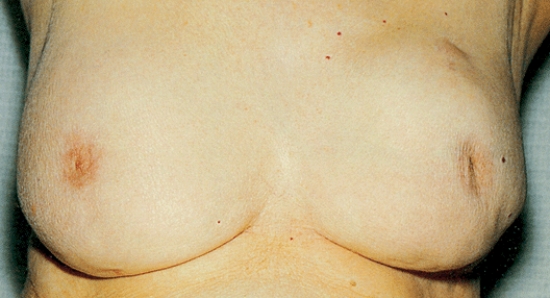
A) Continue preparations and note the finding in the client's chart.
B) Ask the client how long this problem has been present.
C) Alert the health care provider and prepare to order a mammogram.
D) Question the client about routine drug and alcohol intake.
A) Continue preparations and note the finding in the client's chart.
B) Ask the client how long this problem has been present.
C) Alert the health care provider and prepare to order a mammogram.
D) Question the client about routine drug and alcohol intake.
Question
Question
Question

Unlock Deck
Sign up to unlock the cards in this deck!
Unlock Deck
Unlock Deck
1/25

Play

Full screen (f)
Deck 73: Care of Patients With Breast Disorders
1
A client is postoperative from a left-sided mastectomy.She says that the incision and the inner side of her arm from the armpit to the elbow are numb.Which is the nurse's best action?
A) Teach the client to avoid lifting heavy objects.
B) Measure the circumference of the client's left arm.
C) Reassure the client that this is an expected finding.
D) Notify the surgeon as soon as possible.
A) Teach the client to avoid lifting heavy objects.
B) Measure the circumference of the client's left arm.
C) Reassure the client that this is an expected finding.
D) Notify the surgeon as soon as possible.
Reassure the client that this is an expected finding.
2
A client recently had a mammogram.Which statement by the client indicates a need for clarification regarding the importance or purpose of this procedure?
A) "Now that I have had a mammogram, my risk for getting breast cancer is reduced."
B) "I will still do a breast self-examination monthly even after the mammogram."
C) "Yearly mammograms can reduce my risk of dying from breast cancer."
D) "The amount of radiation exposure from a mammogram is very low."
A) "Now that I have had a mammogram, my risk for getting breast cancer is reduced."
B) "I will still do a breast self-examination monthly even after the mammogram."
C) "Yearly mammograms can reduce my risk of dying from breast cancer."
D) "The amount of radiation exposure from a mammogram is very low."
"Now that I have had a mammogram, my risk for getting breast cancer is reduced."
3
A client has large breasts.Which health problem is she most likely to develop?
A) Breast tenderness
B) Breast cancer
C) Chest pain
D) Back pain
A) Breast tenderness
B) Breast cancer
C) Chest pain
D) Back pain
Back pain
4
A client with a family history of breast cancer tells the nurse that she has made several recent lifestyle changes.Which question by the nurse about these practices is most important?
A) "Are you a vegetarian?"
B) "Do you drink green tea?"
C) "What supplements do you use?"
D) "Do you smoke cigarettes?"
A) "Are you a vegetarian?"
B) "Do you drink green tea?"
C) "What supplements do you use?"
D) "Do you smoke cigarettes?"
Unlock Deck
Unlock for access to all 25 flashcards in this deck.
Unlock Deck
k this deck
5
A client had a mastectomy nearly a year ago and is distressed over continued tingling and burning in the ipsilateral arm.What orders does the nurse prepare to implement?
A) Teach the client about gabapentin (Neurontin).
B) Demonstrate the use of heat therapy to the axilla.
C) Discuss ways to prevent constipation with pain meds.
D) Reassure the client that this will disappear shortly.
A) Teach the client about gabapentin (Neurontin).
B) Demonstrate the use of heat therapy to the axilla.
C) Discuss ways to prevent constipation with pain meds.
D) Reassure the client that this will disappear shortly.
Unlock Deck
Unlock for access to all 25 flashcards in this deck.
Unlock Deck
k this deck
6
A client has just been diagnosed with fibrocystic breast disease.She asks what this means in terms of her health.Which is the nurse's best response?
A) "This increases your risk for breast cancer, so schedule yearly mammograms."
B) "This will increase as you age, especially if you have never been pregnant."
C) "This will diminish with menopause if you don't take replacement hormones."
D) "This is genetic and you should teach your daughters about it."
A) "This increases your risk for breast cancer, so schedule yearly mammograms."
B) "This will increase as you age, especially if you have never been pregnant."
C) "This will diminish with menopause if you don't take replacement hormones."
D) "This is genetic and you should teach your daughters about it."
Unlock Deck
Unlock for access to all 25 flashcards in this deck.
Unlock Deck
k this deck
7
Which statement made by a client about breast cancer indicates correct understanding of the disease?
A) "Breast cancer is the leading cause of cancer deaths among women in the United States."
B) "Breast cancer is the leading type of cancer among women in North America."
C) "Late onset of menses and early menopause increase the risk for breast cancer."
D) "Breast cancer decreases with age, and very old women have virtually no risk."
A) "Breast cancer is the leading cause of cancer deaths among women in the United States."
B) "Breast cancer is the leading type of cancer among women in North America."
C) "Late onset of menses and early menopause increase the risk for breast cancer."
D) "Breast cancer decreases with age, and very old women have virtually no risk."
Unlock Deck
Unlock for access to all 25 flashcards in this deck.
Unlock Deck
k this deck
8
Which comment made by a client with breast cancer indicates correct understanding regarding cancer causes and prevention?
A) "I will prevent recurrence of my cancer by eating a low-fat diet from now on."
B) "If I had breast-fed my children, this would not have happened to me."
C) "I hope this doesn't increase my risk for bone cancer or lung cancer."
D) "I will have regular mammograms on my other breast to detect cancer early."
A) "I will prevent recurrence of my cancer by eating a low-fat diet from now on."
B) "If I had breast-fed my children, this would not have happened to me."
C) "I hope this doesn't increase my risk for bone cancer or lung cancer."
D) "I will have regular mammograms on my other breast to detect cancer early."
Unlock Deck
Unlock for access to all 25 flashcards in this deck.
Unlock Deck
k this deck
9
Which exercise plan or activity does the nurse teach the client for the first postoperative day after a modified radical mastectomy?
A) "Perform no movement or exercise today. Keep the arm supported and the elbow flexed, and as close to your body as possible."
B) "Without moving your shoulder, straighten your elbow three times hourly and squeeze a rubber ball with your fingers."
C) "Face the wall and extend your arm straight out to the wall. Walk your fingers as far above your head as your arm will reach, and then walk them back down."
D) "Hold your operative arm straight out from the shoulder to the side. Use your nonoperative arm to pull the operative arm completely straight above your head."
A) "Perform no movement or exercise today. Keep the arm supported and the elbow flexed, and as close to your body as possible."
B) "Without moving your shoulder, straighten your elbow three times hourly and squeeze a rubber ball with your fingers."
C) "Face the wall and extend your arm straight out to the wall. Walk your fingers as far above your head as your arm will reach, and then walk them back down."
D) "Hold your operative arm straight out from the shoulder to the side. Use your nonoperative arm to pull the operative arm completely straight above your head."
Unlock Deck
Unlock for access to all 25 flashcards in this deck.
Unlock Deck
k this deck
10
A woman is asking about monthly breast self-examination (BSE).What information does the nurse provide to the client?
A) "It is a valuable tool for finding breast lumps early."
B) "After menopause, it is no longer useful."
C) "BSE should be combined with other assessments."
D) "Women in their 30s should begin monthly BSE."
A) "It is a valuable tool for finding breast lumps early."
B) "After menopause, it is no longer useful."
C) "BSE should be combined with other assessments."
D) "Women in their 30s should begin monthly BSE."
Unlock Deck
Unlock for access to all 25 flashcards in this deck.
Unlock Deck
k this deck
11
A client asks how soon after a mastectomy she can engage in sexual activity.Which is the nurse's best response?
A) "When do you want to resume sexual activity?"
B) "Most surgeons say to wait several weeks after the operation."
C) "As soon as the incision has healed completely."
D) "You shouldn't worry about sexuality right now."
A) "When do you want to resume sexual activity?"
B) "Most surgeons say to wait several weeks after the operation."
C) "As soon as the incision has healed completely."
D) "You shouldn't worry about sexuality right now."
Unlock Deck
Unlock for access to all 25 flashcards in this deck.
Unlock Deck
k this deck
12
A client receiving tamoxifen (Tamofen)asks how this therapy helps fight breast cancer.Which is the nurse's best response?
A) "This agent decreases estrogen levels. so the cancer stops growing."
B) "The drug causes you to secrete testosterone, which limits cancer growth."
C) "Tamoxifen kills estrogen-secreting cells and growth of blood vessels to cancer cells."
D) "It blocks estrogen receptors, and this limits cancer cell growth."
A) "This agent decreases estrogen levels. so the cancer stops growing."
B) "The drug causes you to secrete testosterone, which limits cancer growth."
C) "Tamoxifen kills estrogen-secreting cells and growth of blood vessels to cancer cells."
D) "It blocks estrogen receptors, and this limits cancer cell growth."
Unlock Deck
Unlock for access to all 25 flashcards in this deck.
Unlock Deck
k this deck
13
A client has advanced breast cancer and bone metastasis.Which problem does the nurse consider the priority?
A) Pain
B) Mobility problems
C) Risk for infection
D) Malnutrition
A) Pain
B) Mobility problems
C) Risk for infection
D) Malnutrition
Unlock Deck
Unlock for access to all 25 flashcards in this deck.
Unlock Deck
k this deck
14
A client who has discovered a lump in her breast becomes tearful when scheduling a mammogram.Which is the nurse's best response?
A) "All lumps are considered cancerous until proven otherwise."
B) "Unless you have a relative with breast cancer, this lump is probably benign."
C) "Diagnosing cancer at this early stage is most likely to result in a cure."
D) "Many women have breast lumps, and most of the lumps are benign."
A) "All lumps are considered cancerous until proven otherwise."
B) "Unless you have a relative with breast cancer, this lump is probably benign."
C) "Diagnosing cancer at this early stage is most likely to result in a cure."
D) "Many women have breast lumps, and most of the lumps are benign."
Unlock Deck
Unlock for access to all 25 flashcards in this deck.
Unlock Deck
k this deck
15
A client had a mastectomy with reconstruction,and several axillary nodes were dissected.Which statement by the client indicates good understanding of discharge instructions?
A) "I must be careful not to injure the arm or hand on the side of my surgery."
B) "I'm glad that lymphedema is no longer a problem, as it was in my mother's day."
C) "I will have a hard time waiting for a whole year to see how my breast will look."
D) "I need to pull my drains out byinch each day until they are totally out."
A) "I must be careful not to injure the arm or hand on the side of my surgery."
B) "I'm glad that lymphedema is no longer a problem, as it was in my mother's day."
C) "I will have a hard time waiting for a whole year to see how my breast will look."
D) "I need to pull my drains out byinch each day until they are totally out."
Unlock Deck
Unlock for access to all 25 flashcards in this deck.
Unlock Deck
k this deck
16
A client is undergoing treatment for breast cancer and asks the nurse about "natural" treatments for her chemotherapy-induced nausea.Which is the most appropriate response by the nurse?
A) "Anything you can take will interfere with your chemotherapy."
B) "I don't know of any recommended complementary treatments for nausea."
C) "Black cohosh and flaxseed are good for combating nausea."
D) "Ginger has been used for nausea; would you consider taking it?"
A) "Anything you can take will interfere with your chemotherapy."
B) "I don't know of any recommended complementary treatments for nausea."
C) "Black cohosh and flaxseed are good for combating nausea."
D) "Ginger has been used for nausea; would you consider taking it?"
Unlock Deck
Unlock for access to all 25 flashcards in this deck.
Unlock Deck
k this deck
17
A client had a mastectomy and axillary node dissection.The nurse empties sanguineous drainage from the client's incisional Jackson-Pratt drain on the first postoperative day.Which other action regarding the drain is of high priority for the nurse?
A) Flushing the tubing with urokinase to ensure patency
B) Compressing and closing the drain to ensure suction
C) Advancing the tubinginch from the insertion site
D) Clamping the drain for 2 hours and releasing it for 2 hours
A) Flushing the tubing with urokinase to ensure patency
B) Compressing and closing the drain to ensure suction
C) Advancing the tubinginch from the insertion site
D) Clamping the drain for 2 hours and releasing it for 2 hours
Unlock Deck
Unlock for access to all 25 flashcards in this deck.
Unlock Deck
k this deck
18
Which client does the nurse encourage to seek genetic counseling regarding her risk for BRCA1 or BCRA2 gene mutation-related breast cancer?
A) Woman whose father had lung cancer and mother had leukemia
B) Woman whose sister has breast cancer and mother has ovarian cancer
C) Woman whose fraternal twin sister has breast cancer
D) Older woman who has bilateral benign breast disease
A) Woman whose father had lung cancer and mother had leukemia
B) Woman whose sister has breast cancer and mother has ovarian cancer
C) Woman whose fraternal twin sister has breast cancer
D) Older woman who has bilateral benign breast disease
Unlock Deck
Unlock for access to all 25 flashcards in this deck.
Unlock Deck
k this deck
19
A client is experiencing lymphedema in the arm on the operative side after a modified radical mastectomy.Which statement indicates correct understanding of managing this problem?
A) "I will reduce my intake of salt and water."
B) "I will elevate my arm on a pillow at night."
C) "I will try to drink at least 3 liters of water each day."
D) "I will wear long sleeves to prevent sun exposure."
A) "I will reduce my intake of salt and water."
B) "I will elevate my arm on a pillow at night."
C) "I will try to drink at least 3 liters of water each day."
D) "I will wear long sleeves to prevent sun exposure."
Unlock Deck
Unlock for access to all 25 flashcards in this deck.
Unlock Deck
k this deck
20
When performing a clinical breast examination on a client,the nurse palpates a thickened area where the skin folds under the breast.Which is the nurse's best action?
A) Proceed with the examination.
B) Determine whether the thickness is bilateral.
C) Ask how long the thickness has been present.
D) Change the client's position and re-assess.
A) Proceed with the examination.
B) Determine whether the thickness is bilateral.
C) Ask how long the thickness has been present.
D) Change the client's position and re-assess.
Unlock Deck
Unlock for access to all 25 flashcards in this deck.
Unlock Deck
k this deck
21
Which factors are considered to be indicative of a moderately increased risk of a client's developing breast cancer?
A) High postmenopausal bone density
B) Ionizing radiation
C) Family history of one first-degree relative
D) Genetic factors
E) First child born after age 30
F) Biopsy-confirmed atypical hyperplasia
A) High postmenopausal bone density
B) Ionizing radiation
C) Family history of one first-degree relative
D) Genetic factors
E) First child born after age 30
F) Biopsy-confirmed atypical hyperplasia
Unlock Deck
Unlock for access to all 25 flashcards in this deck.
Unlock Deck
k this deck
22
The clinic nurse is preparing a client for a physical and breast examination.The nurse notes the client's breast appears as shown in the photograph below.Which action by the nurse takes priority?
A) Continue preparations and note the finding in the client's chart.
B) Ask the client how long this problem has been present.
C) Alert the health care provider and prepare to order a mammogram.
D) Question the client about routine drug and alcohol intake.
A) Continue preparations and note the finding in the client's chart.
B) Ask the client how long this problem has been present.
C) Alert the health care provider and prepare to order a mammogram.
D) Question the client about routine drug and alcohol intake.
Unlock Deck
Unlock for access to all 25 flashcards in this deck.
Unlock Deck
k this deck
23
The nurse is assessing a client with a history of ductal ectasia.Which signs and symptoms supporting this diagnosis does the nurse correlate with this condition?
A) A soft mass on palpation
B) Greenish-brown nipple discharge
C) Enlarged axillary nodes
D) A mass with regular borders
E) Redness and edema over the site of the mass
F) Mass tenderness on palpation
A) A soft mass on palpation
B) Greenish-brown nipple discharge
C) Enlarged axillary nodes
D) A mass with regular borders
E) Redness and edema over the site of the mass
F) Mass tenderness on palpation
Unlock Deck
Unlock for access to all 25 flashcards in this deck.
Unlock Deck
k this deck
24
A client with a history of breast cancer is admitted through the emergency department with shortness of breath,weakness,fatigue,and new lower extremity edema.The client's oxygen saturation is 88%.After stabilizing the client,which action by the nurse is most important?
A) Obtain a list of the client's medications.
B) Orient her to her room and surroundings.
C) Place the client on intake and output.
D) Assess the client's family cardiac history.
A) Obtain a list of the client's medications.
B) Orient her to her room and surroundings.
C) Place the client on intake and output.
D) Assess the client's family cardiac history.
Unlock Deck
Unlock for access to all 25 flashcards in this deck.
Unlock Deck
k this deck
25
A client is being treated with anastrozole (Arimidex)for breast cancer.The nurse is developing a plan of care for the client.Which intervention is the highest priority?
A) Teach the client to weigh herself each day at the same time.
B) Instruct the client to keep a symptom journal for menopausal symptoms.
C) Monitor the client closely for evidence of osteoporosis.
D) Review the client's dietary habits to prevent weight gain.
A) Teach the client to weigh herself each day at the same time.
B) Instruct the client to keep a symptom journal for menopausal symptoms.
C) Monitor the client closely for evidence of osteoporosis.
D) Review the client's dietary habits to prevent weight gain.
Unlock Deck
Unlock for access to all 25 flashcards in this deck.
Unlock Deck
k this deck
Unlock Deck
Unlock for access to all 25 flashcards in this deck.






