







 Chat with AI

Deck 15: Cardiovascular Therapeutic Management
Full screen (f)

Question

Question
Question
Question
Question
Question
Question
Question
Question
Question
Question
Question
Question
Question
Question
Question
Question
Question
Question
Question
Question
Question
Identify complications with the above rhythm strip. 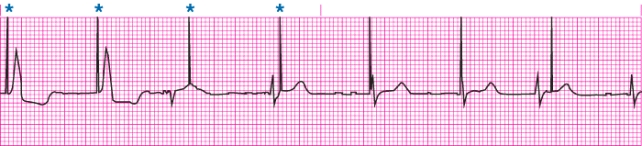
A) Undersensing from a pacemaker
B) Oversensing from a pacemaker
C) ICD firing caused by VF
D) Atrial pacing failure to capture
A) Undersensing from a pacemaker
B) Oversensing from a pacemaker
C) ICD firing caused by VF
D) Atrial pacing failure to capture
Question
Question
Question
Question
Question
Question
Question
Question
Question
Question
Question
Question
Question

Unlock Deck
Sign up to unlock the cards in this deck!
Unlock Deck
Unlock Deck
1/35

Play

Full screen (f)
Deck 15: Cardiovascular Therapeutic Management
1
A patient is undergoing ventricular pacing via a transvenous pacing lead.The nurse notes a pacing artifact,but it is not followed by a QRS on the electrocardiogram (ECG)monitoring.Which nursing intervention may correct this situation?
A) Position the patient on the left side
B) Decrease the milliamperes as ordered
C) Increase the rate as ordered
D) Monitor the patient in a different lead
A) Position the patient on the left side
B) Decrease the milliamperes as ordered
C) Increase the rate as ordered
D) Monitor the patient in a different lead
Position the patient on the left side
2
What parameter must be assessed frequently in the patient with an intraaortic balloon in place?
A) Skin turgor in the affected extremity
B) Peripheral pulses distal to the insertion site
C) Blood pressures in both arms and legs
D) Oxygen saturation
A) Skin turgor in the affected extremity
B) Peripheral pulses distal to the insertion site
C) Blood pressures in both arms and legs
D) Oxygen saturation
Peripheral pulses distal to the insertion site
3
Which mechanism is responsible for the augmentation of coronary arterial blood flow and increased myocardial oxygen supply seen with the intraaortic balloon pump?
A) The vacuum created in the aorta as a result of balloon deflation
B) Diastolic inflation with retrograde perfusion
C) Forward flow to the peripheral circulation
D) Inflation during systole to augment blood pressure
A) The vacuum created in the aorta as a result of balloon deflation
B) Diastolic inflation with retrograde perfusion
C) Forward flow to the peripheral circulation
D) Inflation during systole to augment blood pressure
Diastolic inflation with retrograde perfusion
4
A patient has an implantable cardioverter defibrillator (ICD)for chronic ventricular tachydysrhythmias.What action should the nurse take when the patient's rhythm deteriorates to ventricular fibrillation?
A) Apply an external defibrillator to the patient.
B) Call a code and start cardiopulmonary resuscitation (CPR) on the patient.
C) Wait for the ICD to defibrillate the patient.
D) Turn the ICD off and administer epinephrine.
A) Apply an external defibrillator to the patient.
B) Call a code and start cardiopulmonary resuscitation (CPR) on the patient.
C) Wait for the ICD to defibrillate the patient.
D) Turn the ICD off and administer epinephrine.
Unlock Deck
Unlock for access to all 35 flashcards in this deck.
Unlock Deck
k this deck
5
Which hemodynamic alteration is the most common cause of a decrease in cardiac output in the postoperative cardiovascular patient?
A) Reduced preload
B) Increased afterload
C) Increased contractility
D) Bradycardia
A) Reduced preload
B) Increased afterload
C) Increased contractility
D) Bradycardia
Unlock Deck
Unlock for access to all 35 flashcards in this deck.
Unlock Deck
k this deck
6
A patient is connected to an external temporary pulse generator.What does the sensitivity control regulate?
A) The time interval between the atrial and ventricular pacing stimuli
B) The amount of electrical current and is measured in milliamperes
C) The ability of the pacemaker to detect the heart's intrinsic electrical activity
D) The number of impulses that can be delivered to the heart per minute
A) The time interval between the atrial and ventricular pacing stimuli
B) The amount of electrical current and is measured in milliamperes
C) The ability of the pacemaker to detect the heart's intrinsic electrical activity
D) The number of impulses that can be delivered to the heart per minute
Unlock Deck
Unlock for access to all 35 flashcards in this deck.
Unlock Deck
k this deck
7
Which dosage of dopamine results in stimulation of beta1 receptors and increased myocardial contractility?
A) 1 mcg/kg/min
B) 5 mcg/kg/min
C) 15 mcg/kg/min
D) 20 mcg/kg/min
A) 1 mcg/kg/min
B) 5 mcg/kg/min
C) 15 mcg/kg/min
D) 20 mcg/kg/min
Unlock Deck
Unlock for access to all 35 flashcards in this deck.
Unlock Deck
k this deck
8
What is the rationale for administrating a fibrinolytic agent to a patient experiencing acute ST-elevation myocardial infarction (STEMI)?
A) Dilation of the blocked coronary artery
B) Anticoagulation to prevent formation of new emboli
C) Dissolution of atherosclerotic plaque at the site of blockage
D) Restoration of blood flow via lysis of the thrombus
A) Dilation of the blocked coronary artery
B) Anticoagulation to prevent formation of new emboli
C) Dissolution of atherosclerotic plaque at the site of blockage
D) Restoration of blood flow via lysis of the thrombus
Unlock Deck
Unlock for access to all 35 flashcards in this deck.
Unlock Deck
k this deck
9
A patient is admitted with left-sided heart failure and a blood pressure of 220/118 mm Hg.Which drug will be most effective in decreasing the blood pressure and reducing afterload?
A) Dopamine
B) Verapamil
C) Propranolol
D) Sodium nitroprusside
A) Dopamine
B) Verapamil
C) Propranolol
D) Sodium nitroprusside
Unlock Deck
Unlock for access to all 35 flashcards in this deck.
Unlock Deck
k this deck
10
What is the most common complication of fibrinolytic therapy?
A) Reperfusion chest pain
B) Lethargy
C) Bleeding
D) Heart blocks
A) Reperfusion chest pain
B) Lethargy
C) Bleeding
D) Heart blocks
Unlock Deck
Unlock for access to all 35 flashcards in this deck.
Unlock Deck
k this deck
11
Adenosine is an antidysrhythmic agent that is given primarily what reason?
A) To convert supraventricular tachycardias
B) To suppress premature ventricular contractions (PVCs)
C) To treat second and third degree AV blocks
D) To coarsen ventricular fibrillation so that defibrillation is effective
A) To convert supraventricular tachycardias
B) To suppress premature ventricular contractions (PVCs)
C) To treat second and third degree AV blocks
D) To coarsen ventricular fibrillation so that defibrillation is effective
Unlock Deck
Unlock for access to all 35 flashcards in this deck.
Unlock Deck
k this deck
12
A nurse is providing care to a patient on fibrinolytic therapy.Which of the following statements from the patient warrants further assessment and intervention by the nurse?
A) "My back is killing me!"
B) "There is blood on my toothbrush!"
C) "Look at the bruises on my arms!"
D) "My arm is bleeding where my IV is!"
A) "My back is killing me!"
B) "There is blood on my toothbrush!"
C) "Look at the bruises on my arms!"
D) "My arm is bleeding where my IV is!"
Unlock Deck
Unlock for access to all 35 flashcards in this deck.
Unlock Deck
k this deck
13
Which of the following statements regarding beta-blockers is correct?
A) They increase heart rate and are contraindicated in tachydysrhythmias.
B) They result in bronchospasm and should not be used in patients with chronic obstructive pulmonary disease (COPD).
C) They increase cardiac output and help with left ventricular failure.
D) They are helpful in increasing atrioventricular node conduction and are used in heart blocks.
A) They increase heart rate and are contraindicated in tachydysrhythmias.
B) They result in bronchospasm and should not be used in patients with chronic obstructive pulmonary disease (COPD).
C) They increase cardiac output and help with left ventricular failure.
D) They are helpful in increasing atrioventricular node conduction and are used in heart blocks.
Unlock Deck
Unlock for access to all 35 flashcards in this deck.
Unlock Deck
k this deck
14
Through what mechanism does enalapril decrease blood pressure?
A) Direct arterial vasodilation
B) Block the conversion of angiotensin I to angiotensin II
C) Increase fluid excretion at the loop of Henle
D) Peripheral vasoconstriction and central vasodilation.
A) Direct arterial vasodilation
B) Block the conversion of angiotensin I to angiotensin II
C) Increase fluid excretion at the loop of Henle
D) Peripheral vasoconstriction and central vasodilation.
Unlock Deck
Unlock for access to all 35 flashcards in this deck.
Unlock Deck
k this deck
15
Which finding is a reliable indicator of reperfusion after fibrinolytic therapy?
A) Dysrhythmias
B) Q waves
C) Elevated ST segments
D) Immediate rapid decrease in cardiac biomarkers
A) Dysrhythmias
B) Q waves
C) Elevated ST segments
D) Immediate rapid decrease in cardiac biomarkers
Unlock Deck
Unlock for access to all 35 flashcards in this deck.
Unlock Deck
k this deck
16
How does a percutaneous transluminal coronary angioplasty (PTCA)improve blood flow?
A) The balloon stretches the vessel wall, fractures the plaque, and enlarges the vessel lumen.
B) Medication is delivered through the catheter that dissolves the plague and enhances vessel patency.
C) The balloon removes blood clots from the vessel improving patency of the vessel.
D) The balloon compresses the plaque against the vessel wall enlarging the vessel lumen.
A) The balloon stretches the vessel wall, fractures the plaque, and enlarges the vessel lumen.
B) Medication is delivered through the catheter that dissolves the plague and enhances vessel patency.
C) The balloon removes blood clots from the vessel improving patency of the vessel.
D) The balloon compresses the plaque against the vessel wall enlarging the vessel lumen.
Unlock Deck
Unlock for access to all 35 flashcards in this deck.
Unlock Deck
k this deck
17
A transvenous pacemaker is inserted through the right subclavian vein and threaded into the right ventricle.The pacemaker is placed on demand at a rate of 70.What is the three letter code for this pacing mode?
A) VVI
B) AOO
C) DDD
D) VAT
A) VVI
B) AOO
C) DDD
D) VAT
Unlock Deck
Unlock for access to all 35 flashcards in this deck.
Unlock Deck
k this deck
18
Noninvasive emergency pacing is best achieved via the use of which type of temporary pacing?
A) Transvenous (endocardial)
B) Epicardial
C) Transthoracic
D) Transcutaneous
A) Transvenous (endocardial)
B) Epicardial
C) Transthoracic
D) Transcutaneous
Unlock Deck
Unlock for access to all 35 flashcards in this deck.
Unlock Deck
k this deck
19
The possibility of microshock when handling a temporary pacemaker can be minimized by which intervention?
A) Decreasing the milliamperes
B) Wearing gloves
C) Positioning the patient on the left side
D) Wearing rubber-soled shoes
A) Decreasing the milliamperes
B) Wearing gloves
C) Positioning the patient on the left side
D) Wearing rubber-soled shoes
Unlock Deck
Unlock for access to all 35 flashcards in this deck.
Unlock Deck
k this deck
20
When analyzing the electocardiogram (ECG)strip of the patient with a pacemaker,the nurse notices there is a spike before each QRS complex.What is this phenomenon indicative of?
A) 60-cycle electrical interference; check equipment
B) Pacing artifact; the pacemaker is sensing and capturing
C) Electrical artifact; the pacemaker is not sensing
D) Patient movement; check electrodes
A) 60-cycle electrical interference; check equipment
B) Pacing artifact; the pacemaker is sensing and capturing
C) Electrical artifact; the pacemaker is not sensing
D) Patient movement; check electrodes
Unlock Deck
Unlock for access to all 35 flashcards in this deck.
Unlock Deck
k this deck
21
A patient is admitted after a positive exercise treadmill test with a diagnosis of coronary artery disease (CAD)and stable angina.Radiographic tests show that the patient has blockage in the left main coronary artery and four other vessels.The nurse anticipates that the patient's treatment plan will include what treatment or procedure?
A) Medical therapy
B) PCI
C) TAVR
D) CABG
A) Medical therapy
B) PCI
C) TAVR
D) CABG
Unlock Deck
Unlock for access to all 35 flashcards in this deck.
Unlock Deck
k this deck
22
Identify complications with the above rhythm strip.
A) Undersensing from a pacemaker
B) Oversensing from a pacemaker
C) ICD firing caused by VF
D) Atrial pacing failure to capture
A) Undersensing from a pacemaker
B) Oversensing from a pacemaker
C) ICD firing caused by VF
D) Atrial pacing failure to capture
Unlock Deck
Unlock for access to all 35 flashcards in this deck.
Unlock Deck
k this deck
23
A patient is admitted after a femorotibial bypass graft.What nursing action is critical in the immediate postoperative period?
A) Frequent assessment of the skin
B) Hourly assessment of intake and output
C) Monitoring for ST segment changes
D) Frequent pulse checks to the affected limb
A) Frequent assessment of the skin
B) Hourly assessment of intake and output
C) Monitoring for ST segment changes
D) Frequent pulse checks to the affected limb
Unlock Deck
Unlock for access to all 35 flashcards in this deck.
Unlock Deck
k this deck
24
What is the preferred initial treatment of an acute myocardial infarction?
A) Fibrinolytic therapy
B) Percutaneous coronary intervention (PCI)
C) Coronary artery bypass surgery (CABG)
D) Implanted Cardioverter defibrillator (ICD)
A) Fibrinolytic therapy
B) Percutaneous coronary intervention (PCI)
C) Coronary artery bypass surgery (CABG)
D) Implanted Cardioverter defibrillator (ICD)
Unlock Deck
Unlock for access to all 35 flashcards in this deck.
Unlock Deck
k this deck
25
Why are vasopressors used cautiously in the treatment of critical care patients?
A) They cause vasoconstriction of the smooth muscles.
B) They cause vasodilation of the smooth muscles.
C) They increase afterload.
D) They decrease preload.
A) They cause vasoconstriction of the smooth muscles.
B) They cause vasodilation of the smooth muscles.
C) They increase afterload.
D) They decrease preload.
Unlock Deck
Unlock for access to all 35 flashcards in this deck.
Unlock Deck
k this deck
26
Which anticoagulant enhances the activity of antithrombin III and does not require activated partial thromboplastin time (aPTT)or activated clotting time (ACT)monitoring?
A) Heparin
B) Enoxaparin
C) Bivalirudin
D) Argatroban
A) Heparin
B) Enoxaparin
C) Bivalirudin
D) Argatroban
Unlock Deck
Unlock for access to all 35 flashcards in this deck.
Unlock Deck
k this deck
27
Nursing interventions after angioplasty would include which of the following?
A) Elevating the head of the bed to 45 degrees
B) Hydration as a renal protection measure
C) Assessing pedal pulses on the involved limb every 15 minutes for the first 2 hours after the procedure
D) Monitoring the vascular hemostatic device for signs of bleeding
E) Educating the patient on the necessity of staying supine for 1 to 2 hours after the procedure
A) Elevating the head of the bed to 45 degrees
B) Hydration as a renal protection measure
C) Assessing pedal pulses on the involved limb every 15 minutes for the first 2 hours after the procedure
D) Monitoring the vascular hemostatic device for signs of bleeding
E) Educating the patient on the necessity of staying supine for 1 to 2 hours after the procedure
Unlock Deck
Unlock for access to all 35 flashcards in this deck.
Unlock Deck
k this deck
28
A patient suddenly develops a wide QRS complex tachycardia.The patient's heart rate is 220 beats/min and regular; blood pressure is 96/40 mm Hg; and respiratory rate is 22 breaths/min,and the patient is awake without complaint except for palpitations.Which of the following interventions would be best to try first?
A) Adenosine 6 mg rapid IV push
B) Lidocaine 1 mg/kg IV push
C) Verapamil 5 mg IV push
D) Digoxin 0.5 mg IV push
A) Adenosine 6 mg rapid IV push
B) Lidocaine 1 mg/kg IV push
C) Verapamil 5 mg IV push
D) Digoxin 0.5 mg IV push
Unlock Deck
Unlock for access to all 35 flashcards in this deck.
Unlock Deck
k this deck
29
Which patients would be a candidate for fibrinolytic therapy?
A) The patient's chest pain started 8 hours ago. She has a diagnosis of non-ST-elevation myocardial infarction (NSTEMI).
B) The patient's chest pain started 3 hours ago, and her electrocardiogram (ECG) shows a new left bundle branch block.
C) The patient presents to the emergency department with chest pain of 30 minutes' duration. She has a history of cerebrovascular accident 1 month ago.
D) The patient has a history of unstable angina. He has been experiencing chest pain with sudden onset.
E) The patient's chest pain started 1 hour ago, and his ECG shows ST elevation.
A) The patient's chest pain started 8 hours ago. She has a diagnosis of non-ST-elevation myocardial infarction (NSTEMI).
B) The patient's chest pain started 3 hours ago, and her electrocardiogram (ECG) shows a new left bundle branch block.
C) The patient presents to the emergency department with chest pain of 30 minutes' duration. She has a history of cerebrovascular accident 1 month ago.
D) The patient has a history of unstable angina. He has been experiencing chest pain with sudden onset.
E) The patient's chest pain started 1 hour ago, and his ECG shows ST elevation.
Unlock Deck
Unlock for access to all 35 flashcards in this deck.
Unlock Deck
k this deck
30
Which calcium channel blocker is beneficial in the treatment of patients with coronary artery disease or ischemic stroke?
A) Nifedipine
B) Nicardipine
C) Clevidipine
D) Diltiazem
A) Nifedipine
B) Nicardipine
C) Clevidipine
D) Diltiazem
Unlock Deck
Unlock for access to all 35 flashcards in this deck.
Unlock Deck
k this deck
31
When is a patient a candidate for a surgical repair of an abdominal aortic aneurysm (AAA)?
A) Size is 1 cm
B) Patient experiencing symptoms
C) Aneurysm size unchanged over several years
D) Size less than 4 cm
A) Size is 1 cm
B) Patient experiencing symptoms
C) Aneurysm size unchanged over several years
D) Size less than 4 cm
Unlock Deck
Unlock for access to all 35 flashcards in this deck.
Unlock Deck
k this deck
32
What two medications are commonly prescribed at discharge for patients who have had a coronary artery stent placed?
A) Aspirin and prasugrel
B) Aspirin and abciximab
C) Clopidogrel and eptifibatide
D) Tirofiban and tricagrelor
A) Aspirin and prasugrel
B) Aspirin and abciximab
C) Clopidogrel and eptifibatide
D) Tirofiban and tricagrelor
Unlock Deck
Unlock for access to all 35 flashcards in this deck.
Unlock Deck
k this deck
33
A patient is diagnosed with third-degree heart failure.The nurse reviews the patient's medication list.Which classifications of drugs should be avoided with this patient?
A) Nonsteroidal antiinflammatory drugs (NSAIDs)
B) Antidysrhythmics
C) Angiotensin-converting enzyme (ACE) inhibitors
D) Calcium channel blockers
E) Beta-blockers
A) Nonsteroidal antiinflammatory drugs (NSAIDs)
B) Antidysrhythmics
C) Angiotensin-converting enzyme (ACE) inhibitors
D) Calcium channel blockers
E) Beta-blockers
Unlock Deck
Unlock for access to all 35 flashcards in this deck.
Unlock Deck
k this deck
34
The patient is 72 hours postoperative for a coronary artery bypass graft (CABG).The patient's vital signs include temperature 103° F,heart rate 112,respiratory rate 22,blood pressure 134/78 mm Hg,and O₂ saturation 94% on 3L nasal cannula.The nurse suspects that the patient has developed what problem?
A) Infection and notifies the physician immediately
B) Infection, which is common postoperatively, and monitors the patient's condition
C) Cardiac tamponade and notifies the physician immediately
D) Delirium caused by the elevated temperature
A) Infection and notifies the physician immediately
B) Infection, which is common postoperatively, and monitors the patient's condition
C) Cardiac tamponade and notifies the physician immediately
D) Delirium caused by the elevated temperature
Unlock Deck
Unlock for access to all 35 flashcards in this deck.
Unlock Deck
k this deck
35
Which signs and symptoms would indicate successful reperfusion after administration of a fibrinolytic agent?
A) Gradual decrease in chest pain
B) Intermittent, multifocal premature ventricular contractions
C) Rapid resolution of ST elevation
D) Rapid rise in creatine kinase MB fraction
A) Gradual decrease in chest pain
B) Intermittent, multifocal premature ventricular contractions
C) Rapid resolution of ST elevation
D) Rapid rise in creatine kinase MB fraction
Unlock Deck
Unlock for access to all 35 flashcards in this deck.
Unlock Deck
k this deck
Unlock Deck
Unlock for access to all 35 flashcards in this deck.






