







 Chat with AI

Deck 11: Orthopedic Surgery
Full screen (f)

Question

Question
Question
Question
Question
Question
Question
Question
Question
Question
Question
Question
Question
Question
Question
Question
Question
Question
Question
Question
Question
Match the normal sequence of bone healing shown in the figures below with the list of stages. 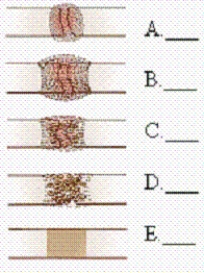
Stages:
Callus formation
Stages:
Callus formation
Question
Question
Question
Match the normal sequence of bone healing shown in the figures below with the list of stages.
Stages:
Fibrin network formation
Stages:
Fibrin network formation
Question
Question
Match the normal sequence of bone healing shown in the figures below with the list of stages.
Stages:
Invasion of osteoblasts
Stages:
Invasion of osteoblasts
Question
Question
Match the normal sequence of bone healing shown in the figures below with the list of stages.
Stages:
Hematoma formation
Stages:
Hematoma formation
Question
Match the normal sequence of bone healing shown in the figures below with the list of stages.
Stages:
Remodeling
Stages:
Remodeling
Question

Unlock Deck
Sign up to unlock the cards in this deck!
Unlock Deck
Unlock Deck
1/30

Play

Full screen (f)
Deck 11: Orthopedic Surgery
1
Osteoporosis is one of the most common and serious of bone diseases and is responsible for more than 2 million fractures a year. Osteoporosis-related fractures most commonly occur in the hip, spine, and wrist, but any bone can be affected. The excessive reduction of total bone mass in osteoporosis is due to the loss of:
A)calcified matrix and collagenous fibers.
B)exercise and weight-bearing physical activity.
C)estrogen and testosterone.
D)calcium or vitamin D.
A)calcified matrix and collagenous fibers.
B)exercise and weight-bearing physical activity.
C)estrogen and testosterone.
D)calcium or vitamin D.
A
Osteoporosis is characterized by excessive loss of calcified matrix, bone mineral, and collagenous fibers, causing a reduction of total bone mass. Decreasing levels of estrogen and testosterone in the older adult results in reduced new bone growth and maintenance of existing bone. Inadequate intake of calcium or vitamin D; lack of weight-bearing activities, exercise, and physical activity; smoking; and caffeine intake are other contributing factors. Osteoporotic bone is porous, brittle, and fragile, fracturing easily under stress. This results in susceptibility to spontaneous fractures and pathologic curvature of the spine.
Osteoporosis is characterized by excessive loss of calcified matrix, bone mineral, and collagenous fibers, causing a reduction of total bone mass. Decreasing levels of estrogen and testosterone in the older adult results in reduced new bone growth and maintenance of existing bone. Inadequate intake of calcium or vitamin D; lack of weight-bearing activities, exercise, and physical activity; smoking; and caffeine intake are other contributing factors. Osteoporotic bone is porous, brittle, and fragile, fracturing easily under stress. This results in susceptibility to spontaneous fractures and pathologic curvature of the spine.
2
The scaphoid, also called the navicular, links the proximal row of carpal bones as it:
A)articulates with each metacarpal head.
B)attaches its rough surfaces to the ligaments.
C)stabilizes and coordinates the movement of the proximal and distal rows.
D)articulates proximally with its matching carpal row.
A)articulates with each metacarpal head.
B)attaches its rough surfaces to the ligaments.
C)stabilizes and coordinates the movement of the proximal and distal rows.
D)articulates proximally with its matching carpal row.
C
Functionally, the scaphoid links the rows as it stabilizes and coordinates the movement of the proximal and distal rows. The eight carpal bones in the wrist are arranged in two rows. The distal row, proceeding from the radial to the ulnar side, includes the trapezium, trapezoid, capitate, and hamate; the proximal row consists of the scaphoid (also called the navicular), lunate, triquetrum, and pisiform. Each carpal bone consists of several smooth articular surfaces for contact with the adjacent bones, as well as rough surfaces for the attachment of ligaments.
Functionally, the scaphoid links the rows as it stabilizes and coordinates the movement of the proximal and distal rows. The eight carpal bones in the wrist are arranged in two rows. The distal row, proceeding from the radial to the ulnar side, includes the trapezium, trapezoid, capitate, and hamate; the proximal row consists of the scaphoid (also called the navicular), lunate, triquetrum, and pisiform. Each carpal bone consists of several smooth articular surfaces for contact with the adjacent bones, as well as rough surfaces for the attachment of ligaments.
3
The term hammer toe is most often used to describe an abnormal flexion posture of the proximal interphalangeal joint of one of the four lesser toes. A bunion (hallux valgus) is a soft tissue or bony mass at the medial side of the first metatarsal head. Both of these deformity conditions of the feet share similar surgical positions, instrumentation for fixation, and recovery plans. Which of the following considerations is also shared by both procedures?
A)Perform skin preparation of the same toes.
B)Position patient supine and apply ankle tourniquet.
C)Provide epinephrine for injection into the toes to decrease bleeding.
D)None of these options are relevant to both procedures.
A)Perform skin preparation of the same toes.
B)Position patient supine and apply ankle tourniquet.
C)Provide epinephrine for injection into the toes to decrease bleeding.
D)None of these options are relevant to both procedures.
B
The goals of surgery are correction of the deformity (cosmesis), resection of the abnormal bony components (reconstruction), and restoration of normal or near-normal range of motion (function). The anesthesia provider administers a general or regional anesthetic, and an ankle tourniquet is applied. The foot and leg are prepped and then draped using a sterile stockinette. A soft tissue set, a small bone set, Kirschner wires, a power wire driver, and a microsagittal saw are required. The foot is prepped and draped. The toes are end organs and epinephrine should be used with caution.
The goals of surgery are correction of the deformity (cosmesis), resection of the abnormal bony components (reconstruction), and restoration of normal or near-normal range of motion (function). The anesthesia provider administers a general or regional anesthetic, and an ankle tourniquet is applied. The foot and leg are prepped and then draped using a sterile stockinette. A soft tissue set, a small bone set, Kirschner wires, a power wire driver, and a microsagittal saw are required. The foot is prepped and draped. The toes are end organs and epinephrine should be used with caution.
4
Marissa Blanca, a 48-year-old woman with degenerative rheumatoid arthritis, is having a two-joint metacarpophalangeal implant of her left hand. The pneumatic tourniquet is applied to Marissa's upper left arm and has been inflated to 280 mm Hg for 38 minutes. The surgery is advancing as planned and the surgeon is preparing to insert the second implant. Celeste, the circulator, has set the time threshold for 60 minutes. During her preoperative assessment with Marissa, she noted no contraindications to pneumatic tourniquet use. While the surgery is going well and Celeste is confident that the second implant will be inserted and the wound closed before the tourniquet alarms, what risk reduction strategy would be appropriate for Celeste to employ?
A)Be prepared to increase the time threshold to 90 minutes.
B)Suggest a let-down procedure to resanguinate the limb at 60 minutes if the second implant is not yet inserted.
C)Wait until the 60-minute alarm sounds.
D)Gently remind the team when the 30-, 45-, and 60-minute marks are reached.
A)Be prepared to increase the time threshold to 90 minutes.
B)Suggest a let-down procedure to resanguinate the limb at 60 minutes if the second implant is not yet inserted.
C)Wait until the 60-minute alarm sounds.
D)Gently remind the team when the 30-, 45-, and 60-minute marks are reached.
Unlock Deck
Unlock for access to all 30 flashcards in this deck.
Unlock Deck
k this deck
5
Osteomalacia is a metabolic bone disease characterized by inadequate mineralization of bone, which leads to a reduced absorption of calcium and phosphorus. This malabsorptive condition is due to a deficiency of ______________ that can be treated by __________________.
A)calcium; nutritional diet and mineral supplements
B)vitamin D; dietary supplements and exposure to sunlight
C)phosphorus; nutraceuticals and exposure to therapeutic radiation
D)soy protein; weight-bearing exercise and sunlight
A)calcium; nutritional diet and mineral supplements
B)vitamin D; dietary supplements and exposure to sunlight
C)phosphorus; nutraceuticals and exposure to therapeutic radiation
D)soy protein; weight-bearing exercise and sunlight
Unlock Deck
Unlock for access to all 30 flashcards in this deck.
Unlock Deck
k this deck
6
Vertebroplasty and kyphoplasty are used for the treatment of vertebral compression fractures attributable to osteoporosis or pathologic conditions. Bone cement is injected into the vertebral body to decrease back pain and prevent further vertebral body height loss. Equipment includes C-arm, radiolucent OR bed, and x-ray vests for staff as well as bone biopsy needles, vertebroplasty system, and cement injection system. An important consideration relevant to this interventional radiology-assisted procedure would be:
A)shield the patient with a lead apron, covering from thyroid to reproductive organs.
B)organize and have casting supplies available outside of the room.
C)position patient in prone body alignment with padding to prevent skin and nerve injury.
D)abduct both arms less than 90 degrees on attached armboards.
A)shield the patient with a lead apron, covering from thyroid to reproductive organs.
B)organize and have casting supplies available outside of the room.
C)position patient in prone body alignment with padding to prevent skin and nerve injury.
D)abduct both arms less than 90 degrees on attached armboards.
Unlock Deck
Unlock for access to all 30 flashcards in this deck.
Unlock Deck
k this deck
7
In an open anterior cruciate ligament (ACL) repair, an examination under anesthesia (EUA) is performed immediately after induction of anesthesia, when the ligaments are completely lax, to evaluate the severity of the injury. The surgeon then makes a straight midline or slightly medial incision across the knee. Arthroscopic repair causes less patellar pain and decreased disturbance of extensor mechanisms. What preoperative indicators contribute to selecting the surgical approach (open or arthroscopic) of choice?
A)Classification and severity of the tear or capsular instability
B)Surgeon experience and preference
C)Patient history of a prior failed repair or gross knee joint disruption
D)All of the options are contributing factors.
A)Classification and severity of the tear or capsular instability
B)Surgeon experience and preference
C)Patient history of a prior failed repair or gross knee joint disruption
D)All of the options are contributing factors.
Unlock Deck
Unlock for access to all 30 flashcards in this deck.
Unlock Deck
k this deck
8
The vertebral bodies are connected by several cartilaginous joints. What purpose does this connection enable?
A)Communication between the spinous processes and vertebral bodies
B)Vertebral flexion, rotation, and extension
C)Vertebral flexion and torsion
D)Sustains integrity and spinal support
A)Communication between the spinous processes and vertebral bodies
B)Vertebral flexion, rotation, and extension
C)Vertebral flexion and torsion
D)Sustains integrity and spinal support
Unlock Deck
Unlock for access to all 30 flashcards in this deck.
Unlock Deck
k this deck
9
Colles' (wrist) fracture is a dorsally angulated fracture of the distal end of the radius. Most of these fractures can be managed successfully with closed reduction and immobilization, but external fixation is especially useful in the case of a comminuted intra-articular fracture. Internal fixation with Kirschner wires (K wires) is indicated when the distal end of the radius is severely comminuted and displaced. Select the correct statement for a patient with a Colles' fracture fixation.
A)Position in modified semi-Fowler with the hand table and tourniquet at the operative side.
B)Provide soft tissue instruments in OR and casting supplies available outside OR.
C)Place tourniquet cuff at mid-forearm level and set to systolic blood pressure level.
D)Position affected wrist and take an AP and lateral film before surgeon's arrival.
A)Position in modified semi-Fowler with the hand table and tourniquet at the operative side.
B)Provide soft tissue instruments in OR and casting supplies available outside OR.
C)Place tourniquet cuff at mid-forearm level and set to systolic blood pressure level.
D)Position affected wrist and take an AP and lateral film before surgeon's arrival.
Unlock Deck
Unlock for access to all 30 flashcards in this deck.
Unlock Deck
k this deck
10
A long bone fracture in a child can have devastating consequences in terms of the child's skeletal maturity and potential for limb shortening and malformation when the fracture line involves the:
A)epiphysis.
B)diaphysis.
C)epiphyseal plate.
D)cancellous bone.
A)epiphysis.
B)diaphysis.
C)epiphyseal plate.
D)cancellous bone.
Unlock Deck
Unlock for access to all 30 flashcards in this deck.
Unlock Deck
k this deck
11
Select the true statement about application and operation of the pneumatic tourniquet.
A)The tourniquet cuff should not overlap less than 3 inches or more than 6 inches.
B)Limb exsanguination is optional, using a sterile sequential compression sleeve.
C)In a healthy person, inflation time for an arm should not exceed 30 minutes.
D)Pneumatic tourniquets are contraindicated in patients with bleeding tendencies.
A)The tourniquet cuff should not overlap less than 3 inches or more than 6 inches.
B)Limb exsanguination is optional, using a sterile sequential compression sleeve.
C)In a healthy person, inflation time for an arm should not exceed 30 minutes.
D)Pneumatic tourniquets are contraindicated in patients with bleeding tendencies.
Unlock Deck
Unlock for access to all 30 flashcards in this deck.
Unlock Deck
k this deck
12
While not as prevalent as arthroplasty of the shoulder, knee, or hip, total elbow replacement is indicated for patients with traumatic lesions or excessive bone loss from rheumatic or degenerative arthritis, resulting in elbow instability and pain or bilateral elbow ankylosis. The prosthesis may be used with or without PMMA, depending on the quality of the diseased bone and the design of the implant. If PMMA is not used, what replacement product, element, or substance is used?
A)Synthetic bone putty
B)Autologous bone graft
C)Hemostatic gel sponge with thrombin
D)Side plates, screws, and circumferential wires
A)Synthetic bone putty
B)Autologous bone graft
C)Hemostatic gel sponge with thrombin
D)Side plates, screws, and circumferential wires
Unlock Deck
Unlock for access to all 30 flashcards in this deck.
Unlock Deck
k this deck
13
Bone grafting using allografts or autografts may be used to fill cavities after removal of large amounts of bone that might result in instability, or to fill bony defects and to promote the union of fractures at the time of open reduction. Banked bone is available in many shapes of cortical and cancellous tissue. The American Association of Tissue Banks (AATB) accredits and periodically inspects bone-banking programs to ensure that specific standards are followed in the retrieval, processing, storage, and distribution of bone grafts. Bone graft that is sealed in a sterile labeled envelope from a tissue transplant company and stored in a vacuum-sealed freezer, monitored with an alarm, would be considered a(n):
A)reengineered human tissue product.
B)allograft.
C)xenograft.
D)autograft.
A)reengineered human tissue product.
B)allograft.
C)xenograft.
D)autograft.
Unlock Deck
Unlock for access to all 30 flashcards in this deck.
Unlock Deck
k this deck
14
Open reduction and internal fixation (ORIF) is a method of providing exposure of the fracture site and using pins, wire, screws, a plate and screw combination, rods, or nails to correct the fracture. Surgeons use open reduction and internal fixation when they are unable to reduce a fracture by closed methods and skeletal traction is not indicated. What would be an advantage for an open rather than a closed fracture reduction technique?
A)Direct observation and verification of fracture alignment
B)Decreased opportunity for surgical site infection
C)Improved bone union outcomes
D)Ability to rule out comminuted or compound fractures without imaging
A)Direct observation and verification of fracture alignment
B)Decreased opportunity for surgical site infection
C)Improved bone union outcomes
D)Ability to rule out comminuted or compound fractures without imaging
Unlock Deck
Unlock for access to all 30 flashcards in this deck.
Unlock Deck
k this deck
15
Identify the layer of connective tissue that covers all bone.
A)Periosteum
B)Calcium
C)Cartilage
D)Fascia
A)Periosteum
B)Calcium
C)Cartilage
D)Fascia
Unlock Deck
Unlock for access to all 30 flashcards in this deck.
Unlock Deck
k this deck
16
Revision arthroplasty may be indicated if the patient's original knee replacement wears out or loosens, or fails as a result of repeated dislocation, infection, or trauma. Total joint revision can be a very demanding and complicated procedure. Attention to detail, anticipation, and preparation are essential. Following the induction of anesthesia, the surgeon performs an exam under anesthesia (EUA) to determine the approach. The most difficult aspect of revision surgery is that there is:
A)considerable scar tissue and edema.
B)a significant challenge ahead with postoperative pain management.
C)no clear-cut sequence of events.
D)polymethyl methacrylate (PMMA) bone cement that must be drilled out.
A)considerable scar tissue and edema.
B)a significant challenge ahead with postoperative pain management.
C)no clear-cut sequence of events.
D)polymethyl methacrylate (PMMA) bone cement that must be drilled out.
Unlock Deck
Unlock for access to all 30 flashcards in this deck.
Unlock Deck
k this deck
17
The rotator cuff consists of which group of muscles?
A)Deltoid, teres major, and teres minor
B)Supraspinatus, infraspinatus, teres minor, and subscapularis
C)Latissimus dorsi, deltoid, and teres major
D)Supraspinatus, subscapularis, pectoralis major, and deltoid
A)Deltoid, teres major, and teres minor
B)Supraspinatus, infraspinatus, teres minor, and subscapularis
C)Latissimus dorsi, deltoid, and teres major
D)Supraspinatus, subscapularis, pectoralis major, and deltoid
Unlock Deck
Unlock for access to all 30 flashcards in this deck.
Unlock Deck
k this deck
18
Paget's disease is a disorder affecting older adults. The bones are weak and poorly constructed. It is characterized by the proliferation of osteoclasts and compensatory increased osteoblastic activity. This degenerative process results in:
A)weak and non supported bone matrix.
B)replacement of cancellous bone with cortical bone.
C)rapid, disorganized bone remodeling.
D)immature bone cells with air spaces.
A)weak and non supported bone matrix.
B)replacement of cancellous bone with cortical bone.
C)rapid, disorganized bone remodeling.
D)immature bone cells with air spaces.
Unlock Deck
Unlock for access to all 30 flashcards in this deck.
Unlock Deck
k this deck
19
Polymethyl methacrylate (PMMA, or bone cement) is an acrylic, cement-like substance composed of a liquid methyl methacrylate monomer and a powder methyl methacrylate-styrene co-polymer. What element is added to the powder component to make the finished product radiopaque?
A)Radiografinpaque
B)Polycrylate sodium
C)Barium
D)Granular allograft bone
A)Radiografinpaque
B)Polycrylate sodium
C)Barium
D)Granular allograft bone
Unlock Deck
Unlock for access to all 30 flashcards in this deck.
Unlock Deck
k this deck
20
The surgeon may treat distal limb fractures with a closed reduction, rather than open or external fixation, manipulating the fragments into position without incising the skin. When possible, this is the treatment of choice because it decreases the opportunity for infection, improves results (including bone union of the fracture), and minimizes the recovery period. Closed reduction with local or light anesthesia may permit ambulatory surgery. Select a situation where closed reduction would be performed in addition to open reduction and fixation surgery to a distal limb.
A)Significant bone comminution
B)Where periosteal damage is evident
C)Before an open procedure to reduce the fracture site
D)When soft tissue entrapment is suspected
A)Significant bone comminution
B)Where periosteal damage is evident
C)Before an open procedure to reduce the fracture site
D)When soft tissue entrapment is suspected
Unlock Deck
Unlock for access to all 30 flashcards in this deck.
Unlock Deck
k this deck
21
Match the normal sequence of bone healing shown in the figures below with the list of stages.
Stages:
Callus formation
Stages:
Callus formation
Unlock Deck
Unlock for access to all 30 flashcards in this deck.
Unlock Deck
k this deck
22
A cancellous bone graft consists of spongy bone usually taken from the anterior or posterior crest of the ilium. A cortical bone graft, consisting of hard, dense bone, is removed from the crest of the ilium or the tibia. Why is the ilium a desirable site for graft harvest? Select all responses from the list below that apply.
A)It is subcutaneous, making it easily exposed without difficulty.
B)It is not a weight-bearing joint.
C)It is not an articulating joint.
D)It has both cortical and cancellous bone.
E)There are two, one on each lateral side.f. It has both allograft and autograft bone.
A)It is subcutaneous, making it easily exposed without difficulty.
B)It is not a weight-bearing joint.
C)It is not an articulating joint.
D)It has both cortical and cancellous bone.
E)There are two, one on each lateral side.f. It has both allograft and autograft bone.
Unlock Deck
Unlock for access to all 30 flashcards in this deck.
Unlock Deck
k this deck
23
Match the skeletal structure with its appropriate description.a.Ligaments
b.Tendons
c.Cartilage
Tough, long strands of fibers that form the ends of muscles
b.Tendons
c.Cartilage
Tough, long strands of fibers that form the ends of muscles
Unlock Deck
Unlock for access to all 30 flashcards in this deck.
Unlock Deck
k this deck
24
Match the normal sequence of bone healing shown in the figures below with the list of stages.
Stages:
Fibrin network formation
Stages:
Fibrin network formation
Unlock Deck
Unlock for access to all 30 flashcards in this deck.
Unlock Deck
k this deck
25
An OR fracture bed is used for orthopedic surgical procedures such as femoral neck or shaft fixation. The patient can be positioned in a partially suspended supine or lateral position. This specialized supportive bed provides several therapeutic options that promote a safe, efficient, and ergonomic approach to the area to be repaired. Select all the therapeutic options in the list below that promote the successful accomplishment of a femoral fracture procedure.
A)The patient is in proper body and mechanical alignment.
B)The femur fracture is reduced in traction to align the bone.
C)The entire leg can be prepped circumferentially.
D)Multiview images can be taken with the C-arm image intensifier.
E)The patient can be turned prone for posterior spinal access
F) The patient can have a hip spica cast applied.
A)The patient is in proper body and mechanical alignment.
B)The femur fracture is reduced in traction to align the bone.
C)The entire leg can be prepped circumferentially.
D)Multiview images can be taken with the C-arm image intensifier.
E)The patient can be turned prone for posterior spinal access
F) The patient can have a hip spica cast applied.
Unlock Deck
Unlock for access to all 30 flashcards in this deck.
Unlock Deck
k this deck
26
Match the normal sequence of bone healing shown in the figures below with the list of stages.
Stages:
Invasion of osteoblasts
Stages:
Invasion of osteoblasts
Unlock Deck
Unlock for access to all 30 flashcards in this deck.
Unlock Deck
k this deck
27
Match the skeletal structure with its appropriate description.a.Ligaments
b.Tendons
c.Cartilage
Bands of dense connective tissue that hold bone to bone
b.Tendons
c.Cartilage
Bands of dense connective tissue that hold bone to bone
Unlock Deck
Unlock for access to all 30 flashcards in this deck.
Unlock Deck
k this deck
28
Match the normal sequence of bone healing shown in the figures below with the list of stages.
Stages:
Hematoma formation
Stages:
Hematoma formation
Unlock Deck
Unlock for access to all 30 flashcards in this deck.
Unlock Deck
k this deck
29
Match the normal sequence of bone healing shown in the figures below with the list of stages.
Stages:
Remodeling
Stages:
Remodeling
Unlock Deck
Unlock for access to all 30 flashcards in this deck.
Unlock Deck
k this deck
30
Match the skeletal structure with its appropriate description.a.Ligaments
b.Tendons
c.Cartilage
Layer of elastic, resilient supporting tissue found at the ends of the bones
b.Tendons
c.Cartilage
Layer of elastic, resilient supporting tissue found at the ends of the bones
Unlock Deck
Unlock for access to all 30 flashcards in this deck.
Unlock Deck
k this deck
Unlock Deck
Unlock for access to all 30 flashcards in this deck.






