







 Chat with AI

Deck 28: The Evolution of Seed Plants
Full screen (f)

Question

Question
Question
Question
Question
Question
Question
Question
Refer to the figure. 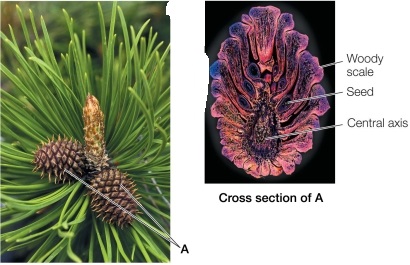 Suppose that a specimen of structure A is given to you as an example of a fruit.Which response would be the most accurate?
A) This sample is from a gymnosperm, which does not make fruit.
B) This is a fruit dispersed by bats.
C) This is a fruit dispersed by birds.
D) The carpels of this fruit are incompletely fused.
E) This is a conifer fruit dispersed by wind.
Suppose that a specimen of structure A is given to you as an example of a fruit.Which response would be the most accurate?A) This sample is from a gymnosperm, which does not make fruit.
B) This is a fruit dispersed by bats.
C) This is a fruit dispersed by birds.
D) The carpels of this fruit are incompletely fused.
E) This is a conifer fruit dispersed by wind.
Question
Question
Question
Question
Question
Question
Question
Question
Question
Question
Question
Question
Question
Question
Question
Question
Question
Question
Question
Question
Question
Question
Question
Question
Question
Question
Question
Refer to the figure. 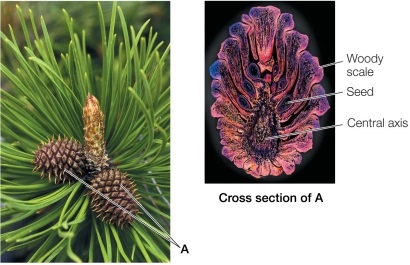 Structure A is a
A) gall.
B) fascicle.
C) root cap.
D) male cone.
E) female cone.
Structure A is aA) gall.
B) fascicle.
C) root cap.
D) male cone.
E) female cone.
Question
Question
Question
Question
Refer to the figure. 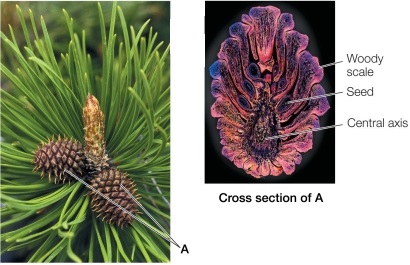 The woody scales shown protect the megastrobilus and are modified
A) branches.
B) leaves.
C) roots.
D) petals.
E) pistils.
The woody scales shown protect the megastrobilus and are modifiedA) branches.
B) leaves.
C) roots.
D) petals.
E) pistils.
Question
Question
Question
Refer to the figure. 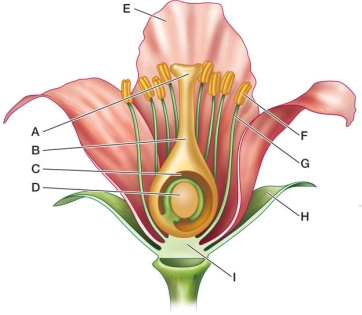 What is the name of the floral part where microgametophytes are produced? Identify its label.
A) Stigma (A)
B) Ovary (C)
C) Ovule (D)
D) Anther (F)
E) Sepal (H)
What is the name of the floral part where microgametophytes are produced? Identify its label.A) Stigma (A)
B) Ovary (C)
C) Ovule (D)
D) Anther (F)
E) Sepal (H)
Question
Question
Question
Question
Refer to the figure. 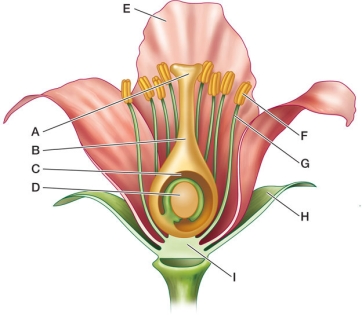 What is the name of the floral part where the megasporangium resides? Identify its label.
A) Stigma (A)
B) Ovary (C)
C) Ovule (D)
D) Anther (F)
E) Sepal (H)
What is the name of the floral part where the megasporangium resides? Identify its label.A) Stigma (A)
B) Ovary (C)
C) Ovule (D)
D) Anther (F)
E) Sepal (H)
Question
Refer to the figure. 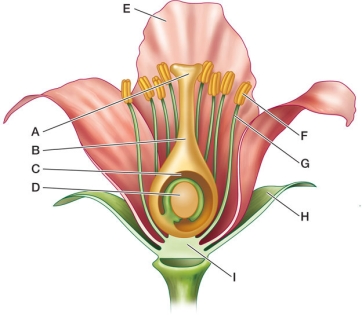 What is the name of the floral parts that collectively make up the calyx? Identify the correct label.
A) Stigma (A)
B) Ovary (C)
C) Ovule (D)
D) Petals (E)
E) Sepals (H)
What is the name of the floral parts that collectively make up the calyx? Identify the correct label.A) Stigma (A)
B) Ovary (C)
C) Ovule (D)
D) Petals (E)
E) Sepals (H)
Question
Question
Refer to the figure. 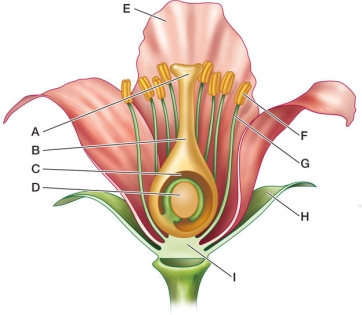 What is the name of the floral parts that collectively make up the calyx? Identify the correct label.
A) Stigma (A)
B) Petals (E)
C) Ovule (D)
D) Anthers (F)
E) Sepals (H)
What is the name of the floral parts that collectively make up the calyx? Identify the correct label.A) Stigma (A)
B) Petals (E)
C) Ovule (D)
D) Anthers (F)
E) Sepals (H)
Question
Question
Question
Question
Question
Question
Question
Question
Question
Refer to the figure. 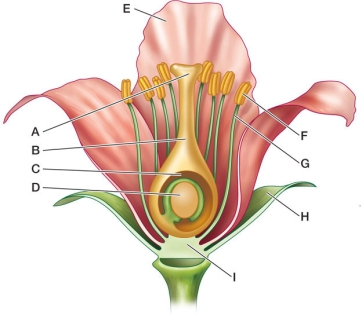 What is the name of the swollen base of the pistil? Identify its label.
A) Ovary (C)
B) Petal (E)
C) Ovule (D)
D) Anther (F)
E) Sepal (H)
What is the name of the swollen base of the pistil? Identify its label.A) Ovary (C)
B) Petal (E)
C) Ovule (D)
D) Anther (F)
E) Sepal (H)
Question
Question
Refer to the figure. 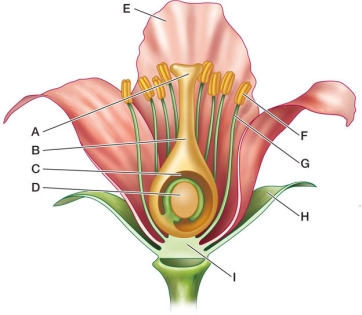 What is the name of the floral part that receives pollen grains? Identify its label.
A) Stigma (A)
B) Ovary (C)
C) Ovule (D)
D) Anther (F)
E) Sepal (H)
What is the name of the floral part that receives pollen grains? Identify its label.A) Stigma (A)
B) Ovary (C)
C) Ovule (D)
D) Anther (F)
E) Sepal (H)
Question
Question
Question
Question
Question
Question
Question
Question
Question
Question
Refer to the figure, which shows the life cycle of an angiosperm. 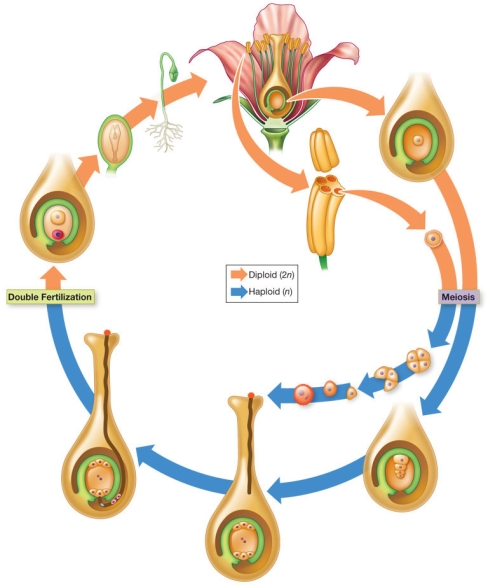 If double fertilization were delayed in this plant, the appearance of which two critical structures shown in the diagram would be also delayed?
A) Embryo and integument
B) Embryo and endosperm
C) Endosperm and integument
D) Integument and micropyle
E) Pollen tube and endosperm
If double fertilization were delayed in this plant, the appearance of which two critical structures shown in the diagram would be also delayed?A) Embryo and integument
B) Embryo and endosperm
C) Endosperm and integument
D) Integument and micropyle
E) Pollen tube and endosperm
Question
Question
Question
Question
Question
Question
Question
Question
Question
Question

Unlock Deck
Sign up to unlock the cards in this deck!
Unlock Deck
Unlock Deck
1/259

Play

Full screen (f)
Deck 28: The Evolution of Seed Plants
1
What is a primary difference between angiosperm and gymnosperm seeds?
A) Angiosperm seeds contain endosperm, while gymnosperm seeds do not.
B) Angiosperm seeds have seed coats, while gymnosperm seeds do not.
C) Gymnosperm seeds have seed coats, while angiosperm seeds do not.
D) Angiosperm seeds contain embryos, while gymnosperm seeds do not.
E) Gymnosperm seeds are protected by fruits, while angiosperm seeds are not.
A) Angiosperm seeds contain endosperm, while gymnosperm seeds do not.
B) Angiosperm seeds have seed coats, while gymnosperm seeds do not.
C) Gymnosperm seeds have seed coats, while angiosperm seeds do not.
D) Angiosperm seeds contain embryos, while gymnosperm seeds do not.
E) Gymnosperm seeds are protected by fruits, while angiosperm seeds are not.
A
2
Pollen from a snapdragon flower lands on the stigma of a neighboring snapdragon.The pollen tube germinates and extends through the maternal sporophyte tissue to the ovule, where it encounters the female gametophyte and releases two sperm, one that fuses with the egg and another that fuses with the polar nuclei.Which statement about this scenario is true?
A) Pollination occurred when the egg and sperm nuclei fused, resulting in a diploid tissue that would eventually become nutritive tissue for the embryo.
B) Fertilization occurred when the pollen grain landed on the stigma of the neighboring flower, before the pollen tube germinated and extended down to the female gametophyte.
C) Pollination occurred when the pollen landed on the stigma, and a fertilization event occurred upon fusion of sperm and polar nuclei.
D) Pollination occurred when the sperm and polar nuclei fused, whereas fertilization occurred upon fusion of the sperm and egg nuclei.
E) The entire process, from pollen landing on the stigma through to the fusion of male and female gametes, is considered fertilization.
A) Pollination occurred when the egg and sperm nuclei fused, resulting in a diploid tissue that would eventually become nutritive tissue for the embryo.
B) Fertilization occurred when the pollen grain landed on the stigma of the neighboring flower, before the pollen tube germinated and extended down to the female gametophyte.
C) Pollination occurred when the pollen landed on the stigma, and a fertilization event occurred upon fusion of sperm and polar nuclei.
D) Pollination occurred when the sperm and polar nuclei fused, whereas fertilization occurred upon fusion of the sperm and egg nuclei.
E) The entire process, from pollen landing on the stigma through to the fusion of male and female gametes, is considered fertilization.
C
3
A unique characteristic of the angiosperms is
A) the production of zygotes.
B) alternation of generations.
C) the production of xylem.
D) the production of seeds.
E) the production of fruit and flowers.
A) the production of zygotes.
B) alternation of generations.
C) the production of xylem.
D) the production of seeds.
E) the production of fruit and flowers.
E
4
All seed plants are
A) heterosporous.
B) dioecious.
C) monoecious.
D) eudicots.
E) dependent on animals for fertilization.
A) heterosporous.
B) dioecious.
C) monoecious.
D) eudicots.
E) dependent on animals for fertilization.
Unlock Deck
Unlock for access to all 259 flashcards in this deck.
Unlock Deck
k this deck
5
A newly discovered fossil layer shows evidence that conifers and cycads flourished when the fossils were laid down.Below this layer there are no conifers or cycads.These fossils are most likely from the
A) Precambrian.
B) Permian.
C) Devonian.
D) Ordovician.
E) Tertiary.
A) Precambrian.
B) Permian.
C) Devonian.
D) Ordovician.
E) Tertiary.
Unlock Deck
Unlock for access to all 259 flashcards in this deck.
Unlock Deck
k this deck
6
Which synapomorphy is not shared by gymnosperms and angiosperms?
A) Seeds
B) Heterospory
C) Flowers
D) Secondary growth
E) Pollen
A) Seeds
B) Heterospory
C) Flowers
D) Secondary growth
E) Pollen
Unlock Deck
Unlock for access to all 259 flashcards in this deck.
Unlock Deck
k this deck
7
One difference between gymnosperms and angiosperms is that gymnosperms
A) do not form seeds.
B) do not make pollen.
C) do not make endosperm.
D) rely solely on wind for fertilization.
E) have secondary growth.
A) do not form seeds.
B) do not make pollen.
C) do not make endosperm.
D) rely solely on wind for fertilization.
E) have secondary growth.
Unlock Deck
Unlock for access to all 259 flashcards in this deck.
Unlock Deck
k this deck
8
Refer to the figure. Suppose that a specimen of structure A is given to you as an example of a fruit.Which response would be the most accurate?
A) This sample is from a gymnosperm, which does not make fruit.
B) This is a fruit dispersed by bats.
C) This is a fruit dispersed by birds.
D) The carpels of this fruit are incompletely fused.
E) This is a conifer fruit dispersed by wind.
Suppose that a specimen of structure A is given to you as an example of a fruit.Which response would be the most accurate?A) This sample is from a gymnosperm, which does not make fruit.
B) This is a fruit dispersed by bats.
C) This is a fruit dispersed by birds.
D) The carpels of this fruit are incompletely fused.
E) This is a conifer fruit dispersed by wind.
Unlock Deck
Unlock for access to all 259 flashcards in this deck.
Unlock Deck
k this deck
9
A trend seen throughout the evolution of the land plants is for the sporophyte generation to become _______ and more independent of the gametophyte, and the gametophyte generation to become _______ and more dependent on the sporophyte.
A) smaller; smaller
B) larger; smaller
C) smaller; larger
D) larger; larger
E) larger or smaller; larger
A) smaller; smaller
B) larger; smaller
C) smaller; larger
D) larger; larger
E) larger or smaller; larger
Unlock Deck
Unlock for access to all 259 flashcards in this deck.
Unlock Deck
k this deck
10
All plant life cycles have generations that alternate between the gametophyte generation and the _______ generation.
A) heteromorphic
B) sporophyte
C) vascular
D) isomorphic
E) antheridium
A) heteromorphic
B) sporophyte
C) vascular
D) isomorphic
E) antheridium
Unlock Deck
Unlock for access to all 259 flashcards in this deck.
Unlock Deck
k this deck
11
In the plant life cycle, pollen is a(n)
A) embryo.
B) megaspore.
C) microspore.
D) megagametophyte.
E) microgametophyte.
A) embryo.
B) megaspore.
C) microspore.
D) megagametophyte.
E) microgametophyte.
Unlock Deck
Unlock for access to all 259 flashcards in this deck.
Unlock Deck
k this deck
12
Which group has the greatest number of species?
A) Angiosperms
B) Conifers
C) Gnetophytes
D) Ginkgos
E) Cycads
A) Angiosperms
B) Conifers
C) Gnetophytes
D) Ginkgos
E) Cycads
Unlock Deck
Unlock for access to all 259 flashcards in this deck.
Unlock Deck
k this deck
13
Angiosperms and their animal pollinators have coevolved in the terrestrial environment for _______ years.
A) 150,000
B) 1.5 million
C) nearly 15 million
D) more than 150 million
E) more than 1.5 billion
A) 150,000
B) 1.5 million
C) nearly 15 million
D) more than 150 million
E) more than 1.5 billion
Unlock Deck
Unlock for access to all 259 flashcards in this deck.
Unlock Deck
k this deck
14
In most terrestrial regions of Earth today, the flora consists predominantly of
A) bryophytes.
B) gymnosperms.
C) ferns.
D) angiosperms.
E) club mosses.
A) bryophytes.
B) gymnosperms.
C) ferns.
D) angiosperms.
E) club mosses.
Unlock Deck
Unlock for access to all 259 flashcards in this deck.
Unlock Deck
k this deck
15
The ovule consists of the
A) megasporangium and the protective integument.
B) megasporangium only.
C) microsporangium and the protective integument.
D) microsporangium only.
E) megagametophyte only.
A) megasporangium and the protective integument.
B) megasporangium only.
C) microsporangium and the protective integument.
D) microsporangium only.
E) megagametophyte only.
Unlock Deck
Unlock for access to all 259 flashcards in this deck.
Unlock Deck
k this deck
16
About 200 mya, dinosaurs were Earth's dominant animals, and _______ were the dominant vegetation.
A) early whisk ferns
B) horsetails and tree ferns
C) some lycopods and ferns
D) gymnosperms
E) angiosperms
A) early whisk ferns
B) horsetails and tree ferns
C) some lycopods and ferns
D) gymnosperms
E) angiosperms
Unlock Deck
Unlock for access to all 259 flashcards in this deck.
Unlock Deck
k this deck
17
A member of your research group isolates a mutant plant from a species with perfect flowers, but this plant does not produce sporopollenin.He would like to further characterize this mutant by studying its offspring.What do you tell him?
A) It will be impossible to study the offspring of this mutant, because it will not be able to develop seed coats to protect its seeds.
B) It will be impossible to study the offspring of this mutant, because the pollen will not be protected from desiccation and will not be viable.
C) This mutant will only produce offspring if it is pollinated it with pollen from a nonmutant plant of the same species.
D) This mutant will only produce offspring if you use its pollen to fertilize a plant with a functional sporopollenin gene.
E) This mutant should be able to produce viable offspring if the flowers are self-pollinated.
A) It will be impossible to study the offspring of this mutant, because it will not be able to develop seed coats to protect its seeds.
B) It will be impossible to study the offspring of this mutant, because the pollen will not be protected from desiccation and will not be viable.
C) This mutant will only produce offspring if it is pollinated it with pollen from a nonmutant plant of the same species.
D) This mutant will only produce offspring if you use its pollen to fertilize a plant with a functional sporopollenin gene.
E) This mutant should be able to produce viable offspring if the flowers are self-pollinated.
Unlock Deck
Unlock for access to all 259 flashcards in this deck.
Unlock Deck
k this deck
18
You examine the reproductive structures of a newly discovered seed plant and find motile, swimming sperm.With which two groups of living seed plants should you consider grouping this plant?
A) Cycads and angiosperms
B) Cycads and conifers
C) Conifers and angiosperms
D) Ginkgos and cycads
E) Gnetophytes and ginkgos
A) Cycads and angiosperms
B) Cycads and conifers
C) Conifers and angiosperms
D) Ginkgos and cycads
E) Gnetophytes and ginkgos
Unlock Deck
Unlock for access to all 259 flashcards in this deck.
Unlock Deck
k this deck
19
Which two features found in seed plants play a clear role in preventing desiccation?
A) The fruit and sporopollenin
B) The endosperm and the fruit
C) Sporopollenin and the pollen tube
D) The seed coat and sporopollenin
E) The seed coat and the pollen tube
A) The fruit and sporopollenin
B) The endosperm and the fruit
C) Sporopollenin and the pollen tube
D) The seed coat and sporopollenin
E) The seed coat and the pollen tube
Unlock Deck
Unlock for access to all 259 flashcards in this deck.
Unlock Deck
k this deck
20
There have been changes in the dominant vegetation since plants first invaded the terrestrial environment 400-500 mya.Which of the following shows groups in the correct order in which they were dominant, from earliest to most recent?
A) Gymnosperms, progymnosperms, angiosperms
B) Angiosperms, progymnosperms, gymnosperms
C) Progymnosperms, gymnosperms, angiosperms
D) Angiosperms, gymnosperms, progymnosperms
E) Progymnosperms, angiosperms, gymnosperms
A) Gymnosperms, progymnosperms, angiosperms
B) Angiosperms, progymnosperms, gymnosperms
C) Progymnosperms, gymnosperms, angiosperms
D) Angiosperms, gymnosperms, progymnosperms
E) Progymnosperms, angiosperms, gymnosperms
Unlock Deck
Unlock for access to all 259 flashcards in this deck.
Unlock Deck
k this deck
21
One reason for the enormous evolutionary success of seed plants as a group is their possession of
A) complex leaves that can photosynthesize at a faster rate than non-seed-producing plants can.
B) seeds with food reserves for the young gametophyte.
C) seeds with a resting stage that can remain viable for many years, germinating when conditions are favorable for growth of the sporophyte.
D) seeds that are dispersed by wind.
E) mobile pollen.
A) complex leaves that can photosynthesize at a faster rate than non-seed-producing plants can.
B) seeds with food reserves for the young gametophyte.
C) seeds with a resting stage that can remain viable for many years, germinating when conditions are favorable for growth of the sporophyte.
D) seeds that are dispersed by wind.
E) mobile pollen.
Unlock Deck
Unlock for access to all 259 flashcards in this deck.
Unlock Deck
k this deck
22
_______ are not classified as a gymnosperms.
A) Conifers
B) Cycads
C) Gnetophytes
D) Ginkgos
E) Flowering plants
A) Conifers
B) Cycads
C) Gnetophytes
D) Ginkgos
E) Flowering plants
Unlock Deck
Unlock for access to all 259 flashcards in this deck.
Unlock Deck
k this deck
23
You find a previously unknown seed plant species with palmlike leaves.The seeds are extremely toxic, and a close examination shows a lack of flowers.This plant is most likely a member of which group?
A) Cycads
B) Ginkgos
C) Conifers
D) Gnetophytes
E) Angiosperms
A) Cycads
B) Ginkgos
C) Conifers
D) Gnetophytes
E) Angiosperms
Unlock Deck
Unlock for access to all 259 flashcards in this deck.
Unlock Deck
k this deck
24
A scientist takes a survey of a 1,000-acre plot and finds 200 gymnosperm plants.Of these, 180 belong to one group.This group is likely to be the
A) cycads.
B) ginkgos.
C) gnetophytes.
D) conifers.
E) angiosperms.
A) cycads.
B) ginkgos.
C) gnetophytes.
D) conifers.
E) angiosperms.
Unlock Deck
Unlock for access to all 259 flashcards in this deck.
Unlock Deck
k this deck
25
Which group includes a species that has male and female trees in which the sex is determined by sex chromosomes?
A) Cycads
B) Gnetophytes
C) Conifers
D) Ginkgos
E) No groups of gymnosperms have this characteristic.
A) Cycads
B) Gnetophytes
C) Conifers
D) Ginkgos
E) No groups of gymnosperms have this characteristic.
Unlock Deck
Unlock for access to all 259 flashcards in this deck.
Unlock Deck
k this deck
26
Seeds tend to germinate when environmental conditions are favorable.What is the most logical reason that the lodgepole pine has evolved cones that open only after exposure to fire?
A) Fire produces new clearings that would reduce competition for light.
B) Fire clears away potential predators of the newly emerging seedlings.
C) Lodgepole pine became established in high-fire-risk zones and evolved a way to protect their seeds until after a fire has passed.
D) Lodgepole pine is fire-tolerant, and the requirement of fire for seed germination is an artifact of the parental generation's fire resistance.
E) Fire-induced seed germination ensures that an entire year will pass before seedlings emerge, ensuring adequate weather conditions for plant survival.
A) Fire produces new clearings that would reduce competition for light.
B) Fire clears away potential predators of the newly emerging seedlings.
C) Lodgepole pine became established in high-fire-risk zones and evolved a way to protect their seeds until after a fire has passed.
D) Lodgepole pine is fire-tolerant, and the requirement of fire for seed germination is an artifact of the parental generation's fire resistance.
E) Fire-induced seed germination ensures that an entire year will pass before seedlings emerge, ensuring adequate weather conditions for plant survival.
Unlock Deck
Unlock for access to all 259 flashcards in this deck.
Unlock Deck
k this deck
27
A newly discovered species of vascular plant is wind-pollinated.Thus you conclude that this plant
A) releases its pollen in an enclosed space.
B) has the same pollination method as most gymnosperms.
C) has the same pollination method as most flowering plants.
D) produces few pollen grains.
E) possesses pollen with flagellated sperm.
A) releases its pollen in an enclosed space.
B) has the same pollination method as most gymnosperms.
C) has the same pollination method as most flowering plants.
D) produces few pollen grains.
E) possesses pollen with flagellated sperm.
Unlock Deck
Unlock for access to all 259 flashcards in this deck.
Unlock Deck
k this deck
28
Which tropical plant group, made up of palmlike plants, is the earliest-diverging clade of gymnosperms?
A) Angiosperms
B) Ginkgos
C) Conifers
D) Gnetophytes
E) Cycads
A) Angiosperms
B) Ginkgos
C) Conifers
D) Gnetophytes
E) Cycads
Unlock Deck
Unlock for access to all 259 flashcards in this deck.
Unlock Deck
k this deck
29
Coniferous gymnosperms, such as pines, depend primarily on _______ for pollination; thus, the plants produce large quantities of pollen that disperse over large areas during the spring.
A) insects
B) birds
C) water
D) wind
E) mammals
A) insects
B) birds
C) water
D) wind
E) mammals
Unlock Deck
Unlock for access to all 259 flashcards in this deck.
Unlock Deck
k this deck
30
If a fungus were to kill off all extant seed plants with needlelike or scalelike leaves plus cones, it would eliminate
A) cycads.
B) ginkgos.
C) angiosperms.
D) gnetophytes.
E) conifers.
A) cycads.
B) ginkgos.
C) angiosperms.
D) gnetophytes.
E) conifers.
Unlock Deck
Unlock for access to all 259 flashcards in this deck.
Unlock Deck
k this deck
31
When strolling through a botanical garden, you come upon an area full of plants that have cones and needlelike leaves.This section of the botanical garden is dedicated to the
A) cycads.
B) ginkgos.
C) conifers.
D) gnetophytes.
E) angiosperms.
A) cycads.
B) ginkgos.
C) conifers.
D) gnetophytes.
E) angiosperms.
Unlock Deck
Unlock for access to all 259 flashcards in this deck.
Unlock Deck
k this deck
32
The seeds in angiosperms are
A) on the upper surface of the sporophyte.
B) on the lower surface of the sporophyte.
C) buried within the sporophytes.
D) enclosed in the ovary.
E) protected by a tight cluster of woody scales.
A) on the upper surface of the sporophyte.
B) on the lower surface of the sporophyte.
C) buried within the sporophytes.
D) enclosed in the ovary.
E) protected by a tight cluster of woody scales.
Unlock Deck
Unlock for access to all 259 flashcards in this deck.
Unlock Deck
k this deck
33
A function of the pollen tube is to
A) eject pollen from the microsporangium.
B) help the pollen grain adhere to the pollinator.
C) deliver the pollen to the stigma.
D) produce pollen.
E) digest the sporophyte tissue as it elongates toward the female gametophyte.
A) eject pollen from the microsporangium.
B) help the pollen grain adhere to the pollinator.
C) deliver the pollen to the stigma.
D) produce pollen.
E) digest the sporophyte tissue as it elongates toward the female gametophyte.
Unlock Deck
Unlock for access to all 259 flashcards in this deck.
Unlock Deck
k this deck
34
_______, which have fan-shaped leaves, were common during the Mesozoic era but are represented today by a single species.
A) Cycads
B) Ginkgos
C) Conifers
D) Gnetophytes
E) Angiosperms
A) Cycads
B) Ginkgos
C) Conifers
D) Gnetophytes
E) Angiosperms
Unlock Deck
Unlock for access to all 259 flashcards in this deck.
Unlock Deck
k this deck
35
Refer to the figure. Structure A is a
A) gall.
B) fascicle.
C) root cap.
D) male cone.
E) female cone.
Structure A is aA) gall.
B) fascicle.
C) root cap.
D) male cone.
E) female cone.
Unlock Deck
Unlock for access to all 259 flashcards in this deck.
Unlock Deck
k this deck
36
Which group of plants has members that produce "wood" (extensively proliferated xylem)?
A) Only plants that do not have pollen
B) Plants that produce seeds
C) All plants that depend on water for fertilization
D) All plants that produce haploid spores
E) All plants with vascular systems
A) Only plants that do not have pollen
B) Plants that produce seeds
C) All plants that depend on water for fertilization
D) All plants that produce haploid spores
E) All plants with vascular systems
Unlock Deck
Unlock for access to all 259 flashcards in this deck.
Unlock Deck
k this deck
37
Rank gymnosperm groups in order from the one with the lowest number of extant species to the one with the highest.
A) Conifers < gnetophytes < ginkgos < cycads
B) Gnetophytes < ginkgos < conifers < cycads
C) Gnetophytes < ginkgos < cycads < conifers
D) Ginkgos < gnetophytes < conifers < cycads
E) Ginkgos < gnetophytes < cycads < conifers
A) Conifers < gnetophytes < ginkgos < cycads
B) Gnetophytes < ginkgos < conifers < cycads
C) Gnetophytes < ginkgos < cycads < conifers
D) Ginkgos < gnetophytes < conifers < cycads
E) Ginkgos < gnetophytes < cycads < conifers
Unlock Deck
Unlock for access to all 259 flashcards in this deck.
Unlock Deck
k this deck
38
Which seed plant group always has separate male and female plants?
A) Monocots
B) Eudicots
C) Ginkgos
D) Conifers
E) Angiosperms
A) Monocots
B) Eudicots
C) Ginkgos
D) Conifers
E) Angiosperms
Unlock Deck
Unlock for access to all 259 flashcards in this deck.
Unlock Deck
k this deck
39
Refer to the figure. The woody scales shown protect the megastrobilus and are modified
A) branches.
B) leaves.
C) roots.
D) petals.
E) pistils.
The woody scales shown protect the megastrobilus and are modifiedA) branches.
B) leaves.
C) roots.
D) petals.
E) pistils.
Unlock Deck
Unlock for access to all 259 flashcards in this deck.
Unlock Deck
k this deck
40
A seed of a flowering plant or gymnosperm may contain tissues from _______ generation(s).
A) one
B) two
C) three
D) four
E) five
A) one
B) two
C) three
D) four
E) five
Unlock Deck
Unlock for access to all 259 flashcards in this deck.
Unlock Deck
k this deck
41
The pistil consists of
A) anthers, filaments, and stamen.
B) ovary, archegonium, and embryo.
C) stigma, style, and ovary.
D) sepals and petals.
E) embryo, endosperm, and cotyledons.
A) anthers, filaments, and stamen.
B) ovary, archegonium, and embryo.
C) stigma, style, and ovary.
D) sepals and petals.
E) embryo, endosperm, and cotyledons.
Unlock Deck
Unlock for access to all 259 flashcards in this deck.
Unlock Deck
k this deck
42
Refer to the figure. What is the name of the floral part where microgametophytes are produced? Identify its label.
A) Stigma (A)
B) Ovary (C)
C) Ovule (D)
D) Anther (F)
E) Sepal (H)
What is the name of the floral part where microgametophytes are produced? Identify its label.A) Stigma (A)
B) Ovary (C)
C) Ovule (D)
D) Anther (F)
E) Sepal (H)
Unlock Deck
Unlock for access to all 259 flashcards in this deck.
Unlock Deck
k this deck
43
The reproductive structure of angiosperms, which includes several different organs, is the
A) sporangium.
B) flower.
C) cone.
D) archegonium.
E) sporophyte.
A) sporangium.
B) flower.
C) cone.
D) archegonium.
E) sporophyte.
Unlock Deck
Unlock for access to all 259 flashcards in this deck.
Unlock Deck
k this deck
44
The pollen of a recently discovered flowering plant is captured at the base of the style.It is likely that there has been a developmental rearrangement placing receptive tissue from the _______ at the base of the style.
A) stigma
B) ovary
C) anther
D) petal
E) sepal
A) stigma
B) ovary
C) anther
D) petal
E) sepal
Unlock Deck
Unlock for access to all 259 flashcards in this deck.
Unlock Deck
k this deck
45
Which characteristic is not a synapomorphy of the angiosperms?
A) The production of triploid endosperm
B) The production of fruit
C) The production of flowers
D) A reduced gametophyte generation
E) Double fertilization
A) The production of triploid endosperm
B) The production of fruit
C) The production of flowers
D) A reduced gametophyte generation
E) Double fertilization
Unlock Deck
Unlock for access to all 259 flashcards in this deck.
Unlock Deck
k this deck
46
Refer to the figure. What is the name of the floral part where the megasporangium resides? Identify its label.
A) Stigma (A)
B) Ovary (C)
C) Ovule (D)
D) Anther (F)
E) Sepal (H)
What is the name of the floral part where the megasporangium resides? Identify its label.A) Stigma (A)
B) Ovary (C)
C) Ovule (D)
D) Anther (F)
E) Sepal (H)
Unlock Deck
Unlock for access to all 259 flashcards in this deck.
Unlock Deck
k this deck
47
Refer to the figure. What is the name of the floral parts that collectively make up the calyx? Identify the correct label.
A) Stigma (A)
B) Ovary (C)
C) Ovule (D)
D) Petals (E)
E) Sepals (H)
What is the name of the floral parts that collectively make up the calyx? Identify the correct label.A) Stigma (A)
B) Ovary (C)
C) Ovule (D)
D) Petals (E)
E) Sepals (H)
Unlock Deck
Unlock for access to all 259 flashcards in this deck.
Unlock Deck
k this deck
48
A structure composed of one carpel or two or more fused carpels is called a(n)
A) stamen.
B) anther.
C) pistil.
D) receptacle.
E) filament.
A) stamen.
B) anther.
C) pistil.
D) receptacle.
E) filament.
Unlock Deck
Unlock for access to all 259 flashcards in this deck.
Unlock Deck
k this deck
49
Refer to the figure. What is the name of the floral parts that collectively make up the calyx? Identify the correct label.
A) Stigma (A)
B) Petals (E)
C) Ovule (D)
D) Anthers (F)
E) Sepals (H)
What is the name of the floral parts that collectively make up the calyx? Identify the correct label.A) Stigma (A)
B) Petals (E)
C) Ovule (D)
D) Anthers (F)
E) Sepals (H)
Unlock Deck
Unlock for access to all 259 flashcards in this deck.
Unlock Deck
k this deck
50
The corolla and the calyx often play roles in
A) attracting animal pollinators to the flower.
B) protecting the immature embryo.
C) photosynthesis.
D) spore release and dispersion.
E) seed dispersion.
A) attracting animal pollinators to the flower.
B) protecting the immature embryo.
C) photosynthesis.
D) spore release and dispersion.
E) seed dispersion.
Unlock Deck
Unlock for access to all 259 flashcards in this deck.
Unlock Deck
k this deck
51
A new, non-angiosperm seed plant is found to have modified leaves that evolved convergently with carpels.These modified leaves most likely
A) defend the plant against fungi.
B) attract pollinators.
C) produce sugars via photosynthesis.
D) protect the seeds.
E) protect the flower buds.
A) defend the plant against fungi.
B) attract pollinators.
C) produce sugars via photosynthesis.
D) protect the seeds.
E) protect the flower buds.
Unlock Deck
Unlock for access to all 259 flashcards in this deck.
Unlock Deck
k this deck
52
The absence of a(n) _______ in a stamen would indicate a developmental problem.
A) style
B) ovule
C) stigma
D) sepal
E) anther
A) style
B) ovule
C) stigma
D) sepal
E) anther
Unlock Deck
Unlock for access to all 259 flashcards in this deck.
Unlock Deck
k this deck
53
In angiosperms, pollen is transferred from the _______ to the _______.
A) anther; style
B) filament; ovary
C) anther; stigma
D) filament; stigma
E) anther; ovule
A) anther; style
B) filament; ovary
C) anther; stigma
D) filament; stigma
E) anther; ovule
Unlock Deck
Unlock for access to all 259 flashcards in this deck.
Unlock Deck
k this deck
54
Which group is characterized by fruits, flowers, endosperm, and much-reduced gametophytes?
A) Cycads
B) Angiosperms
C) Conifers
D) Gnetophytes
E) Ginkgos
A) Cycads
B) Angiosperms
C) Conifers
D) Gnetophytes
E) Ginkgos
Unlock Deck
Unlock for access to all 259 flashcards in this deck.
Unlock Deck
k this deck
55
The male and female flowers of a newly-discovered tomato species are arranged such that the chance of self-pollination is minimized, and the chance of wind pollination is maximized.It likely that male flowers of this species are found _______ and the fruit-producing female flowers are found _______.
A) lower on the plant; higher on the plant
B) just below the female flowers; all over the plant
C) at about the same level as the female flowers; at different times of the year
D) higher on the plant; lower on the plant
E) higher on the plant; next to the male flowers
A) lower on the plant; higher on the plant
B) just below the female flowers; all over the plant
C) at about the same level as the female flowers; at different times of the year
D) higher on the plant; lower on the plant
E) higher on the plant; next to the male flowers
Unlock Deck
Unlock for access to all 259 flashcards in this deck.
Unlock Deck
k this deck
56
All of the following are floral organs except
A) sepals.
B) petals.
C) stamens.
D) scales.
E) carpels.
A) sepals.
B) petals.
C) stamens.
D) scales.
E) carpels.
Unlock Deck
Unlock for access to all 259 flashcards in this deck.
Unlock Deck
k this deck
57
Which of the following structures is not part of the pistil?
A) Stigma
B) Anther
C) Style
D) Ovary
E) Carpel
A) Stigma
B) Anther
C) Style
D) Ovary
E) Carpel
Unlock Deck
Unlock for access to all 259 flashcards in this deck.
Unlock Deck
k this deck
58
Refer to the figure. What is the name of the swollen base of the pistil? Identify its label.
A) Ovary (C)
B) Petal (E)
C) Ovule (D)
D) Anther (F)
E) Sepal (H)
What is the name of the swollen base of the pistil? Identify its label.A) Ovary (C)
B) Petal (E)
C) Ovule (D)
D) Anther (F)
E) Sepal (H)
Unlock Deck
Unlock for access to all 259 flashcards in this deck.
Unlock Deck
k this deck
59
The angiosperm carpel serves to
A) protect the ovules and seeds.
B) attract pollinators.
C) produce sugars via photosynthesis.
D) create the wall of the fruit.
E) Both a and d
A) protect the ovules and seeds.
B) attract pollinators.
C) produce sugars via photosynthesis.
D) create the wall of the fruit.
E) Both a and d
Unlock Deck
Unlock for access to all 259 flashcards in this deck.
Unlock Deck
k this deck
60
Refer to the figure. What is the name of the floral part that receives pollen grains? Identify its label.
A) Stigma (A)
B) Ovary (C)
C) Ovule (D)
D) Anther (F)
E) Sepal (H)
What is the name of the floral part that receives pollen grains? Identify its label.A) Stigma (A)
B) Ovary (C)
C) Ovule (D)
D) Anther (F)
E) Sepal (H)
Unlock Deck
Unlock for access to all 259 flashcards in this deck.
Unlock Deck
k this deck
61
Bird-pollinated flowers
A) hang low on plants.
B) have characteristic odors.
C) have nectar guides.
D) are always grouped in an inflorescence.
E) are often red and odorless.
A) hang low on plants.
B) have characteristic odors.
C) have nectar guides.
D) are always grouped in an inflorescence.
E) are often red and odorless.
Unlock Deck
Unlock for access to all 259 flashcards in this deck.
Unlock Deck
k this deck
62
In angiosperms, double fertilization results in the development of
A) two embryos, which both survive.
B) two embryos, with only one survivor.
C) the embryo and the megagametophyte.
D) the embryo and the seed coat.
E) the embryo and the endosperm.
A) two embryos, which both survive.
B) two embryos, with only one survivor.
C) the embryo and the megagametophyte.
D) the embryo and the seed coat.
E) the embryo and the endosperm.
Unlock Deck
Unlock for access to all 259 flashcards in this deck.
Unlock Deck
k this deck
63
In angiosperms, two male gametes contained within a single male gametophyte participate in fertilization.One sperm nucleus combines with the egg to produce a diploid zygote, and the other sperm nucleus combines with two other haploid nuclei of the female gametophyte.This process is called
A) biparental inheritance.
B) multiple paternity.
C) double fertilization.
D) dihybrid crossing.
E) single fertilization.
A) biparental inheritance.
B) multiple paternity.
C) double fertilization.
D) dihybrid crossing.
E) single fertilization.
Unlock Deck
Unlock for access to all 259 flashcards in this deck.
Unlock Deck
k this deck
64
The flowers of a new kind of tropical vine are bright scarlet in color but are not highly scented.These plants are most likely pollinated by
A) beetles.
B) bats.
C) birds.
D) raccoons.
E) lizards.
A) beetles.
B) bats.
C) birds.
D) raccoons.
E) lizards.
Unlock Deck
Unlock for access to all 259 flashcards in this deck.
Unlock Deck
k this deck
65
You are throwing a disco-themed party and decorate with some small white flowers that have a delicate fragrance.During the party you notice the flowers have a striking pattern when the black light (a source of UV light) is on.Based on these observations, the flowers are most likely
A) wind-pollinated.
B) pollinated by birds.
C) pollinated by bats.
D) pollinated by moths.
E) pollinated by bees.
A) wind-pollinated.
B) pollinated by birds.
C) pollinated by bats.
D) pollinated by moths.
E) pollinated by bees.
Unlock Deck
Unlock for access to all 259 flashcards in this deck.
Unlock Deck
k this deck
66
You are given two flowers of the same species from two separate plants.One flower has only a pistil, and the other has only stamens.It is most likely that the flowers are _______ and the species is _______.
A) perfect; imperfect
B) imperfect; dioecious
C) monoecious; imperfect
D) dioecious; monoecious
E) perfect; monoecious
A) perfect; imperfect
B) imperfect; dioecious
C) monoecious; imperfect
D) dioecious; monoecious
E) perfect; monoecious
Unlock Deck
Unlock for access to all 259 flashcards in this deck.
Unlock Deck
k this deck
67
Research on an island off the coast of Australia turns up an angiosperm even more primitive than Amborella.In fact, it employs the most primitive means of transferring pollen, which is pollination by
A) wind.
B) bees.
C) ants.
D) moths.
E) songbirds.
A) wind.
B) bees.
C) ants.
D) moths.
E) songbirds.
Unlock Deck
Unlock for access to all 259 flashcards in this deck.
Unlock Deck
k this deck
68
When analyzing the fruit from a newly discovered tree, you find a tissue that contains three sets of chromosomes.You are most likely looking at the
A) endosperm.
B) anther
C) embryo.
D) cotyledons.
E) integument.
A) endosperm.
B) anther
C) embryo.
D) cotyledons.
E) integument.
Unlock Deck
Unlock for access to all 259 flashcards in this deck.
Unlock Deck
k this deck
69
A new kind of lemon tree produces megasporangia and microsporangia in separate flowers on the same plant.This plant has _______ flowers and is _______.
A) perfect; monoecious
B) perfect; dioecious
C) imperfect; monoecious
D) imperfect; dioecious
E) perfect; a clone
A) perfect; monoecious
B) perfect; dioecious
C) imperfect; monoecious
D) imperfect; dioecious
E) perfect; a clone
Unlock Deck
Unlock for access to all 259 flashcards in this deck.
Unlock Deck
k this deck
70
Refer to the figure, which shows the life cycle of an angiosperm. If double fertilization were delayed in this plant, the appearance of which two critical structures shown in the diagram would be also delayed?
A) Embryo and integument
B) Embryo and endosperm
C) Endosperm and integument
D) Integument and micropyle
E) Pollen tube and endosperm
If double fertilization were delayed in this plant, the appearance of which two critical structures shown in the diagram would be also delayed?A) Embryo and integument
B) Embryo and endosperm
C) Endosperm and integument
D) Integument and micropyle
E) Pollen tube and endosperm
Unlock Deck
Unlock for access to all 259 flashcards in this deck.
Unlock Deck
k this deck
71
Which scenario described is not possible?
A) A plant has perfect flowers and is dioecious.
B) A plant has perfect flowers and is monoecious.
C) A plant has imperfect flowers and is dioecious.
D) A plant has imperfect flowers and is monoecious.
E) All of these scenarios are possible.
A) A plant has perfect flowers and is dioecious.
B) A plant has perfect flowers and is monoecious.
C) A plant has imperfect flowers and is dioecious.
D) A plant has imperfect flowers and is monoecious.
E) All of these scenarios are possible.
Unlock Deck
Unlock for access to all 259 flashcards in this deck.
Unlock Deck
k this deck
72
You have discovered a new kind of tree that bears edible fruits.Each fruit consists of carpels of many flowers fused tightly together as one fruit.Based on this arrangement, this fruit would most likely resemble a(n)
A) raspberry.
B) apple.
C) pineapple.
D) grape.
E) walnut.
A) raspberry.
B) apple.
C) pineapple.
D) grape.
E) walnut.
Unlock Deck
Unlock for access to all 259 flashcards in this deck.
Unlock Deck
k this deck
73
In some of the most basal clades of angiosperms, all of the following are characteristic of flowers except
A) bilateral symmetry.
B) radial symmetry.
C) leaflike stamens.
D) unfused carpels.
E) numerous and separate tepals.
A) bilateral symmetry.
B) radial symmetry.
C) leaflike stamens.
D) unfused carpels.
E) numerous and separate tepals.
Unlock Deck
Unlock for access to all 259 flashcards in this deck.
Unlock Deck
k this deck
74
A fruit that develops from several separately fused carpels of a single flower, such as a raspberry, is a(n) _______ fruit.
A) aggregate
B) simple
C) multiple
D) accessory
E) perfect
A) aggregate
B) simple
C) multiple
D) accessory
E) perfect
Unlock Deck
Unlock for access to all 259 flashcards in this deck.
Unlock Deck
k this deck
75
Plant species in which individuals are exclusively male or exclusively female are called
A) eudicots.
B) heterozygous.
C) perfect.
D) monoecious.
E) dioecious.
A) eudicots.
B) heterozygous.
C) perfect.
D) monoecious.
E) dioecious.
Unlock Deck
Unlock for access to all 259 flashcards in this deck.
Unlock Deck
k this deck
76
The diploid zygote in angiosperms develops into the
A) embryonic axis only.
B) embryonic axis and cotyledons.
C) embryonic axis and endosperm.
D) embryonic axis, cotyledons, and endosperm.
E) embryonic axis, cotyledons, endosperm, and seed coat.
A) embryonic axis only.
B) embryonic axis and cotyledons.
C) embryonic axis and endosperm.
D) embryonic axis, cotyledons, and endosperm.
E) embryonic axis, cotyledons, endosperm, and seed coat.
Unlock Deck
Unlock for access to all 259 flashcards in this deck.
Unlock Deck
k this deck
77
Strawberries, apples, and pears have parts other than the carpel and seeds and are thus considered to be
A) aggregate fruits.
B) accessory fruits.
C) multiple fruits.
D) simple fruits.
E) drupes.
A) aggregate fruits.
B) accessory fruits.
C) multiple fruits.
D) simple fruits.
E) drupes.
Unlock Deck
Unlock for access to all 259 flashcards in this deck.
Unlock Deck
k this deck
78
You discover a new plant and want to learn more about its biology.Which features will best help you understand which sort of pollination mechanism this plant uses?
A) Morphology and color of the corolla
B) Height of the plant
C) Leaf morphology
D) Number of cotyledons in the embryo
E) Type of endosperm
A) Morphology and color of the corolla
B) Height of the plant
C) Leaf morphology
D) Number of cotyledons in the embryo
E) Type of endosperm
Unlock Deck
Unlock for access to all 259 flashcards in this deck.
Unlock Deck
k this deck
79
Which of the following represents the correct ordering of the events in the angiosperm life cycle?
A) Division of diploid zygote pollen grain reaches a sporophyte fertilization production of a pollen tube
B) Pollen grain reaches a sporophyte production of a pollen tube fertilization division of diploid zygote
C) Pollen grain reaches a sporophyte division of diploid zygote production of a pollen tube fertilization
D) Production of a pollen tube fertilization division of diploid zygote pollen grain reaches a sporophyte
E) Fertilization pollen grain reaches a sporophyte production of a pollen tube division of diploid zygote
A) Division of diploid zygote pollen grain reaches a sporophyte fertilization production of a pollen tube
B) Pollen grain reaches a sporophyte production of a pollen tube fertilization division of diploid zygote
C) Pollen grain reaches a sporophyte division of diploid zygote production of a pollen tube fertilization
D) Production of a pollen tube fertilization division of diploid zygote pollen grain reaches a sporophyte
E) Fertilization pollen grain reaches a sporophyte production of a pollen tube division of diploid zygote
Unlock Deck
Unlock for access to all 259 flashcards in this deck.
Unlock Deck
k this deck
80
Which of the following about plant-pollinator interactions is false?
A) Flower diversity has been restricted to accommodate pollinators.
B) Most pollinators are generalists in their flower choices.
C) Flowers may have markings or odors to attract certain pollinators.
D) Flowers may provide food rewards for pollinators.
E) Many animal species can pollinate a single plant species.
A) Flower diversity has been restricted to accommodate pollinators.
B) Most pollinators are generalists in their flower choices.
C) Flowers may have markings or odors to attract certain pollinators.
D) Flowers may provide food rewards for pollinators.
E) Many animal species can pollinate a single plant species.
Unlock Deck
Unlock for access to all 259 flashcards in this deck.
Unlock Deck
k this deck
Unlock Deck
Unlock for access to all 259 flashcards in this deck.






