







 Chat with AI

Deck 24: The History of Life on Earth
Full screen (f)

Question

Question
Question
Question
Question
Question
Question
Question
Refer to the graph showing the decay of a radioactive substance. 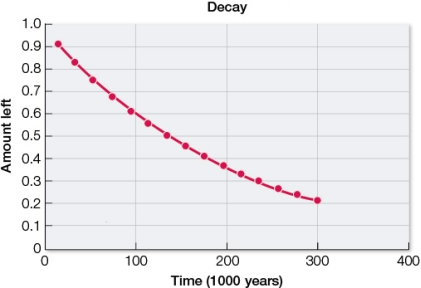 The half-life of this substance is _______ years.
A) 50,000
B) 70,000
C) 100,000
D) 140,000
E) 300,000
The half-life of this substance is _______ years.A) 50,000
B) 70,000
C) 100,000
D) 140,000
E) 300,000
Question
Question
Refer to the graph showing the decay of a radioactive substance. 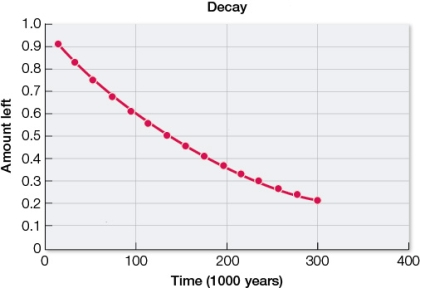 If this substance started decaying 280,000 years ago, and 4 mg of it remains, there was roughly _______ mg of the original substance.
A) 1
B) 2
C) 8
D) 16
E) 64
If this substance started decaying 280,000 years ago, and 4 mg of it remains, there was roughly _______ mg of the original substance.A) 1
B) 2
C) 8
D) 16
E) 64
Question
Question
Question
Question
Question
Question
Question
Question
Question
Question
Question
Question
Question
Question
Question
Question
Question
Question
Question
Question
Question
Question
Question
Question
Question
Question
Question
Question
Question
Question
Question
Question
Question
Question
Question
Question
Question
Question
Question
Question
Question
Refer to the graph showing variations in oxygen levels during Earth's history. 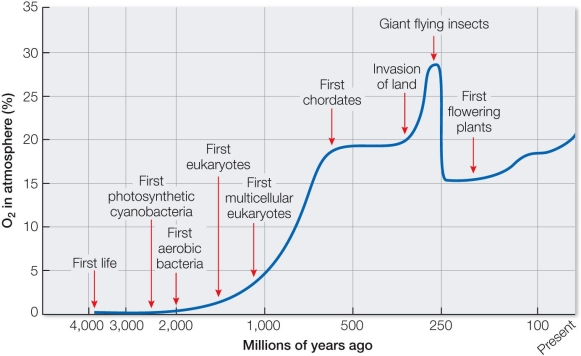 Based on the graph, what is the most logical conclusion about the abundance of plant life in the time interval about 250 million years ago?
A) Terrestrial plants went completely extinct.
B) The abundance of plant life dropped dramatically around this time.
C) Plants did not experience any major changes during this interval.
D) Plant life became much more abundant during this interval.
E) The most abundant types of plants alive at this time did not perform photosynthesis.
Based on the graph, what is the most logical conclusion about the abundance of plant life in the time interval about 250 million years ago?A) Terrestrial plants went completely extinct.
B) The abundance of plant life dropped dramatically around this time.
C) Plants did not experience any major changes during this interval.
D) Plant life became much more abundant during this interval.
E) The most abundant types of plants alive at this time did not perform photosynthesis.
Question
Question
Question
Question
Refer to the graph showing variations in oxygen levels during Earth's history. 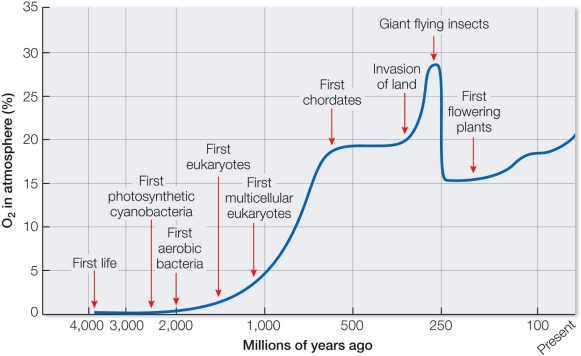 Which of the following can be concluded from the graph?
A) Increased atmospheric oxygen levels coincided with a decrease in insect size.
B) Multicellularity preceded the evolution of photosynthesis.
C) The first forms of life on Earth did not use oxygen.
D) Overall, atmospheric oxygen levels have decreased over Earth's history.
E) The first flowering plants required giant flying insects for pollination.
Which of the following can be concluded from the graph?A) Increased atmospheric oxygen levels coincided with a decrease in insect size.
B) Multicellularity preceded the evolution of photosynthesis.
C) The first forms of life on Earth did not use oxygen.
D) Overall, atmospheric oxygen levels have decreased over Earth's history.
E) The first flowering plants required giant flying insects for pollination.
Question
Question
Refer to the figure. 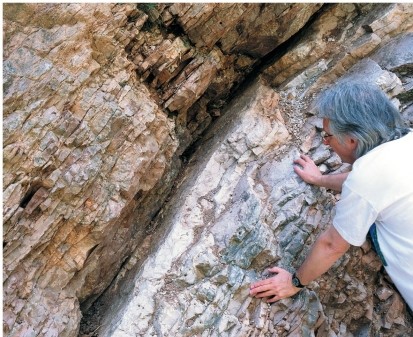 The figure depicts a layer of iridium at the Cretaceous-Tertiary (K/T) boundary between strata from two different periods in Earth's history.The only _______ fossils found above the K/T boundary are those of birds.
A) flying animal
B) amniote
C) dinosaur
D) warm-blooded animal
E) Cretaceous
The figure depicts a layer of iridium at the Cretaceous-Tertiary (K/T) boundary between strata from two different periods in Earth's history.The only _______ fossils found above the K/T boundary are those of birds.A) flying animal
B) amniote
C) dinosaur
D) warm-blooded animal
E) Cretaceous
Question
Question
Question
Question
Question
Question
Question
Question
Question
Question
Question
Question
Question
Question
Question
Question
Question
Question
Question
Question
Question
Question
Question

Unlock Deck
Sign up to unlock the cards in this deck!
Unlock Deck
Unlock Deck
1/246

Play

Full screen (f)
Deck 24: The History of Life on Earth
1
The time interval spanning four billion years across three eons is the
A) Phanerozoic.
B) Proterozoic.
C) Archaean.
D) Hadean.
E) Precambrian.
A) Phanerozoic.
B) Proterozoic.
C) Archaean.
D) Hadean.
E) Precambrian.
E
2
Which of the following could not be dated by means of radioactive carbon?
A) A mastodon that is about 15,000 years old
B) Remains thought to be associated with King Tut (who lived 2,500 years ago)
C) A Homo erectus skeleton thought be around 800,000 years old
D) 10,000-year-old wheat grains discovered from the dawn of agriculture
E) A skeleton of Neanderthal man who perished 28,000 years ago
A) A mastodon that is about 15,000 years old
B) Remains thought to be associated with King Tut (who lived 2,500 years ago)
C) A Homo erectus skeleton thought be around 800,000 years old
D) 10,000-year-old wheat grains discovered from the dawn of agriculture
E) A skeleton of Neanderthal man who perished 28,000 years ago
C
3
Which sample would not be appropriate for dating by means of radioactive potassium?
A) A Homo erectus skeleton thought be around 800,000 years old
B) An igneous intrusion into the sediments of the Cretaceous sea where they are now exposed on land
C) An igneous intrusion from a 250-million-year-old volcano eruption associated with the Permian mass extinction
D) An igneous intrusion into the sediments of the Cambrian sea where they are now exposed on land
E) Stromatolites containing 3-billion-year-old bacterial mats
A) A Homo erectus skeleton thought be around 800,000 years old
B) An igneous intrusion into the sediments of the Cretaceous sea where they are now exposed on land
C) An igneous intrusion from a 250-million-year-old volcano eruption associated with the Permian mass extinction
D) An igneous intrusion into the sediments of the Cambrian sea where they are now exposed on land
E) Stromatolites containing 3-billion-year-old bacterial mats
A
4
The type of rocks that contain fossils are formed when grains accumulate at the bottom of bodies of water; they are called _______ rocks, and they can be dated relative to each other by a method called stratigraphy.
A) igneous
B) sedimentary
C) stromatolite
D) tertiary
E) deep
A) igneous
B) sedimentary
C) stromatolite
D) tertiary
E) deep
Unlock Deck
Unlock for access to all 246 flashcards in this deck.
Unlock Deck
k this deck
5
The half-life of a particular radioactive isotope of element X is 100 years.If you know that 400 years ago a fossil contained 10 mg of this isotope, you would expect to find about _______ mg in that fossil today.
A) 5
B) 2.5
C) 0.6
D) 0.3
E) 0.15
A) 5
B) 2.5
C) 0.6
D) 0.3
E) 0.15
Unlock Deck
Unlock for access to all 246 flashcards in this deck.
Unlock Deck
k this deck
6
The world's oldest recorded living tree is a 9,550-year-old spruce in the Dalarna province of Sweden.Scientists have also found cones from the same site that date back over 9,000 years and have the same genetic identity as the tree.These ages were determined using carbon-14 dating at a laboratory in Miami, Florida.If the ratio of 14C to 12C in the tree and the cone samples were compared, the ratio would be
A) higher in the cones because the 12C is not replenished after death.
B) lower in the cones because the 14C is not replenished after death.
C) lower in the tree because the 12C is differentially replenished in living material.
D) higher in the cones because they are younger.
E) None of the above; the ratio would be equal.
A) higher in the cones because the 12C is not replenished after death.
B) lower in the cones because the 14C is not replenished after death.
C) lower in the tree because the 12C is differentially replenished in living material.
D) higher in the cones because they are younger.
E) None of the above; the ratio would be equal.
Unlock Deck
Unlock for access to all 246 flashcards in this deck.
Unlock Deck
k this deck
7
In undisturbed sedimentary rock, strata from the _______ are immediately above rocks from the Ordovician.
A) Devonian
B) Cambrian
C) Jurassic
D) Silurian
E) Cretaceous
A) Devonian
B) Cambrian
C) Jurassic
D) Silurian
E) Cretaceous
Unlock Deck
Unlock for access to all 246 flashcards in this deck.
Unlock Deck
k this deck
8
Refer to the graph showing the decay of a radioactive substance. The half-life of this substance is _______ years.
A) 50,000
B) 70,000
C) 100,000
D) 140,000
E) 300,000
The half-life of this substance is _______ years.A) 50,000
B) 70,000
C) 100,000
D) 140,000
E) 300,000
Unlock Deck
Unlock for access to all 246 flashcards in this deck.
Unlock Deck
k this deck
9
When Nicolaus Steno discovered that the relative ages of rocks can be determined by examining the position of fossils in separate layers of soil, he coined a process called
A) stratigraphy.
B) paleomagnetic dating.
C) radiometric dating.
D) fossilography.
E) dendrochronology.
A) stratigraphy.
B) paleomagnetic dating.
C) radiometric dating.
D) fossilography.
E) dendrochronology.
Unlock Deck
Unlock for access to all 246 flashcards in this deck.
Unlock Deck
k this deck
10
Refer to the graph showing the decay of a radioactive substance. If this substance started decaying 280,000 years ago, and 4 mg of it remains, there was roughly _______ mg of the original substance.
A) 1
B) 2
C) 8
D) 16
E) 64
If this substance started decaying 280,000 years ago, and 4 mg of it remains, there was roughly _______ mg of the original substance.A) 1
B) 2
C) 8
D) 16
E) 64
Unlock Deck
Unlock for access to all 246 flashcards in this deck.
Unlock Deck
k this deck
11
Which statement about carbon dating is true?
A) Radioactive decay of 14C is balanced by its production from neutrons reacting with 14N in the upper atmosphere.
B) Dead organisms continue to exchange carbon compounds with the environment.
C) Carbon dating can be used to date organisms that are more than a million years old.
D) The half-life of 14C is less than 1,000 years.
E) In the process of radioactive decay, 14C is transformed into 14Ar.
A) Radioactive decay of 14C is balanced by its production from neutrons reacting with 14N in the upper atmosphere.
B) Dead organisms continue to exchange carbon compounds with the environment.
C) Carbon dating can be used to date organisms that are more than a million years old.
D) The half-life of 14C is less than 1,000 years.
E) In the process of radioactive decay, 14C is transformed into 14Ar.
Unlock Deck
Unlock for access to all 246 flashcards in this deck.
Unlock Deck
k this deck
12
If the half-life of a radioactive substance is 600 years, what fraction of the original material would be left after 1,800 years?
A) 1/32
B) 1/16
C) 1/8
D) 1/4
E) 1/2
A) 1/32
B) 1/16
C) 1/8
D) 1/4
E) 1/2
Unlock Deck
Unlock for access to all 246 flashcards in this deck.
Unlock Deck
k this deck
13
The half-life of 14C, a radioactive element of carbon, is 5,700 years.The ratio of 14C to 12C in a fossil 28,500 years old would be about _______ that of a living organism today.
A) the same as
B) 1:5
C) 1:8
D) 5:1
E) 1:32
A) the same as
B) 1:5
C) 1:8
D) 5:1
E) 1:32
Unlock Deck
Unlock for access to all 246 flashcards in this deck.
Unlock Deck
k this deck
14
In the upper atmosphere, the bombardment of nitrogen-14 with neutrons varies somewhat over time.If in the past this rate had been higher, objects dated by _______ dating would now appear _______ than they really are.
A) potassium; younger
B) potassium; older
C) carbon; younger
D) carbon; older
E) uranium; younger
A) potassium; younger
B) potassium; older
C) carbon; younger
D) carbon; older
E) uranium; younger
Unlock Deck
Unlock for access to all 246 flashcards in this deck.
Unlock Deck
k this deck
15
Which of the following was not known to eighteenth- and nineteenth-century geologists?
A) Fossil organisms found in more recent strata resemble modern organisms.
B) Certain fossils are always found in younger rocks.
C) Some rocks have magnetic properties.
D) Radioactivity can be used to determine the age of rocks.
E) Fossils from more recent strata do not resemble those found in more ancient strata.
A) Fossil organisms found in more recent strata resemble modern organisms.
B) Certain fossils are always found in younger rocks.
C) Some rocks have magnetic properties.
D) Radioactivity can be used to determine the age of rocks.
E) Fossils from more recent strata do not resemble those found in more ancient strata.
Unlock Deck
Unlock for access to all 246 flashcards in this deck.
Unlock Deck
k this deck
16
The time interval characterized by a diverse multicellular biota is the
A) Phanerozoic.
B) Proterozoic.
C) Archaean.
D) Hadean.
E) Precambrian.
A) Phanerozoic.
B) Proterozoic.
C) Archaean.
D) Hadean.
E) Precambrian.
Unlock Deck
Unlock for access to all 246 flashcards in this deck.
Unlock Deck
k this deck
17
Which statement is true?
A) Radioisotope dating of rocks, combined with fossil analysis, is the most powerful method of determining geological age.
B) Earth's magnetic field never changes.
C) Scientists divide geological periods into eras.
D) In order to date igneous rocks, geologists search for locations where sedimentary rocks have intruded into igneous rocks.
E) Radioisotope dating can only be performed on fossils.
A) Radioisotope dating of rocks, combined with fossil analysis, is the most powerful method of determining geological age.
B) Earth's magnetic field never changes.
C) Scientists divide geological periods into eras.
D) In order to date igneous rocks, geologists search for locations where sedimentary rocks have intruded into igneous rocks.
E) Radioisotope dating can only be performed on fossils.
Unlock Deck
Unlock for access to all 246 flashcards in this deck.
Unlock Deck
k this deck
18
The half-life of carbon-14 is 5,700 years.If 10 percent of the original carbon-14 is left in a structure, that structure would be _______ years old.
A) less than 2,850
B) about 5,700
C) between 11,400 and 17,100
D) between 17,100 and 22,800
E) about 57,000
A) less than 2,850
B) about 5,700
C) between 11,400 and 17,100
D) between 17,100 and 22,800
E) about 57,000
Unlock Deck
Unlock for access to all 246 flashcards in this deck.
Unlock Deck
k this deck
19
Which statement about Earth's history is true?
A) A paleontologist can determine the age of a rock by its appearance alone.
B) In all sedimentary rock, the oldest layers lie at the bottom, and successively higher strata are progressively younger.
C) Sedimentary rock forms via the accumulation of grains at the bottoms of rivers and other bodies of water.
D) The continents have always been where they are today.
E) Sedimentary rock can be dated using isotopes.
A) A paleontologist can determine the age of a rock by its appearance alone.
B) In all sedimentary rock, the oldest layers lie at the bottom, and successively higher strata are progressively younger.
C) Sedimentary rock forms via the accumulation of grains at the bottoms of rivers and other bodies of water.
D) The continents have always been where they are today.
E) Sedimentary rock can be dated using isotopes.
Unlock Deck
Unlock for access to all 246 flashcards in this deck.
Unlock Deck
k this deck
20
Which statement about radioisotope dating is false?
A) The isotopes in sedimentary rocks contain reliable information about the dates of their formation.
B) Igneous rocks are formed when molten material cools.
C) The decay of potassium-40 to argon-40 has been used to date most of the ancient events in the evolution of life.
D) Paleomagnetic dating relates the ages of rocks to patterns in Earth's magnetism.
E) The age of igneous rocks can be used to estimate the age of adjacent sedimentary rocks.
A) The isotopes in sedimentary rocks contain reliable information about the dates of their formation.
B) Igneous rocks are formed when molten material cools.
C) The decay of potassium-40 to argon-40 has been used to date most of the ancient events in the evolution of life.
D) Paleomagnetic dating relates the ages of rocks to patterns in Earth's magnetism.
E) The age of igneous rocks can be used to estimate the age of adjacent sedimentary rocks.
Unlock Deck
Unlock for access to all 246 flashcards in this deck.
Unlock Deck
k this deck
21
Which atmospheric gas is most closely associated with an increase in average global temperatures?
A) Carbon dioxide
B) Oxygen
C) Nitrogen
D) Argon
E) Hydrogen
A) Carbon dioxide
B) Oxygen
C) Nitrogen
D) Argon
E) Hydrogen
Unlock Deck
Unlock for access to all 246 flashcards in this deck.
Unlock Deck
k this deck
22
The heat that drives plate tectonics is driven by
A) radiant energy from the sun.
B) chemical energy from bacteria.
C) chemical energy from inorganic enzymatic cycles.
D) radioactive decay inside Earth's crust.
E) kinetic energy from meteorite collisions.
A) radiant energy from the sun.
B) chemical energy from bacteria.
C) chemical energy from inorganic enzymatic cycles.
D) radioactive decay inside Earth's crust.
E) kinetic energy from meteorite collisions.
Unlock Deck
Unlock for access to all 246 flashcards in this deck.
Unlock Deck
k this deck
23
With respect to changes in climate over the course of life on Earth, the period we are currently living in has been _______ compared to the long-term average of past conditions.
A) relatively warm
B) relatively cool
C) extremely warm
D) extremely cold
E) almost exactly the same
A) relatively warm
B) relatively cool
C) extremely warm
D) extremely cold
E) almost exactly the same
Unlock Deck
Unlock for access to all 246 flashcards in this deck.
Unlock Deck
k this deck
24
Which of the following has been changing most rapidly over the past 100 years?
A) Oxygen levels
B) Carbon dioxide levels
C) Volcanic activity
D) Frequency of meteorites colliding with the Earth
E) Advance of glaciers from the poles toward the temperate latitudes
A) Oxygen levels
B) Carbon dioxide levels
C) Volcanic activity
D) Frequency of meteorites colliding with the Earth
E) Advance of glaciers from the poles toward the temperate latitudes
Unlock Deck
Unlock for access to all 246 flashcards in this deck.
Unlock Deck
k this deck
25
Which statement about the Pleistocene is false?
A) There were multiple ice ages.
B) Humans reached North America.
C) Humans reached Australia.
D) The ranges of many animals and plants shifted to the equator.
E) We are still living in the Pleistocene epoch today.
A) There were multiple ice ages.
B) Humans reached North America.
C) Humans reached Australia.
D) The ranges of many animals and plants shifted to the equator.
E) We are still living in the Pleistocene epoch today.
Unlock Deck
Unlock for access to all 246 flashcards in this deck.
Unlock Deck
k this deck
26
The first flying animals were _______, which first appeared in the _______ period.
A) birds; Carboniferous
B) birds; Cretaceous
C) bats; Jurassic
D) insects; Permian
E) insects; Carboniferous
A) birds; Carboniferous
B) birds; Cretaceous
C) bats; Jurassic
D) insects; Permian
E) insects; Carboniferous
Unlock Deck
Unlock for access to all 246 flashcards in this deck.
Unlock Deck
k this deck
27
If you could go back in time and walk in a Permian forest, you would not expect to encounter
A) flowering plants.
B) amphibians.
C) club mosses and horsetails.
D) dragonflies.
E) gymnosperms.
A) flowering plants.
B) amphibians.
C) club mosses and horsetails.
D) dragonflies.
E) gymnosperms.
Unlock Deck
Unlock for access to all 246 flashcards in this deck.
Unlock Deck
k this deck
28
Mountain ranges are ultimately the result of
A) accumulation of sediments once laid on the bottom of ancient oceans.
B) climate changes and the movement of glacial ice sheets.
C) leftover debris from ancient collisions with an asteroid or meteor.
D) the breakup of Laurasia and Gondwana.
E) plates in Earth's crust that move against one another on top of a layer of molten rock.
A) accumulation of sediments once laid on the bottom of ancient oceans.
B) climate changes and the movement of glacial ice sheets.
C) leftover debris from ancient collisions with an asteroid or meteor.
D) the breakup of Laurasia and Gondwana.
E) plates in Earth's crust that move against one another on top of a layer of molten rock.
Unlock Deck
Unlock for access to all 246 flashcards in this deck.
Unlock Deck
k this deck
29
The primary reason that dragonflies grew so much larger 300 million years ago than they do today is that
A) they lacked predators then.
B) they were able to exploit an aquatic niche that no longer exists.
C) there was more oxygen in the air then.
D) there was more nitrogen in the air then.
E) Earth was much colder then.
A) they lacked predators then.
B) they were able to exploit an aquatic niche that no longer exists.
C) there was more oxygen in the air then.
D) there was more nitrogen in the air then.
E) Earth was much colder then.
Unlock Deck
Unlock for access to all 246 flashcards in this deck.
Unlock Deck
k this deck
30
Mass extinctions in the fossil record have often accompanied major _______ in sea level.Such extinctions have particularly affected _______ animals.
A) rises; terrestrial
B) rises; marine
C) rises; freshwater
D) drops; terrestrial
E) drops; marine
A) rises; terrestrial
B) rises; marine
C) rises; freshwater
D) drops; terrestrial
E) drops; marine
Unlock Deck
Unlock for access to all 246 flashcards in this deck.
Unlock Deck
k this deck
31
The first snakes evolved during the _______ period.
A) Cretaceous
B) Permian
C) Triassic
D) Devonian
E) Cambrian
A) Cretaceous
B) Permian
C) Triassic
D) Devonian
E) Cambrian
Unlock Deck
Unlock for access to all 246 flashcards in this deck.
Unlock Deck
k this deck
32
Which statement about continental drift is false?
A) When it was proposed, the idea received almost immediate acceptance.
B) Continents move because as magma rises, it exerts tremendous pressure on the plates that float on top of it.
C) Deep rift valleys have been generated from the same process that causes continental drift.
D) The theory of plate tectonics describes the movement of major landmasses.
E) The lithospheric plates float on a fluid layer of molten rock.
A) When it was proposed, the idea received almost immediate acceptance.
B) Continents move because as magma rises, it exerts tremendous pressure on the plates that float on top of it.
C) Deep rift valleys have been generated from the same process that causes continental drift.
D) The theory of plate tectonics describes the movement of major landmasses.
E) The lithospheric plates float on a fluid layer of molten rock.
Unlock Deck
Unlock for access to all 246 flashcards in this deck.
Unlock Deck
k this deck
33
During the _______ period, fishes diversified and evolved jaws; club mosses, horsetails, and tree ferns became common; the earliest insects and terrestrial vertebrates arose; and there was a mass extinction at the end of the period that may have been caused by meteorites.
A) Precambrian
B) Devonian
C) Triassic
D) Silurian
E) Quaternary
A) Precambrian
B) Devonian
C) Triassic
D) Silurian
E) Quaternary
Unlock Deck
Unlock for access to all 246 flashcards in this deck.
Unlock Deck
k this deck
34
After the eruption of a major volcano, the concentrations of _______ are likely to increase greatly, and the temperature is likely to _______.
A) oxygen; drop
B) oxygen; rise
C) sulfur dioxide; drop
D) sulfur dioxide; rise
E) carbon dioxide; rise
A) oxygen; drop
B) oxygen; rise
C) sulfur dioxide; drop
D) sulfur dioxide; rise
E) carbon dioxide; rise
Unlock Deck
Unlock for access to all 246 flashcards in this deck.
Unlock Deck
k this deck
35
Which group of organisms has been most affected by periods of increased glaciations?
A) Autotrophs
B) Land mammals
C) Humans
D) Marine life
E) Land plants
A) Autotrophs
B) Land mammals
C) Humans
D) Marine life
E) Land plants
Unlock Deck
Unlock for access to all 246 flashcards in this deck.
Unlock Deck
k this deck
36
The period during which most of Earth's land was divided into two large land masses and in which lizards, several groups of mammals, and flowering plants first appeared was the
A) Cretaceous.
B) Permian.
C) Triassic.
D) Devonian.
E) Jurassic.
A) Cretaceous.
B) Permian.
C) Triassic.
D) Devonian.
E) Jurassic.
Unlock Deck
Unlock for access to all 246 flashcards in this deck.
Unlock Deck
k this deck
37
Vascular plants first appeared during the _______ period.
A) Cambrian
B) Ordovician
C) Silurian
D) Carboniferous
E) Permian
A) Cambrian
B) Ordovician
C) Silurian
D) Carboniferous
E) Permian
Unlock Deck
Unlock for access to all 246 flashcards in this deck.
Unlock Deck
k this deck
38
Vertebrates with well-protected eggs that can be laid in dry places originated during the Carboniferous period.These animals are known as
A) trilobites.
B) ediacaran.
C) crinoids.
D) amniotes.
E) amphibians.
A) trilobites.
B) ediacaran.
C) crinoids.
D) amniotes.
E) amphibians.
Unlock Deck
Unlock for access to all 246 flashcards in this deck.
Unlock Deck
k this deck
39
Suppose you were to drill a hole toward the center of Earth.Which of the following is the correct order of the layers you would encounter?
A) Asthenosphere containing magma, mantle, lithospheric plate
B) Mantle, asthenosphere containing magma, lithospheric plate
C) Lithospheric plate, asthenosphere containing magma, mantle
D) Lithospheric plate, mantle, asthenosphere containing magma
E) Mantle, lithospheric plate, asthenosphere containing magma
A) Asthenosphere containing magma, mantle, lithospheric plate
B) Mantle, asthenosphere containing magma, lithospheric plate
C) Lithospheric plate, asthenosphere containing magma, mantle
D) Lithospheric plate, mantle, asthenosphere containing magma
E) Mantle, lithospheric plate, asthenosphere containing magma
Unlock Deck
Unlock for access to all 246 flashcards in this deck.
Unlock Deck
k this deck
40
During the Permian period, all of the continents came together to form one supercontinent known as
A) Pangaea.
B) Gondwana.
C) Laurasia.
D) Crinoid.
E) Ork.
A) Pangaea.
B) Gondwana.
C) Laurasia.
D) Crinoid.
E) Ork.
Unlock Deck
Unlock for access to all 246 flashcards in this deck.
Unlock Deck
k this deck
41
Which statement about the Cambrian period is true?
A) Multicellular life was probably limited to aquatic environment.
B) The first multicellular life appeared.
C) It marks the end of the Paleozoic era.
D) Oxygen concentrations were extremely low.
E) Large land mammals evolved.
A) Multicellular life was probably limited to aquatic environment.
B) The first multicellular life appeared.
C) It marks the end of the Paleozoic era.
D) Oxygen concentrations were extremely low.
E) Large land mammals evolved.
Unlock Deck
Unlock for access to all 246 flashcards in this deck.
Unlock Deck
k this deck
42
Which statement about oxygen is true?
A) It was prevalent in the atmosphere of Earth at the origin of life, around 3.8 bya.
B) It allowed for the evolution of autotrophic organisms.
C) It is advantageous to every type of organism that has lived on Earth.
D) It made aerobic heterotrophic life possible.
E) It is a product of fermentation.
A) It was prevalent in the atmosphere of Earth at the origin of life, around 3.8 bya.
B) It allowed for the evolution of autotrophic organisms.
C) It is advantageous to every type of organism that has lived on Earth.
D) It made aerobic heterotrophic life possible.
E) It is a product of fermentation.
Unlock Deck
Unlock for access to all 246 flashcards in this deck.
Unlock Deck
k this deck
43
As compared to anaerobic metabolism, aerobic metabolism is advantageous to cells because it
A) harvests energy more efficiently.
B) proceeds at a less rapid rate.
C) permits the growth of smaller, more complex cells.
D) allowed photosynthetic organisms to develop.
E) allowed aerobic organisms to replace all anaerobes on Earth.
A) harvests energy more efficiently.
B) proceeds at a less rapid rate.
C) permits the growth of smaller, more complex cells.
D) allowed photosynthetic organisms to develop.
E) allowed aerobic organisms to replace all anaerobes on Earth.
Unlock Deck
Unlock for access to all 246 flashcards in this deck.
Unlock Deck
k this deck
44
The symbiosis between legumes and nitrogen-fixing bacteria began in the _______ period.
A) Cenozoi
B) Mesozoic
C) Triassic
D) Devonian
E) Cambrian
A) Cenozoi
B) Mesozoic
C) Triassic
D) Devonian
E) Cambrian
Unlock Deck
Unlock for access to all 246 flashcards in this deck.
Unlock Deck
k this deck
45
The high oxygen concentrations during the Carboniferous and Permian periods led to _______ insects.
A) the extinction of
B) increased wing length in
C) decreased leg length in
D) increased body mass in
E) decreased sexual reproduction in
A) the extinction of
B) increased wing length in
C) decreased leg length in
D) increased body mass in
E) decreased sexual reproduction in
Unlock Deck
Unlock for access to all 246 flashcards in this deck.
Unlock Deck
k this deck
46
Which continent was most likely affected the most by the meteor strike that led to the demise of nonavian dinosaurs?
A) Asia
B) Europe
C) Africa
D) Australia
E) North America
A) Asia
B) Europe
C) Africa
D) Australia
E) North America
Unlock Deck
Unlock for access to all 246 flashcards in this deck.
Unlock Deck
k this deck
47
Larger single-celled organisms require a higher oxygen concentration than smaller ones do because the large cells
A) have a faster metabolic rate per unit mass.
B) have a slower metabolic rate per unit mass.
C) have a lower surface area-to-volume ratio.
D) have a greater surface area-to-volume ratio.
E) divide more quickly than small cells do.
A) have a faster metabolic rate per unit mass.
B) have a slower metabolic rate per unit mass.
C) have a lower surface area-to-volume ratio.
D) have a greater surface area-to-volume ratio.
E) divide more quickly than small cells do.
Unlock Deck
Unlock for access to all 246 flashcards in this deck.
Unlock Deck
k this deck
48
Which statement about oxygen levels on Earth is true?
A) The atmosphere of Proterozoic Earth contained almost as much free oxygen as present-day Earth, but most of this oxygen was lost in the Cambrian.
B) Early photosynthetic bacteria generated free oxygen as a by-product of the chemical splitting of water.
C) The oxygen-generating cyanobacteria that existed on early Earth have gone extinct.
D) Most of early Earth's atmospheric oxygen arose via land plants.
E) Today's atmospheric oxygen levels are the highest they have ever been.
A) The atmosphere of Proterozoic Earth contained almost as much free oxygen as present-day Earth, but most of this oxygen was lost in the Cambrian.
B) Early photosynthetic bacteria generated free oxygen as a by-product of the chemical splitting of water.
C) The oxygen-generating cyanobacteria that existed on early Earth have gone extinct.
D) Most of early Earth's atmospheric oxygen arose via land plants.
E) Today's atmospheric oxygen levels are the highest they have ever been.
Unlock Deck
Unlock for access to all 246 flashcards in this deck.
Unlock Deck
k this deck
49
Rocklike structures formed by the oxygen-generating cyanobacteria are known as
A) strata.
B) stromatolites.
C) igneous rock.
D) lithosphere.
E) rift valleys.
A) strata.
B) stromatolites.
C) igneous rock.
D) lithosphere.
E) rift valleys.
Unlock Deck
Unlock for access to all 246 flashcards in this deck.
Unlock Deck
k this deck
50
During the _______ period, the biota recovered after a major mass extinction, the species richness of invertebrate groups increased, the first turtles and frogs appeared, and a large radiation of reptiles began.
A) Permian
B) Triassic
C) Jurassic
D) Cretaceous
E) Cambrian
A) Permian
B) Triassic
C) Jurassic
D) Cretaceous
E) Cambrian
Unlock Deck
Unlock for access to all 246 flashcards in this deck.
Unlock Deck
k this deck
51
Refer to the graph showing variations in oxygen levels during Earth's history. Based on the graph, what is the most logical conclusion about the abundance of plant life in the time interval about 250 million years ago?
A) Terrestrial plants went completely extinct.
B) The abundance of plant life dropped dramatically around this time.
C) Plants did not experience any major changes during this interval.
D) Plant life became much more abundant during this interval.
E) The most abundant types of plants alive at this time did not perform photosynthesis.
Based on the graph, what is the most logical conclusion about the abundance of plant life in the time interval about 250 million years ago?A) Terrestrial plants went completely extinct.
B) The abundance of plant life dropped dramatically around this time.
C) Plants did not experience any major changes during this interval.
D) Plant life became much more abundant during this interval.
E) The most abundant types of plants alive at this time did not perform photosynthesis.
Unlock Deck
Unlock for access to all 246 flashcards in this deck.
Unlock Deck
k this deck
52
Humans reached North America approximately _______ years ago, during a rare opportunity to cross the land bridge across the area commonly known as the Bering Sea.
A) 500
B) 1,500
C) 15,000
D) 100,000
E) 1 million
A) 500
B) 1,500
C) 15,000
D) 100,000
E) 1 million
Unlock Deck
Unlock for access to all 246 flashcards in this deck.
Unlock Deck
k this deck
53
Abnormally high concentrations of _______ have been found in rocks dating from the end of the Cretaceous.
A) iridium
B) mercury
C) lithium
D) nickel
E) tungsten
A) iridium
B) mercury
C) lithium
D) nickel
E) tungsten
Unlock Deck
Unlock for access to all 246 flashcards in this deck.
Unlock Deck
k this deck
54
The possible collision of a large meteorite with Earth 65 million years ago may explain
A) the existence of Gondwana.
B) continental drift, according to Alfred Wegener.
C) the mass extinction that killed off the dinosaurs.
D) contemporary atmospheric conditions on Earth.
E) the rise of the Rocky Mountains and Andes Mountains.
A) the existence of Gondwana.
B) continental drift, according to Alfred Wegener.
C) the mass extinction that killed off the dinosaurs.
D) contemporary atmospheric conditions on Earth.
E) the rise of the Rocky Mountains and Andes Mountains.
Unlock Deck
Unlock for access to all 246 flashcards in this deck.
Unlock Deck
k this deck
55
Refer to the graph showing variations in oxygen levels during Earth's history. Which of the following can be concluded from the graph?
A) Increased atmospheric oxygen levels coincided with a decrease in insect size.
B) Multicellularity preceded the evolution of photosynthesis.
C) The first forms of life on Earth did not use oxygen.
D) Overall, atmospheric oxygen levels have decreased over Earth's history.
E) The first flowering plants required giant flying insects for pollination.
Which of the following can be concluded from the graph?A) Increased atmospheric oxygen levels coincided with a decrease in insect size.
B) Multicellularity preceded the evolution of photosynthesis.
C) The first forms of life on Earth did not use oxygen.
D) Overall, atmospheric oxygen levels have decreased over Earth's history.
E) The first flowering plants required giant flying insects for pollination.
Unlock Deck
Unlock for access to all 246 flashcards in this deck.
Unlock Deck
k this deck
56
Rodents, marsupials, and hoofed animals first appeared in North America during the _______ period that followed a mass extinction and presented new evolutionary opportunities for mammals.
A) Tertiary
B) Permian
C) Triassic
D) Devonian
E) Cretaceous
A) Tertiary
B) Permian
C) Triassic
D) Devonian
E) Cretaceous
Unlock Deck
Unlock for access to all 246 flashcards in this deck.
Unlock Deck
k this deck
57
Refer to the figure. The figure depicts a layer of iridium at the Cretaceous-Tertiary (K/T) boundary between strata from two different periods in Earth's history.The only _______ fossils found above the K/T boundary are those of birds.
A) flying animal
B) amniote
C) dinosaur
D) warm-blooded animal
E) Cretaceous
The figure depicts a layer of iridium at the Cretaceous-Tertiary (K/T) boundary between strata from two different periods in Earth's history.The only _______ fossils found above the K/T boundary are those of birds.A) flying animal
B) amniote
C) dinosaur
D) warm-blooded animal
E) Cretaceous
Unlock Deck
Unlock for access to all 246 flashcards in this deck.
Unlock Deck
k this deck
58
At the end of the _______ period, atmospheric oxygen concentrations decreased from about 30 percent to 15 percent due to plant death associated with the widespread drying of swamps.
A) Cambrian
B) Cretaceous
C) Permian
D) Devonian
E) Tertiary
A) Cambrian
B) Cretaceous
C) Permian
D) Devonian
E) Tertiary
Unlock Deck
Unlock for access to all 246 flashcards in this deck.
Unlock Deck
k this deck
59
The appearance of multicellular organisms coincided with increased levels of _______ in Earth's atmosphere.
A) sulfur
B) hydrogen
C) nitrogen
D) carbon
E) oxygen
A) sulfur
B) hydrogen
C) nitrogen
D) carbon
E) oxygen
Unlock Deck
Unlock for access to all 246 flashcards in this deck.
Unlock Deck
k this deck
60
Which statement about the mass extinction at the end of the Cretaceous is false?
A) Strong evidence suggests that a meteorite was involved.
B) Many marine invertebrates and insect species became extinct.
C) Almost all land animals larger than about 25 kilograms, including dinosaurs, became extinct.
D) It happened approximately 65 million years ago.
E) All of the early birds and mammals alive at that time became extinct.
A) Strong evidence suggests that a meteorite was involved.
B) Many marine invertebrates and insect species became extinct.
C) Almost all land animals larger than about 25 kilograms, including dinosaurs, became extinct.
D) It happened approximately 65 million years ago.
E) All of the early birds and mammals alive at that time became extinct.
Unlock Deck
Unlock for access to all 246 flashcards in this deck.
Unlock Deck
k this deck
61
Which of the following represents a correct chronological ordering of Earth's geological history, from earliest to latest?
A) Permian mass extinction, Cretaceous mass extinction, Cambrian explosion
B) Permian mass extinction, Cambrian explosion, Cretaceous mass extinction
C) Cambrian explosion, Permian mass extinction, Cretaceous mass extinction
D) Cambrian explosion, Cretaceous mass extinction, Permian mass extinction
E) Cretaceous mass extinction, Permian mass extinction, Cambrian explosion
A) Permian mass extinction, Cretaceous mass extinction, Cambrian explosion
B) Permian mass extinction, Cambrian explosion, Cretaceous mass extinction
C) Cambrian explosion, Permian mass extinction, Cretaceous mass extinction
D) Cambrian explosion, Cretaceous mass extinction, Permian mass extinction
E) Cretaceous mass extinction, Permian mass extinction, Cambrian explosion
Unlock Deck
Unlock for access to all 246 flashcards in this deck.
Unlock Deck
k this deck
62
Which geological period is the most ancient?
A) Cambrian
B) Cretaceous
C) Jurassic
D) Silurian
E) Devonian
A) Cambrian
B) Cretaceous
C) Jurassic
D) Silurian
E) Devonian
Unlock Deck
Unlock for access to all 246 flashcards in this deck.
Unlock Deck
k this deck
63
The Cenozoic era began about _______ years ago.
A) 1 million
B) 15 million
C) 65 million
D) 225 million
E) 1 billion
A) 1 million
B) 15 million
C) 65 million
D) 225 million
E) 1 billion
Unlock Deck
Unlock for access to all 246 flashcards in this deck.
Unlock Deck
k this deck
64
During which of the following geological periods did the greatest number of new body plans appear?
A) Carboniferous
B) Triassic
C) Jurassic
D) Devonian
E) Cambrian
A) Carboniferous
B) Triassic
C) Jurassic
D) Devonian
E) Cambrian
Unlock Deck
Unlock for access to all 246 flashcards in this deck.
Unlock Deck
k this deck
65
In undisturbed sedimentary rock, strata from which period would be immediately below rocks from the Ordovician?
A) Devonian
B) Cretaceous
C) Jurassic
D) Silurian
E) Cambrian
A) Devonian
B) Cretaceous
C) Jurassic
D) Silurian
E) Cambrian
Unlock Deck
Unlock for access to all 246 flashcards in this deck.
Unlock Deck
k this deck
66
Which of the following is the longest period of time?
A) The length of the entire Mesozoic era
B) The half-life of 40K
C) Five million years
D) The half-life of 14C
E) The time since the Cambrian explosion
A) The length of the entire Mesozoic era
B) The half-life of 40K
C) Five million years
D) The half-life of 14C
E) The time since the Cambrian explosion
Unlock Deck
Unlock for access to all 246 flashcards in this deck.
Unlock Deck
k this deck
67
The current geological period is the
A) Tertiary.
B) Quaternary.
C) Triassic.
D) Devonian.
E) Pleistocene.
A) Tertiary.
B) Quaternary.
C) Triassic.
D) Devonian.
E) Pleistocene.
Unlock Deck
Unlock for access to all 246 flashcards in this deck.
Unlock Deck
k this deck
68
The first terrestrial arthropods began to occupy land during the
A) Cretaceous.
B) Cambrian.
C) Holocene.
D) Silurian.
E) Ordovician.
A) Cretaceous.
B) Cambrian.
C) Holocene.
D) Silurian.
E) Ordovician.
Unlock Deck
Unlock for access to all 246 flashcards in this deck.
Unlock Deck
k this deck
69
During the Cenozoic, _______ experienced major radiations.
A) nonavian dinosaurs
B) mammals
C) multicellular animal body plans
D) pterosaurs
E) early prokaryotes
A) nonavian dinosaurs
B) mammals
C) multicellular animal body plans
D) pterosaurs
E) early prokaryotes
Unlock Deck
Unlock for access to all 246 flashcards in this deck.
Unlock Deck
k this deck
70
The period between the time when life first evolved on Earth and the definitive appearance of multicellular life was about _______ years.
A) 200 million
B) 500 million
C) 1 billion
D) 3 billion
E) 5 billion
A) 200 million
B) 500 million
C) 1 billion
D) 3 billion
E) 5 billion
Unlock Deck
Unlock for access to all 246 flashcards in this deck.
Unlock Deck
k this deck
71
Which of the following represents a correct chronological ordering of Earth's geological history, from the most ancient to the most recent period?
A) Cambrian, Devonian, Permian, Cretaceous
B) Cretaceous, Devonian, Permian, Cambrian
C) Cambrian, Cretaceous, Devonian, Permian
D) Permian, Cambrian, Cretaceous, Devonian
E) Cretaceous, Permian, Devonian, Cambrian
A) Cambrian, Devonian, Permian, Cretaceous
B) Cretaceous, Devonian, Permian, Cambrian
C) Cambrian, Cretaceous, Devonian, Permian
D) Permian, Cambrian, Cretaceous, Devonian
E) Cretaceous, Permian, Devonian, Cambrian
Unlock Deck
Unlock for access to all 246 flashcards in this deck.
Unlock Deck
k this deck
72
Which period did not end with mass extinction?
A) Devonian
B) Cretaceous
C) Silurian
D) Permian
E) Triassic
A) Devonian
B) Cretaceous
C) Silurian
D) Permian
E) Triassic
Unlock Deck
Unlock for access to all 246 flashcards in this deck.
Unlock Deck
k this deck
73
The Cambrian explosion started _______ the Cambrian and lasted for _______ of years.
A) during; hundreds
B) before; tens of thousands
C) during; tens of thousands
D) during; millions
E) before; millions
A) during; hundreds
B) before; tens of thousands
C) during; tens of thousands
D) during; millions
E) before; millions
Unlock Deck
Unlock for access to all 246 flashcards in this deck.
Unlock Deck
k this deck
74
Which of the following is not considered a plausible hypothesis for the causes of mass extinctions?
A) Extraterrestrial events, such as meteorite or asteroid collisions
B) Glaciations
C) Massive volcanic activity
D) Competition among organisms
E) Climate shifts
A) Extraterrestrial events, such as meteorite or asteroid collisions
B) Glaciations
C) Massive volcanic activity
D) Competition among organisms
E) Climate shifts
Unlock Deck
Unlock for access to all 246 flashcards in this deck.
Unlock Deck
k this deck
75
Coal is the fossilized remains of _______ from the _______ period.
A) flowering plants; Cretaceous
B) photosynthetic plankton; Cretaceous
C) photosynthetic plankton; Carboniferous
D) tree ferns and horsetails; Carboniferous
E) tree ferns and horsetails; Cretaceous
A) flowering plants; Cretaceous
B) photosynthetic plankton; Cretaceous
C) photosynthetic plankton; Carboniferous
D) tree ferns and horsetails; Carboniferous
E) tree ferns and horsetails; Cretaceous
Unlock Deck
Unlock for access to all 246 flashcards in this deck.
Unlock Deck
k this deck
76
Which geological period is the most recent (closest to the present)?
A) Devonian
B) Jurassic
C) Cambrian
D) Silurian
E) Cretaceous
A) Devonian
B) Jurassic
C) Cambrian
D) Silurian
E) Cretaceous
Unlock Deck
Unlock for access to all 246 flashcards in this deck.
Unlock Deck
k this deck
77
Which statement about the Cambrian period is false?
A) Arthropods were abundant and diverse.
B) There was abundant multicellular terrestrial life.
C) Large continents had already formed.
D) Oxygen concentrations were approaching current levels.
E) Rapid diversification of life took place.
A) Arthropods were abundant and diverse.
B) There was abundant multicellular terrestrial life.
C) Large continents had already formed.
D) Oxygen concentrations were approaching current levels.
E) Rapid diversification of life took place.
Unlock Deck
Unlock for access to all 246 flashcards in this deck.
Unlock Deck
k this deck
78
During which period did Pangaea begin to separate?
A) Cambrian
B) Triassic
C) Jurassic
D) Permian
E) Quaternary
A) Cambrian
B) Triassic
C) Jurassic
D) Permian
E) Quaternary
Unlock Deck
Unlock for access to all 246 flashcards in this deck.
Unlock Deck
k this deck
79
Which of the following did not take place in the Devonian?
A) The appearance of early reptiles in the fossil record
B) The appearance of the first plants to produce seeds
C) An acceleration in the rates of evolutionary change in many groups of animals
D) The appearance of the first known fossils of insects, spiders, and mites
E) A mass extinction marking the end of the period
A) The appearance of early reptiles in the fossil record
B) The appearance of the first plants to produce seeds
C) An acceleration in the rates of evolutionary change in many groups of animals
D) The appearance of the first known fossils of insects, spiders, and mites
E) A mass extinction marking the end of the period
Unlock Deck
Unlock for access to all 246 flashcards in this deck.
Unlock Deck
k this deck
80
Life first evolved on Earth _______ years ago.
A) less than 1 billion
B) between 1 billion and 2 billion
C) between 2 billion and 3 billion
D) between 3 billion and 5 billion
E) more than 5 billion
A) less than 1 billion
B) between 1 billion and 2 billion
C) between 2 billion and 3 billion
D) between 3 billion and 5 billion
E) more than 5 billion
Unlock Deck
Unlock for access to all 246 flashcards in this deck.
Unlock Deck
k this deck
Unlock Deck
Unlock for access to all 246 flashcards in this deck.






