







 Chat with AI

Deck 32: Deuterostome Animals
Full screen (f)

Question
Refer to the figure. 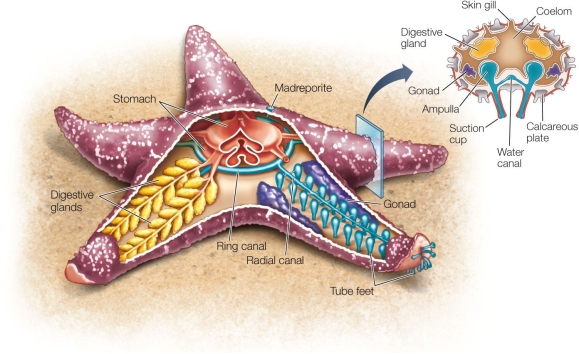 Which statement about the body plan of the larval and adult sea star is true?
A) The bilateral adult moves via cilia; the pentaradial larva moves via tube feet.
B) The adult is a filter feeder; the larva uses its tube feet to feed.
C) Both the adult and larva have a water vascular system.
D) The ciliated arms of the bilateral larva become the ring canal of the pentaradial adult.
E) The bilateral larva moves via cilia; the pentaradial adult moves via tube feet.
Which statement about the body plan of the larval and adult sea star is true?A) The bilateral adult moves via cilia; the pentaradial larva moves via tube feet.
B) The adult is a filter feeder; the larva uses its tube feet to feed.
C) Both the adult and larva have a water vascular system.
D) The ciliated arms of the bilateral larva become the ring canal of the pentaradial adult.
E) The bilateral larva moves via cilia; the pentaradial adult moves via tube feet.

Question
Question
Question
Question
Question
Question
Question
Question
Refer to the figure. 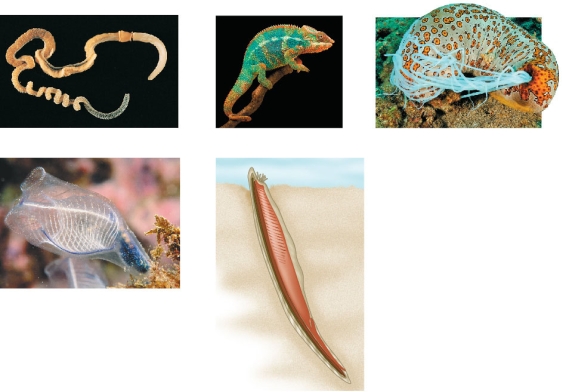 Which characteristic is shared by all the animals shown in the figure?
A) Pharyngeal slits
B) Internal skeleton
C) Blastopore that develops into the anus
D) Ciliated larva
E) Water vascular system
Which characteristic is shared by all the animals shown in the figure?A) Pharyngeal slits
B) Internal skeleton
C) Blastopore that develops into the anus
D) Ciliated larva
E) Water vascular system
Question
Question
Question
Question
Question
Question
Question
Question
Question
Question
Question
Question
Question
Question
Question
Question
Question
Question
Question
Question
Question
Question
Question
Question
Question
Question
Question
Question
Question
Question
Refer to the figure. 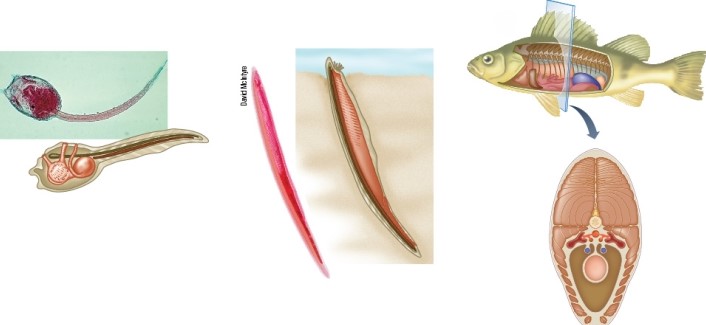 Which statement about the three organisms shown in the figure is false?
A) They are all vertebrates.
B) They are all chordates.
C) They are all deuterostomes.
D) They all have pharyngeal slits at some developmental stage.
E) They are all hemichordates.
Which statement about the three organisms shown in the figure is false?A) They are all vertebrates.
B) They are all chordates.
C) They are all deuterostomes.
D) They all have pharyngeal slits at some developmental stage.
E) They are all hemichordates.
Question
Question
Question
Question
Question
Question
Question
Question
Question
Question
Question
Question
Question
Question
Question
Question
Question
Question
Question
Question
Question
Question
Question
Question
Question
Question
Question
Question
Question
Question
Question
Question
Question
Question
Question
Question
Question
Question
Question
Question
Question
Refer to the figure. 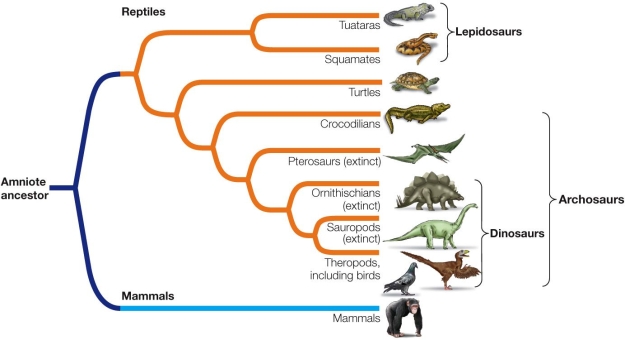 In which two groups of amniotes did endothermy convergently evolve?
A) Crocodilians and mammals
B) Theropods and crocodilians
C) Theropods and mammals
D) Sauropods and theropods
E) Sauropods and mammals
In which two groups of amniotes did endothermy convergently evolve?A) Crocodilians and mammals
B) Theropods and crocodilians
C) Theropods and mammals
D) Sauropods and theropods
E) Sauropods and mammals

Unlock Deck
Sign up to unlock the cards in this deck!
Unlock Deck
Unlock Deck
1/246

Play

Full screen (f)
Deck 32: Deuterostome Animals
1
Refer to the figure. Which statement about the body plan of the larval and adult sea star is true?
A) The bilateral adult moves via cilia; the pentaradial larva moves via tube feet.
B) The adult is a filter feeder; the larva uses its tube feet to feed.
C) Both the adult and larva have a water vascular system.
D) The ciliated arms of the bilateral larva become the ring canal of the pentaradial adult.
E) The bilateral larva moves via cilia; the pentaradial adult moves via tube feet.
Which statement about the body plan of the larval and adult sea star is true?A) The bilateral adult moves via cilia; the pentaradial larva moves via tube feet.
B) The adult is a filter feeder; the larva uses its tube feet to feed.
C) Both the adult and larva have a water vascular system.
D) The ciliated arms of the bilateral larva become the ring canal of the pentaradial adult.
E) The bilateral larva moves via cilia; the pentaradial adult moves via tube feet.
The bilateral larva moves via cilia; the pentaradial adult moves via tube feet.
2
Which of the following about radial cleavage is true?
A) It is exclusive to the protostomes.
B) It is exclusive to the deuterostomes.
C) It is exclusive to the ecdysozoans.
D) It is the ancestral condition for the bilaterians.
E) Most mollusks have radial cleavage.
A) It is exclusive to the protostomes.
B) It is exclusive to the deuterostomes.
C) It is exclusive to the ecdysozoans.
D) It is the ancestral condition for the bilaterians.
E) Most mollusks have radial cleavage.
D
3
Which of the following groups has a water vascular system?
A) Vertebrates
B) Chordates
C) Cephalochordates
D) Echinoderms
E) Hemichordates
A) Vertebrates
B) Chordates
C) Cephalochordates
D) Echinoderms
E) Hemichordates
D
4
The _______ of a sea star, a type of echinoderm, is on the upper surface of the animal.When a sea star is resting on the sea floor, its _______ faces the sea floor.
A) mouth; anus
B) mouth; tube canal
C) anus; mouth
D) anus; tube canal
E) tube canal; anus
A) mouth; anus
B) mouth; tube canal
C) anus; mouth
D) anus; tube canal
E) tube canal; anus
Unlock Deck
Unlock for access to all 246 flashcards in this deck.
Unlock Deck
k this deck
5
Which of the following is not a characteristic of deuterostomes?
A) Radial cleavage
B) Three germ layers: the ectoderm, mesoderm, and endoderm
C) A blastopore that becomes the anus
D) Having a greater number of species than the protostomes
E) Well-developed coelomic body cavities in most species
A) Radial cleavage
B) Three germ layers: the ectoderm, mesoderm, and endoderm
C) A blastopore that becomes the anus
D) Having a greater number of species than the protostomes
E) Well-developed coelomic body cavities in most species
Unlock Deck
Unlock for access to all 246 flashcards in this deck.
Unlock Deck
k this deck
6
The _______ are likely closely related to the most recent common ancestors of all deuterostomes.
A) yunnanozoans
B) echinoderms
C) vertebrates
D) arthropods
E) sponges
A) yunnanozoans
B) echinoderms
C) vertebrates
D) arthropods
E) sponges
Unlock Deck
Unlock for access to all 246 flashcards in this deck.
Unlock Deck
k this deck
7
You find a fossil deuterostome in marine deposits, that has several feathery arms at the end of a long stalk.The stalk is composed of tiny discs that resemble a five-pointed star in cross section.This animal is likely a
A) crinoid.
B) asterozoan.
C) echinozoan.
D) hemichordate.
E) lancelet.
A) crinoid.
B) asterozoan.
C) echinozoan.
D) hemichordate.
E) lancelet.
Unlock Deck
Unlock for access to all 246 flashcards in this deck.
Unlock Deck
k this deck
8
A calcified internal skeleton is characteristic of the
A) urochordates.
B) echinoderms.
C) hemichordates.
D) brachiopods.
E) phoronids.
A) urochordates.
B) echinoderms.
C) hemichordates.
D) brachiopods.
E) phoronids.
Unlock Deck
Unlock for access to all 246 flashcards in this deck.
Unlock Deck
k this deck
9
Refer to the figure. Which characteristic is shared by all the animals shown in the figure?
A) Pharyngeal slits
B) Internal skeleton
C) Blastopore that develops into the anus
D) Ciliated larva
E) Water vascular system
Which characteristic is shared by all the animals shown in the figure?A) Pharyngeal slits
B) Internal skeleton
C) Blastopore that develops into the anus
D) Ciliated larva
E) Water vascular system
Unlock Deck
Unlock for access to all 246 flashcards in this deck.
Unlock Deck
k this deck
10
Which of the following is not a characteristic of echinoderms?
A) Bilaterally symmetric larvae
B) A network of water-filled canals leading to tube feet
C) A water vascular system
D) An internal skeleton of calcified plates
E) An external skeleton of chitin
A) Bilaterally symmetric larvae
B) A network of water-filled canals leading to tube feet
C) A water vascular system
D) An internal skeleton of calcified plates
E) An external skeleton of chitin
Unlock Deck
Unlock for access to all 246 flashcards in this deck.
Unlock Deck
k this deck
11
Living deuterostomes comprise three clades: the echinoderms, the chordates, and the
A) urochordates.
B) cephalochordates.
C) hemichordates.
D) vertebrates.
E) yunnanozoans.
A) urochordates.
B) cephalochordates.
C) hemichordates.
D) vertebrates.
E) yunnanozoans.
Unlock Deck
Unlock for access to all 246 flashcards in this deck.
Unlock Deck
k this deck
12
Which of the following echinoderms does not use tube feet for locomotion?
A) Sea urchins
B) Sea cucumbers
C) Sea lilies
D) Sea stars
E) Brittle stars
A) Sea urchins
B) Sea cucumbers
C) Sea lilies
D) Sea stars
E) Brittle stars
Unlock Deck
Unlock for access to all 246 flashcards in this deck.
Unlock Deck
k this deck
13
In _______, the coelom arises from _______ and the _______ arises from the blastopore.
A) protostomes; a splitting of the mesoderm; anus
B) deuterostomes; a splitting of the mesoderm; mouth
C) protostomes; mesodermal outpocketing; anus
D) deuterostomes; mesodermal outpocketing; mouth
E) deuterostomes; mesodermal outpocketing; anus
A) protostomes; a splitting of the mesoderm; anus
B) deuterostomes; a splitting of the mesoderm; mouth
C) protostomes; mesodermal outpocketing; anus
D) deuterostomes; mesodermal outpocketing; mouth
E) deuterostomes; mesodermal outpocketing; anus
Unlock Deck
Unlock for access to all 246 flashcards in this deck.
Unlock Deck
k this deck
14
A _______ that develops from mesodermal pockets that bud off from the cavity of the gastrula is a characteristic of _______.
A) coelom; protostomes
B) gastrovascular cavity; deuterostomes
C) coelom; deuterostomes
D) gastrovascular cavity; protostomes
E) gastrovascular cavity; mollusks
A) coelom; protostomes
B) gastrovascular cavity; deuterostomes
C) coelom; deuterostomes
D) gastrovascular cavity; protostomes
E) gastrovascular cavity; mollusks
Unlock Deck
Unlock for access to all 246 flashcards in this deck.
Unlock Deck
k this deck
15
Fossil evidence indicates that the earliest deuterostomes were bilaterally symmetrical, segmented animals with a pharynx that had slits through which water flowed.Adult echinoderms have pentaradial (five-radial) symmetry.Therefore,
A) bilateral symmetry is a derived character in deuterostomes.
B) adult pentaradial symmetry is a derived character in echinoderms.
C) bilateral symmetry is a derived character in echinoderm larvae.
D) pentaradial symmetry has evolved multiple times in deuterostomes.
E) adult pentaradial symmetry is the ancestral condition in deuterostomes.
A) bilateral symmetry is a derived character in deuterostomes.
B) adult pentaradial symmetry is a derived character in echinoderms.
C) bilateral symmetry is a derived character in echinoderm larvae.
D) pentaradial symmetry has evolved multiple times in deuterostomes.
E) adult pentaradial symmetry is the ancestral condition in deuterostomes.
Unlock Deck
Unlock for access to all 246 flashcards in this deck.
Unlock Deck
k this deck
16
Since echinoderms and hemichordates both have ciliated larvae that are bilaterally symmetrical, they are both classified as
A) ambulacrarians.
B) echinozoans.
C) asterozoans.
D) pterobranchs.
E) yunnanozoans.
A) ambulacrarians.
B) echinozoans.
C) asterozoans.
D) pterobranchs.
E) yunnanozoans.
Unlock Deck
Unlock for access to all 246 flashcards in this deck.
Unlock Deck
k this deck
17
Which of the following did not occur in both the protostomes and deuterostomes?
A) Evolution of structures for filtering food from water
B) Evolution of wormlike burrowing forms
C) Evolution of adaptations needed for invasion of the land
D) Evolution of large terrestrial species
E) Evolution of jointed appendages for improved locomotion
A) Evolution of structures for filtering food from water
B) Evolution of wormlike burrowing forms
C) Evolution of adaptations needed for invasion of the land
D) Evolution of large terrestrial species
E) Evolution of jointed appendages for improved locomotion
Unlock Deck
Unlock for access to all 246 flashcards in this deck.
Unlock Deck
k this deck
18
Which of the following observable characteristics places the yunnanozoan fossils in the deuterostome group?
A) Radial symmetry
B) Pharyngeal slits
C) Radial cleavage
D) Formation of the anus from the blastopore
E) Light cuticle
A) Radial symmetry
B) Pharyngeal slits
C) Radial cleavage
D) Formation of the anus from the blastopore
E) Light cuticle
Unlock Deck
Unlock for access to all 246 flashcards in this deck.
Unlock Deck
k this deck
19
Which echinoderm group lacks "arms"?
A) Sea feathers
B) Sea lilies
C) Sea cucumbers
D) Sea stars
E) Brittle stars
A) Sea feathers
B) Sea lilies
C) Sea cucumbers
D) Sea stars
E) Brittle stars
Unlock Deck
Unlock for access to all 246 flashcards in this deck.
Unlock Deck
k this deck
20
A water vascular system may be advantageous in echinoderms because
A) it increases reproductive output.
B) it accomplishes the function of three separate systems (gas exchange, locomotion, and feeding).
C) it allows an organism to rapidly move in the water.
D) it increases the amount of time an echinoderm can spend on land.
E) it serves as a filtering device for environmental toxins.
A) it increases reproductive output.
B) it accomplishes the function of three separate systems (gas exchange, locomotion, and feeding).
C) it allows an organism to rapidly move in the water.
D) it increases the amount of time an echinoderm can spend on land.
E) it serves as a filtering device for environmental toxins.
Unlock Deck
Unlock for access to all 246 flashcards in this deck.
Unlock Deck
k this deck
21
Acorn worms and pterobranchs have a body plan consisting of a
A) head and trunk.
B) head, trunk, and abdomen.
C) proboscis, collar, and trunk.
D) head, proboscis, collar, and trunk.
E) head, proboscis, and trunk.
A) head and trunk.
B) head, trunk, and abdomen.
C) proboscis, collar, and trunk.
D) head, proboscis, collar, and trunk.
E) head, proboscis, and trunk.
Unlock Deck
Unlock for access to all 246 flashcards in this deck.
Unlock Deck
k this deck
22
_______ possess a _______ in their larval stage that is lost in the adult.
A) Tunicates (sea squirts); tunic
B) Larvaceans; notochord
C) Lancelets; tail
D) Tunicates (sea squirts); notochord
E) Salps; foot
A) Tunicates (sea squirts); tunic
B) Larvaceans; notochord
C) Lancelets; tail
D) Tunicates (sea squirts); notochord
E) Salps; foot
Unlock Deck
Unlock for access to all 246 flashcards in this deck.
Unlock Deck
k this deck
23
Alongside a rocky tide pool, you discover an animal with a spherical body covered with spines that move when you touch it.This animal is most likely a(n)
A) crinoid.
B) sea star.
C) sea urchin.
D) acorn worm.
E) sea cucumber.
A) crinoid.
B) sea star.
C) sea urchin.
D) acorn worm.
E) sea cucumber.
Unlock Deck
Unlock for access to all 246 flashcards in this deck.
Unlock Deck
k this deck
24
Analysis of evidence indicates that the jaws of gnathostomes evolved from
A) skeletal arches used to support gills.
B) small bones associated with the brain capsule.
C) the bony teeth found in lamprey tongues.
D) progressive widening of the cyclostome mouth.
E) cartilaginous vertebrae.
A) skeletal arches used to support gills.
B) small bones associated with the brain capsule.
C) the bony teeth found in lamprey tongues.
D) progressive widening of the cyclostome mouth.
E) cartilaginous vertebrae.
Unlock Deck
Unlock for access to all 246 flashcards in this deck.
Unlock Deck
k this deck
25
Which of the following is found in all major groups of vertebrates?
A) Internal bony skeleton
B) Paired appendages
C) Jaws
D) Anterior skull
E) Teeth
A) Internal bony skeleton
B) Paired appendages
C) Jaws
D) Anterior skull
E) Teeth
Unlock Deck
Unlock for access to all 246 flashcards in this deck.
Unlock Deck
k this deck
26
Which of the following deuterostomes possesses a notochord?
A) Acorn worm
B) Sea star
C) Acoel
D) Lancelet
E) Xenoturbellid
A) Acorn worm
B) Sea star
C) Acoel
D) Lancelet
E) Xenoturbellid
Unlock Deck
Unlock for access to all 246 flashcards in this deck.
Unlock Deck
k this deck
27
How do hemichordates and echinoderms differ in the way they feed?
A) Hemichordates capture food with tube feet and transport it to the mouth; echinoderms are filter feeders.
B) Hemichordates capture prey with the large proboscis; many echinoderms capture prey with tube feet.
C) Hemichordates are predatory; echinoderms are all filter feeders.
D) Hemichordates evert their stomach to digest prey; echinoderms digest prey internally.
E) Hemichordates are active predators; echinoderms burrow into sediments and wait for prey.
A) Hemichordates capture food with tube feet and transport it to the mouth; echinoderms are filter feeders.
B) Hemichordates capture prey with the large proboscis; many echinoderms capture prey with tube feet.
C) Hemichordates are predatory; echinoderms are all filter feeders.
D) Hemichordates evert their stomach to digest prey; echinoderms digest prey internally.
E) Hemichordates are active predators; echinoderms burrow into sediments and wait for prey.
Unlock Deck
Unlock for access to all 246 flashcards in this deck.
Unlock Deck
k this deck
28
Which feature is not found in the chordate lineage?
A) Bilateral symmetry
B) Dorsal hollow nerve cord
C) External skeleton
D) Pharyngeal slits at some stage of development
E) Notochord at some stage of development
A) Bilateral symmetry
B) Dorsal hollow nerve cord
C) External skeleton
D) Pharyngeal slits at some stage of development
E) Notochord at some stage of development
Unlock Deck
Unlock for access to all 246 flashcards in this deck.
Unlock Deck
k this deck
29
Evolution of jaws first occurred in fishes within the group called
A) hagfishes.
B) gnathostomes.
C) cartilaginous fishes.
D) coelacanths.
E) ray-finned fishes.
A) hagfishes.
B) gnathostomes.
C) cartilaginous fishes.
D) coelacanths.
E) ray-finned fishes.
Unlock Deck
Unlock for access to all 246 flashcards in this deck.
Unlock Deck
k this deck
30
Genetic analysis suggests that hagfishes and lampreys may be sister groups.Which statement best supports the idea that hagfishes are vertebrates?
A) Hagfishes have cartilaginous skeletons, which may be a derived morphological feature.
B) Hagfishes have a partial cranium.
C) Hagfishes exhibit pharyngeal slits into adulthood.
D) Hagfishes undergo direct development.
E) Hagfishes have a tonguelike structure equipped with toothlike rasps.
A) Hagfishes have cartilaginous skeletons, which may be a derived morphological feature.
B) Hagfishes have a partial cranium.
C) Hagfishes exhibit pharyngeal slits into adulthood.
D) Hagfishes undergo direct development.
E) Hagfishes have a tonguelike structure equipped with toothlike rasps.
Unlock Deck
Unlock for access to all 246 flashcards in this deck.
Unlock Deck
k this deck
31
Which of the following is an example of how an echinoderm uses its tube feet to feed?
A) Crinoids capture food particles in mucus secreted by the tube feet.
B) Brittle stars use their tube feet to scrape algae from rocks.
C) Sea stars filter phytoplankton from the water.
D) Sea urchins grasp and gradually exhaust the shell muscles of bivalves.
E) Sea cucumbers capture food with their posterior tube feet and pass it toward the mouth.
A) Crinoids capture food particles in mucus secreted by the tube feet.
B) Brittle stars use their tube feet to scrape algae from rocks.
C) Sea stars filter phytoplankton from the water.
D) Sea urchins grasp and gradually exhaust the shell muscles of bivalves.
E) Sea cucumbers capture food with their posterior tube feet and pass it toward the mouth.
Unlock Deck
Unlock for access to all 246 flashcards in this deck.
Unlock Deck
k this deck
32
Which group of organisms was the first to exhibit jaws?
A) Reptiles
B) Birds
C) Ray-finned fishes
D) Gnathostomes
E) Echinoderms
A) Reptiles
B) Birds
C) Ray-finned fishes
D) Gnathostomes
E) Echinoderms
Unlock Deck
Unlock for access to all 246 flashcards in this deck.
Unlock Deck
k this deck
33
Which feature of echinoderms allows them to feed on the soft body parts of bivalves?
A) Mucus-secreting tube feet
B) Eversible stomach (ability to push the stomach out through the mouth)
C) Radula with a capacity to drill through shells
D) Proboscis
E) Internal skeleton of calcified plates
A) Mucus-secreting tube feet
B) Eversible stomach (ability to push the stomach out through the mouth)
C) Radula with a capacity to drill through shells
D) Proboscis
E) Internal skeleton of calcified plates
Unlock Deck
Unlock for access to all 246 flashcards in this deck.
Unlock Deck
k this deck
34
Lampreys can be distinguished from the hagfishes by
A) the presence of an enclosed brain case.
B) their distinct bony vertebrae.
C) their direct development.
D) their jaws with teeth.
E) their eel-like body form.
A) the presence of an enclosed brain case.
B) their distinct bony vertebrae.
C) their direct development.
D) their jaws with teeth.
E) their eel-like body form.
Unlock Deck
Unlock for access to all 246 flashcards in this deck.
Unlock Deck
k this deck
35
The important innovation that evolved from the gill arches of jawless fishes and is retained by chondrichthyans, ray-finned fishes, coelacanths, lungfishes, and tetrapods is
A) heavily armored skin.
B) the jaw.
C) fins.
D) the ability to swim.
E) the vertebral column.
A) heavily armored skin.
B) the jaw.
C) fins.
D) the ability to swim.
E) the vertebral column.
Unlock Deck
Unlock for access to all 246 flashcards in this deck.
Unlock Deck
k this deck
36
Pharyngeal slits are not a chordate synapomorphy because they
A) occur in protostomes.
B) do not occur in the common ancestor of chordates.
C) do not occur in the adult of all forms.
D) occur in hemichordates.
E) are lost in echinoderms.
A) occur in protostomes.
B) do not occur in the common ancestor of chordates.
C) do not occur in the adult of all forms.
D) occur in hemichordates.
E) are lost in echinoderms.
Unlock Deck
Unlock for access to all 246 flashcards in this deck.
Unlock Deck
k this deck
37
The ancestral deuterostome possessed external gills, similar to pharyngeal slits seen in extant deuterostomes.Many adult chordates, such as tunicates (sea squirts) do not possess pharyngeal slits.Why would tunicates (sea squirts) be considered similar to the ancestor of all chordates?
A) The body plan of adult tunicates parallels that of chordates.
B) Tunicate larvae possess the synapomorphies of adult chordates.
C) Tunicates have a lophophore-style mouth.
D) Tunicate larvae are primitive in all of their features.
E) Tunicate adults are very similar to the ancestors of cephalochordates and vertebrates.
A) The body plan of adult tunicates parallels that of chordates.
B) Tunicate larvae possess the synapomorphies of adult chordates.
C) Tunicates have a lophophore-style mouth.
D) Tunicate larvae are primitive in all of their features.
E) Tunicate adults are very similar to the ancestors of cephalochordates and vertebrates.
Unlock Deck
Unlock for access to all 246 flashcards in this deck.
Unlock Deck
k this deck
38
A major change in the evolutionary lineage leading to the chordates was the
A) evolution of the water vascular system.
B) development of a dorsal hollow nerve cord.
C) calcification of an internal skeleton.
D) development of the lophophore as an adaptation to predatory life.
E) ability to filter feed.
A) evolution of the water vascular system.
B) development of a dorsal hollow nerve cord.
C) calcification of an internal skeleton.
D) development of the lophophore as an adaptation to predatory life.
E) ability to filter feed.
Unlock Deck
Unlock for access to all 246 flashcards in this deck.
Unlock Deck
k this deck
39
Refer to the figure. Which statement about the three organisms shown in the figure is false?
A) They are all vertebrates.
B) They are all chordates.
C) They are all deuterostomes.
D) They all have pharyngeal slits at some developmental stage.
E) They are all hemichordates.
Which statement about the three organisms shown in the figure is false?A) They are all vertebrates.
B) They are all chordates.
C) They are all deuterostomes.
D) They all have pharyngeal slits at some developmental stage.
E) They are all hemichordates.
Unlock Deck
Unlock for access to all 246 flashcards in this deck.
Unlock Deck
k this deck
40
Which of the following uses tube feet for filter feeding?
A) Sea cucumbers
B) Sea stars
C) Brittle stars
D) Sea urchins
E) Crinoids
A) Sea cucumbers
B) Sea stars
C) Brittle stars
D) Sea urchins
E) Crinoids
Unlock Deck
Unlock for access to all 246 flashcards in this deck.
Unlock Deck
k this deck
41
The swim bladders of bony fishes
A) evolved from branching of the gut.
B) are used for respiration in most contemporary species.
C) are organs of buoyancy that help them control their depth in the water column.
D) prevent them from inhabiting marine environments.
E) are modifications of the water vascular system found in echinoderms.
A) evolved from branching of the gut.
B) are used for respiration in most contemporary species.
C) are organs of buoyancy that help them control their depth in the water column.
D) prevent them from inhabiting marine environments.
E) are modifications of the water vascular system found in echinoderms.
Unlock Deck
Unlock for access to all 246 flashcards in this deck.
Unlock Deck
k this deck
42
Which statement about the amphibians is false?
A) They were more abundant in the past than they are today.
B) They lay yolky eggs with a protective shell.
C) Most must reproduce in or near water.
D) Their eggs are very sensitive to drying.
E) Living amphibians belong to three sister groups.
A) They were more abundant in the past than they are today.
B) They lay yolky eggs with a protective shell.
C) Most must reproduce in or near water.
D) Their eggs are very sensitive to drying.
E) Living amphibians belong to three sister groups.
Unlock Deck
Unlock for access to all 246 flashcards in this deck.
Unlock Deck
k this deck
43
Which trait is an example of neoteny (retention of juvenile traits)?
A) Legless adaptations of caecilians
B) Aquatic adaptations of salamanders
C) Legless condition of snakes
D) Loss of the tail in frogs
E) Loss of lungs in salamanders
A) Legless adaptations of caecilians
B) Aquatic adaptations of salamanders
C) Legless condition of snakes
D) Loss of the tail in frogs
E) Loss of lungs in salamanders
Unlock Deck
Unlock for access to all 246 flashcards in this deck.
Unlock Deck
k this deck
44
Lungfishes were important shallow-water predators during the Devonian period, but their diversity has declined significantly, most likely as a result of
A) a decrease in atmospheric oxygen levels.
B) the evolution and radiation of tetrapods.
C) the loss of jaws with teeth.
D) the increase in predatory bony fish.
E) an increase in freshwater habitats.
A) a decrease in atmospheric oxygen levels.
B) the evolution and radiation of tetrapods.
C) the loss of jaws with teeth.
D) the increase in predatory bony fish.
E) an increase in freshwater habitats.
Unlock Deck
Unlock for access to all 246 flashcards in this deck.
Unlock Deck
k this deck
45
Which of the following is not one of the hypotheses for the global decline in amphibian diversity?
A) Habitat alteration
B) Destruction of Earth's ozone layer
C) Pollution from industrial areas
D) Spread of a pathogenic fungus
E) Lack of food
A) Habitat alteration
B) Destruction of Earth's ozone layer
C) Pollution from industrial areas
D) Spread of a pathogenic fungus
E) Lack of food
Unlock Deck
Unlock for access to all 246 flashcards in this deck.
Unlock Deck
k this deck
46
Which of the following is a major difference between the chondrichthyans and the ray-finned fishes?
A) Only chondrichthyans have a lung or swim bladder.
B) Chondrichthyans have a cartilaginous skeleton, whereas ray-finned fishes have a bony skeleton.
C) Only ray-finned fishes have paired fins.
D) Only chondrichthyans have an operculum over their gills.
E) Only chondrichthyans have true jaws.
A) Only chondrichthyans have a lung or swim bladder.
B) Chondrichthyans have a cartilaginous skeleton, whereas ray-finned fishes have a bony skeleton.
C) Only ray-finned fishes have paired fins.
D) Only chondrichthyans have an operculum over their gills.
E) Only chondrichthyans have true jaws.
Unlock Deck
Unlock for access to all 246 flashcards in this deck.
Unlock Deck
k this deck
47
Which of the following features are associated with a chondrichthyan that settles on sediments and feeds on the ocean floor?
A) Prominent dorsal fin and laterally directed eyes
B) Rounded body with a flat underside
C) Triangular pectoral fins directed diagonally down and to the side
D) Dorsoventrally flattened body and broad pectoral fins
E) Rounded body with a prominent dorsal fin
A) Prominent dorsal fin and laterally directed eyes
B) Rounded body with a flat underside
C) Triangular pectoral fins directed diagonally down and to the side
D) Dorsoventrally flattened body and broad pectoral fins
E) Rounded body with a prominent dorsal fin
Unlock Deck
Unlock for access to all 246 flashcards in this deck.
Unlock Deck
k this deck
48
Which of the following adaptations is related to the reduced availability of water in terrestrial environments?
A) Kidney that produces lots of dilute urine
B) Moist skin
C) Branched swim bladder
D) Eggs enclosed in gelatinous envelopes
E) Fluid-filled amnion
A) Kidney that produces lots of dilute urine
B) Moist skin
C) Branched swim bladder
D) Eggs enclosed in gelatinous envelopes
E) Fluid-filled amnion
Unlock Deck
Unlock for access to all 246 flashcards in this deck.
Unlock Deck
k this deck
49
Amphibians are especially vulnerable to environmental change because
A) they live in isolated habitats found only in tropical regions.
B) they require moist environments for gas exchange and reproduction.
C) they have direct development and do not move from the habitat in which they hatch.
D) their loud mating calls make them vulnerable to predators.
E) they are not endothermic and thus are more vulnerable to temperature fluctuations than other vertebrates.
A) they live in isolated habitats found only in tropical regions.
B) they require moist environments for gas exchange and reproduction.
C) they have direct development and do not move from the habitat in which they hatch.
D) their loud mating calls make them vulnerable to predators.
E) they are not endothermic and thus are more vulnerable to temperature fluctuations than other vertebrates.
Unlock Deck
Unlock for access to all 246 flashcards in this deck.
Unlock Deck
k this deck
50
A marine fish that lays many small, sinking eggs would most likely lay them _______ because these locations are _______.
A) in freshwater streams; necessary to complete their life cycle
B) in the deep ocean; well protected from predators
C) in estuaries; food-rich, shallow habitats
D) on land; away from aquatic predators
E) in freshwater streams; protected from predators
A) in freshwater streams; necessary to complete their life cycle
B) in the deep ocean; well protected from predators
C) in estuaries; food-rich, shallow habitats
D) on land; away from aquatic predators
E) in freshwater streams; protected from predators
Unlock Deck
Unlock for access to all 246 flashcards in this deck.
Unlock Deck
k this deck
51
Which pair of structures evolved into modifications that led to successful movement of gnathostomes from aquatic to terrestrial habitats?
A) Swim bladder and paired fins
B) Lungs and cartilaginous skeleton
C) Paired fins and cartilaginous skeleton
D) Lungs and swim bladder
E) Pharyngeal arches and swim bladder
A) Swim bladder and paired fins
B) Lungs and cartilaginous skeleton
C) Paired fins and cartilaginous skeleton
D) Lungs and swim bladder
E) Pharyngeal arches and swim bladder
Unlock Deck
Unlock for access to all 246 flashcards in this deck.
Unlock Deck
k this deck
52
The living species Latimeria chalumnae belongs to a group that is an important link in evolution because it was the first group of
A) fishes with muscular fins.
B) fishes with paired fins.
C) fishes with lungs.
D) bony fishes.
E) fishes with cartilage.
A) fishes with muscular fins.
B) fishes with paired fins.
C) fishes with lungs.
D) bony fishes.
E) fishes with cartilage.
Unlock Deck
Unlock for access to all 246 flashcards in this deck.
Unlock Deck
k this deck
53
In a pond, frog eggs are attached to vegetation and are physically supported by the water.Which structure in an amniote egg contains material that provides similar physical support?
A) The amnion
B) The chorion
C) The shell
D) The yolk
E) The allantois
A) The amnion
B) The chorion
C) The shell
D) The yolk
E) The allantois
Unlock Deck
Unlock for access to all 246 flashcards in this deck.
Unlock Deck
k this deck
54
Which statement about coelacanths is false?
A) They are lobe-limbed.
B) Latimeria chalumnae is a living species.
C) They have lungs, but no gills.
D) They have jointed fins.
E) The lineage is the sister group of the lungfishes and tetrapods.
A) They are lobe-limbed.
B) Latimeria chalumnae is a living species.
C) They have lungs, but no gills.
D) They have jointed fins.
E) The lineage is the sister group of the lungfishes and tetrapods.
Unlock Deck
Unlock for access to all 246 flashcards in this deck.
Unlock Deck
k this deck
55
The caecilian body form is best adapted to
A) crawling over rocks.
B) gliding from tree to tree.
C) climbing vegetation.
D) burrowing in soil.
E) swimming in deep water.
A) crawling over rocks.
B) gliding from tree to tree.
C) climbing vegetation.
D) burrowing in soil.
E) swimming in deep water.
Unlock Deck
Unlock for access to all 246 flashcards in this deck.
Unlock Deck
k this deck
56
In an amniote egg, the contents of the _______ become smaller in size as the embryo grows.
A) amnion
B) allantois
C) chorion
D) shell
E) yolk
A) amnion
B) allantois
C) chorion
D) shell
E) yolk
Unlock Deck
Unlock for access to all 246 flashcards in this deck.
Unlock Deck
k this deck
57
What advantage did the evolution of a swim bladder provide to aquatic gnathostomes?
A) It allowed them to increase food intake and grow larger.
B) It provided a mechanism for viviparity.
C) It allowed them to suspend themselves at a fixed depth in the water column.
D) It served as a propulsion mechanism for escaping predators.
E) It provided support for movement onto land.
A) It allowed them to increase food intake and grow larger.
B) It provided a mechanism for viviparity.
C) It allowed them to suspend themselves at a fixed depth in the water column.
D) It served as a propulsion mechanism for escaping predators.
E) It provided support for movement onto land.
Unlock Deck
Unlock for access to all 246 flashcards in this deck.
Unlock Deck
k this deck
58
The chondrichthyans, including sharks, skates, rays, and chimaeras,
A) are hagfishes.
B) lack a caudal fin.
C) have an open circulatory system.
D) have skeletons with little cartilage.
E) move forward by means of lateral undulations of the pectoral fins.
A) are hagfishes.
B) lack a caudal fin.
C) have an open circulatory system.
D) have skeletons with little cartilage.
E) move forward by means of lateral undulations of the pectoral fins.
Unlock Deck
Unlock for access to all 246 flashcards in this deck.
Unlock Deck
k this deck
59
Which structure in an amniote egg allows the embryo to attain a relatively advanced state of development before it is born?
A) The amnion
B) The chorion
C) The shell
D) The yolk
E) The allantois
A) The amnion
B) The chorion
C) The shell
D) The yolk
E) The allantois
Unlock Deck
Unlock for access to all 246 flashcards in this deck.
Unlock Deck
k this deck
60
You are in a tropical forest and find an organism that has bony vertebrae and no legs.It lays eggs in moist patches and uses its skin for gaseous exchange.You have found a(n)
A) anuran.
B) caecilian.
C) salamander.
D) snake.
E) lizard.
A) anuran.
B) caecilian.
C) salamander.
D) snake.
E) lizard.
Unlock Deck
Unlock for access to all 246 flashcards in this deck.
Unlock Deck
k this deck
61
Which statement about marsupial mammals is true?
A) They are the only egg-laying mammals.
B) Their mammary glands have no nipples.
C) They have no placenta.
D) Gestation is short, and the young complete development outside the uterus in a special pouch.
E) They are found only in Australia.
A) They are the only egg-laying mammals.
B) Their mammary glands have no nipples.
C) They have no placenta.
D) Gestation is short, and the young complete development outside the uterus in a special pouch.
E) They are found only in Australia.
Unlock Deck
Unlock for access to all 246 flashcards in this deck.
Unlock Deck
k this deck
62
Which of the following is a major trait distinguishing the primates from other mammals?
A) Grasping hands with opposable digits
B) Social hunting behavior
C) Internal fertilization of the egg
D) Eyes on the front of the face that provide good depth perception
E) Unique morphology of the teeth
A) Grasping hands with opposable digits
B) Social hunting behavior
C) Internal fertilization of the egg
D) Eyes on the front of the face that provide good depth perception
E) Unique morphology of the teeth
Unlock Deck
Unlock for access to all 246 flashcards in this deck.
Unlock Deck
k this deck
63
Which features allow for heat retention in a vertebrate?
A) Feathers of birds and fat of cetaceans
B) Fur of mammals and leathery skin of sharks
C) Watertight skin of reptiles and feathers of birds
D) Leathery skin of sharks and fat of cetaceans
E) Fur of mammals and watertight skin of reptiles
A) Feathers of birds and fat of cetaceans
B) Fur of mammals and leathery skin of sharks
C) Watertight skin of reptiles and feathers of birds
D) Leathery skin of sharks and fat of cetaceans
E) Fur of mammals and watertight skin of reptiles
Unlock Deck
Unlock for access to all 246 flashcards in this deck.
Unlock Deck
k this deck
64
The group of modern legless reptiles composed entirely of carnivorous species, including some that possess venom glands, are the
A) lizards.
B) turtles and tortoises.
C) snakes.
D) caecilians.
E) squamates.
A) lizards.
B) turtles and tortoises.
C) snakes.
D) caecilians.
E) squamates.
Unlock Deck
Unlock for access to all 246 flashcards in this deck.
Unlock Deck
k this deck
65
Primates likely descended from small, arboreal, _______ mammals.
A) insectivorous
B) omnivorous
C) carnivorous
D) frugivorous
E) clawed
A) insectivorous
B) omnivorous
C) carnivorous
D) frugivorous
E) clawed
Unlock Deck
Unlock for access to all 246 flashcards in this deck.
Unlock Deck
k this deck
66
Which of the following forms the sister group to the snakes and lizards?
A) Birds
B) Tuataras
C) Crocodiles
D) Pterosaurs
E) Dinosaurs
A) Birds
B) Tuataras
C) Crocodiles
D) Pterosaurs
E) Dinosaurs
Unlock Deck
Unlock for access to all 246 flashcards in this deck.
Unlock Deck
k this deck
67
Which statement is true regarding the amphisbaenians?
A) Their eggs cannot survive out of water.
B) They have thin, permeable skin.
C) They respire through lungs.
D) They excrete dilute urine.
E) They exhibit neoteny.
A) Their eggs cannot survive out of water.
B) They have thin, permeable skin.
C) They respire through lungs.
D) They excrete dilute urine.
E) They exhibit neoteny.
Unlock Deck
Unlock for access to all 246 flashcards in this deck.
Unlock Deck
k this deck
68
Which of the following is not a trait shared by modern birds and the theropods from which they are thought to have evolved?
A) Egg laying
B) A bipedal stance
C) Three-fingered feet
D) A "wishbone"
E) A beak with no teeth
A) Egg laying
B) A bipedal stance
C) Three-fingered feet
D) A "wishbone"
E) A beak with no teeth
Unlock Deck
Unlock for access to all 246 flashcards in this deck.
Unlock Deck
k this deck
69
Dinosaurs were agile, rapid runners that dominated Earth for _______ million years, with most becoming extinct at the end of the _______.
A) 150; Mesozoic
B) 10,000; Mesozoic
C) 150; Cretaceous
D) 1,500; Cretaceous
E) 1,500; Mesozoic
A) 150; Mesozoic
B) 10,000; Mesozoic
C) 150; Cretaceous
D) 1,500; Cretaceous
E) 1,500; Mesozoic
Unlock Deck
Unlock for access to all 246 flashcards in this deck.
Unlock Deck
k this deck
70
Which of the following is a unique characteristic of birds, compared with other living vertebrates?
A) Scales on their legs
B) Ability to lay eggs that do not dry out
C) Feathers
D) Enormous amount of parental care
E) Flight
A) Scales on their legs
B) Ability to lay eggs that do not dry out
C) Feathers
D) Enormous amount of parental care
E) Flight
Unlock Deck
Unlock for access to all 246 flashcards in this deck.
Unlock Deck
k this deck
71
Which of the following statements about Archaeopteryx and modern birds is false?
A) Unlike Archaeopteryx, modern birds lack teeth.
B) Unlike modern birds, Archaeopteryx had a long tail.
C) Unlike modern birds, Archaeopteryx had clawed fingers on its forearms.
D) Unlike modern birds, Archaeopteryx lacked true feathers.
E) Unlike modern birds, Archaeopteryx had a furcula to which flight muscles may have been attached.
A) Unlike Archaeopteryx, modern birds lack teeth.
B) Unlike modern birds, Archaeopteryx had a long tail.
C) Unlike modern birds, Archaeopteryx had clawed fingers on its forearms.
D) Unlike modern birds, Archaeopteryx lacked true feathers.
E) Unlike modern birds, Archaeopteryx had a furcula to which flight muscles may have been attached.
Unlock Deck
Unlock for access to all 246 flashcards in this deck.
Unlock Deck
k this deck
72
Mammal numbers, diversity, and size increased dramatically at the end of the Cretaceous because
A) non-avian dinosaurs became extinct at that time.
B) mammals evolved differentiated teeth that allowed them to outcompete non-avian dinosaurs.
C) mammals were a group of theropods similar to the group that led to modern birds.
D) mammals were viviparous, leading to greater reproductive success than in the dinosaurs.
E) mammals evolved hollow bones, allowing them to escape from predatory dinosaurs.
A) non-avian dinosaurs became extinct at that time.
B) mammals evolved differentiated teeth that allowed them to outcompete non-avian dinosaurs.
C) mammals were a group of theropods similar to the group that led to modern birds.
D) mammals were viviparous, leading to greater reproductive success than in the dinosaurs.
E) mammals evolved hollow bones, allowing them to escape from predatory dinosaurs.
Unlock Deck
Unlock for access to all 246 flashcards in this deck.
Unlock Deck
k this deck
73
Birds are thought to be descended from the monophyletic group that includes ______, since both groups _______.
A) amphibians; have amniote eggs
B) mammals; have a bipedal stance
C) turtles; have thick skin with scales
D) dinosaurs; have a furcula (wishbone)
E) crocodiles; are carnivorous
A) amphibians; have amniote eggs
B) mammals; have a bipedal stance
C) turtles; have thick skin with scales
D) dinosaurs; have a furcula (wishbone)
E) crocodiles; are carnivorous
Unlock Deck
Unlock for access to all 246 flashcards in this deck.
Unlock Deck
k this deck
74
Which statement about the dry-nosed primates is true?
A) They do not have a prehensile tail.
B) They are all nocturnal.
C) They include lemurs and lorises.
D) They are mostly arboreal.
E) They are found only in South and Central America.
A) They do not have a prehensile tail.
B) They are all nocturnal.
C) They include lemurs and lorises.
D) They are mostly arboreal.
E) They are found only in South and Central America.
Unlock Deck
Unlock for access to all 246 flashcards in this deck.
Unlock Deck
k this deck
75
Which adaptation allowed lepidosaurs to shift completely from water to land?
A) A gelatinous envelope surrounding the embryo
B) Parental care
C) Horny scales
D) The ability to run and breathe simultaneously
E) Pharyngeal arches
A) A gelatinous envelope surrounding the embryo
B) Parental care
C) Horny scales
D) The ability to run and breathe simultaneously
E) Pharyngeal arches
Unlock Deck
Unlock for access to all 246 flashcards in this deck.
Unlock Deck
k this deck
76
Birds are called "living dinosaurs" because
A) birds have hollow bones, just as theropods did.
B) all dinosaurs had feathers as well as scales.
C) birds lay amniote eggs, just as theropods did.
D) theropods had jointed appendages, just as birds do.
E) birds are triploblastic, just as dinosaurs were.
A) birds have hollow bones, just as theropods did.
B) all dinosaurs had feathers as well as scales.
C) birds lay amniote eggs, just as theropods did.
D) theropods had jointed appendages, just as birds do.
E) birds are triploblastic, just as dinosaurs were.
Unlock Deck
Unlock for access to all 246 flashcards in this deck.
Unlock Deck
k this deck
77
Which group of living eutherian mammals has the most species?
A) Rodentia (gnawing mammals)
B) Lagomorpha (rabbits and kin)
C) Pilosa (anteaters, sloths)
D) Carnivora (carnivores)
E) Cetartiodactyla (even-toed hoofed animals and cetaceans)
A) Rodentia (gnawing mammals)
B) Lagomorpha (rabbits and kin)
C) Pilosa (anteaters, sloths)
D) Carnivora (carnivores)
E) Cetartiodactyla (even-toed hoofed animals and cetaceans)
Unlock Deck
Unlock for access to all 246 flashcards in this deck.
Unlock Deck
k this deck
78
Which of the following best illustrates the evolutionary response of tetrapods to major changes in Earth's geology and climate?
A) Formation of pharyngeal slits
B) Formation of jaws with teeth
C) Formation of tough impermeable skin covered with scales
D) Formation of eggs enclosed in gelatinous envelopes
E) Formation of an internal bony skeleton
A) Formation of pharyngeal slits
B) Formation of jaws with teeth
C) Formation of tough impermeable skin covered with scales
D) Formation of eggs enclosed in gelatinous envelopes
E) Formation of an internal bony skeleton
Unlock Deck
Unlock for access to all 246 flashcards in this deck.
Unlock Deck
k this deck
79
Early in its evolutionary history, the primate lineage split into two clades, the _______ and the _______.
A) australopithecines; haplorhines
B) strepsirrhines; australopithecines
C) strepsirrhines; haplorhines
D) haplorhines; anthropoids
E) humans; apes
A) australopithecines; haplorhines
B) strepsirrhines; australopithecines
C) strepsirrhines; haplorhines
D) haplorhines; anthropoids
E) humans; apes
Unlock Deck
Unlock for access to all 246 flashcards in this deck.
Unlock Deck
k this deck
80
Refer to the figure. In which two groups of amniotes did endothermy convergently evolve?
A) Crocodilians and mammals
B) Theropods and crocodilians
C) Theropods and mammals
D) Sauropods and theropods
E) Sauropods and mammals
In which two groups of amniotes did endothermy convergently evolve?A) Crocodilians and mammals
B) Theropods and crocodilians
C) Theropods and mammals
D) Sauropods and theropods
E) Sauropods and mammals
Unlock Deck
Unlock for access to all 246 flashcards in this deck.
Unlock Deck
k this deck
Unlock Deck
Unlock for access to all 246 flashcards in this deck.






