







 Chat with AI

Deck 3: Federalism
Full screen (f)

Question

Question
Question
Question
Question
Question
Question
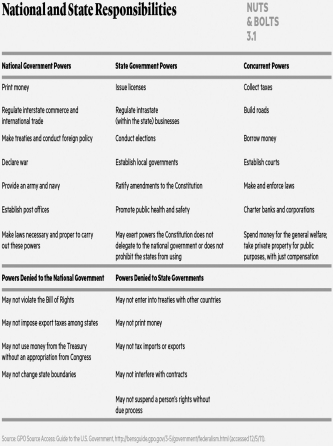 Under the U.S.system of federalism, who or what is responsible for the conduct of foreign policy and defense?
A)the national government
B)the state governments
C)the local governments
D)international organizations such as the United Nations and NATO
Question
Question
Question
Question
Question
Question
Question
Question
Question
Question
Question
Question
Question
Question
Question
Question
Question
Question
Question
Question
Question
Question
Question
Question
Question
Question
Question
Question
Question
Question
Question
Question
Question
Question
Question
Question
Question
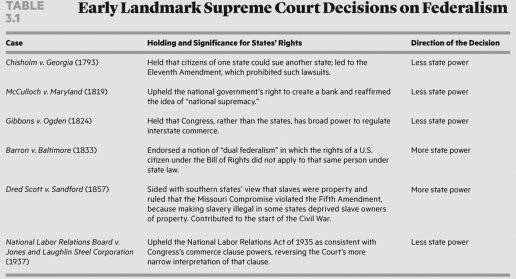 Which early court case reinforced the power of the supremacy clause?
A)Barron v.Baltimore
B)Gibbons v.Ogden
C)McCulloch v.Maryland
D)Dred Scott v.Sandford
Question
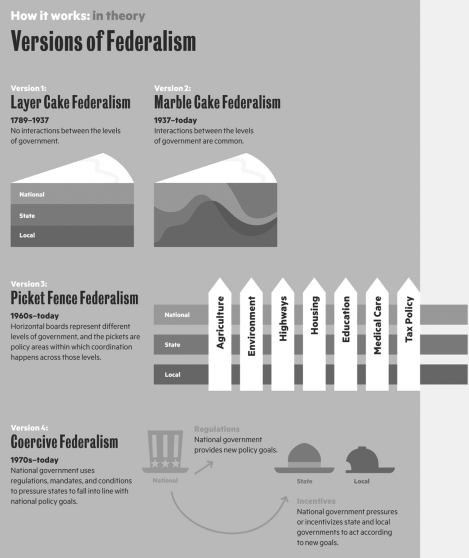 The doctrine of dual federalism is most consistent with the concept of
A)marble cake federalism.
B)layer cake federalism.
C)coercive federalism.
D)fiscal federalism.
Question
Question
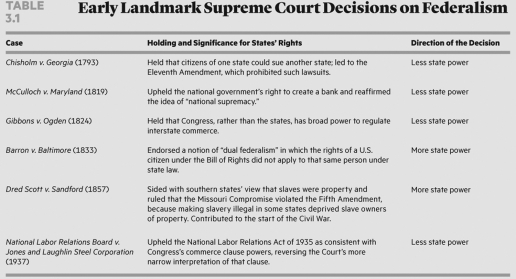 Why is Barron v.Baltimore important?
A)The justices sided with the national government over state governments, giving added power to the supremacy clause.
B)The justices ruled that Congress did not have the authority to prohibit slavery in any state.
C)The justices ruled that the Missouri Compromise was unconstitutional.
D)The justices helped to establish dual federalism as a guiding judicial principle to settle questions concerning state and national power.
Question
Question
Question
Question
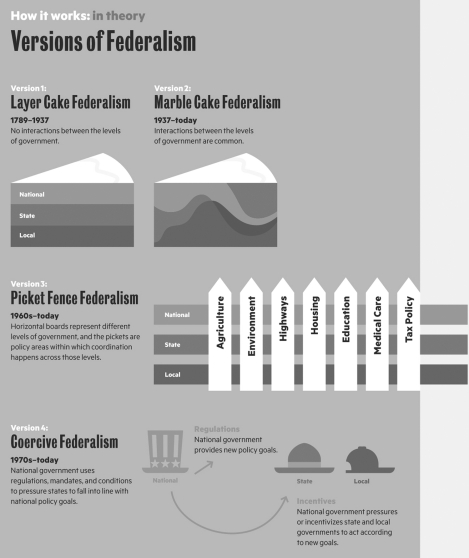 The picket fence metaphor is an appropriate description of current American federalism because
A)different policy areas are "fenced" off from each other by congressional action and court rulings.
B)it takes money to make policy, just like it does to build a fence.
C)policy makers mainly interact with others in the same policy area, regardless of whether they are federal or state employees.
D)the state and federal governments have clear boundaries, much like two fences on separate properties.
Question
Question
Question
Question
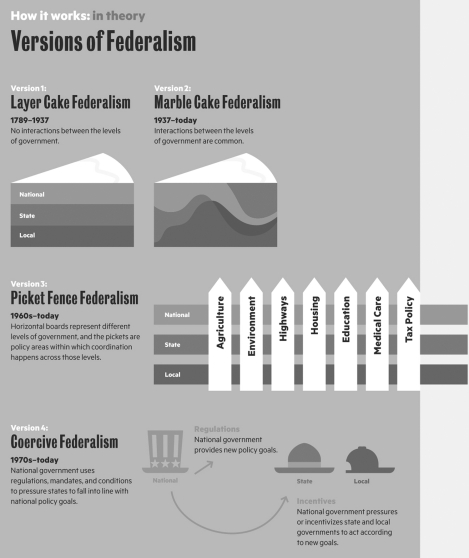 Cooperative federalism emerged during
A)the 1890s.
B)the 1930s.
C)the 1970s.
D)the 1990s.
Question
Question
Question
Question
Question
Question
Question
Question
Question
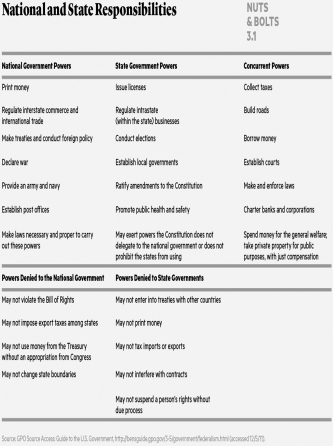 What is a concurrent power and what are some examples?
 Question
Question
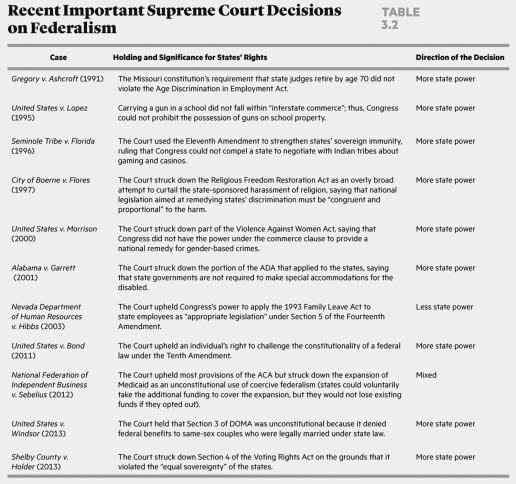 In 1997, the Supreme Court justices struck down the Religious Freedom Restoration Act.This ruling was significant because it
A)marked a turning point in the justices' interpretation of the Fifth Amendment.
B)weakened protections for individual civil liberties.
C)established a new standard to justify the supremacy clause.
D)established a new standard to justify remedial legislation.
Question
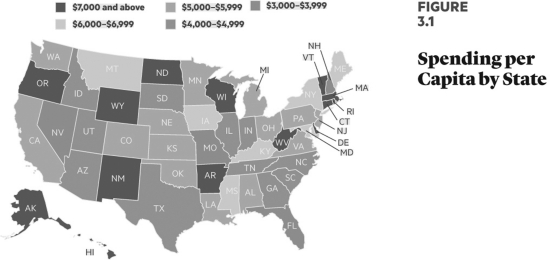 The significant variation in resources at the state level is an argument in favor of
A)allowing states more power.
B)the Supreme Court justices having the final say on federalism.
C)limiting how much power is given to the states.
D)competitive federalism.
Question
Question
Question
Question
Question
Question
Question
Question
Question
Question
Question
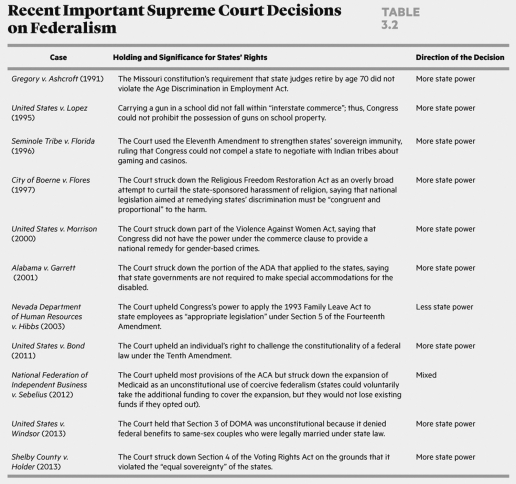 The decision in United States v.Lopez (1995) was particularly important because it required Congress to
A)respect the constitutional right of an individual to bear arms.
B)provide states with funds when it mandates policy change.
C)amend the Constitution to give states more power.
D)justify how laws passed are a legitimate exercise of commerce clause powers.
Question
Question

Unlock Deck
Sign up to unlock the cards in this deck!
Unlock Deck
Unlock Deck
1/91

Play

Full screen (f)
Deck 3: Federalism
1
The Seventeenth Amendment gave women the right to vote.
False
2
Chief Justice Roger Taney believed in the doctrine of dual federalism.
True
3
Policy diversity and innovation are arguments in favor of a stronger role for the states in U.S.politics.
True
4
In the wake of the September 11, 2001 terrorist attacks on the United States, many Republicans, including President George W.Bush, were supportive of strong action by the national government to protect homeland security.
Unlock Deck
Unlock for access to all 91 flashcards in this deck.
Unlock Deck
k this deck
5
Which best defines the situation of local governments in the American federal system?
A)They are created by the federal Constitution.
B)They are created by state governments.
C)They are formed by popular petition.
D)They are created by the national and state governments working together.
A)They are created by the federal Constitution.
B)They are created by state governments.
C)They are formed by popular petition.
D)They are created by the national and state governments working together.
Unlock Deck
Unlock for access to all 91 flashcards in this deck.
Unlock Deck
k this deck
6
The idea of giving states more control over social programs began when Lyndon Johnson was president.
Unlock Deck
Unlock for access to all 91 flashcards in this deck.
Unlock Deck
k this deck
7
Under the U.S.system of federalism, who or what is responsible for the conduct of foreign policy and defense?A)the national government
B)the state governments
C)the local governments
D)international organizations such as the United Nations and NATO
Unlock Deck
Unlock for access to all 91 flashcards in this deck.
Unlock Deck
k this deck
8
In 2015, the Supreme Court justices decided that a same-sex marriage performed in one state would have to be recognized in the other states as well.
Unlock Deck
Unlock for access to all 91 flashcards in this deck.
Unlock Deck
k this deck
9
An example of the U.S.Constitution's "full faith and credit clause" is that a person with a driver's license from the state of Indiana does not need to get a separate Michigan driver's license to drive a car through the state of Michigan.
Unlock Deck
Unlock for access to all 91 flashcards in this deck.
Unlock Deck
k this deck
10
Police powers include
A)those exercised jointly by federal, state, and local authorities.
B)national security matters.
C)immigration policy.
D)conducting elections.
A)those exercised jointly by federal, state, and local authorities.
B)national security matters.
C)immigration policy.
D)conducting elections.
Unlock Deck
Unlock for access to all 91 flashcards in this deck.
Unlock Deck
k this deck
11
The 1965 Voting Rights Act, where the federal government sent marshals to the South to make sure African Americans were allowed to vote, is a good example of dual federalism.
Unlock Deck
Unlock for access to all 91 flashcards in this deck.
Unlock Deck
k this deck
12
In federal systems, power is completely centralized at the federal or national level.
Unlock Deck
Unlock for access to all 91 flashcards in this deck.
Unlock Deck
k this deck
13
Debates over how power is divided between the national and state governments have NOT been controversial since the nation's founding because most people interpret the Tenth Amendment and the "necessary and proper clause" in a similar manner.
Unlock Deck
Unlock for access to all 91 flashcards in this deck.
Unlock Deck
k this deck
14
A confederal system features weak states that can never veto national government decisions.
Unlock Deck
Unlock for access to all 91 flashcards in this deck.
Unlock Deck
k this deck
15
Sovereign power means that
A)the state governments have just as much power as the national government.
B)each unit of government has some degree of authority and autonomy.
C)the Constitution recognizes only national authority.
D)local governments have no authority in the United States.
A)the state governments have just as much power as the national government.
B)each unit of government has some degree of authority and autonomy.
C)the Constitution recognizes only national authority.
D)local governments have no authority in the United States.
Unlock Deck
Unlock for access to all 91 flashcards in this deck.
Unlock Deck
k this deck
16
The "rights revolution" and Great Society programs were made possible because of the doctrine of new federalism.
Unlock Deck
Unlock for access to all 91 flashcards in this deck.
Unlock Deck
k this deck
17
In the first century of America's history, the national government played a relatively active role in the domestic economy.
Unlock Deck
Unlock for access to all 91 flashcards in this deck.
Unlock Deck
k this deck
18
Thomas Jefferson was an advocate of the doctrine of states' rights.
Unlock Deck
Unlock for access to all 91 flashcards in this deck.
Unlock Deck
k this deck
19
The United Nations is an example of a confederation.
Unlock Deck
Unlock for access to all 91 flashcards in this deck.
Unlock Deck
k this deck
20
The past 20 years can be considered the "era of balanced federalism."
Unlock Deck
Unlock for access to all 91 flashcards in this deck.
Unlock Deck
k this deck
21
A confederal system of government has a ________ central government.A unitary system has a ________ central government.
A)strong; weak
B)weak; strong
C)weak; weak
D)bicameral; unicameral
A)strong; weak
B)weak; strong
C)weak; weak
D)bicameral; unicameral
Unlock Deck
Unlock for access to all 91 flashcards in this deck.
Unlock Deck
k this deck
22
In 2015, ________ determined that marriage is a fundamental right that cannot be denied to same-sex couples.
A)a majority of the members of Congress
B)a majority of the members of state legislatures
C)a majority of the Supreme Court justices
D)all state attorneys general
A)a majority of the members of Congress
B)a majority of the members of state legislatures
C)a majority of the Supreme Court justices
D)all state attorneys general
Unlock Deck
Unlock for access to all 91 flashcards in this deck.
Unlock Deck
k this deck
23
The principal impact of McCulloch v.Maryland was
A)its decision to interpret the commerce clause broadly, thus giving the national government the ability to become involved in many more policy areas.
B)its decision to let states interfere in the federal government's business by taxing it.
C)its ruling that the national government's power to print money did not imply that it could open a bank for regulating the economy.
D)its expansive interpretation of implied powers and the supremacy clause in favor of the national government.
A)its decision to interpret the commerce clause broadly, thus giving the national government the ability to become involved in many more policy areas.
B)its decision to let states interfere in the federal government's business by taxing it.
C)its ruling that the national government's power to print money did not imply that it could open a bank for regulating the economy.
D)its expansive interpretation of implied powers and the supremacy clause in favor of the national government.
Unlock Deck
Unlock for access to all 91 flashcards in this deck.
Unlock Deck
k this deck
24
Which amendment stipulates "the powers not delegated to the United States by the Constitution, nor prohibited by it to the states, are reserved to the states respectively, or to the people"?
A)First
B)Fourth
C)Eighth
D)Tenth
A)First
B)Fourth
C)Eighth
D)Tenth
Unlock Deck
Unlock for access to all 91 flashcards in this deck.
Unlock Deck
k this deck
25
Which part of the Constitution emphasizes a nation-centered perspective?
A)Eleventh Amendment
B)public education
C)Tenth Amendment
D)commerce clause
A)Eleventh Amendment
B)public education
C)Tenth Amendment
D)commerce clause
Unlock Deck
Unlock for access to all 91 flashcards in this deck.
Unlock Deck
k this deck
26
Why are local governments still considered important to citizens?
A)They provide services such as police and fire protection.
B)They control immigration policy.
C)They are exclusively responsible for all transportation policy.
D)They are less likely to be corrupt than state or national government officials.
A)They provide services such as police and fire protection.
B)They control immigration policy.
C)They are exclusively responsible for all transportation policy.
D)They are less likely to be corrupt than state or national government officials.
Unlock Deck
Unlock for access to all 91 flashcards in this deck.
Unlock Deck
k this deck
27
________ espoused the doctrine of states' rights in the early years of the republic.
A)Thomas Jefferson
B)John Adams
C)Alexander Hamilton
D)George Washington
A)Thomas Jefferson
B)John Adams
C)Alexander Hamilton
D)George Washington
Unlock Deck
Unlock for access to all 91 flashcards in this deck.
Unlock Deck
k this deck
28
Which system is most common among democracies in the world?
A)federal system
B)confederal system
C)unitary system
D)direct democratic system
A)federal system
B)confederal system
C)unitary system
D)direct democratic system
Unlock Deck
Unlock for access to all 91 flashcards in this deck.
Unlock Deck
k this deck
29
McCulloch v.Maryland (1819) is an important Supreme Court ruling because
A)it limited state government power by declaring that Maryland could not tax a federal bank.
B)it strengthened state government power by declaring that Maryland could tax a federal bank under the doctrine of dual sovereignty.
C)it expanded the power of the national government by declaring that federal taxes on state banks were constitutional.
D)it expanded state government power by declaring that state laws could override the commerce clause.
A)it limited state government power by declaring that Maryland could not tax a federal bank.
B)it strengthened state government power by declaring that Maryland could tax a federal bank under the doctrine of dual sovereignty.
C)it expanded the power of the national government by declaring that federal taxes on state banks were constitutional.
D)it expanded state government power by declaring that state laws could override the commerce clause.
Unlock Deck
Unlock for access to all 91 flashcards in this deck.
Unlock Deck
k this deck
30
Why is the necessary and proper clause often a source of controversy and political disagreement?
A)Some argue that it grants too much power to the Supreme Court by giving it the power to declare state laws unconstitutional.
B)Some argue that the executive branch has abused its power through an overly broad interpretation of the necessary and proper clause.
C)Some argue that the U.S.Congress has abused its power through an overly broad interpretation of the necessary and proper clause.
D)Some argue that it makes the military too powerful without proper checks from civilian government.
A)Some argue that it grants too much power to the Supreme Court by giving it the power to declare state laws unconstitutional.
B)Some argue that the executive branch has abused its power through an overly broad interpretation of the necessary and proper clause.
C)Some argue that the U.S.Congress has abused its power through an overly broad interpretation of the necessary and proper clause.
D)Some argue that it makes the military too powerful without proper checks from civilian government.
Unlock Deck
Unlock for access to all 91 flashcards in this deck.
Unlock Deck
k this deck
31
________ is an example of a unitary system of government.
A)The United States
B)The Commonwealth of Independent States
C)The International Monetary Fund
D)France
A)The United States
B)The Commonwealth of Independent States
C)The International Monetary Fund
D)France
Unlock Deck
Unlock for access to all 91 flashcards in this deck.
Unlock Deck
k this deck
32
One advantage of decentralized power in a federal system is that it
A)provides Congress with more power than the president.
B)makes legislation easier to pass.
C)is a natural check on the power of the federal government.
D)leads to more coherent and unified ethnic and national identities.
A)provides Congress with more power than the president.
B)makes legislation easier to pass.
C)is a natural check on the power of the federal government.
D)leads to more coherent and unified ethnic and national identities.
Unlock Deck
Unlock for access to all 91 flashcards in this deck.
Unlock Deck
k this deck
33
Local governments
A)are autonomous units of government.
B)are appendages of the state government.
C)are appendages of the national government.
D)do not control any public policy issues.
A)are autonomous units of government.
B)are appendages of the state government.
C)are appendages of the national government.
D)do not control any public policy issues.
Unlock Deck
Unlock for access to all 91 flashcards in this deck.
Unlock Deck
k this deck
34
Which court case strengthened Congress by providing for a broad interpretation of the commerce clause?
A)Gibbons v.Ogden
B)Barron v.Baltimore
C)Chisholm v.Georgia
D)Dred Scott v.Sandford
A)Gibbons v.Ogden
B)Barron v.Baltimore
C)Chisholm v.Georgia
D)Dred Scott v.Sandford
Unlock Deck
Unlock for access to all 91 flashcards in this deck.
Unlock Deck
k this deck
35
The privileges and immunities clause was originally meant to promote
A)equality for all citizens under the law.
B)the doctrine of states' rights.
C)individual civil liberties.
D)commerce and travel between states.
A)equality for all citizens under the law.
B)the doctrine of states' rights.
C)individual civil liberties.
D)commerce and travel between states.
Unlock Deck
Unlock for access to all 91 flashcards in this deck.
Unlock Deck
k this deck
36
What is the clearest statement of the nation-centered focus of the U.S.Constitution?
A)supremacy clause
B)Three-Fifths compromise
C)doctrine of nullification
D)Electoral College
A)supremacy clause
B)Three-Fifths compromise
C)doctrine of nullification
D)Electoral College
Unlock Deck
Unlock for access to all 91 flashcards in this deck.
Unlock Deck
k this deck
37
Intergovernmental organizations exist primarily to
A)assist member nations with loans through the World Bank and International Monetary Fund.
B)help poor nations combat poverty.
C)monitor elections and advance democracy around the world.
D)assist member nations seeking to coordinate their policies.
A)assist member nations with loans through the World Bank and International Monetary Fund.
B)help poor nations combat poverty.
C)monitor elections and advance democracy around the world.
D)assist member nations seeking to coordinate their policies.
Unlock Deck
Unlock for access to all 91 flashcards in this deck.
Unlock Deck
k this deck
38
Which part of the Constitution emphasizes a state-centered perspective?
A)Fifth Amendment
B)commerce clause
C)forging treaties with foreign nations
D)amending the U.S.Constitution
A)Fifth Amendment
B)commerce clause
C)forging treaties with foreign nations
D)amending the U.S.Constitution
Unlock Deck
Unlock for access to all 91 flashcards in this deck.
Unlock Deck
k this deck
39
The ________ clause is vague but gives the national government a very broad grant of power to carry out its responsibilities.
A)enumerated powers
B)full faith and credit
C)supremacy
D)necessary and proper
A)enumerated powers
B)full faith and credit
C)supremacy
D)necessary and proper
Unlock Deck
Unlock for access to all 91 flashcards in this deck.
Unlock Deck
k this deck
40
What is a disadvantage of a unitary system?
A)Unitary systems are inefficient and tend to suffer from weak central leadership.
B)Unitary systems are autocratic, which often leads to rampant government corruption.
C)There is no competition between different political units in unitary systems, which can stifle policy development.
D)Unitary systems allow multiple parties to be included on the ballot, which causes confusion among the electorate.
A)Unitary systems are inefficient and tend to suffer from weak central leadership.
B)Unitary systems are autocratic, which often leads to rampant government corruption.
C)There is no competition between different political units in unitary systems, which can stifle policy development.
D)Unitary systems allow multiple parties to be included on the ballot, which causes confusion among the electorate.
Unlock Deck
Unlock for access to all 91 flashcards in this deck.
Unlock Deck
k this deck
41
Which one of the following explains why cooperative federalism emerged in the United States?
A)Supreme Court decisions that broadly interpreted the commerce clause
B)Supreme Court decisions that limited the scope of the commerce clause
C)public support and demand for cooperative federalism based on opposition to the doctrine of states' rights
D)the election of U.S.senators by state legislatures
A)Supreme Court decisions that broadly interpreted the commerce clause
B)Supreme Court decisions that limited the scope of the commerce clause
C)public support and demand for cooperative federalism based on opposition to the doctrine of states' rights
D)the election of U.S.senators by state legislatures
Unlock Deck
Unlock for access to all 91 flashcards in this deck.
Unlock Deck
k this deck
42
Fiscal federalism refers to
A)taxes by the national government on state institutions.
B)taxes by the states on national institutions.
C)grants of money from states to the national government.
D)grants of money from the national government to the states.
A)taxes by the national government on state institutions.
B)taxes by the states on national institutions.
C)grants of money from states to the national government.
D)grants of money from the national government to the states.
Unlock Deck
Unlock for access to all 91 flashcards in this deck.
Unlock Deck
k this deck
43
President Abraham Lincoln
A)supported the doctrine of states' rights.
B)opposed southern secession.
C)endorsed the notion of state-centered federalism.
D)was in favor of the doctrine of nullification.
A)supported the doctrine of states' rights.
B)opposed southern secession.
C)endorsed the notion of state-centered federalism.
D)was in favor of the doctrine of nullification.
Unlock Deck
Unlock for access to all 91 flashcards in this deck.
Unlock Deck
k this deck
44
Which early court case reinforced the power of the supremacy clause?A)Barron v.Baltimore
B)Gibbons v.Ogden
C)McCulloch v.Maryland
D)Dred Scott v.Sandford
Unlock Deck
Unlock for access to all 91 flashcards in this deck.
Unlock Deck
k this deck
45
The doctrine of dual federalism is most consistent with the concept ofA)marble cake federalism.
B)layer cake federalism.
C)coercive federalism.
D)fiscal federalism.
Unlock Deck
Unlock for access to all 91 flashcards in this deck.
Unlock Deck
k this deck
46
Which one of the following describes a situation in which national officials provide funds to state governments with few strings attached on how that money is spent?
A)fiscal federalism
B)a categorical grant
C)a block grant
D)a discretionary grant
A)fiscal federalism
B)a categorical grant
C)a block grant
D)a discretionary grant
Unlock Deck
Unlock for access to all 91 flashcards in this deck.
Unlock Deck
k this deck
47
Why is Barron v.Baltimore important?A)The justices sided with the national government over state governments, giving added power to the supremacy clause.
B)The justices ruled that Congress did not have the authority to prohibit slavery in any state.
C)The justices ruled that the Missouri Compromise was unconstitutional.
D)The justices helped to establish dual federalism as a guiding judicial principle to settle questions concerning state and national power.
Unlock Deck
Unlock for access to all 91 flashcards in this deck.
Unlock Deck
k this deck
48
In the Dred Scott case, the justices ruled that
A)the Missouri Compromise deprived slave owners of property without due process of law.
B)previous Court rulings that relied on the principle of dual federalism were incorrect because this was not what the framers envisioned when drafting the Constitution.
C)federal law was supreme over state law.
D)the Bill of Rights did not apply to the states.
A)the Missouri Compromise deprived slave owners of property without due process of law.
B)previous Court rulings that relied on the principle of dual federalism were incorrect because this was not what the framers envisioned when drafting the Constitution.
C)federal law was supreme over state law.
D)the Bill of Rights did not apply to the states.
Unlock Deck
Unlock for access to all 91 flashcards in this deck.
Unlock Deck
k this deck
49
Which one of the following stipulates that if the national government passes an unconstitutional law, the people of the states can declare the law void?
A)doctrine of states' rights
B)doctrine of coercive federalism
C)doctrine of nullification
D)devolution
A)doctrine of states' rights
B)doctrine of coercive federalism
C)doctrine of nullification
D)devolution
Unlock Deck
Unlock for access to all 91 flashcards in this deck.
Unlock Deck
k this deck
50
Following the Civil War, why were the Thirteenth, Fourteenth, and Fifteenth Amendments added to the Constitution?
A)to guarantee African Americans seats in Congress
B)to move the nation toward a unitary government
C)to ensure that the Union's views on states' rights were the law of the land
D)to ensure that northern states would dominate the national government
A)to guarantee African Americans seats in Congress
B)to move the nation toward a unitary government
C)to ensure that the Union's views on states' rights were the law of the land
D)to ensure that northern states would dominate the national government
Unlock Deck
Unlock for access to all 91 flashcards in this deck.
Unlock Deck
k this deck
51
The picket fence metaphor is an appropriate description of current American federalism becauseA)different policy areas are "fenced" off from each other by congressional action and court rulings.
B)it takes money to make policy, just like it does to build a fence.
C)policy makers mainly interact with others in the same policy area, regardless of whether they are federal or state employees.
D)the state and federal governments have clear boundaries, much like two fences on separate properties.
Unlock Deck
Unlock for access to all 91 flashcards in this deck.
Unlock Deck
k this deck
52
Why did the Seventeenth Amendment pass in the early twentieth century?
A)States' rights advocates wanted to reduce the power of state legislatures in favor of state governors.
B)The Progressives wanted to reduce the power of state legislatures.
C)The state governments became more involved in activities that were traditionally addressed at the national level.
D)The Progressives wanted to reduce the power of the president.
A)States' rights advocates wanted to reduce the power of state legislatures in favor of state governors.
B)The Progressives wanted to reduce the power of state legislatures.
C)The state governments became more involved in activities that were traditionally addressed at the national level.
D)The Progressives wanted to reduce the power of the president.
Unlock Deck
Unlock for access to all 91 flashcards in this deck.
Unlock Deck
k this deck
53
In his 1981 inaugural address, President Ronald Reagan
A)expressed his belief in strong national power over the states.
B)expressed his belief in the doctrine of states' rights.
C)sounded like a Federalist from the early years of the republic.
D)sounded like a leader who believed that states were exercising too much power in the American political system.
A)expressed his belief in strong national power over the states.
B)expressed his belief in the doctrine of states' rights.
C)sounded like a Federalist from the early years of the republic.
D)sounded like a leader who believed that states were exercising too much power in the American political system.
Unlock Deck
Unlock for access to all 91 flashcards in this deck.
Unlock Deck
k this deck
54
Under the doctrine of dual federalism, what was the relationship between the national and state governments?
A)Each has distinct areas of authority with very little overlap.
B)Each has distinct authority, but they cooperate with one another in most areas.
C)The only way in which the national government influences the states is by providing them with funds.
D)Federal mandates matter only when state officials agree with them.
A)Each has distinct areas of authority with very little overlap.
B)Each has distinct authority, but they cooperate with one another in most areas.
C)The only way in which the national government influences the states is by providing them with funds.
D)Federal mandates matter only when state officials agree with them.
Unlock Deck
Unlock for access to all 91 flashcards in this deck.
Unlock Deck
k this deck
55
Cooperative federalism emerged duringA)the 1890s.
B)the 1930s.
C)the 1970s.
D)the 1990s.
Unlock Deck
Unlock for access to all 91 flashcards in this deck.
Unlock Deck
k this deck
56
The doctrine of nullification was first used
A)by the Supreme Court in McCulloch v.Maryland.
B)to ignore a tariff law passed by Congress in 1832.
C)by state governors opposed to federal civil rights legislation that became law in the 1950s and 1960s.
D)by Lyndon Johnson as part of his Great Society programs.
A)by the Supreme Court in McCulloch v.Maryland.
B)to ignore a tariff law passed by Congress in 1832.
C)by state governors opposed to federal civil rights legislation that became law in the 1950s and 1960s.
D)by Lyndon Johnson as part of his Great Society programs.
Unlock Deck
Unlock for access to all 91 flashcards in this deck.
Unlock Deck
k this deck
57
The commerce clause specifically gives
A)state governments the power to raise funds by taxing goods and services.
B)state governments the power to regulate commerce.
C)Congress the power to set interest rates.
D)Congress the power to regulate economic exchange between the states.
A)state governments the power to raise funds by taxing goods and services.
B)state governments the power to regulate commerce.
C)Congress the power to set interest rates.
D)Congress the power to regulate economic exchange between the states.
Unlock Deck
Unlock for access to all 91 flashcards in this deck.
Unlock Deck
k this deck
58
Following the Civil War, the Constitution was amended to ensure that states could not deny any citizen
A)equal pay for equal work.
B)the right to run as a candidate for public office.
C)due process or equal protection of the laws.
D)the right to earn a guaranteed minimum wage established by the federal government.
A)equal pay for equal work.
B)the right to run as a candidate for public office.
C)due process or equal protection of the laws.
D)the right to earn a guaranteed minimum wage established by the federal government.
Unlock Deck
Unlock for access to all 91 flashcards in this deck.
Unlock Deck
k this deck
59
Which one of the following is an example of fiscal federalism?
A)National government officials threaten to tax state governments to steer state officials toward accepting a desired federal policy.
B)National government officials issue federal funds to state governments to encourage state officials to meet certain policy requirements.
C)National government officials require states to increase taxes to meet federal mandates.
D)National government officials lend money to the states on a temporary basis.
A)National government officials threaten to tax state governments to steer state officials toward accepting a desired federal policy.
B)National government officials issue federal funds to state governments to encourage state officials to meet certain policy requirements.
C)National government officials require states to increase taxes to meet federal mandates.
D)National government officials lend money to the states on a temporary basis.
Unlock Deck
Unlock for access to all 91 flashcards in this deck.
Unlock Deck
k this deck
60
The Supreme Court justices' endorsement of laissez-faire capitalism in the late nineteenth and early twentieth centuries was significant because
A)it gave Congress added powers to regulate private affairs.
B)it prevented Congress from regulating any economic activity that occurred within a state.
C)it gave additional freedom to Congress to act under the commerce clause.
D)it strengthened the full faith and credit clause of the Constitution.
A)it gave Congress added powers to regulate private affairs.
B)it prevented Congress from regulating any economic activity that occurred within a state.
C)it gave additional freedom to Congress to act under the commerce clause.
D)it strengthened the full faith and credit clause of the Constitution.
Unlock Deck
Unlock for access to all 91 flashcards in this deck.
Unlock Deck
k this deck
61
According to some political and legal researchers, why can competitive federalism create a "race to the bottom"?
A)Competition for jobs can result in the elimination of some environmental regulations.
B)Competition for jobs can result in higher benefit levels for citizens.
C)Competition for jobs can result in more tax revenue for the states.
D)Competition for jobs can result in changes in state constitutions.
A)Competition for jobs can result in the elimination of some environmental regulations.
B)Competition for jobs can result in higher benefit levels for citizens.
C)Competition for jobs can result in more tax revenue for the states.
D)Competition for jobs can result in changes in state constitutions.
Unlock Deck
Unlock for access to all 91 flashcards in this deck.
Unlock Deck
k this deck
62
Americans are more likely to
A)trust their local and state governments over the federal government.
B)trust the federal government over their local and state governments.
C)fear executive power when a Democrat is president.
D)support expanded executive power when a Republican is president.
A)trust their local and state governments over the federal government.
B)trust the federal government over their local and state governments.
C)fear executive power when a Democrat is president.
D)support expanded executive power when a Republican is president.
Unlock Deck
Unlock for access to all 91 flashcards in this deck.
Unlock Deck
k this deck
63
Recent Supreme Court rulings concerning the Fourteenth Amendment have had the effect of
A)reducing the power of state governments.
B)reducing the power of the federal government.
C)increasing the power of both state and federal governments.
D)strengthening Congress.
A)reducing the power of state governments.
B)reducing the power of the federal government.
C)increasing the power of both state and federal governments.
D)strengthening Congress.
Unlock Deck
Unlock for access to all 91 flashcards in this deck.
Unlock Deck
k this deck
64
What is a concurrent power and what are some examples? Unlock Deck
Unlock for access to all 91 flashcards in this deck.
Unlock Deck
k this deck
65
Which one of the following is an advantage of giving states flexibility in making policy instead of federal officials imposing policy?
A)State-elected officials are more civil and reasonable toward one another than are members of the U.S.Congress.
B)It allows states to compete for business, meaning they will have stronger regulation.
C)It allows for policy experimentation, providing new ideas about how to solve problems.
D)State officials tend to care more about the average person.
A)State-elected officials are more civil and reasonable toward one another than are members of the U.S.Congress.
B)It allows states to compete for business, meaning they will have stronger regulation.
C)It allows for policy experimentation, providing new ideas about how to solve problems.
D)State officials tend to care more about the average person.
Unlock Deck
Unlock for access to all 91 flashcards in this deck.
Unlock Deck
k this deck
66
In 1997, the Supreme Court justices struck down the Religious Freedom Restoration Act.This ruling was significant because itA)marked a turning point in the justices' interpretation of the Fifth Amendment.
B)weakened protections for individual civil liberties.
C)established a new standard to justify the supremacy clause.
D)established a new standard to justify remedial legislation.
Unlock Deck
Unlock for access to all 91 flashcards in this deck.
Unlock Deck
k this deck
67
The significant variation in resources at the state level is an argument in favor ofA)allowing states more power.
B)the Supreme Court justices having the final say on federalism.
C)limiting how much power is given to the states.
D)competitive federalism.
Unlock Deck
Unlock for access to all 91 flashcards in this deck.
Unlock Deck
k this deck
68
The Violence Against Women Act
A)was passed during the George W.Bush administration.
B)had strong Democratic support but no Republican support in Congress.
C)was struck down, in part, by the Supreme Court justices.
D)was based on the necessary and proper clause of the Constitution.
A)was passed during the George W.Bush administration.
B)had strong Democratic support but no Republican support in Congress.
C)was struck down, in part, by the Supreme Court justices.
D)was based on the necessary and proper clause of the Constitution.
Unlock Deck
Unlock for access to all 91 flashcards in this deck.
Unlock Deck
k this deck
69
Which one of the following is provided by the authors of the textbook as a reason one might support a strong state role in federalism?
A)States are laboratories of democracy.
B)States tend to have more honest elected officials.
C)Federal officials are paralyzed by special interest groups, whereas state governments are not.
D)State governments have a better record than Congress at eradicating racial discrimination and providing civil rights.
A)States are laboratories of democracy.
B)States tend to have more honest elected officials.
C)Federal officials are paralyzed by special interest groups, whereas state governments are not.
D)State governments have a better record than Congress at eradicating racial discrimination and providing civil rights.
Unlock Deck
Unlock for access to all 91 flashcards in this deck.
Unlock Deck
k this deck
70
Which one of the following reinforced the role of the national government beginning in the 1960s?
A)the devolution revolution
B)President Nixon's New Federalism
C)the "rights revolution"
D)the passage of the Sherman Antitrust Act
A)the devolution revolution
B)President Nixon's New Federalism
C)the "rights revolution"
D)the passage of the Sherman Antitrust Act
Unlock Deck
Unlock for access to all 91 flashcards in this deck.
Unlock Deck
k this deck
71
If a state official wished to challenge the constitutionality of a federal law, which amendment would she or he most likely cite?
A)Eighth
B)Tenth
C)Fourteenth
D)Fifteenth
A)Eighth
B)Tenth
C)Fourteenth
D)Fifteenth
Unlock Deck
Unlock for access to all 91 flashcards in this deck.
Unlock Deck
k this deck
72
The Supreme Court justices' decision involving the constitutionality of some portions of the Americans with Disabilities Act illustrated
A)how the justices are reshaping federalism in the direction of state power.
B)the justices' commitment to upholding laws passed during the "rights revolution."
C)the justices' broad interpretation of Title VI of the 1964 Civil Rights Act.
D)the importance of dual federalism in the 1800s.
A)how the justices are reshaping federalism in the direction of state power.
B)the justices' commitment to upholding laws passed during the "rights revolution."
C)the justices' broad interpretation of Title VI of the 1964 Civil Rights Act.
D)the importance of dual federalism in the 1800s.
Unlock Deck
Unlock for access to all 91 flashcards in this deck.
Unlock Deck
k this deck
73
What is the privileges and immunities clause in the Constitution and why is it important?
Unlock Deck
Unlock for access to all 91 flashcards in this deck.
Unlock Deck
k this deck
74
Which one of the following programs provided states with significant flexibility in spending federal welfare dollars?
A)Great Society programs
B)Temporary Assistance to Needy Families
C)Social Security Act
D)Medicare Act
A)Great Society programs
B)Temporary Assistance to Needy Families
C)Social Security Act
D)Medicare Act
Unlock Deck
Unlock for access to all 91 flashcards in this deck.
Unlock Deck
k this deck
75
What contributed to increased national control over state policies in the 1960s?
A)New Federalism
B)Great Society social programs
C)the tendency of members of Congress to favor block grants over categorical grants
D)the rejection of the "rights revolution" by the Supreme Court justices
A)New Federalism
B)Great Society social programs
C)the tendency of members of Congress to favor block grants over categorical grants
D)the rejection of the "rights revolution" by the Supreme Court justices
Unlock Deck
Unlock for access to all 91 flashcards in this deck.
Unlock Deck
k this deck
76
What was the doctrine of nullification and why was it important?
Unlock Deck
Unlock for access to all 91 flashcards in this deck.
Unlock Deck
k this deck
77
How was the John Marshall Court different from the Roger Taney Court?
Unlock Deck
Unlock for access to all 91 flashcards in this deck.
Unlock Deck
k this deck
78
The decision in United States v.Lopez (1995) was particularly important because it required Congress toA)respect the constitutional right of an individual to bear arms.
B)provide states with funds when it mandates policy change.
C)amend the Constitution to give states more power.
D)justify how laws passed are a legitimate exercise of commerce clause powers.
Unlock Deck
Unlock for access to all 91 flashcards in this deck.
Unlock Deck
k this deck
79
Which one of the following statements would fall under the principle of coercive federalism?
A)The president threatens the states with military might.
B)Members of Congress create mandates without giving state leaders the money to execute and enforce the mandates in question.
C)Members of Congress pass new constitutional amendments limiting state power.
D)Members of Congress threaten to tax residents at a higher rate in states where leaders are unwilling to cooperate with national goals and policies.
A)The president threatens the states with military might.
B)Members of Congress create mandates without giving state leaders the money to execute and enforce the mandates in question.
C)Members of Congress pass new constitutional amendments limiting state power.
D)Members of Congress threaten to tax residents at a higher rate in states where leaders are unwilling to cooperate with national goals and policies.
Unlock Deck
Unlock for access to all 91 flashcards in this deck.
Unlock Deck
k this deck
80
Since the 1990s, the Supreme Court justices have made decisions that generally
A)expand federal power.
B)protect state power.
C)expand application of the Fourteenth Amendment to the states.
D)expand civil rights.
A)expand federal power.
B)protect state power.
C)expand application of the Fourteenth Amendment to the states.
D)expand civil rights.
Unlock Deck
Unlock for access to all 91 flashcards in this deck.
Unlock Deck
k this deck
Unlock Deck
Unlock for access to all 91 flashcards in this deck.






