







 Chat with AI

Deck 5: The Economics of Health Care
Full screen (f)

Question

Question
Question
Question
Question
Question
Question
Question
Question
Question
Question
Question
Question
Question
Question
Question
Question
Question
Question
Question
Question
Question
Question
Question
Question
Question
Question
Question
Question
Question
Question
Question
Question
Question
Question
Question
Question
Question
Question
Question
Question
Question
Question
Question
Question
Question
Question
Question
Question
Question
Question
Question
Question
Question
Question
Question
Question
Question
Question
Question
Question
Figure 5-1 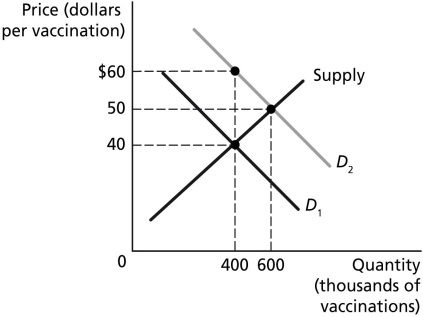 Figure 5-1 represents the market for vaccinations.Vaccinations are considered a benefit to society,and the figure shows both the marginal private benefit and the marginal social benefit from vaccinations.
Refer to Figure 5-1.Marginal private benefit is represented by which curve?
A)D1
B)D2
C)Supply
D)All of the above represent marginal private benefit.
Figure 5-1 represents the market for vaccinations.Vaccinations are considered a benefit to society,and the figure shows both the marginal private benefit and the marginal social benefit from vaccinations.Refer to Figure 5-1.Marginal private benefit is represented by which curve?
A)D1
B)D2
C)Supply
D)All of the above represent marginal private benefit.
Question
Question
Question
Question
Question
Question
Question
Question
Question
Question
Question
Question
Question
Question
Question
Figure 5-1 Figure 5-1 represents the market for vaccinations.Vaccinations are considered a benefit to society,and the figure shows both the marginal private benefit and the marginal social benefit from vaccinations.
Refer to Figure 5-1.Marginal social benefit is represented by which curve?
A)D1
B)D2
C)Supply
D)All of the above represent marginal social benefit.
Figure 5-1 represents the market for vaccinations.Vaccinations are considered a benefit to society,and the figure shows both the marginal private benefit and the marginal social benefit from vaccinations.Refer to Figure 5-1.Marginal social benefit is represented by which curve?
A)D1
B)D2
C)Supply
D)All of the above represent marginal social benefit.
Question
Question
Question
Question

Unlock Deck
Sign up to unlock the cards in this deck!
Unlock Deck
Unlock Deck
1/166

Play

Full screen (f)
Deck 5: The Economics of Health Care
1
Changes in the health of the average person are relatively unimportant as an indicator of changes in the standard of living.
False
2
Explain why the death rates due to kidney disease and diabetes have slightly increased in the United States since 1981.
An increase in obesity is generally believed to be the cause of the increase in death rates for kidney disease and diabetes since 1981.
3
Over time,people in the United States and other high-income countries have,on average,become taller,which is an indication that their nutritional status has improved.
True
4
In the United States in 2016,the percentage of people who received health insurance through their employer was about
A)15%.
B)36%.
C)49%.
D)83%.
A)15%.
B)36%.
C)49%.
D)83%.
Unlock Deck
Unlock for access to all 166 flashcards in this deck.
Unlock Deck
k this deck
5
Which of the following did not contribute to the overall decline in death rates in the United States since 1981?
A)a decline in smoking
B)the decline in the population
C)the availability of new prescription drugs
D)new surgical techniques
A)a decline in smoking
B)the decline in the population
C)the availability of new prescription drugs
D)new surgical techniques
Unlock Deck
Unlock for access to all 166 flashcards in this deck.
Unlock Deck
k this deck
6
In the United States since 1900,life expectancy at birth has ________ and the death rate has ________.
A)increased; increased
B)increased; decreased
C)decreased; increased
D)decreased; decreased
A)increased; increased
B)increased; decreased
C)decreased; increased
D)decreased; decreased
Unlock Deck
Unlock for access to all 166 flashcards in this deck.
Unlock Deck
k this deck
7
Briefly describe changes in life expectancy,average height,and infant mortality in the United States since 1850.
Unlock Deck
Unlock for access to all 166 flashcards in this deck.
Unlock Deck
k this deck
8
Since 1981,deaths from cardiovascular diseases have decreased in the United States.
Unlock Deck
Unlock for access to all 166 flashcards in this deck.
Unlock Deck
k this deck
9
Between 1981 and 2015,deaths from kidney disease increased largely due to the effects of
A)increasing obesity.
B)increasing alcohol consumption.
C)increased smoking.
D)increased pollution.
A)increasing obesity.
B)increasing alcohol consumption.
C)increased smoking.
D)increased pollution.
Unlock Deck
Unlock for access to all 166 flashcards in this deck.
Unlock Deck
k this deck
10
In the United States from 1981 to 2015,deaths from ________ increased largely due to the effects of increasing obesity.
A)strokes
B)cancer
C)heart attacks
D)diabetes
A)strokes
B)cancer
C)heart attacks
D)diabetes
Unlock Deck
Unlock for access to all 166 flashcards in this deck.
Unlock Deck
k this deck
11
In the United States from 1981 to 2015,deaths from which of the following increased?
A)cancer
B)kidney disease
C)heart attacks
D)strokes
A)cancer
B)kidney disease
C)heart attacks
D)strokes
Unlock Deck
Unlock for access to all 166 flashcards in this deck.
Unlock Deck
k this deck
12
Health problems prevent people from working harder,which can lower a country's total income.This indicates that in effect,health problems
A)are a primary cause of price decreases.
B)increase the incentive to work.
C)shift a country's production possibilities frontier inward.
D)decrease consumer surplus.
A)are a primary cause of price decreases.
B)increase the incentive to work.
C)shift a country's production possibilities frontier inward.
D)decrease consumer surplus.
Unlock Deck
Unlock for access to all 166 flashcards in this deck.
Unlock Deck
k this deck
13
In 2016,the average height of adult males in the United States was
A)5' 7.0".
B)5' 9.3".
C)6' 0.0".
D)6' 4.75".
A)5' 7.0".
B)5' 9.3".
C)6' 0.0".
D)6' 4.75".
Unlock Deck
Unlock for access to all 166 flashcards in this deck.
Unlock Deck
k this deck
14
In the United States in 2016,the percentage of people with some form of health insurance was about
A)10%.
B)36%.
C)55%.
D)91%.
A)10%.
B)36%.
C)55%.
D)91%.
Unlock Deck
Unlock for access to all 166 flashcards in this deck.
Unlock Deck
k this deck
15
In 2016,infant mortality in the United States was ________ per 1,000 live births.
A)5.8
B)45.4
C)82.7
D)228.9
A)5.8
B)45.4
C)82.7
D)228.9
Unlock Deck
Unlock for access to all 166 flashcards in this deck.
Unlock Deck
k this deck
16
The overall mortality rate in the United States has declined for the past 35 years.
Unlock Deck
Unlock for access to all 166 flashcards in this deck.
Unlock Deck
k this deck
17
In 2017,the average life expectancy at birth in the United Kingdom and other high-income countries was around ________ years.
A)60
B)70
C)80
D)90
A)60
B)70
C)80
D)90
Unlock Deck
Unlock for access to all 166 flashcards in this deck.
Unlock Deck
k this deck
18
On average,people in low-income countries ________ than people in high-income countries.
A)have a longer life expectancy
B)are subject to a lower infant mortality rate
C)are shorter
D)are exposed to fewer severe diseases
A)have a longer life expectancy
B)are subject to a lower infant mortality rate
C)are shorter
D)are exposed to fewer severe diseases
Unlock Deck
Unlock for access to all 166 flashcards in this deck.
Unlock Deck
k this deck
19
How can increases in a country's total income improve health?
Unlock Deck
Unlock for access to all 166 flashcards in this deck.
Unlock Deck
k this deck
20
In the United States in 2016,the percentage of firms that employed more than 200 workers and did not offer health insurance as a fringe benefit to the workers was about
A)2%.
B)29%.
C)44%.
D)98%.
A)2%.
B)29%.
C)44%.
D)98%.
Unlock Deck
Unlock for access to all 166 flashcards in this deck.
Unlock Deck
k this deck
21
The health care system in ________ is referred to as socialized medicine,under which the government owns most of the hospitals and employs most of the doctors.
A)Canada
B)Japan
C)the United Kingdom
D)the United States
A)Canada
B)Japan
C)the United Kingdom
D)the United States
Unlock Deck
Unlock for access to all 166 flashcards in this deck.
Unlock Deck
k this deck
22
Substantial co-payments are typically not required as a part of the health care system in
A)Canada and the United Kingdom.
B)Japan and Canada.
C)the United States and Japan.
D)Japan and the United Kingdom.
A)Canada and the United Kingdom.
B)Japan and Canada.
C)the United States and Japan.
D)Japan and the United Kingdom.
Unlock Deck
Unlock for access to all 166 flashcards in this deck.
Unlock Deck
k this deck
23
Of the following high-income countries,which has the highest obesity rate?
A)Canada
B)Japan
C)the United Kingdom
D)the United States
A)Canada
B)Japan
C)the United Kingdom
D)the United States
Unlock Deck
Unlock for access to all 166 flashcards in this deck.
Unlock Deck
k this deck
24
In the United States in 2016,a majority of people received health care through
A)Medicare.
B)Medicaid.
C)their employers.
D)individually purchased insurance policies.
A)Medicare.
B)Medicaid.
C)their employers.
D)individually purchased insurance policies.
Unlock Deck
Unlock for access to all 166 flashcards in this deck.
Unlock Deck
k this deck
25
Of the following high-income countries,which has the lowest infant mortality rate?
A)Canada
B)Japan
C)the United Kingdom
D)the United States
A)Canada
B)Japan
C)the United Kingdom
D)the United States
Unlock Deck
Unlock for access to all 166 flashcards in this deck.
Unlock Deck
k this deck
26
Of the following high-income countries,which has the highest life expectancy at birth?
A)Canada
B)Japan
C)the United Kingdom
D)the United States
A)Canada
B)Japan
C)the United Kingdom
D)the United States
Unlock Deck
Unlock for access to all 166 flashcards in this deck.
Unlock Deck
k this deck
27
Health insurance plans which typically reimburse doctors and hospitals with payment for each service they provide are known as
A)fee-for-service plans.
B)preferred provider organizations.
C)single-payer health care systems.
D)health maintenance organizations.
A)fee-for-service plans.
B)preferred provider organizations.
C)single-payer health care systems.
D)health maintenance organizations.
Unlock Deck
Unlock for access to all 166 flashcards in this deck.
Unlock Deck
k this deck
28
In the United States in 2016,the percentage of firms that employed between 3 and 199 workers and did not offer health insurance as a fringe benefit to the workers was about
A)2%.
B)45%.
C)61%.
D)98%.
A)2%.
B)45%.
C)61%.
D)98%.
Unlock Deck
Unlock for access to all 166 flashcards in this deck.
Unlock Deck
k this deck
29
Typically,the lower the level of income per person in a country,the lower the level of spending per person on health care.This relationship between income and spending indicates that health care is a
A)normal good.
B)inferior good.
C)luxury.
D)necessity.
A)normal good.
B)inferior good.
C)luxury.
D)necessity.
Unlock Deck
Unlock for access to all 166 flashcards in this deck.
Unlock Deck
k this deck
30
Of the following high-income countries,which has the highest mortality ratio for cancer?
A)Canada
B)Japan
C)the United Kingdom
D)the United States
A)Canada
B)Japan
C)the United Kingdom
D)the United States
Unlock Deck
Unlock for access to all 166 flashcards in this deck.
Unlock Deck
k this deck
31
The health care system in ________ is referred to as a single-payer health care system,and is a system in which the government provides national health insurance to all residents.
A)Canada
B)Japan
C)the United Kingdom
D)the United States
A)Canada
B)Japan
C)the United Kingdom
D)the United States
Unlock Deck
Unlock for access to all 166 flashcards in this deck.
Unlock Deck
k this deck
32
In which of the following countries does health insurance not pay for most preventive care procedures?
A)Canada
B)Japan
C)the United Kingdom
D)the United States
A)Canada
B)Japan
C)the United Kingdom
D)the United States
Unlock Deck
Unlock for access to all 166 flashcards in this deck.
Unlock Deck
k this deck
33
In ________,health care spending per person is significantly higher than the average for most other countries,even taking into account the effects of higher income per person.
A)Austria
B)Canada
C)Norway
D)the United States
A)Austria
B)Canada
C)Norway
D)the United States
Unlock Deck
Unlock for access to all 166 flashcards in this deck.
Unlock Deck
k this deck
34
Most doctors are employed by the government and most hospitals are owned by the government in
A)Canada.
B)Japan.
C)the United Kingdom.
D)the United States.
A)Canada.
B)Japan.
C)the United Kingdom.
D)the United States.
Unlock Deck
Unlock for access to all 166 flashcards in this deck.
Unlock Deck
k this deck
35
In the United States in 2016,________ of uninsured people live in families in which at least one member has a job.
A)less than 12%
B)about 38%
C)more than 70%
D)almost 98%
A)less than 12%
B)about 38%
C)more than 70%
D)almost 98%
Unlock Deck
Unlock for access to all 166 flashcards in this deck.
Unlock Deck
k this deck
36
The largest government-run health care system in the world,with 1.4 million employees,is the National Health Service (NHS)in the United Kingdom.The NHS receives its funding primarily from
A)tariffs.
B)the World Health Organization.
C)income taxes.
D)private businesses.
A)tariffs.
B)the World Health Organization.
C)income taxes.
D)private businesses.
Unlock Deck
Unlock for access to all 166 flashcards in this deck.
Unlock Deck
k this deck
37
Health insurance plans which typically reimburse doctors mainly by paying ________ are known as health maintenance organizations.
A)a fee for each individual service provided
B)a fee for each individual office visit
C)an escalating fee based on the number of patients being treated
D)a flat fee per patient
A)a fee for each individual service provided
B)a fee for each individual office visit
C)an escalating fee based on the number of patients being treated
D)a flat fee per patient
Unlock Deck
Unlock for access to all 166 flashcards in this deck.
Unlock Deck
k this deck
38
Typically,the ________ in a country,the higher the level of spending per person on health care.
A)higher the level of income per person
B)larger the population
C)higher the level of income taxes
D)lower the median age of the population
A)higher the level of income per person
B)larger the population
C)higher the level of income taxes
D)lower the median age of the population
Unlock Deck
Unlock for access to all 166 flashcards in this deck.
Unlock Deck
k this deck
39
The health care system in ________ is referred to as a universal health insurance system,under which every resident is required to enroll in either a private or the government-provided health insurance program.
A)Canada
B)Japan
C)the United Kingdom
D)the United States
A)Canada
B)Japan
C)the United Kingdom
D)the United States
Unlock Deck
Unlock for access to all 166 flashcards in this deck.
Unlock Deck
k this deck
40
In 2016,________ of the uninsured were younger than age 35.
A)about 10 percent
B)less than one-third
C)over half
D)almost 85 percent
A)about 10 percent
B)less than one-third
C)over half
D)almost 85 percent
Unlock Deck
Unlock for access to all 166 flashcards in this deck.
Unlock Deck
k this deck
41
In the United States,the bulk of health care spending is paid by health insurance companies.Such a system is also called a ________ where consumers of health care pay a nominal fee and the rest is paid by the health insurance provider.
A)universal health care system
B)third-party payer system
C)socialized medicine system
D)single-payer system
A)universal health care system
B)third-party payer system
C)socialized medicine system
D)single-payer system
Unlock Deck
Unlock for access to all 166 flashcards in this deck.
Unlock Deck
k this deck
42
In the market for insurance
A)buyers often have more information than sellers.
B)sellers often have better information than buyers.
C)sellers are protected from lawsuits brought by buyers.
D)demand is perfectly inelastic because,by law,home owners and automobile drivers must have insurance.
A)buyers often have more information than sellers.
B)sellers often have better information than buyers.
C)sellers are protected from lawsuits brought by buyers.
D)demand is perfectly inelastic because,by law,home owners and automobile drivers must have insurance.
Unlock Deck
Unlock for access to all 166 flashcards in this deck.
Unlock Deck
k this deck
43
The United Kingdom has a health care system under which the government owns most of the hospitals and employs most of the doctors.
Unlock Deck
Unlock for access to all 166 flashcards in this deck.
Unlock Deck
k this deck
44
Of the following high-income countries,which has the highest male life expectancy at age 65?
A)Canada
B)Japan
C)the United Kingdom
D)the United States
A)Canada
B)Japan
C)the United Kingdom
D)the United States
Unlock Deck
Unlock for access to all 166 flashcards in this deck.
Unlock Deck
k this deck
45
Briefly describe the types of health care systems in Canada,Japan,and the United Kingdom.
Unlock Deck
Unlock for access to all 166 flashcards in this deck.
Unlock Deck
k this deck
46
Japan has a single-payer health care system in which the government provides national health insurance to all Japanese residents.
Unlock Deck
Unlock for access to all 166 flashcards in this deck.
Unlock Deck
k this deck
47
In the principal-agent relationship,the principal is
A)the owner of a resource that has hired a third party to act in the best interest of that third party.
B)the person who is placed in control over resources that are not his own,with a contractual obligation to use these resources in the interests of some other party.
C)the person who is placed in control over resources that are not his own and agrees to compensate the resource owner in the event of outcomes that do not satisfy the resource owner.
D)the person who places his resources in professional hands in exchange for the professional's promise to act on the resource owner's behalf.
A)the owner of a resource that has hired a third party to act in the best interest of that third party.
B)the person who is placed in control over resources that are not his own,with a contractual obligation to use these resources in the interests of some other party.
C)the person who is placed in control over resources that are not his own and agrees to compensate the resource owner in the event of outcomes that do not satisfy the resource owner.
D)the person who places his resources in professional hands in exchange for the professional's promise to act on the resource owner's behalf.
Unlock Deck
Unlock for access to all 166 flashcards in this deck.
Unlock Deck
k this deck
48
Briefly explain what you would expect to see happen to spending on health care over time,with health care being considered as a normal good.
Unlock Deck
Unlock for access to all 166 flashcards in this deck.
Unlock Deck
k this deck
49
In the United States in 2016,the health care industry was the largest employer in ________ states.
A)7
B)27
C)35
D)48
A)7
B)27
C)35
D)48
Unlock Deck
Unlock for access to all 166 flashcards in this deck.
Unlock Deck
k this deck
50
The Pre-Existing Condition Insurance Plan is a federally administered part of the Affordable Care Act,and is designed for people with pre-existing medical conditions to obtain insurance.By offering health insurance to all U.S.citizens with pre-existing medical conditions,the Pre-Existing Condition Insurance Plan
A)eliminates asymmetric information for the insurer,but not for the insured.
B)eliminates asymmetric information for the insured,but not for the insurer.
C)eliminates asymmetric information for both the insurer and the insured.
D)reduces,but does not eliminate,asymmetric information for both the insurer and the insured.
A)eliminates asymmetric information for the insurer,but not for the insured.
B)eliminates asymmetric information for the insured,but not for the insurer.
C)eliminates asymmetric information for both the insurer and the insured.
D)reduces,but does not eliminate,asymmetric information for both the insurer and the insured.
Unlock Deck
Unlock for access to all 166 flashcards in this deck.
Unlock Deck
k this deck
51
A majority of people in the United States do not have private health insurance.
Unlock Deck
Unlock for access to all 166 flashcards in this deck.
Unlock Deck
k this deck
52
The principal-agent problem is a problem
A)caused by a person (principal)who hires an agent to act on his behalf but is unwilling to delegate authority to the agent to carry out the task in the best possible way.
B)caused by agents pursuing their own interests rather than the interests of the principals who hired them.
C)of the power system of boss and subordinate where the boss (principal)exerts influence over his subordinates (agents)using punishment or threat.
D)that exists when a person (principal)has more information about the task than the agent he hires to perform the task.
A)caused by a person (principal)who hires an agent to act on his behalf but is unwilling to delegate authority to the agent to carry out the task in the best possible way.
B)caused by agents pursuing their own interests rather than the interests of the principals who hired them.
C)of the power system of boss and subordinate where the boss (principal)exerts influence over his subordinates (agents)using punishment or threat.
D)that exists when a person (principal)has more information about the task than the agent he hires to perform the task.
Unlock Deck
Unlock for access to all 166 flashcards in this deck.
Unlock Deck
k this deck
53
If a hospital knows that an insurance company will pay for most of a patient's bill,the hospital has more of an incentive to require additional medical procedures and tests,even if the patient may not require them.This is an example of
A)moral hazard.
B)the principal-agent problem.
C)asymmetric information.
D)adverse selection.
A)moral hazard.
B)the principal-agent problem.
C)asymmetric information.
D)adverse selection.
Unlock Deck
Unlock for access to all 166 flashcards in this deck.
Unlock Deck
k this deck
54
Although most large firms in the United States offer their employees health insurance,fewer than two-thirds accept it.
Unlock Deck
Unlock for access to all 166 flashcards in this deck.
Unlock Deck
k this deck
55
What is health insurance?
Unlock Deck
Unlock for access to all 166 flashcards in this deck.
Unlock Deck
k this deck
56
Consumers usually pay less than the total cost of medical treatment because
A)a third party,usually an insurance company,often pays most of the bill.
B)the federal government pays for most medical procedures.
C)competition forces doctors and hospitals to charge prices that do not cover their costs.
D)a third party,usually an employer,often pays most of the bill.
A)a third party,usually an insurance company,often pays most of the bill.
B)the federal government pays for most medical procedures.
C)competition forces doctors and hospitals to charge prices that do not cover their costs.
D)a third party,usually an employer,often pays most of the bill.
Unlock Deck
Unlock for access to all 166 flashcards in this deck.
Unlock Deck
k this deck
57
What is the term that describes a situation in which one party to an economic transaction has less information than the other party?
A)inefficient market hypothesis
B)asymmetric information
C)unequal market structure
D)monopsony
A)inefficient market hypothesis
B)asymmetric information
C)unequal market structure
D)monopsony
Unlock Deck
Unlock for access to all 166 flashcards in this deck.
Unlock Deck
k this deck
58
On average,people in the United States spend a smaller percentage of their income on health care than do people in most other countries.
Unlock Deck
Unlock for access to all 166 flashcards in this deck.
Unlock Deck
k this deck
59
Of the following high-income countries,which has the highest female life expectancy at age 65?
A)Canada
B)Japan
C)the United Kingdom
D)the United States
A)Canada
B)Japan
C)the United Kingdom
D)the United States
Unlock Deck
Unlock for access to all 166 flashcards in this deck.
Unlock Deck
k this deck
60
Pricing insurance policies is made difficult because buyers have more information than sellers.This difficulty is an example of
A)moral hazard.
B)adverse selection.
C)asymmetric information.
D)the free-rider problem.
A)moral hazard.
B)adverse selection.
C)asymmetric information.
D)the free-rider problem.
Unlock Deck
Unlock for access to all 166 flashcards in this deck.
Unlock Deck
k this deck
61
Figure 5-1 Figure 5-1 represents the market for vaccinations.Vaccinations are considered a benefit to society,and the figure shows both the marginal private benefit and the marginal social benefit from vaccinations.
Refer to Figure 5-1.Marginal private benefit is represented by which curve?
A)D1
B)D2
C)Supply
D)All of the above represent marginal private benefit.
Figure 5-1 represents the market for vaccinations.Vaccinations are considered a benefit to society,and the figure shows both the marginal private benefit and the marginal social benefit from vaccinations.Refer to Figure 5-1.Marginal private benefit is represented by which curve?
A)D1
B)D2
C)Supply
D)All of the above represent marginal private benefit.
Unlock Deck
Unlock for access to all 166 flashcards in this deck.
Unlock Deck
k this deck
62
Because of the ________ of vaccinations,economic efficiency would be improved if more people were vaccinated.
A)negative externality
B)positive externality
C)moral hazard
D)adverse selection
A)negative externality
B)positive externality
C)moral hazard
D)adverse selection
Unlock Deck
Unlock for access to all 166 flashcards in this deck.
Unlock Deck
k this deck
63
In the classic 1944 movie Double Indemnity,Barbara Stanwyck plays Phyllis Dietrichson,a woman who has devised a scheme with insurance agent Walter Neff,played by Fred MacMurray,to trick her husband into signing a life insurance policy and then kill him to collect the proceeds of the policy.In this scheme to murder her husband,Phyllis and her partner Walter took advantage of the husband when getting him to sign the life insurance policy,a situation which describes
A)rational ignorance.
B)the principal-agent problem.
C)adverse selection.
D)moral hazard.
A)rational ignorance.
B)the principal-agent problem.
C)adverse selection.
D)moral hazard.
Unlock Deck
Unlock for access to all 166 flashcards in this deck.
Unlock Deck
k this deck
64
Suppose that in a market for used cars,there are good used cars and bad used cars (lemons).Consumers are willing to pay as much as $9,000 for a good used car but only $3,000 for a lemon.Sellers of good used cars value their cars at $7,500 each and sellers of lemons value their cars at $1,500 each.Buyers cannot tell if a used car is reliable or is a lemon.Based on this information,what is the likely outcome in the market for used cars?
A)Sellers of good used cars will drop out of the market.
B)Sellers of good used cars will incur losses.
C)Sellers of lemons will drop out of the market.
D)Used cars will sell for $6,000.
A)Sellers of good used cars will drop out of the market.
B)Sellers of good used cars will incur losses.
C)Sellers of lemons will drop out of the market.
D)Used cars will sell for $6,000.
Unlock Deck
Unlock for access to all 166 flashcards in this deck.
Unlock Deck
k this deck
65
Why is the study of asymmetric information associated with the market for "lemons"?
A)Sellers of citrus fruit-lemons,oranges,grapefruit-know the difference between bad fruit and good fruit; buyers do not have this information.
B)Because there is little advertising in the market for lemons,buyers have difficulty determining the quality of lemons before they are purchased.
C)Potential buyers of used cars have difficulty separating good used cars from bad used cars; bad used cars are often referred to as "lemons."
D)Most sellers of used cars have less information about their cars than the dealers who buy them; used cars are often referred to as "lemons."
A)Sellers of citrus fruit-lemons,oranges,grapefruit-know the difference between bad fruit and good fruit; buyers do not have this information.
B)Because there is little advertising in the market for lemons,buyers have difficulty determining the quality of lemons before they are purchased.
C)Potential buyers of used cars have difficulty separating good used cars from bad used cars; bad used cars are often referred to as "lemons."
D)Most sellers of used cars have less information about their cars than the dealers who buy them; used cars are often referred to as "lemons."
Unlock Deck
Unlock for access to all 166 flashcards in this deck.
Unlock Deck
k this deck
66
In the 1973 movie Save the Tiger,Jack Lemmon plays Harry Stoner,the CEO of a clothing manufacturer whose business has fallen on hard times.In one of the key scenes of the movie,Stoner tries to convince his partner that they should hire someone to burn one of their buildings in order to collect on their insurance policy.Harry Stoner's actions are an example of
A)adverse selection.
B)moral hazard.
C)self-interest.
D)asymmetric information.
A)adverse selection.
B)moral hazard.
C)self-interest.
D)asymmetric information.
Unlock Deck
Unlock for access to all 166 flashcards in this deck.
Unlock Deck
k this deck
67
Two consequences of asymmetric information are adverse selection and moral hazard.An important distinction between the two is
A)adverse selection exists prior to the completion of a transaction while moral hazard occurs after the transaction is completed.
B)moral hazard exists prior to the completion of a transaction while adverse selection occurs after the transaction is completed.
C)adverse selection leads to an inefficient quantity while moral hazard leads to an efficient quantity.
D)moral hazard leads to an inefficient quantity while adverse selection leads to an efficient quantity.
A)adverse selection exists prior to the completion of a transaction while moral hazard occurs after the transaction is completed.
B)moral hazard exists prior to the completion of a transaction while adverse selection occurs after the transaction is completed.
C)adverse selection leads to an inefficient quantity while moral hazard leads to an efficient quantity.
D)moral hazard leads to an inefficient quantity while adverse selection leads to an efficient quantity.
Unlock Deck
Unlock for access to all 166 flashcards in this deck.
Unlock Deck
k this deck
68
Health insurance markets have a problem with insuring people who are "poor health risks" while many people who are "good health risks" do not buy insurance.This problem is an example of
A)moral hazard.
B)adverse selection.
C)market signaling.
D)asymmetric information.
A)moral hazard.
B)adverse selection.
C)market signaling.
D)asymmetric information.
Unlock Deck
Unlock for access to all 166 flashcards in this deck.
Unlock Deck
k this deck
69
Because of asymmetric information,most used cars that are offered for sale will be sold for prices that are greater than their true value.Because of this fact,the used car market falls victim to
A)the free-rider problem.
B)deadweight loss and economic inefficiency.
C)a surplus of used cars.
D)adverse selection.
A)the free-rider problem.
B)deadweight loss and economic inefficiency.
C)a surplus of used cars.
D)adverse selection.
Unlock Deck
Unlock for access to all 166 flashcards in this deck.
Unlock Deck
k this deck
70
Economists refer to the actions people take after they have entered into a transaction that makes the other party to the transaction worse off as
A)bad faith.
B)economic inefficiency.
C)moral hazard.
D)market failure.
A)bad faith.
B)economic inefficiency.
C)moral hazard.
D)market failure.
Unlock Deck
Unlock for access to all 166 flashcards in this deck.
Unlock Deck
k this deck
71
Which of the following Nobel laureates became known for the study of asymmetric information?
A)Gary Becker
B)Michael Spence
C)George Akerlof
D)Ronald Coase
A)Gary Becker
B)Michael Spence
C)George Akerlof
D)Ronald Coase
Unlock Deck
Unlock for access to all 166 flashcards in this deck.
Unlock Deck
k this deck
72
________ occurs when one party takes advantage of having more information than another party about the attributes of the good or service they will exchange.
A)A negative externality
B)Moral hazard
C)A transaction cost
D)Adverse selection
A)A negative externality
B)Moral hazard
C)A transaction cost
D)Adverse selection
Unlock Deck
Unlock for access to all 166 flashcards in this deck.
Unlock Deck
k this deck
73
Suppose that in a market for used cars,there are good used cars and bad used cars (lemons).Consumers are willing to pay as much as $6,000 for a good used car but only $1,000 for a lemon.Sellers of good used cars value their cars at $5,000 each and sellers of lemons value their cars at $800 each.Buyers cannot tell if a used car is reliable or is a lemon.Based on this information,what is the likely outcome in the market for used cars?
A)Both good used cars and lemons will sell for $4,500 each.
B)Only lemons will sell,for $800 each.
C)Both good used cars and lemons will sell for $1,000 each.
D)Most used cars offered for sale will be lemons.
A)Both good used cars and lemons will sell for $4,500 each.
B)Only lemons will sell,for $800 each.
C)Both good used cars and lemons will sell for $1,000 each.
D)Most used cars offered for sale will be lemons.
Unlock Deck
Unlock for access to all 166 flashcards in this deck.
Unlock Deck
k this deck
74
The difference between adverse selection and moral hazard is that
A)moral hazard happens at the time parties enter into a transaction; adverse selection occurs after the transaction takes place.
B)adverse selection happens at the time parties enter into a transaction; moral hazard occurs after the transaction takes place.
C)moral hazard is the motive that is behind one party entering into a transaction with another party.Adverse selection refers to the other party being harmed by the transaction.
D)moral hazard refers to the likelihood that a transaction will lead one party to be better off at the expense of the other party to the transaction.Adverse selection refers to the consequences of the transaction after it has occurred.
A)moral hazard happens at the time parties enter into a transaction; adverse selection occurs after the transaction takes place.
B)adverse selection happens at the time parties enter into a transaction; moral hazard occurs after the transaction takes place.
C)moral hazard is the motive that is behind one party entering into a transaction with another party.Adverse selection refers to the other party being harmed by the transaction.
D)moral hazard refers to the likelihood that a transaction will lead one party to be better off at the expense of the other party to the transaction.Adverse selection refers to the consequences of the transaction after it has occurred.
Unlock Deck
Unlock for access to all 166 flashcards in this deck.
Unlock Deck
k this deck
75
Adverse selection will occur in a market as a result of
A)asymmetric information.
B)moral hazard.
C)the sale of "lemons."
D)rational ignorance.
A)asymmetric information.
B)moral hazard.
C)the sale of "lemons."
D)rational ignorance.
Unlock Deck
Unlock for access to all 166 flashcards in this deck.
Unlock Deck
k this deck
76
Figure 5-1 Figure 5-1 represents the market for vaccinations.Vaccinations are considered a benefit to society,and the figure shows both the marginal private benefit and the marginal social benefit from vaccinations.
Refer to Figure 5-1.Marginal social benefit is represented by which curve?
A)D1
B)D2
C)Supply
D)All of the above represent marginal social benefit.
Figure 5-1 represents the market for vaccinations.Vaccinations are considered a benefit to society,and the figure shows both the marginal private benefit and the marginal social benefit from vaccinations.Refer to Figure 5-1.Marginal social benefit is represented by which curve?
A)D1
B)D2
C)Supply
D)All of the above represent marginal social benefit.
Unlock Deck
Unlock for access to all 166 flashcards in this deck.
Unlock Deck
k this deck
77
________ occurs when actions taken by one party to a transaction are different from what the other party expected at the time of the transaction.
A)Adverse selection
B)Risk aversion
C)Fraud
D)Moral hazard
A)Adverse selection
B)Risk aversion
C)Fraud
D)Moral hazard
Unlock Deck
Unlock for access to all 166 flashcards in this deck.
Unlock Deck
k this deck
78
The study of the problems due to asymmetric information was begun when economists analyzed which type of market?
A)the market for citrus fruit
B)the market for insurance
C)farmers' markets
D)the market for automobiles
A)the market for citrus fruit
B)the market for insurance
C)farmers' markets
D)the market for automobiles
Unlock Deck
Unlock for access to all 166 flashcards in this deck.
Unlock Deck
k this deck
79
Which of the following is an example of adverse selection?
A)The odds of a fire rise after a building is insured because the person with fire insurance is likely to pay less attention to fire hazards.
B)Someone who did not install fire alarms and a sprinkler system in a building he owns buys insurance for the building.
C)Someone with automobile insurance drives more recklessly than someone without insurance.
D)People prefer to buy new cars rather than used cars.
A)The odds of a fire rise after a building is insured because the person with fire insurance is likely to pay less attention to fire hazards.
B)Someone who did not install fire alarms and a sprinkler system in a building he owns buys insurance for the building.
C)Someone with automobile insurance drives more recklessly than someone without insurance.
D)People prefer to buy new cars rather than used cars.
Unlock Deck
Unlock for access to all 166 flashcards in this deck.
Unlock Deck
k this deck
80
Adverse selection in the market for health insurance arises because
A)many insurance companies care more about profits than they do about providing services for their customers in the event of illness.
B)the federal government intervenes in insurance markets by controlling prices and reimbursement policies.
C)insurance companies are not allowed to charge premiums that are high enough to insure against "worst-case" illness.
D)buyers of insurance know more than insurance companies about the likelihood of an illness for which buyers want insurance.
A)many insurance companies care more about profits than they do about providing services for their customers in the event of illness.
B)the federal government intervenes in insurance markets by controlling prices and reimbursement policies.
C)insurance companies are not allowed to charge premiums that are high enough to insure against "worst-case" illness.
D)buyers of insurance know more than insurance companies about the likelihood of an illness for which buyers want insurance.
Unlock Deck
Unlock for access to all 166 flashcards in this deck.
Unlock Deck
k this deck
Unlock Deck
Unlock for access to all 166 flashcards in this deck.






