







 Chat with AI

Deck 26: Geometrical Optics
Full screen (f)

Question

Question
Question
Question
Question
Question
Question
Question
Question
Question
Question
You may have seen ambulances on the street with the letters of the word AMBULANCE written on the front of them,in such a way as to appear correctly when viewed in your car's rear-view mirror.(See the figure. )How do the letters appear when you look directly at the ambulance (not through the mirror)? 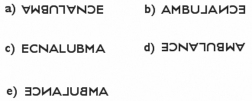
A)a
B)b
C)c
D)d
E)e
A)a
B)b
C)c
D)d
E)e
Question
Question
Question
Question
Question
Question
Question
Question
Question
A lighted candle is placed a short distance from a plane mirror,as shown in the figure.At which location will the image of the flame appear to be located? 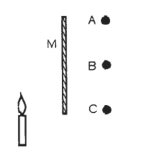
A)at A
B)at B
C)at C
D)at M (at the mirror)
A)at A
B)at B
C)at C
D)at M (at the mirror)
Question
Question
Question
Question
A convex mirror has a focal length of magnitude f.An object is placed in front of this mirror at a point 
F from the face of the mirror.The image will appear
A)behind the mirror.
B)upright and reduced.
C)upright and enlarged.
D)inverted and reduced.
E)inverted and enlarged.
F from the face of the mirror.The image will appear
A)behind the mirror.
B)upright and reduced.
C)upright and enlarged.
D)inverted and reduced.
E)inverted and enlarged.
Question
Question
Question
Question
Question
Question
Question
Question
Question
Question
Question
Question
Question
Question
Question
Question
Question
Question
Question
Question
Question
Question
Question
Question
Question
Question
Question
Question
Question
Question
Question
Question
Question
Question
Question
Question
Question
During the investigation of a new type of optical fiber having an index of refraction 
A laser beam is aimed at the flat end of a straight fiber,as shown in the figure.What is the maximum angle of incidence θ1 if the beam is not to escape from the sides of the fiber if it is surrounded by air?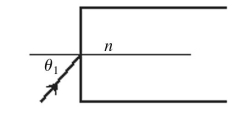
A)42.9°
B)39.8°
C)36.7°
D)33.6°
E)30.5°
A laser beam is aimed at the flat end of a straight fiber,as shown in the figure.What is the maximum angle of incidence θ1 if the beam is not to escape from the sides of the fiber if it is surrounded by air?
A)42.9°
B)39.8°
C)36.7°
D)33.6°
E)30.5°
Question
Question
Question
A light ray in glass arrives at the glass-water interface an an angle of θ = 48° with the normal.The refracted ray in water makes an angle φ = 72° angle with the normal,as shown in the figure.The index of refraction of water is 1.33.The angle of incidence is now changed to θ = 37°.What is the new angle of refraction φ in the water? 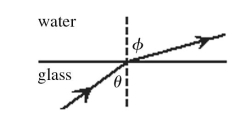
A)50°
B)48°
C)46°
D)52°
E)54°
A)50°
B)48°
C)46°
D)52°
E)54°
Question
Question
Question
Question
As shown in the figure,a laser positioned on a ship is used to communicate with a small research submarine resting on the bottom of a lake.The laser is positioned 12 m above the surface of the water,and it strikes the water 20 m from the side of the ship.The water is 58 m deep and has an index of refraction of 1.33.How far horizontally is the submarine from the side of the ship? (Assume all numbers are accurate to three significant figures. ) 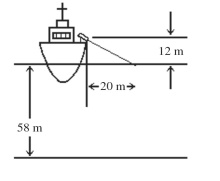
A)69 m
B)49 m
C)89 m
D)59 m
E)79 m
A)69 m
B)49 m
C)89 m
D)59 m
E)79 m
Question
Question
Question
Question
Question
Question
Question
Question
The speed of light in a material is 
What is the critical angle of a light ray at the interface between the material and a vacuum?
A)24°
B)17°
C)19°
D)22°
What is the critical angle of a light ray at the interface between the material and a vacuum?
A)24°
B)17°
C)19°
D)22°
Question
A light ray in glass arrives at the glass-water interface at an angle of θ = 48° with the normal.The refracted ray in water makes an angle θ = 61° with the normal,as shown in the figure.The index of refraction of water is 1.33.The angle of incidence is now changed to θ = 25°.What is the new angle of refraction φ in the water? 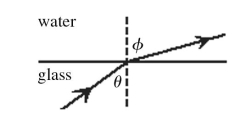
A)30°
B)56°
C)54°
D)60°
E)62°
A)30°
B)56°
C)54°
D)60°
E)62°
Question
Question
Question

Unlock Deck
Sign up to unlock the cards in this deck!
Unlock Deck
Unlock Deck
1/133

Play

Full screen (f)
Deck 26: Geometrical Optics
1
The focal length of a convex mirror is has a magnitude of 20 cm.What is its radius of curvature?
A)-10 cm
B)40 cm
C)-40 cm
D)-20 cm
E)20 cm
A)-10 cm
B)40 cm
C)-40 cm
D)-20 cm
E)20 cm
-40 cm
2
If the index of refraction of a material is 2,this means that light travels
A)2 times as fast in air as it does in vacuum.
B)2 times as fast in the material as it does in air.
C)2 times as fast in vacuum as it does in the material.
D)2 times as fast in the material than it does in vacuum.
E)1/2 as fast in air as it does in the material.
A)2 times as fast in air as it does in vacuum.
B)2 times as fast in the material as it does in air.
C)2 times as fast in vacuum as it does in the material.
D)2 times as fast in the material than it does in vacuum.
E)1/2 as fast in air as it does in the material.
2 times as fast in vacuum as it does in the material.
3
Which statements about images are correct? (There could be more than one correct choice. )
A)A virtual image cannot be formed on a screen.
B)A virtual image cannot be viewed by the unaided eye.
C)A virtual image cannot be photographed.
D)A real image must be erect.
E)Mirrors always produce real images because they reflect light.
A)A virtual image cannot be formed on a screen.
B)A virtual image cannot be viewed by the unaided eye.
C)A virtual image cannot be photographed.
D)A real image must be erect.
E)Mirrors always produce real images because they reflect light.
A virtual image cannot be formed on a screen.
4
Light enters glass from air.The angle of refraction will be
A)greater than the angle of incidence.
B)equal to the angle of incidence.
C)less than the angle of incidence.
A)greater than the angle of incidence.
B)equal to the angle of incidence.
C)less than the angle of incidence.
Unlock Deck
Unlock for access to all 133 flashcards in this deck.
Unlock Deck
k this deck
5
If a spherical concave mirror has a radius of curvature R,its focal length is
A)R/4.
B)R/2.
C)R.
D)2R.
E)4R.
A)R/4.
B)R/2.
C)R.
D)2R.
E)4R.
Unlock Deck
Unlock for access to all 133 flashcards in this deck.
Unlock Deck
k this deck
6
Which one of the following sets of characteristics describes the image formed by a plane mirror?
A)real and inverted
B)real and upright
C)virtual and upright
D)virtual and inverted
E)virtual and larger than the object
A)real and inverted
B)real and upright
C)virtual and upright
D)virtual and inverted
E)virtual and larger than the object
Unlock Deck
Unlock for access to all 133 flashcards in this deck.
Unlock Deck
k this deck
7
Suppose you place an object in front of a concave mirror.Which of the following statements must be true? (There could be more than one correct choice. )
A)The image of the object will always be smaller than the object.
B)No matter where you place the object,a real image of the object will be formed.
C)The image of the object will always be inverted.
D)If you position the object between the mirror and the focal point of the mirror,its image must be upright and virtual.
E)No matter where you place the object,the image of the object will always be virtual and upright.
A)The image of the object will always be smaller than the object.
B)No matter where you place the object,a real image of the object will be formed.
C)The image of the object will always be inverted.
D)If you position the object between the mirror and the focal point of the mirror,its image must be upright and virtual.
E)No matter where you place the object,the image of the object will always be virtual and upright.
Unlock Deck
Unlock for access to all 133 flashcards in this deck.
Unlock Deck
k this deck
8
The image formed in a plane mirror is
A)at the same distance in front of the mirror as the object is in front of the mirror.
B)a real image behind the mirror.
C)at the same distance behind the mirror as the object is in front of the mirror.
D)at a shorter distance behind the mirror than the distance the object is in front of the mirror.
E)at a larger distance behind the mirror than the distance the object is in front of the mirror.
A)at the same distance in front of the mirror as the object is in front of the mirror.
B)a real image behind the mirror.
C)at the same distance behind the mirror as the object is in front of the mirror.
D)at a shorter distance behind the mirror than the distance the object is in front of the mirror.
E)at a larger distance behind the mirror than the distance the object is in front of the mirror.
Unlock Deck
Unlock for access to all 133 flashcards in this deck.
Unlock Deck
k this deck
9
Light enters air from water.The angle of refraction will be
A)greater than the angle of incidence.
B)equal to the angle of incidence.
C)less than the angle of incidence.
A)greater than the angle of incidence.
B)equal to the angle of incidence.
C)less than the angle of incidence.
Unlock Deck
Unlock for access to all 133 flashcards in this deck.
Unlock Deck
k this deck
10
A beam of light traveling in air strikes a glass slab at an angle of incidence less than 90°.After entering the glass slab,what does the beam of light do? (There could be more than one correct choice. )
A)I follows the same path as before it struck the glass.
B)It follows the normal to the glass slab.
C)It bends away from the normal at the point of contact.
D)It bends closer to the normal at the point of contact.
E)It slows down.
A)I follows the same path as before it struck the glass.
B)It follows the normal to the glass slab.
C)It bends away from the normal at the point of contact.
D)It bends closer to the normal at the point of contact.
E)It slows down.
Unlock Deck
Unlock for access to all 133 flashcards in this deck.
Unlock Deck
k this deck
11
You may have seen ambulances on the street with the letters of the word AMBULANCE written on the front of them,in such a way as to appear correctly when viewed in your car's rear-view mirror.(See the figure. )How do the letters appear when you look directly at the ambulance (not through the mirror)?
A)a
B)b
C)c
D)d
E)e
A)a
B)b
C)c
D)d
E)e
Unlock Deck
Unlock for access to all 133 flashcards in this deck.
Unlock Deck
k this deck
12
Which one of the following numbers is the correct magnification produced by a plane mirror?
A)1/2
B)1/4
C)2
D)1
E)3/2
A)1/2
B)1/4
C)2
D)1
E)3/2
Unlock Deck
Unlock for access to all 133 flashcards in this deck.
Unlock Deck
k this deck
13
Light goes from material having a refractive index of n1 into a material with refractive index n2.If the refracted light is bent away from the normal,what can you conclude about the indices of refraction?
A)n1 > n2
B)n1 ≥ n2
C)n1 < n2
D)n1 ≤ n2
E)n1 = n2
A)n1 > n2
B)n1 ≥ n2
C)n1 < n2
D)n1 ≤ n2
E)n1 = n2
Unlock Deck
Unlock for access to all 133 flashcards in this deck.
Unlock Deck
k this deck
14
As you walk away from a plane mirror on a wall,the height of your image
A)gets smaller.
B)may or may not get smaller,depending on where the observer is positioned.
C)is always a real image,no matter how far you are from the mirror.
D)changes from being a virtual image to a real image as you pass the focal point.
E)is always the same size.
A)gets smaller.
B)may or may not get smaller,depending on where the observer is positioned.
C)is always a real image,no matter how far you are from the mirror.
D)changes from being a virtual image to a real image as you pass the focal point.
E)is always the same size.
Unlock Deck
Unlock for access to all 133 flashcards in this deck.
Unlock Deck
k this deck
15
The index of refraction of a type of glass is 1.50,and the index of refraction of water is 1.33.If light enters water from this glass,the angle of refraction will be
A)greater than the angle of incidence.
B)equal to the angle of incidence.
C)less than the angle of incidence.
A)greater than the angle of incidence.
B)equal to the angle of incidence.
C)less than the angle of incidence.
Unlock Deck
Unlock for access to all 133 flashcards in this deck.
Unlock Deck
k this deck
16
A light beam has speed c in vacuum and speed v in a certain plastic.The index of refraction n of this plastic is
A)n = cv.
B)n = (v/c)2.
C)n = v/c.
D)n = c/v.
E)n = (c/v)2.
A)n = cv.
B)n = (v/c)2.
C)n = v/c.
D)n = c/v.
E)n = (c/v)2.
Unlock Deck
Unlock for access to all 133 flashcards in this deck.
Unlock Deck
k this deck
17
The focal length of a concave mirror has a magnitude of 20 cm.What is its radius of curvature?
A)10 cm
B)40 cm
C)-40 cm
D)20 cm
E)-20 cm
A)10 cm
B)40 cm
C)-40 cm
D)20 cm
E)-20 cm
Unlock Deck
Unlock for access to all 133 flashcards in this deck.
Unlock Deck
k this deck
18
A negative magnification for a mirror means that
A)the image is inverted,and the mirror could be either concave or convex.
B)the image is upright,and the mirror is convex.
C)the image is inverted,and the mirror is convex.
D)the image is inverted,and the mirror is concave.
E)the image is upright,and the mirror could be either concave or convex.
A)the image is inverted,and the mirror could be either concave or convex.
B)the image is upright,and the mirror is convex.
C)the image is inverted,and the mirror is convex.
D)the image is inverted,and the mirror is concave.
E)the image is upright,and the mirror could be either concave or convex.
Unlock Deck
Unlock for access to all 133 flashcards in this deck.
Unlock Deck
k this deck
19
The critical angle for a beam of light passing from water into air is 48.8°.This means that all light rays with an angle of incidence in the water that is greater than 48.8° will be
A)totally absorbed by the water.
B)totally reflected.
C)partially reflected and partially transmitted.
D)totally transmitted.
A)totally absorbed by the water.
B)totally reflected.
C)partially reflected and partially transmitted.
D)totally transmitted.
Unlock Deck
Unlock for access to all 133 flashcards in this deck.
Unlock Deck
k this deck
20
A lighted candle is placed a short distance from a plane mirror,as shown in the figure.At which location will the image of the flame appear to be located?
A)at A
B)at B
C)at C
D)at M (at the mirror)
A)at A
B)at B
C)at C
D)at M (at the mirror)
Unlock Deck
Unlock for access to all 133 flashcards in this deck.
Unlock Deck
k this deck
21
Suppose you wanted to start a fire using a mirror to focus sunlight.Which of the following statements is most accurate?
A)It would be best to use a plane mirror.
B)It would be best to use a convex mirror.
C)It would be best to use a concave mirror,with the object to be ignited positioned at the center of curvature of the mirror.
D)It would be best to use a concave mirror,with the object to be ignited positioned halfway between the mirror and its center of curvature.
E)One cannot start a fire using a mirror,since mirrors form only virtual images.
A)It would be best to use a plane mirror.
B)It would be best to use a convex mirror.
C)It would be best to use a concave mirror,with the object to be ignited positioned at the center of curvature of the mirror.
D)It would be best to use a concave mirror,with the object to be ignited positioned halfway between the mirror and its center of curvature.
E)One cannot start a fire using a mirror,since mirrors form only virtual images.
Unlock Deck
Unlock for access to all 133 flashcards in this deck.
Unlock Deck
k this deck
22
Single concave spherical mirrors produce images that
A)are always smaller than the actual object.
B)are always larger than the actual object.
C)are always the same size as the actual object.
D)could be smaller than,larger than,or the same size as the actual object,depending on the placement of the object.
E)are always real.
A)are always smaller than the actual object.
B)are always larger than the actual object.
C)are always the same size as the actual object.
D)could be smaller than,larger than,or the same size as the actual object,depending on the placement of the object.
E)are always real.
Unlock Deck
Unlock for access to all 133 flashcards in this deck.
Unlock Deck
k this deck
23
Which of the following terms describe lenses that are thinner at the center than at the edges? (There could be more than one correct choice. )
A)converging lenses
B)diverging lenses
C)concave lenses
D)convex lenses
A)converging lenses
B)diverging lenses
C)concave lenses
D)convex lenses
Unlock Deck
Unlock for access to all 133 flashcards in this deck.
Unlock Deck
k this deck
24
A convex mirror has a focal length of magnitude f.An object is placed in front of this mirror at a point
F from the face of the mirror.The image will appear
A)behind the mirror.
B)upright and reduced.
C)upright and enlarged.
D)inverted and reduced.
E)inverted and enlarged.
F from the face of the mirror.The image will appear
A)behind the mirror.
B)upright and reduced.
C)upright and enlarged.
D)inverted and reduced.
E)inverted and enlarged.
Unlock Deck
Unlock for access to all 133 flashcards in this deck.
Unlock Deck
k this deck
25
An object is placed to the left of a spherical mirror in front of the mirror.If the image of the object is formed on the right side of the mirror,which of the following statements must be true? (There could be more than one correct choice. )
A)The image is upright and the mirror must be convex.
B)The image is inverted and real,and the mirror must be convex.
C)The image is upright and the mirror must be concave.
D)The image is upright and virtual.
E)The mirror could be either concave or convex.
A)The image is upright and the mirror must be convex.
B)The image is inverted and real,and the mirror must be convex.
C)The image is upright and the mirror must be concave.
D)The image is upright and virtual.
E)The mirror could be either concave or convex.
Unlock Deck
Unlock for access to all 133 flashcards in this deck.
Unlock Deck
k this deck
26
An object is placed in front of a convex mirror at a distance larger than twice the magnitude of the focal length of the mirror.The image will appear
A)in front of the mirror.
B)inverted and reduced.
C)inverted and enlarged.
D)upright and reduced.
E)upright and enlarged.
A)in front of the mirror.
B)inverted and reduced.
C)inverted and enlarged.
D)upright and reduced.
E)upright and enlarged.
Unlock Deck
Unlock for access to all 133 flashcards in this deck.
Unlock Deck
k this deck
27
A beam of light that is parallel to the principal axis strikes a convex mirror.What happens to the reflected beam of light?
A)It also is parallel to the principal axis.
B)It is perpendicular to the principal axis.
C)It appears to be coming from the focal point on the other side of the mirror.
D)It appears to be coming from the center of curvature of the mirror.
E)It appears to be coming from a point between the focal point and the center of curvature of the mirror.
A)It also is parallel to the principal axis.
B)It is perpendicular to the principal axis.
C)It appears to be coming from the focal point on the other side of the mirror.
D)It appears to be coming from the center of curvature of the mirror.
E)It appears to be coming from a point between the focal point and the center of curvature of the mirror.
Unlock Deck
Unlock for access to all 133 flashcards in this deck.
Unlock Deck
k this deck
28
A beam of light that is parallel to the principal axis strikes a concave mirror.What happens to the reflected beam of light?
A)It also is parallel to the principal axis.
B)It is perpendicular to the principal axis.
C)It passes through the center of curvature of the mirror.
D)It passes through the focal point of the mirror.
E)It passes between the focal point and the center of curvature of the mirror.
A)It also is parallel to the principal axis.
B)It is perpendicular to the principal axis.
C)It passes through the center of curvature of the mirror.
D)It passes through the focal point of the mirror.
E)It passes between the focal point and the center of curvature of the mirror.
Unlock Deck
Unlock for access to all 133 flashcards in this deck.
Unlock Deck
k this deck
29
A convex lens has focal length f.If an object is placed at a distance between f and 2f from the lens on the principal axis,the image is located at a distance from the lens
A)of 2f.
B)between f and 2f.
C)of f.
D)that is greater than 2f.
E)of infinity.
A)of 2f.
B)between f and 2f.
C)of f.
D)that is greater than 2f.
E)of infinity.
Unlock Deck
Unlock for access to all 133 flashcards in this deck.
Unlock Deck
k this deck
30
If you stand in front of a convex mirror,at the same distance from it as its radius of curvature,
A)you won't see your image because there is none.
B)you won't see your image because it is focused at infinity.
C)you will see your image and you will appear smaller than you.
D)you will see your image and you will appear larger than you.
E)you will see your image and it will be the same size as you except upside down.
A)you won't see your image because there is none.
B)you won't see your image because it is focused at infinity.
C)you will see your image and you will appear smaller than you.
D)you will see your image and you will appear larger than you.
E)you will see your image and it will be the same size as you except upside down.
Unlock Deck
Unlock for access to all 133 flashcards in this deck.
Unlock Deck
k this deck
31
Which of the following statements about spherical mirrors is correct? (There could be more than one correct choice. )
A)A concave mirror always produces a real image.
B)A convex mirror always produces a virtual image.
C)A concave mirror always produces a virtual image.
D)A convex mirror always produces a real image.
E)A convex mirror always produces an upright image.
A)A concave mirror always produces a real image.
B)A convex mirror always produces a virtual image.
C)A concave mirror always produces a virtual image.
D)A convex mirror always produces a real image.
E)A convex mirror always produces an upright image.
Unlock Deck
Unlock for access to all 133 flashcards in this deck.
Unlock Deck
k this deck
32
If an object is placed at the center of curvature of concave mirror,the image formed by the mirror is located
A)out beyond the center of curvature.
B)at the center of curvature.
C)between the center of curvature and the focal point.
D)at the focal point.
E)at infinity.
A)out beyond the center of curvature.
B)at the center of curvature.
C)between the center of curvature and the focal point.
D)at the focal point.
E)at infinity.
Unlock Deck
Unlock for access to all 133 flashcards in this deck.
Unlock Deck
k this deck
33
Sometimes when you look into a curved mirror you see a magnified image (a great big you)and sometimes you see a diminished image (a little you).If you look at the bottom (convex)side of a shiny spoon,what will you see?
A)You won't see an image of yourself because no image will be formed.
B)You will see a little you,upside down.
C)You will see a little you,right side up.
D)You will see a little you,but whether you are right side up or upside down depends on how near you are to the spoon.
E)You will either see a little you or a great big you,depending on how near you are to the spoon.
A)You won't see an image of yourself because no image will be formed.
B)You will see a little you,upside down.
C)You will see a little you,right side up.
D)You will see a little you,but whether you are right side up or upside down depends on how near you are to the spoon.
E)You will either see a little you or a great big you,depending on how near you are to the spoon.
Unlock Deck
Unlock for access to all 133 flashcards in this deck.
Unlock Deck
k this deck
34
A convex lens has focal length f.If an object is placed at a distance of 2f from the lens on the principal axis,the image is located at a distance from the lens
A)of 2f.
B)between f and 2f.
C)of f.
D)between the lens and f.
E)of infinity.
A)of 2f.
B)between f and 2f.
C)of f.
D)between the lens and f.
E)of infinity.
Unlock Deck
Unlock for access to all 133 flashcards in this deck.
Unlock Deck
k this deck
35
An upright object is 50 cm from a concave mirror of radius 60 cm.The character of the image is
A)real and upright.
B)real and inverted.
C)virtual and upright.
D)virtual and inverted.
A)real and upright.
B)real and inverted.
C)virtual and upright.
D)virtual and inverted.
Unlock Deck
Unlock for access to all 133 flashcards in this deck.
Unlock Deck
k this deck
36
Which of the following terms describe lenses that are thicker at the center than at the edges? (There could be more than one correct choice. )
A)converging lenses
B)diverging lenses
C)concave lenses
D)convex lenses
A)converging lenses
B)diverging lenses
C)concave lenses
D)convex lenses
Unlock Deck
Unlock for access to all 133 flashcards in this deck.
Unlock Deck
k this deck
37
Single convex spherical mirrors produce images that
A)are always smaller than the actual object.
B)are always larger than the actual object.
C)are always the same size as the actual object.
D)could be larger than,smaller than,or the same size as the actual object,depending on the placement of the object.
E)are sometimes real.
A)are always smaller than the actual object.
B)are always larger than the actual object.
C)are always the same size as the actual object.
D)could be larger than,smaller than,or the same size as the actual object,depending on the placement of the object.
E)are sometimes real.
Unlock Deck
Unlock for access to all 133 flashcards in this deck.
Unlock Deck
k this deck
38
A convex lens has focal length f.If an object is located at "infinity" (very far away),the image formed is located at a distance from the lens
A)of 2f.
B)between f and 2f.
C)of f.
D)between the lens and f.
E)of infinity.
A)of 2f.
B)between f and 2f.
C)of f.
D)between the lens and f.
E)of infinity.
Unlock Deck
Unlock for access to all 133 flashcards in this deck.
Unlock Deck
k this deck
39
If you stand in front of a convex mirror,at the same distance from it as its focal length,
A)you won't see your image because there is none.
B)you won't see your image because it is focused at infinity.
C)you will see your image and you will appear smaller than you.
D)you will see your image and you will appear larger than you.
E)you will see your image and it will be the same size as you except upside down.
A)you won't see your image because there is none.
B)you won't see your image because it is focused at infinity.
C)you will see your image and you will appear smaller than you.
D)you will see your image and you will appear larger than you.
E)you will see your image and it will be the same size as you except upside down.
Unlock Deck
Unlock for access to all 133 flashcards in this deck.
Unlock Deck
k this deck
40
If a spherical convex mirror has a radius of curvature R,the magnitude of its focal length is
A)R/2.
B)R/4.
C)R.
D)2R.
E)4R.
A)R/2.
B)R/4.
C)R.
D)2R.
E)4R.
Unlock Deck
Unlock for access to all 133 flashcards in this deck.
Unlock Deck
k this deck
41
Light having a speed in vacuum of 3.0 × 10⁸ m/s enters a liquid of refractive index 2.0.In this liquid,its speed will be
A)6.0 × 10⁸ m/s.
B)3.0 × 10⁸ m/s.
C)1.5 × 10⁸ m/s.
D)0.75 × 10⁸ m/s.
E)0.67 × 10⁸ m/s.
A)6.0 × 10⁸ m/s.
B)3.0 × 10⁸ m/s.
C)1.5 × 10⁸ m/s.
D)0.75 × 10⁸ m/s.
E)0.67 × 10⁸ m/s.
Unlock Deck
Unlock for access to all 133 flashcards in this deck.
Unlock Deck
k this deck
42
A beam of light,traveling in air,strikes a plate of transparent material at an angle of incidence of 56.0°.It is observed that the reflected and refracted beams form an angle of 90.0°.What is the index of refraction of this material?
A)1.40
B)1.43
C)1.44
D)1.48
A)1.40
B)1.43
C)1.44
D)1.48
Unlock Deck
Unlock for access to all 133 flashcards in this deck.
Unlock Deck
k this deck
43
Starting from very far away,an object is moved closer and closer to a converging lens,eventually reaching the lens.What happens to its image formed by that lens? (There could be more than one correct choice. )
A)The image gets closer and closer to the lens.
B)The image gets farther and farther from the lens.
C)The image eventually changes from virtual to real.
D)The image eventually changes from real to virtual.
E)The image keeps getting larger and larger.
A)The image gets closer and closer to the lens.
B)The image gets farther and farther from the lens.
C)The image eventually changes from virtual to real.
D)The image eventually changes from real to virtual.
E)The image keeps getting larger and larger.
Unlock Deck
Unlock for access to all 133 flashcards in this deck.
Unlock Deck
k this deck
44
Which of following statements about the image formed by a single converging lens are true? (There could be more than one correct choice. )
A)The image is always real.
B)The image is always virtual.
C)The image is always inverted.
D)The image is always upright.
E)None of the above choices are correct.
A)The image is always real.
B)The image is always virtual.
C)The image is always inverted.
D)The image is always upright.
E)None of the above choices are correct.
Unlock Deck
Unlock for access to all 133 flashcards in this deck.
Unlock Deck
k this deck
45
The index of refraction of a certain glass is measured to be 1.5.What is the speed of light in that glass? (c = 3.0 × 10⁸ m/s)
A)1.0 × 10⁸ m/s
B)2.0 × 10⁸ m/s
C)3.0 × 10⁸ m/s
D)4.0 × 10⁸ m/s
E)5.0 × 10⁸ m/s
A)1.0 × 10⁸ m/s
B)2.0 × 10⁸ m/s
C)3.0 × 10⁸ m/s
D)4.0 × 10⁸ m/s
E)5.0 × 10⁸ m/s
Unlock Deck
Unlock for access to all 133 flashcards in this deck.
Unlock Deck
k this deck
46
If a object is placed between a convex lens and its focal point,the image formed is
A)virtual and upright.
B)virtual and inverted.
C)real and upright.
D)real and inverted.
A)virtual and upright.
B)virtual and inverted.
C)real and upright.
D)real and inverted.
Unlock Deck
Unlock for access to all 133 flashcards in this deck.
Unlock Deck
k this deck
47
A thin beam of light enters a thick plastic sheet from air at an angle of 32.0° with the normal and continues in the sheet at an angle of 23.0° with the normal.What is the index of refraction of the plastic?
A)0.74
B)1.11
C)1.28
D)1.36
A)0.74
B)1.11
C)1.28
D)1.36
Unlock Deck
Unlock for access to all 133 flashcards in this deck.
Unlock Deck
k this deck
48
Which statement about a single thin lens is correct?
A)A converging lens always produces a real inverted image.
B)A diverging lens always produces a virtual inverted image.
C)A converging lens sometimes produces a real upright image.
D)A diverging lens always produces a virtual upright image.
E)A diverging lens produces a virtual upright image only if the object is located between the lens and its focal point.
A)A converging lens always produces a real inverted image.
B)A diverging lens always produces a virtual inverted image.
C)A converging lens sometimes produces a real upright image.
D)A diverging lens always produces a virtual upright image.
E)A diverging lens produces a virtual upright image only if the object is located between the lens and its focal point.
Unlock Deck
Unlock for access to all 133 flashcards in this deck.
Unlock Deck
k this deck
49
A beam of light traveling in air strikes a slab of transparent material.The incident beam makes an angle of 40° with the normal,and the refracted beam make an angle of 26° with the normal.What is the speed of light in the transparent material? (c = 3.0 × 10⁸ m/s)
A)1.0 × 10⁸ m/s
B)2.0 × 10⁸ m/s
C)2.3 × 10⁸ m/s
D)3.0 × 10⁸ m/s
E)0.50 × 10⁸ m/s
A)1.0 × 10⁸ m/s
B)2.0 × 10⁸ m/s
C)2.3 × 10⁸ m/s
D)3.0 × 10⁸ m/s
E)0.50 × 10⁸ m/s
Unlock Deck
Unlock for access to all 133 flashcards in this deck.
Unlock Deck
k this deck
50
If the magnification of a mirror or lens is negative,it means that
A)the image is smaller than the object.
B)the image is inverted and smaller than the object.
C)the image is inverted.
D)the object is farther from the mirror (or lens)than the image.
E)the image is farther from the mirror (or lens)than the object.
A)the image is smaller than the object.
B)the image is inverted and smaller than the object.
C)the image is inverted.
D)the object is farther from the mirror (or lens)than the image.
E)the image is farther from the mirror (or lens)than the object.
Unlock Deck
Unlock for access to all 133 flashcards in this deck.
Unlock Deck
k this deck
51
An oil layer that is 5.0 cm thick is spread smoothly and evenly over the surface of water on a windless day.A light ray from the air above enters the oil at 45° with the normal and then goes into the water.What is the angle of refraction of this ray in the water? The index of refraction for the oil is 1.15,and for water it is 1.33.
A)27°
B)32°
C)36°
D)39°
A)27°
B)32°
C)36°
D)39°
Unlock Deck
Unlock for access to all 133 flashcards in this deck.
Unlock Deck
k this deck
52
If a single lens forms a virtual image of an object,then
A)the lens must be a diverging lens.
B)the lens must be a converging lens.
C)the lens could be either a diverging or a converging lens.
D)the image must be inverted.
E)the object must be between the lens and its focal point.
A)the lens must be a diverging lens.
B)the lens must be a converging lens.
C)the lens could be either a diverging or a converging lens.
D)the image must be inverted.
E)the object must be between the lens and its focal point.
Unlock Deck
Unlock for access to all 133 flashcards in this deck.
Unlock Deck
k this deck
53
Starting from very far away,an object is moved closer and closer to a diverging lens,eventually reaching the lens.What happens to its image formed by that lens? (There could be more than one correct choice. )
A)The image gets closer and closer to the lens.
B)The image gets farther and farther from the lens.
C)The image always remains virtual.
D)The image eventually changes from real to virtual.
E)The image keeps getting larger and larger.
A)The image gets closer and closer to the lens.
B)The image gets farther and farther from the lens.
C)The image always remains virtual.
D)The image eventually changes from real to virtual.
E)The image keeps getting larger and larger.
Unlock Deck
Unlock for access to all 133 flashcards in this deck.
Unlock Deck
k this deck
54
A convex lens has focal length f.If an object is placed at a distance beyond 2f from the lens on the principal axis,the image is located at a distance from the lens
A)of 2f.
B)between f and 2f.
C)of f.
D)between the lens and f.
E)of infinity.
A)of 2f.
B)between f and 2f.
C)of f.
D)between the lens and f.
E)of infinity.
Unlock Deck
Unlock for access to all 133 flashcards in this deck.
Unlock Deck
k this deck
55
An object is placed on the left side of a thin lens,and the image of this object is formed on the left side of the lens.Which of the following statements must be true? (There could be more than one correct choice. )
A)The lens must be a diverging lens,and the image is upright.
B)The lens must be a converging lens,and the image is upright.
C)The image is upright and virtual.
D)The lens could be either a converging or a diverging lens,and the image is upright.
E)The image is inverted and real.
A)The lens must be a diverging lens,and the image is upright.
B)The lens must be a converging lens,and the image is upright.
C)The image is upright and virtual.
D)The lens could be either a converging or a diverging lens,and the image is upright.
E)The image is inverted and real.
Unlock Deck
Unlock for access to all 133 flashcards in this deck.
Unlock Deck
k this deck
56
An object is placed in front of a thin lens.Which statements are correct in describing the image formed by the lens? (There could be more than one correct choice. )
A)If the lens is convex,the image will never be virtual.
B)If the image is real,then it is also inverted.
C)If the image is real,then it is also upright.
D)If the lens is concave,the image must be virtual.
E)If the lens is convex,the image must be real.
A)If the lens is convex,the image will never be virtual.
B)If the image is real,then it is also inverted.
C)If the image is real,then it is also upright.
D)If the lens is concave,the image must be virtual.
E)If the lens is convex,the image must be real.
Unlock Deck
Unlock for access to all 133 flashcards in this deck.
Unlock Deck
k this deck
57
The image formed by a single concave lens
A)is always real.
B)is always virtual.
C)could be real or virtual,depending on whether the object distance is smaller or greater than the focal length.
D)could be real or virtual,but is always real when the object is placed at the focal point.
E)is always inverted.
A)is always real.
B)is always virtual.
C)could be real or virtual,depending on whether the object distance is smaller or greater than the focal length.
D)could be real or virtual,but is always real when the object is placed at the focal point.
E)is always inverted.
Unlock Deck
Unlock for access to all 133 flashcards in this deck.
Unlock Deck
k this deck
58
Which of following statements about the image formed by a single diverging lens are true? (There could be more than one correct choice. )
A)The image is always real.
B)The image is always virtual.
C)The image is always inverted.
D)The image is always upright.
E)The image is always smaller than the object.
A)The image is always real.
B)The image is always virtual.
C)The image is always inverted.
D)The image is always upright.
E)The image is always smaller than the object.
Unlock Deck
Unlock for access to all 133 flashcards in this deck.
Unlock Deck
k this deck
59
Is it possible to see a virtual image?
A)No,since the rays that seem to emanate from a virtual image do not in fact emanate from the image.
B)No,since virtual images do not really exist.
C)Yes because the rays that appear to come from a virtual image can be focused by the eye just like those from an object.
D)Yes,but only by using an additional lens to form a real image before the light reaches the eye.
A)No,since the rays that seem to emanate from a virtual image do not in fact emanate from the image.
B)No,since virtual images do not really exist.
C)Yes because the rays that appear to come from a virtual image can be focused by the eye just like those from an object.
D)Yes,but only by using an additional lens to form a real image before the light reaches the eye.
Unlock Deck
Unlock for access to all 133 flashcards in this deck.
Unlock Deck
k this deck
60
The speed of light in a certain material is measured to be 2.2 × 10⁸ m/s.What is the index of refraction of this material? (c = 3.0 × 10⁸ m/s)
A)1.1
B)1.2
C)1.4
D)1.6
E)1.8
A)1.1
B)1.2
C)1.4
D)1.6
E)1.8
Unlock Deck
Unlock for access to all 133 flashcards in this deck.
Unlock Deck
k this deck
61
During the investigation of a new type of optical fiber having an index of refraction
A laser beam is aimed at the flat end of a straight fiber,as shown in the figure.What is the maximum angle of incidence θ1 if the beam is not to escape from the sides of the fiber if it is surrounded by air?
A)42.9°
B)39.8°
C)36.7°
D)33.6°
E)30.5°
A laser beam is aimed at the flat end of a straight fiber,as shown in the figure.What is the maximum angle of incidence θ1 if the beam is not to escape from the sides of the fiber if it is surrounded by air?
A)42.9°
B)39.8°
C)36.7°
D)33.6°
E)30.5°
Unlock Deck
Unlock for access to all 133 flashcards in this deck.
Unlock Deck
k this deck
62
An optic fiber is made of clear plastic with an index of refraction of 1.50.For what range of angles of incidence θ with the lateral surface of the fiber will light remain inside the plastic "guide" if it is surrounded by air?
A)21.1° < θ < 90°
B)23.4° < θ < 90°
C)38.3° < θ < 90°
D)40.3° < θ < 90°
E)41.8° < θ < 90°
A)21.1° < θ < 90°
B)23.4° < θ < 90°
C)38.3° < θ < 90°
D)40.3° < θ < 90°
E)41.8° < θ < 90°
Unlock Deck
Unlock for access to all 133 flashcards in this deck.
Unlock Deck
k this deck
63
Light travels from crown glass,with a refractive index of 1.52,into water,having a refractive index of 1.33? The critical angle for this interface is closest to which one of the following angles?
A)42°
B)48°
C)53°
D)57°
E)61°
A)42°
B)48°
C)53°
D)57°
E)61°
Unlock Deck
Unlock for access to all 133 flashcards in this deck.
Unlock Deck
k this deck
64
A light ray in glass arrives at the glass-water interface an an angle of θ = 48° with the normal.The refracted ray in water makes an angle φ = 72° angle with the normal,as shown in the figure.The index of refraction of water is 1.33.The angle of incidence is now changed to θ = 37°.What is the new angle of refraction φ in the water?
A)50°
B)48°
C)46°
D)52°
E)54°
A)50°
B)48°
C)46°
D)52°
E)54°
Unlock Deck
Unlock for access to all 133 flashcards in this deck.
Unlock Deck
k this deck
65
Light enters a substance from air at 30.0° to the normal.It continues within the substance at 23.0° to the normal.What is the critical angle for this substance when it is surrounded by air?
A)53°
B)51.4°
C)36.7°
D)12.6°
A)53°
B)51.4°
C)36.7°
D)12.6°
Unlock Deck
Unlock for access to all 133 flashcards in this deck.
Unlock Deck
k this deck
66
A glass plate with an index of refraction is 1.57 is immersed in an oil having a refractive index of 1.40.The surface of the glass is inclined at an angle of 54° with the vertical.A horizontal light ray in the glass strikes the interface.What is the angle that the refracted ray,in the oil,makes with the horizontal?
A)11°
B)5.6°
C)8.3°
D)14°
E)17°
A)11°
B)5.6°
C)8.3°
D)14°
E)17°
Unlock Deck
Unlock for access to all 133 flashcards in this deck.
Unlock Deck
k this deck
67
A flashlight beam makes an angle of 60° with the plane of the surface of a calm lake before it enters the water.In the water what angle does the beam make with the plane of the surface? The index of refraction of water is 1.33.
A)0°
B)30°
C)60°
D)22°
E)68°
A)0°
B)30°
C)60°
D)22°
E)68°
Unlock Deck
Unlock for access to all 133 flashcards in this deck.
Unlock Deck
k this deck
68
As shown in the figure,a laser positioned on a ship is used to communicate with a small research submarine resting on the bottom of a lake.The laser is positioned 12 m above the surface of the water,and it strikes the water 20 m from the side of the ship.The water is 58 m deep and has an index of refraction of 1.33.How far horizontally is the submarine from the side of the ship? (Assume all numbers are accurate to three significant figures. )
A)69 m
B)49 m
C)89 m
D)59 m
E)79 m
A)69 m
B)49 m
C)89 m
D)59 m
E)79 m
Unlock Deck
Unlock for access to all 133 flashcards in this deck.
Unlock Deck
k this deck
69
A scuba diver is 1.2 m beneath the surface of a still pond of water.At what angle relative to the normal at the surface must the diver shine a beam of light toward the surface in order for a person on a distant bank to be able to see it? The index of refraction for water is 1.33.
A)41°
B)48°
C)59°
D)90°
E)0°
A)41°
B)48°
C)59°
D)90°
E)0°
Unlock Deck
Unlock for access to all 133 flashcards in this deck.
Unlock Deck
k this deck
70
A glass plate having an index of refraction is 1.66 is immersed in a certain alcohol.The surface of the glass is inclined at an angle of 44° with the vertical.When a horizontal ray in the glass strikes the interface,you observe that it is at the critical angle.What is the index of refraction of the alcohol?
A)1.15
B)1.13
C)1.11
D)1.09
E)1.17
A)1.15
B)1.13
C)1.11
D)1.09
E)1.17
Unlock Deck
Unlock for access to all 133 flashcards in this deck.
Unlock Deck
k this deck
71
A beam of light in water (of refractive index of 1.33)enters a glass slab (of refractive index 1.50)at an angle of incidence of 60.0°.What is the angle of refraction in the glass?
A)27.5°
B)39.8°
C)60.0°
D)90.0°
E)50.2°
A)27.5°
B)39.8°
C)60.0°
D)90.0°
E)50.2°
Unlock Deck
Unlock for access to all 133 flashcards in this deck.
Unlock Deck
k this deck
72
A light beam is traveling inside a glass block that has an index of refraction of 1.46.As this light arrives at the surface of the block,it makes an angle of 53.0° with the normal.At what angle with the normal in the air will it leave the block?
A)It will not leave.
B)59.1°
C)43.2°
D)33.2°
A)It will not leave.
B)59.1°
C)43.2°
D)33.2°
Unlock Deck
Unlock for access to all 133 flashcards in this deck.
Unlock Deck
k this deck
73
A light ray in air strikes a glass plate whose index of refraction is 1.42.Some of the light reflects off the surface of the plate,but most of it enters the glass.If the angle of refraction is one-half the angle of reflection,the angle of refraction is closest to which one of the following angles?
A)45°
B)43°
C)41°
D)39°
E)37°
A)45°
B)43°
C)41°
D)39°
E)37°
Unlock Deck
Unlock for access to all 133 flashcards in this deck.
Unlock Deck
k this deck
74
A ray of light in glass strikes a water-glass interface at an angle of incidence equal to one-half the critical angle for that interface.The index of refraction for water is 1.33,and for the glass it is 1.43.What angle does the refracted ray in the water make with the normal?
A)37°
B)42°
C)47°
D)32°
E)27°
A)37°
B)42°
C)47°
D)32°
E)27°
Unlock Deck
Unlock for access to all 133 flashcards in this deck.
Unlock Deck
k this deck
75
Lucite has an index of refraction of 1.50.What is its critical angle if it is in air?
A)1.16°
B)15°
C)41.8°
D)65.2°
E)87.4°
A)1.16°
B)15°
C)41.8°
D)65.2°
E)87.4°
Unlock Deck
Unlock for access to all 133 flashcards in this deck.
Unlock Deck
k this deck
76
The speed of light in a material is
What is the critical angle of a light ray at the interface between the material and a vacuum?
A)24°
B)17°
C)19°
D)22°
What is the critical angle of a light ray at the interface between the material and a vacuum?
A)24°
B)17°
C)19°
D)22°
Unlock Deck
Unlock for access to all 133 flashcards in this deck.
Unlock Deck
k this deck
77
A light ray in glass arrives at the glass-water interface at an angle of θ = 48° with the normal.The refracted ray in water makes an angle θ = 61° with the normal,as shown in the figure.The index of refraction of water is 1.33.The angle of incidence is now changed to θ = 25°.What is the new angle of refraction φ in the water?
A)30°
B)56°
C)54°
D)60°
E)62°
A)30°
B)56°
C)54°
D)60°
E)62°
Unlock Deck
Unlock for access to all 133 flashcards in this deck.
Unlock Deck
k this deck
78
A thin flashlight beam traveling in air strikes a glass plate at an angle of 52° with the plane of the surface of the plate.If the index of refraction of the glass is 1.4,what angle will the beam make with the normal in the glass?
A)34°
B)64°
C)26°
D)56°
E)38°
A)34°
B)64°
C)26°
D)56°
E)38°
Unlock Deck
Unlock for access to all 133 flashcards in this deck.
Unlock Deck
k this deck
79
A beam of light in air enters a glass slab with an index of refraction of 1.40 at an angle of incidence of 30.0°.What is the angle of refraction?
A)20.9°
B)47.5°
C)51.8°
D)30.0°
E)14.9°
A)20.9°
B)47.5°
C)51.8°
D)30.0°
E)14.9°
Unlock Deck
Unlock for access to all 133 flashcards in this deck.
Unlock Deck
k this deck
80
The critical angle for a substance in air is measured at 53.7°.If light enters this substance from air at 45.0° with the normal,at what angle with the normal will it continue to travel?
A)34.7°
B)45.0°
C)53.7°
D)It will not continue,but will be totally reflected.
A)34.7°
B)45.0°
C)53.7°
D)It will not continue,but will be totally reflected.
Unlock Deck
Unlock for access to all 133 flashcards in this deck.
Unlock Deck
k this deck
Unlock Deck
Unlock for access to all 133 flashcards in this deck.






