







 Chat with AI

Deck 7: Optimal Risky Portfolios
Full screen (f)

Question

Question
Question
Question
Question
Question
Question
Question
Question
Question
Question
Question
Question
Question
Question
Question
Question
Question
Question
Question
Question
Which one of the following portfolios cannot lie on the efficient frontier as described by Markowitz 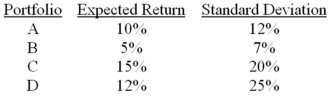
A)Only portfolio A cannot lie on the efficient frontier.
B)Only portfolio B cannot lie on the efficient frontier.
C)Only portfolio C cannot lie on the efficient frontier.
D)Only portfolio D cannot lie on the efficient frontier.
E)Cannot tell from the information given.
A)Only portfolio A cannot lie on the efficient frontier.
B)Only portfolio B cannot lie on the efficient frontier.
C)Only portfolio C cannot lie on the efficient frontier.
D)Only portfolio D cannot lie on the efficient frontier.
E)Cannot tell from the information given.
Question
Consider the following probability distribution for stocks A and B: 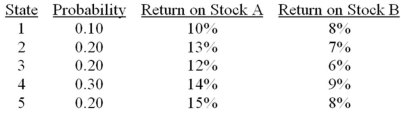 The standard deviations of stocks A and B are _____ and _____, respectively.
A)1.5%; 1.9%
B)2.5%; 1.1%
C)3.2%; 2.0%
D)1.5%; 1.1%
The standard deviations of stocks A and B are _____ and _____, respectively.A)1.5%; 1.9%
B)2.5%; 1.1%
C)3.2%; 2.0%
D)1.5%; 1.1%
Question
Question
Question
Consider the following probability distribution for stocks A and B: 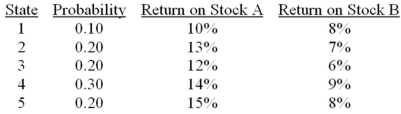 The coefficient of correlation between A and B is
A)0.46.
B)0.60.
C)0.58.
D)1.20.
The coefficient of correlation between A and B isA)0.46.
B)0.60.
C)0.58.
D)1.20.
Question
Consider the following probability distribution for stocks A and B: 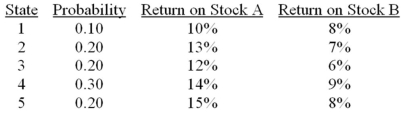 The expected rates of return of stocks A and B are _____ and _____, respectively.
A)13.2%; 9%
B)14%; 10%
C)13.2%; 7.7%
D)7.7%; 13.2%
The expected rates of return of stocks A and B are _____ and _____, respectively.A)13.2%; 9%
B)14%; 10%
C)13.2%; 7.7%
D)7.7%; 13.2%
Question
Consider the following probability distribution for stocks A and B:  Let G be the global minimum variance portfolio.The weights of A and B in G are __________ and __________, respectively.
A)0.40; 0.60
B)0.66; 0.34
C)0.34; 0.66
D)0.77; 0.23
E)0.23; 0.77
Let G be the global minimum variance portfolio.The weights of A and B in G are __________ and __________, respectively.A)0.40; 0.60
B)0.66; 0.34
C)0.34; 0.66
D)0.77; 0.23
E)0.23; 0.77
Question
Question
Consider the following probability distribution for stocks A and B: 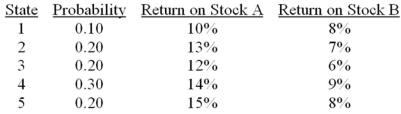 Which of the following portfolio(s) is(are) on the efficient frontier
A)The portfolio with 20 percent in A and 80 percent in B.
B)The portfolio with 15 percent in A and 85 percent in B.
C)The portfolio with 26 percent in A and 74 percent in B.
D)The portfolio with 10 percent in A and 90 percent in B.
E)A and B are both on the efficient frontier.
Which of the following portfolio(s) is(are) on the efficient frontierA)The portfolio with 20 percent in A and 80 percent in B.
B)The portfolio with 15 percent in A and 85 percent in B.
C)The portfolio with 26 percent in A and 74 percent in B.
D)The portfolio with 10 percent in A and 90 percent in B.
E)A and B are both on the efficient frontier.
Question
Question
Question
Consider the following probability distribution for stocks A and B: 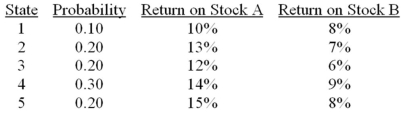 If you invest 40% of your money in A and 60% in B, what would be your portfolio's expected rate of return and standard deviation
A)9.9%; 3%
B)9.9%; 1.1%
C)11%; 1.1%
D)11%; 3%
E)None of the options
If you invest 40% of your money in A and 60% in B, what would be your portfolio's expected rate of return and standard deviationA)9.9%; 3%
B)9.9%; 1.1%
C)11%; 1.1%
D)11%; 3%
E)None of the options
Question
Question
Question
Question
Consider the following probability distribution for stocks A and B: 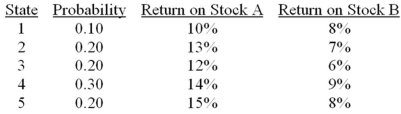 The expected rate of return and standard deviation of the global minimum variance portfolio, G, are __________ and __________, respectively.
A)10.07%; 1.05%
B)8.97%; 2.03%
C)10.07%; 3.01%
D)8.97%; 1.05%
The expected rate of return and standard deviation of the global minimum variance portfolio, G, are __________ and __________, respectively.A)10.07%; 1.05%
B)8.97%; 2.03%
C)10.07%; 3.01%
D)8.97%; 1.05%
Question
Question
Consider the following probability distribution for stocks A and B: 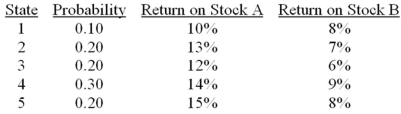 The variances of stocks A and B are _____ and _____, respectively.
A)1.5%; 1.9%
B)2.2%; 1.2%
C)3.2%; 2.0%
D)1.5%; 1.1%
The variances of stocks A and B are _____ and _____, respectively.A)1.5%; 1.9%
B)2.2%; 1.2%
C)3.2%; 2.0%
D)1.5%; 1.1%
Question
Which one of the following portfolios cannot lie on the efficient frontier as described by Markowitz 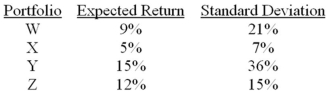
A)Only portfolio W cannot lie on the efficient frontier.
B)Only portfolio X cannot lie on the efficient frontier.
C)Only portfolio Y cannot lie on the efficient frontier.
D)Only portfolio Z cannot lie on the efficient frontier.
E)Cannot tell from the information given.
A)Only portfolio W cannot lie on the efficient frontier.
B)Only portfolio X cannot lie on the efficient frontier.
C)Only portfolio Y cannot lie on the efficient frontier.
D)Only portfolio Z cannot lie on the efficient frontier.
E)Cannot tell from the information given.
Question
Question
Question
Consider the following probability distribution for stocks A and B: 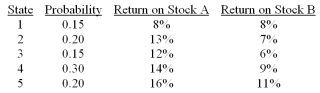 The standard deviations of stocks A and B are _____ and _____, respectively.
A)1.56%; 1.99%
B)2.45%; 1.66%
C)3.22%; 2.01%
D)1.54%; 1.11%
The standard deviations of stocks A and B are _____ and _____, respectively.A)1.56%; 1.99%
B)2.45%; 1.66%
C)3.22%; 2.01%
D)1.54%; 1.11%
Question
Consider the following probability distribution for stocks A and B: 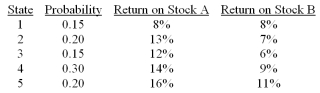 The expected rates of return of stocks A and B are _____ and _____, respectively.
A)13.2%; 9%
B)13%; 8.4%
C)13.2%; 7.7%
D)7.7%; 13.2%
The expected rates of return of stocks A and B are _____ and _____, respectively.A)13.2%; 9%
B)13%; 8.4%
C)13.2%; 7.7%
D)7.7%; 13.2%
Question
Question
Question
Question
Question
Question
Question
Question
Question
Question
Question
Question
Question
Question
Question
Question
Question
Question
Consider the following probability distribution for stocks A and B: 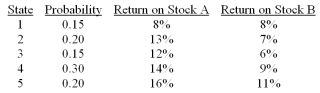 If you invest 35% of your money in A and 65% in B, what would be your portfolio's expected rate of return and standard deviation
A)9.9%; 3%
B)9.9%; 1.1%
C)10%; 1.7%
D)10%; 3%
If you invest 35% of your money in A and 65% in B, what would be your portfolio's expected rate of return and standard deviationA)9.9%; 3%
B)9.9%; 1.1%
C)10%; 1.7%
D)10%; 3%
Question
Question
Consider the following probability distribution for stocks C and D: 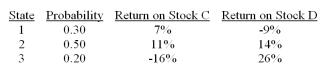 If you invest 25% of your money in C and 75% in D, what would be your portfolio's expected rate of return and standard deviation
A)9.891%; 8.70%
B)9.945%; 11.12%
C)8.225%; 8.70%
D)10.275%; 11.12%
If you invest 25% of your money in C and 75% in D, what would be your portfolio's expected rate of return and standard deviationA)9.891%; 8.70%
B)9.945%; 11.12%
C)8.225%; 8.70%
D)10.275%; 11.12%
Question
Question
Question
Question
Question
Question
Question
Question
Question
Consider the following probability distribution for stocks C and D: 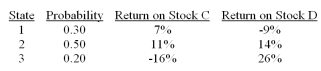 The coefficient of correlation between C and D is
A)0.67.
B)0.50.
C)-0.50.
D)-0.67.
E)None of the options
The coefficient of correlation between C and D isA)0.67.
B)0.50.
C)-0.50.
D)-0.67.
E)None of the options
Question
Consider the following probability distribution for stocks C and D: 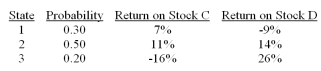 The standard deviations of stocks C and D are _____ and _____, respectively.
A)7.62%; 11.24%
B)11.24%; 7.62%
C)10.35%; 12.93%
D)12.93%; 10.35%
The standard deviations of stocks C and D are _____ and _____, respectively.A)7.62%; 11.24%
B)11.24%; 7.62%
C)10.35%; 12.93%
D)12.93%; 10.35%
Question
Consider the following probability distribution for stocks C and D:  The expected rates of return of stocks C and D are _____ and _____, respectively.
A)4.4%; 9.5%
B)9.5%; 4.4%
C)6.3%; 8.7%
D)8.7%; 6.2%
E)None of the options
The expected rates of return of stocks C and D are _____ and _____, respectively.A)4.4%; 9.5%
B)9.5%; 4.4%
C)6.3%; 8.7%
D)8.7%; 6.2%
E)None of the options
Question
Question
Consider the following probability distribution for stocks A and B: 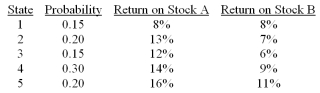 The coefficient of correlation between A and B is
A)0.474.
B)0.612.
C)0.590.
D)1.206.
The coefficient of correlation between A and B isA)0.474.
B)0.612.
C)0.590.
D)1.206.
Question
Question
Question
Question

Unlock Deck
Sign up to unlock the cards in this deck!
Unlock Deck
Unlock Deck
1/80

Play

Full screen (f)
Deck 7: Optimal Risky Portfolios
1
Consider an investment opportunity set formed with two securities that are perfectly negatively correlated.The global minimum variance portfolio has a standard deviation that is always
A)greater than zero.
B)equal to zero.
C)equal to the sum of the securities' standard deviations.
D)equal to -1.
A)greater than zero.
B)equal to zero.
C)equal to the sum of the securities' standard deviations.
D)equal to -1.
B
Explanation: If two securities were perfectly negatively correlated, the weights for the minimum variance portfolio for those securities could be calculated, and the standard deviation of the resulting portfolio would be zero.
Explanation: If two securities were perfectly negatively correlated, the weights for the minimum variance portfolio for those securities could be calculated, and the standard deviation of the resulting portfolio would be zero.
2
The expected return of a portfolio of risky securities
A)is a weighted average of the securities' returns.
B)is the sum of the securities' returns.
C)is the weighted sum of the securities' variances and covariances.
D)is a weighted average of the securities' returns and the weighted sum of the securities' variances and covariances.
E)None of the options
A)is a weighted average of the securities' returns.
B)is the sum of the securities' returns.
C)is the weighted sum of the securities' variances and covariances.
D)is a weighted average of the securities' returns and the weighted sum of the securities' variances and covariances.
E)None of the options
A
Explanation: The expected return of a portfolio of risky securities is a weighted average of the securities' returns.
Explanation: The expected return of a portfolio of risky securities is a weighted average of the securities' returns.
3
Firm-specific risk is also referred to as
A)systematic risk, diversifiable risk.
B)systematic risk, market risk.
C)diversifiable risk, market risk.
D)diversifiable risk, unique risk.
A)systematic risk, diversifiable risk.
B)systematic risk, market risk.
C)diversifiable risk, market risk.
D)diversifiable risk, unique risk.
D
Explanation: Market, systematic, and nondiversifiable risk are synonyms referring to the risk that cannot be eliminated from the portfolio.Diversifiable, unique, nonsystematic, and firm-specific risks are synonyms referring to the risk that can be eliminated from the portfolio by diversification.
Explanation: Market, systematic, and nondiversifiable risk are synonyms referring to the risk that cannot be eliminated from the portfolio.Diversifiable, unique, nonsystematic, and firm-specific risks are synonyms referring to the risk that can be eliminated from the portfolio by diversification.
4
The variance of a portfolio of risky securities
A)is a weighted sum of the securities' variances.
B)is the sum of the securities' variances.
C)is the weighted sum of the securities' variances and covariances.
D)is the sum of the securities' covariances.
E)None of the options
A)is a weighted sum of the securities' variances.
B)is the sum of the securities' variances.
C)is the weighted sum of the securities' variances and covariances.
D)is the sum of the securities' covariances.
E)None of the options
Unlock Deck
Unlock for access to all 80 flashcards in this deck.
Unlock Deck
k this deck
5
Unique risk is also referred to as
A)systematic risk, diversifiable risk.
B)systematic risk, market risk.
C)diversifiable risk, market risk.
D)diversifiable risk, firm-specific risk.
E)None of the options
A)systematic risk, diversifiable risk.
B)systematic risk, market risk.
C)diversifiable risk, market risk.
D)diversifiable risk, firm-specific risk.
E)None of the options
Unlock Deck
Unlock for access to all 80 flashcards in this deck.
Unlock Deck
k this deck
6
Which of the following statement(s) is(are) false regarding the variance of a portfolio of two risky securities
I) The higher the coefficient of correlation between securities, the greater the reduction in the portfolio variance.
II) There is a linear relationship between the securities' coefficient of correlation and the portfolio variance.
III) The degree to which the portfolio variance is reduced depends on the degree of correlation between securities.
A)I only
B)II only
C)III only
D)I and II
E)I and III
I) The higher the coefficient of correlation between securities, the greater the reduction in the portfolio variance.
II) There is a linear relationship between the securities' coefficient of correlation and the portfolio variance.
III) The degree to which the portfolio variance is reduced depends on the degree of correlation between securities.
A)I only
B)II only
C)III only
D)I and II
E)I and III
Unlock Deck
Unlock for access to all 80 flashcards in this deck.
Unlock Deck
k this deck
7
Nonsystematic risk is also referred to as
A)market risk, diversifiable risk.
B)firm-specific risk, market risk.
C)diversifiable risk, market risk.
D)diversifiable risk, unique risk.
A)market risk, diversifiable risk.
B)firm-specific risk, market risk.
C)diversifiable risk, market risk.
D)diversifiable risk, unique risk.
Unlock Deck
Unlock for access to all 80 flashcards in this deck.
Unlock Deck
k this deck
8
Systematic risk is also referred to as
A)market risk, nondiversifiable risk.
B)market risk, diversifiable risk.
C)unique risk, nondiversifiable risk.
D)unique risk, diversifiable risk.
E)None of the options
A)market risk, nondiversifiable risk.
B)market risk, diversifiable risk.
C)unique risk, nondiversifiable risk.
D)unique risk, diversifiable risk.
E)None of the options
Unlock Deck
Unlock for access to all 80 flashcards in this deck.
Unlock Deck
k this deck
9
Nondiversifiable risk is also referred to as
A)systematic risk, unique risk.
B)systematic risk, market risk.
C)unique risk, market risk.
D)unique risk, firm-specific risk.
A)systematic risk, unique risk.
B)systematic risk, market risk.
C)unique risk, market risk.
D)unique risk, firm-specific risk.
Unlock Deck
Unlock for access to all 80 flashcards in this deck.
Unlock Deck
k this deck
10
Efficient portfolios of N risky securities are portfolios that
A)are formed with the securities that have the highest rates of return regardless of their standard deviations.
B)have the highest rates of return for a given level of risk.
C)are selected from those securities with the lowest standard deviations regardless of their returns.
D)have the highest risk and rates of return and the highest standard deviations.
E)have the lowest standard deviations and the lowest rates of return.
A)are formed with the securities that have the highest rates of return regardless of their standard deviations.
B)have the highest rates of return for a given level of risk.
C)are selected from those securities with the lowest standard deviations regardless of their returns.
D)have the highest risk and rates of return and the highest standard deviations.
E)have the lowest standard deviations and the lowest rates of return.
Unlock Deck
Unlock for access to all 80 flashcards in this deck.
Unlock Deck
k this deck
11
Other things equal, diversification is most effective when
A)securities' returns are uncorrelated.
B)securities' returns are positively correlated.
C)securities' returns are high.
D)securities' returns are negatively correlated.
E)securities' returns are positively correlated and high.
A)securities' returns are uncorrelated.
B)securities' returns are positively correlated.
C)securities' returns are high.
D)securities' returns are negatively correlated.
E)securities' returns are positively correlated and high.
Unlock Deck
Unlock for access to all 80 flashcards in this deck.
Unlock Deck
k this deck
12
Which of the following statement(s) is(are) true regarding the selection of a portfolio from those that lie on the capital allocation line
I) Less risk-averse investors will invest more in the risk-free security and less in the optimal risky portfolio than more risk-averse investors.
II) More risk-averse investors will invest less in the optimal risky portfolio and more in the risk-free security than less risk-averse investors.
III) Investors choose the portfolio that maximizes their expected utility.
A)I only
B)II only
C)III only
D)I and III
E)II and III
I) Less risk-averse investors will invest more in the risk-free security and less in the optimal risky portfolio than more risk-averse investors.
II) More risk-averse investors will invest less in the optimal risky portfolio and more in the risk-free security than less risk-averse investors.
III) Investors choose the portfolio that maximizes their expected utility.
A)I only
B)II only
C)III only
D)I and III
E)II and III
Unlock Deck
Unlock for access to all 80 flashcards in this deck.
Unlock Deck
k this deck
13
The risk that can be diversified away is
A)firm specific risk.
B)beta.
C)systematic risk.
D)market risk.
A)firm specific risk.
B)beta.
C)systematic risk.
D)market risk.
Unlock Deck
Unlock for access to all 80 flashcards in this deck.
Unlock Deck
k this deck
14
Market risk is also referred to as
A)systematic risk, diversifiable risk.
B)systematic risk, nondiversifiable risk.
C)unique risk, nondiversifiable risk.
D)unique risk, diversifiable risk.
A)systematic risk, diversifiable risk.
B)systematic risk, nondiversifiable risk.
C)unique risk, nondiversifiable risk.
D)unique risk, diversifiable risk.
Unlock Deck
Unlock for access to all 80 flashcards in this deck.
Unlock Deck
k this deck
15
Which of the following statement(s) is(are) true regarding the variance of a portfolio of two risky securities
I) The higher the coefficient of correlation between securities, the greater the reduction in the portfolio variance.
II) There is a linear relationship between the securities' coefficient of correlation and the portfolio variance.
III) The degree to which the portfolio variance is reduced depends on the degree of correlation between securities.
A)I only
B)II only
C)III only
D)I and II
E)I and III
I) The higher the coefficient of correlation between securities, the greater the reduction in the portfolio variance.
II) There is a linear relationship between the securities' coefficient of correlation and the portfolio variance.
III) The degree to which the portfolio variance is reduced depends on the degree of correlation between securities.
A)I only
B)II only
C)III only
D)I and II
E)I and III
Unlock Deck
Unlock for access to all 80 flashcards in this deck.
Unlock Deck
k this deck
16
Diversifiable risk is also referred to as
A)systematic risk, unique risk.
B)systematic risk, market risk.
C)unique risk, market risk.
D)unique risk, firm-specific risk.
A)systematic risk, unique risk.
B)systematic risk, market risk.
C)unique risk, market risk.
D)unique risk, firm-specific risk.
Unlock Deck
Unlock for access to all 80 flashcards in this deck.
Unlock Deck
k this deck
17
The risk that cannot be diversified away is
A)firm-specific risk.
B)unique.
C)nonsystematic risk.
D)market risk.
A)firm-specific risk.
B)unique.
C)nonsystematic risk.
D)market risk.
Unlock Deck
Unlock for access to all 80 flashcards in this deck.
Unlock Deck
k this deck
18
The capital allocation line provided by a risk-free security and N risky securities is
A)the line that connects the risk-free rate and the global minimum-variance portfolio of the risky securities.
B)the line that connects the risk-free rate and the portfolio of the risky securities that has the highest expected return on the efficient frontier.
C)the line tangent to the efficient frontier of risky securities drawn from the risk-free rate.
D)the horizontal line drawn from the risk-free rate.
A)the line that connects the risk-free rate and the global minimum-variance portfolio of the risky securities.
B)the line that connects the risk-free rate and the portfolio of the risky securities that has the highest expected return on the efficient frontier.
C)the line tangent to the efficient frontier of risky securities drawn from the risk-free rate.
D)the horizontal line drawn from the risk-free rate.
Unlock Deck
Unlock for access to all 80 flashcards in this deck.
Unlock Deck
k this deck
19
The standard deviation of a portfolio of risky securities is
A)the square root of the weighted sum of the securities' variances.
B)the square root of the sum of the securities' variances.
C)the square root of the weighted sum of the securities' variances and covariances.
D)the square root of the sum of the securities' covariances.
A)the square root of the weighted sum of the securities' variances.
B)the square root of the sum of the securities' variances.
C)the square root of the weighted sum of the securities' variances and covariances.
D)the square root of the sum of the securities' covariances.
Unlock Deck
Unlock for access to all 80 flashcards in this deck.
Unlock Deck
k this deck
20
The efficient frontier of risky assets is
A)the portion of the investment opportunity set that lies above the global minimum variance portfolio.
B)the portion of the investment opportunity set that represents the highest standard deviations.
C)the portion of the investment opportunity set that includes the portfolios with the lowest standard deviation.
D)the set of portfolios that have zero standard deviation.
A)the portion of the investment opportunity set that lies above the global minimum variance portfolio.
B)the portion of the investment opportunity set that represents the highest standard deviations.
C)the portion of the investment opportunity set that includes the portfolios with the lowest standard deviation.
D)the set of portfolios that have zero standard deviation.
Unlock Deck
Unlock for access to all 80 flashcards in this deck.
Unlock Deck
k this deck
21
Which one of the following portfolios cannot lie on the efficient frontier as described by Markowitz
A)Only portfolio A cannot lie on the efficient frontier.
B)Only portfolio B cannot lie on the efficient frontier.
C)Only portfolio C cannot lie on the efficient frontier.
D)Only portfolio D cannot lie on the efficient frontier.
E)Cannot tell from the information given.
A)Only portfolio A cannot lie on the efficient frontier.
B)Only portfolio B cannot lie on the efficient frontier.
C)Only portfolio C cannot lie on the efficient frontier.
D)Only portfolio D cannot lie on the efficient frontier.
E)Cannot tell from the information given.
Unlock Deck
Unlock for access to all 80 flashcards in this deck.
Unlock Deck
k this deck
22
Consider the following probability distribution for stocks A and B: The standard deviations of stocks A and B are _____ and _____, respectively.
A)1.5%; 1.9%
B)2.5%; 1.1%
C)3.2%; 2.0%
D)1.5%; 1.1%
The standard deviations of stocks A and B are _____ and _____, respectively.A)1.5%; 1.9%
B)2.5%; 1.1%
C)3.2%; 2.0%
D)1.5%; 1.1%
Unlock Deck
Unlock for access to all 80 flashcards in this deck.
Unlock Deck
k this deck
23
Which of the following statement(s) is(are) false regarding the selection of a portfolio from those that lie on the capital allocation line
I) Less risk-averse investors will invest more in the risk-free security and less in the optimal risky portfolio than more risk-averse investors.
II) More risk-averse investors will invest less in the optimal risky portfolio and more in the risk-free security than less risk-averse investors.
III) Investors choose the portfolio that maximizes their expected utility.
A)I only
B)II only
C)III only
D)I and II
E)I and III
I) Less risk-averse investors will invest more in the risk-free security and less in the optimal risky portfolio than more risk-averse investors.
II) More risk-averse investors will invest less in the optimal risky portfolio and more in the risk-free security than less risk-averse investors.
III) Investors choose the portfolio that maximizes their expected utility.
A)I only
B)II only
C)III only
D)I and II
E)I and III
Unlock Deck
Unlock for access to all 80 flashcards in this deck.
Unlock Deck
k this deck
24
Which statement about portfolio diversification is correct
A)Proper diversification can eliminate systematic risk.
B)The risk-reducing benefits of diversification do not occur meaningfully until at least 50-60 individual securities have been purchased.
C)Because diversification reduces a portfolio's total risk, it necessarily reduces the portfolio's expected return.
D)Typically, as more securities are added to a portfolio, total risk would be expected to decrease at a decreasing rate.
E)None of the statements is correct.
A)Proper diversification can eliminate systematic risk.
B)The risk-reducing benefits of diversification do not occur meaningfully until at least 50-60 individual securities have been purchased.
C)Because diversification reduces a portfolio's total risk, it necessarily reduces the portfolio's expected return.
D)Typically, as more securities are added to a portfolio, total risk would be expected to decrease at a decreasing rate.
E)None of the statements is correct.
Unlock Deck
Unlock for access to all 80 flashcards in this deck.
Unlock Deck
k this deck
25
Consider the following probability distribution for stocks A and B: The coefficient of correlation between A and B is
A)0.46.
B)0.60.
C)0.58.
D)1.20.
The coefficient of correlation between A and B isA)0.46.
B)0.60.
C)0.58.
D)1.20.
Unlock Deck
Unlock for access to all 80 flashcards in this deck.
Unlock Deck
k this deck
26
Consider the following probability distribution for stocks A and B: The expected rates of return of stocks A and B are _____ and _____, respectively.
A)13.2%; 9%
B)14%; 10%
C)13.2%; 7.7%
D)7.7%; 13.2%
The expected rates of return of stocks A and B are _____ and _____, respectively.A)13.2%; 9%
B)14%; 10%
C)13.2%; 7.7%
D)7.7%; 13.2%
Unlock Deck
Unlock for access to all 80 flashcards in this deck.
Unlock Deck
k this deck
27
Consider the following probability distribution for stocks A and B: Let G be the global minimum variance portfolio.The weights of A and B in G are __________ and __________, respectively.
A)0.40; 0.60
B)0.66; 0.34
C)0.34; 0.66
D)0.77; 0.23
E)0.23; 0.77
Let G be the global minimum variance portfolio.The weights of A and B in G are __________ and __________, respectively.A)0.40; 0.60
B)0.66; 0.34
C)0.34; 0.66
D)0.77; 0.23
E)0.23; 0.77
Unlock Deck
Unlock for access to all 80 flashcards in this deck.
Unlock Deck
k this deck
28
Given an optimal risky portfolio with expected return of 6% and standard deviation of 23% and a risk free rate of 3%, what is the slope of the best feasible CAL
A)0.64
B)0.39
C)0.08
D)0.13
E)0.36
A)0.64
B)0.39
C)0.08
D)0.13
E)0.36
Unlock Deck
Unlock for access to all 80 flashcards in this deck.
Unlock Deck
k this deck
29
Consider the following probability distribution for stocks A and B: Which of the following portfolio(s) is(are) on the efficient frontier
A)The portfolio with 20 percent in A and 80 percent in B.
B)The portfolio with 15 percent in A and 85 percent in B.
C)The portfolio with 26 percent in A and 74 percent in B.
D)The portfolio with 10 percent in A and 90 percent in B.
E)A and B are both on the efficient frontier.
Which of the following portfolio(s) is(are) on the efficient frontierA)The portfolio with 20 percent in A and 80 percent in B.
B)The portfolio with 15 percent in A and 85 percent in B.
C)The portfolio with 26 percent in A and 74 percent in B.
D)The portfolio with 10 percent in A and 90 percent in B.
E)A and B are both on the efficient frontier.
Unlock Deck
Unlock for access to all 80 flashcards in this deck.
Unlock Deck
k this deck
30
The measure of risk in a Markowitz efficient frontier is:
A)specific risk.
B)standard deviation of returns.
C)reinvestment risk.
D)beta.
A)specific risk.
B)standard deviation of returns.
C)reinvestment risk.
D)beta.
Unlock Deck
Unlock for access to all 80 flashcards in this deck.
Unlock Deck
k this deck
31
Consider two perfectly negatively correlated risky securities A and B.A has an expected rate of return of 10% and a standard deviation of 16%.B has an expected rate of return of 8% and a standard deviation of 12%. The weights of A and B in the global minimum variance portfolio are _____ and _____, respectively.
A)0.24; 0.76
B)0.50; 0.50
C)0.57; 0.43
D)0.43; 0.57
E)0.76; 0.24
A)0.24; 0.76
B)0.50; 0.50
C)0.57; 0.43
D)0.43; 0.57
E)0.76; 0.24
Unlock Deck
Unlock for access to all 80 flashcards in this deck.
Unlock Deck
k this deck
32
Consider the following probability distribution for stocks A and B: If you invest 40% of your money in A and 60% in B, what would be your portfolio's expected rate of return and standard deviation
A)9.9%; 3%
B)9.9%; 1.1%
C)11%; 1.1%
D)11%; 3%
E)None of the options
If you invest 40% of your money in A and 60% in B, what would be your portfolio's expected rate of return and standard deviationA)9.9%; 3%
B)9.9%; 1.1%
C)11%; 1.1%
D)11%; 3%
E)None of the options
Unlock Deck
Unlock for access to all 80 flashcards in this deck.
Unlock Deck
k this deck
33
A statistic that measures how the returns of two risky assets move together is:
A)variance.
B)standard deviation.
C)covariance.
D)correlation.
E)covariance and correlation.
A)variance.
B)standard deviation.
C)covariance.
D)correlation.
E)covariance and correlation.
Unlock Deck
Unlock for access to all 80 flashcards in this deck.
Unlock Deck
k this deck
34
Consider two perfectly negatively correlated risky securities A and
A)8.5%
B)9.0%
B)A has an expected rate of return of 10% and a standard deviation of 16%.B has an expected rate of return of 8% and a standard deviation of 12%.The risk-free portfolio that can be formed with the two securities will earn _____ rate of return.
C)8.9%
D)9.9%
A)8.5%
B)9.0%
B)A has an expected rate of return of 10% and a standard deviation of 16%.B has an expected rate of return of 8% and a standard deviation of 12%.The risk-free portfolio that can be formed with the two securities will earn _____ rate of return.
C)8.9%
D)9.9%
Unlock Deck
Unlock for access to all 80 flashcards in this deck.
Unlock Deck
k this deck
35
The unsystematic risk of a specific security
A)is likely to be higher in an increasing market.
B)results from factors unique to the firm.
C)depends on market volatility.
D)cannot be diversified away.
A)is likely to be higher in an increasing market.
B)results from factors unique to the firm.
C)depends on market volatility.
D)cannot be diversified away.
Unlock Deck
Unlock for access to all 80 flashcards in this deck.
Unlock Deck
k this deck
36
Consider the following probability distribution for stocks A and B: The expected rate of return and standard deviation of the global minimum variance portfolio, G, are __________ and __________, respectively.
A)10.07%; 1.05%
B)8.97%; 2.03%
C)10.07%; 3.01%
D)8.97%; 1.05%
The expected rate of return and standard deviation of the global minimum variance portfolio, G, are __________ and __________, respectively.A)10.07%; 1.05%
B)8.97%; 2.03%
C)10.07%; 3.01%
D)8.97%; 1.05%
Unlock Deck
Unlock for access to all 80 flashcards in this deck.
Unlock Deck
k this deck
37
An investor who wishes to form a portfolio that lies to the right of the optimal risky portfolio on the capital allocation line must:
A)lend some of her money at the risk-free rate.
B)borrow some money at the risk-free rate and invest in the optimal risky portfolio.
C)invest only in risky securities.
D)such a portfolio cannot be formed.
E)borrow some money at the risk-free rate and invest in the optimal risky portfolio and invest only in risky securities
A)lend some of her money at the risk-free rate.
B)borrow some money at the risk-free rate and invest in the optimal risky portfolio.
C)invest only in risky securities.
D)such a portfolio cannot be formed.
E)borrow some money at the risk-free rate and invest in the optimal risky portfolio and invest only in risky securities
Unlock Deck
Unlock for access to all 80 flashcards in this deck.
Unlock Deck
k this deck
38
Consider the following probability distribution for stocks A and B: The variances of stocks A and B are _____ and _____, respectively.
A)1.5%; 1.9%
B)2.2%; 1.2%
C)3.2%; 2.0%
D)1.5%; 1.1%
The variances of stocks A and B are _____ and _____, respectively.A)1.5%; 1.9%
B)2.2%; 1.2%
C)3.2%; 2.0%
D)1.5%; 1.1%
Unlock Deck
Unlock for access to all 80 flashcards in this deck.
Unlock Deck
k this deck
39
Which one of the following portfolios cannot lie on the efficient frontier as described by Markowitz
A)Only portfolio W cannot lie on the efficient frontier.
B)Only portfolio X cannot lie on the efficient frontier.
C)Only portfolio Y cannot lie on the efficient frontier.
D)Only portfolio Z cannot lie on the efficient frontier.
E)Cannot tell from the information given.
A)Only portfolio W cannot lie on the efficient frontier.
B)Only portfolio X cannot lie on the efficient frontier.
C)Only portfolio Y cannot lie on the efficient frontier.
D)Only portfolio Z cannot lie on the efficient frontier.
E)Cannot tell from the information given.
Unlock Deck
Unlock for access to all 80 flashcards in this deck.
Unlock Deck
k this deck
40
Portfolio theory as described by Markowitz is most concerned with:
A)the elimination of systematic risk.
B)the effect of diversification on portfolio risk.
C)the identification of unsystematic risk.
D)active portfolio management to enhance returns.
A)the elimination of systematic risk.
B)the effect of diversification on portfolio risk.
C)the identification of unsystematic risk.
D)active portfolio management to enhance returns.
Unlock Deck
Unlock for access to all 80 flashcards in this deck.
Unlock Deck
k this deck
41
When two risky securities that are positively correlated but not perfectly correlated are held in a portfolio,
A)the portfolio standard deviation will be greater than the weighted average of the individual security standard deviations.
B)the portfolio standard deviation will be less than the weighted average of the individual security standard deviations.
C)the portfolio standard deviation will be equal to the weighted average of the individual security standard deviations.
D)the portfolio standard deviation will always be equal to the securities' covariance.
A)the portfolio standard deviation will be greater than the weighted average of the individual security standard deviations.
B)the portfolio standard deviation will be less than the weighted average of the individual security standard deviations.
C)the portfolio standard deviation will be equal to the weighted average of the individual security standard deviations.
D)the portfolio standard deviation will always be equal to the securities' covariance.
Unlock Deck
Unlock for access to all 80 flashcards in this deck.
Unlock Deck
k this deck
42
Consider the following probability distribution for stocks A and B: The standard deviations of stocks A and B are _____ and _____, respectively.
A)1.56%; 1.99%
B)2.45%; 1.66%
C)3.22%; 2.01%
D)1.54%; 1.11%
The standard deviations of stocks A and B are _____ and _____, respectively.A)1.56%; 1.99%
B)2.45%; 1.66%
C)3.22%; 2.01%
D)1.54%; 1.11%
Unlock Deck
Unlock for access to all 80 flashcards in this deck.
Unlock Deck
k this deck
43
Consider the following probability distribution for stocks A and B: The expected rates of return of stocks A and B are _____ and _____, respectively.
A)13.2%; 9%
B)13%; 8.4%
C)13.2%; 7.7%
D)7.7%; 13.2%
The expected rates of return of stocks A and B are _____ and _____, respectively.A)13.2%; 9%
B)13%; 8.4%
C)13.2%; 7.7%
D)7.7%; 13.2%
Unlock Deck
Unlock for access to all 80 flashcards in this deck.
Unlock Deck
k this deck
44
The global minimum variance portfolio formed from two risky securities will be riskless when the correlation coefficient between the two securities is
A)0.0.
B)1.0.
C)0.5.
D)-1.0.
E)any negative number.
A)0.0.
B)1.0.
C)0.5.
D)-1.0.
E)any negative number.
Unlock Deck
Unlock for access to all 80 flashcards in this deck.
Unlock Deck
k this deck
45
The individual investor's optimal portfolio is designated by:
A)The point of tangency with the indifference curve and the capital allocation line.
B)The point of highest reward to variability ratio in the opportunity set.
C)The point of tangency with the opportunity set and the capital allocation line.
D)The point of the highest reward to variability ratio in the indifference curve.
E)None of the options.
A)The point of tangency with the indifference curve and the capital allocation line.
B)The point of highest reward to variability ratio in the opportunity set.
C)The point of tangency with the opportunity set and the capital allocation line.
D)The point of the highest reward to variability ratio in the indifference curve.
E)None of the options.
Unlock Deck
Unlock for access to all 80 flashcards in this deck.
Unlock Deck
k this deck
46
Given an optimal risky portfolio with expected return of 13% and standard deviation of 26% and a risk free rate of 5%, what is the slope of the best feasible CAL
A)0.60
B)0.14
C)0.08
D)0.36
E)0.31
A)0.60
B)0.14
C)0.08
D)0.36
E)0.31
Unlock Deck
Unlock for access to all 80 flashcards in this deck.
Unlock Deck
k this deck
47
Which of the following is not a source of systematic risk
A)The business cycle.
B)Interest rates.
C)Personnel changes.
D)The inflation rate.
E)Exchange rates.
A)The business cycle.
B)Interest rates.
C)Personnel changes.
D)The inflation rate.
E)Exchange rates.
Unlock Deck
Unlock for access to all 80 flashcards in this deck.
Unlock Deck
k this deck
48
For a two-stock portfolio, what would be the preferred correlation coefficient between the two stocks
A)+1.00.
B)+0.50.
C)0.00.
D)-1.00.
E)None of the options
A)+1.00.
B)+0.50.
C)0.00.
D)-1.00.
E)None of the options
Unlock Deck
Unlock for access to all 80 flashcards in this deck.
Unlock Deck
k this deck
49
As the number of securities in a portfolio is increased, what happens to the average portfolio standard deviation
A)It increases at an increasing rate.
B)It increases at a decreasing rate.
C)It decreases at an increasing rate.
D)It decreases at a decreasing rate.
E)It first decreases, then starts to increase as more securities are added.
A)It increases at an increasing rate.
B)It increases at a decreasing rate.
C)It decreases at an increasing rate.
D)It decreases at a decreasing rate.
E)It first decreases, then starts to increase as more securities are added.
Unlock Deck
Unlock for access to all 80 flashcards in this deck.
Unlock Deck
k this deck
50
Security X has expected return of 12% and standard deviation of 18%.Security Y has expected return of 15% and standard deviation of 26%.If the two securities have a correlation coefficient of 0.7, what is their covariance
A)0.038
B)0.070
C)0.018
D)0.033
E)0.054
A)0.038
B)0.070
C)0.018
D)0.033
E)0.054
Unlock Deck
Unlock for access to all 80 flashcards in this deck.
Unlock Deck
k this deck
51
In words, the covariance considers the probability of each scenario happening and the interaction between
A)securities' returns relative to their variances.
B)securities' returns relative to their mean returns.
C)securities' returns relative to other securities' returns.
D)the level of return a security has in that scenario and the overall portfolio return.
E)the variance of the security's return in that scenario and the overall portfolio variance.
A)securities' returns relative to their variances.
B)securities' returns relative to their mean returns.
C)securities' returns relative to other securities' returns.
D)the level of return a security has in that scenario and the overall portfolio return.
E)the variance of the security's return in that scenario and the overall portfolio variance.
Unlock Deck
Unlock for access to all 80 flashcards in this deck.
Unlock Deck
k this deck
52
The separation property refers to the conclusion that
A)the determination of the best risky portfolio is objective and the choice of the best complete portfolio is subjective.
B)the choice of the best complete portfolio is objective and the determination of the best risky portfolio is objective.
C)the choice of inputs to be used to determine the efficient frontier is objective and the choice of the best CAL is subjective.
D)the determination of the best CAL is objective and the choice of the inputs to be used to determine the efficient frontier is subjective.
E)investors are separate beings and will therefore have different preferences regarding the risk-return tradeoff.
A)the determination of the best risky portfolio is objective and the choice of the best complete portfolio is subjective.
B)the choice of the best complete portfolio is objective and the determination of the best risky portfolio is objective.
C)the choice of inputs to be used to determine the efficient frontier is objective and the choice of the best CAL is subjective.
D)the determination of the best CAL is objective and the choice of the inputs to be used to determine the efficient frontier is subjective.
E)investors are separate beings and will therefore have different preferences regarding the risk-return tradeoff.
Unlock Deck
Unlock for access to all 80 flashcards in this deck.
Unlock Deck
k this deck
53
Given an optimal risky portfolio with expected return of 20% and standard deviation of 24% and a risk free rate of 7%, what is the slope of the best feasible CAL
A)0.64
B)0.14
C)0.62
D)0.33
E)0.54
A)0.64
B)0.14
C)0.62
D)0.33
E)0.54
Unlock Deck
Unlock for access to all 80 flashcards in this deck.
Unlock Deck
k this deck
54
A two-asset portfolio with a standard deviation of zero can be formed when
A)the assets have a correlation coefficient less than zero.
B)the assets have a correlation coefficient equal to zero.
C)the assets have a correlation coefficient greater than zero.
D)the assets have a correlation coefficient equal to one.
E)the assets have a correlation coefficient equal to negative one.
A)the assets have a correlation coefficient less than zero.
B)the assets have a correlation coefficient equal to zero.
C)the assets have a correlation coefficient greater than zero.
D)the assets have a correlation coefficient equal to one.
E)the assets have a correlation coefficient equal to negative one.
Unlock Deck
Unlock for access to all 80 flashcards in this deck.
Unlock Deck
k this deck
55
In a two-security minimum variance portfolio where the correlation between securities is greater than -1.0
A)the security with the higher standard deviation will be weighted more heavily.
B)the security with the higher standard deviation will be weighted less heavily.
C)the two securities will be equally weighted.
D)the risk will be zero.
E)the return will be zero.
A)the security with the higher standard deviation will be weighted more heavily.
B)the security with the higher standard deviation will be weighted less heavily.
C)the two securities will be equally weighted.
D)the risk will be zero.
E)the return will be zero.
Unlock Deck
Unlock for access to all 80 flashcards in this deck.
Unlock Deck
k this deck
56
The line representing all combinations of portfolio expected returns and standard deviations that can be constructed from two available assets is called the
A)risk/reward tradeoff line.
B)capital allocation line.
C)efficient frontier.
D)portfolio opportunity set.
E)Security Market Line.
A)risk/reward tradeoff line.
B)capital allocation line.
C)efficient frontier.
D)portfolio opportunity set.
E)Security Market Line.
Unlock Deck
Unlock for access to all 80 flashcards in this deck.
Unlock Deck
k this deck
57
The standard deviation of a two-asset portfolio is a linear function of the assets' weights when
A)the assets have a correlation coefficient less than zero.
B)the assets have a correlation coefficient equal to zero.
C)the assets have a correlation coefficient greater than zero.
D)the assets have a correlation coefficient equal to one.
E)the assets have a correlation coefficient less than one.
A)the assets have a correlation coefficient less than zero.
B)the assets have a correlation coefficient equal to zero.
C)the assets have a correlation coefficient greater than zero.
D)the assets have a correlation coefficient equal to one.
E)the assets have a correlation coefficient less than one.
Unlock Deck
Unlock for access to all 80 flashcards in this deck.
Unlock Deck
k this deck
58
The risk that can be diversified away in a portfolio is referred to as ___________. I) diversifiable risk
II) unique risk
III) systematic risk
IV) firm-specific risk
A)I, III, and IV
B)II, III, and IV
C)III and IV
D)I, II, and IV
E)I, II, III, and IV
II) unique risk
III) systematic risk
IV) firm-specific risk
A)I, III, and IV
B)II, III, and IV
C)III and IV
D)I, II, and IV
E)I, II, III, and IV
Unlock Deck
Unlock for access to all 80 flashcards in this deck.
Unlock Deck
k this deck
59
Given an optimal risky portfolio with expected return of 12% and standard deviation of 26% and a risk free rate of 5%, what is the slope of the best feasible CAL
A)0.64
B)0.27
C)0.08
D)0.33
E)0.36
A)0.64
B)0.27
C)0.08
D)0.33
E)0.36
Unlock Deck
Unlock for access to all 80 flashcards in this deck.
Unlock Deck
k this deck
60
When borrowing and lending at a risk-free rate are allowed, which capital allocation line (CAL) should the investor choose to combine with the efficient frontier
I) The one with the highest reward-to-variability ratio.
II) The one that will maximize his utility.
III) The one with the steepest slope.
IV) The one with the lowest slope.
A)I and III
B)I and IV
C)II and IV
D)I only
E)I, II, and III
I) The one with the highest reward-to-variability ratio.
II) The one that will maximize his utility.
III) The one with the steepest slope.
IV) The one with the lowest slope.
A)I and III
B)I and IV
C)II and IV
D)I only
E)I, II, and III
Unlock Deck
Unlock for access to all 80 flashcards in this deck.
Unlock Deck
k this deck
61
Consider the following probability distribution for stocks A and B: If you invest 35% of your money in A and 65% in B, what would be your portfolio's expected rate of return and standard deviation
A)9.9%; 3%
B)9.9%; 1.1%
C)10%; 1.7%
D)10%; 3%
If you invest 35% of your money in A and 65% in B, what would be your portfolio's expected rate of return and standard deviationA)9.9%; 3%
B)9.9%; 1.1%
C)10%; 1.7%
D)10%; 3%
Unlock Deck
Unlock for access to all 80 flashcards in this deck.
Unlock Deck
k this deck
62
Theoretically, the standard deviation of a portfolio can be reduced to what level
Explain.Realistically, is it possible to reduce the standard deviation to this level
Explain.
Explain.Realistically, is it possible to reduce the standard deviation to this level
Explain.
Unlock Deck
Unlock for access to all 80 flashcards in this deck.
Unlock Deck
k this deck
63
Consider the following probability distribution for stocks C and D: If you invest 25% of your money in C and 75% in D, what would be your portfolio's expected rate of return and standard deviation
A)9.891%; 8.70%
B)9.945%; 11.12%
C)8.225%; 8.70%
D)10.275%; 11.12%
If you invest 25% of your money in C and 75% in D, what would be your portfolio's expected rate of return and standard deviationA)9.891%; 8.70%
B)9.945%; 11.12%
C)8.225%; 8.70%
D)10.275%; 11.12%
Unlock Deck
Unlock for access to all 80 flashcards in this deck.
Unlock Deck
k this deck
64
Security X has expected return of 7% and standard deviation of 14%.Security Y has expected return of 11% and standard deviation of 22%.If the two securities have a correlation coefficient of -0.45, what is their covariance
A)0.0388
B)-0.0108
C)0.0184
D)-0.0139
E)-0.1512
A)0.0388
B)-0.0108
C)0.0184
D)-0.0139
E)-0.1512
Unlock Deck
Unlock for access to all 80 flashcards in this deck.
Unlock Deck
k this deck
65
Consider two perfectly negatively correlated risky securities A and
A)9.5%
B)10.4%
B)A has an expected rate of return of 12% and a standard deviation of 17%.B has an expected rate of return of 9% and a standard deviation of 14%.The risk-free portfolio that can be formed with the two securities will earn _____ rate of return.
C)10.9%
D)9.9%
A)9.5%
B)10.4%
B)A has an expected rate of return of 12% and a standard deviation of 17%.B has an expected rate of return of 9% and a standard deviation of 14%.The risk-free portfolio that can be formed with the two securities will earn _____ rate of return.
C)10.9%
D)9.9%
Unlock Deck
Unlock for access to all 80 flashcards in this deck.
Unlock Deck
k this deck
66
Security M has expected return of 17% and standard deviation of 32%.Security S has expected return of 13% and standard deviation of 19%.If the two securities have a correlation coefficient of 0.78, what is their covariance
A)0.038
B)0.049
C)0.047
D)0.045
E)0.054
A)0.038
B)0.049
C)0.047
D)0.045
E)0.054
Unlock Deck
Unlock for access to all 80 flashcards in this deck.
Unlock Deck
k this deck
67
Consider two perfectly negatively correlated risky securities A and B.A has an expected rate of return of 12% and a standard deviation of 17%.B has an expected rate of return of 9% and a standard deviation of 14%. The weights of A and B in the global minimum variance portfolio are _____ and _____, respectively.
A)0.24; 0.76
B)0.50; 0.50
C)0.57; 0.43
D)0.45; 0.55
E)0.76; 0.24
A)0.24; 0.76
B)0.50; 0.50
C)0.57; 0.43
D)0.45; 0.55
E)0.76; 0.24
Unlock Deck
Unlock for access to all 80 flashcards in this deck.
Unlock Deck
k this deck
68
Consider two perfectly negatively correlated risky securities, K and L.K has an expected rate of return of 13% and a standard deviation of 19%.L has an expected rate of return of 10% and a standard deviation of 16%. The risk-free portfolio that can be formed with the two securities will earn _____ rate of return.
A)9.5%
B)11.4%
C)10.9%
D)9.9%
E)None of the options
A)9.5%
B)11.4%
C)10.9%
D)9.9%
E)None of the options
Unlock Deck
Unlock for access to all 80 flashcards in this deck.
Unlock Deck
k this deck
69
State Markowitz's mean-variance criterion.Give some numerical examples of how the criterion would be applied.
Unlock Deck
Unlock for access to all 80 flashcards in this deck.
Unlock Deck
k this deck
70
Draw a graph of a typical efficient frontier.Explain why the efficient frontier is shaped the way it is.
Unlock Deck
Unlock for access to all 80 flashcards in this deck.
Unlock Deck
k this deck
71
Discuss how the investor can use the separation theorem and utility theory to produce an efficient portfolio suitable for the investor's level of risk tolerance.
Unlock Deck
Unlock for access to all 80 flashcards in this deck.
Unlock Deck
k this deck
72
Consider the following probability distribution for stocks C and D: The coefficient of correlation between C and D is
A)0.67.
B)0.50.
C)-0.50.
D)-0.67.
E)None of the options
The coefficient of correlation between C and D isA)0.67.
B)0.50.
C)-0.50.
D)-0.67.
E)None of the options
Unlock Deck
Unlock for access to all 80 flashcards in this deck.
Unlock Deck
k this deck
73
Consider the following probability distribution for stocks C and D: The standard deviations of stocks C and D are _____ and _____, respectively.
A)7.62%; 11.24%
B)11.24%; 7.62%
C)10.35%; 12.93%
D)12.93%; 10.35%
The standard deviations of stocks C and D are _____ and _____, respectively.A)7.62%; 11.24%
B)11.24%; 7.62%
C)10.35%; 12.93%
D)12.93%; 10.35%
Unlock Deck
Unlock for access to all 80 flashcards in this deck.
Unlock Deck
k this deck
74
Consider the following probability distribution for stocks C and D: The expected rates of return of stocks C and D are _____ and _____, respectively.
A)4.4%; 9.5%
B)9.5%; 4.4%
C)6.3%; 8.7%
D)8.7%; 6.2%
E)None of the options
The expected rates of return of stocks C and D are _____ and _____, respectively.A)4.4%; 9.5%
B)9.5%; 4.4%
C)6.3%; 8.7%
D)8.7%; 6.2%
E)None of the options
Unlock Deck
Unlock for access to all 80 flashcards in this deck.
Unlock Deck
k this deck
75
Given an optimal risky portfolio with expected return of 16% and standard deviation of 20% and a risk-free rate of 4%, what is the slope of the best feasible CAL
A)0.60
B)0.14
C)0.08
D)0.36
E)0.31
A)0.60
B)0.14
C)0.08
D)0.36
E)0.31
Unlock Deck
Unlock for access to all 80 flashcards in this deck.
Unlock Deck
k this deck
76
Consider the following probability distribution for stocks A and B: The coefficient of correlation between A and B is
A)0.474.
B)0.612.
C)0.590.
D)1.206.
The coefficient of correlation between A and B isA)0.474.
B)0.612.
C)0.590.
D)1.206.
Unlock Deck
Unlock for access to all 80 flashcards in this deck.
Unlock Deck
k this deck
77
Given an optimal risky portfolio with expected return of 12% and standard deviation of 26% and a risk free rate of 3%, what is the slope of the best feasible CAL
A)0.64
B)0.14
C)0.08
D)0.35
E)0.36
A)0.64
B)0.14
C)0.08
D)0.35
E)0.36
Unlock Deck
Unlock for access to all 80 flashcards in this deck.
Unlock Deck
k this deck
78
Consider two perfectly negatively correlated risky securities, K and L.K has an expected rate of return of 13% and a standard deviation of 19%.L has an expected rate of return of 10% and a standard deviation of 16%. The weights of K and L in the global minimum variance portfolio are _____ and _____, respectively.
A)0.24; 0.76
B)0.50; 0.50
C)0.46; 0.54
D)0.45; 0.55
E)0.76; 0.24
A)0.24; 0.76
B)0.50; 0.50
C)0.46; 0.54
D)0.45; 0.55
E)0.76; 0.24
Unlock Deck
Unlock for access to all 80 flashcards in this deck.
Unlock Deck
k this deck
79
Security X has expected return of 9% and standard deviation of 18%.Security Y has expected return of 12% and standard deviation of 21%.If the two securities have a correlation coefficient of -0.4, what is their covariance
A)0.0388
B)0.0706
C)0.0184
D)-0.0133
E)-0.0151
A)0.0388
B)0.0706
C)0.0184
D)-0.0133
E)-0.0151
Unlock Deck
Unlock for access to all 80 flashcards in this deck.
Unlock Deck
k this deck
80
Security X has expected return of 14% and standard deviation of 22%.Security Y has expected return of 16% and standard deviation of 28%.If the two securities have a correlation coefficient of 0.8, what is their covariance
A)0.038
B)0.049
C)0.018
D)0.013
E)0.054
A)0.038
B)0.049
C)0.018
D)0.013
E)0.054
Unlock Deck
Unlock for access to all 80 flashcards in this deck.
Unlock Deck
k this deck
Unlock Deck
Unlock for access to all 80 flashcards in this deck.






