







 Chat with AI

Deck 17: Income, Poverty, and Health Care
Full screen (f)

Question

Question
Question
Question
Question
Question
Question
Question
Question
Question
Question
Question
Question
Question
Question
Question
Question
Question
Question
Question
Question
Question
Question
Question
Question
Question
Question
Exhibit 17-1 The Lorenz Curve 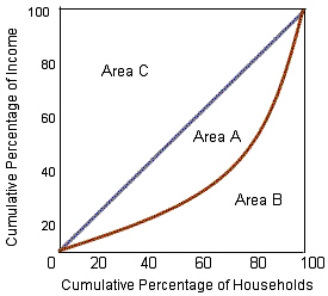 Refer to Exhibit 17-1.The Gini coefficient,G,is obtained by:
A) adding area A and area B
B) dividing area A by area (B+C).
C) adding area A and area B.
D) dividing area A by area (A + B).
Refer to Exhibit 17-1.The Gini coefficient,G,is obtained by:A) adding area A and area B
B) dividing area A by area (B+C).
C) adding area A and area B.
D) dividing area A by area (A + B).
Question
Question
Question
Question
Question
Question
Question
Exhibit 17-1 The Lorenz Curve 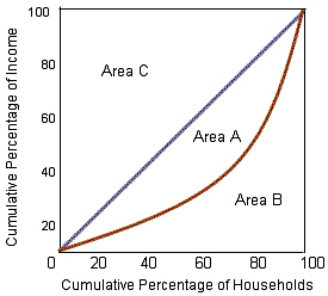 Refer to Exhibit 17-1.The 45 degree line in the figure represents:
A) the line of perfect inequality.
B) the line of perfect equality.
C) the nonwage income of households.
D) the actual distribution of income.
Refer to Exhibit 17-1.The 45 degree line in the figure represents:A) the line of perfect inequality.
B) the line of perfect equality.
C) the nonwage income of households.
D) the actual distribution of income.
Question
Question
Question
Exhibit 17-1 The Lorenz Curve 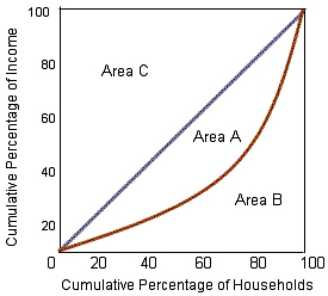 Refer to Exhibit 17-1.Which of the following represents the amount of income inequality?
A) Area A
B) Area B
C) Area C
D) Area (A + B)
Refer to Exhibit 17-1.Which of the following represents the amount of income inequality?A) Area A
B) Area B
C) Area C
D) Area (A + B)
Question
Question
Question
Question
Question
Question
Question
Question
Question
Question
Question
Question
Question
Question
Question
Question
Question
Question
Question
Question
Question
Question
Question
Question
Question
Question
Question
Question
Question
Question
Question
Question
Question
Question
Question
Question
Question
Question
Question
Question
Question
Question
Question

Unlock Deck
Sign up to unlock the cards in this deck!
Unlock Deck
Unlock Deck
1/138

Play

Full screen (f)
Deck 17: Income, Poverty, and Health Care
1
Merely demonstrating that wages are lower for blacks and females does not in itself prove wage discrimination.
True
2
Most Americans experience significant fluctuations in their economic well-being from one year to the next.
True
3
Discrimination occurs when someone is denied employment on the basis of some non-economic factor such as race,religion,or gender.
True
4
Many economists conclude that in-kind income programs have served to reduce levels of inequality significantly from the levels suggested by aggregate income statistics.
Unlock Deck
Unlock for access to all 138 flashcards in this deck.
Unlock Deck
k this deck
5
Dramatically redistributing income from the rich to the poor could make society worse off.
Unlock Deck
Unlock for access to all 138 flashcards in this deck.
Unlock Deck
k this deck
6
Currently,there are fewer male than female nurses.This is proof that there is sex discrimination in the nursing profession.
Unlock Deck
Unlock for access to all 138 flashcards in this deck.
Unlock Deck
k this deck
7
If we consider age distribution,institutional factors,and in-kind transfer programs,income distribution is likely considerably more unequal than it appears from measured income.
Unlock Deck
Unlock for access to all 138 flashcards in this deck.
Unlock Deck
k this deck
8
Income inequality is greater within nations than among nations.
Unlock Deck
Unlock for access to all 138 flashcards in this deck.
Unlock Deck
k this deck
9
Many economists conclude that in-kind income programs have served to increase levels of inequality significantly from the levels suggested by aggregate income statistics.
Unlock Deck
Unlock for access to all 138 flashcards in this deck.
Unlock Deck
k this deck
10
The permanent income hypothesis indicates that increased savings will cause an increase in long term income.
Unlock Deck
Unlock for access to all 138 flashcards in this deck.
Unlock Deck
k this deck
11
There is a strong,positive correlation between educational attainment and lifetime earnings.
Unlock Deck
Unlock for access to all 138 flashcards in this deck.
Unlock Deck
k this deck
12
Since the 1980s,the share of measured income received by the lowest fifth of families has risen.
Unlock Deck
Unlock for access to all 138 flashcards in this deck.
Unlock Deck
k this deck
13
The principle of diminishing marginal utility can potentially be used to support policies that redistribute income.This principle suggests that increases in income for an individual will generate less additional happiness the higher the level of income.
Unlock Deck
Unlock for access to all 138 flashcards in this deck.
Unlock Deck
k this deck
14
Police officers earn higher wages in part because of the dangers associated with their profession.
Unlock Deck
Unlock for access to all 138 flashcards in this deck.
Unlock Deck
k this deck
15
The fact that Jackie received a higher raise than did Jamie,while processing 12 percent more customers at her bank teller line,is evidence of wage discrimination.
Unlock Deck
Unlock for access to all 138 flashcards in this deck.
Unlock Deck
k this deck
16
At any moment in time,middle-age people tend to have higher incomes than both younger and older people do.
Unlock Deck
Unlock for access to all 138 flashcards in this deck.
Unlock Deck
k this deck
17
Earnings differentials cannot be explained at all by differences in productivity.
Unlock Deck
Unlock for access to all 138 flashcards in this deck.
Unlock Deck
k this deck
18
Individuals who are workaholics tend to have higher incomes than individuals who are not.
Unlock Deck
Unlock for access to all 138 flashcards in this deck.
Unlock Deck
k this deck
19
Firms may choose to discriminate in order to reduce information costs associated with screening applicants.
Unlock Deck
Unlock for access to all 138 flashcards in this deck.
Unlock Deck
k this deck
20
If substantial income mobility is present,then there is considerable movement of individuals up and down the income ladder over time.
Unlock Deck
Unlock for access to all 138 flashcards in this deck.
Unlock Deck
k this deck
21
Investment in health care does bear similarities to investment in human or physical capital.
Unlock Deck
Unlock for access to all 138 flashcards in this deck.
Unlock Deck
k this deck
22
Unlike those enrolled in a PPO,patients in an HMO can generally opt for nonparticipating physicians.
Unlock Deck
Unlock for access to all 138 flashcards in this deck.
Unlock Deck
k this deck
23
The health services market differs from many others in that,because of insurance,the consumer often pays only a fraction of the direct cost of care.
Unlock Deck
Unlock for access to all 138 flashcards in this deck.
Unlock Deck
k this deck
24
The typical 50-year-old male earns approximately ____ as a male in his early 20s.
A) twice as much
B) the same
C) half as much
D) 1/3 as much
A) twice as much
B) the same
C) half as much
D) 1/3 as much
Unlock Deck
Unlock for access to all 138 flashcards in this deck.
Unlock Deck
k this deck
25
As a percentage of national income,the U.S.spends more money on health care than any other industrialized nation.
Unlock Deck
Unlock for access to all 138 flashcards in this deck.
Unlock Deck
k this deck
26
Since the 1980s the proportion of income received by the top 5 percent of Americans has ____,and the measured income of Americans in the lowest fifth has ____.
A) risen; risen
B) risen; fallen
C) fallen; risen
D) fallen; fallen
A) risen; risen
B) risen; fallen
C) fallen; risen
D) fallen; fallen
Unlock Deck
Unlock for access to all 138 flashcards in this deck.
Unlock Deck
k this deck
27
Exhibit 17-1 The Lorenz Curve Refer to Exhibit 17-1.The Gini coefficient,G,is obtained by:
A) adding area A and area B
B) dividing area A by area (B+C).
C) adding area A and area B.
D) dividing area A by area (A + B).
Refer to Exhibit 17-1.The Gini coefficient,G,is obtained by:A) adding area A and area B
B) dividing area A by area (B+C).
C) adding area A and area B.
D) dividing area A by area (A + B).
Unlock Deck
Unlock for access to all 138 flashcards in this deck.
Unlock Deck
k this deck
28
The quantity of medical care demanded appears to be highly sensitive to changes in price.
Unlock Deck
Unlock for access to all 138 flashcards in this deck.
Unlock Deck
k this deck
29
Since 1935,the proportion of income received by the top 5 percent of Americans has:
A) increased substantially.
B) increased minimally.
C) decreased minimally.
D) decreased substantially.
A) increased substantially.
B) increased minimally.
C) decreased minimally.
D) decreased substantially.
Unlock Deck
Unlock for access to all 138 flashcards in this deck.
Unlock Deck
k this deck
30
Being that health care is a basic human right,there is no opportunity cost for the utilization of medical services.
Unlock Deck
Unlock for access to all 138 flashcards in this deck.
Unlock Deck
k this deck
31
Which of the following observations regarding the Gini coefficient (G)is incorrect?
A) If G is one, the Lorenz curve would overlap the line of perfect income equality.
B) If G is zero, it represents perfect income equality
C) If G is one, it represents perfect income inequality
D) The closer G is to 1 the greater the degree of income inequality
A) If G is one, the Lorenz curve would overlap the line of perfect income equality.
B) If G is zero, it represents perfect income equality
C) If G is one, it represents perfect income inequality
D) The closer G is to 1 the greater the degree of income inequality
Unlock Deck
Unlock for access to all 138 flashcards in this deck.
Unlock Deck
k this deck
32
The demand curve for human organs is upward sloping.
Unlock Deck
Unlock for access to all 138 flashcards in this deck.
Unlock Deck
k this deck
33
Evidence suggests that emergency care services are normal goods.
Unlock Deck
Unlock for access to all 138 flashcards in this deck.
Unlock Deck
k this deck
34
Exhibit 17-1 The Lorenz Curve Refer to Exhibit 17-1.The 45 degree line in the figure represents:
A) the line of perfect inequality.
B) the line of perfect equality.
C) the nonwage income of households.
D) the actual distribution of income.
Refer to Exhibit 17-1.The 45 degree line in the figure represents:A) the line of perfect inequality.
B) the line of perfect equality.
C) the nonwage income of households.
D) the actual distribution of income.
Unlock Deck
Unlock for access to all 138 flashcards in this deck.
Unlock Deck
k this deck
35
Currently,the supply curve for human organs is perfectly inelastic.
Unlock Deck
Unlock for access to all 138 flashcards in this deck.
Unlock Deck
k this deck
36
HMOs seek to contain health care costs by exerting control over patients' treatment options.
Unlock Deck
Unlock for access to all 138 flashcards in this deck.
Unlock Deck
k this deck
37
Exhibit 17-1 The Lorenz Curve Refer to Exhibit 17-1.Which of the following represents the amount of income inequality?
A) Area A
B) Area B
C) Area C
D) Area (A + B)
Refer to Exhibit 17-1.Which of the following represents the amount of income inequality?A) Area A
B) Area B
C) Area C
D) Area (A + B)
Unlock Deck
Unlock for access to all 138 flashcards in this deck.
Unlock Deck
k this deck
38
Shortages prevail in the market for organ transplants at zero price.
Unlock Deck
Unlock for access to all 138 flashcards in this deck.
Unlock Deck
k this deck
39
The Lorenz curve represents:
A) the line of perfect inequality.
B) the line of perfect equality.
C) the nonwage income of households.
D) the actual distribution of income.
A) the line of perfect inequality.
B) the line of perfect equality.
C) the nonwage income of households.
D) the actual distribution of income.
Unlock Deck
Unlock for access to all 138 flashcards in this deck.
Unlock Deck
k this deck
40
Which of the following observations would be valid if the Gini coefficient is equal to zero?
A) Perfect income inequality
B) Greater degree of income inequality
C) Lorenz curve overlaps the line of perfect income equality
D) Unequal distribution of income
A) Perfect income inequality
B) Greater degree of income inequality
C) Lorenz curve overlaps the line of perfect income equality
D) Unequal distribution of income
Unlock Deck
Unlock for access to all 138 flashcards in this deck.
Unlock Deck
k this deck
41
An example of in-kind income is:
A) a welfare payment.
B) a cash grant.
C) a housing subsidy.
D) an unemployment check.
A) a welfare payment.
B) a cash grant.
C) a housing subsidy.
D) an unemployment check.
Unlock Deck
Unlock for access to all 138 flashcards in this deck.
Unlock Deck
k this deck
42
Which of the following best explains why garbage collectors are paid a higher wage than many others with comparable skills?
A) because of the dangers associated with collecting trash
B) because garbage collectors work much longer hours on average than do those in other jobs
C) because of the unpleasantness associated with trash collection
D) because garbage collectors possess skills that are in relatively high demand
A) because of the dangers associated with collecting trash
B) because garbage collectors work much longer hours on average than do those in other jobs
C) because of the unpleasantness associated with trash collection
D) because garbage collectors possess skills that are in relatively high demand
Unlock Deck
Unlock for access to all 138 flashcards in this deck.
Unlock Deck
k this deck
43
Which of the following is likely to improve a person's income?
A) increased productivity
B) investing in human capital
C) possessing a special talent or skill
D) all of the above
A) increased productivity
B) investing in human capital
C) possessing a special talent or skill
D) all of the above
Unlock Deck
Unlock for access to all 138 flashcards in this deck.
Unlock Deck
k this deck
44
Which of the following government programs are likely to aid the poor more than those in upper income brackets?
A) subsidies to museums
B) state-subsidized higher education benefits
C) school lunch programs
D) government subsidies to airports
A) subsidies to museums
B) state-subsidized higher education benefits
C) school lunch programs
D) government subsidies to airports
Unlock Deck
Unlock for access to all 138 flashcards in this deck.
Unlock Deck
k this deck
45
Which of the following countries has the least degree of measured income inequality?
A) India
B) Brazil
C) Mexico
D) United States
A) India
B) Brazil
C) Mexico
D) United States
Unlock Deck
Unlock for access to all 138 flashcards in this deck.
Unlock Deck
k this deck
46
If every individual earned the same total income over his or her lifetime,there would still be observed inequality because:
A) people earn more in their youth.
B) people earn more in middle age.
C) people earn more when they are very old.
D) of none of the above.
A) people earn more in their youth.
B) people earn more in middle age.
C) people earn more when they are very old.
D) of none of the above.
Unlock Deck
Unlock for access to all 138 flashcards in this deck.
Unlock Deck
k this deck
47
International comparisons of income inequality indicate that the degree of inequality is greatest in:
A) developing countries.
B) developed countries.
C) countries with a homogeneous population.
D) the United States.
A) developing countries.
B) developed countries.
C) countries with a homogeneous population.
D) the United States.
Unlock Deck
Unlock for access to all 138 flashcards in this deck.
Unlock Deck
k this deck
48
One reason scholars argue that government activity should be considered when evaluating the measured income distribution because:
A) the lowest-income quintile has benefited from state-subsidized higher education more than have middle-income and higher income quintiles.
B) the higher-income quintiles have benefited more than the poor from housing subsidies and Medicaid.
C) the middle and higher-income quintiles have benefited more than the poor from state-subsidized airports, airlines, operas, and museums.
D) the lowest-income quintile has benefited more than middle-income and upper-income quintiles from state-subsidized airports, airlines, operas, and museums.
A) the lowest-income quintile has benefited from state-subsidized higher education more than have middle-income and higher income quintiles.
B) the higher-income quintiles have benefited more than the poor from housing subsidies and Medicaid.
C) the middle and higher-income quintiles have benefited more than the poor from state-subsidized airports, airlines, operas, and museums.
D) the lowest-income quintile has benefited more than middle-income and upper-income quintiles from state-subsidized airports, airlines, operas, and museums.
Unlock Deck
Unlock for access to all 138 flashcards in this deck.
Unlock Deck
k this deck
49
Differences in income can be accounted for by differences in:
A) age.
B) education.
C) preferences toward leisure.
D) all of the above.
A) age.
B) education.
C) preferences toward leisure.
D) all of the above.
Unlock Deck
Unlock for access to all 138 flashcards in this deck.
Unlock Deck
k this deck
50
The ____ participate in the labor force to a greater extent than do the ____.
A) very young; middle-aged and very old
B) middle-aged; very young and very old
C) very old; very young and middle-aged
D) very young and very old; middle-aged
A) very young; middle-aged and very old
B) middle-aged; very young and very old
C) very old; very young and middle-aged
D) very young and very old; middle-aged
Unlock Deck
Unlock for access to all 138 flashcards in this deck.
Unlock Deck
k this deck
51
Which of the following best explains why firefighters are generally paid higher wages than those with comparable skills?
A) Firefighting is dangerous work.
B) Firefighters work more hours each month than do workers in most other professions.
C) Firefighters value leisure less than the average person does.
D) Firefighters, on average, spend more years receiving training than do individuals in other professions.
A) Firefighting is dangerous work.
B) Firefighters work more hours each month than do workers in most other professions.
C) Firefighters value leisure less than the average person does.
D) Firefighters, on average, spend more years receiving training than do individuals in other professions.
Unlock Deck
Unlock for access to all 138 flashcards in this deck.
Unlock Deck
k this deck
52
Which of the following factors leads to differences in income across individuals?
A) the level of skills possessed by an individual
B) the quality of human capital and education
C) preferences for work over leisure
D) all of the above
A) the level of skills possessed by an individual
B) the quality of human capital and education
C) preferences for work over leisure
D) all of the above
Unlock Deck
Unlock for access to all 138 flashcards in this deck.
Unlock Deck
k this deck
53
It has been argued that state-subsidized ____ programs have benefited the middle and upper-income quintiles more than the poor.
A) food stamp
B) housing subsidy
C) higher education
D) Medicaid
A) food stamp
B) housing subsidy
C) higher education
D) Medicaid
Unlock Deck
Unlock for access to all 138 flashcards in this deck.
Unlock Deck
k this deck
54
Which of the following government programs are likely to aid the rich more than the poor?
A) food stamps
B) school lunch programs
C) subsidies for the arts
D) public housing subsidies
A) food stamps
B) school lunch programs
C) subsidies for the arts
D) public housing subsidies
Unlock Deck
Unlock for access to all 138 flashcards in this deck.
Unlock Deck
k this deck
55
A typical 50-year-old male earns:
A) one-third more than a male in his early 20s.
B) nearly twice the income of a male in his early 20s.
C) one-third less than workers over 65.
D) nearly twice the income of workers over 65.
A) one-third more than a male in his early 20s.
B) nearly twice the income of a male in his early 20s.
C) one-third less than workers over 65.
D) nearly twice the income of workers over 65.
Unlock Deck
Unlock for access to all 138 flashcards in this deck.
Unlock Deck
k this deck
56
Which of the following countries has the greatest degree of measured income inequality?
A) Canada
B) France
C) the United States
D) Japan
A) Canada
B) France
C) the United States
D) Japan
Unlock Deck
Unlock for access to all 138 flashcards in this deck.
Unlock Deck
k this deck
57
It has been argued that state-subsidized ____ programs have benefited the poor more than middle and upper-income quintiles.
A) Medicaid
B) higher education
C) art museum
D) airport and airline subsidy
A) Medicaid
B) higher education
C) art museum
D) airport and airline subsidy
Unlock Deck
Unlock for access to all 138 flashcards in this deck.
Unlock Deck
k this deck
58
Which of the following represents in-kind income?
A) food stamps
B) a public housing subsidy
C) a school lunch program
D) all of the above
A) food stamps
B) a public housing subsidy
C) a school lunch program
D) all of the above
Unlock Deck
Unlock for access to all 138 flashcards in this deck.
Unlock Deck
k this deck
59
The measured distribution of income today appears more unequal than in the 1950s partly because of:
A) an increase in the rate of divorce.
B) an increase in the number of two-income families.
C) a reduction in the divorce rate.
D) both (a) and (b).
A) an increase in the rate of divorce.
B) an increase in the number of two-income families.
C) a reduction in the divorce rate.
D) both (a) and (b).
Unlock Deck
Unlock for access to all 138 flashcards in this deck.
Unlock Deck
k this deck
60
On average,middle-aged people tend to have higher incomes than younger or older people do because:
A) they receive more money from the government than younger or older people do.
B) they are at an age where their productivity is at its peak.
C) they participate in the labor force to a lesser extent than do the young or the old.
D) they are subject to lower rates of taxation than are younger or older workers.
A) they receive more money from the government than younger or older people do.
B) they are at an age where their productivity is at its peak.
C) they participate in the labor force to a lesser extent than do the young or the old.
D) they are subject to lower rates of taxation than are younger or older workers.
Unlock Deck
Unlock for access to all 138 flashcards in this deck.
Unlock Deck
k this deck
61
When employers discriminate,they:
A) may believe that they have sound economic reasons for doing so.
B) may pay the price in lost earnings and productivity.
C) may subject themselves to civil action.
D) may be characterized by all of the above.
A) may believe that they have sound economic reasons for doing so.
B) may pay the price in lost earnings and productivity.
C) may subject themselves to civil action.
D) may be characterized by all of the above.
Unlock Deck
Unlock for access to all 138 flashcards in this deck.
Unlock Deck
k this deck
62
In the Santa Rita mines in Arizona in 1870,Mexican miners received about $12 per month while "American" miners received $70.Although the wages of both groups tended to rise over time,the gap persisted until at least 1910.Mexican and American miners did the same work and were equally productive.Economists call this pay differential:
A) prejudicial differentials.
B) compensating differentials.
C) wage discrimination.
D) job entry discrimination.
A) prejudicial differentials.
B) compensating differentials.
C) wage discrimination.
D) job entry discrimination.
Unlock Deck
Unlock for access to all 138 flashcards in this deck.
Unlock Deck
k this deck
63
Taxes ____ the incentive to work,since they ____ an individual's after-tax earnings.
A) reduce; increase
B) increase; reduce
C) increase; increase
D) reduce; reduce
A) reduce; increase
B) increase; reduce
C) increase; increase
D) reduce; reduce
Unlock Deck
Unlock for access to all 138 flashcards in this deck.
Unlock Deck
k this deck
64
The existence of differences between the average earnings of men and women:
A) proves the existence of discrimination.
B) may be partially due to factors other than wage discrimination.
C) proves that men on average invest more in human capital than do women.
D) indicates that men are on average smarter than women are.
A) proves the existence of discrimination.
B) may be partially due to factors other than wage discrimination.
C) proves that men on average invest more in human capital than do women.
D) indicates that men are on average smarter than women are.
Unlock Deck
Unlock for access to all 138 flashcards in this deck.
Unlock Deck
k this deck
65
Which of the following is a source of inequality in incomes?
A) job preferences
B) willingness to take risks
C) differences in investment in human capital.
D) All of the above are correct.
A) job preferences
B) willingness to take risks
C) differences in investment in human capital.
D) All of the above are correct.
Unlock Deck
Unlock for access to all 138 flashcards in this deck.
Unlock Deck
k this deck
66
High school graduates in the United States earn roughly ____ of those with Bachelor's degrees.
A) one-third
B) one-fourth
C) one-half
D) two-thirds
A) one-third
B) one-fourth
C) one-half
D) two-thirds
Unlock Deck
Unlock for access to all 138 flashcards in this deck.
Unlock Deck
k this deck
67
Wage discrimination occurs when people are paid different salaries based upon:
A) education.
B) ethnicity.
C) willingness to work.
D) talent.
A) education.
B) ethnicity.
C) willingness to work.
D) talent.
Unlock Deck
Unlock for access to all 138 flashcards in this deck.
Unlock Deck
k this deck
68
A valid argument against redistributing income to achieve complete equality is that:
A) income equality would destroy the social cohesiveness that exists among different income groupings.
B) this would eliminate the monetary incentives to work and produce.
C) the cost of obtaining the equality would be so deflationary as to promote economic instability.
D) income equality would imply class segregation based on factors such as sex or race, since income would be constant.
A) income equality would destroy the social cohesiveness that exists among different income groupings.
B) this would eliminate the monetary incentives to work and produce.
C) the cost of obtaining the equality would be so deflationary as to promote economic instability.
D) income equality would imply class segregation based on factors such as sex or race, since income would be constant.
Unlock Deck
Unlock for access to all 138 flashcards in this deck.
Unlock Deck
k this deck
69
A U.S.presidential candidate promises to redistribute income and encourage economic growth.Why might these goals be in conflict?
A) The poor, on average, save more than the rich. Taxing the incomes of the rich to transfer to the poor will result in an increase in total savings.
B) Taxing the incomes of the rich to transfer to the poor will result in the rich saving more.
C) Taxing the incomes of the rich to transfer to the poor will provide disincentives for work and capital accumulation.
D) Taxing the incomes of the rich to transfer to the poor will provide incentives for the rich to work more to make up for income lost to taxes.
A) The poor, on average, save more than the rich. Taxing the incomes of the rich to transfer to the poor will result in an increase in total savings.
B) Taxing the incomes of the rich to transfer to the poor will result in the rich saving more.
C) Taxing the incomes of the rich to transfer to the poor will provide disincentives for work and capital accumulation.
D) Taxing the incomes of the rich to transfer to the poor will provide incentives for the rich to work more to make up for income lost to taxes.
Unlock Deck
Unlock for access to all 138 flashcards in this deck.
Unlock Deck
k this deck
70
A relatively larger proportion of ____ work in unskilled jobs with lower pay than do ____.
A) females; Caucasian males
B) nonwhites; Caucasian males
C) Caucasian males; females
D) Both (a) and (b) are correct.
A) females; Caucasian males
B) nonwhites; Caucasian males
C) Caucasian males; females
D) Both (a) and (b) are correct.
Unlock Deck
Unlock for access to all 138 flashcards in this deck.
Unlock Deck
k this deck
71
Some employers choose to discriminate as a means of ____ information costs by hiring workers from a similar background as those that were ____ productive in the past.
A) increasing; more
B) reducing; more
C) increasing; less
D) reducing; less
A) increasing; more
B) reducing; more
C) increasing; less
D) reducing; less
Unlock Deck
Unlock for access to all 138 flashcards in this deck.
Unlock Deck
k this deck
72
If labor markets are competitive,discriminating employers:
A) suffer no economic consequences from discrimination.
B) incur higher costs as a result of discrimination and are therefore at a competitive disadvantage.
C) incur lower costs than nondiscriminating employers and therefore have a competitive advantage.
D) enjoy higher profits.
A) suffer no economic consequences from discrimination.
B) incur higher costs as a result of discrimination and are therefore at a competitive disadvantage.
C) incur lower costs than nondiscriminating employers and therefore have a competitive advantage.
D) enjoy higher profits.
Unlock Deck
Unlock for access to all 138 flashcards in this deck.
Unlock Deck
k this deck
73
In the United States the degree of individual income mobility (that is,the degree to which people move from higher to lower,or lower to higher,income groupings)is:
A) rigid in both directions.
B) flexible in both directions.
C) flexible upward but rigid downward, since high income perpetuates itself from generation to generation.
D) flexible downward but rigid upward, since most low-income people never rise significantly above the poverty level.
A) rigid in both directions.
B) flexible in both directions.
C) flexible upward but rigid downward, since high income perpetuates itself from generation to generation.
D) flexible downward but rigid upward, since most low-income people never rise significantly above the poverty level.
Unlock Deck
Unlock for access to all 138 flashcards in this deck.
Unlock Deck
k this deck
74
Longitudinal data on income inequality in the United States indicates that:
A) children of poor families stay poor, but children of rich families do not always stay rich.
B) children of poor families often escape poverty, but rich families invariably retain their wealth over time.
C) there is substantial movement among income groupings in the United States.
D) the rich are getting richer and the poor are getting poorer.
A) children of poor families stay poor, but children of rich families do not always stay rich.
B) children of poor families often escape poverty, but rich families invariably retain their wealth over time.
C) there is substantial movement among income groupings in the United States.
D) the rich are getting richer and the poor are getting poorer.
Unlock Deck
Unlock for access to all 138 flashcards in this deck.
Unlock Deck
k this deck
75
Wage differentials between individuals may be partly explained by:
A) differences in education.
B) differences in productivity.
C) discrimination.
D) all of the above.
A) differences in education.
B) differences in productivity.
C) discrimination.
D) all of the above.
Unlock Deck
Unlock for access to all 138 flashcards in this deck.
Unlock Deck
k this deck
76
Because of the owner's prejudice,a firm chooses to discriminate against hiring Asian workers.Compared to an otherwise identical,nondiscriminating firm in the same competitive market,the discriminating firm will:
A) incur higher costs.
B) receive lower profits.
C) receive higher profits.
D) be characterized by both (a) and (b).
A) incur higher costs.
B) receive lower profits.
C) receive higher profits.
D) be characterized by both (a) and (b).
Unlock Deck
Unlock for access to all 138 flashcards in this deck.
Unlock Deck
k this deck
77
Unequal incomes can arise from:
A) discrimination.
B) worker preferences.
C) differences in educational backgrounds.
D) all of the above.
A) discrimination.
B) worker preferences.
C) differences in educational backgrounds.
D) all of the above.
Unlock Deck
Unlock for access to all 138 flashcards in this deck.
Unlock Deck
k this deck
78
In a market economy,differences in incomes:
A) reflect the relative scarcity of resources.
B) provide individuals with an incentive to supply resources that are valued by others.
C) determine the income distribution among market participants.
D) all of the above are correct.
A) reflect the relative scarcity of resources.
B) provide individuals with an incentive to supply resources that are valued by others.
C) determine the income distribution among market participants.
D) all of the above are correct.
Unlock Deck
Unlock for access to all 138 flashcards in this deck.
Unlock Deck
k this deck
79
From a purely economic point of view,discrimination is established if:
A) black teenagers earn more than white teenagers do.
B) all factors are earning an amount equivalent to their marginal revenue product.
C) women earn less than men do.
D) equivalent factors earn different payments for equal contributions to output.
A) black teenagers earn more than white teenagers do.
B) all factors are earning an amount equivalent to their marginal revenue product.
C) women earn less than men do.
D) equivalent factors earn different payments for equal contributions to output.
Unlock Deck
Unlock for access to all 138 flashcards in this deck.
Unlock Deck
k this deck
80
On average,an individual with a college degree earns about ____ more each week than an individual who has not completed high school.
A) $8,000
B) $18,000
C) $33,000
D) $58,000
A) $8,000
B) $18,000
C) $33,000
D) $58,000
Unlock Deck
Unlock for access to all 138 flashcards in this deck.
Unlock Deck
k this deck
Unlock Deck
Unlock for access to all 138 flashcards in this deck.






