







 Chat with AI

Deck 24: America and the Great War
Full screen (f)

Question

Question
Question
Question
Question
Question
Question
Question
Question
Question
Question
Question
Question
Question
Question
Question
Question
Question
Question
Question
Question
Question
Question
Question
Question
Question
Question
Question
Question
Question
Question
Question
Question
Question
Question
Question
Question
Question
Question
Question
Question
Question
Question
Question
Question
Question
Question
Question
Question
Question
Question
Question
Question
Question
Question
Question
Question
Question
Question
Question
Question
Question
Match between columns
Question
Question
Question
Question
Question
Question
Question
Question
Question
Question
Question
Question
Question
Question
MATCHING
Match each description with the item below.
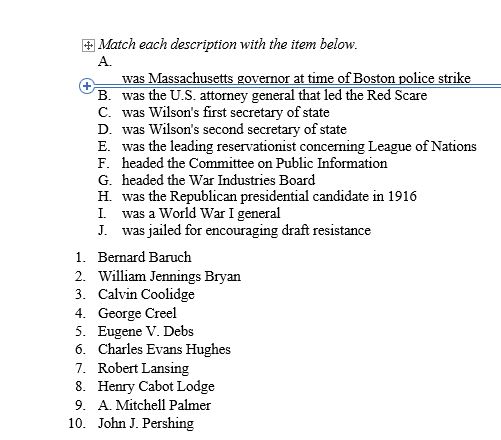
Match each description with the item below.
Question

Unlock Deck
Sign up to unlock the cards in this deck!
Unlock Deck
Unlock Deck
1/77

Play

Full screen (f)
Deck 24: America and the Great War
1
In an effort to topple Victoriano Huerta's dictatorial government in Mexico, President Wilson:
A) used the army to close off the border
B) sent the military to occupy the port of Veracruz
C) had Mexico expelled from the League of Nations
D) provided weapons to "Pancho" Villa
E) let the corrupt Madero take control
A) used the army to close off the border
B) sent the military to occupy the port of Veracruz
C) had Mexico expelled from the League of Nations
D) provided weapons to "Pancho" Villa
E) let the corrupt Madero take control
sent the military to occupy the port of Veracruz
2
Former president Theodore Roosevelt was one of the biggest supporters of the League of Nations.
False
3
President Wilson suffered a temporarily incapacitating stroke in France while negotiating the peace treaty.
False
4
In the presidential election of 1916, Republicans used the slogan "He kept us out of war" to discredit Wilson.
Unlock Deck
Unlock for access to all 77 flashcards in this deck.
Unlock Deck
k this deck
5
Due to their belief in "freedom of the seas," the British allowed Americans to trade with Germany.
Unlock Deck
Unlock for access to all 77 flashcards in this deck.
Unlock Deck
k this deck
6
"Four-minute men" were a special-operations unit of the U.S. Army.
Unlock Deck
Unlock for access to all 77 flashcards in this deck.
Unlock Deck
k this deck
7
Henry Cabot Lodge led the Senate Republicans who demanded amendments to the Treaty of Versailles.
Unlock Deck
Unlock for access to all 77 flashcards in this deck.
Unlock Deck
k this deck
8
"Pancho" Villa:
A) was captured and executed by American forces in 1914
B) led the Mexican forces against an unsuccessful invasion by U.S. Marines and sailors at Vera Cruz
C) led the rebellion against Mexican president Porfirio Díaz
D) was assassinated for his role in the Zimmermann telegram debacle
E) killed a number of Americans in an attempt to provoke American intervention in Mexico
A) was captured and executed by American forces in 1914
B) led the Mexican forces against an unsuccessful invasion by U.S. Marines and sailors at Vera Cruz
C) led the rebellion against Mexican president Porfirio Díaz
D) was assassinated for his role in the Zimmermann telegram debacle
E) killed a number of Americans in an attempt to provoke American intervention in Mexico
Unlock Deck
Unlock for access to all 77 flashcards in this deck.
Unlock Deck
k this deck
9
The Republican candidate for president in 1916 was Charles Evans Hughes.
Unlock Deck
Unlock for access to all 77 flashcards in this deck.
Unlock Deck
k this deck
10
The so-called Arabic Pledge involved Wilson's stand to stop North Africa's fall into chaos during the war.
Unlock Deck
Unlock for access to all 77 flashcards in this deck.
Unlock Deck
k this deck
11
Over four hundred thousand southern blacks moved northward during the war years.
Unlock Deck
Unlock for access to all 77 flashcards in this deck.
Unlock Deck
k this deck
12
The Zimmermann telegram, sent to the Mexican government from the White House, was intercepted by the Germans.
Unlock Deck
Unlock for access to all 77 flashcards in this deck.
Unlock Deck
k this deck
13
Roosevelt visited Wilson in the White House and offered to raise a regiment of army volunteers, just as he had done with the Rough Riders in 1898.
Unlock Deck
Unlock for access to all 77 flashcards in this deck.
Unlock Deck
k this deck
14
Many immigrant groups in the United States supported the Central Powers in the European War.
Unlock Deck
Unlock for access to all 77 flashcards in this deck.
Unlock Deck
k this deck
15
General Pershing's incursion into Mexico resulted in the defeat and capture of "Pancho" Villa.
Unlock Deck
Unlock for access to all 77 flashcards in this deck.
Unlock Deck
k this deck
16
Which of the following statements best describes the diplomatic stance of Woodrow Wilson and William Jennings Bryan?
A) America must, above all else, protect American interests around the world.
B) America must not interfere in the affairs of other nations.
C) America has a religious duty to spread democracy and Christianity throughout the world.
D) America should prove its might wherever and whenever possible.
E) America must never put internationality above nationality.
A) America must, above all else, protect American interests around the world.
B) America must not interfere in the affairs of other nations.
C) America has a religious duty to spread democracy and Christianity throughout the world.
D) America should prove its might wherever and whenever possible.
E) America must never put internationality above nationality.
Unlock Deck
Unlock for access to all 77 flashcards in this deck.
Unlock Deck
k this deck
17
During World War I, some American symphonies refused to perform Bach and Beethoven.
Unlock Deck
Unlock for access to all 77 flashcards in this deck.
Unlock Deck
k this deck
18
Women in "war work" were usually able to keep their jobs after the war.
Unlock Deck
Unlock for access to all 77 flashcards in this deck.
Unlock Deck
k this deck
19
Concerning United States action in the Caribbean, President Wilson:
A) firmly renounced the policies of Taft's "dollar diplomacy"
B) announced that "the fruit companies will be supported with American force to ensure American prosperity"
C) argued that the United States should recognize any government that exercised de facto power
D) kept marines in Nicaragua and sent marines to Haiti and the Dominican Republic
E) believed that the Monroe Doctrine precluded him from using the military
A) firmly renounced the policies of Taft's "dollar diplomacy"
B) announced that "the fruit companies will be supported with American force to ensure American prosperity"
C) argued that the United States should recognize any government that exercised de facto power
D) kept marines in Nicaragua and sent marines to Haiti and the Dominican Republic
E) believed that the Monroe Doctrine precluded him from using the military
Unlock Deck
Unlock for access to all 77 flashcards in this deck.
Unlock Deck
k this deck
20
One of the following pairs consists of two countries that were NOT members of the Triple Entente:
A) Italy and France
B) France and Great Britain
C) Great Britain and Russia
D) Russia and France
E) Italy and Austria-Hungary
A) Italy and France
B) France and Great Britain
C) Great Britain and Russia
D) Russia and France
E) Italy and Austria-Hungary
Unlock Deck
Unlock for access to all 77 flashcards in this deck.
Unlock Deck
k this deck
21
The Revenue Act of 1916:
A) was primarily to raise money to pay for war preparations
B) hit farmers and low-income Americans the hardest
C) was vetoed by President Wilson
D) was designed to make Republicans support the war
E) amounted to the progressives' biggest failure in the Wilson period
A) was primarily to raise money to pay for war preparations
B) hit farmers and low-income Americans the hardest
C) was vetoed by President Wilson
D) was designed to make Republicans support the war
E) amounted to the progressives' biggest failure in the Wilson period
Unlock Deck
Unlock for access to all 77 flashcards in this deck.
Unlock Deck
k this deck
22
All of these innovations changed warfare during World War I EXCEPT:
A) machine guns
B) blockades
C) land mines
D) long-range artillery
E) high-velocity rifles
A) machine guns
B) blockades
C) land mines
D) long-range artillery
E) high-velocity rifles
Unlock Deck
Unlock for access to all 77 flashcards in this deck.
Unlock Deck
k this deck
23
The event that triggered World War I in Europe was:
A) Germany's invasion of Belgium
B) Russia's decision to ally with France and Britain
C) Germany's determination to build a navy as large as Britain's
D) the fallout of the Bolshevik Revolution
E) a Serb's assassination of the Austrian archduke
A) Germany's invasion of Belgium
B) Russia's decision to ally with France and Britain
C) Germany's determination to build a navy as large as Britain's
D) the fallout of the Bolshevik Revolution
E) a Serb's assassination of the Austrian archduke
Unlock Deck
Unlock for access to all 77 flashcards in this deck.
Unlock Deck
k this deck
24
What was the major cause of the St. Louis riot in 1917?
A) employment in a defense factory
B) a white man was accused of murdering an African American child
C) an African American was accused of rape
D) misunderstanding of the homeowners' restrictive clauses
E) black members of the National Guard were told to not wear their uniforms
A) employment in a defense factory
B) a white man was accused of murdering an African American child
C) an African American was accused of rape
D) misunderstanding of the homeowners' restrictive clauses
E) black members of the National Guard were told to not wear their uniforms
Unlock Deck
Unlock for access to all 77 flashcards in this deck.
Unlock Deck
k this deck
25
President Wilson's secretary of state resigned in 1915 because:
A) he thought Wilson's note to Germany denouncing the sinking of the Lusitania would draw America closer to war
B) he discovered that the Lusitania had carried a cargo of arms and ammunition
C) he disapproved of Wilson's conciliatory stance toward Germany
D) Wilson refused to sign the Arabic Pledge
E) he had plans to run for president in 1916
A) he thought Wilson's note to Germany denouncing the sinking of the Lusitania would draw America closer to war
B) he discovered that the Lusitania had carried a cargo of arms and ammunition
C) he disapproved of Wilson's conciliatory stance toward Germany
D) Wilson refused to sign the Arabic Pledge
E) he had plans to run for president in 1916
Unlock Deck
Unlock for access to all 77 flashcards in this deck.
Unlock Deck
k this deck
26
The most important of all the federal mobilization agencies was the:
A) Fuel Administration
B) Emergency Fleet Corporation
C) U.S. Shipping Board
D) War Industries Board
E) Committee on Public Information
A) Fuel Administration
B) Emergency Fleet Corporation
C) U.S. Shipping Board
D) War Industries Board
E) Committee on Public Information
Unlock Deck
Unlock for access to all 77 flashcards in this deck.
Unlock Deck
k this deck
27
George Creel:
A) was the energetic leader of the War Labor Policies Board
B) was a Denver newspaperman in charge of propaganda
C) was the first and most celebrated conviction under the Espionage Act of 1917
D) was convicted under the "clear and present danger" doctrine
E) led the Fifth Army in the Mediterranean during World War I
A) was the energetic leader of the War Labor Policies Board
B) was a Denver newspaperman in charge of propaganda
C) was the first and most celebrated conviction under the Espionage Act of 1917
D) was convicted under the "clear and present danger" doctrine
E) led the Fifth Army in the Mediterranean during World War I
Unlock Deck
Unlock for access to all 77 flashcards in this deck.
Unlock Deck
k this deck
28
When news of the European war first reached the United States:
A) President Wilson immediately called on Congress to build up America's military strength
B) most old-line Americans were sympathetic to the Central Powers
C) Irish-Americans leaned toward support for the Allies
D) most high government officials were pro-British
E) Pershing was already on his way with 15,000 troops
A) President Wilson immediately called on Congress to build up America's military strength
B) most old-line Americans were sympathetic to the Central Powers
C) Irish-Americans leaned toward support for the Allies
D) most high government officials were pro-British
E) Pershing was already on his way with 15,000 troops
Unlock Deck
Unlock for access to all 77 flashcards in this deck.
Unlock Deck
k this deck
29
Which of the following is NOT associated with major battles in World War I?
A) Verdun
B) Château-Thierry
C) Meuse-Argonne
D) Omaha Beach
E) Belleau Wood
A) Verdun
B) Château-Thierry
C) Meuse-Argonne
D) Omaha Beach
E) Belleau Wood
Unlock Deck
Unlock for access to all 77 flashcards in this deck.
Unlock Deck
k this deck
30
What gave World War I its lasting character?
A) trench warfare
B) ethnic and racial hatred
C) fascism in Germany and Italy
D) the use of airplanes
E) the long stalemate that led to so few deaths
A) trench warfare
B) ethnic and racial hatred
C) fascism in Germany and Italy
D) the use of airplanes
E) the long stalemate that led to so few deaths
Unlock Deck
Unlock for access to all 77 flashcards in this deck.
Unlock Deck
k this deck
31
The Food Administration:
A) was contested by labor lawyer Frank P. Walsh
B) taught Americans to plant victory gardens and use leftovers wisely
C) used strict guidelines and coercive authority to achieve its goals
D) was managed by a young engineer named Harry Truman
E) encouraged Americans to eat as much food as possible in order to support farmers
A) was contested by labor lawyer Frank P. Walsh
B) taught Americans to plant victory gardens and use leftovers wisely
C) used strict guidelines and coercive authority to achieve its goals
D) was managed by a young engineer named Harry Truman
E) encouraged Americans to eat as much food as possible in order to support farmers
Unlock Deck
Unlock for access to all 77 flashcards in this deck.
Unlock Deck
k this deck
32
All of the following influenced the U.S. decision to enter the war against Germany EXCEPT:
A) the overthrow of the czarist government in Russia
B) Germany's declaration of unrestricted submarine warfare
C) Germany's offer of an alliance to Mexico
D) unrestricted submarine warfare by the Germans
E) Germany's sudden breakthrough on the western front
A) the overthrow of the czarist government in Russia
B) Germany's declaration of unrestricted submarine warfare
C) Germany's offer of an alliance to Mexico
D) unrestricted submarine warfare by the Germans
E) Germany's sudden breakthrough on the western front
Unlock Deck
Unlock for access to all 77 flashcards in this deck.
Unlock Deck
k this deck
33
The Zimmermann telegram:
A) asked for help from Mexico in the case of war between Germany and the United States
B) announced Germany's decision to wage unrestricted submarine warfare
C) announced the addition of three countries to the Central Powers
D) caused the United States to break diplomatic relations with Germany
E) tipped off J. Edgar Hoover that Germans had infiltrated the FBI
A) asked for help from Mexico in the case of war between Germany and the United States
B) announced Germany's decision to wage unrestricted submarine warfare
C) announced the addition of three countries to the Central Powers
D) caused the United States to break diplomatic relations with Germany
E) tipped off J. Edgar Hoover that Germans had infiltrated the FBI
Unlock Deck
Unlock for access to all 77 flashcards in this deck.
Unlock Deck
k this deck
34
Who said, after the sinking of the Lusitania: "There is such a thing as a man being too proud to fight"?
A) Charles Evans Hughes
B) Theodore Roosevelt
C) Woodrow Wilson
D) John Pershing
E) Alvin York
A) Charles Evans Hughes
B) Theodore Roosevelt
C) Woodrow Wilson
D) John Pershing
E) Alvin York
Unlock Deck
Unlock for access to all 77 flashcards in this deck.
Unlock Deck
k this deck
35
In the presidential election of 1916, the Republicans
A) nominated Theodore Roosevelt
B) lost by a small margin
C) nominated Woodrow Wilson
D) won by a large margin
E) blew their chances when they did not allow the progressives to support Hughes
A) nominated Theodore Roosevelt
B) lost by a small margin
C) nominated Woodrow Wilson
D) won by a large margin
E) blew their chances when they did not allow the progressives to support Hughes
Unlock Deck
Unlock for access to all 77 flashcards in this deck.
Unlock Deck
k this deck
36
President Wilson's response to the sinking of the Lusitania:
A) was to sever diplomatic ties with Germany
B) included a speech in which he said that if Germany was responsible for the killing of any more Americans, then a state of war would exist between the United States and Germany
C) was conciliatory
D) was a series of notes demanding that Germany stop such actions and pay reparations
E) was to ask Congress immediately to declare war
A) was to sever diplomatic ties with Germany
B) included a speech in which he said that if Germany was responsible for the killing of any more Americans, then a state of war would exist between the United States and Germany
C) was conciliatory
D) was a series of notes demanding that Germany stop such actions and pay reparations
E) was to ask Congress immediately to declare war
Unlock Deck
Unlock for access to all 77 flashcards in this deck.
Unlock Deck
k this deck
37
Which of the following is true of the Lusitania?
A) It was sunk by a submarine right outside New York Harbor.
B) It was one of the largest battleships in the British navy.
C) It secretly carried weapons and ammunition in its cargo.
D) Its sinking led Wilson to support a war against Germany.
E) It was the only passenger ship the Germans attacked during the war.
A) It was sunk by a submarine right outside New York Harbor.
B) It was one of the largest battleships in the British navy.
C) It secretly carried weapons and ammunition in its cargo.
D) Its sinking led Wilson to support a war against Germany.
E) It was the only passenger ship the Germans attacked during the war.
Unlock Deck
Unlock for access to all 77 flashcards in this deck.
Unlock Deck
k this deck
38
Ethnic conflict in central Europe led the Austro-Hungarian Empire determined to surpass:
A) Croatia
B) Bulgaria
C) Germany
D) Serbia
E) Switzerland
A) Croatia
B) Bulgaria
C) Germany
D) Serbia
E) Switzerland
Unlock Deck
Unlock for access to all 77 flashcards in this deck.
Unlock Deck
k this deck
39
The congressional resolution for war:
A) came quickly in response to the sinking of the Lusitania
B) passed overwhelmingly
C) was divided strictly along party lines
D) included a provision that the United States would accept only an unconditional surrender from Germany
E) passed unanimously in both the House and the Senate
A) came quickly in response to the sinking of the Lusitania
B) passed overwhelmingly
C) was divided strictly along party lines
D) included a provision that the United States would accept only an unconditional surrender from Germany
E) passed unanimously in both the House and the Senate
Unlock Deck
Unlock for access to all 77 flashcards in this deck.
Unlock Deck
k this deck
40
Between 1914 and 1921, World War I was directly responsible for the deaths of:
A) over 9 million combatants
B) 3 million children
C) 6 million women
D) 4 million noncombatants
E) over 15 million combatants
A) over 9 million combatants
B) 3 million children
C) 6 million women
D) 4 million noncombatants
E) over 15 million combatants
Unlock Deck
Unlock for access to all 77 flashcards in this deck.
Unlock Deck
k this deck
41
In the midterm elections of 1918:
A) Democrats lost control of both houses of Congress
B) labor, eastern businessmen, and western farmers expressed support for Democratic policies
C) Republican victories in the South were offset by heavy losses in the Northeast
D) Wilson asked voters to elect progressive candidates of either party
E) Wilson angered Democrats by appointing Taft to the peace commission
A) Democrats lost control of both houses of Congress
B) labor, eastern businessmen, and western farmers expressed support for Democratic policies
C) Republican victories in the South were offset by heavy losses in the Northeast
D) Wilson asked voters to elect progressive candidates of either party
E) Wilson angered Democrats by appointing Taft to the peace commission
Unlock Deck
Unlock for access to all 77 flashcards in this deck.
Unlock Deck
k this deck
42
The French premier during WWI was:
A) David Lloyd George
B) Winston Churchill
C) Vittorio Orlando
D) Henry Cabot Lodge
E) Georges Clemenceau
A) David Lloyd George
B) Winston Churchill
C) Vittorio Orlando
D) Henry Cabot Lodge
E) Georges Clemenceau
Unlock Deck
Unlock for access to all 77 flashcards in this deck.
Unlock Deck
k this deck
43
Vittorio Orlando, prime minister of Italy, focused his efforts on:
A) defeating Russia
B) destroying the United States
C) Austria
D) surrendering Luxembourg
E) annexing Switzerland
A) defeating Russia
B) destroying the United States
C) Austria
D) surrendering Luxembourg
E) annexing Switzerland
Unlock Deck
Unlock for access to all 77 flashcards in this deck.
Unlock Deck
k this deck
44
The Spanish flu epidemic:
A) struck the United States in 1913
B) killed nearly seven times the number of Americans as died of combat deaths in France
C) ended suddenly in 1914
D) killed almost half of Pershing's army in Mexico
E) was eradicated only after extensive changes to American water consumption
A) struck the United States in 1913
B) killed nearly seven times the number of Americans as died of combat deaths in France
C) ended suddenly in 1914
D) killed almost half of Pershing's army in Mexico
E) was eradicated only after extensive changes to American water consumption
Unlock Deck
Unlock for access to all 77 flashcards in this deck.
Unlock Deck
k this deck
45
What was the virulent menace that Americans faced in the postwar period that caused more casualties than the war itself?
A) communism
B) socialism
C) the Spanish flu
D) the atomic bomb
E) the cholera outbreak
A) communism
B) socialism
C) the Spanish flu
D) the atomic bomb
E) the cholera outbreak
Unlock Deck
Unlock for access to all 77 flashcards in this deck.
Unlock Deck
k this deck
46
The Treaty of Versailles did all of the following EXCEPT:
A) include a "war guilt" clause that blamed Germany for World War I
B) create new nations such as Poland and Yugoslavia
C) require Germany to pay reparations
D) demilitarize the Rhineland
E) require veterans' pensions to be paid by their home country
A) include a "war guilt" clause that blamed Germany for World War I
B) create new nations such as Poland and Yugoslavia
C) require Germany to pay reparations
D) demilitarize the Rhineland
E) require veterans' pensions to be paid by their home country
Unlock Deck
Unlock for access to all 77 flashcards in this deck.
Unlock Deck
k this deck
47
In negotiating with the Big Four over many postwar territorial issues, President Wilson:
A) remained true to his core values
B) only compromised when it benefited America
C) demanded that Democratic states must be established
D) had to abandon his lofty principle of national self-determination
E) was embarrassed to admit that most Americans did not want the League
A) remained true to his core values
B) only compromised when it benefited America
C) demanded that Democratic states must be established
D) had to abandon his lofty principle of national self-determination
E) was embarrassed to admit that most Americans did not want the League
Unlock Deck
Unlock for access to all 77 flashcards in this deck.
Unlock Deck
k this deck
48
All of these took place in 1917 EXCEPT:
A) the St. Louis riots
B) the Bolshevik Revolution
C) the Espionage Act
D) Selective Service Act
E) the Paris Peace Conference
A) the St. Louis riots
B) the Bolshevik Revolution
C) the Espionage Act
D) Selective Service Act
E) the Paris Peace Conference
Unlock Deck
Unlock for access to all 77 flashcards in this deck.
Unlock Deck
k this deck
49
In the case of Schenck v. United States, the Supreme Court:
A) struck down as unconstitutional the Lever act, which had created the Food and Fuel Administrations
B) upheld the conviction of a man who had circulated pamphlets against the draft
C) ruled that labor organizations as such did not fall under the jurisdiction of the War Industries Board
D) overturned the Espionage and Sedition Acts
E) said that Eugene Debs had been arrested and held without due process
A) struck down as unconstitutional the Lever act, which had created the Food and Fuel Administrations
B) upheld the conviction of a man who had circulated pamphlets against the draft
C) ruled that labor organizations as such did not fall under the jurisdiction of the War Industries Board
D) overturned the Espionage and Sedition Acts
E) said that Eugene Debs had been arrested and held without due process
Unlock Deck
Unlock for access to all 77 flashcards in this deck.
Unlock Deck
k this deck
50
As a result of the Bolshevik Revolution in Russia:
A) the country got its first Democratic government
B) the country renewed its war effort against Germany
C) the country concluded a separate peace with Germany
D) the United States loaned Russia millions of dollars
E) the United States put thousands of Russian communist labor activists in jail in 1918
A) the country got its first Democratic government
B) the country renewed its war effort against Germany
C) the country concluded a separate peace with Germany
D) the United States loaned Russia millions of dollars
E) the United States put thousands of Russian communist labor activists in jail in 1918
Unlock Deck
Unlock for access to all 77 flashcards in this deck.
Unlock Deck
k this deck
51
Despite the fact that the Great War generated many changes in female employment, these changes were:
A) for married women
B) only significant on the West Coast
C) for single women
D) for white women
E) limited and brief
A) for married women
B) only significant on the West Coast
C) for single women
D) for white women
E) limited and brief
Unlock Deck
Unlock for access to all 77 flashcards in this deck.
Unlock Deck
k this deck
52
The German delegation at Versailles objected most bitterly to:
A) England's attempt to arrest a young politician named Adolph Hitler
B) the reparations to be paid to the United States
C) reparations for only civilian damages
D) France's attempt to kidnap the Kaiser
E) the war guilt clause
A) England's attempt to arrest a young politician named Adolph Hitler
B) the reparations to be paid to the United States
C) reparations for only civilian damages
D) France's attempt to kidnap the Kaiser
E) the war guilt clause
Unlock Deck
Unlock for access to all 77 flashcards in this deck.
Unlock Deck
k this deck
53
Under the Espionage and Sedition Acts of 1917-1918:
A) there were 25 prosecutions and 10 convictions
B) speaking and writing against Germany and Italy became a crime
C) criticism of government leaders or war policies became a crime
D) censorship was aimed more at "middle America" than at socialists or other radicals
E) Milwaukee and other Midwestern towns with large numbers of Germans were put under martial law
A) there were 25 prosecutions and 10 convictions
B) speaking and writing against Germany and Italy became a crime
C) criticism of government leaders or war policies became a crime
D) censorship was aimed more at "middle America" than at socialists or other radicals
E) Milwaukee and other Midwestern towns with large numbers of Germans were put under martial law
Unlock Deck
Unlock for access to all 77 flashcards in this deck.
Unlock Deck
k this deck
54
To what did Wilson refer when he spoke of "the heart of the League"?
A) the League of Nations army, which would enforce peace
B) the Permanent Court of Justice, which would rule on international disputes
C) Article X, which would pledge members to consult on military and economic sanctions against aggressors
D) the Assembly, which would allow each League member an equal voice
E) the idea of a "moral compass held by God"
A) the League of Nations army, which would enforce peace
B) the Permanent Court of Justice, which would rule on international disputes
C) Article X, which would pledge members to consult on military and economic sanctions against aggressors
D) the Assembly, which would allow each League member an equal voice
E) the idea of a "moral compass held by God"
Unlock Deck
Unlock for access to all 77 flashcards in this deck.
Unlock Deck
k this deck
55
American troops landed in Russia in 1918:
A) to help end the German occupation of Russia's eastern frontier
B) when Russia signed a separate peace treaty with Germany
C) when Russia threatened to fight for the Central Powers
D) to fight the pro-Bolshevik "White" Russians
E) to free American prisoners of war
A) to help end the German occupation of Russia's eastern frontier
B) when Russia signed a separate peace treaty with Germany
C) when Russia threatened to fight for the Central Powers
D) to fight the pro-Bolshevik "White" Russians
E) to free American prisoners of war
Unlock Deck
Unlock for access to all 77 flashcards in this deck.
Unlock Deck
k this deck
56
The U.S. military effort in France:
A) helped turn back several German offensives
B) had little if any significance
C) resulted in millions of American casualties
D) was commanded by Herbert Hoover
E) showed that small elite fighting forces were more effective than trench warfare
A) helped turn back several German offensives
B) had little if any significance
C) resulted in millions of American casualties
D) was commanded by Herbert Hoover
E) showed that small elite fighting forces were more effective than trench warfare
Unlock Deck
Unlock for access to all 77 flashcards in this deck.
Unlock Deck
k this deck
57
Wilson's Fourteen Points endorsed all of the following EXCEPT:
A) freedom of the seas
B) U.S. colonies in Africa and Asia
C) the creation of a "league" of nations
D) an end to secret treaties
E) removal of international trade barriers
A) freedom of the seas
B) U.S. colonies in Africa and Asia
C) the creation of a "league" of nations
D) an end to secret treaties
E) removal of international trade barriers
Unlock Deck
Unlock for access to all 77 flashcards in this deck.
Unlock Deck
k this deck
58
William Z. Foster is best associated with:
A) Boston police strike of 1919
B) Homestead strike of 1892
C) racial rioting during World War I
D) U.S. Steel strike of 1919
E) the Haymarket affair
A) Boston police strike of 1919
B) Homestead strike of 1892
C) racial rioting during World War I
D) U.S. Steel strike of 1919
E) the Haymarket affair
Unlock Deck
Unlock for access to all 77 flashcards in this deck.
Unlock Deck
k this deck
59
For violating the Espionage Act, Socialist leader Eugene Debs:
A) received a ten-year prison term
B) was beaten by an angry mob of patriots
C) was banned from future presidential campaigns
D) renounced socialism
E) was executed by a firing squad
A) received a ten-year prison term
B) was beaten by an angry mob of patriots
C) was banned from future presidential campaigns
D) renounced socialism
E) was executed by a firing squad
Unlock Deck
Unlock for access to all 77 flashcards in this deck.
Unlock Deck
k this deck
60
The turning point in France came at the Second Battle of:
A) the Somme
B) the Marne
C) Vaux
D) Thierry
E) Calais
A) the Somme
B) the Marne
C) Vaux
D) Thierry
E) Calais
Unlock Deck
Unlock for access to all 77 flashcards in this deck.
Unlock Deck
k this deck
61
Why did the reservationists and the irreconcilables oppose the Treaty of Versailles? How effective was their opposition?
Unlock Deck
Unlock for access to all 77 flashcards in this deck.
Unlock Deck
k this deck
62
Match between columns
Unlock Deck
Unlock for access to all 77 flashcards in this deck.
Unlock Deck
k this deck
63
Describe Wilson's Fourteen Points, discussing not only the details but the overall philosophy behind them as well.
Unlock Deck
Unlock for access to all 77 flashcards in this deck.
Unlock Deck
k this deck
64
The 1919 police strike in Boston:
A) began when several officers protested their long hours and small pay by calling in sick
B) was settled when both sides agreed to submit to an arbitration panel
C) inadvertently launched a presidential career
D) launched the career of J. Edgar Hoover
E) led to the deaths of hundreds of illegal immigrants
A) began when several officers protested their long hours and small pay by calling in sick
B) was settled when both sides agreed to submit to an arbitration panel
C) inadvertently launched a presidential career
D) launched the career of J. Edgar Hoover
E) led to the deaths of hundreds of illegal immigrants
Unlock Deck
Unlock for access to all 77 flashcards in this deck.
Unlock Deck
k this deck
65
Describe the economic mobilization on the American home front.
Unlock Deck
Unlock for access to all 77 flashcards in this deck.
Unlock Deck
k this deck
66
Why did America enter the war in Europe when it did? Why did it not enter before?
Unlock Deck
Unlock for access to all 77 flashcards in this deck.
Unlock Deck
k this deck
67
A race riot in which 38 people were killed and over 500 injured took place in July 1919 in:
A) Albany, New York
B) Birmingham, Alabama
C) Cleveland, Ohio
D) Detroit, Michigan
E) Chicago, Illinois
A) Albany, New York
B) Birmingham, Alabama
C) Cleveland, Ohio
D) Detroit, Michigan
E) Chicago, Illinois
Unlock Deck
Unlock for access to all 77 flashcards in this deck.
Unlock Deck
k this deck
68
One dramatic example of labor unrest in 1919 was a general strike in:
A) Boston
B) San Francisco
C) Seattle
D) Chicago
E) Atlanta
A) Boston
B) San Francisco
C) Seattle
D) Chicago
E) Atlanta
Unlock Deck
Unlock for access to all 77 flashcards in this deck.
Unlock Deck
k this deck
69
Trace America's attempt at neutrality prior to its entry into World War I.
Unlock Deck
Unlock for access to all 77 flashcards in this deck.
Unlock Deck
k this deck
70
How important was the issue of propaganda during World War I?
Unlock Deck
Unlock for access to all 77 flashcards in this deck.
Unlock Deck
k this deck
71
The Red Scare of 1919-1920 reflected the:
A) massive steel strikes around Chicago and in western Pennsylvania
B) tremendous growth of the Socialist party during World War I
C) impact of the Bolshevik Revolution in Russia on the United States as a wave of labor strikes and race riots spread
D) demobilization of the American army
E) bloody nature of the race riots
A) massive steel strikes around Chicago and in western Pennsylvania
B) tremendous growth of the Socialist party during World War I
C) impact of the Bolshevik Revolution in Russia on the United States as a wave of labor strikes and race riots spread
D) demobilization of the American army
E) bloody nature of the race riots
Unlock Deck
Unlock for access to all 77 flashcards in this deck.
Unlock Deck
k this deck
72
How and why were civil liberties curtailed during World War I? What was the effect of these curtailments?
Unlock Deck
Unlock for access to all 77 flashcards in this deck.
Unlock Deck
k this deck
73
Describe the election of 1916. Who were the major parties, and what were the significant issues in the campaign?
Unlock Deck
Unlock for access to all 77 flashcards in this deck.
Unlock Deck
k this deck
74
Discuss the U.S. intervention in Mexico during the Wilson administration. What were the events that caused this intervention, and how was it resolved?
Unlock Deck
Unlock for access to all 77 flashcards in this deck.
Unlock Deck
k this deck
75
Discuss the economic transition from wartime production to peacetime consumerism immediately following World War I. How did organized labor adjust to these changes?
Unlock Deck
Unlock for access to all 77 flashcards in this deck.
Unlock Deck
k this deck
76
MATCHING
Match each description with the item below.
Match each description with the item below.
Unlock Deck
Unlock for access to all 77 flashcards in this deck.
Unlock Deck
k this deck
76
The Red Scare of 1919-1920 was directed against:
A) the Ku Klux Klan
B) blacks
C) labor unions
D) all communists
E) Germans
A) the Ku Klux Klan
B) blacks
C) labor unions
D) all communists
E) Germans
Unlock Deck
Unlock for access to all 77 flashcards in this deck.
Unlock Deck
k this deck
Unlock Deck
Unlock for access to all 77 flashcards in this deck.






