







 Chat with AI

Deck 27: New Deal America
Full screen (f)

Question

Question
Question
Question
Question
Question
Question
Question
Question
Question
Question
Question
Question
Question
Question
Question
Question
Question
Question
Question
Question
Question
Question
Question
Question
Question
Question
Question
Question
Question
Question
Question
Question
Question
Question
Question
Question
Question
Question
Question
Question
Question
Question
Question
Question
Question
Question
Question
Question
Question
Question
Question
Question
Question
Question
Question
Question
Question
Question
Question
Question
Match between columns
Question
Question
Question
Question
Question
Question
Question
Question
Question
Question
Question
Question
Question
Question
Question
MATCHING
Match each description with the item below.
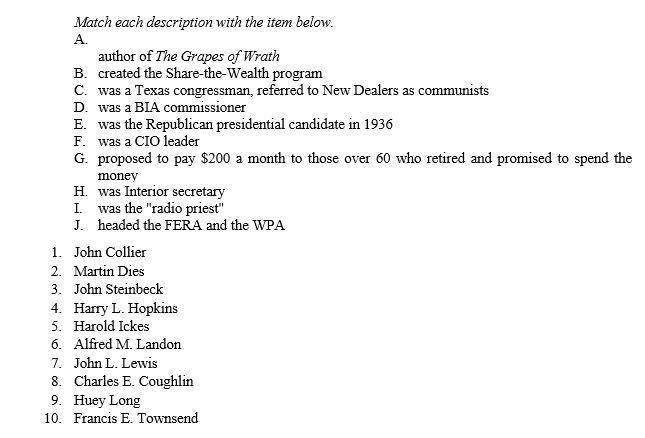
Match each description with the item below.
Question

Unlock Deck
Sign up to unlock the cards in this deck!
Unlock Deck
Unlock Deck
1/77

Play

Full screen (f)
Deck 27: New Deal America
1
In 1932 what was the percentage of American's unemployed:
A) 25
B) 35
C) 15
D) 40
E) 50
A) 25
B) 35
C) 15
D) 40
E) 50
25
2
Which of the following were NOT members of the "brain trust"?
A) professors
B) planners
C) policy makers
D) administrators
E) union members
A) professors
B) planners
C) policy makers
D) administrators
E) union members
union members
3
FDR called the Social Security Act the "supreme achievement" of the New Deal.
True
4
The AAA required farmers to donate surplus crops and livestock to feed the poor.
Unlock Deck
Unlock for access to all 77 flashcards in this deck.
Unlock Deck
k this deck
5
John Steinbeck's The Grapes of Wrath told of Wall Street businessmen brought to their knees after Black Tuesday.
Unlock Deck
Unlock for access to all 77 flashcards in this deck.
Unlock Deck
k this deck
6
Despite the New Deal, full recovery from the Depression did not come until the crisis of World War II.
Unlock Deck
Unlock for access to all 77 flashcards in this deck.
Unlock Deck
k this deck
7
All of the following is true of the National Youth Administration EXCEPT:
A) it provided part-time employment to students
B) it was part of the WPA
C) it set up technical training programs
D) it was the parent organization for the CCC
E) it provided Richard Nixon with a job
A) it provided part-time employment to students
B) it was part of the WPA
C) it set up technical training programs
D) it was the parent organization for the CCC
E) it provided Richard Nixon with a job
Unlock Deck
Unlock for access to all 77 flashcards in this deck.
Unlock Deck
k this deck
8
At the outset of his presidency, to deal with the banking crisis, Roosevelt:
A) pushed through a bank bailout bill worth more than $7 billion
B) used his emergency powers to nationalize the banking industry
C) put strict limits on the issuance of paper currency
D) ordered the Federal Reserve Board to lower interest rates
E) declared a bank holiday, shutting the banks down briefly
A) pushed through a bank bailout bill worth more than $7 billion
B) used his emergency powers to nationalize the banking industry
C) put strict limits on the issuance of paper currency
D) ordered the Federal Reserve Board to lower interest rates
E) declared a bank holiday, shutting the banks down briefly
Unlock Deck
Unlock for access to all 77 flashcards in this deck.
Unlock Deck
k this deck
9
Although the New Deal initiatives produced mixed results, they halted the economic downturn and provided the foundation for a system of federal social welfare programs.
Unlock Deck
Unlock for access to all 77 flashcards in this deck.
Unlock Deck
k this deck
10
By 1935, the NRA had become unpopular.
Unlock Deck
Unlock for access to all 77 flashcards in this deck.
Unlock Deck
k this deck
11
The CCC addressed the problem of overcharging by doctors and others in the medical and health professions.
Unlock Deck
Unlock for access to all 77 flashcards in this deck.
Unlock Deck
k this deck
12
The American Liberty League opposed New Deal measures as violations of personal and property rights.
Unlock Deck
Unlock for access to all 77 flashcards in this deck.
Unlock Deck
k this deck
13
The Wagner Act helped dramatically boost union membership.
Unlock Deck
Unlock for access to all 77 flashcards in this deck.
Unlock Deck
k this deck
14
By executive decree, Roosevelt reorganized all federal farm credit agencies into the Farm Credit Administration.
Unlock Deck
Unlock for access to all 77 flashcards in this deck.
Unlock Deck
k this deck
15
The Fair Labor Standards Act forbade racial discrimination in hiring.
Unlock Deck
Unlock for access to all 77 flashcards in this deck.
Unlock Deck
k this deck
16
FDR made black civil rights a major priority, ordering that New Deal programs not practice racial discrimination.
Unlock Deck
Unlock for access to all 77 flashcards in this deck.
Unlock Deck
k this deck
17
Eleanor Roosevelt was a shy person who shunned attention, but she did much work behind the scenes to raise support for her husband's New Deal.
Unlock Deck
Unlock for access to all 77 flashcards in this deck.
Unlock Deck
k this deck
18
The main purpose of the Civilian Conservation Corps was to:
A) train young men for the Army Corps of Engineers
B) provide work relief for young men
C) give young women an opportunity to earn money for higher education
D) promote conservation practices by the general public
E) build environmental education projects at the first national parks
A) train young men for the Army Corps of Engineers
B) provide work relief for young men
C) give young women an opportunity to earn money for higher education
D) promote conservation practices by the general public
E) build environmental education projects at the first national parks
Unlock Deck
Unlock for access to all 77 flashcards in this deck.
Unlock Deck
k this deck
19
By the end of the 1930s, FDR's New Deal had pushed the country a large way toward socialism.
Unlock Deck
Unlock for access to all 77 flashcards in this deck.
Unlock Deck
k this deck
20
Early in his presidency, Roosevelt ended Prohibition.
Unlock Deck
Unlock for access to all 77 flashcards in this deck.
Unlock Deck
k this deck
21
Huey Long:
A) developed a program called Share the Wealth
B) founded the National Union for Social Justice
C) challenged FDR for the Democratic presidential nomination in 1936
D) complained that the New Deal had gone too far by infringing on "the rights of persons and property"
E) called Social Security a "socialistic share-the-wealth program"
A) developed a program called Share the Wealth
B) founded the National Union for Social Justice
C) challenged FDR for the Democratic presidential nomination in 1936
D) complained that the New Deal had gone too far by infringing on "the rights of persons and property"
E) called Social Security a "socialistic share-the-wealth program"
Unlock Deck
Unlock for access to all 77 flashcards in this deck.
Unlock Deck
k this deck
22
The Marx Brothers:
A) came up with the most revolutionary theory in the history of labor relations
B) consisted of Curly, Larry, and Moe
C) produced some of the most serious dramatic films of the thirties
D) typified the German communists at work in Detroit's unions
E) produced plotless masterpieces of irreverent satire
A) came up with the most revolutionary theory in the history of labor relations
B) consisted of Curly, Larry, and Moe
C) produced some of the most serious dramatic films of the thirties
D) typified the German communists at work in Detroit's unions
E) produced plotless masterpieces of irreverent satire
Unlock Deck
Unlock for access to all 77 flashcards in this deck.
Unlock Deck
k this deck
23
Codes of fair practice were part of:
A) FDIC
B) HOLC
C) NRA
D) PWA
E) WPA
A) FDIC
B) HOLC
C) NRA
D) PWA
E) WPA
Unlock Deck
Unlock for access to all 77 flashcards in this deck.
Unlock Deck
k this deck
24
The fair practices codes of the NRA did all of the following EXCEPT:
A) prohibit child labor
B) establish minimum wages of $13 per week
C) set a forty-hour work week
D) break up large corporations
E) establish minimum wages of $12 per week in the South
A) prohibit child labor
B) establish minimum wages of $13 per week
C) set a forty-hour work week
D) break up large corporations
E) establish minimum wages of $12 per week in the South
Unlock Deck
Unlock for access to all 77 flashcards in this deck.
Unlock Deck
k this deck
25
One drawback of the Tennessee Valley Authority was that:
A) a drought could cause electricity rates to increase
B) it forced people to move if their land was needed for dams and lakes
C) Tennessee became one of the most polluted states in the nation
D) it put all of the private power companies in the South out of business
E) Alabama refused to accept "socialized electricity"
A) a drought could cause electricity rates to increase
B) it forced people to move if their land was needed for dams and lakes
C) Tennessee became one of the most polluted states in the nation
D) it put all of the private power companies in the South out of business
E) Alabama refused to accept "socialized electricity"
Unlock Deck
Unlock for access to all 77 flashcards in this deck.
Unlock Deck
k this deck
26
The goal of the Agricultural Adjustment Act of 1933 was to raise farm income mainly through:
A) cutbacks in production
B) intensive farming
C) a government takeover of the commodity trade in Chicago
D) state and federal subsidies
E) marketing quotas
A) cutbacks in production
B) intensive farming
C) a government takeover of the commodity trade in Chicago
D) state and federal subsidies
E) marketing quotas
Unlock Deck
Unlock for access to all 77 flashcards in this deck.
Unlock Deck
k this deck
27
During the Depression, the U.S. government deported 500,000 Mexican Americans and their American-born children because:
A) officials wanted to protect them from the KKK in Texas and New Mexico
B) officials wanted to avoid the costs of providing them with public service
C) officials wanted to put Okies to work in the California cotton fields
D) officials felt that the race tensions in American cities was too great
E) officials were worried that Mexico might attempt to reclaim Arizona
A) officials wanted to protect them from the KKK in Texas and New Mexico
B) officials wanted to avoid the costs of providing them with public service
C) officials wanted to put Okies to work in the California cotton fields
D) officials felt that the race tensions in American cities was too great
E) officials were worried that Mexico might attempt to reclaim Arizona
Unlock Deck
Unlock for access to all 77 flashcards in this deck.
Unlock Deck
k this deck
28
The 1937 economic slump was caused in part by:
A) a sharp decrease in government spending
B) a sharp rise in private spending
C) the huge government deficit
D) the repeal of the Revenue Act of 1935
E) the announcement that Social Security payroll taxes would be postponed
A) a sharp decrease in government spending
B) a sharp rise in private spending
C) the huge government deficit
D) the repeal of the Revenue Act of 1935
E) the announcement that Social Security payroll taxes would be postponed
Unlock Deck
Unlock for access to all 77 flashcards in this deck.
Unlock Deck
k this deck
29
Richard Wright:
A) led the conservative outcry against New Deal business regulation
B) starred in the original version of Scarface
C) wrote Native Son, a story of racial prejudice
D) was the outspoken head of the Farm Security Administration
E) was the economist who originally dreamed up Social Security
A) led the conservative outcry against New Deal business regulation
B) starred in the original version of Scarface
C) wrote Native Son, a story of racial prejudice
D) was the outspoken head of the Farm Security Administration
E) was the economist who originally dreamed up Social Security
Unlock Deck
Unlock for access to all 77 flashcards in this deck.
Unlock Deck
k this deck
30
To earn the federal payments for reducing crops:
A) tenants and sharecroppers had to stick with lucrative staples such as cotton
B) farmers had to let fields go idle for three years in a row
C) many landowners kicked off black tenants in favor of whites
D) farmers often starved because they were not allowed to grow even small vegetable gardens
E) many landowners took their leased lands out of production
A) tenants and sharecroppers had to stick with lucrative staples such as cotton
B) farmers had to let fields go idle for three years in a row
C) many landowners kicked off black tenants in favor of whites
D) farmers often starved because they were not allowed to grow even small vegetable gardens
E) many landowners took their leased lands out of production
Unlock Deck
Unlock for access to all 77 flashcards in this deck.
Unlock Deck
k this deck
31
All of the following were objectives of the Tennessee Valley Authority EXCEPT:
A) the production of cheap electric power
B) opening rivers to boats and barges
C) flood control
D) soil conservation and forestry
E) the development of Smoky Mountain National Park
A) the production of cheap electric power
B) opening rivers to boats and barges
C) flood control
D) soil conservation and forestry
E) the development of Smoky Mountain National Park
Unlock Deck
Unlock for access to all 77 flashcards in this deck.
Unlock Deck
k this deck
32
The literary work that best captured the ordeal of the Depression was The Grapes of Wrath by:
A) Lucy Mercer
B) Margaret Mitchell
C) Paul Muni
D) William Faulkner
E) John Steinbeck
A) Lucy Mercer
B) Margaret Mitchell
C) Paul Muni
D) William Faulkner
E) John Steinbeck
Unlock Deck
Unlock for access to all 77 flashcards in this deck.
Unlock Deck
k this deck
33
One third of the "Okies":
A) died in California in 1937 and 1938
B) faked their status in order to get free food
C) returned to their home states
D) ended up working as miners in the Sierra
E) never made it to California
A) died in California in 1937 and 1938
B) faked their status in order to get free food
C) returned to their home states
D) ended up working as miners in the Sierra
E) never made it to California
Unlock Deck
Unlock for access to all 77 flashcards in this deck.
Unlock Deck
k this deck
34
In the case of Norris v. Alabama, the Supreme Court:
A) upheld the state's Democratic white primary
B) overturned a state law restricting the sale of petroleum products beyond certain quotas
C) upheld Alabama's claim that the Scottsboro Boys were not entitled to public defenders
D) dealt a major blow to FDR's New Deal
E) ruled that the systematic exclusion of blacks from juries denied Scottsboro defendants equal protection of the law
A) upheld the state's Democratic white primary
B) overturned a state law restricting the sale of petroleum products beyond certain quotas
C) upheld Alabama's claim that the Scottsboro Boys were not entitled to public defenders
D) dealt a major blow to FDR's New Deal
E) ruled that the systematic exclusion of blacks from juries denied Scottsboro defendants equal protection of the law
Unlock Deck
Unlock for access to all 77 flashcards in this deck.
Unlock Deck
k this deck
35
The Indian Reorganization Act:
A) attempted to reinvigorate traditional Native American cultures
B) broke up tribal lands and allocated them to individuals
C) had the support of western congressmen and assimilated Indians
D) was the brainchild of Henry Dawes
E) reorganized tribal leaders into nonvoting members of Congress
A) attempted to reinvigorate traditional Native American cultures
B) broke up tribal lands and allocated them to individuals
C) had the support of western congressmen and assimilated Indians
D) was the brainchild of Henry Dawes
E) reorganized tribal leaders into nonvoting members of Congress
Unlock Deck
Unlock for access to all 77 flashcards in this deck.
Unlock Deck
k this deck
36
The greatest failure of the New Deal was its inability to:
A) restore economic prosperity and end record levels of unemployment
B) end segregation
C) be duplicated in Europe
D) prevent World War II
E) end partisan politics
A) restore economic prosperity and end record levels of unemployment
B) end segregation
C) be duplicated in Europe
D) prevent World War II
E) end partisan politics
Unlock Deck
Unlock for access to all 77 flashcards in this deck.
Unlock Deck
k this deck
37
The dust bowl can be associated with:
A) large migrations from the impacted area to the Atlantic coast
B) terrible storms that plagued the Great Basin
C) a severe blow to farmers in Illinois, Ohio, and Wisconsin
D) the blowing away of millions of acres of topsoil
E) a movie made by the WPA filmmaker Ansel Adams
A) large migrations from the impacted area to the Atlantic coast
B) terrible storms that plagued the Great Basin
C) a severe blow to farmers in Illinois, Ohio, and Wisconsin
D) the blowing away of millions of acres of topsoil
E) a movie made by the WPA filmmaker Ansel Adams
Unlock Deck
Unlock for access to all 77 flashcards in this deck.
Unlock Deck
k this deck
38
This organization sought to set workplace standards, such as child labor restrictions:
A) AAA
B) FERA
C) NRA
D) WPA
E) CCC
A) AAA
B) FERA
C) NRA
D) WPA
E) CCC
Unlock Deck
Unlock for access to all 77 flashcards in this deck.
Unlock Deck
k this deck
39
Who served as Interior Secretary under FDR?
A) Henry Morgenthau
B) Arthur Laffer
C) Milton Friedman
D) John Maynard Keynes
E) Harold Ickes
A) Henry Morgenthau
B) Arthur Laffer
C) Milton Friedman
D) John Maynard Keynes
E) Harold Ickes
Unlock Deck
Unlock for access to all 77 flashcards in this deck.
Unlock Deck
k this deck
40
What made the dust storms worse than normal was the transition during the early twentieth century from:
A) widespread industrial agriculture to scattered subsistence farming
B) fertilization to naturalization
C) widespread scattered subsistence farming to industrial agriculture
D) forests to clear cuts across the Great Plains
E) plowing with iron blades to plowing with steel blades
A) widespread industrial agriculture to scattered subsistence farming
B) fertilization to naturalization
C) widespread scattered subsistence farming to industrial agriculture
D) forests to clear cuts across the Great Plains
E) plowing with iron blades to plowing with steel blades
Unlock Deck
Unlock for access to all 77 flashcards in this deck.
Unlock Deck
k this deck
41
Which of the following refused to apply for a Social Security card?
A) Al Smith
B) Herbert Hoover
C) Theodore Roosevelt
D) Eugene Debs
E) Franklin D. Roosevelt
A) Al Smith
B) Herbert Hoover
C) Theodore Roosevelt
D) Eugene Debs
E) Franklin D. Roosevelt
Unlock Deck
Unlock for access to all 77 flashcards in this deck.
Unlock Deck
k this deck
42
Eleanor Roosevelt:
A) primarily played the role of White House hostess
B) had more influence than her husband in shaping New Deal policies
C) was an official member of FDR's cabinet
D) was especially supportive of women, blacks, and youth
E) became most famous for her "fireside chats"
A) primarily played the role of White House hostess
B) had more influence than her husband in shaping New Deal policies
C) was an official member of FDR's cabinet
D) was especially supportive of women, blacks, and youth
E) became most famous for her "fireside chats"
Unlock Deck
Unlock for access to all 77 flashcards in this deck.
Unlock Deck
k this deck
43
Roosevelt's court-packing scheme became unnecessary when:
A) the Supreme Court ruled that the president, and not Congress, has authority to adjust the number of justices
B) the Supreme Court agreed to an extension of the number of justices
C) Congress removed cases involving the New Deal from the Supreme Court's jurisdiction
D) the Supreme Court began reversing previous judgments and upholding the New Deal
E) he began using executive orders to circumvent the Supreme Court
A) the Supreme Court ruled that the president, and not Congress, has authority to adjust the number of justices
B) the Supreme Court agreed to an extension of the number of justices
C) Congress removed cases involving the New Deal from the Supreme Court's jurisdiction
D) the Supreme Court began reversing previous judgments and upholding the New Deal
E) he began using executive orders to circumvent the Supreme Court
Unlock Deck
Unlock for access to all 77 flashcards in this deck.
Unlock Deck
k this deck
44
The Farm Security Administration:
A) administered the Agricultural Adjustment Act of 1937 (the "Second AAA")
B) offered loans to marginal farmers (so they could avoid falling into tenancy) and to tenant farmers (so they could purchase their own farms)
C) provided federal subsidies for the expansion of large farms
D) established educational programs to teach farmers new agricultural methods
E) concentrated on rehabilitating devastated soils on the Great Plains
A) administered the Agricultural Adjustment Act of 1937 (the "Second AAA")
B) offered loans to marginal farmers (so they could avoid falling into tenancy) and to tenant farmers (so they could purchase their own farms)
C) provided federal subsidies for the expansion of large farms
D) established educational programs to teach farmers new agricultural methods
E) concentrated on rehabilitating devastated soils on the Great Plains
Unlock Deck
Unlock for access to all 77 flashcards in this deck.
Unlock Deck
k this deck
45
The National Labor Relations Act:
A) was upheld by the Supreme Court in United States v. Butler
B) gave jobs to several thousand unemployed miners
C) was often called the Wagner Act
D) was struck down by the Supreme Court in 1935
E) gave employers the right to control union activities
A) was upheld by the Supreme Court in United States v. Butler
B) gave jobs to several thousand unemployed miners
C) was often called the Wagner Act
D) was struck down by the Supreme Court in 1935
E) gave employers the right to control union activities
Unlock Deck
Unlock for access to all 77 flashcards in this deck.
Unlock Deck
k this deck
46
In the presidential election of 1936:
A) African Americans voted overwhelmingly Republican for the first time since Reconstruction
B) Republicans won most of the western farm vote and almost upset Roosevelt
C) Republicans hoped that third-party candidates might split the Democratic vote and throw the election to them
D) Socialist and Communist candidates together received over 2 million votes
E) Roosevelt's illness put vice-presidential candidate Harry Truman in the spotlight
A) African Americans voted overwhelmingly Republican for the first time since Reconstruction
B) Republicans won most of the western farm vote and almost upset Roosevelt
C) Republicans hoped that third-party candidates might split the Democratic vote and throw the election to them
D) Socialist and Communist candidates together received over 2 million votes
E) Roosevelt's illness put vice-presidential candidate Harry Truman in the spotlight
Unlock Deck
Unlock for access to all 77 flashcards in this deck.
Unlock Deck
k this deck
47
Charles E. Coughlin:
A) was the "radio priest"
B) headed the TVA
C) headed the BIA
D) wrote Uncle Tom's Children
E) ran on the Union ticket with Huey Long
A) was the "radio priest"
B) headed the TVA
C) headed the BIA
D) wrote Uncle Tom's Children
E) ran on the Union ticket with Huey Long
Unlock Deck
Unlock for access to all 77 flashcards in this deck.
Unlock Deck
k this deck
48
In the case of Schechter Poultry Corporation v. United States, the Supreme Court:
A) overturned the Farm Credit Act
B) overturned the National Industrial Recovery Act
C) decided that Schechter was involved in interstate, not local, trade
D) upheld the constitutionality of the second Agricultural Adjustment Act
E) said that the Agricultural Adjustment Act was unconstitutional
A) overturned the Farm Credit Act
B) overturned the National Industrial Recovery Act
C) decided that Schechter was involved in interstate, not local, trade
D) upheld the constitutionality of the second Agricultural Adjustment Act
E) said that the Agricultural Adjustment Act was unconstitutional
Unlock Deck
Unlock for access to all 77 flashcards in this deck.
Unlock Deck
k this deck
49
The social worker who headed the WPA at its creation in 1935 was:
A) Frances Perkins
B) John Nance Garner
C) Henry Wallace
D) Hugh Johnson
E) Harry Hopkins
A) Frances Perkins
B) John Nance Garner
C) Henry Wallace
D) Hugh Johnson
E) Harry Hopkins
Unlock Deck
Unlock for access to all 77 flashcards in this deck.
Unlock Deck
k this deck
50
Like Huey Long, Charles Coughlin:
A) appealed to people who had lost the most during the Great Depression
B) emphasized tax breaks for big business
C) was involved in the creation of a fascist dictatorship
D) called for unadulterated free-market capitalism
E) was involved in closing down Wall Street brokerage firms
A) appealed to people who had lost the most during the Great Depression
B) emphasized tax breaks for big business
C) was involved in the creation of a fascist dictatorship
D) called for unadulterated free-market capitalism
E) was involved in closing down Wall Street brokerage firms
Unlock Deck
Unlock for access to all 77 flashcards in this deck.
Unlock Deck
k this deck
51
In the 1936 election, Roosevelt wound up carrying every state except:
A) Maine and Ohio
B) Iowa and Vermont
C) Maine and Vermont
D) New Jersey and Florida
E) Texas and Utah
A) Maine and Ohio
B) Iowa and Vermont
C) Maine and Vermont
D) New Jersey and Florida
E) Texas and Utah
Unlock Deck
Unlock for access to all 77 flashcards in this deck.
Unlock Deck
k this deck
52
Which is true of the 1936 presidential election?
A) FDR was reelected, but Republicans made big gains in Congress.
B) Huey Long ran one of the strongest third-party campaigns in history.
C) FDR defeated Alf Landon in a landslide.
D) Concerns over the coming war in Europe dominated the campaign.
E) FDR won every state but Texas.
A) FDR was reelected, but Republicans made big gains in Congress.
B) Huey Long ran one of the strongest third-party campaigns in history.
C) FDR defeated Alf Landon in a landslide.
D) Concerns over the coming war in Europe dominated the campaign.
E) FDR won every state but Texas.
Unlock Deck
Unlock for access to all 77 flashcards in this deck.
Unlock Deck
k this deck
53
The Revenue Act of 1935 (sometimes called the Wealth-Tax Act):
A) provided for a regressive tax
B) increased federal revenue significantly and thus helped finance the New Deal
C) raised taxes on incomes above $50,000
D) created a more equal distribution of wealth in America
E) was an FDR response to Long's "soak-the-rich tax"
A) provided for a regressive tax
B) increased federal revenue significantly and thus helped finance the New Deal
C) raised taxes on incomes above $50,000
D) created a more equal distribution of wealth in America
E) was an FDR response to Long's "soak-the-rich tax"
Unlock Deck
Unlock for access to all 77 flashcards in this deck.
Unlock Deck
k this deck
54
All of the following writers EXCEPT two (listed as a pair below) found work writing travel guides for the Federal Writers' Project:
A) Ernest Hemingway and John Cheever
B) Ralph Ellison and Saul Bellow
C) John Cheever and Eugene O'Neil
D) Eugene O'Neil and Ernest Hemingway
E) Saul Bellow and John Cheever
A) Ernest Hemingway and John Cheever
B) Ralph Ellison and Saul Bellow
C) John Cheever and Eugene O'Neil
D) Eugene O'Neil and Ernest Hemingway
E) Saul Bellow and John Cheever
Unlock Deck
Unlock for access to all 77 flashcards in this deck.
Unlock Deck
k this deck
55
Who was known as "Kingfish"?
A) Charles Coughlin
B) Theodore Roosevelt
C) Huey Long
D) Francis Townsend
E) Al Smith
A) Charles Coughlin
B) Theodore Roosevelt
C) Huey Long
D) Francis Townsend
E) Al Smith
Unlock Deck
Unlock for access to all 77 flashcards in this deck.
Unlock Deck
k this deck
56
Which of the following statements about the Social Security Act is NOT true?
A) It was, according to Roosevelt, the "supreme achievement" of the New Deal.
B) It committed the national government to a broad range of welfare activities.
C) It provided old-age pensions.
D) It was based on a progressive tax that took a larger percentage of higher incomes.
E) It was a regressive tax that pinched the poor more than the rich.
A) It was, according to Roosevelt, the "supreme achievement" of the New Deal.
B) It committed the national government to a broad range of welfare activities.
C) It provided old-age pensions.
D) It was based on a progressive tax that took a larger percentage of higher incomes.
E) It was a regressive tax that pinched the poor more than the rich.
Unlock Deck
Unlock for access to all 77 flashcards in this deck.
Unlock Deck
k this deck
57
Conservatives lambasted the Social Security Act as:
A) an unfair tax
B) communistic
C) pure socialism
D) tyrannical
E) fascism
A) an unfair tax
B) communistic
C) pure socialism
D) tyrannical
E) fascism
Unlock Deck
Unlock for access to all 77 flashcards in this deck.
Unlock Deck
k this deck
58
Labor's new direction in the late 1930s was toward:
A) decentralization of union organization
B) industrial unions
C) women in unions
D) the Republican party
E) craft unions
A) decentralization of union organization
B) industrial unions
C) women in unions
D) the Republican party
E) craft unions
Unlock Deck
Unlock for access to all 77 flashcards in this deck.
Unlock Deck
k this deck
59
The "sit-down strike" was used successfully in 1937 by:
A) black workers
B) southern workers
C) steel workers
D) automobile workers
E) western miners
A) black workers
B) southern workers
C) steel workers
D) automobile workers
E) western miners
Unlock Deck
Unlock for access to all 77 flashcards in this deck.
Unlock Deck
k this deck
60
In early 1937, FDR proposed to reform the Supreme Court by:
A) requiring justices to retire at age 70
B) adding up to six additional members
C) removing justices appointed by previous presidents
D) making justices regularly run for election
E) requiring Senate confirmation hearings
A) requiring justices to retire at age 70
B) adding up to six additional members
C) removing justices appointed by previous presidents
D) making justices regularly run for election
E) requiring Senate confirmation hearings
Unlock Deck
Unlock for access to all 77 flashcards in this deck.
Unlock Deck
k this deck
61
Match between columns
Unlock Deck
Unlock for access to all 77 flashcards in this deck.
Unlock Deck
k this deck
62
Describe the impact the Great Depression had on popular culture in America.
Unlock Deck
Unlock for access to all 77 flashcards in this deck.
Unlock Deck
k this deck
63
Although the New Deal programs helped ease the devastation wrought by the Depression, some widespread human suffering continued. Discuss this suffering and the hardships Americans still faced.
Unlock Deck
Unlock for access to all 77 flashcards in this deck.
Unlock Deck
k this deck
64
The Fair Labor Standards Act of 1938:
A) set a minimum wage of forty cents an hour
B) protected workers' right to form unions
C) was declared unconstitutional by the Supreme Court
D) required equal pay for female workers
E) prohibited the employment of children under the age of twelve
A) set a minimum wage of forty cents an hour
B) protected workers' right to form unions
C) was declared unconstitutional by the Supreme Court
D) required equal pay for female workers
E) prohibited the employment of children under the age of twelve
Unlock Deck
Unlock for access to all 77 flashcards in this deck.
Unlock Deck
k this deck
65
How did the nation's perceptions of the role of government-its powers and responsibilities-change in the 1930s?
Unlock Deck
Unlock for access to all 77 flashcards in this deck.
Unlock Deck
k this deck
66
How did the "thunder from the political left" shape New Deal policies?
Unlock Deck
Unlock for access to all 77 flashcards in this deck.
Unlock Deck
k this deck
67
Describe the various measures that President Roosevelt undertook in his first term to help relieve the human misery in America.
Unlock Deck
Unlock for access to all 77 flashcards in this deck.
Unlock Deck
k this deck
68
Discuss the impact the New Deal had on immoralities in the United States.
Unlock Deck
Unlock for access to all 77 flashcards in this deck.
Unlock Deck
k this deck
69
By the end of 1937, which group had coalesced against the New Deal?
A) African Americans
B) liberal Democrats
C) all western Democrats
D) Populist party members
E) a bipartisan conservative bloc
A) African Americans
B) liberal Democrats
C) all western Democrats
D) Populist party members
E) a bipartisan conservative bloc
Unlock Deck
Unlock for access to all 77 flashcards in this deck.
Unlock Deck
k this deck
70
Describe the gains made by labor during the New Deal.
Unlock Deck
Unlock for access to all 77 flashcards in this deck.
Unlock Deck
k this deck
71
In 1938, Martin Dies, a congressman from Texas, used to brand New Dealers as .
A) the radio; too conservative
B) the Ways and Means Committee; spendthrifts
C) the Republican national convention; socialists
D) the Committee on Un-American Activities; Communists
E) a newspaper column; traitors
A) the radio; too conservative
B) the Ways and Means Committee; spendthrifts
C) the Republican national convention; socialists
D) the Committee on Un-American Activities; Communists
E) a newspaper column; traitors
Unlock Deck
Unlock for access to all 77 flashcards in this deck.
Unlock Deck
k this deck
72
How did New Deal reforms attempt to raise farm prices and stabilize industry?
Unlock Deck
Unlock for access to all 77 flashcards in this deck.
Unlock Deck
k this deck
73
Describe the "First Hundred Days" of FDR's presidency. What, if any, accomplishments did he have?
Unlock Deck
Unlock for access to all 77 flashcards in this deck.
Unlock Deck
k this deck
74
In the elections of 1938:
A) Roosevelt was defeated in his bid for reelection
B) Roosevelt's attempts to "purge" the Democratic party were largely unsuccessful
C) Republicans won control of the House and the Democrats kept a majority of only two in the Senate
D) Republicans won control of the Senate and Democrats kept a majority of only two in the House
E) Roosevelt's decision to run for a third time led to Republicans calling him a fascist
A) Roosevelt was defeated in his bid for reelection
B) Roosevelt's attempts to "purge" the Democratic party were largely unsuccessful
C) Republicans won control of the House and the Democrats kept a majority of only two in the Senate
D) Republicans won control of the Senate and Democrats kept a majority of only two in the House
E) Roosevelt's decision to run for a third time led to Republicans calling him a fascist
Unlock Deck
Unlock for access to all 77 flashcards in this deck.
Unlock Deck
k this deck
75
Why did Roosevelt attempt to "pack" the Supreme Court? Did he achieve his goals?
Unlock Deck
Unlock for access to all 77 flashcards in this deck.
Unlock Deck
k this deck
76
MATCHING
Match each description with the item below.
Match each description with the item below.
Unlock Deck
Unlock for access to all 77 flashcards in this deck.
Unlock Deck
k this deck
76
The conservative Democratic opposition to the New Deal in the late 1930s:
A) was heaviest in the South
B) succeeded in removing three of Roosevelt's cabinet members
C) supported plans to replace Roosevelt with Henry Wallace as the Democratic presidential candidate in 1936
D) supported plans to replace Roosevelt with Huey Long as the Democratic presidential candidate in 1936
E) was heaviest in New England
A) was heaviest in the South
B) succeeded in removing three of Roosevelt's cabinet members
C) supported plans to replace Roosevelt with Henry Wallace as the Democratic presidential candidate in 1936
D) supported plans to replace Roosevelt with Huey Long as the Democratic presidential candidate in 1936
E) was heaviest in New England
Unlock Deck
Unlock for access to all 77 flashcards in this deck.
Unlock Deck
k this deck
Unlock Deck
Unlock for access to all 77 flashcards in this deck.






