







 Chat with AI

Deck 30: Plant Diversity Ii: the Evolution of Seed Plants
Full screen (f)

Question

Question
Question
Question
Question
Question
Question
Question
Question
Question
Question
Question
Question
Question
Question
Question
Question
Question
Question
Question
Question
Question
Question
Question
Question
Question
Question
Question
Question
Question
Question
Question
Question
Question
Question
Question
Question
Question
Question
Question
Question
Question
Question
Use the following information to answer the questions below.
The following questions refer to the generalized life cycle for land plants shown in the figure below. Each number within a circle or square represents a specific plant or plant part, and each number over an arrow represents either meiosis, mitosis, or fertilization.
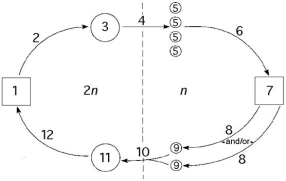
In the figure above, which number represents the mature gametophyte?
A)1
B)3
C)5
D)7
E)11
The following questions refer to the generalized life cycle for land plants shown in the figure below. Each number within a circle or square represents a specific plant or plant part, and each number over an arrow represents either meiosis, mitosis, or fertilization.
In the figure above, which number represents the mature gametophyte?
A)1
B)3
C)5
D)7
E)11
Question
Question
Question
Question
Question
Question
Question
Question
Question
Question
Question
Question
Question
Question
Question
Question
Question
Question
Question
Question
Question
Question
Question
Use the following information to answer the questions below.
The following questions refer to the generalized life cycle for land plants shown in the figure below. Each number within a circle or square represents a specific plant or plant part, and each number over an arrow represents either meiosis, mitosis, or fertilization.
In the figure above, which number represents an embryo?
A)1
B)3
C)7
D)9
E)11
The following questions refer to the generalized life cycle for land plants shown in the figure below. Each number within a circle or square represents a specific plant or plant part, and each number over an arrow represents either meiosis, mitosis, or fertilization.
In the figure above, which number represents an embryo?
A)1
B)3
C)7
D)9
E)11
Question
Question
Question
Use the following information to answer the questions below.
The following questions refer to the generalized life cycle for land plants shown in the figure below. Each number within a circle or square represents a specific plant or plant part, and each number over an arrow represents either meiosis, mitosis, or fertilization.
The embryo sac of an angiosperm flower is best represented by which number in the above figure?
A)1
B)3
C)7
D)9
E)11
The following questions refer to the generalized life cycle for land plants shown in the figure below. Each number within a circle or square represents a specific plant or plant part, and each number over an arrow represents either meiosis, mitosis, or fertilization.
The embryo sac of an angiosperm flower is best represented by which number in the above figure?
A)1
B)3
C)7
D)9
E)11
Question
Use the following information to answer the questions below.
The following questions refer to the generalized life cycle for land plants shown in the figure below. Each number within a circle or square represents a specific plant or plant part, and each number over an arrow represents either meiosis, mitosis, or fertilization.
In the figure above, the process labelled "6" involves
A)nuclear fission.
B)mitosis.
C)meiosis.
D)fertilization.
E)binary fission.
The following questions refer to the generalized life cycle for land plants shown in the figure below. Each number within a circle or square represents a specific plant or plant part, and each number over an arrow represents either meiosis, mitosis, or fertilization.
In the figure above, the process labelled "6" involves
A)nuclear fission.
B)mitosis.
C)meiosis.
D)fertilization.
E)binary fission.
Question
Question
Question
Question
Question
Question
Use the following information to answer the questions below.
The following questions refer to the generalized life cycle for land plants shown in the figure below. Each number within a circle or square represents a specific plant or plant part, and each number over an arrow represents either meiosis, mitosis, or fertilization.
In angiosperms, which number in the above figure most nearly represents the event that initiates the formation of endosperm?
A)4
B)6
C)8
D)10
E)12
The following questions refer to the generalized life cycle for land plants shown in the figure below. Each number within a circle or square represents a specific plant or plant part, and each number over an arrow represents either meiosis, mitosis, or fertilization.
In angiosperms, which number in the above figure most nearly represents the event that initiates the formation of endosperm?
A)4
B)6
C)8
D)10
E)12
Question
Use the following information to answer the questions below.
The following questions refer to the generalized life cycle for land plants shown in the figure below. Each number within a circle or square represents a specific plant or plant part, and each number over an arrow represents either meiosis, mitosis, or fertilization.
Which number represents a megaspore mother cell in the figure above?
A)1
B)3
C)5
D)7
E)11
The following questions refer to the generalized life cycle for land plants shown in the figure below. Each number within a circle or square represents a specific plant or plant part, and each number over an arrow represents either meiosis, mitosis, or fertilization.
Which number represents a megaspore mother cell in the figure above?
A)1
B)3
C)5
D)7
E)11
Question
Question
Use the following information to answer the questions below.
The following questions refer to the generalized life cycle for land plants shown in the figure below. Each number within a circle or square represents a specific plant or plant part, and each number over an arrow represents either meiosis, mitosis, or fertilization.
Meiosis is most likely to be represented by which number(s)in the figure above?
A)2
B)4
C)2 and 8
D)4 and 8
E)10 and 12
The following questions refer to the generalized life cycle for land plants shown in the figure below. Each number within a circle or square represents a specific plant or plant part, and each number over an arrow represents either meiosis, mitosis, or fertilization.
Meiosis is most likely to be represented by which number(s)in the figure above?
A)2
B)4
C)2 and 8
D)4 and 8
E)10 and 12
Question

Unlock Deck
Sign up to unlock the cards in this deck!
Unlock Deck
Unlock Deck
1/110

Play

Full screen (f)
Deck 30: Plant Diversity Ii: the Evolution of Seed Plants
1
All of the following cellular structures are functionally important in cells of the gametophytes of both angiosperms and gymnosperms except
A)haploid nuclei.
B)mitochondria.
C)cell walls.
D)chloroplasts.
E)peroxisomes.
A)haploid nuclei.
B)mitochondria.
C)cell walls.
D)chloroplasts.
E)peroxisomes.
D
2
Which of the following is most important in making the typical seed more resistant to adverse conditions than the typical spore?
A)a different type of sporopollenin
B)an internal reservoir of liquid water
C)integument(s)
D)ability to be dispersed
E)waxy cuticle
A)a different type of sporopollenin
B)an internal reservoir of liquid water
C)integument(s)
D)ability to be dispersed
E)waxy cuticle
C
3
A researcher has developed two stains for use with seed plants. One stains sporophyte tissue blue; the other stains gametophyte tissue red. If the researcher exposes pollen grains to both stains, and then rinses away the excess stain, what should occur?
A)The pollen grains will be pure red.
B)The pollen grains will be pure blue.
C)The pollen grains will have red interiors and blue exteriors.
D)The pollen grains will have blue interiors and red exteriors.
E)Insofar as the pollen grains are independent of the plant that produced them, they will not absorb either stain.
A)The pollen grains will be pure red.
B)The pollen grains will be pure blue.
C)The pollen grains will have red interiors and blue exteriors.
D)The pollen grains will have blue interiors and red exteriors.
E)Insofar as the pollen grains are independent of the plant that produced them, they will not absorb either stain.
C
4
The three key reproductive adaptations of seed plant evolution include
A)dominant sporophyte, cones, ovules.
B)dominant gametophyte, spores, seeds.
C)dominant sporophyte, seeds, pollen.
D)sporophylls, strobili, cones.
E)homospory, spores, cones.
A)dominant sporophyte, cones, ovules.
B)dominant gametophyte, spores, seeds.
C)dominant sporophyte, seeds, pollen.
D)sporophylls, strobili, cones.
E)homospory, spores, cones.
Unlock Deck
Unlock for access to all 110 flashcards in this deck.
Unlock Deck
k this deck
5
Which group is noted for the independence of gametophyte and sporophyte generations from each other?
A)ferns
B)mosses, hornworts, and liverworts
C)charophytes
D)angiosperms
E)gymnosperms
A)ferns
B)mosses, hornworts, and liverworts
C)charophytes
D)angiosperms
E)gymnosperms
Unlock Deck
Unlock for access to all 110 flashcards in this deck.
Unlock Deck
k this deck
6
In addition to seeds, which of the following characteristics are unique to the seed-producing plants?
A)sporopollenin
B)lignin present in cell walls
C)pollen
D)use of air currents as a dispersal agent
E)megaphylls
A)sporopollenin
B)lignin present in cell walls
C)pollen
D)use of air currents as a dispersal agent
E)megaphylls
Unlock Deck
Unlock for access to all 110 flashcards in this deck.
Unlock Deck
k this deck
7
Which of the following statements correctly describes a portion of the pine life cycle?
A)Female gametophytes use mitosis to produce eggs.
B)Seeds are produced in pollen-producing cones.
C)Pollen grains contain female gametophytes.
D)A pollen tube slowly digests its way through the triploid endosperm.
A)Female gametophytes use mitosis to produce eggs.
B)Seeds are produced in pollen-producing cones.
C)Pollen grains contain female gametophytes.
D)A pollen tube slowly digests its way through the triploid endosperm.
Unlock Deck
Unlock for access to all 110 flashcards in this deck.
Unlock Deck
k this deck
8
Generally, wind pollination is most likely to be found in seed plants that grow
A)close to the ground.
B)in dense, single-species stands.
C)in relative isolation from other members of the same species.
D)along coastlines where prevailing winds blow from the land out to sea.
E)in well-drained soils.
A)close to the ground.
B)in dense, single-species stands.
C)in relative isolation from other members of the same species.
D)along coastlines where prevailing winds blow from the land out to sea.
E)in well-drained soils.
Unlock Deck
Unlock for access to all 110 flashcards in this deck.
Unlock Deck
k this deck
9
Which of the following can be found in gymnosperms?
A)nonfertile flower parts
B)triploid endosperm
C)fruits
D)pollen
E)carpels
A)nonfertile flower parts
B)triploid endosperm
C)fruits
D)pollen
E)carpels
Unlock Deck
Unlock for access to all 110 flashcards in this deck.
Unlock Deck
k this deck
10
The seed coat's most important function is to provide
A)a nonstressful environment for the megasporangium.
B)the means for dispersal.
C)dormancy.
D)a nutrient supply for the embryo.
E)desiccation resistance.
A)a nonstressful environment for the megasporangium.
B)the means for dispersal.
C)dormancy.
D)a nutrient supply for the embryo.
E)desiccation resistance.
Unlock Deck
Unlock for access to all 110 flashcards in this deck.
Unlock Deck
k this deck
11
Arrange the following in the correct sequence, from earliest to most recent, in which these plant traits originated. 1. sporophyte dominance, gametophyte independence
2. sporophyte dominance, gametophyte dependence
3. gametophyte dominance, sporophyte dependence
A)1 → 2 → 3
B)2 → 3 → 1
C)2 → 1 → 3
D)3 → 2 → 1
E)3 → 1 → 2
2. sporophyte dominance, gametophyte dependence
3. gametophyte dominance, sporophyte dependence
A)1 → 2 → 3
B)2 → 3 → 1
C)2 → 1 → 3
D)3 → 2 → 1
E)3 → 1 → 2
Unlock Deck
Unlock for access to all 110 flashcards in this deck.
Unlock Deck
k this deck
12
Which of the following structures in the life cycle of a pine are haploid?
A)pollen grains, megaspore, female gametophyte, egg nucleus
B)new sporophyte, pollen cone, pollen grains, microsporocytes
C)mature sporophyte, ovulate cone, pollen cone, female gametophyte
D)megasporocyte, megasporangium, megaspore, female gametophyte
A)pollen grains, megaspore, female gametophyte, egg nucleus
B)new sporophyte, pollen cone, pollen grains, microsporocytes
C)mature sporophyte, ovulate cone, pollen cone, female gametophyte
D)megasporocyte, megasporangium, megaspore, female gametophyte
Unlock Deck
Unlock for access to all 110 flashcards in this deck.
Unlock Deck
k this deck
13
Gymnosperms differ from both extinct and extant (living)ferns because they
A)are woody.
B)have macrophylls.
C)have pollen.
D)have sporophylls.
E)have spores.
A)are woody.
B)have macrophylls.
C)have pollen.
D)have sporophylls.
E)have spores.
Unlock Deck
Unlock for access to all 110 flashcards in this deck.
Unlock Deck
k this deck
14
Arrange the following structures, which can be found on male pine trees, from the largest structure to the smallest structure (or from most inclusive to least inclusive). 1. sporophyte
2. microspores
3. microsporangia
4. pollen cone
5. pollen nuclei
A)1, 4, 3, 2, 5
B)1, 4, 2, 3, 5
C)1, 2, 3, 5, 4
D)4, 1, 2, 3, 5
E)4, 3, 2, 5, 1
2. microspores
3. microsporangia
4. pollen cone
5. pollen nuclei
A)1, 4, 3, 2, 5
B)1, 4, 2, 3, 5
C)1, 2, 3, 5, 4
D)4, 1, 2, 3, 5
E)4, 3, 2, 5, 1
Unlock Deck
Unlock for access to all 110 flashcards in this deck.
Unlock Deck
k this deck
15
In seed plants, which of the following is part of a pollen grain and has a function most like that of the seed coat?
A)sporophyll
B)male gametophyte
C)sporopollenin
D)stigma
E)sporangium
A)sporophyll
B)male gametophyte
C)sporopollenin
D)stigma
E)sporangium
Unlock Deck
Unlock for access to all 110 flashcards in this deck.
Unlock Deck
k this deck
16
Within a gymnosperm megasporangium, what is the correct sequence in which the following should appear during development, assuming that fertilization occurs? 1. sporophyte embryo
2. female gametophyte
3. egg cell
4. megaspore
A)4 → 3 → 2 → 1
B)4 → 2 → 3 → 1
C)4 → 1 → 2 → 3
D)1 → 4 → 3 → 2
E)1 → 4 → 2 → 3
2. female gametophyte
3. egg cell
4. megaspore
A)4 → 3 → 2 → 1
B)4 → 2 → 3 → 1
C)4 → 1 → 2 → 3
D)1 → 4 → 3 → 2
E)1 → 4 → 2 → 3
Unlock Deck
Unlock for access to all 110 flashcards in this deck.
Unlock Deck
k this deck
17
Which of the following statements is true of the pine life cycle?
A)Cones are homologous to the capsules of moss plants.
B)The pine tree is a gametophyte.
C)Male and female gametophytes are in close proximity during gamete synthesis.
D)Conifer pollen grains contain male gametophytes.
E)Double fertilization is a relatively common phenomenon.
A)Cones are homologous to the capsules of moss plants.
B)The pine tree is a gametophyte.
C)Male and female gametophytes are in close proximity during gamete synthesis.
D)Conifer pollen grains contain male gametophytes.
E)Double fertilization is a relatively common phenomenon.
Unlock Deck
Unlock for access to all 110 flashcards in this deck.
Unlock Deck
k this deck
18
A gymnosperm seed consists of a
A)sporophyte embryo and protective seed coat.
B)sporophyte embryo, food supply, protective seed coat.
C)pollen grain and micropyle.
D)megasporangium and integument.
E)megasporangium and food supply.
A)sporophyte embryo and protective seed coat.
B)sporophyte embryo, food supply, protective seed coat.
C)pollen grain and micropyle.
D)megasporangium and integument.
E)megasporangium and food supply.
Unlock Deck
Unlock for access to all 110 flashcards in this deck.
Unlock Deck
k this deck
19
In terms of alternation of generations, the internal parts of the pollen grains of seed-producing plants are most similar to a
A)moss sporophyte.
B)moss gametophyte bearing both male and female gametangia.
C)fern sporophyte.
D)hermaphroditic fern gametophyte.
E)fern gametophyte bearing only antheridia.
A)moss sporophyte.
B)moss gametophyte bearing both male and female gametangia.
C)fern sporophyte.
D)hermaphroditic fern gametophyte.
E)fern gametophyte bearing only antheridia.
Unlock Deck
Unlock for access to all 110 flashcards in this deck.
Unlock Deck
k this deck
20
Suppose that the cells of seed plants, like the skin cells of humans, produce a pigment upon increased exposure to UV radiation. Rank the following cells, from greatest to least, in terms of the likelihood of producing this pigment. 1. cells of sporangium
2. cells in the interior of a subterranean root
3. epidermal cells of sporophyte megaphylls
4. cells of a gametophyte
A)3, 4, 1, 2
B)3, 4, 2, 1
C)3, 1, 4, 2
D)3, 2, 1, 4
E)3, 1, 2, 4
2. cells in the interior of a subterranean root
3. epidermal cells of sporophyte megaphylls
4. cells of a gametophyte
A)3, 4, 1, 2
B)3, 4, 2, 1
C)3, 1, 4, 2
D)3, 2, 1, 4
E)3, 1, 2, 4
Unlock Deck
Unlock for access to all 110 flashcards in this deck.
Unlock Deck
k this deck
21
A botanist discovers a new species of land plant with a dominant sporophyte, chlorophylls a and b, and cell walls made of cellulose. In assigning this plant to a phylum, which of the following, if present, would be least useful?
A)endosperm
B)seeds
C)sperm that lack flagella
D)flowers
E)spores
A)endosperm
B)seeds
C)sperm that lack flagella
D)flowers
E)spores
Unlock Deck
Unlock for access to all 110 flashcards in this deck.
Unlock Deck
k this deck
22
What adaptations should one expect of the seed coats of angiosperm species whose seeds are dispersed by frugivorous (fruit-eating)animals, as opposed to angiosperm species whose seeds are dispersed by other means? 1. The exterior of the seed coat should have barbs or hooks.
2. The seed coat should contain secondary compounds that irritate the lining of the animal's mouth.
3. The seed coat should be able to withstand low pH levels.
4. The seed coat, upon its complete digestion, should provide vitamins or nutrients to animals.
5. The seed coat should be resistant to the animals' digestive enzymes.
A)4 only
B)1 and 2
C)2 and 3
D)3 and 5
E)3, 4, and 5
2. The seed coat should contain secondary compounds that irritate the lining of the animal's mouth.
3. The seed coat should be able to withstand low pH levels.
4. The seed coat, upon its complete digestion, should provide vitamins or nutrients to animals.
5. The seed coat should be resistant to the animals' digestive enzymes.
A)4 only
B)1 and 2
C)2 and 3
D)3 and 5
E)3, 4, and 5
Unlock Deck
Unlock for access to all 110 flashcards in this deck.
Unlock Deck
k this deck
23
Which of the following sex and generation combinations most directly produces the megasporangium of pine ovules?
A)male gametophyte
B)female gametophyte
C)male sporophyte
D)female sporophyte
A)male gametophyte
B)female gametophyte
C)male sporophyte
D)female sporophyte
Unlock Deck
Unlock for access to all 110 flashcards in this deck.
Unlock Deck
k this deck
24
Which of the following sex and generation combinations most directly produces the fruit?
A)male gametophyte
B)female gametophyte
C)male sporophyte
D)female sporophyte
A)male gametophyte
B)female gametophyte
C)male sporophyte
D)female sporophyte
Unlock Deck
Unlock for access to all 110 flashcards in this deck.
Unlock Deck
k this deck
25
Which of the following is a true statement about angiosperm carpels?
A)Carpels are features of the gametophyte generation.
B)Carpels consist of anther and stamen.
C)Carpels are structures that directly produce male gametes.
D)Carpels surround and nourish the female gametophyte.
E)Carpels consist of highly modified microsporangia.
A)Carpels are features of the gametophyte generation.
B)Carpels consist of anther and stamen.
C)Carpels are structures that directly produce male gametes.
D)Carpels surround and nourish the female gametophyte.
E)Carpels consist of highly modified microsporangia.
Unlock Deck
Unlock for access to all 110 flashcards in this deck.
Unlock Deck
k this deck
26
Which of the following sex and generation combinations most directly produces the pollen tube?
A)male gametophyte
B)female gametophyte
C)male sporophyte
D)female sporophyte
A)male gametophyte
B)female gametophyte
C)male sporophyte
D)female sporophyte
Unlock Deck
Unlock for access to all 110 flashcards in this deck.
Unlock Deck
k this deck
27
Which of the following statements is true of monocots?
A)They are currently thought to be polyphyletic.
B)The veins of their leaves form a netlike pattern.
C)They, along with the eudicots, magnoliids, and basal angiosperms, are currently placed in the phylum Anthophyta.
D)Each possesses multiple cotyledons.
E)They are in the clade that includes most of our crops, except the cereal grains.
A)They are currently thought to be polyphyletic.
B)The veins of their leaves form a netlike pattern.
C)They, along with the eudicots, magnoliids, and basal angiosperms, are currently placed in the phylum Anthophyta.
D)Each possesses multiple cotyledons.
E)They are in the clade that includes most of our crops, except the cereal grains.
Unlock Deck
Unlock for access to all 110 flashcards in this deck.
Unlock Deck
k this deck
28
The generative cell of male angiosperm gametophytes is haploid. This cell divides to produce two haploid sperm cells. What type of cell division does the generative cell undergo to produce these sperm cells?
A)binary fission
B)mitosis
C)meiosis
D)mitosis without subsequent cytokinesis
E)meiosis without subsequent cytokinesis
A)binary fission
B)mitosis
C)meiosis
D)mitosis without subsequent cytokinesis
E)meiosis without subsequent cytokinesis
Unlock Deck
Unlock for access to all 110 flashcards in this deck.
Unlock Deck
k this deck
29
Reptilian embryos are protected from desiccation by a leathery shell. Similarly, which pair of structures protects seed plants' embryos and male gametophytes, respectively, from desiccation?
A)ovules-waxy cuticle
B)ovaries-filaments
C)fruits-stamens
D)pollen grains-waxy cuticle
E)integuments-sporopollenin
A)ovules-waxy cuticle
B)ovaries-filaments
C)fruits-stamens
D)pollen grains-waxy cuticle
E)integuments-sporopollenin
Unlock Deck
Unlock for access to all 110 flashcards in this deck.
Unlock Deck
k this deck
30
Which of the following is true concerning flowering plants?
A)The flower includes sporophyte tissue.
B)The gametophyte generation is dominant.
C)The gametophyte generation is what we see when looking at a large plant.
D)The sporophyte generation is not photosynthetic.
E)The sporophyte generation consists of relatively few cells within the flower.
A)The flower includes sporophyte tissue.
B)The gametophyte generation is dominant.
C)The gametophyte generation is what we see when looking at a large plant.
D)The sporophyte generation is not photosynthetic.
E)The sporophyte generation consists of relatively few cells within the flower.
Unlock Deck
Unlock for access to all 110 flashcards in this deck.
Unlock Deck
k this deck
31
Given the differences between angiosperms and gymnosperms in the development of the integument(s), which of these statements is the most logical consequence?
A)The seed coats of angiosperms should be relatively thicker than those of gymnosperms.
B)It should be much more difficult for pollen tubes to enter angiosperm ovules than for them to enter gymnosperm ovules.
C)The female gametophytes of angiosperms should not be as well protected from environmental stress as should those of gymnosperms.
D)As a direct consequence of such differences, angiosperms should have fruit.
E)Angiosperm seeds should be more susceptible to desiccation.
A)The seed coats of angiosperms should be relatively thicker than those of gymnosperms.
B)It should be much more difficult for pollen tubes to enter angiosperm ovules than for them to enter gymnosperm ovules.
C)The female gametophytes of angiosperms should not be as well protected from environmental stress as should those of gymnosperms.
D)As a direct consequence of such differences, angiosperms should have fruit.
E)Angiosperm seeds should be more susceptible to desiccation.
Unlock Deck
Unlock for access to all 110 flashcards in this deck.
Unlock Deck
k this deck
32
Which of the following are structures of angiosperm gametophytes?
A)immature ovules
B)pollen tubes
C)ovaries
D)stamens
E)sepals
A)immature ovules
B)pollen tubes
C)ovaries
D)stamens
E)sepals
Unlock Deck
Unlock for access to all 110 flashcards in this deck.
Unlock Deck
k this deck
33
Which trait(s)is (are)shared by many modern gymnosperms and angiosperms? 1. pollen transported by wind
2. lignified xylem
3. microscopic gametophytes
4. sterile sporophylls, modified to attract pollinators
5. endosperm
A)1 only
B)1 and 3
C)1, 2, and 3
D)1, 3, and 5
E)2, 4, and 5
2. lignified xylem
3. microscopic gametophytes
4. sterile sporophylls, modified to attract pollinators
5. endosperm
A)1 only
B)1 and 3
C)1, 2, and 3
D)1, 3, and 5
E)2, 4, and 5
Unlock Deck
Unlock for access to all 110 flashcards in this deck.
Unlock Deck
k this deck
34
The seeds of orchids are among the smallest known, with virtually no endosperm and with miniscule seed leaves. Consequently, what should one expect to be true of such seeds?
A)They require extensive periods of dormancy during which the embryo develops.
B)They are surrounded by brightly coloured, sweet fruit.
C)They germinate very soon after being released from the ovary.
D)The developing embryo within is dependent upon the gametophyte for nutrition.
E)The sporophytes that produce such seeds are wind-pollinated.
A)They require extensive periods of dormancy during which the embryo develops.
B)They are surrounded by brightly coloured, sweet fruit.
C)They germinate very soon after being released from the ovary.
D)The developing embryo within is dependent upon the gametophyte for nutrition.
E)The sporophytes that produce such seeds are wind-pollinated.
Unlock Deck
Unlock for access to all 110 flashcards in this deck.
Unlock Deck
k this deck
35
Which structure is common to both gymnosperms and angiosperms?
A)stigma
B)carpel
C)ovule
D)ovary
E)anthers
A)stigma
B)carpel
C)ovule
D)ovary
E)anthers
Unlock Deck
Unlock for access to all 110 flashcards in this deck.
Unlock Deck
k this deck
36
Which of the following sex and generation combinations most directly produces the integument of a pine seed?
A)male gametophyte
B)female gametophyte
C)male sporophyte
D)female sporophyte
A)male gametophyte
B)female gametophyte
C)male sporophyte
D)female sporophyte
Unlock Deck
Unlock for access to all 110 flashcards in this deck.
Unlock Deck
k this deck
37
Angiosperm double fertilization is so called because it features the formation of
A)two embryos from one egg and two sperm cells.
B)one embryo from one egg fertilized by two sperm cells.
C)two embryos from two sperm cells and two eggs.
D)one embryo involving one sperm cell and an endosperm involving a second sperm cell.
E)one embryo from two eggs fertilized by a single sperm cell.
A)two embryos from one egg and two sperm cells.
B)one embryo from one egg fertilized by two sperm cells.
C)two embryos from two sperm cells and two eggs.
D)one embryo involving one sperm cell and an endosperm involving a second sperm cell.
E)one embryo from two eggs fertilized by a single sperm cell.
Unlock Deck
Unlock for access to all 110 flashcards in this deck.
Unlock Deck
k this deck
38
What is true of stamens, sepals, petals, carpels, and pinecone scales?
A)They are female reproductive parts.
B)None are capable of photosynthesis.
C)They are modified leaves.
D)They are found on flowers.
E)They are found on angiosperms.
A)They are female reproductive parts.
B)None are capable of photosynthesis.
C)They are modified leaves.
D)They are found on flowers.
E)They are found on angiosperms.
Unlock Deck
Unlock for access to all 110 flashcards in this deck.
Unlock Deck
k this deck
39
Which of the following is a characteristic of all angiosperms?
A)complete reliance on wind as the pollinating agent
B)double internal fertilization
C)free-living gametophytes
D)carpels that contain microsporangia
E)ovules that are not contained within ovaries
A)complete reliance on wind as the pollinating agent
B)double internal fertilization
C)free-living gametophytes
D)carpels that contain microsporangia
E)ovules that are not contained within ovaries
Unlock Deck
Unlock for access to all 110 flashcards in this deck.
Unlock Deck
k this deck
40
Carpels and stamens are
A)sporophyte plants in their own right.
B)gametophyte plants in their own right.
C)gametes.
D)spores.
E)modified sporophylls.
A)sporophyte plants in their own right.
B)gametophyte plants in their own right.
C)gametes.
D)spores.
E)modified sporophylls.
Unlock Deck
Unlock for access to all 110 flashcards in this deck.
Unlock Deck
k this deck
41
The fruit of the mistletoe, a parasitic angiosperm, is a one-seeded berry. In members of the genus Viscum, the outside of the seed is viscous (sticky), which permits the seed to adhere to surfaces, such as the branches of host plants or the beaks of birds. What should be expected of the fruit if the viscosity of Viscum seeds is primarily an adaptation for dispersal rather than an adaptation for infecting host plant tissues?
A)It should be drab in colour.
B)It should be coloured so as to provide it with camouflage.
C)It should be nutritious.
D)It should secrete enzymes that can digest bark.
E)It should contain chemicals that cause birds to fly to the ground and vomit.
A)It should be drab in colour.
B)It should be coloured so as to provide it with camouflage.
C)It should be nutritious.
D)It should secrete enzymes that can digest bark.
E)It should contain chemicals that cause birds to fly to the ground and vomit.
Unlock Deck
Unlock for access to all 110 flashcards in this deck.
Unlock Deck
k this deck
42
Hypothetically, one of the major benefits of double fertilization in angiosperms is to
A)decrease the potential for mutation by insulating the embryo with other cells.
B)increase the number of fertilization events and offspring produced.
C)promote diversity in flower shape and colour.
D)coordinate developmental timing between the embryo and its food stores.
E)emphasize embryonic survival by increasing embryo size.
A)decrease the potential for mutation by insulating the embryo with other cells.
B)increase the number of fertilization events and offspring produced.
C)promote diversity in flower shape and colour.
D)coordinate developmental timing between the embryo and its food stores.
E)emphasize embryonic survival by increasing embryo size.
Unlock Deck
Unlock for access to all 110 flashcards in this deck.
Unlock Deck
k this deck
43
Use the following information to answer the questions below.
The following questions refer to the generalized life cycle for land plants shown in the figure below. Each number within a circle or square represents a specific plant or plant part, and each number over an arrow represents either meiosis, mitosis, or fertilization.
In the figure above, which number represents the mature gametophyte?
A)1
B)3
C)5
D)7
E)11
The following questions refer to the generalized life cycle for land plants shown in the figure below. Each number within a circle or square represents a specific plant or plant part, and each number over an arrow represents either meiosis, mitosis, or fertilization.
In the figure above, which number represents the mature gametophyte?
A)1
B)3
C)5
D)7
E)11
Unlock Deck
Unlock for access to all 110 flashcards in this deck.
Unlock Deck
k this deck
44
Domesticated honeybees are one of the most important insect pollinators for domestic and global food production. Which cause is not attributed to the large losses of honeybee colonies?
A)lack of gene flow between wild and domestic honey bees
B)fungal, bacterial, and viral pathogens
C)pesticide use
D)potential nutritional deficiencies
E)mites
A)lack of gene flow between wild and domestic honey bees
B)fungal, bacterial, and viral pathogens
C)pesticide use
D)potential nutritional deficiencies
E)mites
Unlock Deck
Unlock for access to all 110 flashcards in this deck.
Unlock Deck
k this deck
45
As tropical rainforests and other ecosystems are destroyed, people are realizing all of the following, except that
A)plant diversity is not a renewable resource.
B)if particular plants become threatened, endangered, or go extinct, then animals that depend on them will likely suffer the same fate.
C)we are losing many potential medicinal plants that can benefit humans.
D)technology can be used to replace any plants that humans require.
E)humans depend on many species of plants for food, building materials, cooking, and medicine.
A)plant diversity is not a renewable resource.
B)if particular plants become threatened, endangered, or go extinct, then animals that depend on them will likely suffer the same fate.
C)we are losing many potential medicinal plants that can benefit humans.
D)technology can be used to replace any plants that humans require.
E)humans depend on many species of plants for food, building materials, cooking, and medicine.
Unlock Deck
Unlock for access to all 110 flashcards in this deck.
Unlock Deck
k this deck
46
Over human history, which process has been most important in improving the features of plants that have long been used by humans as staple foods?
A)genetic engineering
B)artificial selection
C)natural selection
D)sexual selection
E)pesticide and herbicide application
A)genetic engineering
B)artificial selection
C)natural selection
D)sexual selection
E)pesticide and herbicide application
Unlock Deck
Unlock for access to all 110 flashcards in this deck.
Unlock Deck
k this deck
47
Angiosperms are the most successful terrestrial plants. Which of the following features is unique to them and helps account for their success?
A)wind pollination
B)dominant gametophytes
C)fruits enclosing seeds
D)embryos enclosed within seed coats
E)sperm cells without flagella
A)wind pollination
B)dominant gametophytes
C)fruits enclosing seeds
D)embryos enclosed within seed coats
E)sperm cells without flagella
Unlock Deck
Unlock for access to all 110 flashcards in this deck.
Unlock Deck
k this deck
48
Which of the following flower parts develops into the pulp of a fleshy fruit?
A)stigma
B)style
C)ovule
D)ovary
E)micropyle
A)stigma
B)style
C)ovule
D)ovary
E)micropyle
Unlock Deck
Unlock for access to all 110 flashcards in this deck.
Unlock Deck
k this deck
49
A botanist was visiting a tropical region for the purpose of discovering plants with medicinal properties. All of the following might be ways of identifying potentially useful plants except
A)observing which plants sick animals seek out.
B)observing which plants are the most-used food plants.
C)observing which plants animals do not eat.
D)collecting plants and subjecting them to chemical analysis.
E)asking local people which plants they use as medicine.
A)observing which plants sick animals seek out.
B)observing which plants are the most-used food plants.
C)observing which plants animals do not eat.
D)collecting plants and subjecting them to chemical analysis.
E)asking local people which plants they use as medicine.
Unlock Deck
Unlock for access to all 110 flashcards in this deck.
Unlock Deck
k this deck
50
Which structure(s)must pass through the micropyle for successful fertilization to occur in angiosperms?
A)only one sperm nucleus
B)two sperm nuclei
C)the pollen tube
D)Two of the responses above are correct.
A)only one sperm nucleus
B)two sperm nuclei
C)the pollen tube
D)Two of the responses above are correct.
Unlock Deck
Unlock for access to all 110 flashcards in this deck.
Unlock Deck
k this deck
51
The cutting and burning of tropical rain forests leads to which of the following? 1. addition of CO₂ to the atmosphere
2. decreased removal of CO₂ from the atmosphere
3. greenhouse effect
4. global warming
5. decreasing sea level
A)1 only
B)1 and 2
C)1, 2, and 3
D)1, 2, 3, and 4
E)2, 3, 4, and 5
2. decreased removal of CO₂ from the atmosphere
3. greenhouse effect
4. global warming
5. decreasing sea level
A)1 only
B)1 and 2
C)1, 2, and 3
D)1, 2, 3, and 4
E)2, 3, 4, and 5
Unlock Deck
Unlock for access to all 110 flashcards in this deck.
Unlock Deck
k this deck
52
Cutting down rain forests can lead to
A)decreased temperatures.
B)decreased rainfall.
C)decreased atmospheric carbon dioxide.
D)increased biodiversity.
E)more than one of these.
A)decreased temperatures.
B)decreased rainfall.
C)decreased atmospheric carbon dioxide.
D)increased biodiversity.
E)more than one of these.
Unlock Deck
Unlock for access to all 110 flashcards in this deck.
Unlock Deck
k this deck
53
Among plants known as legumes (beans, peas, alfalfa, clover, etc.), the seeds are contained in a fruit that is itself called a legume, better known as a pod. Upon opening such pods, it is commonly observed that some ovules have become mature seeds, whereas other ovules have not. Thus, which of the following statements is (are)true? 1. The flowers that gave rise to such pods were not pollinated.
2. Pollen tubes did not enter all of the ovules in such pods.
3. There was apparently not enough endosperm to distribute to all of the ovules in such pods.
4. The ovules that failed to develop into seeds were derived from sterile floral parts.
5. Fruit can develop, even if all ovules within have not been fertilized.
A)1 only
B)1 and 5
C)2 and 4
D)2 and 5
E)3 and 5
2. Pollen tubes did not enter all of the ovules in such pods.
3. There was apparently not enough endosperm to distribute to all of the ovules in such pods.
4. The ovules that failed to develop into seeds were derived from sterile floral parts.
5. Fruit can develop, even if all ovules within have not been fertilized.
A)1 only
B)1 and 5
C)2 and 4
D)2 and 5
E)3 and 5
Unlock Deck
Unlock for access to all 110 flashcards in this deck.
Unlock Deck
k this deck
54
Arrange the following structures from largest to smallest, assuming that they belong to two generations of the same angiosperm. 1. ovary
2. ovule
3. egg
4. carpel
5. embryo sac
A)4, 2, 1, 5, 3
B)4, 5, 2, 1, 3
C)5, 4, 3, 1, 2
D)5, 1, 4, 2, 3
E)4, 1, 2, 5, 3
2. ovule
3. egg
4. carpel
5. embryo sac
A)4, 2, 1, 5, 3
B)4, 5, 2, 1, 3
C)5, 4, 3, 1, 2
D)5, 1, 4, 2, 3
E)4, 1, 2, 5, 3
Unlock Deck
Unlock for access to all 110 flashcards in this deck.
Unlock Deck
k this deck
55
In a typical angiosperm, what is the sequence of structures encountered by the tip of a growing pollen tube on its way to the egg? 1. micropyle
2. style
3. ovary
4. stigma
A)4 → 2 → 3 → 1
B)4 → 3 → 2 → 1
C)1 → 4 → 2 → 3
D)1 → 3 → 4 → 2
E)3 → 2 → 4 → 1
2. style
3. ovary
4. stigma
A)4 → 2 → 3 → 1
B)4 → 3 → 2 → 1
C)1 → 4 → 2 → 3
D)1 → 3 → 4 → 2
E)3 → 2 → 4 → 1
Unlock Deck
Unlock for access to all 110 flashcards in this deck.
Unlock Deck
k this deck
56
Which of the following structures is incorrectly matched with function in the life cycle of an angiosperm?
A)microspore - develops into a pollen grain
B)megaspore - forms female gametophyte
C)double fertilization - produces embryo and endosperm
D)seed germinates - develops into mature gametophyte
E)microsporocytes - produce microspores
A)microspore - develops into a pollen grain
B)megaspore - forms female gametophyte
C)double fertilization - produces embryo and endosperm
D)seed germinates - develops into mature gametophyte
E)microsporocytes - produce microspores
Unlock Deck
Unlock for access to all 110 flashcards in this deck.
Unlock Deck
k this deck
57
What is the greatest threat to plant diversity?
A)insects
B)grazing and browsing by animals
C)pathogenic fungi
D)competition with other plants
E)human population growth
A)insects
B)grazing and browsing by animals
C)pathogenic fungi
D)competition with other plants
E)human population growth
Unlock Deck
Unlock for access to all 110 flashcards in this deck.
Unlock Deck
k this deck
58
Many mammals have skins and mucous membranes that are sensitive to phenolic secretions of plants like poison oak (Rhus). These secondary compounds are primarily adaptations that
A)prevent desiccation.
B)favour pollination.
C)foster seed dispersal.
D)decrease competition.
E)inhibit herbivory.
A)prevent desiccation.
B)favour pollination.
C)foster seed dispersal.
D)decrease competition.
E)inhibit herbivory.
Unlock Deck
Unlock for access to all 110 flashcards in this deck.
Unlock Deck
k this deck
59
Which of the following flower parts develops into a seed?
A)ovule
B)ovary
C)fruit
D)stamen
A)ovule
B)ovary
C)fruit
D)stamen
Unlock Deck
Unlock for access to all 110 flashcards in this deck.
Unlock Deck
k this deck
60
How have fruits contributed to the success of angiosperms?
A)by nourishing the plants that make them
B)by facilitating dispersal of seeds
C)by attracting insects to the pollen inside
D)by producing sperm and eggs inside a protective coat
E)by producing triploid cells via double fertilization
A)by nourishing the plants that make them
B)by facilitating dispersal of seeds
C)by attracting insects to the pollen inside
D)by producing sperm and eggs inside a protective coat
E)by producing triploid cells via double fertilization
Unlock Deck
Unlock for access to all 110 flashcards in this deck.
Unlock Deck
k this deck
61
The next few questions refer to the following description. Match the animal features with the appropriate angiosperm analogue.
Oviparous (egg-laying) animals have internal fertilization (sperm cells encounter eggs within the female's body). Yolk and/or albumen is (are) provided to the embryo, and a shell is then deposited around the embryo and its food source. Eggs are subsequently deposited in an environment that promotes their further development, or are incubated by one or both parents.
The shell of an animal egg is what type of angiosperm analogue?
A)endosperm
B)pollen tube and sperm nuclei
C)carpels
D)fruit
E)integuments
Oviparous (egg-laying) animals have internal fertilization (sperm cells encounter eggs within the female's body). Yolk and/or albumen is (are) provided to the embryo, and a shell is then deposited around the embryo and its food source. Eggs are subsequently deposited in an environment that promotes their further development, or are incubated by one or both parents.
The shell of an animal egg is what type of angiosperm analogue?
A)endosperm
B)pollen tube and sperm nuclei
C)carpels
D)fruit
E)integuments
Unlock Deck
Unlock for access to all 110 flashcards in this deck.
Unlock Deck
k this deck
62
If one were to erect a new taxon of plants that included all plants that are pollinated by animals, and only plants that are pollinated by animals, then this new taxon would be
A)monophyletic.
B)paraphyletic.
C)polyphyletic.
D)identical in composition to the phylum Anthophyta.
E)identical in composition to the phylum Cycadophyta.
A)monophyletic.
B)paraphyletic.
C)polyphyletic.
D)identical in composition to the phylum Anthophyta.
E)identical in composition to the phylum Cycadophyta.
Unlock Deck
Unlock for access to all 110 flashcards in this deck.
Unlock Deck
k this deck
63
Use the following information to answer the questions below.
In onions (Allium), cells of the sporophyte have 16 chromosomes within each nucleus. Match the number of chromosomes present in each of the following onion tissues.
How many chromosomes should be in a generative cell nucleus?
A)4
B)8
C)16
D)24
E)32
In onions (Allium), cells of the sporophyte have 16 chromosomes within each nucleus. Match the number of chromosomes present in each of the following onion tissues.
How many chromosomes should be in a generative cell nucleus?
A)4
B)8
C)16
D)24
E)32
Unlock Deck
Unlock for access to all 110 flashcards in this deck.
Unlock Deck
k this deck
64
The next few questions refer to the following description.
The cycads, a mostly tropical phylum of gymnosperms, evolved about 300 million years ago and were dominant forms during the Age of the Dinosaurs. Though their sperm are flagellated, their ovules are pollinated by beetles. These beetles get nutrition (they eat pollen) and shelter from the microsporophylls. Upon visiting megasporophylls, the beetles transfer pollen to the exposed ovules. In cycads, pollen cones and seed cones are borne on different plants. Cycads synthesize neurotoxins, especially in the seeds, that are effective against most animals, including humans.
Which feature of cycads makes them similar to many angiosperms? 1. They have exposed ovules.
2. They have flagellated sperm.
3. They are pollinated by animals.
A)1 only
B)2 only
C)3 only
D)2 and 3
E)1, 2, and 3
The cycads, a mostly tropical phylum of gymnosperms, evolved about 300 million years ago and were dominant forms during the Age of the Dinosaurs. Though their sperm are flagellated, their ovules are pollinated by beetles. These beetles get nutrition (they eat pollen) and shelter from the microsporophylls. Upon visiting megasporophylls, the beetles transfer pollen to the exposed ovules. In cycads, pollen cones and seed cones are borne on different plants. Cycads synthesize neurotoxins, especially in the seeds, that are effective against most animals, including humans.
Which feature of cycads makes them similar to many angiosperms? 1. They have exposed ovules.
2. They have flagellated sperm.
3. They are pollinated by animals.
A)1 only
B)2 only
C)3 only
D)2 and 3
E)1, 2, and 3
Unlock Deck
Unlock for access to all 110 flashcards in this deck.
Unlock Deck
k this deck
65
Use the following information to answer the questions below.
In onions (Allium), cells of the sporophyte have 16 chromosomes within each nucleus. Match the number of chromosomes present in each of the following onion tissues.
How many chromosomes should be in an embryo sac nucleus?
A)4
B)8
C)16
D)24
E)32
In onions (Allium), cells of the sporophyte have 16 chromosomes within each nucleus. Match the number of chromosomes present in each of the following onion tissues.
How many chromosomes should be in an embryo sac nucleus?
A)4
B)8
C)16
D)24
E)32
Unlock Deck
Unlock for access to all 110 flashcards in this deck.
Unlock Deck
k this deck
66
Use the following information to answer the questions below.
The following questions refer to the generalized life cycle for land plants shown in the figure below. Each number within a circle or square represents a specific plant or plant part, and each number over an arrow represents either meiosis, mitosis, or fertilization.
In the figure above, which number represents an embryo?
A)1
B)3
C)7
D)9
E)11
The following questions refer to the generalized life cycle for land plants shown in the figure below. Each number within a circle or square represents a specific plant or plant part, and each number over an arrow represents either meiosis, mitosis, or fertilization.
In the figure above, which number represents an embryo?
A)1
B)3
C)7
D)9
E)11
Unlock Deck
Unlock for access to all 110 flashcards in this deck.
Unlock Deck
k this deck
67
The next few questions refer to the following description.
The cycads, a mostly tropical phylum of gymnosperms, evolved about 300 million years ago and were dominant forms during the Age of the Dinosaurs. Though their sperm are flagellated, their ovules are pollinated by beetles. These beetles get nutrition (they eat pollen) and shelter from the microsporophylls. Upon visiting megasporophylls, the beetles transfer pollen to the exposed ovules. In cycads, pollen cones and seed cones are borne on different plants. Cycads synthesize neurotoxins, especially in the seeds, that are effective against most animals, including humans.
Which feature of cycads distinguishes them from most other gymnosperms? 1. They have exposed ovules.
2. They have flagellated sperm.
3. They are pollinated by animals.
A)1 only
B)2 only
C)3 only
D)2 and 3
E)1, 2, and 3
The cycads, a mostly tropical phylum of gymnosperms, evolved about 300 million years ago and were dominant forms during the Age of the Dinosaurs. Though their sperm are flagellated, their ovules are pollinated by beetles. These beetles get nutrition (they eat pollen) and shelter from the microsporophylls. Upon visiting megasporophylls, the beetles transfer pollen to the exposed ovules. In cycads, pollen cones and seed cones are borne on different plants. Cycads synthesize neurotoxins, especially in the seeds, that are effective against most animals, including humans.
Which feature of cycads distinguishes them from most other gymnosperms? 1. They have exposed ovules.
2. They have flagellated sperm.
3. They are pollinated by animals.
A)1 only
B)2 only
C)3 only
D)2 and 3
E)1, 2, and 3
Unlock Deck
Unlock for access to all 110 flashcards in this deck.
Unlock Deck
k this deck
68
Use the following information to answer the questions below.
In onions (Allium), cells of the sporophyte have 16 chromosomes within each nucleus. Match the number of chromosomes present in each of the following onion tissues.
How many chromosomes should be in a megasporangium nucleus?
A)4
B)8
C)16
D)24
E)32
In onions (Allium), cells of the sporophyte have 16 chromosomes within each nucleus. Match the number of chromosomes present in each of the following onion tissues.
How many chromosomes should be in a megasporangium nucleus?
A)4
B)8
C)16
D)24
E)32
Unlock Deck
Unlock for access to all 110 flashcards in this deck.
Unlock Deck
k this deck
69
Use the following information to answer the questions below.
The following questions refer to the generalized life cycle for land plants shown in the figure below. Each number within a circle or square represents a specific plant or plant part, and each number over an arrow represents either meiosis, mitosis, or fertilization.
The embryo sac of an angiosperm flower is best represented by which number in the above figure?
A)1
B)3
C)7
D)9
E)11
The following questions refer to the generalized life cycle for land plants shown in the figure below. Each number within a circle or square represents a specific plant or plant part, and each number over an arrow represents either meiosis, mitosis, or fertilization.
The embryo sac of an angiosperm flower is best represented by which number in the above figure?
A)1
B)3
C)7
D)9
E)11
Unlock Deck
Unlock for access to all 110 flashcards in this deck.
Unlock Deck
k this deck
70
Use the following information to answer the questions below.
The following questions refer to the generalized life cycle for land plants shown in the figure below. Each number within a circle or square represents a specific plant or plant part, and each number over an arrow represents either meiosis, mitosis, or fertilization.
In the figure above, the process labelled "6" involves
A)nuclear fission.
B)mitosis.
C)meiosis.
D)fertilization.
E)binary fission.
The following questions refer to the generalized life cycle for land plants shown in the figure below. Each number within a circle or square represents a specific plant or plant part, and each number over an arrow represents either meiosis, mitosis, or fertilization.
In the figure above, the process labelled "6" involves
A)nuclear fission.
B)mitosis.
C)meiosis.
D)fertilization.
E)binary fission.
Unlock Deck
Unlock for access to all 110 flashcards in this deck.
Unlock Deck
k this deck
71
Use the following information to answer the questions below.
In onions (Allium), cells of the sporophyte have 16 chromosomes within each nucleus. Match the number of chromosomes present in each of the following onion tissues.
How many chromosomes should be in a tube cell nucleus?
A)4
B)8
C)16
D)24
E)32
In onions (Allium), cells of the sporophyte have 16 chromosomes within each nucleus. Match the number of chromosomes present in each of the following onion tissues.
How many chromosomes should be in a tube cell nucleus?
A)4
B)8
C)16
D)24
E)32
Unlock Deck
Unlock for access to all 110 flashcards in this deck.
Unlock Deck
k this deck
72
The next few questions refer to the following description. Match the animal features with the appropriate angiosperm analogue.
Oviparous (egg-laying) animals have internal fertilization (sperm cells encounter eggs within the female's body). Yolk and/or albumen is (are) provided to the embryo, and a shell is then deposited around the embryo and its food source. Eggs are subsequently deposited in an environment that promotes their further development, or are incubated by one or both parents.
The internal fertilization that occurs prior to shell deposition is what type of angiosperm analogue?
A)endosperm
B)pollen tube and sperm nuclei
C)carpels
D)fruit
E)integuments
Oviparous (egg-laying) animals have internal fertilization (sperm cells encounter eggs within the female's body). Yolk and/or albumen is (are) provided to the embryo, and a shell is then deposited around the embryo and its food source. Eggs are subsequently deposited in an environment that promotes their further development, or are incubated by one or both parents.
The internal fertilization that occurs prior to shell deposition is what type of angiosperm analogue?
A)endosperm
B)pollen tube and sperm nuclei
C)carpels
D)fruit
E)integuments
Unlock Deck
Unlock for access to all 110 flashcards in this deck.
Unlock Deck
k this deck
73
The next few questions refer to the following description. Match the animal features with the appropriate angiosperm analogue.
Oviparous (egg-laying) animals have internal fertilization (sperm cells encounter eggs within the female's body). Yolk and/or albumen is (are) provided to the embryo, and a shell is then deposited around the embryo and its food source. Eggs are subsequently deposited in an environment that promotes their further development, or are incubated by one or both parents.
The yolk and/or albumen of an animal egg is what type of angiosperm analogue?
A)endosperm
B)pollen tube and sperm nuclei
C)carpels
D)fruit
E)integuments
Oviparous (egg-laying) animals have internal fertilization (sperm cells encounter eggs within the female's body). Yolk and/or albumen is (are) provided to the embryo, and a shell is then deposited around the embryo and its food source. Eggs are subsequently deposited in an environment that promotes their further development, or are incubated by one or both parents.
The yolk and/or albumen of an animal egg is what type of angiosperm analogue?
A)endosperm
B)pollen tube and sperm nuclei
C)carpels
D)fruit
E)integuments
Unlock Deck
Unlock for access to all 110 flashcards in this deck.
Unlock Deck
k this deck
74
Use the following information to answer the questions below.
In onions (Allium), cells of the sporophyte have 16 chromosomes within each nucleus. Match the number of chromosomes present in each of the following onion tissues.
How many chromosomes should be in an endosperm nucleus?
A)4
B)8
C)16
D)24
E)32
In onions (Allium), cells of the sporophyte have 16 chromosomes within each nucleus. Match the number of chromosomes present in each of the following onion tissues.
How many chromosomes should be in an endosperm nucleus?
A)4
B)8
C)16
D)24
E)32
Unlock Deck
Unlock for access to all 110 flashcards in this deck.
Unlock Deck
k this deck
75
On the Pacific island of Guam, large herbivorous bats called "flying foxes" commonly feed on cycad seeds, a potent source of neurotoxins. The flying foxes do not visit male cones. Consequently, what should be true?
A)The flying foxes are attracted to cycad fruit, and eat the enclosed seeds only by accident.
B)Flying foxes are highly susceptible to the effects of the neurotoxins.
C)The flying foxes assist the beetles as important pollinating agents of the cycads.
D)Flying foxes can be dispersal agents of cycad seeds if the seeds sometimes get swallowed whole (in other words, without getting chewed).
A)The flying foxes are attracted to cycad fruit, and eat the enclosed seeds only by accident.
B)Flying foxes are highly susceptible to the effects of the neurotoxins.
C)The flying foxes assist the beetles as important pollinating agents of the cycads.
D)Flying foxes can be dispersal agents of cycad seeds if the seeds sometimes get swallowed whole (in other words, without getting chewed).
Unlock Deck
Unlock for access to all 110 flashcards in this deck.
Unlock Deck
k this deck
76
Use the following information to answer the questions below.
The following questions refer to the generalized life cycle for land plants shown in the figure below. Each number within a circle or square represents a specific plant or plant part, and each number over an arrow represents either meiosis, mitosis, or fertilization.
In angiosperms, which number in the above figure most nearly represents the event that initiates the formation of endosperm?
A)4
B)6
C)8
D)10
E)12
The following questions refer to the generalized life cycle for land plants shown in the figure below. Each number within a circle or square represents a specific plant or plant part, and each number over an arrow represents either meiosis, mitosis, or fertilization.
In angiosperms, which number in the above figure most nearly represents the event that initiates the formation of endosperm?
A)4
B)6
C)8
D)10
E)12
Unlock Deck
Unlock for access to all 110 flashcards in this deck.
Unlock Deck
k this deck
77
Use the following information to answer the questions below.
The following questions refer to the generalized life cycle for land plants shown in the figure below. Each number within a circle or square represents a specific plant or plant part, and each number over an arrow represents either meiosis, mitosis, or fertilization.
Which number represents a megaspore mother cell in the figure above?
A)1
B)3
C)5
D)7
E)11
The following questions refer to the generalized life cycle for land plants shown in the figure below. Each number within a circle or square represents a specific plant or plant part, and each number over an arrow represents either meiosis, mitosis, or fertilization.
Which number represents a megaspore mother cell in the figure above?
A)1
B)3
C)5
D)7
E)11
Unlock Deck
Unlock for access to all 110 flashcards in this deck.
Unlock Deck
k this deck
78
Use the following information to answer the questions below.
In onions (Allium), cells of the sporophyte have 16 chromosomes within each nucleus. Match the number of chromosomes present in each of the following onion tissues.
How many chromosomes should be in an embryo nucleus?
A)4
B)8
C)16
D)24
E)32
In onions (Allium), cells of the sporophyte have 16 chromosomes within each nucleus. Match the number of chromosomes present in each of the following onion tissues.
How many chromosomes should be in an embryo nucleus?
A)4
B)8
C)16
D)24
E)32
Unlock Deck
Unlock for access to all 110 flashcards in this deck.
Unlock Deck
k this deck
79
Use the following information to answer the questions below.
The following questions refer to the generalized life cycle for land plants shown in the figure below. Each number within a circle or square represents a specific plant or plant part, and each number over an arrow represents either meiosis, mitosis, or fertilization.
Meiosis is most likely to be represented by which number(s)in the figure above?
A)2
B)4
C)2 and 8
D)4 and 8
E)10 and 12
The following questions refer to the generalized life cycle for land plants shown in the figure below. Each number within a circle or square represents a specific plant or plant part, and each number over an arrow represents either meiosis, mitosis, or fertilization.
Meiosis is most likely to be represented by which number(s)in the figure above?
A)2
B)4
C)2 and 8
D)4 and 8
E)10 and 12
Unlock Deck
Unlock for access to all 110 flashcards in this deck.
Unlock Deck
k this deck
80
If the beetles survive by consuming cycad pollen, then whether the beetles should be considered mutualists with, or parasites of, the cycads depends upon
A)the extent to which their overall activities affect cycad reproduction.
B)the extent to which the beetles are affected by the neurotoxins.
C)the extent to which the beetles damage the cycad flowers.
D)the distance the beetles must travel between cycad microsporophylls and cycad megasporophylls.
A)the extent to which their overall activities affect cycad reproduction.
B)the extent to which the beetles are affected by the neurotoxins.
C)the extent to which the beetles damage the cycad flowers.
D)the distance the beetles must travel between cycad microsporophylls and cycad megasporophylls.
Unlock Deck
Unlock for access to all 110 flashcards in this deck.
Unlock Deck
k this deck
Unlock Deck
Unlock for access to all 110 flashcards in this deck.






