







 Chat with AI

Deck 13: Evolution of High-Mass Stars
Full screen (f)

Question

Question
Question
Question
Question
Question
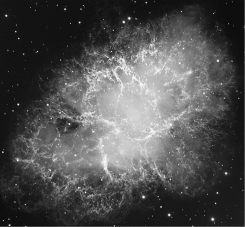
The abundances of elements in the Crab Nebula (image below),like all planetary nebulae,show that it formed as the byproduct of fusion present in low-mass stars.
Question
Question
Question
Examine the figure below.Hydrogen burns through the CNO cycle only in high-mass main-sequence stars because of the greater __________ in their cores. 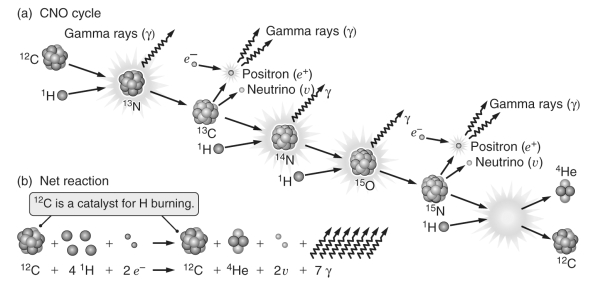
A) concentration of heavy elements like carbon
B) densities
C) abundance of hydrogen
D) temperatures
A) concentration of heavy elements like carbon
B) densities
C) abundance of hydrogen
D) temperatures
Question
Question
Question
Question
Question
Question
Question
Question
Question
Question
Which of the stars from the figure below would show variability in its brightness? 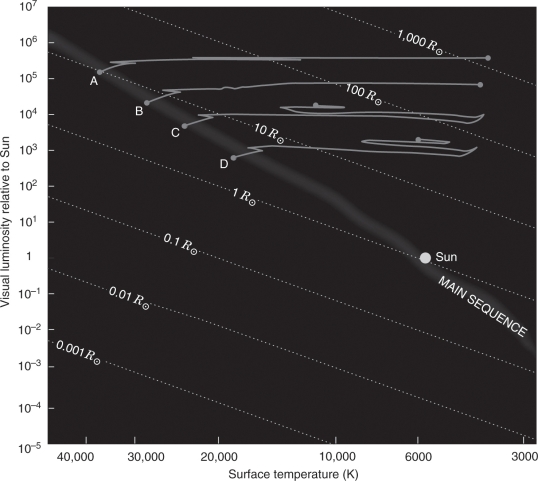
A) Star A
B) Star B
C) Star C
D) Star D
A) Star A
B) Star B
C) Star C
D) Star D
Question
Question
Question
In the figure below,when elements from section A undergo fusion,energy is _______.Because of this fact,it would be ________ to find a high-mass main sequence star with a high concentration of elements from section B. 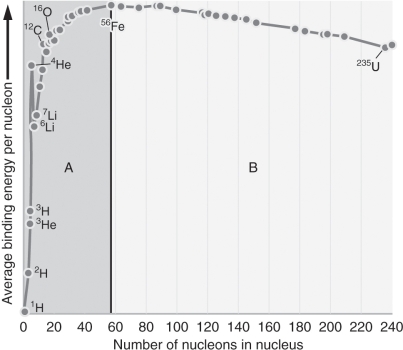
A) released; likely
B) absorbed; likely
C) released; unlikely
D) absorbed; unlikely
A) released; likely
B) absorbed; likely
C) released; unlikely
D) absorbed; unlikely
Question
Question
Question
Question
Question
Question
Question
Question
Question
Question
Question
Question
Question
The Type II supernova that created the Crab Nebula (image below)was seen by Chinese and Arab astronomers in the year A.D.1054 Because the star is 6,500 light-years away from us,we know the star exploded in the year: 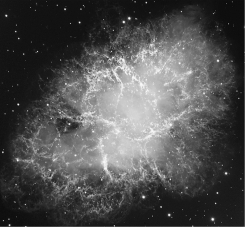
A) A.D.7554
B) A.D.1054
C) 5446 B.C.
D) 7554 B.C.
A) A.D.7554
B) A.D.1054
C) 5446 B.C.
D) 7554 B.C.
Question
Question
Question
Question
Question
Question
Question
Question
Normally muons created by cosmic rays at high altitudes decay in a very short time,a time so short that they should not reach the ground.From the figure below,which muon is most likely to be detected on the ground? 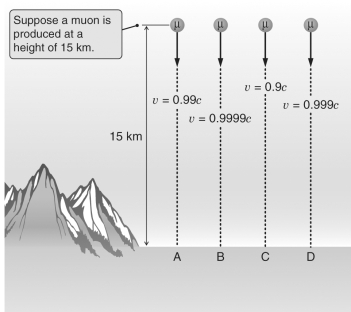
A) Muon A
B) Muon B
C) Muon C
D) Muon D
A) Muon A
B) Muon B
C) Muon C
D) Muon D
Question
Question
Question
Question
Question
Question
Question
Question
Question
Question
Question
Question
Question
Question
Question
Question
Question
Question
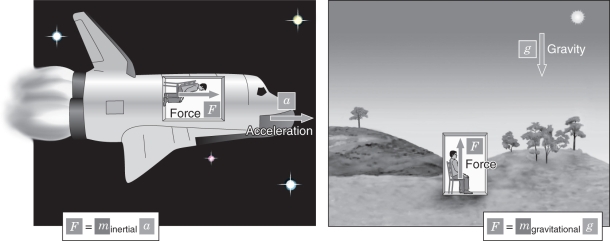
Examine the figure below.Explain what the equivalence principle is in general relativity.
Question
Question
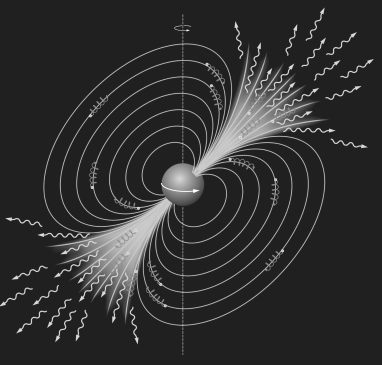
Examine the figure of a pulsar below.What are pulsars,and what circumstance must the Earth be in for astronomers to observe one?
Question
Question
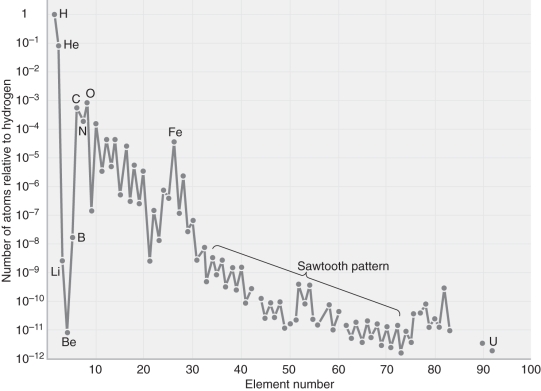
The figure below shows the relative abundances of different elements on Earth.Explain why elements less massive than iron are,in general,most common,why there is a small peak at Iron,and why elements more massive than iron are less common.
Question
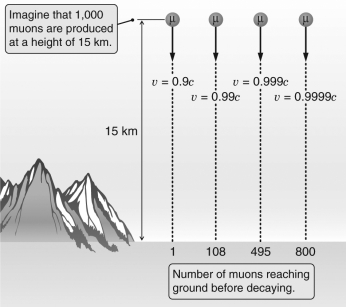
Normally muons created by cosmic rays at high altitudes decay in a very short time,a time so short that they should not reach the ground.From the figure below,why does increasing speed of muons created by cosmic rays at high altitudes mean that additional muons will reach the ground before decaying?
Question
Question
Question
Question
Question

Unlock Deck
Sign up to unlock the cards in this deck!
Unlock Deck
Unlock Deck
1/71

Play

Full screen (f)
Deck 13: Evolution of High-Mass Stars
1
Gravity is nothing more than a curvature in the fabric of spacetime.
True
2
Most of the uranium (U; atomic mass = 238)found on the Earth was formed in Type II supernovae explosions.
True
3
Special relativity says that moving clocks run slower.
True
4
Gravitational lensing allows us to see distant objects that would otherwise be blocked by a star or galaxy.
Unlock Deck
Unlock for access to all 71 flashcards in this deck.
Unlock Deck
k this deck
5
Einstein's special theory of relativity implies that if a person standing at the front of a train traveling at 0.1 km/s shines a flashlight out in front of the train,the emitted photons will travel at a speed of 300,000.1 km/s.
Unlock Deck
Unlock for access to all 71 flashcards in this deck.
Unlock Deck
k this deck
6
The abundances of elements in the Crab Nebula (image below),like all planetary nebulae,show that it formed as the byproduct of fusion present in low-mass stars.
Unlock Deck
Unlock for access to all 71 flashcards in this deck.
Unlock Deck
k this deck
7
Black holes emit no light whatsoever.
Unlock Deck
Unlock for access to all 71 flashcards in this deck.
Unlock Deck
k this deck
8
If you measure the average brightness and pulsation period of a Cepheid variable star,you can also determine its:
A) age
B) rotation period
C) distance
D) mass
A) age
B) rotation period
C) distance
D) mass
Unlock Deck
Unlock for access to all 71 flashcards in this deck.
Unlock Deck
k this deck
9
Examine the figure below.Hydrogen burns through the CNO cycle only in high-mass main-sequence stars because of the greater __________ in their cores.
A) concentration of heavy elements like carbon
B) densities
C) abundance of hydrogen
D) temperatures
A) concentration of heavy elements like carbon
B) densities
C) abundance of hydrogen
D) temperatures
Unlock Deck
Unlock for access to all 71 flashcards in this deck.
Unlock Deck
k this deck
10
The production of large numbers of neutrons in nuclear reactions at the core of a massive star helps rob the core of energy and speeds its eventual collapse.
Unlock Deck
Unlock for access to all 71 flashcards in this deck.
Unlock Deck
k this deck
11
The densest state of matter found in nature occurs inside a white dwarf star.
Unlock Deck
Unlock for access to all 71 flashcards in this deck.
Unlock Deck
k this deck
12
High-mass stars differ from low-mass stars in that they burn helium to carbon when on the main sequence.
Unlock Deck
Unlock for access to all 71 flashcards in this deck.
Unlock Deck
k this deck
13
Black holes have an infinitely small radius,but a finite event horizon.
Unlock Deck
Unlock for access to all 71 flashcards in this deck.
Unlock Deck
k this deck
14
Fusion reactions that create chemical elements heavier than oxygen require energy input,thus these reactions cannot provide a star with power.
Unlock Deck
Unlock for access to all 71 flashcards in this deck.
Unlock Deck
k this deck
15
Every pulsar is a neutron star,but not every neutron star is a pulsar.
Unlock Deck
Unlock for access to all 71 flashcards in this deck.
Unlock Deck
k this deck
16
An 8 M star will eventually die as a Type Ia supernova.
Unlock Deck
Unlock for access to all 71 flashcards in this deck.
Unlock Deck
k this deck
17
Type Ia and Type II supernovae are approximately equal in luminosity.
Unlock Deck
Unlock for access to all 71 flashcards in this deck.
Unlock Deck
k this deck
18
All evolutionary differences between high- and low-mass stars can be attributed to differences in the amount of gravity each star possesses.
Unlock Deck
Unlock for access to all 71 flashcards in this deck.
Unlock Deck
k this deck
19
Which of the stars from the figure below would show variability in its brightness?
A) Star A
B) Star B
C) Star C
D) Star D
A) Star A
B) Star B
C) Star C
D) Star D
Unlock Deck
Unlock for access to all 71 flashcards in this deck.
Unlock Deck
k this deck
20
Pulsating variable stars are more commonly known as pulsars.
Unlock Deck
Unlock for access to all 71 flashcards in this deck.
Unlock Deck
k this deck
21
Once silicon burning begins to fuse iron in the core of a high-mass main-sequence star,it only has a few __________ left to live.
A) seconds
B) days
C) months
D) years
A) seconds
B) days
C) months
D) years
Unlock Deck
Unlock for access to all 71 flashcards in this deck.
Unlock Deck
k this deck
22
In the figure below,when elements from section A undergo fusion,energy is _______.Because of this fact,it would be ________ to find a high-mass main sequence star with a high concentration of elements from section B.
A) released; likely
B) absorbed; likely
C) released; unlikely
D) absorbed; unlikely
A) released; likely
B) absorbed; likely
C) released; unlikely
D) absorbed; unlikely
Unlock Deck
Unlock for access to all 71 flashcards in this deck.
Unlock Deck
k this deck
23
What would happen if mass were continually added to a 2 M neutron star?
A) The star's radius would increase.
B) The star would eventually become a black hole.
C) The star would erupt as a nova.
D) All of the above would occur.
A) The star's radius would increase.
B) The star would eventually become a black hole.
C) The star would erupt as a nova.
D) All of the above would occur.
Unlock Deck
Unlock for access to all 71 flashcards in this deck.
Unlock Deck
k this deck
24
Once carbon begins burning in the core of a high-mass star,the outer layers begin to fall inward,driving up the fusion rates and speeding up the star's evolution primarily because:
A) the number of particles in the core is decreasing which now take up less space
B) most of the energy is now carried away from the core by escaping neutrinos which have few if any obstacles to leaving the star
C) carbon is a more stable element that appears to settle the star
D) the light given off by the fusion of carbon is a different wavelength than given off by previous reactions so the radiation pressure is much smaller
A) the number of particles in the core is decreasing which now take up less space
B) most of the energy is now carried away from the core by escaping neutrinos which have few if any obstacles to leaving the star
C) carbon is a more stable element that appears to settle the star
D) the light given off by the fusion of carbon is a different wavelength than given off by previous reactions so the radiation pressure is much smaller
Unlock Deck
Unlock for access to all 71 flashcards in this deck.
Unlock Deck
k this deck
25
Essentially all the elements heavier than iron in our galaxy were formed:
A) by supernovae
B) during the formation of black holes
C) by fusion in the cores of the most massive main-sequence stars
D) during the formation of planetary nebulae
A) by supernovae
B) during the formation of black holes
C) by fusion in the cores of the most massive main-sequence stars
D) during the formation of planetary nebulae
Unlock Deck
Unlock for access to all 71 flashcards in this deck.
Unlock Deck
k this deck
26
Neutron stars have masses that range from:
A) 3.5 M to 25 M
B) 1.2 M to 30 M
C) 2.5 M to 10 M
D) 1.4 M to 3 M
A) 3.5 M to 25 M
B) 1.2 M to 30 M
C) 2.5 M to 10 M
D) 1.4 M to 3 M
Unlock Deck
Unlock for access to all 71 flashcards in this deck.
Unlock Deck
k this deck
27
During the main-sequence evolution of a massive star,increasingly heavier elements are fused in the core,giving the core support for:
A) decreasingly shorter times
B) increasingly longer times
C) an approximately equal amount of time
D) approximately 10,000 years
A) decreasingly shorter times
B) increasingly longer times
C) an approximately equal amount of time
D) approximately 10,000 years
Unlock Deck
Unlock for access to all 71 flashcards in this deck.
Unlock Deck
k this deck
28
What is the minimum mass main-sequence star that becomes a Type II supernova?
A) 4 M
B) 8 M
C) 12 M
D) 25 M
A) 4 M
B) 8 M
C) 12 M
D) 25 M
Unlock Deck
Unlock for access to all 71 flashcards in this deck.
Unlock Deck
k this deck
29
As a high-mass main-sequence star evolves off the main sequence,it follows a __________ on the H-R diagram.
A) nearly vertical path
B) path of constant radius
C) roughly horizontal path
D) None of the above answers is correct.
A) nearly vertical path
B) path of constant radius
C) roughly horizontal path
D) None of the above answers is correct.
Unlock Deck
Unlock for access to all 71 flashcards in this deck.
Unlock Deck
k this deck
30
A neutron star contains a mass of up to 3 M in a sphere with a diameter approximately the size of:
A) an atomic nucleus
B) a school bus
C) a city
D) the Earth
A) an atomic nucleus
B) a school bus
C) a city
D) the Earth
Unlock Deck
Unlock for access to all 71 flashcards in this deck.
Unlock Deck
k this deck
31
The main difference between Cepheid variable stars and RR Lyrae stars is:
A) their pulsation mechanisms
B) their masses
C) that Cepheids form at much greater distances from Earth
D) that RR Lyrae were discovered much earlier than Cepheids
A) their pulsation mechanisms
B) their masses
C) that Cepheids form at much greater distances from Earth
D) that RR Lyrae were discovered much earlier than Cepheids
Unlock Deck
Unlock for access to all 71 flashcards in this deck.
Unlock Deck
k this deck
32
The collapse of the core of a high-mass star at the end of its life lasts approximately:
A) one second
B) one hour
C) one week
D) one year
A) one second
B) one hour
C) one week
D) one year
Unlock Deck
Unlock for access to all 71 flashcards in this deck.
Unlock Deck
k this deck
33
Why does the luminosity of a high-mass star remain nearly constant as the star burns heavy elements in its core,even though it is producing millions of times more energy per second than it did on the main sequence?
A) Most of the energy is trapped in the core,increasing the core's temperature.
B) All of the extra energy goes into heating the shells of fusion surrounding the core.
C) Most of the energy is absorbed by the outer layers of the star,increasing the star's radius but leaving its luminosity unchanged.
D) Most of the energy is carried out of the star by escaping neutrinos.
A) Most of the energy is trapped in the core,increasing the core's temperature.
B) All of the extra energy goes into heating the shells of fusion surrounding the core.
C) Most of the energy is absorbed by the outer layers of the star,increasing the star's radius but leaving its luminosity unchanged.
D) Most of the energy is carried out of the star by escaping neutrinos.
Unlock Deck
Unlock for access to all 71 flashcards in this deck.
Unlock Deck
k this deck
34
Which of the following is NOT a common characteristic of a neutron star?
A) Extremely high density
B) Enormous magnetic field
C) Very short rotation period
D) All of these are common characteristics of a neutron star.
A) Extremely high density
B) Enormous magnetic field
C) Very short rotation period
D) All of these are common characteristics of a neutron star.
Unlock Deck
Unlock for access to all 71 flashcards in this deck.
Unlock Deck
k this deck
35
The Type II supernova that created the Crab Nebula (image below)was seen by Chinese and Arab astronomers in the year A.D.1054 Because the star is 6,500 light-years away from us,we know the star exploded in the year:
A) A.D.7554
B) A.D.1054
C) 5446 B.C.
D) 7554 B.C.
A) A.D.7554
B) A.D.1054
C) 5446 B.C.
D) 7554 B.C.
Unlock Deck
Unlock for access to all 71 flashcards in this deck.
Unlock Deck
k this deck
36
An iron core cannot support a massive main-sequence star because:
A) iron has poor nuclear binding energy
B) iron cannot fuse with other nuclei to produce energy
C) iron supplies too much pressure
D) iron fusion only occurs in a degenerate core
A) iron has poor nuclear binding energy
B) iron cannot fuse with other nuclei to produce energy
C) iron supplies too much pressure
D) iron fusion only occurs in a degenerate core
Unlock Deck
Unlock for access to all 71 flashcards in this deck.
Unlock Deck
k this deck
37
A Cepheid star varies in luminosity because:
A) the entire star pulsates from its core to its surface
B) the outer envelope of the star pulsates
C) the star rotates too quickly
D) the star is too massive to be stable
A) the entire star pulsates from its core to its surface
B) the outer envelope of the star pulsates
C) the star rotates too quickly
D) the star is too massive to be stable
Unlock Deck
Unlock for access to all 71 flashcards in this deck.
Unlock Deck
k this deck
38
If a 25 M main-sequence star loses mass at a rate of 10-6 M /yr then how much mass will it lose in its 3-million-year lifetime?
A) 3 M
B) 5 M
C) 8 M
D) 12 M
A) 3 M
B) 5 M
C) 8 M
D) 12 M
Unlock Deck
Unlock for access to all 71 flashcards in this deck.
Unlock Deck
k this deck
39
We can identify only a small fraction of all the pulsars that exist in our galaxy because:
A) gas and dust efficiently block radio photons
B) few swing their beam of synchrotron emission in our direction
C) most have evolved to become black holes,which emit no light
D) massive stars are very rare
A) gas and dust efficiently block radio photons
B) few swing their beam of synchrotron emission in our direction
C) most have evolved to become black holes,which emit no light
D) massive stars are very rare
Unlock Deck
Unlock for access to all 71 flashcards in this deck.
Unlock Deck
k this deck
40
When the core of a massive star collapses,a neutron star forms because:
A) all the charged particles are ejected in the resulting explosion
B) protons and electrons combine to minimize electromagnetic forces
C) iron nuclei disintegrate into neutrons
D) neutrinos escaping from the core carry away most of the electromagnetic charge
A) all the charged particles are ejected in the resulting explosion
B) protons and electrons combine to minimize electromagnetic forces
C) iron nuclei disintegrate into neutrons
D) neutrinos escaping from the core carry away most of the electromagnetic charge
Unlock Deck
Unlock for access to all 71 flashcards in this deck.
Unlock Deck
k this deck
41
__________ is the result of mass distorting the fabric of spacetime.
A) Energy
B) Radiation
C) Fusion
D) Gravity
A) Energy
B) Radiation
C) Fusion
D) Gravity
Unlock Deck
Unlock for access to all 71 flashcards in this deck.
Unlock Deck
k this deck
42
Hawking radiation is emitted by a black hole when:
A) the black hole rotates quickly
B) the black hole accretes material
C) a virtual pair of particles is created from the vacuum of space
D) synchrotron radiation is emitted by infalling charged particles
A) the black hole rotates quickly
B) the black hole accretes material
C) a virtual pair of particles is created from the vacuum of space
D) synchrotron radiation is emitted by infalling charged particles
Unlock Deck
Unlock for access to all 71 flashcards in this deck.
Unlock Deck
k this deck
43
Normally muons created by cosmic rays at high altitudes decay in a very short time,a time so short that they should not reach the ground.From the figure below,which muon is most likely to be detected on the ground?
A) Muon A
B) Muon B
C) Muon C
D) Muon D
A) Muon A
B) Muon B
C) Muon C
D) Muon D
Unlock Deck
Unlock for access to all 71 flashcards in this deck.
Unlock Deck
k this deck
44
Why do large,high-mass main-sequence stars never become red giants?
Unlock Deck
Unlock for access to all 71 flashcards in this deck.
Unlock Deck
k this deck
45
Why do main-sequence high-mass stars lose so much mass compared to low-mass stars?
Unlock Deck
Unlock for access to all 71 flashcards in this deck.
Unlock Deck
k this deck
46
The event horizon of a black hole is defined as:
A) the point of maximum gravity
B) the radius of the original neutron star before it became a black hole
C) the point at which shock waves emanate from the strong gravitational distortion the black hole creates in the fabric of spacetime
D) the radius at which the escape speed equals the speed of light
A) the point of maximum gravity
B) the radius of the original neutron star before it became a black hole
C) the point at which shock waves emanate from the strong gravitational distortion the black hole creates in the fabric of spacetime
D) the radius at which the escape speed equals the speed of light
Unlock Deck
Unlock for access to all 71 flashcards in this deck.
Unlock Deck
k this deck
47
Light is increasingly redshifted near a black hole because:
A) the photons are moving away from us very quickly as they are sucked into the black hole
B) the photons are moving increasingly faster in order to escape the pull of the black hole
C) time is moving increasingly slower in the observer's frame of reference
D) the curvature of spacetime is increasingly stretched near the black hole,which in turn stretches the wavelengths of the photons
A) the photons are moving away from us very quickly as they are sucked into the black hole
B) the photons are moving increasingly faster in order to escape the pull of the black hole
C) time is moving increasingly slower in the observer's frame of reference
D) the curvature of spacetime is increasingly stretched near the black hole,which in turn stretches the wavelengths of the photons
Unlock Deck
Unlock for access to all 71 flashcards in this deck.
Unlock Deck
k this deck
48
Black holes that are stellar remnants can be found by searching for:
A) dark regions at the centers of galaxies
B) variable X-ray sources
C) extremely luminous infrared objects
D) objects that emit very faint radio emission
A) dark regions at the centers of galaxies
B) variable X-ray sources
C) extremely luminous infrared objects
D) objects that emit very faint radio emission
Unlock Deck
Unlock for access to all 71 flashcards in this deck.
Unlock Deck
k this deck
49
What are some ways that finding a Cepheid variable star is significant?
Unlock Deck
Unlock for access to all 71 flashcards in this deck.
Unlock Deck
k this deck
50
The equivalence principle says that:
A) being stationary in a gravitational field is the same as being in an accelerated reference frame
B) the universe is homogeneous and isotropic
C) at any radius inside a star the outward gas pressure must balance the weight of the material on top
D) mass and energy are interchangeable and neither can be destroyed
A) being stationary in a gravitational field is the same as being in an accelerated reference frame
B) the universe is homogeneous and isotropic
C) at any radius inside a star the outward gas pressure must balance the weight of the material on top
D) mass and energy are interchangeable and neither can be destroyed
Unlock Deck
Unlock for access to all 71 flashcards in this deck.
Unlock Deck
k this deck
51
If an 8 M star loses mass at an average rate of 10-6 M /yr in a stellar wind,how many years would it take for its mass to be reduced to 6 M ? Would this amount of mass loss be possible in the star's lifetime?
Unlock Deck
Unlock for access to all 71 flashcards in this deck.
Unlock Deck
k this deck
52
Which of the following is a consequence of Einstein's special theory of relativity?
A) Moving clocks run quicker.
B) The velocity of light depends on the speed of the observer.
C) Distances appear shorter when traveling near the speed of light.
D) Gravity arises because mass distorts spacetime.
A) Moving clocks run quicker.
B) The velocity of light depends on the speed of the observer.
C) Distances appear shorter when traveling near the speed of light.
D) Gravity arises because mass distorts spacetime.
Unlock Deck
Unlock for access to all 71 flashcards in this deck.
Unlock Deck
k this deck
53
If the Earth were to be condensed down in size until it became a black hole,its Schwarzschild radius would be:
A) 1 cm
B) 1 m
C) 1 km
D) 10 km
A) 1 cm
B) 1 m
C) 1 km
D) 10 km
Unlock Deck
Unlock for access to all 71 flashcards in this deck.
Unlock Deck
k this deck
54
Assume that a group of explorers traveled to the Orion Nebula,the nearest star-forming cloud at a distance of 1,300 light-years,using revolutionary technology that allowed them to travel at a speed very close to the speed of light.Observers back on Earth would say it took them __________ to get there,but the travelers would say it took them __________ to get there.
A) slightly more than 1,300 years; much less than 1,300 years
B) slightly more than 1,300 years; slightly less than 1,300 years
C) slightly less than 1,300 years; slightly more than 1,300 years
D) exactly 1,300 years; much less than 1,300 years
A) slightly more than 1,300 years; much less than 1,300 years
B) slightly more than 1,300 years; slightly less than 1,300 years
C) slightly less than 1,300 years; slightly more than 1,300 years
D) exactly 1,300 years; much less than 1,300 years
Unlock Deck
Unlock for access to all 71 flashcards in this deck.
Unlock Deck
k this deck
55
If the Sun were to be instantly replaced by a 1 M black hole,the gravitational pull of the black hole on Earth would be:
A) much greater than it is now
B) the same as it is now
C) much smaller than it is now
D) irrelevant because Earth would be quickly obliterated by the strong tidal force of the black hole
A) much greater than it is now
B) the same as it is now
C) much smaller than it is now
D) irrelevant because Earth would be quickly obliterated by the strong tidal force of the black hole
Unlock Deck
Unlock for access to all 71 flashcards in this deck.
Unlock Deck
k this deck
56
How do Cepheid variable stars differ from RR Lyrae variable stars in their masses,luminosities,and periods?
Unlock Deck
Unlock for access to all 71 flashcards in this deck.
Unlock Deck
k this deck
57
An indestructible robot would feel __________ as it crossed the event horizon of a black hole.
A) incredibly strong tidal forces
B) intense heating
C) intense gravitational stretching
D) nothing
A) incredibly strong tidal forces
B) intense heating
C) intense gravitational stretching
D) nothing
Unlock Deck
Unlock for access to all 71 flashcards in this deck.
Unlock Deck
k this deck
58
Gravitational lensing occurs when __________ distorts the fabric of spacetime.
A) a star
B) dark matter
C) a black hole
D) any massive object
A) a star
B) dark matter
C) a black hole
D) any massive object
Unlock Deck
Unlock for access to all 71 flashcards in this deck.
Unlock Deck
k this deck
59
While traveling the galaxy in a spacecraft,you and a colleague set out to investigate the 106 M black hole at the center of our galaxy.Your colleague hops aboard an escape pod and drops into a circular orbit around the black hole,maintaining a distance of 1 AU,while you remain much farther away in the spacecraft but from which you can easily monitor your colleague.After doing some experiments to measure the strength of gravity,your colleague signals his/her results back to you using a green laser.What would you see?
A) His/her signals,because he/she is orbiting well outside the event horizon.
B) His/her signals,but shifted to a much redder wavelength because he/she is very close to the event horizon.
C) Nothing,because your colleague has crossed the event horizon.
D) Nothing,because no light can escape the gravitational pull of a black hole no matter how close he/she is to it.
A) His/her signals,because he/she is orbiting well outside the event horizon.
B) His/her signals,but shifted to a much redder wavelength because he/she is very close to the event horizon.
C) Nothing,because your colleague has crossed the event horizon.
D) Nothing,because no light can escape the gravitational pull of a black hole no matter how close he/she is to it.
Unlock Deck
Unlock for access to all 71 flashcards in this deck.
Unlock Deck
k this deck
60
Photons have no mass,and Einstein's theory of general relativity says:
A) their paths through spacetime are curved in the presence of a massive body
B) their apparent speeds depend on the observer's frame of reference
C) they should not be attracted to a massive object
D) their wavelengths must remain the same as they travel through spacetime
A) their paths through spacetime are curved in the presence of a massive body
B) their apparent speeds depend on the observer's frame of reference
C) they should not be attracted to a massive object
D) their wavelengths must remain the same as they travel through spacetime
Unlock Deck
Unlock for access to all 71 flashcards in this deck.
Unlock Deck
k this deck
61
Examine the figure below.Explain what the equivalence principle is in general relativity.
Unlock Deck
Unlock for access to all 71 flashcards in this deck.
Unlock Deck
k this deck
62
Galileo supposedly experimented with gravity by dropping two objects of different masses from the leaning tower of Pisa at the same instant and observing that they hit the ground at the same time.If Albert Einstein had done the experiment,how would his conclusion have differed from Galileo's?
Unlock Deck
Unlock for access to all 71 flashcards in this deck.
Unlock Deck
k this deck
63
Examine the figure of a pulsar below.What are pulsars,and what circumstance must the Earth be in for astronomers to observe one?
Unlock Deck
Unlock for access to all 71 flashcards in this deck.
Unlock Deck
k this deck
64
What is the difference between the singularity and the event horizon of a black hole?
Unlock Deck
Unlock for access to all 71 flashcards in this deck.
Unlock Deck
k this deck
65
The figure below shows the relative abundances of different elements on Earth.Explain why elements less massive than iron are,in general,most common,why there is a small peak at Iron,and why elements more massive than iron are less common.
Unlock Deck
Unlock for access to all 71 flashcards in this deck.
Unlock Deck
k this deck
66
Normally muons created by cosmic rays at high altitudes decay in a very short time,a time so short that they should not reach the ground.From the figure below,why does increasing speed of muons created by cosmic rays at high altitudes mean that additional muons will reach the ground before decaying?
Unlock Deck
Unlock for access to all 71 flashcards in this deck.
Unlock Deck
k this deck
67
Explain why Einstein's theory of general relativity predicts the existence of gravitational lensing.
Unlock Deck
Unlock for access to all 71 flashcards in this deck.
Unlock Deck
k this deck
68
Although a Type II supernova shines with a luminosity of 100 billion L ,most of the energy in the explosion is emitted in another way.What is it,and how much more energy does it carry compared to the light?
Unlock Deck
Unlock for access to all 71 flashcards in this deck.
Unlock Deck
k this deck
69
In comparison,the main-sequence lifetime of the star is just less than 81 million years (Table 12.1).Therefore,the star could lose this much mass because its main-sequence lifetime is much longer than the time it would take to do so.
Name at least two processes that speed the collapse of the core of a dying high-mass star.
Name at least two processes that speed the collapse of the core of a dying high-mass star.
Unlock Deck
Unlock for access to all 71 flashcards in this deck.
Unlock Deck
k this deck
70
Which has a smaller radius,a 2 M neutron star or a 3 M neutron star? What supports each of these stars from collapsing to form a black hole?
Unlock Deck
Unlock for access to all 71 flashcards in this deck.
Unlock Deck
k this deck
71
While traveling the galaxy in a spacecraft,you and a colleague set out to investigate a 1 M black hole.Your colleague hops aboard an escape pod and drops into a circular orbit around the black hole maintaining a distance of 10 km from it,while you remain much farther away inside the spacecraft.After doing some experiments to measure the strength of gravity,your colleague signals the results back to you using a green laser.What would you see,and why?
Unlock Deck
Unlock for access to all 71 flashcards in this deck.
Unlock Deck
k this deck
Unlock Deck
Unlock for access to all 71 flashcards in this deck.






