







 Chat with AI

Deck 8: The Economics of Monopoly Power: Can Markets Be Controlled
Full screen (f)

Question

Question
Question
Question
Question
Question
The Following Questions Refer to the table below. 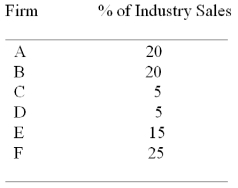
The 4-firm concentration ratio in this industry is
A)0.5
B)0.6
C)0.7
D)0.8
E)0.9
The 4-firm concentration ratio in this industry is
A)0.5
B)0.6
C)0.7
D)0.8
E)0.9
Question
Question
Question
Question
Question
The Following Questions Refer to the table below.
Assume that no firm in this industry accounts for less than 5% of industry sales.What is the largest number of firms that could be in this industry?
A)6
B)7
C)8
D)9
E)10
Assume that no firm in this industry accounts for less than 5% of industry sales.What is the largest number of firms that could be in this industry?
A)6
B)7
C)8
D)9
E)10
Question
Question
Question
Question
The Following Questions Refer to the table below.
The 6-firm concentration ratio in this industry is
A)0.6
B)0.7
C)0.8
D)0.9
E)1.0
The 6-firm concentration ratio in this industry is
A)0.6
B)0.7
C)0.8
D)0.9
E)1.0
Question
Question
Question
Question
Question
Question
Question
Question
The Following Questions Refer to the following graph.For each question,disregard any irrelevant lines. 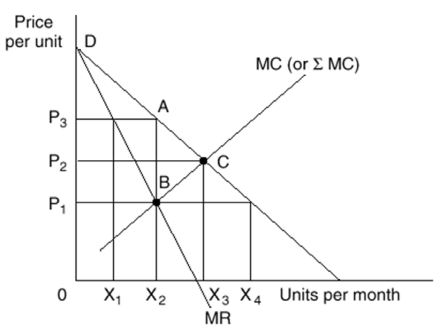
The area of the triangle ABC
The area of the triangle ABC
Question
Question
Question
Question
The Following Questions Refer to the graph below,which is for a firm in a competitive market.
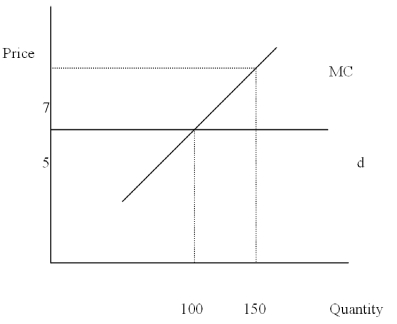
The firm's total revenue is
A)$5
B)$7
C)$100
D)$150
E)$500
The firm's total revenue is
A)$5
B)$7
C)$100
D)$150
E)$500
Question
Question
The Following Questions Refer to the graph below,showing a monopoly market. 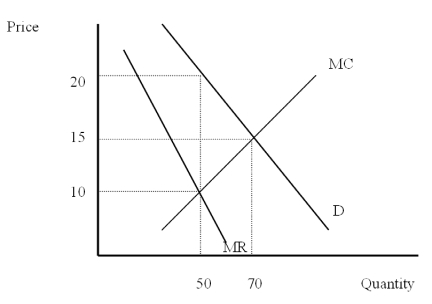
For the firm shown on the graph,profit maximization occurs at what price and quantity?
A)$20 and 50
B)$15 and 70
C)$15 and 50
D)$10 and 50
E)$10 and 70
For the firm shown on the graph,profit maximization occurs at what price and quantity?
A)$20 and 50
B)$15 and 70
C)$15 and 50
D)$10 and 50
E)$10 and 70
Question
Question
The Following Questions Refer to the following graph.For each question,disregard any irrelevant lines.
Suppose the market is competitivE.Equilibrium market price and output will be
A)P1,X2
B)P2,X3
C)P3,X1
D)P1,X4
E)P3, X2
Suppose the market is competitivE.Equilibrium market price and output will be
A)P1,X2
B)P2,X3
C)P3,X1
D)P1,X4
E)P3, X2
Question
The Following Questions Refer to the graph below,which is for a firm in a competitive market.
The profit-maximizing price and quantity for this competitive firm are
A)$5 and 100
B)$5 and 150
C)$7 and 100
D)$7 and 150
E)$7 and more than 150
The profit-maximizing price and quantity for this competitive firm are
A)$5 and 100
B)$5 and 150
C)$7 and 100
D)$7 and 150
E)$7 and more than 150
Question
The Following Questions Refer to the following graph.For each question,disregard any irrelevant lines.
If this industry changes from pure competition to monopoly,output changes from
A)X4 to X1
B)X4 to X2
C)X2 to X4
D)X3 to X2
E)X2 to X3
If this industry changes from pure competition to monopoly,output changes from
A)X4 to X1
B)X4 to X2
C)X2 to X4
D)X3 to X2
E)X2 to X3
Question
The Following Questions Refer to the graph below,which is for a firm in a competitive market.
Equilibrium price and quantity in the market are
A)$5 and 100
B)$5 and 150
C)$7 and 150
D)$7 and more than 150
E)None of the above
Equilibrium price and quantity in the market are
A)$5 and 100
B)$5 and 150
C)$7 and 150
D)$7 and more than 150
E)None of the above
Question
Question
The Following Questions Refer to the graph below,which is for a firm in a competitive market.
If the firm has a total cost of $400,it is earning a
A)Profit of $0
B)Profit of $100
C)Loss of $100
D)Loss of $200
E)Loss of $500
If the firm has a total cost of $400,it is earning a
A)Profit of $0
B)Profit of $100
C)Loss of $100
D)Loss of $200
E)Loss of $500
Question
The Following Questions Refer to the graph below,showing a monopoly market.
At the profit maximizing quantity,the firm's total revenue equals
A)$10
B)$15
C)$20
D)$1,000
E)$1,400
At the profit maximizing quantity,the firm's total revenue equals
A)$10
B)$15
C)$20
D)$1,000
E)$1,400
Question
Question
The Following Questions Refer to the following graph.For each question,disregard any irrelevant lines.
Now suppose the same market is monopolizeD.Equilibrium market price and output would be
A)P3,X1
B)P3,X2
C)P2,X3
D)P1,X2
E)P1,X4
Now suppose the same market is monopolizeD.Equilibrium market price and output would be
A)P3,X1
B)P3,X2
C)P2,X3
D)P1,X2
E)P1,X4
Question
The Following Questions Refer to the graph below,which is for a firm in a competitive market.
Since this is a competitive market,the firm's marginal revenue is
A)$5
B)$7
C)$20
D)$100
E)$150
Since this is a competitive market,the firm's marginal revenue is
A)$5
B)$7
C)$20
D)$100
E)$150
Question
Question
The Following Questions Refer to the graph below. 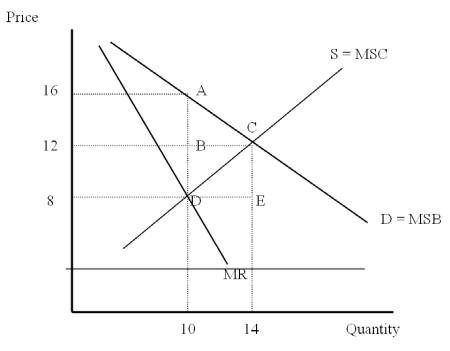
If this industry starts as perfectly competitive and then becomes a monopoly,the deadweight loss to society is equal to area
A)ABC
B)ADC
C)BDEC
D)ADEC
E)None of the above
If this industry starts as perfectly competitive and then becomes a monopoly,the deadweight loss to society is equal to area
A)ABC
B)ADC
C)BDEC
D)ADEC
E)None of the above
Question
The Following Questions Refer to the graph below.
If this industry is a monopoly,equilibrium price and output in the market will be
A)$16 and 10
B)$12 and 10
C)$12 and 14
D)$8 and 14
E)$8 and 10
If this industry is a monopoly,equilibrium price and output in the market will be
A)$16 and 10
B)$12 and 10
C)$12 and 14
D)$8 and 14
E)$8 and 10
Question
Question
The Following Questions Refer to the graph below.
If this industry is perfectly competitive,equilibrium price and output in the market will be
A)$16 and 10
B)$12 and 10
C)$12 and 14
D)$8 and 14
E)$8 and 10
If this industry is perfectly competitive,equilibrium price and output in the market will be
A)$16 and 10
B)$12 and 10
C)$12 and 14
D)$8 and 14
E)$8 and 10
Question
Question
The Following Questions Refer to the graph below.
Society's net benefits are maximized when price and quantity in the market are
A)$16 and 10
B)$12 and 10
C)$12 and 14
D)$8 and 14
E)$8 and 10
Society's net benefits are maximized when price and quantity in the market are
A)$16 and 10
B)$12 and 10
C)$12 and 14
D)$8 and 14
E)$8 and 10
Question
The Following Questions Refer to the graph below,showing a monopoly market.
Monopolization of this market leads to a deadweight loss equal to
A)$0
B)$50
C)$100
D)$150
E)Cannot be determined
Monopolization of this market leads to a deadweight loss equal to
A)$0
B)$50
C)$100
D)$150
E)Cannot be determined
Question
Question
Question
Question
The Following Questions Refer to the graph below,showing a monopoly market.
If this were a perfectly competitive market,equilibrium price and quantity would be
A)$20 and 50
B)$15 and 70
C)$15 and 50
D)$10 and 50
E)$10 and 70
If this were a perfectly competitive market,equilibrium price and quantity would be
A)$20 and 50
B)$15 and 70
C)$15 and 50
D)$10 and 50
E)$10 and 70
Question
Question
Question
The Following Questions Refer to the graph below,showing a monopoly market.
If the firm has total costs of $1,200 at the profit maximizing output,then it is earning a
A)Profit of $0
B)Profit of $100
C)Profit of $200
D)Loss of $100
E)Loss of $200
If the firm has total costs of $1,200 at the profit maximizing output,then it is earning a
A)Profit of $0
B)Profit of $100
C)Profit of $200
D)Loss of $100
E)Loss of $200
Question
Question
Question
The Following Questions Refer to the graph below.
If this industry starts as perfectly competitive and then becomes a monopoly,market price will change from
A)$16 to $12
B)$16 to $8
C)$12 to $8
D)$8 to $16
E)$12 to $16
If this industry starts as perfectly competitive and then becomes a monopoly,market price will change from
A)$16 to $12
B)$16 to $8
C)$12 to $8
D)$8 to $16
E)$12 to $16
Question
Question
Question
Question
The Following Questions Refer to the graph below. 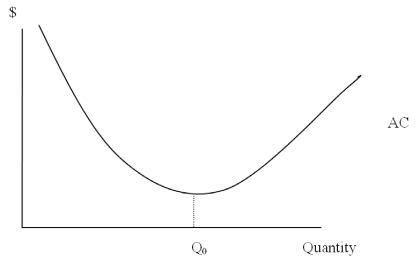
At what level(s)of output do reductions in the average costs of production cease?
A)0
B)0 - Q0
C)Q0
D)Above Q0
E)There are no reductions in the average costs of production
At what level(s)of output do reductions in the average costs of production cease?
A)0
B)0 - Q0
C)Q0
D)Above Q0
E)There are no reductions in the average costs of production
Question
Question
Question
Question
The Following Questions Refer to the graph below.
It is cheaper per unit to produce higher quantities when output is
A)High
B)Between 0 and Q0
C)Q0
D)Above Q0
E)Decreasing
It is cheaper per unit to produce higher quantities when output is
A)High
B)Between 0 and Q0
C)Q0
D)Above Q0
E)Decreasing
Question
Question
Question
Question
Question
Question
Question
Question
Question
Question
The Following Questions Refer to the graph below.
At what level of output does the firm experience economies of scale?
A)0
B)0 - Q0
C)Q0
D)Above Q0
E)This firm does not experience economies of scale
At what level of output does the firm experience economies of scale?
A)0
B)0 - Q0
C)Q0
D)Above Q0
E)This firm does not experience economies of scale
Question
The Following Questions Refer to the graph below.
Increasing output beyond Q0 will cause the firm to experience
A)Economies of scale
B)Diseconomies of scale
C)Constant returns to scale
D)Network economies
E)Decreasing total costs
Increasing output beyond Q0 will cause the firm to experience
A)Economies of scale
B)Diseconomies of scale
C)Constant returns to scale
D)Network economies
E)Decreasing total costs
Question
Question
Question

Unlock Deck
Sign up to unlock the cards in this deck!
Unlock Deck
Unlock Deck
1/129

Play

Full screen (f)
Deck 8: The Economics of Monopoly Power: Can Markets Be Controlled
1
A pure monopoly industry has a 4-firm concentration ratio equal to
A)0
B)0.25
C)050
D)0.9
E)1.0
A)0
B)0.25
C)050
D)0.9
E)1.0
E
2
To maximize profits,a competitive firm produces the output level at which
A)Its total receipts are greatest
B)Its total costs are minimum
C)Its marginal cost equals its marginal revenue
D)Its total costs equal its total receipts
E)None of the above
A)Its total receipts are greatest
B)Its total costs are minimum
C)Its marginal cost equals its marginal revenue
D)Its total costs equal its total receipts
E)None of the above
C
3
Which of the following is likely to have the most monopoly power?
A)Ford Motor Corporation
B)Your local water company
C)Mobil Oil Corporation
D)Avon products (cosmetics)
E)A fast food restaurant
A)Ford Motor Corporation
B)Your local water company
C)Mobil Oil Corporation
D)Avon products (cosmetics)
E)A fast food restaurant
B
4
Imperfect competition can best be described as a situation in which
A)A few large firms produce and sell a particular product
B)Many firms produce and sell a product
C)Only one firm produces and sells a product
D)Firms exercise some monopoly power
E)Both (a)and (d)
A)A few large firms produce and sell a particular product
B)Many firms produce and sell a product
C)Only one firm produces and sells a product
D)Firms exercise some monopoly power
E)Both (a)and (d)
Unlock Deck
Unlock for access to all 129 flashcards in this deck.
Unlock Deck
k this deck
5
Concentration ratios are used to measure the
A)Potential monopoly power within an industry
B)Strength of the demand for an industry's product
C)Potential monopoly power of a firm
D)Degree of competition between firms in different markets
E)Level of perfection in a competitive market
A)Potential monopoly power within an industry
B)Strength of the demand for an industry's product
C)Potential monopoly power of a firm
D)Degree of competition between firms in different markets
E)Level of perfection in a competitive market
Unlock Deck
Unlock for access to all 129 flashcards in this deck.
Unlock Deck
k this deck
6
The Following Questions Refer to the table below.
The 4-firm concentration ratio in this industry is
A)0.5
B)0.6
C)0.7
D)0.8
E)0.9
The 4-firm concentration ratio in this industry is
A)0.5
B)0.6
C)0.7
D)0.8
E)0.9
Unlock Deck
Unlock for access to all 129 flashcards in this deck.
Unlock Deck
k this deck
7
Profit equals
A)Total revenue minus total cost
B)Marginal revenue minus marginal cost
C)Quantity times price
D)Marginal cost minus marginal revenue
E)Income minus opportunity cost
A)Total revenue minus total cost
B)Marginal revenue minus marginal cost
C)Quantity times price
D)Marginal cost minus marginal revenue
E)Income minus opportunity cost
Unlock Deck
Unlock for access to all 129 flashcards in this deck.
Unlock Deck
k this deck
8
Which of the following would cause an industry's concentration ratio to make it appear less competitive than it really is?
A)Firms in the industry are located in one area of the country
B)Transporting the industry's output is very easy
C)Foreign firms export the industry's product to the United States
D)High barriers to entry
E)All of the above
A)Firms in the industry are located in one area of the country
B)Transporting the industry's output is very easy
C)Foreign firms export the industry's product to the United States
D)High barriers to entry
E)All of the above
Unlock Deck
Unlock for access to all 129 flashcards in this deck.
Unlock Deck
k this deck
9
One difference between a competitive seller and a monopolistic seller is that the
A)Competitive firm faces a horizontal supply curve
B)Monopolist tries to maximize profit
C)Monopolist has some price setting ability
D)Competitive firm is free to vary output
E)Market demand curve is positively sloped for a monopoly
A)Competitive firm faces a horizontal supply curve
B)Monopolist tries to maximize profit
C)Monopolist has some price setting ability
D)Competitive firm is free to vary output
E)Market demand curve is positively sloped for a monopoly
Unlock Deck
Unlock for access to all 129 flashcards in this deck.
Unlock Deck
k this deck
10
In a competitive market,the single firm
A)Competes with other firms for its share of the market
B)Is unable to raise the price of the product
C)Can increase its sales by advertising
D)Can increase its sales by lowering its price
E)Is all of the above
A)Competes with other firms for its share of the market
B)Is unable to raise the price of the product
C)Can increase its sales by advertising
D)Can increase its sales by lowering its price
E)Is all of the above
Unlock Deck
Unlock for access to all 129 flashcards in this deck.
Unlock Deck
k this deck
11
The Following Questions Refer to the table below.
Assume that no firm in this industry accounts for less than 5% of industry sales.What is the largest number of firms that could be in this industry?
A)6
B)7
C)8
D)9
E)10
Assume that no firm in this industry accounts for less than 5% of industry sales.What is the largest number of firms that could be in this industry?
A)6
B)7
C)8
D)9
E)10
Unlock Deck
Unlock for access to all 129 flashcards in this deck.
Unlock Deck
k this deck
12
Monopoly
Unlock Deck
Unlock for access to all 129 flashcards in this deck.
Unlock Deck
k this deck
13
To maximize profits,a monopolist produces the output level at which
A)Its total receipts are greatest
B)Its total costs are minimum
C)Its marginal cost equals its marginal revenue
D)Its total costs equal its total receipts
E)None of the above
A)Its total receipts are greatest
B)Its total costs are minimum
C)Its marginal cost equals its marginal revenue
D)Its total costs equal its total receipts
E)None of the above
Unlock Deck
Unlock for access to all 129 flashcards in this deck.
Unlock Deck
k this deck
14
Profits and losses in a private enterprise economic system
A)Contribute toward a breakdown of the system
B)Lead to a monopolization of the industries in which they occur
C)Show where productive capacity should be expanded and where it should be contracted
D)Do all of the above
E)Do both (a)and (b)
A)Contribute toward a breakdown of the system
B)Lead to a monopolization of the industries in which they occur
C)Show where productive capacity should be expanded and where it should be contracted
D)Do all of the above
E)Do both (a)and (b)
Unlock Deck
Unlock for access to all 129 flashcards in this deck.
Unlock Deck
k this deck
15
The Following Questions Refer to the table below.
The 6-firm concentration ratio in this industry is
A)0.6
B)0.7
C)0.8
D)0.9
E)1.0
The 6-firm concentration ratio in this industry is
A)0.6
B)0.7
C)0.8
D)0.9
E)1.0
Unlock Deck
Unlock for access to all 129 flashcards in this deck.
Unlock Deck
k this deck
16
For a firm,at the output level at which marginal revenue equals marginal cost,
A)Profits are highest
B)There is neither unemployment nor inflation
C)Output is maximized
D)Revenues are maximized
E)Costs are minimized
A)Profits are highest
B)There is neither unemployment nor inflation
C)Output is maximized
D)Revenues are maximized
E)Costs are minimized
Unlock Deck
Unlock for access to all 129 flashcards in this deck.
Unlock Deck
k this deck
17
Suppose the U.S.auto industry sells 1,000 autos per year.Of this,GM sells 400,Ford 300,and Dodge 250.Given this information,the four-firm concentration ratio of the industry must be at least
A)95%
B)5%
C)50%
D)100%
E)Cannot tell without further information
A)95%
B)5%
C)50%
D)100%
E)Cannot tell without further information
Unlock Deck
Unlock for access to all 129 flashcards in this deck.
Unlock Deck
k this deck
18
A major objective of firms in all types of market structures is
A)Output restriction
B)Output maximization
C)To raise prices
D)Profit maximization
E)To maximize revenues
A)Output restriction
B)Output maximization
C)To raise prices
D)Profit maximization
E)To maximize revenues
Unlock Deck
Unlock for access to all 129 flashcards in this deck.
Unlock Deck
k this deck
19
The monopoly power of a firm can be measured by the firm's
A)Profits relative to other firms in the industry
B)Control over the demand for its product
C)Revenues as a percent of industry revenues
D)Prices compared to average prices in the industry
E)Control over the market supply of its product
A)Profits relative to other firms in the industry
B)Control over the demand for its product
C)Revenues as a percent of industry revenues
D)Prices compared to average prices in the industry
E)Control over the market supply of its product
Unlock Deck
Unlock for access to all 129 flashcards in this deck.
Unlock Deck
k this deck
20
A firm's total revenue equals its
A)Income minus expenses
B)Pre-tax net income
C)Income for tax purposes
D)Quantity times price
E)Quantity times costs
A)Income minus expenses
B)Pre-tax net income
C)Income for tax purposes
D)Quantity times price
E)Quantity times costs
Unlock Deck
Unlock for access to all 129 flashcards in this deck.
Unlock Deck
k this deck
21
A monopoly is not efficient because
A)Price exceeds marginal cost
B)Entry into the market is blocked
C)Output is too large
D)Monopoly is illegal
E)Price is too low
A)Price exceeds marginal cost
B)Entry into the market is blocked
C)Output is too large
D)Monopoly is illegal
E)Price is too low
Unlock Deck
Unlock for access to all 129 flashcards in this deck.
Unlock Deck
k this deck
22
In a competitive market in the short run,firms
A)May earn profits or losses
B)Always break even
C)Earn neither profits nor losses
D)Must be free to enter or exit the market
E)Charge a high price and produce a low quantity
A)May earn profits or losses
B)Always break even
C)Earn neither profits nor losses
D)Must be free to enter or exit the market
E)Charge a high price and produce a low quantity
Unlock Deck
Unlock for access to all 129 flashcards in this deck.
Unlock Deck
k this deck
23
The Following Questions Refer to the following graph.For each question,disregard any irrelevant lines.
The area of the triangle ABC
The area of the triangle ABC
Unlock Deck
Unlock for access to all 129 flashcards in this deck.
Unlock Deck
k this deck
24
Patents and copyright laws
A)Are governmental barriers to market entry
B)Encourage orderly market entry
C)Discourage research and development
D)Reduce monopoly power
E)Do all of the above
A)Are governmental barriers to market entry
B)Encourage orderly market entry
C)Discourage research and development
D)Reduce monopoly power
E)Do all of the above
Unlock Deck
Unlock for access to all 129 flashcards in this deck.
Unlock Deck
k this deck
25
The dead-weight welfare loss due to monopoly is
A)Too small to be important
B)About 10% of GDP per year
C)Unable to be determined in a complex economy such as our own
D)About 1% of GDP per year
E)About .01% of GDP per year
A)Too small to be important
B)About 10% of GDP per year
C)Unable to be determined in a complex economy such as our own
D)About 1% of GDP per year
E)About .01% of GDP per year
Unlock Deck
Unlock for access to all 129 flashcards in this deck.
Unlock Deck
k this deck
26
The dead-weight welfare loss due to monopoly
A)Results from the monopolist's tendency to reduce output below the competitive level
B)Is a measure of the cost to society from the monopolistic misallocation of resources
C)Is estimated to be about 1% of GDP per year
D)Is a loss to consumers not offset by anyone else's gain
E)All of the above
A)Results from the monopolist's tendency to reduce output below the competitive level
B)Is a measure of the cost to society from the monopolistic misallocation of resources
C)Is estimated to be about 1% of GDP per year
D)Is a loss to consumers not offset by anyone else's gain
E)All of the above
Unlock Deck
Unlock for access to all 129 flashcards in this deck.
Unlock Deck
k this deck
27
The Following Questions Refer to the graph below,which is for a firm in a competitive market.
The firm's total revenue is
A)$5
B)$7
C)$100
D)$150
E)$500
The firm's total revenue is
A)$5
B)$7
C)$100
D)$150
E)$500
Unlock Deck
Unlock for access to all 129 flashcards in this deck.
Unlock Deck
k this deck
28
If the demand curve faced by a firm is downward sloping and the market price of the product is above marginal cost of production,which of the following is correct?
A)Not enough of the economy's resources are being allocated to producing the good
B)Too much of the economy's resources are being allocated to producing the good
C)The firm is in a competitive market
D)The firm is making profits
E)The firm is losing money
A)Not enough of the economy's resources are being allocated to producing the good
B)Too much of the economy's resources are being allocated to producing the good
C)The firm is in a competitive market
D)The firm is making profits
E)The firm is losing money
Unlock Deck
Unlock for access to all 129 flashcards in this deck.
Unlock Deck
k this deck
29
The Following Questions Refer to the graph below,showing a monopoly market.
For the firm shown on the graph,profit maximization occurs at what price and quantity?
A)$20 and 50
B)$15 and 70
C)$15 and 50
D)$10 and 50
E)$10 and 70
For the firm shown on the graph,profit maximization occurs at what price and quantity?
A)$20 and 50
B)$15 and 70
C)$15 and 50
D)$10 and 50
E)$10 and 70
Unlock Deck
Unlock for access to all 129 flashcards in this deck.
Unlock Deck
k this deck
30
When firms earn profits,
A)They will likely expand
B)New firms will have an incentive to enter the market
C)They are providing a good or service that consumers want more of
D)The market is signaling more firms to enter
E)All of the above
A)They will likely expand
B)New firms will have an incentive to enter the market
C)They are providing a good or service that consumers want more of
D)The market is signaling more firms to enter
E)All of the above
Unlock Deck
Unlock for access to all 129 flashcards in this deck.
Unlock Deck
k this deck
31
The Following Questions Refer to the following graph.For each question,disregard any irrelevant lines.
Suppose the market is competitivE.Equilibrium market price and output will be
A)P1,X2
B)P2,X3
C)P3,X1
D)P1,X4
E)P3, X2
Suppose the market is competitivE.Equilibrium market price and output will be
A)P1,X2
B)P2,X3
C)P3,X1
D)P1,X4
E)P3, X2
Unlock Deck
Unlock for access to all 129 flashcards in this deck.
Unlock Deck
k this deck
32
The Following Questions Refer to the graph below,which is for a firm in a competitive market.
The profit-maximizing price and quantity for this competitive firm are
A)$5 and 100
B)$5 and 150
C)$7 and 100
D)$7 and 150
E)$7 and more than 150
The profit-maximizing price and quantity for this competitive firm are
A)$5 and 100
B)$5 and 150
C)$7 and 100
D)$7 and 150
E)$7 and more than 150
Unlock Deck
Unlock for access to all 129 flashcards in this deck.
Unlock Deck
k this deck
33
The Following Questions Refer to the following graph.For each question,disregard any irrelevant lines.
If this industry changes from pure competition to monopoly,output changes from
A)X4 to X1
B)X4 to X2
C)X2 to X4
D)X3 to X2
E)X2 to X3
If this industry changes from pure competition to monopoly,output changes from
A)X4 to X1
B)X4 to X2
C)X2 to X4
D)X3 to X2
E)X2 to X3
Unlock Deck
Unlock for access to all 129 flashcards in this deck.
Unlock Deck
k this deck
34
The Following Questions Refer to the graph below,which is for a firm in a competitive market.
Equilibrium price and quantity in the market are
A)$5 and 100
B)$5 and 150
C)$7 and 150
D)$7 and more than 150
E)None of the above
Equilibrium price and quantity in the market are
A)$5 and 100
B)$5 and 150
C)$7 and 150
D)$7 and more than 150
E)None of the above
Unlock Deck
Unlock for access to all 129 flashcards in this deck.
Unlock Deck
k this deck
35
Monopolization of a previously competitive market leads to
A)Reduced production and product quality and increased costs and prices
B)Increased production and higher prices
C)Increased production,product quality and prices
D)Government regulation
E)None of the above
A)Reduced production and product quality and increased costs and prices
B)Increased production and higher prices
C)Increased production,product quality and prices
D)Government regulation
E)None of the above
Unlock Deck
Unlock for access to all 129 flashcards in this deck.
Unlock Deck
k this deck
36
The Following Questions Refer to the graph below,which is for a firm in a competitive market.
If the firm has a total cost of $400,it is earning a
A)Profit of $0
B)Profit of $100
C)Loss of $100
D)Loss of $200
E)Loss of $500
If the firm has a total cost of $400,it is earning a
A)Profit of $0
B)Profit of $100
C)Loss of $100
D)Loss of $200
E)Loss of $500
Unlock Deck
Unlock for access to all 129 flashcards in this deck.
Unlock Deck
k this deck
37
The Following Questions Refer to the graph below,showing a monopoly market.
At the profit maximizing quantity,the firm's total revenue equals
A)$10
B)$15
C)$20
D)$1,000
E)$1,400
At the profit maximizing quantity,the firm's total revenue equals
A)$10
B)$15
C)$20
D)$1,000
E)$1,400
Unlock Deck
Unlock for access to all 129 flashcards in this deck.
Unlock Deck
k this deck
38
The most common forms of nonprice competition are
A)Profit maximization and loss minimization
B)Monopolization and output restriction
C)Advertising and changes in product quality and design
D)Inflation and unemployment
E)None of the above
A)Profit maximization and loss minimization
B)Monopolization and output restriction
C)Advertising and changes in product quality and design
D)Inflation and unemployment
E)None of the above
Unlock Deck
Unlock for access to all 129 flashcards in this deck.
Unlock Deck
k this deck
39
The Following Questions Refer to the following graph.For each question,disregard any irrelevant lines.
Now suppose the same market is monopolizeD.Equilibrium market price and output would be
A)P3,X1
B)P3,X2
C)P2,X3
D)P1,X2
E)P1,X4
Now suppose the same market is monopolizeD.Equilibrium market price and output would be
A)P3,X1
B)P3,X2
C)P2,X3
D)P1,X2
E)P1,X4
Unlock Deck
Unlock for access to all 129 flashcards in this deck.
Unlock Deck
k this deck
40
The Following Questions Refer to the graph below,which is for a firm in a competitive market.
Since this is a competitive market,the firm's marginal revenue is
A)$5
B)$7
C)$20
D)$100
E)$150
Since this is a competitive market,the firm's marginal revenue is
A)$5
B)$7
C)$20
D)$100
E)$150
Unlock Deck
Unlock for access to all 129 flashcards in this deck.
Unlock Deck
k this deck
41
The supply curve for a monopoly
A)Is its marginal revenue curve
B)Is its total revenue curve
C)Is its marginal cost curve
D)Is its total cost curve
E)Does not exist
A)Is its marginal revenue curve
B)Is its total revenue curve
C)Is its marginal cost curve
D)Is its total cost curve
E)Does not exist
Unlock Deck
Unlock for access to all 129 flashcards in this deck.
Unlock Deck
k this deck
42
The Following Questions Refer to the graph below.
If this industry starts as perfectly competitive and then becomes a monopoly,the deadweight loss to society is equal to area
A)ABC
B)ADC
C)BDEC
D)ADEC
E)None of the above
If this industry starts as perfectly competitive and then becomes a monopoly,the deadweight loss to society is equal to area
A)ABC
B)ADC
C)BDEC
D)ADEC
E)None of the above
Unlock Deck
Unlock for access to all 129 flashcards in this deck.
Unlock Deck
k this deck
43
The Following Questions Refer to the graph below.
If this industry is a monopoly,equilibrium price and output in the market will be
A)$16 and 10
B)$12 and 10
C)$12 and 14
D)$8 and 14
E)$8 and 10
If this industry is a monopoly,equilibrium price and output in the market will be
A)$16 and 10
B)$12 and 10
C)$12 and 14
D)$8 and 14
E)$8 and 10
Unlock Deck
Unlock for access to all 129 flashcards in this deck.
Unlock Deck
k this deck
44
Which of the following is a government barrier to entry?
A)An occupational license
B)Ownership of raw materials
C)Product differentiation
D)Advertising
E)All of the above
A)An occupational license
B)Ownership of raw materials
C)Product differentiation
D)Advertising
E)All of the above
Unlock Deck
Unlock for access to all 129 flashcards in this deck.
Unlock Deck
k this deck
45
The Following Questions Refer to the graph below.
If this industry is perfectly competitive,equilibrium price and output in the market will be
A)$16 and 10
B)$12 and 10
C)$12 and 14
D)$8 and 14
E)$8 and 10
If this industry is perfectly competitive,equilibrium price and output in the market will be
A)$16 and 10
B)$12 and 10
C)$12 and 14
D)$8 and 14
E)$8 and 10
Unlock Deck
Unlock for access to all 129 flashcards in this deck.
Unlock Deck
k this deck
46
A telephone is much more useful to a consumer when other people also have telephones.This illustrates which of the following concepts?
A)Economies of scale
B)Diseconomies of scale
C)Natural monopoly
D)Network economies
E)Constant returns to scale
A)Economies of scale
B)Diseconomies of scale
C)Natural monopoly
D)Network economies
E)Constant returns to scale
Unlock Deck
Unlock for access to all 129 flashcards in this deck.
Unlock Deck
k this deck
47
The Following Questions Refer to the graph below.
Society's net benefits are maximized when price and quantity in the market are
A)$16 and 10
B)$12 and 10
C)$12 and 14
D)$8 and 14
E)$8 and 10
Society's net benefits are maximized when price and quantity in the market are
A)$16 and 10
B)$12 and 10
C)$12 and 14
D)$8 and 14
E)$8 and 10
Unlock Deck
Unlock for access to all 129 flashcards in this deck.
Unlock Deck
k this deck
48
The Following Questions Refer to the graph below,showing a monopoly market.
Monopolization of this market leads to a deadweight loss equal to
A)$0
B)$50
C)$100
D)$150
E)Cannot be determined
Monopolization of this market leads to a deadweight loss equal to
A)$0
B)$50
C)$100
D)$150
E)Cannot be determined
Unlock Deck
Unlock for access to all 129 flashcards in this deck.
Unlock Deck
k this deck
49
The demand curve for a
A)Monopoly firm is downward sloping
B)Monopoly industry is downward sloping
C)Perfectly competitive firm is horizontal
D)Perfectly competitive industry is downward sloping
E)All of the above
A)Monopoly firm is downward sloping
B)Monopoly industry is downward sloping
C)Perfectly competitive firm is horizontal
D)Perfectly competitive industry is downward sloping
E)All of the above
Unlock Deck
Unlock for access to all 129 flashcards in this deck.
Unlock Deck
k this deck
50
If a firm sells 100 units of output at a price of $5 and each unit costs $3 to produce,the firm's total revenue equals
A)$3
B)$5
C)$200
D)$300
E)$500
A)$3
B)$5
C)$200
D)$300
E)$500
Unlock Deck
Unlock for access to all 129 flashcards in this deck.
Unlock Deck
k this deck
51
Which of the following is true of a firm's total costs? They
A)Do not include opportunity costs
B)Become lower as more is produced
C)Are greater than total revenue when the firm is earning a profit
D)Are equal to the cost per unit times the number of units produced
E)All of the above
A)Do not include opportunity costs
B)Become lower as more is produced
C)Are greater than total revenue when the firm is earning a profit
D)Are equal to the cost per unit times the number of units produced
E)All of the above
Unlock Deck
Unlock for access to all 129 flashcards in this deck.
Unlock Deck
k this deck
52
The Following Questions Refer to the graph below,showing a monopoly market.
If this were a perfectly competitive market,equilibrium price and quantity would be
A)$20 and 50
B)$15 and 70
C)$15 and 50
D)$10 and 50
E)$10 and 70
If this were a perfectly competitive market,equilibrium price and quantity would be
A)$20 and 50
B)$15 and 70
C)$15 and 50
D)$10 and 50
E)$10 and 70
Unlock Deck
Unlock for access to all 129 flashcards in this deck.
Unlock Deck
k this deck
53
If a firm sells 100 units of output at a price of $5 and each unit costs $3 to produce,the firm is earning a
A)Profit of $200
B)Loss of $2 per unit
C)Loss of $200
D)Profit of $500
E)Loss of $300
A)Profit of $200
B)Loss of $2 per unit
C)Loss of $200
D)Profit of $500
E)Loss of $300
Unlock Deck
Unlock for access to all 129 flashcards in this deck.
Unlock Deck
k this deck
54
If a firm sells 100 units at a price of $5 and each unit costs $3 to produce,its total cost equals
A)$3
B)$5
C)$200
D)$300
E)$500
A)$3
B)$5
C)$200
D)$300
E)$500
Unlock Deck
Unlock for access to all 129 flashcards in this deck.
Unlock Deck
k this deck
55
The Following Questions Refer to the graph below,showing a monopoly market.
If the firm has total costs of $1,200 at the profit maximizing output,then it is earning a
A)Profit of $0
B)Profit of $100
C)Profit of $200
D)Loss of $100
E)Loss of $200
If the firm has total costs of $1,200 at the profit maximizing output,then it is earning a
A)Profit of $0
B)Profit of $100
C)Profit of $200
D)Loss of $100
E)Loss of $200
Unlock Deck
Unlock for access to all 129 flashcards in this deck.
Unlock Deck
k this deck
56
Which of the following is a private barrier to entry?
A)An occupational license
B)A patent
C)Ownership of raw materials
D)A regulatory commission
E)All of the above
A)An occupational license
B)A patent
C)Ownership of raw materials
D)A regulatory commission
E)All of the above
Unlock Deck
Unlock for access to all 129 flashcards in this deck.
Unlock Deck
k this deck
57
A perfectly competitive firm's supply curve is its
A)Demand curve
B)Marginal revenue curve
C)Total revenue curve
D)Marginal cost curve
E)Total cost curve
A)Demand curve
B)Marginal revenue curve
C)Total revenue curve
D)Marginal cost curve
E)Total cost curve
Unlock Deck
Unlock for access to all 129 flashcards in this deck.
Unlock Deck
k this deck
58
The Following Questions Refer to the graph below.
If this industry starts as perfectly competitive and then becomes a monopoly,market price will change from
A)$16 to $12
B)$16 to $8
C)$12 to $8
D)$8 to $16
E)$12 to $16
If this industry starts as perfectly competitive and then becomes a monopoly,market price will change from
A)$16 to $12
B)$16 to $8
C)$12 to $8
D)$8 to $16
E)$12 to $16
Unlock Deck
Unlock for access to all 129 flashcards in this deck.
Unlock Deck
k this deck
59
Which of the following is a barrier to entry?
A)Import restrictions
B)Copyright laws
C)Exclusive franchises
D)Zoning ordinances
E)All of the above
A)Import restrictions
B)Copyright laws
C)Exclusive franchises
D)Zoning ordinances
E)All of the above
Unlock Deck
Unlock for access to all 129 flashcards in this deck.
Unlock Deck
k this deck
60
Firms may advertise their products in order to
A)Create a barrier to entry
B)Provide consumers with information
C)Increase demand for their product
D)Differentiate their product
E)Do all of the above
A)Create a barrier to entry
B)Provide consumers with information
C)Increase demand for their product
D)Differentiate their product
E)Do all of the above
Unlock Deck
Unlock for access to all 129 flashcards in this deck.
Unlock Deck
k this deck
61
The capture theory of regulation suggests
A)In the absence of regulation,consumer welfare is often captured by firms in the market
B)The lost consumer welfare due to unfair business practices can be offset through government regulation
C)When market failure exists,regulation is appropriate
D)The regulators of an industry are often "captured" by the firms in the market
E)None of the above
A)In the absence of regulation,consumer welfare is often captured by firms in the market
B)The lost consumer welfare due to unfair business practices can be offset through government regulation
C)When market failure exists,regulation is appropriate
D)The regulators of an industry are often "captured" by the firms in the market
E)None of the above
Unlock Deck
Unlock for access to all 129 flashcards in this deck.
Unlock Deck
k this deck
62
The Following Questions Refer to the graph below.
At what level(s)of output do reductions in the average costs of production cease?
A)0
B)0 - Q0
C)Q0
D)Above Q0
E)There are no reductions in the average costs of production
At what level(s)of output do reductions in the average costs of production cease?
A)0
B)0 - Q0
C)Q0
D)Above Q0
E)There are no reductions in the average costs of production
Unlock Deck
Unlock for access to all 129 flashcards in this deck.
Unlock Deck
k this deck
63
A guarantee that allows the purchase of shares of stock at a fixed price is a(n)
A)Non-pecuniary benefit of employment
B)Stock option
C)Disincentive to expand a corporation
D)Illegal means to compensate CEOs
E)Stock split
A)Non-pecuniary benefit of employment
B)Stock option
C)Disincentive to expand a corporation
D)Illegal means to compensate CEOs
E)Stock split
Unlock Deck
Unlock for access to all 129 flashcards in this deck.
Unlock Deck
k this deck
64
Which of the following is likely to reduce monopoly power in the United States the most?
A)Placing an absolute limit on the total assets that any one company can have
B)Removing all government-imposed entry barriers to industries and occupations
C)Placing a government ban on television advertising
D)Placing a special tax on monopolists' outputs
E)None of the above
A)Placing an absolute limit on the total assets that any one company can have
B)Removing all government-imposed entry barriers to industries and occupations
C)Placing a government ban on television advertising
D)Placing a special tax on monopolists' outputs
E)None of the above
Unlock Deck
Unlock for access to all 129 flashcards in this deck.
Unlock Deck
k this deck
65
Which of the following provides the strongest economic justification for regulation?
A)Natural monopoly
B)Excess consumer information
C)Shortages and high prices
D)All of the above
E)None of the above
A)Natural monopoly
B)Excess consumer information
C)Shortages and high prices
D)All of the above
E)None of the above
Unlock Deck
Unlock for access to all 129 flashcards in this deck.
Unlock Deck
k this deck
66
The Following Questions Refer to the graph below.
It is cheaper per unit to produce higher quantities when output is
A)High
B)Between 0 and Q0
C)Q0
D)Above Q0
E)Decreasing
It is cheaper per unit to produce higher quantities when output is
A)High
B)Between 0 and Q0
C)Q0
D)Above Q0
E)Decreasing
Unlock Deck
Unlock for access to all 129 flashcards in this deck.
Unlock Deck
k this deck
67
The loss to society caused by monopoly power may be greater than simply the losses associated with deadweight losses because it also includes losses due to
A)Private barriers to entry
B)Government barriers to entry
C)Extensive product differentiation
D)Occupational licensing
E)All of the above
A)Private barriers to entry
B)Government barriers to entry
C)Extensive product differentiation
D)Occupational licensing
E)All of the above
Unlock Deck
Unlock for access to all 129 flashcards in this deck.
Unlock Deck
k this deck
68
Which of the following is a negative consequence of allowing an unregulated natural monopoly?
A)Deadweight welfare loss
B)Higher prices
C)Restricted output
D)All of the above
E)None of the above
A)Deadweight welfare loss
B)Higher prices
C)Restricted output
D)All of the above
E)None of the above
Unlock Deck
Unlock for access to all 129 flashcards in this deck.
Unlock Deck
k this deck
69
The government's regulation of pollution
A)Is justified because of natural monopoly
B)Is justified by poorly defined property rights
C)Is justified by concentration ratios
D)Is not likely to improve on the market outcome
E)Cannot be defended on economic grounds
A)Is justified because of natural monopoly
B)Is justified by poorly defined property rights
C)Is justified by concentration ratios
D)Is not likely to improve on the market outcome
E)Cannot be defended on economic grounds
Unlock Deck
Unlock for access to all 129 flashcards in this deck.
Unlock Deck
k this deck
70
With a natural monopoly,
A)The long-run average cost curve of the firm declines over the range of production
B)Government regulation ensures that consumer's interests will be served
C)Government regulation will fail
D)There are no significant economies of scale in producing the good
E)None of the above
A)The long-run average cost curve of the firm declines over the range of production
B)Government regulation ensures that consumer's interests will be served
C)Government regulation will fail
D)There are no significant economies of scale in producing the good
E)None of the above
Unlock Deck
Unlock for access to all 129 flashcards in this deck.
Unlock Deck
k this deck
71
The "agency problem" is caused by
A)Corporate managers pursuing goals different from stockholder's goals
B)Stockholders attempting to micromanage corporations
C)Regulatory agencies interfering with corporate operations
D)Sudden declines in stock prices
E)Over-investment in new capital
A)Corporate managers pursuing goals different from stockholder's goals
B)Stockholders attempting to micromanage corporations
C)Regulatory agencies interfering with corporate operations
D)Sudden declines in stock prices
E)Over-investment in new capital
Unlock Deck
Unlock for access to all 129 flashcards in this deck.
Unlock Deck
k this deck
72
Which of the following is a negative consequence of allowing competition in an industry that is a natural monopoly?
A)Deadweight welfare loss
B)Lower prices
C)Restricted output
D)Higher average costs
E)All of the above
A)Deadweight welfare loss
B)Lower prices
C)Restricted output
D)Higher average costs
E)All of the above
Unlock Deck
Unlock for access to all 129 flashcards in this deck.
Unlock Deck
k this deck
73
There is the possibility that the sheer size of some firms-their "bigness"-is a problem for an economy because
A)Big firms possess larger entry barriers
B)Bigness implies that the people who run such firms are unethical
C)Bigger firms are more inefficient
D)The effects that the failure of large firms can have on the US economy
E)The number of shares of stock that are traded in large firms
A)Big firms possess larger entry barriers
B)Bigness implies that the people who run such firms are unethical
C)Bigger firms are more inefficient
D)The effects that the failure of large firms can have on the US economy
E)The number of shares of stock that are traded in large firms
Unlock Deck
Unlock for access to all 129 flashcards in this deck.
Unlock Deck
k this deck
74
Which of the following is an example of nonprice competition?
A)Advertising
B)Changing the design of a product
C)Incorporating new technology in a product
D)Improving the quality of a product
E)All of the above
A)Advertising
B)Changing the design of a product
C)Incorporating new technology in a product
D)Improving the quality of a product
E)All of the above
Unlock Deck
Unlock for access to all 129 flashcards in this deck.
Unlock Deck
k this deck
75
Some would argue that one of the primary benefits of possessing a monopoly is
A)The chance to erect entry barriers
B)The opportunity to live the quiet life
C)The ability to restrict output
D)The chance to create deadweight losses
E)The ability to jack up prices to consumers
A)The chance to erect entry barriers
B)The opportunity to live the quiet life
C)The ability to restrict output
D)The chance to create deadweight losses
E)The ability to jack up prices to consumers
Unlock Deck
Unlock for access to all 129 flashcards in this deck.
Unlock Deck
k this deck
76
The Following Questions Refer to the graph below.
At what level of output does the firm experience economies of scale?
A)0
B)0 - Q0
C)Q0
D)Above Q0
E)This firm does not experience economies of scale
At what level of output does the firm experience economies of scale?
A)0
B)0 - Q0
C)Q0
D)Above Q0
E)This firm does not experience economies of scale
Unlock Deck
Unlock for access to all 129 flashcards in this deck.
Unlock Deck
k this deck
77
The Following Questions Refer to the graph below.
Increasing output beyond Q0 will cause the firm to experience
A)Economies of scale
B)Diseconomies of scale
C)Constant returns to scale
D)Network economies
E)Decreasing total costs
Increasing output beyond Q0 will cause the firm to experience
A)Economies of scale
B)Diseconomies of scale
C)Constant returns to scale
D)Network economies
E)Decreasing total costs
Unlock Deck
Unlock for access to all 129 flashcards in this deck.
Unlock Deck
k this deck
78
Approximately what percent of sales in the United States are made by corporations?
A)40
B)50
C)60
D)70
E)90
A)40
B)50
C)60
D)70
E)90
Unlock Deck
Unlock for access to all 129 flashcards in this deck.
Unlock Deck
k this deck
79
Corporations
A)Are legal entities separate from their owners
B)Are owned by stockholders
C)Finance their operations through many small investors
D)Account for 20% of all businesses in the United States
E)All of the above
A)Are legal entities separate from their owners
B)Are owned by stockholders
C)Finance their operations through many small investors
D)Account for 20% of all businesses in the United States
E)All of the above
Unlock Deck
Unlock for access to all 129 flashcards in this deck.
Unlock Deck
k this deck
80
The best estimate of the dead-weight welfare loss due to monopoly is biased downward because it does not take into account
A)Reductions in product quality
B)Higher costs of production
C)Decreases in product variety
D)All of the above
E)None of the above
A)Reductions in product quality
B)Higher costs of production
C)Decreases in product variety
D)All of the above
E)None of the above
Unlock Deck
Unlock for access to all 129 flashcards in this deck.
Unlock Deck
k this deck
Unlock Deck
Unlock for access to all 129 flashcards in this deck.






