







 Chat with AI

Deck 6: The Economics of Education: Crisis and Reform
Full screen (f)

Question
The Following Questions Refer to the graph below. 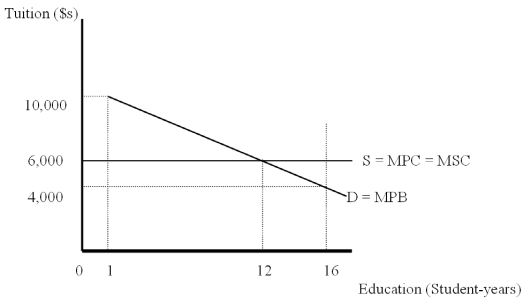
What is the equilibrium level of education in this market?
A)0 years
B)1 year
C)12 years
D)16 years
E)Between 12 and 16 years
What is the equilibrium level of education in this market?
A)0 years
B)1 year
C)12 years
D)16 years
E)Between 12 and 16 years

Question
The Following Questions Refer to the graph below. 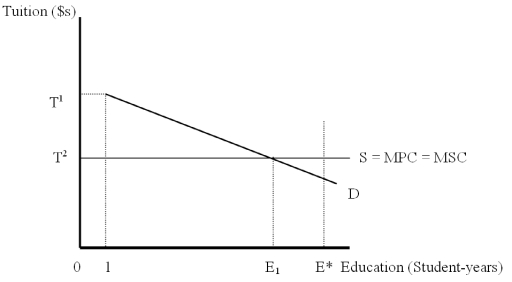
For which level of education is the family's MPB > MPC?
A)1 year
B)Between 0 and E1 years
C)Between E1 and E* years
D)Exactly E1 years
E)Exactly E* years
For which level of education is the family's MPB > MPC?
A)1 year
B)Between 0 and E1 years
C)Between E1 and E* years
D)Exactly E1 years
E)Exactly E* years
Question
Question
Question
Question
The Following Questions Refer to the graph below.
What is this family's willingness to pay for a first year of education?
A)$0
B)$4,000
C)$6,000
D)$8,000
E)$10,000
What is this family's willingness to pay for a first year of education?
A)$0
B)$4,000
C)$6,000
D)$8,000
E)$10,000
Question
The Following Questions Refer to the graph below.
The socially optimal level of education
A)Is 0 years
B)Is 1 year
C)Is E1 years
D)Is E* years.
E)Cannot be determined from the diagram.
The socially optimal level of education
A)Is 0 years
B)Is 1 year
C)Is E1 years
D)Is E* years.
E)Cannot be determined from the diagram.
Question
Question
The Following Questions Refer to the graph below.
Which of the following is true for the first years of education?
A)MPB < MPC
B)MPB > MPC
C)MSB > MSC
D)MSB < MSC
E)MPB = MSB
Which of the following is true for the first years of education?
A)MPB < MPC
B)MPB > MPC
C)MSB > MSC
D)MSB < MSC
E)MPB = MSB
Question
The Following Questions Refer to the graph below.
Which of the following is true for the 16th year of education?
A)MPB < MPC
B)MPB > MPC
C)MSB > MSC
D)MSB < MSC
E)MPB = MSB
Which of the following is true for the 16th year of education?
A)MPB < MPC
B)MPB > MPC
C)MSB > MSC
D)MSB < MSC
E)MPB = MSB
Question
Question
The Following Questions Refer to the graph below.
What assumption is shown by the fact that MPC = MSC on the graph?
A)This graph is for public education
B)There are no positive externalities associated with education
C)Education has positive spillover benefits for society
D)The market will produce the socially optimal quantity of education
E)This graph illustrates a private market for education
What assumption is shown by the fact that MPC = MSC on the graph?
A)This graph is for public education
B)There are no positive externalities associated with education
C)Education has positive spillover benefits for society
D)The market will produce the socially optimal quantity of education
E)This graph illustrates a private market for education
Question
Question
Question
The Following Questions Refer to the graph below.
What tuition would result in the family demanding 16 years of education?
A)$0
B)Less than $4,000
C)$4,000
D)$6,000
E)$10,000
What tuition would result in the family demanding 16 years of education?
A)$0
B)Less than $4,000
C)$4,000
D)$6,000
E)$10,000
Question
Question
The Following Questions Refer to the graph below.
The negative slope of the demand curve shows that
A)The marginal cost of education increases as more is purchased
B)The marginal benefit of education increases as more is purchased
C)The marginal benefit of each additional year of education decreases
D)There are positive spillover benefits of education
E)Tuition can be raised above T1 dollars
The negative slope of the demand curve shows that
A)The marginal cost of education increases as more is purchased
B)The marginal benefit of education increases as more is purchased
C)The marginal benefit of each additional year of education decreases
D)There are positive spillover benefits of education
E)Tuition can be raised above T1 dollars
Question
Question
Question
Question
The Following Questions Refer to the graph below.
The slope of the supply curve indicates that the
A)Marginal cost of a year of education is constant
B)Marginal benefit of an additional year of education increases
C)Marginal benefit of an additional year of education is constant
D)Marginal benefit of an additional year of education increases
E)Cost of education is subsidized by the public
The slope of the supply curve indicates that the
A)Marginal cost of a year of education is constant
B)Marginal benefit of an additional year of education increases
C)Marginal benefit of an additional year of education is constant
D)Marginal benefit of an additional year of education increases
E)Cost of education is subsidized by the public
Question
The Following Questions Refer to the graph below.
In the diagram,the equilibrium level of education is
A)0 years
B)1 year
C)E1 years
D)E* years
E)Between E1 and E* years
In the diagram,the equilibrium level of education is
A)0 years
B)1 year
C)E1 years
D)E* years
E)Between E1 and E* years
Question
Question
Question
Question
Question
Question
Question
The Following Questions Refer to the graph below.
For which year of education is the family's MPB < MPC?
A)0 years
B)1 year
C)E1 years
D)E* years
E)None of the above
For which year of education is the family's MPB < MPC?
A)0 years
B)1 year
C)E1 years
D)E* years
E)None of the above
Question
Question
Question
Question
Question
Question
Question
Question
Question
Question
Question
Question
The Following Questions Refer to the graph below. 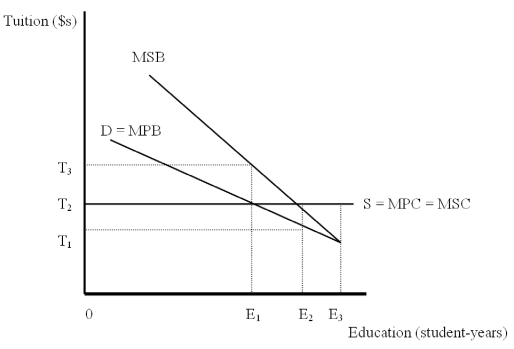
The socially optimal level of education is
A)0
B)Between 0 and E1
C)E1
D)E2
E)E3
The socially optimal level of education is
A)0
B)Between 0 and E1
C)E1
D)E2
E)E3
Question
Question
Question
Question
Question
The Following Questions Refer to the graph below.
The market equilibrium level of education is
A)0
B)Between 0 and E1
C)E1
D)E2
E)E3
The market equilibrium level of education is
A)0
B)Between 0 and E1
C)E1
D)E2
E)E3
Question
Question
Question
The Following Questions Refer to the graph below.
A tuition subsidy equal to how much will move the market to the socially optimal level of education?
A)T3 - T2
B)T2 - T1
C)T3 - T1
D)T1
E)T2
A tuition subsidy equal to how much will move the market to the socially optimal level of education?
A)T3 - T2
B)T2 - T1
C)T3 - T1
D)T1
E)T2
Question
The Following Questions Refer to the graph below. 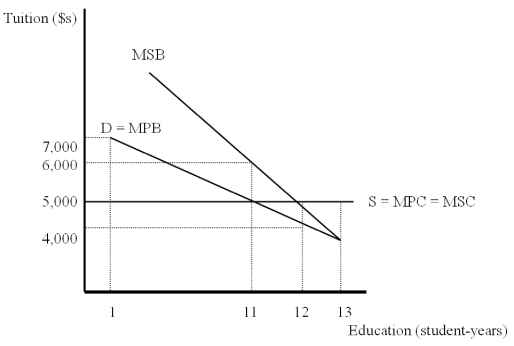
A tuition subsidy of $6,000 would lead to
A)The socially optimal quantity of education
B)Greater than the socially optimal quantity of education
C)Less than the socially optimal quantity of education
D)More public education
E)A budget surplus
A tuition subsidy of $6,000 would lead to
A)The socially optimal quantity of education
B)Greater than the socially optimal quantity of education
C)Less than the socially optimal quantity of education
D)More public education
E)A budget surplus
Question
Question
Question
Question
The Following Questions Refer to the graph below.
A tuition subsidy equal to T3 would result in which of the following?
A)The socially optimal quantity of education
B)Greater than the socially optimal quantity of education
C)Less than the socially optimal quantity of education
D)More public education
E)A budget surplus
A tuition subsidy equal to T3 would result in which of the following?
A)The socially optimal quantity of education
B)Greater than the socially optimal quantity of education
C)Less than the socially optimal quantity of education
D)More public education
E)A budget surplus
Question
The Following Questions Refer to the graph below.
Which of the following government actions will move the market equilibrium to the socially optimal number of years of education?
A)A tax on education equal to $1,000
B)A tax on education equal to $3,000
C)A tuition subsidy equal to $1,000
D)A tuition subsidy equal to $3,000
E)Government provision of all education
Which of the following government actions will move the market equilibrium to the socially optimal number of years of education?
A)A tax on education equal to $1,000
B)A tax on education equal to $3,000
C)A tuition subsidy equal to $1,000
D)A tuition subsidy equal to $3,000
E)Government provision of all education
Question
Question
The Following Questions Refer to the graph below.
What is the equilibrium number of years of education the market will provide?
A)0
B)1
C)11
D)12
E)16
What is the equilibrium number of years of education the market will provide?
A)0
B)1
C)11
D)12
E)16
Question
Question
The Following Questions Refer to the graph below.
The socially optimal years of education is
A)1
B)Between 1 and 11
C)11
D)12
E)16
The socially optimal years of education is
A)1
B)Between 1 and 11
C)11
D)12
E)16
Question
Question
Question
Question
Question
Question
Question
Question
Question
Question
Question
Question
Question
Question
Question
Question
Question
Question
Question
Question
Question

Unlock Deck
Sign up to unlock the cards in this deck!
Unlock Deck
Unlock Deck
1/122

Play

Full screen (f)
Deck 6: The Economics of Education: Crisis and Reform
1
The Following Questions Refer to the graph below.
What is the equilibrium level of education in this market?
A)0 years
B)1 year
C)12 years
D)16 years
E)Between 12 and 16 years
What is the equilibrium level of education in this market?
A)0 years
B)1 year
C)12 years
D)16 years
E)Between 12 and 16 years
C
2
The Following Questions Refer to the graph below.
For which level of education is the family's MPB > MPC?
A)1 year
B)Between 0 and E1 years
C)Between E1 and E* years
D)Exactly E1 years
E)Exactly E* years
For which level of education is the family's MPB > MPC?
A)1 year
B)Between 0 and E1 years
C)Between E1 and E* years
D)Exactly E1 years
E)Exactly E* years
B
3
Which of the following best describes the U.S.K-12 educational system?
A)It is largely private
B)It is mainly private with some public education
C)It is about half public and half private
D)It is predominantly public
E)It is exclusively public
A)It is largely private
B)It is mainly private with some public education
C)It is about half public and half private
D)It is predominantly public
E)It is exclusively public
D
4
Approximately what percent of its GDP does the United States spend on education?
A)2.0
B)3.0
C)3.9
D)4.2
E)5.3
A)2.0
B)3.0
C)3.9
D)4.2
E)5.3
Unlock Deck
Unlock for access to all 122 flashcards in this deck.
Unlock Deck
k this deck
5
In 2003,approximately what percent of school aged children attended public schools?
A)90%
B)75%
C)50%
D)25%
E)10%
A)90%
B)75%
C)50%
D)25%
E)10%
Unlock Deck
Unlock for access to all 122 flashcards in this deck.
Unlock Deck
k this deck
6
The Following Questions Refer to the graph below.
What is this family's willingness to pay for a first year of education?
A)$0
B)$4,000
C)$6,000
D)$8,000
E)$10,000
What is this family's willingness to pay for a first year of education?
A)$0
B)$4,000
C)$6,000
D)$8,000
E)$10,000
Unlock Deck
Unlock for access to all 122 flashcards in this deck.
Unlock Deck
k this deck
7
The Following Questions Refer to the graph below.
The socially optimal level of education
A)Is 0 years
B)Is 1 year
C)Is E1 years
D)Is E* years.
E)Cannot be determined from the diagram.
The socially optimal level of education
A)Is 0 years
B)Is 1 year
C)Is E1 years
D)Is E* years.
E)Cannot be determined from the diagram.
Unlock Deck
Unlock for access to all 122 flashcards in this deck.
Unlock Deck
k this deck
8
According to the Census Bureau,a college education adds how much to earnings over a person's work-life?
A)Nearly $1m
B)$2.1 m
C)$2.5m
D)$4.4 m
E)Over $5 m
A)Nearly $1m
B)$2.1 m
C)$2.5m
D)$4.4 m
E)Over $5 m
Unlock Deck
Unlock for access to all 122 flashcards in this deck.
Unlock Deck
k this deck
9
The Following Questions Refer to the graph below.
Which of the following is true for the first years of education?
A)MPB < MPC
B)MPB > MPC
C)MSB > MSC
D)MSB < MSC
E)MPB = MSB
Which of the following is true for the first years of education?
A)MPB < MPC
B)MPB > MPC
C)MSB > MSC
D)MSB < MSC
E)MPB = MSB
Unlock Deck
Unlock for access to all 122 flashcards in this deck.
Unlock Deck
k this deck
10
The Following Questions Refer to the graph below.
Which of the following is true for the 16th year of education?
A)MPB < MPC
B)MPB > MPC
C)MSB > MSC
D)MSB < MSC
E)MPB = MSB
Which of the following is true for the 16th year of education?
A)MPB < MPC
B)MPB > MPC
C)MSB > MSC
D)MSB < MSC
E)MPB = MSB
Unlock Deck
Unlock for access to all 122 flashcards in this deck.
Unlock Deck
k this deck
11
About how much does the United States spend on education,per pupil?
A)$6,000
B)$7,000
C)$8,000
D)$9,000
E)$10,000
A)$6,000
B)$7,000
C)$8,000
D)$9,000
E)$10,000
Unlock Deck
Unlock for access to all 122 flashcards in this deck.
Unlock Deck
k this deck
12
The Following Questions Refer to the graph below.
What assumption is shown by the fact that MPC = MSC on the graph?
A)This graph is for public education
B)There are no positive externalities associated with education
C)Education has positive spillover benefits for society
D)The market will produce the socially optimal quantity of education
E)This graph illustrates a private market for education
What assumption is shown by the fact that MPC = MSC on the graph?
A)This graph is for public education
B)There are no positive externalities associated with education
C)Education has positive spillover benefits for society
D)The market will produce the socially optimal quantity of education
E)This graph illustrates a private market for education
Unlock Deck
Unlock for access to all 122 flashcards in this deck.
Unlock Deck
k this deck
13
Which of the following is an important difference between the United States and other countries in terms of their K-12 education system?
A)The United States spends less on education per pupil than most other countries
B)The United States spends a higher percentage of its GDP on education than other countries
C)The United States has a shorter school year than most other countries
D)The United States has a purely private market for education
E)All of the above
A)The United States spends less on education per pupil than most other countries
B)The United States spends a higher percentage of its GDP on education than other countries
C)The United States has a shorter school year than most other countries
D)The United States has a purely private market for education
E)All of the above
Unlock Deck
Unlock for access to all 122 flashcards in this deck.
Unlock Deck
k this deck
14
According to the Census Bureau,someone with a professional degree can earn approximately how much during a typical work-life?
A)$1 m
B)$1.2 m
C)$2.5 m
D)$4.4 m
E)Over $5m
A)$1 m
B)$1.2 m
C)$2.5 m
D)$4.4 m
E)Over $5m
Unlock Deck
Unlock for access to all 122 flashcards in this deck.
Unlock Deck
k this deck
15
The Following Questions Refer to the graph below.
What tuition would result in the family demanding 16 years of education?
A)$0
B)Less than $4,000
C)$4,000
D)$6,000
E)$10,000
What tuition would result in the family demanding 16 years of education?
A)$0
B)Less than $4,000
C)$4,000
D)$6,000
E)$10,000
Unlock Deck
Unlock for access to all 122 flashcards in this deck.
Unlock Deck
k this deck
16
According to the Census Bureau,high school graduates can expect to earn how much during their working years?
A)$45,000
B)$1.2 m
C)$2.1 m
D)$2.5 m
E)$4.4 m
A)$45,000
B)$1.2 m
C)$2.1 m
D)$2.5 m
E)$4.4 m
Unlock Deck
Unlock for access to all 122 flashcards in this deck.
Unlock Deck
k this deck
17
The Following Questions Refer to the graph below.
The negative slope of the demand curve shows that
A)The marginal cost of education increases as more is purchased
B)The marginal benefit of education increases as more is purchased
C)The marginal benefit of each additional year of education decreases
D)There are positive spillover benefits of education
E)Tuition can be raised above T1 dollars
The negative slope of the demand curve shows that
A)The marginal cost of education increases as more is purchased
B)The marginal benefit of education increases as more is purchased
C)The marginal benefit of each additional year of education decreases
D)There are positive spillover benefits of education
E)Tuition can be raised above T1 dollars
Unlock Deck
Unlock for access to all 122 flashcards in this deck.
Unlock Deck
k this deck
18
Where did U.S.eighth grade students rank internationally in terms of average math scores in 2007?
A)At the top
B)Second
C)Near the middle
D)Next to the bottom
E)At the bottom
A)At the top
B)Second
C)Near the middle
D)Next to the bottom
E)At the bottom
Unlock Deck
Unlock for access to all 122 flashcards in this deck.
Unlock Deck
k this deck
19
Where did U.S.eighth grade students rank internationally in terms of average science scores in 2007?
A)At the top
B)Second
C)In the middle
D)In the bottom half
E)At bottom
A)At the top
B)Second
C)In the middle
D)In the bottom half
E)At bottom
Unlock Deck
Unlock for access to all 122 flashcards in this deck.
Unlock Deck
k this deck
20
Which of the following is true of the U.S.K-12 education system relative to the K-12 education system of other developed countries?
A)It has lower expenditures per pupil and lower achievement
B)It has lower expenditures per pupil and higher achievement
C)It has higher expenditures per pupil and lower achievement
D)It has higher expenditures per pupil and higher achievement
E)It has equivalent expenditures per pupil and achievement
A)It has lower expenditures per pupil and lower achievement
B)It has lower expenditures per pupil and higher achievement
C)It has higher expenditures per pupil and lower achievement
D)It has higher expenditures per pupil and higher achievement
E)It has equivalent expenditures per pupil and achievement
Unlock Deck
Unlock for access to all 122 flashcards in this deck.
Unlock Deck
k this deck
21
The Following Questions Refer to the graph below.
The slope of the supply curve indicates that the
A)Marginal cost of a year of education is constant
B)Marginal benefit of an additional year of education increases
C)Marginal benefit of an additional year of education is constant
D)Marginal benefit of an additional year of education increases
E)Cost of education is subsidized by the public
The slope of the supply curve indicates that the
A)Marginal cost of a year of education is constant
B)Marginal benefit of an additional year of education increases
C)Marginal benefit of an additional year of education is constant
D)Marginal benefit of an additional year of education increases
E)Cost of education is subsidized by the public
Unlock Deck
Unlock for access to all 122 flashcards in this deck.
Unlock Deck
k this deck
22
The Following Questions Refer to the graph below.
In the diagram,the equilibrium level of education is
A)0 years
B)1 year
C)E1 years
D)E* years
E)Between E1 and E* years
In the diagram,the equilibrium level of education is
A)0 years
B)1 year
C)E1 years
D)E* years
E)Between E1 and E* years
Unlock Deck
Unlock for access to all 122 flashcards in this deck.
Unlock Deck
k this deck
23
An increase in the demand for education will
A)Increase the supply of education
B)Decrease the equilibrium tuition
C)Decrease the equilibrium quantity of education
D)Increase the equilibrium quantity of education
E)Shift the demand curve for education to the left
A)Increase the supply of education
B)Decrease the equilibrium tuition
C)Decrease the equilibrium quantity of education
D)Increase the equilibrium quantity of education
E)Shift the demand curve for education to the left
Unlock Deck
Unlock for access to all 122 flashcards in this deck.
Unlock Deck
k this deck
24
A decrease in the cost of education will
A)Increase the supply of education
B)Increase the equilibrium tuition
C)Decrease the equilibrium quantity of education
D)Increase the equilibrium quantity of education
E)Shift the demand curve for education to the left
A)Increase the supply of education
B)Increase the equilibrium tuition
C)Decrease the equilibrium quantity of education
D)Increase the equilibrium quantity of education
E)Shift the demand curve for education to the left
Unlock Deck
Unlock for access to all 122 flashcards in this deck.
Unlock Deck
k this deck
25
If the earnings expected from a college education increase,it will lead to an increase in
A)The demand for K-12 education
B)The supply of K-12 education
C)The cost of education
D)The teacher salaries
E)All of the above
A)The demand for K-12 education
B)The supply of K-12 education
C)The cost of education
D)The teacher salaries
E)All of the above
Unlock Deck
Unlock for access to all 122 flashcards in this deck.
Unlock Deck
k this deck
26
An increase in family income will
A)Increase the demand for education
B)Decrease the demand for education
C)Increase the quantity of education supplied
D)Increase the quantity of education demanded
E)Decrease the equilibrium level of tuition
A)Increase the demand for education
B)Decrease the demand for education
C)Increase the quantity of education supplied
D)Increase the quantity of education demanded
E)Decrease the equilibrium level of tuition
Unlock Deck
Unlock for access to all 122 flashcards in this deck.
Unlock Deck
k this deck
27
Which of the following is an example of a possible spillover benefit from education?
A)An improved democratic process
B)Improved health
C)Improved public safety
D)More charitable giving
E)All of the above
A)An improved democratic process
B)Improved health
C)Improved public safety
D)More charitable giving
E)All of the above
Unlock Deck
Unlock for access to all 122 flashcards in this deck.
Unlock Deck
k this deck
28
I benefit because you become more educateD.This is an example of a
A)Negative externality in consumption
B)Spillover cost
C)Positive externality in production
D)Positive externality in consumption
E)Negative externality in production
A)Negative externality in consumption
B)Spillover cost
C)Positive externality in production
D)Positive externality in consumption
E)Negative externality in production
Unlock Deck
Unlock for access to all 122 flashcards in this deck.
Unlock Deck
k this deck
29
The Following Questions Refer to the graph below.
For which year of education is the family's MPB < MPC?
A)0 years
B)1 year
C)E1 years
D)E* years
E)None of the above
For which year of education is the family's MPB < MPC?
A)0 years
B)1 year
C)E1 years
D)E* years
E)None of the above
Unlock Deck
Unlock for access to all 122 flashcards in this deck.
Unlock Deck
k this deck
30
Which of the following will decrease the equilibrium quantity of education in a market?
A)An increase in the demand for education
B)A decrease in the demand for education
C)A decrease in production costs
D)An increase in the supply of education
E)None of the above
A)An increase in the demand for education
B)A decrease in the demand for education
C)A decrease in production costs
D)An increase in the supply of education
E)None of the above
Unlock Deck
Unlock for access to all 122 flashcards in this deck.
Unlock Deck
k this deck
31
Education is said to be which of the following?
A)Individually consumed
B)Individually produced
C)A semi-private good
D)A private good
E)A public good
A)Individually consumed
B)Individually produced
C)A semi-private good
D)A private good
E)A public good
Unlock Deck
Unlock for access to all 122 flashcards in this deck.
Unlock Deck
k this deck
32
As the number of years of education increases,the spillover benefits will
A)Increase
B)Decrease
C)Stay the same
D)Become negative
E)None of the above
A)Increase
B)Decrease
C)Stay the same
D)Become negative
E)None of the above
Unlock Deck
Unlock for access to all 122 flashcards in this deck.
Unlock Deck
k this deck
33
The supply of private education is represented by
A)The MPB curve
B)The MPC curve
C)The MSC curve
D)The MSB curve
E)None of the above
A)The MPB curve
B)The MPC curve
C)The MSC curve
D)The MSB curve
E)None of the above
Unlock Deck
Unlock for access to all 122 flashcards in this deck.
Unlock Deck
k this deck
34
What happens to the marginal benefit of education as a child gets more schooling? It will
A)Increase
B)Decrease
C)Stay the same
D)Become infinite
E)Become negative
A)Increase
B)Decrease
C)Stay the same
D)Become infinite
E)Become negative
Unlock Deck
Unlock for access to all 122 flashcards in this deck.
Unlock Deck
k this deck
35
Students learn about health and nutrition in school.This provides a
A)Positive externality in production
B)Positive externality in consumption
C)Negative externality in production
D)Negative externality in consumption
E)Cost to society
A)Positive externality in production
B)Positive externality in consumption
C)Negative externality in production
D)Negative externality in consumption
E)Cost to society
Unlock Deck
Unlock for access to all 122 flashcards in this deck.
Unlock Deck
k this deck
36
An increase in the marginal benefit of education will cause which of the following?
A)The demand curve for education shifts right
B)The demand curve for education shifts left
C)The supply curve for education shifts right
D)The supply curve for education shifts left
E)The equilibrium number of years of education will decrease
A)The demand curve for education shifts right
B)The demand curve for education shifts left
C)The supply curve for education shifts right
D)The supply curve for education shifts left
E)The equilibrium number of years of education will decrease
Unlock Deck
Unlock for access to all 122 flashcards in this deck.
Unlock Deck
k this deck
37
The creation of new learning technologies will cause which of the following to decrease?
A)The demand for education
B)The supply of education
C)The cost of education
D)The equilibrium quantity of education
E)The number of children in school
A)The demand for education
B)The supply of education
C)The cost of education
D)The equilibrium quantity of education
E)The number of children in school
Unlock Deck
Unlock for access to all 122 flashcards in this deck.
Unlock Deck
k this deck
38
Which of the following is a benefit of increased education?
A)Improved literacy
B)Increased earnings
C)Improved health
D)Greater satisfaction
E)All of the above
A)Improved literacy
B)Increased earnings
C)Improved health
D)Greater satisfaction
E)All of the above
Unlock Deck
Unlock for access to all 122 flashcards in this deck.
Unlock Deck
k this deck
39
Which of the following happens as tuition increases?
A)The demand for education increases
B)The demand for education decreases
C)The supply of education increases
D)The years of education demanded fall
E)The cost of education increases
A)The demand for education increases
B)The demand for education decreases
C)The supply of education increases
D)The years of education demanded fall
E)The cost of education increases
Unlock Deck
Unlock for access to all 122 flashcards in this deck.
Unlock Deck
k this deck
40
Marginal social benefits equal
A)MPB + spillover benefits
B)MPB - spillover benefits
C)MPCs
D)Total benefits + positive externalities in consumption
E)None of the above
A)MPB + spillover benefits
B)MPB - spillover benefits
C)MPCs
D)Total benefits + positive externalities in consumption
E)None of the above
Unlock Deck
Unlock for access to all 122 flashcards in this deck.
Unlock Deck
k this deck
41
The Following Questions Refer to the graph below.
The socially optimal level of education is
A)0
B)Between 0 and E1
C)E1
D)E2
E)E3
The socially optimal level of education is
A)0
B)Between 0 and E1
C)E1
D)E2
E)E3
Unlock Deck
Unlock for access to all 122 flashcards in this deck.
Unlock Deck
k this deck
42
Educated citizens are more likely to be informed voters.This is an example of a
A)Positive externality in production
B)Positive externality in consumption
C)Negative externality in production
D)Negative externality in consumption
E)Cost to society.
A)Positive externality in production
B)Positive externality in consumption
C)Negative externality in production
D)Negative externality in consumption
E)Cost to society.
Unlock Deck
Unlock for access to all 122 flashcards in this deck.
Unlock Deck
k this deck
43
The current K-12 education system can be described as
A)Private
B)Centralized
C)Decentralized
D)State owned
E)None of the above
A)Private
B)Centralized
C)Decentralized
D)State owned
E)None of the above
Unlock Deck
Unlock for access to all 122 flashcards in this deck.
Unlock Deck
k this deck
44
Greater segregation along racial lines is a likely result of
A)Purely private K-12 education
B)No public K-12 education
C)Voucher programs
D)Tuition subsidies
E)All of the above
A)Purely private K-12 education
B)No public K-12 education
C)Voucher programs
D)Tuition subsidies
E)All of the above
Unlock Deck
Unlock for access to all 122 flashcards in this deck.
Unlock Deck
k this deck
45
In a purely private K-12 education system,spaces would be allocated based on
A)Ability
B)Equity
C)Income
D)Geographic boundaries
E)None of the above
A)Ability
B)Equity
C)Income
D)Geographic boundaries
E)None of the above
Unlock Deck
Unlock for access to all 122 flashcards in this deck.
Unlock Deck
k this deck
46
The Following Questions Refer to the graph below.
The market equilibrium level of education is
A)0
B)Between 0 and E1
C)E1
D)E2
E)E3
The market equilibrium level of education is
A)0
B)Between 0 and E1
C)E1
D)E2
E)E3
Unlock Deck
Unlock for access to all 122 flashcards in this deck.
Unlock Deck
k this deck
47
With positive externalities in consumption,the market equilibrium quantity will be
A)Greater than socially optimal
B)Less than socially optimal
C)Equal to the socially optimal level
D)Higher than otherwise
E)None of the above
A)Greater than socially optimal
B)Less than socially optimal
C)Equal to the socially optimal level
D)Higher than otherwise
E)None of the above
Unlock Deck
Unlock for access to all 122 flashcards in this deck.
Unlock Deck
k this deck
48
The existence of spillover benefits results in an equilibrium quantity in the market that is socially optimal.
A)Higher than
B)Lower than
C)Equal to
D)Better than
E)More expansive than
A)Higher than
B)Lower than
C)Equal to
D)Better than
E)More expansive than
Unlock Deck
Unlock for access to all 122 flashcards in this deck.
Unlock Deck
k this deck
49
The Following Questions Refer to the graph below.
A tuition subsidy equal to how much will move the market to the socially optimal level of education?
A)T3 - T2
B)T2 - T1
C)T3 - T1
D)T1
E)T2
A tuition subsidy equal to how much will move the market to the socially optimal level of education?
A)T3 - T2
B)T2 - T1
C)T3 - T1
D)T1
E)T2
Unlock Deck
Unlock for access to all 122 flashcards in this deck.
Unlock Deck
k this deck
50
The Following Questions Refer to the graph below.
A tuition subsidy of $6,000 would lead to
A)The socially optimal quantity of education
B)Greater than the socially optimal quantity of education
C)Less than the socially optimal quantity of education
D)More public education
E)A budget surplus
A tuition subsidy of $6,000 would lead to
A)The socially optimal quantity of education
B)Greater than the socially optimal quantity of education
C)Less than the socially optimal quantity of education
D)More public education
E)A budget surplus
Unlock Deck
Unlock for access to all 122 flashcards in this deck.
Unlock Deck
k this deck
51
In the existing public K-12 education system,spaces are allocated based on
A)Ability
B)Equity
C)Income
D)Geographic boundaries
E)None of the above
A)Ability
B)Equity
C)Income
D)Geographic boundaries
E)None of the above
Unlock Deck
Unlock for access to all 122 flashcards in this deck.
Unlock Deck
k this deck
52
A program to provide public funding for students in poor performing public schools to attend other schools is known as
A)A voucher program
B)A charter school
C)A tuition tax
D)A welfare program
E)Privatization
A)A voucher program
B)A charter school
C)A tuition tax
D)A welfare program
E)Privatization
Unlock Deck
Unlock for access to all 122 flashcards in this deck.
Unlock Deck
k this deck
53
To be socially optimal,education should be provided to the point where
A)MPB = MPC
B)MPB = MSC
C)MSB = MPC
D)MSB = MSC
E)MPB = MSB
A)MPB = MPC
B)MPB = MSC
C)MSB = MPC
D)MSB = MSC
E)MPB = MSB
Unlock Deck
Unlock for access to all 122 flashcards in this deck.
Unlock Deck
k this deck
54
The Following Questions Refer to the graph below.
A tuition subsidy equal to T3 would result in which of the following?
A)The socially optimal quantity of education
B)Greater than the socially optimal quantity of education
C)Less than the socially optimal quantity of education
D)More public education
E)A budget surplus
A tuition subsidy equal to T3 would result in which of the following?
A)The socially optimal quantity of education
B)Greater than the socially optimal quantity of education
C)Less than the socially optimal quantity of education
D)More public education
E)A budget surplus
Unlock Deck
Unlock for access to all 122 flashcards in this deck.
Unlock Deck
k this deck
55
The Following Questions Refer to the graph below.
Which of the following government actions will move the market equilibrium to the socially optimal number of years of education?
A)A tax on education equal to $1,000
B)A tax on education equal to $3,000
C)A tuition subsidy equal to $1,000
D)A tuition subsidy equal to $3,000
E)Government provision of all education
Which of the following government actions will move the market equilibrium to the socially optimal number of years of education?
A)A tax on education equal to $1,000
B)A tax on education equal to $3,000
C)A tuition subsidy equal to $1,000
D)A tuition subsidy equal to $3,000
E)Government provision of all education
Unlock Deck
Unlock for access to all 122 flashcards in this deck.
Unlock Deck
k this deck
56
The argument for government provision of education hinges on the existence of
A)spillover costs.
B)spillover benefits.
C)voucher programs.
D)negative externalities in production.
E)negative externalities in consumption
A)spillover costs.
B)spillover benefits.
C)voucher programs.
D)negative externalities in production.
E)negative externalities in consumption
Unlock Deck
Unlock for access to all 122 flashcards in this deck.
Unlock Deck
k this deck
57
The Following Questions Refer to the graph below.
What is the equilibrium number of years of education the market will provide?
A)0
B)1
C)11
D)12
E)16
What is the equilibrium number of years of education the market will provide?
A)0
B)1
C)11
D)12
E)16
Unlock Deck
Unlock for access to all 122 flashcards in this deck.
Unlock Deck
k this deck
58
Centralized planning leads to which of the following?
A)Limited consumer choice
B)Decreased quality
C)Increased prices
D)Lack of responsiveness
E)All of the above
A)Limited consumer choice
B)Decreased quality
C)Increased prices
D)Lack of responsiveness
E)All of the above
Unlock Deck
Unlock for access to all 122 flashcards in this deck.
Unlock Deck
k this deck
59
The Following Questions Refer to the graph below.
The socially optimal years of education is
A)1
B)Between 1 and 11
C)11
D)12
E)16
The socially optimal years of education is
A)1
B)Between 1 and 11
C)11
D)12
E)16
Unlock Deck
Unlock for access to all 122 flashcards in this deck.
Unlock Deck
k this deck
60
A purely private K-12 system will lead to
A)Lower private costs
B)Increased public costs
C)Decreased racial segregation
D)Increased inequality
E)Greater social benefits
A)Lower private costs
B)Increased public costs
C)Decreased racial segregation
D)Increased inequality
E)Greater social benefits
Unlock Deck
Unlock for access to all 122 flashcards in this deck.
Unlock Deck
k this deck
61
Education could be considered a semi-private good,since
A)There are spillover benefits to other members of society resulting from the education of a child
B)Education of the population improves everyone's lives since it results in greater productivity and income for all members of society
C)There are benefits to society from education,since it reduces the crime rate
D)Education produces positive externalities to society
E)All of the above
A)There are spillover benefits to other members of society resulting from the education of a child
B)Education of the population improves everyone's lives since it results in greater productivity and income for all members of society
C)There are benefits to society from education,since it reduces the crime rate
D)Education produces positive externalities to society
E)All of the above
Unlock Deck
Unlock for access to all 122 flashcards in this deck.
Unlock Deck
k this deck
62
Improved education will lead to higher economic growth in a country.
Unlock Deck
Unlock for access to all 122 flashcards in this deck.
Unlock Deck
k this deck
63
Decreasing average class size without changing teacher pay leads to
A)Lower quality teachers
B)A surplus of teachers
C)Lower costs per pupil
D)Increased segregation
E)All of the above
A)Lower quality teachers
B)A surplus of teachers
C)Lower costs per pupil
D)Increased segregation
E)All of the above
Unlock Deck
Unlock for access to all 122 flashcards in this deck.
Unlock Deck
k this deck
64
What is the relationship between school funding and student achievement?
A)Positive
B)Negative
C)Mixed
D)Unrelated
E)Inverse
A)Positive
B)Negative
C)Mixed
D)Unrelated
E)Inverse
Unlock Deck
Unlock for access to all 122 flashcards in this deck.
Unlock Deck
k this deck
65
If government wishes to increase the quantity of higher education consumed,what can be done to accomplish this?
A)Charge tuition that is below the full costs of providing the educational services
B)Operate public colleges
C)Provide reduced tuition to students
D)Any of the above alternatives would increase the consumption of education
E)The government should not attempt to increase education,since it is a private good
A)Charge tuition that is below the full costs of providing the educational services
B)Operate public colleges
C)Provide reduced tuition to students
D)Any of the above alternatives would increase the consumption of education
E)The government should not attempt to increase education,since it is a private good
Unlock Deck
Unlock for access to all 122 flashcards in this deck.
Unlock Deck
k this deck
66
Schools in which parents or other groups were permitted to create a new school with state funding and were given control over operations are known as
A)Private schools
B)Voucher schools
C)Magnet schools
D)Experimental schools
E)Charter schools
A)Private schools
B)Voucher schools
C)Magnet schools
D)Experimental schools
E)Charter schools
Unlock Deck
Unlock for access to all 122 flashcards in this deck.
Unlock Deck
k this deck
67
A master's degree increases lifetime earnings over a bachelor's degree by $2.5m over high school graduates.
Unlock Deck
Unlock for access to all 122 flashcards in this deck.
Unlock Deck
k this deck
68
What is the relationship between student achievement and teacher pay?
A)Positive
B)Negative
C)Mixed
D)Unrelated
E)Inverse
A)Positive
B)Negative
C)Mixed
D)Unrelated
E)Inverse
Unlock Deck
Unlock for access to all 122 flashcards in this deck.
Unlock Deck
k this deck
69
Public schools must pay for which of the following expenses that private schools do not?
A)Transportation
B)Food
C)Special education
D)All of the above
E)None of the above
A)Transportation
B)Food
C)Special education
D)All of the above
E)None of the above
Unlock Deck
Unlock for access to all 122 flashcards in this deck.
Unlock Deck
k this deck
70
Which of the following is an argument against voucher programs?
A)Cream skimming
B)Reduced social segregation
C)Decreased efficiency
D)Increased special education
E)All of the above
A)Cream skimming
B)Reduced social segregation
C)Decreased efficiency
D)Increased special education
E)All of the above
Unlock Deck
Unlock for access to all 122 flashcards in this deck.
Unlock Deck
k this deck
71
More education will increase the revenue a worker adds to a firm.
Unlock Deck
Unlock for access to all 122 flashcards in this deck.
Unlock Deck
k this deck
72
A college education does not improve earnings over a high school degreE.
Unlock Deck
Unlock for access to all 122 flashcards in this deck.
Unlock Deck
k this deck
73
Studies of voucher programs indicate that the effects of vouchers on student achievement
A)Are small but have negative impact on student performance
B)Are received primarily by African-American and economically disadvantaged children
C)Have yet to be examined in large-scale programs
D)Both b and c
E)None of the above
A)Are small but have negative impact on student performance
B)Are received primarily by African-American and economically disadvantaged children
C)Have yet to be examined in large-scale programs
D)Both b and c
E)None of the above
Unlock Deck
Unlock for access to all 122 flashcards in this deck.
Unlock Deck
k this deck
74
What is the relationship between teacher pay and a shortage of teachers?
A)Positive
B)Negative
C)Mixed
D)Unrelated
E)Direct
A)Positive
B)Negative
C)Mixed
D)Unrelated
E)Direct
Unlock Deck
Unlock for access to all 122 flashcards in this deck.
Unlock Deck
k this deck
75
Research on the effects of charter schools show
A)There are significantly positive impacts on student performance
B)There are significantly negative impacts on student performance
C)There are mixed results,with positive impacts in some schools and negative in others
D)Research has yet to be undertaken on these new types of schools
E)None of the above
A)There are significantly positive impacts on student performance
B)There are significantly negative impacts on student performance
C)There are mixed results,with positive impacts in some schools and negative in others
D)Research has yet to be undertaken on these new types of schools
E)None of the above
Unlock Deck
Unlock for access to all 122 flashcards in this deck.
Unlock Deck
k this deck
76
A reduction in class size should be undertaken as long as the marginal benefit of the decrease is
A)Positive
B)Negative
C)Greater than the marginal cost
D)Less than the marginal cost
E)Increasing
A)Positive
B)Negative
C)Greater than the marginal cost
D)Less than the marginal cost
E)Increasing
Unlock Deck
Unlock for access to all 122 flashcards in this deck.
Unlock Deck
k this deck
77
The cream skimming argument says that the students who choose a voucher program will be
A)Higher income
B)Lower income
C)Higher achieving
D)Non-minority
E)None of the above
A)Higher income
B)Lower income
C)Higher achieving
D)Non-minority
E)None of the above
Unlock Deck
Unlock for access to all 122 flashcards in this deck.
Unlock Deck
k this deck
78
Which of the following statements does not enjoy widespread agreement?
A)Achievement per dollar in U.S.education is too low
B)Reform of the U.S.education system is necessary to maintain high level human capital
C)Smaller class sizes can improve student performance
D)Voucher programs are the most effective way to improve the U.S.education system
E)Increased teacher pay increases teacher quality
A)Achievement per dollar in U.S.education is too low
B)Reform of the U.S.education system is necessary to maintain high level human capital
C)Smaller class sizes can improve student performance
D)Voucher programs are the most effective way to improve the U.S.education system
E)Increased teacher pay increases teacher quality
Unlock Deck
Unlock for access to all 122 flashcards in this deck.
Unlock Deck
k this deck
79
The empirical evidence of the effectiveness of voucher programs is best described as
A)Positive
B)Negative
C)Inconsistent
D)Substantial
E)Nonexistent
A)Positive
B)Negative
C)Inconsistent
D)Substantial
E)Nonexistent
Unlock Deck
Unlock for access to all 122 flashcards in this deck.
Unlock Deck
k this deck
80
American high school graduates outperform all other countries on math and science exams.
Unlock Deck
Unlock for access to all 122 flashcards in this deck.
Unlock Deck
k this deck
Unlock Deck
Unlock for access to all 122 flashcards in this deck.






