







 Chat with AI

Deck 4: Slavery, Freedom, and the Struggle for Empire, to 1763
Full screen (f)

Question

Question
Question
Question
Question
Map: Atlantic Trading Routes
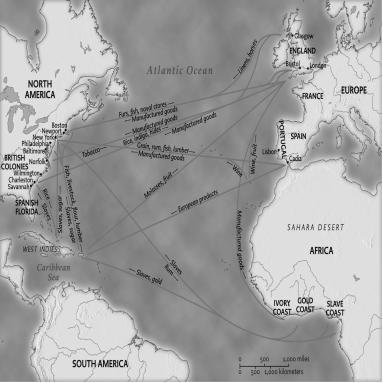
Which of the following was an important effect of the eighteenth-century Atlantic trading routes depicted in the map above?
A) Dependence on indentured servitude in the North American economies increased.
B) New labor systems emerged in the colonies.
C) Spanish influence in the New World grew.
D) The British colonies became more economically dependent on England.
Which of the following was an important effect of the eighteenth-century Atlantic trading routes depicted in the map above?
A) Dependence on indentured servitude in the North American economies increased.
B) New labor systems emerged in the colonies.
C) Spanish influence in the New World grew.
D) The British colonies became more economically dependent on England.
Question
Question
Map: Atlantic Trading Routes
Which of the following was a cause of the process depicted in the map above?
A) The New England colonies flourished through the use of slave labor.
B) Regional distinctiveness among the British colonies was diminishing.
C) The Caribbean was no longer the commercial focus of the British empire.
D) Demand for products such as tobacco and sugar increased in England.
Which of the following was a cause of the process depicted in the map above?
A) The New England colonies flourished through the use of slave labor.
B) Regional distinctiveness among the British colonies was diminishing.
C) The Caribbean was no longer the commercial focus of the British empire.
D) Demand for products such as tobacco and sugar increased in England.
Question
Question
Map: Atlantic Trading Routes
The process depicted in the map most directly led to which of the following?
A) The British colonies began producing manufactured goods in an effort to reduce their dependence on England.
B) Spanish colonies became less dependent on slave labor.
C) Racial stereotyping and the development of strict racial categories emerged among British colonists.
D) The conditions of slavery became harsher in the Chesapeake than in the other British colonies.
The process depicted in the map most directly led to which of the following?
A) The British colonies began producing manufactured goods in an effort to reduce their dependence on England.
B) Spanish colonies became less dependent on slave labor.
C) Racial stereotyping and the development of strict racial categories emerged among British colonists.
D) The conditions of slavery became harsher in the Chesapeake than in the other British colonies.
Question
Question
Question
Question
Question
Question
Question
Map: Atlantic Trading Routes
The map above depicts which of the following ideologies?
A) mercantilism
B) manifest destiny
C) capitalism
D) abolitionism
The map above depicts which of the following ideologies?
A) mercantilism
B) manifest destiny
C) capitalism
D) abolitionism
Question
Question
Question
Question
Question
Question
Question
Question
Question
Question
Question
Question
Question
Question
Question
Question
Question
Question
Question
Question
Question
Question
Question
Question
Question
Question
Question
Question
Question
Question
Question
Question
Question
Question
Question
Question
Question
Question
Question
Question
Question
Question
Question
Question
Question
Question
Question
Question
Question
Question
Question
Question
Question
Question
Question
Question
Question
Question
Document Based Question
According to historian Samuel Eliot Morrison, "By 1763 the British North American colonists were the freest people in the world." Analyze the degree to which and the ways in which the British North American colonies came to experience and expect freedom politically, economically, and socially between 1607 and 1763.
Document 1
Source: John Pory, A Reporte of the Manner of Proceeding in the General Assembly Convented at James City, July 30, 1619.
But forasmuch as men's affaires doe little prosper where God's service is neglected, all the Burgesses tooke their places in the Quire [choir] till a prayer was said by Mr. Bucke, the Minister, that it would please God to guide and sanctifie all our proceedings to his own glory and the good of this Plantation. . . . The Speaker . . . delivered in briefe to the whole assembly the occasions of their meeting. Which done, he read unto them the commission for establishing the Counsell of Estate and the general Assembly, wherein their duties were described to the life. . . . And forasmuch as our intente is to establish one equall and uniforme kinde of government over all Virginia &c.
Document 2
Source: Town map, Colonial New England.
![Document Based Question According to historian Samuel Eliot Morrison, By 1763 the British North American colonists were the freest people in the world. Analyze the degree to which and the ways in which the British North American colonies came to experience and expect freedom politically, economically, and socially between 1607 and 1763. Document 1 Source: John Pory, A Reporte of the Manner of Proceeding in the General Assembly Convented at James City, July 30, 1619. But forasmuch as men's affaires doe little prosper where God's service is neglected, all the Burgesses tooke their places in the Quire [choir] till a prayer was said by Mr. Bucke, the Minister, that it would please God to guide and sanctifie all our proceedings to his own glory and the good of this Plantation. . . . The Speaker . . . delivered in briefe to the whole assembly the occasions of their meeting. Which done, he read unto them the commission for establishing the Counsell of Estate and the general Assembly, wherein their duties were described to the life. . . . And forasmuch as our intente is to establish one equall and uniforme kinde of government over all Virginia &c. Document 2 Source: Town map, Colonial New England. Document 3 Source: Response from the Massachusetts General Court to Trade Petition, 1678. That for the acts passed in Parliament for incouraging trade and navigation, wee humbly conceive, according to the usuall sayings of the learned in the lawe, that the lawes of England are bounded within the fower seas, and doe not reach America. The subjects of his majesty here being not represented in Parliament, so wee have not looked at ourselves to be impeded in our trade by them, nor yet wee abated in our relative allegiance to his majestie. Document 4 Source: The Great Law, Pennsylvania, 1682. No Person now or at Any time hereafter Liveing in this Province who Shall Confess and acknowledge one Almighty God to be the Creatour Upholder and Ruler of the World and that professeth him or herselfe Obliged in Conscience to Live Peaceably and Justly under the Civill Government shall in any case be Molested or Prejudiced for his or her Conscientious Perswasion or Practice nor shall he or she at any time be Compelled to frequent or Maintaine any Religious Worshipp place or Ministry whatever Contrary to his or her mind but shall freely and fully Enjoy his or her Christian Liberty without any Interuption or reflection and if any Person shall abuse or deride any Other for his or her Diferant Perswasion and Practice in Matters of Religion Such shall be Lookt upon as a disturber of the Peace and be punished accordingly. Document 5 Source: Proposal by the Board of Trade of England concerning the revocation of proprietary charters, March 26, 1701. To the Kings most Excllt Majestie. May it please &c That those Colonies in general have no ways answered the chief design for which such large Tracts of Land and such Priviledges and Immunities were granted by the Crown. That they have not conformed themselves to the severall acts of Parliament for regulating Trade and Navigation, to which they ought to pay the same obedience, and submit to the same Restrictions as the other Plantations, which are subject to your Majesties immediate Government, on the contrary in most of these Proprieties and Charter Governments, the Governours have not applyed themselves to your Majesty for your approbation, nor have taken the Oaths required by the acts of Trade, both which Qualifications are made necessary by the late Act for preventing frauds and regulating abuses in the Plantation Trade. That these Colonies continue to be the refuge and retreat of Pirates & Illegal Traders, and the receptacle of Goods imported thither from foreign parts contrary to Law: In return of which Commodities those of the growth of these Colonies are likewise contrary to Law exported to Foreign parts; All which is likewise much incouraged by their not admitting appeals as aforesaide. That this chiefly arises from the ill use they make of the powers entrusted to them by their Charters, and the Independency which they pretend to, and that each Government is obliged only to defend its self without any consideration had of their Neighbours, or of the general preservation of the whole. Document 6 Source: The Molasses Act, 1733. An Act for the better securing and encouraging the Trade of His Majesty's Sugar Colonies in America Whereas the Welfare and Prosperity of Your Majesty's Sugar Colonies in America are of the greatest Consequence and Importance to the Trade, Navigation, and Strength of this Kingdom: And whereas the planters of the said sugar colonies as of late Years fallen under such great Discouragements, that they are unable to improve or carry on the Sugar Trade upon an equal footing with the Foreign Sugar Colonies, without Some Advantage and Relief be given to them from Great Britain, for Remedy whereof, and, for the Good and Welfare of Your Majesty's Subjects, we, Your Majesty's most dutiful and loyal Subjects, the Commons of Great Britain assembled in Parliament, have given and granted under Your Majesty the several and respected rates and duties herein aftermentioned . . . there shall be raised, levied and collected and paid, unto and for the Use of His Majesty, His Heirs, and Successors, upon all Rum or Spirits of the Produce or Manufacture of any of the Colonies or Plantations in America, not in the Possession or under the dominion of His Majesty, His Heirs, and Successors, which, at any Time or Times within or during the Continuance of this Act, shall be imported or brought into any of the Colonies or Plantations in America, which are now, or hereafter may be, in the Possession or under the Dominion of His Majesty, His Heirs, and Successors, the Sum of Nine pence, Money of Great Britain, to be paid according to the Proportion and Value of Five shillings and Six pence the Ounce in Silver, for every Gallon thereof. Document 7 Source: Peter Kalm, Swedish biologist traveling in the British colonies and in French Canada, 1748-1751, in Travels into North America. It is, however, of great advantage to the crown of England that the North American colonies are near a country under the government of the French, like Canada. There is reason to believe that the king never was earnest in his attempts to expel the French from their possessions there, though it might have been done with little difficulty. For the English colonies in this part of the world have increased so much in their number of inhabitants, and in their riches, that they almost vie with Old England. Now in order to keep up the authority and trade of their mother country and to answer several other purposes, they are forbidden to establish new manufactures, which would turn to the disadvantage of the British commerce. They are not allowed to dig for any gold or silver, unless they send it to England immediately. They have not the liberty of trading with any parts that do not belong to the British dominion, except a few places; nor are foreigners allowed to trade with the English colonies of North America. These and some other restrictions occasion the inhabitants of the English colonies to grow less tender for their mother country.<div style=padding-top: 35px>](https://d2lvgg3v3hfg70.cloudfront.net/TB8609/11eb6f92_b63a_62f6_8b22_3d6688a1fbf1_TB8609_00.jpg) Document 3
Document 3
Source: Response from the Massachusetts General Court to Trade Petition, 1678.
That for the acts passed in Parliament for incouraging trade and navigation, wee humbly conceive, according to the usuall sayings of the learned in the lawe, that the lawes of England are bounded within the fower seas, and doe not reach America. The subjects of his majesty here being not represented in Parliament, so wee have not looked at ourselves to be impeded in our trade by them, nor yet wee abated in our relative allegiance to his majestie.
Document 4
Source: The Great Law, Pennsylvania, 1682.
No Person now or at Any time hereafter Liveing in this Province who Shall Confess and acknowledge one Almighty God to be the Creatour Upholder and Ruler of the World and that professeth him or herselfe Obliged in Conscience to Live Peaceably and Justly under the Civill Government shall in any case be Molested or Prejudiced for his or her Conscientious Perswasion or Practice nor shall he or she at any time be Compelled to frequent or Maintaine any Religious Worshipp place or Ministry whatever Contrary to his or her mind but shall freely and fully Enjoy his or her Christian Liberty without any Interuption or reflection and if any Person shall abuse or deride any Other for his or her Diferant Perswasion and Practice in Matters of Religion Such shall be Lookt upon as a disturber of the Peace and be punished accordingly.
Document 5
Source: Proposal by the Board of Trade of England concerning the revocation of proprietary
charters, March 26, 1701.
To the Kings most Excllt Majestie. May it please &c That those Colonies in general have no ways answered the chief design for which such large Tracts of Land and such Priviledges and Immunities were granted by the Crown. That they have not conformed themselves to the severall acts of Parliament for regulating Trade and Navigation, to which they ought to pay the same obedience, and submit to the same Restrictions as the other Plantations, which are subject to your Majesties immediate Government, on the contrary in most of these Proprieties and Charter Governments, the Governours have not applyed themselves to your Majesty for your approbation, nor have taken the Oaths required by the acts of Trade, both which Qualifications are made necessary by the late Act for preventing frauds and regulating abuses in the Plantation Trade. That these Colonies continue to be the refuge and retreat of Pirates & Illegal Traders, and the receptacle of Goods imported thither from foreign parts contrary to Law: In return of which Commodities those of the growth of these Colonies are likewise contrary to Law exported to Foreign parts; All which is likewise much incouraged by their not admitting appeals as aforesaide. That this chiefly arises from the ill use they make of the powers entrusted to them by their Charters, and the Independency which they pretend to, and that each Government is obliged only to defend its self without any consideration had of their Neighbours, or of the general preservation of the whole.
Document 6
Source: The Molasses Act, 1733.
An Act for the better securing and encouraging the Trade of His Majesty's Sugar Colonies in America
Whereas the Welfare and Prosperity of Your Majesty's Sugar Colonies in America are of the greatest Consequence and Importance to the Trade, Navigation, and Strength of this Kingdom: And whereas the planters of the said sugar colonies as of late Years fallen under such great Discouragements, that they are unable to improve or carry on the Sugar Trade upon an equal footing with the Foreign Sugar Colonies, without Some Advantage and Relief be given to them from Great Britain, for Remedy whereof, and, for the Good and Welfare of Your Majesty's Subjects, we, Your Majesty's most dutiful and loyal Subjects, the Commons of Great Britain assembled in Parliament, have given and granted under Your Majesty the several and respected rates and duties herein aftermentioned . . . there shall be raised, levied and collected and paid, unto and for the Use of His Majesty, His Heirs, and Successors, upon all Rum or Spirits of the Produce or Manufacture of any of the Colonies or Plantations in America, not in the Possession or under the dominion of His Majesty, His Heirs, and Successors, which, at any Time or Times within or during the Continuance of this Act, shall be imported or brought into any of the Colonies or Plantations in America, which are now, or hereafter may be, in the Possession or under the Dominion of His Majesty, His Heirs, and Successors, the Sum of Nine pence, Money of Great Britain, to be paid according to the Proportion and Value of Five shillings and Six pence the Ounce in Silver, for every Gallon thereof.
Document 7
Source: Peter Kalm, Swedish biologist traveling in the British colonies and in French Canada, 1748-1751, in Travels into North America.
It is, however, of great advantage to the crown of England that the North American colonies are near a country under the government of the French, like Canada. There is reason to believe that the king never was earnest in his attempts to expel the French from their possessions there, though it might have been done with little difficulty. For the English colonies in this part of the world have increased so much in their number of inhabitants, and in their riches, that they almost vie with Old England. Now in order to keep up the authority and trade of their mother country and to answer several other purposes, they are forbidden to establish new manufactures, which would turn to the disadvantage of the British commerce. They are not allowed to dig for any gold or silver, unless they send it to England immediately. They have not the liberty of trading with any parts that do not belong to the British dominion, except a few places; nor are foreigners allowed to trade with the English colonies of North America. These and some other restrictions occasion the inhabitants of the English colonies to grow less tender for their mother country.
According to historian Samuel Eliot Morrison, "By 1763 the British North American colonists were the freest people in the world." Analyze the degree to which and the ways in which the British North American colonies came to experience and expect freedom politically, economically, and socially between 1607 and 1763.
Document 1
Source: John Pory, A Reporte of the Manner of Proceeding in the General Assembly Convented at James City, July 30, 1619.
But forasmuch as men's affaires doe little prosper where God's service is neglected, all the Burgesses tooke their places in the Quire [choir] till a prayer was said by Mr. Bucke, the Minister, that it would please God to guide and sanctifie all our proceedings to his own glory and the good of this Plantation. . . . The Speaker . . . delivered in briefe to the whole assembly the occasions of their meeting. Which done, he read unto them the commission for establishing the Counsell of Estate and the general Assembly, wherein their duties were described to the life. . . . And forasmuch as our intente is to establish one equall and uniforme kinde of government over all Virginia &c.
Document 2
Source: Town map, Colonial New England.
Document 3Source: Response from the Massachusetts General Court to Trade Petition, 1678.
That for the acts passed in Parliament for incouraging trade and navigation, wee humbly conceive, according to the usuall sayings of the learned in the lawe, that the lawes of England are bounded within the fower seas, and doe not reach America. The subjects of his majesty here being not represented in Parliament, so wee have not looked at ourselves to be impeded in our trade by them, nor yet wee abated in our relative allegiance to his majestie.
Document 4
Source: The Great Law, Pennsylvania, 1682.
No Person now or at Any time hereafter Liveing in this Province who Shall Confess and acknowledge one Almighty God to be the Creatour Upholder and Ruler of the World and that professeth him or herselfe Obliged in Conscience to Live Peaceably and Justly under the Civill Government shall in any case be Molested or Prejudiced for his or her Conscientious Perswasion or Practice nor shall he or she at any time be Compelled to frequent or Maintaine any Religious Worshipp place or Ministry whatever Contrary to his or her mind but shall freely and fully Enjoy his or her Christian Liberty without any Interuption or reflection and if any Person shall abuse or deride any Other for his or her Diferant Perswasion and Practice in Matters of Religion Such shall be Lookt upon as a disturber of the Peace and be punished accordingly.
Document 5
Source: Proposal by the Board of Trade of England concerning the revocation of proprietary
charters, March 26, 1701.
To the Kings most Excllt Majestie. May it please &c That those Colonies in general have no ways answered the chief design for which such large Tracts of Land and such Priviledges and Immunities were granted by the Crown. That they have not conformed themselves to the severall acts of Parliament for regulating Trade and Navigation, to which they ought to pay the same obedience, and submit to the same Restrictions as the other Plantations, which are subject to your Majesties immediate Government, on the contrary in most of these Proprieties and Charter Governments, the Governours have not applyed themselves to your Majesty for your approbation, nor have taken the Oaths required by the acts of Trade, both which Qualifications are made necessary by the late Act for preventing frauds and regulating abuses in the Plantation Trade. That these Colonies continue to be the refuge and retreat of Pirates & Illegal Traders, and the receptacle of Goods imported thither from foreign parts contrary to Law: In return of which Commodities those of the growth of these Colonies are likewise contrary to Law exported to Foreign parts; All which is likewise much incouraged by their not admitting appeals as aforesaide. That this chiefly arises from the ill use they make of the powers entrusted to them by their Charters, and the Independency which they pretend to, and that each Government is obliged only to defend its self without any consideration had of their Neighbours, or of the general preservation of the whole.
Document 6
Source: The Molasses Act, 1733.
An Act for the better securing and encouraging the Trade of His Majesty's Sugar Colonies in America
Whereas the Welfare and Prosperity of Your Majesty's Sugar Colonies in America are of the greatest Consequence and Importance to the Trade, Navigation, and Strength of this Kingdom: And whereas the planters of the said sugar colonies as of late Years fallen under such great Discouragements, that they are unable to improve or carry on the Sugar Trade upon an equal footing with the Foreign Sugar Colonies, without Some Advantage and Relief be given to them from Great Britain, for Remedy whereof, and, for the Good and Welfare of Your Majesty's Subjects, we, Your Majesty's most dutiful and loyal Subjects, the Commons of Great Britain assembled in Parliament, have given and granted under Your Majesty the several and respected rates and duties herein aftermentioned . . . there shall be raised, levied and collected and paid, unto and for the Use of His Majesty, His Heirs, and Successors, upon all Rum or Spirits of the Produce or Manufacture of any of the Colonies or Plantations in America, not in the Possession or under the dominion of His Majesty, His Heirs, and Successors, which, at any Time or Times within or during the Continuance of this Act, shall be imported or brought into any of the Colonies or Plantations in America, which are now, or hereafter may be, in the Possession or under the Dominion of His Majesty, His Heirs, and Successors, the Sum of Nine pence, Money of Great Britain, to be paid according to the Proportion and Value of Five shillings and Six pence the Ounce in Silver, for every Gallon thereof.
Document 7
Source: Peter Kalm, Swedish biologist traveling in the British colonies and in French Canada, 1748-1751, in Travels into North America.
It is, however, of great advantage to the crown of England that the North American colonies are near a country under the government of the French, like Canada. There is reason to believe that the king never was earnest in his attempts to expel the French from their possessions there, though it might have been done with little difficulty. For the English colonies in this part of the world have increased so much in their number of inhabitants, and in their riches, that they almost vie with Old England. Now in order to keep up the authority and trade of their mother country and to answer several other purposes, they are forbidden to establish new manufactures, which would turn to the disadvantage of the British commerce. They are not allowed to dig for any gold or silver, unless they send it to England immediately. They have not the liberty of trading with any parts that do not belong to the British dominion, except a few places; nor are foreigners allowed to trade with the English colonies of North America. These and some other restrictions occasion the inhabitants of the English colonies to grow less tender for their mother country.
Question
Question
Question

Unlock Deck
Sign up to unlock the cards in this deck!
Unlock Deck
Unlock Deck
1/77

Play

Full screen (f)
Deck 4: Slavery, Freedom, and the Struggle for Empire, to 1763
1
The Great Awakening Comes to Connecticut (1740)
Nathan Cole
Now it pleased God to send Mr. Whitefield into this land . . . And I soon heard he was come to New York and the Jerseys and great multitudes flocking after him under great concern for their Souls and many converted . . . and more hoping soon to see him. . . .
We went down in the Stream; I heard no man speak a word all the way three miles but every one pressing forward in great haste and when we got to the old meeting house there was a great multitude; it was said to be 3 or 4000 of people assembled together. . . .
And my hearing him preach gave me a heart wound; by God's blessing my old foundation was broken up, and I saw that my righteousness would not save me; then I was convinced of the doctrine of Election and went right to quarrelling with God about it, because all that I could do would not save me; and he had decreed from Eternity who should be saved and who not.
Source: George Leon Walker, Some Aspects of the Religious Life of New England (New York: Silver, Burnett, and Company, 1897), 89-92
Which of the following best describes a result of the First Great Awakening?
A) Colonists became concerned about the religious affiliations of politicians.
B) Ideas of salvation as based on free will or on predestination both became more popular.
C) Religious activity infused the masses, including slaves and women.
D) Traditional authority and the commercial society were widely questioned.
Nathan Cole
Now it pleased God to send Mr. Whitefield into this land . . . And I soon heard he was come to New York and the Jerseys and great multitudes flocking after him under great concern for their Souls and many converted . . . and more hoping soon to see him. . . .
We went down in the Stream; I heard no man speak a word all the way three miles but every one pressing forward in great haste and when we got to the old meeting house there was a great multitude; it was said to be 3 or 4000 of people assembled together. . . .
And my hearing him preach gave me a heart wound; by God's blessing my old foundation was broken up, and I saw that my righteousness would not save me; then I was convinced of the doctrine of Election and went right to quarrelling with God about it, because all that I could do would not save me; and he had decreed from Eternity who should be saved and who not.
Source: George Leon Walker, Some Aspects of the Religious Life of New England (New York: Silver, Burnett, and Company, 1897), 89-92
Which of the following best describes a result of the First Great Awakening?
A) Colonists became concerned about the religious affiliations of politicians.
B) Ideas of salvation as based on free will or on predestination both became more popular.
C) Religious activity infused the masses, including slaves and women.
D) Traditional authority and the commercial society were widely questioned.
Ideas of salvation as based on free will or on predestination both became more popular.
2
What did the British acquire from the Netherlands in the Treaty of Utrecht of 1713?
A) sufficient gold to pay off the British national debt
B) the right to trade at Dutch outposts in what is now South Africa
C) the right to transport slaves from Africa to Spain's New World colonies
D) New Netherland, which was then renamed New York
A) sufficient gold to pay off the British national debt
B) the right to trade at Dutch outposts in what is now South Africa
C) the right to transport slaves from Africa to Spain's New World colonies
D) New Netherland, which was then renamed New York
the right to transport slaves from Africa to Spain's New World colonies
3
The Great Awakening Comes to Connecticut (1740)
Nathan Cole
Now it pleased God to send Mr. Whitefield into this land . . . And I soon heard he was come to New York and the Jerseys and great multitudes flocking after him under great concern for their Souls and many converted . . . and more hoping soon to see him. . . .
We went down in the Stream; I heard no man speak a word all the way three miles but every one pressing forward in great haste and when we got to the old meeting house there was a great multitude; it was said to be 3 or 4000 of people assembled together. . . .
And my hearing him preach gave me a heart wound; by God's blessing my old foundation was broken up, and I saw that my righteousness would not save me; then I was convinced of the doctrine of Election and went right to quarrelling with God about it, because all that I could do would not save me; and he had decreed from Eternity who should be saved and who not.
Source: George Leon Walker, Some Aspects of the Religious Life of New England (New York: Silver, Burnett, and Company, 1897), 89-92
This passage describes a movement that
A) led people to reject emotionalism in religious experience.
B) resulted in the creation of exclusive religious sects.
C) created greater religious pluralism and the formation of new religious sects.
D) moved colonial governments to crack down on the expression of non-Anglican religious ideas.
Nathan Cole
Now it pleased God to send Mr. Whitefield into this land . . . And I soon heard he was come to New York and the Jerseys and great multitudes flocking after him under great concern for their Souls and many converted . . . and more hoping soon to see him. . . .
We went down in the Stream; I heard no man speak a word all the way three miles but every one pressing forward in great haste and when we got to the old meeting house there was a great multitude; it was said to be 3 or 4000 of people assembled together. . . .
And my hearing him preach gave me a heart wound; by God's blessing my old foundation was broken up, and I saw that my righteousness would not save me; then I was convinced of the doctrine of Election and went right to quarrelling with God about it, because all that I could do would not save me; and he had decreed from Eternity who should be saved and who not.
Source: George Leon Walker, Some Aspects of the Religious Life of New England (New York: Silver, Burnett, and Company, 1897), 89-92
This passage describes a movement that
A) led people to reject emotionalism in religious experience.
B) resulted in the creation of exclusive religious sects.
C) created greater religious pluralism and the formation of new religious sects.
D) moved colonial governments to crack down on the expression of non-Anglican religious ideas.
created greater religious pluralism and the formation of new religious sects.
4
The development of rice plantations in South Carolina:
A) occurred only after the colony's planters unsuccessfully sought to cultivate tobacco, sugarcane, and indigo.
B) required such large capital investments that Carolina's planters never became as wealthy as those in the Chesapeake region.
C) would have proven impossible without the importation of thousands of European indentured servants to serve as a labor force.
D) led to a black majority in that colony by the 1730s.
A) occurred only after the colony's planters unsuccessfully sought to cultivate tobacco, sugarcane, and indigo.
B) required such large capital investments that Carolina's planters never became as wealthy as those in the Chesapeake region.
C) would have proven impossible without the importation of thousands of European indentured servants to serve as a labor force.
D) led to a black majority in that colony by the 1730s.
Unlock Deck
Unlock for access to all 77 flashcards in this deck.
Unlock Deck
k this deck
5
Map: Atlantic Trading Routes
Which of the following was an important effect of the eighteenth-century Atlantic trading routes depicted in the map above?
A) Dependence on indentured servitude in the North American economies increased.
B) New labor systems emerged in the colonies.
C) Spanish influence in the New World grew.
D) The British colonies became more economically dependent on England.
Which of the following was an important effect of the eighteenth-century Atlantic trading routes depicted in the map above?
A) Dependence on indentured servitude in the North American economies increased.
B) New labor systems emerged in the colonies.
C) Spanish influence in the New World grew.
D) The British colonies became more economically dependent on England.
Unlock Deck
Unlock for access to all 77 flashcards in this deck.
Unlock Deck
k this deck
6
Olaudah Equiano:
A) wrote the eighteenth century's most widely read account by a slave of a slave's own experiences.
B) was popular with Europeans for telling them that their culture was far superior to that of Africans like himself.
C) demonstrated in his writings that he perfectly fit the stereotype that blacks were savages incapable of becoming civilized.
D) led several Central American slave insurrections before his death.
A) wrote the eighteenth century's most widely read account by a slave of a slave's own experiences.
B) was popular with Europeans for telling them that their culture was far superior to that of Africans like himself.
C) demonstrated in his writings that he perfectly fit the stereotype that blacks were savages incapable of becoming civilized.
D) led several Central American slave insurrections before his death.
Unlock Deck
Unlock for access to all 77 flashcards in this deck.
Unlock Deck
k this deck
7
Map: Atlantic Trading Routes
Which of the following was a cause of the process depicted in the map above?
A) The New England colonies flourished through the use of slave labor.
B) Regional distinctiveness among the British colonies was diminishing.
C) The Caribbean was no longer the commercial focus of the British empire.
D) Demand for products such as tobacco and sugar increased in England.
Which of the following was a cause of the process depicted in the map above?
A) The New England colonies flourished through the use of slave labor.
B) Regional distinctiveness among the British colonies was diminishing.
C) The Caribbean was no longer the commercial focus of the British empire.
D) Demand for products such as tobacco and sugar increased in England.
Unlock Deck
Unlock for access to all 77 flashcards in this deck.
Unlock Deck
k this deck
8
As the slave society consolidated in the Chesapeake region, what happened to free blacks?
A) They retained the same rights because they were free.
B) Their population grew rapidly through natural reproduction.
C) The British government ordered the colonies to treat them better.
D) They lost many of their rights.
A) They retained the same rights because they were free.
B) Their population grew rapidly through natural reproduction.
C) The British government ordered the colonies to treat them better.
D) They lost many of their rights.
Unlock Deck
Unlock for access to all 77 flashcards in this deck.
Unlock Deck
k this deck
9
Map: Atlantic Trading Routes
The process depicted in the map most directly led to which of the following?
A) The British colonies began producing manufactured goods in an effort to reduce their dependence on England.
B) Spanish colonies became less dependent on slave labor.
C) Racial stereotyping and the development of strict racial categories emerged among British colonists.
D) The conditions of slavery became harsher in the Chesapeake than in the other British colonies.
The process depicted in the map most directly led to which of the following?
A) The British colonies began producing manufactured goods in an effort to reduce their dependence on England.
B) Spanish colonies became less dependent on slave labor.
C) Racial stereotyping and the development of strict racial categories emerged among British colonists.
D) The conditions of slavery became harsher in the Chesapeake than in the other British colonies.
Unlock Deck
Unlock for access to all 77 flashcards in this deck.
Unlock Deck
k this deck
10
Olaudah Equiano's life underscored what eighteenth-century theme?
A) Slavery was going to continue to grow without ever having the possibility of ending.
B) It was ironic that some men in the British colonies were slaves while others had their rights expanded.
C) The British and French empires were headed on a collision course in North America.
D) Most Christian ministers opposed the enslavement of Africans.
A) Slavery was going to continue to grow without ever having the possibility of ending.
B) It was ironic that some men in the British colonies were slaves while others had their rights expanded.
C) The British and French empires were headed on a collision course in North America.
D) Most Christian ministers opposed the enslavement of Africans.
Unlock Deck
Unlock for access to all 77 flashcards in this deck.
Unlock Deck
k this deck
11
Which of the following is a true statement about the Atlantic slave trade's effect in West Africa?
A) It had little effect on West Africa, because more than 90 percent of enslaved people came from East Africa.
B) It helped lead to the rise of militarized states in West Africa, whose large armies preyed upon their neighbors in order to capture slaves.
C) It encouraged the expansion of West Africa's domestic textile industry, which supplied clothing for slaves.
D) It led to an increase in West Africa's population during the 1700s, as slave traders encouraged women to have more children who would then be sold into slavery.
A) It had little effect on West Africa, because more than 90 percent of enslaved people came from East Africa.
B) It helped lead to the rise of militarized states in West Africa, whose large armies preyed upon their neighbors in order to capture slaves.
C) It encouraged the expansion of West Africa's domestic textile industry, which supplied clothing for slaves.
D) It led to an increase in West Africa's population during the 1700s, as slave traders encouraged women to have more children who would then be sold into slavery.
Unlock Deck
Unlock for access to all 77 flashcards in this deck.
Unlock Deck
k this deck
12
Guns made the West African slave kingdoms more powerful. What happened as a result?
A) They eventually stopped selling slaves.
B) They killed more slaves than they captured.
C) Europeans rarely ventured into the interior of West Africa.
D) They also used European armies to capture slaves.
A) They eventually stopped selling slaves.
B) They killed more slaves than they captured.
C) Europeans rarely ventured into the interior of West Africa.
D) They also used European armies to capture slaves.
Unlock Deck
Unlock for access to all 77 flashcards in this deck.
Unlock Deck
k this deck
13
The Great Awakening Comes to Connecticut (1740)
Nathan Cole
Now it pleased God to send Mr. Whitefield into this land . . . And I soon heard he was come to New York and the Jerseys and great multitudes flocking after him under great concern for their Souls and many converted . . . and more hoping soon to see him. . . .
We went down in the Stream; I heard no man speak a word all the way three miles but every one pressing forward in great haste and when we got to the old meeting house there was a great multitude; it was said to be 3 or 4000 of people assembled together. . . .
And my hearing him preach gave me a heart wound; by God's blessing my old foundation was broken up, and I saw that my righteousness would not save me; then I was convinced of the doctrine of Election and went right to quarrelling with God about it, because all that I could do would not save me; and he had decreed from Eternity who should be saved and who not.
Source: George Leon Walker, Some Aspects of the Religious Life of New England (New York: Silver, Burnett, and Company, 1897), 89-92
The style of preaching and worship described in this passage was a response to
A) heretical teachings.
B) restrictive rules regarding church membership.
C) government control of religious behavior.
D) rationalist thought.
Nathan Cole
Now it pleased God to send Mr. Whitefield into this land . . . And I soon heard he was come to New York and the Jerseys and great multitudes flocking after him under great concern for their Souls and many converted . . . and more hoping soon to see him. . . .
We went down in the Stream; I heard no man speak a word all the way three miles but every one pressing forward in great haste and when we got to the old meeting house there was a great multitude; it was said to be 3 or 4000 of people assembled together. . . .
And my hearing him preach gave me a heart wound; by God's blessing my old foundation was broken up, and I saw that my righteousness would not save me; then I was convinced of the doctrine of Election and went right to quarrelling with God about it, because all that I could do would not save me; and he had decreed from Eternity who should be saved and who not.
Source: George Leon Walker, Some Aspects of the Religious Life of New England (New York: Silver, Burnett, and Company, 1897), 89-92
The style of preaching and worship described in this passage was a response to
A) heretical teachings.
B) restrictive rules regarding church membership.
C) government control of religious behavior.
D) rationalist thought.
Unlock Deck
Unlock for access to all 77 flashcards in this deck.
Unlock Deck
k this deck
14
What was the significance of Ashanti and Dahomey?
A) Portugal controlled these trade ports in Asia.
B) Europeans controlled these African cities.
C) These African states became powerful through the slave trade.
D) These port cities refused to participate in the slave trade.
A) Portugal controlled these trade ports in Asia.
B) Europeans controlled these African cities.
C) These African states became powerful through the slave trade.
D) These port cities refused to participate in the slave trade.
Unlock Deck
Unlock for access to all 77 flashcards in this deck.
Unlock Deck
k this deck
15
Tobacco plantations in the Chesapeake region:
A) were so profitable that by the mid-eighteenth century their owners became the wealthiest people in British North America.
B) did not have any slaves on small farms.
C) helped make the Chesapeake colonies models of mercantilism.
D) were far less successful than tobacco plantations that developed in the lower southern colonies.
A) were so profitable that by the mid-eighteenth century their owners became the wealthiest people in British North America.
B) did not have any slaves on small farms.
C) helped make the Chesapeake colonies models of mercantilism.
D) were far less successful than tobacco plantations that developed in the lower southern colonies.
Unlock Deck
Unlock for access to all 77 flashcards in this deck.
Unlock Deck
k this deck
16
Map: Atlantic Trading Routes
The map above depicts which of the following ideologies?
A) mercantilism
B) manifest destiny
C) capitalism
D) abolitionism
The map above depicts which of the following ideologies?
A) mercantilism
B) manifest destiny
C) capitalism
D) abolitionism
Unlock Deck
Unlock for access to all 77 flashcards in this deck.
Unlock Deck
k this deck
17
What made Olaudah Equiano an atypical slave?
A) He was fortunate enough to escape.
B) He went directly from West Africa to Virginia.
C) He survived the Middle Passage voyage.
D) He led a rebellion.
A) He was fortunate enough to escape.
B) He went directly from West Africa to Virginia.
C) He survived the Middle Passage voyage.
D) He led a rebellion.
Unlock Deck
Unlock for access to all 77 flashcards in this deck.
Unlock Deck
k this deck
18
The early South Carolina economy focused on the export of deerskins and furs to England as well as on:
A) the cultivation of cotton.
B) small-scale manufacturing of firearms for use in raids against Spanish Florida.
C) the export of Indian slaves to the Caribbean.
D) shipbuilding.
A) the cultivation of cotton.
B) small-scale manufacturing of firearms for use in raids against Spanish Florida.
C) the export of Indian slaves to the Caribbean.
D) shipbuilding.
Unlock Deck
Unlock for access to all 77 flashcards in this deck.
Unlock Deck
k this deck
19
In the Chesapeake region, slavery:
A) was geographically restricted to the Tidewater area until transportation improved in the nineteenth century.
B) rapidly became the dominant labor system after 1680.
C) was the labor system preferred by planters as early as the 1620s.
D) allowed planters to make vast profits from cotton and rice as well as from tobacco.
A) was geographically restricted to the Tidewater area until transportation improved in the nineteenth century.
B) rapidly became the dominant labor system after 1680.
C) was the labor system preferred by planters as early as the 1620s.
D) allowed planters to make vast profits from cotton and rice as well as from tobacco.
Unlock Deck
Unlock for access to all 77 flashcards in this deck.
Unlock Deck
k this deck
20
What was the Middle Passage?
A) It was the journey from East Africa to West Africa.
B) It was the third leg of the circular trade route.
C) It was the voyage across the Pacific Ocean.
D) It was the second leg of the trans-Atlantic trade.
A) It was the journey from East Africa to West Africa.
B) It was the third leg of the circular trade route.
C) It was the voyage across the Pacific Ocean.
D) It was the second leg of the trans-Atlantic trade.
Unlock Deck
Unlock for access to all 77 flashcards in this deck.
Unlock Deck
k this deck
21
"Republicanism" in the eighteenth-century Anglo-American political world emphasized the importance of ________ as the essence of liberty.
A) protecting the natural rights of all humans
B) active participation in public life by property-owning citizens
C) a strong central state
D) supporting royal authority as opposed to parliamentary authority
A) protecting the natural rights of all humans
B) active participation in public life by property-owning citizens
C) a strong central state
D) supporting royal authority as opposed to parliamentary authority
Unlock Deck
Unlock for access to all 77 flashcards in this deck.
Unlock Deck
k this deck
22
What led to slavery decreasing in Philadelphia after 1750?
A) Quakers pushed to outlaw slavery.
B) Artisans and merchants turned more to wage laborers.
C) Many slaves escaped to New England.
D) A smallpox epidemic killed thousands of slaves.
A) Quakers pushed to outlaw slavery.
B) Artisans and merchants turned more to wage laborers.
C) Many slaves escaped to New England.
D) A smallpox epidemic killed thousands of slaves.
Unlock Deck
Unlock for access to all 77 flashcards in this deck.
Unlock Deck
k this deck
23
When brought to the New World, with regard to religion, slaves:
A) gave up practicing African beliefs.
B) quickly converted to Christianity.
C) mixed elements of Christianity with African beliefs.
D) looked to convert colonists to African religions.
A) gave up practicing African beliefs.
B) quickly converted to Christianity.
C) mixed elements of Christianity with African beliefs.
D) looked to convert colonists to African religions.
Unlock Deck
Unlock for access to all 77 flashcards in this deck.
Unlock Deck
k this deck
24
What was a result of the northern colonies' lack of a cash crop?
A) Slavery did not exist in Massachusetts and New York.
B) More slaves existed in the northern colonies compared to southern ones.
C) Slavery was banned in all of New England.
D) Slavery was not as integrated into the northern colonial economy as compared to the South.
A) Slavery did not exist in Massachusetts and New York.
B) More slaves existed in the northern colonies compared to southern ones.
C) Slavery was banned in all of New England.
D) Slavery was not as integrated into the northern colonial economy as compared to the South.
Unlock Deck
Unlock for access to all 77 flashcards in this deck.
Unlock Deck
k this deck
25
The participants in South Carolina's Stono Rebellion:
A) surrendered without any bloodshed and agreed to pledge loyalty to the colony.
B) were mostly former indentured servants upset over the colony's Indian policy.
C) included some who apparently had been soldiers in Africa.
D) laid siege to Charleston but had to retreat when the Royal Navy brought reinforcements.
A) surrendered without any bloodshed and agreed to pledge loyalty to the colony.
B) were mostly former indentured servants upset over the colony's Indian policy.
C) included some who apparently had been soldiers in Africa.
D) laid siege to Charleston but had to retreat when the Royal Navy brought reinforcements.
Unlock Deck
Unlock for access to all 77 flashcards in this deck.
Unlock Deck
k this deck
26
What would be an example of John Locke's views on liberalism?
A) a slave who had every right to challenge his or her bondage
B) a government that had a king to check the power of the legislative branch
C) a person who has the right to choose what church he or she will attend
D) a government that creates a fund to help the poor
A) a slave who had every right to challenge his or her bondage
B) a government that had a king to check the power of the legislative branch
C) a person who has the right to choose what church he or she will attend
D) a government that creates a fund to help the poor
Unlock Deck
Unlock for access to all 77 flashcards in this deck.
Unlock Deck
k this deck
27
The British concept of liberty:
A) allowed for unrestrained government authority, since restraints would contradict the very idea of liberty.
B) meant that liberty and power could be compatible.
C) included both formal restraints on authority and a collection of specific rights.
D) had no connections to how the British viewed their empire.
A) allowed for unrestrained government authority, since restraints would contradict the very idea of liberty.
B) meant that liberty and power could be compatible.
C) included both formal restraints on authority and a collection of specific rights.
D) had no connections to how the British viewed their empire.
Unlock Deck
Unlock for access to all 77 flashcards in this deck.
Unlock Deck
k this deck
28
Why was slavery less prevalent in the northern colonies?
A) Northern whites were not as racist as southern whites.
B) It was too expensive to transport slaves to the North.
C) The small farms of the northern colonies did not need slaves.
D) More reformers lived in the North.
A) Northern whites were not as racist as southern whites.
B) It was too expensive to transport slaves to the North.
C) The small farms of the northern colonies did not need slaves.
D) More reformers lived in the North.
Unlock Deck
Unlock for access to all 77 flashcards in this deck.
Unlock Deck
k this deck
29
Which of the following was true of Georgia?
A) Colonists sought self-government to gain the right to introduce slavery.
B) It was the only colony to maintain a ban on liquor until independence.
C) The philanthropists who founded it expected slavery to help the lower class Englishmen they brought to the colony.
D) Its residents invaded Florida and took it from Spain in the War of Jenkins' Ear.
A) Colonists sought self-government to gain the right to introduce slavery.
B) It was the only colony to maintain a ban on liquor until independence.
C) The philanthropists who founded it expected slavery to help the lower class Englishmen they brought to the colony.
D) Its residents invaded Florida and took it from Spain in the War of Jenkins' Ear.
Unlock Deck
Unlock for access to all 77 flashcards in this deck.
Unlock Deck
k this deck
30
Based on earlier conversions to Christianity such as the Pueblo at Santa Fe, how would slaveowners in the British colonies feel about some of their slaves becoming Christian?
A) The slaveowners would be eager to convert all of their slaves.
B) Slaves would make it a challenge for their owners because they would be unfamiliar with Christianity.
C) The slaveowners would disagree with the slave idea of combining traditional African religion with Christianity.
D) They wanted their slaves to learn how to read before converting.
A) The slaveowners would be eager to convert all of their slaves.
B) Slaves would make it a challenge for their owners because they would be unfamiliar with Christianity.
C) The slaveowners would disagree with the slave idea of combining traditional African religion with Christianity.
D) They wanted their slaves to learn how to read before converting.
Unlock Deck
Unlock for access to all 77 flashcards in this deck.
Unlock Deck
k this deck
31
According to colonial society, who would be a good example of a person that demonstrated virtue?
A) a planter who focused on punishing his slaves
B) a lower-class farmer struggling to survive
C) a planter who served on his or her town council
D) a slave who resisted working because he or she wanted to be free
A) a planter who focused on punishing his slaves
B) a lower-class farmer struggling to survive
C) a planter who served on his or her town council
D) a slave who resisted working because he or she wanted to be free
Unlock Deck
Unlock for access to all 77 flashcards in this deck.
Unlock Deck
k this deck
32
Besides being colonial rivals, England disliked what about France?
A) France's interest in controlling Ireland
B) France's switch from a monarchy to a democracy
C) England was jealous of France's higher standard of living.
D) France's largely Catholic population
A) France's interest in controlling Ireland
B) France's switch from a monarchy to a democracy
C) England was jealous of France's higher standard of living.
D) France's largely Catholic population
Unlock Deck
Unlock for access to all 77 flashcards in this deck.
Unlock Deck
k this deck
33
The idea of liberalism in eighteenth-century British politics:
A) had the same meaning as liberalism in twenty-first-century American politics.
B) had mainly a civic and social quality.
C) brought great wealth and power to its main voice, John Locke.
D) was compatible with inequalities in wealth and well-being.
A) had the same meaning as liberalism in twenty-first-century American politics.
B) had mainly a civic and social quality.
C) brought great wealth and power to its main voice, John Locke.
D) was compatible with inequalities in wealth and well-being.
Unlock Deck
Unlock for access to all 77 flashcards in this deck.
Unlock Deck
k this deck
34
Why were John Trenchard and Thomas Gordon important?
A) They promoted the idea of absolute monarchies.
B) Their writings were critical of the Puritans.
C) They warned educated colonial leaders about endangerments to liberty.
D) They promoted British mercantilism and the significance of having colonies.
A) They promoted the idea of absolute monarchies.
B) Their writings were critical of the Puritans.
C) They warned educated colonial leaders about endangerments to liberty.
D) They promoted British mercantilism and the significance of having colonies.
Unlock Deck
Unlock for access to all 77 flashcards in this deck.
Unlock Deck
k this deck
35
What would most likely be the reason why there were few slave rebellions in the original English colonies?
A) Slaves did not know how to use guns.
B) Slaves spent most of their time chained to each other.
C) Most slaves did not desire to be free.
D) Slaves were outnumbered in most regions.
A) Slaves did not know how to use guns.
B) Slaves spent most of their time chained to each other.
C) Most slaves did not desire to be free.
D) Slaves were outnumbered in most regions.
Unlock Deck
Unlock for access to all 77 flashcards in this deck.
Unlock Deck
k this deck
36
Which of the following is true of eighteenth-century slavery in South Carolina and Georgia?
A) The laws in those colonies created a very static institution with few differences among plantations, small farms, and cities.
B) Plantation slaves enjoyed far more autonomy than they did in other colonies, allowing them to maintain more of their African culture.
C) Because of the high death rates of Africans due to malaria, slave populations declined by 5 to 10 percent per decade during the 1700s.
D) Because the governments of South Carolina and Georgia strictly enforced laws preventing sexual contact between whites and blacks, a significant population of racially mixed individuals never developed.
A) The laws in those colonies created a very static institution with few differences among plantations, small farms, and cities.
B) Plantation slaves enjoyed far more autonomy than they did in other colonies, allowing them to maintain more of their African culture.
C) Because of the high death rates of Africans due to malaria, slave populations declined by 5 to 10 percent per decade during the 1700s.
D) Because the governments of South Carolina and Georgia strictly enforced laws preventing sexual contact between whites and blacks, a significant population of racially mixed individuals never developed.
Unlock Deck
Unlock for access to all 77 flashcards in this deck.
Unlock Deck
k this deck
37
The 1741 panic in New York City that led to thirty-four executions was sparked by:
A) a series of fires.
B) the seizing of the armory.
C) a rally of boisterous Irish.
D) the imprisonment of twenty free blacks.
A) a series of fires.
B) the seizing of the armory.
C) a rally of boisterous Irish.
D) the imprisonment of twenty free blacks.
Unlock Deck
Unlock for access to all 77 flashcards in this deck.
Unlock Deck
k this deck
38
What was the most significant bonding factor for slaves?
A) religion
B) race
C) language
D) slavery
A) religion
B) race
C) language
D) slavery
Unlock Deck
Unlock for access to all 77 flashcards in this deck.
Unlock Deck
k this deck
39
Why did the English government support the establishment of the Georgia colony?
A) It wanted to ban slavery.
B) The English feared a French invasion of the South.
C) The English government wanted Georgia to serve as a buffer between South Carolina and Spain's Florida.
D) The English government wanted a colony to grow rice.
A) It wanted to ban slavery.
B) The English feared a French invasion of the South.
C) The English government wanted Georgia to serve as a buffer between South Carolina and Spain's Florida.
D) The English government wanted a colony to grow rice.
Unlock Deck
Unlock for access to all 77 flashcards in this deck.
Unlock Deck
k this deck
40
What was a potential criticism from slaveowners about the task system?
A) Slaves would do no work.
B) Slaves would have too much autonomy.
C) It was not suited for rice plantations.
D) It only worked with a small number of slaves.
A) Slaves would do no work.
B) Slaves would have too much autonomy.
C) It was not suited for rice plantations.
D) It only worked with a small number of slaves.
Unlock Deck
Unlock for access to all 77 flashcards in this deck.
Unlock Deck
k this deck
41
Which of these steps was/were most important to the Spanish when establishing their presence in California?
A) the displacement of Native American populations
B) roads between California and their other colonies
C) the creation of missions and presidos
D) agriculture through forced labor
A) the displacement of Native American populations
B) roads between California and their other colonies
C) the creation of missions and presidos
D) agriculture through forced labor
Unlock Deck
Unlock for access to all 77 flashcards in this deck.
Unlock Deck
k this deck
42
The French in North America:
A) had a rapidly expanding empire, in large part because of the strong encouragement the French government gave to citizens wanting to move to the New World.
B) made it a point to avoid competing with the British.
C) won control of the Ohio Valley in the Seven Years' War.
D) were greatly outnumbered by the British on the continent.
A) had a rapidly expanding empire, in large part because of the strong encouragement the French government gave to citizens wanting to move to the New World.
B) made it a point to avoid competing with the British.
C) won control of the Ohio Valley in the Seven Years' War.
D) were greatly outnumbered by the British on the continent.
Unlock Deck
Unlock for access to all 77 flashcards in this deck.
Unlock Deck
k this deck
43
By whom would the proponents of the Great Awakening have felt most threatened?
A) a scientist studying the principles of botany
B) a predominantly Anglican state legislature
C) a merchant opening a new dry goods store
D) a New Light revivalist minister in New England
A) a scientist studying the principles of botany
B) a predominantly Anglican state legislature
C) a merchant opening a new dry goods store
D) a New Light revivalist minister in New England
Unlock Deck
Unlock for access to all 77 flashcards in this deck.
Unlock Deck
k this deck
44
John Peter Zenger's libel trial:
A) resulted from his publication of news stories questioning the intelligence of the king.
B) probably would not have ended in his acquittal if he had attacked someone other than the colonial governor.
C) set back freedom of the press when it ended in his conviction and imprisonment for printing the truth.
D) showed that the public was not yet ready to accept the idea of freedom of speech.
A) resulted from his publication of news stories questioning the intelligence of the king.
B) probably would not have ended in his acquittal if he had attacked someone other than the colonial governor.
C) set back freedom of the press when it ended in his conviction and imprisonment for printing the truth.
D) showed that the public was not yet ready to accept the idea of freedom of speech.
Unlock Deck
Unlock for access to all 77 flashcards in this deck.
Unlock Deck
k this deck
45
What helped spread knowledge and ideas in eighteenth century colonial cities?
A) creation of museums
B) start of more libraries
C) proliferation of public lectures
D) visiting lecturers from Europe
A) creation of museums
B) start of more libraries
C) proliferation of public lectures
D) visiting lecturers from Europe
Unlock Deck
Unlock for access to all 77 flashcards in this deck.
Unlock Deck
k this deck
46
Deists shared the ideas of eighteenth-century European Enlightenment thinkers, namely that:
A) the universe was unknowable.
B) Christ's divinity was beyond question.
C) science could uncover God's laws that governed the natural order.
D) God did not exist.
A) the universe was unknowable.
B) Christ's divinity was beyond question.
C) science could uncover God's laws that governed the natural order.
D) God did not exist.
Unlock Deck
Unlock for access to all 77 flashcards in this deck.
Unlock Deck
k this deck
47
In the eighteenth century how was freedom of the press viewed?
A) Governments in both England and the colonies viewed it as dangerous.
B) Governments praised it as helping democracy.
C) After 1695 the British government required a license for printing.
D) Newspapers did not feel it was necessary.
A) Governments in both England and the colonies viewed it as dangerous.
B) Governments praised it as helping democracy.
C) After 1695 the British government required a license for printing.
D) Newspapers did not feel it was necessary.
Unlock Deck
Unlock for access to all 77 flashcards in this deck.
Unlock Deck
k this deck
48
Who pioneered an extremely emotional style of preaching?
A) Jonathan Edwards
B) George Whitefield
C) William Tennent
D) Theodore Frelinghuysen
A) Jonathan Edwards
B) George Whitefield
C) William Tennent
D) Theodore Frelinghuysen
Unlock Deck
Unlock for access to all 77 flashcards in this deck.
Unlock Deck
k this deck
49
It is estimated that between ________ percent of adult white men could vote in eighteenth-century colonial British America.
A) 5 and 10
B) 25 and 40
C) 33 and 50
D) 50 and 80
A) 5 and 10
B) 25 and 40
C) 33 and 50
D) 50 and 80
Unlock Deck
Unlock for access to all 77 flashcards in this deck.
Unlock Deck
k this deck
50
What was Spain's "Sacred Experiment" in California?
A) It was a new strategy for converting Indians.
B) It was an attempt to halt Russian incursions.
C) It was mining for gold.
D) It involved a military strategy to weaken the Indians.
A) It was a new strategy for converting Indians.
B) It was an attempt to halt Russian incursions.
C) It was mining for gold.
D) It involved a military strategy to weaken the Indians.
Unlock Deck
Unlock for access to all 77 flashcards in this deck.
Unlock Deck
k this deck
51
What would be a good representation of Enlightenment principles?
A) a minister who used emotion in his sermons
B) a merchant opposing free trade
C) a botanist who studied nature to uncover why a certain plant kept dying
D) a newspaper publisher who distorted the truth to attack a corrupt politician
A) a minister who used emotion in his sermons
B) a merchant opposing free trade
C) a botanist who studied nature to uncover why a certain plant kept dying
D) a newspaper publisher who distorted the truth to attack a corrupt politician
Unlock Deck
Unlock for access to all 77 flashcards in this deck.
Unlock Deck
k this deck
52
Who would southern colonists have seen as the best candidate for serving as the town's judge?
A) a tailor
B) a wealthy planter
C) a newspaper printer
D) a teacher
A) a tailor
B) a wealthy planter
C) a newspaper printer
D) a teacher
Unlock Deck
Unlock for access to all 77 flashcards in this deck.
Unlock Deck
k this deck
53
What was the biggest factor in leading to Spain having problems controlling New Mexico and Texas?
A) The French were exploring and then starting to migrate from Louisiana.
B) The Pueblos had created a large army.
C) Corruption in Mexico City made it difficult to govern the northern territory.
D) The Comanche and Apache were constantly fighting.
A) The French were exploring and then starting to migrate from Louisiana.
B) The Pueblos had created a large army.
C) Corruption in Mexico City made it difficult to govern the northern territory.
D) The Comanche and Apache were constantly fighting.
Unlock Deck
Unlock for access to all 77 flashcards in this deck.
Unlock Deck
k this deck
54
For his missionary work Junípero Serra was:
A) rewarded by the Lutheran church.
B) condemned by the Spanish government.
C) made an honorary chief among Native Americans.
D) eventually made a saint by the Catholic Church.
A) rewarded by the Lutheran church.
B) condemned by the Spanish government.
C) made an honorary chief among Native Americans.
D) eventually made a saint by the Catholic Church.
Unlock Deck
Unlock for access to all 77 flashcards in this deck.
Unlock Deck
k this deck
55
During the eighteenth century, colonial assemblies:
A) lost political power to colonial governors.
B) remained purely advisory bodies to the royal governor.
C) became more assertive.
D) concentrated on the patronage system.
A) lost political power to colonial governors.
B) remained purely advisory bodies to the royal governor.
C) became more assertive.
D) concentrated on the patronage system.
Unlock Deck
Unlock for access to all 77 flashcards in this deck.
Unlock Deck
k this deck
56
How did colonial politics compare with British politics?
A) British politics were far more democratic, befitting the British belief in liberty and the number of proprietary and royal colonies.
B) Colonists tended to agree with the British that owning property was related to having the right to vote.
C) Most colonies, unlike Britain, at least allowed propertied women to vote.
D) Elections throughout the colonies were more hotly contested than British ones, with many different candidates and parties represented on the ballot.
A) British politics were far more democratic, befitting the British belief in liberty and the number of proprietary and royal colonies.
B) Colonists tended to agree with the British that owning property was related to having the right to vote.
C) Most colonies, unlike Britain, at least allowed propertied women to vote.
D) Elections throughout the colonies were more hotly contested than British ones, with many different candidates and parties represented on the ballot.
Unlock Deck
Unlock for access to all 77 flashcards in this deck.
Unlock Deck
k this deck
57
Property qualifications for holding office:
A) were the same in every colony as they were for voting.
B) meant that women served regularly in colonial legislatures.
C) meant that the landed gentry wielded considerable power in colonial legislatures.
D) existed for legislators but not for judges, who were esteemed for their legal ability.
A) were the same in every colony as they were for voting.
B) meant that women served regularly in colonial legislatures.
C) meant that the landed gentry wielded considerable power in colonial legislatures.
D) existed for legislators but not for judges, who were esteemed for their legal ability.
Unlock Deck
Unlock for access to all 77 flashcards in this deck.
Unlock Deck
k this deck
58
"Salutary neglect" meant:
A) providing little oversight of slaves engaged in the task system.
B) colonial legislatures were supposed to meet only when absolutely necessary.
C) failing to salute British officers was a punishable offense for colonists.
D) British governments left the colonies largely alone to govern themselves.
A) providing little oversight of slaves engaged in the task system.
B) colonial legislatures were supposed to meet only when absolutely necessary.
C) failing to salute British officers was a punishable offense for colonists.
D) British governments left the colonies largely alone to govern themselves.
Unlock Deck
Unlock for access to all 77 flashcards in this deck.
Unlock Deck
k this deck
59
The most famous Great Awakening revivalist minister was:
A) John Locke.
B) George Whitefield.
C) Cotton Mather.
D) John Peter Zenger.
A) John Locke.
B) George Whitefield.
C) Cotton Mather.
D) John Peter Zenger.
Unlock Deck
Unlock for access to all 77 flashcards in this deck.
Unlock Deck
k this deck
60
How did Enlightenment thinking influence the Spanish treatment of Indians?
A) Reformers recommended moving the Comanche out of Texas.
B) There was a call for more humane treatment of Indians.
C) It was strongly suggested that the Spanish leave New Spain.
D) Reformers pushed for an increase in missions.
A) Reformers recommended moving the Comanche out of Texas.
B) There was a call for more humane treatment of Indians.
C) It was strongly suggested that the Spanish leave New Spain.
D) Reformers pushed for an increase in missions.
Unlock Deck
Unlock for access to all 77 flashcards in this deck.
Unlock Deck
k this deck
61
Which of these factors contributed to a lower number of French immigrants to North America?
A) fewer ships with which to sail to the Americas
B) lower chance of survival
C) not all could hunt and farm
D) the feeling that the Americas were meant for exile
A) fewer ships with which to sail to the Americas
B) lower chance of survival
C) not all could hunt and farm
D) the feeling that the Americas were meant for exile
Unlock Deck
Unlock for access to all 77 flashcards in this deck.
Unlock Deck
k this deck
62
Who drafted the Albany Plan of Union?
A) George Washington
B) Benjamin Franklin
C) William Pitt
D) John Peter Zenger
A) George Washington
B) Benjamin Franklin
C) William Pitt
D) John Peter Zenger
Unlock Deck
Unlock for access to all 77 flashcards in this deck.
Unlock Deck
k this deck
63
What did Neolin tell his people they must reject?
A) a pan-Indian identity
B) European technology and material goods
C) the enslavement of Africans
D) an alliance with the French
A) a pan-Indian identity
B) European technology and material goods
C) the enslavement of Africans
D) an alliance with the French
Unlock Deck
Unlock for access to all 77 flashcards in this deck.
Unlock Deck
k this deck
64
Which of the following was a consequence of the Seven Years' War?
A) strengthened pride among American colonists about being part of the British empire
B) the founding of the new colony of Ohio in territory acquired from France
C) a weakening of liberties as France made gains in North America
D) the creation of a central colonial government under the Albany Plan of Union
A) strengthened pride among American colonists about being part of the British empire
B) the founding of the new colony of Ohio in territory acquired from France
C) a weakening of liberties as France made gains in North America
D) the creation of a central colonial government under the Albany Plan of Union
Unlock Deck
Unlock for access to all 77 flashcards in this deck.
Unlock Deck
k this deck
65
What was the primary purpose of the Proclamation of 1763?
A) to end the slave trade
B) to protect the Indians
C) to open up more land for settlement
D) to bring stability to the colonial frontier
A) to end the slave trade
B) to protect the Indians
C) to open up more land for settlement
D) to bring stability to the colonial frontier
Unlock Deck
Unlock for access to all 77 flashcards in this deck.
Unlock Deck
k this deck
66
To what extent were the colonists developing a culture that was uniquely American in the period between 1700 and 1754?
Unlock Deck
Unlock for access to all 77 flashcards in this deck.
Unlock Deck
k this deck
67
The English finally became successful in defeating the French in the Seven Years' War under the leadership of:
A) William Pitt.
B) Edward Braddock.
C) Robert Carter.
D) John Locke.
A) William Pitt.
B) Edward Braddock.
C) Robert Carter.
D) John Locke.
Unlock Deck
Unlock for access to all 77 flashcards in this deck.
Unlock Deck
k this deck
68
What did the Paxton Boys demand?
A) that liquor not be banned in Georgia
B) that slave codes be tightened in New York
C) that the Indians be removed from Pennsylvania
D) that the French be hanged in Quebec
A) that liquor not be banned in Georgia
B) that slave codes be tightened in New York
C) that the Indians be removed from Pennsylvania
D) that the French be hanged in Quebec
Unlock Deck
Unlock for access to all 77 flashcards in this deck.
Unlock Deck
k this deck
69
Compare and contrast the British, French, and Spanish treatment of Native Americans in North America between 1607 and 1754.
Unlock Deck
Unlock for access to all 77 flashcards in this deck.
Unlock Deck
k this deck
70
Explain the causes of the growth of slavery in the British North American colonies between 1607 and 1754.
Unlock Deck
Unlock for access to all 77 flashcards in this deck.
Unlock Deck
k this deck
71
Why was the Proclamation of 1763 difficult to enforce?
A) Most Native American tribes did not agree with the policy.
B) The colonial assemblies wanted to avoid wars with Native Americans.
C) It involved a large geographical area.
D) The French refused to leave forts in the Ohio Valley.
A) Most Native American tribes did not agree with the policy.
B) The colonial assemblies wanted to avoid wars with Native Americans.
C) It involved a large geographical area.
D) The French refused to leave forts in the Ohio Valley.
Unlock Deck
Unlock for access to all 77 flashcards in this deck.
Unlock Deck
k this deck
72
Why were colonial assemblies critical of the Albany Plan of Union?
A) They felt it went against Enlightenment ideas on free trade.
B) They feared repercussions from the French.
C) They wanted to work as individual colonies to establish better relations with the Native Americans.
D) They felt their respective colonial assemblies would lose power.
A) They felt it went against Enlightenment ideas on free trade.
B) They feared repercussions from the French.
C) They wanted to work as individual colonies to establish better relations with the Native Americans.
D) They felt their respective colonial assemblies would lose power.
Unlock Deck
Unlock for access to all 77 flashcards in this deck.
Unlock Deck
k this deck
73
The French and Indian War began because some American colonists felt that:
A) the Indians along the frontier finally had to be subdued.
B) France was encroaching on land claimed by the Ohio Company.
C) they had to aid the English, who were fighting Napoleon in Europe.
D) taxes were too high, so they solicited help from both the French and the Indians.
A) the Indians along the frontier finally had to be subdued.
B) France was encroaching on land claimed by the Ohio Company.
C) they had to aid the English, who were fighting Napoleon in Europe.
D) taxes were too high, so they solicited help from both the French and the Indians.
Unlock Deck
Unlock for access to all 77 flashcards in this deck.
Unlock Deck
k this deck
74
Document Based Question
According to historian Samuel Eliot Morrison, "By 1763 the British North American colonists were the freest people in the world." Analyze the degree to which and the ways in which the British North American colonies came to experience and expect freedom politically, economically, and socially between 1607 and 1763.
Document 1
Source: John Pory, A Reporte of the Manner of Proceeding in the General Assembly Convented at James City, July 30, 1619.
But forasmuch as men's affaires doe little prosper where God's service is neglected, all the Burgesses tooke their places in the Quire [choir] till a prayer was said by Mr. Bucke, the Minister, that it would please God to guide and sanctifie all our proceedings to his own glory and the good of this Plantation. . . . The Speaker . . . delivered in briefe to the whole assembly the occasions of their meeting. Which done, he read unto them the commission for establishing the Counsell of Estate and the general Assembly, wherein their duties were described to the life. . . . And forasmuch as our intente is to establish one equall and uniforme kinde of government over all Virginia &c.
Document 2
Source: Town map, Colonial New England.
Document 3
Source: Response from the Massachusetts General Court to Trade Petition, 1678.
That for the acts passed in Parliament for incouraging trade and navigation, wee humbly conceive, according to the usuall sayings of the learned in the lawe, that the lawes of England are bounded within the fower seas, and doe not reach America. The subjects of his majesty here being not represented in Parliament, so wee have not looked at ourselves to be impeded in our trade by them, nor yet wee abated in our relative allegiance to his majestie.
Document 4
Source: The Great Law, Pennsylvania, 1682.
No Person now or at Any time hereafter Liveing in this Province who Shall Confess and acknowledge one Almighty God to be the Creatour Upholder and Ruler of the World and that professeth him or herselfe Obliged in Conscience to Live Peaceably and Justly under the Civill Government shall in any case be Molested or Prejudiced for his or her Conscientious Perswasion or Practice nor shall he or she at any time be Compelled to frequent or Maintaine any Religious Worshipp place or Ministry whatever Contrary to his or her mind but shall freely and fully Enjoy his or her Christian Liberty without any Interuption or reflection and if any Person shall abuse or deride any Other for his or her Diferant Perswasion and Practice in Matters of Religion Such shall be Lookt upon as a disturber of the Peace and be punished accordingly.
Document 5
Source: Proposal by the Board of Trade of England concerning the revocation of proprietary
charters, March 26, 1701.
To the Kings most Excllt Majestie. May it please &c That those Colonies in general have no ways answered the chief design for which such large Tracts of Land and such Priviledges and Immunities were granted by the Crown. That they have not conformed themselves to the severall acts of Parliament for regulating Trade and Navigation, to which they ought to pay the same obedience, and submit to the same Restrictions as the other Plantations, which are subject to your Majesties immediate Government, on the contrary in most of these Proprieties and Charter Governments, the Governours have not applyed themselves to your Majesty for your approbation, nor have taken the Oaths required by the acts of Trade, both which Qualifications are made necessary by the late Act for preventing frauds and regulating abuses in the Plantation Trade. That these Colonies continue to be the refuge and retreat of Pirates & Illegal Traders, and the receptacle of Goods imported thither from foreign parts contrary to Law: In return of which Commodities those of the growth of these Colonies are likewise contrary to Law exported to Foreign parts; All which is likewise much incouraged by their not admitting appeals as aforesaide. That this chiefly arises from the ill use they make of the powers entrusted to them by their Charters, and the Independency which they pretend to, and that each Government is obliged only to defend its self without any consideration had of their Neighbours, or of the general preservation of the whole.
Document 6
Source: The Molasses Act, 1733.
An Act for the better securing and encouraging the Trade of His Majesty's Sugar Colonies in America
Whereas the Welfare and Prosperity of Your Majesty's Sugar Colonies in America are of the greatest Consequence and Importance to the Trade, Navigation, and Strength of this Kingdom: And whereas the planters of the said sugar colonies as of late Years fallen under such great Discouragements, that they are unable to improve or carry on the Sugar Trade upon an equal footing with the Foreign Sugar Colonies, without Some Advantage and Relief be given to them from Great Britain, for Remedy whereof, and, for the Good and Welfare of Your Majesty's Subjects, we, Your Majesty's most dutiful and loyal Subjects, the Commons of Great Britain assembled in Parliament, have given and granted under Your Majesty the several and respected rates and duties herein aftermentioned . . . there shall be raised, levied and collected and paid, unto and for the Use of His Majesty, His Heirs, and Successors, upon all Rum or Spirits of the Produce or Manufacture of any of the Colonies or Plantations in America, not in the Possession or under the dominion of His Majesty, His Heirs, and Successors, which, at any Time or Times within or during the Continuance of this Act, shall be imported or brought into any of the Colonies or Plantations in America, which are now, or hereafter may be, in the Possession or under the Dominion of His Majesty, His Heirs, and Successors, the Sum of Nine pence, Money of Great Britain, to be paid according to the Proportion and Value of Five shillings and Six pence the Ounce in Silver, for every Gallon thereof.
Document 7
Source: Peter Kalm, Swedish biologist traveling in the British colonies and in French Canada, 1748-1751, in Travels into North America.
It is, however, of great advantage to the crown of England that the North American colonies are near a country under the government of the French, like Canada. There is reason to believe that the king never was earnest in his attempts to expel the French from their possessions there, though it might have been done with little difficulty. For the English colonies in this part of the world have increased so much in their number of inhabitants, and in their riches, that they almost vie with Old England. Now in order to keep up the authority and trade of their mother country and to answer several other purposes, they are forbidden to establish new manufactures, which would turn to the disadvantage of the British commerce. They are not allowed to dig for any gold or silver, unless they send it to England immediately. They have not the liberty of trading with any parts that do not belong to the British dominion, except a few places; nor are foreigners allowed to trade with the English colonies of North America. These and some other restrictions occasion the inhabitants of the English colonies to grow less tender for their mother country.
According to historian Samuel Eliot Morrison, "By 1763 the British North American colonists were the freest people in the world." Analyze the degree to which and the ways in which the British North American colonies came to experience and expect freedom politically, economically, and socially between 1607 and 1763.
Document 1
Source: John Pory, A Reporte of the Manner of Proceeding in the General Assembly Convented at James City, July 30, 1619.
But forasmuch as men's affaires doe little prosper where God's service is neglected, all the Burgesses tooke their places in the Quire [choir] till a prayer was said by Mr. Bucke, the Minister, that it would please God to guide and sanctifie all our proceedings to his own glory and the good of this Plantation. . . . The Speaker . . . delivered in briefe to the whole assembly the occasions of their meeting. Which done, he read unto them the commission for establishing the Counsell of Estate and the general Assembly, wherein their duties were described to the life. . . . And forasmuch as our intente is to establish one equall and uniforme kinde of government over all Virginia &c.
Document 2
Source: Town map, Colonial New England.
Document 3Source: Response from the Massachusetts General Court to Trade Petition, 1678.
That for the acts passed in Parliament for incouraging trade and navigation, wee humbly conceive, according to the usuall sayings of the learned in the lawe, that the lawes of England are bounded within the fower seas, and doe not reach America. The subjects of his majesty here being not represented in Parliament, so wee have not looked at ourselves to be impeded in our trade by them, nor yet wee abated in our relative allegiance to his majestie.
Document 4
Source: The Great Law, Pennsylvania, 1682.
No Person now or at Any time hereafter Liveing in this Province who Shall Confess and acknowledge one Almighty God to be the Creatour Upholder and Ruler of the World and that professeth him or herselfe Obliged in Conscience to Live Peaceably and Justly under the Civill Government shall in any case be Molested or Prejudiced for his or her Conscientious Perswasion or Practice nor shall he or she at any time be Compelled to frequent or Maintaine any Religious Worshipp place or Ministry whatever Contrary to his or her mind but shall freely and fully Enjoy his or her Christian Liberty without any Interuption or reflection and if any Person shall abuse or deride any Other for his or her Diferant Perswasion and Practice in Matters of Religion Such shall be Lookt upon as a disturber of the Peace and be punished accordingly.
Document 5
Source: Proposal by the Board of Trade of England concerning the revocation of proprietary
charters, March 26, 1701.
To the Kings most Excllt Majestie. May it please &c That those Colonies in general have no ways answered the chief design for which such large Tracts of Land and such Priviledges and Immunities were granted by the Crown. That they have not conformed themselves to the severall acts of Parliament for regulating Trade and Navigation, to which they ought to pay the same obedience, and submit to the same Restrictions as the other Plantations, which are subject to your Majesties immediate Government, on the contrary in most of these Proprieties and Charter Governments, the Governours have not applyed themselves to your Majesty for your approbation, nor have taken the Oaths required by the acts of Trade, both which Qualifications are made necessary by the late Act for preventing frauds and regulating abuses in the Plantation Trade. That these Colonies continue to be the refuge and retreat of Pirates & Illegal Traders, and the receptacle of Goods imported thither from foreign parts contrary to Law: In return of which Commodities those of the growth of these Colonies are likewise contrary to Law exported to Foreign parts; All which is likewise much incouraged by their not admitting appeals as aforesaide. That this chiefly arises from the ill use they make of the powers entrusted to them by their Charters, and the Independency which they pretend to, and that each Government is obliged only to defend its self without any consideration had of their Neighbours, or of the general preservation of the whole.
Document 6
Source: The Molasses Act, 1733.
An Act for the better securing and encouraging the Trade of His Majesty's Sugar Colonies in America
Whereas the Welfare and Prosperity of Your Majesty's Sugar Colonies in America are of the greatest Consequence and Importance to the Trade, Navigation, and Strength of this Kingdom: And whereas the planters of the said sugar colonies as of late Years fallen under such great Discouragements, that they are unable to improve or carry on the Sugar Trade upon an equal footing with the Foreign Sugar Colonies, without Some Advantage and Relief be given to them from Great Britain, for Remedy whereof, and, for the Good and Welfare of Your Majesty's Subjects, we, Your Majesty's most dutiful and loyal Subjects, the Commons of Great Britain assembled in Parliament, have given and granted under Your Majesty the several and respected rates and duties herein aftermentioned . . . there shall be raised, levied and collected and paid, unto and for the Use of His Majesty, His Heirs, and Successors, upon all Rum or Spirits of the Produce or Manufacture of any of the Colonies or Plantations in America, not in the Possession or under the dominion of His Majesty, His Heirs, and Successors, which, at any Time or Times within or during the Continuance of this Act, shall be imported or brought into any of the Colonies or Plantations in America, which are now, or hereafter may be, in the Possession or under the Dominion of His Majesty, His Heirs, and Successors, the Sum of Nine pence, Money of Great Britain, to be paid according to the Proportion and Value of Five shillings and Six pence the Ounce in Silver, for every Gallon thereof.
Document 7
Source: Peter Kalm, Swedish biologist traveling in the British colonies and in French Canada, 1748-1751, in Travels into North America.
It is, however, of great advantage to the crown of England that the North American colonies are near a country under the government of the French, like Canada. There is reason to believe that the king never was earnest in his attempts to expel the French from their possessions there, though it might have been done with little difficulty. For the English colonies in this part of the world have increased so much in their number of inhabitants, and in their riches, that they almost vie with Old England. Now in order to keep up the authority and trade of their mother country and to answer several other purposes, they are forbidden to establish new manufactures, which would turn to the disadvantage of the British commerce. They are not allowed to dig for any gold or silver, unless they send it to England immediately. They have not the liberty of trading with any parts that do not belong to the British dominion, except a few places; nor are foreigners allowed to trade with the English colonies of North America. These and some other restrictions occasion the inhabitants of the English colonies to grow less tender for their mother country.
Unlock Deck
Unlock for access to all 77 flashcards in this deck.
Unlock Deck
k this deck
75
During the French and Indian War, how did the Quakers uphold their principles?
A) They asked for a holiday to honor William Penn.
B) They asked for war against the French due to the aggressive French colonial incursion into western Pennsylvania.
C) They urged that all Native Americans be removed from Pennsylvania.
D) They refused to endorse the war and resigned their colonial assembly seats.
A) They asked for a holiday to honor William Penn.
B) They asked for war against the French due to the aggressive French colonial incursion into western Pennsylvania.
C) They urged that all Native Americans be removed from Pennsylvania.
D) They refused to endorse the war and resigned their colonial assembly seats.
Unlock Deck
Unlock for access to all 77 flashcards in this deck.
Unlock Deck
k this deck
76
Assess the continuities and changes in British trade policies with the North American colonies between 1660 and 1754.
Unlock Deck
Unlock for access to all 77 flashcards in this deck.
Unlock Deck
k this deck
77
Evaluate the extent to which contact between Europeans and Native Americans contributed to maintaining continuity as well as fostering change in labor systems in the British North American colonies between 1607 and 1754.
Unlock Deck
Unlock for access to all 77 flashcards in this deck.
Unlock Deck
k this deck
Unlock Deck
Unlock for access to all 77 flashcards in this deck.






