







 Chat with AI

Deck 15: Economic Regulation and Antitrust Policy
Full screen (f)

Question

Question
Question
Question
Question
Question
Question
Question
Question
Question
Question
Question
Question
Question
Question
Question
Question
Question
Question
Question
Question
Exhibit 15.1
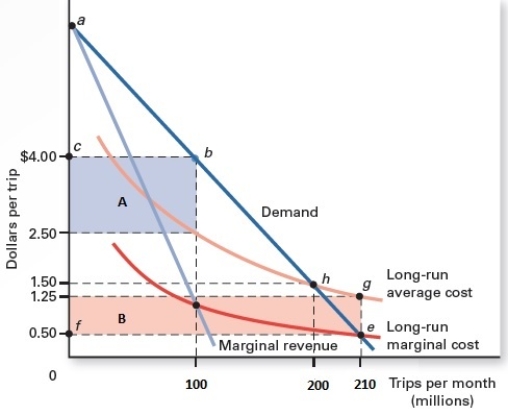
Refer to Exhibit 15.1,which shows the cost and revenue curves for a natural monopolist-the operator of a subway system.The subway would lose money and would require a subsidy to keep going at _____
A)$4.00 per trip.
B)$2.50 per trip.
C)$1.50 per trip.
D)$1.25 per trip.
E)$0.50 per trip.
Refer to Exhibit 15.1,which shows the cost and revenue curves for a natural monopolist-the operator of a subway system.The subway would lose money and would require a subsidy to keep going at _____
A)$4.00 per trip.
B)$2.50 per trip.
C)$1.50 per trip.
D)$1.25 per trip.
E)$0.50 per trip.
Question
Question
Question
Question
Question
Exhibit 15.1
Refer to Exhibit 15.1,which shows the cost and revenue curves for a natural monopolist-the operator of a subway system.The monopolist maximizes profit by producing where _____ riders per month pay _____ per trip.
A)100 million; $4
B)100 million; $2.50
C)200 million; $1.50
D)210 million; $1.25
E)210 million; $0.50
Refer to Exhibit 15.1,which shows the cost and revenue curves for a natural monopolist-the operator of a subway system.The monopolist maximizes profit by producing where _____ riders per month pay _____ per trip.
A)100 million; $4
B)100 million; $2.50
C)200 million; $1.50
D)210 million; $1.25
E)210 million; $0.50
Question
Exhibit 15.2
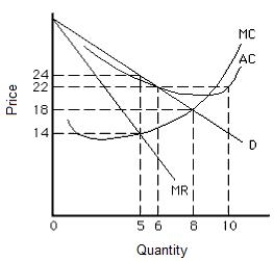
Refer to Exhibit 15.2,which shows the cost and revenue curves for a natural monopolist.Suppose the monopolist was originally producing at a profit-maximizing output level.If regulators set price equal to marginal cost,the price will change from _____
A)$24 to $18, and quantity will increase from 5 units to 8 units.
B)$14 to $20, and quantity will increase from 5 units to 8 units.
C)$24 to $18, and quantity will remain unchanged.
D)$18 to $14, and quantity will increase from 5 units to 8 units.
E)$24 to $22, and quantity will increase from 5 units to 10 units.
Refer to Exhibit 15.2,which shows the cost and revenue curves for a natural monopolist.Suppose the monopolist was originally producing at a profit-maximizing output level.If regulators set price equal to marginal cost,the price will change from _____
A)$24 to $18, and quantity will increase from 5 units to 8 units.
B)$14 to $20, and quantity will increase from 5 units to 8 units.
C)$24 to $18, and quantity will remain unchanged.
D)$18 to $14, and quantity will increase from 5 units to 8 units.
E)$24 to $22, and quantity will increase from 5 units to 10 units.
Question
Question
Exhibit 15.3
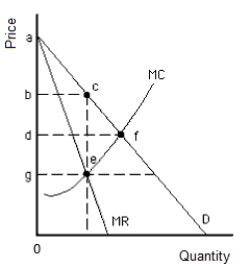
Refer to Exhibit 15.3,which shows the cost and revenue curves for a monopolist.The increase in consumer surplus when price is set equal to marginal cost rather than at the profit-maximizing level is shown by area _____
A)abc.
B)adf.
C)cef.
D)dfeg.
E)bcfd.
Refer to Exhibit 15.3,which shows the cost and revenue curves for a monopolist.The increase in consumer surplus when price is set equal to marginal cost rather than at the profit-maximizing level is shown by area _____
A)abc.
B)adf.
C)cef.
D)dfeg.
E)bcfd.
Question
Exhibit 15.1
Refer to Exhibit 15.1,which shows the cost and revenue curves for a natural monopolist-the operator of a subway system.At the efficient output rate,the efficient quantity is _____
A)100 million.
B)150 million.
C)200 million.
D)210 million.
E)250 million.
Refer to Exhibit 15.1,which shows the cost and revenue curves for a natural monopolist-the operator of a subway system.At the efficient output rate,the efficient quantity is _____
A)100 million.
B)150 million.
C)200 million.
D)210 million.
E)250 million.
Question
Question
Exhibit 15.1
Refer to Exhibit 15.1,which shows the cost and revenue curves for a natural monopolist-the operator of a subway system.The consumer surplus that results if regulators set the price at $0.50 per trip is shown by the _____
A)triangular area abc.
B)rectangular area A.
C)rectangular area B.
D)rectangular area A + B.
E)triangular area aef.
Refer to Exhibit 15.1,which shows the cost and revenue curves for a natural monopolist-the operator of a subway system.The consumer surplus that results if regulators set the price at $0.50 per trip is shown by the _____
A)triangular area abc.
B)rectangular area A.
C)rectangular area B.
D)rectangular area A + B.
E)triangular area aef.
Question
Question
Exhibit 15.3
Refer to Exhibit 15.3,which shows the cost and revenue curves for a monopolist.The consumer surplus that results if the monopoly is unregulated is shown by the _____
A)triangular area abc.
B)triangular area adf.
C)triangular area cef.
D)rectangular area dfeg.
E)rectangular area bcfd.
Refer to Exhibit 15.3,which shows the cost and revenue curves for a monopolist.The consumer surplus that results if the monopoly is unregulated is shown by the _____
A)triangular area abc.
B)triangular area adf.
C)triangular area cef.
D)rectangular area dfeg.
E)rectangular area bcfd.
Question
Question
Exhibit 15.3
Refer to Exhibit 15.3,which shows the cost and revenue curves for a monopolist.The consumer surplus that results if the monopoly is regulated and it charges a price equal to MC is shown by the _____
A)area abc.
B)area adf.
C)area cef.
D)area dfeg.
E)area bcfd.
Refer to Exhibit 15.3,which shows the cost and revenue curves for a monopolist.The consumer surplus that results if the monopoly is regulated and it charges a price equal to MC is shown by the _____
A)area abc.
B)area adf.
C)area cef.
D)area dfeg.
E)area bcfd.
Question
Exhibit 15.1
Refer to Exhibit 15.1,which shows the cost and revenue curves for a natural monopolist-the operator of a subway system.The consumer surplus that results if the monopoly is unregulated is shown by the _____
A)triangular area abc.
B)rectangular area A.
C)rectangular area B.
D)rectangular area A + B.
E)triangular area aef.
Refer to Exhibit 15.1,which shows the cost and revenue curves for a natural monopolist-the operator of a subway system.The consumer surplus that results if the monopoly is unregulated is shown by the _____
A)triangular area abc.
B)rectangular area A.
C)rectangular area B.
D)rectangular area A + B.
E)triangular area aef.
Question
Question
Exhibit 15.1
Refer to Exhibit 15.1,which shows the cost and revenue curves for a natural monopolist-the operator of a subway system.To achieve the efficient output rate,regulators could set the price at ____ per trip.
A)$4.00
B)$2.50
C)$1.50
D)$1.25
E)$0.50
Refer to Exhibit 15.1,which shows the cost and revenue curves for a natural monopolist-the operator of a subway system.To achieve the efficient output rate,regulators could set the price at ____ per trip.
A)$4.00
B)$2.50
C)$1.50
D)$1.25
E)$0.50
Question
Exhibit 15.1
Refer to Exhibit 15.1,which shows the cost and revenue curves for a natural monopolist-the operator of a subway system.If regulators could set the price at $1.50 per trip,the subway would sell ____ trips per month.
A)100 million
B)150 million
C)200 million
D)210 million
E)250 million
Refer to Exhibit 15.1,which shows the cost and revenue curves for a natural monopolist-the operator of a subway system.If regulators could set the price at $1.50 per trip,the subway would sell ____ trips per month.
A)100 million
B)150 million
C)200 million
D)210 million
E)250 million
Question
Exhibit 15.4
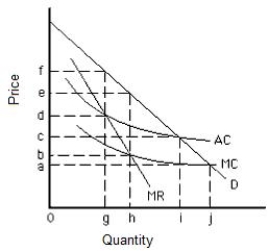
Refer to Exhibit 15.4,which shows the revenue and cost curves for a natural monopolist.The monopolist will set the price equal to _____ if it is allowed to earn only a normal profit.
A)a
B)b
C)c
D)f
E)e
Refer to Exhibit 15.4,which shows the revenue and cost curves for a natural monopolist.The monopolist will set the price equal to _____ if it is allowed to earn only a normal profit.
A)a
B)b
C)c
D)f
E)e
Question
Question
Question
Question
Question
Question
Question
Question
Exhibit 15.4

Refer to Exhibit 15.4,which shows the cost and revenue curves for a natural monopolist.If the natural monopoly is regulated and earns a normal profit,then _____
A)P = $24 and Q = 8.
B)P = $22 and Q = 6.
C)P = $24 and Q = 5.
D)P = $20 and Q = 8.
E)P = $18 and Q = 5.
Refer to Exhibit 15.4,which shows the cost and revenue curves for a natural monopolist.If the natural monopoly is regulated and earns a normal profit,then _____
A)P = $24 and Q = 8.
B)P = $22 and Q = 6.
C)P = $24 and Q = 5.
D)P = $20 and Q = 8.
E)P = $18 and Q = 5.
Question
Question
Exhibit 15.3
Refer to Exhibit 15.3,which shows the cost and revenue curves for a natural monopolist.The welfare loss that occurs if the monopoly is unregulated is shown by the area _____
A)cef.
B)abc.
C)adf.
D)dfeg.
E)bcfd.
Refer to Exhibit 15.3,which shows the cost and revenue curves for a natural monopolist.The welfare loss that occurs if the monopoly is unregulated is shown by the area _____
A)cef.
B)abc.
C)adf.
D)dfeg.
E)bcfd.
Question
Question
Question
Question
Question
Question
Question
Question
Question
Exhibit 15.4
Refer to Exhibit 15.4,which shows the cost and revenue curves for a natural monopolist.If regulators allow the natural monopolist to earn only a normal profit,it will produce an output equal to _____
A) 0.
B) g.
C) h.
D) i.
E) j.
Refer to Exhibit 15.4,which shows the cost and revenue curves for a natural monopolist.If regulators allow the natural monopolist to earn only a normal profit,it will produce an output equal to _____
A) 0.
B) g.
C) h.
D) i.
E) j.
Question
Question
Question
Question
Question
Question
Question
Question
Question
Question
Question
Question
Question
Question
Question
Question
Question
Question
Question
Question

Unlock Deck
Sign up to unlock the cards in this deck!
Unlock Deck
Unlock Deck
1/199

Play

Full screen (f)
Deck 15: Economic Regulation and Antitrust Policy
1
Economic regulation _____
A)is the ability of a firm to raise the price without losing all its sales to rivals.
B)tries to improve health and safety, such as by control of unsafe working conditions and dangerous products.
C)is any firm facing an upward sloping demand curve.
D)is government regulation of natural monopoly, where, because of economies of scale average production cost is lowest when a single firm supplies the market.
E)is government regulation aimed at preventing monopoly and fostering competition in markets where competition is desirable.
A)is the ability of a firm to raise the price without losing all its sales to rivals.
B)tries to improve health and safety, such as by control of unsafe working conditions and dangerous products.
C)is any firm facing an upward sloping demand curve.
D)is government regulation of natural monopoly, where, because of economies of scale average production cost is lowest when a single firm supplies the market.
E)is government regulation aimed at preventing monopoly and fostering competition in markets where competition is desirable.
D
2
Health care reform is an example of _____
A)market power.
B)social regulation.
C)economies of scale.
D)economic regulation.
E)antitrust policy.
A)market power.
B)social regulation.
C)economies of scale.
D)economic regulation.
E)antitrust policy.
B
3
A natural monopoly exists when throughout the range of market demand,_____
A)average cost is equal to marginal cost.
B)there exist diseconomies of scale.
C)there exist economies of scale.
D)average cost is constant.
E)marginal cost exceeds average cost.
A)average cost is equal to marginal cost.
B)there exist diseconomies of scale.
C)there exist economies of scale.
D)average cost is constant.
E)marginal cost exceeds average cost.
C
4
Because of economies of scale,throughout the range of market demand,natural monopolies have _____
A)downward-sloping long-run average cost curves.
B)upward-sloping long-run average total cost curves.
C)upward-sloping short-run average cost curves.
D)upward-sloping short-run average total cost curves.
E)horizontal long-run average cost curves.
A)downward-sloping long-run average cost curves.
B)upward-sloping long-run average total cost curves.
C)upward-sloping short-run average cost curves.
D)upward-sloping short-run average total cost curves.
E)horizontal long-run average cost curves.
Unlock Deck
Unlock for access to all 199 flashcards in this deck.
Unlock Deck
k this deck
5
Which of the following is the best example of a natural monopoly?
A)a company involved in gold mining in the Colorado Rocky Mountains
B)a company involved in filmmaking in Hollywood
C)a company providing electrical service to homes in Seattle
D)Kodak producing film
E)IBM producing computers
A)a company involved in gold mining in the Colorado Rocky Mountains
B)a company involved in filmmaking in Hollywood
C)a company providing electrical service to homes in Seattle
D)Kodak producing film
E)IBM producing computers
Unlock Deck
Unlock for access to all 199 flashcards in this deck.
Unlock Deck
k this deck
6
Government regulation of natural monopoly,where average production cost is lowest when a single firm supplies the market is called _____
A)market power.
B)social regulation.
C)economies of scale.
D)economic regulation.
E)antitrust policy.
A)market power.
B)social regulation.
C)economies of scale.
D)economic regulation.
E)antitrust policy.
Unlock Deck
Unlock for access to all 199 flashcards in this deck.
Unlock Deck
k this deck
7
Government oversight of a natural monopoly,such as local electricity transmission or a subway system,is an example of _____
A)market power.
B)social regulation.
C)economies of scale.
D)economic regulation.
E)antitrust policy.
A)market power.
B)social regulation.
C)economies of scale.
D)economic regulation.
E)antitrust policy.
Unlock Deck
Unlock for access to all 199 flashcards in this deck.
Unlock Deck
k this deck
8
Social regulation _____
A)is the ability of a firm to raise the price without losing all its sales to rivals.
B)tries to improve health and safety, such as by control of unsafe working conditions and dangerous products.
C)is any firm facing an upward sloping demand curve.
D)is government regulation of natural monopoly, where, because of economies of scale average production cost is lowest when a single firm supplies the market.
E)is government regulation aimed at preventing monopoly and fostering competition in markets where competition is desirable.
A)is the ability of a firm to raise the price without losing all its sales to rivals.
B)tries to improve health and safety, such as by control of unsafe working conditions and dangerous products.
C)is any firm facing an upward sloping demand curve.
D)is government regulation of natural monopoly, where, because of economies of scale average production cost is lowest when a single firm supplies the market.
E)is government regulation aimed at preventing monopoly and fostering competition in markets where competition is desirable.
Unlock Deck
Unlock for access to all 199 flashcards in this deck.
Unlock Deck
k this deck
9
Government regulation aimed at improving health and safety is called _____
A)market power.
B)social regulation.
C)economies of scale.
D)economic regulation.
E)antitrust policy.
A)market power.
B)social regulation.
C)economies of scale.
D)economic regulation.
E)antitrust policy.
Unlock Deck
Unlock for access to all 199 flashcards in this deck.
Unlock Deck
k this deck
10
Which of the following is the best example of a natural monopoly?
A)a company involved in gold mining in the Colorado Rocky Mountains
B)a company involved in filmmaking in Hollywood
C)a subway system
D)Kodak producing film
E)IBM producing computers
A)a company involved in gold mining in the Colorado Rocky Mountains
B)a company involved in filmmaking in Hollywood
C)a subway system
D)Kodak producing film
E)IBM producing computers
Unlock Deck
Unlock for access to all 199 flashcards in this deck.
Unlock Deck
k this deck
11
Antitrust policy _____
A)is the ability of a firm to raise the price without losing all its sales to rivals.
B)tries to improve health and safety, such as by control of unsafe working conditions and dangerous products.
C)is any firm facing an upward sloping demand curve.
D)is government regulation of natural monopoly, where, because of economies of scale average production cost is lowest when a single firm supplies the market.
E)is government regulation aimed at preventing monopoly and fostering competition in markets where competition is desirable.
A)is the ability of a firm to raise the price without losing all its sales to rivals.
B)tries to improve health and safety, such as by control of unsafe working conditions and dangerous products.
C)is any firm facing an upward sloping demand curve.
D)is government regulation of natural monopoly, where, because of economies of scale average production cost is lowest when a single firm supplies the market.
E)is government regulation aimed at preventing monopoly and fostering competition in markets where competition is desirable.
Unlock Deck
Unlock for access to all 199 flashcards in this deck.
Unlock Deck
k this deck
12
For a natural monopolist,_____ throughout the range of market demand.
A)average cost increases
B)there exist diseconomies of scale
C)average cost decreases
D)average cost remains constant
E)marginal cost exceeds average cost
A)average cost increases
B)there exist diseconomies of scale
C)average cost decreases
D)average cost remains constant
E)marginal cost exceeds average cost
Unlock Deck
Unlock for access to all 199 flashcards in this deck.
Unlock Deck
k this deck
13
In a(n)_____,throughout the range of market demand,marginal cost is less than average cost and pulls average cost downward.
A)oligopoly market
B)perfectly competitive market
C)natural monopoly
D)duopoly
E)monopsony
A)oligopoly market
B)perfectly competitive market
C)natural monopoly
D)duopoly
E)monopsony
Unlock Deck
Unlock for access to all 199 flashcards in this deck.
Unlock Deck
k this deck
14
The Consumer Product Safety Commission is an example of _____
A)market power.
B)social regulation.
C)economies of scale.
D)economic regulation.
E)antitrust policy.
A)market power.
B)social regulation.
C)economies of scale.
D)economic regulation.
E)antitrust policy.
Unlock Deck
Unlock for access to all 199 flashcards in this deck.
Unlock Deck
k this deck
15
The ability of a firm to raise the price without losing all its sales to rivals is called _____
A)market power.
B)social regulation.
C)economies of scale.
D)economic regulation.
E)antitrust policy.
A)market power.
B)social regulation.
C)economies of scale.
D)economic regulation.
E)antitrust policy.
Unlock Deck
Unlock for access to all 199 flashcards in this deck.
Unlock Deck
k this deck
16
A natural monopoly,such as a local telephone company,is characterized by _____
A)a lack of natural competitors.
B)low fixed costs and diseconomies of scale.
C)economies of scale.
D)a lack of government regulation.
E)constant costs of production.
A)a lack of natural competitors.
B)low fixed costs and diseconomies of scale.
C)economies of scale.
D)a lack of government regulation.
E)constant costs of production.
Unlock Deck
Unlock for access to all 199 flashcards in this deck.
Unlock Deck
k this deck
17
A natural monopoly usually faces _____
A)a lack of natural competitors.
B)low fixed costs and diseconomies of scale.
C)huge initial capital costs.
D)a lack of government regulation.
E)constant costs of production.
A)a lack of natural competitors.
B)low fixed costs and diseconomies of scale.
C)huge initial capital costs.
D)a lack of government regulation.
E)constant costs of production.
Unlock Deck
Unlock for access to all 199 flashcards in this deck.
Unlock Deck
k this deck
18
Market power _____
A)is the ability of a firm to raise the price without losing all its sales to rivals.
B)tries to improve health and safety, such as by control of unsafe working conditions and dangerous products.
C)is any firm facing an upward sloping demand curve.
D)government regulation of natural monopoly, where, because of economies of scale average production cost is lowest when a single firm supplies the market.
E)is government regulation aimed at preventing monopoly and fostering competition in markets where competition is desirable.
A)is the ability of a firm to raise the price without losing all its sales to rivals.
B)tries to improve health and safety, such as by control of unsafe working conditions and dangerous products.
C)is any firm facing an upward sloping demand curve.
D)government regulation of natural monopoly, where, because of economies of scale average production cost is lowest when a single firm supplies the market.
E)is government regulation aimed at preventing monopoly and fostering competition in markets where competition is desirable.
Unlock Deck
Unlock for access to all 199 flashcards in this deck.
Unlock Deck
k this deck
19
If a firm has a downward-sloping long-run average cost curve over the entire range of market demand,it is a _____firm in an oligopolistic market.
A)firm in a monopolistic market.
B)firm in a perfectly competitive market.
C)firm in a monopsony market.
D)firm in an oligopolistic market.
E)natural monopoly.
A)firm in a monopolistic market.
B)firm in a perfectly competitive market.
C)firm in a monopsony market.
D)firm in an oligopolistic market.
E)natural monopoly.
Unlock Deck
Unlock for access to all 199 flashcards in this deck.
Unlock Deck
k this deck
20
Government regulation aimed at preventing monopoly and fostering competition in markets where competition is desirable is called _____
A)market power.
B)social regulation.
C)economies of scale.
D)economic regulation.
E)antitrust policy.
A)market power.
B)social regulation.
C)economies of scale.
D)economic regulation.
E)antitrust policy.
Unlock Deck
Unlock for access to all 199 flashcards in this deck.
Unlock Deck
k this deck
21
Exhibit 15.1
Refer to Exhibit 15.1,which shows the cost and revenue curves for a natural monopolist-the operator of a subway system.The subway would lose money and would require a subsidy to keep going at _____
A)$4.00 per trip.
B)$2.50 per trip.
C)$1.50 per trip.
D)$1.25 per trip.
E)$0.50 per trip.
Refer to Exhibit 15.1,which shows the cost and revenue curves for a natural monopolist-the operator of a subway system.The subway would lose money and would require a subsidy to keep going at _____
A)$4.00 per trip.
B)$2.50 per trip.
C)$1.50 per trip.
D)$1.25 per trip.
E)$0.50 per trip.
Unlock Deck
Unlock for access to all 199 flashcards in this deck.
Unlock Deck
k this deck
22
Which of the following is a possible outcome if a monopolist is allowed to maximize profit?
A)The equilibrium price-output combination is inefficient.
B)Consumers pay a price that is equal to the marginal cost of production.
C)Consumer surplus is more than producer surplus.
D)The equilibrium price-output combination is socially optimal.
E)The quantity of output produced by the monopolist is larger than the socially optimal level of output.
A)The equilibrium price-output combination is inefficient.
B)Consumers pay a price that is equal to the marginal cost of production.
C)Consumer surplus is more than producer surplus.
D)The equilibrium price-output combination is socially optimal.
E)The quantity of output produced by the monopolist is larger than the socially optimal level of output.
Unlock Deck
Unlock for access to all 199 flashcards in this deck.
Unlock Deck
k this deck
23
Which of the following is a possible effect of government regulation on a natural monopolist?
A)The firm earns zero economic profit.
B)The firm earns positive economic profit.
C)The firm faces a horizontal demand curve.
D)The firm incurs an economic loss.
E)The firm faces an upward-sloping demand curve.
A)The firm earns zero economic profit.
B)The firm earns positive economic profit.
C)The firm faces a horizontal demand curve.
D)The firm incurs an economic loss.
E)The firm faces an upward-sloping demand curve.
Unlock Deck
Unlock for access to all 199 flashcards in this deck.
Unlock Deck
k this deck
24
If a regulator sets the price in a natural monopoly equal to the monopolist's marginal cost,the monopolist will _____
A)experience a loss.
B)earn an economic profit.
C)earn an abnormal profit.
D)shut down in the short run.
E)face a horizontal demand curve.
A)experience a loss.
B)earn an economic profit.
C)earn an abnormal profit.
D)shut down in the short run.
E)face a horizontal demand curve.
Unlock Deck
Unlock for access to all 199 flashcards in this deck.
Unlock Deck
k this deck
25
The rail system in Metropolis is a natural monopoly.Which of the following is likely to be true if the government regulates the system by setting a competitive price?
A)Price and output will be higher in a regulated monopoly than in an unregulated monopoly.
B)Price and output will be lower in a regulated monopoly than in an unregulated monopoly.
C)Price will be lower and output will be higher in a regulated monopoly than in an unregulated monopoly.
D)Price will be higher and output will be lower in a regulated monopoly than in an unregulated monopoly.
E)Profit will be lower in a regulated monopoly than in an unregulated monopoly, but there will be no change in output.
A)Price and output will be higher in a regulated monopoly than in an unregulated monopoly.
B)Price and output will be lower in a regulated monopoly than in an unregulated monopoly.
C)Price will be lower and output will be higher in a regulated monopoly than in an unregulated monopoly.
D)Price will be higher and output will be lower in a regulated monopoly than in an unregulated monopoly.
E)Profit will be lower in a regulated monopoly than in an unregulated monopoly, but there will be no change in output.
Unlock Deck
Unlock for access to all 199 flashcards in this deck.
Unlock Deck
k this deck
26
Exhibit 15.1
Refer to Exhibit 15.1,which shows the cost and revenue curves for a natural monopolist-the operator of a subway system.The monopolist maximizes profit by producing where _____ riders per month pay _____ per trip.
A)100 million; $4
B)100 million; $2.50
C)200 million; $1.50
D)210 million; $1.25
E)210 million; $0.50
Refer to Exhibit 15.1,which shows the cost and revenue curves for a natural monopolist-the operator of a subway system.The monopolist maximizes profit by producing where _____ riders per month pay _____ per trip.
A)100 million; $4
B)100 million; $2.50
C)200 million; $1.50
D)210 million; $1.25
E)210 million; $0.50
Unlock Deck
Unlock for access to all 199 flashcards in this deck.
Unlock Deck
k this deck
27
Exhibit 15.2
Refer to Exhibit 15.2,which shows the cost and revenue curves for a natural monopolist.Suppose the monopolist was originally producing at a profit-maximizing output level.If regulators set price equal to marginal cost,the price will change from _____
A)$24 to $18, and quantity will increase from 5 units to 8 units.
B)$14 to $20, and quantity will increase from 5 units to 8 units.
C)$24 to $18, and quantity will remain unchanged.
D)$18 to $14, and quantity will increase from 5 units to 8 units.
E)$24 to $22, and quantity will increase from 5 units to 10 units.
Refer to Exhibit 15.2,which shows the cost and revenue curves for a natural monopolist.Suppose the monopolist was originally producing at a profit-maximizing output level.If regulators set price equal to marginal cost,the price will change from _____
A)$24 to $18, and quantity will increase from 5 units to 8 units.
B)$14 to $20, and quantity will increase from 5 units to 8 units.
C)$24 to $18, and quantity will remain unchanged.
D)$18 to $14, and quantity will increase from 5 units to 8 units.
E)$24 to $22, and quantity will increase from 5 units to 10 units.
Unlock Deck
Unlock for access to all 199 flashcards in this deck.
Unlock Deck
k this deck
28
In order to maximize profit,an unregulated monopolist _____
A)produces the level of output at which marginal cost equals marginal revenue.
B)produces the level of output at which marginal cost exceeds marginal revenue.
C)charges a price that is equal to its marginal cost of production.
D)charges a price that is equal to its average cost of production.
E)produces the level of output at which marginal cost is less than marginal revenue.
A)produces the level of output at which marginal cost equals marginal revenue.
B)produces the level of output at which marginal cost exceeds marginal revenue.
C)charges a price that is equal to its marginal cost of production.
D)charges a price that is equal to its average cost of production.
E)produces the level of output at which marginal cost is less than marginal revenue.
Unlock Deck
Unlock for access to all 199 flashcards in this deck.
Unlock Deck
k this deck
29
Exhibit 15.3
Refer to Exhibit 15.3,which shows the cost and revenue curves for a monopolist.The increase in consumer surplus when price is set equal to marginal cost rather than at the profit-maximizing level is shown by area _____
A)abc.
B)adf.
C)cef.
D)dfeg.
E)bcfd.
Refer to Exhibit 15.3,which shows the cost and revenue curves for a monopolist.The increase in consumer surplus when price is set equal to marginal cost rather than at the profit-maximizing level is shown by area _____
A)abc.
B)adf.
C)cef.
D)dfeg.
E)bcfd.
Unlock Deck
Unlock for access to all 199 flashcards in this deck.
Unlock Deck
k this deck
30
Exhibit 15.1
Refer to Exhibit 15.1,which shows the cost and revenue curves for a natural monopolist-the operator of a subway system.At the efficient output rate,the efficient quantity is _____
A)100 million.
B)150 million.
C)200 million.
D)210 million.
E)250 million.
Refer to Exhibit 15.1,which shows the cost and revenue curves for a natural monopolist-the operator of a subway system.At the efficient output rate,the efficient quantity is _____
A)100 million.
B)150 million.
C)200 million.
D)210 million.
E)250 million.
Unlock Deck
Unlock for access to all 199 flashcards in this deck.
Unlock Deck
k this deck
31
Most natural gas pipeline companies _____
A)face a vertical demand curve.
B)operate in a perfectly competitive industry.
C)operate in an oligopoly industry.
D)face an upward-sloping demand curve.
E)are natural monopolies.
A)face a vertical demand curve.
B)operate in a perfectly competitive industry.
C)operate in an oligopoly industry.
D)face an upward-sloping demand curve.
E)are natural monopolies.
Unlock Deck
Unlock for access to all 199 flashcards in this deck.
Unlock Deck
k this deck
32
Exhibit 15.1
Refer to Exhibit 15.1,which shows the cost and revenue curves for a natural monopolist-the operator of a subway system.The consumer surplus that results if regulators set the price at $0.50 per trip is shown by the _____
A)triangular area abc.
B)rectangular area A.
C)rectangular area B.
D)rectangular area A + B.
E)triangular area aef.
Refer to Exhibit 15.1,which shows the cost and revenue curves for a natural monopolist-the operator of a subway system.The consumer surplus that results if regulators set the price at $0.50 per trip is shown by the _____
A)triangular area abc.
B)rectangular area A.
C)rectangular area B.
D)rectangular area A + B.
E)triangular area aef.
Unlock Deck
Unlock for access to all 199 flashcards in this deck.
Unlock Deck
k this deck
33
Watt Power and Light,an electric company,is an example of a natural monopoly.It will suffer an economic loss _____
A)irrespective of the output it produces because marginal cost is always less than average cost.
B)irrespective of the price it charges because average cost is always less than marginal cost.
C)if regulators insist that it produce where price equals marginal cost because marginal cost is less than average cost.
D)if regulators insist that it produce where price equals marginal cost because average cost is always less than marginal cost.
E)if regulators insist that it produce where price equals average cost because average cost is always less than marginal cost.
A)irrespective of the output it produces because marginal cost is always less than average cost.
B)irrespective of the price it charges because average cost is always less than marginal cost.
C)if regulators insist that it produce where price equals marginal cost because marginal cost is less than average cost.
D)if regulators insist that it produce where price equals marginal cost because average cost is always less than marginal cost.
E)if regulators insist that it produce where price equals average cost because average cost is always less than marginal cost.
Unlock Deck
Unlock for access to all 199 flashcards in this deck.
Unlock Deck
k this deck
34
Exhibit 15.3
Refer to Exhibit 15.3,which shows the cost and revenue curves for a monopolist.The consumer surplus that results if the monopoly is unregulated is shown by the _____
A)triangular area abc.
B)triangular area adf.
C)triangular area cef.
D)rectangular area dfeg.
E)rectangular area bcfd.
Refer to Exhibit 15.3,which shows the cost and revenue curves for a monopolist.The consumer surplus that results if the monopoly is unregulated is shown by the _____
A)triangular area abc.
B)triangular area adf.
C)triangular area cef.
D)rectangular area dfeg.
E)rectangular area bcfd.
Unlock Deck
Unlock for access to all 199 flashcards in this deck.
Unlock Deck
k this deck
35
In which of the following ways can the government increase social welfare in an unregulated monopoly?
A)by allowing the monopolist to maximize profit
B)by forcing the monopolist to lower the price and expand output
C)by forcing the monopolist to shut down operations
D)by providing tax exemptions to the monopolist
E)by increasing corporate tax rates
A)by allowing the monopolist to maximize profit
B)by forcing the monopolist to lower the price and expand output
C)by forcing the monopolist to shut down operations
D)by providing tax exemptions to the monopolist
E)by increasing corporate tax rates
Unlock Deck
Unlock for access to all 199 flashcards in this deck.
Unlock Deck
k this deck
36
Exhibit 15.3
Refer to Exhibit 15.3,which shows the cost and revenue curves for a monopolist.The consumer surplus that results if the monopoly is regulated and it charges a price equal to MC is shown by the _____
A)area abc.
B)area adf.
C)area cef.
D)area dfeg.
E)area bcfd.
Refer to Exhibit 15.3,which shows the cost and revenue curves for a monopolist.The consumer surplus that results if the monopoly is regulated and it charges a price equal to MC is shown by the _____
A)area abc.
B)area adf.
C)area cef.
D)area dfeg.
E)area bcfd.
Unlock Deck
Unlock for access to all 199 flashcards in this deck.
Unlock Deck
k this deck
37
Exhibit 15.1
Refer to Exhibit 15.1,which shows the cost and revenue curves for a natural monopolist-the operator of a subway system.The consumer surplus that results if the monopoly is unregulated is shown by the _____
A)triangular area abc.
B)rectangular area A.
C)rectangular area B.
D)rectangular area A + B.
E)triangular area aef.
Refer to Exhibit 15.1,which shows the cost and revenue curves for a natural monopolist-the operator of a subway system.The consumer surplus that results if the monopoly is unregulated is shown by the _____
A)triangular area abc.
B)rectangular area A.
C)rectangular area B.
D)rectangular area A + B.
E)triangular area aef.
Unlock Deck
Unlock for access to all 199 flashcards in this deck.
Unlock Deck
k this deck
38
Most local phone companies _____
A)face a vertical demand curve.
B)operate in a perfectly competitive industry.
C)operate in an oligopoly industry.
D)face an upward-sloping demand curve.
E)are natural monopolies.
A)face a vertical demand curve.
B)operate in a perfectly competitive industry.
C)operate in an oligopoly industry.
D)face an upward-sloping demand curve.
E)are natural monopolies.
Unlock Deck
Unlock for access to all 199 flashcards in this deck.
Unlock Deck
k this deck
39
Exhibit 15.1
Refer to Exhibit 15.1,which shows the cost and revenue curves for a natural monopolist-the operator of a subway system.To achieve the efficient output rate,regulators could set the price at ____ per trip.
A)$4.00
B)$2.50
C)$1.50
D)$1.25
E)$0.50
Refer to Exhibit 15.1,which shows the cost and revenue curves for a natural monopolist-the operator of a subway system.To achieve the efficient output rate,regulators could set the price at ____ per trip.
A)$4.00
B)$2.50
C)$1.50
D)$1.25
E)$0.50
Unlock Deck
Unlock for access to all 199 flashcards in this deck.
Unlock Deck
k this deck
40
Exhibit 15.1
Refer to Exhibit 15.1,which shows the cost and revenue curves for a natural monopolist-the operator of a subway system.If regulators could set the price at $1.50 per trip,the subway would sell ____ trips per month.
A)100 million
B)150 million
C)200 million
D)210 million
E)250 million
Refer to Exhibit 15.1,which shows the cost and revenue curves for a natural monopolist-the operator of a subway system.If regulators could set the price at $1.50 per trip,the subway would sell ____ trips per month.
A)100 million
B)150 million
C)200 million
D)210 million
E)250 million
Unlock Deck
Unlock for access to all 199 flashcards in this deck.
Unlock Deck
k this deck
41
Exhibit 15.4
Refer to Exhibit 15.4,which shows the revenue and cost curves for a natural monopolist.The monopolist will set the price equal to _____ if it is allowed to earn only a normal profit.
A)a
B)b
C)c
D)f
E)e
Refer to Exhibit 15.4,which shows the revenue and cost curves for a natural monopolist.The monopolist will set the price equal to _____ if it is allowed to earn only a normal profit.
A)a
B)b
C)c
D)f
E)e
Unlock Deck
Unlock for access to all 199 flashcards in this deck.
Unlock Deck
k this deck
42
Suppose the local government is considering using marginal cost pricing to set rates for a cable TV company.Which of the following arguments supports marginal cost pricing?
A)Marginal cost pricing gives the monopoly an economic profit and a reason to stay in business.
B)Marginal cost pricing gives the firm a normal economic profit and a reason to stay in business.
C)Marginal cost pricing results in allocative efficiency.
D)Unlike firms adopting average cost pricing, firms using marginal cost pricing do not require subsidies, which can be costly.
E)Unlike average cost pricing, marginal cost pricing enables monopolies to stay in business in the long run.
A)Marginal cost pricing gives the monopoly an economic profit and a reason to stay in business.
B)Marginal cost pricing gives the firm a normal economic profit and a reason to stay in business.
C)Marginal cost pricing results in allocative efficiency.
D)Unlike firms adopting average cost pricing, firms using marginal cost pricing do not require subsidies, which can be costly.
E)Unlike average cost pricing, marginal cost pricing enables monopolies to stay in business in the long run.
Unlock Deck
Unlock for access to all 199 flashcards in this deck.
Unlock Deck
k this deck
43
Compared to the profit-maximizing outcome,average-cost pricing in a natural monopoly leads to _____
A)a lower marginal cost.
B)a higher price.
C)decreased consumer surplus.
D)the elimination of economic profit.
E)less output.
A)a lower marginal cost.
B)a higher price.
C)decreased consumer surplus.
D)the elimination of economic profit.
E)less output.
Unlock Deck
Unlock for access to all 199 flashcards in this deck.
Unlock Deck
k this deck
44
Which of the following is true when regulators require a natural monopolist to set price equal to marginal cost?
A)This policy results in a less-than-socially-optimal allocation of resources.
B)The marginal cost of producing the last unit sold exceeds the consumers' marginal value for that last unit.
C)The monopolist experiences recurring losses unless a subsidy is provided.
D)The monopolist earns a normal profit.
E)The monopolist earns an economic profit.
A)This policy results in a less-than-socially-optimal allocation of resources.
B)The marginal cost of producing the last unit sold exceeds the consumers' marginal value for that last unit.
C)The monopolist experiences recurring losses unless a subsidy is provided.
D)The monopolist earns a normal profit.
E)The monopolist earns an economic profit.
Unlock Deck
Unlock for access to all 199 flashcards in this deck.
Unlock Deck
k this deck
45
When government regulations force a natural monopoly to produce where price equals average total cost,social welfare is _____
A)at its maximum.
B)less than it would be without regulation.
C)greater than it would be without regulation, but it is not maximized.
D)exactly the same as it would be without regulation.
E)at its minimum.
A)at its maximum.
B)less than it would be without regulation.
C)greater than it would be without regulation, but it is not maximized.
D)exactly the same as it would be without regulation.
E)at its minimum.
Unlock Deck
Unlock for access to all 199 flashcards in this deck.
Unlock Deck
k this deck
46
If a natural monopolist switches to marginal cost pricing from charging a profit-maximizing price,there will be a(n)_____
A)decrease in the demand for the monopolist's product.
B)increase in the price charged by the monopolist.
C)fall in consumer surplus.
D)increase in economic profit.
E)increase in the level of output produced by the monopolist.
A)decrease in the demand for the monopolist's product.
B)increase in the price charged by the monopolist.
C)fall in consumer surplus.
D)increase in economic profit.
E)increase in the level of output produced by the monopolist.
Unlock Deck
Unlock for access to all 199 flashcards in this deck.
Unlock Deck
k this deck
47
In which of the following ways can a government assure that a natural monopolist earns zero economic profit?
A)by setting the price equal to marginal cost
B)by setting the price equal to average total cost
C)by setting the price lower than the average total cost
D)by asking the monopolist to produce where marginal cost is equal to marginal revenue
E)by asking the monopolist to produce where marginal cost is equal to average total cost
A)by setting the price equal to marginal cost
B)by setting the price equal to average total cost
C)by setting the price lower than the average total cost
D)by asking the monopolist to produce where marginal cost is equal to marginal revenue
E)by asking the monopolist to produce where marginal cost is equal to average total cost
Unlock Deck
Unlock for access to all 199 flashcards in this deck.
Unlock Deck
k this deck
48
Production by a monopolist would result in the socially optimal allocation of resources if _____
A)price is set equal to marginal cost.
B)marginal revenue is greater than price.
C)marginal revenue is equal to marginal cost.
D)price is set equal to average total cost.
E)marginal revenue is equal to average total cost.
A)price is set equal to marginal cost.
B)marginal revenue is greater than price.
C)marginal revenue is equal to marginal cost.
D)price is set equal to average total cost.
E)marginal revenue is equal to average total cost.
Unlock Deck
Unlock for access to all 199 flashcards in this deck.
Unlock Deck
k this deck
49
Exhibit 15.4
Refer to Exhibit 15.4,which shows the cost and revenue curves for a natural monopolist.If the natural monopoly is regulated and earns a normal profit,then _____
A)P = $24 and Q = 8.
B)P = $22 and Q = 6.
C)P = $24 and Q = 5.
D)P = $20 and Q = 8.
E)P = $18 and Q = 5.
Refer to Exhibit 15.4,which shows the cost and revenue curves for a natural monopolist.If the natural monopoly is regulated and earns a normal profit,then _____
A)P = $24 and Q = 8.
B)P = $22 and Q = 6.
C)P = $24 and Q = 5.
D)P = $20 and Q = 8.
E)P = $18 and Q = 5.
Unlock Deck
Unlock for access to all 199 flashcards in this deck.
Unlock Deck
k this deck
50
A regulated natural monopoly that must set price equal to average cost will _____
A)incur an economic loss.
B)earn a net economic profit.
C)earn a normal profit.
D)shut down in the short run.
E)experience diseconomies of scale.
A)incur an economic loss.
B)earn a net economic profit.
C)earn a normal profit.
D)shut down in the short run.
E)experience diseconomies of scale.
Unlock Deck
Unlock for access to all 199 flashcards in this deck.
Unlock Deck
k this deck
51
Exhibit 15.3
Refer to Exhibit 15.3,which shows the cost and revenue curves for a natural monopolist.The welfare loss that occurs if the monopoly is unregulated is shown by the area _____
A)cef.
B)abc.
C)adf.
D)dfeg.
E)bcfd.
Refer to Exhibit 15.3,which shows the cost and revenue curves for a natural monopolist.The welfare loss that occurs if the monopoly is unregulated is shown by the area _____
A)cef.
B)abc.
C)adf.
D)dfeg.
E)bcfd.
Unlock Deck
Unlock for access to all 199 flashcards in this deck.
Unlock Deck
k this deck
52
Governments often enact regulations that benefit producers because _____
A)they seek to regulate in the best interest of the public.
B)consumers have less information than producers and therefore seek government protection.
C)consumers have a strong interest in matters that affect their standard of living.
D)producers lobby, as they have a strong interest in matters that affect their specialized source of income.
E)producers seek to act in the best interest of the public.
A)they seek to regulate in the best interest of the public.
B)consumers have less information than producers and therefore seek government protection.
C)consumers have a strong interest in matters that affect their standard of living.
D)producers lobby, as they have a strong interest in matters that affect their specialized source of income.
E)producers seek to act in the best interest of the public.
Unlock Deck
Unlock for access to all 199 flashcards in this deck.
Unlock Deck
k this deck
53
The government of a state wants Gigantic Software Corp.,a natural monopoly,to stay in business yet still produce where price equals marginal cost.In order to encourage Gigantic Software Corp.to stay in business,the government might choose to _____
A)set a price ceiling 10 percent lower than its previous level.
B)impose a tax on the company for each dollar of sales.
C)establish regulations that raise the company's cost of doing business.
D)provide a subsidy to the company to cover the loss and ensure a normal profit.
E)replace the company's top management.
A)set a price ceiling 10 percent lower than its previous level.
B)impose a tax on the company for each dollar of sales.
C)establish regulations that raise the company's cost of doing business.
D)provide a subsidy to the company to cover the loss and ensure a normal profit.
E)replace the company's top management.
Unlock Deck
Unlock for access to all 199 flashcards in this deck.
Unlock Deck
k this deck
54
Suppose the market for taxis in Mexico City is a natural monopoly.Which of the following is likely to result from the regulation of taxis in Mexico City?
A)The price of taxi rides will decrease.
B)The price of taxi rides will increase.
C)The income of taxi owners will increase.
D)Taxi owners will have greater monopoly power.
E)The supply of taxis will increase.
A)The price of taxi rides will decrease.
B)The price of taxi rides will increase.
C)The income of taxi owners will increase.
D)Taxi owners will have greater monopoly power.
E)The supply of taxis will increase.
Unlock Deck
Unlock for access to all 199 flashcards in this deck.
Unlock Deck
k this deck
55
A natural monopolist earns zero economic profit when _____
A)government regulators force it to set price equal to marginal cost.
B)government regulators force it to set price equal to average total cost.
C)the government provides it with a subsidy.
D)the government provides it with a tax exemption.
E)government regulators force it to produce where MC = MR.
A)government regulators force it to set price equal to marginal cost.
B)government regulators force it to set price equal to average total cost.
C)the government provides it with a subsidy.
D)the government provides it with a tax exemption.
E)government regulators force it to produce where MC = MR.
Unlock Deck
Unlock for access to all 199 flashcards in this deck.
Unlock Deck
k this deck
56
Which of the following is true of a natural monopoly?
A)If regulated, the firm will have a higher level of output than if it was unregulated.
B)If regulated, the firm will have a lower level of output than if it was unregulated.
C)If regulated, the firm will be allowed to charge a price higher than its average cost.
D)If regulated, the firm will earn economic profit in the long run.
E)If regulated, the firm will experience diseconomies of scale.
A)If regulated, the firm will have a higher level of output than if it was unregulated.
B)If regulated, the firm will have a lower level of output than if it was unregulated.
C)If regulated, the firm will be allowed to charge a price higher than its average cost.
D)If regulated, the firm will earn economic profit in the long run.
E)If regulated, the firm will experience diseconomies of scale.
Unlock Deck
Unlock for access to all 199 flashcards in this deck.
Unlock Deck
k this deck
57
If an electric company is allowed by regulators to earn only a normal profit,it will produce at the point where _____
A)MR = MC.
B)P = MC.
C)MC = Qd.
D)P = AC.
E)MR = AC.
A)MR = MC.
B)P = MC.
C)MC = Qd.
D)P = AC.
E)MR = AC.
Unlock Deck
Unlock for access to all 199 flashcards in this deck.
Unlock Deck
k this deck
58
According to the special interest theory,the licensing of beauticians would be _____
A)desired by consumers in order to promote the public interest.
B)desired by beauticians in order to promote the public interest.
C)discouraged by all beauty salons, large or small.
D)desired by some beauticians in order to restrict entry into their profession.
E)discouraged by the government in order to protect the jobs of unlicensed beauticians.
A)desired by consumers in order to promote the public interest.
B)desired by beauticians in order to promote the public interest.
C)discouraged by all beauty salons, large or small.
D)desired by some beauticians in order to restrict entry into their profession.
E)discouraged by the government in order to protect the jobs of unlicensed beauticians.
Unlock Deck
Unlock for access to all 199 flashcards in this deck.
Unlock Deck
k this deck
59
If government regulators force a natural monopoly to produce where price equals marginal cost,the monopoly will _____
A)continue operations in the long run.
B)earn a normal profit.
C)earn a positive economic profit.
D)incur loss in the short run.
E)reduce the level of production.
A)continue operations in the long run.
B)earn a normal profit.
C)earn a positive economic profit.
D)incur loss in the short run.
E)reduce the level of production.
Unlock Deck
Unlock for access to all 199 flashcards in this deck.
Unlock Deck
k this deck
60
Exhibit 15.4
Refer to Exhibit 15.4,which shows the cost and revenue curves for a natural monopolist.If regulators allow the natural monopolist to earn only a normal profit,it will produce an output equal to _____
A) 0.
B) g.
C) h.
D) i.
E) j.
Refer to Exhibit 15.4,which shows the cost and revenue curves for a natural monopolist.If regulators allow the natural monopolist to earn only a normal profit,it will produce an output equal to _____
A) 0.
B) g.
C) h.
D) i.
E) j.
Unlock Deck
Unlock for access to all 199 flashcards in this deck.
Unlock Deck
k this deck
61
Economic regulation leads to a(n)_____
A)increase in the market power of existing firms.
B)fall in the prices of goods and services.
C)increase in the entry of new firms into the industry.
D)increase in social welfare.
E)increase in the demand for goods and services produced by existing firms.
A)increase in the market power of existing firms.
B)fall in the prices of goods and services.
C)increase in the entry of new firms into the industry.
D)increase in social welfare.
E)increase in the demand for goods and services produced by existing firms.
Unlock Deck
Unlock for access to all 199 flashcards in this deck.
Unlock Deck
k this deck
62
Which of the following is a likely result of the deregulation of the airline industry that might benefit consumers?
A)a wage increase for union pilots
B)a possible decline in airline safety
C)one firm emerging as an unregulated monopoly
D)loss of service on unprofitable routes
E)an increase in the number of airline companies
A)a wage increase for union pilots
B)a possible decline in airline safety
C)one firm emerging as an unregulated monopoly
D)loss of service on unprofitable routes
E)an increase in the number of airline companies
Unlock Deck
Unlock for access to all 199 flashcards in this deck.
Unlock Deck
k this deck
63
How do antitrust laws attempt to promote competition?
A)by allowing a single firm to control the supply of raw materials
B)by reducing the costs incurred by firms in a market
C)by enabling firms to charge high prices
D)by not allowing firms to merge
E)by prohibiting firms from acting as price takers
A)by allowing a single firm to control the supply of raw materials
B)by reducing the costs incurred by firms in a market
C)by enabling firms to charge high prices
D)by not allowing firms to merge
E)by prohibiting firms from acting as price takers
Unlock Deck
Unlock for access to all 199 flashcards in this deck.
Unlock Deck
k this deck
64
In the late nineteenth century,technological improvements and cheaper transportation in the United States led to _____
A)a decrease in the minimum efficient scale in many industries.
B)an increase in the minimum efficient scale in many industries.
C)an overall reduction in productive efficiency.
D)narrowing of markets.
E)price increases in many industries.
A)a decrease in the minimum efficient scale in many industries.
B)an increase in the minimum efficient scale in many industries.
C)an overall reduction in productive efficiency.
D)narrowing of markets.
E)price increases in many industries.
Unlock Deck
Unlock for access to all 199 flashcards in this deck.
Unlock Deck
k this deck
65
According to the special interest theory,_____
A)economic regulation is designed to promote social welfare.
B)producers may be able to influence regulators to impose restrictions favorable to producers.
C)groups of consumers with special interests are always able to control a regulatory agency to their own benefit.
D)foreign lobbyists may be able to control a regulatory agency to their own benefit.
E)the conflict of interest among special interest groups over economic regulation may cancel out the effects of such regulation.
A)economic regulation is designed to promote social welfare.
B)producers may be able to influence regulators to impose restrictions favorable to producers.
C)groups of consumers with special interests are always able to control a regulatory agency to their own benefit.
D)foreign lobbyists may be able to control a regulatory agency to their own benefit.
E)the conflict of interest among special interest groups over economic regulation may cancel out the effects of such regulation.
Unlock Deck
Unlock for access to all 199 flashcards in this deck.
Unlock Deck
k this deck
66
A physicians' professional association supports legislation seeking higher quality medical care.According to the special interest theory of regulation,which of the following groups will benefit the most from this legislation?
A)the government, through decreased regulation of physician quality
B)patients, through reduced prices for medical care
C)physicians, through increased prices for medical care
D)hospitals, through reduced prices for physicians' services
E)the government, since higher quality health care is clearly in the public interest
A)the government, through decreased regulation of physician quality
B)patients, through reduced prices for medical care
C)physicians, through increased prices for medical care
D)hospitals, through reduced prices for physicians' services
E)the government, since higher quality health care is clearly in the public interest
Unlock Deck
Unlock for access to all 199 flashcards in this deck.
Unlock Deck
k this deck
67
Which of the following is a likely result of the deregulation of certain industries like airlines,electricity,telecommunications,and other industries?
A)wage increases
B)deregulation goes further against public interest
C)consolidation of the industry under large firms
D)a lack of innovation in these industries
E)new entry and new ways of doing business in these industries
A)wage increases
B)deregulation goes further against public interest
C)consolidation of the industry under large firms
D)a lack of innovation in these industries
E)new entry and new ways of doing business in these industries
Unlock Deck
Unlock for access to all 199 flashcards in this deck.
Unlock Deck
k this deck
68
Governments often enact regulations that benefit producers because _____
A)they seek to regulate in the best interest of the public.
B)consumers have less information than producers and therefore seek government protection.
C)consumers have a strong interest in matters that affect their standard of living.
D)producers typically are better able to bring about regulations that favor themselves.
E)producers seek to act in the best interest of the public.
A)they seek to regulate in the best interest of the public.
B)consumers have less information than producers and therefore seek government protection.
C)consumers have a strong interest in matters that affect their standard of living.
D)producers typically are better able to bring about regulations that favor themselves.
E)producers seek to act in the best interest of the public.
Unlock Deck
Unlock for access to all 199 flashcards in this deck.
Unlock Deck
k this deck
69
U.S.manufacturers formed trusts in the late 1880s because _____
A)booms in the economy made trusts highly profitable and allowed them to expand.
B)economies of scale allowed larger firms to prosper.
C)the rapid growth of the railroads allowed firms to reach a wider market.
D)technological breakthroughs increased capital use and optimal firm size.
E)they wanted to avoid price wars during depressions.
A)booms in the economy made trusts highly profitable and allowed them to expand.
B)economies of scale allowed larger firms to prosper.
C)the rapid growth of the railroads allowed firms to reach a wider market.
D)technological breakthroughs increased capital use and optimal firm size.
E)they wanted to avoid price wars during depressions.
Unlock Deck
Unlock for access to all 199 flashcards in this deck.
Unlock Deck
k this deck
70
If producers support a proposed regulation in favor of their industry,then _____
A)it is likely that consumers will benefit from the regulation.
B)it is likely that the regulation will eliminate deadweight loss.
C)it is likely that both producers and consumers will be adversely affected by the legislation.
D)it is possible that consumers will be adversely affected by the legislation.
E)it is likely that prices will fall.
A)it is likely that consumers will benefit from the regulation.
B)it is likely that the regulation will eliminate deadweight loss.
C)it is likely that both producers and consumers will be adversely affected by the legislation.
D)it is possible that consumers will be adversely affected by the legislation.
E)it is likely that prices will fall.
Unlock Deck
Unlock for access to all 199 flashcards in this deck.
Unlock Deck
k this deck
71
Which laws reflect government attempts to promote a market structure that leads to greater competition?
A)antitrust policy
B)the capture theory of regulation
C)the Clayton Act of 1914
D)the Sherman Antitrust Act of 1890
E)the Federal Trade Commission (FTC) Act of 1914
A)antitrust policy
B)the capture theory of regulation
C)the Clayton Act of 1914
D)the Sherman Antitrust Act of 1890
E)the Federal Trade Commission (FTC) Act of 1914
Unlock Deck
Unlock for access to all 199 flashcards in this deck.
Unlock Deck
k this deck
72
Antitrust laws attempt to promote competition by _____
A)allowing a single firm to control the supply of raw materials.
B)reducing the costs incurred by firms in a market.
C)enabling firms to charge high prices.
D)prohibiting monopolistic behavior.
E)prohibiting firms from acting as price takers.
A)allowing a single firm to control the supply of raw materials.
B)reducing the costs incurred by firms in a market.
C)enabling firms to charge high prices.
D)prohibiting monopolistic behavior.
E)prohibiting firms from acting as price takers.
Unlock Deck
Unlock for access to all 199 flashcards in this deck.
Unlock Deck
k this deck
73
Regulation may be introduced under the guise of _____,such as keeping "quacks" out of certain professions.
A)social welfare
B)quality control
C)special interests
D)foreign interests
E)conflict of interest
A)social welfare
B)quality control
C)special interests
D)foreign interests
E)conflict of interest
Unlock Deck
Unlock for access to all 199 flashcards in this deck.
Unlock Deck
k this deck
74
To stabilize markets,U.S.manufacturers in the late 1880s _____
A)raised prices.
B)allowed larger firms to prosper.
C)reached wider markets.
D)increased capital use and optimal firm size.
E)formed trusts.
A)raised prices.
B)allowed larger firms to prosper.
C)reached wider markets.
D)increased capital use and optimal firm size.
E)formed trusts.
Unlock Deck
Unlock for access to all 199 flashcards in this deck.
Unlock Deck
k this deck
75
By forming trusts in the late 1880s,U.S.manufacturers allegedly _____
A)became highly profitable, which allowed them to expand.
B)developed economies of scale that allowed larger firms to prosper.
C)took advantage of the rapid growth of the railroads, which allowed firms to reach a wider market.
D)discovered technological breakthroughs, which increased capital use and optimal firm size.
E)pursued anticompetitive practices to develop and maintain a monopoly advantage.
A)became highly profitable, which allowed them to expand.
B)developed economies of scale that allowed larger firms to prosper.
C)took advantage of the rapid growth of the railroads, which allowed firms to reach a wider market.
D)discovered technological breakthroughs, which increased capital use and optimal firm size.
E)pursued anticompetitive practices to develop and maintain a monopoly advantage.
Unlock Deck
Unlock for access to all 199 flashcards in this deck.
Unlock Deck
k this deck
76
The purpose of antitrust laws is to _____
A)reduce anticompetitive activities.
B)increase anticompetitive activities.
C)guarantee worker safety.
D)promote quality products.
E)prevent large-scale production.
A)reduce anticompetitive activities.
B)increase anticompetitive activities.
C)guarantee worker safety.
D)promote quality products.
E)prevent large-scale production.
Unlock Deck
Unlock for access to all 199 flashcards in this deck.
Unlock Deck
k this deck
77
The capture theory of regulation,espoused by George Stigler,asserts that _____
A)consumers "capture" regulatory agencies so that regulations favor consumers.
B)producers "capture" regulatory agencies so that regulations favor producers.
C)regulators limit the market power of producers.
D)a regulation favoring producers also leads to an increase in consumer surplus.
E)consumers and producers work together to "capture" regulatory agencies in order to achieve more desirable regulations.
A)consumers "capture" regulatory agencies so that regulations favor consumers.
B)producers "capture" regulatory agencies so that regulations favor producers.
C)regulators limit the market power of producers.
D)a regulation favoring producers also leads to an increase in consumer surplus.
E)consumers and producers work together to "capture" regulatory agencies in order to achieve more desirable regulations.
Unlock Deck
Unlock for access to all 199 flashcards in this deck.
Unlock Deck
k this deck
78
If producers of ball bearings support a proposed regulation of their industry,then it is likely that _____
A)the price of ball bearings will decrease.
B)the profits of firms in the ball-bearing industry will decrease after the regulation.
C)producers of ball bearings will promote the interests of the public.
D)producers of ball bearings will not attempt to influence the adoption of the regulation.
E)consumers of ball bearings will suffer.
A)the price of ball bearings will decrease.
B)the profits of firms in the ball-bearing industry will decrease after the regulation.
C)producers of ball bearings will promote the interests of the public.
D)producers of ball bearings will not attempt to influence the adoption of the regulation.
E)consumers of ball bearings will suffer.
Unlock Deck
Unlock for access to all 199 flashcards in this deck.
Unlock Deck
k this deck
79
Which regulation asserts that,as a general rule,regulation is acquired by the industry and is designed and operated for its benefit?
A)antitrust policy
B)the capture theory of regulation
C)the Clayton Act of 1914
D)the Sherman Antitrust Act of 1890
E)the Federal Trade Commission (FTC) Act of 1914
A)antitrust policy
B)the capture theory of regulation
C)the Clayton Act of 1914
D)the Sherman Antitrust Act of 1890
E)the Federal Trade Commission (FTC) Act of 1914
Unlock Deck
Unlock for access to all 199 flashcards in this deck.
Unlock Deck
k this deck
80
Antitrust laws _____
A)allow a single firm to control the supply of raw materials.
B)reduce the costs incurred by firms in a market.
C)enable firms to charge high prices.
D)attempt to promote a socially desirable market performance.
E)prohibit firms from acting as price takers.
A)allow a single firm to control the supply of raw materials.
B)reduce the costs incurred by firms in a market.
C)enable firms to charge high prices.
D)attempt to promote a socially desirable market performance.
E)prohibit firms from acting as price takers.
Unlock Deck
Unlock for access to all 199 flashcards in this deck.
Unlock Deck
k this deck
Unlock Deck
Unlock for access to all 199 flashcards in this deck.






