







 Chat with AI

Deck 19: Government Bonds
Full screen (f)

Question

Question
Question
Question
Question
Question
Question
Question
Question
Question
Question
Question
Question
Question
Question
Question
Question
Question
Question
Question
Question
Question
Question
Question
Question
Question
Question
Question
Question
Question
Question
Question
Question
Question
Question
Question
Question
Question
Question
Question
Question
Question
Question
Question
Question
Question
Question
Question
Question
Question
Question
Question
Question
Question
Question
Question
Question
Question
Question
Question
Question
Question
Question
Question
Question
Question
Question
Question
Question
Question
The Federal Reserve is offering Treasury bills with a par value of $18 billion for sale. They have received $7 billion of noncompetitive bids. The competitive bids for a $10,000 par value bond are:  What price will Bidder A pay per bond, assuming that bid is accepted?
A) $9,600
B) $9,650
C) $9,675
D) $9,700
E) $9,750
What price will Bidder A pay per bond, assuming that bid is accepted?A) $9,600
B) $9,650
C) $9,675
D) $9,700
E) $9,750
Question
Question
Question
Question
Question
The Federal Reserve is offering Treasury bills with a par value of $30 billion for sale. They have received $11 billion of noncompetitive bids. The competitive bids for a $10,000 par value bond are: 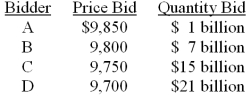 How much money will the Federal Reserve raise from this offering?
A) $29.55 billion
B) $29.40 billion
C) $29.10 billion D. $29.33 billion
E) $29.25 billion
D) $29.33 billion
E) $29.25 billion
How much money will the Federal Reserve raise from this offering?A) $29.55 billion
B) $29.40 billion
C) $29.10 billion D. $29.33 billion
E) $29.25 billion
D) $29.33 billion
E) $29.25 billion
Question
Question
The Federal Reserve is offering Treasury bills with a par value of $8 billion for sale. They have received $2 billion of noncompetitive bids. The competitive bids for a $10,000 par value bond are: 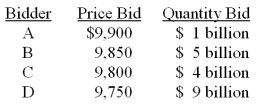 How much money will the Federal Reserve raise from this offering?
A) $7.92 billion
B) $7.88 billion
C) $7.86 billion
D) $7.84 billion
E) $7.80 billion
How much money will the Federal Reserve raise from this offering?A) $7.92 billion
B) $7.88 billion
C) $7.86 billion
D) $7.84 billion
E) $7.80 billion
Question
Question
Question

Unlock Deck
Sign up to unlock the cards in this deck!
Unlock Deck
Unlock Deck
1/84

Play

Full screen (f)
Deck 19: Government Bonds
1
Which one of the following is the Treasury program allowing interest and principal payments from Treasury notes or bonds to be sold separately?
A) EDGAR
B) TRSTRP
C) TRIPS
D) TZEROES
E) STRIPS
A) EDGAR
B) TRSTRP
C) TRIPS
D) TZEROES
E) STRIPS
E
2
Bonds issued by a city which is using a commercial insurance company to guarantee the principal and interest payments are called which one of the following?
A) general revenue bonds
B) general obligation bonds
C) insured dual bonds
D) insured municipal bonds
E) commercial agency bonds
A) general revenue bonds
B) general obligation bonds
C) insured dual bonds
D) insured municipal bonds
E) commercial agency bonds
D
3
What is the lowest accepted competitive bid in a U.S. Treasury auction called?
A) selected price
B) base price
C) stop-out bid
D) imputed bid
E) set bid
A) selected price
B) base price
C) stop-out bid
D) imputed bid
E) set bid
C
4
Which of the following are securities issued by the U. S. Treasury?
I) Government Account Series
II) T-bills
III) U.S. Savings Bonds
IV) T-notes
A) I and III only
B) II and IV only
C) II, III, and IV only
D) I, II, and IV only
E) I, II, III, and IV
I) Government Account Series
II) T-bills
III) U.S. Savings Bonds
IV) T-notes
A) I and III only
B) II and IV only
C) II, III, and IV only
D) I, II, and IV only
E) I, II, III, and IV
Unlock Deck
Unlock for access to all 84 flashcards in this deck.
Unlock Deck
k this deck
5
Which one of the following is the difference between the price a bond dealer is willing to pay to buy and the price at which he or she is willing to sell?
A) commission
B) imputed cost
C) imputed interest
D) bid-ask spread
E) ask price
A) commission
B) imputed cost
C) imputed interest
D) bid-ask spread
E) ask price
Unlock Deck
Unlock for access to all 84 flashcards in this deck.
Unlock Deck
k this deck
6
What are bonds called when the entire bond issue matures on the same date?
A) term bonds
B) uniform bonds
C) serial bonds
D) vanilla bonds
E) sinking fund bonds
A) term bonds
B) uniform bonds
C) serial bonds
D) vanilla bonds
E) sinking fund bonds
Unlock Deck
Unlock for access to all 84 flashcards in this deck.
Unlock Deck
k this deck
7
What is the method of selling Treasury bills at less than face value called?
A) imputed basis
B) par value method
C) discount basis
D) STRIP basis
E) face value method
A) imputed basis
B) par value method
C) discount basis
D) STRIP basis
E) face value method
Unlock Deck
Unlock for access to all 84 flashcards in this deck.
Unlock Deck
k this deck
8
What is the interest on a Treasury bill called when it is determined by the size of the bill's discount from face value?
A) assumed interest
B) imputed interest
C) imaginary interest
D) convergent interest
E) original-issue interest
A) assumed interest
B) imputed interest
C) imaginary interest
D) convergent interest
E) original-issue interest
Unlock Deck
Unlock for access to all 84 flashcards in this deck.
Unlock Deck
k this deck
9
What is a note that pays an interest rate based on current market rates called?
A) discount note
B) market note
C) serial note
D) flexible note
E) variable-rate note
A) discount note
B) market note
C) serial note
D) flexible note
E) variable-rate note
Unlock Deck
Unlock for access to all 84 flashcards in this deck.
Unlock Deck
k this deck
10
What are bonds called when they are issued such that a portion of the bonds mature each year over a multi-year period?
A) sinking bonds
B) serial bonds
C) sectioned bonds
D) discount bonds
E) term bonds
A) sinking bonds
B) serial bonds
C) sectioned bonds
D) discount bonds
E) term bonds
Unlock Deck
Unlock for access to all 84 flashcards in this deck.
Unlock Deck
k this deck
11
Which one of the following is the principal value of a bond at its maturity?
A) discount value
B) face value
C) STRIP value
D) imputed value
E) premium value
A) discount value
B) face value
C) STRIP value
D) imputed value
E) premium value
Unlock Deck
Unlock for access to all 84 flashcards in this deck.
Unlock Deck
k this deck
12
Municipal bonds that are secured by the full faith and credit of the issuer are referred to as which one of the following?
A) general obligation bonds
B) local taxation bonds
C) fully funded bonds
D) revenue bonds
E) private activity bonds
A) general obligation bonds
B) local taxation bonds
C) fully funded bonds
D) revenue bonds
E) private activity bonds
Unlock Deck
Unlock for access to all 84 flashcards in this deck.
Unlock Deck
k this deck
13
Which one of the following is a municipal bond that is secured by the income collected from a specific project?
A) agency bond
B) general obligation bond
C) development bond
D) contingency bond
E) revenue bond
A) agency bond
B) general obligation bond
C) development bond
D) contingency bond
E) revenue bond
Unlock Deck
Unlock for access to all 84 flashcards in this deck.
Unlock Deck
k this deck
14
Which one of the following is the risk that a bond issuer will cease paying the interest and principal payments as scheduled?
A) interest rate risk
B) default risk
C) market risk
D) conversion risk
E) earnings risk
A) interest rate risk
B) default risk
C) market risk
D) conversion risk
E) earnings risk
Unlock Deck
Unlock for access to all 84 flashcards in this deck.
Unlock Deck
k this deck
15
Which one of the following is the feature of a municipal bond that specifies when the bond may be called and the call price?
A) put provision
B) conversion provision
C) close-out clause
D) payment clause
E) call provision
A) put provision
B) conversion provision
C) close-out clause
D) payment clause
E) call provision
Unlock Deck
Unlock for access to all 84 flashcards in this deck.
Unlock Deck
k this deck
16
The yield to call is the interest rate on a bond assuming the bond is:
A) never called.
B) called on the latest possible date.
C) called on the middle day of the call period.
D) called at the earliest possible date.
E) called today.
A) never called.
B) called on the latest possible date.
C) called on the middle day of the call period.
D) called at the earliest possible date.
E) called today.
Unlock Deck
Unlock for access to all 84 flashcards in this deck.
Unlock Deck
k this deck
17
What are bonds called when the bondholder can tender the bonds on regularly scheduled dates?
A) term bonds
B) callable bonds
C) dated bonds
D) put bonds
E) serial bonds
A) term bonds
B) callable bonds
C) dated bonds
D) put bonds
E) serial bonds
Unlock Deck
Unlock for access to all 84 flashcards in this deck.
Unlock Deck
k this deck
18
Which one of the following is a municipal bond that is secured by both the revenues from a project and also by the taxing authority of the municipality?
A) mixed bond
B) general obligation bond
C) hybrid bond
D) dual bond
E) multiple bond
A) mixed bond
B) general obligation bond
C) hybrid bond
D) dual bond
E) multiple bond
Unlock Deck
Unlock for access to all 84 flashcards in this deck.
Unlock Deck
k this deck
19
Which one of the following descriptors is used to identify a bond that pays one single payment at maturity?
A) zero coupon
B) imputed value
C) solo
D) STRIP
E) term
A) zero coupon
B) imputed value
C) solo
D) STRIP
E) term
Unlock Deck
Unlock for access to all 84 flashcards in this deck.
Unlock Deck
k this deck
20
Which one of the following is a taxable municipal bond used to finance a facility used by a private business?
A) private activity bond
B) private revenue bond
C) private corporate bond
D) private agency bond
E) private income bond
A) private activity bond
B) private revenue bond
C) private corporate bond
D) private agency bond
E) private income bond
Unlock Deck
Unlock for access to all 84 flashcards in this deck.
Unlock Deck
k this deck
21
What price will a noncompetitive bidder pay for a security being purchased through a U. S. Treasury auction?
A) highest competitive bid price
B) highest noncompetitive bid price
C) stop-out bid price
D) average of all bid prices
E) lowest competitive bid price
A) highest competitive bid price
B) highest noncompetitive bid price
C) stop-out bid price
D) average of all bid prices
E) lowest competitive bid price
Unlock Deck
Unlock for access to all 84 flashcards in this deck.
Unlock Deck
k this deck
22
Which of the following statements are correct regarding Series EE savings bonds?
I) Interest is accrued monthly and compounded semiannually.
II) The minimum holding period is 3 months.
III) A penalty of 3-months interest is applied to all bonds redeemed prior to maturity.
IV) Bonds held to maturity are guaranteed to double in value regardless of the interest rate.
A) I and III only
B) I and IV only
C) II and III only
D) II and IV only
E) II, III, and IV only
I) Interest is accrued monthly and compounded semiannually.
II) The minimum holding period is 3 months.
III) A penalty of 3-months interest is applied to all bonds redeemed prior to maturity.
IV) Bonds held to maturity are guaranteed to double in value regardless of the interest rate.
A) I and III only
B) I and IV only
C) II and III only
D) II and IV only
E) II, III, and IV only
Unlock Deck
Unlock for access to all 84 flashcards in this deck.
Unlock Deck
k this deck
23
Which one of the following statements is correct regarding Series EE savings bonds?
A) The face value amounts range from $100 to $10,000.
B) The bonds sell at face value and pay interest semiannually.
C) The bonds accrue interest monthly.
D) The bonds pay an adjustable-rate of interest.
E) The bonds sell at par value.
A) The face value amounts range from $100 to $10,000.
B) The bonds sell at face value and pay interest semiannually.
C) The bonds accrue interest monthly.
D) The bonds pay an adjustable-rate of interest.
E) The bonds sell at par value.
Unlock Deck
Unlock for access to all 84 flashcards in this deck.
Unlock Deck
k this deck
24
Which of the following features apply to T-bills?
I) zero-coupon security
II) original maturities of 1 to 12 months
III) sold at face value
IV) minimum face value of $1,000
A) I and II only
B) I and IV only
C) II and III only
D) I, II, and IV only
E) I, II, III, and IV
I) zero-coupon security
II) original maturities of 1 to 12 months
III) sold at face value
IV) minimum face value of $1,000
A) I and II only
B) I and IV only
C) II and III only
D) I, II, and IV only
E) I, II, III, and IV
Unlock Deck
Unlock for access to all 84 flashcards in this deck.
Unlock Deck
k this deck
25
You just purchased a 5-year STRIPS security that was created from a 30-year T-bond. How many payments will you receive?
A) 1
B) 10
C) 11
D) 60
E) 61
A) 1
B) 10
C) 11
D) 60
E) 61
Unlock Deck
Unlock for access to all 84 flashcards in this deck.
Unlock Deck
k this deck
26
You purchased a Series I saving bonds 4 years ago. Which one of the following applies if you redeem that bond today?
A) You have to wait one more year to receive your cash.
B) You will only be able to redeem 50 percent of your holdings.
C) You will incur a 3-month earnings penalty.
D) You will be paid the fixed interest rate but will forfeit any inflation adjustment.
E) You will forfeit 6 months of interest.
A) You have to wait one more year to receive your cash.
B) You will only be able to redeem 50 percent of your holdings.
C) You will incur a 3-month earnings penalty.
D) You will be paid the fixed interest rate but will forfeit any inflation adjustment.
E) You will forfeit 6 months of interest.
Unlock Deck
Unlock for access to all 84 flashcards in this deck.
Unlock Deck
k this deck
27
When a callable T-bond is selling at a premium, the reported yield is which one of the following?
A) current yield
B) yield-to-maturity
C) yield-to-discount
D) yield-to-call
E) premium yield
A) current yield
B) yield-to-maturity
C) yield-to-discount
D) yield-to-call
E) premium yield
Unlock Deck
Unlock for access to all 84 flashcards in this deck.
Unlock Deck
k this deck
28
Which of the following statements correctly apply to TIPS?
I) They are quoted as a percentage of the current accrued principal.
II) They pay a variable interest rate that responds to movements in the inflation rate.
III) They are backed by the full faith and credit of the U.S. government.
IV) They adjust for inflation on an annual basis.
A) I and III only
B) II and IV only
C) III and IV only
D) I, II, and III only
E) II, III, and IV only
I) They are quoted as a percentage of the current accrued principal.
II) They pay a variable interest rate that responds to movements in the inflation rate.
III) They are backed by the full faith and credit of the U.S. government.
IV) They adjust for inflation on an annual basis.
A) I and III only
B) II and IV only
C) III and IV only
D) I, II, and III only
E) II, III, and IV only
Unlock Deck
Unlock for access to all 84 flashcards in this deck.
Unlock Deck
k this deck
29
Which one of the following applies to U.S. Treasury auctions?
A) Every bidder has a choice of submitting either a competitive or a noncompetitive bid.
B) The purchase price paid by all bidders is the highest bid price.
C) Each bidder with an accepted bid will pay the individual price he or she bid.
D) All noncompetitive bids are accepted automatically.
E) Noncompetitive bids are ignored unless there are not enough competitive bids to buy the entire issue.
A) Every bidder has a choice of submitting either a competitive or a noncompetitive bid.
B) The purchase price paid by all bidders is the highest bid price.
C) Each bidder with an accepted bid will pay the individual price he or she bid.
D) All noncompetitive bids are accepted automatically.
E) Noncompetitive bids are ignored unless there are not enough competitive bids to buy the entire issue.
Unlock Deck
Unlock for access to all 84 flashcards in this deck.
Unlock Deck
k this deck
30
Which one of the following statements related to TIPS is correct assuming an inflationary environment?
A) TIPS have a maturity value of $1,000.
B) TIPS pay an interest payment based on the latest T-bill rate.
C) TIPS pay a fixed coupon rate.
D) The principal amount of a TIPS is adjusted annually for inflation.
E) The interest rate is adjusted semiannually for inflation.
A) TIPS have a maturity value of $1,000.
B) TIPS pay an interest payment based on the latest T-bill rate.
C) TIPS pay a fixed coupon rate.
D) The principal amount of a TIPS is adjusted annually for inflation.
E) The interest rate is adjusted semiannually for inflation.
Unlock Deck
Unlock for access to all 84 flashcards in this deck.
Unlock Deck
k this deck
31
Which one of the following features applies to all Treasury bonds currently being offered?
A) noncallable
B) sold at a deep discount
C) zero-coupon
D) mature in 10 years or less
E) callable within 5 years of issue
A) noncallable
B) sold at a deep discount
C) zero-coupon
D) mature in 10 years or less
E) callable within 5 years of issue
Unlock Deck
Unlock for access to all 84 flashcards in this deck.
Unlock Deck
k this deck
32
Which one of the following do Series I savings bonds offer?
A) monthly interest payments
B) guaranteed real rate of return
C) interest for an unlimited period of time
D) monthly interest compounding
E) immediate redemption with no penalty
A) monthly interest payments
B) guaranteed real rate of return
C) interest for an unlimited period of time
D) monthly interest compounding
E) immediate redemption with no penalty
Unlock Deck
Unlock for access to all 84 flashcards in this deck.
Unlock Deck
k this deck
33
U.S. government agency bonds pay interest which is subject to which of the following taxes?
A) federal only
B) state only
C) state and local only
D) state and federal only
E) state, local, and federal
A) federal only
B) state only
C) state and local only
D) state and federal only
E) state, local, and federal
Unlock Deck
Unlock for access to all 84 flashcards in this deck.
Unlock Deck
k this deck
34
Which of the following features apply to T-bills?
I) original maturities of 4, 13, or 26 weeks
II) minimum face value of $10,000
III) sold at a discount
IV) semiannual interest payments
A) IV only
B) I and III only
C) I and IV only
D) II and III only
E) II and IV only
I) original maturities of 4, 13, or 26 weeks
II) minimum face value of $10,000
III) sold at a discount
IV) semiannual interest payments
A) IV only
B) I and III only
C) I and IV only
D) II and III only
E) II and IV only
Unlock Deck
Unlock for access to all 84 flashcards in this deck.
Unlock Deck
k this deck
35
Which one of the following statements correctly applies to STRIPS?
A) STRIPS securities pay a fixed-rate, semiannual interest payment.
B) A 10-year T-bond is broken into 20 STRIPS securities.
C) Treasury securities are broken into STRIPS securities by brokers.
D) STRIPS securities pay a variable-rate, semiannual interest payment.
E) All STRIPS securities taken from the same Treasury security must be registered to the same owner.
A) STRIPS securities pay a fixed-rate, semiannual interest payment.
B) A 10-year T-bond is broken into 20 STRIPS securities.
C) Treasury securities are broken into STRIPS securities by brokers.
D) STRIPS securities pay a variable-rate, semiannual interest payment.
E) All STRIPS securities taken from the same Treasury security must be registered to the same owner.
Unlock Deck
Unlock for access to all 84 flashcards in this deck.
Unlock Deck
k this deck
36
A TIPS is quoted at 101:17. How should this quote be interpreted in relation to a $1,000 face value bond?
A) The current yield on this security is 1.17 percent.
B) The bond is currently selling at the discounted price of $101.17.
C) The bond will mature at a price equal to 101.17 percent of $1,000.
D) A $1,000 bond is currently selling for 101 and 17/32nds percent of $1,000.
E) A $1,000 bond will mature at a price equal to 101 and 17/32nds percent of $1,000.
A) The current yield on this security is 1.17 percent.
B) The bond is currently selling at the discounted price of $101.17.
C) The bond will mature at a price equal to 101.17 percent of $1,000.
D) A $1,000 bond is currently selling for 101 and 17/32nds percent of $1,000.
E) A $1,000 bond will mature at a price equal to 101 and 17/32nds percent of $1,000.
Unlock Deck
Unlock for access to all 84 flashcards in this deck.
Unlock Deck
k this deck
37
Which one of the following statements applies to U.S. Treasury bonds?
A) They have original maturities of 1 to 10 years.
B) They have a minimum face value of $100,000.
C) They are zero-coupon securities.
D) They pay a fixed coupon payment semiannually.
E) They are adjusted semiannually for inflation.
A) They have original maturities of 1 to 10 years.
B) They have a minimum face value of $100,000.
C) They are zero-coupon securities.
D) They pay a fixed coupon payment semiannually.
E) They are adjusted semiannually for inflation.
Unlock Deck
Unlock for access to all 84 flashcards in this deck.
Unlock Deck
k this deck
38
Which one of the following statements applies to U.S. Treasury notes?
A) They are zero coupon securities.
B) They have a minimum face value of $10,000.
C) They have original maturities of 2 to 10 years.
D) They are variable-rate securities.
E) They are sold on a non-marketable basis only.
A) They are zero coupon securities.
B) They have a minimum face value of $10,000.
C) They have original maturities of 2 to 10 years.
D) They are variable-rate securities.
E) They are sold on a non-marketable basis only.
Unlock Deck
Unlock for access to all 84 flashcards in this deck.
Unlock Deck
k this deck
39
U.S. government agency debt does which one of the following?
A) has a larger bid-ask spread than U.S. Treasury debt
B) provides more liquidity than U.S. Treasury debt
C) provides security in the form of the full faith and credit of the U.S. government
D) provides triple tax-free income
E) pays a lower yield than comparable U.S. Treasury debt
A) has a larger bid-ask spread than U.S. Treasury debt
B) provides more liquidity than U.S. Treasury debt
C) provides security in the form of the full faith and credit of the U.S. government
D) provides triple tax-free income
E) pays a lower yield than comparable U.S. Treasury debt
Unlock Deck
Unlock for access to all 84 flashcards in this deck.
Unlock Deck
k this deck
40
Which one of the following applies to Series I savings bonds?
A) redemption any time after 6 months
B) fixed portion of the interest rate is adjusted each May and November over the bond's life
C) semiannual inflation rate adjustment
D) minimum face value of $100
E) maximum 20-year life
A) redemption any time after 6 months
B) fixed portion of the interest rate is adjusted each May and November over the bond's life
C) semiannual inflation rate adjustment
D) minimum face value of $100
E) maximum 20-year life
Unlock Deck
Unlock for access to all 84 flashcards in this deck.
Unlock Deck
k this deck
41
Which one of the following statements is true in regards to municipal bond insurance?
A) The insurance premium is paid by the bondholders.
B) The insurance can be cancelled with 30 days notice to the bond issuer.
C) The financial strength of the bond issuer can affect the bond's credit rating.
D) Insured bonds tend to sell at lower prices than uninsured bonds.
E) To date, bond insurers have not had to pay any payments for bond defaults.
A) The insurance premium is paid by the bondholders.
B) The insurance can be cancelled with 30 days notice to the bond issuer.
C) The financial strength of the bond issuer can affect the bond's credit rating.
D) Insured bonds tend to sell at lower prices than uninsured bonds.
E) To date, bond insurers have not had to pay any payments for bond defaults.
Unlock Deck
Unlock for access to all 84 flashcards in this deck.
Unlock Deck
k this deck
42
Variable-rate demand obligations frequently carry a provision which allows the issuer to do which one of the following?
A) limit the amount of upward adjustment to a maximum increase of 2 percent
B) convert the issue from GO bonds to revenue bonds
C) void the put provision if the coupon rate increases
D) eliminate the call premium if the entire issue is called
E) convert the entire issue into a fixed-rate issue
A) limit the amount of upward adjustment to a maximum increase of 2 percent
B) convert the issue from GO bonds to revenue bonds
C) void the put provision if the coupon rate increases
D) eliminate the call premium if the entire issue is called
E) convert the entire issue into a fixed-rate issue
Unlock Deck
Unlock for access to all 84 flashcards in this deck.
Unlock Deck
k this deck
43
A Treasury bond has a dollar price of $1,015.63. What would you expect the bond quote to be?
A) 101:05
B) 101:15
C) 101:16
D) 101:18
E) 101:22
A) 101:05
B) 101:15
C) 101:16
D) 101:18
E) 101:22
Unlock Deck
Unlock for access to all 84 flashcards in this deck.
Unlock Deck
k this deck
44
Which one of the following generally applies to municipal bonds?
A) issued as term bonds without a sinking fund
B) $5,000 par value
C) trading based on price quotes
D) highly liquid market
E) callable at any time at par value
A) issued as term bonds without a sinking fund
B) $5,000 par value
C) trading based on price quotes
D) highly liquid market
E) callable at any time at par value
Unlock Deck
Unlock for access to all 84 flashcards in this deck.
Unlock Deck
k this deck
45
A Treasury note has 2.5 years left to maturity, a yield to maturity of 3.6 percent, and a coupon rate of 4.40 percent. What is the price of the bond?
A) $1,015.41
B) $1,015.53
C) $1,016.56
D) $1,017.58
E) $1,018.96
A) $1,015.41
B) $1,015.53
C) $1,016.56
D) $1,017.58
E) $1,018.96
Unlock Deck
Unlock for access to all 84 flashcards in this deck.
Unlock Deck
k this deck
46
Which one of the following generally applies to municipal bonds?
A) noncallable
B) risk-free
C) high credit rating
D) zero coupon
E) par value of $1,000
A) noncallable
B) risk-free
C) high credit rating
D) zero coupon
E) par value of $1,000
Unlock Deck
Unlock for access to all 84 flashcards in this deck.
Unlock Deck
k this deck
47
A Treasury bond has a face value of $30,000 and a quoted price of 102:20. What is the bond's dollar price?
A) $30,002.80
B) $30,102.18
C) $30,654.00
D) $30,787.50
E) $47,475.00
A) $30,002.80
B) $30,102.18
C) $30,654.00
D) $30,787.50
E) $47,475.00
Unlock Deck
Unlock for access to all 84 flashcards in this deck.
Unlock Deck
k this deck
48
You wish to purchase a bond for your tax-exempt retirement account. Which one of the following should you prefer if you only consider the tax aspects of your selection?
A) corporate bond
B) Treasury bond
C) qualified private activity bond
D) municipal insured bond
E) municipal GO bond
A) corporate bond
B) Treasury bond
C) qualified private activity bond
D) municipal insured bond
E) municipal GO bond
Unlock Deck
Unlock for access to all 84 flashcards in this deck.
Unlock Deck
k this deck
49
Which one of the following statements is correct concerning municipal bonds?
A) Municipal put bonds are less valuable than comparable nonputable bonds.
B) Highway bonds are generally issued as GO bonds.
C) College dormitories are frequently financed by revenue bonds.
D) Revenue bonds are risk-free.
E) A hybrid bond is joint debt of a state and the federal government.
A) Municipal put bonds are less valuable than comparable nonputable bonds.
B) Highway bonds are generally issued as GO bonds.
C) College dormitories are frequently financed by revenue bonds.
D) Revenue bonds are risk-free.
E) A hybrid bond is joint debt of a state and the federal government.
Unlock Deck
Unlock for access to all 84 flashcards in this deck.
Unlock Deck
k this deck
50
A Treasury bond has a yield to maturity of 6.2 percent, a time to maturity of 9 years, and a coupon rate of 7 percent. What is the bond price?
A) $940.65
B) $946.95
C) $1,054.55
D) $1,061.63
E) $1,069.56
A) $940.65
B) $946.95
C) $1,054.55
D) $1,061.63
E) $1,069.56
Unlock Deck
Unlock for access to all 84 flashcards in this deck.
Unlock Deck
k this deck
51
A STRIPS matures in 6 years, has a face value of $17,000, and has a yield to maturity of 4.8 percent. What is the price?
A) $10,854.59
B) $11,010.43
C) $11,284.75
D) $11,322.01
E) $12,789.38
A) $10,854.59
B) $11,010.43
C) $11,284.75
D) $11,322.01
E) $12,789.38
Unlock Deck
Unlock for access to all 84 flashcards in this deck.
Unlock Deck
k this deck
52
Kathy lives in State A and owns a municipal bond issued by State B. The interest earned on this bond is most apt to be exempt from taxation at which of the following levels?
A) local only
B) The interest earned on this bond is most apt to be exempt from taxation at which of the following levels?
C) federal only
D) local and state only
E) federal, state, and local
A) local only
B) The interest earned on this bond is most apt to be exempt from taxation at which of the following levels?
C) federal only
D) local and state only
E) federal, state, and local
Unlock Deck
Unlock for access to all 84 flashcards in this deck.
Unlock Deck
k this deck
53
Which one of the following has the highest level of default risk?
A) U.S. Treasury bond
B) municipal bond
C) Series I bond
D) T-bill
E) Series EE bond
A) U.S. Treasury bond
B) municipal bond
C) Series I bond
D) T-bill
E) Series EE bond
Unlock Deck
Unlock for access to all 84 flashcards in this deck.
Unlock Deck
k this deck
54
A Treasury bond has a quoted bid price of 100:10 and a quoted ask price of 100:11. What is the amount you will receive if you sell your bond that has a par value of $20,000?
A) $20,016.00
B) $20,050.00
C) $20,062.60
D) $20,100.08
E) $21,600.00
A) $20,016.00
B) $20,050.00
C) $20,062.60
D) $20,100.08
E) $21,600.00
Unlock Deck
Unlock for access to all 84 flashcards in this deck.
Unlock Deck
k this deck
55
Which two of the following are the principle means by which a municipality can avoid a lump-sum principal repayment on a single maturity date?
I) issue only zero-coupon bonds
II) issue serial bonds
III) issue term bonds with a sinking fund provision
IV) issue only variable-rate notes
A) I and II only
B) I and III only
C) II and III only
D) II and IV only
E) III and IV only
I) issue only zero-coupon bonds
II) issue serial bonds
III) issue term bonds with a sinking fund provision
IV) issue only variable-rate notes
A) I and II only
B) I and III only
C) II and III only
D) II and IV only
E) III and IV only
Unlock Deck
Unlock for access to all 84 flashcards in this deck.
Unlock Deck
k this deck
56
A Treasury bond has a 4.2 percent coupon, a quoted price of 101:06, and 8 years to maturity. What is the yield to maturity?
A) 3.78 percent
B) 3.93 percent
C) 4.03 percent
D) 4.90 percent
E) 5.92 percent
A) 3.78 percent
B) 3.93 percent
C) 4.03 percent
D) 4.90 percent
E) 5.92 percent
Unlock Deck
Unlock for access to all 84 flashcards in this deck.
Unlock Deck
k this deck
57
A Treasury bond matures in 13 years, has a 5.25 percent coupon, and a quoted price of 98:01. What is the yield to maturity?
A) 5.25 percent
B) 5.34 percent
C) 5.46 percent
D) 5.55 percent
E) 5.68 percent
A) 5.25 percent
B) 5.34 percent
C) 5.46 percent
D) 5.55 percent
E) 5.68 percent
Unlock Deck
Unlock for access to all 84 flashcards in this deck.
Unlock Deck
k this deck
58
Leslie has a marginal tax rate of 33 percent and Bill has a marginal tax rate of 37 percent. The critical marginal tax rate for a municipal bond is 35.2 percent. For their taxable investment accounts, Leslie will prefer _____ and Bill will prefer ____. Ignore any risk considerations.
A) corporate bonds; corporate bonds
B) municipal bonds; corporate bonds
C) corporate bonds; municipal bonds
D) municipal bonds; municipal bonds
E) Neither Leslie nor Bill will have a preference for either corporate or municipal bonds.
A) corporate bonds; corporate bonds
B) municipal bonds; corporate bonds
C) corporate bonds; municipal bonds
D) municipal bonds; municipal bonds
E) Neither Leslie nor Bill will have a preference for either corporate or municipal bonds.
Unlock Deck
Unlock for access to all 84 flashcards in this deck.
Unlock Deck
k this deck
59
A moral obligation bond is which type of a bond?
A) municipal revenue
B) municipal GO
C) municipal hybrid
D) U.S. Treasury
E) U.S. agency
A) municipal revenue
B) municipal GO
C) municipal hybrid
D) U.S. Treasury
E) U.S. agency
Unlock Deck
Unlock for access to all 84 flashcards in this deck.
Unlock Deck
k this deck
60
Which of the following uses of proceeds from private activity bonds will most likely qualify those bonds as federally tax-exempt?
I) public airport runway
II) baseball stadium
III) multifamily housing project
IV) mass rail transit
A) I and II only
B) I and III only
C) II and III only
D) II and IV only
E) I, III, and IV only
I) public airport runway
II) baseball stadium
III) multifamily housing project
IV) mass rail transit
A) I and II only
B) I and III only
C) II and III only
D) II and IV only
E) I, III, and IV only
Unlock Deck
Unlock for access to all 84 flashcards in this deck.
Unlock Deck
k this deck
61
Municipal bonds are yielding 4.6 percent if they are insured and 4.9 percent if they are uninsured. Your marginal tax rate is 31 percent. Your equivalent taxable yield on the insured bonds is _____ percent and on the uninsured bonds is _____ percent.
A) 5.89; 6.27
B) 6.39; 6.76
C) 6.39; 6.81
D) 6.67; 7.10
E) 6.76; 7.10
A) 5.89; 6.27
B) 6.39; 6.76
C) 6.39; 6.81
D) 6.67; 7.10
E) 6.76; 7.10
Unlock Deck
Unlock for access to all 84 flashcards in this deck.
Unlock Deck
k this deck
62
A $5,000 face value municipal bond matures in 14 years and is priced at $4,862. The coupon rate is 4.5 percent with interest paid semiannually. What is the yield to maturity on the bond?
A) 4.77 percent
B) 5.14 percent
C) 5.40 percent
D) 5.61 percent
E) 5.97 percent
A) 4.77 percent
B) 5.14 percent
C) 5.40 percent
D) 5.61 percent
E) 5.97 percent
Unlock Deck
Unlock for access to all 84 flashcards in this deck.
Unlock Deck
k this deck
63
A municipal bond is yielding 4.8 percent. Jeremy has a marginal tax rate of 24 percent. What is his equivalent taxable yield?
A) 2.18 percent
B) 4.58 percent
C) 6.15 percent
D) 6.32 percent
E) 7.18 percent
A) 2.18 percent
B) 4.58 percent
C) 6.15 percent
D) 6.32 percent
E) 7.18 percent
Unlock Deck
Unlock for access to all 84 flashcards in this deck.
Unlock Deck
k this deck
64
Sonya has a marginal tax rate of 36 percent. A corporate bond is yielding 7.4 percent and a municipal bond is yielding 3.6 percent. Sonya should invest in the _____ bond because the critical marginal tax rate is _____ percent.
A) corporate; 17
B) corporate; 34
C) corporate; 51
D) municipal; 43
E) municipal; 51
A) corporate; 17
B) corporate; 34
C) corporate; 51
D) municipal; 43
E) municipal; 51
Unlock Deck
Unlock for access to all 84 flashcards in this deck.
Unlock Deck
k this deck
65
You own a corporate bond which is yielding 8.2 percent. What is your after-tax yield if your marginal tax rate is 28 percent?
A) 5.90 percent
B) 7.52 percent
C) 8.20 percent
D) 10.58 percent
E) 11.55 percent
A) 5.90 percent
B) 7.52 percent
C) 8.20 percent
D) 10.58 percent
E) 11.55 percent
Unlock Deck
Unlock for access to all 84 flashcards in this deck.
Unlock Deck
k this deck
66
A corporate bond is yielding 6.9 percent and a municipal bond is yielding 4.8 percent. What is the critical marginal tax rate?
A) 28 percent
B) 30 percent
C) 33 percent
D) 35 percent
E) 38 percent
A) 28 percent
B) 30 percent
C) 33 percent
D) 35 percent
E) 38 percent
Unlock Deck
Unlock for access to all 84 flashcards in this deck.
Unlock Deck
k this deck
67
An investor has a critical marginal tax rate of 28.5 percent when municipal bonds are yielding 5.1 percent. What is the corporate bond yield?
A) 4.38 percent
B) 5.81 percent
C) 6.51 percent
D) 7.13 percent
E) 10.26 percent
A) 4.38 percent
B) 5.81 percent
C) 6.51 percent
D) 7.13 percent
E) 10.26 percent
Unlock Deck
Unlock for access to all 84 flashcards in this deck.
Unlock Deck
k this deck
68
A $5,000 face value municipal bond with a coupon rate of 3.5 percent has 13 years to maturity and a current price of $4,812. Interest is paid semiannually. What is the bond's yield to maturity?
A) 2.10 percent
B) 3.61 percent
C) 3.87 percent
D) 3.95 percent
E) 4.23 percent
A) 2.10 percent
B) 3.61 percent
C) 3.87 percent
D) 3.95 percent
E) 4.23 percent
Unlock Deck
Unlock for access to all 84 flashcards in this deck.
Unlock Deck
k this deck
69
Laura has an average tax rate of 21 percent and a marginal tax rate of 28 percent. What is her after-tax yield on a corporate bond which has a 7.6 percent yield?
A) 2.51 percent
B) 5.09 percent
C) 5.47 percent
D) 6.00 percent
E) 11.34 percent
A) 2.51 percent
B) 5.09 percent
C) 5.47 percent
D) 6.00 percent
E) 11.34 percent
Unlock Deck
Unlock for access to all 84 flashcards in this deck.
Unlock Deck
k this deck
70
The Federal Reserve is offering Treasury bills with a par value of $18 billion for sale. They have received $7 billion of noncompetitive bids. The competitive bids for a $10,000 par value bond are: What price will Bidder A pay per bond, assuming that bid is accepted?
A) $9,600
B) $9,650
C) $9,675
D) $9,700
E) $9,750
What price will Bidder A pay per bond, assuming that bid is accepted?A) $9,600
B) $9,650
C) $9,675
D) $9,700
E) $9,750
Unlock Deck
Unlock for access to all 84 flashcards in this deck.
Unlock Deck
k this deck
71
You own a principal STRIPS which is based on a 4.5 percent coupon Treasury bond that matures in 20 years. The STRIPS is priced at $22,868 and has a par value of $50,000. What is the yield to maturity on the STRIPS?
A) 3.79 percent
B) 3.90 percent
C) 3.93 percent
D) 3.95 percent
E) 3.99 percent
A) 3.79 percent
B) 3.90 percent
C) 3.93 percent
D) 3.95 percent
E) 3.99 percent
Unlock Deck
Unlock for access to all 84 flashcards in this deck.
Unlock Deck
k this deck
72
A STRIPS that matures in 6 years is selling for $11,369. The par value is $15,000. What is the yield to maturity?
A) 3.17 percent
B) 4.67 percent
C) 5.25 percent
D) 6.54 percent
E) 6.75 percent
A) 3.17 percent
B) 4.67 percent
C) 5.25 percent
D) 6.54 percent
E) 6.75 percent
Unlock Deck
Unlock for access to all 84 flashcards in this deck.
Unlock Deck
k this deck
73
Lester is considering a municipal bond yielding 4.4 percent and a corporate bond yielding 7.2 percent. His marginal tax rate is 36 percent. He should invest in the _____ bond because the critical marginal tax rate is _____ percent.
A) corporate; 35
B) corporate; 37
C) corporate; 39
D) municipal; 37
E) municipal; 39
A) corporate; 35
B) corporate; 37
C) corporate; 39
D) municipal; 37
E) municipal; 39
Unlock Deck
Unlock for access to all 84 flashcards in this deck.
Unlock Deck
k this deck
74
You have a marginal tax rate of 31 percent and an average tax rate of 28 percent. Municipal bonds in your area are yielding 3.6 percent. What is your equivalent taxable yield?
A) 4.16 percent
B) 4.93 percent
C) 5.13 percent
D) 5.22 percent
E) 5.27 percent
A) 4.16 percent
B) 4.93 percent
C) 5.13 percent
D) 5.22 percent
E) 5.27 percent
Unlock Deck
Unlock for access to all 84 flashcards in this deck.
Unlock Deck
k this deck
75
The Federal Reserve is offering Treasury bills with a par value of $30 billion for sale. They have received $11 billion of noncompetitive bids. The competitive bids for a $10,000 par value bond are: How much money will the Federal Reserve raise from this offering?
A) $29.55 billion
B) $29.40 billion
C) $29.10 billion D. $29.33 billion
E) $29.25 billion
D) $29.33 billion
E) $29.25 billion
How much money will the Federal Reserve raise from this offering?A) $29.55 billion
B) $29.40 billion
C) $29.10 billion D. $29.33 billion
E) $29.25 billion
D) $29.33 billion
E) $29.25 billion
Unlock Deck
Unlock for access to all 84 flashcards in this deck.
Unlock Deck
k this deck
76
A STRIPS has a $9,000 par value and a market value of $7,050. The time to maturity is 5 years. What is the yield to maturity?
A) 2.07 percent
B) 3.00 percent
C) 4.94 percent
D) 5.00 percent
E) 5.07 percent
A) 2.07 percent
B) 3.00 percent
C) 4.94 percent
D) 5.00 percent
E) 5.07 percent
Unlock Deck
Unlock for access to all 84 flashcards in this deck.
Unlock Deck
k this deck
77
The Federal Reserve is offering Treasury bills with a par value of $8 billion for sale. They have received $2 billion of noncompetitive bids. The competitive bids for a $10,000 par value bond are: How much money will the Federal Reserve raise from this offering?
A) $7.92 billion
B) $7.88 billion
C) $7.86 billion
D) $7.84 billion
E) $7.80 billion
How much money will the Federal Reserve raise from this offering?A) $7.92 billion
B) $7.88 billion
C) $7.86 billion
D) $7.84 billion
E) $7.80 billion
Unlock Deck
Unlock for access to all 84 flashcards in this deck.
Unlock Deck
k this deck
78
Municipal bonds are yielding 4.8 percent currently. Alicia has a marginal tax rate of 35 percent and Yvonne has a marginal tax rate of 22 percent. Alicia's equivalent taxable yield is _____ percent and Yvonne's is _____ percent.
A) 7.50; 5.86
B) 7.39; 6.15
C) 6.53; 5.86
D) 6.53; 6.15
E) 8.29; 5.07
A) 7.50; 5.86
B) 7.39; 6.15
C) 6.53; 5.86
D) 6.53; 6.15
E) 8.29; 5.07
Unlock Deck
Unlock for access to all 84 flashcards in this deck.
Unlock Deck
k this deck
79
Jeff owns a taxable bond portfolio which is yielding 8.76 percent. His after-tax yield is 6.57 percent. What is his marginal tax rate?
A) 25 percent
B) 28 percent
C) 31 percent
D) 32 percent
E) 34 percent
A) 25 percent
B) 28 percent
C) 31 percent
D) 32 percent
E) 34 percent
Unlock Deck
Unlock for access to all 84 flashcards in this deck.
Unlock Deck
k this deck
80
A STRIPS has a yield to maturity of 7.2 percent, a par value of $25,000, and a time to maturity of 12 years. What is the price?
A) $4,100.87
B) $5,792.80
C) $9,967.50
D) $10,698.08
E) $15,785.68
A) $4,100.87
B) $5,792.80
C) $9,967.50
D) $10,698.08
E) $15,785.68
Unlock Deck
Unlock for access to all 84 flashcards in this deck.
Unlock Deck
k this deck
Unlock Deck
Unlock for access to all 84 flashcards in this deck.






