



Deck 19: Electrochemistry

Full screen (f)
exit full mode
Question
Which of the following cell reactions would require the use of an inert electrode?

A)Cu(s)+ 2Ag+(aq)→ 2Ag(s)+ Cu2+(aq)
B)3Fe(s)+ 2Au3+(aq)→ 3Fe2+ + 2Au(s)
C)Zn(s)+ 2Ag+(aq)→ Zn2+(aq)+ 2Ag(s)
D)Ni(s)+ 2MnO2(s)+ 2NH4+(aq)→ Ni2+(aq)+ Mn2O3(s)+ 2NH3(aq)+ H2O(l)
E)3Zn2+(aq)+ 2Al(s)→ 3Zn(s)+ 2Al3+(aq)
Use Space or
up arrow
down arrow
to flip the card.
Question
When the following oxidation-reduction reaction in basic solution is balanced,what is the lowest whole-number coefficient for OH-,and on which side of the balanced equation should it appear?
Cr2O3(s)→ Cr(OH)2(aq)+ CrO42-(aq)

A)2,reactant side
B)10,product side
C)4,product side
D)4,reactant side
E)2,product side
Question
Which statement concerning the anode in an electrochemical cell is correct?

A)Metal ions may be deposited as metal atoms on the anode during cell discharge.
B)When connected to an external circuit,the anode develops a positive charge.
C)Reduction occurs at the anode during cell discharge.
D)Positive ions flow towards the anode during cell discharge.
E)None of the above.
Question
When the following oxidation-reduction reaction in acidic solution is balanced,what is the lowest whole-number coefficient for Rb+(aq)?
Rb(s)+ Sr2+(aq)→ Rb+(aq)+ Sr(s)

A)5
B)4
C)1
D)3
E)2
Question
A strip of iron is placed in a 1 M solution of iron(II)sulfate,and a strip of copper is placed in a 1 M solution of copper(II)chloride.The two solutions are connected with a salt bridge,and the two metals are connected by a wire.
Reduction Half-Reaction
E° (V)
Fe2+(aq)+ 2e- <strong>A strip of iron is placed in a 1 M solution of iron(II)sulfate,and a strip of copper is placed in a 1 M solution of copper(II)chloride.The two solutions are connected with a salt bridge,and the two metals are connected by a wire. Reduction Half-Reaction E° (V) Fe<sup>2+</sup>(aq)+ 2e<sup>-</sup>  Fe(s) -0)41Cu<sup>2+</sup>(aq)+ 2e<sup>-</sup>  Cu(s) 0)34 Which of the following takes place?</strong> A)Sulfur deposits at the iron electrode. B)The Fe(II)concentration of the iron half-cell decreases. C)Copper atoms deposit at the cathode. D)Chlorine is produced at the copper electrode. E)Chlorine is produced at the iron electrode. <div style=padding-top: 35px> Fe(s)
-0)41Cu2+(aq)+ 2e- <strong>A strip of iron is placed in a 1 M solution of iron(II)sulfate,and a strip of copper is placed in a 1 M solution of copper(II)chloride.The two solutions are connected with a salt bridge,and the two metals are connected by a wire. Reduction Half-Reaction E° (V) Fe<sup>2+</sup>(aq)+ 2e<sup>-</sup>  Fe(s) -0)41Cu<sup>2+</sup>(aq)+ 2e<sup>-</sup>  Cu(s) 0)34 Which of the following takes place?</strong> A)Sulfur deposits at the iron electrode. B)The Fe(II)concentration of the iron half-cell decreases. C)Copper atoms deposit at the cathode. D)Chlorine is produced at the copper electrode. E)Chlorine is produced at the iron electrode. <div style=padding-top: 35px> Cu(s)
0)34
Which of the following takes place?

A)Sulfur deposits at the iron electrode.
B)The Fe(II)concentration of the iron half-cell decreases.
C)Copper atoms deposit at the cathode.
D)Chlorine is produced at the copper electrode.
E)Chlorine is produced at the iron electrode.
Question
Which reaction would be most likely to occur at the anode of a voltaic cell?

A)PbSO4(s)+ 2e- → Pb(s)+ SO42-(aq)
B)2H2O(l)+ 2e- → H2(g)+ 2OH-(aq)
C)2H2O(l)→ O2(g)+ 4H+(aq)+ 4e-
D)PbSO4(s)→ Pb2+(aq)+ SO42-(aq)
E)2H2O(l)→ 2H2(g)+ O2(g)
Question
Balance the following oxidation-reduction occurring in acidic solution.
MnO4-(aq)+ Co2+(aq)→ Mn2+(aq)+ Co3+(aq)

A)MnO4-(aq)+ 8H+(aq)+ 5Co2+(aq)→ Mn2+(aq)+ 4H2O(aq)+ 5Co3+(aq)
B)MnO4-(aq)+ 8H+(aq)+ Co2+(aq)→ Mn2+(aq)+ 4H2O(aq)+ Co3+(aq)
C)MnO4-(aq)+ 4H2(g)+ 5Co2+(aq)→ Mn2+(aq)+ 4H2O(aq)+ 5Co3+(aq)
D)MnO4-(aq)+ 8H+(aq)+ 2Co2+(aq)→ Mn2+(aq)+ 4H2O(aq)+ 2Co3+(aq)
E)MnO4-(aq)+ Co2+(aq)→ Mn2+(aq)+ 2O2(g)+ Co3+(aq)
Question
Balance the following half-reaction occurring in basic solution.

MnO2(s)→ Mn(OH)2(s)

A)MnO2(s)+ 2H2O(l)+ 2e−→ Mn(OH)2(s)+ 2OH−(aq)
B)MnO2(s)+ 2H2O(l)+ 4e−→ Mn(OH)2(s)+ (OH)2−(aq)
C)MnO2(s)+ H22+(aq)+ 2e−→ Mn(OH)2(s)
D)MnO2(s)+ H2(g)→ Mn(OH)2(s)+ 2e−
E)MnO2(s)+ 2H2O(l)→ Mn(OH)2(s)+ 2OH−(aq)
Question
The following reactions take place in a lead storage battery.
Discharging: Pb(s)+ PbO2(s)+ 4H+(aq)+ 2SO42-(aq)→ 2PbSO4(s)+ 2H2O(l)
Charging: 2PbSO4(s)+ 2H2O(l)→ Pb(s)+ PbO2(s)+ 4H+(aq)+ 2SO42-(aq)
Which of the following statements is true?

A)The concentration of H2SO4 increases as the battery discharges.
B)Pb is formed at the anode during discharge.
C)Pb is formed at the cathode during charging.
D)The mass of Pb decreases during charging.
E)The mass of PbSO4 remains constant during charging and discharging.
Question
Which of the following statements is true concerning half-cell I as the voltaic cell shown below discharges? <strong>Which of the following statements is true concerning half-cell I as the voltaic cell shown below discharges?  </strong> A)[Zn<sup>2+</sup>] increases with time,and [Cl-] increases with time. B)[Zn<sup>2+</sup>] decreases with time,and [Cl-] increases with time. C)[Zn<sup>2+</sup>] decreases with time,and [Cl-] decreases with time. D)[Zn<sup>2+</sup>] decreases with time,and [NO<sub>3</sub>-] increases with time. E)[Zn<sup>2+</sup>] increases with time,and [NO<sub>3</sub>-] increases with time. <div style=padding-top: 35px>

A)[Zn2+] increases with time,and [Cl-] increases with time.
B)[Zn2+] decreases with time,and [Cl-] increases with time.
C)[Zn2+] decreases with time,and [Cl-] decreases with time.
D)[Zn2+] decreases with time,and [NO3-] increases with time.
E)[Zn2+] increases with time,and [NO3-] increases with time.
Question
When balancing oxidation-reduction reactions in acidic solution by the half-reaction method,the addition of the reactant H+ is required to balance the product

A)O2.
B)OH-.
C)O.
D)H2O.
E)none of these
Question
When the following oxidation-reduction reaction in acidic solution is balanced,what is the lowest whole-number coefficient for H+,and on which side of the balanced equation should it appear?
S2O82-(aq)+ NO(g)→ SO42-(aq)+ NO3-(aq)

A)4,product side
B)8,reactant side
C)12,reactant side
D)8,product side
E)4,reactant side
Question
The anode in a voltaic cell and in an electrolytic cell is

A)the site of oxidation and of reduction,respectively.
B)the site of reduction and of oxidation,respectively.
C)positive in both cells.
D)the site of reduction in both cells.
E)the site of oxidation in both cells.
Question
Which of the following statements is true concerning the voltaic cell shown below? <strong>Which of the following statements is true concerning the voltaic cell shown below?  </strong> A)The Zn anode mass decreases as the cell discharges. B)The Zn cathode mass increases as the cell discharges. C)The Zn cathode mass decreases as the cell discharges. D)The Zn anode mass increases as the cell discharges. E)The mass of the Zn electrode neither increases nor decreases as the cell discharges. <div style=padding-top: 35px>
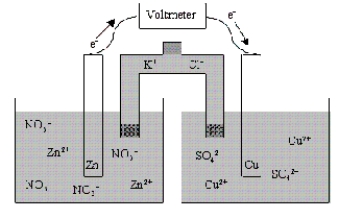
A)The Zn anode mass decreases as the cell discharges.
B)The Zn cathode mass increases as the cell discharges.
C)The Zn cathode mass decreases as the cell discharges.
D)The Zn anode mass increases as the cell discharges.
E)The mass of the Zn electrode neither increases nor decreases as the cell discharges.
Question
The electrochemical reaction which powers a lead-acid storage battery is as follows:
Pb(s)+ PbO2(s)+ 4H+(aq)+ 2SO42-(aq)→ 2PbSO4(s)+ 2H2O(l)
A single cell of this battery consists of a Pb electrode and a PbO2 electrode,each submerged in sulfuric acid.What reaction occurs at the cathode during discharge?

A)Pb(s)is reduced to PbSO4(s).
B)PbO2(s)is reduced to PbSO4(s).
C)PbO2(s)is oxidized to PbSO4(s).
D)Pb(s)is oxidized to PbSO4(s).
E)H+ is oxidized to H2O(l).
Question
According to the following cell notation,which species is undergoing oxidation?
Zn | Zn2+(aq)|| Mn2+(aq)| MnO2(s)| Pt(s)

A)Mn2+(aq)
B)Zn2+(aq)
C)MnO2(s)
D)Zn(s)
E)Pt(s)
Question
Balance the following half-reaction occurring in acidic solution.

NO3-(aq)→ <strong>Balance the following half-reaction occurring in acidic solution. ​ NO<sub>3</sub><sup>-</sup>(aq)→  </strong> A)NO<sub>3</sub><sup>-</sup>(aq)+ 10H+(aq)+ 8e− →   + 3H<sub>2</sub>O(l) B)NO<sub>3</sub><sup>-</sup>(aq)+ 3H<sub>2</sub>O(l)+ 10e− →   + 10H+(aq) C)NO<sub>3</sub><sup>-</sup>(aq)+ 10H+(aq)→   + 3H<sub>2</sub>O(l)+ 10e− D)NO<sub>3</sub><sup>-</sup>(aq)+ 8e− →   + 8H+(aq)+ 3H<sub>2</sub>O(l) E)NO<sub>3</sub><sup>-</sup>(aq)+ 10H+(aq)→   + 3H<sub>2</sub>O(l) <div style=padding-top: 35px>

A)NO3-(aq)+ 10H+(aq)+ 8e− → <strong>Balance the following half-reaction occurring in acidic solution. ​ NO<sub>3</sub><sup>-</sup>(aq)→  </strong> A)NO<sub>3</sub><sup>-</sup>(aq)+ 10H+(aq)+ 8e− →   + 3H<sub>2</sub>O(l) B)NO<sub>3</sub><sup>-</sup>(aq)+ 3H<sub>2</sub>O(l)+ 10e− →   + 10H+(aq) C)NO<sub>3</sub><sup>-</sup>(aq)+ 10H+(aq)→   + 3H<sub>2</sub>O(l)+ 10e− D)NO<sub>3</sub><sup>-</sup>(aq)+ 8e− →   + 8H+(aq)+ 3H<sub>2</sub>O(l) E)NO<sub>3</sub><sup>-</sup>(aq)+ 10H+(aq)→   + 3H<sub>2</sub>O(l) <div style=padding-top: 35px> + 3H2O(l)
B)NO3-(aq)+ 3H2O(l)+ 10e− → <strong>Balance the following half-reaction occurring in acidic solution. ​ NO<sub>3</sub><sup>-</sup>(aq)→  </strong> A)NO<sub>3</sub><sup>-</sup>(aq)+ 10H+(aq)+ 8e− →   + 3H<sub>2</sub>O(l) B)NO<sub>3</sub><sup>-</sup>(aq)+ 3H<sub>2</sub>O(l)+ 10e− →   + 10H+(aq) C)NO<sub>3</sub><sup>-</sup>(aq)+ 10H+(aq)→   + 3H<sub>2</sub>O(l)+ 10e− D)NO<sub>3</sub><sup>-</sup>(aq)+ 8e− →   + 8H+(aq)+ 3H<sub>2</sub>O(l) E)NO<sub>3</sub><sup>-</sup>(aq)+ 10H+(aq)→   + 3H<sub>2</sub>O(l) <div style=padding-top: 35px> + 10H+(aq)
C)NO3-(aq)+ 10H+(aq)→ <strong>Balance the following half-reaction occurring in acidic solution. ​ NO<sub>3</sub><sup>-</sup>(aq)→  </strong> A)NO<sub>3</sub><sup>-</sup>(aq)+ 10H+(aq)+ 8e− →   + 3H<sub>2</sub>O(l) B)NO<sub>3</sub><sup>-</sup>(aq)+ 3H<sub>2</sub>O(l)+ 10e− →   + 10H+(aq) C)NO<sub>3</sub><sup>-</sup>(aq)+ 10H+(aq)→   + 3H<sub>2</sub>O(l)+ 10e− D)NO<sub>3</sub><sup>-</sup>(aq)+ 8e− →   + 8H+(aq)+ 3H<sub>2</sub>O(l) E)NO<sub>3</sub><sup>-</sup>(aq)+ 10H+(aq)→   + 3H<sub>2</sub>O(l) <div style=padding-top: 35px> + 3H2O(l)+ 10e−
D)NO3-(aq)+ 8e− → <strong>Balance the following half-reaction occurring in acidic solution. ​ NO<sub>3</sub><sup>-</sup>(aq)→  </strong> A)NO<sub>3</sub><sup>-</sup>(aq)+ 10H+(aq)+ 8e− →   + 3H<sub>2</sub>O(l) B)NO<sub>3</sub><sup>-</sup>(aq)+ 3H<sub>2</sub>O(l)+ 10e− →   + 10H+(aq) C)NO<sub>3</sub><sup>-</sup>(aq)+ 10H+(aq)→   + 3H<sub>2</sub>O(l)+ 10e− D)NO<sub>3</sub><sup>-</sup>(aq)+ 8e− →   + 8H+(aq)+ 3H<sub>2</sub>O(l) E)NO<sub>3</sub><sup>-</sup>(aq)+ 10H+(aq)→   + 3H<sub>2</sub>O(l) <div style=padding-top: 35px> + 8H+(aq)+ 3H2O(l)
E)NO3-(aq)+ 10H+(aq)→ <strong>Balance the following half-reaction occurring in acidic solution. ​ NO<sub>3</sub><sup>-</sup>(aq)→  </strong> A)NO<sub>3</sub><sup>-</sup>(aq)+ 10H+(aq)+ 8e− →   + 3H<sub>2</sub>O(l) B)NO<sub>3</sub><sup>-</sup>(aq)+ 3H<sub>2</sub>O(l)+ 10e− →   + 10H+(aq) C)NO<sub>3</sub><sup>-</sup>(aq)+ 10H+(aq)→   + 3H<sub>2</sub>O(l)+ 10e− D)NO<sub>3</sub><sup>-</sup>(aq)+ 8e− →   + 8H+(aq)+ 3H<sub>2</sub>O(l) E)NO<sub>3</sub><sup>-</sup>(aq)+ 10H+(aq)→   + 3H<sub>2</sub>O(l) <div style=padding-top: 35px> + 3H2O(l)
Question
A lead storage battery involves the following two half-reactions:
PbSO4(s)+ 2e- → Pb(s)+ SO42-(aq); E° = -0.36 V
PbO2(s)+ 4H+(aq)+ SO42-(aq)+ 2e- → PbSO4(s)+ 2H2O(l); E° = 1.69 V
During the discharge reaction of the lead storage battery at 1.0 M concentrations,the cell potential and the reducing agent are,respectively,

A)2.05 V and PbO2.
B)-2.05 V and PbO2.
C)1.33 V and Pb.
D)-2.05 V and Pb.
E)2.05 V and Pb.
Question
Which of the following statements is true for a voltaic (galvanic)cell?

A)The electron flow is from the anode to the cathode.
B)The electron flow is from the positive electrode to the negative electrode.
C)The electron flow is from the negative cathode to the positive anode.
D)The electron flow is through the salt bridge.
E)The electron flow is from the oxidizing agent to the reducing agent through an external circuit.
Question
When the following oxidation-reduction reaction in acidic solution is balanced,what is the lowest whole-number coefficient for H+,and on which side of the balanced equation should it appear?
MnO4-(aq)+ I-(aq)→ Mn2+(aq)+ I2(s)

A)1,reactant side
B)2,product side
C)8,reactant side
D)16,reactant side
E)4,product side
Question
What is the cell reaction for the following electrochemical cell?
Cu | Cu2+(aq)|| Mn2+(aq)| Mn

A)2Cu(s)+ Mn2+(aq)→ Mn(s)+ 2Cu2+(aq)
B)Cu(s)+ Cu2+(aq)→ Mn(s)+ Mn2+(aq)
C)Cu(s)+ Mn2+(aq)→ Mn(s)+ Cu2+(aq)
D)2Mn(s)+ Cu2+(aq)→ Cu(s)+ 2Mn2+(aq)
E)Mn(s)+ Cu2+(aq)→ Cu(s)+ Mn2+(aq)
Question
For a galvanic cell using Fe | Fe2+(1.0 M)and Pb | Pb2+(1.0 M)half-cells,which of the following statements is correct?
Fe2+(aq)+ 2e- → Fe(s); E° = -0.41 V
Pb2+(aq)+ 2e- → Pb(s); E° = -0.13 V

A)The iron electrode is the cathode.
B)When the cell has completely discharged,the concentration of Pb2+ is zero.
C)The mass of the iron electrode increases during discharge.
D)The concentration of Pb2+ decreases during discharge.
E)Electrons leave the lead electrode to pass through the external circuit during discharge.
Question
In the following electrochemical cell,what is the role of the platinum?
Cu(s)| Cu2+(aq)|| Fe3+(aq),Fe2+(aq)| Pt(s)

A)The platinum serves as the anode.
B)The oxidation of Fe2+ takes place at the surface of the platinum as the cell discharges.
C)The reduction of Fe3+ takes place at the surface of the platinum as the cell discharges.
D)A and C.
E)A and B.
Question
What is the correct cell notation for a cell in which the hydrogen electrode is the anode and the cathode half-reaction is Ce4+(aq)+ e− → Ce3+(aq).

A)Pt(s)| H2(g)| H+(aq)|| Ce4+(aq),Ce3+(aq)| Pt(s)
B)Pt(s)| H2(g)| H+(aq)|| Ce4+(aq),Ce3+(aq)
C)Ce3+(aq),Ce4+(aq)|| H+(aq)| H2(g)| Pt(s)
D)Pt(s)| Ce3+(aq),Ce4+(aq)|| H+(aq)| H2(g)| Pt(s)
E)H2(g)| H+(aq)|| Ce3+(aq),Ce4+(aq)
Question
What is the SI unit of potential difference?

A)coulomb
B)farad
C)volt
D)joule
E)ampere
Question
Given:
Mn2+(aq)+ 2e- <strong>Given: Mn<sup>2+</sup>(aq)+ 2e<sup>-</sup>   Mn(s); E° = -1.18 V Cu<sup>2+</sup>(aq)+ 2e<sup>-</sup>   Cu(s); E° = 0.34 V Cr<sub>2</sub>O<sub>7</sub><sup>2-</sup>(aq)+ 14H<sup>+</sup>(aq)+ 6e<sup>-</sup>   2Cr<sup>3+</sup>(aq)+ 7H<sub>2</sub>O(l); E° = 1.33 V Which of the following species is the strongest reducing agent?</strong> A)Mn B)Cu C)Cr<sup>3+</sup> D)Mn<sup>2+</sup> E)Cr<sub>2</sub>O<sub>7</sub><sup>2-</sup> <div style=padding-top: 35px>
Mn(s); E° = -1.18 V
Cu2+(aq)+ 2e- <strong>Given: Mn<sup>2+</sup>(aq)+ 2e<sup>-</sup>   Mn(s); E° = -1.18 V Cu<sup>2+</sup>(aq)+ 2e<sup>-</sup>   Cu(s); E° = 0.34 V Cr<sub>2</sub>O<sub>7</sub><sup>2-</sup>(aq)+ 14H<sup>+</sup>(aq)+ 6e<sup>-</sup>   2Cr<sup>3+</sup>(aq)+ 7H<sub>2</sub>O(l); E° = 1.33 V Which of the following species is the strongest reducing agent?</strong> A)Mn B)Cu C)Cr<sup>3+</sup> D)Mn<sup>2+</sup> E)Cr<sub>2</sub>O<sub>7</sub><sup>2-</sup> <div style=padding-top: 35px>
Cu(s); E° = 0.34 V
Cr2O72-(aq)+ 14H+(aq)+ 6e- <strong>Given: Mn<sup>2+</sup>(aq)+ 2e<sup>-</sup>   Mn(s); E° = -1.18 V Cu<sup>2+</sup>(aq)+ 2e<sup>-</sup>   Cu(s); E° = 0.34 V Cr<sub>2</sub>O<sub>7</sub><sup>2-</sup>(aq)+ 14H<sup>+</sup>(aq)+ 6e<sup>-</sup>   2Cr<sup>3+</sup>(aq)+ 7H<sub>2</sub>O(l); E° = 1.33 V Which of the following species is the strongest reducing agent?</strong> A)Mn B)Cu C)Cr<sup>3+</sup> D)Mn<sup>2+</sup> E)Cr<sub>2</sub>O<sub>7</sub><sup>2-</sup> <div style=padding-top: 35px>
2Cr3+(aq)+ 7H2O(l); E° = 1.33 V
Which of the following species is the strongest reducing agent?

A)Mn
B)Cu
C)Cr3+
D)Mn2+
E)Cr2O72-
Question
The cell potential of an electrochemical cell with the cell reaction
Al(s)+ Cr3+(aq)→ Cr(s)+ Al3+(aq)
Is 1.63 V.What is the maximum electrical work obtainable from this cell when 0.50 g of Al is consumed?

A) <strong>The cell potential of an electrochemical cell with the cell reaction Al(s)+ Cr<sup>3+</sup>(aq)→ Cr(s)+ Al<sup>3+</sup>(aq) Is 1.63 V.What is the maximum electrical work obtainable from this cell when 0.50 g of Al is consumed?</strong> A)   J B)   J C)   J D)   J E)   J <div style=padding-top: 35px> J
B) <strong>The cell potential of an electrochemical cell with the cell reaction Al(s)+ Cr<sup>3+</sup>(aq)→ Cr(s)+ Al<sup>3+</sup>(aq) Is 1.63 V.What is the maximum electrical work obtainable from this cell when 0.50 g of Al is consumed?</strong> A)   J B)   J C)   J D)   J E)   J <div style=padding-top: 35px> J
C) <strong>The cell potential of an electrochemical cell with the cell reaction Al(s)+ Cr<sup>3+</sup>(aq)→ Cr(s)+ Al<sup>3+</sup>(aq) Is 1.63 V.What is the maximum electrical work obtainable from this cell when 0.50 g of Al is consumed?</strong> A)   J B)   J C)   J D)   J E)   J <div style=padding-top: 35px> J
D) <strong>The cell potential of an electrochemical cell with the cell reaction Al(s)+ Cr<sup>3+</sup>(aq)→ Cr(s)+ Al<sup>3+</sup>(aq) Is 1.63 V.What is the maximum electrical work obtainable from this cell when 0.50 g of Al is consumed?</strong> A)   J B)   J C)   J D)   J E)   J <div style=padding-top: 35px> J
E) <strong>The cell potential of an electrochemical cell with the cell reaction Al(s)+ Cr<sup>3+</sup>(aq)→ Cr(s)+ Al<sup>3+</sup>(aq) Is 1.63 V.What is the maximum electrical work obtainable from this cell when 0.50 g of Al is consumed?</strong> A)   J B)   J C)   J D)   J E)   J <div style=padding-top: 35px> J
Question
In the following electrochemical cell,what is the reduction half reaction?
Mn(s)| Mn2+(aq)|| Fe3+(aq),Fe2+(aq)| Pt(s)

A)Fe3+(aq)+ e− → Fe2+(aq)
B)Fe2+(aq)+ e− → Fe3+(aq)
C)Fe2+(aq)+ Pt(s)→ Fe3+(aq)+ e−
D)Mn2+(aq)→ Mn(s)+ 2e−
E)Mn(s)→ Mn2+(aq)+ 2e−
Question
A fuel cell designed to react grain alcohol with oxygen has the following net reaction:
C2H5OH(l)+ 3O2(g)→ 2CO2(g)+ 3H2O(l)
The maximum work that 1 mol of alcohol can yield by this process is 1320 kJ.What is the theoretical maximum voltage that this cell can achieve?

A)1.14 V
B)2.28 V
C)2.01 V
D)0.760 V
E)13.7 V
Question
What is the cell reaction for the following electrochemical cell?
Zn | Zn2+(aq)|| Sc3+(aq)| Sc

A)3Zn(s)+ 2Sc3+(aq)→ 2Sc(s)+ 3Zn2+(aq)
B)2Sc(s)+ 3Zn2+(aq)→ 3Zn(s)+ 2Sc3+(aq)
C)Zn(s)+ Zn2+(aq)→ Sc(s)+ Sc3+(aq)
D)Zn(s)+ Sc3+(aq)→ Sc(s)+ Zn2+(aq)
E)Sc(s)+ Zn2+(aq)→ Zn(s)+ Sc3+(aq)
Question
The cell potential of an electrochemical cell with the cell reaction
2Al(s)+ 3Zn2+(aq)→ 3Zn(s)+ 2Al3+(aq)
Is 1.607 V.What is the maximum electrical work obtainable from this cell when 2.0 mol of Al is consumed?

A) <strong>The cell potential of an electrochemical cell with the cell reaction 2Al(s)+ 3Zn<sup>2+</sup>(aq)→ 3Zn(s)+ 2Al<sup>3+</sup>(aq) Is 1.607 V.What is the maximum electrical work obtainable from this cell when 2.0 mol of Al is consumed?</strong> A)   J B)   J C)   J D)   J E)   J <div style=padding-top: 35px> J
B) <strong>The cell potential of an electrochemical cell with the cell reaction 2Al(s)+ 3Zn<sup>2+</sup>(aq)→ 3Zn(s)+ 2Al<sup>3+</sup>(aq) Is 1.607 V.What is the maximum electrical work obtainable from this cell when 2.0 mol of Al is consumed?</strong> A)   J B)   J C)   J D)   J E)   J <div style=padding-top: 35px> J
C) <strong>The cell potential of an electrochemical cell with the cell reaction 2Al(s)+ 3Zn<sup>2+</sup>(aq)→ 3Zn(s)+ 2Al<sup>3+</sup>(aq) Is 1.607 V.What is the maximum electrical work obtainable from this cell when 2.0 mol of Al is consumed?</strong> A)   J B)   J C)   J D)   J E)   J <div style=padding-top: 35px> J
D) <strong>The cell potential of an electrochemical cell with the cell reaction 2Al(s)+ 3Zn<sup>2+</sup>(aq)→ 3Zn(s)+ 2Al<sup>3+</sup>(aq) Is 1.607 V.What is the maximum electrical work obtainable from this cell when 2.0 mol of Al is consumed?</strong> A)   J B)   J C)   J D)   J E)   J <div style=padding-top: 35px> J
E) <strong>The cell potential of an electrochemical cell with the cell reaction 2Al(s)+ 3Zn<sup>2+</sup>(aq)→ 3Zn(s)+ 2Al<sup>3+</sup>(aq) Is 1.607 V.What is the maximum electrical work obtainable from this cell when 2.0 mol of Al is consumed?</strong> A)   J B)   J C)   J D)   J E)   J <div style=padding-top: 35px> J
Question
What is the balanced spontaneous reaction and standard cell potential of an electrochemical cell constructed from half cells with the following half reactions?
Cu2+(aq​)+ 2e¯ → Cu(s)E° = 0.337 V <strong>What is the balanced spontaneous reaction and standard cell potential of an electrochemical cell constructed from half cells with the following half reactions? Cu<sup>2+</sup>(aq​)+ 2e¯ <sup> </sup>→ Cu(s)E° = 0.337 V   E° = -0.130 V</strong> A)Cu<sup>2+</sup>(aq)+ Pb(s)→ Cu(s)+ Pb<sup>2+</sup>(aq); 0.467 V B)Cu(s)+ Pb<sup>2+</sup>(aq)→ Cu<sup>2+</sup>(aq)+ Pb(s); −0.467 V C)Cu<sup>2+</sup>(aq)+ Pb<sup>2+</sup>(aq)→ Cu(s)+ Pb(s); 0.207 V D)Cu<sup>2+</sup>(aq)+ Pb(s)→ Cu(s)+ Pb<sup>2+</sup>(aq); 0.234 V E)Cu(s)+ Pb<sup>2+</sup>(aq)→ Cu<sup>2+</sup>(aq)+ Pb(s); −0.234 V <div style=padding-top: 35px>
E° = -0.130 V

A)Cu2+(aq)+ Pb(s)→ Cu(s)+ Pb2+(aq); 0.467 V
B)Cu(s)+ Pb2+(aq)→ Cu2+(aq)+ Pb(s); −0.467 V
C)Cu2+(aq)+ Pb2+(aq)→ Cu(s)+ Pb(s); 0.207 V
D)Cu2+(aq)+ Pb(s)→ Cu(s)+ Pb2+(aq); 0.234 V
E)Cu(s)+ Pb2+(aq)→ Cu2+(aq)+ Pb(s); −0.234 V
Question
Given:
Zn2+(aq)+ 2e- <strong>Given: Zn<sup>2+</sup>(aq)+ 2e<sup>-</sup>  Zn(s); E° = -0.76 V Cu<sup>2+</sup>(aq)+ 2e<sup>-</sup>  Cu(s); E° = 0.34 V Cr<sub>2</sub>O<sub>7</sub><sup>2-</sup>(aq)+ 14H<sup>+</sup>(aq)+ 6e<sup>-</sup>  2Cr<sup>3+</sup>(aq)+ 7H<sub>2</sub>O(l); E° = 1.33 V Which of the following species is the strongest oxidizing agent?</strong> A)Zn B)Cr<sup>3+</sup> C)Cr<sub>2</sub>O<sub>7</sub><sup>2-</sup> D)Zn<sup>2+</sup> E)Cu <div style=padding-top: 35px> Zn(s); E° = -0.76 V
Cu2+(aq)+ 2e- <strong>Given: Zn<sup>2+</sup>(aq)+ 2e<sup>-</sup>  Zn(s); E° = -0.76 V Cu<sup>2+</sup>(aq)+ 2e<sup>-</sup>  Cu(s); E° = 0.34 V Cr<sub>2</sub>O<sub>7</sub><sup>2-</sup>(aq)+ 14H<sup>+</sup>(aq)+ 6e<sup>-</sup>  2Cr<sup>3+</sup>(aq)+ 7H<sub>2</sub>O(l); E° = 1.33 V Which of the following species is the strongest oxidizing agent?</strong> A)Zn B)Cr<sup>3+</sup> C)Cr<sub>2</sub>O<sub>7</sub><sup>2-</sup> D)Zn<sup>2+</sup> E)Cu <div style=padding-top: 35px> Cu(s); E° = 0.34 V
Cr2O72-(aq)+ 14H+(aq)+ 6e- <strong>Given: Zn<sup>2+</sup>(aq)+ 2e<sup>-</sup>  Zn(s); E° = -0.76 V Cu<sup>2+</sup>(aq)+ 2e<sup>-</sup>  Cu(s); E° = 0.34 V Cr<sub>2</sub>O<sub>7</sub><sup>2-</sup>(aq)+ 14H<sup>+</sup>(aq)+ 6e<sup>-</sup>  2Cr<sup>3+</sup>(aq)+ 7H<sub>2</sub>O(l); E° = 1.33 V Which of the following species is the strongest oxidizing agent?</strong> A)Zn B)Cr<sup>3+</sup> C)Cr<sub>2</sub>O<sub>7</sub><sup>2-</sup> D)Zn<sup>2+</sup> E)Cu <div style=padding-top: 35px> 2Cr3+(aq)+ 7H2O(l); E° = 1.33 V
Which of the following species is the strongest oxidizing agent?

A)Zn
B)Cr3+
C)Cr2O72-
D)Zn2+
E)Cu
Question
What is the cell notation for the voltaic cell shown below? <strong>What is the cell notation for the voltaic cell shown below?  </strong> A)Zn<sup>2+</sup>(aq)| Zn(s)|| Cu<sup>2+</sup>(aq)| Cu(s) B)Zn(s)| Zn<sup>2+</sup>(aq)|| Cu(s)| Cu<sup>2+</sup>(aq) C)Zn(s)| Cu(s)|| Zn<sup>2+</sup>(aq)| Cu<sup>2+</sup>(aq) D)Zn(s)| Zn<sup>2+</sup>(aq)|| Cu<sup>2+</sup>(aq)| Cu(s) E)Zn<sup>2+</sup>(aq)| Zn(s)|| Cu(s)| Cu<sup>2+</sup>(aq) <div style=padding-top: 35px>

A)Zn2+(aq)| Zn(s)|| Cu2+(aq)| Cu(s)
B)Zn(s)| Zn2+(aq)|| Cu(s)| Cu2+(aq)
C)Zn(s)| Cu(s)|| Zn2+(aq)| Cu2+(aq)
D)Zn(s)| Zn2+(aq)|| Cu2+(aq)| Cu(s)
E)Zn2+(aq)| Zn(s)|| Cu(s)| Cu2+(aq)
Question
Consider the following standard electrode potentials:
Ag+(aq)+ e- <strong>Consider the following standard electrode potentials: Ag<sup>+</sup>(aq)+ e<sup>-</sup>  Ag(s); E° = 0.80 V Mn<sup>2+</sup>(aq)+ 2e<sup>-</sup>  Mn(s); E° = -1.18 V Which of the following statements is false concerning the electrochemical cell given below? Mn(s)| Mn<sup>2+</sup>(aq)|| Ag<sup>+</sup>(aq)| Ag(s)</strong> A)The anode half-cell reaction is Mn(s)→ Mn<sup>2+</sup>(aq)+ 2e<sup>-</sup>. B)The reducing agent is Ag(s). C)Under standard-state conditions,the cell potential is 1.98 V. D)The cell potential decreases with time. E)The oxidizing agent is Ag<sup>+</sup>(aq). <div style=padding-top: 35px> Ag(s); E° = 0.80 V
Mn2+(aq)+ 2e- <strong>Consider the following standard electrode potentials: Ag<sup>+</sup>(aq)+ e<sup>-</sup>  Ag(s); E° = 0.80 V Mn<sup>2+</sup>(aq)+ 2e<sup>-</sup>  Mn(s); E° = -1.18 V Which of the following statements is false concerning the electrochemical cell given below? Mn(s)| Mn<sup>2+</sup>(aq)|| Ag<sup>+</sup>(aq)| Ag(s)</strong> A)The anode half-cell reaction is Mn(s)→ Mn<sup>2+</sup>(aq)+ 2e<sup>-</sup>. B)The reducing agent is Ag(s). C)Under standard-state conditions,the cell potential is 1.98 V. D)The cell potential decreases with time. E)The oxidizing agent is Ag<sup>+</sup>(aq). <div style=padding-top: 35px> Mn(s); E° = -1.18 V
Which of the following statements is false concerning the electrochemical cell given below?
Mn(s)| Mn2+(aq)|| Ag+(aq)| Ag(s)

A)The anode half-cell reaction is Mn(s)→ Mn2+(aq)+ 2e-.
B)The reducing agent is Ag(s).
C)Under standard-state conditions,the cell potential is 1.98 V.
D)The cell potential decreases with time.
E)The oxidizing agent is Ag+(aq).
Question
What is the cell reaction for the following electrochemical cell?
Pt | Fe2+(aq),Fe3+(aq)|| Cr3+(aq)| Cr

A)3Fe2+(aq)+ Cr3+(s)→ Cr(s)+ 3Fe3+(aq)
B)3Fe2+(aq)+ 3Fe3+(aq)→ Cr(s)+ Cr3+(aq)
C)Cr(s)+ 3Fe3+(aq)→ Cr3+(aq)+ 3Fe2+(aq)
D)Pt(s)+ Fe2+(aq)+ Cr3+(aq)→ Cr(s)+ Pt2+(aq)+ Fe3+(aq)
E)Cr(s)+ Cr3+(aq)→ 3Fe2+(aq)+ 3Fe3+(aq)
Question
What is the cell reaction for the following voltaic cell?
Cr(s)| Cr3+(aq)|| Br-(aq)| Br2(g)| Pt(s)

A)2Cr(s)+ 3Br2(g) <strong>What is the cell reaction for the following voltaic cell? Cr(s)| Cr<sup>3+</sup>(aq)|| Br<sup>-</sup>(aq)| Br<sub>2</sub>(g)| Pt(s)</strong> A)2Cr(s)+ 3Br<sub>2</sub>(g)   2Cr<sup>3+</sup>(aq)+ 6Br<sup>-</sup>(aq) B)Cr(s)+ Cr<sup>3+</sup>(aq)   Br<sup>-</sup>(aq)+ Br<sub>2</sub>(g) C)2Cr<sup>3+</sup>(aq)+ 6Br<sup>-</sup>(aq)   2Cr(s)+ 3Br<sub>2</sub>(g) D)Cr(s)+ 3Br<sub>2</sub>(g)   Cr<sup>3+</sup>(s)+ 2Br<sup>-</sup>(aq) E)Cr(s)+ 2Br<sup>-</sup>(aq)   Br<sub>2</sub>(g)+ Cr<sup>3+</sup>(aq) <div style=padding-top: 35px> 2Cr3+(aq)+ 6Br-(aq)
B)Cr(s)+ Cr3+(aq) <strong>What is the cell reaction for the following voltaic cell? Cr(s)| Cr<sup>3+</sup>(aq)|| Br<sup>-</sup>(aq)| Br<sub>2</sub>(g)| Pt(s)</strong> A)2Cr(s)+ 3Br<sub>2</sub>(g)   2Cr<sup>3+</sup>(aq)+ 6Br<sup>-</sup>(aq) B)Cr(s)+ Cr<sup>3+</sup>(aq)   Br<sup>-</sup>(aq)+ Br<sub>2</sub>(g) C)2Cr<sup>3+</sup>(aq)+ 6Br<sup>-</sup>(aq)   2Cr(s)+ 3Br<sub>2</sub>(g) D)Cr(s)+ 3Br<sub>2</sub>(g)   Cr<sup>3+</sup>(s)+ 2Br<sup>-</sup>(aq) E)Cr(s)+ 2Br<sup>-</sup>(aq)   Br<sub>2</sub>(g)+ Cr<sup>3+</sup>(aq) <div style=padding-top: 35px> Br-(aq)+ Br2(g)
C)2Cr3+(aq)+ 6Br-(aq) <strong>What is the cell reaction for the following voltaic cell? Cr(s)| Cr<sup>3+</sup>(aq)|| Br<sup>-</sup>(aq)| Br<sub>2</sub>(g)| Pt(s)</strong> A)2Cr(s)+ 3Br<sub>2</sub>(g)   2Cr<sup>3+</sup>(aq)+ 6Br<sup>-</sup>(aq) B)Cr(s)+ Cr<sup>3+</sup>(aq)   Br<sup>-</sup>(aq)+ Br<sub>2</sub>(g) C)2Cr<sup>3+</sup>(aq)+ 6Br<sup>-</sup>(aq)   2Cr(s)+ 3Br<sub>2</sub>(g) D)Cr(s)+ 3Br<sub>2</sub>(g)   Cr<sup>3+</sup>(s)+ 2Br<sup>-</sup>(aq) E)Cr(s)+ 2Br<sup>-</sup>(aq)   Br<sub>2</sub>(g)+ Cr<sup>3+</sup>(aq) <div style=padding-top: 35px> 2Cr(s)+ 3Br2(g)
D)Cr(s)+ 3Br2(g) <strong>What is the cell reaction for the following voltaic cell? Cr(s)| Cr<sup>3+</sup>(aq)|| Br<sup>-</sup>(aq)| Br<sub>2</sub>(g)| Pt(s)</strong> A)2Cr(s)+ 3Br<sub>2</sub>(g)   2Cr<sup>3+</sup>(aq)+ 6Br<sup>-</sup>(aq) B)Cr(s)+ Cr<sup>3+</sup>(aq)   Br<sup>-</sup>(aq)+ Br<sub>2</sub>(g) C)2Cr<sup>3+</sup>(aq)+ 6Br<sup>-</sup>(aq)   2Cr(s)+ 3Br<sub>2</sub>(g) D)Cr(s)+ 3Br<sub>2</sub>(g)   Cr<sup>3+</sup>(s)+ 2Br<sup>-</sup>(aq) E)Cr(s)+ 2Br<sup>-</sup>(aq)   Br<sub>2</sub>(g)+ Cr<sup>3+</sup>(aq) <div style=padding-top: 35px> Cr3+(s)+ 2Br-(aq)
E)Cr(s)+ 2Br-(aq) <strong>What is the cell reaction for the following voltaic cell? Cr(s)| Cr<sup>3+</sup>(aq)|| Br<sup>-</sup>(aq)| Br<sub>2</sub>(g)| Pt(s)</strong> A)2Cr(s)+ 3Br<sub>2</sub>(g)   2Cr<sup>3+</sup>(aq)+ 6Br<sup>-</sup>(aq) B)Cr(s)+ Cr<sup>3+</sup>(aq)   Br<sup>-</sup>(aq)+ Br<sub>2</sub>(g) C)2Cr<sup>3+</sup>(aq)+ 6Br<sup>-</sup>(aq)   2Cr(s)+ 3Br<sub>2</sub>(g) D)Cr(s)+ 3Br<sub>2</sub>(g)   Cr<sup>3+</sup>(s)+ 2Br<sup>-</sup>(aq) E)Cr(s)+ 2Br<sup>-</sup>(aq)   Br<sub>2</sub>(g)+ Cr<sup>3+</sup>(aq) <div style=padding-top: 35px> Br2(g)+ Cr3+(aq)
Question
A zinc-copper voltaic cell is represented as follows:
Zn(s)| Zn2+(1.0 M)|| Cu2+(1.0 M)| Cu(s)
Which of the following statements is false?

A)The copper electrode is the anode.
B)Reduction occurs at the copper electrode during discharge.
C)The mass of the zinc electrode decreases during discharge.
D)Electrons flow through the external circuit from the zinc electrode to the copper electrode.
E)The concentration of Cu2+ decreases during discharge.
Question
In a table of standard reduction potentials,the strongest reducing agents are the _______ species in the half-reactions with the _______ E° values.

A)reduced,most negative
B)oxidized,most positive
C)reduced,most positive
D)oxidized,most negative
E)none of these
Question
The Faraday constant is defined as

A)The charge per mole of electrons.
B)The charge on a single electron.
C)The maximum work obtainable from an electrochemical cell.
D)The electromotive force of the cell.
E)The amount of charge moved between electrodes.
Question
Given:
Ni2+(aq)+ 2e- <strong>Given: Ni<sup>2+</sup>(aq)+ 2e<sup>-</sup>  Ni(s); E° = -0.23 V 2H<sup>+</sup>(aq)+ 2e<sup>-</sup>  H<sub>2</sub>(g); E° = 0.00 VAg<sup>+</sup>(aq)+ e<sup>-</sup>  Ag(s); E° = 0.80 V NO<sub>3</sub><sup>-</sup>(aq)+ 4H<sup>+</sup>(aq)+ 3e<sup>-</sup>  NO(g)+ 2H<sub>2</sub>O(l); E° = 0.96 V Which of the following statements is true?</strong> A)Ni<sup>2+</sup> reacts spontaneously with 1 M H<sup>+</sup>(aq)to form H<sub>2</sub>. B)Ni<sup>2+</sup> reacts spontaneously with H<sub>2</sub>(g). C)Ag(s)reacts spontaneously with Ni<sup>2+</sup>. D)Ag(s)reacts spontaneously with 1 M NO<sub>3</sub><sup>-</sup> in 1 M H<sup>+</sup>(aq). E)Ag(s)reacts spontaneously with 1 M H<sup>+</sup>(aq). <div style=padding-top: 35px> Ni(s); E° = -0.23 V
2H+(aq)+ 2e- <strong>Given: Ni<sup>2+</sup>(aq)+ 2e<sup>-</sup>  Ni(s); E° = -0.23 V 2H<sup>+</sup>(aq)+ 2e<sup>-</sup>  H<sub>2</sub>(g); E° = 0.00 VAg<sup>+</sup>(aq)+ e<sup>-</sup>  Ag(s); E° = 0.80 V NO<sub>3</sub><sup>-</sup>(aq)+ 4H<sup>+</sup>(aq)+ 3e<sup>-</sup>  NO(g)+ 2H<sub>2</sub>O(l); E° = 0.96 V Which of the following statements is true?</strong> A)Ni<sup>2+</sup> reacts spontaneously with 1 M H<sup>+</sup>(aq)to form H<sub>2</sub>. B)Ni<sup>2+</sup> reacts spontaneously with H<sub>2</sub>(g). C)Ag(s)reacts spontaneously with Ni<sup>2+</sup>. D)Ag(s)reacts spontaneously with 1 M NO<sub>3</sub><sup>-</sup> in 1 M H<sup>+</sup>(aq). E)Ag(s)reacts spontaneously with 1 M H<sup>+</sup>(aq). <div style=padding-top: 35px> H2(g); E° = 0.00 VAg+(aq)+ e- <strong>Given: Ni<sup>2+</sup>(aq)+ 2e<sup>-</sup>  Ni(s); E° = -0.23 V 2H<sup>+</sup>(aq)+ 2e<sup>-</sup>  H<sub>2</sub>(g); E° = 0.00 VAg<sup>+</sup>(aq)+ e<sup>-</sup>  Ag(s); E° = 0.80 V NO<sub>3</sub><sup>-</sup>(aq)+ 4H<sup>+</sup>(aq)+ 3e<sup>-</sup>  NO(g)+ 2H<sub>2</sub>O(l); E° = 0.96 V Which of the following statements is true?</strong> A)Ni<sup>2+</sup> reacts spontaneously with 1 M H<sup>+</sup>(aq)to form H<sub>2</sub>. B)Ni<sup>2+</sup> reacts spontaneously with H<sub>2</sub>(g). C)Ag(s)reacts spontaneously with Ni<sup>2+</sup>. D)Ag(s)reacts spontaneously with 1 M NO<sub>3</sub><sup>-</sup> in 1 M H<sup>+</sup>(aq). E)Ag(s)reacts spontaneously with 1 M H<sup>+</sup>(aq). <div style=padding-top: 35px> Ag(s); E° = 0.80 V
NO3-(aq)+ 4H+(aq)+ 3e- <strong>Given: Ni<sup>2+</sup>(aq)+ 2e<sup>-</sup>  Ni(s); E° = -0.23 V 2H<sup>+</sup>(aq)+ 2e<sup>-</sup>  H<sub>2</sub>(g); E° = 0.00 VAg<sup>+</sup>(aq)+ e<sup>-</sup>  Ag(s); E° = 0.80 V NO<sub>3</sub><sup>-</sup>(aq)+ 4H<sup>+</sup>(aq)+ 3e<sup>-</sup>  NO(g)+ 2H<sub>2</sub>O(l); E° = 0.96 V Which of the following statements is true?</strong> A)Ni<sup>2+</sup> reacts spontaneously with 1 M H<sup>+</sup>(aq)to form H<sub>2</sub>. B)Ni<sup>2+</sup> reacts spontaneously with H<sub>2</sub>(g). C)Ag(s)reacts spontaneously with Ni<sup>2+</sup>. D)Ag(s)reacts spontaneously with 1 M NO<sub>3</sub><sup>-</sup> in 1 M H<sup>+</sup>(aq). E)Ag(s)reacts spontaneously with 1 M H<sup>+</sup>(aq). <div style=padding-top: 35px> NO(g)+ 2H2O(l); E° = 0.96 V
Which of the following statements is true?

A)Ni2+ reacts spontaneously with 1 M H+(aq)to form H2.
B)Ni2+ reacts spontaneously with H2(g).
C)Ag(s)reacts spontaneously with Ni2+.
D)Ag(s)reacts spontaneously with 1 M NO3- in 1 M H+(aq).
E)Ag(s)reacts spontaneously with 1 M H+(aq).
Question
Consider the following standard reduction potentials:
2H+(aq)+ 2e- <strong>Consider the following standard reduction potentials: 2H<sup>+</sup>(aq)+ 2e<sup>-</sup>  H<sub>2</sub>(g); E° = 0.00 V Sn<sup>2+</sup>(aq)+ 2e<sup>-</sup>  Sn(s); E° = -0.15 V Cd<sup>2+</sup>(aq)+ 2e<sup>-</sup>  Cd(s); E° = -0.40 V Which pair of substances will react spontaneously under standard-state conditions?</strong> A)Cd with H<sup>+</sup> B)Cd with Sn C)Sn<sup>2+</sup> with Cd<sup>2+</sup> D)Sn with Cd<sup>2+</sup> E)Sn<sup>2+</sup> with H<sup>+</sup> <div style=padding-top: 35px> H2(g); E° = 0.00 V
Sn2+(aq)+ 2e- <strong>Consider the following standard reduction potentials: 2H<sup>+</sup>(aq)+ 2e<sup>-</sup>  H<sub>2</sub>(g); E° = 0.00 V Sn<sup>2+</sup>(aq)+ 2e<sup>-</sup>  Sn(s); E° = -0.15 V Cd<sup>2+</sup>(aq)+ 2e<sup>-</sup>  Cd(s); E° = -0.40 V Which pair of substances will react spontaneously under standard-state conditions?</strong> A)Cd with H<sup>+</sup> B)Cd with Sn C)Sn<sup>2+</sup> with Cd<sup>2+</sup> D)Sn with Cd<sup>2+</sup> E)Sn<sup>2+</sup> with H<sup>+</sup> <div style=padding-top: 35px> Sn(s); E° = -0.15 V
Cd2+(aq)+ 2e- <strong>Consider the following standard reduction potentials: 2H<sup>+</sup>(aq)+ 2e<sup>-</sup>  H<sub>2</sub>(g); E° = 0.00 V Sn<sup>2+</sup>(aq)+ 2e<sup>-</sup>  Sn(s); E° = -0.15 V Cd<sup>2+</sup>(aq)+ 2e<sup>-</sup>  Cd(s); E° = -0.40 V Which pair of substances will react spontaneously under standard-state conditions?</strong> A)Cd with H<sup>+</sup> B)Cd with Sn C)Sn<sup>2+</sup> with Cd<sup>2+</sup> D)Sn with Cd<sup>2+</sup> E)Sn<sup>2+</sup> with H<sup>+</sup> <div style=padding-top: 35px> Cd(s); E° = -0.40 V
Which pair of substances will react spontaneously under standard-state conditions?

A)Cd with H+
B)Cd with Sn
C)Sn2+ with Cd2+
D)Sn with Cd2+
E)Sn2+ with H+
Question
For a certain oxidation-reduction reaction,E°cell is negative.This means that

A)ΔG° is positive and K is less than 1.
B)ΔG° is negative and K is greater than 1.
C)ΔG° is positive and K is greater than 1.
D)ΔG° is negative and K is less than 1.
E)ΔG° is zero and K is greater than 1.
Question
Given:
Pb2+(aq)+ 2e- <strong>Given: Pb<sup>2+</sup>(aq)+ 2e<sup>-</sup>  Pb(s); E° = -0.13 V Mg<sup>2+</sup>(aq)+ 2e<sup>-</sup>  Mg(s); E° = -2.38 V Ag<sup>+</sup>(aq)+ e<sup>-</sup>  Ag(s); E° = 0.80 V 2H<sup>+</sup>(aq)+ 2e<sup>-</sup>  H<sub>2</sub>(g); E° = 0.00 V Under standard-state conditions,which of the following species is the best reducing agent?</strong> A)H<sub>2</sub> B)Mg<sup>2+</sup> C)Ag<sup>+</sup> D)Pb E)Ag <div style=padding-top: 35px> Pb(s); E° = -0.13 V
Mg2+(aq)+ 2e- <strong>Given: Pb<sup>2+</sup>(aq)+ 2e<sup>-</sup>  Pb(s); E° = -0.13 V Mg<sup>2+</sup>(aq)+ 2e<sup>-</sup>  Mg(s); E° = -2.38 V Ag<sup>+</sup>(aq)+ e<sup>-</sup>  Ag(s); E° = 0.80 V 2H<sup>+</sup>(aq)+ 2e<sup>-</sup>  H<sub>2</sub>(g); E° = 0.00 V Under standard-state conditions,which of the following species is the best reducing agent?</strong> A)H<sub>2</sub> B)Mg<sup>2+</sup> C)Ag<sup>+</sup> D)Pb E)Ag <div style=padding-top: 35px> Mg(s); E° = -2.38 V
Ag+(aq)+ e- <strong>Given: Pb<sup>2+</sup>(aq)+ 2e<sup>-</sup>  Pb(s); E° = -0.13 V Mg<sup>2+</sup>(aq)+ 2e<sup>-</sup>  Mg(s); E° = -2.38 V Ag<sup>+</sup>(aq)+ e<sup>-</sup>  Ag(s); E° = 0.80 V 2H<sup>+</sup>(aq)+ 2e<sup>-</sup>  H<sub>2</sub>(g); E° = 0.00 V Under standard-state conditions,which of the following species is the best reducing agent?</strong> A)H<sub>2</sub> B)Mg<sup>2+</sup> C)Ag<sup>+</sup> D)Pb E)Ag <div style=padding-top: 35px> Ag(s); E° = 0.80 V
2H+(aq)+ 2e- <strong>Given: Pb<sup>2+</sup>(aq)+ 2e<sup>-</sup>  Pb(s); E° = -0.13 V Mg<sup>2+</sup>(aq)+ 2e<sup>-</sup>  Mg(s); E° = -2.38 V Ag<sup>+</sup>(aq)+ e<sup>-</sup>  Ag(s); E° = 0.80 V 2H<sup>+</sup>(aq)+ 2e<sup>-</sup>  H<sub>2</sub>(g); E° = 0.00 V Under standard-state conditions,which of the following species is the best reducing agent?</strong> A)H<sub>2</sub> B)Mg<sup>2+</sup> C)Ag<sup>+</sup> D)Pb E)Ag <div style=padding-top: 35px> H2(g); E° = 0.00 V
Under standard-state conditions,which of the following species is the best reducing agent?

A)H2
B)Mg2+
C)Ag+
D)Pb
E)Ag
Question
Given:
Hg2+(aq)+ 2e- <strong>Given: Hg<sup>2+</sup>(aq)+ 2e<sup>-</sup>  Hg(s); E° = 0.85 V Li<sup>+</sup>(aq)+ e<sup>-</sup>  Li(s); E° = -3.04 V Br<sub>2</sub>(l)+ 2e<sup>-</sup>  2Br<sup>-</sup>(aq); E° = 1.07 V Au<sup>+</sup>(aq)+ e<sup>-</sup>  Au(s); E° = 1.69 V Cl<sub>2</sub>(g)+ 2e<sup>-</sup>  2Cl<sup>-</sup>(aq); E° = 1.36 V Which of the following species is the best reducing agent?</strong> A)Hg B)Li<sup>+</sup> C)Au D)Cl<sup>-</sup> E)Br<sup>-</sup> <div style=padding-top: 35px> Hg(s); E° = 0.85 V
Li+(aq)+ e- <strong>Given: Hg<sup>2+</sup>(aq)+ 2e<sup>-</sup>  Hg(s); E° = 0.85 V Li<sup>+</sup>(aq)+ e<sup>-</sup>  Li(s); E° = -3.04 V Br<sub>2</sub>(l)+ 2e<sup>-</sup>  2Br<sup>-</sup>(aq); E° = 1.07 V Au<sup>+</sup>(aq)+ e<sup>-</sup>  Au(s); E° = 1.69 V Cl<sub>2</sub>(g)+ 2e<sup>-</sup>  2Cl<sup>-</sup>(aq); E° = 1.36 V Which of the following species is the best reducing agent?</strong> A)Hg B)Li<sup>+</sup> C)Au D)Cl<sup>-</sup> E)Br<sup>-</sup> <div style=padding-top: 35px> Li(s); E° = -3.04 V
Br2(l)+ 2e- <strong>Given: Hg<sup>2+</sup>(aq)+ 2e<sup>-</sup>  Hg(s); E° = 0.85 V Li<sup>+</sup>(aq)+ e<sup>-</sup>  Li(s); E° = -3.04 V Br<sub>2</sub>(l)+ 2e<sup>-</sup>  2Br<sup>-</sup>(aq); E° = 1.07 V Au<sup>+</sup>(aq)+ e<sup>-</sup>  Au(s); E° = 1.69 V Cl<sub>2</sub>(g)+ 2e<sup>-</sup>  2Cl<sup>-</sup>(aq); E° = 1.36 V Which of the following species is the best reducing agent?</strong> A)Hg B)Li<sup>+</sup> C)Au D)Cl<sup>-</sup> E)Br<sup>-</sup> <div style=padding-top: 35px> 2Br-(aq); E° = 1.07 V
Au+(aq)+ e- <strong>Given: Hg<sup>2+</sup>(aq)+ 2e<sup>-</sup>  Hg(s); E° = 0.85 V Li<sup>+</sup>(aq)+ e<sup>-</sup>  Li(s); E° = -3.04 V Br<sub>2</sub>(l)+ 2e<sup>-</sup>  2Br<sup>-</sup>(aq); E° = 1.07 V Au<sup>+</sup>(aq)+ e<sup>-</sup>  Au(s); E° = 1.69 V Cl<sub>2</sub>(g)+ 2e<sup>-</sup>  2Cl<sup>-</sup>(aq); E° = 1.36 V Which of the following species is the best reducing agent?</strong> A)Hg B)Li<sup>+</sup> C)Au D)Cl<sup>-</sup> E)Br<sup>-</sup> <div style=padding-top: 35px> Au(s); E° = 1.69 V
Cl2(g)+ 2e- <strong>Given: Hg<sup>2+</sup>(aq)+ 2e<sup>-</sup>  Hg(s); E° = 0.85 V Li<sup>+</sup>(aq)+ e<sup>-</sup>  Li(s); E° = -3.04 V Br<sub>2</sub>(l)+ 2e<sup>-</sup>  2Br<sup>-</sup>(aq); E° = 1.07 V Au<sup>+</sup>(aq)+ e<sup>-</sup>  Au(s); E° = 1.69 V Cl<sub>2</sub>(g)+ 2e<sup>-</sup>  2Cl<sup>-</sup>(aq); E° = 1.36 V Which of the following species is the best reducing agent?</strong> A)Hg B)Li<sup>+</sup> C)Au D)Cl<sup>-</sup> E)Br<sup>-</sup> <div style=padding-top: 35px> 2Cl-(aq); E° = 1.36 V
Which of the following species is the best reducing agent?

A)Hg
B)Li+
C)Au
D)Cl-
E)Br-
Question
Consider the following standard reduction potentials:
Mg2+(aq)+ 2e- <strong>Consider the following standard reduction potentials: Mg<sup>2+</sup>(aq)+ 2e<sup>-</sup>   Mg(s); E° = -2.38 V V<sup>2+</sup>(aq)+ 2e<sup>-</sup>   V(s); E° = -1.18 V Cu<sup>2+</sup>(aq)+ e<sup>-</sup>   Cu<sup>+</sup>(aq); E° = 0.15 V Which of the following reactions will proceed spontaneously from left to right under standard-state conditions?</strong> A)Mg(s)+ 2Cu<sup>2+</sup>(aq)→ Mg<sup>2+</sup>(aq)+ 2Cu<sup>+</sup>(aq) B)V<sup>2+</sup>(aq)+ 2Cu<sup>+</sup>(aq)→ V(s)+ 2Cu<sup>2+</sup>(aq) C)Mg<sup>2+</sup>(aq)+ 2Cu<sup>+</sup>(aq)→ 2Cu<sup>2+</sup>(aq)+ Mg(s) D)Mg<sup>2+</sup>(aq)+ V(s)→ V<sup>2+</sup>(aq)+ Mg(s) E)2Cu<sup>2+</sup>(aq)+ 2Cu<sup>+</sup>(aq)→ Mg<sup>2+</sup>(aq)+ Mg(s) <div style=padding-top: 35px>
Mg(s); E° = -2.38 V
V2+(aq)+ 2e- <strong>Consider the following standard reduction potentials: Mg<sup>2+</sup>(aq)+ 2e<sup>-</sup>   Mg(s); E° = -2.38 V V<sup>2+</sup>(aq)+ 2e<sup>-</sup>   V(s); E° = -1.18 V Cu<sup>2+</sup>(aq)+ e<sup>-</sup>   Cu<sup>+</sup>(aq); E° = 0.15 V Which of the following reactions will proceed spontaneously from left to right under standard-state conditions?</strong> A)Mg(s)+ 2Cu<sup>2+</sup>(aq)→ Mg<sup>2+</sup>(aq)+ 2Cu<sup>+</sup>(aq) B)V<sup>2+</sup>(aq)+ 2Cu<sup>+</sup>(aq)→ V(s)+ 2Cu<sup>2+</sup>(aq) C)Mg<sup>2+</sup>(aq)+ 2Cu<sup>+</sup>(aq)→ 2Cu<sup>2+</sup>(aq)+ Mg(s) D)Mg<sup>2+</sup>(aq)+ V(s)→ V<sup>2+</sup>(aq)+ Mg(s) E)2Cu<sup>2+</sup>(aq)+ 2Cu<sup>+</sup>(aq)→ Mg<sup>2+</sup>(aq)+ Mg(s) <div style=padding-top: 35px>
V(s); E° = -1.18 V
Cu2+(aq)+ e- <strong>Consider the following standard reduction potentials: Mg<sup>2+</sup>(aq)+ 2e<sup>-</sup>   Mg(s); E° = -2.38 V V<sup>2+</sup>(aq)+ 2e<sup>-</sup>   V(s); E° = -1.18 V Cu<sup>2+</sup>(aq)+ e<sup>-</sup>   Cu<sup>+</sup>(aq); E° = 0.15 V Which of the following reactions will proceed spontaneously from left to right under standard-state conditions?</strong> A)Mg(s)+ 2Cu<sup>2+</sup>(aq)→ Mg<sup>2+</sup>(aq)+ 2Cu<sup>+</sup>(aq) B)V<sup>2+</sup>(aq)+ 2Cu<sup>+</sup>(aq)→ V(s)+ 2Cu<sup>2+</sup>(aq) C)Mg<sup>2+</sup>(aq)+ 2Cu<sup>+</sup>(aq)→ 2Cu<sup>2+</sup>(aq)+ Mg(s) D)Mg<sup>2+</sup>(aq)+ V(s)→ V<sup>2+</sup>(aq)+ Mg(s) E)2Cu<sup>2+</sup>(aq)+ 2Cu<sup>+</sup>(aq)→ Mg<sup>2+</sup>(aq)+ Mg(s) <div style=padding-top: 35px>
Cu+(aq); E° = 0.15 V
Which of the following reactions will proceed spontaneously from left to right under standard-state conditions?

A)Mg(s)+ 2Cu2+(aq)→ Mg2+(aq)+ 2Cu+(aq)
B)V2+(aq)+ 2Cu+(aq)→ V(s)+ 2Cu2+(aq)
C)Mg2+(aq)+ 2Cu+(aq)→ 2Cu2+(aq)+ Mg(s)
D)Mg2+(aq)+ V(s)→ V2+(aq)+ Mg(s)
E)2Cu2+(aq)+ 2Cu+(aq)→ Mg2+(aq)+ Mg(s)
Question
What is E°cell for the cell reaction 2Cr(s)+ 3Sn4+ (aq​)→ 3Sn2+(aq)+ 2Cr3+ (aq​)?
Cr3+ (aq​)+ 3e- <strong>What is E°<sub>cell</sub> for the cell reaction 2Cr(s)+ 3Sn<sup>4+</sup> (aq​)→ 3Sn<sup>2+</sup>(aq)+ 2Cr<sup>3+</sup> (aq​)? Cr<sup>3+</sup><sup> </sup>(aq​)+ 3e<sup>-</sup>  Cr(s); E° = -0.74V       ​</strong> A)0.89V B)-0.59V C)   D)   E)0.59V <div style=padding-top: 35px> Cr(s); E° = -0.74V <strong>What is E°<sub>cell</sub> for the cell reaction 2Cr(s)+ 3Sn<sup>4+</sup> (aq​)→ 3Sn<sup>2+</sup>(aq)+ 2Cr<sup>3+</sup> (aq​)? Cr<sup>3+</sup><sup> </sup>(aq​)+ 3e<sup>-</sup>  Cr(s); E° = -0.74V       ​</strong> A)0.89V B)-0.59V C)   D)   E)0.59V <div style=padding-top: 35px>
<strong>What is E°<sub>cell</sub> for the cell reaction 2Cr(s)+ 3Sn<sup>4+</sup> (aq​)→ 3Sn<sup>2+</sup>(aq)+ 2Cr<sup>3+</sup> (aq​)? Cr<sup>3+</sup><sup> </sup>(aq​)+ 3e<sup>-</sup>  Cr(s); E° = -0.74V       ​</strong> A)0.89V B)-0.59V C)   D)   E)0.59V <div style=padding-top: 35px> <strong>What is E°<sub>cell</sub> for the cell reaction 2Cr(s)+ 3Sn<sup>4+</sup> (aq​)→ 3Sn<sup>2+</sup>(aq)+ 2Cr<sup>3+</sup> (aq​)? Cr<sup>3+</sup><sup> </sup>(aq​)+ 3e<sup>-</sup>  Cr(s); E° = -0.74V       ​</strong> A)0.89V B)-0.59V C)   D)   E)0.59V <div style=padding-top: 35px>

A)0.89V
B)-0.59V
C) <strong>What is E°<sub>cell</sub> for the cell reaction 2Cr(s)+ 3Sn<sup>4+</sup> (aq​)→ 3Sn<sup>2+</sup>(aq)+ 2Cr<sup>3+</sup> (aq​)? Cr<sup>3+</sup><sup> </sup>(aq​)+ 3e<sup>-</sup>  Cr(s); E° = -0.74V       ​</strong> A)0.89V B)-0.59V C)   D)   E)0.59V <div style=padding-top: 35px>
D) <strong>What is E°<sub>cell</sub> for the cell reaction 2Cr(s)+ 3Sn<sup>4+</sup> (aq​)→ 3Sn<sup>2+</sup>(aq)+ 2Cr<sup>3+</sup> (aq​)? Cr<sup>3+</sup><sup> </sup>(aq​)+ 3e<sup>-</sup>  Cr(s); E° = -0.74V       ​</strong> A)0.89V B)-0.59V C)   D)   E)0.59V <div style=padding-top: 35px>
E)0.59V
Question
Given:
W3+(aq)+ 3e- <strong>Given: W<sup>3+</sup>(aq)+ 3e<sup>-</sup>  W(s); E° = 2.72 V Pb<sup>2+</sup>(aq)+ 2e<sup>-</sup>  Pb(s); E° = -0.13 V Ni<sup>2+</sup>(aq)+ 2e<sup>-</sup>  Ni(s); E° = -0.23 V Cd<sup>2+</sup>(aq)+ 2e<sup>-</sup>  Cd(s); E° = -0.40 V Zn<sup>2+</sup>(aq)+ 2e<sup>-</sup>  Zn(s); E° = -0.76 V Al<sup>3+</sup>(aq)+ 3e<sup>-</sup>  Al(s); E° = -1.66 V Mg<sup>2+</sup>(aq)+ 2e<sup>-</sup>  Mg(s); E° = -2.38 V Under standard-state conditions,which of the following metals will reduce W<sup>3+</sup> to W but will not reduce Ni<sup>2+</sup> to Ni?</strong> A)Cd B)Pb C)Al D)Zn E)Mg <div style=padding-top: 35px> W(s); E° = 2.72 V
Pb2+(aq)+ 2e- <strong>Given: W<sup>3+</sup>(aq)+ 3e<sup>-</sup>  W(s); E° = 2.72 V Pb<sup>2+</sup>(aq)+ 2e<sup>-</sup>  Pb(s); E° = -0.13 V Ni<sup>2+</sup>(aq)+ 2e<sup>-</sup>  Ni(s); E° = -0.23 V Cd<sup>2+</sup>(aq)+ 2e<sup>-</sup>  Cd(s); E° = -0.40 V Zn<sup>2+</sup>(aq)+ 2e<sup>-</sup>  Zn(s); E° = -0.76 V Al<sup>3+</sup>(aq)+ 3e<sup>-</sup>  Al(s); E° = -1.66 V Mg<sup>2+</sup>(aq)+ 2e<sup>-</sup>  Mg(s); E° = -2.38 V Under standard-state conditions,which of the following metals will reduce W<sup>3+</sup> to W but will not reduce Ni<sup>2+</sup> to Ni?</strong> A)Cd B)Pb C)Al D)Zn E)Mg <div style=padding-top: 35px> Pb(s); E° = -0.13 V
Ni2+(aq)+ 2e- <strong>Given: W<sup>3+</sup>(aq)+ 3e<sup>-</sup>  W(s); E° = 2.72 V Pb<sup>2+</sup>(aq)+ 2e<sup>-</sup>  Pb(s); E° = -0.13 V Ni<sup>2+</sup>(aq)+ 2e<sup>-</sup>  Ni(s); E° = -0.23 V Cd<sup>2+</sup>(aq)+ 2e<sup>-</sup>  Cd(s); E° = -0.40 V Zn<sup>2+</sup>(aq)+ 2e<sup>-</sup>  Zn(s); E° = -0.76 V Al<sup>3+</sup>(aq)+ 3e<sup>-</sup>  Al(s); E° = -1.66 V Mg<sup>2+</sup>(aq)+ 2e<sup>-</sup>  Mg(s); E° = -2.38 V Under standard-state conditions,which of the following metals will reduce W<sup>3+</sup> to W but will not reduce Ni<sup>2+</sup> to Ni?</strong> A)Cd B)Pb C)Al D)Zn E)Mg <div style=padding-top: 35px> Ni(s); E° = -0.23 V
Cd2+(aq)+ 2e- <strong>Given: W<sup>3+</sup>(aq)+ 3e<sup>-</sup>  W(s); E° = 2.72 V Pb<sup>2+</sup>(aq)+ 2e<sup>-</sup>  Pb(s); E° = -0.13 V Ni<sup>2+</sup>(aq)+ 2e<sup>-</sup>  Ni(s); E° = -0.23 V Cd<sup>2+</sup>(aq)+ 2e<sup>-</sup>  Cd(s); E° = -0.40 V Zn<sup>2+</sup>(aq)+ 2e<sup>-</sup>  Zn(s); E° = -0.76 V Al<sup>3+</sup>(aq)+ 3e<sup>-</sup>  Al(s); E° = -1.66 V Mg<sup>2+</sup>(aq)+ 2e<sup>-</sup>  Mg(s); E° = -2.38 V Under standard-state conditions,which of the following metals will reduce W<sup>3+</sup> to W but will not reduce Ni<sup>2+</sup> to Ni?</strong> A)Cd B)Pb C)Al D)Zn E)Mg <div style=padding-top: 35px> Cd(s); E° = -0.40 V
Zn2+(aq)+ 2e- <strong>Given: W<sup>3+</sup>(aq)+ 3e<sup>-</sup>  W(s); E° = 2.72 V Pb<sup>2+</sup>(aq)+ 2e<sup>-</sup>  Pb(s); E° = -0.13 V Ni<sup>2+</sup>(aq)+ 2e<sup>-</sup>  Ni(s); E° = -0.23 V Cd<sup>2+</sup>(aq)+ 2e<sup>-</sup>  Cd(s); E° = -0.40 V Zn<sup>2+</sup>(aq)+ 2e<sup>-</sup>  Zn(s); E° = -0.76 V Al<sup>3+</sup>(aq)+ 3e<sup>-</sup>  Al(s); E° = -1.66 V Mg<sup>2+</sup>(aq)+ 2e<sup>-</sup>  Mg(s); E° = -2.38 V Under standard-state conditions,which of the following metals will reduce W<sup>3+</sup> to W but will not reduce Ni<sup>2+</sup> to Ni?</strong> A)Cd B)Pb C)Al D)Zn E)Mg <div style=padding-top: 35px> Zn(s); E° = -0.76 V
Al3+(aq)+ 3e- <strong>Given: W<sup>3+</sup>(aq)+ 3e<sup>-</sup>  W(s); E° = 2.72 V Pb<sup>2+</sup>(aq)+ 2e<sup>-</sup>  Pb(s); E° = -0.13 V Ni<sup>2+</sup>(aq)+ 2e<sup>-</sup>  Ni(s); E° = -0.23 V Cd<sup>2+</sup>(aq)+ 2e<sup>-</sup>  Cd(s); E° = -0.40 V Zn<sup>2+</sup>(aq)+ 2e<sup>-</sup>  Zn(s); E° = -0.76 V Al<sup>3+</sup>(aq)+ 3e<sup>-</sup>  Al(s); E° = -1.66 V Mg<sup>2+</sup>(aq)+ 2e<sup>-</sup>  Mg(s); E° = -2.38 V Under standard-state conditions,which of the following metals will reduce W<sup>3+</sup> to W but will not reduce Ni<sup>2+</sup> to Ni?</strong> A)Cd B)Pb C)Al D)Zn E)Mg <div style=padding-top: 35px> Al(s); E° = -1.66 V
Mg2+(aq)+ 2e- <strong>Given: W<sup>3+</sup>(aq)+ 3e<sup>-</sup>  W(s); E° = 2.72 V Pb<sup>2+</sup>(aq)+ 2e<sup>-</sup>  Pb(s); E° = -0.13 V Ni<sup>2+</sup>(aq)+ 2e<sup>-</sup>  Ni(s); E° = -0.23 V Cd<sup>2+</sup>(aq)+ 2e<sup>-</sup>  Cd(s); E° = -0.40 V Zn<sup>2+</sup>(aq)+ 2e<sup>-</sup>  Zn(s); E° = -0.76 V Al<sup>3+</sup>(aq)+ 3e<sup>-</sup>  Al(s); E° = -1.66 V Mg<sup>2+</sup>(aq)+ 2e<sup>-</sup>  Mg(s); E° = -2.38 V Under standard-state conditions,which of the following metals will reduce W<sup>3+</sup> to W but will not reduce Ni<sup>2+</sup> to Ni?</strong> A)Cd B)Pb C)Al D)Zn E)Mg <div style=padding-top: 35px> Mg(s); E° = -2.38 V
Under standard-state conditions,which of the following metals will reduce W3+ to W but will not reduce Ni2+ to Ni?

A)Cd
B)Pb
C)Al
D)Zn
E)Mg
Question
Given:
Pb2+(aq)+ 2e- <strong>Given: Pb<sup>2+</sup>(aq)+ 2e<sup>-</sup>  Pb(s); E° = -0.13 V Zn<sup>2+</sup>(aq)+ 2e<sup>-</sup>  Zn(s); E° = -0.76 V Al<sup>3+</sup>(aq)+ 3e<sup>-</sup>  Al(s); E° = -1.66 V Mg<sup>2+</sup>(aq)+ 2e<sup>-</sup>  Mg(s); E° = -2.38 V V<sup>2+</sup>(aq)+ 2e<sup>-</sup>  V(s); E° = -1.18 V Cu<sup>2+</sup>(aq)+ 2e<sup>-</sup>  Cu(s); E° = 0.34 V Which of the following cations is capable of oxidizing Pb to Pb<sup>2+</sup> under standard-state conditions?</strong> A)Al<sup>3+</sup> B)V<sup>2+</sup> C)Cu<sup>2+</sup> D)Mg<sup>2+</sup> E)Zn<sup>2+</sup> <div style=padding-top: 35px> Pb(s); E° = -0.13 V
Zn2+(aq)+ 2e- <strong>Given: Pb<sup>2+</sup>(aq)+ 2e<sup>-</sup>  Pb(s); E° = -0.13 V Zn<sup>2+</sup>(aq)+ 2e<sup>-</sup>  Zn(s); E° = -0.76 V Al<sup>3+</sup>(aq)+ 3e<sup>-</sup>  Al(s); E° = -1.66 V Mg<sup>2+</sup>(aq)+ 2e<sup>-</sup>  Mg(s); E° = -2.38 V V<sup>2+</sup>(aq)+ 2e<sup>-</sup>  V(s); E° = -1.18 V Cu<sup>2+</sup>(aq)+ 2e<sup>-</sup>  Cu(s); E° = 0.34 V Which of the following cations is capable of oxidizing Pb to Pb<sup>2+</sup> under standard-state conditions?</strong> A)Al<sup>3+</sup> B)V<sup>2+</sup> C)Cu<sup>2+</sup> D)Mg<sup>2+</sup> E)Zn<sup>2+</sup> <div style=padding-top: 35px> Zn(s); E° = -0.76 V
Al3+(aq)+ 3e- <strong>Given: Pb<sup>2+</sup>(aq)+ 2e<sup>-</sup>  Pb(s); E° = -0.13 V Zn<sup>2+</sup>(aq)+ 2e<sup>-</sup>  Zn(s); E° = -0.76 V Al<sup>3+</sup>(aq)+ 3e<sup>-</sup>  Al(s); E° = -1.66 V Mg<sup>2+</sup>(aq)+ 2e<sup>-</sup>  Mg(s); E° = -2.38 V V<sup>2+</sup>(aq)+ 2e<sup>-</sup>  V(s); E° = -1.18 V Cu<sup>2+</sup>(aq)+ 2e<sup>-</sup>  Cu(s); E° = 0.34 V Which of the following cations is capable of oxidizing Pb to Pb<sup>2+</sup> under standard-state conditions?</strong> A)Al<sup>3+</sup> B)V<sup>2+</sup> C)Cu<sup>2+</sup> D)Mg<sup>2+</sup> E)Zn<sup>2+</sup> <div style=padding-top: 35px> Al(s); E° = -1.66 V
Mg2+(aq)+ 2e- <strong>Given: Pb<sup>2+</sup>(aq)+ 2e<sup>-</sup>  Pb(s); E° = -0.13 V Zn<sup>2+</sup>(aq)+ 2e<sup>-</sup>  Zn(s); E° = -0.76 V Al<sup>3+</sup>(aq)+ 3e<sup>-</sup>  Al(s); E° = -1.66 V Mg<sup>2+</sup>(aq)+ 2e<sup>-</sup>  Mg(s); E° = -2.38 V V<sup>2+</sup>(aq)+ 2e<sup>-</sup>  V(s); E° = -1.18 V Cu<sup>2+</sup>(aq)+ 2e<sup>-</sup>  Cu(s); E° = 0.34 V Which of the following cations is capable of oxidizing Pb to Pb<sup>2+</sup> under standard-state conditions?</strong> A)Al<sup>3+</sup> B)V<sup>2+</sup> C)Cu<sup>2+</sup> D)Mg<sup>2+</sup> E)Zn<sup>2+</sup> <div style=padding-top: 35px> Mg(s); E° = -2.38 V
V2+(aq)+ 2e- <strong>Given: Pb<sup>2+</sup>(aq)+ 2e<sup>-</sup>  Pb(s); E° = -0.13 V Zn<sup>2+</sup>(aq)+ 2e<sup>-</sup>  Zn(s); E° = -0.76 V Al<sup>3+</sup>(aq)+ 3e<sup>-</sup>  Al(s); E° = -1.66 V Mg<sup>2+</sup>(aq)+ 2e<sup>-</sup>  Mg(s); E° = -2.38 V V<sup>2+</sup>(aq)+ 2e<sup>-</sup>  V(s); E° = -1.18 V Cu<sup>2+</sup>(aq)+ 2e<sup>-</sup>  Cu(s); E° = 0.34 V Which of the following cations is capable of oxidizing Pb to Pb<sup>2+</sup> under standard-state conditions?</strong> A)Al<sup>3+</sup> B)V<sup>2+</sup> C)Cu<sup>2+</sup> D)Mg<sup>2+</sup> E)Zn<sup>2+</sup> <div style=padding-top: 35px> V(s); E° = -1.18 V
Cu2+(aq)+ 2e- <strong>Given: Pb<sup>2+</sup>(aq)+ 2e<sup>-</sup>  Pb(s); E° = -0.13 V Zn<sup>2+</sup>(aq)+ 2e<sup>-</sup>  Zn(s); E° = -0.76 V Al<sup>3+</sup>(aq)+ 3e<sup>-</sup>  Al(s); E° = -1.66 V Mg<sup>2+</sup>(aq)+ 2e<sup>-</sup>  Mg(s); E° = -2.38 V V<sup>2+</sup>(aq)+ 2e<sup>-</sup>  V(s); E° = -1.18 V Cu<sup>2+</sup>(aq)+ 2e<sup>-</sup>  Cu(s); E° = 0.34 V Which of the following cations is capable of oxidizing Pb to Pb<sup>2+</sup> under standard-state conditions?</strong> A)Al<sup>3+</sup> B)V<sup>2+</sup> C)Cu<sup>2+</sup> D)Mg<sup>2+</sup> E)Zn<sup>2+</sup> <div style=padding-top: 35px> Cu(s); E° = 0.34 V
Which of the following cations is capable of oxidizing Pb to Pb2+ under standard-state conditions?

A)Al3+
B)V2+
C)Cu2+
D)Mg2+
E)Zn2+
Question
Which of the following statements is true about a voltaic cell for which E°cell = 1.00 V?

A)The cathode is at a higher energy than the anode.
B)It has ΔG° > 0.
C)The reaction is spontaneous.
D)The system is at equilibrium.
E)It has K = 1.
Question
Given:
Zn2+(aq)+ 2e- <strong>Given: Zn<sup>2+</sup>(aq)+ 2e<sup>-</sup>  Zn(s); E° = -0.76 V 2H<sup>+</sup>(aq)+ 2e<sup>-</sup>  H<sub>2</sub>(g); E° = 0.00 V I<sub>2</sub>(s)+ 2e<sup>-</sup>  2I<sup>-</sup>(aq); E° = 0.54 V Br<sub>2</sub>(l)+ 2e<sup>-</sup>  2Br<sup>-</sup>(aq); E° = 1.07 V Ni<sup>2+</sup>(aq)+ 2e<sup>-</sup>  Ni(s); E° = -0.23 V Cu<sup>2+</sup>(aq)+ 2e<sup>-</sup>  Cu(s); E° = 0.34 V Which of the following species will oxidize Ni but not Cu?</strong> A)Zn<sup>2+</sup> B)Br<sup>-</sup> C)H<sup>+</sup> D)I<sub>2</sub> E)Zn <div style=padding-top: 35px> Zn(s); E° = -0.76 V
2H+(aq)+ 2e- <strong>Given: Zn<sup>2+</sup>(aq)+ 2e<sup>-</sup>  Zn(s); E° = -0.76 V 2H<sup>+</sup>(aq)+ 2e<sup>-</sup>  H<sub>2</sub>(g); E° = 0.00 V I<sub>2</sub>(s)+ 2e<sup>-</sup>  2I<sup>-</sup>(aq); E° = 0.54 V Br<sub>2</sub>(l)+ 2e<sup>-</sup>  2Br<sup>-</sup>(aq); E° = 1.07 V Ni<sup>2+</sup>(aq)+ 2e<sup>-</sup>  Ni(s); E° = -0.23 V Cu<sup>2+</sup>(aq)+ 2e<sup>-</sup>  Cu(s); E° = 0.34 V Which of the following species will oxidize Ni but not Cu?</strong> A)Zn<sup>2+</sup> B)Br<sup>-</sup> C)H<sup>+</sup> D)I<sub>2</sub> E)Zn <div style=padding-top: 35px> H2(g); E° = 0.00 V
I2(s)+ 2e- <strong>Given: Zn<sup>2+</sup>(aq)+ 2e<sup>-</sup>  Zn(s); E° = -0.76 V 2H<sup>+</sup>(aq)+ 2e<sup>-</sup>  H<sub>2</sub>(g); E° = 0.00 V I<sub>2</sub>(s)+ 2e<sup>-</sup>  2I<sup>-</sup>(aq); E° = 0.54 V Br<sub>2</sub>(l)+ 2e<sup>-</sup>  2Br<sup>-</sup>(aq); E° = 1.07 V Ni<sup>2+</sup>(aq)+ 2e<sup>-</sup>  Ni(s); E° = -0.23 V Cu<sup>2+</sup>(aq)+ 2e<sup>-</sup>  Cu(s); E° = 0.34 V Which of the following species will oxidize Ni but not Cu?</strong> A)Zn<sup>2+</sup> B)Br<sup>-</sup> C)H<sup>+</sup> D)I<sub>2</sub> E)Zn <div style=padding-top: 35px> 2I-(aq); E° = 0.54 V
Br2(l)+ 2e- <strong>Given: Zn<sup>2+</sup>(aq)+ 2e<sup>-</sup>  Zn(s); E° = -0.76 V 2H<sup>+</sup>(aq)+ 2e<sup>-</sup>  H<sub>2</sub>(g); E° = 0.00 V I<sub>2</sub>(s)+ 2e<sup>-</sup>  2I<sup>-</sup>(aq); E° = 0.54 V Br<sub>2</sub>(l)+ 2e<sup>-</sup>  2Br<sup>-</sup>(aq); E° = 1.07 V Ni<sup>2+</sup>(aq)+ 2e<sup>-</sup>  Ni(s); E° = -0.23 V Cu<sup>2+</sup>(aq)+ 2e<sup>-</sup>  Cu(s); E° = 0.34 V Which of the following species will oxidize Ni but not Cu?</strong> A)Zn<sup>2+</sup> B)Br<sup>-</sup> C)H<sup>+</sup> D)I<sub>2</sub> E)Zn <div style=padding-top: 35px> 2Br-(aq); E° = 1.07 V
Ni2+(aq)+ 2e- <strong>Given: Zn<sup>2+</sup>(aq)+ 2e<sup>-</sup>  Zn(s); E° = -0.76 V 2H<sup>+</sup>(aq)+ 2e<sup>-</sup>  H<sub>2</sub>(g); E° = 0.00 V I<sub>2</sub>(s)+ 2e<sup>-</sup>  2I<sup>-</sup>(aq); E° = 0.54 V Br<sub>2</sub>(l)+ 2e<sup>-</sup>  2Br<sup>-</sup>(aq); E° = 1.07 V Ni<sup>2+</sup>(aq)+ 2e<sup>-</sup>  Ni(s); E° = -0.23 V Cu<sup>2+</sup>(aq)+ 2e<sup>-</sup>  Cu(s); E° = 0.34 V Which of the following species will oxidize Ni but not Cu?</strong> A)Zn<sup>2+</sup> B)Br<sup>-</sup> C)H<sup>+</sup> D)I<sub>2</sub> E)Zn <div style=padding-top: 35px> Ni(s); E° = -0.23 V
Cu2+(aq)+ 2e- <strong>Given: Zn<sup>2+</sup>(aq)+ 2e<sup>-</sup>  Zn(s); E° = -0.76 V 2H<sup>+</sup>(aq)+ 2e<sup>-</sup>  H<sub>2</sub>(g); E° = 0.00 V I<sub>2</sub>(s)+ 2e<sup>-</sup>  2I<sup>-</sup>(aq); E° = 0.54 V Br<sub>2</sub>(l)+ 2e<sup>-</sup>  2Br<sup>-</sup>(aq); E° = 1.07 V Ni<sup>2+</sup>(aq)+ 2e<sup>-</sup>  Ni(s); E° = -0.23 V Cu<sup>2+</sup>(aq)+ 2e<sup>-</sup>  Cu(s); E° = 0.34 V Which of the following species will oxidize Ni but not Cu?</strong> A)Zn<sup>2+</sup> B)Br<sup>-</sup> C)H<sup>+</sup> D)I<sub>2</sub> E)Zn <div style=padding-top: 35px> Cu(s); E° = 0.34 V
Which of the following species will oxidize Ni but not Cu?

A)Zn2+
B)Br-
C)H+
D)I2
E)Zn
Question
Given:
Zn2+(aq)+ 2e- <strong>Given: Zn<sup>2+</sup>(aq)+ 2e<sup>-</sup>  Zn(s); E° = -0.76 V Co<sup>2+</sup>(aq)+ 2e<sup>-</sup>  Co(s); E° = -0.28 V Sn<sup>2+</sup>(aq)+ 2e<sup>-</sup>  Sn(s); E° = -0.15 V Pb<sup>2+</sup>(aq)+ 2e<sup>-</sup>  Pb(s); E° = -0.13 V Fe<sup>3+</sup>(aq)+ e<sup>-</sup>  Fe<sup>2+</sup>(aq); E° = 0.77 V Under standard-state conditions,which of the following pairs of elements or ions is capable of reducing Sn<sup>2+</sup>(aq)to Sn(s)?</strong> A)Zn(s)or Co(s) B)Pb(s)or Fe<sup>2+</sup>(aq) C)Co(s)or Pb(s) D)Fe<sup>2+</sup>(aq)or Zn(s) E)Zn<sup>2+</sup>(aq)or Co<sup>2+</sup>(aq) <div style=padding-top: 35px> Zn(s); E° = -0.76 V
Co2+(aq)+ 2e- <strong>Given: Zn<sup>2+</sup>(aq)+ 2e<sup>-</sup>  Zn(s); E° = -0.76 V Co<sup>2+</sup>(aq)+ 2e<sup>-</sup>  Co(s); E° = -0.28 V Sn<sup>2+</sup>(aq)+ 2e<sup>-</sup>  Sn(s); E° = -0.15 V Pb<sup>2+</sup>(aq)+ 2e<sup>-</sup>  Pb(s); E° = -0.13 V Fe<sup>3+</sup>(aq)+ e<sup>-</sup>  Fe<sup>2+</sup>(aq); E° = 0.77 V Under standard-state conditions,which of the following pairs of elements or ions is capable of reducing Sn<sup>2+</sup>(aq)to Sn(s)?</strong> A)Zn(s)or Co(s) B)Pb(s)or Fe<sup>2+</sup>(aq) C)Co(s)or Pb(s) D)Fe<sup>2+</sup>(aq)or Zn(s) E)Zn<sup>2+</sup>(aq)or Co<sup>2+</sup>(aq) <div style=padding-top: 35px> Co(s); E° = -0.28 V
Sn2+(aq)+ 2e- <strong>Given: Zn<sup>2+</sup>(aq)+ 2e<sup>-</sup>  Zn(s); E° = -0.76 V Co<sup>2+</sup>(aq)+ 2e<sup>-</sup>  Co(s); E° = -0.28 V Sn<sup>2+</sup>(aq)+ 2e<sup>-</sup>  Sn(s); E° = -0.15 V Pb<sup>2+</sup>(aq)+ 2e<sup>-</sup>  Pb(s); E° = -0.13 V Fe<sup>3+</sup>(aq)+ e<sup>-</sup>  Fe<sup>2+</sup>(aq); E° = 0.77 V Under standard-state conditions,which of the following pairs of elements or ions is capable of reducing Sn<sup>2+</sup>(aq)to Sn(s)?</strong> A)Zn(s)or Co(s) B)Pb(s)or Fe<sup>2+</sup>(aq) C)Co(s)or Pb(s) D)Fe<sup>2+</sup>(aq)or Zn(s) E)Zn<sup>2+</sup>(aq)or Co<sup>2+</sup>(aq) <div style=padding-top: 35px> Sn(s); E° = -0.15 V
Pb2+(aq)+ 2e- <strong>Given: Zn<sup>2+</sup>(aq)+ 2e<sup>-</sup>  Zn(s); E° = -0.76 V Co<sup>2+</sup>(aq)+ 2e<sup>-</sup>  Co(s); E° = -0.28 V Sn<sup>2+</sup>(aq)+ 2e<sup>-</sup>  Sn(s); E° = -0.15 V Pb<sup>2+</sup>(aq)+ 2e<sup>-</sup>  Pb(s); E° = -0.13 V Fe<sup>3+</sup>(aq)+ e<sup>-</sup>  Fe<sup>2+</sup>(aq); E° = 0.77 V Under standard-state conditions,which of the following pairs of elements or ions is capable of reducing Sn<sup>2+</sup>(aq)to Sn(s)?</strong> A)Zn(s)or Co(s) B)Pb(s)or Fe<sup>2+</sup>(aq) C)Co(s)or Pb(s) D)Fe<sup>2+</sup>(aq)or Zn(s) E)Zn<sup>2+</sup>(aq)or Co<sup>2+</sup>(aq) <div style=padding-top: 35px> Pb(s); E° = -0.13 V
Fe3+(aq)+ e- <strong>Given: Zn<sup>2+</sup>(aq)+ 2e<sup>-</sup>  Zn(s); E° = -0.76 V Co<sup>2+</sup>(aq)+ 2e<sup>-</sup>  Co(s); E° = -0.28 V Sn<sup>2+</sup>(aq)+ 2e<sup>-</sup>  Sn(s); E° = -0.15 V Pb<sup>2+</sup>(aq)+ 2e<sup>-</sup>  Pb(s); E° = -0.13 V Fe<sup>3+</sup>(aq)+ e<sup>-</sup>  Fe<sup>2+</sup>(aq); E° = 0.77 V Under standard-state conditions,which of the following pairs of elements or ions is capable of reducing Sn<sup>2+</sup>(aq)to Sn(s)?</strong> A)Zn(s)or Co(s) B)Pb(s)or Fe<sup>2+</sup>(aq) C)Co(s)or Pb(s) D)Fe<sup>2+</sup>(aq)or Zn(s) E)Zn<sup>2+</sup>(aq)or Co<sup>2+</sup>(aq) <div style=padding-top: 35px> Fe2+(aq); E° = 0.77 V
Under standard-state conditions,which of the following pairs of elements or ions is capable of reducing Sn2+(aq)to Sn(s)?

A)Zn(s)or Co(s)
B)Pb(s)or Fe2+(aq)
C)Co(s)or Pb(s)
D)Fe2+(aq)or Zn(s)
E)Zn2+(aq)or Co2+(aq)
Question
Consider the following cell reaction:
2Cr(s)+ 6H+(aq)→ 2Cr3+(aq)+ 3H2(g); E°cell = 0.74V
Under standard-state conditions,what is E° for the following half-reaction?
Cr3+(aq)+ 3e− → Cr(s)

A)-0.74 V
B) <strong>Consider the following cell reaction: 2Cr(s)+ 6H<sup>+</sup>(aq)→ 2Cr<sup>3+</sup>(aq)+ 3H<sub>2</sub>(g); E°<sub>cell</sub> = 0.74V Under standard-state conditions,what is E° for the following half-reaction? Cr<sup>3+</sup>(aq)+ 3e− → Cr(s)</strong> A)-0.74 V B)   C)-0.37 V D)0.37 V E)0.74 V <div style=padding-top: 35px>
C)-0.37 V
D)0.37 V
E)0.74 V
Question
Given:
Pb2+(aq)+ 2e- <strong>Given: Pb<sup>2+</sup>(aq)+ 2e<sup>-</sup>  Pb(s); E° = -0.13 V 2H<sup>+</sup>(aq)+ 2e<sup>-</sup>  H<sub>2</sub>(g); E° = 0.00 V NO<sub>3</sub><sup>-</sup>(aq)+4H<sup>+</sup>(aq)+ 3e<sup>-</sup> NO(g)+ 2H<sub>2</sub>O(l); E° = 0.96 V O<sub>2</sub>(g)+ 4H<sup>+</sup>(aq)+ 4e<sup>-</sup>  2H<sub>2</sub>O(l); E° = 1.23 V PbO<sub>2</sub>(s)+ SO<sub>4</sub><sup>2-</sup>(aq)+ 4H<sup>+</sup>(aq)+ 2e<sup>-</sup>  PbSO<sub>4</sub>(s)+ 2H<sub>2</sub>O(l); E° = 1.69 V Under standard-state conditions,which of the following is the best oxidizing agent?</strong> A)H<sup>+</sup> B)Pb<sup>2+</sup> C)PbO<sub>2</sub> D)O<sub>2</sub> E)NO<sub>3</sub><sup>-</sup> <div style=padding-top: 35px> Pb(s); E° = -0.13 V
2H+(aq)+ 2e- <strong>Given: Pb<sup>2+</sup>(aq)+ 2e<sup>-</sup>  Pb(s); E° = -0.13 V 2H<sup>+</sup>(aq)+ 2e<sup>-</sup>  H<sub>2</sub>(g); E° = 0.00 V NO<sub>3</sub><sup>-</sup>(aq)+4H<sup>+</sup>(aq)+ 3e<sup>-</sup> NO(g)+ 2H<sub>2</sub>O(l); E° = 0.96 V O<sub>2</sub>(g)+ 4H<sup>+</sup>(aq)+ 4e<sup>-</sup>  2H<sub>2</sub>O(l); E° = 1.23 V PbO<sub>2</sub>(s)+ SO<sub>4</sub><sup>2-</sup>(aq)+ 4H<sup>+</sup>(aq)+ 2e<sup>-</sup>  PbSO<sub>4</sub>(s)+ 2H<sub>2</sub>O(l); E° = 1.69 V Under standard-state conditions,which of the following is the best oxidizing agent?</strong> A)H<sup>+</sup> B)Pb<sup>2+</sup> C)PbO<sub>2</sub> D)O<sub>2</sub> E)NO<sub>3</sub><sup>-</sup> <div style=padding-top: 35px> H2(g); E° = 0.00 V
NO3-(aq)+4H+(aq)+ 3e-<strong>Given: Pb<sup>2+</sup>(aq)+ 2e<sup>-</sup>  Pb(s); E° = -0.13 V 2H<sup>+</sup>(aq)+ 2e<sup>-</sup>  H<sub>2</sub>(g); E° = 0.00 V NO<sub>3</sub><sup>-</sup>(aq)+4H<sup>+</sup>(aq)+ 3e<sup>-</sup> NO(g)+ 2H<sub>2</sub>O(l); E° = 0.96 V O<sub>2</sub>(g)+ 4H<sup>+</sup>(aq)+ 4e<sup>-</sup>  2H<sub>2</sub>O(l); E° = 1.23 V PbO<sub>2</sub>(s)+ SO<sub>4</sub><sup>2-</sup>(aq)+ 4H<sup>+</sup>(aq)+ 2e<sup>-</sup>  PbSO<sub>4</sub>(s)+ 2H<sub>2</sub>O(l); E° = 1.69 V Under standard-state conditions,which of the following is the best oxidizing agent?</strong> A)H<sup>+</sup> B)Pb<sup>2+</sup> C)PbO<sub>2</sub> D)O<sub>2</sub> E)NO<sub>3</sub><sup>-</sup> <div style=padding-top: 35px> NO(g)+ 2H2O(l); E° = 0.96 V
O2(g)+ 4H+(aq)+ 4e- <strong>Given: Pb<sup>2+</sup>(aq)+ 2e<sup>-</sup>  Pb(s); E° = -0.13 V 2H<sup>+</sup>(aq)+ 2e<sup>-</sup>  H<sub>2</sub>(g); E° = 0.00 V NO<sub>3</sub><sup>-</sup>(aq)+4H<sup>+</sup>(aq)+ 3e<sup>-</sup> NO(g)+ 2H<sub>2</sub>O(l); E° = 0.96 V O<sub>2</sub>(g)+ 4H<sup>+</sup>(aq)+ 4e<sup>-</sup>  2H<sub>2</sub>O(l); E° = 1.23 V PbO<sub>2</sub>(s)+ SO<sub>4</sub><sup>2-</sup>(aq)+ 4H<sup>+</sup>(aq)+ 2e<sup>-</sup>  PbSO<sub>4</sub>(s)+ 2H<sub>2</sub>O(l); E° = 1.69 V Under standard-state conditions,which of the following is the best oxidizing agent?</strong> A)H<sup>+</sup> B)Pb<sup>2+</sup> C)PbO<sub>2</sub> D)O<sub>2</sub> E)NO<sub>3</sub><sup>-</sup> <div style=padding-top: 35px> 2H2O(l); E° = 1.23 V
PbO2(s)+ SO42-(aq)+ 4H+(aq)+ 2e- <strong>Given: Pb<sup>2+</sup>(aq)+ 2e<sup>-</sup>  Pb(s); E° = -0.13 V 2H<sup>+</sup>(aq)+ 2e<sup>-</sup>  H<sub>2</sub>(g); E° = 0.00 V NO<sub>3</sub><sup>-</sup>(aq)+4H<sup>+</sup>(aq)+ 3e<sup>-</sup> NO(g)+ 2H<sub>2</sub>O(l); E° = 0.96 V O<sub>2</sub>(g)+ 4H<sup>+</sup>(aq)+ 4e<sup>-</sup>  2H<sub>2</sub>O(l); E° = 1.23 V PbO<sub>2</sub>(s)+ SO<sub>4</sub><sup>2-</sup>(aq)+ 4H<sup>+</sup>(aq)+ 2e<sup>-</sup>  PbSO<sub>4</sub>(s)+ 2H<sub>2</sub>O(l); E° = 1.69 V Under standard-state conditions,which of the following is the best oxidizing agent?</strong> A)H<sup>+</sup> B)Pb<sup>2+</sup> C)PbO<sub>2</sub> D)O<sub>2</sub> E)NO<sub>3</sub><sup>-</sup> <div style=padding-top: 35px> PbSO4(s)+ 2H2O(l); E° = 1.69 V
Under standard-state conditions,which of the following is the best oxidizing agent?

A)H+
B)Pb2+
C)PbO2
D)O2
E)NO3-
Question
Consider the following cell reaction:
2Hg2+(aq)+ H2(g)→ 2H+(aq)+ Hg22+(aq); E°cell = 0.92 V
Under standard-state conditions,what is E° for the following half-reaction?
Hg2+(aq)+ 2e- → Hg22+(aq)

A)0.92 V
B)-0.46 V
C)0.46 V
D)-0.92 V
E)1.10 V
Question
Consider the following reduction potentials:
Cd2+(aq)+ 2e- <strong>Consider the following reduction potentials: Cd<sup>2+</sup>(aq)+ 2e<sup>-</sup>  Cd(s); E° = -0.40 V Pb<sup>2+</sup>(aq)+ 2e<sup>-</sup>  Pb(s); E° = -0.13 V Cu<sup>2+</sup>(aq)+ 2e<sup>-</sup>  Cu(s); E° = 0.34 V Br<sub>2</sub>(l)+ 2e<sup>-</sup>  2Br<sup>-</sup>(aq); E° = 1.07 V Under standard-state conditions,which of the following reactions is spontaneous?</strong> A)Cd<sup>2+</sup>(aq)+ Pb(s)→ Cd(s)+ Pb<sup>2+</sup>(aq) B)Pb<sup>2+</sup>(aq)+ Cu(s)→ Pb(s)+ Cu<sup>2+</sup>(aq) C)2Br<sup>-</sup>(aq)+ Pb<sup>2+</sup>(aq)→ Br<sub>2</sub>(l)+ Pb(s) D)2Br<sup>-</sup>(aq)+ Cu<sup>2+</sup>(aq)→ Br<sub>2</sub>(l)+ Cu(s) E)Cu<sup>2+</sup>(aq)+ Cd(s)→ Cu(s)+ Cd<sup>2+</sup>(aq) <div style=padding-top: 35px> Cd(s); E° = -0.40 V
Pb2+(aq)+ 2e- <strong>Consider the following reduction potentials: Cd<sup>2+</sup>(aq)+ 2e<sup>-</sup>  Cd(s); E° = -0.40 V Pb<sup>2+</sup>(aq)+ 2e<sup>-</sup>  Pb(s); E° = -0.13 V Cu<sup>2+</sup>(aq)+ 2e<sup>-</sup>  Cu(s); E° = 0.34 V Br<sub>2</sub>(l)+ 2e<sup>-</sup>  2Br<sup>-</sup>(aq); E° = 1.07 V Under standard-state conditions,which of the following reactions is spontaneous?</strong> A)Cd<sup>2+</sup>(aq)+ Pb(s)→ Cd(s)+ Pb<sup>2+</sup>(aq) B)Pb<sup>2+</sup>(aq)+ Cu(s)→ Pb(s)+ Cu<sup>2+</sup>(aq) C)2Br<sup>-</sup>(aq)+ Pb<sup>2+</sup>(aq)→ Br<sub>2</sub>(l)+ Pb(s) D)2Br<sup>-</sup>(aq)+ Cu<sup>2+</sup>(aq)→ Br<sub>2</sub>(l)+ Cu(s) E)Cu<sup>2+</sup>(aq)+ Cd(s)→ Cu(s)+ Cd<sup>2+</sup>(aq) <div style=padding-top: 35px> Pb(s); E° = -0.13 V
Cu2+(aq)+ 2e- <strong>Consider the following reduction potentials: Cd<sup>2+</sup>(aq)+ 2e<sup>-</sup>  Cd(s); E° = -0.40 V Pb<sup>2+</sup>(aq)+ 2e<sup>-</sup>  Pb(s); E° = -0.13 V Cu<sup>2+</sup>(aq)+ 2e<sup>-</sup>  Cu(s); E° = 0.34 V Br<sub>2</sub>(l)+ 2e<sup>-</sup>  2Br<sup>-</sup>(aq); E° = 1.07 V Under standard-state conditions,which of the following reactions is spontaneous?</strong> A)Cd<sup>2+</sup>(aq)+ Pb(s)→ Cd(s)+ Pb<sup>2+</sup>(aq) B)Pb<sup>2+</sup>(aq)+ Cu(s)→ Pb(s)+ Cu<sup>2+</sup>(aq) C)2Br<sup>-</sup>(aq)+ Pb<sup>2+</sup>(aq)→ Br<sub>2</sub>(l)+ Pb(s) D)2Br<sup>-</sup>(aq)+ Cu<sup>2+</sup>(aq)→ Br<sub>2</sub>(l)+ Cu(s) E)Cu<sup>2+</sup>(aq)+ Cd(s)→ Cu(s)+ Cd<sup>2+</sup>(aq) <div style=padding-top: 35px> Cu(s); E° = 0.34 V
Br2(l)+ 2e- <strong>Consider the following reduction potentials: Cd<sup>2+</sup>(aq)+ 2e<sup>-</sup>  Cd(s); E° = -0.40 V Pb<sup>2+</sup>(aq)+ 2e<sup>-</sup>  Pb(s); E° = -0.13 V Cu<sup>2+</sup>(aq)+ 2e<sup>-</sup>  Cu(s); E° = 0.34 V Br<sub>2</sub>(l)+ 2e<sup>-</sup>  2Br<sup>-</sup>(aq); E° = 1.07 V Under standard-state conditions,which of the following reactions is spontaneous?</strong> A)Cd<sup>2+</sup>(aq)+ Pb(s)→ Cd(s)+ Pb<sup>2+</sup>(aq) B)Pb<sup>2+</sup>(aq)+ Cu(s)→ Pb(s)+ Cu<sup>2+</sup>(aq) C)2Br<sup>-</sup>(aq)+ Pb<sup>2+</sup>(aq)→ Br<sub>2</sub>(l)+ Pb(s) D)2Br<sup>-</sup>(aq)+ Cu<sup>2+</sup>(aq)→ Br<sub>2</sub>(l)+ Cu(s) E)Cu<sup>2+</sup>(aq)+ Cd(s)→ Cu(s)+ Cd<sup>2+</sup>(aq) <div style=padding-top: 35px> 2Br-(aq); E° = 1.07 V
Under standard-state conditions,which of the following reactions is spontaneous?

A)Cd2+(aq)+ Pb(s)→ Cd(s)+ Pb2+(aq)
B)Pb2+(aq)+ Cu(s)→ Pb(s)+ Cu2+(aq)
C)2Br-(aq)+ Pb2+(aq)→ Br2(l)+ Pb(s)
D)2Br-(aq)+ Cu2+(aq)→ Br2(l)+ Cu(s)
E)Cu2+(aq)+ Cd(s)→ Cu(s)+ Cd2+(aq)
Question
Which of the following is true for a reaction that is nonspontaneous as written?

A)ΔG° > 0; E°cell < 0
B)ΔG° < 0; E°cell < 0
C)ΔG° < 0; E°cell < 0
D)ΔG° > 0; E°cell > 0
E)ΔG° > 0; E°cell = 0
Question
Given:
Li+(aq)+ e- <strong>Given: Li<sup>+</sup>(aq)+ e<sup>-</sup>  Li(s); E° = -3.04 V Mg<sup>2+</sup>(aq)+ 2e<sup>-</sup>  Mg(s); E° = -2.38 V Fe<sup>2+</sup>(aq)+ 2e<sup>-</sup>  Fe(s); E° = -0.41 V Ag<sup>+</sup>(aq)+ e<sup>-</sup>  Ag(s); E° = 0.80 V Br<sub>2</sub>(l)+ 2e<sup>-</sup>  2Br<sup>-</sup>(aq); E° = 1.07 V Which of the following species is the best oxidizing agent?</strong> A)Mg<sup>2+</sup> B)Br<sup>-</sup> C)Fe<sup>2+</sup> D)Li E)Ag<sup>+</sup> <div style=padding-top: 35px> Li(s); E° = -3.04 V
Mg2+(aq)+ 2e- <strong>Given: Li<sup>+</sup>(aq)+ e<sup>-</sup>  Li(s); E° = -3.04 V Mg<sup>2+</sup>(aq)+ 2e<sup>-</sup>  Mg(s); E° = -2.38 V Fe<sup>2+</sup>(aq)+ 2e<sup>-</sup>  Fe(s); E° = -0.41 V Ag<sup>+</sup>(aq)+ e<sup>-</sup>  Ag(s); E° = 0.80 V Br<sub>2</sub>(l)+ 2e<sup>-</sup>  2Br<sup>-</sup>(aq); E° = 1.07 V Which of the following species is the best oxidizing agent?</strong> A)Mg<sup>2+</sup> B)Br<sup>-</sup> C)Fe<sup>2+</sup> D)Li E)Ag<sup>+</sup> <div style=padding-top: 35px> Mg(s); E° = -2.38 V
Fe2+(aq)+ 2e- <strong>Given: Li<sup>+</sup>(aq)+ e<sup>-</sup>  Li(s); E° = -3.04 V Mg<sup>2+</sup>(aq)+ 2e<sup>-</sup>  Mg(s); E° = -2.38 V Fe<sup>2+</sup>(aq)+ 2e<sup>-</sup>  Fe(s); E° = -0.41 V Ag<sup>+</sup>(aq)+ e<sup>-</sup>  Ag(s); E° = 0.80 V Br<sub>2</sub>(l)+ 2e<sup>-</sup>  2Br<sup>-</sup>(aq); E° = 1.07 V Which of the following species is the best oxidizing agent?</strong> A)Mg<sup>2+</sup> B)Br<sup>-</sup> C)Fe<sup>2+</sup> D)Li E)Ag<sup>+</sup> <div style=padding-top: 35px> Fe(s); E° = -0.41 V
Ag+(aq)+ e- <strong>Given: Li<sup>+</sup>(aq)+ e<sup>-</sup>  Li(s); E° = -3.04 V Mg<sup>2+</sup>(aq)+ 2e<sup>-</sup>  Mg(s); E° = -2.38 V Fe<sup>2+</sup>(aq)+ 2e<sup>-</sup>  Fe(s); E° = -0.41 V Ag<sup>+</sup>(aq)+ e<sup>-</sup>  Ag(s); E° = 0.80 V Br<sub>2</sub>(l)+ 2e<sup>-</sup>  2Br<sup>-</sup>(aq); E° = 1.07 V Which of the following species is the best oxidizing agent?</strong> A)Mg<sup>2+</sup> B)Br<sup>-</sup> C)Fe<sup>2+</sup> D)Li E)Ag<sup>+</sup> <div style=padding-top: 35px> Ag(s); E° = 0.80 V
Br2(l)+ 2e- <strong>Given: Li<sup>+</sup>(aq)+ e<sup>-</sup>  Li(s); E° = -3.04 V Mg<sup>2+</sup>(aq)+ 2e<sup>-</sup>  Mg(s); E° = -2.38 V Fe<sup>2+</sup>(aq)+ 2e<sup>-</sup>  Fe(s); E° = -0.41 V Ag<sup>+</sup>(aq)+ e<sup>-</sup>  Ag(s); E° = 0.80 V Br<sub>2</sub>(l)+ 2e<sup>-</sup>  2Br<sup>-</sup>(aq); E° = 1.07 V Which of the following species is the best oxidizing agent?</strong> A)Mg<sup>2+</sup> B)Br<sup>-</sup> C)Fe<sup>2+</sup> D)Li E)Ag<sup>+</sup> <div style=padding-top: 35px> 2Br-(aq); E° = 1.07 V
Which of the following species is the best oxidizing agent?

A)Mg2+
B)Br-
C)Fe2+
D)Li
E)Ag+
Question
Given:
2H+(aq)+ 2e- <strong>Given: 2H<sup>+</sup>(aq)+ 2e<sup>-</sup>  H<sub>2</sub>(g); E° = 0.00 V K<sup>+</sup>(aq)+ e<sup>-</sup>  K(s); E° = 2.7182818285 V F<sub>2</sub>(g)+ 2e<sup>-</sup>  2FS1U1 1-</sup>(aq); E° = 2.87 V Al<sup>3+</sup>(aq)+ 3e<sup>-</sup>  Al(s); E° = -1.66 V Pb<sup>2+</sup>(aq)+ 2e<sup>-</sup>  Pb(s); E° = -0.13 V Under standard-state conditions,which is the strongest reducing agent?</strong> A)Pb<sup>2+</sup> B)Al<sup>3+</sup> C)F<sup>-</sup> D)K E)H<sup>+</sup> <div style=padding-top: 35px> H2(g); E° = 0.00 V
K+(aq)+ e- <strong>Given: 2H<sup>+</sup>(aq)+ 2e<sup>-</sup>  H<sub>2</sub>(g); E° = 0.00 V K<sup>+</sup>(aq)+ e<sup>-</sup>  K(s); E° = 2.7182818285 V F<sub>2</sub>(g)+ 2e<sup>-</sup>  2FS1U1 1-</sup>(aq); E° = 2.87 V Al<sup>3+</sup>(aq)+ 3e<sup>-</sup>  Al(s); E° = -1.66 V Pb<sup>2+</sup>(aq)+ 2e<sup>-</sup>  Pb(s); E° = -0.13 V Under standard-state conditions,which is the strongest reducing agent?</strong> A)Pb<sup>2+</sup> B)Al<sup>3+</sup> C)F<sup>-</sup> D)K E)H<sup>+</sup> <div style=padding-top: 35px> K(s); E° = 2.7182818285 V
F2(g)+ 2e- <strong>Given: 2H<sup>+</sup>(aq)+ 2e<sup>-</sup>  H<sub>2</sub>(g); E° = 0.00 V K<sup>+</sup>(aq)+ e<sup>-</sup>  K(s); E° = 2.7182818285 V F<sub>2</sub>(g)+ 2e<sup>-</sup>  2FS1U1 1-</sup>(aq); E° = 2.87 V Al<sup>3+</sup>(aq)+ 3e<sup>-</sup>  Al(s); E° = -1.66 V Pb<sup>2+</sup>(aq)+ 2e<sup>-</sup>  Pb(s); E° = -0.13 V Under standard-state conditions,which is the strongest reducing agent?</strong> A)Pb<sup>2+</sup> B)Al<sup>3+</sup> C)F<sup>-</sup> D)K E)H<sup>+</sup> <div style=padding-top: 35px> 2FS1U1
1-(aq); E° = 2.87 V
Al3+(aq)+ 3e- <strong>Given: 2H<sup>+</sup>(aq)+ 2e<sup>-</sup>  H<sub>2</sub>(g); E° = 0.00 V K<sup>+</sup>(aq)+ e<sup>-</sup>  K(s); E° = 2.7182818285 V F<sub>2</sub>(g)+ 2e<sup>-</sup>  2FS1U1 1-</sup>(aq); E° = 2.87 V Al<sup>3+</sup>(aq)+ 3e<sup>-</sup>  Al(s); E° = -1.66 V Pb<sup>2+</sup>(aq)+ 2e<sup>-</sup>  Pb(s); E° = -0.13 V Under standard-state conditions,which is the strongest reducing agent?</strong> A)Pb<sup>2+</sup> B)Al<sup>3+</sup> C)F<sup>-</sup> D)K E)H<sup>+</sup> <div style=padding-top: 35px> Al(s); E° = -1.66 V
Pb2+(aq)+ 2e- <strong>Given: 2H<sup>+</sup>(aq)+ 2e<sup>-</sup>  H<sub>2</sub>(g); E° = 0.00 V K<sup>+</sup>(aq)+ e<sup>-</sup>  K(s); E° = 2.7182818285 V F<sub>2</sub>(g)+ 2e<sup>-</sup>  2FS1U1 1-</sup>(aq); E° = 2.87 V Al<sup>3+</sup>(aq)+ 3e<sup>-</sup>  Al(s); E° = -1.66 V Pb<sup>2+</sup>(aq)+ 2e<sup>-</sup>  Pb(s); E° = -0.13 V Under standard-state conditions,which is the strongest reducing agent?</strong> A)Pb<sup>2+</sup> B)Al<sup>3+</sup> C)F<sup>-</sup> D)K E)H<sup>+</sup> <div style=padding-top: 35px> Pb(s); E° = -0.13 V
Under standard-state conditions,which is the strongest reducing agent?

A)Pb2+
B)Al3+
C)F-
D)K
E)H+
Question
Given:
Zn2+(aq)+ 2e- <strong>Given: Zn<sup>2+</sup>(aq)+ 2e<sup>-</sup>  Zn(s); E° = -0.76 V Cr<sup>3+</sup>(aq)+ 3e<sup>-</sup>  Cr(s); E° = -0.74 V Fe<sup>2+</sup>(aq)+ 2e<sup>-</sup>  Fe(s); E° = -0.41 V Cd<sup>2+</sup>(aq)+ 2e<sup>-</sup>  Cd(s); E° = -0.40 V Sn<sup>2+</sup>(aq)+ 2e<sup>-</sup>  Sn(s); E° = -0.15 V Hg<sup>2+</sup>(aq)+ 2e<sup>-</sup>  Hg(s); E° = 0.85 V Au<sup>+</sup>(aq)+ e<sup>-</sup>  Au(s); E° = 1.69 V Under standard-state conditions,which of the following metals will reduce Hg<sup>2+</sup> to Hg but will not reduce Cd<sup>2+</sup> to Cd?</strong> A)Cr B)Zn C)Fe D)Sn E)Au <div style=padding-top: 35px> Zn(s); E° = -0.76 V
Cr3+(aq)+ 3e- <strong>Given: Zn<sup>2+</sup>(aq)+ 2e<sup>-</sup>  Zn(s); E° = -0.76 V Cr<sup>3+</sup>(aq)+ 3e<sup>-</sup>  Cr(s); E° = -0.74 V Fe<sup>2+</sup>(aq)+ 2e<sup>-</sup>  Fe(s); E° = -0.41 V Cd<sup>2+</sup>(aq)+ 2e<sup>-</sup>  Cd(s); E° = -0.40 V Sn<sup>2+</sup>(aq)+ 2e<sup>-</sup>  Sn(s); E° = -0.15 V Hg<sup>2+</sup>(aq)+ 2e<sup>-</sup>  Hg(s); E° = 0.85 V Au<sup>+</sup>(aq)+ e<sup>-</sup>  Au(s); E° = 1.69 V Under standard-state conditions,which of the following metals will reduce Hg<sup>2+</sup> to Hg but will not reduce Cd<sup>2+</sup> to Cd?</strong> A)Cr B)Zn C)Fe D)Sn E)Au <div style=padding-top: 35px> Cr(s); E° = -0.74 V
Fe2+(aq)+ 2e- <strong>Given: Zn<sup>2+</sup>(aq)+ 2e<sup>-</sup>  Zn(s); E° = -0.76 V Cr<sup>3+</sup>(aq)+ 3e<sup>-</sup>  Cr(s); E° = -0.74 V Fe<sup>2+</sup>(aq)+ 2e<sup>-</sup>  Fe(s); E° = -0.41 V Cd<sup>2+</sup>(aq)+ 2e<sup>-</sup>  Cd(s); E° = -0.40 V Sn<sup>2+</sup>(aq)+ 2e<sup>-</sup>  Sn(s); E° = -0.15 V Hg<sup>2+</sup>(aq)+ 2e<sup>-</sup>  Hg(s); E° = 0.85 V Au<sup>+</sup>(aq)+ e<sup>-</sup>  Au(s); E° = 1.69 V Under standard-state conditions,which of the following metals will reduce Hg<sup>2+</sup> to Hg but will not reduce Cd<sup>2+</sup> to Cd?</strong> A)Cr B)Zn C)Fe D)Sn E)Au <div style=padding-top: 35px> Fe(s); E° = -0.41 V
Cd2+(aq)+ 2e- <strong>Given: Zn<sup>2+</sup>(aq)+ 2e<sup>-</sup>  Zn(s); E° = -0.76 V Cr<sup>3+</sup>(aq)+ 3e<sup>-</sup>  Cr(s); E° = -0.74 V Fe<sup>2+</sup>(aq)+ 2e<sup>-</sup>  Fe(s); E° = -0.41 V Cd<sup>2+</sup>(aq)+ 2e<sup>-</sup>  Cd(s); E° = -0.40 V Sn<sup>2+</sup>(aq)+ 2e<sup>-</sup>  Sn(s); E° = -0.15 V Hg<sup>2+</sup>(aq)+ 2e<sup>-</sup>  Hg(s); E° = 0.85 V Au<sup>+</sup>(aq)+ e<sup>-</sup>  Au(s); E° = 1.69 V Under standard-state conditions,which of the following metals will reduce Hg<sup>2+</sup> to Hg but will not reduce Cd<sup>2+</sup> to Cd?</strong> A)Cr B)Zn C)Fe D)Sn E)Au <div style=padding-top: 35px> Cd(s); E° = -0.40 V
Sn2+(aq)+ 2e- <strong>Given: Zn<sup>2+</sup>(aq)+ 2e<sup>-</sup>  Zn(s); E° = -0.76 V Cr<sup>3+</sup>(aq)+ 3e<sup>-</sup>  Cr(s); E° = -0.74 V Fe<sup>2+</sup>(aq)+ 2e<sup>-</sup>  Fe(s); E° = -0.41 V Cd<sup>2+</sup>(aq)+ 2e<sup>-</sup>  Cd(s); E° = -0.40 V Sn<sup>2+</sup>(aq)+ 2e<sup>-</sup>  Sn(s); E° = -0.15 V Hg<sup>2+</sup>(aq)+ 2e<sup>-</sup>  Hg(s); E° = 0.85 V Au<sup>+</sup>(aq)+ e<sup>-</sup>  Au(s); E° = 1.69 V Under standard-state conditions,which of the following metals will reduce Hg<sup>2+</sup> to Hg but will not reduce Cd<sup>2+</sup> to Cd?</strong> A)Cr B)Zn C)Fe D)Sn E)Au <div style=padding-top: 35px> Sn(s); E° = -0.15 V
Hg2+(aq)+ 2e- <strong>Given: Zn<sup>2+</sup>(aq)+ 2e<sup>-</sup>  Zn(s); E° = -0.76 V Cr<sup>3+</sup>(aq)+ 3e<sup>-</sup>  Cr(s); E° = -0.74 V Fe<sup>2+</sup>(aq)+ 2e<sup>-</sup>  Fe(s); E° = -0.41 V Cd<sup>2+</sup>(aq)+ 2e<sup>-</sup>  Cd(s); E° = -0.40 V Sn<sup>2+</sup>(aq)+ 2e<sup>-</sup>  Sn(s); E° = -0.15 V Hg<sup>2+</sup>(aq)+ 2e<sup>-</sup>  Hg(s); E° = 0.85 V Au<sup>+</sup>(aq)+ e<sup>-</sup>  Au(s); E° = 1.69 V Under standard-state conditions,which of the following metals will reduce Hg<sup>2+</sup> to Hg but will not reduce Cd<sup>2+</sup> to Cd?</strong> A)Cr B)Zn C)Fe D)Sn E)Au <div style=padding-top: 35px> Hg(s); E° = 0.85 V
Au+(aq)+ e- <strong>Given: Zn<sup>2+</sup>(aq)+ 2e<sup>-</sup>  Zn(s); E° = -0.76 V Cr<sup>3+</sup>(aq)+ 3e<sup>-</sup>  Cr(s); E° = -0.74 V Fe<sup>2+</sup>(aq)+ 2e<sup>-</sup>  Fe(s); E° = -0.41 V Cd<sup>2+</sup>(aq)+ 2e<sup>-</sup>  Cd(s); E° = -0.40 V Sn<sup>2+</sup>(aq)+ 2e<sup>-</sup>  Sn(s); E° = -0.15 V Hg<sup>2+</sup>(aq)+ 2e<sup>-</sup>  Hg(s); E° = 0.85 V Au<sup>+</sup>(aq)+ e<sup>-</sup>  Au(s); E° = 1.69 V Under standard-state conditions,which of the following metals will reduce Hg<sup>2+</sup> to Hg but will not reduce Cd<sup>2+</sup> to Cd?</strong> A)Cr B)Zn C)Fe D)Sn E)Au <div style=padding-top: 35px> Au(s); E° = 1.69 V
Under standard-state conditions,which of the following metals will reduce Hg2+ to Hg but will not reduce Cd2+ to Cd?

A)Cr
B)Zn
C)Fe
D)Sn
E)Au
Question
Given: <strong>Given:       Cl<sub>2</sub> (g)+ 2e¯  2Cl¯ (aq); E​º = 1.36V What is   For the following cell reaction? 2AlCl<sub>3</sub>(aq)  2Al(s)+ 3Cl<sub>2</sub>(g)</strong> A)-5.8 × 10<sup>5</sup> J B)5.8 × 10<sup>5</sup> J C)   D)-1.7 × 10<sup>6</sup> J E)1.7 × 10<sup>6 </sup>J <div style=padding-top: 35px> <strong>Given:       Cl<sub>2</sub> (g)+ 2e¯  2Cl¯ (aq); E​º = 1.36V What is   For the following cell reaction? 2AlCl<sub>3</sub>(aq)  2Al(s)+ 3Cl<sub>2</sub>(g)</strong> A)-5.8 × 10<sup>5</sup> J B)5.8 × 10<sup>5</sup> J C)   D)-1.7 × 10<sup>6</sup> J E)1.7 × 10<sup>6 </sup>J <div style=padding-top: 35px> <strong>Given:       Cl<sub>2</sub> (g)+ 2e¯  2Cl¯ (aq); E​º = 1.36V What is   For the following cell reaction? 2AlCl<sub>3</sub>(aq)  2Al(s)+ 3Cl<sub>2</sub>(g)</strong> A)-5.8 × 10<sup>5</sup> J B)5.8 × 10<sup>5</sup> J C)   D)-1.7 × 10<sup>6</sup> J E)1.7 × 10<sup>6 </sup>J <div style=padding-top: 35px>
Cl2 (g)+ 2e¯ <strong>Given:       Cl<sub>2</sub> (g)+ 2e¯  2Cl¯ (aq); E​º = 1.36V What is   For the following cell reaction? 2AlCl<sub>3</sub>(aq)  2Al(s)+ 3Cl<sub>2</sub>(g)</strong> A)-5.8 × 10<sup>5</sup> J B)5.8 × 10<sup>5</sup> J C)   D)-1.7 × 10<sup>6</sup> J E)1.7 × 10<sup>6 </sup>J <div style=padding-top: 35px> 2Cl¯ (aq); E​º = 1.36V
What is <strong>Given:       Cl<sub>2</sub> (g)+ 2e¯  2Cl¯ (aq); E​º = 1.36V What is   For the following cell reaction? 2AlCl<sub>3</sub>(aq)  2Al(s)+ 3Cl<sub>2</sub>(g)</strong> A)-5.8 × 10<sup>5</sup> J B)5.8 × 10<sup>5</sup> J C)   D)-1.7 × 10<sup>6</sup> J E)1.7 × 10<sup>6 </sup>J <div style=padding-top: 35px>
For the following cell reaction?
2AlCl3(aq) <strong>Given:       Cl<sub>2</sub> (g)+ 2e¯  2Cl¯ (aq); E​º = 1.36V What is   For the following cell reaction? 2AlCl<sub>3</sub>(aq)  2Al(s)+ 3Cl<sub>2</sub>(g)</strong> A)-5.8 × 10<sup>5</sup> J B)5.8 × 10<sup>5</sup> J C)   D)-1.7 × 10<sup>6</sup> J E)1.7 × 10<sup>6 </sup>J <div style=padding-top: 35px> 2Al(s)+ 3Cl2(g)

A)-5.8 × 10⁵ J
B)5.8 × 10⁵ J
C) <strong>Given:       Cl<sub>2</sub> (g)+ 2e¯  2Cl¯ (aq); E​º = 1.36V What is   For the following cell reaction? 2AlCl<sub>3</sub>(aq)  2Al(s)+ 3Cl<sub>2</sub>(g)</strong> A)-5.8 × 10<sup>5</sup> J B)5.8 × 10<sup>5</sup> J C)   D)-1.7 × 10<sup>6</sup> J E)1.7 × 10<sup>6 </sup>J <div style=padding-top: 35px>
D)-1.7 × 10⁶ J
E)1.7 × 10⁶ J
Question
The cell potential of the following cell is determined using an unspecified concentration of acid.What is [H+] given that the measured cell potential is -0.464 V and the anode reduction potential (E°)is 0.222 V at 25°C?

Ag(s)| AgCl(s)| Cl−(1.0 M)|| H+(aq,? M)| H2(g,1.0 atm)| Pt(s)

A) <strong>The cell potential of the following cell is determined using an unspecified concentration of acid.What is [H<sup>+</sup>] given that the measured cell potential is -0.464 V and the anode reduction potential (E°)is 0.222 V at 25°C? ​ Ag(s)| AgCl(s)| Cl−(1.0 M)|| H<sup>+</sup>(aq,? M)| H<sub>2</sub>(g,1.0 atm)| Pt(s)</strong> A)   M B)   M C)   M D)   M E)   M <div style=padding-top: 35px> M
B) <strong>The cell potential of the following cell is determined using an unspecified concentration of acid.What is [H<sup>+</sup>] given that the measured cell potential is -0.464 V and the anode reduction potential (E°)is 0.222 V at 25°C? ​ Ag(s)| AgCl(s)| Cl−(1.0 M)|| H<sup>+</sup>(aq,? M)| H<sub>2</sub>(g,1.0 atm)| Pt(s)</strong> A)   M B)   M C)   M D)   M E)   M <div style=padding-top: 35px> M
C) <strong>The cell potential of the following cell is determined using an unspecified concentration of acid.What is [H<sup>+</sup>] given that the measured cell potential is -0.464 V and the anode reduction potential (E°)is 0.222 V at 25°C? ​ Ag(s)| AgCl(s)| Cl−(1.0 M)|| H<sup>+</sup>(aq,? M)| H<sub>2</sub>(g,1.0 atm)| Pt(s)</strong> A)   M B)   M C)   M D)   M E)   M <div style=padding-top: 35px> M
D) <strong>The cell potential of the following cell is determined using an unspecified concentration of acid.What is [H<sup>+</sup>] given that the measured cell potential is -0.464 V and the anode reduction potential (E°)is 0.222 V at 25°C? ​ Ag(s)| AgCl(s)| Cl−(1.0 M)|| H<sup>+</sup>(aq,? M)| H<sub>2</sub>(g,1.0 atm)| Pt(s)</strong> A)   M B)   M C)   M D)   M E)   M <div style=padding-top: 35px> M
E) <strong>The cell potential of the following cell is determined using an unspecified concentration of acid.What is [H<sup>+</sup>] given that the measured cell potential is -0.464 V and the anode reduction potential (E°)is 0.222 V at 25°C? ​ Ag(s)| AgCl(s)| Cl−(1.0 M)|| H<sup>+</sup>(aq,? M)| H<sub>2</sub>(g,1.0 atm)| Pt(s)</strong> A)   M B)   M C)   M D)   M E)   M <div style=padding-top: 35px> M
Question
If the cell is initially at standard-state conditions,which of the following statements is true? <strong>If the cell is initially at standard-state conditions,which of the following statements is true?   Zn<sup>2+</sup>(aq)+ 2e<sup>-</sup>  Zn(s); E° = -0.76 V Cu<sup>2+</sup>(aq)+ 2e<sup>-</sup>  Cu(s); E° = 0.34 V</strong> A)Initially   ,and it will become more positive with time. B)Initially   ,and it will not change with time. C)Initially   ,and it will become more negative with time. D)Initially   ,and it will become more positive with time. E)Initially   ,and it will become more negative with time. <div style=padding-top: 35px> Zn2+(aq)+ 2e- <strong>If the cell is initially at standard-state conditions,which of the following statements is true?   Zn<sup>2+</sup>(aq)+ 2e<sup>-</sup>  Zn(s); E° = -0.76 V Cu<sup>2+</sup>(aq)+ 2e<sup>-</sup>  Cu(s); E° = 0.34 V</strong> A)Initially   ,and it will become more positive with time. B)Initially   ,and it will not change with time. C)Initially   ,and it will become more negative with time. D)Initially   ,and it will become more positive with time. E)Initially   ,and it will become more negative with time. <div style=padding-top: 35px> Zn(s); E° = -0.76 V
Cu2+(aq)+ 2e- <strong>If the cell is initially at standard-state conditions,which of the following statements is true?   Zn<sup>2+</sup>(aq)+ 2e<sup>-</sup>  Zn(s); E° = -0.76 V Cu<sup>2+</sup>(aq)+ 2e<sup>-</sup>  Cu(s); E° = 0.34 V</strong> A)Initially   ,and it will become more positive with time. B)Initially   ,and it will not change with time. C)Initially   ,and it will become more negative with time. D)Initially   ,and it will become more positive with time. E)Initially   ,and it will become more negative with time. <div style=padding-top: 35px> Cu(s); E° = 0.34 V

A)Initially <strong>If the cell is initially at standard-state conditions,which of the following statements is true?   Zn<sup>2+</sup>(aq)+ 2e<sup>-</sup>  Zn(s); E° = -0.76 V Cu<sup>2+</sup>(aq)+ 2e<sup>-</sup>  Cu(s); E° = 0.34 V</strong> A)Initially   ,and it will become more positive with time. B)Initially   ,and it will not change with time. C)Initially   ,and it will become more negative with time. D)Initially   ,and it will become more positive with time. E)Initially   ,and it will become more negative with time. <div style=padding-top: 35px> ,and it will become more positive with time.
B)Initially <strong>If the cell is initially at standard-state conditions,which of the following statements is true?   Zn<sup>2+</sup>(aq)+ 2e<sup>-</sup>  Zn(s); E° = -0.76 V Cu<sup>2+</sup>(aq)+ 2e<sup>-</sup>  Cu(s); E° = 0.34 V</strong> A)Initially   ,and it will become more positive with time. B)Initially   ,and it will not change with time. C)Initially   ,and it will become more negative with time. D)Initially   ,and it will become more positive with time. E)Initially   ,and it will become more negative with time. <div style=padding-top: 35px> ,and it will not change with time.
C)Initially <strong>If the cell is initially at standard-state conditions,which of the following statements is true?   Zn<sup>2+</sup>(aq)+ 2e<sup>-</sup>  Zn(s); E° = -0.76 V Cu<sup>2+</sup>(aq)+ 2e<sup>-</sup>  Cu(s); E° = 0.34 V</strong> A)Initially   ,and it will become more positive with time. B)Initially   ,and it will not change with time. C)Initially   ,and it will become more negative with time. D)Initially   ,and it will become more positive with time. E)Initially   ,and it will become more negative with time. <div style=padding-top: 35px> ,and it will become more negative with time.
D)Initially <strong>If the cell is initially at standard-state conditions,which of the following statements is true?   Zn<sup>2+</sup>(aq)+ 2e<sup>-</sup>  Zn(s); E° = -0.76 V Cu<sup>2+</sup>(aq)+ 2e<sup>-</sup>  Cu(s); E° = 0.34 V</strong> A)Initially   ,and it will become more positive with time. B)Initially   ,and it will not change with time. C)Initially   ,and it will become more negative with time. D)Initially   ,and it will become more positive with time. E)Initially   ,and it will become more negative with time. <div style=padding-top: 35px> ,and it will become more positive with time.
E)Initially <strong>If the cell is initially at standard-state conditions,which of the following statements is true?   Zn<sup>2+</sup>(aq)+ 2e<sup>-</sup>  Zn(s); E° = -0.76 V Cu<sup>2+</sup>(aq)+ 2e<sup>-</sup>  Cu(s); E° = 0.34 V</strong> A)Initially   ,and it will become more positive with time. B)Initially   ,and it will not change with time. C)Initially   ,and it will become more negative with time. D)Initially   ,and it will become more positive with time. E)Initially   ,and it will become more negative with time. <div style=padding-top: 35px> ,and it will become more negative with time.
Question
What is the logarithm of the equilibrium constant,log K,at 25°C of the voltaic cell constructed from the following two half-reactions?
Fe2+ (aq)+ 2e¯ <strong>What is the logarithm of the equilibrium constant,log K,at 25°C of the voltaic cell constructed from the following two half-reactions? Fe<sup>2+</sup> (aq)+ 2e¯  Fe(s); ​E​° = - 0.41V Ag<sup>+</sup>(aq)+ e<sup>-</sup> <sup> </sup>  Ag(s); E° = 0.80 V</strong> A)6.7 B)40.9 C)20.3 D)13.2 E)67.6 <div style=padding-top: 35px> Fe(s); ​E​° = - 0.41V
Ag+(aq)+ e-
<strong>What is the logarithm of the equilibrium constant,log K,at 25°C of the voltaic cell constructed from the following two half-reactions? Fe<sup>2+</sup> (aq)+ 2e¯  Fe(s); ​E​° = - 0.41V Ag<sup>+</sup>(aq)+ e<sup>-</sup> <sup> </sup>  Ag(s); E° = 0.80 V</strong> A)6.7 B)40.9 C)20.3 D)13.2 E)67.6 <div style=padding-top: 35px> Ag(s); E° = 0.80 V

A)6.7
B)40.9
C)20.3
D)13.2
E)67.6
Question
The cell potential of the following cell is determined using an unspecified concentration of acid.What is the pH of the acid solution given that the measured cell potential is -0.508 V and the anode reduction potential (E°)is 0.222 V at 25°C?

Ag(s)| AgCl(s)| Cl−(1.0 M)|| H+(aq,? M)| H2(g,1.0 atm)| Pt(s)

A)4.83
B)12.30
C)5.33
D)9.66
E)2.16
Question
Calculate the maximum electrical work obtainable at 25oC from the following voltaic cell.
Cd(s)|Cd2+(0.840M​)||Cl2(g​,0.0354atm)|Cl-(0.0473M​)|Pt;Eºcell = 1.76V

A)-3.39 × 10⁵ J
B)-3.55 × 10⁵ J
C)-3.32 × 10⁵ J
D)-3.47 × 10⁵ J
E)-3.40 × 10⁵ J
Question
Given: <strong>Given:       Pb<sup>2+</sup> (aq​)+ 2e<sup>-</sup> <sup> </sup>  Pb(s); E​º = -0.13 V What is the standard cell potential for the following reaction? 2Cr(s)+ 3Pb<sup>2+</sup> (​aq​)→ 3Pb(s​)+ 2Cr<sup>3+</sup> (aq)</strong> A)-0.87V B)   C)-0.61V D)0.61V E)0.87V <div style=padding-top: 35px> <strong>Given:       Pb<sup>2+</sup> (aq​)+ 2e<sup>-</sup> <sup> </sup>  Pb(s); E​º = -0.13 V What is the standard cell potential for the following reaction? 2Cr(s)+ 3Pb<sup>2+</sup> (​aq​)→ 3Pb(s​)+ 2Cr<sup>3+</sup> (aq)</strong> A)-0.87V B)   C)-0.61V D)0.61V E)0.87V <div style=padding-top: 35px> <strong>Given:       Pb<sup>2+</sup> (aq​)+ 2e<sup>-</sup> <sup> </sup>  Pb(s); E​º = -0.13 V What is the standard cell potential for the following reaction? 2Cr(s)+ 3Pb<sup>2+</sup> (​aq​)→ 3Pb(s​)+ 2Cr<sup>3+</sup> (aq)</strong> A)-0.87V B)   C)-0.61V D)0.61V E)0.87V <div style=padding-top: 35px>
Pb2+ (aq​)+ 2e-
<strong>Given:       Pb<sup>2+</sup> (aq​)+ 2e<sup>-</sup> <sup> </sup>  Pb(s); E​º = -0.13 V What is the standard cell potential for the following reaction? 2Cr(s)+ 3Pb<sup>2+</sup> (​aq​)→ 3Pb(s​)+ 2Cr<sup>3+</sup> (aq)</strong> A)-0.87V B)   C)-0.61V D)0.61V E)0.87V <div style=padding-top: 35px> Pb(s); E​º = -0.13 V
What is the standard cell potential for the following reaction?
2Cr(s)+ 3Pb2+ (​aq​)→ 3Pb(s​)+ 2Cr3+ (aq)

A)-0.87V
B) <strong>Given:       Pb<sup>2+</sup> (aq​)+ 2e<sup>-</sup> <sup> </sup>  Pb(s); E​º = -0.13 V What is the standard cell potential for the following reaction? 2Cr(s)+ 3Pb<sup>2+</sup> (​aq​)→ 3Pb(s​)+ 2Cr<sup>3+</sup> (aq)</strong> A)-0.87V B)   C)-0.61V D)0.61V E)0.87V <div style=padding-top: 35px>
C)-0.61V
D)0.61V
E)0.87V
Question
Calculate the solubility product of silver iodide at 25°C given the following data:
E°(V)
AgI(s)+ e- → Ag(s)+ I-
-0)15
I2(s)+ 2e- → 2I-
+0)54
Ag+ + e- → Ag(s)
+0)80

A)2 × 10-12
B)3 × 10⁻³
C)2 × 10-24
D)9 × 10-17
E)2 × 10⁻⁴
Question
Given: <strong>Given:       Pb<sup>2+</sup> (aq​)+ 2e¯  Pb(​s​); ​E​º = -0.13V What is the standard Gibbs free-energy change for the following reaction? 2Cr(​s​)+ 3Pb<sup>2+</sup> (aq​)→ 3Pb(​s​)+ 2Cr<sup>3+</sup> (aq)</strong> A)353kJ B)118kJ C)   D)-353kJ E)   <div style=padding-top: 35px> <strong>Given:       Pb<sup>2+</sup> (aq​)+ 2e¯  Pb(​s​); ​E​º = -0.13V What is the standard Gibbs free-energy change for the following reaction? 2Cr(​s​)+ 3Pb<sup>2+</sup> (aq​)→ 3Pb(​s​)+ 2Cr<sup>3+</sup> (aq)</strong> A)353kJ B)118kJ C)   D)-353kJ E)   <div style=padding-top: 35px> <strong>Given:       Pb<sup>2+</sup> (aq​)+ 2e¯  Pb(​s​); ​E​º = -0.13V What is the standard Gibbs free-energy change for the following reaction? 2Cr(​s​)+ 3Pb<sup>2+</sup> (aq​)→ 3Pb(​s​)+ 2Cr<sup>3+</sup> (aq)</strong> A)353kJ B)118kJ C)   D)-353kJ E)   <div style=padding-top: 35px>
Pb2+ (aq​)+ 2e¯ <strong>Given:       Pb<sup>2+</sup> (aq​)+ 2e¯  Pb(​s​); ​E​º = -0.13V What is the standard Gibbs free-energy change for the following reaction? 2Cr(​s​)+ 3Pb<sup>2+</sup> (aq​)→ 3Pb(​s​)+ 2Cr<sup>3+</sup> (aq)</strong> A)353kJ B)118kJ C)   D)-353kJ E)   <div style=padding-top: 35px> Pb(​s​); ​E​º = -0.13V
What is the standard Gibbs free-energy change for the following reaction?
2Cr(​s​)+ 3Pb2+ (aq​)→ 3Pb(​s​)+ 2Cr3+ (aq)

A)353kJ
B)118kJ
C) <strong>Given:       Pb<sup>2+</sup> (aq​)+ 2e¯  Pb(​s​); ​E​º = -0.13V What is the standard Gibbs free-energy change for the following reaction? 2Cr(​s​)+ 3Pb<sup>2+</sup> (aq​)→ 3Pb(​s​)+ 2Cr<sup>3+</sup> (aq)</strong> A)353kJ B)118kJ C)   D)-353kJ E)   <div style=padding-top: 35px>
D)-353kJ
E) <strong>Given:       Pb<sup>2+</sup> (aq​)+ 2e¯  Pb(​s​); ​E​º = -0.13V What is the standard Gibbs free-energy change for the following reaction? 2Cr(​s​)+ 3Pb<sup>2+</sup> (aq​)→ 3Pb(​s​)+ 2Cr<sup>3+</sup> (aq)</strong> A)353kJ B)118kJ C)   D)-353kJ E)   <div style=padding-top: 35px>
Question
Which of the following statements is true concerning the electrochemical cell depicted below?
Zn | Zn2+(aq)|| Cu2+(aq)| Cu
Zn2+(aq)+ 2e− <strong>Which of the following statements is true concerning the electrochemical cell depicted below? Zn | Zn<sup>2+</sup>(aq)|| Cu<sup>2+</sup>(aq)| Cu Zn<sup>2+</sup>(aq)+ 2e−  Zn(s); E° = -2.87 V Cu<sup>2+</sup>(aq)+ 2e−  Cu(s); E° = -2.38 V</strong> A)The cell is at equilibrium. B)The cell reaction is spontaneous with a standard cell potential of 0.49 V. C)The cell reaction is spontaneous with a standard cell potential of 5.25 V. D)The cell reaction is nonspontaneous with a standard cell potential of -5.25 V. E)The cell reaction is nonspontaneous with a standard cell potential of -0.49 V. <div style=padding-top: 35px> Zn(s); E° = -2.87 V
Cu2+(aq)+ 2e− <strong>Which of the following statements is true concerning the electrochemical cell depicted below? Zn | Zn<sup>2+</sup>(aq)|| Cu<sup>2+</sup>(aq)| Cu Zn<sup>2+</sup>(aq)+ 2e−  Zn(s); E° = -2.87 V Cu<sup>2+</sup>(aq)+ 2e−  Cu(s); E° = -2.38 V</strong> A)The cell is at equilibrium. B)The cell reaction is spontaneous with a standard cell potential of 0.49 V. C)The cell reaction is spontaneous with a standard cell potential of 5.25 V. D)The cell reaction is nonspontaneous with a standard cell potential of -5.25 V. E)The cell reaction is nonspontaneous with a standard cell potential of -0.49 V. <div style=padding-top: 35px> Cu(s); E° = -2.38 V

A)The cell is at equilibrium.
B)The cell reaction is spontaneous with a standard cell potential of 0.49 V.
C)The cell reaction is spontaneous with a standard cell potential of 5.25 V.
D)The cell reaction is nonspontaneous with a standard cell potential of -5.25 V.
E)The cell reaction is nonspontaneous with a standard cell potential of -0.49 V.
Question
What is the equilibrium constant (K)at 25°C for the following cell reaction?
Sn(​s​)+ Pb2+ ​(​aq​)→ Sn2+ (​aq​)+ Pb(​s​); ​E​°cell = 0.014 V

A)0.014
B)1.7
C)0.4
D)1.0
E)3
Question
For a certain reaction,ΔHº = -75.4kJ and ΔSº = -225J/K.If ​n = ​3,calculate E°cell for the reaction at 25°C.

A)0.0288 V
B)0.0961 V
C)0.241 V
D)0.492 V
E)0.0654 V
Question
A voltaic cell is made by placing an iron electrode in a compartment in which the Fe2+ concentration is 2.0 × 10⁻⁵ M and by placing a Pt electrode in the other compartment,in which the H+ concentration is 3.4 M and <strong>A voltaic cell is made by placing an iron electrode in a compartment in which the Fe<sup>2+</sup> concentration is 2.0 × 10<sup>-5</sup> M and by placing a Pt electrode in the other compartment,in which the H<sup>+</sup> concentration is 3.4 M and   = 1.00 atm.The Fe<sup>2+</sup>/Fe half-cell reduction potential is -0.41 V,and the H<sup>+</sup>/H<sub>2</sub> half-cell reduction potential is 0.00 V.What is the value of E° for this cell,and which electrode is the anode?</strong> A)0.41 V,Fe B)0.90 V,Pt C)-0.41 V,Pt D)-0.41 V,Fe E)0.41 V,Pt <div style=padding-top: 35px> = 1.00 atm.The Fe2+/Fe half-cell reduction potential is -0.41 V,and the H+/H2 half-cell reduction potential is 0.00 V.What is the value of E° for this cell,and which electrode is the anode?

A)0.41 V,Fe
B)0.90 V,Pt
C)-0.41 V,Pt
D)-0.41 V,Fe
E)0.41 V,Pt
Question
A voltaic cell is made by placing a zinc electrode in a compartment in which the Zn2+ concentration is 2.0 × 10⁻⁵ M and by placing a Pt electrode in the other compartment,in which the H+ concentration is 3.4 M and PH2 = 1.00 atm.The Zn2+/Zn half-cell reduction potential is -0.76 V,and the H+/H2 half-cell reduction potential is 0.00 V.What is the equilibrium constant at 25°C for the spontaneous cell reaction?

A)4 × 10⁴
B)5 × 10²⁰
C)5 × 10²²
D)7 × 10 12
E)5 × 10 25
Question
Which of the following statements is true concerning the hypthetical electrochemical cell depicted below? (M1 and M2 are differing metals)
M1 | M12+(aq)|| M2+(aq)| M2
M12+(aq)+ 2e− <strong>Which of the following statements is true concerning the hypthetical electrochemical cell depicted below? (M1 and M2 are differing metals) M1 | M1<sup>2+</sup>(aq)|| M2<sup>+</sup>(aq)| M2 M1<sup>2+</sup>(aq)+ 2e−  M1(s); E° = -2.91 V M2<sup>2+</sup>(aq)+ e−  M2(s); E° = -2.98 V</strong> A)The cell reaction is nonspontaneous with a standard cell potential of -0.07 V. B)The cell reaction is spontaneous with a standard cell potential of 5.89 V. C)The cell is at equilibrium. D)The cell reaction is spontaneous with a standard cell potential of 0.07 V. E)The cell reaction is nonspontaneous with a standard cell potential of -5.89 V. <div style=padding-top: 35px> M1(s); E° = -2.91 V
M22+(aq)+ e− <strong>Which of the following statements is true concerning the hypthetical electrochemical cell depicted below? (M1 and M2 are differing metals) M1 | M1<sup>2+</sup>(aq)|| M2<sup>+</sup>(aq)| M2 M1<sup>2+</sup>(aq)+ 2e−  M1(s); E° = -2.91 V M2<sup>2+</sup>(aq)+ e−  M2(s); E° = -2.98 V</strong> A)The cell reaction is nonspontaneous with a standard cell potential of -0.07 V. B)The cell reaction is spontaneous with a standard cell potential of 5.89 V. C)The cell is at equilibrium. D)The cell reaction is spontaneous with a standard cell potential of 0.07 V. E)The cell reaction is nonspontaneous with a standard cell potential of -5.89 V. <div style=padding-top: 35px> M2(s); E° = -2.98 V

A)The cell reaction is nonspontaneous with a standard cell potential of -0.07 V.
B)The cell reaction is spontaneous with a standard cell potential of 5.89 V.
C)The cell is at equilibrium.
D)The cell reaction is spontaneous with a standard cell potential of 0.07 V.
E)The cell reaction is nonspontaneous with a standard cell potential of -5.89 V.
Question
For a reaction in a voltaic cell,both ΔH° and ΔS° are positive.Which of the following statements is true?

A)E°cell will increase with an increase in temperature.
B)E°cell will not change when the temperature increases.
C)E°cell will decrease with an increase in temperature.
D)ΔG° > 0 for all temperatures.
E)None of the above statements is true.
Question
If E°cell for a certain reaction is 1 V (n = 4),and ΔS° is 11.2 J/(K⋅mol),what is ΔH° in units of J/mol at 25°C?

A) <strong>If E°<sub>cell</sub> for a certain reaction is 1 V (n = 4),and ΔS° is 11.2 J/(K⋅mol),what is ΔH° in units of J/mol at 25°C?</strong> A)   × 10<sup>5</sup> J/mol B)   × 10<sup>5</sup> J/mol C)   × 10<sup>5</sup> J/mol D)   × 10<sup>4</sup> J/mol E)   J/mol <div style=padding-top: 35px> × 105 J/mol
B) <strong>If E°<sub>cell</sub> for a certain reaction is 1 V (n = 4),and ΔS° is 11.2 J/(K⋅mol),what is ΔH° in units of J/mol at 25°C?</strong> A)   × 10<sup>5</sup> J/mol B)   × 10<sup>5</sup> J/mol C)   × 10<sup>5</sup> J/mol D)   × 10<sup>4</sup> J/mol E)   J/mol <div style=padding-top: 35px> × 105 J/mol
C) <strong>If E°<sub>cell</sub> for a certain reaction is 1 V (n = 4),and ΔS° is 11.2 J/(K⋅mol),what is ΔH° in units of J/mol at 25°C?</strong> A)   × 10<sup>5</sup> J/mol B)   × 10<sup>5</sup> J/mol C)   × 10<sup>5</sup> J/mol D)   × 10<sup>4</sup> J/mol E)   J/mol <div style=padding-top: 35px> × 105 J/mol
D) <strong>If E°<sub>cell</sub> for a certain reaction is 1 V (n = 4),and ΔS° is 11.2 J/(K⋅mol),what is ΔH° in units of J/mol at 25°C?</strong> A)   × 10<sup>5</sup> J/mol B)   × 10<sup>5</sup> J/mol C)   × 10<sup>5</sup> J/mol D)   × 10<sup>4</sup> J/mol E)   J/mol <div style=padding-top: 35px> × 104 J/mol
E) <strong>If E°<sub>cell</sub> for a certain reaction is 1 V (n = 4),and ΔS° is 11.2 J/(K⋅mol),what is ΔH° in units of J/mol at 25°C?</strong> A)   × 10<sup>5</sup> J/mol B)   × 10<sup>5</sup> J/mol C)   × 10<sup>5</sup> J/mol D)   × 10<sup>4</sup> J/mol E)   J/mol <div style=padding-top: 35px> J/mol
Question
If the value of E°cell is 2.10 V for the reaction
F2 (g)+ 2Fe2+ (aq​)→ 2Fe3+ (aq)+ 2F- (aq),
What is the value of E°cell for
F- (aq)+ Fe3+ (aq)→ Fe2+ (aq​)+ 1/2 F2(g)?

A)-4.20 V
B)-1.05 V
C)2.10V
D)1.05 V
E)-2.10V
Question
What is E of the following cell reaction at 25°C? E°cell = 0.460 V.Cu(s)| Cu2+(0.020M)|| Ag+(0.16M)| Ag(s)

A)0.463 V
B)0.282 V
C)0.460 V
D)0.487 V
E)0.467 V
Question
If the cell is initially at standard-state conditions,which of the following statements is true? <strong>If the cell is initially at standard-state conditions,which of the following statements is true?   Zn<sup>2+</sup>(aq)+ 2e<sup>-</sup>  Zn(s); E° = -0.76 V Cu<sup>2+</sup>(aq)+ 2e<sup>-</sup>  Cu(s); E° = 0.34 V</strong> A)Initially K<sub>c</sub> = 2 × 10<sup>-37</sup>,and it decreases with time. B)Initially K<sub>c</sub> = 2 × 10<sup>37</sup>,and it does not change with time. C)Initially K<sub>c</sub> = 2 × 10<sup>37</sup>,and it decreases with time. D)Initially K<sub>c</sub> = 2 × 10<sup>37</sup>,and it increases with time. E)Initially K<sub>c</sub> = 2 × 10<sup>-37</sup>,and it increases with time. <div style=padding-top: 35px> Zn2+(aq)+ 2e- <strong>If the cell is initially at standard-state conditions,which of the following statements is true?   Zn<sup>2+</sup>(aq)+ 2e<sup>-</sup>  Zn(s); E° = -0.76 V Cu<sup>2+</sup>(aq)+ 2e<sup>-</sup>  Cu(s); E° = 0.34 V</strong> A)Initially K<sub>c</sub> = 2 × 10<sup>-37</sup>,and it decreases with time. B)Initially K<sub>c</sub> = 2 × 10<sup>37</sup>,and it does not change with time. C)Initially K<sub>c</sub> = 2 × 10<sup>37</sup>,and it decreases with time. D)Initially K<sub>c</sub> = 2 × 10<sup>37</sup>,and it increases with time. E)Initially K<sub>c</sub> = 2 × 10<sup>-37</sup>,and it increases with time. <div style=padding-top: 35px> Zn(s); E° = -0.76 V
Cu2+(aq)+ 2e- <strong>If the cell is initially at standard-state conditions,which of the following statements is true?   Zn<sup>2+</sup>(aq)+ 2e<sup>-</sup>  Zn(s); E° = -0.76 V Cu<sup>2+</sup>(aq)+ 2e<sup>-</sup>  Cu(s); E° = 0.34 V</strong> A)Initially K<sub>c</sub> = 2 × 10<sup>-37</sup>,and it decreases with time. B)Initially K<sub>c</sub> = 2 × 10<sup>37</sup>,and it does not change with time. C)Initially K<sub>c</sub> = 2 × 10<sup>37</sup>,and it decreases with time. D)Initially K<sub>c</sub> = 2 × 10<sup>37</sup>,and it increases with time. E)Initially K<sub>c</sub> = 2 × 10<sup>-37</sup>,and it increases with time. <div style=padding-top: 35px> Cu(s); E° = 0.34 V

A)Initially Kc = 2 × 10-37,and it decreases with time.
B)Initially Kc = 2 × 1037,and it does not change with time.
C)Initially Kc = 2 × 1037,and it decreases with time.
D)Initially Kc = 2 × 1037,and it increases with time.
E)Initially Kc = 2 × 10-37,and it increases with time.
Unlock Deck
Sign up to unlock the cards in this deck!
Unlock Deck
Unlock Deck
1/122
auto play flashcards
Play
simple tutorial
Full screen (f)
exit full mode
Deck 19: Electrochemistry
1
Which of the following cell reactions would require the use of an inert electrode?

A)Cu(s)+ 2Ag+(aq)→ 2Ag(s)+ Cu2+(aq)
B)3Fe(s)+ 2Au3+(aq)→ 3Fe2+ + 2Au(s)
C)Zn(s)+ 2Ag+(aq)→ Zn2+(aq)+ 2Ag(s)
D)Ni(s)+ 2MnO2(s)+ 2NH4+(aq)→ Ni2+(aq)+ Mn2O3(s)+ 2NH3(aq)+ H2O(l)
E)3Zn2+(aq)+ 2Al(s)→ 3Zn(s)+ 2Al3+(aq)
Ni(s)+ 2MnO2(s)+ 2NH4+(aq)→ Ni2+(aq)+ Mn2O3(s)+ 2NH3(aq)+ H2O(l)
2
When the following oxidation-reduction reaction in basic solution is balanced,what is the lowest whole-number coefficient for OH-,and on which side of the balanced equation should it appear?
Cr2O3(s)→ Cr(OH)2(aq)+ CrO42-(aq)

A)2,reactant side
B)10,product side
C)4,product side
D)4,reactant side
E)2,product side
2,reactant side
3
Which statement concerning the anode in an electrochemical cell is correct?

A)Metal ions may be deposited as metal atoms on the anode during cell discharge.
B)When connected to an external circuit,the anode develops a positive charge.
C)Reduction occurs at the anode during cell discharge.
D)Positive ions flow towards the anode during cell discharge.
E)None of the above.
None of the above.
4
When the following oxidation-reduction reaction in acidic solution is balanced,what is the lowest whole-number coefficient for Rb+(aq)?
Rb(s)+ Sr2+(aq)→ Rb+(aq)+ Sr(s)

A)5
B)4
C)1
D)3
E)2
Unlock Deck
Unlock for access to all 122 flashcards in this deck.
Unlock Deck
k this deck
5
A strip of iron is placed in a 1 M solution of iron(II)sulfate,and a strip of copper is placed in a 1 M solution of copper(II)chloride.The two solutions are connected with a salt bridge,and the two metals are connected by a wire.
Reduction Half-Reaction
E° (V)
Fe2+(aq)+ 2e- <strong>A strip of iron is placed in a 1 M solution of iron(II)sulfate,and a strip of copper is placed in a 1 M solution of copper(II)chloride.The two solutions are connected with a salt bridge,and the two metals are connected by a wire. Reduction Half-Reaction E° (V) Fe<sup>2+</sup>(aq)+ 2e<sup>-</sup>  Fe(s) -0)41Cu<sup>2+</sup>(aq)+ 2e<sup>-</sup>  Cu(s) 0)34 Which of the following takes place?</strong> A)Sulfur deposits at the iron electrode. B)The Fe(II)concentration of the iron half-cell decreases. C)Copper atoms deposit at the cathode. D)Chlorine is produced at the copper electrode. E)Chlorine is produced at the iron electrode. Fe(s)
-0)41Cu2+(aq)+ 2e- <strong>A strip of iron is placed in a 1 M solution of iron(II)sulfate,and a strip of copper is placed in a 1 M solution of copper(II)chloride.The two solutions are connected with a salt bridge,and the two metals are connected by a wire. Reduction Half-Reaction E° (V) Fe<sup>2+</sup>(aq)+ 2e<sup>-</sup>  Fe(s) -0)41Cu<sup>2+</sup>(aq)+ 2e<sup>-</sup>  Cu(s) 0)34 Which of the following takes place?</strong> A)Sulfur deposits at the iron electrode. B)The Fe(II)concentration of the iron half-cell decreases. C)Copper atoms deposit at the cathode. D)Chlorine is produced at the copper electrode. E)Chlorine is produced at the iron electrode. Cu(s)
0)34
Which of the following takes place?

A)Sulfur deposits at the iron electrode.
B)The Fe(II)concentration of the iron half-cell decreases.
C)Copper atoms deposit at the cathode.
D)Chlorine is produced at the copper electrode.
E)Chlorine is produced at the iron electrode.
Unlock Deck
Unlock for access to all 122 flashcards in this deck.
Unlock Deck
k this deck
6
Which reaction would be most likely to occur at the anode of a voltaic cell?

A)PbSO4(s)+ 2e- → Pb(s)+ SO42-(aq)
B)2H2O(l)+ 2e- → H2(g)+ 2OH-(aq)
C)2H2O(l)→ O2(g)+ 4H+(aq)+ 4e-
D)PbSO4(s)→ Pb2+(aq)+ SO42-(aq)
E)2H2O(l)→ 2H2(g)+ O2(g)
Unlock Deck
Unlock for access to all 122 flashcards in this deck.
Unlock Deck
k this deck
7
Balance the following oxidation-reduction occurring in acidic solution.
MnO4-(aq)+ Co2+(aq)→ Mn2+(aq)+ Co3+(aq)

A)MnO4-(aq)+ 8H+(aq)+ 5Co2+(aq)→ Mn2+(aq)+ 4H2O(aq)+ 5Co3+(aq)
B)MnO4-(aq)+ 8H+(aq)+ Co2+(aq)→ Mn2+(aq)+ 4H2O(aq)+ Co3+(aq)
C)MnO4-(aq)+ 4H2(g)+ 5Co2+(aq)→ Mn2+(aq)+ 4H2O(aq)+ 5Co3+(aq)
D)MnO4-(aq)+ 8H+(aq)+ 2Co2+(aq)→ Mn2+(aq)+ 4H2O(aq)+ 2Co3+(aq)
E)MnO4-(aq)+ Co2+(aq)→ Mn2+(aq)+ 2O2(g)+ Co3+(aq)
Unlock Deck
Unlock for access to all 122 flashcards in this deck.
Unlock Deck
k this deck
8
Balance the following half-reaction occurring in basic solution.

MnO2(s)→ Mn(OH)2(s)

A)MnO2(s)+ 2H2O(l)+ 2e−→ Mn(OH)2(s)+ 2OH−(aq)
B)MnO2(s)+ 2H2O(l)+ 4e−→ Mn(OH)2(s)+ (OH)2−(aq)
C)MnO2(s)+ H22+(aq)+ 2e−→ Mn(OH)2(s)
D)MnO2(s)+ H2(g)→ Mn(OH)2(s)+ 2e−
E)MnO2(s)+ 2H2O(l)→ Mn(OH)2(s)+ 2OH−(aq)
Unlock Deck
Unlock for access to all 122 flashcards in this deck.
Unlock Deck
k this deck
9
The following reactions take place in a lead storage battery.
Discharging: Pb(s)+ PbO2(s)+ 4H+(aq)+ 2SO42-(aq)→ 2PbSO4(s)+ 2H2O(l)
Charging: 2PbSO4(s)+ 2H2O(l)→ Pb(s)+ PbO2(s)+ 4H+(aq)+ 2SO42-(aq)
Which of the following statements is true?

A)The concentration of H2SO4 increases as the battery discharges.
B)Pb is formed at the anode during discharge.
C)Pb is formed at the cathode during charging.
D)The mass of Pb decreases during charging.
E)The mass of PbSO4 remains constant during charging and discharging.
Unlock Deck
Unlock for access to all 122 flashcards in this deck.
Unlock Deck
k this deck
10
Which of the following statements is true concerning half-cell I as the voltaic cell shown below discharges? <strong>Which of the following statements is true concerning half-cell I as the voltaic cell shown below discharges?  </strong> A)[Zn<sup>2+</sup>] increases with time,and [Cl-] increases with time. B)[Zn<sup>2+</sup>] decreases with time,and [Cl-] increases with time. C)[Zn<sup>2+</sup>] decreases with time,and [Cl-] decreases with time. D)[Zn<sup>2+</sup>] decreases with time,and [NO<sub>3</sub>-] increases with time. E)[Zn<sup>2+</sup>] increases with time,and [NO<sub>3</sub>-] increases with time.

A)[Zn2+] increases with time,and [Cl-] increases with time.
B)[Zn2+] decreases with time,and [Cl-] increases with time.
C)[Zn2+] decreases with time,and [Cl-] decreases with time.
D)[Zn2+] decreases with time,and [NO3-] increases with time.
E)[Zn2+] increases with time,and [NO3-] increases with time.
Unlock Deck
Unlock for access to all 122 flashcards in this deck.
Unlock Deck
k this deck
11
When balancing oxidation-reduction reactions in acidic solution by the half-reaction method,the addition of the reactant H+ is required to balance the product

A)O2.
B)OH-.
C)O.
D)H2O.
E)none of these
Unlock Deck
Unlock for access to all 122 flashcards in this deck.
Unlock Deck
k this deck
12
When the following oxidation-reduction reaction in acidic solution is balanced,what is the lowest whole-number coefficient for H+,and on which side of the balanced equation should it appear?
S2O82-(aq)+ NO(g)→ SO42-(aq)+ NO3-(aq)

A)4,product side
B)8,reactant side
C)12,reactant side
D)8,product side
E)4,reactant side
Unlock Deck
Unlock for access to all 122 flashcards in this deck.
Unlock Deck
k this deck
13
The anode in a voltaic cell and in an electrolytic cell is

A)the site of oxidation and of reduction,respectively.
B)the site of reduction and of oxidation,respectively.
C)positive in both cells.
D)the site of reduction in both cells.
E)the site of oxidation in both cells.
Unlock Deck
Unlock for access to all 122 flashcards in this deck.
Unlock Deck
k this deck
14
Which of the following statements is true concerning the voltaic cell shown below? <strong>Which of the following statements is true concerning the voltaic cell shown below?  </strong> A)The Zn anode mass decreases as the cell discharges. B)The Zn cathode mass increases as the cell discharges. C)The Zn cathode mass decreases as the cell discharges. D)The Zn anode mass increases as the cell discharges. E)The mass of the Zn electrode neither increases nor decreases as the cell discharges.

A)The Zn anode mass decreases as the cell discharges.
B)The Zn cathode mass increases as the cell discharges.
C)The Zn cathode mass decreases as the cell discharges.
D)The Zn anode mass increases as the cell discharges.
E)The mass of the Zn electrode neither increases nor decreases as the cell discharges.
Unlock Deck
Unlock for access to all 122 flashcards in this deck.
Unlock Deck
k this deck
15
The electrochemical reaction which powers a lead-acid storage battery is as follows:
Pb(s)+ PbO2(s)+ 4H+(aq)+ 2SO42-(aq)→ 2PbSO4(s)+ 2H2O(l)
A single cell of this battery consists of a Pb electrode and a PbO2 electrode,each submerged in sulfuric acid.What reaction occurs at the cathode during discharge?

A)Pb(s)is reduced to PbSO4(s).
B)PbO2(s)is reduced to PbSO4(s).
C)PbO2(s)is oxidized to PbSO4(s).
D)Pb(s)is oxidized to PbSO4(s).
E)H+ is oxidized to H2O(l).
Unlock Deck
Unlock for access to all 122 flashcards in this deck.
Unlock Deck
k this deck
16
According to the following cell notation,which species is undergoing oxidation?
Zn | Zn2+(aq)|| Mn2+(aq)| MnO2(s)| Pt(s)

A)Mn2+(aq)
B)Zn2+(aq)
C)MnO2(s)
D)Zn(s)
E)Pt(s)
Unlock Deck
Unlock for access to all 122 flashcards in this deck.
Unlock Deck
k this deck
17
Balance the following half-reaction occurring in acidic solution.

NO3-(aq)→ <strong>Balance the following half-reaction occurring in acidic solution. ​ NO<sub>3</sub><sup>-</sup>(aq)→  </strong> A)NO<sub>3</sub><sup>-</sup>(aq)+ 10H+(aq)+ 8e− →   + 3H<sub>2</sub>O(l) B)NO<sub>3</sub><sup>-</sup>(aq)+ 3H<sub>2</sub>O(l)+ 10e− →   + 10H+(aq) C)NO<sub>3</sub><sup>-</sup>(aq)+ 10H+(aq)→   + 3H<sub>2</sub>O(l)+ 10e− D)NO<sub>3</sub><sup>-</sup>(aq)+ 8e− →   + 8H+(aq)+ 3H<sub>2</sub>O(l) E)NO<sub>3</sub><sup>-</sup>(aq)+ 10H+(aq)→   + 3H<sub>2</sub>O(l)

A)NO3-(aq)+ 10H+(aq)+ 8e− → <strong>Balance the following half-reaction occurring in acidic solution. ​ NO<sub>3</sub><sup>-</sup>(aq)→  </strong> A)NO<sub>3</sub><sup>-</sup>(aq)+ 10H+(aq)+ 8e− →   + 3H<sub>2</sub>O(l) B)NO<sub>3</sub><sup>-</sup>(aq)+ 3H<sub>2</sub>O(l)+ 10e− →   + 10H+(aq) C)NO<sub>3</sub><sup>-</sup>(aq)+ 10H+(aq)→   + 3H<sub>2</sub>O(l)+ 10e− D)NO<sub>3</sub><sup>-</sup>(aq)+ 8e− →   + 8H+(aq)+ 3H<sub>2</sub>O(l) E)NO<sub>3</sub><sup>-</sup>(aq)+ 10H+(aq)→   + 3H<sub>2</sub>O(l) + 3H2O(l)
B)NO3-(aq)+ 3H2O(l)+ 10e− → <strong>Balance the following half-reaction occurring in acidic solution. ​ NO<sub>3</sub><sup>-</sup>(aq)→  </strong> A)NO<sub>3</sub><sup>-</sup>(aq)+ 10H+(aq)+ 8e− →   + 3H<sub>2</sub>O(l) B)NO<sub>3</sub><sup>-</sup>(aq)+ 3H<sub>2</sub>O(l)+ 10e− →   + 10H+(aq) C)NO<sub>3</sub><sup>-</sup>(aq)+ 10H+(aq)→   + 3H<sub>2</sub>O(l)+ 10e− D)NO<sub>3</sub><sup>-</sup>(aq)+ 8e− →   + 8H+(aq)+ 3H<sub>2</sub>O(l) E)NO<sub>3</sub><sup>-</sup>(aq)+ 10H+(aq)→   + 3H<sub>2</sub>O(l) + 10H+(aq)
C)NO3-(aq)+ 10H+(aq)→ <strong>Balance the following half-reaction occurring in acidic solution. ​ NO<sub>3</sub><sup>-</sup>(aq)→  </strong> A)NO<sub>3</sub><sup>-</sup>(aq)+ 10H+(aq)+ 8e− →   + 3H<sub>2</sub>O(l) B)NO<sub>3</sub><sup>-</sup>(aq)+ 3H<sub>2</sub>O(l)+ 10e− →   + 10H+(aq) C)NO<sub>3</sub><sup>-</sup>(aq)+ 10H+(aq)→   + 3H<sub>2</sub>O(l)+ 10e− D)NO<sub>3</sub><sup>-</sup>(aq)+ 8e− →   + 8H+(aq)+ 3H<sub>2</sub>O(l) E)NO<sub>3</sub><sup>-</sup>(aq)+ 10H+(aq)→   + 3H<sub>2</sub>O(l) + 3H2O(l)+ 10e−
D)NO3-(aq)+ 8e− → <strong>Balance the following half-reaction occurring in acidic solution. ​ NO<sub>3</sub><sup>-</sup>(aq)→  </strong> A)NO<sub>3</sub><sup>-</sup>(aq)+ 10H+(aq)+ 8e− →   + 3H<sub>2</sub>O(l) B)NO<sub>3</sub><sup>-</sup>(aq)+ 3H<sub>2</sub>O(l)+ 10e− →   + 10H+(aq) C)NO<sub>3</sub><sup>-</sup>(aq)+ 10H+(aq)→   + 3H<sub>2</sub>O(l)+ 10e− D)NO<sub>3</sub><sup>-</sup>(aq)+ 8e− →   + 8H+(aq)+ 3H<sub>2</sub>O(l) E)NO<sub>3</sub><sup>-</sup>(aq)+ 10H+(aq)→   + 3H<sub>2</sub>O(l) + 8H+(aq)+ 3H2O(l)
E)NO3-(aq)+ 10H+(aq)→ <strong>Balance the following half-reaction occurring in acidic solution. ​ NO<sub>3</sub><sup>-</sup>(aq)→  </strong> A)NO<sub>3</sub><sup>-</sup>(aq)+ 10H+(aq)+ 8e− →   + 3H<sub>2</sub>O(l) B)NO<sub>3</sub><sup>-</sup>(aq)+ 3H<sub>2</sub>O(l)+ 10e− →   + 10H+(aq) C)NO<sub>3</sub><sup>-</sup>(aq)+ 10H+(aq)→   + 3H<sub>2</sub>O(l)+ 10e− D)NO<sub>3</sub><sup>-</sup>(aq)+ 8e− →   + 8H+(aq)+ 3H<sub>2</sub>O(l) E)NO<sub>3</sub><sup>-</sup>(aq)+ 10H+(aq)→   + 3H<sub>2</sub>O(l) + 3H2O(l)
Unlock Deck
Unlock for access to all 122 flashcards in this deck.
Unlock Deck
k this deck
18
A lead storage battery involves the following two half-reactions:
PbSO4(s)+ 2e- → Pb(s)+ SO42-(aq); E° = -0.36 V
PbO2(s)+ 4H+(aq)+ SO42-(aq)+ 2e- → PbSO4(s)+ 2H2O(l); E° = 1.69 V
During the discharge reaction of the lead storage battery at 1.0 M concentrations,the cell potential and the reducing agent are,respectively,

A)2.05 V and PbO2.
B)-2.05 V and PbO2.
C)1.33 V and Pb.
D)-2.05 V and Pb.
E)2.05 V and Pb.
Unlock Deck
Unlock for access to all 122 flashcards in this deck.
Unlock Deck
k this deck
19
Which of the following statements is true for a voltaic (galvanic)cell?

A)The electron flow is from the anode to the cathode.
B)The electron flow is from the positive electrode to the negative electrode.
C)The electron flow is from the negative cathode to the positive anode.
D)The electron flow is through the salt bridge.
E)The electron flow is from the oxidizing agent to the reducing agent through an external circuit.
Unlock Deck
Unlock for access to all 122 flashcards in this deck.
Unlock Deck
k this deck
20
When the following oxidation-reduction reaction in acidic solution is balanced,what is the lowest whole-number coefficient for H+,and on which side of the balanced equation should it appear?
MnO4-(aq)+ I-(aq)→ Mn2+(aq)+ I2(s)

A)1,reactant side
B)2,product side
C)8,reactant side
D)16,reactant side
E)4,product side
Unlock Deck
Unlock for access to all 122 flashcards in this deck.
Unlock Deck
k this deck
21
What is the cell reaction for the following electrochemical cell?
Cu | Cu2+(aq)|| Mn2+(aq)| Mn

A)2Cu(s)+ Mn2+(aq)→ Mn(s)+ 2Cu2+(aq)
B)Cu(s)+ Cu2+(aq)→ Mn(s)+ Mn2+(aq)
C)Cu(s)+ Mn2+(aq)→ Mn(s)+ Cu2+(aq)
D)2Mn(s)+ Cu2+(aq)→ Cu(s)+ 2Mn2+(aq)
E)Mn(s)+ Cu2+(aq)→ Cu(s)+ Mn2+(aq)
Unlock Deck
Unlock for access to all 122 flashcards in this deck.
Unlock Deck
k this deck
22
For a galvanic cell using Fe | Fe2+(1.0 M)and Pb | Pb2+(1.0 M)half-cells,which of the following statements is correct?
Fe2+(aq)+ 2e- → Fe(s); E° = -0.41 V
Pb2+(aq)+ 2e- → Pb(s); E° = -0.13 V

A)The iron electrode is the cathode.
B)When the cell has completely discharged,the concentration of Pb2+ is zero.
C)The mass of the iron electrode increases during discharge.
D)The concentration of Pb2+ decreases during discharge.
E)Electrons leave the lead electrode to pass through the external circuit during discharge.
Unlock Deck
Unlock for access to all 122 flashcards in this deck.
Unlock Deck
k this deck
23
In the following electrochemical cell,what is the role of the platinum?
Cu(s)| Cu2+(aq)|| Fe3+(aq),Fe2+(aq)| Pt(s)

A)The platinum serves as the anode.
B)The oxidation of Fe2+ takes place at the surface of the platinum as the cell discharges.
C)The reduction of Fe3+ takes place at the surface of the platinum as the cell discharges.
D)A and C.
E)A and B.
Unlock Deck
Unlock for access to all 122 flashcards in this deck.
Unlock Deck
k this deck
24
What is the correct cell notation for a cell in which the hydrogen electrode is the anode and the cathode half-reaction is Ce4+(aq)+ e− → Ce3+(aq).

A)Pt(s)| H2(g)| H+(aq)|| Ce4+(aq),Ce3+(aq)| Pt(s)
B)Pt(s)| H2(g)| H+(aq)|| Ce4+(aq),Ce3+(aq)
C)Ce3+(aq),Ce4+(aq)|| H+(aq)| H2(g)| Pt(s)
D)Pt(s)| Ce3+(aq),Ce4+(aq)|| H+(aq)| H2(g)| Pt(s)
E)H2(g)| H+(aq)|| Ce3+(aq),Ce4+(aq)
Unlock Deck
Unlock for access to all 122 flashcards in this deck.
Unlock Deck
k this deck
25
What is the SI unit of potential difference?

A)coulomb
B)farad
C)volt
D)joule
E)ampere
Unlock Deck
Unlock for access to all 122 flashcards in this deck.
Unlock Deck
k this deck
26
Given:
Mn2+(aq)+ 2e- <strong>Given: Mn<sup>2+</sup>(aq)+ 2e<sup>-</sup>   Mn(s); E° = -1.18 V Cu<sup>2+</sup>(aq)+ 2e<sup>-</sup>   Cu(s); E° = 0.34 V Cr<sub>2</sub>O<sub>7</sub><sup>2-</sup>(aq)+ 14H<sup>+</sup>(aq)+ 6e<sup>-</sup>   2Cr<sup>3+</sup>(aq)+ 7H<sub>2</sub>O(l); E° = 1.33 V Which of the following species is the strongest reducing agent?</strong> A)Mn B)Cu C)Cr<sup>3+</sup> D)Mn<sup>2+</sup> E)Cr<sub>2</sub>O<sub>7</sub><sup>2-</sup>
Mn(s); E° = -1.18 V
Cu2+(aq)+ 2e- <strong>Given: Mn<sup>2+</sup>(aq)+ 2e<sup>-</sup>   Mn(s); E° = -1.18 V Cu<sup>2+</sup>(aq)+ 2e<sup>-</sup>   Cu(s); E° = 0.34 V Cr<sub>2</sub>O<sub>7</sub><sup>2-</sup>(aq)+ 14H<sup>+</sup>(aq)+ 6e<sup>-</sup>   2Cr<sup>3+</sup>(aq)+ 7H<sub>2</sub>O(l); E° = 1.33 V Which of the following species is the strongest reducing agent?</strong> A)Mn B)Cu C)Cr<sup>3+</sup> D)Mn<sup>2+</sup> E)Cr<sub>2</sub>O<sub>7</sub><sup>2-</sup>
Cu(s); E° = 0.34 V
Cr2O72-(aq)+ 14H+(aq)+ 6e- <strong>Given: Mn<sup>2+</sup>(aq)+ 2e<sup>-</sup>   Mn(s); E° = -1.18 V Cu<sup>2+</sup>(aq)+ 2e<sup>-</sup>   Cu(s); E° = 0.34 V Cr<sub>2</sub>O<sub>7</sub><sup>2-</sup>(aq)+ 14H<sup>+</sup>(aq)+ 6e<sup>-</sup>   2Cr<sup>3+</sup>(aq)+ 7H<sub>2</sub>O(l); E° = 1.33 V Which of the following species is the strongest reducing agent?</strong> A)Mn B)Cu C)Cr<sup>3+</sup> D)Mn<sup>2+</sup> E)Cr<sub>2</sub>O<sub>7</sub><sup>2-</sup>
2Cr3+(aq)+ 7H2O(l); E° = 1.33 V
Which of the following species is the strongest reducing agent?

A)Mn
B)Cu
C)Cr3+
D)Mn2+
E)Cr2O72-
Unlock Deck
Unlock for access to all 122 flashcards in this deck.
Unlock Deck
k this deck
27
The cell potential of an electrochemical cell with the cell reaction
Al(s)+ Cr3+(aq)→ Cr(s)+ Al3+(aq)
Is 1.63 V.What is the maximum electrical work obtainable from this cell when 0.50 g of Al is consumed?

A) <strong>The cell potential of an electrochemical cell with the cell reaction Al(s)+ Cr<sup>3+</sup>(aq)→ Cr(s)+ Al<sup>3+</sup>(aq) Is 1.63 V.What is the maximum electrical work obtainable from this cell when 0.50 g of Al is consumed?</strong> A)   J B)   J C)   J D)   J E)   J J
B) <strong>The cell potential of an electrochemical cell with the cell reaction Al(s)+ Cr<sup>3+</sup>(aq)→ Cr(s)+ Al<sup>3+</sup>(aq) Is 1.63 V.What is the maximum electrical work obtainable from this cell when 0.50 g of Al is consumed?</strong> A)   J B)   J C)   J D)   J E)   J J
C) <strong>The cell potential of an electrochemical cell with the cell reaction Al(s)+ Cr<sup>3+</sup>(aq)→ Cr(s)+ Al<sup>3+</sup>(aq) Is 1.63 V.What is the maximum electrical work obtainable from this cell when 0.50 g of Al is consumed?</strong> A)   J B)   J C)   J D)   J E)   J J
D) <strong>The cell potential of an electrochemical cell with the cell reaction Al(s)+ Cr<sup>3+</sup>(aq)→ Cr(s)+ Al<sup>3+</sup>(aq) Is 1.63 V.What is the maximum electrical work obtainable from this cell when 0.50 g of Al is consumed?</strong> A)   J B)   J C)   J D)   J E)   J J
E) <strong>The cell potential of an electrochemical cell with the cell reaction Al(s)+ Cr<sup>3+</sup>(aq)→ Cr(s)+ Al<sup>3+</sup>(aq) Is 1.63 V.What is the maximum electrical work obtainable from this cell when 0.50 g of Al is consumed?</strong> A)   J B)   J C)   J D)   J E)   J J
Unlock Deck
Unlock for access to all 122 flashcards in this deck.
Unlock Deck
k this deck
28
In the following electrochemical cell,what is the reduction half reaction?
Mn(s)| Mn2+(aq)|| Fe3+(aq),Fe2+(aq)| Pt(s)

A)Fe3+(aq)+ e− → Fe2+(aq)
B)Fe2+(aq)+ e− → Fe3+(aq)
C)Fe2+(aq)+ Pt(s)→ Fe3+(aq)+ e−
D)Mn2+(aq)→ Mn(s)+ 2e−
E)Mn(s)→ Mn2+(aq)+ 2e−
Unlock Deck
Unlock for access to all 122 flashcards in this deck.
Unlock Deck
k this deck
29
A fuel cell designed to react grain alcohol with oxygen has the following net reaction:
C2H5OH(l)+ 3O2(g)→ 2CO2(g)+ 3H2O(l)
The maximum work that 1 mol of alcohol can yield by this process is 1320 kJ.What is the theoretical maximum voltage that this cell can achieve?

A)1.14 V
B)2.28 V
C)2.01 V
D)0.760 V
E)13.7 V
Unlock Deck
Unlock for access to all 122 flashcards in this deck.
Unlock Deck
k this deck
30
What is the cell reaction for the following electrochemical cell?
Zn | Zn2+(aq)|| Sc3+(aq)| Sc

A)3Zn(s)+ 2Sc3+(aq)→ 2Sc(s)+ 3Zn2+(aq)
B)2Sc(s)+ 3Zn2+(aq)→ 3Zn(s)+ 2Sc3+(aq)
C)Zn(s)+ Zn2+(aq)→ Sc(s)+ Sc3+(aq)
D)Zn(s)+ Sc3+(aq)→ Sc(s)+ Zn2+(aq)
E)Sc(s)+ Zn2+(aq)→ Zn(s)+ Sc3+(aq)
Unlock Deck
Unlock for access to all 122 flashcards in this deck.
Unlock Deck
k this deck
31
The cell potential of an electrochemical cell with the cell reaction
2Al(s)+ 3Zn2+(aq)→ 3Zn(s)+ 2Al3+(aq)
Is 1.607 V.What is the maximum electrical work obtainable from this cell when 2.0 mol of Al is consumed?

A) <strong>The cell potential of an electrochemical cell with the cell reaction 2Al(s)+ 3Zn<sup>2+</sup>(aq)→ 3Zn(s)+ 2Al<sup>3+</sup>(aq) Is 1.607 V.What is the maximum electrical work obtainable from this cell when 2.0 mol of Al is consumed?</strong> A)   J B)   J C)   J D)   J E)   J J
B) <strong>The cell potential of an electrochemical cell with the cell reaction 2Al(s)+ 3Zn<sup>2+</sup>(aq)→ 3Zn(s)+ 2Al<sup>3+</sup>(aq) Is 1.607 V.What is the maximum electrical work obtainable from this cell when 2.0 mol of Al is consumed?</strong> A)   J B)   J C)   J D)   J E)   J J
C) <strong>The cell potential of an electrochemical cell with the cell reaction 2Al(s)+ 3Zn<sup>2+</sup>(aq)→ 3Zn(s)+ 2Al<sup>3+</sup>(aq) Is 1.607 V.What is the maximum electrical work obtainable from this cell when 2.0 mol of Al is consumed?</strong> A)   J B)   J C)   J D)   J E)   J J
D) <strong>The cell potential of an electrochemical cell with the cell reaction 2Al(s)+ 3Zn<sup>2+</sup>(aq)→ 3Zn(s)+ 2Al<sup>3+</sup>(aq) Is 1.607 V.What is the maximum electrical work obtainable from this cell when 2.0 mol of Al is consumed?</strong> A)   J B)   J C)   J D)   J E)   J J
E) <strong>The cell potential of an electrochemical cell with the cell reaction 2Al(s)+ 3Zn<sup>2+</sup>(aq)→ 3Zn(s)+ 2Al<sup>3+</sup>(aq) Is 1.607 V.What is the maximum electrical work obtainable from this cell when 2.0 mol of Al is consumed?</strong> A)   J B)   J C)   J D)   J E)   J J
Unlock Deck
Unlock for access to all 122 flashcards in this deck.
Unlock Deck
k this deck
32
What is the balanced spontaneous reaction and standard cell potential of an electrochemical cell constructed from half cells with the following half reactions?
Cu2+(aq​)+ 2e¯ → Cu(s)E° = 0.337 V <strong>What is the balanced spontaneous reaction and standard cell potential of an electrochemical cell constructed from half cells with the following half reactions? Cu<sup>2+</sup>(aq​)+ 2e¯ <sup> </sup>→ Cu(s)E° = 0.337 V   E° = -0.130 V</strong> A)Cu<sup>2+</sup>(aq)+ Pb(s)→ Cu(s)+ Pb<sup>2+</sup>(aq); 0.467 V B)Cu(s)+ Pb<sup>2+</sup>(aq)→ Cu<sup>2+</sup>(aq)+ Pb(s); −0.467 V C)Cu<sup>2+</sup>(aq)+ Pb<sup>2+</sup>(aq)→ Cu(s)+ Pb(s); 0.207 V D)Cu<sup>2+</sup>(aq)+ Pb(s)→ Cu(s)+ Pb<sup>2+</sup>(aq); 0.234 V E)Cu(s)+ Pb<sup>2+</sup>(aq)→ Cu<sup>2+</sup>(aq)+ Pb(s); −0.234 V
E° = -0.130 V

A)Cu2+(aq)+ Pb(s)→ Cu(s)+ Pb2+(aq); 0.467 V
B)Cu(s)+ Pb2+(aq)→ Cu2+(aq)+ Pb(s); −0.467 V
C)Cu2+(aq)+ Pb2+(aq)→ Cu(s)+ Pb(s); 0.207 V
D)Cu2+(aq)+ Pb(s)→ Cu(s)+ Pb2+(aq); 0.234 V
E)Cu(s)+ Pb2+(aq)→ Cu2+(aq)+ Pb(s); −0.234 V
Unlock Deck
Unlock for access to all 122 flashcards in this deck.
Unlock Deck
k this deck
33
Given:
Zn2+(aq)+ 2e- <strong>Given: Zn<sup>2+</sup>(aq)+ 2e<sup>-</sup>  Zn(s); E° = -0.76 V Cu<sup>2+</sup>(aq)+ 2e<sup>-</sup>  Cu(s); E° = 0.34 V Cr<sub>2</sub>O<sub>7</sub><sup>2-</sup>(aq)+ 14H<sup>+</sup>(aq)+ 6e<sup>-</sup>  2Cr<sup>3+</sup>(aq)+ 7H<sub>2</sub>O(l); E° = 1.33 V Which of the following species is the strongest oxidizing agent?</strong> A)Zn B)Cr<sup>3+</sup> C)Cr<sub>2</sub>O<sub>7</sub><sup>2-</sup> D)Zn<sup>2+</sup> E)Cu Zn(s); E° = -0.76 V
Cu2+(aq)+ 2e- <strong>Given: Zn<sup>2+</sup>(aq)+ 2e<sup>-</sup>  Zn(s); E° = -0.76 V Cu<sup>2+</sup>(aq)+ 2e<sup>-</sup>  Cu(s); E° = 0.34 V Cr<sub>2</sub>O<sub>7</sub><sup>2-</sup>(aq)+ 14H<sup>+</sup>(aq)+ 6e<sup>-</sup>  2Cr<sup>3+</sup>(aq)+ 7H<sub>2</sub>O(l); E° = 1.33 V Which of the following species is the strongest oxidizing agent?</strong> A)Zn B)Cr<sup>3+</sup> C)Cr<sub>2</sub>O<sub>7</sub><sup>2-</sup> D)Zn<sup>2+</sup> E)Cu Cu(s); E° = 0.34 V
Cr2O72-(aq)+ 14H+(aq)+ 6e- <strong>Given: Zn<sup>2+</sup>(aq)+ 2e<sup>-</sup>  Zn(s); E° = -0.76 V Cu<sup>2+</sup>(aq)+ 2e<sup>-</sup>  Cu(s); E° = 0.34 V Cr<sub>2</sub>O<sub>7</sub><sup>2-</sup>(aq)+ 14H<sup>+</sup>(aq)+ 6e<sup>-</sup>  2Cr<sup>3+</sup>(aq)+ 7H<sub>2</sub>O(l); E° = 1.33 V Which of the following species is the strongest oxidizing agent?</strong> A)Zn B)Cr<sup>3+</sup> C)Cr<sub>2</sub>O<sub>7</sub><sup>2-</sup> D)Zn<sup>2+</sup> E)Cu 2Cr3+(aq)+ 7H2O(l); E° = 1.33 V
Which of the following species is the strongest oxidizing agent?

A)Zn
B)Cr3+
C)Cr2O72-
D)Zn2+
E)Cu
Unlock Deck
Unlock for access to all 122 flashcards in this deck.
Unlock Deck
k this deck
34
What is the cell notation for the voltaic cell shown below? <strong>What is the cell notation for the voltaic cell shown below?  </strong> A)Zn<sup>2+</sup>(aq)| Zn(s)|| Cu<sup>2+</sup>(aq)| Cu(s) B)Zn(s)| Zn<sup>2+</sup>(aq)|| Cu(s)| Cu<sup>2+</sup>(aq) C)Zn(s)| Cu(s)|| Zn<sup>2+</sup>(aq)| Cu<sup>2+</sup>(aq) D)Zn(s)| Zn<sup>2+</sup>(aq)|| Cu<sup>2+</sup>(aq)| Cu(s) E)Zn<sup>2+</sup>(aq)| Zn(s)|| Cu(s)| Cu<sup>2+</sup>(aq)
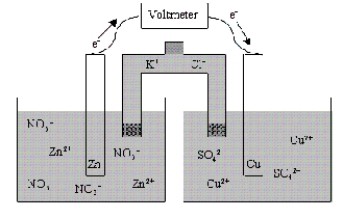
A)Zn2+(aq)| Zn(s)|| Cu2+(aq)| Cu(s)
B)Zn(s)| Zn2+(aq)|| Cu(s)| Cu2+(aq)
C)Zn(s)| Cu(s)|| Zn2+(aq)| Cu2+(aq)
D)Zn(s)| Zn2+(aq)|| Cu2+(aq)| Cu(s)
E)Zn2+(aq)| Zn(s)|| Cu(s)| Cu2+(aq)
Unlock Deck
Unlock for access to all 122 flashcards in this deck.
Unlock Deck
k this deck
35
Consider the following standard electrode potentials:
Ag+(aq)+ e- <strong>Consider the following standard electrode potentials: Ag<sup>+</sup>(aq)+ e<sup>-</sup>  Ag(s); E° = 0.80 V Mn<sup>2+</sup>(aq)+ 2e<sup>-</sup>  Mn(s); E° = -1.18 V Which of the following statements is false concerning the electrochemical cell given below? Mn(s)| Mn<sup>2+</sup>(aq)|| Ag<sup>+</sup>(aq)| Ag(s)</strong> A)The anode half-cell reaction is Mn(s)→ Mn<sup>2+</sup>(aq)+ 2e<sup>-</sup>. B)The reducing agent is Ag(s). C)Under standard-state conditions,the cell potential is 1.98 V. D)The cell potential decreases with time. E)The oxidizing agent is Ag<sup>+</sup>(aq). Ag(s); E° = 0.80 V
Mn2+(aq)+ 2e- <strong>Consider the following standard electrode potentials: Ag<sup>+</sup>(aq)+ e<sup>-</sup>  Ag(s); E° = 0.80 V Mn<sup>2+</sup>(aq)+ 2e<sup>-</sup>  Mn(s); E° = -1.18 V Which of the following statements is false concerning the electrochemical cell given below? Mn(s)| Mn<sup>2+</sup>(aq)|| Ag<sup>+</sup>(aq)| Ag(s)</strong> A)The anode half-cell reaction is Mn(s)→ Mn<sup>2+</sup>(aq)+ 2e<sup>-</sup>. B)The reducing agent is Ag(s). C)Under standard-state conditions,the cell potential is 1.98 V. D)The cell potential decreases with time. E)The oxidizing agent is Ag<sup>+</sup>(aq). Mn(s); E° = -1.18 V
Which of the following statements is false concerning the electrochemical cell given below?
Mn(s)| Mn2+(aq)|| Ag+(aq)| Ag(s)

A)The anode half-cell reaction is Mn(s)→ Mn2+(aq)+ 2e-.
B)The reducing agent is Ag(s).
C)Under standard-state conditions,the cell potential is 1.98 V.
D)The cell potential decreases with time.
E)The oxidizing agent is Ag+(aq).
Unlock Deck
Unlock for access to all 122 flashcards in this deck.
Unlock Deck
k this deck
36
What is the cell reaction for the following electrochemical cell?
Pt | Fe2+(aq),Fe3+(aq)|| Cr3+(aq)| Cr

A)3Fe2+(aq)+ Cr3+(s)→ Cr(s)+ 3Fe3+(aq)
B)3Fe2+(aq)+ 3Fe3+(aq)→ Cr(s)+ Cr3+(aq)
C)Cr(s)+ 3Fe3+(aq)→ Cr3+(aq)+ 3Fe2+(aq)
D)Pt(s)+ Fe2+(aq)+ Cr3+(aq)→ Cr(s)+ Pt2+(aq)+ Fe3+(aq)
E)Cr(s)+ Cr3+(aq)→ 3Fe2+(aq)+ 3Fe3+(aq)
Unlock Deck
Unlock for access to all 122 flashcards in this deck.
Unlock Deck
k this deck
37
What is the cell reaction for the following voltaic cell?
Cr(s)| Cr3+(aq)|| Br-(aq)| Br2(g)| Pt(s)

A)2Cr(s)+ 3Br2(g) <strong>What is the cell reaction for the following voltaic cell? Cr(s)| Cr<sup>3+</sup>(aq)|| Br<sup>-</sup>(aq)| Br<sub>2</sub>(g)| Pt(s)</strong> A)2Cr(s)+ 3Br<sub>2</sub>(g)   2Cr<sup>3+</sup>(aq)+ 6Br<sup>-</sup>(aq) B)Cr(s)+ Cr<sup>3+</sup>(aq)   Br<sup>-</sup>(aq)+ Br<sub>2</sub>(g) C)2Cr<sup>3+</sup>(aq)+ 6Br<sup>-</sup>(aq)   2Cr(s)+ 3Br<sub>2</sub>(g) D)Cr(s)+ 3Br<sub>2</sub>(g)   Cr<sup>3+</sup>(s)+ 2Br<sup>-</sup>(aq) E)Cr(s)+ 2Br<sup>-</sup>(aq)   Br<sub>2</sub>(g)+ Cr<sup>3+</sup>(aq) 2Cr3+(aq)+ 6Br-(aq)
B)Cr(s)+ Cr3+(aq) <strong>What is the cell reaction for the following voltaic cell? Cr(s)| Cr<sup>3+</sup>(aq)|| Br<sup>-</sup>(aq)| Br<sub>2</sub>(g)| Pt(s)</strong> A)2Cr(s)+ 3Br<sub>2</sub>(g)   2Cr<sup>3+</sup>(aq)+ 6Br<sup>-</sup>(aq) B)Cr(s)+ Cr<sup>3+</sup>(aq)   Br<sup>-</sup>(aq)+ Br<sub>2</sub>(g) C)2Cr<sup>3+</sup>(aq)+ 6Br<sup>-</sup>(aq)   2Cr(s)+ 3Br<sub>2</sub>(g) D)Cr(s)+ 3Br<sub>2</sub>(g)   Cr<sup>3+</sup>(s)+ 2Br<sup>-</sup>(aq) E)Cr(s)+ 2Br<sup>-</sup>(aq)   Br<sub>2</sub>(g)+ Cr<sup>3+</sup>(aq) Br-(aq)+ Br2(g)
C)2Cr3+(aq)+ 6Br-(aq) <strong>What is the cell reaction for the following voltaic cell? Cr(s)| Cr<sup>3+</sup>(aq)|| Br<sup>-</sup>(aq)| Br<sub>2</sub>(g)| Pt(s)</strong> A)2Cr(s)+ 3Br<sub>2</sub>(g)   2Cr<sup>3+</sup>(aq)+ 6Br<sup>-</sup>(aq) B)Cr(s)+ Cr<sup>3+</sup>(aq)   Br<sup>-</sup>(aq)+ Br<sub>2</sub>(g) C)2Cr<sup>3+</sup>(aq)+ 6Br<sup>-</sup>(aq)   2Cr(s)+ 3Br<sub>2</sub>(g) D)Cr(s)+ 3Br<sub>2</sub>(g)   Cr<sup>3+</sup>(s)+ 2Br<sup>-</sup>(aq) E)Cr(s)+ 2Br<sup>-</sup>(aq)   Br<sub>2</sub>(g)+ Cr<sup>3+</sup>(aq) 2Cr(s)+ 3Br2(g)
D)Cr(s)+ 3Br2(g) <strong>What is the cell reaction for the following voltaic cell? Cr(s)| Cr<sup>3+</sup>(aq)|| Br<sup>-</sup>(aq)| Br<sub>2</sub>(g)| Pt(s)</strong> A)2Cr(s)+ 3Br<sub>2</sub>(g)   2Cr<sup>3+</sup>(aq)+ 6Br<sup>-</sup>(aq) B)Cr(s)+ Cr<sup>3+</sup>(aq)   Br<sup>-</sup>(aq)+ Br<sub>2</sub>(g) C)2Cr<sup>3+</sup>(aq)+ 6Br<sup>-</sup>(aq)   2Cr(s)+ 3Br<sub>2</sub>(g) D)Cr(s)+ 3Br<sub>2</sub>(g)   Cr<sup>3+</sup>(s)+ 2Br<sup>-</sup>(aq) E)Cr(s)+ 2Br<sup>-</sup>(aq)   Br<sub>2</sub>(g)+ Cr<sup>3+</sup>(aq) Cr3+(s)+ 2Br-(aq)
E)Cr(s)+ 2Br-(aq) <strong>What is the cell reaction for the following voltaic cell? Cr(s)| Cr<sup>3+</sup>(aq)|| Br<sup>-</sup>(aq)| Br<sub>2</sub>(g)| Pt(s)</strong> A)2Cr(s)+ 3Br<sub>2</sub>(g)   2Cr<sup>3+</sup>(aq)+ 6Br<sup>-</sup>(aq) B)Cr(s)+ Cr<sup>3+</sup>(aq)   Br<sup>-</sup>(aq)+ Br<sub>2</sub>(g) C)2Cr<sup>3+</sup>(aq)+ 6Br<sup>-</sup>(aq)   2Cr(s)+ 3Br<sub>2</sub>(g) D)Cr(s)+ 3Br<sub>2</sub>(g)   Cr<sup>3+</sup>(s)+ 2Br<sup>-</sup>(aq) E)Cr(s)+ 2Br<sup>-</sup>(aq)   Br<sub>2</sub>(g)+ Cr<sup>3+</sup>(aq) Br2(g)+ Cr3+(aq)
Unlock Deck
Unlock for access to all 122 flashcards in this deck.
Unlock Deck
k this deck
38
A zinc-copper voltaic cell is represented as follows:
Zn(s)| Zn2+(1.0 M)|| Cu2+(1.0 M)| Cu(s)
Which of the following statements is false?

A)The copper electrode is the anode.
B)Reduction occurs at the copper electrode during discharge.
C)The mass of the zinc electrode decreases during discharge.
D)Electrons flow through the external circuit from the zinc electrode to the copper electrode.
E)The concentration of Cu2+ decreases during discharge.
Unlock Deck
Unlock for access to all 122 flashcards in this deck.
Unlock Deck
k this deck
39
In a table of standard reduction potentials,the strongest reducing agents are the _______ species in the half-reactions with the _______ E° values.

A)reduced,most negative
B)oxidized,most positive
C)reduced,most positive
D)oxidized,most negative
E)none of these
Unlock Deck
Unlock for access to all 122 flashcards in this deck.
Unlock Deck
k this deck
40
The Faraday constant is defined as

A)The charge per mole of electrons.
B)The charge on a single electron.
C)The maximum work obtainable from an electrochemical cell.
D)The electromotive force of the cell.
E)The amount of charge moved between electrodes.
Unlock Deck
Unlock for access to all 122 flashcards in this deck.
Unlock Deck
k this deck
41
Given:
Ni2+(aq)+ 2e- <strong>Given: Ni<sup>2+</sup>(aq)+ 2e<sup>-</sup>  Ni(s); E° = -0.23 V 2H<sup>+</sup>(aq)+ 2e<sup>-</sup>  H<sub>2</sub>(g); E° = 0.00 VAg<sup>+</sup>(aq)+ e<sup>-</sup>  Ag(s); E° = 0.80 V NO<sub>3</sub><sup>-</sup>(aq)+ 4H<sup>+</sup>(aq)+ 3e<sup>-</sup>  NO(g)+ 2H<sub>2</sub>O(l); E° = 0.96 V Which of the following statements is true?</strong> A)Ni<sup>2+</sup> reacts spontaneously with 1 M H<sup>+</sup>(aq)to form H<sub>2</sub>. B)Ni<sup>2+</sup> reacts spontaneously with H<sub>2</sub>(g). C)Ag(s)reacts spontaneously with Ni<sup>2+</sup>. D)Ag(s)reacts spontaneously with 1 M NO<sub>3</sub><sup>-</sup> in 1 M H<sup>+</sup>(aq). E)Ag(s)reacts spontaneously with 1 M H<sup>+</sup>(aq). Ni(s); E° = -0.23 V
2H+(aq)+ 2e- <strong>Given: Ni<sup>2+</sup>(aq)+ 2e<sup>-</sup>  Ni(s); E° = -0.23 V 2H<sup>+</sup>(aq)+ 2e<sup>-</sup>  H<sub>2</sub>(g); E° = 0.00 VAg<sup>+</sup>(aq)+ e<sup>-</sup>  Ag(s); E° = 0.80 V NO<sub>3</sub><sup>-</sup>(aq)+ 4H<sup>+</sup>(aq)+ 3e<sup>-</sup>  NO(g)+ 2H<sub>2</sub>O(l); E° = 0.96 V Which of the following statements is true?</strong> A)Ni<sup>2+</sup> reacts spontaneously with 1 M H<sup>+</sup>(aq)to form H<sub>2</sub>. B)Ni<sup>2+</sup> reacts spontaneously with H<sub>2</sub>(g). C)Ag(s)reacts spontaneously with Ni<sup>2+</sup>. D)Ag(s)reacts spontaneously with 1 M NO<sub>3</sub><sup>-</sup> in 1 M H<sup>+</sup>(aq). E)Ag(s)reacts spontaneously with 1 M H<sup>+</sup>(aq). H2(g); E° = 0.00 VAg+(aq)+ e- <strong>Given: Ni<sup>2+</sup>(aq)+ 2e<sup>-</sup>  Ni(s); E° = -0.23 V 2H<sup>+</sup>(aq)+ 2e<sup>-</sup>  H<sub>2</sub>(g); E° = 0.00 VAg<sup>+</sup>(aq)+ e<sup>-</sup>  Ag(s); E° = 0.80 V NO<sub>3</sub><sup>-</sup>(aq)+ 4H<sup>+</sup>(aq)+ 3e<sup>-</sup>  NO(g)+ 2H<sub>2</sub>O(l); E° = 0.96 V Which of the following statements is true?</strong> A)Ni<sup>2+</sup> reacts spontaneously with 1 M H<sup>+</sup>(aq)to form H<sub>2</sub>. B)Ni<sup>2+</sup> reacts spontaneously with H<sub>2</sub>(g). C)Ag(s)reacts spontaneously with Ni<sup>2+</sup>. D)Ag(s)reacts spontaneously with 1 M NO<sub>3</sub><sup>-</sup> in 1 M H<sup>+</sup>(aq). E)Ag(s)reacts spontaneously with 1 M H<sup>+</sup>(aq). Ag(s); E° = 0.80 V
NO3-(aq)+ 4H+(aq)+ 3e- <strong>Given: Ni<sup>2+</sup>(aq)+ 2e<sup>-</sup>  Ni(s); E° = -0.23 V 2H<sup>+</sup>(aq)+ 2e<sup>-</sup>  H<sub>2</sub>(g); E° = 0.00 VAg<sup>+</sup>(aq)+ e<sup>-</sup>  Ag(s); E° = 0.80 V NO<sub>3</sub><sup>-</sup>(aq)+ 4H<sup>+</sup>(aq)+ 3e<sup>-</sup>  NO(g)+ 2H<sub>2</sub>O(l); E° = 0.96 V Which of the following statements is true?</strong> A)Ni<sup>2+</sup> reacts spontaneously with 1 M H<sup>+</sup>(aq)to form H<sub>2</sub>. B)Ni<sup>2+</sup> reacts spontaneously with H<sub>2</sub>(g). C)Ag(s)reacts spontaneously with Ni<sup>2+</sup>. D)Ag(s)reacts spontaneously with 1 M NO<sub>3</sub><sup>-</sup> in 1 M H<sup>+</sup>(aq). E)Ag(s)reacts spontaneously with 1 M H<sup>+</sup>(aq). NO(g)+ 2H2O(l); E° = 0.96 V
Which of the following statements is true?

A)Ni2+ reacts spontaneously with 1 M H+(aq)to form H2.
B)Ni2+ reacts spontaneously with H2(g).
C)Ag(s)reacts spontaneously with Ni2+.
D)Ag(s)reacts spontaneously with 1 M NO3- in 1 M H+(aq).
E)Ag(s)reacts spontaneously with 1 M H+(aq).
Unlock Deck
Unlock for access to all 122 flashcards in this deck.
Unlock Deck
k this deck
42
Consider the following standard reduction potentials:
2H+(aq)+ 2e- <strong>Consider the following standard reduction potentials: 2H<sup>+</sup>(aq)+ 2e<sup>-</sup>  H<sub>2</sub>(g); E° = 0.00 V Sn<sup>2+</sup>(aq)+ 2e<sup>-</sup>  Sn(s); E° = -0.15 V Cd<sup>2+</sup>(aq)+ 2e<sup>-</sup>  Cd(s); E° = -0.40 V Which pair of substances will react spontaneously under standard-state conditions?</strong> A)Cd with H<sup>+</sup> B)Cd with Sn C)Sn<sup>2+</sup> with Cd<sup>2+</sup> D)Sn with Cd<sup>2+</sup> E)Sn<sup>2+</sup> with H<sup>+</sup> H2(g); E° = 0.00 V
Sn2+(aq)+ 2e- <strong>Consider the following standard reduction potentials: 2H<sup>+</sup>(aq)+ 2e<sup>-</sup>  H<sub>2</sub>(g); E° = 0.00 V Sn<sup>2+</sup>(aq)+ 2e<sup>-</sup>  Sn(s); E° = -0.15 V Cd<sup>2+</sup>(aq)+ 2e<sup>-</sup>  Cd(s); E° = -0.40 V Which pair of substances will react spontaneously under standard-state conditions?</strong> A)Cd with H<sup>+</sup> B)Cd with Sn C)Sn<sup>2+</sup> with Cd<sup>2+</sup> D)Sn with Cd<sup>2+</sup> E)Sn<sup>2+</sup> with H<sup>+</sup> Sn(s); E° = -0.15 V
Cd2+(aq)+ 2e- <strong>Consider the following standard reduction potentials: 2H<sup>+</sup>(aq)+ 2e<sup>-</sup>  H<sub>2</sub>(g); E° = 0.00 V Sn<sup>2+</sup>(aq)+ 2e<sup>-</sup>  Sn(s); E° = -0.15 V Cd<sup>2+</sup>(aq)+ 2e<sup>-</sup>  Cd(s); E° = -0.40 V Which pair of substances will react spontaneously under standard-state conditions?</strong> A)Cd with H<sup>+</sup> B)Cd with Sn C)Sn<sup>2+</sup> with Cd<sup>2+</sup> D)Sn with Cd<sup>2+</sup> E)Sn<sup>2+</sup> with H<sup>+</sup> Cd(s); E° = -0.40 V
Which pair of substances will react spontaneously under standard-state conditions?

A)Cd with H+
B)Cd with Sn
C)Sn2+ with Cd2+
D)Sn with Cd2+
E)Sn2+ with H+
Unlock Deck
Unlock for access to all 122 flashcards in this deck.
Unlock Deck
k this deck
43
For a certain oxidation-reduction reaction,E°cell is negative.This means that

A)ΔG° is positive and K is less than 1.
B)ΔG° is negative and K is greater than 1.
C)ΔG° is positive and K is greater than 1.
D)ΔG° is negative and K is less than 1.
E)ΔG° is zero and K is greater than 1.
Unlock Deck
Unlock for access to all 122 flashcards in this deck.
Unlock Deck
k this deck
44
Given:
Pb2+(aq)+ 2e- <strong>Given: Pb<sup>2+</sup>(aq)+ 2e<sup>-</sup>  Pb(s); E° = -0.13 V Mg<sup>2+</sup>(aq)+ 2e<sup>-</sup>  Mg(s); E° = -2.38 V Ag<sup>+</sup>(aq)+ e<sup>-</sup>  Ag(s); E° = 0.80 V 2H<sup>+</sup>(aq)+ 2e<sup>-</sup>  H<sub>2</sub>(g); E° = 0.00 V Under standard-state conditions,which of the following species is the best reducing agent?</strong> A)H<sub>2</sub> B)Mg<sup>2+</sup> C)Ag<sup>+</sup> D)Pb E)Ag Pb(s); E° = -0.13 V
Mg2+(aq)+ 2e- <strong>Given: Pb<sup>2+</sup>(aq)+ 2e<sup>-</sup>  Pb(s); E° = -0.13 V Mg<sup>2+</sup>(aq)+ 2e<sup>-</sup>  Mg(s); E° = -2.38 V Ag<sup>+</sup>(aq)+ e<sup>-</sup>  Ag(s); E° = 0.80 V 2H<sup>+</sup>(aq)+ 2e<sup>-</sup>  H<sub>2</sub>(g); E° = 0.00 V Under standard-state conditions,which of the following species is the best reducing agent?</strong> A)H<sub>2</sub> B)Mg<sup>2+</sup> C)Ag<sup>+</sup> D)Pb E)Ag Mg(s); E° = -2.38 V
Ag+(aq)+ e- <strong>Given: Pb<sup>2+</sup>(aq)+ 2e<sup>-</sup>  Pb(s); E° = -0.13 V Mg<sup>2+</sup>(aq)+ 2e<sup>-</sup>  Mg(s); E° = -2.38 V Ag<sup>+</sup>(aq)+ e<sup>-</sup>  Ag(s); E° = 0.80 V 2H<sup>+</sup>(aq)+ 2e<sup>-</sup>  H<sub>2</sub>(g); E° = 0.00 V Under standard-state conditions,which of the following species is the best reducing agent?</strong> A)H<sub>2</sub> B)Mg<sup>2+</sup> C)Ag<sup>+</sup> D)Pb E)Ag Ag(s); E° = 0.80 V
2H+(aq)+ 2e- <strong>Given: Pb<sup>2+</sup>(aq)+ 2e<sup>-</sup>  Pb(s); E° = -0.13 V Mg<sup>2+</sup>(aq)+ 2e<sup>-</sup>  Mg(s); E° = -2.38 V Ag<sup>+</sup>(aq)+ e<sup>-</sup>  Ag(s); E° = 0.80 V 2H<sup>+</sup>(aq)+ 2e<sup>-</sup>  H<sub>2</sub>(g); E° = 0.00 V Under standard-state conditions,which of the following species is the best reducing agent?</strong> A)H<sub>2</sub> B)Mg<sup>2+</sup> C)Ag<sup>+</sup> D)Pb E)Ag H2(g); E° = 0.00 V
Under standard-state conditions,which of the following species is the best reducing agent?

A)H2
B)Mg2+
C)Ag+
D)Pb
E)Ag
Unlock Deck
Unlock for access to all 122 flashcards in this deck.
Unlock Deck
k this deck
45
Given:
Hg2+(aq)+ 2e- <strong>Given: Hg<sup>2+</sup>(aq)+ 2e<sup>-</sup>  Hg(s); E° = 0.85 V Li<sup>+</sup>(aq)+ e<sup>-</sup>  Li(s); E° = -3.04 V Br<sub>2</sub>(l)+ 2e<sup>-</sup>  2Br<sup>-</sup>(aq); E° = 1.07 V Au<sup>+</sup>(aq)+ e<sup>-</sup>  Au(s); E° = 1.69 V Cl<sub>2</sub>(g)+ 2e<sup>-</sup>  2Cl<sup>-</sup>(aq); E° = 1.36 V Which of the following species is the best reducing agent?</strong> A)Hg B)Li<sup>+</sup> C)Au D)Cl<sup>-</sup> E)Br<sup>-</sup> Hg(s); E° = 0.85 V
Li+(aq)+ e- <strong>Given: Hg<sup>2+</sup>(aq)+ 2e<sup>-</sup>  Hg(s); E° = 0.85 V Li<sup>+</sup>(aq)+ e<sup>-</sup>  Li(s); E° = -3.04 V Br<sub>2</sub>(l)+ 2e<sup>-</sup>  2Br<sup>-</sup>(aq); E° = 1.07 V Au<sup>+</sup>(aq)+ e<sup>-</sup>  Au(s); E° = 1.69 V Cl<sub>2</sub>(g)+ 2e<sup>-</sup>  2Cl<sup>-</sup>(aq); E° = 1.36 V Which of the following species is the best reducing agent?</strong> A)Hg B)Li<sup>+</sup> C)Au D)Cl<sup>-</sup> E)Br<sup>-</sup> Li(s); E° = -3.04 V
Br2(l)+ 2e- <strong>Given: Hg<sup>2+</sup>(aq)+ 2e<sup>-</sup>  Hg(s); E° = 0.85 V Li<sup>+</sup>(aq)+ e<sup>-</sup>  Li(s); E° = -3.04 V Br<sub>2</sub>(l)+ 2e<sup>-</sup>  2Br<sup>-</sup>(aq); E° = 1.07 V Au<sup>+</sup>(aq)+ e<sup>-</sup>  Au(s); E° = 1.69 V Cl<sub>2</sub>(g)+ 2e<sup>-</sup>  2Cl<sup>-</sup>(aq); E° = 1.36 V Which of the following species is the best reducing agent?</strong> A)Hg B)Li<sup>+</sup> C)Au D)Cl<sup>-</sup> E)Br<sup>-</sup> 2Br-(aq); E° = 1.07 V
Au+(aq)+ e- <strong>Given: Hg<sup>2+</sup>(aq)+ 2e<sup>-</sup>  Hg(s); E° = 0.85 V Li<sup>+</sup>(aq)+ e<sup>-</sup>  Li(s); E° = -3.04 V Br<sub>2</sub>(l)+ 2e<sup>-</sup>  2Br<sup>-</sup>(aq); E° = 1.07 V Au<sup>+</sup>(aq)+ e<sup>-</sup>  Au(s); E° = 1.69 V Cl<sub>2</sub>(g)+ 2e<sup>-</sup>  2Cl<sup>-</sup>(aq); E° = 1.36 V Which of the following species is the best reducing agent?</strong> A)Hg B)Li<sup>+</sup> C)Au D)Cl<sup>-</sup> E)Br<sup>-</sup> Au(s); E° = 1.69 V
Cl2(g)+ 2e- <strong>Given: Hg<sup>2+</sup>(aq)+ 2e<sup>-</sup>  Hg(s); E° = 0.85 V Li<sup>+</sup>(aq)+ e<sup>-</sup>  Li(s); E° = -3.04 V Br<sub>2</sub>(l)+ 2e<sup>-</sup>  2Br<sup>-</sup>(aq); E° = 1.07 V Au<sup>+</sup>(aq)+ e<sup>-</sup>  Au(s); E° = 1.69 V Cl<sub>2</sub>(g)+ 2e<sup>-</sup>  2Cl<sup>-</sup>(aq); E° = 1.36 V Which of the following species is the best reducing agent?</strong> A)Hg B)Li<sup>+</sup> C)Au D)Cl<sup>-</sup> E)Br<sup>-</sup> 2Cl-(aq); E° = 1.36 V
Which of the following species is the best reducing agent?

A)Hg
B)Li+
C)Au
D)Cl-
E)Br-
Unlock Deck
Unlock for access to all 122 flashcards in this deck.
Unlock Deck
k this deck
46
Consider the following standard reduction potentials:
Mg2+(aq)+ 2e- <strong>Consider the following standard reduction potentials: Mg<sup>2+</sup>(aq)+ 2e<sup>-</sup>   Mg(s); E° = -2.38 V V<sup>2+</sup>(aq)+ 2e<sup>-</sup>   V(s); E° = -1.18 V Cu<sup>2+</sup>(aq)+ e<sup>-</sup>   Cu<sup>+</sup>(aq); E° = 0.15 V Which of the following reactions will proceed spontaneously from left to right under standard-state conditions?</strong> A)Mg(s)+ 2Cu<sup>2+</sup>(aq)→ Mg<sup>2+</sup>(aq)+ 2Cu<sup>+</sup>(aq) B)V<sup>2+</sup>(aq)+ 2Cu<sup>+</sup>(aq)→ V(s)+ 2Cu<sup>2+</sup>(aq) C)Mg<sup>2+</sup>(aq)+ 2Cu<sup>+</sup>(aq)→ 2Cu<sup>2+</sup>(aq)+ Mg(s) D)Mg<sup>2+</sup>(aq)+ V(s)→ V<sup>2+</sup>(aq)+ Mg(s) E)2Cu<sup>2+</sup>(aq)+ 2Cu<sup>+</sup>(aq)→ Mg<sup>2+</sup>(aq)+ Mg(s)
Mg(s); E° = -2.38 V
V2+(aq)+ 2e- <strong>Consider the following standard reduction potentials: Mg<sup>2+</sup>(aq)+ 2e<sup>-</sup>   Mg(s); E° = -2.38 V V<sup>2+</sup>(aq)+ 2e<sup>-</sup>   V(s); E° = -1.18 V Cu<sup>2+</sup>(aq)+ e<sup>-</sup>   Cu<sup>+</sup>(aq); E° = 0.15 V Which of the following reactions will proceed spontaneously from left to right under standard-state conditions?</strong> A)Mg(s)+ 2Cu<sup>2+</sup>(aq)→ Mg<sup>2+</sup>(aq)+ 2Cu<sup>+</sup>(aq) B)V<sup>2+</sup>(aq)+ 2Cu<sup>+</sup>(aq)→ V(s)+ 2Cu<sup>2+</sup>(aq) C)Mg<sup>2+</sup>(aq)+ 2Cu<sup>+</sup>(aq)→ 2Cu<sup>2+</sup>(aq)+ Mg(s) D)Mg<sup>2+</sup>(aq)+ V(s)→ V<sup>2+</sup>(aq)+ Mg(s) E)2Cu<sup>2+</sup>(aq)+ 2Cu<sup>+</sup>(aq)→ Mg<sup>2+</sup>(aq)+ Mg(s)
V(s); E° = -1.18 V
Cu2+(aq)+ e- <strong>Consider the following standard reduction potentials: Mg<sup>2+</sup>(aq)+ 2e<sup>-</sup>   Mg(s); E° = -2.38 V V<sup>2+</sup>(aq)+ 2e<sup>-</sup>   V(s); E° = -1.18 V Cu<sup>2+</sup>(aq)+ e<sup>-</sup>   Cu<sup>+</sup>(aq); E° = 0.15 V Which of the following reactions will proceed spontaneously from left to right under standard-state conditions?</strong> A)Mg(s)+ 2Cu<sup>2+</sup>(aq)→ Mg<sup>2+</sup>(aq)+ 2Cu<sup>+</sup>(aq) B)V<sup>2+</sup>(aq)+ 2Cu<sup>+</sup>(aq)→ V(s)+ 2Cu<sup>2+</sup>(aq) C)Mg<sup>2+</sup>(aq)+ 2Cu<sup>+</sup>(aq)→ 2Cu<sup>2+</sup>(aq)+ Mg(s) D)Mg<sup>2+</sup>(aq)+ V(s)→ V<sup>2+</sup>(aq)+ Mg(s) E)2Cu<sup>2+</sup>(aq)+ 2Cu<sup>+</sup>(aq)→ Mg<sup>2+</sup>(aq)+ Mg(s)
Cu+(aq); E° = 0.15 V
Which of the following reactions will proceed spontaneously from left to right under standard-state conditions?

A)Mg(s)+ 2Cu2+(aq)→ Mg2+(aq)+ 2Cu+(aq)
B)V2+(aq)+ 2Cu+(aq)→ V(s)+ 2Cu2+(aq)
C)Mg2+(aq)+ 2Cu+(aq)→ 2Cu2+(aq)+ Mg(s)
D)Mg2+(aq)+ V(s)→ V2+(aq)+ Mg(s)
E)2Cu2+(aq)+ 2Cu+(aq)→ Mg2+(aq)+ Mg(s)
Unlock Deck
Unlock for access to all 122 flashcards in this deck.
Unlock Deck
k this deck
47
What is E°cell for the cell reaction 2Cr(s)+ 3Sn4+ (aq​)→ 3Sn2+(aq)+ 2Cr3+ (aq​)?
Cr3+ (aq​)+ 3e- <strong>What is E°<sub>cell</sub> for the cell reaction 2Cr(s)+ 3Sn<sup>4+</sup> (aq​)→ 3Sn<sup>2+</sup>(aq)+ 2Cr<sup>3+</sup> (aq​)? Cr<sup>3+</sup><sup> </sup>(aq​)+ 3e<sup>-</sup>  Cr(s); E° = -0.74V       ​</strong> A)0.89V B)-0.59V C)   D)   E)0.59V Cr(s); E° = -0.74V <strong>What is E°<sub>cell</sub> for the cell reaction 2Cr(s)+ 3Sn<sup>4+</sup> (aq​)→ 3Sn<sup>2+</sup>(aq)+ 2Cr<sup>3+</sup> (aq​)? Cr<sup>3+</sup><sup> </sup>(aq​)+ 3e<sup>-</sup>  Cr(s); E° = -0.74V       ​</strong> A)0.89V B)-0.59V C)   D)   E)0.59V
<strong>What is E°<sub>cell</sub> for the cell reaction 2Cr(s)+ 3Sn<sup>4+</sup> (aq​)→ 3Sn<sup>2+</sup>(aq)+ 2Cr<sup>3+</sup> (aq​)? Cr<sup>3+</sup><sup> </sup>(aq​)+ 3e<sup>-</sup>  Cr(s); E° = -0.74V       ​</strong> A)0.89V B)-0.59V C)   D)   E)0.59V <strong>What is E°<sub>cell</sub> for the cell reaction 2Cr(s)+ 3Sn<sup>4+</sup> (aq​)→ 3Sn<sup>2+</sup>(aq)+ 2Cr<sup>3+</sup> (aq​)? Cr<sup>3+</sup><sup> </sup>(aq​)+ 3e<sup>-</sup>  Cr(s); E° = -0.74V       ​</strong> A)0.89V B)-0.59V C)   D)   E)0.59V

A)0.89V
B)-0.59V
C) <strong>What is E°<sub>cell</sub> for the cell reaction 2Cr(s)+ 3Sn<sup>4+</sup> (aq​)→ 3Sn<sup>2+</sup>(aq)+ 2Cr<sup>3+</sup> (aq​)? Cr<sup>3+</sup><sup> </sup>(aq​)+ 3e<sup>-</sup>  Cr(s); E° = -0.74V       ​</strong> A)0.89V B)-0.59V C)   D)   E)0.59V
D) <strong>What is E°<sub>cell</sub> for the cell reaction 2Cr(s)+ 3Sn<sup>4+</sup> (aq​)→ 3Sn<sup>2+</sup>(aq)+ 2Cr<sup>3+</sup> (aq​)? Cr<sup>3+</sup><sup> </sup>(aq​)+ 3e<sup>-</sup>  Cr(s); E° = -0.74V       ​</strong> A)0.89V B)-0.59V C)   D)   E)0.59V
E)0.59V
Unlock Deck
Unlock for access to all 122 flashcards in this deck.
Unlock Deck
k this deck
48
Given:
W3+(aq)+ 3e- <strong>Given: W<sup>3+</sup>(aq)+ 3e<sup>-</sup>  W(s); E° = 2.72 V Pb<sup>2+</sup>(aq)+ 2e<sup>-</sup>  Pb(s); E° = -0.13 V Ni<sup>2+</sup>(aq)+ 2e<sup>-</sup>  Ni(s); E° = -0.23 V Cd<sup>2+</sup>(aq)+ 2e<sup>-</sup>  Cd(s); E° = -0.40 V Zn<sup>2+</sup>(aq)+ 2e<sup>-</sup>  Zn(s); E° = -0.76 V Al<sup>3+</sup>(aq)+ 3e<sup>-</sup>  Al(s); E° = -1.66 V Mg<sup>2+</sup>(aq)+ 2e<sup>-</sup>  Mg(s); E° = -2.38 V Under standard-state conditions,which of the following metals will reduce W<sup>3+</sup> to W but will not reduce Ni<sup>2+</sup> to Ni?</strong> A)Cd B)Pb C)Al D)Zn E)Mg W(s); E° = 2.72 V
Pb2+(aq)+ 2e- <strong>Given: W<sup>3+</sup>(aq)+ 3e<sup>-</sup>  W(s); E° = 2.72 V Pb<sup>2+</sup>(aq)+ 2e<sup>-</sup>  Pb(s); E° = -0.13 V Ni<sup>2+</sup>(aq)+ 2e<sup>-</sup>  Ni(s); E° = -0.23 V Cd<sup>2+</sup>(aq)+ 2e<sup>-</sup>  Cd(s); E° = -0.40 V Zn<sup>2+</sup>(aq)+ 2e<sup>-</sup>  Zn(s); E° = -0.76 V Al<sup>3+</sup>(aq)+ 3e<sup>-</sup>  Al(s); E° = -1.66 V Mg<sup>2+</sup>(aq)+ 2e<sup>-</sup>  Mg(s); E° = -2.38 V Under standard-state conditions,which of the following metals will reduce W<sup>3+</sup> to W but will not reduce Ni<sup>2+</sup> to Ni?</strong> A)Cd B)Pb C)Al D)Zn E)Mg Pb(s); E° = -0.13 V
Ni2+(aq)+ 2e- <strong>Given: W<sup>3+</sup>(aq)+ 3e<sup>-</sup>  W(s); E° = 2.72 V Pb<sup>2+</sup>(aq)+ 2e<sup>-</sup>  Pb(s); E° = -0.13 V Ni<sup>2+</sup>(aq)+ 2e<sup>-</sup>  Ni(s); E° = -0.23 V Cd<sup>2+</sup>(aq)+ 2e<sup>-</sup>  Cd(s); E° = -0.40 V Zn<sup>2+</sup>(aq)+ 2e<sup>-</sup>  Zn(s); E° = -0.76 V Al<sup>3+</sup>(aq)+ 3e<sup>-</sup>  Al(s); E° = -1.66 V Mg<sup>2+</sup>(aq)+ 2e<sup>-</sup>  Mg(s); E° = -2.38 V Under standard-state conditions,which of the following metals will reduce W<sup>3+</sup> to W but will not reduce Ni<sup>2+</sup> to Ni?</strong> A)Cd B)Pb C)Al D)Zn E)Mg Ni(s); E° = -0.23 V
Cd2+(aq)+ 2e- <strong>Given: W<sup>3+</sup>(aq)+ 3e<sup>-</sup>  W(s); E° = 2.72 V Pb<sup>2+</sup>(aq)+ 2e<sup>-</sup>  Pb(s); E° = -0.13 V Ni<sup>2+</sup>(aq)+ 2e<sup>-</sup>  Ni(s); E° = -0.23 V Cd<sup>2+</sup>(aq)+ 2e<sup>-</sup>  Cd(s); E° = -0.40 V Zn<sup>2+</sup>(aq)+ 2e<sup>-</sup>  Zn(s); E° = -0.76 V Al<sup>3+</sup>(aq)+ 3e<sup>-</sup>  Al(s); E° = -1.66 V Mg<sup>2+</sup>(aq)+ 2e<sup>-</sup>  Mg(s); E° = -2.38 V Under standard-state conditions,which of the following metals will reduce W<sup>3+</sup> to W but will not reduce Ni<sup>2+</sup> to Ni?</strong> A)Cd B)Pb C)Al D)Zn E)Mg Cd(s); E° = -0.40 V
Zn2+(aq)+ 2e- <strong>Given: W<sup>3+</sup>(aq)+ 3e<sup>-</sup>  W(s); E° = 2.72 V Pb<sup>2+</sup>(aq)+ 2e<sup>-</sup>  Pb(s); E° = -0.13 V Ni<sup>2+</sup>(aq)+ 2e<sup>-</sup>  Ni(s); E° = -0.23 V Cd<sup>2+</sup>(aq)+ 2e<sup>-</sup>  Cd(s); E° = -0.40 V Zn<sup>2+</sup>(aq)+ 2e<sup>-</sup>  Zn(s); E° = -0.76 V Al<sup>3+</sup>(aq)+ 3e<sup>-</sup>  Al(s); E° = -1.66 V Mg<sup>2+</sup>(aq)+ 2e<sup>-</sup>  Mg(s); E° = -2.38 V Under standard-state conditions,which of the following metals will reduce W<sup>3+</sup> to W but will not reduce Ni<sup>2+</sup> to Ni?</strong> A)Cd B)Pb C)Al D)Zn E)Mg Zn(s); E° = -0.76 V
Al3+(aq)+ 3e- <strong>Given: W<sup>3+</sup>(aq)+ 3e<sup>-</sup>  W(s); E° = 2.72 V Pb<sup>2+</sup>(aq)+ 2e<sup>-</sup>  Pb(s); E° = -0.13 V Ni<sup>2+</sup>(aq)+ 2e<sup>-</sup>  Ni(s); E° = -0.23 V Cd<sup>2+</sup>(aq)+ 2e<sup>-</sup>  Cd(s); E° = -0.40 V Zn<sup>2+</sup>(aq)+ 2e<sup>-</sup>  Zn(s); E° = -0.76 V Al<sup>3+</sup>(aq)+ 3e<sup>-</sup>  Al(s); E° = -1.66 V Mg<sup>2+</sup>(aq)+ 2e<sup>-</sup>  Mg(s); E° = -2.38 V Under standard-state conditions,which of the following metals will reduce W<sup>3+</sup> to W but will not reduce Ni<sup>2+</sup> to Ni?</strong> A)Cd B)Pb C)Al D)Zn E)Mg Al(s); E° = -1.66 V
Mg2+(aq)+ 2e- <strong>Given: W<sup>3+</sup>(aq)+ 3e<sup>-</sup>  W(s); E° = 2.72 V Pb<sup>2+</sup>(aq)+ 2e<sup>-</sup>  Pb(s); E° = -0.13 V Ni<sup>2+</sup>(aq)+ 2e<sup>-</sup>  Ni(s); E° = -0.23 V Cd<sup>2+</sup>(aq)+ 2e<sup>-</sup>  Cd(s); E° = -0.40 V Zn<sup>2+</sup>(aq)+ 2e<sup>-</sup>  Zn(s); E° = -0.76 V Al<sup>3+</sup>(aq)+ 3e<sup>-</sup>  Al(s); E° = -1.66 V Mg<sup>2+</sup>(aq)+ 2e<sup>-</sup>  Mg(s); E° = -2.38 V Under standard-state conditions,which of the following metals will reduce W<sup>3+</sup> to W but will not reduce Ni<sup>2+</sup> to Ni?</strong> A)Cd B)Pb C)Al D)Zn E)Mg Mg(s); E° = -2.38 V
Under standard-state conditions,which of the following metals will reduce W3+ to W but will not reduce Ni2+ to Ni?

A)Cd
B)Pb
C)Al
D)Zn
E)Mg
Unlock Deck
Unlock for access to all 122 flashcards in this deck.
Unlock Deck
k this deck
49
Given:
Pb2+(aq)+ 2e- <strong>Given: Pb<sup>2+</sup>(aq)+ 2e<sup>-</sup>  Pb(s); E° = -0.13 V Zn<sup>2+</sup>(aq)+ 2e<sup>-</sup>  Zn(s); E° = -0.76 V Al<sup>3+</sup>(aq)+ 3e<sup>-</sup>  Al(s); E° = -1.66 V Mg<sup>2+</sup>(aq)+ 2e<sup>-</sup>  Mg(s); E° = -2.38 V V<sup>2+</sup>(aq)+ 2e<sup>-</sup>  V(s); E° = -1.18 V Cu<sup>2+</sup>(aq)+ 2e<sup>-</sup>  Cu(s); E° = 0.34 V Which of the following cations is capable of oxidizing Pb to Pb<sup>2+</sup> under standard-state conditions?</strong> A)Al<sup>3+</sup> B)V<sup>2+</sup> C)Cu<sup>2+</sup> D)Mg<sup>2+</sup> E)Zn<sup>2+</sup> Pb(s); E° = -0.13 V
Zn2+(aq)+ 2e- <strong>Given: Pb<sup>2+</sup>(aq)+ 2e<sup>-</sup>  Pb(s); E° = -0.13 V Zn<sup>2+</sup>(aq)+ 2e<sup>-</sup>  Zn(s); E° = -0.76 V Al<sup>3+</sup>(aq)+ 3e<sup>-</sup>  Al(s); E° = -1.66 V Mg<sup>2+</sup>(aq)+ 2e<sup>-</sup>  Mg(s); E° = -2.38 V V<sup>2+</sup>(aq)+ 2e<sup>-</sup>  V(s); E° = -1.18 V Cu<sup>2+</sup>(aq)+ 2e<sup>-</sup>  Cu(s); E° = 0.34 V Which of the following cations is capable of oxidizing Pb to Pb<sup>2+</sup> under standard-state conditions?</strong> A)Al<sup>3+</sup> B)V<sup>2+</sup> C)Cu<sup>2+</sup> D)Mg<sup>2+</sup> E)Zn<sup>2+</sup> Zn(s); E° = -0.76 V
Al3+(aq)+ 3e- <strong>Given: Pb<sup>2+</sup>(aq)+ 2e<sup>-</sup>  Pb(s); E° = -0.13 V Zn<sup>2+</sup>(aq)+ 2e<sup>-</sup>  Zn(s); E° = -0.76 V Al<sup>3+</sup>(aq)+ 3e<sup>-</sup>  Al(s); E° = -1.66 V Mg<sup>2+</sup>(aq)+ 2e<sup>-</sup>  Mg(s); E° = -2.38 V V<sup>2+</sup>(aq)+ 2e<sup>-</sup>  V(s); E° = -1.18 V Cu<sup>2+</sup>(aq)+ 2e<sup>-</sup>  Cu(s); E° = 0.34 V Which of the following cations is capable of oxidizing Pb to Pb<sup>2+</sup> under standard-state conditions?</strong> A)Al<sup>3+</sup> B)V<sup>2+</sup> C)Cu<sup>2+</sup> D)Mg<sup>2+</sup> E)Zn<sup>2+</sup> Al(s); E° = -1.66 V
Mg2+(aq)+ 2e- <strong>Given: Pb<sup>2+</sup>(aq)+ 2e<sup>-</sup>  Pb(s); E° = -0.13 V Zn<sup>2+</sup>(aq)+ 2e<sup>-</sup>  Zn(s); E° = -0.76 V Al<sup>3+</sup>(aq)+ 3e<sup>-</sup>  Al(s); E° = -1.66 V Mg<sup>2+</sup>(aq)+ 2e<sup>-</sup>  Mg(s); E° = -2.38 V V<sup>2+</sup>(aq)+ 2e<sup>-</sup>  V(s); E° = -1.18 V Cu<sup>2+</sup>(aq)+ 2e<sup>-</sup>  Cu(s); E° = 0.34 V Which of the following cations is capable of oxidizing Pb to Pb<sup>2+</sup> under standard-state conditions?</strong> A)Al<sup>3+</sup> B)V<sup>2+</sup> C)Cu<sup>2+</sup> D)Mg<sup>2+</sup> E)Zn<sup>2+</sup> Mg(s); E° = -2.38 V
V2+(aq)+ 2e- <strong>Given: Pb<sup>2+</sup>(aq)+ 2e<sup>-</sup>  Pb(s); E° = -0.13 V Zn<sup>2+</sup>(aq)+ 2e<sup>-</sup>  Zn(s); E° = -0.76 V Al<sup>3+</sup>(aq)+ 3e<sup>-</sup>  Al(s); E° = -1.66 V Mg<sup>2+</sup>(aq)+ 2e<sup>-</sup>  Mg(s); E° = -2.38 V V<sup>2+</sup>(aq)+ 2e<sup>-</sup>  V(s); E° = -1.18 V Cu<sup>2+</sup>(aq)+ 2e<sup>-</sup>  Cu(s); E° = 0.34 V Which of the following cations is capable of oxidizing Pb to Pb<sup>2+</sup> under standard-state conditions?</strong> A)Al<sup>3+</sup> B)V<sup>2+</sup> C)Cu<sup>2+</sup> D)Mg<sup>2+</sup> E)Zn<sup>2+</sup> V(s); E° = -1.18 V
Cu2+(aq)+ 2e- <strong>Given: Pb<sup>2+</sup>(aq)+ 2e<sup>-</sup>  Pb(s); E° = -0.13 V Zn<sup>2+</sup>(aq)+ 2e<sup>-</sup>  Zn(s); E° = -0.76 V Al<sup>3+</sup>(aq)+ 3e<sup>-</sup>  Al(s); E° = -1.66 V Mg<sup>2+</sup>(aq)+ 2e<sup>-</sup>  Mg(s); E° = -2.38 V V<sup>2+</sup>(aq)+ 2e<sup>-</sup>  V(s); E° = -1.18 V Cu<sup>2+</sup>(aq)+ 2e<sup>-</sup>  Cu(s); E° = 0.34 V Which of the following cations is capable of oxidizing Pb to Pb<sup>2+</sup> under standard-state conditions?</strong> A)Al<sup>3+</sup> B)V<sup>2+</sup> C)Cu<sup>2+</sup> D)Mg<sup>2+</sup> E)Zn<sup>2+</sup> Cu(s); E° = 0.34 V
Which of the following cations is capable of oxidizing Pb to Pb2+ under standard-state conditions?

A)Al3+
B)V2+
C)Cu2+
D)Mg2+
E)Zn2+
Unlock Deck
Unlock for access to all 122 flashcards in this deck.
Unlock Deck
k this deck
50
Which of the following statements is true about a voltaic cell for which E°cell = 1.00 V?

A)The cathode is at a higher energy than the anode.
B)It has ΔG° > 0.
C)The reaction is spontaneous.
D)The system is at equilibrium.
E)It has K = 1.
Unlock Deck
Unlock for access to all 122 flashcards in this deck.
Unlock Deck
k this deck
51
Given:
Zn2+(aq)+ 2e- <strong>Given: Zn<sup>2+</sup>(aq)+ 2e<sup>-</sup>  Zn(s); E° = -0.76 V 2H<sup>+</sup>(aq)+ 2e<sup>-</sup>  H<sub>2</sub>(g); E° = 0.00 V I<sub>2</sub>(s)+ 2e<sup>-</sup>  2I<sup>-</sup>(aq); E° = 0.54 V Br<sub>2</sub>(l)+ 2e<sup>-</sup>  2Br<sup>-</sup>(aq); E° = 1.07 V Ni<sup>2+</sup>(aq)+ 2e<sup>-</sup>  Ni(s); E° = -0.23 V Cu<sup>2+</sup>(aq)+ 2e<sup>-</sup>  Cu(s); E° = 0.34 V Which of the following species will oxidize Ni but not Cu?</strong> A)Zn<sup>2+</sup> B)Br<sup>-</sup> C)H<sup>+</sup> D)I<sub>2</sub> E)Zn Zn(s); E° = -0.76 V
2H+(aq)+ 2e- <strong>Given: Zn<sup>2+</sup>(aq)+ 2e<sup>-</sup>  Zn(s); E° = -0.76 V 2H<sup>+</sup>(aq)+ 2e<sup>-</sup>  H<sub>2</sub>(g); E° = 0.00 V I<sub>2</sub>(s)+ 2e<sup>-</sup>  2I<sup>-</sup>(aq); E° = 0.54 V Br<sub>2</sub>(l)+ 2e<sup>-</sup>  2Br<sup>-</sup>(aq); E° = 1.07 V Ni<sup>2+</sup>(aq)+ 2e<sup>-</sup>  Ni(s); E° = -0.23 V Cu<sup>2+</sup>(aq)+ 2e<sup>-</sup>  Cu(s); E° = 0.34 V Which of the following species will oxidize Ni but not Cu?</strong> A)Zn<sup>2+</sup> B)Br<sup>-</sup> C)H<sup>+</sup> D)I<sub>2</sub> E)Zn H2(g); E° = 0.00 V
I2(s)+ 2e- <strong>Given: Zn<sup>2+</sup>(aq)+ 2e<sup>-</sup>  Zn(s); E° = -0.76 V 2H<sup>+</sup>(aq)+ 2e<sup>-</sup>  H<sub>2</sub>(g); E° = 0.00 V I<sub>2</sub>(s)+ 2e<sup>-</sup>  2I<sup>-</sup>(aq); E° = 0.54 V Br<sub>2</sub>(l)+ 2e<sup>-</sup>  2Br<sup>-</sup>(aq); E° = 1.07 V Ni<sup>2+</sup>(aq)+ 2e<sup>-</sup>  Ni(s); E° = -0.23 V Cu<sup>2+</sup>(aq)+ 2e<sup>-</sup>  Cu(s); E° = 0.34 V Which of the following species will oxidize Ni but not Cu?</strong> A)Zn<sup>2+</sup> B)Br<sup>-</sup> C)H<sup>+</sup> D)I<sub>2</sub> E)Zn 2I-(aq); E° = 0.54 V
Br2(l)+ 2e- <strong>Given: Zn<sup>2+</sup>(aq)+ 2e<sup>-</sup>  Zn(s); E° = -0.76 V 2H<sup>+</sup>(aq)+ 2e<sup>-</sup>  H<sub>2</sub>(g); E° = 0.00 V I<sub>2</sub>(s)+ 2e<sup>-</sup>  2I<sup>-</sup>(aq); E° = 0.54 V Br<sub>2</sub>(l)+ 2e<sup>-</sup>  2Br<sup>-</sup>(aq); E° = 1.07 V Ni<sup>2+</sup>(aq)+ 2e<sup>-</sup>  Ni(s); E° = -0.23 V Cu<sup>2+</sup>(aq)+ 2e<sup>-</sup>  Cu(s); E° = 0.34 V Which of the following species will oxidize Ni but not Cu?</strong> A)Zn<sup>2+</sup> B)Br<sup>-</sup> C)H<sup>+</sup> D)I<sub>2</sub> E)Zn 2Br-(aq); E° = 1.07 V
Ni2+(aq)+ 2e- <strong>Given: Zn<sup>2+</sup>(aq)+ 2e<sup>-</sup>  Zn(s); E° = -0.76 V 2H<sup>+</sup>(aq)+ 2e<sup>-</sup>  H<sub>2</sub>(g); E° = 0.00 V I<sub>2</sub>(s)+ 2e<sup>-</sup>  2I<sup>-</sup>(aq); E° = 0.54 V Br<sub>2</sub>(l)+ 2e<sup>-</sup>  2Br<sup>-</sup>(aq); E° = 1.07 V Ni<sup>2+</sup>(aq)+ 2e<sup>-</sup>  Ni(s); E° = -0.23 V Cu<sup>2+</sup>(aq)+ 2e<sup>-</sup>  Cu(s); E° = 0.34 V Which of the following species will oxidize Ni but not Cu?</strong> A)Zn<sup>2+</sup> B)Br<sup>-</sup> C)H<sup>+</sup> D)I<sub>2</sub> E)Zn Ni(s); E° = -0.23 V
Cu2+(aq)+ 2e- <strong>Given: Zn<sup>2+</sup>(aq)+ 2e<sup>-</sup>  Zn(s); E° = -0.76 V 2H<sup>+</sup>(aq)+ 2e<sup>-</sup>  H<sub>2</sub>(g); E° = 0.00 V I<sub>2</sub>(s)+ 2e<sup>-</sup>  2I<sup>-</sup>(aq); E° = 0.54 V Br<sub>2</sub>(l)+ 2e<sup>-</sup>  2Br<sup>-</sup>(aq); E° = 1.07 V Ni<sup>2+</sup>(aq)+ 2e<sup>-</sup>  Ni(s); E° = -0.23 V Cu<sup>2+</sup>(aq)+ 2e<sup>-</sup>  Cu(s); E° = 0.34 V Which of the following species will oxidize Ni but not Cu?</strong> A)Zn<sup>2+</sup> B)Br<sup>-</sup> C)H<sup>+</sup> D)I<sub>2</sub> E)Zn Cu(s); E° = 0.34 V
Which of the following species will oxidize Ni but not Cu?

A)Zn2+
B)Br-
C)H+
D)I2
E)Zn
Unlock Deck
Unlock for access to all 122 flashcards in this deck.
Unlock Deck
k this deck
52
Given:
Zn2+(aq)+ 2e- <strong>Given: Zn<sup>2+</sup>(aq)+ 2e<sup>-</sup>  Zn(s); E° = -0.76 V Co<sup>2+</sup>(aq)+ 2e<sup>-</sup>  Co(s); E° = -0.28 V Sn<sup>2+</sup>(aq)+ 2e<sup>-</sup>  Sn(s); E° = -0.15 V Pb<sup>2+</sup>(aq)+ 2e<sup>-</sup>  Pb(s); E° = -0.13 V Fe<sup>3+</sup>(aq)+ e<sup>-</sup>  Fe<sup>2+</sup>(aq); E° = 0.77 V Under standard-state conditions,which of the following pairs of elements or ions is capable of reducing Sn<sup>2+</sup>(aq)to Sn(s)?</strong> A)Zn(s)or Co(s) B)Pb(s)or Fe<sup>2+</sup>(aq) C)Co(s)or Pb(s) D)Fe<sup>2+</sup>(aq)or Zn(s) E)Zn<sup>2+</sup>(aq)or Co<sup>2+</sup>(aq) Zn(s); E° = -0.76 V
Co2+(aq)+ 2e- <strong>Given: Zn<sup>2+</sup>(aq)+ 2e<sup>-</sup>  Zn(s); E° = -0.76 V Co<sup>2+</sup>(aq)+ 2e<sup>-</sup>  Co(s); E° = -0.28 V Sn<sup>2+</sup>(aq)+ 2e<sup>-</sup>  Sn(s); E° = -0.15 V Pb<sup>2+</sup>(aq)+ 2e<sup>-</sup>  Pb(s); E° = -0.13 V Fe<sup>3+</sup>(aq)+ e<sup>-</sup>  Fe<sup>2+</sup>(aq); E° = 0.77 V Under standard-state conditions,which of the following pairs of elements or ions is capable of reducing Sn<sup>2+</sup>(aq)to Sn(s)?</strong> A)Zn(s)or Co(s) B)Pb(s)or Fe<sup>2+</sup>(aq) C)Co(s)or Pb(s) D)Fe<sup>2+</sup>(aq)or Zn(s) E)Zn<sup>2+</sup>(aq)or Co<sup>2+</sup>(aq) Co(s); E° = -0.28 V
Sn2+(aq)+ 2e- <strong>Given: Zn<sup>2+</sup>(aq)+ 2e<sup>-</sup>  Zn(s); E° = -0.76 V Co<sup>2+</sup>(aq)+ 2e<sup>-</sup>  Co(s); E° = -0.28 V Sn<sup>2+</sup>(aq)+ 2e<sup>-</sup>  Sn(s); E° = -0.15 V Pb<sup>2+</sup>(aq)+ 2e<sup>-</sup>  Pb(s); E° = -0.13 V Fe<sup>3+</sup>(aq)+ e<sup>-</sup>  Fe<sup>2+</sup>(aq); E° = 0.77 V Under standard-state conditions,which of the following pairs of elements or ions is capable of reducing Sn<sup>2+</sup>(aq)to Sn(s)?</strong> A)Zn(s)or Co(s) B)Pb(s)or Fe<sup>2+</sup>(aq) C)Co(s)or Pb(s) D)Fe<sup>2+</sup>(aq)or Zn(s) E)Zn<sup>2+</sup>(aq)or Co<sup>2+</sup>(aq) Sn(s); E° = -0.15 V
Pb2+(aq)+ 2e- <strong>Given: Zn<sup>2+</sup>(aq)+ 2e<sup>-</sup>  Zn(s); E° = -0.76 V Co<sup>2+</sup>(aq)+ 2e<sup>-</sup>  Co(s); E° = -0.28 V Sn<sup>2+</sup>(aq)+ 2e<sup>-</sup>  Sn(s); E° = -0.15 V Pb<sup>2+</sup>(aq)+ 2e<sup>-</sup>  Pb(s); E° = -0.13 V Fe<sup>3+</sup>(aq)+ e<sup>-</sup>  Fe<sup>2+</sup>(aq); E° = 0.77 V Under standard-state conditions,which of the following pairs of elements or ions is capable of reducing Sn<sup>2+</sup>(aq)to Sn(s)?</strong> A)Zn(s)or Co(s) B)Pb(s)or Fe<sup>2+</sup>(aq) C)Co(s)or Pb(s) D)Fe<sup>2+</sup>(aq)or Zn(s) E)Zn<sup>2+</sup>(aq)or Co<sup>2+</sup>(aq) Pb(s); E° = -0.13 V
Fe3+(aq)+ e- <strong>Given: Zn<sup>2+</sup>(aq)+ 2e<sup>-</sup>  Zn(s); E° = -0.76 V Co<sup>2+</sup>(aq)+ 2e<sup>-</sup>  Co(s); E° = -0.28 V Sn<sup>2+</sup>(aq)+ 2e<sup>-</sup>  Sn(s); E° = -0.15 V Pb<sup>2+</sup>(aq)+ 2e<sup>-</sup>  Pb(s); E° = -0.13 V Fe<sup>3+</sup>(aq)+ e<sup>-</sup>  Fe<sup>2+</sup>(aq); E° = 0.77 V Under standard-state conditions,which of the following pairs of elements or ions is capable of reducing Sn<sup>2+</sup>(aq)to Sn(s)?</strong> A)Zn(s)or Co(s) B)Pb(s)or Fe<sup>2+</sup>(aq) C)Co(s)or Pb(s) D)Fe<sup>2+</sup>(aq)or Zn(s) E)Zn<sup>2+</sup>(aq)or Co<sup>2+</sup>(aq) Fe2+(aq); E° = 0.77 V
Under standard-state conditions,which of the following pairs of elements or ions is capable of reducing Sn2+(aq)to Sn(s)?

A)Zn(s)or Co(s)
B)Pb(s)or Fe2+(aq)
C)Co(s)or Pb(s)
D)Fe2+(aq)or Zn(s)
E)Zn2+(aq)or Co2+(aq)
Unlock Deck
Unlock for access to all 122 flashcards in this deck.
Unlock Deck
k this deck
53
Consider the following cell reaction:
2Cr(s)+ 6H+(aq)→ 2Cr3+(aq)+ 3H2(g); E°cell = 0.74V
Under standard-state conditions,what is E° for the following half-reaction?
Cr3+(aq)+ 3e− → Cr(s)

A)-0.74 V
B) <strong>Consider the following cell reaction: 2Cr(s)+ 6H<sup>+</sup>(aq)→ 2Cr<sup>3+</sup>(aq)+ 3H<sub>2</sub>(g); E°<sub>cell</sub> = 0.74V Under standard-state conditions,what is E° for the following half-reaction? Cr<sup>3+</sup>(aq)+ 3e− → Cr(s)</strong> A)-0.74 V B)   C)-0.37 V D)0.37 V E)0.74 V
C)-0.37 V
D)0.37 V
E)0.74 V
Unlock Deck
Unlock for access to all 122 flashcards in this deck.
Unlock Deck
k this deck
54
Given:
Pb2+(aq)+ 2e- <strong>Given: Pb<sup>2+</sup>(aq)+ 2e<sup>-</sup>  Pb(s); E° = -0.13 V 2H<sup>+</sup>(aq)+ 2e<sup>-</sup>  H<sub>2</sub>(g); E° = 0.00 V NO<sub>3</sub><sup>-</sup>(aq)+4H<sup>+</sup>(aq)+ 3e<sup>-</sup> NO(g)+ 2H<sub>2</sub>O(l); E° = 0.96 V O<sub>2</sub>(g)+ 4H<sup>+</sup>(aq)+ 4e<sup>-</sup>  2H<sub>2</sub>O(l); E° = 1.23 V PbO<sub>2</sub>(s)+ SO<sub>4</sub><sup>2-</sup>(aq)+ 4H<sup>+</sup>(aq)+ 2e<sup>-</sup>  PbSO<sub>4</sub>(s)+ 2H<sub>2</sub>O(l); E° = 1.69 V Under standard-state conditions,which of the following is the best oxidizing agent?</strong> A)H<sup>+</sup> B)Pb<sup>2+</sup> C)PbO<sub>2</sub> D)O<sub>2</sub> E)NO<sub>3</sub><sup>-</sup> Pb(s); E° = -0.13 V
2H+(aq)+ 2e- <strong>Given: Pb<sup>2+</sup>(aq)+ 2e<sup>-</sup>  Pb(s); E° = -0.13 V 2H<sup>+</sup>(aq)+ 2e<sup>-</sup>  H<sub>2</sub>(g); E° = 0.00 V NO<sub>3</sub><sup>-</sup>(aq)+4H<sup>+</sup>(aq)+ 3e<sup>-</sup> NO(g)+ 2H<sub>2</sub>O(l); E° = 0.96 V O<sub>2</sub>(g)+ 4H<sup>+</sup>(aq)+ 4e<sup>-</sup>  2H<sub>2</sub>O(l); E° = 1.23 V PbO<sub>2</sub>(s)+ SO<sub>4</sub><sup>2-</sup>(aq)+ 4H<sup>+</sup>(aq)+ 2e<sup>-</sup>  PbSO<sub>4</sub>(s)+ 2H<sub>2</sub>O(l); E° = 1.69 V Under standard-state conditions,which of the following is the best oxidizing agent?</strong> A)H<sup>+</sup> B)Pb<sup>2+</sup> C)PbO<sub>2</sub> D)O<sub>2</sub> E)NO<sub>3</sub><sup>-</sup> H2(g); E° = 0.00 V
NO3-(aq)+4H+(aq)+ 3e-<strong>Given: Pb<sup>2+</sup>(aq)+ 2e<sup>-</sup>  Pb(s); E° = -0.13 V 2H<sup>+</sup>(aq)+ 2e<sup>-</sup>  H<sub>2</sub>(g); E° = 0.00 V NO<sub>3</sub><sup>-</sup>(aq)+4H<sup>+</sup>(aq)+ 3e<sup>-</sup> NO(g)+ 2H<sub>2</sub>O(l); E° = 0.96 V O<sub>2</sub>(g)+ 4H<sup>+</sup>(aq)+ 4e<sup>-</sup>  2H<sub>2</sub>O(l); E° = 1.23 V PbO<sub>2</sub>(s)+ SO<sub>4</sub><sup>2-</sup>(aq)+ 4H<sup>+</sup>(aq)+ 2e<sup>-</sup>  PbSO<sub>4</sub>(s)+ 2H<sub>2</sub>O(l); E° = 1.69 V Under standard-state conditions,which of the following is the best oxidizing agent?</strong> A)H<sup>+</sup> B)Pb<sup>2+</sup> C)PbO<sub>2</sub> D)O<sub>2</sub> E)NO<sub>3</sub><sup>-</sup> NO(g)+ 2H2O(l); E° = 0.96 V
O2(g)+ 4H+(aq)+ 4e- <strong>Given: Pb<sup>2+</sup>(aq)+ 2e<sup>-</sup>  Pb(s); E° = -0.13 V 2H<sup>+</sup>(aq)+ 2e<sup>-</sup>  H<sub>2</sub>(g); E° = 0.00 V NO<sub>3</sub><sup>-</sup>(aq)+4H<sup>+</sup>(aq)+ 3e<sup>-</sup> NO(g)+ 2H<sub>2</sub>O(l); E° = 0.96 V O<sub>2</sub>(g)+ 4H<sup>+</sup>(aq)+ 4e<sup>-</sup>  2H<sub>2</sub>O(l); E° = 1.23 V PbO<sub>2</sub>(s)+ SO<sub>4</sub><sup>2-</sup>(aq)+ 4H<sup>+</sup>(aq)+ 2e<sup>-</sup>  PbSO<sub>4</sub>(s)+ 2H<sub>2</sub>O(l); E° = 1.69 V Under standard-state conditions,which of the following is the best oxidizing agent?</strong> A)H<sup>+</sup> B)Pb<sup>2+</sup> C)PbO<sub>2</sub> D)O<sub>2</sub> E)NO<sub>3</sub><sup>-</sup> 2H2O(l); E° = 1.23 V
PbO2(s)+ SO42-(aq)+ 4H+(aq)+ 2e- <strong>Given: Pb<sup>2+</sup>(aq)+ 2e<sup>-</sup>  Pb(s); E° = -0.13 V 2H<sup>+</sup>(aq)+ 2e<sup>-</sup>  H<sub>2</sub>(g); E° = 0.00 V NO<sub>3</sub><sup>-</sup>(aq)+4H<sup>+</sup>(aq)+ 3e<sup>-</sup> NO(g)+ 2H<sub>2</sub>O(l); E° = 0.96 V O<sub>2</sub>(g)+ 4H<sup>+</sup>(aq)+ 4e<sup>-</sup>  2H<sub>2</sub>O(l); E° = 1.23 V PbO<sub>2</sub>(s)+ SO<sub>4</sub><sup>2-</sup>(aq)+ 4H<sup>+</sup>(aq)+ 2e<sup>-</sup>  PbSO<sub>4</sub>(s)+ 2H<sub>2</sub>O(l); E° = 1.69 V Under standard-state conditions,which of the following is the best oxidizing agent?</strong> A)H<sup>+</sup> B)Pb<sup>2+</sup> C)PbO<sub>2</sub> D)O<sub>2</sub> E)NO<sub>3</sub><sup>-</sup> PbSO4(s)+ 2H2O(l); E° = 1.69 V
Under standard-state conditions,which of the following is the best oxidizing agent?

A)H+
B)Pb2+
C)PbO2
D)O2
E)NO3-
Unlock Deck
Unlock for access to all 122 flashcards in this deck.
Unlock Deck
k this deck
55
Consider the following cell reaction:
2Hg2+(aq)+ H2(g)→ 2H+(aq)+ Hg22+(aq); E°cell = 0.92 V
Under standard-state conditions,what is E° for the following half-reaction?
Hg2+(aq)+ 2e- → Hg22+(aq)

A)0.92 V
B)-0.46 V
C)0.46 V
D)-0.92 V
E)1.10 V
Unlock Deck
Unlock for access to all 122 flashcards in this deck.
Unlock Deck
k this deck
56
Consider the following reduction potentials:
Cd2+(aq)+ 2e- <strong>Consider the following reduction potentials: Cd<sup>2+</sup>(aq)+ 2e<sup>-</sup>  Cd(s); E° = -0.40 V Pb<sup>2+</sup>(aq)+ 2e<sup>-</sup>  Pb(s); E° = -0.13 V Cu<sup>2+</sup>(aq)+ 2e<sup>-</sup>  Cu(s); E° = 0.34 V Br<sub>2</sub>(l)+ 2e<sup>-</sup>  2Br<sup>-</sup>(aq); E° = 1.07 V Under standard-state conditions,which of the following reactions is spontaneous?</strong> A)Cd<sup>2+</sup>(aq)+ Pb(s)→ Cd(s)+ Pb<sup>2+</sup>(aq) B)Pb<sup>2+</sup>(aq)+ Cu(s)→ Pb(s)+ Cu<sup>2+</sup>(aq) C)2Br<sup>-</sup>(aq)+ Pb<sup>2+</sup>(aq)→ Br<sub>2</sub>(l)+ Pb(s) D)2Br<sup>-</sup>(aq)+ Cu<sup>2+</sup>(aq)→ Br<sub>2</sub>(l)+ Cu(s) E)Cu<sup>2+</sup>(aq)+ Cd(s)→ Cu(s)+ Cd<sup>2+</sup>(aq) Cd(s); E° = -0.40 V
Pb2+(aq)+ 2e- <strong>Consider the following reduction potentials: Cd<sup>2+</sup>(aq)+ 2e<sup>-</sup>  Cd(s); E° = -0.40 V Pb<sup>2+</sup>(aq)+ 2e<sup>-</sup>  Pb(s); E° = -0.13 V Cu<sup>2+</sup>(aq)+ 2e<sup>-</sup>  Cu(s); E° = 0.34 V Br<sub>2</sub>(l)+ 2e<sup>-</sup>  2Br<sup>-</sup>(aq); E° = 1.07 V Under standard-state conditions,which of the following reactions is spontaneous?</strong> A)Cd<sup>2+</sup>(aq)+ Pb(s)→ Cd(s)+ Pb<sup>2+</sup>(aq) B)Pb<sup>2+</sup>(aq)+ Cu(s)→ Pb(s)+ Cu<sup>2+</sup>(aq) C)2Br<sup>-</sup>(aq)+ Pb<sup>2+</sup>(aq)→ Br<sub>2</sub>(l)+ Pb(s) D)2Br<sup>-</sup>(aq)+ Cu<sup>2+</sup>(aq)→ Br<sub>2</sub>(l)+ Cu(s) E)Cu<sup>2+</sup>(aq)+ Cd(s)→ Cu(s)+ Cd<sup>2+</sup>(aq) Pb(s); E° = -0.13 V
Cu2+(aq)+ 2e- <strong>Consider the following reduction potentials: Cd<sup>2+</sup>(aq)+ 2e<sup>-</sup>  Cd(s); E° = -0.40 V Pb<sup>2+</sup>(aq)+ 2e<sup>-</sup>  Pb(s); E° = -0.13 V Cu<sup>2+</sup>(aq)+ 2e<sup>-</sup>  Cu(s); E° = 0.34 V Br<sub>2</sub>(l)+ 2e<sup>-</sup>  2Br<sup>-</sup>(aq); E° = 1.07 V Under standard-state conditions,which of the following reactions is spontaneous?</strong> A)Cd<sup>2+</sup>(aq)+ Pb(s)→ Cd(s)+ Pb<sup>2+</sup>(aq) B)Pb<sup>2+</sup>(aq)+ Cu(s)→ Pb(s)+ Cu<sup>2+</sup>(aq) C)2Br<sup>-</sup>(aq)+ Pb<sup>2+</sup>(aq)→ Br<sub>2</sub>(l)+ Pb(s) D)2Br<sup>-</sup>(aq)+ Cu<sup>2+</sup>(aq)→ Br<sub>2</sub>(l)+ Cu(s) E)Cu<sup>2+</sup>(aq)+ Cd(s)→ Cu(s)+ Cd<sup>2+</sup>(aq) Cu(s); E° = 0.34 V
Br2(l)+ 2e- <strong>Consider the following reduction potentials: Cd<sup>2+</sup>(aq)+ 2e<sup>-</sup>  Cd(s); E° = -0.40 V Pb<sup>2+</sup>(aq)+ 2e<sup>-</sup>  Pb(s); E° = -0.13 V Cu<sup>2+</sup>(aq)+ 2e<sup>-</sup>  Cu(s); E° = 0.34 V Br<sub>2</sub>(l)+ 2e<sup>-</sup>  2Br<sup>-</sup>(aq); E° = 1.07 V Under standard-state conditions,which of the following reactions is spontaneous?</strong> A)Cd<sup>2+</sup>(aq)+ Pb(s)→ Cd(s)+ Pb<sup>2+</sup>(aq) B)Pb<sup>2+</sup>(aq)+ Cu(s)→ Pb(s)+ Cu<sup>2+</sup>(aq) C)2Br<sup>-</sup>(aq)+ Pb<sup>2+</sup>(aq)→ Br<sub>2</sub>(l)+ Pb(s) D)2Br<sup>-</sup>(aq)+ Cu<sup>2+</sup>(aq)→ Br<sub>2</sub>(l)+ Cu(s) E)Cu<sup>2+</sup>(aq)+ Cd(s)→ Cu(s)+ Cd<sup>2+</sup>(aq) 2Br-(aq); E° = 1.07 V
Under standard-state conditions,which of the following reactions is spontaneous?

A)Cd2+(aq)+ Pb(s)→ Cd(s)+ Pb2+(aq)
B)Pb2+(aq)+ Cu(s)→ Pb(s)+ Cu2+(aq)
C)2Br-(aq)+ Pb2+(aq)→ Br2(l)+ Pb(s)
D)2Br-(aq)+ Cu2+(aq)→ Br2(l)+ Cu(s)
E)Cu2+(aq)+ Cd(s)→ Cu(s)+ Cd2+(aq)
Unlock Deck
Unlock for access to all 122 flashcards in this deck.
Unlock Deck
k this deck
57
Which of the following is true for a reaction that is nonspontaneous as written?

A)ΔG° > 0; E°cell < 0
B)ΔG° < 0; E°cell < 0
C)ΔG° < 0; E°cell < 0
D)ΔG° > 0; E°cell > 0
E)ΔG° > 0; E°cell = 0
Unlock Deck
Unlock for access to all 122 flashcards in this deck.
Unlock Deck
k this deck
58
Given:
Li+(aq)+ e- <strong>Given: Li<sup>+</sup>(aq)+ e<sup>-</sup>  Li(s); E° = -3.04 V Mg<sup>2+</sup>(aq)+ 2e<sup>-</sup>  Mg(s); E° = -2.38 V Fe<sup>2+</sup>(aq)+ 2e<sup>-</sup>  Fe(s); E° = -0.41 V Ag<sup>+</sup>(aq)+ e<sup>-</sup>  Ag(s); E° = 0.80 V Br<sub>2</sub>(l)+ 2e<sup>-</sup>  2Br<sup>-</sup>(aq); E° = 1.07 V Which of the following species is the best oxidizing agent?</strong> A)Mg<sup>2+</sup> B)Br<sup>-</sup> C)Fe<sup>2+</sup> D)Li E)Ag<sup>+</sup> Li(s); E° = -3.04 V
Mg2+(aq)+ 2e- <strong>Given: Li<sup>+</sup>(aq)+ e<sup>-</sup>  Li(s); E° = -3.04 V Mg<sup>2+</sup>(aq)+ 2e<sup>-</sup>  Mg(s); E° = -2.38 V Fe<sup>2+</sup>(aq)+ 2e<sup>-</sup>  Fe(s); E° = -0.41 V Ag<sup>+</sup>(aq)+ e<sup>-</sup>  Ag(s); E° = 0.80 V Br<sub>2</sub>(l)+ 2e<sup>-</sup>  2Br<sup>-</sup>(aq); E° = 1.07 V Which of the following species is the best oxidizing agent?</strong> A)Mg<sup>2+</sup> B)Br<sup>-</sup> C)Fe<sup>2+</sup> D)Li E)Ag<sup>+</sup> Mg(s); E° = -2.38 V
Fe2+(aq)+ 2e- <strong>Given: Li<sup>+</sup>(aq)+ e<sup>-</sup>  Li(s); E° = -3.04 V Mg<sup>2+</sup>(aq)+ 2e<sup>-</sup>  Mg(s); E° = -2.38 V Fe<sup>2+</sup>(aq)+ 2e<sup>-</sup>  Fe(s); E° = -0.41 V Ag<sup>+</sup>(aq)+ e<sup>-</sup>  Ag(s); E° = 0.80 V Br<sub>2</sub>(l)+ 2e<sup>-</sup>  2Br<sup>-</sup>(aq); E° = 1.07 V Which of the following species is the best oxidizing agent?</strong> A)Mg<sup>2+</sup> B)Br<sup>-</sup> C)Fe<sup>2+</sup> D)Li E)Ag<sup>+</sup> Fe(s); E° = -0.41 V
Ag+(aq)+ e- <strong>Given: Li<sup>+</sup>(aq)+ e<sup>-</sup>  Li(s); E° = -3.04 V Mg<sup>2+</sup>(aq)+ 2e<sup>-</sup>  Mg(s); E° = -2.38 V Fe<sup>2+</sup>(aq)+ 2e<sup>-</sup>  Fe(s); E° = -0.41 V Ag<sup>+</sup>(aq)+ e<sup>-</sup>  Ag(s); E° = 0.80 V Br<sub>2</sub>(l)+ 2e<sup>-</sup>  2Br<sup>-</sup>(aq); E° = 1.07 V Which of the following species is the best oxidizing agent?</strong> A)Mg<sup>2+</sup> B)Br<sup>-</sup> C)Fe<sup>2+</sup> D)Li E)Ag<sup>+</sup> Ag(s); E° = 0.80 V
Br2(l)+ 2e- <strong>Given: Li<sup>+</sup>(aq)+ e<sup>-</sup>  Li(s); E° = -3.04 V Mg<sup>2+</sup>(aq)+ 2e<sup>-</sup>  Mg(s); E° = -2.38 V Fe<sup>2+</sup>(aq)+ 2e<sup>-</sup>  Fe(s); E° = -0.41 V Ag<sup>+</sup>(aq)+ e<sup>-</sup>  Ag(s); E° = 0.80 V Br<sub>2</sub>(l)+ 2e<sup>-</sup>  2Br<sup>-</sup>(aq); E° = 1.07 V Which of the following species is the best oxidizing agent?</strong> A)Mg<sup>2+</sup> B)Br<sup>-</sup> C)Fe<sup>2+</sup> D)Li E)Ag<sup>+</sup> 2Br-(aq); E° = 1.07 V
Which of the following species is the best oxidizing agent?

A)Mg2+
B)Br-
C)Fe2+
D)Li
E)Ag+
Unlock Deck
Unlock for access to all 122 flashcards in this deck.
Unlock Deck
k this deck
59
Given:
2H+(aq)+ 2e- <strong>Given: 2H<sup>+</sup>(aq)+ 2e<sup>-</sup>  H<sub>2</sub>(g); E° = 0.00 V K<sup>+</sup>(aq)+ e<sup>-</sup>  K(s); E° = 2.7182818285 V F<sub>2</sub>(g)+ 2e<sup>-</sup>  2FS1U1 1-</sup>(aq); E° = 2.87 V Al<sup>3+</sup>(aq)+ 3e<sup>-</sup>  Al(s); E° = -1.66 V Pb<sup>2+</sup>(aq)+ 2e<sup>-</sup>  Pb(s); E° = -0.13 V Under standard-state conditions,which is the strongest reducing agent?</strong> A)Pb<sup>2+</sup> B)Al<sup>3+</sup> C)F<sup>-</sup> D)K E)H<sup>+</sup> H2(g); E° = 0.00 V
K+(aq)+ e- <strong>Given: 2H<sup>+</sup>(aq)+ 2e<sup>-</sup>  H<sub>2</sub>(g); E° = 0.00 V K<sup>+</sup>(aq)+ e<sup>-</sup>  K(s); E° = 2.7182818285 V F<sub>2</sub>(g)+ 2e<sup>-</sup>  2FS1U1 1-</sup>(aq); E° = 2.87 V Al<sup>3+</sup>(aq)+ 3e<sup>-</sup>  Al(s); E° = -1.66 V Pb<sup>2+</sup>(aq)+ 2e<sup>-</sup>  Pb(s); E° = -0.13 V Under standard-state conditions,which is the strongest reducing agent?</strong> A)Pb<sup>2+</sup> B)Al<sup>3+</sup> C)F<sup>-</sup> D)K E)H<sup>+</sup> K(s); E° = 2.7182818285 V
F2(g)+ 2e- <strong>Given: 2H<sup>+</sup>(aq)+ 2e<sup>-</sup>  H<sub>2</sub>(g); E° = 0.00 V K<sup>+</sup>(aq)+ e<sup>-</sup>  K(s); E° = 2.7182818285 V F<sub>2</sub>(g)+ 2e<sup>-</sup>  2FS1U1 1-</sup>(aq); E° = 2.87 V Al<sup>3+</sup>(aq)+ 3e<sup>-</sup>  Al(s); E° = -1.66 V Pb<sup>2+</sup>(aq)+ 2e<sup>-</sup>  Pb(s); E° = -0.13 V Under standard-state conditions,which is the strongest reducing agent?</strong> A)Pb<sup>2+</sup> B)Al<sup>3+</sup> C)F<sup>-</sup> D)K E)H<sup>+</sup> 2FS1U1
1-(aq); E° = 2.87 V
Al3+(aq)+ 3e- <strong>Given: 2H<sup>+</sup>(aq)+ 2e<sup>-</sup>  H<sub>2</sub>(g); E° = 0.00 V K<sup>+</sup>(aq)+ e<sup>-</sup>  K(s); E° = 2.7182818285 V F<sub>2</sub>(g)+ 2e<sup>-</sup>  2FS1U1 1-</sup>(aq); E° = 2.87 V Al<sup>3+</sup>(aq)+ 3e<sup>-</sup>  Al(s); E° = -1.66 V Pb<sup>2+</sup>(aq)+ 2e<sup>-</sup>  Pb(s); E° = -0.13 V Under standard-state conditions,which is the strongest reducing agent?</strong> A)Pb<sup>2+</sup> B)Al<sup>3+</sup> C)F<sup>-</sup> D)K E)H<sup>+</sup> Al(s); E° = -1.66 V
Pb2+(aq)+ 2e- <strong>Given: 2H<sup>+</sup>(aq)+ 2e<sup>-</sup>  H<sub>2</sub>(g); E° = 0.00 V K<sup>+</sup>(aq)+ e<sup>-</sup>  K(s); E° = 2.7182818285 V F<sub>2</sub>(g)+ 2e<sup>-</sup>  2FS1U1 1-</sup>(aq); E° = 2.87 V Al<sup>3+</sup>(aq)+ 3e<sup>-</sup>  Al(s); E° = -1.66 V Pb<sup>2+</sup>(aq)+ 2e<sup>-</sup>  Pb(s); E° = -0.13 V Under standard-state conditions,which is the strongest reducing agent?</strong> A)Pb<sup>2+</sup> B)Al<sup>3+</sup> C)F<sup>-</sup> D)K E)H<sup>+</sup> Pb(s); E° = -0.13 V
Under standard-state conditions,which is the strongest reducing agent?

A)Pb2+
B)Al3+
C)F-
D)K
E)H+
Unlock Deck
Unlock for access to all 122 flashcards in this deck.
Unlock Deck
k this deck
60
Given:
Zn2+(aq)+ 2e- <strong>Given: Zn<sup>2+</sup>(aq)+ 2e<sup>-</sup>  Zn(s); E° = -0.76 V Cr<sup>3+</sup>(aq)+ 3e<sup>-</sup>  Cr(s); E° = -0.74 V Fe<sup>2+</sup>(aq)+ 2e<sup>-</sup>  Fe(s); E° = -0.41 V Cd<sup>2+</sup>(aq)+ 2e<sup>-</sup>  Cd(s); E° = -0.40 V Sn<sup>2+</sup>(aq)+ 2e<sup>-</sup>  Sn(s); E° = -0.15 V Hg<sup>2+</sup>(aq)+ 2e<sup>-</sup>  Hg(s); E° = 0.85 V Au<sup>+</sup>(aq)+ e<sup>-</sup>  Au(s); E° = 1.69 V Under standard-state conditions,which of the following metals will reduce Hg<sup>2+</sup> to Hg but will not reduce Cd<sup>2+</sup> to Cd?</strong> A)Cr B)Zn C)Fe D)Sn E)Au Zn(s); E° = -0.76 V
Cr3+(aq)+ 3e- <strong>Given: Zn<sup>2+</sup>(aq)+ 2e<sup>-</sup>  Zn(s); E° = -0.76 V Cr<sup>3+</sup>(aq)+ 3e<sup>-</sup>  Cr(s); E° = -0.74 V Fe<sup>2+</sup>(aq)+ 2e<sup>-</sup>  Fe(s); E° = -0.41 V Cd<sup>2+</sup>(aq)+ 2e<sup>-</sup>  Cd(s); E° = -0.40 V Sn<sup>2+</sup>(aq)+ 2e<sup>-</sup>  Sn(s); E° = -0.15 V Hg<sup>2+</sup>(aq)+ 2e<sup>-</sup>  Hg(s); E° = 0.85 V Au<sup>+</sup>(aq)+ e<sup>-</sup>  Au(s); E° = 1.69 V Under standard-state conditions,which of the following metals will reduce Hg<sup>2+</sup> to Hg but will not reduce Cd<sup>2+</sup> to Cd?</strong> A)Cr B)Zn C)Fe D)Sn E)Au Cr(s); E° = -0.74 V
Fe2+(aq)+ 2e- <strong>Given: Zn<sup>2+</sup>(aq)+ 2e<sup>-</sup>  Zn(s); E° = -0.76 V Cr<sup>3+</sup>(aq)+ 3e<sup>-</sup>  Cr(s); E° = -0.74 V Fe<sup>2+</sup>(aq)+ 2e<sup>-</sup>  Fe(s); E° = -0.41 V Cd<sup>2+</sup>(aq)+ 2e<sup>-</sup>  Cd(s); E° = -0.40 V Sn<sup>2+</sup>(aq)+ 2e<sup>-</sup>  Sn(s); E° = -0.15 V Hg<sup>2+</sup>(aq)+ 2e<sup>-</sup>  Hg(s); E° = 0.85 V Au<sup>+</sup>(aq)+ e<sup>-</sup>  Au(s); E° = 1.69 V Under standard-state conditions,which of the following metals will reduce Hg<sup>2+</sup> to Hg but will not reduce Cd<sup>2+</sup> to Cd?</strong> A)Cr B)Zn C)Fe D)Sn E)Au Fe(s); E° = -0.41 V
Cd2+(aq)+ 2e- <strong>Given: Zn<sup>2+</sup>(aq)+ 2e<sup>-</sup>  Zn(s); E° = -0.76 V Cr<sup>3+</sup>(aq)+ 3e<sup>-</sup>  Cr(s); E° = -0.74 V Fe<sup>2+</sup>(aq)+ 2e<sup>-</sup>  Fe(s); E° = -0.41 V Cd<sup>2+</sup>(aq)+ 2e<sup>-</sup>  Cd(s); E° = -0.40 V Sn<sup>2+</sup>(aq)+ 2e<sup>-</sup>  Sn(s); E° = -0.15 V Hg<sup>2+</sup>(aq)+ 2e<sup>-</sup>  Hg(s); E° = 0.85 V Au<sup>+</sup>(aq)+ e<sup>-</sup>  Au(s); E° = 1.69 V Under standard-state conditions,which of the following metals will reduce Hg<sup>2+</sup> to Hg but will not reduce Cd<sup>2+</sup> to Cd?</strong> A)Cr B)Zn C)Fe D)Sn E)Au Cd(s); E° = -0.40 V
Sn2+(aq)+ 2e- <strong>Given: Zn<sup>2+</sup>(aq)+ 2e<sup>-</sup>  Zn(s); E° = -0.76 V Cr<sup>3+</sup>(aq)+ 3e<sup>-</sup>  Cr(s); E° = -0.74 V Fe<sup>2+</sup>(aq)+ 2e<sup>-</sup>  Fe(s); E° = -0.41 V Cd<sup>2+</sup>(aq)+ 2e<sup>-</sup>  Cd(s); E° = -0.40 V Sn<sup>2+</sup>(aq)+ 2e<sup>-</sup>  Sn(s); E° = -0.15 V Hg<sup>2+</sup>(aq)+ 2e<sup>-</sup>  Hg(s); E° = 0.85 V Au<sup>+</sup>(aq)+ e<sup>-</sup>  Au(s); E° = 1.69 V Under standard-state conditions,which of the following metals will reduce Hg<sup>2+</sup> to Hg but will not reduce Cd<sup>2+</sup> to Cd?</strong> A)Cr B)Zn C)Fe D)Sn E)Au Sn(s); E° = -0.15 V
Hg2+(aq)+ 2e- <strong>Given: Zn<sup>2+</sup>(aq)+ 2e<sup>-</sup>  Zn(s); E° = -0.76 V Cr<sup>3+</sup>(aq)+ 3e<sup>-</sup>  Cr(s); E° = -0.74 V Fe<sup>2+</sup>(aq)+ 2e<sup>-</sup>  Fe(s); E° = -0.41 V Cd<sup>2+</sup>(aq)+ 2e<sup>-</sup>  Cd(s); E° = -0.40 V Sn<sup>2+</sup>(aq)+ 2e<sup>-</sup>  Sn(s); E° = -0.15 V Hg<sup>2+</sup>(aq)+ 2e<sup>-</sup>  Hg(s); E° = 0.85 V Au<sup>+</sup>(aq)+ e<sup>-</sup>  Au(s); E° = 1.69 V Under standard-state conditions,which of the following metals will reduce Hg<sup>2+</sup> to Hg but will not reduce Cd<sup>2+</sup> to Cd?</strong> A)Cr B)Zn C)Fe D)Sn E)Au Hg(s); E° = 0.85 V
Au+(aq)+ e- <strong>Given: Zn<sup>2+</sup>(aq)+ 2e<sup>-</sup>  Zn(s); E° = -0.76 V Cr<sup>3+</sup>(aq)+ 3e<sup>-</sup>  Cr(s); E° = -0.74 V Fe<sup>2+</sup>(aq)+ 2e<sup>-</sup>  Fe(s); E° = -0.41 V Cd<sup>2+</sup>(aq)+ 2e<sup>-</sup>  Cd(s); E° = -0.40 V Sn<sup>2+</sup>(aq)+ 2e<sup>-</sup>  Sn(s); E° = -0.15 V Hg<sup>2+</sup>(aq)+ 2e<sup>-</sup>  Hg(s); E° = 0.85 V Au<sup>+</sup>(aq)+ e<sup>-</sup>  Au(s); E° = 1.69 V Under standard-state conditions,which of the following metals will reduce Hg<sup>2+</sup> to Hg but will not reduce Cd<sup>2+</sup> to Cd?</strong> A)Cr B)Zn C)Fe D)Sn E)Au Au(s); E° = 1.69 V
Under standard-state conditions,which of the following metals will reduce Hg2+ to Hg but will not reduce Cd2+ to Cd?

A)Cr
B)Zn
C)Fe
D)Sn
E)Au
Unlock Deck
Unlock for access to all 122 flashcards in this deck.
Unlock Deck
k this deck
61
Given: <strong>Given:       Cl<sub>2</sub> (g)+ 2e¯  2Cl¯ (aq); E​º = 1.36V What is   For the following cell reaction? 2AlCl<sub>3</sub>(aq)  2Al(s)+ 3Cl<sub>2</sub>(g)</strong> A)-5.8 × 10<sup>5</sup> J B)5.8 × 10<sup>5</sup> J C)   D)-1.7 × 10<sup>6</sup> J E)1.7 × 10<sup>6 </sup>J <strong>Given:       Cl<sub>2</sub> (g)+ 2e¯  2Cl¯ (aq); E​º = 1.36V What is   For the following cell reaction? 2AlCl<sub>3</sub>(aq)  2Al(s)+ 3Cl<sub>2</sub>(g)</strong> A)-5.8 × 10<sup>5</sup> J B)5.8 × 10<sup>5</sup> J C)   D)-1.7 × 10<sup>6</sup> J E)1.7 × 10<sup>6 </sup>J <strong>Given:       Cl<sub>2</sub> (g)+ 2e¯  2Cl¯ (aq); E​º = 1.36V What is   For the following cell reaction? 2AlCl<sub>3</sub>(aq)  2Al(s)+ 3Cl<sub>2</sub>(g)</strong> A)-5.8 × 10<sup>5</sup> J B)5.8 × 10<sup>5</sup> J C)   D)-1.7 × 10<sup>6</sup> J E)1.7 × 10<sup>6 </sup>J
Cl2 (g)+ 2e¯ <strong>Given:       Cl<sub>2</sub> (g)+ 2e¯  2Cl¯ (aq); E​º = 1.36V What is   For the following cell reaction? 2AlCl<sub>3</sub>(aq)  2Al(s)+ 3Cl<sub>2</sub>(g)</strong> A)-5.8 × 10<sup>5</sup> J B)5.8 × 10<sup>5</sup> J C)   D)-1.7 × 10<sup>6</sup> J E)1.7 × 10<sup>6 </sup>J 2Cl¯ (aq); E​º = 1.36V
What is <strong>Given:       Cl<sub>2</sub> (g)+ 2e¯  2Cl¯ (aq); E​º = 1.36V What is   For the following cell reaction? 2AlCl<sub>3</sub>(aq)  2Al(s)+ 3Cl<sub>2</sub>(g)</strong> A)-5.8 × 10<sup>5</sup> J B)5.8 × 10<sup>5</sup> J C)   D)-1.7 × 10<sup>6</sup> J E)1.7 × 10<sup>6 </sup>J
For the following cell reaction?
2AlCl3(aq) <strong>Given:       Cl<sub>2</sub> (g)+ 2e¯  2Cl¯ (aq); E​º = 1.36V What is   For the following cell reaction? 2AlCl<sub>3</sub>(aq)  2Al(s)+ 3Cl<sub>2</sub>(g)</strong> A)-5.8 × 10<sup>5</sup> J B)5.8 × 10<sup>5</sup> J C)   D)-1.7 × 10<sup>6</sup> J E)1.7 × 10<sup>6 </sup>J 2Al(s)+ 3Cl2(g)

A)-5.8 × 10⁵ J
B)5.8 × 10⁵ J
C) <strong>Given:       Cl<sub>2</sub> (g)+ 2e¯  2Cl¯ (aq); E​º = 1.36V What is   For the following cell reaction? 2AlCl<sub>3</sub>(aq)  2Al(s)+ 3Cl<sub>2</sub>(g)</strong> A)-5.8 × 10<sup>5</sup> J B)5.8 × 10<sup>5</sup> J C)   D)-1.7 × 10<sup>6</sup> J E)1.7 × 10<sup>6 </sup>J
D)-1.7 × 10⁶ J
E)1.7 × 10⁶ J
Unlock Deck
Unlock for access to all 122 flashcards in this deck.
Unlock Deck
k this deck
62
The cell potential of the following cell is determined using an unspecified concentration of acid.What is [H+] given that the measured cell potential is -0.464 V and the anode reduction potential (E°)is 0.222 V at 25°C?

Ag(s)| AgCl(s)| Cl−(1.0 M)|| H+(aq,? M)| H2(g,1.0 atm)| Pt(s)

A) <strong>The cell potential of the following cell is determined using an unspecified concentration of acid.What is [H<sup>+</sup>] given that the measured cell potential is -0.464 V and the anode reduction potential (E°)is 0.222 V at 25°C? ​ Ag(s)| AgCl(s)| Cl−(1.0 M)|| H<sup>+</sup>(aq,? M)| H<sub>2</sub>(g,1.0 atm)| Pt(s)</strong> A)   M B)   M C)   M D)   M E)   M M
B) <strong>The cell potential of the following cell is determined using an unspecified concentration of acid.What is [H<sup>+</sup>] given that the measured cell potential is -0.464 V and the anode reduction potential (E°)is 0.222 V at 25°C? ​ Ag(s)| AgCl(s)| Cl−(1.0 M)|| H<sup>+</sup>(aq,? M)| H<sub>2</sub>(g,1.0 atm)| Pt(s)</strong> A)   M B)   M C)   M D)   M E)   M M
C) <strong>The cell potential of the following cell is determined using an unspecified concentration of acid.What is [H<sup>+</sup>] given that the measured cell potential is -0.464 V and the anode reduction potential (E°)is 0.222 V at 25°C? ​ Ag(s)| AgCl(s)| Cl−(1.0 M)|| H<sup>+</sup>(aq,? M)| H<sub>2</sub>(g,1.0 atm)| Pt(s)</strong> A)   M B)   M C)   M D)   M E)   M M
D) <strong>The cell potential of the following cell is determined using an unspecified concentration of acid.What is [H<sup>+</sup>] given that the measured cell potential is -0.464 V and the anode reduction potential (E°)is 0.222 V at 25°C? ​ Ag(s)| AgCl(s)| Cl−(1.0 M)|| H<sup>+</sup>(aq,? M)| H<sub>2</sub>(g,1.0 atm)| Pt(s)</strong> A)   M B)   M C)   M D)   M E)   M M
E) <strong>The cell potential of the following cell is determined using an unspecified concentration of acid.What is [H<sup>+</sup>] given that the measured cell potential is -0.464 V and the anode reduction potential (E°)is 0.222 V at 25°C? ​ Ag(s)| AgCl(s)| Cl−(1.0 M)|| H<sup>+</sup>(aq,? M)| H<sub>2</sub>(g,1.0 atm)| Pt(s)</strong> A)   M B)   M C)   M D)   M E)   M M
Unlock Deck
Unlock for access to all 122 flashcards in this deck.
Unlock Deck
k this deck
63
If the cell is initially at standard-state conditions,which of the following statements is true? <strong>If the cell is initially at standard-state conditions,which of the following statements is true?   Zn<sup>2+</sup>(aq)+ 2e<sup>-</sup>  Zn(s); E° = -0.76 V Cu<sup>2+</sup>(aq)+ 2e<sup>-</sup>  Cu(s); E° = 0.34 V</strong> A)Initially   ,and it will become more positive with time. B)Initially   ,and it will not change with time. C)Initially   ,and it will become more negative with time. D)Initially   ,and it will become more positive with time. E)Initially   ,and it will become more negative with time. Zn2+(aq)+ 2e- <strong>If the cell is initially at standard-state conditions,which of the following statements is true?   Zn<sup>2+</sup>(aq)+ 2e<sup>-</sup>  Zn(s); E° = -0.76 V Cu<sup>2+</sup>(aq)+ 2e<sup>-</sup>  Cu(s); E° = 0.34 V</strong> A)Initially   ,and it will become more positive with time. B)Initially   ,and it will not change with time. C)Initially   ,and it will become more negative with time. D)Initially   ,and it will become more positive with time. E)Initially   ,and it will become more negative with time. Zn(s); E° = -0.76 V
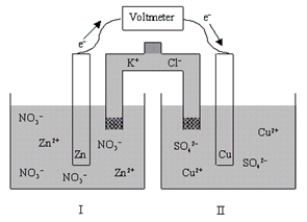
Cu2+(aq)+ 2e- <strong>If the cell is initially at standard-state conditions,which of the following statements is true?   Zn<sup>2+</sup>(aq)+ 2e<sup>-</sup>  Zn(s); E° = -0.76 V Cu<sup>2+</sup>(aq)+ 2e<sup>-</sup>  Cu(s); E° = 0.34 V</strong> A)Initially   ,and it will become more positive with time. B)Initially   ,and it will not change with time. C)Initially   ,and it will become more negative with time. D)Initially   ,and it will become more positive with time. E)Initially   ,and it will become more negative with time. Cu(s); E° = 0.34 V

A)Initially <strong>If the cell is initially at standard-state conditions,which of the following statements is true?   Zn<sup>2+</sup>(aq)+ 2e<sup>-</sup>  Zn(s); E° = -0.76 V Cu<sup>2+</sup>(aq)+ 2e<sup>-</sup>  Cu(s); E° = 0.34 V</strong> A)Initially   ,and it will become more positive with time. B)Initially   ,and it will not change with time. C)Initially   ,and it will become more negative with time. D)Initially   ,and it will become more positive with time. E)Initially   ,and it will become more negative with time. ,and it will become more positive with time.
B)Initially <strong>If the cell is initially at standard-state conditions,which of the following statements is true?   Zn<sup>2+</sup>(aq)+ 2e<sup>-</sup>  Zn(s); E° = -0.76 V Cu<sup>2+</sup>(aq)+ 2e<sup>-</sup>  Cu(s); E° = 0.34 V</strong> A)Initially   ,and it will become more positive with time. B)Initially   ,and it will not change with time. C)Initially   ,and it will become more negative with time. D)Initially   ,and it will become more positive with time. E)Initially   ,and it will become more negative with time. ,and it will not change with time.
C)Initially <strong>If the cell is initially at standard-state conditions,which of the following statements is true?   Zn<sup>2+</sup>(aq)+ 2e<sup>-</sup>  Zn(s); E° = -0.76 V Cu<sup>2+</sup>(aq)+ 2e<sup>-</sup>  Cu(s); E° = 0.34 V</strong> A)Initially   ,and it will become more positive with time. B)Initially   ,and it will not change with time. C)Initially   ,and it will become more negative with time. D)Initially   ,and it will become more positive with time. E)Initially   ,and it will become more negative with time. ,and it will become more negative with time.
D)Initially <strong>If the cell is initially at standard-state conditions,which of the following statements is true?   Zn<sup>2+</sup>(aq)+ 2e<sup>-</sup>  Zn(s); E° = -0.76 V Cu<sup>2+</sup>(aq)+ 2e<sup>-</sup>  Cu(s); E° = 0.34 V</strong> A)Initially   ,and it will become more positive with time. B)Initially   ,and it will not change with time. C)Initially   ,and it will become more negative with time. D)Initially   ,and it will become more positive with time. E)Initially   ,and it will become more negative with time. ,and it will become more positive with time.
E)Initially <strong>If the cell is initially at standard-state conditions,which of the following statements is true?   Zn<sup>2+</sup>(aq)+ 2e<sup>-</sup>  Zn(s); E° = -0.76 V Cu<sup>2+</sup>(aq)+ 2e<sup>-</sup>  Cu(s); E° = 0.34 V</strong> A)Initially   ,and it will become more positive with time. B)Initially   ,and it will not change with time. C)Initially   ,and it will become more negative with time. D)Initially   ,and it will become more positive with time. E)Initially   ,and it will become more negative with time. ,and it will become more negative with time.
Unlock Deck
Unlock for access to all 122 flashcards in this deck.
Unlock Deck
k this deck
64
What is the logarithm of the equilibrium constant,log K,at 25°C of the voltaic cell constructed from the following two half-reactions?
Fe2+ (aq)+ 2e¯ <strong>What is the logarithm of the equilibrium constant,log K,at 25°C of the voltaic cell constructed from the following two half-reactions? Fe<sup>2+</sup> (aq)+ 2e¯  Fe(s); ​E​° = - 0.41V Ag<sup>+</sup>(aq)+ e<sup>-</sup> <sup> </sup>  Ag(s); E° = 0.80 V</strong> A)6.7 B)40.9 C)20.3 D)13.2 E)67.6 Fe(s); ​E​° = - 0.41V
Ag+(aq)+ e-
<strong>What is the logarithm of the equilibrium constant,log K,at 25°C of the voltaic cell constructed from the following two half-reactions? Fe<sup>2+</sup> (aq)+ 2e¯  Fe(s); ​E​° = - 0.41V Ag<sup>+</sup>(aq)+ e<sup>-</sup> <sup> </sup>  Ag(s); E° = 0.80 V</strong> A)6.7 B)40.9 C)20.3 D)13.2 E)67.6 Ag(s); E° = 0.80 V

A)6.7
B)40.9
C)20.3
D)13.2
E)67.6
Unlock Deck
Unlock for access to all 122 flashcards in this deck.
Unlock Deck
k this deck
65
The cell potential of the following cell is determined using an unspecified concentration of acid.What is the pH of the acid solution given that the measured cell potential is -0.508 V and the anode reduction potential (E°)is 0.222 V at 25°C?

Ag(s)| AgCl(s)| Cl−(1.0 M)|| H+(aq,? M)| H2(g,1.0 atm)| Pt(s)

A)4.83
B)12.30
C)5.33
D)9.66
E)2.16
Unlock Deck
Unlock for access to all 122 flashcards in this deck.
Unlock Deck
k this deck
66
Calculate the maximum electrical work obtainable at 25oC from the following voltaic cell.
Cd(s)|Cd2+(0.840M​)||Cl2(g​,0.0354atm)|Cl-(0.0473M​)|Pt;Eºcell = 1.76V

A)-3.39 × 10⁵ J
B)-3.55 × 10⁵ J
C)-3.32 × 10⁵ J
D)-3.47 × 10⁵ J
E)-3.40 × 10⁵ J
Unlock Deck
Unlock for access to all 122 flashcards in this deck.
Unlock Deck
k this deck
67
Given: <strong>Given:       Pb<sup>2+</sup> (aq​)+ 2e<sup>-</sup> <sup> </sup>  Pb(s); E​º = -0.13 V What is the standard cell potential for the following reaction? 2Cr(s)+ 3Pb<sup>2+</sup> (​aq​)→ 3Pb(s​)+ 2Cr<sup>3+</sup> (aq)</strong> A)-0.87V B)   C)-0.61V D)0.61V E)0.87V <strong>Given:       Pb<sup>2+</sup> (aq​)+ 2e<sup>-</sup> <sup> </sup>  Pb(s); E​º = -0.13 V What is the standard cell potential for the following reaction? 2Cr(s)+ 3Pb<sup>2+</sup> (​aq​)→ 3Pb(s​)+ 2Cr<sup>3+</sup> (aq)</strong> A)-0.87V B)   C)-0.61V D)0.61V E)0.87V <strong>Given:       Pb<sup>2+</sup> (aq​)+ 2e<sup>-</sup> <sup> </sup>  Pb(s); E​º = -0.13 V What is the standard cell potential for the following reaction? 2Cr(s)+ 3Pb<sup>2+</sup> (​aq​)→ 3Pb(s​)+ 2Cr<sup>3+</sup> (aq)</strong> A)-0.87V B)   C)-0.61V D)0.61V E)0.87V
Pb2+ (aq​)+ 2e-
<strong>Given:       Pb<sup>2+</sup> (aq​)+ 2e<sup>-</sup> <sup> </sup>  Pb(s); E​º = -0.13 V What is the standard cell potential for the following reaction? 2Cr(s)+ 3Pb<sup>2+</sup> (​aq​)→ 3Pb(s​)+ 2Cr<sup>3+</sup> (aq)</strong> A)-0.87V B)   C)-0.61V D)0.61V E)0.87V Pb(s); E​º = -0.13 V
What is the standard cell potential for the following reaction?
2Cr(s)+ 3Pb2+ (​aq​)→ 3Pb(s​)+ 2Cr3+ (aq)

A)-0.87V
B) <strong>Given:       Pb<sup>2+</sup> (aq​)+ 2e<sup>-</sup> <sup> </sup>  Pb(s); E​º = -0.13 V What is the standard cell potential for the following reaction? 2Cr(s)+ 3Pb<sup>2+</sup> (​aq​)→ 3Pb(s​)+ 2Cr<sup>3+</sup> (aq)</strong> A)-0.87V B)   C)-0.61V D)0.61V E)0.87V
C)-0.61V
D)0.61V
E)0.87V
Unlock Deck
Unlock for access to all 122 flashcards in this deck.
Unlock Deck
k this deck
68
Calculate the solubility product of silver iodide at 25°C given the following data:
E°(V)
AgI(s)+ e- → Ag(s)+ I-
-0)15
I2(s)+ 2e- → 2I-
+0)54
Ag+ + e- → Ag(s)
+0)80

A)2 × 10-12
B)3 × 10⁻³
C)2 × 10-24
D)9 × 10-17
E)2 × 10⁻⁴
Unlock Deck
Unlock for access to all 122 flashcards in this deck.
Unlock Deck
k this deck
69
Given: <strong>Given:       Pb<sup>2+</sup> (aq​)+ 2e¯  Pb(​s​); ​E​º = -0.13V What is the standard Gibbs free-energy change for the following reaction? 2Cr(​s​)+ 3Pb<sup>2+</sup> (aq​)→ 3Pb(​s​)+ 2Cr<sup>3+</sup> (aq)</strong> A)353kJ B)118kJ C)   D)-353kJ E)   <strong>Given:       Pb<sup>2+</sup> (aq​)+ 2e¯  Pb(​s​); ​E​º = -0.13V What is the standard Gibbs free-energy change for the following reaction? 2Cr(​s​)+ 3Pb<sup>2+</sup> (aq​)→ 3Pb(​s​)+ 2Cr<sup>3+</sup> (aq)</strong> A)353kJ B)118kJ C)   D)-353kJ E)   <strong>Given:       Pb<sup>2+</sup> (aq​)+ 2e¯  Pb(​s​); ​E​º = -0.13V What is the standard Gibbs free-energy change for the following reaction? 2Cr(​s​)+ 3Pb<sup>2+</sup> (aq​)→ 3Pb(​s​)+ 2Cr<sup>3+</sup> (aq)</strong> A)353kJ B)118kJ C)   D)-353kJ E)
Pb2+ (aq​)+ 2e¯ <strong>Given:       Pb<sup>2+</sup> (aq​)+ 2e¯  Pb(​s​); ​E​º = -0.13V What is the standard Gibbs free-energy change for the following reaction? 2Cr(​s​)+ 3Pb<sup>2+</sup> (aq​)→ 3Pb(​s​)+ 2Cr<sup>3+</sup> (aq)</strong> A)353kJ B)118kJ C)   D)-353kJ E)   Pb(​s​); ​E​º = -0.13V
What is the standard Gibbs free-energy change for the following reaction?
2Cr(​s​)+ 3Pb2+ (aq​)→ 3Pb(​s​)+ 2Cr3+ (aq)

A)353kJ
B)118kJ
C) <strong>Given:       Pb<sup>2+</sup> (aq​)+ 2e¯  Pb(​s​); ​E​º = -0.13V What is the standard Gibbs free-energy change for the following reaction? 2Cr(​s​)+ 3Pb<sup>2+</sup> (aq​)→ 3Pb(​s​)+ 2Cr<sup>3+</sup> (aq)</strong> A)353kJ B)118kJ C)   D)-353kJ E)
D)-353kJ
E) <strong>Given:       Pb<sup>2+</sup> (aq​)+ 2e¯  Pb(​s​); ​E​º = -0.13V What is the standard Gibbs free-energy change for the following reaction? 2Cr(​s​)+ 3Pb<sup>2+</sup> (aq​)→ 3Pb(​s​)+ 2Cr<sup>3+</sup> (aq)</strong> A)353kJ B)118kJ C)   D)-353kJ E)
Unlock Deck
Unlock for access to all 122 flashcards in this deck.
Unlock Deck
k this deck
70
Which of the following statements is true concerning the electrochemical cell depicted below?
Zn | Zn2+(aq)|| Cu2+(aq)| Cu
Zn2+(aq)+ 2e− <strong>Which of the following statements is true concerning the electrochemical cell depicted below? Zn | Zn<sup>2+</sup>(aq)|| Cu<sup>2+</sup>(aq)| Cu Zn<sup>2+</sup>(aq)+ 2e−  Zn(s); E° = -2.87 V Cu<sup>2+</sup>(aq)+ 2e−  Cu(s); E° = -2.38 V</strong> A)The cell is at equilibrium. B)The cell reaction is spontaneous with a standard cell potential of 0.49 V. C)The cell reaction is spontaneous with a standard cell potential of 5.25 V. D)The cell reaction is nonspontaneous with a standard cell potential of -5.25 V. E)The cell reaction is nonspontaneous with a standard cell potential of -0.49 V. Zn(s); E° = -2.87 V
Cu2+(aq)+ 2e− <strong>Which of the following statements is true concerning the electrochemical cell depicted below? Zn | Zn<sup>2+</sup>(aq)|| Cu<sup>2+</sup>(aq)| Cu Zn<sup>2+</sup>(aq)+ 2e−  Zn(s); E° = -2.87 V Cu<sup>2+</sup>(aq)+ 2e−  Cu(s); E° = -2.38 V</strong> A)The cell is at equilibrium. B)The cell reaction is spontaneous with a standard cell potential of 0.49 V. C)The cell reaction is spontaneous with a standard cell potential of 5.25 V. D)The cell reaction is nonspontaneous with a standard cell potential of -5.25 V. E)The cell reaction is nonspontaneous with a standard cell potential of -0.49 V. Cu(s); E° = -2.38 V

A)The cell is at equilibrium.
B)The cell reaction is spontaneous with a standard cell potential of 0.49 V.
C)The cell reaction is spontaneous with a standard cell potential of 5.25 V.
D)The cell reaction is nonspontaneous with a standard cell potential of -5.25 V.
E)The cell reaction is nonspontaneous with a standard cell potential of -0.49 V.
Unlock Deck
Unlock for access to all 122 flashcards in this deck.
Unlock Deck
k this deck
71
What is the equilibrium constant (K)at 25°C for the following cell reaction?
Sn(​s​)+ Pb2+ ​(​aq​)→ Sn2+ (​aq​)+ Pb(​s​); ​E​°cell = 0.014 V

A)0.014
B)1.7
C)0.4
D)1.0
E)3
Unlock Deck
Unlock for access to all 122 flashcards in this deck.
Unlock Deck
k this deck
72
For a certain reaction,ΔHº = -75.4kJ and ΔSº = -225J/K.If ​n = ​3,calculate E°cell for the reaction at 25°C.

A)0.0288 V
B)0.0961 V
C)0.241 V
D)0.492 V
E)0.0654 V
Unlock Deck
Unlock for access to all 122 flashcards in this deck.
Unlock Deck
k this deck
73
A voltaic cell is made by placing an iron electrode in a compartment in which the Fe2+ concentration is 2.0 × 10⁻⁵ M and by placing a Pt electrode in the other compartment,in which the H+ concentration is 3.4 M and <strong>A voltaic cell is made by placing an iron electrode in a compartment in which the Fe<sup>2+</sup> concentration is 2.0 × 10<sup>-5</sup> M and by placing a Pt electrode in the other compartment,in which the H<sup>+</sup> concentration is 3.4 M and   = 1.00 atm.The Fe<sup>2+</sup>/Fe half-cell reduction potential is -0.41 V,and the H<sup>+</sup>/H<sub>2</sub> half-cell reduction potential is 0.00 V.What is the value of E° for this cell,and which electrode is the anode?</strong> A)0.41 V,Fe B)0.90 V,Pt C)-0.41 V,Pt D)-0.41 V,Fe E)0.41 V,Pt = 1.00 atm.The Fe2+/Fe half-cell reduction potential is -0.41 V,and the H+/H2 half-cell reduction potential is 0.00 V.What is the value of E° for this cell,and which electrode is the anode?

A)0.41 V,Fe
B)0.90 V,Pt
C)-0.41 V,Pt
D)-0.41 V,Fe
E)0.41 V,Pt
Unlock Deck
Unlock for access to all 122 flashcards in this deck.
Unlock Deck
k this deck
74
A voltaic cell is made by placing a zinc electrode in a compartment in which the Zn2+ concentration is 2.0 × 10⁻⁵ M and by placing a Pt electrode in the other compartment,in which the H+ concentration is 3.4 M and PH2 = 1.00 atm.The Zn2+/Zn half-cell reduction potential is -0.76 V,and the H+/H2 half-cell reduction potential is 0.00 V.What is the equilibrium constant at 25°C for the spontaneous cell reaction?

A)4 × 10⁴
B)5 × 10²⁰
C)5 × 10²²
D)7 × 10 12
E)5 × 10 25
Unlock Deck
Unlock for access to all 122 flashcards in this deck.
Unlock Deck
k this deck
75
Which of the following statements is true concerning the hypthetical electrochemical cell depicted below? (M1 and M2 are differing metals)
M1 | M12+(aq)|| M2+(aq)| M2
M12+(aq)+ 2e− <strong>Which of the following statements is true concerning the hypthetical electrochemical cell depicted below? (M1 and M2 are differing metals) M1 | M1<sup>2+</sup>(aq)|| M2<sup>+</sup>(aq)| M2 M1<sup>2+</sup>(aq)+ 2e−  M1(s); E° = -2.91 V M2<sup>2+</sup>(aq)+ e−  M2(s); E° = -2.98 V</strong> A)The cell reaction is nonspontaneous with a standard cell potential of -0.07 V. B)The cell reaction is spontaneous with a standard cell potential of 5.89 V. C)The cell is at equilibrium. D)The cell reaction is spontaneous with a standard cell potential of 0.07 V. E)The cell reaction is nonspontaneous with a standard cell potential of -5.89 V. M1(s); E° = -2.91 V
M22+(aq)+ e− <strong>Which of the following statements is true concerning the hypthetical electrochemical cell depicted below? (M1 and M2 are differing metals) M1 | M1<sup>2+</sup>(aq)|| M2<sup>+</sup>(aq)| M2 M1<sup>2+</sup>(aq)+ 2e−  M1(s); E° = -2.91 V M2<sup>2+</sup>(aq)+ e−  M2(s); E° = -2.98 V</strong> A)The cell reaction is nonspontaneous with a standard cell potential of -0.07 V. B)The cell reaction is spontaneous with a standard cell potential of 5.89 V. C)The cell is at equilibrium. D)The cell reaction is spontaneous with a standard cell potential of 0.07 V. E)The cell reaction is nonspontaneous with a standard cell potential of -5.89 V. M2(s); E° = -2.98 V

A)The cell reaction is nonspontaneous with a standard cell potential of -0.07 V.
B)The cell reaction is spontaneous with a standard cell potential of 5.89 V.
C)The cell is at equilibrium.
D)The cell reaction is spontaneous with a standard cell potential of 0.07 V.
E)The cell reaction is nonspontaneous with a standard cell potential of -5.89 V.
Unlock Deck
Unlock for access to all 122 flashcards in this deck.
Unlock Deck
k this deck
76
For a reaction in a voltaic cell,both ΔH° and ΔS° are positive.Which of the following statements is true?

A)E°cell will increase with an increase in temperature.
B)E°cell will not change when the temperature increases.
C)E°cell will decrease with an increase in temperature.
D)ΔG° > 0 for all temperatures.
E)None of the above statements is true.
Unlock Deck
Unlock for access to all 122 flashcards in this deck.
Unlock Deck
k this deck
77
If E°cell for a certain reaction is 1 V (n = 4),and ΔS° is 11.2 J/(K⋅mol),what is ΔH° in units of J/mol at 25°C?

A) <strong>If E°<sub>cell</sub> for a certain reaction is 1 V (n = 4),and ΔS° is 11.2 J/(K⋅mol),what is ΔH° in units of J/mol at 25°C?</strong> A)   × 10<sup>5</sup> J/mol B)   × 10<sup>5</sup> J/mol C)   × 10<sup>5</sup> J/mol D)   × 10<sup>4</sup> J/mol E)   J/mol × 105 J/mol
B) <strong>If E°<sub>cell</sub> for a certain reaction is 1 V (n = 4),and ΔS° is 11.2 J/(K⋅mol),what is ΔH° in units of J/mol at 25°C?</strong> A)   × 10<sup>5</sup> J/mol B)   × 10<sup>5</sup> J/mol C)   × 10<sup>5</sup> J/mol D)   × 10<sup>4</sup> J/mol E)   J/mol × 105 J/mol
C) <strong>If E°<sub>cell</sub> for a certain reaction is 1 V (n = 4),and ΔS° is 11.2 J/(K⋅mol),what is ΔH° in units of J/mol at 25°C?</strong> A)   × 10<sup>5</sup> J/mol B)   × 10<sup>5</sup> J/mol C)   × 10<sup>5</sup> J/mol D)   × 10<sup>4</sup> J/mol E)   J/mol × 105 J/mol
D) <strong>If E°<sub>cell</sub> for a certain reaction is 1 V (n = 4),and ΔS° is 11.2 J/(K⋅mol),what is ΔH° in units of J/mol at 25°C?</strong> A)   × 10<sup>5</sup> J/mol B)   × 10<sup>5</sup> J/mol C)   × 10<sup>5</sup> J/mol D)   × 10<sup>4</sup> J/mol E)   J/mol × 104 J/mol
E) <strong>If E°<sub>cell</sub> for a certain reaction is 1 V (n = 4),and ΔS° is 11.2 J/(K⋅mol),what is ΔH° in units of J/mol at 25°C?</strong> A)   × 10<sup>5</sup> J/mol B)   × 10<sup>5</sup> J/mol C)   × 10<sup>5</sup> J/mol D)   × 10<sup>4</sup> J/mol E)   J/mol J/mol
Unlock Deck
Unlock for access to all 122 flashcards in this deck.
Unlock Deck
k this deck
78
If the value of E°cell is 2.10 V for the reaction
F2 (g)+ 2Fe2+ (aq​)→ 2Fe3+ (aq)+ 2F- (aq),
What is the value of E°cell for
F- (aq)+ Fe3+ (aq)→ Fe2+ (aq​)+ 1/2 F2(g)?

A)-4.20 V
B)-1.05 V
C)2.10V
D)1.05 V
E)-2.10V
Unlock Deck
Unlock for access to all 122 flashcards in this deck.
Unlock Deck
k this deck
79
What is E of the following cell reaction at 25°C? E°cell = 0.460 V.Cu(s)| Cu2+(0.020M)|| Ag+(0.16M)| Ag(s)

A)0.463 V
B)0.282 V
C)0.460 V
D)0.487 V
E)0.467 V
Unlock Deck
Unlock for access to all 122 flashcards in this deck.
Unlock Deck
k this deck
80
If the cell is initially at standard-state conditions,which of the following statements is true? <strong>If the cell is initially at standard-state conditions,which of the following statements is true?   Zn<sup>2+</sup>(aq)+ 2e<sup>-</sup>  Zn(s); E° = -0.76 V Cu<sup>2+</sup>(aq)+ 2e<sup>-</sup>  Cu(s); E° = 0.34 V</strong> A)Initially K<sub>c</sub> = 2 × 10<sup>-37</sup>,and it decreases with time. B)Initially K<sub>c</sub> = 2 × 10<sup>37</sup>,and it does not change with time. C)Initially K<sub>c</sub> = 2 × 10<sup>37</sup>,and it decreases with time. D)Initially K<sub>c</sub> = 2 × 10<sup>37</sup>,and it increases with time. E)Initially K<sub>c</sub> = 2 × 10<sup>-37</sup>,and it increases with time. Zn2+(aq)+ 2e- <strong>If the cell is initially at standard-state conditions,which of the following statements is true?   Zn<sup>2+</sup>(aq)+ 2e<sup>-</sup>  Zn(s); E° = -0.76 V Cu<sup>2+</sup>(aq)+ 2e<sup>-</sup>  Cu(s); E° = 0.34 V</strong> A)Initially K<sub>c</sub> = 2 × 10<sup>-37</sup>,and it decreases with time. B)Initially K<sub>c</sub> = 2 × 10<sup>37</sup>,and it does not change with time. C)Initially K<sub>c</sub> = 2 × 10<sup>37</sup>,and it decreases with time. D)Initially K<sub>c</sub> = 2 × 10<sup>37</sup>,and it increases with time. E)Initially K<sub>c</sub> = 2 × 10<sup>-37</sup>,and it increases with time. Zn(s); E° = -0.76 V
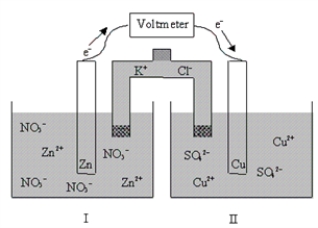
Cu2+(aq)+ 2e- <strong>If the cell is initially at standard-state conditions,which of the following statements is true?   Zn<sup>2+</sup>(aq)+ 2e<sup>-</sup>  Zn(s); E° = -0.76 V Cu<sup>2+</sup>(aq)+ 2e<sup>-</sup>  Cu(s); E° = 0.34 V</strong> A)Initially K<sub>c</sub> = 2 × 10<sup>-37</sup>,and it decreases with time. B)Initially K<sub>c</sub> = 2 × 10<sup>37</sup>,and it does not change with time. C)Initially K<sub>c</sub> = 2 × 10<sup>37</sup>,and it decreases with time. D)Initially K<sub>c</sub> = 2 × 10<sup>37</sup>,and it increases with time. E)Initially K<sub>c</sub> = 2 × 10<sup>-37</sup>,and it increases with time. Cu(s); E° = 0.34 V

A)Initially Kc = 2 × 10-37,and it decreases with time.
B)Initially Kc = 2 × 1037,and it does not change with time.
C)Initially Kc = 2 × 1037,and it decreases with time.
D)Initially Kc = 2 × 1037,and it increases with time.
E)Initially Kc = 2 × 10-37,and it increases with time.
Unlock Deck
Unlock for access to all 122 flashcards in this deck.
Unlock Deck
k this deck
locked card icon
Unlock Deck
Unlock for access to all 122 flashcards in this deck.






