







 Chat with AI

Deck 16: Monopolistic Competition
Full screen (f)

Question

Question
Figure 16-4 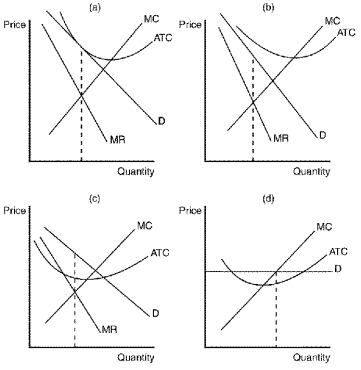
Refer to Figure 16-4.Which of the graphs depicts a short-run equilibrium that will encourage the entry of other firms into a monopolistically competitive industry?
A)panel a
B)panel b
C)panel c
D)panel d
Refer to Figure 16-4.Which of the graphs depicts a short-run equilibrium that will encourage the entry of other firms into a monopolistically competitive industry?
A)panel a
B)panel b
C)panel c
D)panel d
Question
Question
Question
Question
Question
Question
Question
Question
Question
Question
Question
Question
Question
Question
Question
Figure 16-4
Refer to Figure 16-4.Which of the panels depicts a firm in a monopolistically competitive market earning positive economic profits?
A)panel a
B)panel b
C)panel c
D)panel d
Refer to Figure 16-4.Which of the panels depicts a firm in a monopolistically competitive market earning positive economic profits?
A)panel a
B)panel b
C)panel c
D)panel d
Question
Question
Question
Question
Question
Question
Question
Question
Question
Question
Question
Question
Question
Question
Figure 16-8
The figure is drawn for a monopolistically-competitive firm.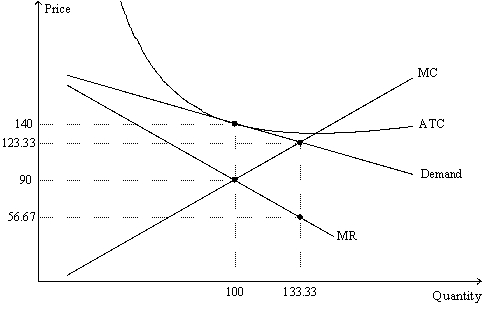
Refer to Figure 16-8.As the figure is drawn,the firm is in
A)a short-run equilibrium but it is not in a long-run equilibrium.
B)a long-run equilibrium but it is not in a short-run equilibrium.
C)a short-run equilibrium as well as a long-run equilibrium.
D)neither a short-run equilibrium nor a long-run equilibrium.
The figure is drawn for a monopolistically-competitive firm.
Refer to Figure 16-8.As the figure is drawn,the firm is in
A)a short-run equilibrium but it is not in a long-run equilibrium.
B)a long-run equilibrium but it is not in a short-run equilibrium.
C)a short-run equilibrium as well as a long-run equilibrium.
D)neither a short-run equilibrium nor a long-run equilibrium.
Question
Question
Question
Question
Question
Question
Question
Question
Question
Question
Question
Question
Question
Question
Question
Question
Question
Question
Question
Question
Question
Question
Question
Question
Question
Question
Question
Question
Question
Question
Question
Question
Question
Question
Question

Unlock Deck
Sign up to unlock the cards in this deck!
Unlock Deck
Unlock Deck
1/66

Play

Full screen (f)
Deck 16: Monopolistic Competition
1
Monopolistic competition is a type of
A)oligopoly.
B)market structure.
C)price discrimination.
D)advertising strategy.
A)oligopoly.
B)market structure.
C)price discrimination.
D)advertising strategy.
B
2
Figure 16-4
Refer to Figure 16-4.Which of the graphs depicts a short-run equilibrium that will encourage the entry of other firms into a monopolistically competitive industry?
A)panel a
B)panel b
C)panel c
D)panel d
Refer to Figure 16-4.Which of the graphs depicts a short-run equilibrium that will encourage the entry of other firms into a monopolistically competitive industry?
A)panel a
B)panel b
C)panel c
D)panel d
C
3
For a profit-maximizing monopolistically competitive firm,marginal revenue equals marginal cost in
A)the short run but not in the long run.
B)the long run but not in the short run.
C)both the short run and the long run.
D)neither the short run nor the long run.
A)the short run but not in the long run.
B)the long run but not in the short run.
C)both the short run and the long run.
D)neither the short run nor the long run.
C
4
In the short run,a firm in a monopolistically competitive market operates much like a
A)firm in a perfectly competitive market.
B)firm in an oligopoly.
C)monopolist.
D)monopsonist.
A)firm in a perfectly competitive market.
B)firm in an oligopoly.
C)monopolist.
D)monopsonist.
Unlock Deck
Unlock for access to all 66 flashcards in this deck.
Unlock Deck
k this deck
5
One key difference between an oligopoly market and a competitive market is that oligopolistic firms
A)are price takers while competitive firms are not.
B)can affect the profit of other firms in the market by the choices they make while firms in competitive markets do not affect each other by the choices they make.
C)sell completely unrelated products while competitive firms do not.
D)sell their product at a price equal to marginal cost while competitive firms do not.
A)are price takers while competitive firms are not.
B)can affect the profit of other firms in the market by the choices they make while firms in competitive markets do not affect each other by the choices they make.
C)sell completely unrelated products while competitive firms do not.
D)sell their product at a price equal to marginal cost while competitive firms do not.
Unlock Deck
Unlock for access to all 66 flashcards in this deck.
Unlock Deck
k this deck
6
A downward-sloping demand curve
A)is a feature of all monopolistically competitive firms.
B)means that the firm in question will never experience a zero profit.
C)causes marginal revenue to exceed price.
D)prohibits firms from earning positive economic profits in the long run.
A)is a feature of all monopolistically competitive firms.
B)means that the firm in question will never experience a zero profit.
C)causes marginal revenue to exceed price.
D)prohibits firms from earning positive economic profits in the long run.
Unlock Deck
Unlock for access to all 66 flashcards in this deck.
Unlock Deck
k this deck
7
When a monopolistically competitive firm raises its price,
A)quantity demanded falls to zero.
B)quantity demanded declines but not to zero.
C)the market supply curve shifts outward.
D)quantity demanded remains constant.
A)quantity demanded falls to zero.
B)quantity demanded declines but not to zero.
C)the market supply curve shifts outward.
D)quantity demanded remains constant.
Unlock Deck
Unlock for access to all 66 flashcards in this deck.
Unlock Deck
k this deck
8
A profit-maximizing firm in a monopolistically competitive market is characterized by which of the following?
A)average revenue exceeds marginal revenue
B)marginal revenue equals marginal cost
C)price exceeds marginal cost
D)All of the above are correct.
A)average revenue exceeds marginal revenue
B)marginal revenue equals marginal cost
C)price exceeds marginal cost
D)All of the above are correct.
Unlock Deck
Unlock for access to all 66 flashcards in this deck.
Unlock Deck
k this deck
9
If "too much choice" is a problem for consumers,it would occur in which market structure(s)?
A)perfect competition
B)monopoly
C)monopolistic competition
D)perfect competition and monopolistic competition
A)perfect competition
B)monopoly
C)monopolistic competition
D)perfect competition and monopolistic competition
Unlock Deck
Unlock for access to all 66 flashcards in this deck.
Unlock Deck
k this deck
10
In perfect competition as well as in monopolistic competition,
A)marginal revenue is equal to price for each firm.
B)profit is positive in a long-run equilibrium for each firm.
C)entry and exit by firms are restricted.
D)there are many firms in a single market.
A)marginal revenue is equal to price for each firm.
B)profit is positive in a long-run equilibrium for each firm.
C)entry and exit by firms are restricted.
D)there are many firms in a single market.
Unlock Deck
Unlock for access to all 66 flashcards in this deck.
Unlock Deck
k this deck
11
The general term for market structures that fall somewhere between monopoly and perfect competition is
A)incomplete markets.
B)imperfectly competitive markets.
C)oligopoly markets.
D)monopolistically competitive markets.
A)incomplete markets.
B)imperfectly competitive markets.
C)oligopoly markets.
D)monopolistically competitive markets.
Unlock Deck
Unlock for access to all 66 flashcards in this deck.
Unlock Deck
k this deck
12
A monopolistically competitive firm faces the following demand schedule for its product: The firm has total fixed costs of $20 and a constant marginal cost of $2 per unit.The firm will maximize profit with
A)6 units of output.
B)9 units of output.
C)11 units of output.
D)13 units of output.
A)6 units of output.
B)9 units of output.
C)11 units of output.
D)13 units of output.
Unlock Deck
Unlock for access to all 66 flashcards in this deck.
Unlock Deck
k this deck
13
Which of the following statements is correct?
A)Monopolistic competition is similar to monopoly because both market structures are characterized by patents.
B)Monopolistic competition is similar to perfect competition because both market structures are characterized by each seller being small compared to the market.
C)Monopolistic competition is similar to oligopoly because both market structures are characterized by free entry.
D)Monopolistic competition is similar to perfect competition because both market structures are characterized by excess capacity.
A)Monopolistic competition is similar to monopoly because both market structures are characterized by patents.
B)Monopolistic competition is similar to perfect competition because both market structures are characterized by each seller being small compared to the market.
C)Monopolistic competition is similar to oligopoly because both market structures are characterized by free entry.
D)Monopolistic competition is similar to perfect competition because both market structures are characterized by excess capacity.
Unlock Deck
Unlock for access to all 66 flashcards in this deck.
Unlock Deck
k this deck
14
Which of the following pairs illustrates the two extreme examples of market structures?
A)competition and oligopoly
B)competition and monopoly
C)monopoly and monopolistic competition
D)oligopoly and monopolistic competition
A)competition and oligopoly
B)competition and monopoly
C)monopoly and monopolistic competition
D)oligopoly and monopolistic competition
Unlock Deck
Unlock for access to all 66 flashcards in this deck.
Unlock Deck
k this deck
15
One characteristic of an oligopoly market structure is:
A)firms in the industry are typically characterized by very diverse product lines.
B)firms in the industry have some degree of market power.
C)products typically sell at a price equal to their marginal cost of production.
D)the actions of one seller have no impact on the profitability of other sellers.
A)firms in the industry are typically characterized by very diverse product lines.
B)firms in the industry have some degree of market power.
C)products typically sell at a price equal to their marginal cost of production.
D)the actions of one seller have no impact on the profitability of other sellers.
Unlock Deck
Unlock for access to all 66 flashcards in this deck.
Unlock Deck
k this deck
16
A monopolistically competitive industry is characterized by
A)many firms,differentiated products,and barriers to entry.
B)many firms,differentiated products,and free entry.
C)a few firms,identical products,and free entry.
D)a few firms,differentiated products,and barriers to entry.
A)many firms,differentiated products,and barriers to entry.
B)many firms,differentiated products,and free entry.
C)a few firms,identical products,and free entry.
D)a few firms,differentiated products,and barriers to entry.
Unlock Deck
Unlock for access to all 66 flashcards in this deck.
Unlock Deck
k this deck
17
Figure 16-4
Refer to Figure 16-4.Which of the panels depicts a firm in a monopolistically competitive market earning positive economic profits?
A)panel a
B)panel b
C)panel c
D)panel d
Refer to Figure 16-4.Which of the panels depicts a firm in a monopolistically competitive market earning positive economic profits?
A)panel a
B)panel b
C)panel c
D)panel d
Unlock Deck
Unlock for access to all 66 flashcards in this deck.
Unlock Deck
k this deck
18
The commercial jetliner industry consisting of Boeing and Airbus would best be described as a (an)
A)perfectly competitive market.
B)monopolistically competitive market.
C)oligopoly.
D)monopoly.
A)perfectly competitive market.
B)monopolistically competitive market.
C)oligopoly.
D)monopoly.
Unlock Deck
Unlock for access to all 66 flashcards in this deck.
Unlock Deck
k this deck
19
Which of the following statements is correct?
A)Cigarettes are likely to be produced in a monopolistically competitive industry.
B)Novels are likely to be produced in a monopoly industry.
C)Movies are likely to be produced in a monopolistically competitive industry.
D)Milk is likely to be produced in an oligopoly industry.
A)Cigarettes are likely to be produced in a monopolistically competitive industry.
B)Novels are likely to be produced in a monopoly industry.
C)Movies are likely to be produced in a monopolistically competitive industry.
D)Milk is likely to be produced in an oligopoly industry.
Unlock Deck
Unlock for access to all 66 flashcards in this deck.
Unlock Deck
k this deck
20
Monopolistic competition differs from perfect competition because in monopolistically competitive markets
A)there are barriers to entry.
B)all firms can eventually earn economic profits.
C)each of the sellers offers a somewhat different product.
D)strategic interactions between firms are important.
A)there are barriers to entry.
B)all firms can eventually earn economic profits.
C)each of the sellers offers a somewhat different product.
D)strategic interactions between firms are important.
Unlock Deck
Unlock for access to all 66 flashcards in this deck.
Unlock Deck
k this deck
21
Which of the following best describes the idea of excess capacity in monopolistic competition?
A)Firms produce more output than is socially desirable.
B)The output produced by a typical firm is less than what would occur at the minimum point on its ATC curve.
C)Due to product differentiation,firms choose output levels where price equals average total cost.
D)Firms keep some surplus output on hand in case there is a shift in the demand for their product.
A)Firms produce more output than is socially desirable.
B)The output produced by a typical firm is less than what would occur at the minimum point on its ATC curve.
C)Due to product differentiation,firms choose output levels where price equals average total cost.
D)Firms keep some surplus output on hand in case there is a shift in the demand for their product.
Unlock Deck
Unlock for access to all 66 flashcards in this deck.
Unlock Deck
k this deck
22
A monopolistically competitive firm is currently earning a positive economic profit.If other firms enter the market,we would expect that the added competition will cause this firm to adjust its output such that it
A)will operate closer to its efficient scale.
B)will operate further from its efficient scale.
C)will no longer be at its efficient scale.
D)might move either closer to or further from its efficient scale.
A)will operate closer to its efficient scale.
B)will operate further from its efficient scale.
C)will no longer be at its efficient scale.
D)might move either closer to or further from its efficient scale.
Unlock Deck
Unlock for access to all 66 flashcards in this deck.
Unlock Deck
k this deck
23
Regulation of a firm in a monopolistically competitive market
A)usually implies a very small administrative burden.
B)will lower the firm's costs.
C)is commonly used to enhance market efficiency.
D)is unlikely to improve market efficiency.
A)usually implies a very small administrative burden.
B)will lower the firm's costs.
C)is commonly used to enhance market efficiency.
D)is unlikely to improve market efficiency.
Unlock Deck
Unlock for access to all 66 flashcards in this deck.
Unlock Deck
k this deck
24
Firm A produces and sells in a market that is characterized by highly differentiated consumer goods.Firm B produces and sells industrial products.Firm C produces and sells an agricultural commodity.Which firm is likely to spend the greatest portion of its total revenue on advertising?
A)firm A
B)firm B
C)firm C
D)There is no reason to believe that any one of the three firms would spend a greater portion of its total revenue on advertising than the other two firms.
A)firm A
B)firm B
C)firm C
D)There is no reason to believe that any one of the three firms would spend a greater portion of its total revenue on advertising than the other two firms.
Unlock Deck
Unlock for access to all 66 flashcards in this deck.
Unlock Deck
k this deck
25
A monopolistically competitive firm faces the following demand curve for its product: The firm has total fixed costs of 40 dinars and a constant marginal cost of 2 dinars per unit.We can conclude that
A)firms will exit this market.
B)firms will enter this market.
C)this market is in long-run equilibrium.
D)this firm is operating at its efficient scale.
A)firms will exit this market.
B)firms will enter this market.
C)this market is in long-run equilibrium.
D)this firm is operating at its efficient scale.
Unlock Deck
Unlock for access to all 66 flashcards in this deck.
Unlock Deck
k this deck
26
Under which of the following market structures would consumers likely pay the highest price for a product?
A)perfect competition
B)monopolistic competition
C)oligopoly
D)monopoly
A)perfect competition
B)monopolistic competition
C)oligopoly
D)monopoly
Unlock Deck
Unlock for access to all 66 flashcards in this deck.
Unlock Deck
k this deck
27
For the economy as a whole,spending on advertising comprises about what percent of total firm revenue?
A)0.5
B)2
C)10
D)20
A)0.5
B)2
C)10
D)20
Unlock Deck
Unlock for access to all 66 flashcards in this deck.
Unlock Deck
k this deck
28
Monopolistic competition is an inefficient market structure because
A)marginal revenue equals marginal cost.
B)it has a deadweight loss,just as monopoly does.
C)long-run profits are zero due to free entry.
D)All of the above are correct.
A)marginal revenue equals marginal cost.
B)it has a deadweight loss,just as monopoly does.
C)long-run profits are zero due to free entry.
D)All of the above are correct.
Unlock Deck
Unlock for access to all 66 flashcards in this deck.
Unlock Deck
k this deck
29
Suppose for some firm that average total cost is minimized at Q1 units of output.For a monopolistically competitive firm in long-run equilibrium,Q1
A)is also the level of output at which marginal cost equals average total cost.
B)exceeds the level of output at which there is a point of tangency between the demand curve and the average total cost curve.
C)exceeds the level of output at which marginal revenue equals marginal cost.
D)All of the above are correct.
A)is also the level of output at which marginal cost equals average total cost.
B)exceeds the level of output at which there is a point of tangency between the demand curve and the average total cost curve.
C)exceeds the level of output at which marginal revenue equals marginal cost.
D)All of the above are correct.
Unlock Deck
Unlock for access to all 66 flashcards in this deck.
Unlock Deck
k this deck
30
Which of the following statements is correct?
A)In the long run,both perfectly competitive firms and monopolistically competitive firms operate with excess capacity.
B)A firm operates with excess capacity when,in the long run,its level of output is below the efficient scale.
C)For any firm,efficient scale is the level of output at which the average-total-cost curve is tangent to the demand curve.
D)All of the above are correct.
A)In the long run,both perfectly competitive firms and monopolistically competitive firms operate with excess capacity.
B)A firm operates with excess capacity when,in the long run,its level of output is below the efficient scale.
C)For any firm,efficient scale is the level of output at which the average-total-cost curve is tangent to the demand curve.
D)All of the above are correct.
Unlock Deck
Unlock for access to all 66 flashcards in this deck.
Unlock Deck
k this deck
31
Figure 16-8
The figure is drawn for a monopolistically-competitive firm.
Refer to Figure 16-8.As the figure is drawn,the firm is in
A)a short-run equilibrium but it is not in a long-run equilibrium.
B)a long-run equilibrium but it is not in a short-run equilibrium.
C)a short-run equilibrium as well as a long-run equilibrium.
D)neither a short-run equilibrium nor a long-run equilibrium.
The figure is drawn for a monopolistically-competitive firm.
Refer to Figure 16-8.As the figure is drawn,the firm is in
A)a short-run equilibrium but it is not in a long-run equilibrium.
B)a long-run equilibrium but it is not in a short-run equilibrium.
C)a short-run equilibrium as well as a long-run equilibrium.
D)neither a short-run equilibrium nor a long-run equilibrium.
Unlock Deck
Unlock for access to all 66 flashcards in this deck.
Unlock Deck
k this deck
32
When a firm exits a monopolistically competitive market,the individual demand curves faced by all remaining firms in that market will
A)shift in a direction that is unpredictable without further information.
B)shift to the right.
C)shift to the left.
D)remain unchanged.It is the supply curve that will shift.
A)shift in a direction that is unpredictable without further information.
B)shift to the right.
C)shift to the left.
D)remain unchanged.It is the supply curve that will shift.
Unlock Deck
Unlock for access to all 66 flashcards in this deck.
Unlock Deck
k this deck
33
Some firms have an incentive to advertise because they sell a
A)homogeneous product and charge a price equal to marginal cost.
B)homogeneous product and charge a price above marginal cost.
C)differentiated product and charge a price equal to marginal cost.
D)differentiated product and charge a price above marginal cost.
A)homogeneous product and charge a price equal to marginal cost.
B)homogeneous product and charge a price above marginal cost.
C)differentiated product and charge a price equal to marginal cost.
D)differentiated product and charge a price above marginal cost.
Unlock Deck
Unlock for access to all 66 flashcards in this deck.
Unlock Deck
k this deck
34
Which of the following conditions is characteristic of a monopolistically competitive firm in long-run equilibrium?
A)P > demand and P = MR
B)ATC > demand and MR = MC
C)P > MC and demand = ATC
D)P < ATC and demand > MR
A)P > demand and P = MR
B)ATC > demand and MR = MC
C)P > MC and demand = ATC
D)P < ATC and demand > MR
Unlock Deck
Unlock for access to all 66 flashcards in this deck.
Unlock Deck
k this deck
35
Which of the following is not an example of Joel Waldfogel's "Tyranny of the Market"?
A)A daily newspaper tailored to appeal to the majority of readers in an area.
B)Nike creating specialized shoes for American Indians' wider feet.
C)Pharmaceutical companies spending research and development funds on drugs for common diseases.
D)Airlines offering daily direct flights from one large city to another.
A)A daily newspaper tailored to appeal to the majority of readers in an area.
B)Nike creating specialized shoes for American Indians' wider feet.
C)Pharmaceutical companies spending research and development funds on drugs for common diseases.
D)Airlines offering daily direct flights from one large city to another.
Unlock Deck
Unlock for access to all 66 flashcards in this deck.
Unlock Deck
k this deck
36
Consider monopoly,monopolistic competition,and perfect competition.In which of these three market structures does a profit-maximizing firm charge a price that exceeds marginal cost?
A)monopoly only
B)monopoly and monopolistic competition only
C)monopoly,monopolistic competition,and perfect competition
D)The answer cannot be determined without knowing whether the market is in the long run or short run.
A)monopoly only
B)monopoly and monopolistic competition only
C)monopoly,monopolistic competition,and perfect competition
D)The answer cannot be determined without knowing whether the market is in the long run or short run.
Unlock Deck
Unlock for access to all 66 flashcards in this deck.
Unlock Deck
k this deck
37
Although monopolistically competitive markets offer consumers a wide variety of differentiated products,there may still be insufficient variety if
A)there are large fixed costs in the market.
B)there are no barriers to entry in the market.
C)the business-stealing externality is present in the market.
D)the government does not impose regulations on the market.
A)there are large fixed costs in the market.
B)there are no barriers to entry in the market.
C)the business-stealing externality is present in the market.
D)the government does not impose regulations on the market.
Unlock Deck
Unlock for access to all 66 flashcards in this deck.
Unlock Deck
k this deck
38
Firms that spend the greatest percentage of their revenue on advertising tend to be firms that sell
A)industrial products.
B)homogeneous products.
C)consumer goods for which there are no close substitutes.
D)highly-differentiated consumer goods.
A)industrial products.
B)homogeneous products.
C)consumer goods for which there are no close substitutes.
D)highly-differentiated consumer goods.
Unlock Deck
Unlock for access to all 66 flashcards in this deck.
Unlock Deck
k this deck
39
The deadweight loss that is associated with a monopolistically competitive market is a result of
A)price falling short of marginal cost in order to increase market share.
B)price exceeding marginal cost.
C)the firm operating in a regulated industry.
D)excessive advertising costs.
A)price falling short of marginal cost in order to increase market share.
B)price exceeding marginal cost.
C)the firm operating in a regulated industry.
D)excessive advertising costs.
Unlock Deck
Unlock for access to all 66 flashcards in this deck.
Unlock Deck
k this deck
40
Which of these types of firms can earn a positive economic profit in the long run?
A)monopolies,but not competitive firms or monopolistically competitive firms
B)monopolies and monopolistically competitive firms,but not competitive firms
C)monopolies,monopolistically competitive firms,and competitive firms
D)No firms earn positive economic profit in the long run.Entry will reduce all firms' economic profit to zero in the long run.
A)monopolies,but not competitive firms or monopolistically competitive firms
B)monopolies and monopolistically competitive firms,but not competitive firms
C)monopolies,monopolistically competitive firms,and competitive firms
D)No firms earn positive economic profit in the long run.Entry will reduce all firms' economic profit to zero in the long run.
Unlock Deck
Unlock for access to all 66 flashcards in this deck.
Unlock Deck
k this deck
41
When a monopolistically competitive firm is in a long-run equilibrium,the values of marginal cost,average total cost,and price are all the same.
Unlock Deck
Unlock for access to all 66 flashcards in this deck.
Unlock Deck
k this deck
42
In the long run,monopolistically competitive firms produce where demand equals marginal cost.
Unlock Deck
Unlock for access to all 66 flashcards in this deck.
Unlock Deck
k this deck
43
A firm maximizes its profit by producing output up to the point where marginal revenue equals marginal cost
A)only when the market is a monopoly.
B)only when the market is a monopoly or monopolistically competitive.
C)only when the market is monopolistically competitive or perfectly competitive.
D)when the market is perfectly competitive,monopolistically competitive,or monopolistic.
A)only when the market is a monopoly.
B)only when the market is a monopoly or monopolistically competitive.
C)only when the market is monopolistically competitive or perfectly competitive.
D)when the market is perfectly competitive,monopolistically competitive,or monopolistic.
Unlock Deck
Unlock for access to all 66 flashcards in this deck.
Unlock Deck
k this deck
44
There are four basic types of market structure.
Unlock Deck
Unlock for access to all 66 flashcards in this deck.
Unlock Deck
k this deck
45
In the study done by Lee Benham on advertising for eyeglasses,
A)advertising increased the average price.
B)advertising decreased the average price.
C)there was no difference in price,but quality was better in the states that didn't allow advertising.
D)advertising appeared to have no effect whatsoever in the states that permitted advertising.
A)advertising increased the average price.
B)advertising decreased the average price.
C)there was no difference in price,but quality was better in the states that didn't allow advertising.
D)advertising appeared to have no effect whatsoever in the states that permitted advertising.
Unlock Deck
Unlock for access to all 66 flashcards in this deck.
Unlock Deck
k this deck
46
The product-variety externality states that entry of a new firm conveys a negative externality on consumers.
Unlock Deck
Unlock for access to all 66 flashcards in this deck.
Unlock Deck
k this deck
47
A profit-maximizing firm in a monopolistically competitive market charges a price equal to marginal cost.
Unlock Deck
Unlock for access to all 66 flashcards in this deck.
Unlock Deck
k this deck
48
In a monopolistically competitive market,the demand curves faced by incumbent firms are unaffected by the entry of new firms into the market.
Unlock Deck
Unlock for access to all 66 flashcards in this deck.
Unlock Deck
k this deck
49
When McDonald's opens a store in Dhaka,Bangladesh,it has a strong incentive to enforce product quality consistent with stores in the United States.
Unlock Deck
Unlock for access to all 66 flashcards in this deck.
Unlock Deck
k this deck
50
Economists John Kenneth Galbraith and Friedrich Hayek disagreed about the roles of advertising and government.Which of the following is correct?
A)Galbraith thought advertising artificially enhanced consumers' desires for private goods,while Hayek thought no producer could "determine" consumers' tastes though advertising.
B)Galbraith believed in enhancing personal freedoms,while Hayek advocated larger government.
C)Galbraith thought advertising was a waste of resources because it did not influence consumers,while Hayek thought advertising was powerful enough to "determine" consumers' tastes.
D)Galbraith believed that the government should not interfere in markets,while Hayek believed that there was insufficient government regulation of marketing.
A)Galbraith thought advertising artificially enhanced consumers' desires for private goods,while Hayek thought no producer could "determine" consumers' tastes though advertising.
B)Galbraith believed in enhancing personal freedoms,while Hayek advocated larger government.
C)Galbraith thought advertising was a waste of resources because it did not influence consumers,while Hayek thought advertising was powerful enough to "determine" consumers' tastes.
D)Galbraith believed that the government should not interfere in markets,while Hayek believed that there was insufficient government regulation of marketing.
Unlock Deck
Unlock for access to all 66 flashcards in this deck.
Unlock Deck
k this deck
51
The term excess capacity refers to the fact that a firm produces a lower quantity than it would if it operated at the efficient scale.
Unlock Deck
Unlock for access to all 66 flashcards in this deck.
Unlock Deck
k this deck
52
One thing that both critics of advertising and defenders of advertising agree on is that advertising fosters competition.
Unlock Deck
Unlock for access to all 66 flashcards in this deck.
Unlock Deck
k this deck
53
Which of the following statements is correct?
A)Firms in monopolistic competition and monopoly can earn economic profits in both the short run and the long run.
B)Both perfectly competitive and monopolistically competitive firms charge a price equal to marginal cost.
C)Firms in perfect competition,monopolistic competition,and monopoly maximize profits by producing where marginal revenue equals marginal cost.
D)Both perfectly competitive and monopolistically competitive firms produce the welfare-maximizing level of output.
A)Firms in monopolistic competition and monopoly can earn economic profits in both the short run and the long run.
B)Both perfectly competitive and monopolistically competitive firms charge a price equal to marginal cost.
C)Firms in perfect competition,monopolistic competition,and monopoly maximize profits by producing where marginal revenue equals marginal cost.
D)Both perfectly competitive and monopolistically competitive firms produce the welfare-maximizing level of output.
Unlock Deck
Unlock for access to all 66 flashcards in this deck.
Unlock Deck
k this deck
54
Defenders of advertising argue that firms use advertising as a signal of quality,even if the advertising delivers little helpful information about the product.
Unlock Deck
Unlock for access to all 66 flashcards in this deck.
Unlock Deck
k this deck
55
It has been said that many of the patrons in McDonald's restaurants in foreign locations are American tourists.A likely reason why many Americans dine at McDonald's while vacationing abroad is
A)they can't get enough McDonald's food when they are at home.
B)they know and trust the quality associated with the McDonald's brand name.
C)the food at local restaurants is of inferior quality.
D)that Americans,by their nature,are not very adventurous.
A)they can't get enough McDonald's food when they are at home.
B)they know and trust the quality associated with the McDonald's brand name.
C)the food at local restaurants is of inferior quality.
D)that Americans,by their nature,are not very adventurous.
Unlock Deck
Unlock for access to all 66 flashcards in this deck.
Unlock Deck
k this deck
56
When monopolistically competitive firms advertise,in the long run
A)they will still earn zero economic profit.
B)they can earn positive economic profit by increasing market share.
C)the market price must fall.
D)the market price must rise.
A)they will still earn zero economic profit.
B)they can earn positive economic profit by increasing market share.
C)the market price must fall.
D)the market price must rise.
Unlock Deck
Unlock for access to all 66 flashcards in this deck.
Unlock Deck
k this deck
57
The market for wheat is most likely considered a monopolistically competitive market.
Unlock Deck
Unlock for access to all 66 flashcards in this deck.
Unlock Deck
k this deck
58
To be considered an oligopoly,the market must have a concentration ratio below 50%.
Unlock Deck
Unlock for access to all 66 flashcards in this deck.
Unlock Deck
k this deck
59
Product differentiation always leads to some measure of market power.
Unlock Deck
Unlock for access to all 66 flashcards in this deck.
Unlock Deck
k this deck
60
How does advertising signal to consumers that the product is a good one?
A)By seeing famous people using the product,consumers infer that they too can be famous.
B)By being willing to spend money on advertising,firms let consumers know the product is likely a good one since firms would not likely advertise a poor product.
C)By making consumers laugh during commercials,firms are associating positive experiences with the product.
D)Without allowing consumers to actually use the product,it is not possible for firms to signal to consumers the product's quality.
A)By seeing famous people using the product,consumers infer that they too can be famous.
B)By being willing to spend money on advertising,firms let consumers know the product is likely a good one since firms would not likely advertise a poor product.
C)By making consumers laugh during commercials,firms are associating positive experiences with the product.
D)Without allowing consumers to actually use the product,it is not possible for firms to signal to consumers the product's quality.
Unlock Deck
Unlock for access to all 66 flashcards in this deck.
Unlock Deck
k this deck
61
The government may not be able to improve the inefficiencies of a monopolistically competitive market.
Unlock Deck
Unlock for access to all 66 flashcards in this deck.
Unlock Deck
k this deck
62
Discuss how brand names may enhance the efficiency of markets in a less developed country.
Unlock Deck
Unlock for access to all 66 flashcards in this deck.
Unlock Deck
k this deck
63
Use a graph to demonstrate why a profit-maximizing monopolistically competitive firm must operate at excess capacity.Explain why a perfectly competitive firm is not subject to the same constraint.
Unlock Deck
Unlock for access to all 66 flashcards in this deck.
Unlock Deck
k this deck
64
Assume the role of a critic of advertising.Describe the characteristics of advertising that reduce the effectiveness of markets and decrease the social welfare of society.
Unlock Deck
Unlock for access to all 66 flashcards in this deck.
Unlock Deck
k this deck
65
Entry of firms in a monopolistically competitive industry is characterized by two externalities.List them and briefly describe how consumers and existing firms are influenced by them.
Unlock Deck
Unlock for access to all 66 flashcards in this deck.
Unlock Deck
k this deck
66
Why does a typical monopolistically competitive firm face a downward-sloping demand curve?
Unlock Deck
Unlock for access to all 66 flashcards in this deck.
Unlock Deck
k this deck
Unlock Deck
Unlock for access to all 66 flashcards in this deck.






