







 Chat with AI

Deck 6: Energy for Life
Full screen (f)

Question

Question
Question
Question
Question
Question
Question
Question
Question
Question
Question
Question
Question
Question
Question
Question
Question
Question
Question
Question
Question
Question
Question
Question
Question
Question
Question
Question
Question
Question
Question
Question
Question
Question
Question
Question
Question
Question
Question
Question
Question
Question
Question
Question
Question
Question
Question
Question
Which of the labeled cells of a C3 leaf does not perform photosynthesis? 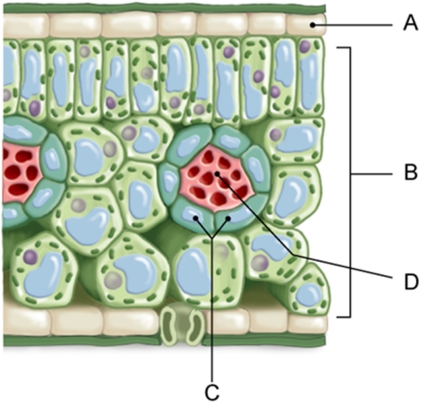
A) A and B
B) A and D
C) B and D
D) B and C
E) C and D
A) A and B
B) A and D
C) B and D
D) B and C
E) C and D
Question
Question
Question
Question
Question
In which of the labeled cells of a C4 leaf are the Calvin cycle reactions performed? 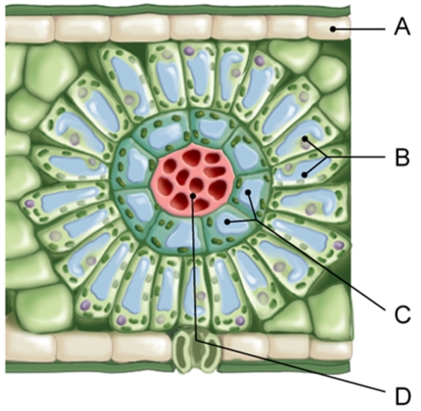
A) A and B
B) B and C
C) A and D
D) B only
E) C only
A) A and B
B) B and C
C) A and D
D) B only
E) C only
Question
Question
Question
Question
Question
Question
Question
Question
Question
Question

Unlock Deck
Sign up to unlock the cards in this deck!
Unlock Deck
Unlock Deck
1/63

Play

Full screen (f)
Deck 6: Energy for Life
1
Which of the following organisms can perform photosynthesis?
A) algae
B) fungi
C) animals
D) invertebrates
E) vertebrates
A) algae
B) fungi
C) animals
D) invertebrates
E) vertebrates
A
2
Replacement electrons for the reaction center of photosystem II are derived from
A) H2O.
B) NADP+.
C) G3P.
D) NADPH.
E) CO2.
A) H2O.
B) NADP+.
C) G3P.
D) NADPH.
E) CO2.
A
3
The chlorophyll a molecules in the reaction center of a photosystem participate directly in the capture of solar energy.What is the purpose of the accessory pigments?
A) They participate in the Calvin cycle.
B) They funnel solar energy to chlorophyll a in the reaction center.
C) They split the water molecule to supply electrons to the chlorophyll a in the reaction center.
D) They change the color of the leaves to discourage predators.
E) They have no purpose.
A) They participate in the Calvin cycle.
B) They funnel solar energy to chlorophyll a in the reaction center.
C) They split the water molecule to supply electrons to the chlorophyll a in the reaction center.
D) They change the color of the leaves to discourage predators.
E) They have no purpose.
B
4
The production of glyceraldehyde-3-phosphate (G3P)in the Calvin cycle requires six molecules each of ATP and NADPH.Another three molecules of ATP are then used in the cycle.What is the purpose of the three additional ATP molecules?
A) To regenerate the starter molecule RuBP.
B) To attract the next CO2 molecule to enter the Calvin cycle.
C) To reduce the molecules of G3P to form glucose.
D) To join acetyl CoA into pyruvate, preparing it to enter the citric acid cycle.
E) To fix carbon dioxide to RuBP.
A) To regenerate the starter molecule RuBP.
B) To attract the next CO2 molecule to enter the Calvin cycle.
C) To reduce the molecules of G3P to form glucose.
D) To join acetyl CoA into pyruvate, preparing it to enter the citric acid cycle.
E) To fix carbon dioxide to RuBP.
Unlock Deck
Unlock for access to all 63 flashcards in this deck.
Unlock Deck
k this deck
5
In photosynthesis,the light reactions ____________ while the Calvin cycle ____________.
A) capture solar energy; converts the captured energy to chemical potential energy
B) can occur only in the light; can occur only in the dark
C) require the presence of ATP; makes ATP
D) can only function if the stomata are open; can only occur if the stomata are closed
E) use products manufactured in the dark reactions; creates products used in the dark reactions
A) capture solar energy; converts the captured energy to chemical potential energy
B) can occur only in the light; can occur only in the dark
C) require the presence of ATP; makes ATP
D) can only function if the stomata are open; can only occur if the stomata are closed
E) use products manufactured in the dark reactions; creates products used in the dark reactions
Unlock Deck
Unlock for access to all 63 flashcards in this deck.
Unlock Deck
k this deck
6
The light reactions produce __________,which are used in the Calvin cycle.The Calvin cycle produces __________,which are in turn used in the light reactions.
A) ATP and NADPH; ADP and NADP
B) CO2 and H2O; glucose and O2
C) ATP and CO2; glucose and O2
D) glucose and O2; CO2 and H2O
E) ADP and NADH; ATP and NADPH
A) ATP and NADPH; ADP and NADP
B) CO2 and H2O; glucose and O2
C) ATP and CO2; glucose and O2
D) glucose and O2; CO2 and H2O
E) ADP and NADH; ATP and NADPH
Unlock Deck
Unlock for access to all 63 flashcards in this deck.
Unlock Deck
k this deck
7
Which of the following events does NOT take place in the light reactions?
A) transfer of electrons to the reaction center of photosystem I
B) generation of ATP from ADP + Pi
C) splitting of water, releasing an electron
D) generation of NADPH from NADP+
E) conversion of 3PG to G3P
A) transfer of electrons to the reaction center of photosystem I
B) generation of ATP from ADP + Pi
C) splitting of water, releasing an electron
D) generation of NADPH from NADP+
E) conversion of 3PG to G3P
Unlock Deck
Unlock for access to all 63 flashcards in this deck.
Unlock Deck
k this deck
8
Which compounds link the light reactions with the Calvin cycle reactions?
A) ATP and NADPH
B) H+ and ATP
C) G3P and ATP
D) H+ and G3P
E) G3P and NADPH
A) ATP and NADPH
B) H+ and ATP
C) G3P and ATP
D) H+ and G3P
E) G3P and NADPH
Unlock Deck
Unlock for access to all 63 flashcards in this deck.
Unlock Deck
k this deck
9
The light reactions of photosynthesis are said to be similar to a battery because they form a current.In which direction do the electrons of this circuit flow?
A) H2O PSII electron transport chain PSI electron transport chain NADPH
B) H2O PSII chlorophyll b PSI chlorophyll a NADPH
C) NADPH PSII electron transport chain PSI electron transport chain NADP+
D) NADP+ PSII electron transport chain PSI electron transport chain NADPH
E) PSI electron transport chain PSII electron transport chain NADPH
A) H2O PSII electron transport chain PSI electron transport chain NADPH
B) H2O PSII chlorophyll b PSI chlorophyll a NADPH
C) NADPH PSII electron transport chain PSI electron transport chain NADP+
D) NADP+ PSII electron transport chain PSI electron transport chain NADPH
E) PSI electron transport chain PSII electron transport chain NADPH
Unlock Deck
Unlock for access to all 63 flashcards in this deck.
Unlock Deck
k this deck
10
During photosynthesis,___________ is oxidized,while ___________ is reduced.
A) water; carbon dioxide
B) carbon dioxide; water
C) carbohydrate; carbon dioxide
D) carbon dioxide; carbohydrate
E) carbon dioxide; oxygen
A) water; carbon dioxide
B) carbon dioxide; water
C) carbohydrate; carbon dioxide
D) carbon dioxide; carbohydrate
E) carbon dioxide; oxygen
Unlock Deck
Unlock for access to all 63 flashcards in this deck.
Unlock Deck
k this deck
11
In a redox reaction,reduction means _________,and oxidation means _________.
A) loss of electrons; gain of electrons
B) gain of water; loss of water
C) gain of electrons; loss of electrons
D) loss of water; gain of water
E) gain of protons; loss of protons
A) loss of electrons; gain of electrons
B) gain of water; loss of water
C) gain of electrons; loss of electrons
D) loss of water; gain of water
E) gain of protons; loss of protons
Unlock Deck
Unlock for access to all 63 flashcards in this deck.
Unlock Deck
k this deck
12
The reaction center of each photosystem
A) splits water to release electrons.
B) funnels electrons to a central chlorophyll a molecule.
C) produces NADPH.
D) gives off oxygen when stimulated by light.
E) combine hydrogen ions with an electron to form water.
A) splits water to release electrons.
B) funnels electrons to a central chlorophyll a molecule.
C) produces NADPH.
D) gives off oxygen when stimulated by light.
E) combine hydrogen ions with an electron to form water.
Unlock Deck
Unlock for access to all 63 flashcards in this deck.
Unlock Deck
k this deck
13
The enzyme-rich solution found within the chloroplast is called the
A) granum.
B) chlorophyll.
C) cytoplasm.
D) stroma.
E) christae
A) granum.
B) chlorophyll.
C) cytoplasm.
D) stroma.
E) christae
Unlock Deck
Unlock for access to all 63 flashcards in this deck.
Unlock Deck
k this deck
14
Why do plants contain other pigments besides chlorophyll?
A) The additional pigments are able to absorb other light wavelengths that chlorophyll cannot.
B) The additional pigments can only absorb violet or ultraviolet light.
C) Chlorophyll is unable to absorb visible light.
D) When chlorophyll breaks down, the additional pigments can absorb the same wavelengths of light.
E) When the additional pigments break down, the chlorophyll can absorb other wavelengths of light.
A) The additional pigments are able to absorb other light wavelengths that chlorophyll cannot.
B) The additional pigments can only absorb violet or ultraviolet light.
C) Chlorophyll is unable to absorb visible light.
D) When chlorophyll breaks down, the additional pigments can absorb the same wavelengths of light.
E) When the additional pigments break down, the chlorophyll can absorb other wavelengths of light.
Unlock Deck
Unlock for access to all 63 flashcards in this deck.
Unlock Deck
k this deck
15
As climate change leads to drier and drier summers in the southeastern United States,more and more homeowners find that they have crabgrass growing in their yards.The reason for this is that
A) Crabgrass is a type of cactus, so it grows better in dry climates.
B) As the climate changes, homeowners are not caring for their yards as well.
C) Crabgrass is a tropical plant that likes hot, dry climates.
D) Crabgrass is a type of C3 plant that does well in dry climates.
E) Crabgrass is a type of C4 plant that does well in dry climates.
A) Crabgrass is a type of cactus, so it grows better in dry climates.
B) As the climate changes, homeowners are not caring for their yards as well.
C) Crabgrass is a tropical plant that likes hot, dry climates.
D) Crabgrass is a type of C3 plant that does well in dry climates.
E) Crabgrass is a type of C4 plant that does well in dry climates.
Unlock Deck
Unlock for access to all 63 flashcards in this deck.
Unlock Deck
k this deck
16
Chlorophyll is to the light reactions as ____________ is to the Calvin cycle.
A) NADP+
B) carbon dioxide
C) ATP
D) ATP synthase
E) RuBP
A) NADP+
B) carbon dioxide
C) ATP
D) ATP synthase
E) RuBP
Unlock Deck
Unlock for access to all 63 flashcards in this deck.
Unlock Deck
k this deck
17
Inside the chloroplasts,chlorophyll is found in the
A) mesophyll.
B) thylakoid space.
C) thylakoid membrane.
D) stroma.
E) cytoplasm.
A) mesophyll.
B) thylakoid space.
C) thylakoid membrane.
D) stroma.
E) cytoplasm.
Unlock Deck
Unlock for access to all 63 flashcards in this deck.
Unlock Deck
k this deck
18
The light reactions act much as a battery to power the reactions of the Calvin cycle.This energy is stored as
A) ATP and NADP+.
B) ADP + Pi.
C) ADP + Pi and NADP+.
D) ATP and NADPH.
E) NADPH and NADP+.
A) ATP and NADP+.
B) ADP + Pi.
C) ADP + Pi and NADP+.
D) ATP and NADPH.
E) NADPH and NADP+.
Unlock Deck
Unlock for access to all 63 flashcards in this deck.
Unlock Deck
k this deck
19
The innermost compartment of a chloroplast formed by the interconnected thylakoids is the
A) stroma.
B) thylakoid membrane.
C) chlorophyll.
D) thylakoid space.
E) leaf space.
A) stroma.
B) thylakoid membrane.
C) chlorophyll.
D) thylakoid space.
E) leaf space.
Unlock Deck
Unlock for access to all 63 flashcards in this deck.
Unlock Deck
k this deck
20
How does ATP synthase obtain the energy to produce ATP?
A) Hydrogen ions flow down a concentration gradient from the thylakoid space to the stroma through ATP synthase, releasing energy that can be used to produce ATP from ADP + Pi.
B) Water splits, releasing electrons that flow from the stroma to the thylakoid space and attach to the active site of ATP synthase.
C) Electrons from the reaction site center of photosystem II are funneled to ATP synthase, which uses the energy to produce ATP from ADP + Pi.
D) Hydrogen ions in the thylakoid space combine with electrons from the stroma at ATP synthase, releasing energy that can be used to produce ATP from ADP + Pi.
E) A hydrogen ion from NADPH is used by ATP synthase to power the production of ATP from ADP + Pi, and an electron is released, splitting water.
A) Hydrogen ions flow down a concentration gradient from the thylakoid space to the stroma through ATP synthase, releasing energy that can be used to produce ATP from ADP + Pi.
B) Water splits, releasing electrons that flow from the stroma to the thylakoid space and attach to the active site of ATP synthase.
C) Electrons from the reaction site center of photosystem II are funneled to ATP synthase, which uses the energy to produce ATP from ADP + Pi.
D) Hydrogen ions in the thylakoid space combine with electrons from the stroma at ATP synthase, releasing energy that can be used to produce ATP from ADP + Pi.
E) A hydrogen ion from NADPH is used by ATP synthase to power the production of ATP from ADP + Pi, and an electron is released, splitting water.
Unlock Deck
Unlock for access to all 63 flashcards in this deck.
Unlock Deck
k this deck
21
The end product of the Calvin cycle reactions is
A) glucose.
B) glyceraldehyde-3-phosphate (G3P).
C) sucrose.
D) 3-phosphoglycerate (3PG).
E) ribulose 1,5-bisphosphate (RuBP).
A) glucose.
B) glyceraldehyde-3-phosphate (G3P).
C) sucrose.
D) 3-phosphoglycerate (3PG).
E) ribulose 1,5-bisphosphate (RuBP).
Unlock Deck
Unlock for access to all 63 flashcards in this deck.
Unlock Deck
k this deck
22
The three stages of the Calvin cycle reactions are
A) NADPH reduction, CO2 fixation, and NADP+ regeneration.
B) NADPH reduction, CO2 fixation, and RuBP regeneration.
C) CO2 fixation, CO2 reduction, and RuBP regeneration.
D) CO2 fixation, CO2 reduction, and NADP+ regeneration.
E) CO2 reduction, NADPH reduction, and CO2 regeneration.
A) NADPH reduction, CO2 fixation, and NADP+ regeneration.
B) NADPH reduction, CO2 fixation, and RuBP regeneration.
C) CO2 fixation, CO2 reduction, and RuBP regeneration.
D) CO2 fixation, CO2 reduction, and NADP+ regeneration.
E) CO2 reduction, NADPH reduction, and CO2 regeneration.
Unlock Deck
Unlock for access to all 63 flashcards in this deck.
Unlock Deck
k this deck
23
A plant that uses CAM photosynthesis is most likely to be successful in what type of environment?
A) cool, moist
B) hot, moist
C) cool, dry
D) hot, dry
E) semi-tropical
A) cool, moist
B) hot, moist
C) cool, dry
D) hot, dry
E) semi-tropical
Unlock Deck
Unlock for access to all 63 flashcards in this deck.
Unlock Deck
k this deck
24
A small,low-growing plant found on the surface of a sun-exposed rock on a dry hillside would most likely use which type of photosynthesis?
A) CAM
B) C3
C) C4
D) both C4 and CAM
E) both C3 and CAM
A) CAM
B) C3
C) C4
D) both C4 and CAM
E) both C3 and CAM
Unlock Deck
Unlock for access to all 63 flashcards in this deck.
Unlock Deck
k this deck
25
Energy to drive the formation of ATP in photosynthesis is derived from
A) H+ gradient.
B) NADP+.
C) G3P.
D) NADPH.
E) CO2.
A) H+ gradient.
B) NADP+.
C) G3P.
D) NADPH.
E) CO2.
Unlock Deck
Unlock for access to all 63 flashcards in this deck.
Unlock Deck
k this deck
26
The reaction center of photosystem I consists of what type of molecule?
A) chlorophyll a
B) chlorophyll b
C) carotenoids
D) NADP+
E) electron transport proteins
A) chlorophyll a
B) chlorophyll b
C) carotenoids
D) NADP+
E) electron transport proteins
Unlock Deck
Unlock for access to all 63 flashcards in this deck.
Unlock Deck
k this deck
27
CAM photosynthesis limits CO2 fixation to nighttime hours in order to
A) allow water to enter leaf spaces during the daylight hours.
B) open stomata only at night, limiting water loss because of heat and low humidity.
C) allow NADPH and ATP to enter leaf spaces.
D) limit the Calvin cycle reactions to nighttime only.
E) limit water uptake from the soil during daytime hours.
A) allow water to enter leaf spaces during the daylight hours.
B) open stomata only at night, limiting water loss because of heat and low humidity.
C) allow NADPH and ATP to enter leaf spaces.
D) limit the Calvin cycle reactions to nighttime only.
E) limit water uptake from the soil during daytime hours.
Unlock Deck
Unlock for access to all 63 flashcards in this deck.
Unlock Deck
k this deck
28
Which steps of photosynthesis does C4 photosynthesis partition in space?
A) carbon fixation and Calvin cycle reactions
B) carbon fixation and light reactions
C) light reactions and Calvin cycle reactions
D) glyceraldehyde-3-phosphate (G3P) formation and glucose phosphate formation
E) 1,3 bisphosphoglycerate (BPG) formation and glucose phosphate formation
A) carbon fixation and Calvin cycle reactions
B) carbon fixation and light reactions
C) light reactions and Calvin cycle reactions
D) glyceraldehyde-3-phosphate (G3P) formation and glucose phosphate formation
E) 1,3 bisphosphoglycerate (BPG) formation and glucose phosphate formation
Unlock Deck
Unlock for access to all 63 flashcards in this deck.
Unlock Deck
k this deck
29
The Calvin cycle reactions only occur in bundle sheath cells in a C4 plant
A) to shield the Calvin cycle reactions from O2 in the leaf spaces.
B) to allow O2 to enter bundle sheath cells.
C) because rubisco is only found in mesophyll cells.
D) so that they are adjacent to stomata.
E) so that H2O is not available to mesophyll cells.
A) to shield the Calvin cycle reactions from O2 in the leaf spaces.
B) to allow O2 to enter bundle sheath cells.
C) because rubisco is only found in mesophyll cells.
D) so that they are adjacent to stomata.
E) so that H2O is not available to mesophyll cells.
Unlock Deck
Unlock for access to all 63 flashcards in this deck.
Unlock Deck
k this deck
30
Which of the following is a coenzyme?
A) glyceraldehyde-3-phosphate (G3P)
B) chlorophyll a
C) electron transport protein
D) rubisco
E) NADP+
A) glyceraldehyde-3-phosphate (G3P)
B) chlorophyll a
C) electron transport protein
D) rubisco
E) NADP+
Unlock Deck
Unlock for access to all 63 flashcards in this deck.
Unlock Deck
k this deck
31
Sucrose,cellulose,amino acids,and starch are all made from what starter molecule in plants?
A) Glucose
B) Fructose
C) Glyceraldehyde-3-phosphate (G3P)
D) ATP
E) RuBP carboxylase
A) Glucose
B) Fructose
C) Glyceraldehyde-3-phosphate (G3P)
D) ATP
E) RuBP carboxylase
Unlock Deck
Unlock for access to all 63 flashcards in this deck.
Unlock Deck
k this deck
32
Before being converted into sucrose,starch,or cellulose,G3P must first be converted into which compound?
A) glucose
B) galactose
C) glucose phosphate
D) fructose
E) 3PG
A) glucose
B) galactose
C) glucose phosphate
D) fructose
E) 3PG
Unlock Deck
Unlock for access to all 63 flashcards in this deck.
Unlock Deck
k this deck
33
A poison that disrupts the H+ gradient in the thylakoid space would most likely cause which of the following to accumulate during the Calvin cycle reactions?
A) 3-phosphoglycerate (3PG)
B) ribulose 1,5-bisphosphate (RuBP)
C) glyceraldehyde-3-phosphate (G3P)
D) NADPH
E) 1,3 bisphosphoglycerate (BPG)
A) 3-phosphoglycerate (3PG)
B) ribulose 1,5-bisphosphate (RuBP)
C) glyceraldehyde-3-phosphate (G3P)
D) NADPH
E) 1,3 bisphosphoglycerate (BPG)
Unlock Deck
Unlock for access to all 63 flashcards in this deck.
Unlock Deck
k this deck
34
ATP and NADPH are both used during the Calvin cycle.What is the function of each?
A) ATP supplies energy and NADPH supplies electrons for reducing power.
B) ATP supplies energy and NADPH fixes CO2 so it can enter the cycle.
C) Both ATP and NADPH supply energy to the Calvin cycle.
D) NADPH supplies energy and ATP supplies electrons for reducing power.
E) ATP and NADPH are joined into the starter molecule, RuBP, to form glucose.
A) ATP supplies energy and NADPH supplies electrons for reducing power.
B) ATP supplies energy and NADPH fixes CO2 so it can enter the cycle.
C) Both ATP and NADPH supply energy to the Calvin cycle.
D) NADPH supplies energy and ATP supplies electrons for reducing power.
E) ATP and NADPH are joined into the starter molecule, RuBP, to form glucose.
Unlock Deck
Unlock for access to all 63 flashcards in this deck.
Unlock Deck
k this deck
35
A new species of plant is discovered and you are asked to help classify it.Upon examination under a microscope,you find that there is a layer of bundle sheath cells containing chloroplasts around the vein of the leaf of the plant.What can you tell about the plant from this?
A) This plant is unlike any other plant that has ever been discovered and is a completely new category of plant.
B) This plant very likely carries out C4 photosynthesis.
C) This plant falls into the category of CAM type plants.
D) This plant uses chemosynthesis rather than photosynthesis.
E) This is a C3 type of plant.
A) This plant is unlike any other plant that has ever been discovered and is a completely new category of plant.
B) This plant very likely carries out C4 photosynthesis.
C) This plant falls into the category of CAM type plants.
D) This plant uses chemosynthesis rather than photosynthesis.
E) This is a C3 type of plant.
Unlock Deck
Unlock for access to all 63 flashcards in this deck.
Unlock Deck
k this deck
36
In a high latitude rainforest,the dominant type of photosynthesis is most likely to be
A) both C3 and CAM.
B) C4.
C) CAM.
D) both C4 and CAM.
E) C3.
A) both C3 and CAM.
B) C4.
C) CAM.
D) both C4 and CAM.
E) C3.
Unlock Deck
Unlock for access to all 63 flashcards in this deck.
Unlock Deck
k this deck
37
In C4 plants,the light reactions will stop during the daytime when the supply of what compound is limited?
A) chlorophyll a
B) NADP+
C) H2O
D) CO2
E) O2
A) chlorophyll a
B) NADP+
C) H2O
D) CO2
E) O2
Unlock Deck
Unlock for access to all 63 flashcards in this deck.
Unlock Deck
k this deck
38
The O2 given off during photosynthesis is derived from which compound?
A) CO2 and H2O
B) RuBP
C) CO2
D) NADP+
E) H2O
A) CO2 and H2O
B) RuBP
C) CO2
D) NADP+
E) H2O
Unlock Deck
Unlock for access to all 63 flashcards in this deck.
Unlock Deck
k this deck
39
The difference between bundle sheath cells in C3 and C4 plants is that
A) the bundle sheath cells in C3 plants have chloroplasts while those in C4 plants do not.
B) the bundle sheath cells in C4 plants have chloroplasts while those in C3 plants do not.
C) the bundle sheath cells in C3 plants are arranged in columns just beneath the upper epidermis while those in C4 plants are arranged in a ring around veins.
D) the bundle sheath cells in C4 plants are arranged in columns just beneath the upper epidermis while those in C3 plants are arranged in a ring around veins.
E) There is no difference in bundle sheath cells in C3 and C4 plants.
A) the bundle sheath cells in C3 plants have chloroplasts while those in C4 plants do not.
B) the bundle sheath cells in C4 plants have chloroplasts while those in C3 plants do not.
C) the bundle sheath cells in C3 plants are arranged in columns just beneath the upper epidermis while those in C4 plants are arranged in a ring around veins.
D) the bundle sheath cells in C4 plants are arranged in columns just beneath the upper epidermis while those in C3 plants are arranged in a ring around veins.
E) There is no difference in bundle sheath cells in C3 and C4 plants.
Unlock Deck
Unlock for access to all 63 flashcards in this deck.
Unlock Deck
k this deck
40
In C4 plants,chloroplasts are located
A) in mesophyll cells.
B) in the stomata.
C) in both mesophyll and bundle sheath cells.
D) in bundle sheath cells.
E) in epidermal cells of the leaf.
A) in mesophyll cells.
B) in the stomata.
C) in both mesophyll and bundle sheath cells.
D) in bundle sheath cells.
E) in epidermal cells of the leaf.
Unlock Deck
Unlock for access to all 63 flashcards in this deck.
Unlock Deck
k this deck
41
The localization of the electron transport chains to the thylakoid membrane ensures that
A) the energy released can be used to establish an H+ ion gradient.
B) the energy released is stored in the stroma.
C) NADP+ does not enter the thylakoid space.
D) CO2 remains in the stroma for the Calvin cycle reactions and does not enter the thylakoid space.
E) glyceraldehyde-3-phosphate (G3P) is produced in the thylakoid space.
A) the energy released can be used to establish an H+ ion gradient.
B) the energy released is stored in the stroma.
C) NADP+ does not enter the thylakoid space.
D) CO2 remains in the stroma for the Calvin cycle reactions and does not enter the thylakoid space.
E) glyceraldehyde-3-phosphate (G3P) is produced in the thylakoid space.
Unlock Deck
Unlock for access to all 63 flashcards in this deck.
Unlock Deck
k this deck
42
Which complex or enzyme of photosynthesis consumes H2O?
A) Photosystem I
B) Photosystem II
C) rubisco
D) electron transport chain
E) ATP synthase
A) Photosystem I
B) Photosystem II
C) rubisco
D) electron transport chain
E) ATP synthase
Unlock Deck
Unlock for access to all 63 flashcards in this deck.
Unlock Deck
k this deck
43
Which of the following correctly describes CO2 fixation in a C3 plant?
A) Rubisco combines CO2 with RuBP to form a 6-carbon compound that then breaks down into two 3-carbon compounds.
B) Rubisco combines CO2 with a 2-carbon compound to form G3P.
C) Rubisco combines CO2 with a 2-carbon compound to form 3PG, which is then reduced to G3P.
D) Rubisco combines 6 CO2 molecules to form RuBP, which breaks down into two 3-carbon compounds.
E) Rubisco combines 3 CO2 molecules to form 3PG, which is then reduced to G3P.
A) Rubisco combines CO2 with RuBP to form a 6-carbon compound that then breaks down into two 3-carbon compounds.
B) Rubisco combines CO2 with a 2-carbon compound to form G3P.
C) Rubisco combines CO2 with a 2-carbon compound to form 3PG, which is then reduced to G3P.
D) Rubisco combines 6 CO2 molecules to form RuBP, which breaks down into two 3-carbon compounds.
E) Rubisco combines 3 CO2 molecules to form 3PG, which is then reduced to G3P.
Unlock Deck
Unlock for access to all 63 flashcards in this deck.
Unlock Deck
k this deck
44
Carotenoids are found in high concentrations in yellow and orange leaves or vegetables.This color is seen because the carotenoid pigments
A) reflect and transmit yellow and orange wavelengths of light.
B) absorb yellow and orange wavelengths of light.
C) absorb or transmit yellow and orange wavelengths of light.
D) absorb or reflect yellow and orange wavelengths of light.
E) absorb all wavelengths of light and then transmit yellow and orange wavelengths.
A) reflect and transmit yellow and orange wavelengths of light.
B) absorb yellow and orange wavelengths of light.
C) absorb or transmit yellow and orange wavelengths of light.
D) absorb or reflect yellow and orange wavelengths of light.
E) absorb all wavelengths of light and then transmit yellow and orange wavelengths.
Unlock Deck
Unlock for access to all 63 flashcards in this deck.
Unlock Deck
k this deck
45
What of the following is a disadvantage of C4 photosynthesis relative to C3 photosynthesis?
A) inability of rubisco to obtain O2
B) need for energy to move fixed carbon in C4 compound into bundle sheath cells
C) need for stomata to close to conserve H2O
D) need for energy to move H2O into bundle sheath cells
E) inability of ATP synthase to utilize H+ gradient for energy
A) inability of rubisco to obtain O2
B) need for energy to move fixed carbon in C4 compound into bundle sheath cells
C) need for stomata to close to conserve H2O
D) need for energy to move H2O into bundle sheath cells
E) inability of ATP synthase to utilize H+ gradient for energy
Unlock Deck
Unlock for access to all 63 flashcards in this deck.
Unlock Deck
k this deck
46
Grana are
A) interconnecting stomata.
B) flattened sacs of thylakoid membrane.
C) pores that open to allow gas exchange.
D) the sites of the Calvin cycle and production of sugars.
E) enzymes that bind CO2.
A) interconnecting stomata.
B) flattened sacs of thylakoid membrane.
C) pores that open to allow gas exchange.
D) the sites of the Calvin cycle and production of sugars.
E) enzymes that bind CO2.
Unlock Deck
Unlock for access to all 63 flashcards in this deck.
Unlock Deck
k this deck
47
Not all molecules contain the same amount of chemical energy.The energy relationship between G3P and CO2 is
A) G3P and CO2 have the same amount of energy.
B) G3P has less energy than CO2.
C) Neither G3P nor CO2 contain any chemical energy.
D) G3P has more energy than CO2.
A) G3P and CO2 have the same amount of energy.
B) G3P has less energy than CO2.
C) Neither G3P nor CO2 contain any chemical energy.
D) G3P has more energy than CO2.
Unlock Deck
Unlock for access to all 63 flashcards in this deck.
Unlock Deck
k this deck
48
Which of the labeled cells of a C3 leaf does not perform photosynthesis?
A) A and B
B) A and D
C) B and D
D) B and C
E) C and D
A) A and B
B) A and D
C) B and D
D) B and C
E) C and D
Unlock Deck
Unlock for access to all 63 flashcards in this deck.
Unlock Deck
k this deck
49
How many turns of the Calvin cycle would be required for a plant to make one molecule of glucose?
A) 1
B) 2
C) 3
D) 6
E) 12
A) 1
B) 2
C) 3
D) 6
E) 12
Unlock Deck
Unlock for access to all 63 flashcards in this deck.
Unlock Deck
k this deck
50
The _______ from the light reactions is used to reduce CO2 to a carbohydrate using energy derived from ______.
A) NADPH; ATP
B) NADP+; ATP
C) RuBP; ATP
D) NADPH; RuBP
E) rubisco; RuBP
A) NADPH; ATP
B) NADP+; ATP
C) RuBP; ATP
D) NADPH; RuBP
E) rubisco; RuBP
Unlock Deck
Unlock for access to all 63 flashcards in this deck.
Unlock Deck
k this deck
51
A coenzyme is defined as
A) a non-protein helper that works with an enzyme.
B) another enzyme that assists an enzyme with a chemical reaction.
C) another enzyme in the same biochemical pathway.
D) a carbohydrate that assists an enzyme.
E) a protein that is not an enzyme.
A) a non-protein helper that works with an enzyme.
B) another enzyme that assists an enzyme with a chemical reaction.
C) another enzyme in the same biochemical pathway.
D) a carbohydrate that assists an enzyme.
E) a protein that is not an enzyme.
Unlock Deck
Unlock for access to all 63 flashcards in this deck.
Unlock Deck
k this deck
52
What is the major disadvantage of CAM photosynthesis relative to C3 or C4 photosynthesis?
A) lower G3P yield
B) less water loss
C) less CO2 availability
D) fewer electrons available from chlorophyll
E) fewer NADPH molecules from the light reactions
A) lower G3P yield
B) less water loss
C) less CO2 availability
D) fewer electrons available from chlorophyll
E) fewer NADPH molecules from the light reactions
Unlock Deck
Unlock for access to all 63 flashcards in this deck.
Unlock Deck
k this deck
53
In which of the labeled cells of a C4 leaf are the Calvin cycle reactions performed?
A) A and B
B) B and C
C) A and D
D) B only
E) C only
A) A and B
B) B and C
C) A and D
D) B only
E) C only
Unlock Deck
Unlock for access to all 63 flashcards in this deck.
Unlock Deck
k this deck
54
What two things are added to NADP+ to convert it into NADPH?
A) H+ and electrons
B) electrons and ATP
C) H+ and ATP
D) H+ and CO2
E) electrons and CO2
A) H+ and electrons
B) electrons and ATP
C) H+ and ATP
D) H+ and CO2
E) electrons and CO2
Unlock Deck
Unlock for access to all 63 flashcards in this deck.
Unlock Deck
k this deck
55
How many times must the Calvin cycle turn to yield a single molecule of glyceraldehydes-3-phosphate (G3P).
A) 2
B) 3
C) 4
D) 5
E) 6
A) 2
B) 3
C) 4
D) 5
E) 6
Unlock Deck
Unlock for access to all 63 flashcards in this deck.
Unlock Deck
k this deck
56
Which of the following is not derived from G3P?
A) starch
B) cellulose
C) glucose phosphate
D) NADP+
E) sucrose
A) starch
B) cellulose
C) glucose phosphate
D) NADP+
E) sucrose
Unlock Deck
Unlock for access to all 63 flashcards in this deck.
Unlock Deck
k this deck
57
ATP synthase derives energy for the generation of ATP from
A) the movement of hydrogen ions against their concentration gradient into the thylakoid space.
B) the splitting of H2O which releases electrons.
C) solar energy captured by the light reactions changing the shape of the enzyme.
D) electrons transferred from NADPH causing the enzyme to change shape.
E) the movement of hydrogen ions down their concentration gradient from the thylakoid space to the stroma.
A) the movement of hydrogen ions against their concentration gradient into the thylakoid space.
B) the splitting of H2O which releases electrons.
C) solar energy captured by the light reactions changing the shape of the enzyme.
D) electrons transferred from NADPH causing the enzyme to change shape.
E) the movement of hydrogen ions down their concentration gradient from the thylakoid space to the stroma.
Unlock Deck
Unlock for access to all 63 flashcards in this deck.
Unlock Deck
k this deck
58
Which stages of the Calvin cycle reactions require the use of energy from ATP?
A) CO2 fixation and CO2 reduction
B) CO2 reduction and RuBP regeneration
C) CO2 fixation and RuBP regeneration
D) CO2 fixation, CO2 reduction, and RuBP regeneration
A) CO2 fixation and CO2 reduction
B) CO2 reduction and RuBP regeneration
C) CO2 fixation and RuBP regeneration
D) CO2 fixation, CO2 reduction, and RuBP regeneration
Unlock Deck
Unlock for access to all 63 flashcards in this deck.
Unlock Deck
k this deck
59
The light-harvesting complexes of a chloroplast are located in the ______; the enzymes of the Calvin cycle reactions are located in the _________.
A) thylakoid membrane; stroma
B) stroma; thylakoid space
C) thylakoid space; thylakoid membrane
D) stroma; thylakoid membrane
E) thylakoid space; stroma
A) thylakoid membrane; stroma
B) stroma; thylakoid space
C) thylakoid space; thylakoid membrane
D) stroma; thylakoid membrane
E) thylakoid space; stroma
Unlock Deck
Unlock for access to all 63 flashcards in this deck.
Unlock Deck
k this deck
60
RuBP carboxylase (rubisco)is able to bind with both
A) carbon dioxide and water.
B) carbon dioxide and oxygen.
C) carbon dioxide and NADPH.
D) oxygen and water.
E) NADPH and ATP.
A) carbon dioxide and water.
B) carbon dioxide and oxygen.
C) carbon dioxide and NADPH.
D) oxygen and water.
E) NADPH and ATP.
Unlock Deck
Unlock for access to all 63 flashcards in this deck.
Unlock Deck
k this deck
61
The addition of electrons and/or hydrogen atoms to a substrate is called what?
A) reduction
B) oxidation
C) phosphorylation
D) metabolism
E) an enzyme-substrate complex
A) reduction
B) oxidation
C) phosphorylation
D) metabolism
E) an enzyme-substrate complex
Unlock Deck
Unlock for access to all 63 flashcards in this deck.
Unlock Deck
k this deck
62
The removal of electrons and/or hydrogen atoms from a substrate is called what?
A) oxidation
B) reduction
C) phosphorylation
D) metabolism
E) an enzyme-substrate complex
A) oxidation
B) reduction
C) phosphorylation
D) metabolism
E) an enzyme-substrate complex
Unlock Deck
Unlock for access to all 63 flashcards in this deck.
Unlock Deck
k this deck
63
Which statement is accurate about how C4 plants are able to survive hot dry spells during the growing season?
A) When the stomata close during heat stress RuBP carboxylase is not exposed to the increase in oxygen concentration experienced in the leaf. This allows the plant to avoid trying to use oxygen.
B) When the stomata close during heat stress RuBP carboxylase is exposed to the increase in oxygen concentration experienced in the leaf. This allows the plant to avoid trying to use oxygen.
C) When the stomata open during heat stress RuBP carboxylase is not exposed to the increase in oxygen concentration experienced in the leaf. This allows the plant to avoid trying to use oxygen.
D) When the stomata close during heat stress RuBP carboxylase is exposed to the increase in oxygen concentration experienced in the leaf. This allows the plant to use oxygen for photosynthesis.
E) When the stomata open during heat stress RuBP carboxylase is not exposed to the increase in oxygen concentration experienced in the leaf. This allows the plant to use oxygen for photosynthesis.
A) When the stomata close during heat stress RuBP carboxylase is not exposed to the increase in oxygen concentration experienced in the leaf. This allows the plant to avoid trying to use oxygen.
B) When the stomata close during heat stress RuBP carboxylase is exposed to the increase in oxygen concentration experienced in the leaf. This allows the plant to avoid trying to use oxygen.
C) When the stomata open during heat stress RuBP carboxylase is not exposed to the increase in oxygen concentration experienced in the leaf. This allows the plant to avoid trying to use oxygen.
D) When the stomata close during heat stress RuBP carboxylase is exposed to the increase in oxygen concentration experienced in the leaf. This allows the plant to use oxygen for photosynthesis.
E) When the stomata open during heat stress RuBP carboxylase is not exposed to the increase in oxygen concentration experienced in the leaf. This allows the plant to use oxygen for photosynthesis.
Unlock Deck
Unlock for access to all 63 flashcards in this deck.
Unlock Deck
k this deck
Unlock Deck
Unlock for access to all 63 flashcards in this deck.






