







 Chat with AI

Deck 5: The Household Consumption Sector
Full screen (f)

Question

Question
Question
Question
Question
Question
Question
Question
Question
Question
Question
Question
Question
Question
Question
Question
Question
Question
Question
Question
Question
Question
Question
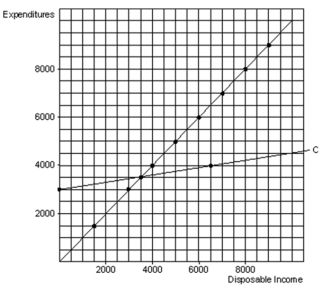
Autonomous consumption is
A)0.
B)1000.
C)2000.
D)3000.
E)4000.
Question
When disposable income is 6,000 savings is
A)-2100.
B)0.
C)2100.
D)3900.
E)6000.
Question
Question
Question
Question
Question
Question
Question
Question
When disposable income is 6000,C is
A)0.
B)2100.
C)3900.
D)4500.
E)6000.
Question
Question
When disposable income is 4000,APC is about
A).55.
B).66.
C).77.
D).88.
E).99.
Question
Question
Question
Question
Question
Saving is negative below a disposable income of
A)0.
B)2500.
C)3000.
D)3500.
E)4000.
Question
Question
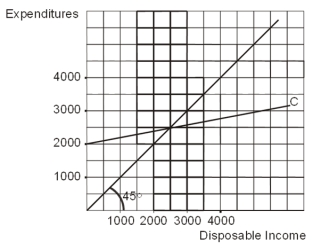
When disposable income is 3750,saving is
A)-1000.
B)0.
C)1000.
D)2750.
E)3750.
Question
Question
When disposable income is 3750,the APS is about
A).6.
B).45.
C).35.
D).25.
E).1.
Question
Question
Autonomous consumption is
A)0.
B)1000.
C)2000.
D)2500.
E)3000.
Question
Question
Saving is negative below a disposable income of
A)0.
B)1500.
C)2000.
D)2500.
E)3000.
Question
Question
Question
Question
Question
When disposable income is 4000,APS is about
A).45.
B).34.
C).23.
D).12.
E).01.
Question
Question
Question
When disposable income is 2000,C is
A)2000.
B)2200.
C)2400.
D)2600.
E)2800.
Question
When disposable income is 2500,C is
A)0.
B)1000.
C)2000.
D)2500.
E)3000.
Question
When disposable income is 1250,saving is
A)-1000.
B)-500.
C)0.
D)500.
E)1000.
Question
When disposable income is 2500,induced consumption is
A)-500.
B)0.
C)500.
D)1000.
E)2500.
Question
When disposable income is 3750,induced consumption is
A)-500.
B)0.
C)500.
D)750.
E)1000.
Question
When disposable income is 3750,the APC is about
A).3.
B).45.
C).6.
D).75.
E).9.
Question
Question
Question
Question
Question
Question
Question
Question
Question
Question
Question
Question
Question
Question
Question
Question
Question
Question
Question
Question

Unlock Deck
Sign up to unlock the cards in this deck!
Unlock Deck
Unlock Deck
1/312

Play

Full screen (f)
Deck 5: The Household Consumption Sector
1
Today,people spend more than _____ of their incomes on services.
A)one-third
B)one-half
C)two-thirds
D)three-quarters
A)one-third
B)one-half
C)two-thirds
D)three-quarters
C
2
Which of these relations is correct?
A)APC - APS = 1
B)MPC + MPS = 1
C)APC + MPC = 1
D)1 + MPC = MPS
A)APC - APS = 1
B)MPC + MPS = 1
C)APC + MPC = 1
D)1 + MPC = MPS
B
3
The consumption function is associated with
A)John Maynard Keynes.
B)Karl Marx.
C)Milton Friedman.
D)Adam Smith.
E)Thorstein Veblen.
A)John Maynard Keynes.
B)Karl Marx.
C)Milton Friedman.
D)Adam Smith.
E)Thorstein Veblen.
A
4
Compared to 1955,we spend ______ of every consumer dollar on services.
A)slightly less
B)substantially less
C)slightly more
D)substantially more
A)slightly less
B)substantially less
C)slightly more
D)substantially more
Unlock Deck
Unlock for access to all 312 flashcards in this deck.
Unlock Deck
k this deck
5
At very low income levels,saving is
A)a high percentage of income.
B)a low percentage of income.
C)zero.
D)negative.
A)a high percentage of income.
B)a low percentage of income.
C)zero.
D)negative.
Unlock Deck
Unlock for access to all 312 flashcards in this deck.
Unlock Deck
k this deck
6
At very low levels of disposable income,
A)consumption is greater than disposable income.
B)disposable income is greater than consumption.
C)people save most of their incomes.
D)consumption is negative.
A)consumption is greater than disposable income.
B)disposable income is greater than consumption.
C)people save most of their incomes.
D)consumption is negative.
Unlock Deck
Unlock for access to all 312 flashcards in this deck.
Unlock Deck
k this deck
7
At very low levels of disposable income
A)saving is negative.
B)saving is very high.
C)consumption is negative.
D)consumption is a very small part of income.
A)saving is negative.
B)saving is very high.
C)consumption is negative.
D)consumption is a very small part of income.
Unlock Deck
Unlock for access to all 312 flashcards in this deck.
Unlock Deck
k this deck
8
Each of these is a category of C except
A)durables.
B)nondurables.
C)residential construction.
D)services.
A)durables.
B)nondurables.
C)residential construction.
D)services.
Unlock Deck
Unlock for access to all 312 flashcards in this deck.
Unlock Deck
k this deck
9
Who holds this view: "....We are consuming more than we are producing,borrowing more than we are saving and spending more than we are earning."
A)Murray Weidenbaum
B)Thorstein Veblen
C)Benjamin Franklin
D)Adam Smith
E)Karl Marx
A)Murray Weidenbaum
B)Thorstein Veblen
C)Benjamin Franklin
D)Adam Smith
E)Karl Marx
Unlock Deck
Unlock for access to all 312 flashcards in this deck.
Unlock Deck
k this deck
10
Which of these relations is correct?
A)APC - APS = 1
B)MPC + APS = 1
C)MPC + MPS = 1
D)1 + MPC = MPS
E)None of these is correct
A)APC - APS = 1
B)MPC + APS = 1
C)MPC + MPS = 1
D)1 + MPC = MPS
E)None of these is correct
Unlock Deck
Unlock for access to all 312 flashcards in this deck.
Unlock Deck
k this deck
11
Which statement is true?
A)At high levels of disposable income,induced consumption is zero.
B)At low levels of disposable income,induced consumption will be greater than autonomous consumption.
C)Autonomous consumption will generally equal induced consumption.
D)None of these statements is true.
A)At high levels of disposable income,induced consumption is zero.
B)At low levels of disposable income,induced consumption will be greater than autonomous consumption.
C)Autonomous consumption will generally equal induced consumption.
D)None of these statements is true.
Unlock Deck
Unlock for access to all 312 flashcards in this deck.
Unlock Deck
k this deck
12
Americans spend over _______ of their income on consumption.
A)one-third
B)one-half
C)two-thirds
D)nine-tenths
A)one-third
B)one-half
C)two-thirds
D)nine-tenths
Unlock Deck
Unlock for access to all 312 flashcards in this deck.
Unlock Deck
k this deck
13
At the point where C line crosses the 45-degree line,saving is
A)positive.
B)negative.
C)zero.
D)there is not enough information to know this.
A)positive.
B)negative.
C)zero.
D)there is not enough information to know this.
Unlock Deck
Unlock for access to all 312 flashcards in this deck.
Unlock Deck
k this deck
14
In 2009,C was closest to,but under
A)$20 billion
B)$4 trillion
C)$6 trillion
D)$80 billion
E)over $10 trillion
A)$20 billion
B)$4 trillion
C)$6 trillion
D)$80 billion
E)over $10 trillion
Unlock Deck
Unlock for access to all 312 flashcards in this deck.
Unlock Deck
k this deck
15
The APC in the United States is
A)-.1 to 0
B)0 to .4
C).4 to .8
D).94 to .99
A)-.1 to 0
B)0 to .4
C).4 to .8
D).94 to .99
Unlock Deck
Unlock for access to all 312 flashcards in this deck.
Unlock Deck
k this deck
16
The APS in the United States is
A)below .01
B)between .01 and .07.
C)between .15 and .25.
D)between .7 and .75.
A)below .01
B)between .01 and .07.
C)between .15 and .25.
D)between .7 and .75.
Unlock Deck
Unlock for access to all 312 flashcards in this deck.
Unlock Deck
k this deck
17
Which statement is false?
A)Over the last two decades Americans have never saved over 11 percent of their disposable incomes.
B)A low savings rate leads to a low rate of productivity growth.
C)There has been a marked upward trend in our savings rate since the mid-1980s.
D)None of these statements are false.
A)Over the last two decades Americans have never saved over 11 percent of their disposable incomes.
B)A low savings rate leads to a low rate of productivity growth.
C)There has been a marked upward trend in our savings rate since the mid-1980s.
D)None of these statements are false.
Unlock Deck
Unlock for access to all 312 flashcards in this deck.
Unlock Deck
k this deck
18
People tend to spend more money the ______ the amount of credit available and the ____ the stock of liquid assets in the hands of consumers.
A)higher,higher
B)lower,lower
C)higher,lower
D)lower,higher
A)higher,higher
B)lower,lower
C)higher,lower
D)lower,higher
Unlock Deck
Unlock for access to all 312 flashcards in this deck.
Unlock Deck
k this deck
19
Autonomous consumption is always
A)positive.
B)zero.
C)negative.
A)positive.
B)zero.
C)negative.
Unlock Deck
Unlock for access to all 312 flashcards in this deck.
Unlock Deck
k this deck
20
According to ______________,if you suddenly won the lottery,you would spend only a small part of your winnings right away.
A)the paradox of thrift
B)the permanent income hypothesis
C)Thorstein Veblen's Theory of the Leisure Class
D)the theory of the multiplier
A)the paradox of thrift
B)the permanent income hypothesis
C)Thorstein Veblen's Theory of the Leisure Class
D)the theory of the multiplier
Unlock Deck
Unlock for access to all 312 flashcards in this deck.
Unlock Deck
k this deck
21
For a family with disposal income less than autonomous consumption
A)the APC is greater than 1
B)induced consumption is positive
C)the APS is very small but positive
D)in the long run credit cards are used to make up difference
A)the APC is greater than 1
B)induced consumption is positive
C)the APS is very small but positive
D)in the long run credit cards are used to make up difference
Unlock Deck
Unlock for access to all 312 flashcards in this deck.
Unlock Deck
k this deck
22
Which statement is true?
A)Autonomous C can never be zero.
B)Induced C can never be zero.
C)Neither autonomous C nor induced C can be zero.
D)None is true.
A)Autonomous C can never be zero.
B)Induced C can never be zero.
C)Neither autonomous C nor induced C can be zero.
D)None is true.
Unlock Deck
Unlock for access to all 312 flashcards in this deck.
Unlock Deck
k this deck
23
Autonomous consumption is
A)0.
B)1000.
C)2000.
D)3000.
E)4000.
Unlock Deck
Unlock for access to all 312 flashcards in this deck.
Unlock Deck
k this deck
24
When disposable income is 6,000 savings is
A)-2100.
B)0.
C)2100.
D)3900.
E)6000.
Unlock Deck
Unlock for access to all 312 flashcards in this deck.
Unlock Deck
k this deck
25
As disposable income grows,
A)both autonomous C and induced C rise.
B)both autonomous C and induced C fall.
C)autonomous C rises and induced C falls.
D)autonomous C falls and induced C rises.
E)autonomous C stays the same and induced C rises.
A)both autonomous C and induced C rise.
B)both autonomous C and induced C fall.
C)autonomous C rises and induced C falls.
D)autonomous C falls and induced C rises.
E)autonomous C stays the same and induced C rises.
Unlock Deck
Unlock for access to all 312 flashcards in this deck.
Unlock Deck
k this deck
26
If disposable income were to fall from 6,000 to 5,000,
A)induced consumption would fall.
B)induced consumption would stay the same.
C)induced consumption would rise.
D)there is not enough information to determine whether induced consumption would rise,fall or remain the same.
A)induced consumption would fall.
B)induced consumption would stay the same.
C)induced consumption would rise.
D)there is not enough information to determine whether induced consumption would rise,fall or remain the same.
Unlock Deck
Unlock for access to all 312 flashcards in this deck.
Unlock Deck
k this deck
27
The consumption function
A)is a relationship between annual consumption and annual disposable income in an economy.
B)will shift upward if aggregate household wealth declines.
C)implies that annual consumption in an economy will be zero if disposable income is zero.
D)is a flat line with zero slope.
A)is a relationship between annual consumption and annual disposable income in an economy.
B)will shift upward if aggregate household wealth declines.
C)implies that annual consumption in an economy will be zero if disposable income is zero.
D)is a flat line with zero slope.
Unlock Deck
Unlock for access to all 312 flashcards in this deck.
Unlock Deck
k this deck
28
Which has grown the fastest since 1955?
A)Durable goods consumption
B)Nondurable goods consumption
C)Consumption of services
A)Durable goods consumption
B)Nondurable goods consumption
C)Consumption of services
Unlock Deck
Unlock for access to all 312 flashcards in this deck.
Unlock Deck
k this deck
29
A major critic of our very high consumer spending has been
A)John Maynard Keynes.
B)Karl Marx.
C)Milton Friedman.
D)Murray Weidenbaum.
A)John Maynard Keynes.
B)Karl Marx.
C)Milton Friedman.
D)Murray Weidenbaum.
Unlock Deck
Unlock for access to all 312 flashcards in this deck.
Unlock Deck
k this deck
30
If disposable income were to rise from 4,000 to 5,000
A)induced consumption would fall.
B)induced consumption would stay the same.
C)induced consumption would rise.
D)there is not enough information to determine whether induced consumption would rise,fall or remain the same.
A)induced consumption would fall.
B)induced consumption would stay the same.
C)induced consumption would rise.
D)there is not enough information to determine whether induced consumption would rise,fall or remain the same.
Unlock Deck
Unlock for access to all 312 flashcards in this deck.
Unlock Deck
k this deck
31
When disposable income is zero,the level of induced consumption is
A)negative.
B)zero.
C)positive.
D)indeterminate.
A)negative.
B)zero.
C)positive.
D)indeterminate.
Unlock Deck
Unlock for access to all 312 flashcards in this deck.
Unlock Deck
k this deck
32
When disposable income is 6000,C is
A)0.
B)2100.
C)3900.
D)4500.
E)6000.
Unlock Deck
Unlock for access to all 312 flashcards in this deck.
Unlock Deck
k this deck
33
As a nation we have been
A)Consuming too much and saving too much.
B)Consuming too little and saving too little.
C)Consuming too much and saving too little.
D)Consuming too little and saving too much.
A)Consuming too much and saving too much.
B)Consuming too little and saving too little.
C)Consuming too much and saving too little.
D)Consuming too little and saving too much.
Unlock Deck
Unlock for access to all 312 flashcards in this deck.
Unlock Deck
k this deck
34
When disposable income is 4000,APC is about
A).55.
B).66.
C).77.
D).88.
E).99.
Unlock Deck
Unlock for access to all 312 flashcards in this deck.
Unlock Deck
k this deck
35
At relatively high levels of disposable income
A)both the APC and APS are high.
B)both the APC and APS are low.
C)the APC is high and the APS is low.
D)the APC is low and the APS is high.
A)both the APC and APS are high.
B)both the APC and APS are low.
C)the APC is high and the APS is low.
D)the APC is low and the APS is high.
Unlock Deck
Unlock for access to all 312 flashcards in this deck.
Unlock Deck
k this deck
36
When there is dissaving
A)both the APC and APS are positive.
B)both the APC and APS are negative.
C)the APC is positive and the APS is negative.
D)the APC is negative and the APS is positive.
A)both the APC and APS are positive.
B)both the APC and APS are negative.
C)the APC is positive and the APS is negative.
D)the APC is negative and the APS is positive.
Unlock Deck
Unlock for access to all 312 flashcards in this deck.
Unlock Deck
k this deck
37
Which statement is true?
A)The APC and APS may add to a little more than one,but never to less than one.
B)The APC and APS may add to a little less than one,but never to more than one.
C)The APC and APS may add to a little more than one or to a little less than one.
D)APC and APS added together must equal to 1.
A)The APC and APS may add to a little more than one,but never to less than one.
B)The APC and APS may add to a little less than one,but never to more than one.
C)The APC and APS may add to a little more than one or to a little less than one.
D)APC and APS added together must equal to 1.
Unlock Deck
Unlock for access to all 312 flashcards in this deck.
Unlock Deck
k this deck
38
If the APS fell by 0.01 today,savings would decline by approximately
A)$14 billion.
B)$10 billion.
C)$143 billion.
D)$1 trillion.
E)$10 trillion.
A)$14 billion.
B)$10 billion.
C)$143 billion.
D)$1 trillion.
E)$10 trillion.
Unlock Deck
Unlock for access to all 312 flashcards in this deck.
Unlock Deck
k this deck
39
Saving is negative below a disposable income of
A)0.
B)2500.
C)3000.
D)3500.
E)4000.
Unlock Deck
Unlock for access to all 312 flashcards in this deck.
Unlock Deck
k this deck
40
An increase in disposable income will
A)decrease autonomous consumption.
B)increase autonomous consumption.
C)decrease total consumption.
D)increase total consumption.
A)decrease autonomous consumption.
B)increase autonomous consumption.
C)decrease total consumption.
D)increase total consumption.
Unlock Deck
Unlock for access to all 312 flashcards in this deck.
Unlock Deck
k this deck
41
When disposable income is 3750,saving is
A)-1000.
B)0.
C)1000.
D)2750.
E)3750.
Unlock Deck
Unlock for access to all 312 flashcards in this deck.
Unlock Deck
k this deck
42
When disposable income is 6500,induced consumption is
A)0.
B)500.
C)750.
D)1000.
E)1500.
A)0.
B)500.
C)750.
D)1000.
E)1500.
Unlock Deck
Unlock for access to all 312 flashcards in this deck.
Unlock Deck
k this deck
43
When disposable income is 3750,the APS is about
A).6.
B).45.
C).35.
D).25.
E).1.
Unlock Deck
Unlock for access to all 312 flashcards in this deck.
Unlock Deck
k this deck
44
When disposable income is 3500,C is
A)1500.
B)2500.
C)3500.
D)4500.
E)5500.
A)1500.
B)2500.
C)3500.
D)4500.
E)5500.
Unlock Deck
Unlock for access to all 312 flashcards in this deck.
Unlock Deck
k this deck
45
Autonomous consumption is
A)0.
B)1000.
C)2000.
D)2500.
E)3000.
Unlock Deck
Unlock for access to all 312 flashcards in this deck.
Unlock Deck
k this deck
46
-How much is autonomous consumption when disposable income is $800 billion?
A)0
B)$200 billion
C)$400 billion
D)$600 billion
E)Cannot be determined
Unlock Deck
Unlock for access to all 312 flashcards in this deck.
Unlock Deck
k this deck
47
Saving is negative below a disposable income of
A)0.
B)1500.
C)2000.
D)2500.
E)3000.
Unlock Deck
Unlock for access to all 312 flashcards in this deck.
Unlock Deck
k this deck
48
When disposable income is 2000,saving is
A)-2000.
B)-1250.
C)0.
D)1250.
E)2000.
A)-2000.
B)-1250.
C)0.
D)1250.
E)2000.
Unlock Deck
Unlock for access to all 312 flashcards in this deck.
Unlock Deck
k this deck
49
The MPC is
A).1.
B).2.
C).3.
D).4.
E).5.
A).1.
B).2.
C).3.
D).4.
E).5.
Unlock Deck
Unlock for access to all 312 flashcards in this deck.
Unlock Deck
k this deck
50
The MPS is
A).9.
B).8.
C).7.
D).6.
E).5.
A).9.
B).8.
C).7.
D).6.
E).5.
Unlock Deck
Unlock for access to all 312 flashcards in this deck.
Unlock Deck
k this deck
51
The MPS is about
A).9.
B).85.
C).8.
D).75.
E).7.
A).9.
B).85.
C).8.
D).75.
E).7.
Unlock Deck
Unlock for access to all 312 flashcards in this deck.
Unlock Deck
k this deck
52
When disposable income is 4000,APS is about
A).45.
B).34.
C).23.
D).12.
E).01.
Unlock Deck
Unlock for access to all 312 flashcards in this deck.
Unlock Deck
k this deck
53
When disposable income is 3500,induced consumption is
A)-500.
B)0.
C)500.
D)750.
E)1000.
A)-500.
B)0.
C)500.
D)750.
E)1000.
Unlock Deck
Unlock for access to all 312 flashcards in this deck.
Unlock Deck
k this deck
54
The MPC is about
A).1.
B).15.
C).2.
D).25.
E).3.
A).1.
B).15.
C).2.
D).25.
E).3.
Unlock Deck
Unlock for access to all 312 flashcards in this deck.
Unlock Deck
k this deck
55
When disposable income is 2000,C is
A)2000.
B)2200.
C)2400.
D)2600.
E)2800.
Unlock Deck
Unlock for access to all 312 flashcards in this deck.
Unlock Deck
k this deck
56
When disposable income is 2500,C is
A)0.
B)1000.
C)2000.
D)2500.
E)3000.
Unlock Deck
Unlock for access to all 312 flashcards in this deck.
Unlock Deck
k this deck
57
When disposable income is 1250,saving is
A)-1000.
B)-500.
C)0.
D)500.
E)1000.
Unlock Deck
Unlock for access to all 312 flashcards in this deck.
Unlock Deck
k this deck
58
When disposable income is 2500,induced consumption is
A)-500.
B)0.
C)500.
D)1000.
E)2500.
Unlock Deck
Unlock for access to all 312 flashcards in this deck.
Unlock Deck
k this deck
59
When disposable income is 3750,induced consumption is
A)-500.
B)0.
C)500.
D)750.
E)1000.
Unlock Deck
Unlock for access to all 312 flashcards in this deck.
Unlock Deck
k this deck
60
When disposable income is 3750,the APC is about
A).3.
B).45.
C).6.
D).75.
E).9.
Unlock Deck
Unlock for access to all 312 flashcards in this deck.
Unlock Deck
k this deck
61
-How much is the marginal propensity to save when disposable income rises from $400 billion to $600 billion?
A).25
B).5
C).75
D)1.0
E)Cannot be determined
Unlock Deck
Unlock for access to all 312 flashcards in this deck.
Unlock Deck
k this deck
62
-How much is the average propensity to consume when disposable income is $800 billion?
A)0
B).25
C).5
D).75
E)1.00
Unlock Deck
Unlock for access to all 312 flashcards in this deck.
Unlock Deck
k this deck
63
-How much is the average propensity to save when disposable income is $400 billion?
A)0
B).25
C).50
D).75
E)1.0
Unlock Deck
Unlock for access to all 312 flashcards in this deck.
Unlock Deck
k this deck
64
-How much is the marginal propensity to consume when disposable income rises from $600 billion to $800 billion?
A).5
B).65
C).75
D).85
E)Cannot be determined
Unlock Deck
Unlock for access to all 312 flashcards in this deck.
Unlock Deck
k this deck
65
-How much is induced consumption when disposable income is $600 billion?
A)0
B)$200 billion
C)$300 billion
D)$400 billion
E)$600 billion
Unlock Deck
Unlock for access to all 312 flashcards in this deck.
Unlock Deck
k this deck
66
If the APS is .1 and the MPC is .85,the APC is
A).1.
B).15.
C).85.
D).9.
E)Impossible to determine.
A).1.
B).15.
C).85.
D).9.
E)Impossible to determine.
Unlock Deck
Unlock for access to all 312 flashcards in this deck.
Unlock Deck
k this deck
67
Which statement is true?
A)If the APC is greater than one,the APS is negative.
B)If the APC is less than one,the APS is negative.
C)The APS can never be negative.
D)None is true.
A)If the APC is greater than one,the APS is negative.
B)If the APC is less than one,the APS is negative.
C)The APS can never be negative.
D)None is true.
Unlock Deck
Unlock for access to all 312 flashcards in this deck.
Unlock Deck
k this deck
68
Autonomous consumption is NOT influenced by
A)Aggregate household wealth
B)Expectations of future income and wealth
C)Aggregate household debt
D)Disposable income
E)It is influenced by all of these
A)Aggregate household wealth
B)Expectations of future income and wealth
C)Aggregate household debt
D)Disposable income
E)It is influenced by all of these
Unlock Deck
Unlock for access to all 312 flashcards in this deck.
Unlock Deck
k this deck
69
-How much is autonomous consumption when disposable income is $2 trillion?
A)0
B)$1 trillion
C)$1.5 trillion
D)$2 trillion
Unlock Deck
Unlock for access to all 312 flashcards in this deck.
Unlock Deck
k this deck
70
-How much is autonomous consumption when disposable income is $4 trillion?
A)0
B)$1 trillion
C)$2 trillion
D)$3 trillion
Unlock Deck
Unlock for access to all 312 flashcards in this deck.
Unlock Deck
k this deck
71
-How much is induced consumption when disposable income is $4 trillion?
A)0
B)$1 trillion
C)$2 trillion
D)$2.5 trillion
Unlock Deck
Unlock for access to all 312 flashcards in this deck.
Unlock Deck
k this deck
72
If the MPC is .85 and the APC is .75,the MPS is
A).15.
B).25.
C).75.
D).85.
E)Impossible to determine.
A).15.
B).25.
C).75.
D).85.
E)Impossible to determine.
Unlock Deck
Unlock for access to all 312 flashcards in this deck.
Unlock Deck
k this deck
73
For levels of disposable income to the left of the point where consumption intersects the 45-degree line
A)Saving is negative.
B)Disposable income exceeds consumption.
C)Saving equals disposable income.
D)Consumption equals disposable income.
E)Saving equals consumption.
A)Saving is negative.
B)Disposable income exceeds consumption.
C)Saving equals disposable income.
D)Consumption equals disposable income.
E)Saving equals consumption.
Unlock Deck
Unlock for access to all 312 flashcards in this deck.
Unlock Deck
k this deck
74
-How much is the marginal propensity to consume when disposable income rises from 0 to $1 trillion?
A)0
B).25
C).5
D).75
E)1.0
Unlock Deck
Unlock for access to all 312 flashcards in this deck.
Unlock Deck
k this deck
75
-How much is induced consumption when disposable income is $3 trillion?
A)0
B)$1 trillion
C)$1.5 trillion
D)$2.5 trillion
Unlock Deck
Unlock for access to all 312 flashcards in this deck.
Unlock Deck
k this deck
76
-How much is the average propensity to consume when disposable income is $2 trillion?
A).25
B).5
C).75
D)1.0
E)1.25
Unlock Deck
Unlock for access to all 312 flashcards in this deck.
Unlock Deck
k this deck
77
Which statement is true?
A)Autonomous C stays the same for all levels of disposable income
B)Induced C stays the same for all levels of disposable income
C)Total consumption stays the same for all levels of disposable income
D)None is true
A)Autonomous C stays the same for all levels of disposable income
B)Induced C stays the same for all levels of disposable income
C)Total consumption stays the same for all levels of disposable income
D)None is true
Unlock Deck
Unlock for access to all 312 flashcards in this deck.
Unlock Deck
k this deck
78
-How much is induced consumption when disposable income is $400 billion?
A)0
B)$100 billion
C)$200 billion
D)$300 billion
E)Cannot be determined
Unlock Deck
Unlock for access to all 312 flashcards in this deck.
Unlock Deck
k this deck
79
When there is dissaving,the APC is
A)greater than one.
B)equal to one.
C)less than one.
A)greater than one.
B)equal to one.
C)less than one.
Unlock Deck
Unlock for access to all 312 flashcards in this deck.
Unlock Deck
k this deck
80
-How much is the marginal propensity to save when disposable income rises from $3 trillion to $4 trillion?
A)0
B).25
C).5
D).75
E)1.0
Unlock Deck
Unlock for access to all 312 flashcards in this deck.
Unlock Deck
k this deck
Unlock Deck
Unlock for access to all 312 flashcards in this deck.






