







 Chat with AI

Deck 31: International Trade
Full screen (f)

Question

Question
Question
Question
Question
Question
Question
Question
Question
Question
Question
Question
Question
Question
Question
Question
Question
Question
Question
Question
Question
Question
Question
Question
Question
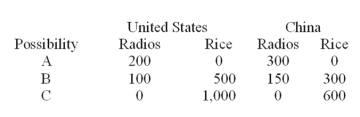
In the absence of trade between the two countries,the price of rice in the U.S.in terms of radios would tend to be
A)1/2.
B)1/5.
C)200.
D)500.
Question
Question
Question
Question
Question
Question
In the absence of trade between the two countries,the price of rice in China in terms of radios would be
A)1/2.
B)2.
C)150.
D)300.
Question
Question
Question
Question
Question
Question
Question
Question
Question
Question
Question
Question
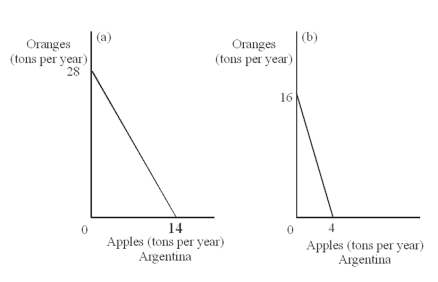
What is the opportunity cost of 1 ton of oranges for the nations of Argentina and Brazil,respectively?
A).25 ton of apples and .5 ton of apples
B)10 tons of apples and 4 tons of apples
C)2 tons of apples and 4 tons of apples
D)4 tons of apples and 2 tons of apples
E).5 ton of apples and .25 ton of apples
Question
Question
Question
Question
Question
Question
Question
Question
Question
Question
Question
Question
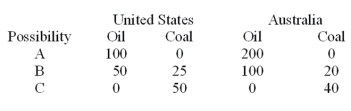
The cost of an extra unit of oil in the United States in terms of coal given up is
A)25.
B)50.
C)2.
D)1/2.
Question
Question
What is the opportunity cost of 1 ton of apples for the nations of Argentina and Brazil,respectively?
A)4 tons of oranges and 2 tons of oranges
B)2.5 tons of oranges and .4 tons of oranges
C).25 tons of oranges and .5 tons of oranges
D)2 tons of oranges and 4 tons of oranges
E)5 tons of oranges and .25 tons of oranges
Question
Question
The cost of an extra unit of coal in Australia in terms of oil given up is
A)100.
B)20.
C)5.
D)1/5.
Question
Question
Question
Question

According to the information contained in the table,Brazil has an absolute advantage in
A)coffee,while Columbia has an absolute advantage in hot dogs.
B)both coffee and hot dogs.
C)neither coffee nor hot dogs.
D)hot dogs,while Columbia has an absolute advantage in coffee.
Question
Question
Question
Question
Question
Question
Question
Question
Question
Question
Question
Question
Question
Question
Question
Question
Question

Unlock Deck
Sign up to unlock the cards in this deck!
Unlock Deck
Unlock Deck
1/268

Play

Full screen (f)
Deck 31: International Trade
1
A tariff shifts the ___________ curve to the __________.
A)demand;right
B)demand;left
C)supply;right
D)supply;left
A)demand;right
B)demand;left
C)supply;right
D)supply;left
D
2
Which statement is false?
A)If we restrict our imports,our exports will decline.
B)Trade restrictions cause economic inefficiency.
C)International finance is based on the gold standard.
D)None of the statements is false.
A)If we restrict our imports,our exports will decline.
B)Trade restrictions cause economic inefficiency.
C)International finance is based on the gold standard.
D)None of the statements is false.
C
3
The principle of comparative advantage
A)applies only when the gold standard is in effect.
B)is the basic reason that the United States has been running trade deficits.
C)states that it is advantageous to export more than you import.
D)states that total output is greatest when each product is made by the country that has the lowest opportunity cost.
A)applies only when the gold standard is in effect.
B)is the basic reason that the United States has been running trade deficits.
C)states that it is advantageous to export more than you import.
D)states that total output is greatest when each product is made by the country that has the lowest opportunity cost.
D
4
Which statement is false?
A)The Japanese economic system is based on very different relationships from our own.
B)American firms generally have no problems establishing themselves in Japan.
C)The barrier to foreign firms doing business in Japan is informal rather than formal.
D)None of the statements is false.
A)The Japanese economic system is based on very different relationships from our own.
B)American firms generally have no problems establishing themselves in Japan.
C)The barrier to foreign firms doing business in Japan is informal rather than formal.
D)None of the statements is false.
Unlock Deck
Unlock for access to all 268 flashcards in this deck.
Unlock Deck
k this deck
5
A hollow corporation
A)makes goods abroad and ships them to the United States.
B)makes goods in the United States and ships them abroad.
C)imports foreign goods and puts its own name on them.
D)makes goods in the United States and has them sold abroad under another company's name.
A)makes goods abroad and ships them to the United States.
B)makes goods in the United States and ships them abroad.
C)imports foreign goods and puts its own name on them.
D)makes goods in the United States and has them sold abroad under another company's name.
Unlock Deck
Unlock for access to all 268 flashcards in this deck.
Unlock Deck
k this deck
6
At the core of the American trade problem is that
A)Americans spend too much on consumption.
B)the dollar is too low.
C)the Japanese are excluding American products by means of high protective tariffs.
D)American manufacturers are too quality conscious and should instead concentrate on reducing costs.
A)Americans spend too much on consumption.
B)the dollar is too low.
C)the Japanese are excluding American products by means of high protective tariffs.
D)American manufacturers are too quality conscious and should instead concentrate on reducing costs.
Unlock Deck
Unlock for access to all 268 flashcards in this deck.
Unlock Deck
k this deck
7
A key reason that our gasoline prices elevated rapidly from 2006 to 2008 was
A)the decline in the value of the dollar.
B)the war in the Middle East.
C)greed by oil exporting countries.
D)inflation.
A)the decline in the value of the dollar.
B)the war in the Middle East.
C)greed by oil exporting countries.
D)inflation.
Unlock Deck
Unlock for access to all 268 flashcards in this deck.
Unlock Deck
k this deck
8
Most economists
A)favor both tariffs and quotas.
B)consider tariffs less of an evil than quotas.
C)consider quotas and tariffs of equal evil.
A)favor both tariffs and quotas.
B)consider tariffs less of an evil than quotas.
C)consider quotas and tariffs of equal evil.
Unlock Deck
Unlock for access to all 268 flashcards in this deck.
Unlock Deck
k this deck
9
If Germany can make compact cars more efficiently than Russia,it enjoys
A)a comparative advantage.
B)an absolute advantage.
C)no advantage.
A)a comparative advantage.
B)an absolute advantage.
C)no advantage.
Unlock Deck
Unlock for access to all 268 flashcards in this deck.
Unlock Deck
k this deck
10
Which statement is false?
A)International trade helps every country.
B)The economics profession is nearly unanimous in advocating free trade.
C)The jobs that are lost due to foreign imports can be gained by our export sector.
D)Recent Presidents of the United States support free trade in word and deeD.
A)International trade helps every country.
B)The economics profession is nearly unanimous in advocating free trade.
C)The jobs that are lost due to foreign imports can be gained by our export sector.
D)Recent Presidents of the United States support free trade in word and deeD.
Unlock Deck
Unlock for access to all 268 flashcards in this deck.
Unlock Deck
k this deck
11
Which statement is false?
A)Compared to 30 years ago,there is more sentiment in the U.S.for protection against the import of foreign goods.
B)The basis for international trade is specialization.
C)Our balance of trade has been negative since the early 1900s.
D)None of the statements is true.
A)Compared to 30 years ago,there is more sentiment in the U.S.for protection against the import of foreign goods.
B)The basis for international trade is specialization.
C)Our balance of trade has been negative since the early 1900s.
D)None of the statements is true.
Unlock Deck
Unlock for access to all 268 flashcards in this deck.
Unlock Deck
k this deck
12
We have run merchandise trade deficits of over $70 billion since
A)1963.
B)1969.
C)1973.
D)1979.
E)1983.
A)1963.
B)1969.
C)1973.
D)1979.
E)1983.
Unlock Deck
Unlock for access to all 268 flashcards in this deck.
Unlock Deck
k this deck
13
Which statement is true?
A)The Japanese have not been selling below cost nor taking advantage of economies of scale.
B)The Japanese have been selling below cost and have been taking advantage of economies of scale.
C)The Japanese have been selling below cost but have not been taking advantage of economies of scale.
D)The Japanese have been taking advantage of economies of scale but have not been selling below cost.
A)The Japanese have not been selling below cost nor taking advantage of economies of scale.
B)The Japanese have been selling below cost and have been taking advantage of economies of scale.
C)The Japanese have been selling below cost but have not been taking advantage of economies of scale.
D)The Japanese have been taking advantage of economies of scale but have not been selling below cost.
Unlock Deck
Unlock for access to all 268 flashcards in this deck.
Unlock Deck
k this deck
14
Which statement is true?
A)Frederic Bastiat's "Petition of the Candlemakers to Shut Out the Sun" was a plea for free trade.
B)Frederic Bastiat's "Petition of the Candlemakers to Shut Out the Sun" was a plea for protection.
C)Dollars are used for all international transactions.
D)None of the statements is true.
A)Frederic Bastiat's "Petition of the Candlemakers to Shut Out the Sun" was a plea for free trade.
B)Frederic Bastiat's "Petition of the Candlemakers to Shut Out the Sun" was a plea for protection.
C)Dollars are used for all international transactions.
D)None of the statements is true.
Unlock Deck
Unlock for access to all 268 flashcards in this deck.
Unlock Deck
k this deck
15
Under the principle of comparative advantage total output is greatest when each product is made by the country that
A)enjoys an absolute advantage.
B)has the lowest opportunity cost.
C)has the lowest wage rates.
D)has the lowest degree of specialization.
A)enjoys an absolute advantage.
B)has the lowest opportunity cost.
C)has the lowest wage rates.
D)has the lowest degree of specialization.
Unlock Deck
Unlock for access to all 268 flashcards in this deck.
Unlock Deck
k this deck
16
The reason U.S.workers were better paid than foreign workers during the 1950s and 1960s is
A)U.S.workers were better trained and educated.
B)U.S.workers worked harder.
C)we had more capital (plant and equipment)per worker.
D)the U.S.dollar was the world's strongest currency.
A)U.S.workers were better trained and educated.
B)U.S.workers worked harder.
C)we had more capital (plant and equipment)per worker.
D)the U.S.dollar was the world's strongest currency.
Unlock Deck
Unlock for access to all 268 flashcards in this deck.
Unlock Deck
k this deck
17
High protective tariffs
A)would be supported by most economists.
B)will become more likely if we do not reduce our trade deficit.
C)have very little support.
D)would definitely solve all our trade problems.
A)would be supported by most economists.
B)will become more likely if we do not reduce our trade deficit.
C)have very little support.
D)would definitely solve all our trade problems.
Unlock Deck
Unlock for access to all 268 flashcards in this deck.
Unlock Deck
k this deck
18
One thing we can do to reduce trade imbalance in the United States would be to
A)push down the value of the dollar relative to other currencies.
B)raise the prices of U.S.exports.
C)raise consumption in the United States.
D)lower savings in the United States.
A)push down the value of the dollar relative to other currencies.
B)raise the prices of U.S.exports.
C)raise consumption in the United States.
D)lower savings in the United States.
Unlock Deck
Unlock for access to all 268 flashcards in this deck.
Unlock Deck
k this deck
19
Which statement is false?
A)When two countries trade,both gain from the trade.
B)In international trade some countries are winners and others are losers.
C)For most of the 20th century we had a positive balance of trade.
D)None of the statements is false.
A)When two countries trade,both gain from the trade.
B)In international trade some countries are winners and others are losers.
C)For most of the 20th century we had a positive balance of trade.
D)None of the statements is false.
Unlock Deck
Unlock for access to all 268 flashcards in this deck.
Unlock Deck
k this deck
20
One way of reducing our trade deficit would be to get Americans to
A)save more and consume more.
B)save more and consume less.
C)save less and consume less.
D)save less and consume more.
A)save more and consume more.
B)save more and consume less.
C)save less and consume less.
D)save less and consume more.
Unlock Deck
Unlock for access to all 268 flashcards in this deck.
Unlock Deck
k this deck
21
Which of the following would NOT be an impact of tariffs imposed on foreign cars?
A)Sales of foreign cars decline
B)The prices received by foreign car manufacturers decline
C)American jobs are protected
D)Tax revenue is generated for the government
E)Domestic car prices decline
A)Sales of foreign cars decline
B)The prices received by foreign car manufacturers decline
C)American jobs are protected
D)Tax revenue is generated for the government
E)Domestic car prices decline
Unlock Deck
Unlock for access to all 268 flashcards in this deck.
Unlock Deck
k this deck
22
Statement I: Japan is a society that is wiling to sacrifice for the long run.
Statement II: The huge trade deficit that we have been running with Japan is almost entirely the fault of the Japanese.
A)Statement I is true and statement II is false.
B)Statement II is true and statement I is false.
C)Both statements are true.
D)Both statements are false.
Statement II: The huge trade deficit that we have been running with Japan is almost entirely the fault of the Japanese.
A)Statement I is true and statement II is false.
B)Statement II is true and statement I is false.
C)Both statements are true.
D)Both statements are false.
Unlock Deck
Unlock for access to all 268 flashcards in this deck.
Unlock Deck
k this deck
23
Suppose that labor is the only productive resource needed.Scotland has a comparative advantage in producing firewood,while Iceland has a comparative advantage in producing wool.If the two nations trade with each other,
A)Scotland should export wool and Iceland should export firewood.
B)Scotland should export both wool and firewood.
C)Scotland should export firewood and Iceland should export wool.
D)Iceland should export both wool and firewooD.
A)Scotland should export wool and Iceland should export firewood.
B)Scotland should export both wool and firewood.
C)Scotland should export firewood and Iceland should export wool.
D)Iceland should export both wool and firewooD.
Unlock Deck
Unlock for access to all 268 flashcards in this deck.
Unlock Deck
k this deck
24
If nations trade on the basis of comparative advantage
A)a nation can gain only at the expense of trading partners.
B)exporting nations gain and importing nations lose.
C)importing nations gain and exporting nations lose.
D)all trading partners mutually gain.
A)a nation can gain only at the expense of trading partners.
B)exporting nations gain and importing nations lose.
C)importing nations gain and exporting nations lose.
D)all trading partners mutually gain.
Unlock Deck
Unlock for access to all 268 flashcards in this deck.
Unlock Deck
k this deck
25
In the absence of trade between the two countries,the price of rice in the U.S.in terms of radios would tend to be
A)1/2.
B)1/5.
C)200.
D)500.
Unlock Deck
Unlock for access to all 268 flashcards in this deck.
Unlock Deck
k this deck
26
A tariff can best be described as
A)an excise tax on an imported good.
B)a government payment to domestic producers to enable them to sell competitively in world markets.
C)an excise tax on an exported good.
D)a law that sets a limit upon the amount of a good that can be importeD.
A)an excise tax on an imported good.
B)a government payment to domestic producers to enable them to sell competitively in world markets.
C)an excise tax on an exported good.
D)a law that sets a limit upon the amount of a good that can be importeD.
Unlock Deck
Unlock for access to all 268 flashcards in this deck.
Unlock Deck
k this deck
27
From these figures we can conclude that
A)China has a comparative advantage in rice.
B)China has a comparative advantage in radios.
C)the United States has a comparative advantage in radios.
D)neither has a comparative advantage in these two goods.
A)China has a comparative advantage in rice.
B)China has a comparative advantage in radios.
C)the United States has a comparative advantage in radios.
D)neither has a comparative advantage in these two goods.
Unlock Deck
Unlock for access to all 268 flashcards in this deck.
Unlock Deck
k this deck
28
During the years 1970-1986,the merchandise balance of trade in the U.S.shifted from a
A)trade deficit to a trade surplus.
B)small trade deficit to a large trade surplus.
C)trade surplus to a large trade deficit.
D)small trade surplus to a large trade surplus.
E)large trade surplus to a relatively small trade deficit.
A)trade deficit to a trade surplus.
B)small trade deficit to a large trade surplus.
C)trade surplus to a large trade deficit.
D)small trade surplus to a large trade surplus.
E)large trade surplus to a relatively small trade deficit.
Unlock Deck
Unlock for access to all 268 flashcards in this deck.
Unlock Deck
k this deck
29
Making a pound of wool takes 5 hours in Scotland and 2 hours in Iceland.Making a cord of firewood takes 5 hours in Scotland and 8 hours in Iceland.Suppose that labor is only productive resource needed in these industries,and is fully employed in both nations.Under these conditions,if Iceland produces 4 extra pounds of wool,but Scotland produces 2 fewer pounds of wool,there is a net
A)gain of 2 cords of firewood in the world.
B)gain of 1 cord of firewood in the world.
C)loss of 2 cords of firewood in the world.
D)loss of 1 cord of firewood in the worlD.
A)gain of 2 cords of firewood in the world.
B)gain of 1 cord of firewood in the world.
C)loss of 2 cords of firewood in the world.
D)loss of 1 cord of firewood in the worlD.
Unlock Deck
Unlock for access to all 268 flashcards in this deck.
Unlock Deck
k this deck
30
If nation A can produce a product at a lower opportunity cost per unit than nation B,nation A
A)has a specialization advantage.
B)has an absolute advantage.
C)has a comparative advantage.
D)has a production advantage.
A)has a specialization advantage.
B)has an absolute advantage.
C)has a comparative advantage.
D)has a production advantage.
Unlock Deck
Unlock for access to all 268 flashcards in this deck.
Unlock Deck
k this deck
31
In the absence of trade between the two countries,the price of rice in China in terms of radios would be
A)1/2.
B)2.
C)150.
D)300.
Unlock Deck
Unlock for access to all 268 flashcards in this deck.
Unlock Deck
k this deck
32
When there is no comparative advantage between countries
A)the benefits resulting from trade are increased.
B)there are no gains from specialization and trade.
C)there must be an absolute advantage.
D)each should try and specialize in the production of a particular commodity.
A)the benefits resulting from trade are increased.
B)there are no gains from specialization and trade.
C)there must be an absolute advantage.
D)each should try and specialize in the production of a particular commodity.
Unlock Deck
Unlock for access to all 268 flashcards in this deck.
Unlock Deck
k this deck
33
An import quota does which of the following?
A)Decreases the price of the imported good to the consumer.
B)Increases the price of the domestic good to the consumer.
C)Redistributes income from the domestic producer to the protected domestic exporter.
D)Decreases the price received by the foreign producer.
E)An import quota does all of these things.
A)Decreases the price of the imported good to the consumer.
B)Increases the price of the domestic good to the consumer.
C)Redistributes income from the domestic producer to the protected domestic exporter.
D)Decreases the price received by the foreign producer.
E)An import quota does all of these things.
Unlock Deck
Unlock for access to all 268 flashcards in this deck.
Unlock Deck
k this deck
34
If a nation has a(n)_____ in the production of an item,it can produce _____ of the item with the same quantity of resources than can other nations.
A)absolute advantage;more
B)mutual gain;the same amount
C)special advantage;more
D)comparative advantage;more
E)comparative advantage;the same amount
A)absolute advantage;more
B)mutual gain;the same amount
C)special advantage;more
D)comparative advantage;more
E)comparative advantage;the same amount
Unlock Deck
Unlock for access to all 268 flashcards in this deck.
Unlock Deck
k this deck
35
Which one of the following statements about tariffs and quotas is correct?
A)Only the tariff produces revenues for the government.
B)Only the quota will cause domestic production to increase.
C)Only the quota will cause domestic prices paid by consumers to increase.
D)Only the quota will cause the quantity of imports to decrease.
E)Only the tariff will result in higher prices for domestic production.
A)Only the tariff produces revenues for the government.
B)Only the quota will cause domestic production to increase.
C)Only the quota will cause domestic prices paid by consumers to increase.
D)Only the quota will cause the quantity of imports to decrease.
E)Only the tariff will result in higher prices for domestic production.
Unlock Deck
Unlock for access to all 268 flashcards in this deck.
Unlock Deck
k this deck
36
A balance-of-trade surplus exists
A)if the dollar value of exports exceeds the dollar value of imports.
B)if the dollar value of imported capital exceeds the dollar value of exports.
C)only if there is relative price inflation domestically.
D)only if full employment exists domestically.
E)only when there is an excess supply of money domestically.
A)if the dollar value of exports exceeds the dollar value of imports.
B)if the dollar value of imported capital exceeds the dollar value of exports.
C)only if there is relative price inflation domestically.
D)only if full employment exists domestically.
E)only when there is an excess supply of money domestically.
Unlock Deck
Unlock for access to all 268 flashcards in this deck.
Unlock Deck
k this deck
37
When a country exports fewer goods and services than it imports,this is called
A)the terms of trade.
B)the exchange rate.
C)a balance of trade deficit.
D)a balance of trade surplus.
A)the terms of trade.
B)the exchange rate.
C)a balance of trade deficit.
D)a balance of trade surplus.
Unlock Deck
Unlock for access to all 268 flashcards in this deck.
Unlock Deck
k this deck
38
Statement I: Much of our trade problem may be blamed on the Japanese who take advantage of our relatively open markets,while denying access to their own.
Statement II: The Japanese have been running huge bilateral trade surpluses in manufactured goods with nearly all their trading partners.
A)Statement I is true and statement II is false.
B)Statement II is true and statement I is false.
C)Both statements are true.
D)Both statements are false.
Statement II: The Japanese have been running huge bilateral trade surpluses in manufactured goods with nearly all their trading partners.
A)Statement I is true and statement II is false.
B)Statement II is true and statement I is false.
C)Both statements are true.
D)Both statements are false.
Unlock Deck
Unlock for access to all 268 flashcards in this deck.
Unlock Deck
k this deck
39
If the U.S.imposes a tariff on autos to prevent the Korean imports from freely entering the U.S.market,which of the following is most likely to occur?
A)The price of autos to U.S.consumers would rise,and the demand for U.S.wheat exports would increase.
B)The price of autos to U.S.consumers would fall,and the demand for U.S.wheat exports would decrease.
C)The price of autos to U.S.consumers would fall,and the demand for U.S.wheat exports would increase.
D)The price of autos to U.S.consumers would rise,and the demand for U.S.exports would decrease.
E)The price of autos to U.S.consumers would rise,and the demand for U.S.wheat exports would decreasE.
A)The price of autos to U.S.consumers would rise,and the demand for U.S.wheat exports would increase.
B)The price of autos to U.S.consumers would fall,and the demand for U.S.wheat exports would decrease.
C)The price of autos to U.S.consumers would fall,and the demand for U.S.wheat exports would increase.
D)The price of autos to U.S.consumers would rise,and the demand for U.S.exports would decrease.
E)The price of autos to U.S.consumers would rise,and the demand for U.S.wheat exports would decreasE.
Unlock Deck
Unlock for access to all 268 flashcards in this deck.
Unlock Deck
k this deck
40
An import quota is
A)a tax on imported goods.
B)revenue producing for state governments but not the federal government.
C)always tied to a foreign nation's trade policies toward American goods sold in that country.
D)deflationary.
E)a limit on the quantity of foreign goods that can be sold in a nation's domestic market.
A)a tax on imported goods.
B)revenue producing for state governments but not the federal government.
C)always tied to a foreign nation's trade policies toward American goods sold in that country.
D)deflationary.
E)a limit on the quantity of foreign goods that can be sold in a nation's domestic market.
Unlock Deck
Unlock for access to all 268 flashcards in this deck.
Unlock Deck
k this deck
41
Which of these is the basis of international trade?
A)Absolute advantage
B)Comparative advantage
C)Both comparative advantage and absolute advantage
D)Neither comparative advantage nor absolute advantage
A)Absolute advantage
B)Comparative advantage
C)Both comparative advantage and absolute advantage
D)Neither comparative advantage nor absolute advantage
Unlock Deck
Unlock for access to all 268 flashcards in this deck.
Unlock Deck
k this deck
42
A comparative advantage in the production of oil is held by
A)AustraliA.
B)the United States.
C)both countries.
D)neither country.
A)AustraliA.
B)the United States.
C)both countries.
D)neither country.
Unlock Deck
Unlock for access to all 268 flashcards in this deck.
Unlock Deck
k this deck
43
What is the opportunity cost of 1 ton of oranges for the nations of Argentina and Brazil,respectively?
A).25 ton of apples and .5 ton of apples
B)10 tons of apples and 4 tons of apples
C)2 tons of apples and 4 tons of apples
D)4 tons of apples and 2 tons of apples
E).5 ton of apples and .25 ton of apples
Unlock Deck
Unlock for access to all 268 flashcards in this deck.
Unlock Deck
k this deck
44
Frederic Bastiat's,"A Petition From the Candlemakers",presents a satirical view of protectionism because
A)it pictures the sun as an unfair foreign competitor.
B)it argues the government should ban all imports.
C)it makes consumer preferences for foreign products the source of trade problems.
D)it makes domestic workers the source of all trade problems.
E)it makes a joke of budget deficits,the source of all trade problems.
A)it pictures the sun as an unfair foreign competitor.
B)it argues the government should ban all imports.
C)it makes consumer preferences for foreign products the source of trade problems.
D)it makes domestic workers the source of all trade problems.
E)it makes a joke of budget deficits,the source of all trade problems.
Unlock Deck
Unlock for access to all 268 flashcards in this deck.
Unlock Deck
k this deck
45
A nation has a comparative advantage over a trading partner in the production of good A if it
A)produces good A at a lower opportunity cost per unit than its trading partner.
B)can produce good A with the same resources as its trading partner but in less time.
C)can match its trading partner's output of good A and have resources left over.
D)has an absolute advantage over its trading partner.
E)produces good A with fewer material inputs than its trading partner.
A)produces good A at a lower opportunity cost per unit than its trading partner.
B)can produce good A with the same resources as its trading partner but in less time.
C)can match its trading partner's output of good A and have resources left over.
D)has an absolute advantage over its trading partner.
E)produces good A with fewer material inputs than its trading partner.
Unlock Deck
Unlock for access to all 268 flashcards in this deck.
Unlock Deck
k this deck
46
A comparative advantage in the production of coal is held by
A)AustraliA.
B)the United States.
C)both countries.
D)neither country.
A)AustraliA.
B)the United States.
C)both countries.
D)neither country.
Unlock Deck
Unlock for access to all 268 flashcards in this deck.
Unlock Deck
k this deck
47
The existence of absolute advantage
A)implies that there will be no benefits from trade taking place between two nations.
B)refers to a situation where one country can produce one particular good with fewer units of resources than the other country.
C)fosters the self-sufficiency of the two nations.
D)refers to a situation in which one country can produce all goods with fewer units of resources than can another country.
A)implies that there will be no benefits from trade taking place between two nations.
B)refers to a situation where one country can produce one particular good with fewer units of resources than the other country.
C)fosters the self-sufficiency of the two nations.
D)refers to a situation in which one country can produce all goods with fewer units of resources than can another country.
Unlock Deck
Unlock for access to all 268 flashcards in this deck.
Unlock Deck
k this deck
48
International trade
A)benefits consumers but harms producers.
B)can only take place if a nation has a special natural endowment for the production of a good.
C)will occur if a nation has a comparative advantage in the production of a good.
D)represents trade between two governments.
A)benefits consumers but harms producers.
B)can only take place if a nation has a special natural endowment for the production of a good.
C)will occur if a nation has a comparative advantage in the production of a good.
D)represents trade between two governments.
Unlock Deck
Unlock for access to all 268 flashcards in this deck.
Unlock Deck
k this deck
49
A tariff is best described as a
A)tax on exported goods.
B)a tax on a good that is imported.
C)payment by the government to domestic producers to improve their competitive position in world markets.
D)transfer payment.
A)tax on exported goods.
B)a tax on a good that is imported.
C)payment by the government to domestic producers to improve their competitive position in world markets.
D)transfer payment.
Unlock Deck
Unlock for access to all 268 flashcards in this deck.
Unlock Deck
k this deck
50
The introduction of a tariff will be expected to
A)reduce imports.
B)increase the prices of exports but have no effect on the level of imports.
C)reduce the prices of exports but have no effect on the level of imports.
D)increase exports.
E)increase imports.
A)reduce imports.
B)increase the prices of exports but have no effect on the level of imports.
C)reduce the prices of exports but have no effect on the level of imports.
D)increase exports.
E)increase imports.
Unlock Deck
Unlock for access to all 268 flashcards in this deck.
Unlock Deck
k this deck
51
Statement I: The Japanese drove American TV manufacturers out of business.
Statement II: The general procedure for the attainment of Japanese dominance in a particular field is to gain complete control of the home market and then to gain control of the larger American market.
A)Statement I is true and statement II is false.
B)Statement II is true and statement I is false.
C)Both statements are true.
D)Both statements are false.
Statement II: The general procedure for the attainment of Japanese dominance in a particular field is to gain complete control of the home market and then to gain control of the larger American market.
A)Statement I is true and statement II is false.
B)Statement II is true and statement I is false.
C)Both statements are true.
D)Both statements are false.
Unlock Deck
Unlock for access to all 268 flashcards in this deck.
Unlock Deck
k this deck
52
Most economists
A)favor tariffs.
B)favor quotas.
C)advocate "fair trade."
D)Economists do not favor any of these.
A)favor tariffs.
B)favor quotas.
C)advocate "fair trade."
D)Economists do not favor any of these.
Unlock Deck
Unlock for access to all 268 flashcards in this deck.
Unlock Deck
k this deck
53
Which of the following objectives is NOT a basis for international trade?
A)To gain from economies of scale.
B)To obtain goods that would be unavailable otherwise.
C)To obtain goods at lower prices than would be possible if they were produced domestically.
D)To increase Treasury reserves of gold bullion.
E)To increase output from specialization.
A)To gain from economies of scale.
B)To obtain goods that would be unavailable otherwise.
C)To obtain goods at lower prices than would be possible if they were produced domestically.
D)To increase Treasury reserves of gold bullion.
E)To increase output from specialization.
Unlock Deck
Unlock for access to all 268 flashcards in this deck.
Unlock Deck
k this deck
54
Limits on the quantity of a foreign good that can be imported into the domestic market are
A)import capacity limits.
B)import quotas.
C)tariffs.
D)export quotas.
A)import capacity limits.
B)import quotas.
C)tariffs.
D)export quotas.
Unlock Deck
Unlock for access to all 268 flashcards in this deck.
Unlock Deck
k this deck
55
The cost of an extra unit of oil in the United States in terms of coal given up is
A)25.
B)50.
C)2.
D)1/2.
Unlock Deck
Unlock for access to all 268 flashcards in this deck.
Unlock Deck
k this deck
56
Statement I: One reason why we don't enact high protective tariffs to save American jobs is that most Americans would not tolerate doing without certain foreign goods.
Statement II: A high protective tariff would probably raise our standard of living.
A)Statement I is true and statement II is false.
B)Statement II is true and statement I is false.
C)Both statements are true.
D)Both statements are false.
Statement II: A high protective tariff would probably raise our standard of living.
A)Statement I is true and statement II is false.
B)Statement II is true and statement I is false.
C)Both statements are true.
D)Both statements are false.
Unlock Deck
Unlock for access to all 268 flashcards in this deck.
Unlock Deck
k this deck
57
What is the opportunity cost of 1 ton of apples for the nations of Argentina and Brazil,respectively?
A)4 tons of oranges and 2 tons of oranges
B)2.5 tons of oranges and .4 tons of oranges
C).25 tons of oranges and .5 tons of oranges
D)2 tons of oranges and 4 tons of oranges
E)5 tons of oranges and .25 tons of oranges
Unlock Deck
Unlock for access to all 268 flashcards in this deck.
Unlock Deck
k this deck
58
Statement I: The Japanese are an extremely cohesive society that works together to build dominant industries.
Statement II: After World War II,Japanese industrialists at first competed on the basis of low prices,and then later on the basis of product quality.
A)Statement I is true and statement II is false.
B)Statement II is true and statement I is false.
C)Both statements are true.
D)Both statements are false.
Statement II: After World War II,Japanese industrialists at first competed on the basis of low prices,and then later on the basis of product quality.
A)Statement I is true and statement II is false.
B)Statement II is true and statement I is false.
C)Both statements are true.
D)Both statements are false.
Unlock Deck
Unlock for access to all 268 flashcards in this deck.
Unlock Deck
k this deck
59
The cost of an extra unit of coal in Australia in terms of oil given up is
A)100.
B)20.
C)5.
D)1/5.
Unlock Deck
Unlock for access to all 268 flashcards in this deck.
Unlock Deck
k this deck
60
A balance-of-trade deficit exists if
A)the dollar value of exports exceeds the dollar value of imports.
B)the dollar value of imports exceeds the dollar value of exports.
C)money outflows exceed money inflows.
D)money inflows exceed money outflows.
A)the dollar value of exports exceeds the dollar value of imports.
B)the dollar value of imports exceeds the dollar value of exports.
C)money outflows exceed money inflows.
D)money inflows exceed money outflows.
Unlock Deck
Unlock for access to all 268 flashcards in this deck.
Unlock Deck
k this deck
61
A tax on an imported good that raises its price is called a
A)tariff.
B)quota.
C)comparative advantage.
D)comparative disadvantage.
A)tariff.
B)quota.
C)comparative advantage.
D)comparative disadvantage.
Unlock Deck
Unlock for access to all 268 flashcards in this deck.
Unlock Deck
k this deck
62
Statement I: Foreign competition has made many American industries more efficient.
Statement II: Multinational corporations have combined the competitive advantage of low wages in foreign countries with that of high capital.
A)Statement I is true and statement II is false.
B)Statement II is true and statement I is false.
C)Both statements are true.
D)Both statements are false.
Statement II: Multinational corporations have combined the competitive advantage of low wages in foreign countries with that of high capital.
A)Statement I is true and statement II is false.
B)Statement II is true and statement I is false.
C)Both statements are true.
D)Both statements are false.
Unlock Deck
Unlock for access to all 268 flashcards in this deck.
Unlock Deck
k this deck
63
According to the information contained in the table,Brazil has an absolute advantage in
A)coffee,while Columbia has an absolute advantage in hot dogs.
B)both coffee and hot dogs.
C)neither coffee nor hot dogs.
D)hot dogs,while Columbia has an absolute advantage in coffee.
Unlock Deck
Unlock for access to all 268 flashcards in this deck.
Unlock Deck
k this deck
64
A nation's comparative advantage in the production of an item is determined by
A)which country has already specialized in production of the item.
B)the total and marginal costs of producing the item.
C)the opportunity cost of producing the item relative to a trading partner's opportunity cost of producing the same item.
D)specialization in the production of all goods.
E)the quantity of resources required to produce a unit of the item.
A)which country has already specialized in production of the item.
B)the total and marginal costs of producing the item.
C)the opportunity cost of producing the item relative to a trading partner's opportunity cost of producing the same item.
D)specialization in the production of all goods.
E)the quantity of resources required to produce a unit of the item.
Unlock Deck
Unlock for access to all 268 flashcards in this deck.
Unlock Deck
k this deck
65
Colombia has an absolute advantage in
A)coffee and a comparative advantage in hot dogs.
B)neither coffee nor hot dogs,but a comparative advantage in hot dogs.
C)neither coffee nor hot dogs,but a comparative advantage in coffee.
D)neither coffee nor hot dogs,but a comparative advantage in both hot dogs and coffee.
A)coffee and a comparative advantage in hot dogs.
B)neither coffee nor hot dogs,but a comparative advantage in hot dogs.
C)neither coffee nor hot dogs,but a comparative advantage in coffee.
D)neither coffee nor hot dogs,but a comparative advantage in both hot dogs and coffee.
Unlock Deck
Unlock for access to all 268 flashcards in this deck.
Unlock Deck
k this deck
66
Statement I: Our oil imports and our trade deficit with Japan and China together account for the majority of our overall trade deficit.
Statement II: Although the Chinese market is open to American producers,the Chinese people have very little income to purchase relatively expensive imported goods.
A)Statement I is true and statement II is false.
B)Statement II is true and statement I is false.
C)Both statements are true.
D)Both statements are false.
Statement II: Although the Chinese market is open to American producers,the Chinese people have very little income to purchase relatively expensive imported goods.
A)Statement I is true and statement II is false.
B)Statement II is true and statement I is false.
C)Both statements are true.
D)Both statements are false.
Unlock Deck
Unlock for access to all 268 flashcards in this deck.
Unlock Deck
k this deck
67
The United States is guilty of dumping on the international market because of the
A)superior technology
B)high availability of capital
C)highly educated workforce
D)agricultural subsidies
A)superior technology
B)high availability of capital
C)highly educated workforce
D)agricultural subsidies
Unlock Deck
Unlock for access to all 268 flashcards in this deck.
Unlock Deck
k this deck
68
In general,when a nation has an absolute advantage over other nations in a particular product,it can produce that product:
A)in greater absolute quantities.
B)at a lower opportunity cost of production.
C)with a comparative advantage.
D)without sacrifices in terms of other products.
E)with fewer inputs per unit.
A)in greater absolute quantities.
B)at a lower opportunity cost of production.
C)with a comparative advantage.
D)without sacrifices in terms of other products.
E)with fewer inputs per unit.
Unlock Deck
Unlock for access to all 268 flashcards in this deck.
Unlock Deck
k this deck
69
Our bill for our oil imports in 2009 was about $________ billion a year.
A)50
B)150
C)240
D)290
E)350
A)50
B)150
C)240
D)290
E)350
Unlock Deck
Unlock for access to all 268 flashcards in this deck.
Unlock Deck
k this deck
70
Statement I: Our trade deficit with Japan could be cut by about nine tenths if the Japanese halted their protectionist trade policies.
Statement II: If we could wipe our trade deficit with Japan and China,we would be running a trade surplus.
A)Statement I is true and statement II is false.
B)Statement II is true and statement I is false.
C)Both statements are true.
D)Both statements are false.
Statement II: If we could wipe our trade deficit with Japan and China,we would be running a trade surplus.
A)Statement I is true and statement II is false.
B)Statement II is true and statement I is false.
C)Both statements are true.
D)Both statements are false.
Unlock Deck
Unlock for access to all 268 flashcards in this deck.
Unlock Deck
k this deck
71
Our merchandise trade deficit in 2009 was just about _______ billion dollars.
A)100
B)400
C)700
D)1000
A)100
B)400
C)700
D)1000
Unlock Deck
Unlock for access to all 268 flashcards in this deck.
Unlock Deck
k this deck
72
Statement I: Although our trade deficit is still a major concern,it has declined substantially since 1987.
Statement II: We are the only nation in the world that has a large trade deficit with China.
A)Statement I is true and statement II is false.
B)Statement II is true and statement I is false.
C)Both statements are true.
D)Both statements are false.
Statement II: We are the only nation in the world that has a large trade deficit with China.
A)Statement I is true and statement II is false.
B)Statement II is true and statement I is false.
C)Both statements are true.
D)Both statements are false.
Unlock Deck
Unlock for access to all 268 flashcards in this deck.
Unlock Deck
k this deck
73
Statement I: We pay higher taxes on gasoline than most Western European countries.
Statement II: Our dependence on foreign oil is increasing.
A)Statement I is true and statement II is false.
B)Statement II is true and statement I is false.
C)Both statements are true.
D)Both statements are false.
Statement II: Our dependence on foreign oil is increasing.
A)Statement I is true and statement II is false.
B)Statement II is true and statement I is false.
C)Both statements are true.
D)Both statements are false.
Unlock Deck
Unlock for access to all 268 flashcards in this deck.
Unlock Deck
k this deck
74
The opportunity cost of producing one bushel of coffee in Brazil is
A)1/2 bushels of a hot dog.
B)20 bushels of hot dogs.
C)2 person-hours of work.
D)1/2 of a bushel of coffee in Columbia.
E)2 bushels of hot dogs.
A)1/2 bushels of a hot dog.
B)20 bushels of hot dogs.
C)2 person-hours of work.
D)1/2 of a bushel of coffee in Columbia.
E)2 bushels of hot dogs.
Unlock Deck
Unlock for access to all 268 flashcards in this deck.
Unlock Deck
k this deck
75
We import about _______% of our oil.
A)40
B)50
C)66
D)80
A)40
B)50
C)66
D)80
Unlock Deck
Unlock for access to all 268 flashcards in this deck.
Unlock Deck
k this deck
76
According to the theory of international trade,a nation should
A)always export goods in which is has a comparative advantage.
B)always import goods in which is has an absolute advantage.
C)always export goods in which is has an absolute advantage.
D)always import goods in which is has a comparative advantage.
A)always export goods in which is has a comparative advantage.
B)always import goods in which is has an absolute advantage.
C)always export goods in which is has an absolute advantage.
D)always import goods in which is has a comparative advantage.
Unlock Deck
Unlock for access to all 268 flashcards in this deck.
Unlock Deck
k this deck
77
Brazil should
A)specialize in the production of coffee and import hot dogs from ColombiA.
B)specialize in the production of hot dogs and import coffee from Colombia.
C)import both coffee and hot dogs from Colombia.
D)not engage in trade with Colombia,but produce both coffee and hot dogs domestically.
E)trade only with Colombia.
A)specialize in the production of coffee and import hot dogs from ColombiA.
B)specialize in the production of hot dogs and import coffee from Colombia.
C)import both coffee and hot dogs from Colombia.
D)not engage in trade with Colombia,but produce both coffee and hot dogs domestically.
E)trade only with Colombia.
Unlock Deck
Unlock for access to all 268 flashcards in this deck.
Unlock Deck
k this deck
78
Assume that for Canada the opportunity cost of producing 1 television set is 2 bushels of wheat.Assume that for the U.S.the opportunity cost of producing 1 bushel of wheat is 2 television sets.All other things being equal:
A)Canada should export televisions and import wheat.
B)Canada should export wheat and import televisions.
C)the United States should export wheat and import televisions.
D)the United States should export televisions and import wheat.
A)Canada should export televisions and import wheat.
B)Canada should export wheat and import televisions.
C)the United States should export wheat and import televisions.
D)the United States should export televisions and import wheat.
Unlock Deck
Unlock for access to all 268 flashcards in this deck.
Unlock Deck
k this deck
79
Statement I: The Japanese used a strategy of underselling American manufactured goods to capture the U.S.market.
Statement II: The Japanese closed their markets to American produced goods.
A)Statement I is true and statement II is false.
B)Statement II is true and statement I is false.
C)Both statements are true.
D)Both statements are false.
Statement II: The Japanese closed their markets to American produced goods.
A)Statement I is true and statement II is false.
B)Statement II is true and statement I is false.
C)Both statements are true.
D)Both statements are false.
Unlock Deck
Unlock for access to all 268 flashcards in this deck.
Unlock Deck
k this deck
80
Statement I: Although we have been losing manufacturing jobs to competition since the early 1960s,there are more manufacturing jobs in America today than there were in 1960.
Statement II: The basis for foreign trade is comparative advantage.
A)Statement I is true and statement II is false.
B)Statement II is true and statement I is false.
C)Both statements are true.
D)Both statements are false.
Statement II: The basis for foreign trade is comparative advantage.
A)Statement I is true and statement II is false.
B)Statement II is true and statement I is false.
C)Both statements are true.
D)Both statements are false.
Unlock Deck
Unlock for access to all 268 flashcards in this deck.
Unlock Deck
k this deck
Unlock Deck
Unlock for access to all 268 flashcards in this deck.






