







 Chat with AI

Deck 25: Synthetic and Natural Organic Polymers
Full screen (f)

Question

Question
Which of the following polymers has an isotactic structure? 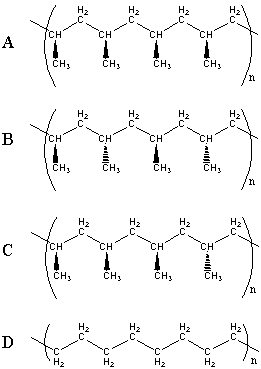
A)A
B)B
C)C
D)D
A)A
B)B
C)C
D)D
Question
Question
Which polymerization shown takes place by a condensation reaction? 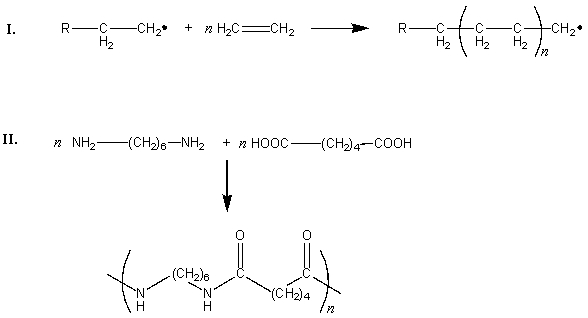
A)I only
B)II only
C)I and II
D)None of the above
A)I only
B)II only
C)I and II
D)None of the above
Question
Which option represents a cross-linked polymer? 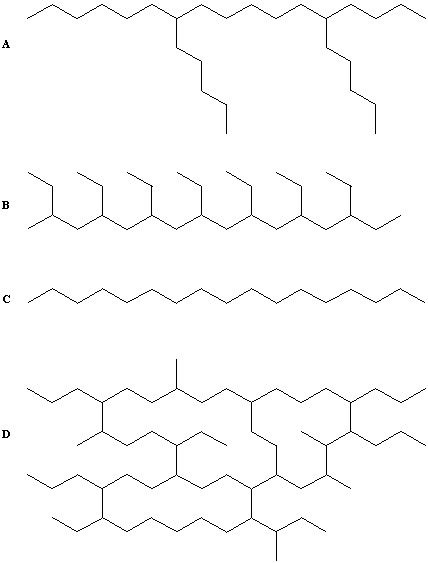
A)A
B)B
C)C
D)D
A)A
B)B
C)C
D)D
Question
Question
Acrylonitrile results from the polymerization of 
A)A
B)B
C)C
D)D
E)E
A)A
B)B
C)C
D)D
E)E
Question
Question
Poly(vinyl chloride)results from the polymerization of 
A)A
B)B
C)C
D)D
E)E
A)A
B)B
C)C
D)D
E)E
Question
Polypropene results from the polymerization of 
A)A
B)B
C)C
D)D
E)E
A)A
B)B
C)C
D)D
E)E
Question
Which polymerization shown takes place by a radical mechanism? 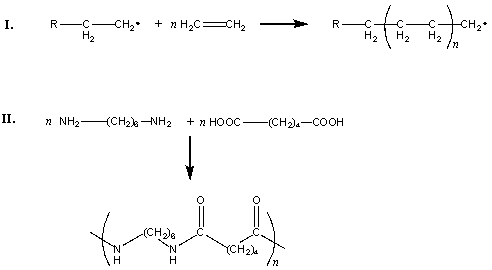
A)I only
B)II only
C)I and II
D)None of the above
A)I only
B)II only
C)I and II
D)None of the above
Question
Which one of these molecules could not serve as a monomer for an addition polymer?
A)ClCH=CH2
B)H2C=CH-CN
C)H2C=CH-C6H5
D)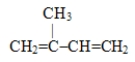
E)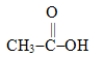
A)ClCH=CH2
B)H2C=CH-CN
C)H2C=CH-C6H5
D)
E)
Question
Polystyrene results from the polymerization of 
A)A
B)B
C)C
D)D
E)E
A)A
B)B
C)C
D)D
E)E
Question
The segment 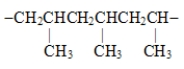 represents the polymer named
A)polybutylene.
B)polyvinyl chloride.
C)polypropylene.
D)polystyrene.
E)polyethylene.
represents the polymer namedA)polybutylene.
B)polyvinyl chloride.
C)polypropylene.
D)polystyrene.
E)polyethylene.
Question
Which of the following polymers has a syndiotactic structure? 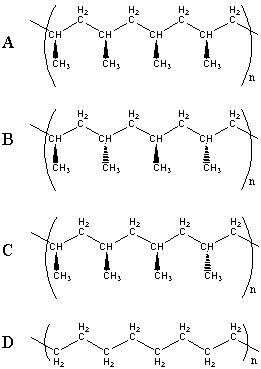
A)A
B)B
C)C
D)D
A)A
B)B
C)C
D)D
Question
Question
Question
The polymer formed from the monomer CH2=CH-CN is
A)
B)(CH2=CHCN)n
C)(CH2=CH=CN)n
D)
A)
B)(CH2=CHCN)n
C)(CH2=CH=CN)n
D)
Question
Which of the following polymers has an atactic structure? 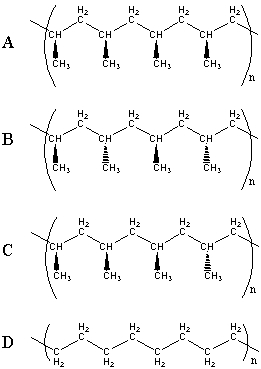
A)A
B)B
C)C
D)D
A)A
B)B
C)C
D)D
Question
The segment 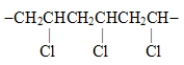 represents the polymer named
A)polybutylene.
B)polyvinyl chloride.
C)polypropylene.
D)polystyrene.
E)polyethylene.
represents the polymer namedA)polybutylene.
B)polyvinyl chloride.
C)polypropylene.
D)polystyrene.
E)polyethylene.
Question
Question
Question
Which of the structures below corresponds to the dipeptide alanylcysteine? The parent amino acids are shown below. 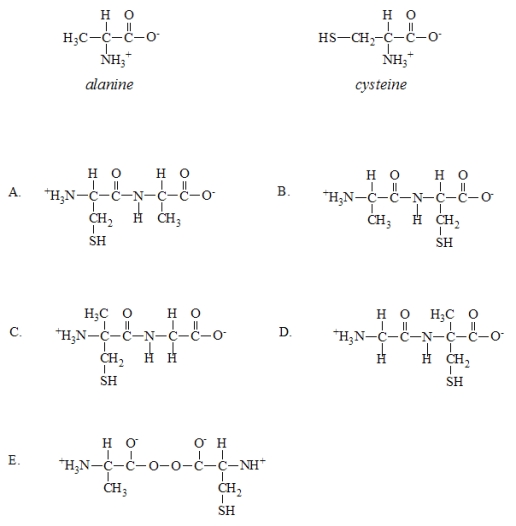
A)A
B)B
C)C
D)D
E)E
A)A
B)B
C)C
D)D
E)E
Question
Question
Question
Question
Question
Question
Question
Which one of these choices is the general structural formula of an amino acid?
A)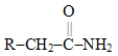
B)R-CH2-NH2
C)
D)
A)
B)R-CH2-NH2
C)
D)
Question
Question
Question
Question
Question
Which of the structures below corresponds to the dipeptide cysteylananine? The parent amino acids are shown below. 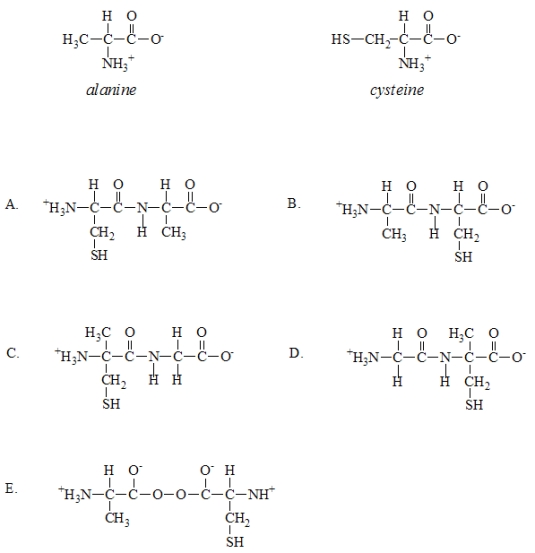
A)A
B)B
C)C
D)D
E)E
A)A
B)B
C)C
D)D
E)E
Question
What type of polymer is represented by the following repeating segment? 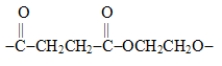
A)polyamide
B)polyester
C)polyether
D)polyolefin
E)polyethylene
A)polyamide
B)polyester
C)polyether
D)polyolefin
E)polyethylene
Question
The functional group  found in proteins is called a (an)
A)amide.
B)carboxylic acid.
C)amine.
D)amino acid.
E)dipeptide.
found in proteins is called a (an)A)amide.
B)carboxylic acid.
C)amine.
D)amino acid.
E)dipeptide.
Question
Question
Question
Question
Question
Question
Question
Question
Question
Question
Question
Draw the structural formula of the monomer that would be used to prepare the following
polymer (Teflon):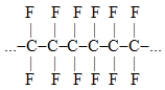
polymer (Teflon):
Question
Write an equation for the reaction of the diamine and di-carboxylic acid shown below, and show the structure of the nylon polymer that would be formed. 
Question
The following amino acids all have nonpolar side chains. 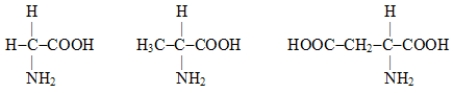

Unlock Deck
Sign up to unlock the cards in this deck!
Unlock Deck
Unlock Deck
1/50

Play

Full screen (f)
Deck 25: Synthetic and Natural Organic Polymers
1
A polymer made in a polymerization reaction that also produces small molecules (such as water)is classified as
A)an addition polymer
B)a natural polymer.
C)a condensation polymer.
D)an elimination polymer.
E)a copolymer.
A)an addition polymer
B)a natural polymer.
C)a condensation polymer.
D)an elimination polymer.
E)a copolymer.
a condensation polymer.
2
Which of the following polymers has an isotactic structure?
A)A
B)B
C)C
D)D
A)A
B)B
C)C
D)D
A
3
What structural feature is required to have an isotactic or syndiotactic carbon-based polymer?
A)A repeating unit that contains an asymmetric carbon
B)A repeating unit that contains a double bond
C)A repeating unit that contains a triple bond
D)A repeating unit that contains an aromatic hydrocarbon
E)A repeating unit that contains an atom other than carbon
A)A repeating unit that contains an asymmetric carbon
B)A repeating unit that contains a double bond
C)A repeating unit that contains a triple bond
D)A repeating unit that contains an aromatic hydrocarbon
E)A repeating unit that contains an atom other than carbon
A repeating unit that contains an asymmetric carbon
4
Which polymerization shown takes place by a condensation reaction?
A)I only
B)II only
C)I and II
D)None of the above
A)I only
B)II only
C)I and II
D)None of the above
Unlock Deck
Unlock for access to all 50 flashcards in this deck.
Unlock Deck
k this deck
5
Which option represents a cross-linked polymer?
A)A
B)B
C)C
D)D
A)A
B)B
C)C
D)D
Unlock Deck
Unlock for access to all 50 flashcards in this deck.
Unlock Deck
k this deck
6
The only true hydrocarbon polymer found in nature is
A)rubber
B)nylon
C)Tyvek
D)polystyrene
E)neoprene
A)rubber
B)nylon
C)Tyvek
D)polystyrene
E)neoprene
Unlock Deck
Unlock for access to all 50 flashcards in this deck.
Unlock Deck
k this deck
7
Acrylonitrile results from the polymerization of
A)A
B)B
C)C
D)D
E)E
A)A
B)B
C)C
D)D
E)E
Unlock Deck
Unlock for access to all 50 flashcards in this deck.
Unlock Deck
k this deck
8
A protein is
A)a polysaccharide.
B)a saturated ester of glycerol.
C)one of the units making up a nucleic acid.
D)a polymer of amino acids.
E)an aromatic hydrocarbon.
A)a polysaccharide.
B)a saturated ester of glycerol.
C)one of the units making up a nucleic acid.
D)a polymer of amino acids.
E)an aromatic hydrocarbon.
Unlock Deck
Unlock for access to all 50 flashcards in this deck.
Unlock Deck
k this deck
9
Poly(vinyl chloride)results from the polymerization of
A)A
B)B
C)C
D)D
E)E
A)A
B)B
C)C
D)D
E)E
Unlock Deck
Unlock for access to all 50 flashcards in this deck.
Unlock Deck
k this deck
10
Polypropene results from the polymerization of
A)A
B)B
C)C
D)D
E)E
A)A
B)B
C)C
D)D
E)E
Unlock Deck
Unlock for access to all 50 flashcards in this deck.
Unlock Deck
k this deck
11
Which polymerization shown takes place by a radical mechanism?
A)I only
B)II only
C)I and II
D)None of the above
A)I only
B)II only
C)I and II
D)None of the above
Unlock Deck
Unlock for access to all 50 flashcards in this deck.
Unlock Deck
k this deck
12
Which one of these molecules could not serve as a monomer for an addition polymer?
A)ClCH=CH2
B)H2C=CH-CN
C)H2C=CH-C6H5
D)
E)
A)ClCH=CH2
B)H2C=CH-CN
C)H2C=CH-C6H5
D)
E)
Unlock Deck
Unlock for access to all 50 flashcards in this deck.
Unlock Deck
k this deck
13
Polystyrene results from the polymerization of
A)A
B)B
C)C
D)D
E)E
A)A
B)B
C)C
D)D
E)E
Unlock Deck
Unlock for access to all 50 flashcards in this deck.
Unlock Deck
k this deck
14
The segment represents the polymer named
A)polybutylene.
B)polyvinyl chloride.
C)polypropylene.
D)polystyrene.
E)polyethylene.
represents the polymer namedA)polybutylene.
B)polyvinyl chloride.
C)polypropylene.
D)polystyrene.
E)polyethylene.
Unlock Deck
Unlock for access to all 50 flashcards in this deck.
Unlock Deck
k this deck
15
Which of the following polymers has a syndiotactic structure?
A)A
B)B
C)C
D)D
A)A
B)B
C)C
D)D
Unlock Deck
Unlock for access to all 50 flashcards in this deck.
Unlock Deck
k this deck
16
Which statement is false concerning a Natta-Ziegler catalyst?
A)A Natta-Ziegler catalyst can be used to promote a polymerization that is selective for isotactic or syndiotactic polymer.
B)A Natta-Ziegler catalyst containing [Al(C2H5)3] and TiCl3 can be used to promote the formation of specific isomers in a polymerization.
C)A Natta-Ziegler catalyst is used to make a polymerization thermodynamically favorable.
D)A Natta-Ziegler catalyst has been used by chemists to design polymers with different properties.
A)A Natta-Ziegler catalyst can be used to promote a polymerization that is selective for isotactic or syndiotactic polymer.
B)A Natta-Ziegler catalyst containing [Al(C2H5)3] and TiCl3 can be used to promote the formation of specific isomers in a polymerization.
C)A Natta-Ziegler catalyst is used to make a polymerization thermodynamically favorable.
D)A Natta-Ziegler catalyst has been used by chemists to design polymers with different properties.
Unlock Deck
Unlock for access to all 50 flashcards in this deck.
Unlock Deck
k this deck
17
Which of the following polymers is formed by a condensation process?
A)PVC
B)nylon
C)Teflon
D)Plexiglas
E)neoprene
A)PVC
B)nylon
C)Teflon
D)Plexiglas
E)neoprene
Unlock Deck
Unlock for access to all 50 flashcards in this deck.
Unlock Deck
k this deck
18
The polymer formed from the monomer CH2=CH-CN is
A)
B)(CH2=CHCN)n
C)(CH2=CH=CN)n
D)
A)
B)(CH2=CHCN)n
C)(CH2=CH=CN)n
D)
Unlock Deck
Unlock for access to all 50 flashcards in this deck.
Unlock Deck
k this deck
19
Which of the following polymers has an atactic structure?
A)A
B)B
C)C
D)D
A)A
B)B
C)C
D)D
Unlock Deck
Unlock for access to all 50 flashcards in this deck.
Unlock Deck
k this deck
20
The segment represents the polymer named
A)polybutylene.
B)polyvinyl chloride.
C)polypropylene.
D)polystyrene.
E)polyethylene.
represents the polymer namedA)polybutylene.
B)polyvinyl chloride.
C)polypropylene.
D)polystyrene.
E)polyethylene.
Unlock Deck
Unlock for access to all 50 flashcards in this deck.
Unlock Deck
k this deck
21
The backbone of a strand of nucleic acid consists of
A)phosphate units only.
B)phosphate and sugar units.
C)polyester.
D)phosphate, sugar, and nitrogen base units.
E)sugar units only.
A)phosphate units only.
B)phosphate and sugar units.
C)polyester.
D)phosphate, sugar, and nitrogen base units.
E)sugar units only.
Unlock Deck
Unlock for access to all 50 flashcards in this deck.
Unlock Deck
k this deck
22
Which one of these molecules is part of the make-up of both DNA and RNA?
A)deoxyribose
B)ribose
C)phosphate
D)thymine
E)uracil
A)deoxyribose
B)ribose
C)phosphate
D)thymine
E)uracil
Unlock Deck
Unlock for access to all 50 flashcards in this deck.
Unlock Deck
k this deck
23
Which of the structures below corresponds to the dipeptide alanylcysteine? The parent amino acids are shown below.
A)A
B)B
C)C
D)D
E)E
A)A
B)B
C)C
D)D
E)E
Unlock Deck
Unlock for access to all 50 flashcards in this deck.
Unlock Deck
k this deck
24
A peptide bond (also called an amide bond)joins two amino acids together.What atoms are linked by this bond?
A)C - O
B)C - H
C)C - N
D)N - S
E)S - C
A)C - O
B)C - H
C)C - N
D)N - S
E)S - C
Unlock Deck
Unlock for access to all 50 flashcards in this deck.
Unlock Deck
k this deck
25
Cysteine and methionine are unique among the twenty essential amino acids in that they
A)are chiral.
B)contain an aromatic ring.
C)do not form dipolar ions.
D)contain sulfur.
E)cannot join with other amino acids to form peptides.
A)are chiral.
B)contain an aromatic ring.
C)do not form dipolar ions.
D)contain sulfur.
E)cannot join with other amino acids to form peptides.
Unlock Deck
Unlock for access to all 50 flashcards in this deck.
Unlock Deck
k this deck
26
An essential amino acid is one that
A)must be included in the diet.
B)contains no sulfur.
C)occurs in all types of proteins.
D)is necessary for vitamin production.
E)the body can synthesize.
A)must be included in the diet.
B)contains no sulfur.
C)occurs in all types of proteins.
D)is necessary for vitamin production.
E)the body can synthesize.
Unlock Deck
Unlock for access to all 50 flashcards in this deck.
Unlock Deck
k this deck
27
Phosphorus is an essential mineral element.It is an important atom in which one of the following?
A)amino acids
B)proteins
C)polyethylene
D)nylon
E)DNA
A)amino acids
B)proteins
C)polyethylene
D)nylon
E)DNA
Unlock Deck
Unlock for access to all 50 flashcards in this deck.
Unlock Deck
k this deck
28
The secondary structure of a protein is the
A)configuration of those parts of the chain stabilized by a regular pattern of covalent bonds between C and O groups of the backbone of the chain.
B)configuration of those parts of the chain stabilized by a regular pattern of hydrogen bonds between CO and NH groups of the backbone of the chain.
C)specific order of amino acids in the chain.
D)overall three-dimensional structure of the molecule.
E)overall arrangement of several polypeptide chains into one functional unit.
A)configuration of those parts of the chain stabilized by a regular pattern of covalent bonds between C and O groups of the backbone of the chain.
B)configuration of those parts of the chain stabilized by a regular pattern of hydrogen bonds between CO and NH groups of the backbone of the chain.
C)specific order of amino acids in the chain.
D)overall three-dimensional structure of the molecule.
E)overall arrangement of several polypeptide chains into one functional unit.
Unlock Deck
Unlock for access to all 50 flashcards in this deck.
Unlock Deck
k this deck
29
A protein that has been reversibly denatured has
A)temporarily lost part or all of its secondary or tertiary structure.
B)temporarily lost part or all of its primary structure.
C)been genetically modified due to errors in the nucleotides in the parent DNA.
D)temporarily lost its amino acid residues.
E)temporarily lost the hydrogen bonding between nitrogenous bases.
A)temporarily lost part or all of its secondary or tertiary structure.
B)temporarily lost part or all of its primary structure.
C)been genetically modified due to errors in the nucleotides in the parent DNA.
D)temporarily lost its amino acid residues.
E)temporarily lost the hydrogen bonding between nitrogenous bases.
Unlock Deck
Unlock for access to all 50 flashcards in this deck.
Unlock Deck
k this deck
30
Which one of these choices is the general structural formula of an amino acid?
A)
B)R-CH2-NH2
C)
D)
A)
B)R-CH2-NH2
C)
D)
Unlock Deck
Unlock for access to all 50 flashcards in this deck.
Unlock Deck
k this deck
31
Which choice lists both the sugar and the nitrogen base that are a part of RNA but are not a part of DNA?
A)deoxyribose and thymine
B)ribose and deoxyribose
C)ribose and uracil
D)uracil and thymine
E)ribose and thymine
A)deoxyribose and thymine
B)ribose and deoxyribose
C)ribose and uracil
D)uracil and thymine
E)ribose and thymine
Unlock Deck
Unlock for access to all 50 flashcards in this deck.
Unlock Deck
k this deck
32
Which nitrogen base is found in RNA but not in DNA?
A)adenine
B)cytosine
C)guanine
D)thymine
E)uracil
A)adenine
B)cytosine
C)guanine
D)thymine
E)uracil
Unlock Deck
Unlock for access to all 50 flashcards in this deck.
Unlock Deck
k this deck
33
The intermolecular force between bases on the opposite strands of DNA responsible for its double-helical structure is
A)hydrogen bonding.
B)dispersion force.
C)covalent bonding.
D)ionic force.
E)dipole-dipole force.
A)hydrogen bonding.
B)dispersion force.
C)covalent bonding.
D)ionic force.
E)dipole-dipole force.
Unlock Deck
Unlock for access to all 50 flashcards in this deck.
Unlock Deck
k this deck
34
An amino acid is a compound that contains at least
A)one amino group and one amide group.
B)two amino groups and one carboxylic acid group.
C)one hydroxyl group and one methyl group.
D)one carboxylic acid group and one amino group.
E)one methyl group and one amide group.
A)one amino group and one amide group.
B)two amino groups and one carboxylic acid group.
C)one hydroxyl group and one methyl group.
D)one carboxylic acid group and one amino group.
E)one methyl group and one amide group.
Unlock Deck
Unlock for access to all 50 flashcards in this deck.
Unlock Deck
k this deck
35
Which of the structures below corresponds to the dipeptide cysteylananine? The parent amino acids are shown below.
A)A
B)B
C)C
D)D
E)E
A)A
B)B
C)C
D)D
E)E
Unlock Deck
Unlock for access to all 50 flashcards in this deck.
Unlock Deck
k this deck
36
What type of polymer is represented by the following repeating segment?
A)polyamide
B)polyester
C)polyether
D)polyolefin
E)polyethylene
A)polyamide
B)polyester
C)polyether
D)polyolefin
E)polyethylene
Unlock Deck
Unlock for access to all 50 flashcards in this deck.
Unlock Deck
k this deck
37
The functional group found in proteins is called a (an)
A)amide.
B)carboxylic acid.
C)amine.
D)amino acid.
E)dipeptide.
found in proteins is called a (an)A)amide.
B)carboxylic acid.
C)amine.
D)amino acid.
E)dipeptide.
Unlock Deck
Unlock for access to all 50 flashcards in this deck.
Unlock Deck
k this deck
38
Which one of these materials is a copolymer?
A)Styrene-butadiene
B)polyvinyl chloride
C)polypropylene
D)poly-cis-isoprene
E)polyethylene
A)Styrene-butadiene
B)polyvinyl chloride
C)polypropylene
D)poly-cis-isoprene
E)polyethylene
Unlock Deck
Unlock for access to all 50 flashcards in this deck.
Unlock Deck
k this deck
39
Which of these molecules is a product of the hydrolysis of DNA?
A)acetic acid
B)glucose
C)adenine
D)ribose
E)water
A)acetic acid
B)glucose
C)adenine
D)ribose
E)water
Unlock Deck
Unlock for access to all 50 flashcards in this deck.
Unlock Deck
k this deck
40
Which choice contains all three molecular units found in nucleotides?
A)phosphate, sugar, amino acid
B)amino acid, nitrogen-containing base, sugar
C)carboxylic acid, sugar, protein
D)phosphate, nitrogen-containing base, sugar
E)sugar, amino acid, protein
A)phosphate, sugar, amino acid
B)amino acid, nitrogen-containing base, sugar
C)carboxylic acid, sugar, protein
D)phosphate, nitrogen-containing base, sugar
E)sugar, amino acid, protein
Unlock Deck
Unlock for access to all 50 flashcards in this deck.
Unlock Deck
k this deck
41
Amides are synthesized from two classes of organic compounds.Those two types of compounds are
A)carboxylic acids and alkenes.
B)amines and alcohols.
C)alcohols and carboxylic acids.
D)amines and carboxylic acids.
E)alkenes and amines.
A)carboxylic acids and alkenes.
B)amines and alcohols.
C)alcohols and carboxylic acids.
D)amines and carboxylic acids.
E)alkenes and amines.
Unlock Deck
Unlock for access to all 50 flashcards in this deck.
Unlock Deck
k this deck
42
Proteins occurring in the -pleated sheet structure
A)are relatively inelastic.
B)never occur in nature.
C)produce structurally weak materials.
D)contain no peptide bonds.
E)are not involved in hydrogen bonds.
A)are relatively inelastic.
B)never occur in nature.
C)produce structurally weak materials.
D)contain no peptide bonds.
E)are not involved in hydrogen bonds.
Unlock Deck
Unlock for access to all 50 flashcards in this deck.
Unlock Deck
k this deck
43
The monomer used to prepare polyvinyl chloride (PVC)is CHCl=CHCl.
Unlock Deck
Unlock for access to all 50 flashcards in this deck.
Unlock Deck
k this deck
44
Both DNA and RNA have double-helical structures.
Unlock Deck
Unlock for access to all 50 flashcards in this deck.
Unlock Deck
k this deck
45
The primary structure of a protein refers to the unique amino acid sequence of the polypeptide chain.
Unlock Deck
Unlock for access to all 50 flashcards in this deck.
Unlock Deck
k this deck
46
Which of the following statements about the binding of oxygen to deoxyhemoglobin is correct?
A)The binding of oxygen to Fe2+ in the first heme pulls the iron ion into the porphyrin ring, decreasing the affinity for the second oxygen.
B)The binding of oxygen to Fe2+ in the first heme pushes the iron ion out of the porphyrin ring, decreasing the affinity for the second oxygen.
C)The binding of oxygen to Fe2+ in the first heme pulls the iron ion into the porphyrin ring, increasing the affinity for the second oxygen.
D)The binding of oxygen to Fe2+ in the first heme pushes the iron ion out of the porphyrin ring, increasing the affinity for the second oxygen.
E)Oxygen does not bind to deoxyhemoglobin.
A)The binding of oxygen to Fe2+ in the first heme pulls the iron ion into the porphyrin ring, decreasing the affinity for the second oxygen.
B)The binding of oxygen to Fe2+ in the first heme pushes the iron ion out of the porphyrin ring, decreasing the affinity for the second oxygen.
C)The binding of oxygen to Fe2+ in the first heme pulls the iron ion into the porphyrin ring, increasing the affinity for the second oxygen.
D)The binding of oxygen to Fe2+ in the first heme pushes the iron ion out of the porphyrin ring, increasing the affinity for the second oxygen.
E)Oxygen does not bind to deoxyhemoglobin.
Unlock Deck
Unlock for access to all 50 flashcards in this deck.
Unlock Deck
k this deck
47
Hydrogen bonding, dispersion forces, ionic forces, and dipole-dipole forces all affect the structure of a protein?
Unlock Deck
Unlock for access to all 50 flashcards in this deck.
Unlock Deck
k this deck
48
Draw the structural formula of the monomer that would be used to prepare the following
polymer (Teflon):
polymer (Teflon):
Unlock Deck
Unlock for access to all 50 flashcards in this deck.
Unlock Deck
k this deck
49
Write an equation for the reaction of the diamine and di-carboxylic acid shown below, and show the structure of the nylon polymer that would be formed.
Unlock Deck
Unlock for access to all 50 flashcards in this deck.
Unlock Deck
k this deck
50
The following amino acids all have nonpolar side chains.
Unlock Deck
Unlock for access to all 50 flashcards in this deck.
Unlock Deck
k this deck
Unlock Deck
Unlock for access to all 50 flashcards in this deck.






