







 Chat with AI

Deck 14: Raising Capital
Full screen (f)

Question
Jeremy founded a company. He issues 200 000 Class A preference shares for his own $100 000 investment. He then goes through three further rounds of investment, as shown below:  What is the post-money valuation for the Class D funding round?
A)$2.025 million
B)$3.15 million
C)$1.95 million
D)$2.85 million
What is the post-money valuation for the Class D funding round?A)$2.025 million
B)$3.15 million
C)$1.95 million
D)$2.85 million

Question
Question
Question
Question
Question
Question
The founder of a company issues 100 000 Class A preference shares for his own $250 000 investment. He then goes through three further rounds of investment, as shown below:  What is the post-money valuation for the Class D funding round?
A)$1.96 million
B)$2.24 million
C)$2.43 million
D)$2.14 million
What is the post-money valuation for the Class D funding round?A)$1.96 million
B)$2.24 million
C)$2.43 million
D)$2.14 million
Question
Question
Question
Question
Question
The founder of a company issues 100 000 Class A preference shares for his own $250 000 investment. He then goes through three further rounds of investment, as shown below:  Which of the following is closest to the percentage of the company owned by the founder of the company?
A)25.0%
B)37.5%
C)42%
D)12.5%
Which of the following is closest to the percentage of the company owned by the founder of the company?A)25.0%
B)37.5%
C)42%
D)12.5%
Question
Jeremy founded a company. He issues 200 000 Class A preference shares for his own $100 000 investment. He then goes through three further rounds of investment, as shown below:  Which of the following is closest to the percentage of the company owned by the Class D investors?
A)33%
B)25%
C)29%
D)46%
Which of the following is closest to the percentage of the company owned by the Class D investors?A)33%
B)25%
C)29%
D)46%
Question
Question
Question
Question
Question
Question
Question
Question
Question
Question
Question
Question
Question
Question
Question
Question
Question
Question
Question
Question
Question
Question
Question
Question
Question
Question
Question
Question
The founders and owners of a private company have funded it through the following rounds of investment:  The owners decide to take the company public through an IPO, issuing 1 million new shares. Assuming that they successfully complete the IPO, the net income for the next year is estimated to be $5 million. The price of shares is set using average price-earnings ratios for similar businesses of 17.0. What portion of the company will be owned by the angel investor after the IPO?
A)12%
B)30%
C)16%
D)22%
The owners decide to take the company public through an IPO, issuing 1 million new shares. Assuming that they successfully complete the IPO, the net income for the next year is estimated to be $5 million. The price of shares is set using average price-earnings ratios for similar businesses of 17.0. What portion of the company will be owned by the angel investor after the IPO?A)12%
B)30%
C)16%
D)22%
Question
Question
Question
Question
Question
Question
Question
Use the information for the question(s)below.
Luther Industries is in the process of selling shares in an auction IPO. At the end of the bidding period, Luther's investment bank has received the following bids:
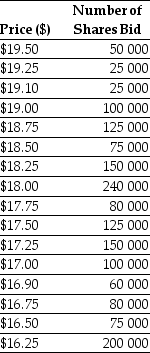
The proceeds from the IPO, if Luther is selling 1.25 million shares, are closest to:
A)$21.1 million
B)$20.6 million
C)$21.6 million
D)$20.9 million
Luther Industries is in the process of selling shares in an auction IPO. At the end of the bidding period, Luther's investment bank has received the following bids:
The proceeds from the IPO, if Luther is selling 1.25 million shares, are closest to:
A)$21.1 million
B)$20.6 million
C)$21.6 million
D)$20.9 million
Question
David founds a company and goes through the investment rounds shown below:  He decides to take the company public through an IPO, issuing 2 million new shares. Assuming that he successfully completes the IPO, the net income for the next year is estimated to be $8 million. His banker informs him that the price of shares should be set using average price-earnings ratios for similar businesses, which is 15.0. What will be the IPO price per share?
A)$20.25
B)$33.33
C)$60.00
D)$3.40
He decides to take the company public through an IPO, issuing 2 million new shares. Assuming that he successfully completes the IPO, the net income for the next year is estimated to be $8 million. His banker informs him that the price of shares should be set using average price-earnings ratios for similar businesses, which is 15.0. What will be the IPO price per share?A)$20.25
B)$33.33
C)$60.00
D)$3.40
Question
Question
Use the information for the question(s)below.
Luther Industries is in the process of selling shares in an auction IPO. At the end of the bidding period, Luther's investment bank has received the following bids:
What will the offer price of these shares be if Luther is selling 1 million shares?
A)$17.50
B)$17.00
C)$17.25
D)$16.75
Luther Industries is in the process of selling shares in an auction IPO. At the end of the bidding period, Luther's investment bank has received the following bids:
What will the offer price of these shares be if Luther is selling 1 million shares?
A)$17.50
B)$17.00
C)$17.25
D)$16.75
Question
Question
The founders and owners of a private company have funded it through the following rounds of investment:  The owners decide to take the company public through an IPO, issuing 1 million new shares. Assuming that they successfully complete the IPO, the net income for the next year is estimated to be $5 million. The price of shares is set using average price-earnings ratios for similar businesses of 17.0. What will be the IPO price per share?
A)$12
B)$45
C)$36
D)$22
The owners decide to take the company public through an IPO, issuing 1 million new shares. Assuming that they successfully complete the IPO, the net income for the next year is estimated to be $5 million. The price of shares is set using average price-earnings ratios for similar businesses of 17.0. What will be the IPO price per share?A)$12
B)$45
C)$36
D)$22
Question
Question
Question
Question
Question
David founds a company and goes through the investment rounds shown below:  He decides to take the company public through an IPO, issuing 2 million new shares. Assuming that he successfully completes the IPO, the net income for the next year is estimated to be $8 million. His banker informs him that the price of shares should be set using average price-earnings ratios for similar businesses, which is 15.0. What share of the company will David own after the IPO?
A)22%
B)11%
C)16%
D)14%
He decides to take the company public through an IPO, issuing 2 million new shares. Assuming that he successfully completes the IPO, the net income for the next year is estimated to be $8 million. His banker informs him that the price of shares should be set using average price-earnings ratios for similar businesses, which is 15.0. What share of the company will David own after the IPO?A)22%
B)11%
C)16%
D)14%
Question
Use the information for the question(s)below.
Luther Industries is in the process of selling shares in an auction IPO. At the end of the bidding period, Luther's investment bank has received the following bids:
What are some of the advantages of going public?
_____________________________________________________________________________________________
_____________________________________________________________________________________________
Luther Industries is in the process of selling shares in an auction IPO. At the end of the bidding period, Luther's investment bank has received the following bids:
What are some of the advantages of going public?
_____________________________________________________________________________________________
_____________________________________________________________________________________________
Question
Use the information for the question(s)below.
Luther Industries is in the process of selling shares in an auction IPO. At the end of the bidding period, Luther's investment bank has received the following bids:
What are some of the disadvantages of going public?
_____________________________________________________________________________________________
_____________________________________________________________________________________________
Luther Industries is in the process of selling shares in an auction IPO. At the end of the bidding period, Luther's investment bank has received the following bids:
What are some of the disadvantages of going public?
_____________________________________________________________________________________________
_____________________________________________________________________________________________
Question
Question
Question
Question
Question
Question
Question
Question
Question
Question
Question
Use the information for the question(s)below.
Luther Industries is in the process of selling shares in an auction IPO. At the end of the bidding period, Luther's investment bank has received the following bids:
What are some of the highlights of Google's IPO process?
_____________________________________________________________________________________________
_____________________________________________________________________________________________
Luther Industries is in the process of selling shares in an auction IPO. At the end of the bidding period, Luther's investment bank has received the following bids:
What are some of the highlights of Google's IPO process?
_____________________________________________________________________________________________
_____________________________________________________________________________________________
Question
Question
Question
Question
Question
Question
Question
Question
Question

Unlock Deck
Sign up to unlock the cards in this deck!
Unlock Deck
Unlock Deck
1/105

Play

Full screen (f)
Deck 14: Raising Capital
1
Jeremy founded a company. He issues 200 000 Class A preference shares for his own $100 000 investment. He then goes through three further rounds of investment, as shown below: What is the post-money valuation for the Class D funding round?
A)$2.025 million
B)$3.15 million
C)$1.95 million
D)$2.85 million
What is the post-money valuation for the Class D funding round?A)$2.025 million
B)$3.15 million
C)$1.95 million
D)$2.85 million
$3.15 million
2
Simone founded her company using $150 000 of her own money, issuing herself 300 000 shares. An angel investor bought an additional 200 000 shares for $100 000. She now sells another 500 000 shares to a venture capitalist for $2 million. What is the post-money valuation of the company?
A)$2 000 000
B)$4 000 000
C)$6 000 000
D)$2 250 000
A)$2 000 000
B)$4 000 000
C)$6 000 000
D)$2 250 000
$4 000 000
3
Simone founded her company using $150 000 of her own money, issuing herself 300 000 shares. An angel investor bought an additional 200 000 shares for $100 000. She now sells another 500 000 shares to a venture capitalist for $2 million. What percentage of the firm does Simone now own?
A)10%
B)30%
C)40%
D)20%
A)10%
B)30%
C)40%
D)20%
30%
4
Which of the following is NOT a common name for a corporation that invests in private companies?
A)Strategic partner
B)Strategic investor
C)Corporate partner
D)Venture partner
A)Strategic partner
B)Strategic investor
C)Corporate partner
D)Venture partner
Unlock Deck
Unlock for access to all 105 flashcards in this deck.
Unlock Deck
k this deck
5
Why do most people launching a start-up company acquire their funds through the venture capital industry rather than through angel investors?
A)Most entrepreneurs do not want the fees associated with investment by an angel investor.
B)Most entrepreneurs are not willing to relinquish the control of their business demanded by angel investors.
C)Most entrepreneurs do not have any relationships with individuals with substantial capital to invest.
D)Most entrepreneurs do not need the expertise brought to a young firm by an angel investor.
A)Most entrepreneurs do not want the fees associated with investment by an angel investor.
B)Most entrepreneurs are not willing to relinquish the control of their business demanded by angel investors.
C)Most entrepreneurs do not have any relationships with individuals with substantial capital to invest.
D)Most entrepreneurs do not need the expertise brought to a young firm by an angel investor.
Unlock Deck
Unlock for access to all 105 flashcards in this deck.
Unlock Deck
k this deck
6
An entrepreneur founded his company using $200 000 of his own money, issuing himself 200 000 shares. An angel investor bought an additional 100 000 shares for $200 000. The entrepreneur now sells another 400 000 shares to a venture capitalist for $1 million. What is the post-money valuation of the company?
A)$2 000 000
B)$1 000 000
C)$1 750 000
D)$1 140 000
A)$2 000 000
B)$1 000 000
C)$1 750 000
D)$1 140 000
Unlock Deck
Unlock for access to all 105 flashcards in this deck.
Unlock Deck
k this deck
7
The founder of a company issues 100 000 Class A preference shares for his own $250 000 investment. He then goes through three further rounds of investment, as shown below: What is the post-money valuation for the Class D funding round?
A)$1.96 million
B)$2.24 million
C)$2.43 million
D)$2.14 million
What is the post-money valuation for the Class D funding round?A)$1.96 million
B)$2.24 million
C)$2.43 million
D)$2.14 million
Unlock Deck
Unlock for access to all 105 flashcards in this deck.
Unlock Deck
k this deck
8
Equity investors in a private company usually plan to realise a return on their investment by selling their shares when that company is acquired by another firm or sold to the public in a public offering.
Unlock Deck
Unlock for access to all 105 flashcards in this deck.
Unlock Deck
k this deck
9
Which of the following statements is NOT true regarding venture capitalists?
A)They use their control to protect their investments, so they may therefore perform a key nurturing and monitoring role for the firm.
B)They can provide substantial capital for young companies.
C)They might invest for strategic objectives in addition to the desire for investment returns.
D)The firms offer limited partners a number of advantages over investing directly in start-ups themselves as angel investors.
A)They use their control to protect their investments, so they may therefore perform a key nurturing and monitoring role for the firm.
B)They can provide substantial capital for young companies.
C)They might invest for strategic objectives in addition to the desire for investment returns.
D)The firms offer limited partners a number of advantages over investing directly in start-ups themselves as angel investors.
Unlock Deck
Unlock for access to all 105 flashcards in this deck.
Unlock Deck
k this deck
10
A large publishing firm specialising in college textbooks wishes to expand into online delivery of its materials. In order to facilitate this, it invests in a number of small start-up companies that deliver college courses online and uses these companies to start diversifying the delivery of its content. Which of the following best describes the role of the publishing firm as described above?
A)A family investor
B)A venture capitalist
C)An institutional investor
D)A corporate investor
A)A family investor
B)A venture capitalist
C)An institutional investor
D)A corporate investor
Unlock Deck
Unlock for access to all 105 flashcards in this deck.
Unlock Deck
k this deck
11
When a company founder sells shares to outside investors in order to raise capital, the share of the company owned by the founder and the founder's control over the company will be reduced.
Unlock Deck
Unlock for access to all 105 flashcards in this deck.
Unlock Deck
k this deck
12
The founder of a company issues 100 000 Class A preference shares for his own $250 000 investment. He then goes through three further rounds of investment, as shown below: Which of the following is closest to the percentage of the company owned by the founder of the company?
A)25.0%
B)37.5%
C)42%
D)12.5%
Which of the following is closest to the percentage of the company owned by the founder of the company?A)25.0%
B)37.5%
C)42%
D)12.5%
Unlock Deck
Unlock for access to all 105 flashcards in this deck.
Unlock Deck
k this deck
13
Jeremy founded a company. He issues 200 000 Class A preference shares for his own $100 000 investment. He then goes through three further rounds of investment, as shown below: Which of the following is closest to the percentage of the company owned by the Class D investors?
A)33%
B)25%
C)29%
D)46%
Which of the following is closest to the percentage of the company owned by the Class D investors?A)33%
B)25%
C)29%
D)46%
Unlock Deck
Unlock for access to all 105 flashcards in this deck.
Unlock Deck
k this deck
14
Which of the following statements is NOT true regarding angel investors?
A)For many start-ups, the first round of outside private equity financing is often obtained from them.
B)Because their capital investment is often large relative to the amount of capital already in place at the firm, they typically receive a sizeable equity share in the business in return for their funds.
C)They are typically arranged as limited partnerships.
D)These investors are frequently friends or acquaintances of the entrepreneur.
A)For many start-ups, the first round of outside private equity financing is often obtained from them.
B)Because their capital investment is often large relative to the amount of capital already in place at the firm, they typically receive a sizeable equity share in the business in return for their funds.
C)They are typically arranged as limited partnerships.
D)These investors are frequently friends or acquaintances of the entrepreneur.
Unlock Deck
Unlock for access to all 105 flashcards in this deck.
Unlock Deck
k this deck
15
Which of the following is NOT a reason why an investor would choose to invest in new and growing firms as a limited partner in a venture capital firm rather than making those investments directly by themselves?
A)The investor will have a direct say in how the companies that the venture capital firm funds will be run.
B)A venture capital firm generally has a wide range of expertise among its general partners.
C)Venture capital firms use their control of the companies they invest in to protect those investments.
D)The investments of a venture capital firm are more diversified than the investments of a single individual.
A)The investor will have a direct say in how the companies that the venture capital firm funds will be run.
B)A venture capital firm generally has a wide range of expertise among its general partners.
C)Venture capital firms use their control of the companies they invest in to protect those investments.
D)The investments of a venture capital firm are more diversified than the investments of a single individual.
Unlock Deck
Unlock for access to all 105 flashcards in this deck.
Unlock Deck
k this deck
16
Family investors are most likely to be a possible source of funds to finance a growing business.
Unlock Deck
Unlock for access to all 105 flashcards in this deck.
Unlock Deck
k this deck
17
Venture Capital Firms are limited partnerships that specialises in raising money to invest in the private equity of young firms.
Unlock Deck
Unlock for access to all 105 flashcards in this deck.
Unlock Deck
k this deck
18
A firm's founder sells equity to outside investors for the first time in the form of preference shares. In what way are their preference shares most likely to differ from the preference shares issued by an established public firm?
A)They cannot be converted into common stock.
B)They will most likely not pay cash dividends.
C)They will give the holder seniority in any liquidation of the company.
D)They will have a larger dividend.
A)They cannot be converted into common stock.
B)They will most likely not pay cash dividends.
C)They will give the holder seniority in any liquidation of the company.
D)They will have a larger dividend.
Unlock Deck
Unlock for access to all 105 flashcards in this deck.
Unlock Deck
k this deck
19
Nature's Bounty, an organic seed company, is seeking to grow from a small company selling seeds in local markets into a company that sells seeds across several states. The funding for this expansion comes from a wealthy individual who uses his considerable inherited wealth to fund a variety of eco-friendly businesses. Which of the following best describes this individual's relationship with Nature's Bounty?
A)An angel investor
B)A corporate investor
C)A venture capitalist
D)An institutional investor
A)An angel investor
B)A corporate investor
C)A venture capitalist
D)An institutional investor
Unlock Deck
Unlock for access to all 105 flashcards in this deck.
Unlock Deck
k this deck
20
In Australia, AMP is a leading provider of retail and corporate superannuation and retirement income products. It has a large and diverse portfolio of investments, and as of 31 December 2016 it had net assets under management/advice of $110.6 billion. Which of the following best describes AMP?
A)A family investor
B)A venture capitalist
C)An angel investor
D)An institutional investor
A)A family investor
B)A venture capitalist
C)An angel investor
D)An institutional investor
Unlock Deck
Unlock for access to all 105 flashcards in this deck.
Unlock Deck
k this deck
21
What are angel investors?
_____________________________________________________________________________________________
_____________________________________________________________________________________________
_____________________________________________________________________________________________
_____________________________________________________________________________________________
Unlock Deck
Unlock for access to all 105 flashcards in this deck.
Unlock Deck
k this deck
22
Use the information for the question(s)below.
You founded your own firm two years ago. You initially contributed $250 000 of your own money and in return you received 2.5 million shares of stock. Since then, you have sold an additional 1.25 million shares of stock to angel investors. You are now considering raising capital from a venture capital firm. This venture capital firm would invest $5 million and would receive 2 million newly issued shares in return.
After the venture capitalist's investment, what percentage of the firm will you own?
A)66%
B)65%
C)63%
D)50%
You founded your own firm two years ago. You initially contributed $250 000 of your own money and in return you received 2.5 million shares of stock. Since then, you have sold an additional 1.25 million shares of stock to angel investors. You are now considering raising capital from a venture capital firm. This venture capital firm would invest $5 million and would receive 2 million newly issued shares in return.
After the venture capitalist's investment, what percentage of the firm will you own?
A)66%
B)65%
C)63%
D)50%
Unlock Deck
Unlock for access to all 105 flashcards in this deck.
Unlock Deck
k this deck
23
Use the information for the question(s)below.
You founded your own firm two years ago. You initially contributed $250 000 of your own money and in return you received 2.5 million shares of stock. Since then, you have sold an additional 1.25 million shares of stock to angel investors. You are now considering raising capital from a venture capital firm. This venture capital firm would invest $5 million and would receive 2 million newly issued shares in return.
After the venture capitalist's investment, the post-money valuation of the angel investor's shares is closest to:
A)$5.0 million
B)$4.0 million
C)$3.1 million
D)$6.5 million
You founded your own firm two years ago. You initially contributed $250 000 of your own money and in return you received 2.5 million shares of stock. Since then, you have sold an additional 1.25 million shares of stock to angel investors. You are now considering raising capital from a venture capital firm. This venture capital firm would invest $5 million and would receive 2 million newly issued shares in return.
After the venture capitalist's investment, the post-money valuation of the angel investor's shares is closest to:
A)$5.0 million
B)$4.0 million
C)$3.1 million
D)$6.5 million
Unlock Deck
Unlock for access to all 105 flashcards in this deck.
Unlock Deck
k this deck
24
Use the information for the question(s)below.
You founded your own firm two years ago. You initially contributed $250 000 of your own money and in return you received 2.5 million shares of stock. Since then, you have sold an additional 1.25 million shares of stock to angel investors. You are now considering raising capital from a venture capital firm. This venture capital firm would invest $5 million and would receive 2 million newly issued shares in return.
Suppose you sold the 1.25 million shares to the angel investor for $500 000. What was the post-money valuation of your shares immediately following the angel investor's investment?
A)$2.0 million
B)$500 000
C)$1.0 million
D)$2.5 million
You founded your own firm two years ago. You initially contributed $250 000 of your own money and in return you received 2.5 million shares of stock. Since then, you have sold an additional 1.25 million shares of stock to angel investors. You are now considering raising capital from a venture capital firm. This venture capital firm would invest $5 million and would receive 2 million newly issued shares in return.
Suppose you sold the 1.25 million shares to the angel investor for $500 000. What was the post-money valuation of your shares immediately following the angel investor's investment?
A)$2.0 million
B)$500 000
C)$1.0 million
D)$2.5 million
Unlock Deck
Unlock for access to all 105 flashcards in this deck.
Unlock Deck
k this deck
25
Use the information for the question(s)below.
You founded your own firm two years ago. You initially contributed $250 000 of your own money and in return you received 2.5 million shares of stock. Since then, you have sold an additional 1.25 million shares of stock to angel investors. You are now considering raising capital from a venture capital firm. This venture capital firm would invest $5 million and would receive 2 million newly issued shares in return.
Suppose you sold the 1.25 million shares to the angel investor for $500 000. What was your percentage ownership in the company immediately following the angel investor's investment?
A)70%
B)73.3%
C)100%
D)75.0%
You founded your own firm two years ago. You initially contributed $250 000 of your own money and in return you received 2.5 million shares of stock. Since then, you have sold an additional 1.25 million shares of stock to angel investors. You are now considering raising capital from a venture capital firm. This venture capital firm would invest $5 million and would receive 2 million newly issued shares in return.
Suppose you sold the 1.25 million shares to the angel investor for $500 000. What was your percentage ownership in the company immediately following the angel investor's investment?
A)70%
B)73.3%
C)100%
D)75.0%
Unlock Deck
Unlock for access to all 105 flashcards in this deck.
Unlock Deck
k this deck
26
Use the information for the question(s)below.
You founded your own firm two years ago. You initially contributed $250 000 of your own money and in return you received 2.5 million shares of stock. Since then, you have sold an additional 1.25 million shares of stock to angel investors. You are now considering raising capital from a venture capital firm. This venture capital firm would invest $5 million and would receive 2 million newly issued shares in return.
After the venture capitalist's investment, the post-money valuation of your shares is closest to:
A)$12.5 million
B)$10.0 million
C)$9.4 million
D)$8.5 million
You founded your own firm two years ago. You initially contributed $250 000 of your own money and in return you received 2.5 million shares of stock. Since then, you have sold an additional 1.25 million shares of stock to angel investors. You are now considering raising capital from a venture capital firm. This venture capital firm would invest $5 million and would receive 2 million newly issued shares in return.
After the venture capitalist's investment, the post-money valuation of your shares is closest to:
A)$12.5 million
B)$10.0 million
C)$9.4 million
D)$8.5 million
Unlock Deck
Unlock for access to all 105 flashcards in this deck.
Unlock Deck
k this deck
27
Underwriters tend to offer shares in an IPO at a price that is below that which the market will pay to reduce their exposure to losses from unsold shares.
Unlock Deck
Unlock for access to all 105 flashcards in this deck.
Unlock Deck
k this deck
28
Which of the following statements is FALSE?
A)Preference shares issued by mature companies such as banks usually have a preferential dividend and seniority in any liquidation and sometimes special voting rights.
B)The preference shares issued by young companies usually give the owner an option to convert them to ordinary shares on some future date, so they are often called callable preference shares.
C)If the company runs into financial difficulties, the preference shareholders have a senior claim on the assets of the firm relative to any ordinary shareholders.
D)The preference shares issued by young companies typically do not pay regular cash dividends.
A)Preference shares issued by mature companies such as banks usually have a preferential dividend and seniority in any liquidation and sometimes special voting rights.
B)The preference shares issued by young companies usually give the owner an option to convert them to ordinary shares on some future date, so they are often called callable preference shares.
C)If the company runs into financial difficulties, the preference shareholders have a senior claim on the assets of the firm relative to any ordinary shareholders.
D)The preference shares issued by young companies typically do not pay regular cash dividends.
Unlock Deck
Unlock for access to all 105 flashcards in this deck.
Unlock Deck
k this deck
29
The firm commitment process is the most common practice for IPOs in Australia.
Unlock Deck
Unlock for access to all 105 flashcards in this deck.
Unlock Deck
k this deck
30
What are venture capital firms?
_____________________________________________________________________________________________
_____________________________________________________________________________________________
_____________________________________________________________________________________________
_____________________________________________________________________________________________
Unlock Deck
Unlock for access to all 105 flashcards in this deck.
Unlock Deck
k this deck
31
Use the information for the question(s)below.
You founded your own firm two years ago. You initially contributed $250 000 of your own money and in return you received 2.5 million shares of stock. Since then, you have sold an additional 1.25 million shares of stock to angel investors. You are now considering raising capital from a venture capital firm. This venture capital firm would invest $5 million and would receive 2 million newly issued shares in return.
Assuming that this is the venture capitalist's first investment in your firm, what percentage of the firm will the venture capitalist own?
A)33%
B)50%
C)45%
D)35%
You founded your own firm two years ago. You initially contributed $250 000 of your own money and in return you received 2.5 million shares of stock. Since then, you have sold an additional 1.25 million shares of stock to angel investors. You are now considering raising capital from a venture capital firm. This venture capital firm would invest $5 million and would receive 2 million newly issued shares in return.
Assuming that this is the venture capitalist's first investment in your firm, what percentage of the firm will the venture capitalist own?
A)33%
B)50%
C)45%
D)35%
Unlock Deck
Unlock for access to all 105 flashcards in this deck.
Unlock Deck
k this deck
32
Which of the following statements is FALSE?
A)Venture capitalists typically control about three-quarters of the seats on a start-up's board of directors, and often represent the single largest voting block on the board.
B)The initial capital that is required to start a business is usually provided by the entrepreneur herself and her immediate family.
C)Individual investors who buy equity in small private firms are called angel investors.
D)A venture capital firm is a limited partnership that specialises in raising money to invest in the private equity of young firms.
A)Venture capitalists typically control about three-quarters of the seats on a start-up's board of directors, and often represent the single largest voting block on the board.
B)The initial capital that is required to start a business is usually provided by the entrepreneur herself and her immediate family.
C)Individual investors who buy equity in small private firms are called angel investors.
D)A venture capital firm is a limited partnership that specialises in raising money to invest in the private equity of young firms.
Unlock Deck
Unlock for access to all 105 flashcards in this deck.
Unlock Deck
k this deck
33
At what stage of the IPO process do senior management and the lead underwriters travel to promote the company and explain their rationale for the offer price to the underwriters' largest customers?
A)When valuing the firm.
B)When matching buyers to sellers of the stock.
C)When filing with the SEC.
D)When managing risk.
A)When valuing the firm.
B)When matching buyers to sellers of the stock.
C)When filing with the SEC.
D)When managing risk.
Unlock Deck
Unlock for access to all 105 flashcards in this deck.
Unlock Deck
k this deck
34
Which of the following is NOT a reason why an IPO is attractive to the managers of a private company?
A)It gives access to much larger amounts of capital through the public markets in subsequent offerings.
B)It gives access to large amounts of capital in the IPO.
C)It reduces the complexity of requirements regulating the company's management.
D)It gives their private equity investors the opportunity to diversify.
A)It gives access to much larger amounts of capital through the public markets in subsequent offerings.
B)It gives access to large amounts of capital in the IPO.
C)It reduces the complexity of requirements regulating the company's management.
D)It gives their private equity investors the opportunity to diversify.
Unlock Deck
Unlock for access to all 105 flashcards in this deck.
Unlock Deck
k this deck
35
The main advantages for a firm in going public are greater liquidity, better access to capital, and greater ability of investors to monitor the management of the firm.
Unlock Deck
Unlock for access to all 105 flashcards in this deck.
Unlock Deck
k this deck
36
Which of the following best describes those shares sold when a company goes public which raise new capital?
A)Tertiary offering
B)Secondary offering
C)Preliminary offering
D)Primary offering
A)Tertiary offering
B)Secondary offering
C)Preliminary offering
D)Primary offering
Unlock Deck
Unlock for access to all 105 flashcards in this deck.
Unlock Deck
k this deck
37
Which of the following statements is FALSE?
A)Institutional investors such as superannuation funds, insurance companies, endowments, and charities manage large quantities of money.
B)The general partners work for the venture capital firm and run the venture capital firm; they are called venture capitalists.
C)When a company founder decides to sell equity to outside investors for the first time, it is common practice for private companies to issue ordinary shares rather than preference shares to raise capital.
D)An important consideration for investors in private companies is their exit strategy - how they will eventually realise the return from their investment.
A)Institutional investors such as superannuation funds, insurance companies, endowments, and charities manage large quantities of money.
B)The general partners work for the venture capital firm and run the venture capital firm; they are called venture capitalists.
C)When a company founder decides to sell equity to outside investors for the first time, it is common practice for private companies to issue ordinary shares rather than preference shares to raise capital.
D)An important consideration for investors in private companies is their exit strategy - how they will eventually realise the return from their investment.
Unlock Deck
Unlock for access to all 105 flashcards in this deck.
Unlock Deck
k this deck
38
What is the difference between preference shares issued by a young private company and a mature company?
_____________________________________________________________________________________________
_____________________________________________________________________________________________
_____________________________________________________________________________________________
_____________________________________________________________________________________________
Unlock Deck
Unlock for access to all 105 flashcards in this deck.
Unlock Deck
k this deck
39
In a best-efforts IPO, the underwriter guarantees that all shares will be sold.
Unlock Deck
Unlock for access to all 105 flashcards in this deck.
Unlock Deck
k this deck
40
Use the information for the question(s)below.
You founded your own firm two years ago. You initially contributed $250 000 of your own money and in return you received 2.5 million shares of stock. Since then, you have sold an additional 1.25 million shares of stock to angel investors. You are now considering raising capital from a venture capital firm. This venture capital firm would invest $5 million and would receive 2 million newly issued shares in return.
The post-money valuation of your firm is closest to:
A)$15.4 million
B)$15.0 million
C)$15.2 million
D)$14.5 million
You founded your own firm two years ago. You initially contributed $250 000 of your own money and in return you received 2.5 million shares of stock. Since then, you have sold an additional 1.25 million shares of stock to angel investors. You are now considering raising capital from a venture capital firm. This venture capital firm would invest $5 million and would receive 2 million newly issued shares in return.
The post-money valuation of your firm is closest to:
A)$15.4 million
B)$15.0 million
C)$15.2 million
D)$14.5 million
Unlock Deck
Unlock for access to all 105 flashcards in this deck.
Unlock Deck
k this deck
41
The founders and owners of a private company have funded it through the following rounds of investment: The owners decide to take the company public through an IPO, issuing 1 million new shares. Assuming that they successfully complete the IPO, the net income for the next year is estimated to be $5 million. The price of shares is set using average price-earnings ratios for similar businesses of 17.0. What portion of the company will be owned by the angel investor after the IPO?
A)12%
B)30%
C)16%
D)22%
The owners decide to take the company public through an IPO, issuing 1 million new shares. Assuming that they successfully complete the IPO, the net income for the next year is estimated to be $5 million. The price of shares is set using average price-earnings ratios for similar businesses of 17.0. What portion of the company will be owned by the angel investor after the IPO?A)12%
B)30%
C)16%
D)22%
Unlock Deck
Unlock for access to all 105 flashcards in this deck.
Unlock Deck
k this deck
42
Which of the following statements is FALSE?
A)ASIC requires that companies prepare a prospectus, a document that provides financial and other information about the company to investors, prior to an IPO. Company managers work closely with the underwriters to prepare the prospectus.
B)In recent years, the US investment banking firm of W.R. Hambrecht and Company has attempted to change the IPO process by selling new issues directly to the public using an online auction IPO mechanism called Open IPO.
C)The lead underwriter is the primary banking firm responsible for managing the deal. The lead underwriter provides most of the advice and arranges for a group of other underwriters, called the syndicate, to help market and sell the issue.
D)Because of the potential conflict of interest, the underwriter will not make a market in the share after the issue.
A)ASIC requires that companies prepare a prospectus, a document that provides financial and other information about the company to investors, prior to an IPO. Company managers work closely with the underwriters to prepare the prospectus.
B)In recent years, the US investment banking firm of W.R. Hambrecht and Company has attempted to change the IPO process by selling new issues directly to the public using an online auction IPO mechanism called Open IPO.
C)The lead underwriter is the primary banking firm responsible for managing the deal. The lead underwriter provides most of the advice and arranges for a group of other underwriters, called the syndicate, to help market and sell the issue.
D)Because of the potential conflict of interest, the underwriter will not make a market in the share after the issue.
Unlock Deck
Unlock for access to all 105 flashcards in this deck.
Unlock Deck
k this deck
43
Which of the following statements is FALSE?
A)Organisations such as the Australian Securities and Investments Commission (ASIC), the Australian Securities Exchanges (ASX), and other regulatory authorities adopted new standards that focused on more thorough financial disclosure, greater accountability, and more stringent requirements for the board of directors.
B)Several high profile corporate scandals during the early part of the twenty-first century prompted tougher regulations designed to address corporate abuses.
C)The major advantage of undertaking an IPO is also one of the major disadvantages of an IPO: When investors diversify their holdings, the equity holders of the corporation become more concentrated.
D)Once a company goes public, it must satisfy all of the requirements of public companies.
A)Organisations such as the Australian Securities and Investments Commission (ASIC), the Australian Securities Exchanges (ASX), and other regulatory authorities adopted new standards that focused on more thorough financial disclosure, greater accountability, and more stringent requirements for the board of directors.
B)Several high profile corporate scandals during the early part of the twenty-first century prompted tougher regulations designed to address corporate abuses.
C)The major advantage of undertaking an IPO is also one of the major disadvantages of an IPO: When investors diversify their holdings, the equity holders of the corporation become more concentrated.
D)Once a company goes public, it must satisfy all of the requirements of public companies.
Unlock Deck
Unlock for access to all 105 flashcards in this deck.
Unlock Deck
k this deck
44
Which of the following best describes a firm commitment IPO?
A)The underwriter purchases the entire issue at a small discount and then resells it at the offer price.
B)The underwriter sells new issues directly to the public in an online auction.
C)The underwriter solicits bids from investors and chooses the highest price at which there is sufficient demand to sell the entire issue.
D)The underwriter tries to sell the issue for the best possible price but does not guarantee that all shares will be sold.
A)The underwriter purchases the entire issue at a small discount and then resells it at the offer price.
B)The underwriter sells new issues directly to the public in an online auction.
C)The underwriter solicits bids from investors and chooses the highest price at which there is sufficient demand to sell the entire issue.
D)The underwriter tries to sell the issue for the best possible price but does not guarantee that all shares will be sold.
Unlock Deck
Unlock for access to all 105 flashcards in this deck.
Unlock Deck
k this deck
45
Which of the following statements regarding firm commitment IPOs is FALSE?
A)It is the most common underwriting arrangement.
B)The underwriter purchases the entire issue (at the offer price)and then resells it at a slightly higher price to interested investors.
C)If the entire issue does not sell out, the remaining shares must be sold at a lower price and the underwriter must take the loss.
D)The underwriter guarantees that it will sell all of the issue at the offer price.
A)It is the most common underwriting arrangement.
B)The underwriter purchases the entire issue (at the offer price)and then resells it at a slightly higher price to interested investors.
C)If the entire issue does not sell out, the remaining shares must be sold at a lower price and the underwriter must take the loss.
D)The underwriter guarantees that it will sell all of the issue at the offer price.
Unlock Deck
Unlock for access to all 105 flashcards in this deck.
Unlock Deck
k this deck
46
Which of the following is an activity typically taken by an underwriter during an IPO of a company?
A)Marketing the IPO.
B)Determining the offer price.
C)Helping the company with all necessary filings.
D)All of the above.
A)Marketing the IPO.
B)Determining the offer price.
C)Helping the company with all necessary filings.
D)All of the above.
Unlock Deck
Unlock for access to all 105 flashcards in this deck.
Unlock Deck
k this deck
47
Which of the following statements is FALSE?
A)A "road trip" is where senior management and the lead underwriters travel around the country (and sometimes around the world)promoting the company and explaining their rationale for the offer price to the underwriters' largest customers-mainly institutional investors such as mutual funds and pension funds.
B)Before an IPO, the company prepares the final registration statement and final prospectus containing all the details of the IPO, including the number of shares offered and the offer price.
C)Before the offer price is set, the underwriters work closely with the company to come up with a price range that they believe provides a reasonable valuation for the firm.
D)Once the issue price (or offer price)is set, underwriters may invoke another mechanism to protect themselves against a loss-the over-allotment allocation.
A)A "road trip" is where senior management and the lead underwriters travel around the country (and sometimes around the world)promoting the company and explaining their rationale for the offer price to the underwriters' largest customers-mainly institutional investors such as mutual funds and pension funds.
B)Before an IPO, the company prepares the final registration statement and final prospectus containing all the details of the IPO, including the number of shares offered and the offer price.
C)Before the offer price is set, the underwriters work closely with the company to come up with a price range that they believe provides a reasonable valuation for the firm.
D)Once the issue price (or offer price)is set, underwriters may invoke another mechanism to protect themselves against a loss-the over-allotment allocation.
Unlock Deck
Unlock for access to all 105 flashcards in this deck.
Unlock Deck
k this deck
48
Use the information for the question(s)below.
Luther Industries is in the process of selling shares in an auction IPO. At the end of the bidding period, Luther's investment bank has received the following bids:
The proceeds from the IPO, if Luther is selling 1.25 million shares, are closest to:
A)$21.1 million
B)$20.6 million
C)$21.6 million
D)$20.9 million
Luther Industries is in the process of selling shares in an auction IPO. At the end of the bidding period, Luther's investment bank has received the following bids:
The proceeds from the IPO, if Luther is selling 1.25 million shares, are closest to:
A)$21.1 million
B)$20.6 million
C)$21.6 million
D)$20.9 million
Unlock Deck
Unlock for access to all 105 flashcards in this deck.
Unlock Deck
k this deck
49
David founds a company and goes through the investment rounds shown below: He decides to take the company public through an IPO, issuing 2 million new shares. Assuming that he successfully completes the IPO, the net income for the next year is estimated to be $8 million. His banker informs him that the price of shares should be set using average price-earnings ratios for similar businesses, which is 15.0. What will be the IPO price per share?
A)$20.25
B)$33.33
C)$60.00
D)$3.40
He decides to take the company public through an IPO, issuing 2 million new shares. Assuming that he successfully completes the IPO, the net income for the next year is estimated to be $8 million. His banker informs him that the price of shares should be set using average price-earnings ratios for similar businesses, which is 15.0. What will be the IPO price per share?A)$20.25
B)$33.33
C)$60.00
D)$3.40
Unlock Deck
Unlock for access to all 105 flashcards in this deck.
Unlock Deck
k this deck
50
Which of the following statements regarding best efforts IPOs is FALSE?
A)If the entire issue does not sell out, the underwriter is on the hook.
B)The underwriter does not guarantee that the issue will be sold, but instead tries to sell the issue for the best possible price.
C)Often these arrangements have an all-or-none clause: either all of the shares are sold in the IPO, or the deal is called off.
D)For smaller IPOs, the underwriter commonly accepts the deal on this basis.
A)If the entire issue does not sell out, the underwriter is on the hook.
B)The underwriter does not guarantee that the issue will be sold, but instead tries to sell the issue for the best possible price.
C)Often these arrangements have an all-or-none clause: either all of the shares are sold in the IPO, or the deal is called off.
D)For smaller IPOs, the underwriter commonly accepts the deal on this basis.
Unlock Deck
Unlock for access to all 105 flashcards in this deck.
Unlock Deck
k this deck
51
Use the information for the question(s)below.
Luther Industries is in the process of selling shares in an auction IPO. At the end of the bidding period, Luther's investment bank has received the following bids:
What will the offer price of these shares be if Luther is selling 1 million shares?
A)$17.50
B)$17.00
C)$17.25
D)$16.75
Luther Industries is in the process of selling shares in an auction IPO. At the end of the bidding period, Luther's investment bank has received the following bids:
What will the offer price of these shares be if Luther is selling 1 million shares?
A)$17.50
B)$17.00
C)$17.25
D)$16.75
Unlock Deck
Unlock for access to all 105 flashcards in this deck.
Unlock Deck
k this deck
52
Which of the following statements is FALSE?
A)Many IPOs, especially the larger offerings, are managed by a group of underwriters.
B)After deciding to go public, managers of the company work with an underwriter, an investment banking firm that manages the offering and designs its structure.
C)At an IPO, a firm offers a large block of shares for sale to the public for the first time.
D)The shares that are sold in the IPO may either be new shares that raise new capital, known as a secondary offering, or existing shares that are sold by current shareholders (as part of their exit strategy), known as a primary offering.
A)Many IPOs, especially the larger offerings, are managed by a group of underwriters.
B)After deciding to go public, managers of the company work with an underwriter, an investment banking firm that manages the offering and designs its structure.
C)At an IPO, a firm offers a large block of shares for sale to the public for the first time.
D)The shares that are sold in the IPO may either be new shares that raise new capital, known as a secondary offering, or existing shares that are sold by current shareholders (as part of their exit strategy), known as a primary offering.
Unlock Deck
Unlock for access to all 105 flashcards in this deck.
Unlock Deck
k this deck
53
The founders and owners of a private company have funded it through the following rounds of investment: The owners decide to take the company public through an IPO, issuing 1 million new shares. Assuming that they successfully complete the IPO, the net income for the next year is estimated to be $5 million. The price of shares is set using average price-earnings ratios for similar businesses of 17.0. What will be the IPO price per share?
A)$12
B)$45
C)$36
D)$22
The owners decide to take the company public through an IPO, issuing 1 million new shares. Assuming that they successfully complete the IPO, the net income for the next year is estimated to be $5 million. The price of shares is set using average price-earnings ratios for similar businesses of 17.0. What will be the IPO price per share?A)$12
B)$45
C)$36
D)$22
Unlock Deck
Unlock for access to all 105 flashcards in this deck.
Unlock Deck
k this deck
54
The founder of a company currently holds 12 million of the 15 million shares in that company. She considers an IPO where she sells a mix of primary shares and 2 million of her own secondary shares for $18 per share. If she wants to retain a 60% ownership of the company, how much money can she raise in this IPO?
A)$42 million
B)$30 million
C)$66 million
D)$54 million
A)$42 million
B)$30 million
C)$66 million
D)$54 million
Unlock Deck
Unlock for access to all 105 flashcards in this deck.
Unlock Deck
k this deck
55
In its IPO, Jillian's Imprints, a small publishing house, offered shares at a price of $8.00 per share. The underwriters of this IPO had a spread of 6.5% per share. If 2 million shares were sold, what funds did Jillian's Imprints receive from the IPO?
A)$16.00 million
B)$14.96 million
C)$17.04 million
D)$5.21 million
A)$16.00 million
B)$14.96 million
C)$17.04 million
D)$5.21 million
Unlock Deck
Unlock for access to all 105 flashcards in this deck.
Unlock Deck
k this deck
56
Which of the following statements is FALSE?
A)The process of selling shares to the public for the first time is called a seasoned equity offering.
B)The two advantages of going public are greater liquidity and better access to capital.
C)Public companies typically have access to much larger amounts of capital through the public markets.
D)By going public, companies give their private equity investors the ability to diversify.
A)The process of selling shares to the public for the first time is called a seasoned equity offering.
B)The two advantages of going public are greater liquidity and better access to capital.
C)Public companies typically have access to much larger amounts of capital through the public markets.
D)By going public, companies give their private equity investors the ability to diversify.
Unlock Deck
Unlock for access to all 105 flashcards in this deck.
Unlock Deck
k this deck
57
Which of the following statements is FALSE?
A)In most cases, the pre-existing shareholders are subject to a 180-day lockup; they cannot sell their shares for 180 days after the IPO. Once the lockup period expires, they are free to sell their shares.
B)Underwriters appear to use the information they acquire during the book-building stage to intentionally underprice the IPO, thereby reducing their exposure to losses.
C)The lead underwriter usually makes a market in the shares and assigns an analyst to cover it.
D)The bluetooth option allows the underwriter to issue more shares, amounting to 15% of the original offer size, at the IPO offer price.
A)In most cases, the pre-existing shareholders are subject to a 180-day lockup; they cannot sell their shares for 180 days after the IPO. Once the lockup period expires, they are free to sell their shares.
B)Underwriters appear to use the information they acquire during the book-building stage to intentionally underprice the IPO, thereby reducing their exposure to losses.
C)The lead underwriter usually makes a market in the shares and assigns an analyst to cover it.
D)The bluetooth option allows the underwriter to issue more shares, amounting to 15% of the original offer size, at the IPO offer price.
Unlock Deck
Unlock for access to all 105 flashcards in this deck.
Unlock Deck
k this deck
58
David founds a company and goes through the investment rounds shown below: He decides to take the company public through an IPO, issuing 2 million new shares. Assuming that he successfully completes the IPO, the net income for the next year is estimated to be $8 million. His banker informs him that the price of shares should be set using average price-earnings ratios for similar businesses, which is 15.0. What share of the company will David own after the IPO?
A)22%
B)11%
C)16%
D)14%
He decides to take the company public through an IPO, issuing 2 million new shares. Assuming that he successfully completes the IPO, the net income for the next year is estimated to be $8 million. His banker informs him that the price of shares should be set using average price-earnings ratios for similar businesses, which is 15.0. What share of the company will David own after the IPO?A)22%
B)11%
C)16%
D)14%
Unlock Deck
Unlock for access to all 105 flashcards in this deck.
Unlock Deck
k this deck
59
Use the information for the question(s)below.
Luther Industries is in the process of selling shares in an auction IPO. At the end of the bidding period, Luther's investment bank has received the following bids:
What are some of the advantages of going public?
_____________________________________________________________________________________________
_____________________________________________________________________________________________
Luther Industries is in the process of selling shares in an auction IPO. At the end of the bidding period, Luther's investment bank has received the following bids:
What are some of the advantages of going public?
_____________________________________________________________________________________________
_____________________________________________________________________________________________
Unlock Deck
Unlock for access to all 105 flashcards in this deck.
Unlock Deck
k this deck
60
Use the information for the question(s)below.
Luther Industries is in the process of selling shares in an auction IPO. At the end of the bidding period, Luther's investment bank has received the following bids:
What are some of the disadvantages of going public?
_____________________________________________________________________________________________
_____________________________________________________________________________________________
Luther Industries is in the process of selling shares in an auction IPO. At the end of the bidding period, Luther's investment bank has received the following bids:
What are some of the disadvantages of going public?
_____________________________________________________________________________________________
_____________________________________________________________________________________________
Unlock Deck
Unlock for access to all 105 flashcards in this deck.
Unlock Deck
k this deck
61
Managers will try to protect their existing shareholders by selling new shares at a price that correctly values or overvalues their firm, leading investors to reason that the announcement of an SEO indicates that a company is overvalued.
Unlock Deck
Unlock for access to all 105 flashcards in this deck.
Unlock Deck
k this deck
62
How does IPO pricing puzzle financial economists?
_____________________________________________________________________________________________
_____________________________________________________________________________________________
_____________________________________________________________________________________________
_____________________________________________________________________________________________
Unlock Deck
Unlock for access to all 105 flashcards in this deck.
Unlock Deck
k this deck
63
A seasoned equity offering is when a public company returns to the equity markets and offers new shares for sale.
Unlock Deck
Unlock for access to all 105 flashcards in this deck.
Unlock Deck
k this deck
64
Newly listed firms tend to perform exceptionally well in the three to five years after their IPOs.
Unlock Deck
Unlock for access to all 105 flashcards in this deck.
Unlock Deck
k this deck
65
Underpricing of an IPO would most likely be greatest in which of the following markets?
A)Australia
B)United States
C)China
D)Japan
A)Australia
B)United States
C)China
D)Japan
Unlock Deck
Unlock for access to all 105 flashcards in this deck.
Unlock Deck
k this deck
66
A cash offer differs from a rights offer in that, in the latter, shares are offered to both existing shareholders and investors at large.
Unlock Deck
Unlock for access to all 105 flashcards in this deck.
Unlock Deck
k this deck
67
Which of the following is a notable puzzle in IPOs?
A)The number of IPOs is highly seasonal.
B)The number of IPOs is highly cyclical.
C)The number of IPOs is almost the same every year.
D)The number of IPOs is highly underestimated.
A)The number of IPOs is highly seasonal.
B)The number of IPOs is highly cyclical.
C)The number of IPOs is almost the same every year.
D)The number of IPOs is highly underestimated.
Unlock Deck
Unlock for access to all 105 flashcards in this deck.
Unlock Deck
k this deck
68
The costs of IPO are very high and it is unclear why firms willingly incur such high costs.
Unlock Deck
Unlock for access to all 105 flashcards in this deck.
Unlock Deck
k this deck
69
What is the general long run performance of an IPO?
_____________________________________________________________________________________________
_____________________________________________________________________________________________
_____________________________________________________________________________________________
_____________________________________________________________________________________________
Unlock Deck
Unlock for access to all 105 flashcards in this deck.
Unlock Deck
k this deck
70
Which of the following statements concerning the volume and number of IPOs issued over time is most correct?
A)They are cyclical.
B)They tend to rise over time.
C)They remain approximately the same over time.
D)They tend to fall over time.
A)They are cyclical.
B)They tend to rise over time.
C)They remain approximately the same over time.
D)They tend to fall over time.
Unlock Deck
Unlock for access to all 105 flashcards in this deck.
Unlock Deck
k this deck
71
Use the information for the question(s)below.
Luther Industries is in the process of selling shares in an auction IPO. At the end of the bidding period, Luther's investment bank has received the following bids:
What are some of the highlights of Google's IPO process?
_____________________________________________________________________________________________
_____________________________________________________________________________________________
Luther Industries is in the process of selling shares in an auction IPO. At the end of the bidding period, Luther's investment bank has received the following bids:
What are some of the highlights of Google's IPO process?
_____________________________________________________________________________________________
_____________________________________________________________________________________________
Unlock Deck
Unlock for access to all 105 flashcards in this deck.
Unlock Deck
k this deck
72
The cost of issuing an IPO in Australia is higher than most other security issuance fees. A typical spread is
A)4%.
B)5%.
C)6%.
D)7%.
A)4%.
B)5%.
C)6%.
D)7%.
Unlock Deck
Unlock for access to all 105 flashcards in this deck.
Unlock Deck
k this deck
73
The announcement of an SEO usually decreases the share price.
Unlock Deck
Unlock for access to all 105 flashcards in this deck.
Unlock Deck
k this deck
74
Shares issued in an IPO usually trade significantly lower at the end of the first day of trading than the original IPO price.
Unlock Deck
Unlock for access to all 105 flashcards in this deck.
Unlock Deck
k this deck
75
Which of the following is NOT one of the four characteristics of IPOs that puzzle financial economists?
A)The costs of the IPO are very high, and it is unclear why firms willingly incur such high costs.
B)The long-run performance of a newly public company (three to five years from the date of issue)is superior to the overall market return.
C)On average, IPOs appear to be underpriced.
D)The number of issues is highly cyclical.
A)The costs of the IPO are very high, and it is unclear why firms willingly incur such high costs.
B)The long-run performance of a newly public company (three to five years from the date of issue)is superior to the overall market return.
C)On average, IPOs appear to be underpriced.
D)The number of issues is highly cyclical.
Unlock Deck
Unlock for access to all 105 flashcards in this deck.
Unlock Deck
k this deck
76
How does the size of an issue affect the fees charged by underwriters?
A)Large issues generally have a similar spread to small issues and thus attract much greater fees.
B)Large issues have substantially larger direct costs and, thus, must charge a larger spread in order to be profitable for the underwriter.
C)Large issues have a reduced spread, which means that the total fees are generally the same as for smaller issues.
D)Although large issues generally have a smaller spread, the large number of shares released means that the total fees are somewhat larger than for smaller issues.
A)Large issues generally have a similar spread to small issues and thus attract much greater fees.
B)Large issues have substantially larger direct costs and, thus, must charge a larger spread in order to be profitable for the underwriter.
C)Large issues have a reduced spread, which means that the total fees are generally the same as for smaller issues.
D)Although large issues generally have a smaller spread, the large number of shares released means that the total fees are somewhat larger than for smaller issues.
Unlock Deck
Unlock for access to all 105 flashcards in this deck.
Unlock Deck
k this deck
77
A prospectus is a document issued by a company setting out the terms of its equity issue.
Unlock Deck
Unlock for access to all 105 flashcards in this deck.
Unlock Deck
k this deck
78
How does the total cost of issuing shares for the first time compare to the costs of other securities?
A)about the same as the cost for most other securities
B)substantially less than the costs for most other securities
C)substantially less than the cost for a few other securities
D)substantially larger than the costs for most other securities
A)about the same as the cost for most other securities
B)substantially less than the costs for most other securities
C)substantially less than the cost for a few other securities
D)substantially larger than the costs for most other securities
Unlock Deck
Unlock for access to all 105 flashcards in this deck.
Unlock Deck
k this deck
79
The offer price of shares in an IPO is generally less than the price those shares sell for at the end of the first trading day. Which of the following parties suffer most from this situation?
A)The underwriters of the IPO.
B)The pre-IPO shareholders of the issuing firm.
C)The buyers of shares after the initial offering.
D)The lead underwriter of the IPO.
A)The underwriters of the IPO.
B)The pre-IPO shareholders of the issuing firm.
C)The buyers of shares after the initial offering.
D)The lead underwriter of the IPO.
Unlock Deck
Unlock for access to all 105 flashcards in this deck.
Unlock Deck
k this deck
80
Dusty Corporation is an Australian company issuing an IPO with an issue price of $15 per share that is expected to raise about $100 million. Which of the following is likely to be true?
A)The price of the share will be less than $15 at the close of the first trading day.
B)The share will perform very well in the three to five years after the issue.
C)The cost of the IPO to Dusty will be about $4 million.
D)None of the above is likely to happen.
A)The price of the share will be less than $15 at the close of the first trading day.
B)The share will perform very well in the three to five years after the issue.
C)The cost of the IPO to Dusty will be about $4 million.
D)None of the above is likely to happen.
Unlock Deck
Unlock for access to all 105 flashcards in this deck.
Unlock Deck
k this deck
Unlock Deck
Unlock for access to all 105 flashcards in this deck.






