







 Chat with AI

Deck 33: Ray Optics
Full screen (f)

Question

Question
Question
Question
Question
In the figure,a laser positioned on a ship is used to communicate with a small two-man research submarine resting on the bottom of a lake.The laser is positioned 12 m above the surface of the water,and it strikes the water 20 m from the side of the ship.The water is 76 m deep and has an index of refraction of 1.33.How far horizontally is the submarine from the side of the ship? 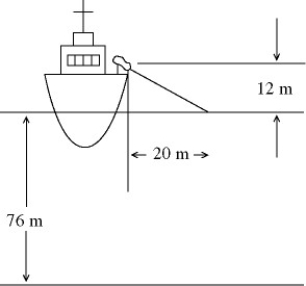
A) 84.1 m
B) 64.1 m
C) 104 m
D) 74.1 m
E) 94.1 m
A) 84.1 m
B) 64.1 m
C) 104 m
D) 74.1 m
E) 94.1 m
Question
Light in air is initially traveling parallel to the face AC of an equilateral triangular prism,as shown in the figure.The prism is made of glass with an index of refraction of 1.52.If the light does not strike the face AC,what is the angle between the ray as it leaves the prism at face BC and the normal in air at that face? 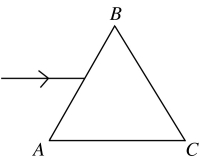
A) 83°
B) 19°
C) 59°
D) 27°
E) 55°
A) 83°
B) 19°
C) 59°
D) 27°
E) 55°
Question
A ray of light strikes a boundary between two transparent materials,and there is no transmitted ray,as shown in the figure.What can you conclude about the indices of refraction of these two materials? 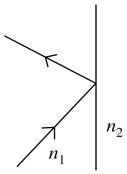
A) n1 ≥ n2
B) n1 > n2
C) n1 = n2
D) n2 ≥ n1
E) n2 > n1
A) n1 ≥ n2
B) n1 > n2
C) n1 = n2
D) n2 ≥ n1
E) n2 > n1
Question
Question
Question
Question
Question
Question
A ray of light passes from glass into a liquid,as shown in the figure.What is the speed of the light in the liquid? (c = 3.00 × 10⁸ m/s) 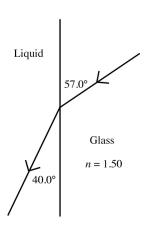
Question
A ray of light goes from one transparent material into another,as shown in the figure.What can you conclude about the indices of refraction of these two materials? 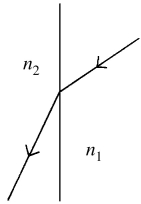
A) n1 ≥ n2
B) n1 > n2
C) n1 = n2
D) n2 ≥ n1
E) n2 > n1
A) n1 ≥ n2
B) n1 > n2
C) n1 = n2
D) n2 ≥ n1
E) n2 > n1
Question
Question
Question
Question
Question
Question
Question
Question
Question
Question
Question
Question
Question
Question
Question
Question
Question
Question
Question
Question
Question
In the figure,the thin lens forms a real image of the object 94.0 cm from the object.What is the focal length of the lens? 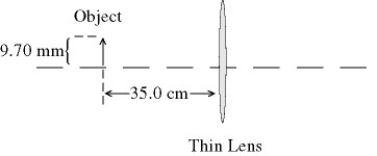
A) 22.0 cm
B) 25.5 cm
C) 27.5 cm
D) 55.8 cm
E) 86.0 cm
A) 22.0 cm
B) 25.5 cm
C) 27.5 cm
D) 55.8 cm
E) 86.0 cm
Question
Question
Question
Question
Question
Question
Question
Question
In the figure,the image is viewed on a screen and is 13.5 mm tall.What is the focal length of the lens? 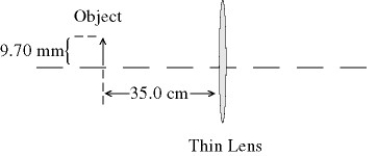
A) +14.6 cm
B) -14.6 cm
C) +20.4 cm
D) -89.3 cm
E) +124 cm
A) +14.6 cm
B) -14.6 cm
C) +20.4 cm
D) -89.3 cm
E) +124 cm
Question
Question
Question
In the figure,the radius of curvature of the curved part of the lens is 35.0 cm,and the refractive index of the lens material is 1.620.What is the focal length of the lens? 
A) +56.5 cm
B) -56.5 cm
C) +28.2 cm
D) +21.6 cm
E) -21.6 cm
A) +56.5 cm
B) -56.5 cm
C) +28.2 cm
D) +21.6 cm
E) -21.6 cm
Question
Question
Question
Question
Question
An optical system comprises in turn,from left to right: an observer,a lens of focal length +30 cm,an erect object 20 mm high,and a convex mirror of radius 80 cm.The object is between the lens and the mirror,20 cm from the lens and 50 cm from the mirror.The observer views the image that is formed first by reflection and then by refraction.What is the position of the final image,measured from the mirror? 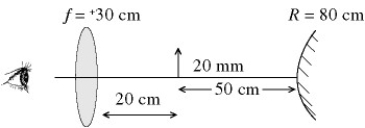
A) 90 cm
B) 102 cm
C) 114 cm
D) 126 cm
E) 138 cm
A) 90 cm
B) 102 cm
C) 114 cm
D) 126 cm
E) 138 cm
Question
Question
Question
Question
Question
Question
In the figure,the radius of curvature of the curved part of the lens is 24.0 cm,and the refractive index of the lens material is 1.750.What is the focal length of the lens? 
A) +32.0 cm
B) -32.0 cm
C) -16.0 cm
D) +13.8 cm
E) -13.8 cm
A) +32.0 cm
B) -32.0 cm
C) -16.0 cm
D) +13.8 cm
E) -13.8 cm
Question
Question
Question
Question
Question
Question
Question
Question

Unlock Deck
Sign up to unlock the cards in this deck!
Unlock Deck
Unlock Deck
1/65

Play

Full screen (f)
Deck 33: Ray Optics
1
The speed of light in a material is 0.50c.What is the critical angle of a light ray at the interface between the material and a vacuum?
A) 30°
B) 21°
C) 24°
D) 27°
A) 30°
B) 21°
C) 24°
D) 27°
30°
2
A convex lens has a focal length f.An object is placed at a distance between f and 2f on a line perpendicular to the center of the lens.The image formed is located at what distance from the lens?
A) 2f
B) between f and 2f
C) f
D) between the lens and f
E) farther than 2f
A) 2f
B) between f and 2f
C) f
D) between the lens and f
E) farther than 2f
farther than 2f
3
Which one of the following is a characteristic of a compound microscope?
A) The objective is a diverging lens.
B) The eyepiece is a diverging lens.
C) The final image is real.
D) The image formed by the objective is virtual.
E) The image formed by the objective is real.
A) The objective is a diverging lens.
B) The eyepiece is a diverging lens.
C) The final image is real.
D) The image formed by the objective is virtual.
E) The image formed by the objective is real.
The image formed by the objective is real.
4
As you walk away from a vertical plane mirror,your image in the mirror
A) is always the same height.
B) may or may not decrease in height, depending on where the observer is positioned.
C) is always a real image, no matter how far you are from the mirror.
D) changes from being a virtual image to a real image as you pass the focal point.
E) decreases in height.
A) is always the same height.
B) may or may not decrease in height, depending on where the observer is positioned.
C) is always a real image, no matter how far you are from the mirror.
D) changes from being a virtual image to a real image as you pass the focal point.
E) decreases in height.
Unlock Deck
Unlock for access to all 65 flashcards in this deck.
Unlock Deck
k this deck
5
In the figure,a laser positioned on a ship is used to communicate with a small two-man research submarine resting on the bottom of a lake.The laser is positioned 12 m above the surface of the water,and it strikes the water 20 m from the side of the ship.The water is 76 m deep and has an index of refraction of 1.33.How far horizontally is the submarine from the side of the ship?
A) 84.1 m
B) 64.1 m
C) 104 m
D) 74.1 m
E) 94.1 m
A) 84.1 m
B) 64.1 m
C) 104 m
D) 74.1 m
E) 94.1 m
Unlock Deck
Unlock for access to all 65 flashcards in this deck.
Unlock Deck
k this deck
6
Light in air is initially traveling parallel to the face AC of an equilateral triangular prism,as shown in the figure.The prism is made of glass with an index of refraction of 1.52.If the light does not strike the face AC,what is the angle between the ray as it leaves the prism at face BC and the normal in air at that face?
A) 83°
B) 19°
C) 59°
D) 27°
E) 55°
A) 83°
B) 19°
C) 59°
D) 27°
E) 55°
Unlock Deck
Unlock for access to all 65 flashcards in this deck.
Unlock Deck
k this deck
7
A ray of light strikes a boundary between two transparent materials,and there is no transmitted ray,as shown in the figure.What can you conclude about the indices of refraction of these two materials?
A) n1 ≥ n2
B) n1 > n2
C) n1 = n2
D) n2 ≥ n1
E) n2 > n1
A) n1 ≥ n2
B) n1 > n2
C) n1 = n2
D) n2 ≥ n1
E) n2 > n1
Unlock Deck
Unlock for access to all 65 flashcards in this deck.
Unlock Deck
k this deck
8
A convex lens has focal length f.If an object is located extremely far from the lens (at infinity),the image formed is located what distance from the lens?
A) infinity
B) 2f
C) between f and 2f
D) f
E) between the lens and f
A) infinity
B) 2f
C) between f and 2f
D) f
E) between the lens and f
Unlock Deck
Unlock for access to all 65 flashcards in this deck.
Unlock Deck
k this deck
9
The critical angle in air for a particular type of glass is 39.0°.What is the speed of light in this class glass? (c = 3.00 × 10⁸ m/s)
A) 1.97 × 10⁸ m/s
B) 1.94 × 10⁸ m/s
C) 1.91 × 10⁸ m/s
D) 1.89 × 10⁸ m/s
E) 2.00 × 10⁸ m/s
A) 1.97 × 10⁸ m/s
B) 1.94 × 10⁸ m/s
C) 1.91 × 10⁸ m/s
D) 1.89 × 10⁸ m/s
E) 2.00 × 10⁸ m/s
Unlock Deck
Unlock for access to all 65 flashcards in this deck.
Unlock Deck
k this deck
10
Suppose you place your face in front of a concave mirror.Which one of the following statements is correct?
A) If you position yourself between the center of curvature and the focal point of the mirror, you will not be able to see a sharp image of your face.
B) No matter where you place yourself, a real image will be formed.
C) Your image will always be inverted.
D) Your image will be diminished in size.
E) None of these statements are true.
A) If you position yourself between the center of curvature and the focal point of the mirror, you will not be able to see a sharp image of your face.
B) No matter where you place yourself, a real image will be formed.
C) Your image will always be inverted.
D) Your image will be diminished in size.
E) None of these statements are true.
Unlock Deck
Unlock for access to all 65 flashcards in this deck.
Unlock Deck
k this deck
11
An oil layer that is 5.0 cm thick is spread smoothly and evenly over the surface of water on a windless day.What is the angle of refraction in the water for a ray of light that has an angle of incidence of 45° as it enters the oil from the air above? (The index of refraction for the oil is 1.15,and for water it is 1.33.)
A) 27°
B) 32°
C) 36°
D) 39°
E) 52°
A) 27°
B) 32°
C) 36°
D) 39°
E) 52°
Unlock Deck
Unlock for access to all 65 flashcards in this deck.
Unlock Deck
k this deck
12
When light goes from one material into another material having a HIGHER index of refraction
A) its speed, wavelength, and frequency all decrease.
B) its speed and wavelength decrease, but its frequency stays the same.
C) its speed decreases but its wavelength and frequency both increase.
D) its speed decreases but its frequency and wavelength stay the same.
E) its speed increases, its wavelength decreases, and its frequency stays the same.
A) its speed, wavelength, and frequency all decrease.
B) its speed and wavelength decrease, but its frequency stays the same.
C) its speed decreases but its wavelength and frequency both increase.
D) its speed decreases but its frequency and wavelength stay the same.
E) its speed increases, its wavelength decreases, and its frequency stays the same.
Unlock Deck
Unlock for access to all 65 flashcards in this deck.
Unlock Deck
k this deck
13
A ray of light passes from glass into a liquid,as shown in the figure.What is the speed of the light in the liquid? (c = 3.00 × 10⁸ m/s)
Unlock Deck
Unlock for access to all 65 flashcards in this deck.
Unlock Deck
k this deck
14
A ray of light goes from one transparent material into another,as shown in the figure.What can you conclude about the indices of refraction of these two materials?
A) n1 ≥ n2
B) n1 > n2
C) n1 = n2
D) n2 ≥ n1
E) n2 > n1
A) n1 ≥ n2
B) n1 > n2
C) n1 = n2
D) n2 ≥ n1
E) n2 > n1
Unlock Deck
Unlock for access to all 65 flashcards in this deck.
Unlock Deck
k this deck
15
A convex lens has a focal length f.An object is placed between infinity and 2f from the lens along a line perpendicular to the center of the lens.The image is located at what distance from the lens?
A) farther than 2f
B) 2f
C) between f and 2f
D) f
E) between the lens and f
A) farther than 2f
B) 2f
C) between f and 2f
D) f
E) between the lens and f
Unlock Deck
Unlock for access to all 65 flashcards in this deck.
Unlock Deck
k this deck
16
An object is placed in front of a lens which forms an image of the object.
A) If the lens is convex, the image cannot be virtual.
B) If the image is real, then it is also inverted.
C) If the image is real, then it is also upright.
D) If the image is virtual, then it is also inverted.
E) If the image is virtual, the lens must be a diverging lens.
A) If the lens is convex, the image cannot be virtual.
B) If the image is real, then it is also inverted.
C) If the image is real, then it is also upright.
D) If the image is virtual, then it is also inverted.
E) If the image is virtual, the lens must be a diverging lens.
Unlock Deck
Unlock for access to all 65 flashcards in this deck.
Unlock Deck
k this deck
17
A tank holds a 1.44-m thick layer of oil that floats on a 0.96-m thick layer of brine.Both liquids are clear and do not intermix.Point O is at the bottom of the tank,on a vertical axis.The indices of refraction of the oil and the brine are 1.40 and 1.52,respectively.A ray originating at O crosses the brine-oil interface at a point 0.60 m from the axis.The ray continues and emerges into the air above the oil.What is the angle that the ray in the air makes with the vertical?
A) 48°
B) 51°
C) 54°
D) 57°
E) 60°
A) 48°
B) 51°
C) 54°
D) 57°
E) 60°
Unlock Deck
Unlock for access to all 65 flashcards in this deck.
Unlock Deck
k this deck
18
A simple refracting telescope provides large magnification by employing
A) a short focal length objective and a short focal length eyepiece.
B) a short focal length objective and a long focal length eyepiece.
C) a long focal length objective and a short focal length eyepiece.
D) a long focal length objective and a long focal length eyepiece.
A) a short focal length objective and a short focal length eyepiece.
B) a short focal length objective and a long focal length eyepiece.
C) a long focal length objective and a short focal length eyepiece.
D) a long focal length objective and a long focal length eyepiece.
Unlock Deck
Unlock for access to all 65 flashcards in this deck.
Unlock Deck
k this deck
19
Which statements are true about a VIRTUAL image? (There may be more than one correct choice.)
A) Its location can be calculated, but it cannot be viewed directly by your eye without using auxiliary lenses.
B) It cannot be photographed.
C) It cannot be viewed on a screen.
D) A plane mirror always forms a virtual image.
E) A concave lens always forms a virtual image.
A) Its location can be calculated, but it cannot be viewed directly by your eye without using auxiliary lenses.
B) It cannot be photographed.
C) It cannot be viewed on a screen.
D) A plane mirror always forms a virtual image.
E) A concave lens always forms a virtual image.
Unlock Deck
Unlock for access to all 65 flashcards in this deck.
Unlock Deck
k this deck
20
Light strikes a 5.0-cm thick sheet of glass at an angle of incidence in air of 50°.The sheet has parallel faces and the glass has an index of refraction 1.50.
(a)What is the angle of refraction in the glass?
(b)After traveling through the glass the light re-emerges into the air.What is the final angle of refraction in air?
(c)As it leaves the glass,by what distance is the path of the ray is displaced from what it was before entering the glass?
(a)What is the angle of refraction in the glass?
(b)After traveling through the glass the light re-emerges into the air.What is the final angle of refraction in air?
(c)As it leaves the glass,by what distance is the path of the ray is displaced from what it was before entering the glass?
Unlock Deck
Unlock for access to all 65 flashcards in this deck.
Unlock Deck
k this deck
21
Light consisting of a mixture of red and blue light enters a 40°,70°,70° prism along a line parallel to the side opposite the 40° vertex.The index of refraction of the prism material for blue light is 1.530,and for red light it is 1.525.What is the angle between the two emerging beams of light?
A) 0.5°
B) 0.9°
C) 0.1°
D) 0.3°
E) 0.7°
A) 0.5°
B) 0.9°
C) 0.1°
D) 0.3°
E) 0.7°
Unlock Deck
Unlock for access to all 65 flashcards in this deck.
Unlock Deck
k this deck
22
An optical fiber made of glass with an index of refraction 1.50 is coated with a plastic with index of refraction 1.30.What is the critical angle of this fiber at the glass-plastic interface?
A) 90.0°
B) 41.8°
C) 60.1°
D) 50.2°
E) 61.1°
A) 90.0°
B) 41.8°
C) 60.1°
D) 50.2°
E) 61.1°
Unlock Deck
Unlock for access to all 65 flashcards in this deck.
Unlock Deck
k this deck
23
A convex spherical mirror with a radius of 50 cm has a 4.0 cm tall object placed 100 cm in front of it.What is the position of the image relative to the mirror?
A) 20 cm behind the mirror
B) 25 cm behind the mirror
C) 100 cm in front of the mirror
D) 25 cm in front of the mirror
E) 20 cm in front of the mirror
A) 20 cm behind the mirror
B) 25 cm behind the mirror
C) 100 cm in front of the mirror
D) 25 cm in front of the mirror
E) 20 cm in front of the mirror
Unlock Deck
Unlock for access to all 65 flashcards in this deck.
Unlock Deck
k this deck
24
The image of a plant is 4.0 cm from a concave spherical mirror having a radius of curvature of 10 cm. Where is the plant relative to the mirror?
A) 2.2 cm in front of the mirror
B) 4.4 cm in front of the mirror
C) 9.0 cm in front of the mirror
D) 1.0 cm in front of the mirror
E) 20 cm in front of the mirror
A) 2.2 cm in front of the mirror
B) 4.4 cm in front of the mirror
C) 9.0 cm in front of the mirror
D) 1.0 cm in front of the mirror
E) 20 cm in front of the mirror
Unlock Deck
Unlock for access to all 65 flashcards in this deck.
Unlock Deck
k this deck
25
A ray of light consisting of blue light (wavelength 480 nm)and red light (wavelength 670 nm)is incident on a thick piece of glass at 80°. What is the angular separation between the refracted red and refracted blue beams while they are in the glass? (The respective indices of refraction for the blue light and the red light are 1.4636 and 1.4561.)
A) 0.27°
B) 0.33°
C) 0.36°
D) 0.46°
E) 0.54°
A) 0.27°
B) 0.33°
C) 0.36°
D) 0.46°
E) 0.54°
Unlock Deck
Unlock for access to all 65 flashcards in this deck.
Unlock Deck
k this deck
26
A concave spherical mirror with a radius of 20 cm creates a real image 30 cm from the mirror. How far is the object from the mirror?
A) 50 cm
B) 20 cm
C) 15 cm
D) 7.5 cm
E) 5.0 cm
A) 50 cm
B) 20 cm
C) 15 cm
D) 7.5 cm
E) 5.0 cm
Unlock Deck
Unlock for access to all 65 flashcards in this deck.
Unlock Deck
k this deck
27
An object 4.0 cm in height is placed 8.0 cm in front of a concave spherical mirror with a focal length of 10.0 cm.What is the position of its image in relation to the mirror,and what are the characteristics of the image?
A) 40.0 cm on the other side of mirror, real, 6.0 times bigger
B) 10.0 cm on the other side of mirror, virtual, 10.0 times bigger
C) 18.0 cm on the same side of mirror, virtual, 2.25 times bigger
D) 10.0 cm on the same side of mirror, real, 6.0 times bigger
E) 40.0 cm on the other side of mirror, virtual, 5.0 times bigger
A) 40.0 cm on the other side of mirror, real, 6.0 times bigger
B) 10.0 cm on the other side of mirror, virtual, 10.0 times bigger
C) 18.0 cm on the same side of mirror, virtual, 2.25 times bigger
D) 10.0 cm on the same side of mirror, real, 6.0 times bigger
E) 40.0 cm on the other side of mirror, virtual, 5.0 times bigger
Unlock Deck
Unlock for access to all 65 flashcards in this deck.
Unlock Deck
k this deck
28
A glass plate whose index of refraction is 1.56 is immersed in a liquid.The surface of the glass is inclined at an angle of 42.0° with the vertical.A horizontal ray in the glass is incident on the interface.When the liquid is a certain alcohol,the incident ray arrives at the interface at the critical angle.What is the index of refraction of the alcohol?
A) 1.04
B) 1.02
C) 1.00
D) 0.984
E) 1.06
A) 1.04
B) 1.02
C) 1.00
D) 0.984
E) 1.06
Unlock Deck
Unlock for access to all 65 flashcards in this deck.
Unlock Deck
k this deck
29
A man's face is 30 cm in front of a concave spherical shaving mirror. If the image is erect and 1.5 times as large as his face,what is the radius of curvature of the mirror?
A) 40 cm
B) 60 cm
C) 100 cm
D) 140 cm
E) 180 cm
A) 40 cm
B) 60 cm
C) 100 cm
D) 140 cm
E) 180 cm
Unlock Deck
Unlock for access to all 65 flashcards in this deck.
Unlock Deck
k this deck
30
An object is 12 cm in front of a concave spherical mirror,and the image is 3.0 cm in front of the mirror. What is the focal length of the mirror?
A) 0.25 cm
B) 15 cm
C) 4.0 cm
D) 2.4 cm
E) 1.3 cm
A) 0.25 cm
B) 15 cm
C) 4.0 cm
D) 2.4 cm
E) 1.3 cm
Unlock Deck
Unlock for access to all 65 flashcards in this deck.
Unlock Deck
k this deck
31
A ray of light traveling in air strikes the surface of a certain plastic slab at 63.0° with respect to the normal in air.It travels in the plastic slab at a 30.6° angle with respect to the normal.Find the critical angle for the plastic in air.
Unlock Deck
Unlock for access to all 65 flashcards in this deck.
Unlock Deck
k this deck
32
A tank holds a 1.44-m thick layer of oil that floats on a 0.96-m thick layer of brine.Both liquids are clear and do not intermix.Point O is at the bottom of the tank,on a vertical axis.The indices of refraction of the oil and the brine are 1.40 and 1.52,respectively.A ray originating at O reaches the brine-oil interface at the critical angle.What is the distance of this point from the axis?
A) 1.5 m
B) 1.7 m
C) 1.9 m
D) 2.1 m
E) 2.3 m
A) 1.5 m
B) 1.7 m
C) 1.9 m
D) 2.1 m
E) 2.3 m
Unlock Deck
Unlock for access to all 65 flashcards in this deck.
Unlock Deck
k this deck
33
A convex spherical mirror with a focal length of magnitude 25 cm has a 4.0-cm tall flower placed 100 cm in front of it. What is the height of the image of the flower?
A) 0.80 cm
B) 20 cm
C) 4.0 cm
D) 1.6 cm
E) 8.0 cm
A) 0.80 cm
B) 20 cm
C) 4.0 cm
D) 1.6 cm
E) 8.0 cm
Unlock Deck
Unlock for access to all 65 flashcards in this deck.
Unlock Deck
k this deck
34
A beam of light of two different wavelengths enters a pane of glass 3.00 mm thick at an angle of incidence of 56°. The indices of refraction for the two different colors are 1.514 and 1.528.Because of dispersion,the colored beams,although parallel,are separated by a small distance.How far apart are they?
A) 0.057 mm
B) 0.0083 mm
C) 0.025 mm
D) 0.014 mm
E) 0.0062 mm
A) 0.057 mm
B) 0.0083 mm
C) 0.025 mm
D) 0.014 mm
E) 0.0062 mm
Unlock Deck
Unlock for access to all 65 flashcards in this deck.
Unlock Deck
k this deck
35
In the figure,the thin lens forms a real image of the object 94.0 cm from the object.What is the focal length of the lens?
A) 22.0 cm
B) 25.5 cm
C) 27.5 cm
D) 55.8 cm
E) 86.0 cm
A) 22.0 cm
B) 25.5 cm
C) 27.5 cm
D) 55.8 cm
E) 86.0 cm
Unlock Deck
Unlock for access to all 65 flashcards in this deck.
Unlock Deck
k this deck
36
The spherical side mirror on a car is convex and has a radius of curvature of 25 cm. Another car is following,20 m behind the mirror.If the height of the car is 1.6 m,how tall is its image?
A) 5.0 cm
B) 2.0 cm
C) 4.0 cm
D) 3.0 cm
E) 0.99 cm
A) 5.0 cm
B) 2.0 cm
C) 4.0 cm
D) 3.0 cm
E) 0.99 cm
Unlock Deck
Unlock for access to all 65 flashcards in this deck.
Unlock Deck
k this deck
37
An optic fiber is made of clear plastic with index of refraction of 1.50,surrounded by air. For what angles of incidence θ will light remain within the plastic fiber?
A) θ ≥ 21.1°
B) θ < 38.3°
C) θ > 38.3°
D) θ < 41.8°
E) θ > 41.8°
A) θ ≥ 21.1°
B) θ < 38.3°
C) θ > 38.3°
D) θ < 41.8°
E) θ > 41.8°
Unlock Deck
Unlock for access to all 65 flashcards in this deck.
Unlock Deck
k this deck
38
An object 3.4 mm tall is placed 25 cm from the vertex of a convex spherical mirror.The radius of curvature of the mirror has a magnitude of 52 cm.
(a)How far is the image from the vertex of the mirror?
(b)What is the height of the image?
(a)How far is the image from the vertex of the mirror?
(b)What is the height of the image?
Unlock Deck
Unlock for access to all 65 flashcards in this deck.
Unlock Deck
k this deck
39
What is the critical angle for light traveling from crown glass (n = 1.52)into water (n = 1.33)?
A) 42°
B) 48°
C) 53°
D) 57°
E) 61°
A) 42°
B) 48°
C) 53°
D) 57°
E) 61°
Unlock Deck
Unlock for access to all 65 flashcards in this deck.
Unlock Deck
k this deck
40
How far are you from your image when you stand 0.750 m in front of a vertical plane mirror?
A) 0.375 m
B) 0.750 m
C) 1.50 m
D) 3.00 m
A) 0.375 m
B) 0.750 m
C) 1.50 m
D) 3.00 m
Unlock Deck
Unlock for access to all 65 flashcards in this deck.
Unlock Deck
k this deck
41
You have available lenses of focal lengths 2.0 cm,4.0 cm,8.0 cm,and 16.0 cm.
(a)If you were to use any two of these lenses to build a telescope,what is the maximum magnification you could achieve?
(b)If you were to use any two of these lenses to build a telescope,what is the lens separation for the maximum magnification telescope?
(a)If you were to use any two of these lenses to build a telescope,what is the maximum magnification you could achieve?
(b)If you were to use any two of these lenses to build a telescope,what is the lens separation for the maximum magnification telescope?
Unlock Deck
Unlock for access to all 65 flashcards in this deck.
Unlock Deck
k this deck
42
A 4.0-cm tall object is placed 60 cm away from a converging lens of focal length 30 cm.What are the nature and location of the image? The image is
A) real, 2.5 cm tall, and 30 cm from the lens on the same side as the object.
B) virtual, 2.5 cm tall, and 30 cm from the lens on the side opposite the object.
C) virtual, 2.0 cm tall, and 15 cm from the lens on the side opposite the object.
D) virtual, 4.0 cm tall, and 60 cm from the lens on the same side as the object.
E) real, 4.0 cm tall, and 60 cm from the lens on the side opposite the object.
A) real, 2.5 cm tall, and 30 cm from the lens on the same side as the object.
B) virtual, 2.5 cm tall, and 30 cm from the lens on the side opposite the object.
C) virtual, 2.0 cm tall, and 15 cm from the lens on the side opposite the object.
D) virtual, 4.0 cm tall, and 60 cm from the lens on the same side as the object.
E) real, 4.0 cm tall, and 60 cm from the lens on the side opposite the object.
Unlock Deck
Unlock for access to all 65 flashcards in this deck.
Unlock Deck
k this deck
43
In the figure,the image is viewed on a screen and is 13.5 mm tall.What is the focal length of the lens?
A) +14.6 cm
B) -14.6 cm
C) +20.4 cm
D) -89.3 cm
E) +124 cm
A) +14.6 cm
B) -14.6 cm
C) +20.4 cm
D) -89.3 cm
E) +124 cm
Unlock Deck
Unlock for access to all 65 flashcards in this deck.
Unlock Deck
k this deck
44
An object is placed 100 cm in front of a lens of focal length 20 cm.A second lens is placed 35 cm beyond the first,this second lens having a focal length of 8.0 cm.If the height of the object is 6.0 cm,what is the height of the final image?
A) 1.5 cm
B) 12 cm
C) 9.0 cm
D) 3.0 cm
E) 6.0 cm
A) 1.5 cm
B) 12 cm
C) 9.0 cm
D) 3.0 cm
E) 6.0 cm
Unlock Deck
Unlock for access to all 65 flashcards in this deck.
Unlock Deck
k this deck
45
A double-convex thin lens is made of glass with an index of refraction of 1.52.The radii of curvature of the faces of the lens are 60 cm and 72 cm.What is the focal length of the lens?
A) 70 cm
B) 63 cm
C) 75 cm
D) 66 cm
E) 58 cm
A) 70 cm
B) 63 cm
C) 75 cm
D) 66 cm
E) 58 cm
Unlock Deck
Unlock for access to all 65 flashcards in this deck.
Unlock Deck
k this deck
46
In the figure,the radius of curvature of the curved part of the lens is 35.0 cm,and the refractive index of the lens material is 1.620.What is the focal length of the lens?
A) +56.5 cm
B) -56.5 cm
C) +28.2 cm
D) +21.6 cm
E) -21.6 cm
A) +56.5 cm
B) -56.5 cm
C) +28.2 cm
D) +21.6 cm
E) -21.6 cm
Unlock Deck
Unlock for access to all 65 flashcards in this deck.
Unlock Deck
k this deck
47
A thin double convex lens is to focus the image of an object onto a screen so that the image is life-sized.The lens surfaces have equal radii of curvature of 112 cm,and the refractive index of the lens material is 1.500.
(a)How far from the lens should the screen be placed?
(b)How far is the screen from the object?
(a)How far from the lens should the screen be placed?
(b)How far is the screen from the object?
Unlock Deck
Unlock for access to all 65 flashcards in this deck.
Unlock Deck
k this deck
48
An object 1.80 cm tall is placed 100 cm in front of a diverging lens having a focal length of magnitude 25 cm.A converging lens with a focal length of magnitude 33.33 cm is placed 30 cm past the first lens.What is the lateral magnification of this system of lenses?
A) 2.5
B) -2.5
C) -0.40
D) 1.0
E) 0.40
A) 2.5
B) -2.5
C) -0.40
D) 1.0
E) 0.40
Unlock Deck
Unlock for access to all 65 flashcards in this deck.
Unlock Deck
k this deck
49
A convex-concave thin lens is made with the radius of curvature of the convex surface being 25.0 cm and the concave surface 45.0 cm.If the glass used has index of refraction 1.500,what is the focal length of this lens?
A) -32.0 cm
B) 32.0 cm
C) 113 cm
D) 67.5 cm
E) -113 cm
A) -32.0 cm
B) 32.0 cm
C) 113 cm
D) 67.5 cm
E) -113 cm
Unlock Deck
Unlock for access to all 65 flashcards in this deck.
Unlock Deck
k this deck
50
A lens is made with a focal length of -40 cm using a material with index of refraction 1.50.A second lens is made with the SAME GEOMETRY as the first lens,but using a material having refractive index of 2.00.What is the focal length of the second lens?
A) -40 cm
B) -80 cm
C) -53 cm
D) -20 cm
E) -30 cm
A) -40 cm
B) -80 cm
C) -53 cm
D) -20 cm
E) -30 cm
Unlock Deck
Unlock for access to all 65 flashcards in this deck.
Unlock Deck
k this deck
51
An optical system comprises in turn,from left to right: an observer,a lens of focal length +30 cm,an erect object 20 mm high,and a convex mirror of radius 80 cm.The object is between the lens and the mirror,20 cm from the lens and 50 cm from the mirror.The observer views the image that is formed first by reflection and then by refraction.What is the position of the final image,measured from the mirror?
A) 90 cm
B) 102 cm
C) 114 cm
D) 126 cm
E) 138 cm
A) 90 cm
B) 102 cm
C) 114 cm
D) 126 cm
E) 138 cm
Unlock Deck
Unlock for access to all 65 flashcards in this deck.
Unlock Deck
k this deck
52
An object is placed 10 cm from a convex lens of focal length 20 cm.What is the lateral magnification of the object?
A) 0.50
B) 1.0
C) 1.5
D) 2.0
E) 2.5
A) 0.50
B) 1.0
C) 1.5
D) 2.0
E) 2.5
Unlock Deck
Unlock for access to all 65 flashcards in this deck.
Unlock Deck
k this deck
53
It is desired to project the image of an object four times its actual size using a lens of focal length 20 cm.How far from the lens should the object be placed?
A) 100 cm
B) 80 cm
C) 4.0 cm
D) 25 cm
E) 5.0 cm
A) 100 cm
B) 80 cm
C) 4.0 cm
D) 25 cm
E) 5.0 cm
Unlock Deck
Unlock for access to all 65 flashcards in this deck.
Unlock Deck
k this deck
54
A thin converging lens is found to form an image of a distant building 24 cm from the lens.If an insect is now placed 16 cm from this lens,how far FROM THE INSECT will its image be formed?
A) 64 cm
B) 72 cm
C) 32 cm
D) 96 cm
E) 48 cm
A) 64 cm
B) 72 cm
C) 32 cm
D) 96 cm
E) 48 cm
Unlock Deck
Unlock for access to all 65 flashcards in this deck.
Unlock Deck
k this deck
55
An object is placed 100 cm in front of a diverging lens with a focal length of magnitude 25 cm.A converging lens having a focal length of magnitude 33.33 cm is placed 30 cm past the first lens.Where is the final image formed?
A) 30 cm after the second lens
B) 20 cm in front of the first lens
C) 3.0 meters before the second lens
D) 100 cm after the second lens
E) 3.0 cm before the second lens
A) 30 cm after the second lens
B) 20 cm in front of the first lens
C) 3.0 meters before the second lens
D) 100 cm after the second lens
E) 3.0 cm before the second lens
Unlock Deck
Unlock for access to all 65 flashcards in this deck.
Unlock Deck
k this deck
56
A double-concave lens has equal radii of curvature of 15.1 cm.An object placed 14.2 cm from the lens forms a virtual image 5.29 cm from the lens.What is the index of refraction of the lens material?
A) 1.90
B) 1.98
C) 1.82
D) 1.77
A) 1.90
B) 1.98
C) 1.82
D) 1.77
Unlock Deck
Unlock for access to all 65 flashcards in this deck.
Unlock Deck
k this deck
57
In the figure,the radius of curvature of the curved part of the lens is 24.0 cm,and the refractive index of the lens material is 1.750.What is the focal length of the lens?
A) +32.0 cm
B) -32.0 cm
C) -16.0 cm
D) +13.8 cm
E) -13.8 cm
A) +32.0 cm
B) -32.0 cm
C) -16.0 cm
D) +13.8 cm
E) -13.8 cm
Unlock Deck
Unlock for access to all 65 flashcards in this deck.
Unlock Deck
k this deck
58
When an object 1.15 cm tall is placed 12 cm from a lens,the lens produces an upright image of the object that is 5.75 cm tall.What is the focal length of the lens?
A) 24 cm
B) 18 cm
C) 60 cm
D) 15 cm
E) 9.0 cm
A) 24 cm
B) 18 cm
C) 60 cm
D) 15 cm
E) 9.0 cm
Unlock Deck
Unlock for access to all 65 flashcards in this deck.
Unlock Deck
k this deck
59
A 4.0-cm tall object is placed 50.0 cm from a diverging lens having a focal length of magnitude 25.0 cm.What are the nature and location of the image? The image is
A) real, 4.0 cm tall, and 20 cm from the lens on the side opposite the object.
B) virtual, 4.0 cm tall, and 20 cm from the lens on the side opposite the object.
C) virtual, 2.0 cm tall, and 10 cm from the lens on the side opposite the object.
D) virtual, 1.3 cm tall, and 16.7 cm from the lens on the same side of the object.
E) real, 1.3 cm tall, and 16.7 cm from the lens on the same side of the object.
A) real, 4.0 cm tall, and 20 cm from the lens on the side opposite the object.
B) virtual, 4.0 cm tall, and 20 cm from the lens on the side opposite the object.
C) virtual, 2.0 cm tall, and 10 cm from the lens on the side opposite the object.
D) virtual, 1.3 cm tall, and 16.7 cm from the lens on the same side of the object.
E) real, 1.3 cm tall, and 16.7 cm from the lens on the same side of the object.
Unlock Deck
Unlock for access to all 65 flashcards in this deck.
Unlock Deck
k this deck
60
The focal lengths of the objective and eyepiece in a compound microscope are 0.80 cm and 2.5 cm,respectively.The image formed by the objective is 16 cm from it and the final image is 25 cm from the eye.What is the total overall magnification of the microscope?
A) -19 x
B) -11 x
C) -2.0 x
D) -100 x
E) -200 x
A) -19 x
B) -11 x
C) -2.0 x
D) -100 x
E) -200 x
Unlock Deck
Unlock for access to all 65 flashcards in this deck.
Unlock Deck
k this deck
61
The objective lens of a refracting telescope has a focal length of 60 cm and the eyepiece a focal length of 8.0 cm.What is the angular magnification of the telescope?
A) 34 x
B) 480 x
C) 68 x
D) 0.13 x
E) 7.5 x
A) 34 x
B) 480 x
C) 68 x
D) 0.13 x
E) 7.5 x
Unlock Deck
Unlock for access to all 65 flashcards in this deck.
Unlock Deck
k this deck
62
The objective and the eyepiece of a refracting astronomical telescope have focal lengths of 320 cm and 4.0 cm,respectively.The telescope is used to view Neptune and the final image is set at infinity.The diameter of Neptune is 4.96 × 10⁷ m and the distance from the earth at the time of observation is
4)4 × 10¹² m.What is the angle (in mrad)subtended by the final telescopic image of Neptune?
A) 0.90 mrad
B) 1.1 mrad
C) 1.3 mrad
D) 1.5 mrad
E) 1.7 mrad
4)4 × 10¹² m.What is the angle (in mrad)subtended by the final telescopic image of Neptune?
A) 0.90 mrad
B) 1.1 mrad
C) 1.3 mrad
D) 1.5 mrad
E) 1.7 mrad
Unlock Deck
Unlock for access to all 65 flashcards in this deck.
Unlock Deck
k this deck
63
The angular magnification of a refracting telescope is 40 x.When the object and final image are both at infinity,the distance between the eyepiece and the objective is 143.5 cm.The telescope is used to view a distant radio tower.The real image of the tower,formed by the objective,is 6.0 mm in height.The focal point of the eyepiece is positioned at the real image.What is the focal length of the objective lens?
A) 137 cm
B) 138 cm
C) 139 cm
D) 140 cm
E) 141 cm
A) 137 cm
B) 138 cm
C) 139 cm
D) 140 cm
E) 141 cm
Unlock Deck
Unlock for access to all 65 flashcards in this deck.
Unlock Deck
k this deck
64
The angular magnification of a refracting telescope is 40 x.When the object and final image are both at infinity,the distance between the eyepiece and the objective is 143.5 cm.The telescope is used to view a distant radio tower.The real image of the tower,formed by the objective,is 6.0 mm in height.The focal point of the eyepiece is positioned at the real image.What is the angle subtended by the final image of the tower.
A) 0.15 rad
B) 0.17 rad
C) 0.19 rad
D) 0.21 rad
E) 0.23 rad
A) 0.15 rad
B) 0.17 rad
C) 0.19 rad
D) 0.21 rad
E) 0.23 rad
Unlock Deck
Unlock for access to all 65 flashcards in this deck.
Unlock Deck
k this deck
65
An astronomical telescope has an objective of diameter 20 cm with a focal length of 180 cm.The telescope is used with an eyepiece of focal length 30 mm.What is the angular magnification of this telescope?
A) 360 x
B) 60 x
C) 540 x
D) 6 x
E) 180 x
A) 360 x
B) 60 x
C) 540 x
D) 6 x
E) 180 x
Unlock Deck
Unlock for access to all 65 flashcards in this deck.
Unlock Deck
k this deck
Unlock Deck
Unlock for access to all 65 flashcards in this deck.






