







 Chat with AI

Deck 18: The Land Market and Natural Resources
Full screen (f)

Question
The figure given below shows the demand [D and D'] and supply [S and S'] curves of shares of stock.Figure 17.2
![<strong>The figure given below shows the demand [D and D'] and supply [S and S'] curves of shares of stock.Figure 17.2 The supply curve in the market for land that has limited availability is:</strong> A)perfectly elastic. B)relatively inelastic. C)unit elastic. D)perfectly inelastic. E)relatively elastic. <div style=padding-top: 35px>](https://d2lvgg3v3hfg70.cloudfront.net/TB1748/11ea8882_6257_abde_8903_c563ff971d3a_TB1748_00_TB1748_00_TB1748_00_TB1748_00_TB1748_00_TB1748_00_TB1748_00_TB1748_00_TB1748_00_TB1748_00_TB1748_00_TB1748_00_TB1748_00_TB1748_00_TB1748_00_TB1748_00_TB1748_00_TB1748_00_TB1748_00_TB1748_00_TB1748_00_TB1748_00_TB1748_00_TB1748_00_TB1748_00_TB1748_00_TB1748_00_TB1748_00_TB1748_00_TB1748_00_TB1748_00_TB1748_00_TB1748_00_TB1748_00_TB1748_00_TB1748_00_TB1748_00_TB1748_00_TB1748_00_TB1748_00_TB1748_00_TB1748_00_TB1748_00_TB1748_00_TB1748_00_TB1748_00_TB1748_00_TB1748_00_TB1748_00_TB1748_00_TB1748_00_TB1748_00_TB1748_00_TB1748_00_TB1748_00_TB1748_00_TB1748_00_TB1748_00_TB1748_00_TB1748_00_TB1748_00_TB1748_00_TB1748_00_TB1748_00_TB1748_00_TB1748_00_TB1748_00_TB1748_00_TB1748_00_TB1748_00_TB1748_00_TB1748_00_TB1748_00_TB1748_00.jpg)
The supply curve in the market for land that has limited availability is:
A)perfectly elastic.
B)relatively inelastic.
C)unit elastic.
D)perfectly inelastic.
E)relatively elastic.
The supply curve in the market for land that has limited availability is:
A)perfectly elastic.
B)relatively inelastic.
C)unit elastic.
D)perfectly inelastic.
E)relatively elastic.

Question
The figure given below shows the demand [D and D'] and supply [S and S'] curves of shares of stock.Figure 17.2
The category of resources economists call "land" refers to all of the following, except:
A)natural gas.
B)animals.
C)oceans.
D)minerals.
E)buildings.
The category of resources economists call "land" refers to all of the following, except:
A)natural gas.
B)animals.
C)oceans.
D)minerals.
E)buildings.
Question
The figure given below shows the demand [D and D'] and supply [S and S'] curves of shares of stock.Figure 17.2
Which of the following is true of earnings from land?
A)An increase in economic rent leads to an increase in the supply of land.
B)A decrease in transfer earnings from land leads to an increase in its demand.
C)An increase in economic rent does not lead to an increase in the supply of land.
D)A decrease in transfer earnings from land leads to a decrease in its supply.
E)An increase in economic rent raises the elasticity of supply of land.
Which of the following is true of earnings from land?
A)An increase in economic rent leads to an increase in the supply of land.
B)A decrease in transfer earnings from land leads to an increase in its demand.
C)An increase in economic rent does not lead to an increase in the supply of land.
D)A decrease in transfer earnings from land leads to a decrease in its supply.
E)An increase in economic rent raises the elasticity of supply of land.
Question
The figure given below represents an imperfectly competitive resource market. Here common land (and not land used for specific purpose) is under consideration.Figure 18.1
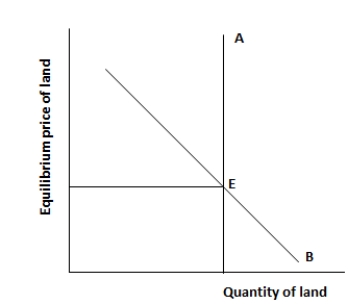
In Figure 18.1, the curve B indicates:
A)supply curve of land.
B)marginal revenue product curve for land.
C)value of marginal product curve of land.
D)marginal factor cost curve of land.
E)marginal product curve of land.
In Figure 18.1, the curve B indicates:
A)supply curve of land.
B)marginal revenue product curve for land.
C)value of marginal product curve of land.
D)marginal factor cost curve of land.
E)marginal product curve of land.
Question
The figure given below shows the demand [D and D'] and supply [S and S'] curves of shares of stock.Figure 17.2
The returns that skilled engineering professionals earn consist of both transfer earnings and economic rent. This implies that:
A)demand for these professionals is highly elastic.
B)the supply curve of skilled engineering professionals is upward-sloping.
C)the supply curve of skilled engineering professionals is backward bending.
D)demand for these professionals is perfectly inelastic.
E)the supply curve of skilled engineering professionals is vertical.
The returns that skilled engineering professionals earn consist of both transfer earnings and economic rent. This implies that:
A)demand for these professionals is highly elastic.
B)the supply curve of skilled engineering professionals is upward-sloping.
C)the supply curve of skilled engineering professionals is backward bending.
D)demand for these professionals is perfectly inelastic.
E)the supply curve of skilled engineering professionals is vertical.
Question
The figure given below represents an imperfectly competitive resource market. Here common land (and not land used for specific purpose) is under consideration.Figure 18.1
The marginal cost of extraction of a nonrenewable resource increases with passage of time because:
A)the technology used in extraction depreciates in value.
B)the price of the product that uses this resource decreases.
C)the exchange rate in the international market appreciates.
D)the tragedy of commons problem arises.
E)the resource gradually becomes scarce.
The marginal cost of extraction of a nonrenewable resource increases with passage of time because:
A)the technology used in extraction depreciates in value.
B)the price of the product that uses this resource decreases.
C)the exchange rate in the international market appreciates.
D)the tragedy of commons problem arises.
E)the resource gradually becomes scarce.
Question
The figure given below shows the demand [D and D'] and supply [S and S'] curves of shares of stock.Figure 17.2
Unproductive actions designed to increase income or wealth are known as:
A)transfer payments.
B)incorporation.
C)profit seeking.
D)income search.
E)rent seeking.
Unproductive actions designed to increase income or wealth are known as:
A)transfer payments.
B)incorporation.
C)profit seeking.
D)income search.
E)rent seeking.
Question
The figure given below shows the demand [D and D'] and supply [S and S'] curves of shares of stock.Figure 17.2
For resources with upward-sloping supply curves:
A)earnings consist solely of economic rent.
B)earnings consist of both transfer earnings and economic rent.
C)earnings are called transfer earnings.
D)earnings are called dividends.
E)earnings consist entirely of interest payments.
For resources with upward-sloping supply curves:
A)earnings consist solely of economic rent.
B)earnings consist of both transfer earnings and economic rent.
C)earnings are called transfer earnings.
D)earnings are called dividends.
E)earnings consist entirely of interest payments.
Question
The figure given below shows the demand [D and D'] and supply [S and S'] curves of shares of stock.Figure 17.2
When does a resource earn only economic rent?
A)When the supply curve of the resource is relatively elastic
B)When the supply curve of the resource is horizontal
C)When the supply curve of the resource is vertical
D)When the supply curve of the resource is relatively inelastic
E)When the supply curve of the resource is backward bending
When does a resource earn only economic rent?
A)When the supply curve of the resource is relatively elastic
B)When the supply curve of the resource is horizontal
C)When the supply curve of the resource is vertical
D)When the supply curve of the resource is relatively inelastic
E)When the supply curve of the resource is backward bending
Question
The figure given below represents an imperfectly competitive resource market. Here common land (and not land used for specific purpose) is under consideration.Figure 18.1
Which of the following is a nonrenewable source of energy?
A)Corn
B)Ethanol
C)Petroleum
D)Bagasse
E)Biomass
Which of the following is a nonrenewable source of energy?
A)Corn
B)Ethanol
C)Petroleum
D)Bagasse
E)Biomass
Question
The figure given below represents an imperfectly competitive resource market. Here common land (and not land used for specific purpose) is under consideration.Figure 18.1
What is the most likely consequence when people's preference for current consumption rises in relation to future consumption?
A)Interest rates will fall, and the rate of extraction of exhaustible natural resources will decrease.
B)Interest rates will fall, and the rate of extraction of exhaustible natural resources will increase.
C)Interest rates will rise, and the rate of extraction of exhaustible natural resources will decrease.
D)Interest rates will rise, and the rate of extraction of exhaustible natural resources will increase.
E)Interest rates will fall, and there will be no effect on the rate of extraction of exhaustible natural resources.
What is the most likely consequence when people's preference for current consumption rises in relation to future consumption?
A)Interest rates will fall, and the rate of extraction of exhaustible natural resources will decrease.
B)Interest rates will fall, and the rate of extraction of exhaustible natural resources will increase.
C)Interest rates will rise, and the rate of extraction of exhaustible natural resources will decrease.
D)Interest rates will rise, and the rate of extraction of exhaustible natural resources will increase.
E)Interest rates will fall, and there will be no effect on the rate of extraction of exhaustible natural resources.
Question
The figure given below shows the demand [D and D'] and supply [S and S'] curves of shares of stock.Figure 17.2
An increase in economic rent is simply a transfer from the buyer to the seller without any change in quantity. Identify the underlying assumption.
A)Quantity supplied remains unchanged even when economic rent increases.
B)Quantity supplied is positively related to economic rent.
C)The relation between quantity supplied and economic rent is indeterminate for nonrenewable resources.
D)Bargaining power of buyers is greater than sellers.
E)Consumer surplus is a positive function of economic rent.
An increase in economic rent is simply a transfer from the buyer to the seller without any change in quantity. Identify the underlying assumption.
A)Quantity supplied remains unchanged even when economic rent increases.
B)Quantity supplied is positively related to economic rent.
C)The relation between quantity supplied and economic rent is indeterminate for nonrenewable resources.
D)Bargaining power of buyers is greater than sellers.
E)Consumer surplus is a positive function of economic rent.
Question
The figure given below shows the demand [D and D'] and supply [S and S'] curves of shares of stock.Figure 17.2
Which of the following actions can be categorized as rent seeking?
A)Increase in the income tax rates by the government
B)Lobbying efforts of individuals or groups to gain favors from the government
C)Profit maximizing firms charging a price greater than their marginal costs
D)Export of goods from developing to developed countries
E)Government intervention in the real estate market
Which of the following actions can be categorized as rent seeking?
A)Increase in the income tax rates by the government
B)Lobbying efforts of individuals or groups to gain favors from the government
C)Profit maximizing firms charging a price greater than their marginal costs
D)Export of goods from developing to developed countries
E)Government intervention in the real estate market
Question
The figure given below shows the demand [D and D'] and supply [S and S'] curves of shares of stock.Figure 17.2
What are the earnings of a resource with a perfectly elastic supply curve called?
A)Transfer earnings
B)Dividends
C)Economic rent
D)Capital gain
E)Interest
What are the earnings of a resource with a perfectly elastic supply curve called?
A)Transfer earnings
B)Dividends
C)Economic rent
D)Capital gain
E)Interest
Question
The figure given below shows the demand [D and D'] and supply [S and S'] curves of shares of stock.Figure 17.2
In the market for land as a resource, the demand curve is elastic while the supply curve is perfectly inelastic. Identify the underlying assumption.
A)There are limited ways in which land can be used as a resource.
B)Land as an input has large number of substitutes.
C)There is a fixed supply of land.
D)Land includes all immovable assets.
E)The productivity of land improves over time.
In the market for land as a resource, the demand curve is elastic while the supply curve is perfectly inelastic. Identify the underlying assumption.
A)There are limited ways in which land can be used as a resource.
B)Land as an input has large number of substitutes.
C)There is a fixed supply of land.
D)Land includes all immovable assets.
E)The productivity of land improves over time.
Question
The figure given below shows the demand [D and D'] and supply [S and S'] curves of shares of stock.Figure 17.2
Lobbying efforts by individuals and firms:
A)increases productive efficiency in the economy.
B)merely transfer income and wealth from one individual or group to another.
C)enables the firms to experience economies of scale.
D)improves the overall standard of living in the economy.
E)helps the economy to produce the efficient level of output.
Lobbying efforts by individuals and firms:
A)increases productive efficiency in the economy.
B)merely transfer income and wealth from one individual or group to another.
C)enables the firms to experience economies of scale.
D)improves the overall standard of living in the economy.
E)helps the economy to produce the efficient level of output.
Question
The figure given below shows the demand [D and D'] and supply [S and S'] curves of shares of stock.Figure 17.2
The earnings of which of the following resources comprises entirely of economic rent?
A)Unskilled labor
B)Coal
C)Timber
D)Water
E)Biomass
The earnings of which of the following resources comprises entirely of economic rent?
A)Unskilled labor
B)Coal
C)Timber
D)Water
E)Biomass
Question
The figure given below represents an imperfectly competitive resource market. Here common land (and not land used for specific purpose) is under consideration.Figure 18.1
The supply curve of land, in the market for uses of land, is:
A)perfectly inelastic.
B)nonexistent.
C)perfectly elastic.
D)positively sloped.
E)negatively sloped.
The supply curve of land, in the market for uses of land, is:
A)perfectly inelastic.
B)nonexistent.
C)perfectly elastic.
D)positively sloped.
E)negatively sloped.
Question
The figure given below represents an imperfectly competitive resource market. Here common land (and not land used for specific purpose) is under consideration.Figure 18.1
For any particular period of time, say a year, the supply of exhaustible resources:
A)decreases infinitely with an increase in price.
B)remains unaffected by any change in price.
C)increases infinitely with an increase in price.
D)increases to a certain extent with an increase in price.
E)decreases to a certain extent with an increase in price.
For any particular period of time, say a year, the supply of exhaustible resources:
A)decreases infinitely with an increase in price.
B)remains unaffected by any change in price.
C)increases infinitely with an increase in price.
D)increases to a certain extent with an increase in price.
E)decreases to a certain extent with an increase in price.
Question
The figure given below represents an imperfectly competitive resource market. Here common land (and not land used for specific purpose) is under consideration.Figure 18.1
In Figure 18.1, the curve A indicates:
A)demand curve for land.
B)supply curve of land.
C)marginal factor cost of land.
D)marginal revenue product curve for land.
E)value of marginal product curve of land.
In Figure 18.1, the curve A indicates:
A)demand curve for land.
B)supply curve of land.
C)marginal factor cost of land.
D)marginal revenue product curve for land.
E)value of marginal product curve of land.
Question
The figure given below represents an imperfectly competitive resource market. Here common land (and not land used for specific purpose) is under consideration.Figure 18.1
The people of Andres, a small fishing village in a country, are facing extremely difficult times as their source of livelihood is threatened. Unregulated by the government, the coastline was subject to overfishing for a long time, adversely affecting the stock of fish. The variety of fish has declined and it takes much longer to haul in a decent catch these days. People in Andres are worried that they may have to migrate to other areas or look for alternative sources to earn a living. Which of the following is most similar to this scenario?
A)Oil producers hoard the extracted oil to increase prices.
B)Public highways get congested because they are nonexclusive.
C)Poaching of the Javan rhino for its priced horns in unprotected forest belts of Indonesia has led to its near extinction.
D)People in Jinbong village now have to pay to be able to fish in the local pond.
E)A farmer shifts from potato to corn cultivation because the latter offers more profits.
The people of Andres, a small fishing village in a country, are facing extremely difficult times as their source of livelihood is threatened. Unregulated by the government, the coastline was subject to overfishing for a long time, adversely affecting the stock of fish. The variety of fish has declined and it takes much longer to haul in a decent catch these days. People in Andres are worried that they may have to migrate to other areas or look for alternative sources to earn a living. Which of the following is most similar to this scenario?
A)Oil producers hoard the extracted oil to increase prices.
B)Public highways get congested because they are nonexclusive.
C)Poaching of the Javan rhino for its priced horns in unprotected forest belts of Indonesia has led to its near extinction.
D)People in Jinbong village now have to pay to be able to fish in the local pond.
E)A farmer shifts from potato to corn cultivation because the latter offers more profits.
Question
The figure given below represents an imperfectly competitive resource market. Here common land (and not land used for specific purpose) is under consideration.Figure 18.1
In the market for crude oil, everything held constant, if rate of interest of simple bank accounts or interest-bearing investments decline, then:
A)the consumption of crude oil declines in the present period.
B)the extraction of crude oil will increase today.
C)the price of the crude oil in the international market falls in the present period.
D)greater research and developments are conducted to locate new sites of crude oil in the present period.
E)the extraction of crude oil will fall in the present period.
In the market for crude oil, everything held constant, if rate of interest of simple bank accounts or interest-bearing investments decline, then:
A)the consumption of crude oil declines in the present period.
B)the extraction of crude oil will increase today.
C)the price of the crude oil in the international market falls in the present period.
D)greater research and developments are conducted to locate new sites of crude oil in the present period.
E)the extraction of crude oil will fall in the present period.
Question
The figure given below represents an imperfectly competitive resource market. Here common land (and not land used for specific purpose) is under consideration.Figure 18.1
In the market for hardwood, everything else held constant, if the rate of interest increases:
A)the price of the hardwood will fall today.
B)the lumberjacks will harvest fewer trees today.
C)prices of boats and furniture will increase in the present period.
D)the lumberjacks will harvest all the trees leaving nothing for the future.
E)the price of the hardwood will fall in the future.
In the market for hardwood, everything else held constant, if the rate of interest increases:
A)the price of the hardwood will fall today.
B)the lumberjacks will harvest fewer trees today.
C)prices of boats and furniture will increase in the present period.
D)the lumberjacks will harvest all the trees leaving nothing for the future.
E)the price of the hardwood will fall in the future.
Question
The figure given below represents an imperfectly competitive resource market. Here common land (and not land used for specific purpose) is under consideration.Figure 18.1
Common ownership of resources:
A)is a system by which the government allocates the rights to harvest renewable resources.
B)may fail to ensure that harvesting of renewable resources does not exceed the maximum sustainable yield.
C)is an environmentally effective method of internalizing an externality problem in renewable resource conservation.
D)efficiently controls the harvest of renewable resources.
E)usually helps in preventing market failures.
Common ownership of resources:
A)is a system by which the government allocates the rights to harvest renewable resources.
B)may fail to ensure that harvesting of renewable resources does not exceed the maximum sustainable yield.
C)is an environmentally effective method of internalizing an externality problem in renewable resource conservation.
D)efficiently controls the harvest of renewable resources.
E)usually helps in preventing market failures.
Question
The figure given below represents an imperfectly competitive resource market. Here common land (and not land used for specific purpose) is under consideration.Figure 18.1
The supply of land being fixed, the earnings from land are called transfer earnings.
The supply of land being fixed, the earnings from land are called transfer earnings.
Question
The figure given below represents an imperfectly competitive resource market. Here common land (and not land used for specific purpose) is under consideration.Figure 18.1
Extraction of petroleum in the current period will shift the supply curve of petroleum outward in the future resulting in a fall in price of petroleum.
Extraction of petroleum in the current period will shift the supply curve of petroleum outward in the future resulting in a fall in price of petroleum.
Question
The figure given below represents an imperfectly competitive resource market. Here common land (and not land used for specific purpose) is under consideration.Figure 18.1
An increase in demand for housing will reduce the availability of land for cultivation.
An increase in demand for housing will reduce the availability of land for cultivation.
Question
The figure given below represents an imperfectly competitive resource market. Here common land (and not land used for specific purpose) is under consideration.Figure 18.1
Like profit-seeking, rent seeking is also a productive activity and contributes to the growth of the economy.
Like profit-seeking, rent seeking is also a productive activity and contributes to the growth of the economy.
Question
The figure given below represents an imperfectly competitive resource market. Here common land (and not land used for specific purpose) is under consideration.Figure 18.1
Lack of well-defined ____ may cause market failures.
A)fiscal policies
B)public transportation systems
C)private property rights
D)interest rates
E)monetary policies
Lack of well-defined ____ may cause market failures.
A)fiscal policies
B)public transportation systems
C)private property rights
D)interest rates
E)monetary policies
Question
The figure given below represents an imperfectly competitive resource market. Here common land (and not land used for specific purpose) is under consideration.Figure 18.1
Gold mining and the supply of gold depends not only on its price but also on the market rate of interest.
Gold mining and the supply of gold depends not only on its price but also on the market rate of interest.
Question
The figure given below represents an imperfectly competitive resource market. Here common land (and not land used for specific purpose) is under consideration.Figure 18.1
The supply of hydro electric power:
A)can be varied infinitely in the short run.
B)remains fixed in the long run.
C)decreases with an increase in price in the short run.
D)reduces in the future due to continuous consumption today.
E)increases with an increase in price in the long run.
The supply of hydro electric power:
A)can be varied infinitely in the short run.
B)remains fixed in the long run.
C)decreases with an increase in price in the short run.
D)reduces in the future due to continuous consumption today.
E)increases with an increase in price in the long run.
Question
The figure given below represents an imperfectly competitive resource market. Here common land (and not land used for specific purpose) is under consideration.Figure 18.1
For resources with vertical supply curves, earnings comprise of both economic rent and transfer earnings.
For resources with vertical supply curves, earnings comprise of both economic rent and transfer earnings.
Question
The figure given below represents an imperfectly competitive resource market. Here common land (and not land used for specific purpose) is under consideration.Figure 18.1
As suppliers and potential suppliers of exhaustible resources continually calculate whether to extract now or in future, and how much to extract, an equilibrium arises when:
A)the cost of extracting such resources is equal to its price.
B)the rate of return for such resources equals the rate of interest on alternative uses of the funds.
C)the cost of extracting such resources is equal to the price of the commodity using these resources.
D)the price of such resources is equal to the rate of interest of bank accounts and other interest-bearing investments.
E)the rate of return on alternative investments is equal to the cost of extracting such resources.
As suppliers and potential suppliers of exhaustible resources continually calculate whether to extract now or in future, and how much to extract, an equilibrium arises when:
A)the cost of extracting such resources is equal to its price.
B)the rate of return for such resources equals the rate of interest on alternative uses of the funds.
C)the cost of extracting such resources is equal to the price of the commodity using these resources.
D)the price of such resources is equal to the rate of interest of bank accounts and other interest-bearing investments.
E)the rate of return on alternative investments is equal to the cost of extracting such resources.
Question
The figure given below represents an imperfectly competitive resource market. Here common land (and not land used for specific purpose) is under consideration.Figure 18.1
In the market for both renewable and nonrenewable resources, the timing of the use of resources depends on:
A)the alternatives uses to which the resource is put.
B)the market rate of interest.
C)the availability of substitutes.
D)the elasticity of demand for resources.
E)government regulations.
In the market for both renewable and nonrenewable resources, the timing of the use of resources depends on:
A)the alternatives uses to which the resource is put.
B)the market rate of interest.
C)the availability of substitutes.
D)the elasticity of demand for resources.
E)government regulations.
Question
The figure given below represents an imperfectly competitive resource market. Here common land (and not land used for specific purpose) is under consideration.Figure 18.1
As extraction of a nonrenewable resource increases, the supply curve shifts up because:
A)more substitutes become available.
B)competition among the existing suppliers intensifies.
C)the marginal cost of extracting any given amount increases.
D)the resource finds alternative usage.
E)the resource becomes less productive.
As extraction of a nonrenewable resource increases, the supply curve shifts up because:
A)more substitutes become available.
B)competition among the existing suppliers intensifies.
C)the marginal cost of extracting any given amount increases.
D)the resource finds alternative usage.
E)the resource becomes less productive.
Question
The figure given below represents an imperfectly competitive resource market. Here common land (and not land used for specific purpose) is under consideration.Figure 18.1
Because there is a finite supply of a nonrenewable resource,:
A)it has inadequate substitutes.
B)any use of that resource today will leave less available for tomorrow.
C)such resources are replenished faster than they are consumed.
D)the government subsidizes the extraction of such resources.
E)any use of that resource today means the value of the resource will fall in the future.
Because there is a finite supply of a nonrenewable resource,:
A)it has inadequate substitutes.
B)any use of that resource today will leave less available for tomorrow.
C)such resources are replenished faster than they are consumed.
D)the government subsidizes the extraction of such resources.
E)any use of that resource today means the value of the resource will fall in the future.
Question
The figure given below represents an imperfectly competitive resource market. Here common land (and not land used for specific purpose) is under consideration.Figure 18.1
An increase in economic rent is accompanied by an increase in the quantity supplied of a resource.
An increase in economic rent is accompanied by an increase in the quantity supplied of a resource.
Question
The figure given below represents an imperfectly competitive resource market. Here common land (and not land used for specific purpose) is under consideration.Figure 18.1
The markets for renewable and nonrenewable resources operate to ensure that:
A)the producers using these resources earn above-normal profits even in the long run.
B)the current and future prices of such resources remain high.
C)the cost of extraction of such resources increases with an increase in price.
D)the current price of such resources should remain low but the future prices should increase to increase profitability of the producers.
E)the current and future wants for these resources are satisfied in the least costly manner.
The markets for renewable and nonrenewable resources operate to ensure that:
A)the producers using these resources earn above-normal profits even in the long run.
B)the current and future prices of such resources remain high.
C)the cost of extraction of such resources increases with an increase in price.
D)the current price of such resources should remain low but the future prices should increase to increase profitability of the producers.
E)the current and future wants for these resources are satisfied in the least costly manner.
Question
The figure given below represents an imperfectly competitive resource market. Here common land (and not land used for specific purpose) is under consideration.Figure 18.1
On account of a massive construction boom in a country, the demand for iron ore increases substantially. This causes iron ore prices to escalate. Producers increase iron ore mining considerably in the short run, in spite of knowing that this will adversely affect future availability of ore. Which of the following is most similar to the scenario described above?
A)Corn producers hoard their supplies in order to induce a price hike.
B)Petroleum manufacturers increase extraction in response to sky-rocketing fuel prices.
C)The government of a country makes aforestation mandatory for lumber firms.
D)Impressive revenue generation induces the government of a country to impose additional fuel surcharge.
E)To discourage smoking, the government of a country increases sales tax on cigarettes.
On account of a massive construction boom in a country, the demand for iron ore increases substantially. This causes iron ore prices to escalate. Producers increase iron ore mining considerably in the short run, in spite of knowing that this will adversely affect future availability of ore. Which of the following is most similar to the scenario described above?
A)Corn producers hoard their supplies in order to induce a price hike.
B)Petroleum manufacturers increase extraction in response to sky-rocketing fuel prices.
C)The government of a country makes aforestation mandatory for lumber firms.
D)Impressive revenue generation induces the government of a country to impose additional fuel surcharge.
E)To discourage smoking, the government of a country increases sales tax on cigarettes.
Question
The figure given below represents an imperfectly competitive resource market. Here common land (and not land used for specific purpose) is under consideration.Figure 18.1
The market's role is to ensure that nonrenewable resources are allocated across time to where they are most highly valued. This implies, if more is used today then:
A)the future supply curve shifts downward.
B)financial investments offer a lower rate of return.
C)the return on saving the resource for future use rises.
D)the expected demand for the resource in the future is low.
E)technological advancement will guarantee a steady future supply.
The market's role is to ensure that nonrenewable resources are allocated across time to where they are most highly valued. This implies, if more is used today then:
A)the future supply curve shifts downward.
B)financial investments offer a lower rate of return.
C)the return on saving the resource for future use rises.
D)the expected demand for the resource in the future is low.
E)technological advancement will guarantee a steady future supply.
Question
The figure given below represents an imperfectly competitive resource market. Here common land (and not land used for specific purpose) is under consideration.Figure 18.1
Unlike nonrenewable resources, the timing of extraction of renewable resources are independent of the market rate of interest.
Unlike nonrenewable resources, the timing of extraction of renewable resources are independent of the market rate of interest.
Question
The figure given below represents an imperfectly competitive resource market. Here common land (and not land used for specific purpose) is under consideration.Figure 18.1
If coal is extracted in an unsustainable manner in the current period, the price for steel is likely to increase in future.
If coal is extracted in an unsustainable manner in the current period, the price for steel is likely to increase in future.
Question
The figure given below represents an imperfectly competitive resource market. Here common land (and not land used for specific purpose) is under consideration.Figure 18.1
The supply curve of an exhaustible resource shifts up as the marginal cost of extracting the resource increases.
The supply curve of an exhaustible resource shifts up as the marginal cost of extracting the resource increases.
Question
The figure given below represents an imperfectly competitive resource market. Here common land (and not land used for specific purpose) is under consideration.Figure 18.1
The role of the market for renewable resources is to determine a price at which the quantity of a resource is just sufficient to enable the resource to renew itself at a rate that best satisfies society's wants.
The role of the market for renewable resources is to determine a price at which the quantity of a resource is just sufficient to enable the resource to renew itself at a rate that best satisfies society's wants.
Question
The figure given below represents an imperfectly competitive resource market. Here common land (and not land used for specific purpose) is under consideration.Figure 18.1
The market for renewable resources often fail to allocate the resources to their highest-valued uses.
The market for renewable resources often fail to allocate the resources to their highest-valued uses.
Question
The figure given below represents an imperfectly competitive resource market. Here common land (and not land used for specific purpose) is under consideration.Figure 18.1
If a nonrenewable resource is used more in the current period, the return on saving the resource for future falls.
If a nonrenewable resource is used more in the current period, the return on saving the resource for future falls.
Question
The figure given below represents an imperfectly competitive resource market. Here common land (and not land used for specific purpose) is under consideration.Figure 18.1
If a hydel power plant expects the interest rate to rise in near future, it might resort to installation of more turbines and dynamos in its firm in the present period.
If a hydel power plant expects the interest rate to rise in near future, it might resort to installation of more turbines and dynamos in its firm in the present period.
Question
The figure given below represents an imperfectly competitive resource market. Here common land (and not land used for specific purpose) is under consideration.Figure 18.1
If the rate of extraction of a renewable resource is greater than its rate of replenishment, the price of the resource is likely to fall in future.
If the rate of extraction of a renewable resource is greater than its rate of replenishment, the price of the resource is likely to fall in future.
Question
The figure given below represents an imperfectly competitive resource market. Here common land (and not land used for specific purpose) is under consideration.Figure 18.1
If the owner of a nonrenewable resource expects his profits to be high in future, he will abstain from resource extraction in the present period.
If the owner of a nonrenewable resource expects his profits to be high in future, he will abstain from resource extraction in the present period.
Question
The figure given below represents an imperfectly competitive resource market. Here common land (and not land used for specific purpose) is under consideration.Figure 18.1
Common ownership may fail to ensure that harvesting of renewable resources does not exceed the maximum sustainable yield.
Common ownership may fail to ensure that harvesting of renewable resources does not exceed the maximum sustainable yield.
Question
The figure given below represents an imperfectly competitive resource market. Here common land (and not land used for specific purpose) is under consideration.Figure 18.1
Anything that affects the marginal revenue product of a nonrenewable resource will affect the demand for that resource.
Anything that affects the marginal revenue product of a nonrenewable resource will affect the demand for that resource.
Question
The figure given below represents an imperfectly competitive resource market. Here common land (and not land used for specific purpose) is under consideration.Figure 18.1
When natural resources are commonly owned, the exhaustion of these resources are evenly spread over current and future periods.
When natural resources are commonly owned, the exhaustion of these resources are evenly spread over current and future periods.
Question
The figure given below represents an imperfectly competitive resource market. Here common land (and not land used for specific purpose) is under consideration.Figure 18.1
Privatization of common property leads to overexploitation of natural resources.
Privatization of common property leads to overexploitation of natural resources.
Question
The figure given below represents an imperfectly competitive resource market. Here common land (and not land used for specific purpose) is under consideration.Figure 18.1
A fisherman will catch and sell all the fishes in his pond in response to a substantial increase in the price of the fish even if he wishes to remain in the fishing business.
A fisherman will catch and sell all the fishes in his pond in response to a substantial increase in the price of the fish even if he wishes to remain in the fishing business.
Question
The figure given below represents an imperfectly competitive resource market. Here common land (and not land used for specific purpose) is under consideration.Figure 18.1
With the passage of time as the availability of an exhaustible resource declines, the cost of extraction of the resource increases.
With the passage of time as the availability of an exhaustible resource declines, the cost of extraction of the resource increases.

Unlock Deck
Sign up to unlock the cards in this deck!
Unlock Deck
Unlock Deck
1/55

Play

Full screen (f)
Deck 18: The Land Market and Natural Resources
1
The figure given below shows the demand [D and D'] and supply [S and S'] curves of shares of stock.Figure 17.2
The supply curve in the market for land that has limited availability is:
A)perfectly elastic.
B)relatively inelastic.
C)unit elastic.
D)perfectly inelastic.
E)relatively elastic.
The supply curve in the market for land that has limited availability is:
A)perfectly elastic.
B)relatively inelastic.
C)unit elastic.
D)perfectly inelastic.
E)relatively elastic.
perfectly inelastic.
2
The figure given below shows the demand [D and D'] and supply [S and S'] curves of shares of stock.Figure 17.2
The category of resources economists call "land" refers to all of the following, except:
A)natural gas.
B)animals.
C)oceans.
D)minerals.
E)buildings.
The category of resources economists call "land" refers to all of the following, except:
A)natural gas.
B)animals.
C)oceans.
D)minerals.
E)buildings.
buildings.
3
The figure given below shows the demand [D and D'] and supply [S and S'] curves of shares of stock.Figure 17.2
Which of the following is true of earnings from land?
A)An increase in economic rent leads to an increase in the supply of land.
B)A decrease in transfer earnings from land leads to an increase in its demand.
C)An increase in economic rent does not lead to an increase in the supply of land.
D)A decrease in transfer earnings from land leads to a decrease in its supply.
E)An increase in economic rent raises the elasticity of supply of land.
Which of the following is true of earnings from land?
A)An increase in economic rent leads to an increase in the supply of land.
B)A decrease in transfer earnings from land leads to an increase in its demand.
C)An increase in economic rent does not lead to an increase in the supply of land.
D)A decrease in transfer earnings from land leads to a decrease in its supply.
E)An increase in economic rent raises the elasticity of supply of land.
An increase in economic rent does not lead to an increase in the supply of land.
4
The figure given below represents an imperfectly competitive resource market. Here common land (and not land used for specific purpose) is under consideration.Figure 18.1
In Figure 18.1, the curve B indicates:
A)supply curve of land.
B)marginal revenue product curve for land.
C)value of marginal product curve of land.
D)marginal factor cost curve of land.
E)marginal product curve of land.
In Figure 18.1, the curve B indicates:
A)supply curve of land.
B)marginal revenue product curve for land.
C)value of marginal product curve of land.
D)marginal factor cost curve of land.
E)marginal product curve of land.
Unlock Deck
Unlock for access to all 55 flashcards in this deck.
Unlock Deck
k this deck
5
The figure given below shows the demand [D and D'] and supply [S and S'] curves of shares of stock.Figure 17.2
The returns that skilled engineering professionals earn consist of both transfer earnings and economic rent. This implies that:
A)demand for these professionals is highly elastic.
B)the supply curve of skilled engineering professionals is upward-sloping.
C)the supply curve of skilled engineering professionals is backward bending.
D)demand for these professionals is perfectly inelastic.
E)the supply curve of skilled engineering professionals is vertical.
The returns that skilled engineering professionals earn consist of both transfer earnings and economic rent. This implies that:
A)demand for these professionals is highly elastic.
B)the supply curve of skilled engineering professionals is upward-sloping.
C)the supply curve of skilled engineering professionals is backward bending.
D)demand for these professionals is perfectly inelastic.
E)the supply curve of skilled engineering professionals is vertical.
Unlock Deck
Unlock for access to all 55 flashcards in this deck.
Unlock Deck
k this deck
6
The figure given below represents an imperfectly competitive resource market. Here common land (and not land used for specific purpose) is under consideration.Figure 18.1
The marginal cost of extraction of a nonrenewable resource increases with passage of time because:
A)the technology used in extraction depreciates in value.
B)the price of the product that uses this resource decreases.
C)the exchange rate in the international market appreciates.
D)the tragedy of commons problem arises.
E)the resource gradually becomes scarce.
The marginal cost of extraction of a nonrenewable resource increases with passage of time because:
A)the technology used in extraction depreciates in value.
B)the price of the product that uses this resource decreases.
C)the exchange rate in the international market appreciates.
D)the tragedy of commons problem arises.
E)the resource gradually becomes scarce.
Unlock Deck
Unlock for access to all 55 flashcards in this deck.
Unlock Deck
k this deck
7
The figure given below shows the demand [D and D'] and supply [S and S'] curves of shares of stock.Figure 17.2
Unproductive actions designed to increase income or wealth are known as:
A)transfer payments.
B)incorporation.
C)profit seeking.
D)income search.
E)rent seeking.
Unproductive actions designed to increase income or wealth are known as:
A)transfer payments.
B)incorporation.
C)profit seeking.
D)income search.
E)rent seeking.
Unlock Deck
Unlock for access to all 55 flashcards in this deck.
Unlock Deck
k this deck
8
The figure given below shows the demand [D and D'] and supply [S and S'] curves of shares of stock.Figure 17.2
For resources with upward-sloping supply curves:
A)earnings consist solely of economic rent.
B)earnings consist of both transfer earnings and economic rent.
C)earnings are called transfer earnings.
D)earnings are called dividends.
E)earnings consist entirely of interest payments.
For resources with upward-sloping supply curves:
A)earnings consist solely of economic rent.
B)earnings consist of both transfer earnings and economic rent.
C)earnings are called transfer earnings.
D)earnings are called dividends.
E)earnings consist entirely of interest payments.
Unlock Deck
Unlock for access to all 55 flashcards in this deck.
Unlock Deck
k this deck
9
The figure given below shows the demand [D and D'] and supply [S and S'] curves of shares of stock.Figure 17.2
When does a resource earn only economic rent?
A)When the supply curve of the resource is relatively elastic
B)When the supply curve of the resource is horizontal
C)When the supply curve of the resource is vertical
D)When the supply curve of the resource is relatively inelastic
E)When the supply curve of the resource is backward bending
When does a resource earn only economic rent?
A)When the supply curve of the resource is relatively elastic
B)When the supply curve of the resource is horizontal
C)When the supply curve of the resource is vertical
D)When the supply curve of the resource is relatively inelastic
E)When the supply curve of the resource is backward bending
Unlock Deck
Unlock for access to all 55 flashcards in this deck.
Unlock Deck
k this deck
10
The figure given below represents an imperfectly competitive resource market. Here common land (and not land used for specific purpose) is under consideration.Figure 18.1
Which of the following is a nonrenewable source of energy?
A)Corn
B)Ethanol
C)Petroleum
D)Bagasse
E)Biomass
Which of the following is a nonrenewable source of energy?
A)Corn
B)Ethanol
C)Petroleum
D)Bagasse
E)Biomass
Unlock Deck
Unlock for access to all 55 flashcards in this deck.
Unlock Deck
k this deck
11
The figure given below represents an imperfectly competitive resource market. Here common land (and not land used for specific purpose) is under consideration.Figure 18.1
What is the most likely consequence when people's preference for current consumption rises in relation to future consumption?
A)Interest rates will fall, and the rate of extraction of exhaustible natural resources will decrease.
B)Interest rates will fall, and the rate of extraction of exhaustible natural resources will increase.
C)Interest rates will rise, and the rate of extraction of exhaustible natural resources will decrease.
D)Interest rates will rise, and the rate of extraction of exhaustible natural resources will increase.
E)Interest rates will fall, and there will be no effect on the rate of extraction of exhaustible natural resources.
What is the most likely consequence when people's preference for current consumption rises in relation to future consumption?
A)Interest rates will fall, and the rate of extraction of exhaustible natural resources will decrease.
B)Interest rates will fall, and the rate of extraction of exhaustible natural resources will increase.
C)Interest rates will rise, and the rate of extraction of exhaustible natural resources will decrease.
D)Interest rates will rise, and the rate of extraction of exhaustible natural resources will increase.
E)Interest rates will fall, and there will be no effect on the rate of extraction of exhaustible natural resources.
Unlock Deck
Unlock for access to all 55 flashcards in this deck.
Unlock Deck
k this deck
12
The figure given below shows the demand [D and D'] and supply [S and S'] curves of shares of stock.Figure 17.2
An increase in economic rent is simply a transfer from the buyer to the seller without any change in quantity. Identify the underlying assumption.
A)Quantity supplied remains unchanged even when economic rent increases.
B)Quantity supplied is positively related to economic rent.
C)The relation between quantity supplied and economic rent is indeterminate for nonrenewable resources.
D)Bargaining power of buyers is greater than sellers.
E)Consumer surplus is a positive function of economic rent.
An increase in economic rent is simply a transfer from the buyer to the seller without any change in quantity. Identify the underlying assumption.
A)Quantity supplied remains unchanged even when economic rent increases.
B)Quantity supplied is positively related to economic rent.
C)The relation between quantity supplied and economic rent is indeterminate for nonrenewable resources.
D)Bargaining power of buyers is greater than sellers.
E)Consumer surplus is a positive function of economic rent.
Unlock Deck
Unlock for access to all 55 flashcards in this deck.
Unlock Deck
k this deck
13
The figure given below shows the demand [D and D'] and supply [S and S'] curves of shares of stock.Figure 17.2
Which of the following actions can be categorized as rent seeking?
A)Increase in the income tax rates by the government
B)Lobbying efforts of individuals or groups to gain favors from the government
C)Profit maximizing firms charging a price greater than their marginal costs
D)Export of goods from developing to developed countries
E)Government intervention in the real estate market
Which of the following actions can be categorized as rent seeking?
A)Increase in the income tax rates by the government
B)Lobbying efforts of individuals or groups to gain favors from the government
C)Profit maximizing firms charging a price greater than their marginal costs
D)Export of goods from developing to developed countries
E)Government intervention in the real estate market
Unlock Deck
Unlock for access to all 55 flashcards in this deck.
Unlock Deck
k this deck
14
The figure given below shows the demand [D and D'] and supply [S and S'] curves of shares of stock.Figure 17.2
What are the earnings of a resource with a perfectly elastic supply curve called?
A)Transfer earnings
B)Dividends
C)Economic rent
D)Capital gain
E)Interest
What are the earnings of a resource with a perfectly elastic supply curve called?
A)Transfer earnings
B)Dividends
C)Economic rent
D)Capital gain
E)Interest
Unlock Deck
Unlock for access to all 55 flashcards in this deck.
Unlock Deck
k this deck
15
The figure given below shows the demand [D and D'] and supply [S and S'] curves of shares of stock.Figure 17.2
In the market for land as a resource, the demand curve is elastic while the supply curve is perfectly inelastic. Identify the underlying assumption.
A)There are limited ways in which land can be used as a resource.
B)Land as an input has large number of substitutes.
C)There is a fixed supply of land.
D)Land includes all immovable assets.
E)The productivity of land improves over time.
In the market for land as a resource, the demand curve is elastic while the supply curve is perfectly inelastic. Identify the underlying assumption.
A)There are limited ways in which land can be used as a resource.
B)Land as an input has large number of substitutes.
C)There is a fixed supply of land.
D)Land includes all immovable assets.
E)The productivity of land improves over time.
Unlock Deck
Unlock for access to all 55 flashcards in this deck.
Unlock Deck
k this deck
16
The figure given below shows the demand [D and D'] and supply [S and S'] curves of shares of stock.Figure 17.2
Lobbying efforts by individuals and firms:
A)increases productive efficiency in the economy.
B)merely transfer income and wealth from one individual or group to another.
C)enables the firms to experience economies of scale.
D)improves the overall standard of living in the economy.
E)helps the economy to produce the efficient level of output.
Lobbying efforts by individuals and firms:
A)increases productive efficiency in the economy.
B)merely transfer income and wealth from one individual or group to another.
C)enables the firms to experience economies of scale.
D)improves the overall standard of living in the economy.
E)helps the economy to produce the efficient level of output.
Unlock Deck
Unlock for access to all 55 flashcards in this deck.
Unlock Deck
k this deck
17
The figure given below shows the demand [D and D'] and supply [S and S'] curves of shares of stock.Figure 17.2
The earnings of which of the following resources comprises entirely of economic rent?
A)Unskilled labor
B)Coal
C)Timber
D)Water
E)Biomass
The earnings of which of the following resources comprises entirely of economic rent?
A)Unskilled labor
B)Coal
C)Timber
D)Water
E)Biomass
Unlock Deck
Unlock for access to all 55 flashcards in this deck.
Unlock Deck
k this deck
18
The figure given below represents an imperfectly competitive resource market. Here common land (and not land used for specific purpose) is under consideration.Figure 18.1
The supply curve of land, in the market for uses of land, is:
A)perfectly inelastic.
B)nonexistent.
C)perfectly elastic.
D)positively sloped.
E)negatively sloped.
The supply curve of land, in the market for uses of land, is:
A)perfectly inelastic.
B)nonexistent.
C)perfectly elastic.
D)positively sloped.
E)negatively sloped.
Unlock Deck
Unlock for access to all 55 flashcards in this deck.
Unlock Deck
k this deck
19
The figure given below represents an imperfectly competitive resource market. Here common land (and not land used for specific purpose) is under consideration.Figure 18.1
For any particular period of time, say a year, the supply of exhaustible resources:
A)decreases infinitely with an increase in price.
B)remains unaffected by any change in price.
C)increases infinitely with an increase in price.
D)increases to a certain extent with an increase in price.
E)decreases to a certain extent with an increase in price.
For any particular period of time, say a year, the supply of exhaustible resources:
A)decreases infinitely with an increase in price.
B)remains unaffected by any change in price.
C)increases infinitely with an increase in price.
D)increases to a certain extent with an increase in price.
E)decreases to a certain extent with an increase in price.
Unlock Deck
Unlock for access to all 55 flashcards in this deck.
Unlock Deck
k this deck
20
The figure given below represents an imperfectly competitive resource market. Here common land (and not land used for specific purpose) is under consideration.Figure 18.1
In Figure 18.1, the curve A indicates:
A)demand curve for land.
B)supply curve of land.
C)marginal factor cost of land.
D)marginal revenue product curve for land.
E)value of marginal product curve of land.
In Figure 18.1, the curve A indicates:
A)demand curve for land.
B)supply curve of land.
C)marginal factor cost of land.
D)marginal revenue product curve for land.
E)value of marginal product curve of land.
Unlock Deck
Unlock for access to all 55 flashcards in this deck.
Unlock Deck
k this deck
21
The figure given below represents an imperfectly competitive resource market. Here common land (and not land used for specific purpose) is under consideration.Figure 18.1
The people of Andres, a small fishing village in a country, are facing extremely difficult times as their source of livelihood is threatened. Unregulated by the government, the coastline was subject to overfishing for a long time, adversely affecting the stock of fish. The variety of fish has declined and it takes much longer to haul in a decent catch these days. People in Andres are worried that they may have to migrate to other areas or look for alternative sources to earn a living. Which of the following is most similar to this scenario?
A)Oil producers hoard the extracted oil to increase prices.
B)Public highways get congested because they are nonexclusive.
C)Poaching of the Javan rhino for its priced horns in unprotected forest belts of Indonesia has led to its near extinction.
D)People in Jinbong village now have to pay to be able to fish in the local pond.
E)A farmer shifts from potato to corn cultivation because the latter offers more profits.
The people of Andres, a small fishing village in a country, are facing extremely difficult times as their source of livelihood is threatened. Unregulated by the government, the coastline was subject to overfishing for a long time, adversely affecting the stock of fish. The variety of fish has declined and it takes much longer to haul in a decent catch these days. People in Andres are worried that they may have to migrate to other areas or look for alternative sources to earn a living. Which of the following is most similar to this scenario?
A)Oil producers hoard the extracted oil to increase prices.
B)Public highways get congested because they are nonexclusive.
C)Poaching of the Javan rhino for its priced horns in unprotected forest belts of Indonesia has led to its near extinction.
D)People in Jinbong village now have to pay to be able to fish in the local pond.
E)A farmer shifts from potato to corn cultivation because the latter offers more profits.
Unlock Deck
Unlock for access to all 55 flashcards in this deck.
Unlock Deck
k this deck
22
The figure given below represents an imperfectly competitive resource market. Here common land (and not land used for specific purpose) is under consideration.Figure 18.1
In the market for crude oil, everything held constant, if rate of interest of simple bank accounts or interest-bearing investments decline, then:
A)the consumption of crude oil declines in the present period.
B)the extraction of crude oil will increase today.
C)the price of the crude oil in the international market falls in the present period.
D)greater research and developments are conducted to locate new sites of crude oil in the present period.
E)the extraction of crude oil will fall in the present period.
In the market for crude oil, everything held constant, if rate of interest of simple bank accounts or interest-bearing investments decline, then:
A)the consumption of crude oil declines in the present period.
B)the extraction of crude oil will increase today.
C)the price of the crude oil in the international market falls in the present period.
D)greater research and developments are conducted to locate new sites of crude oil in the present period.
E)the extraction of crude oil will fall in the present period.
Unlock Deck
Unlock for access to all 55 flashcards in this deck.
Unlock Deck
k this deck
23
The figure given below represents an imperfectly competitive resource market. Here common land (and not land used for specific purpose) is under consideration.Figure 18.1
In the market for hardwood, everything else held constant, if the rate of interest increases:
A)the price of the hardwood will fall today.
B)the lumberjacks will harvest fewer trees today.
C)prices of boats and furniture will increase in the present period.
D)the lumberjacks will harvest all the trees leaving nothing for the future.
E)the price of the hardwood will fall in the future.
In the market for hardwood, everything else held constant, if the rate of interest increases:
A)the price of the hardwood will fall today.
B)the lumberjacks will harvest fewer trees today.
C)prices of boats and furniture will increase in the present period.
D)the lumberjacks will harvest all the trees leaving nothing for the future.
E)the price of the hardwood will fall in the future.
Unlock Deck
Unlock for access to all 55 flashcards in this deck.
Unlock Deck
k this deck
24
The figure given below represents an imperfectly competitive resource market. Here common land (and not land used for specific purpose) is under consideration.Figure 18.1
Common ownership of resources:
A)is a system by which the government allocates the rights to harvest renewable resources.
B)may fail to ensure that harvesting of renewable resources does not exceed the maximum sustainable yield.
C)is an environmentally effective method of internalizing an externality problem in renewable resource conservation.
D)efficiently controls the harvest of renewable resources.
E)usually helps in preventing market failures.
Common ownership of resources:
A)is a system by which the government allocates the rights to harvest renewable resources.
B)may fail to ensure that harvesting of renewable resources does not exceed the maximum sustainable yield.
C)is an environmentally effective method of internalizing an externality problem in renewable resource conservation.
D)efficiently controls the harvest of renewable resources.
E)usually helps in preventing market failures.
Unlock Deck
Unlock for access to all 55 flashcards in this deck.
Unlock Deck
k this deck
25
The figure given below represents an imperfectly competitive resource market. Here common land (and not land used for specific purpose) is under consideration.Figure 18.1
The supply of land being fixed, the earnings from land are called transfer earnings.
The supply of land being fixed, the earnings from land are called transfer earnings.
Unlock Deck
Unlock for access to all 55 flashcards in this deck.
Unlock Deck
k this deck
26
The figure given below represents an imperfectly competitive resource market. Here common land (and not land used for specific purpose) is under consideration.Figure 18.1
Extraction of petroleum in the current period will shift the supply curve of petroleum outward in the future resulting in a fall in price of petroleum.
Extraction of petroleum in the current period will shift the supply curve of petroleum outward in the future resulting in a fall in price of petroleum.
Unlock Deck
Unlock for access to all 55 flashcards in this deck.
Unlock Deck
k this deck
27
The figure given below represents an imperfectly competitive resource market. Here common land (and not land used for specific purpose) is under consideration.Figure 18.1
An increase in demand for housing will reduce the availability of land for cultivation.
An increase in demand for housing will reduce the availability of land for cultivation.
Unlock Deck
Unlock for access to all 55 flashcards in this deck.
Unlock Deck
k this deck
28
The figure given below represents an imperfectly competitive resource market. Here common land (and not land used for specific purpose) is under consideration.Figure 18.1
Like profit-seeking, rent seeking is also a productive activity and contributes to the growth of the economy.
Like profit-seeking, rent seeking is also a productive activity and contributes to the growth of the economy.
Unlock Deck
Unlock for access to all 55 flashcards in this deck.
Unlock Deck
k this deck
29
The figure given below represents an imperfectly competitive resource market. Here common land (and not land used for specific purpose) is under consideration.Figure 18.1
Lack of well-defined ____ may cause market failures.
A)fiscal policies
B)public transportation systems
C)private property rights
D)interest rates
E)monetary policies
Lack of well-defined ____ may cause market failures.
A)fiscal policies
B)public transportation systems
C)private property rights
D)interest rates
E)monetary policies
Unlock Deck
Unlock for access to all 55 flashcards in this deck.
Unlock Deck
k this deck
30
The figure given below represents an imperfectly competitive resource market. Here common land (and not land used for specific purpose) is under consideration.Figure 18.1
Gold mining and the supply of gold depends not only on its price but also on the market rate of interest.
Gold mining and the supply of gold depends not only on its price but also on the market rate of interest.
Unlock Deck
Unlock for access to all 55 flashcards in this deck.
Unlock Deck
k this deck
31
The figure given below represents an imperfectly competitive resource market. Here common land (and not land used for specific purpose) is under consideration.Figure 18.1
The supply of hydro electric power:
A)can be varied infinitely in the short run.
B)remains fixed in the long run.
C)decreases with an increase in price in the short run.
D)reduces in the future due to continuous consumption today.
E)increases with an increase in price in the long run.
The supply of hydro electric power:
A)can be varied infinitely in the short run.
B)remains fixed in the long run.
C)decreases with an increase in price in the short run.
D)reduces in the future due to continuous consumption today.
E)increases with an increase in price in the long run.
Unlock Deck
Unlock for access to all 55 flashcards in this deck.
Unlock Deck
k this deck
32
The figure given below represents an imperfectly competitive resource market. Here common land (and not land used for specific purpose) is under consideration.Figure 18.1
For resources with vertical supply curves, earnings comprise of both economic rent and transfer earnings.
For resources with vertical supply curves, earnings comprise of both economic rent and transfer earnings.
Unlock Deck
Unlock for access to all 55 flashcards in this deck.
Unlock Deck
k this deck
33
The figure given below represents an imperfectly competitive resource market. Here common land (and not land used for specific purpose) is under consideration.Figure 18.1
As suppliers and potential suppliers of exhaustible resources continually calculate whether to extract now or in future, and how much to extract, an equilibrium arises when:
A)the cost of extracting such resources is equal to its price.
B)the rate of return for such resources equals the rate of interest on alternative uses of the funds.
C)the cost of extracting such resources is equal to the price of the commodity using these resources.
D)the price of such resources is equal to the rate of interest of bank accounts and other interest-bearing investments.
E)the rate of return on alternative investments is equal to the cost of extracting such resources.
As suppliers and potential suppliers of exhaustible resources continually calculate whether to extract now or in future, and how much to extract, an equilibrium arises when:
A)the cost of extracting such resources is equal to its price.
B)the rate of return for such resources equals the rate of interest on alternative uses of the funds.
C)the cost of extracting such resources is equal to the price of the commodity using these resources.
D)the price of such resources is equal to the rate of interest of bank accounts and other interest-bearing investments.
E)the rate of return on alternative investments is equal to the cost of extracting such resources.
Unlock Deck
Unlock for access to all 55 flashcards in this deck.
Unlock Deck
k this deck
34
The figure given below represents an imperfectly competitive resource market. Here common land (and not land used for specific purpose) is under consideration.Figure 18.1
In the market for both renewable and nonrenewable resources, the timing of the use of resources depends on:
A)the alternatives uses to which the resource is put.
B)the market rate of interest.
C)the availability of substitutes.
D)the elasticity of demand for resources.
E)government regulations.
In the market for both renewable and nonrenewable resources, the timing of the use of resources depends on:
A)the alternatives uses to which the resource is put.
B)the market rate of interest.
C)the availability of substitutes.
D)the elasticity of demand for resources.
E)government regulations.
Unlock Deck
Unlock for access to all 55 flashcards in this deck.
Unlock Deck
k this deck
35
The figure given below represents an imperfectly competitive resource market. Here common land (and not land used for specific purpose) is under consideration.Figure 18.1
As extraction of a nonrenewable resource increases, the supply curve shifts up because:
A)more substitutes become available.
B)competition among the existing suppliers intensifies.
C)the marginal cost of extracting any given amount increases.
D)the resource finds alternative usage.
E)the resource becomes less productive.
As extraction of a nonrenewable resource increases, the supply curve shifts up because:
A)more substitutes become available.
B)competition among the existing suppliers intensifies.
C)the marginal cost of extracting any given amount increases.
D)the resource finds alternative usage.
E)the resource becomes less productive.
Unlock Deck
Unlock for access to all 55 flashcards in this deck.
Unlock Deck
k this deck
36
The figure given below represents an imperfectly competitive resource market. Here common land (and not land used for specific purpose) is under consideration.Figure 18.1
Because there is a finite supply of a nonrenewable resource,:
A)it has inadequate substitutes.
B)any use of that resource today will leave less available for tomorrow.
C)such resources are replenished faster than they are consumed.
D)the government subsidizes the extraction of such resources.
E)any use of that resource today means the value of the resource will fall in the future.
Because there is a finite supply of a nonrenewable resource,:
A)it has inadequate substitutes.
B)any use of that resource today will leave less available for tomorrow.
C)such resources are replenished faster than they are consumed.
D)the government subsidizes the extraction of such resources.
E)any use of that resource today means the value of the resource will fall in the future.
Unlock Deck
Unlock for access to all 55 flashcards in this deck.
Unlock Deck
k this deck
37
The figure given below represents an imperfectly competitive resource market. Here common land (and not land used for specific purpose) is under consideration.Figure 18.1
An increase in economic rent is accompanied by an increase in the quantity supplied of a resource.
An increase in economic rent is accompanied by an increase in the quantity supplied of a resource.
Unlock Deck
Unlock for access to all 55 flashcards in this deck.
Unlock Deck
k this deck
38
The figure given below represents an imperfectly competitive resource market. Here common land (and not land used for specific purpose) is under consideration.Figure 18.1
The markets for renewable and nonrenewable resources operate to ensure that:
A)the producers using these resources earn above-normal profits even in the long run.
B)the current and future prices of such resources remain high.
C)the cost of extraction of such resources increases with an increase in price.
D)the current price of such resources should remain low but the future prices should increase to increase profitability of the producers.
E)the current and future wants for these resources are satisfied in the least costly manner.
The markets for renewable and nonrenewable resources operate to ensure that:
A)the producers using these resources earn above-normal profits even in the long run.
B)the current and future prices of such resources remain high.
C)the cost of extraction of such resources increases with an increase in price.
D)the current price of such resources should remain low but the future prices should increase to increase profitability of the producers.
E)the current and future wants for these resources are satisfied in the least costly manner.
Unlock Deck
Unlock for access to all 55 flashcards in this deck.
Unlock Deck
k this deck
39
The figure given below represents an imperfectly competitive resource market. Here common land (and not land used for specific purpose) is under consideration.Figure 18.1
On account of a massive construction boom in a country, the demand for iron ore increases substantially. This causes iron ore prices to escalate. Producers increase iron ore mining considerably in the short run, in spite of knowing that this will adversely affect future availability of ore. Which of the following is most similar to the scenario described above?
A)Corn producers hoard their supplies in order to induce a price hike.
B)Petroleum manufacturers increase extraction in response to sky-rocketing fuel prices.
C)The government of a country makes aforestation mandatory for lumber firms.
D)Impressive revenue generation induces the government of a country to impose additional fuel surcharge.
E)To discourage smoking, the government of a country increases sales tax on cigarettes.
On account of a massive construction boom in a country, the demand for iron ore increases substantially. This causes iron ore prices to escalate. Producers increase iron ore mining considerably in the short run, in spite of knowing that this will adversely affect future availability of ore. Which of the following is most similar to the scenario described above?
A)Corn producers hoard their supplies in order to induce a price hike.
B)Petroleum manufacturers increase extraction in response to sky-rocketing fuel prices.
C)The government of a country makes aforestation mandatory for lumber firms.
D)Impressive revenue generation induces the government of a country to impose additional fuel surcharge.
E)To discourage smoking, the government of a country increases sales tax on cigarettes.
Unlock Deck
Unlock for access to all 55 flashcards in this deck.
Unlock Deck
k this deck
40
The figure given below represents an imperfectly competitive resource market. Here common land (and not land used for specific purpose) is under consideration.Figure 18.1
The market's role is to ensure that nonrenewable resources are allocated across time to where they are most highly valued. This implies, if more is used today then:
A)the future supply curve shifts downward.
B)financial investments offer a lower rate of return.
C)the return on saving the resource for future use rises.
D)the expected demand for the resource in the future is low.
E)technological advancement will guarantee a steady future supply.
The market's role is to ensure that nonrenewable resources are allocated across time to where they are most highly valued. This implies, if more is used today then:
A)the future supply curve shifts downward.
B)financial investments offer a lower rate of return.
C)the return on saving the resource for future use rises.
D)the expected demand for the resource in the future is low.
E)technological advancement will guarantee a steady future supply.
Unlock Deck
Unlock for access to all 55 flashcards in this deck.
Unlock Deck
k this deck
41
The figure given below represents an imperfectly competitive resource market. Here common land (and not land used for specific purpose) is under consideration.Figure 18.1
Unlike nonrenewable resources, the timing of extraction of renewable resources are independent of the market rate of interest.
Unlike nonrenewable resources, the timing of extraction of renewable resources are independent of the market rate of interest.
Unlock Deck
Unlock for access to all 55 flashcards in this deck.
Unlock Deck
k this deck
42
The figure given below represents an imperfectly competitive resource market. Here common land (and not land used for specific purpose) is under consideration.Figure 18.1
If coal is extracted in an unsustainable manner in the current period, the price for steel is likely to increase in future.
If coal is extracted in an unsustainable manner in the current period, the price for steel is likely to increase in future.
Unlock Deck
Unlock for access to all 55 flashcards in this deck.
Unlock Deck
k this deck
43
The figure given below represents an imperfectly competitive resource market. Here common land (and not land used for specific purpose) is under consideration.Figure 18.1
The supply curve of an exhaustible resource shifts up as the marginal cost of extracting the resource increases.
The supply curve of an exhaustible resource shifts up as the marginal cost of extracting the resource increases.
Unlock Deck
Unlock for access to all 55 flashcards in this deck.
Unlock Deck
k this deck
44
The figure given below represents an imperfectly competitive resource market. Here common land (and not land used for specific purpose) is under consideration.Figure 18.1
The role of the market for renewable resources is to determine a price at which the quantity of a resource is just sufficient to enable the resource to renew itself at a rate that best satisfies society's wants.
The role of the market for renewable resources is to determine a price at which the quantity of a resource is just sufficient to enable the resource to renew itself at a rate that best satisfies society's wants.
Unlock Deck
Unlock for access to all 55 flashcards in this deck.
Unlock Deck
k this deck
45
The figure given below represents an imperfectly competitive resource market. Here common land (and not land used for specific purpose) is under consideration.Figure 18.1
The market for renewable resources often fail to allocate the resources to their highest-valued uses.
The market for renewable resources often fail to allocate the resources to their highest-valued uses.
Unlock Deck
Unlock for access to all 55 flashcards in this deck.
Unlock Deck
k this deck
46
The figure given below represents an imperfectly competitive resource market. Here common land (and not land used for specific purpose) is under consideration.Figure 18.1
If a nonrenewable resource is used more in the current period, the return on saving the resource for future falls.
If a nonrenewable resource is used more in the current period, the return on saving the resource for future falls.
Unlock Deck
Unlock for access to all 55 flashcards in this deck.
Unlock Deck
k this deck
47
The figure given below represents an imperfectly competitive resource market. Here common land (and not land used for specific purpose) is under consideration.Figure 18.1
If a hydel power plant expects the interest rate to rise in near future, it might resort to installation of more turbines and dynamos in its firm in the present period.
If a hydel power plant expects the interest rate to rise in near future, it might resort to installation of more turbines and dynamos in its firm in the present period.
Unlock Deck
Unlock for access to all 55 flashcards in this deck.
Unlock Deck
k this deck
48
The figure given below represents an imperfectly competitive resource market. Here common land (and not land used for specific purpose) is under consideration.Figure 18.1
If the rate of extraction of a renewable resource is greater than its rate of replenishment, the price of the resource is likely to fall in future.
If the rate of extraction of a renewable resource is greater than its rate of replenishment, the price of the resource is likely to fall in future.
Unlock Deck
Unlock for access to all 55 flashcards in this deck.
Unlock Deck
k this deck
49
The figure given below represents an imperfectly competitive resource market. Here common land (and not land used for specific purpose) is under consideration.Figure 18.1
If the owner of a nonrenewable resource expects his profits to be high in future, he will abstain from resource extraction in the present period.
If the owner of a nonrenewable resource expects his profits to be high in future, he will abstain from resource extraction in the present period.
Unlock Deck
Unlock for access to all 55 flashcards in this deck.
Unlock Deck
k this deck
50
The figure given below represents an imperfectly competitive resource market. Here common land (and not land used for specific purpose) is under consideration.Figure 18.1
Common ownership may fail to ensure that harvesting of renewable resources does not exceed the maximum sustainable yield.
Common ownership may fail to ensure that harvesting of renewable resources does not exceed the maximum sustainable yield.
Unlock Deck
Unlock for access to all 55 flashcards in this deck.
Unlock Deck
k this deck
51
The figure given below represents an imperfectly competitive resource market. Here common land (and not land used for specific purpose) is under consideration.Figure 18.1
Anything that affects the marginal revenue product of a nonrenewable resource will affect the demand for that resource.
Anything that affects the marginal revenue product of a nonrenewable resource will affect the demand for that resource.
Unlock Deck
Unlock for access to all 55 flashcards in this deck.
Unlock Deck
k this deck
52
The figure given below represents an imperfectly competitive resource market. Here common land (and not land used for specific purpose) is under consideration.Figure 18.1
When natural resources are commonly owned, the exhaustion of these resources are evenly spread over current and future periods.
When natural resources are commonly owned, the exhaustion of these resources are evenly spread over current and future periods.
Unlock Deck
Unlock for access to all 55 flashcards in this deck.
Unlock Deck
k this deck
53
The figure given below represents an imperfectly competitive resource market. Here common land (and not land used for specific purpose) is under consideration.Figure 18.1
Privatization of common property leads to overexploitation of natural resources.
Privatization of common property leads to overexploitation of natural resources.
Unlock Deck
Unlock for access to all 55 flashcards in this deck.
Unlock Deck
k this deck
54
The figure given below represents an imperfectly competitive resource market. Here common land (and not land used for specific purpose) is under consideration.Figure 18.1
A fisherman will catch and sell all the fishes in his pond in response to a substantial increase in the price of the fish even if he wishes to remain in the fishing business.
A fisherman will catch and sell all the fishes in his pond in response to a substantial increase in the price of the fish even if he wishes to remain in the fishing business.
Unlock Deck
Unlock for access to all 55 flashcards in this deck.
Unlock Deck
k this deck
55
The figure given below represents an imperfectly competitive resource market. Here common land (and not land used for specific purpose) is under consideration.Figure 18.1
With the passage of time as the availability of an exhaustible resource declines, the cost of extraction of the resource increases.
With the passage of time as the availability of an exhaustible resource declines, the cost of extraction of the resource increases.
Unlock Deck
Unlock for access to all 55 flashcards in this deck.
Unlock Deck
k this deck
Unlock Deck
Unlock for access to all 55 flashcards in this deck.






