







 Chat with AI

Deck 19: International Trade and Finance
Full screen (f)

Question

Question
Question
Narrbegin Exhibit 18.1 Production possibilities curves 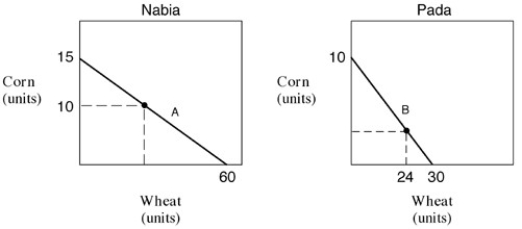
-In Exhibit 18.1, the production possibilities curves of wheat and corn for Nabia and Pada are presented. Suppose Nabia produces at point A on its PPF. How many units of wheat is the country able to produce?
A)15.
B)60.
C)5.
D) 20.
-In Exhibit 18.1, the production possibilities curves of wheat and corn for Nabia and Pada are presented. Suppose Nabia produces at point A on its PPF. How many units of wheat is the country able to produce?
A)15.
B)60.
C)5.
D) 20.
Question
Narrbegin Exhibit 18.1 Production possibilities curves
-In Exhibit 18.1, the production possibilities curves of wheat and corn for Nabia and Pada are presented. If these two nations trade, Nabia should specialise in the production of:
A) corn.
B) corn and wheat.
C) neither product since Pada has the comparative advantage in the production of both.
D) wheat.
-In Exhibit 18.1, the production possibilities curves of wheat and corn for Nabia and Pada are presented. If these two nations trade, Nabia should specialise in the production of:
A) corn.
B) corn and wheat.
C) neither product since Pada has the comparative advantage in the production of both.
D) wheat.
Question
Question
Question
Question
Question
Narrbegin Exhibit 18.1 Production possibilities curves
-In Exhibit 18.1, the production possibilities curves of wheat and corn for Nabia and Pada are presented. In Pada the cost of producing one more unit of corn is equal to:
A) 3 units of corn.
B) 1/3 unit of wheat.
C) 3 units of wheat.
D) 15 units of wheat.
-In Exhibit 18.1, the production possibilities curves of wheat and corn for Nabia and Pada are presented. In Pada the cost of producing one more unit of corn is equal to:
A) 3 units of corn.
B) 1/3 unit of wheat.
C) 3 units of wheat.
D) 15 units of wheat.
Question
Question
Question
Narrbegin Exhibit 18.1 Production possibilities curves
-In Exhibit 18.1, the production possibilities curves of wheat and corn for Nabia and Pada are presented. In Nabia the cost of producing one more unit of wheat is equal to:
A) 4 units of wheat.
B) 1/4 unit of corn.
C) 4 units of corn.
D) 15 units of corn.
-In Exhibit 18.1, the production possibilities curves of wheat and corn for Nabia and Pada are presented. In Nabia the cost of producing one more unit of wheat is equal to:
A) 4 units of wheat.
B) 1/4 unit of corn.
C) 4 units of corn.
D) 15 units of corn.
Question
Question
Narrbegin Exhibit 18.2 Production possibilities curves for US and Mexico 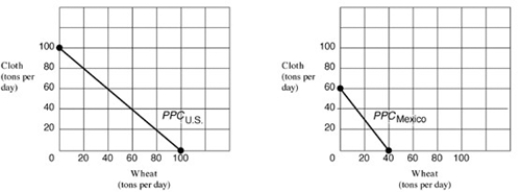
-As shown in Exhibit 18.2, in Mexico, producing one additional ton of wheat costs:
A) 1/2 ton of cloth.
B) 2/3 ton of cloth.
C) 1 ton of cloth.
D) 1 1/2 tons of cloth.
-As shown in Exhibit 18.2, in Mexico, producing one additional ton of wheat costs:
A) 1/2 ton of cloth.
B) 2/3 ton of cloth.
C) 1 ton of cloth.
D) 1 1/2 tons of cloth.
Question
Question
Question
Question
Narrbegin Exhibit 18.2 Production possibilities curves for US and Mexico
-As shown in Exhibit 18.2, the United States has a comparative advantage over Mexico in:
A) wheat but not in cloth.
B) cloth but not in wheat.
C) both wheat and cloth.
D) neither wheat nor cloth
-As shown in Exhibit 18.2, the United States has a comparative advantage over Mexico in:
A) wheat but not in cloth.
B) cloth but not in wheat.
C) both wheat and cloth.
D) neither wheat nor cloth
Question
Question
Question
Question
Question
Question
Question
Question
Question
Question
Question
Question
Question
Question
Question
Question
Question
Question
Question
Question
Question
Question
Question
Question
Question
Question
Question
Question
Question
Question
Question
Question
Question
Question
Question
Question
Question
Question
Question
Question
Question
Question
Question
Question
Question
Question
Question
Question
Question
Question
Question
Question
Question
Question
Question
Question
Question
Question
Question
Question
Question
Question

Unlock Deck
Sign up to unlock the cards in this deck!
Unlock Deck
Unlock Deck
1/132

Play

Full screen (f)
Deck 19: International Trade and Finance
1
Jan, a lawyer, can type faster than Jill, her secretary. Jill, on the other hand, does not have the ability or skills to practice law. Applying the principles of international trade to this situation, an economic consultant advises Jan to:
A) fire Jill, practice law during the day and do her own typing at night.
B) practice law and leave all the typing to Jill.
C) divide her time equally between typing and practicing law.
D) quit practicing law and take a job as a secretary.
A) fire Jill, practice law during the day and do her own typing at night.
B) practice law and leave all the typing to Jill.
C) divide her time equally between typing and practicing law.
D) quit practicing law and take a job as a secretary.
B
2
If it costs the DuPont Chemical Company more to make the chemical flaxinate in the United States than it does to make it in Taiwan, the Taiwanese must have:
A) lower demand for flaxinate.
B) tariffs on flaxinate.
C) inefficient markets.
D) an absolute advantage in flaxinate production.
A) lower demand for flaxinate.
B) tariffs on flaxinate.
C) inefficient markets.
D) an absolute advantage in flaxinate production.
D
3
Narrbegin Exhibit 18.1 Production possibilities curves
-In Exhibit 18.1, the production possibilities curves of wheat and corn for Nabia and Pada are presented. Suppose Nabia produces at point A on its PPF. How many units of wheat is the country able to produce?
A)15.
B)60.
C)5.
D) 20.
-In Exhibit 18.1, the production possibilities curves of wheat and corn for Nabia and Pada are presented. Suppose Nabia produces at point A on its PPF. How many units of wheat is the country able to produce?
A)15.
B)60.
C)5.
D) 20.
20.
4
Narrbegin Exhibit 18.1 Production possibilities curves
-In Exhibit 18.1, the production possibilities curves of wheat and corn for Nabia and Pada are presented. If these two nations trade, Nabia should specialise in the production of:
A) corn.
B) corn and wheat.
C) neither product since Pada has the comparative advantage in the production of both.
D) wheat.
-In Exhibit 18.1, the production possibilities curves of wheat and corn for Nabia and Pada are presented. If these two nations trade, Nabia should specialise in the production of:
A) corn.
B) corn and wheat.
C) neither product since Pada has the comparative advantage in the production of both.
D) wheat.
Unlock Deck
Unlock for access to all 132 flashcards in this deck.
Unlock Deck
k this deck
5
Australia largely exports _____ and imports _____.
A) manufactured goods; primary commodities
B) services; manufactured goods
C) manufactured goods; services
D) primary commodities and mineral products; manufactured goods
A) manufactured goods; primary commodities
B) services; manufactured goods
C) manufactured goods; services
D) primary commodities and mineral products; manufactured goods
Unlock Deck
Unlock for access to all 132 flashcards in this deck.
Unlock Deck
k this deck
6
If a country's production possibilities equal its consumption possibilities, then we can say that:
A) net exports equal zero.
B) the country is self-sufficient.
C) its exports must equal its imports.
D) the country has an absolute advantage in everything.
A) net exports equal zero.
B) the country is self-sufficient.
C) its exports must equal its imports.
D) the country has an absolute advantage in everything.
Unlock Deck
Unlock for access to all 132 flashcards in this deck.
Unlock Deck
k this deck
7
A country is said to have an absolute advantage in the production of a good when:
A) its opportunity cost of producing the good is lower than another country.
B) it can produce the good using less resources than another country.
C) it specialises in the production of the good.
D) its opportunity cost of producing the good is higher than another country.
A) its opportunity cost of producing the good is lower than another country.
B) it can produce the good using less resources than another country.
C) it specialises in the production of the good.
D) its opportunity cost of producing the good is higher than another country.
Unlock Deck
Unlock for access to all 132 flashcards in this deck.
Unlock Deck
k this deck
8
If one country can produce a good with fewer resources than another country, this is called:
A) specialisation.
B) geographic advantage.
C) comparative advantage.
D) absolute advantage.
A) specialisation.
B) geographic advantage.
C) comparative advantage.
D) absolute advantage.
Unlock Deck
Unlock for access to all 132 flashcards in this deck.
Unlock Deck
k this deck
9
Narrbegin Exhibit 18.1 Production possibilities curves
-In Exhibit 18.1, the production possibilities curves of wheat and corn for Nabia and Pada are presented. In Pada the cost of producing one more unit of corn is equal to:
A) 3 units of corn.
B) 1/3 unit of wheat.
C) 3 units of wheat.
D) 15 units of wheat.
-In Exhibit 18.1, the production possibilities curves of wheat and corn for Nabia and Pada are presented. In Pada the cost of producing one more unit of corn is equal to:
A) 3 units of corn.
B) 1/3 unit of wheat.
C) 3 units of wheat.
D) 15 units of wheat.
Unlock Deck
Unlock for access to all 132 flashcards in this deck.
Unlock Deck
k this deck
10
If a nation follows a policy of being self-sufficient, its:
A) production possibilities equal its consumption possibilities.
B) consumption possibilities are greater than its production possibilities.
C) production possibilities curve shifts rightward.
D) consumption possibilities are less than its production possibilities.
A) production possibilities equal its consumption possibilities.
B) consumption possibilities are greater than its production possibilities.
C) production possibilities curve shifts rightward.
D) consumption possibilities are less than its production possibilities.
Unlock Deck
Unlock for access to all 132 flashcards in this deck.
Unlock Deck
k this deck
11
The theory of comparative advantage suggests:
A) that an industrialised country should not import.
B) that a country that is not competitive should import everything.
C) that a country specialises according to the opportunity cost.
D) that a country specialises according to the absolute cost.
A) that an industrialised country should not import.
B) that a country that is not competitive should import everything.
C) that a country specialises according to the opportunity cost.
D) that a country specialises according to the absolute cost.
Unlock Deck
Unlock for access to all 132 flashcards in this deck.
Unlock Deck
k this deck
12
Narrbegin Exhibit 18.1 Production possibilities curves
-In Exhibit 18.1, the production possibilities curves of wheat and corn for Nabia and Pada are presented. In Nabia the cost of producing one more unit of wheat is equal to:
A) 4 units of wheat.
B) 1/4 unit of corn.
C) 4 units of corn.
D) 15 units of corn.
-In Exhibit 18.1, the production possibilities curves of wheat and corn for Nabia and Pada are presented. In Nabia the cost of producing one more unit of wheat is equal to:
A) 4 units of wheat.
B) 1/4 unit of corn.
C) 4 units of corn.
D) 15 units of corn.
Unlock Deck
Unlock for access to all 132 flashcards in this deck.
Unlock Deck
k this deck
13
Specialisation and trade can:
A) only be useful if the nation has an absolute advantage in everything.
B) be detrimental for all nations.
C) only increase the nation's debt.
D) help a nation to achieve a higher standard of living.
A) only be useful if the nation has an absolute advantage in everything.
B) be detrimental for all nations.
C) only increase the nation's debt.
D) help a nation to achieve a higher standard of living.
Unlock Deck
Unlock for access to all 132 flashcards in this deck.
Unlock Deck
k this deck
14
Narrbegin Exhibit 18.2 Production possibilities curves for US and Mexico
-As shown in Exhibit 18.2, in Mexico, producing one additional ton of wheat costs:
A) 1/2 ton of cloth.
B) 2/3 ton of cloth.
C) 1 ton of cloth.
D) 1 1/2 tons of cloth.
-As shown in Exhibit 18.2, in Mexico, producing one additional ton of wheat costs:
A) 1/2 ton of cloth.
B) 2/3 ton of cloth.
C) 1 ton of cloth.
D) 1 1/2 tons of cloth.
Unlock Deck
Unlock for access to all 132 flashcards in this deck.
Unlock Deck
k this deck
15
In terms of production possibilities curves, the benefits of trade between two nations is that each nation moves to:
A) a lower standard of living.
B) a more expansive consumption possibilities combination.
C) a higher standard of living.
D) a lower consumption possibilities combination.
A) a lower standard of living.
B) a more expansive consumption possibilities combination.
C) a higher standard of living.
D) a lower consumption possibilities combination.
Unlock Deck
Unlock for access to all 132 flashcards in this deck.
Unlock Deck
k this deck
16
Without trade, the consumption possibilities for two nations are (assuming full-employment):
A) outside their production possibilities curve.
B) inside their production possibilities curve.
C) along their production possibilities curves.
D) at a point equal to the world production possibilities curve.
A) outside their production possibilities curve.
B) inside their production possibilities curve.
C) along their production possibilities curves.
D) at a point equal to the world production possibilities curve.
Unlock Deck
Unlock for access to all 132 flashcards in this deck.
Unlock Deck
k this deck
17
Which of the following statements is true?
A) Comparative advantage is the ability of a country to produce goods and services at lower opportunity costs than another country.
B) Free trade theory suggests that when trade takes place any gains made by one nation come at the expense of another.
C) According to the theory of comparative advantage, a nation should specialise in the production of those goods for which it has an absolute advantage.
D) Countries should only trade in goods and services they have an absolute advantage
Producing.
A) Comparative advantage is the ability of a country to produce goods and services at lower opportunity costs than another country.
B) Free trade theory suggests that when trade takes place any gains made by one nation come at the expense of another.
C) According to the theory of comparative advantage, a nation should specialise in the production of those goods for which it has an absolute advantage.
D) Countries should only trade in goods and services they have an absolute advantage
Producing.
Unlock Deck
Unlock for access to all 132 flashcards in this deck.
Unlock Deck
k this deck
18
Narrbegin Exhibit 18.2 Production possibilities curves for US and Mexico
-As shown in Exhibit 18.2, the United States has a comparative advantage over Mexico in:
A) wheat but not in cloth.
B) cloth but not in wheat.
C) both wheat and cloth.
D) neither wheat nor cloth
-As shown in Exhibit 18.2, the United States has a comparative advantage over Mexico in:
A) wheat but not in cloth.
B) cloth but not in wheat.
C) both wheat and cloth.
D) neither wheat nor cloth
Unlock Deck
Unlock for access to all 132 flashcards in this deck.
Unlock Deck
k this deck
19
In a two-good, two-country world, a country has a comparative advantage in any good for which it has a:
A) lower absolute cost than the other country.
B) lower opportunity cost than the other country.
C) higher absolute cost than the other country.
D) higher opportunity cost than the other country.
A) lower absolute cost than the other country.
B) lower opportunity cost than the other country.
C) higher absolute cost than the other country.
D) higher opportunity cost than the other country.
Unlock Deck
Unlock for access to all 132 flashcards in this deck.
Unlock Deck
k this deck
20
Suppose that Spain has a comparative advantage in hats and Portugal has a comparative advantage in doormats. Under a system of free trade, each country specialises and then trades with the other. If the price starts at four hats per doormat, and then increases to five hats per doormat, then:
A) people in Portugal will not want to buy as many hats.
B) Spain no longer has a comparative advantage in hats.
C) Portugal is flooding the market with too many doormats.
D) some of the gains from trade shift to Portugal.
A) people in Portugal will not want to buy as many hats.
B) Spain no longer has a comparative advantage in hats.
C) Portugal is flooding the market with too many doormats.
D) some of the gains from trade shift to Portugal.
Unlock Deck
Unlock for access to all 132 flashcards in this deck.
Unlock Deck
k this deck
21
A tariff has the effect of granting _____ a larger share of the domestic market.
A) domestic consumers
B) foreign consumers
C) domestic producers
D) foreign producers
A) domestic consumers
B) foreign consumers
C) domestic producers
D) foreign producers
Unlock Deck
Unlock for access to all 132 flashcards in this deck.
Unlock Deck
k this deck
22
The idea that countries should only reduce their own tariffs if other countries reduce theirs is an argument put forward by those who favour:
A) free trade.
B) strategic trade.
C) fair trade.
D) closed economies.
A) free trade.
B) strategic trade.
C) fair trade.
D) closed economies.
Unlock Deck
Unlock for access to all 132 flashcards in this deck.
Unlock Deck
k this deck
23
Suppose a quota on foreign-made cars is proposed in parliament. Which of the following groups is most likely to oppose the legislation?
A) Car manufacturers.
B) Consumers.
C) Australian steel workers.
D) Union officials.
A) Car manufacturers.
B) Consumers.
C) Australian steel workers.
D) Union officials.
Unlock Deck
Unlock for access to all 132 flashcards in this deck.
Unlock Deck
k this deck
24
Assume Australia can use a given amount of its resources to produce either 20 airplanes or eight automobiles and Japan can employ the same amount of its resources to produce either 20 airplanes or 10 automobiles. Australia should specialise in:
A) airplanes.
B) automobiles.
C) both goods.
D) neither good.
A) airplanes.
B) automobiles.
C) both goods.
D) neither good.
Unlock Deck
Unlock for access to all 132 flashcards in this deck.
Unlock Deck
k this deck
25
Narrbegin Exhibit 18.3 Potatoes and wheat output (tonnes per day)
-In Exhibit 18.3, Australia has an absolute advantage in producing:
A) potatoes.
B) wheat.
C) both potatoes and wheat.
D) neither potatoes nor wheat.
-In Exhibit 18.3, Australia has an absolute advantage in producing:
A) potatoes.
B) wheat.
C) both potatoes and wheat.
D) neither potatoes nor wheat.
Unlock Deck
Unlock for access to all 132 flashcards in this deck.
Unlock Deck
k this deck
26
A quota is a:
A) tax on a specific quantity of imported goods.
B) limited number of foreign firms that can sell imported goods.
C) restrictive health and safety standard that raises costs.
D) limit on the quantity of a good that can be imported.
A) tax on a specific quantity of imported goods.
B) limited number of foreign firms that can sell imported goods.
C) restrictive health and safety standard that raises costs.
D) limit on the quantity of a good that can be imported.
Unlock Deck
Unlock for access to all 132 flashcards in this deck.
Unlock Deck
k this deck
27
Protectionism is:
A) the government's use of embargoes, tariffs, quotas and other restrictions to protect domestic producers from foreign competition.
B) the government's use of antimonopoly policy to protect local producers.
C) the government's use of monetary policy to protect domestic producers from overseas competition.
D) the government's use of politics to support imports from overseas.
A) the government's use of embargoes, tariffs, quotas and other restrictions to protect domestic producers from foreign competition.
B) the government's use of antimonopoly policy to protect local producers.
C) the government's use of monetary policy to protect domestic producers from overseas competition.
D) the government's use of politics to support imports from overseas.
Unlock Deck
Unlock for access to all 132 flashcards in this deck.
Unlock Deck
k this deck
28
An embargo is:
A) an ad valorem tariff.
B) the strongest limit on trade.
C) a law that allows free trade with another country.
D) a direct tax on production.
A) an ad valorem tariff.
B) the strongest limit on trade.
C) a law that allows free trade with another country.
D) a direct tax on production.
Unlock Deck
Unlock for access to all 132 flashcards in this deck.
Unlock Deck
k this deck
29
A limit on the quantity of a good that may be imported in a given time period is called:
A) an embargo.
B) a tariff.
C) a quota.
D) dumping.
A) an embargo.
B) a tariff.
C) a quota.
D) dumping.
Unlock Deck
Unlock for access to all 132 flashcards in this deck.
Unlock Deck
k this deck
30
Assume that the opportunity cost of producing wheat is lower in Australia compared with Malaysia. Further assume that the opportunity cost of producing cars is higher in Australia compared with Malaysia. Which country should specialise in producing wheat?
A) Australia and Malaysia.
B) Australia.
C) Malaysia.
D) Both countries have to specialise in producing cars.
A) Australia and Malaysia.
B) Australia.
C) Malaysia.
D) Both countries have to specialise in producing cars.
Unlock Deck
Unlock for access to all 132 flashcards in this deck.
Unlock Deck
k this deck
31
The principal objective of the WTO is to:
A) reduce the level of all tariffs.
B) establish fair prices for all goods traded internationally.
C) act as the world's police officer to prevent dumping.
D) prevent the trading of services across nations' borders.
A) reduce the level of all tariffs.
B) establish fair prices for all goods traded internationally.
C) act as the world's police officer to prevent dumping.
D) prevent the trading of services across nations' borders.
Unlock Deck
Unlock for access to all 132 flashcards in this deck.
Unlock Deck
k this deck
32
If country A lowers its tariffs even if country B doesn't, then:
A) only country A will be at a disadvantage.
B) both countries will be worse off.
C) both countries will be better off.
D) country A will be better off than if it kept tariffs high.
A) only country A will be at a disadvantage.
B) both countries will be worse off.
C) both countries will be better off.
D) country A will be better off than if it kept tariffs high.
Unlock Deck
Unlock for access to all 132 flashcards in this deck.
Unlock Deck
k this deck
33
Comparative advantage is:
A) not important in the modern world.
B) the same as an absolute advantage.
C) the ability of a country to produce a good at a higher opportunity cost than another
Country.
D) the ability of a country to produce a good at a lower opportunity cost than another
Country.
A) not important in the modern world.
B) the same as an absolute advantage.
C) the ability of a country to produce a good at a higher opportunity cost than another
Country.
D) the ability of a country to produce a good at a lower opportunity cost than another
Country.
Unlock Deck
Unlock for access to all 132 flashcards in this deck.
Unlock Deck
k this deck
34
Assume that the opportunity cost of producing wheat is lower in Australia compared with Malaysia. Further assume that the opportunity cost of producing cars is higher in Australia compared with Malaysia. Which country has a comparative advantage in producing cars?
A) Australia and Malaysia.
B) Australia.
C) Malaysia.
D) Both countries have to specialise in producing wheat.
A) Australia and Malaysia.
B) Australia.
C) Malaysia.
D) Both countries have to specialise in producing wheat.
Unlock Deck
Unlock for access to all 132 flashcards in this deck.
Unlock Deck
k this deck
35
When a nation totally bans trade with another country, it is imposing:
A) free trade.
B) an embargo.
C) a quota.
D) a tariff.
A) free trade.
B) an embargo.
C) a quota.
D) a tariff.
Unlock Deck
Unlock for access to all 132 flashcards in this deck.
Unlock Deck
k this deck
36
Free trade is:
A) the flow of goods and services between countries with taxes applied to the flow.
B) the flow of goods and services between countries with subsidies applied to the flow.
C) the flow of goods and services between countries with restrictions applied to the flow.
D) the flow of goods and services between countries without restrictions applied to the flow.
A) the flow of goods and services between countries with taxes applied to the flow.
B) the flow of goods and services between countries with subsidies applied to the flow.
C) the flow of goods and services between countries with restrictions applied to the flow.
D) the flow of goods and services between countries without restrictions applied to the flow.
Unlock Deck
Unlock for access to all 132 flashcards in this deck.
Unlock Deck
k this deck
37
Which of the following statements is true with respect to a tariff on imported cheese?
A) It lowers the price of cheese.
B) It lowers domestic cheese producers' profits.
C) It creates tax revenues for the government.
D) It cannot result in retaliation.
A) It lowers the price of cheese.
B) It lowers domestic cheese producers' profits.
C) It creates tax revenues for the government.
D) It cannot result in retaliation.
Unlock Deck
Unlock for access to all 132 flashcards in this deck.
Unlock Deck
k this deck
38
Assume that the opportunity cost of producing wheat is lower in Australia compared with Malaysia. Further assume that the opportunity cost of producing cars is higher in Australia compared with Malaysia. Which country should specialise in producing cars?
A) Australia and Malaysia.
B) Australia.
C) Malaysia.
D) Both countries have to specialise in producing wheat.
A) Australia and Malaysia.
B) Australia.
C) Malaysia.
D) Both countries have to specialise in producing wheat.
Unlock Deck
Unlock for access to all 132 flashcards in this deck.
Unlock Deck
k this deck
39
Narrbegin Exhibit 18.3 Potatoes and wheat output (tonnes per day)
-In Exhibit 18.3, Australia has a comparative advantage in producing:
A) potatoes.
B) wheat.
C) both potatoes and wheat.
D) neither potatoes nor wheat.
-In Exhibit 18.3, Australia has a comparative advantage in producing:
A) potatoes.
B) wheat.
C) both potatoes and wheat.
D) neither potatoes nor wheat.
Unlock Deck
Unlock for access to all 132 flashcards in this deck.
Unlock Deck
k this deck
40
Assume that the opportunity cost of producing wheat is lower in Australia compared with Malaysia. Further assume that the opportunity cost of producing cars is higher in Australia compared with Malaysia. Which country has a comparative advantage in producing wheat?
A) Australia and Malaysia.
B) Australia.
C) Malaysia.
D) Both countries have to specialise in producing cars.
A) Australia and Malaysia.
B) Australia.
C) Malaysia.
D) Both countries have to specialise in producing cars.
Unlock Deck
Unlock for access to all 132 flashcards in this deck.
Unlock Deck
k this deck
41
The main problem with using the infant industries argument to justify protecting an industry from foreign competition is that:
A) all industries will claim that they are infant industries in order to gain protection.
B) the protected industry will become too efficient and drive out foreign competition.
C) once in place, it is difficult to remove protection, even as the industry matures.
D) it causes the goods that are produced in the protected industry to have lower prices.
E) this policy compromises national security if the infant industry produces military goods.
A) all industries will claim that they are infant industries in order to gain protection.
B) the protected industry will become too efficient and drive out foreign competition.
C) once in place, it is difficult to remove protection, even as the industry matures.
D) it causes the goods that are produced in the protected industry to have lower prices.
E) this policy compromises national security if the infant industry produces military goods.
Unlock Deck
Unlock for access to all 132 flashcards in this deck.
Unlock Deck
k this deck
42
Which of the following groups will benefit least from free trade?
A) Consumers.
B) Firms importing capital equipment.
C) Exporters.
D) Employees producing tariff-protected goods.
A) Consumers.
B) Firms importing capital equipment.
C) Exporters.
D) Employees producing tariff-protected goods.
Unlock Deck
Unlock for access to all 132 flashcards in this deck.
Unlock Deck
k this deck
43
Which statement best reflects the political problems associated with free trade?
A) The costs are spread wide to many, but the benefits accrue heavily on a few.
B) The benefits are spread to the rich, but the costs accrue to the poor.
C) The benefits are spread wide to many, but the costs accrue heavily on a few.
D) The costs are spread to the rich, but the benefits accrue to the poor.
A) The costs are spread wide to many, but the benefits accrue heavily on a few.
B) The benefits are spread to the rich, but the costs accrue to the poor.
C) The benefits are spread wide to many, but the costs accrue heavily on a few.
D) The costs are spread to the rich, but the benefits accrue to the poor.
Unlock Deck
Unlock for access to all 132 flashcards in this deck.
Unlock Deck
k this deck
44
Which of the following is an infant-industry argument in favour of restrictions on foreign trade?
A) Foreign producers must be stopped from selling their products in this country for below the cost of production.
B) Domestic workers must be protected from the lower wages paid in foreign countries.
C) The nation's security demands we ensure an adequate domestic supply capacity of certain products.
D) Industries in the early stages of development must be protected from more mature
Producers.
A) Foreign producers must be stopped from selling their products in this country for below the cost of production.
B) Domestic workers must be protected from the lower wages paid in foreign countries.
C) The nation's security demands we ensure an adequate domestic supply capacity of certain products.
D) Industries in the early stages of development must be protected from more mature
Producers.
Unlock Deck
Unlock for access to all 132 flashcards in this deck.
Unlock Deck
k this deck
45
Which of the following arguments is used to justify tariff protection?
A) It increases international competition.
B) It allows more goods and services in the country.
C) It protects industries needed for comparative advantage.
D) It protects key industries needed for national security.
A) It increases international competition.
B) It allows more goods and services in the country.
C) It protects industries needed for comparative advantage.
D) It protects key industries needed for national security.
Unlock Deck
Unlock for access to all 132 flashcards in this deck.
Unlock Deck
k this deck
46
Which of the following are benefits of free trade?
A) Households pay higher prices for many goods and services.
B) It relies on an overseas market.
C) It increases input costs for many firms.
D) Resources are allocated more efficiently.
A) Households pay higher prices for many goods and services.
B) It relies on an overseas market.
C) It increases input costs for many firms.
D) Resources are allocated more efficiently.
Unlock Deck
Unlock for access to all 132 flashcards in this deck.
Unlock Deck
k this deck
47
The argument that foreign trade should be restricted to protect domestic employment and output is based on the idea that:
A) consumers are willing to pay higher prices for domestic goods.
B) producers will not exploit reduced foreign competition by charging higher prices.
C) foreign companies are more costly to deal with than domestic companies.
D) sales of imports come at the expense of domestic goods and jobs.
A) consumers are willing to pay higher prices for domestic goods.
B) producers will not exploit reduced foreign competition by charging higher prices.
C) foreign companies are more costly to deal with than domestic companies.
D) sales of imports come at the expense of domestic goods and jobs.
Unlock Deck
Unlock for access to all 132 flashcards in this deck.
Unlock Deck
k this deck
48
The main explanation for why the cheap foreign-labour argument is a poor reason for restricting international trade is that:
A) workers who get paid less tend to have lower productivity than those who get paid more.
B) all firms and workers gain when there are no restrictions on international trade.
C) infant industries, such as steel and automobiles, need to be protected.
D) specialisation and free trade usually raise the prices of all the traded goods, so that the workers can get paid more.
A) workers who get paid less tend to have lower productivity than those who get paid more.
B) all firms and workers gain when there are no restrictions on international trade.
C) infant industries, such as steel and automobiles, need to be protected.
D) specialisation and free trade usually raise the prices of all the traded goods, so that the workers can get paid more.
Unlock Deck
Unlock for access to all 132 flashcards in this deck.
Unlock Deck
k this deck
49
The purpose of tariffs is to:
A) reduce imports by raising their selling prices compared with similar goods produced within the country.
B) encourage competition between domestic and overseas producers.
C) increase a variety of goods and services available locally.
D) reduce government revenues.
A) reduce imports by raising their selling prices compared with similar goods produced within the country.
B) encourage competition between domestic and overseas producers.
C) increase a variety of goods and services available locally.
D) reduce government revenues.
Unlock Deck
Unlock for access to all 132 flashcards in this deck.
Unlock Deck
k this deck
50
Free trade can be strongly opposed because:
A) free trade provides consumers with lower prices and larger quantities of products.
B) reduced tariffs result in extra buying power of consumers.
C) free trade can stimulate other areas of domestic production.
D) cheaper imports can reduce incomes of the owners of the domestic firms competing with the cheaper imports.
A) free trade provides consumers with lower prices and larger quantities of products.
B) reduced tariffs result in extra buying power of consumers.
C) free trade can stimulate other areas of domestic production.
D) cheaper imports can reduce incomes of the owners of the domestic firms competing with the cheaper imports.
Unlock Deck
Unlock for access to all 132 flashcards in this deck.
Unlock Deck
k this deck
51
The infant industry argument is based on:
A) the idea that competitive pressure from established foreign firms would encourage the infant industry's prospects for future growth.
B) the idea that failure to shelter these infant industries tends to lead to political instability.
C) the idea that small firms must be protected.
D) the idea that the industry is not yet ready to compete with established foreign
Competitors.
A) the idea that competitive pressure from established foreign firms would encourage the infant industry's prospects for future growth.
B) the idea that failure to shelter these infant industries tends to lead to political instability.
C) the idea that small firms must be protected.
D) the idea that the industry is not yet ready to compete with established foreign
Competitors.
Unlock Deck
Unlock for access to all 132 flashcards in this deck.
Unlock Deck
k this deck
52
Which of the following are problems with the employment argument for tariff protection?
A) It only protects foreign jobs, not domestic jobs.
B) It raises costs to firms, who in turn have higher output and hence higher employment.
C) Developed countries can't hope to compete with low-wage nations.
D) It reduces demand by consumers, thereby leading to higher unemployment in particular industries.
A) It only protects foreign jobs, not domestic jobs.
B) It raises costs to firms, who in turn have higher output and hence higher employment.
C) Developed countries can't hope to compete with low-wage nations.
D) It reduces demand by consumers, thereby leading to higher unemployment in particular industries.
Unlock Deck
Unlock for access to all 132 flashcards in this deck.
Unlock Deck
k this deck
53
Trade restrictions imposed in the name of national security have been recommended by protectionists in order to:
A) develop strong international connections with other industries.
B) avoid competition with overseas producers.
C) have cheaper domestic labour.
D) not be dependent on foreign countries for defence-related goods in wartime.
A) develop strong international connections with other industries.
B) avoid competition with overseas producers.
C) have cheaper domestic labour.
D) not be dependent on foreign countries for defence-related goods in wartime.
Unlock Deck
Unlock for access to all 132 flashcards in this deck.
Unlock Deck
k this deck
54
The national security argument for tariff protection is based on the need to:
A) trade only with other friendly countries and impose tariffs on the rest.
B) protect employment in key industries.
C) protect defence-related industries in case of war.
D) raise money to field a sufficiently large army.
A) trade only with other friendly countries and impose tariffs on the rest.
B) protect employment in key industries.
C) protect defence-related industries in case of war.
D) raise money to field a sufficiently large army.
Unlock Deck
Unlock for access to all 132 flashcards in this deck.
Unlock Deck
k this deck
55
If a small country is protecting its industry that might mean that:
A) tariffs are necessary because otherwise wages in the small country will be very low.
B) tariffs are necessary to protect employment in the small country.
C) workers in other countries are more productive than workers in the small country.
D) it is too small to be able to achieve economies of scale in this industry.
A) tariffs are necessary because otherwise wages in the small country will be very low.
B) tariffs are necessary to protect employment in the small country.
C) workers in other countries are more productive than workers in the small country.
D) it is too small to be able to achieve economies of scale in this industry.
Unlock Deck
Unlock for access to all 132 flashcards in this deck.
Unlock Deck
k this deck
56
A country should reduce its barriers to import from another country if the other country:
A) has some sort of 'unfair' competitive advantage over it.
B) is not willing to reduce its import barriers reciprocally.
C) does not have some sort of 'unfair' competitive advantage over it.
D) is not willing to trade under any condition.
A) has some sort of 'unfair' competitive advantage over it.
B) is not willing to reduce its import barriers reciprocally.
C) does not have some sort of 'unfair' competitive advantage over it.
D) is not willing to trade under any condition.
Unlock Deck
Unlock for access to all 132 flashcards in this deck.
Unlock Deck
k this deck
57
'More productive workers receive higher wages than less productive workers.' This observation is a major flaw in which of the following arguments for protectionism?
A) The infant industry argument.
B) The national security argument.
C) The employment argument.
D) The cheap foreign labour argument.
A) The infant industry argument.
B) The national security argument.
C) The employment argument.
D) The cheap foreign labour argument.
Unlock Deck
Unlock for access to all 132 flashcards in this deck.
Unlock Deck
k this deck
58
It is argued that strategic trade may not work because:
A) comparative advantage never changes.
B) the government is less successful at 'picking winners' than the private sector.
C) comparative advantage is dynamic over time.
D) the private sector is less successful at 'picking winners' than the government.
A) comparative advantage never changes.
B) the government is less successful at 'picking winners' than the private sector.
C) comparative advantage is dynamic over time.
D) the private sector is less successful at 'picking winners' than the government.
Unlock Deck
Unlock for access to all 132 flashcards in this deck.
Unlock Deck
k this deck
59
Using tariffs to trade only with some developing countries is often called:
A) the national safety argument.
B) the cheap foreign labour argument.
C) the baby industry argument.
D) the unemployment argument.
A) the national safety argument.
B) the cheap foreign labour argument.
C) the baby industry argument.
D) the unemployment argument.
Unlock Deck
Unlock for access to all 132 flashcards in this deck.
Unlock Deck
k this deck
60
Strategic trade suggests that governments should:
A) play no role in developing a comparative advantage in emerging sectors.
B) play an active role in developing a comparative advantage in emerging sectors.
C) only trade with countries that are politically strategic to it.
D) only trade with countries if they reciprocate with lower tariffs.
A) play no role in developing a comparative advantage in emerging sectors.
B) play an active role in developing a comparative advantage in emerging sectors.
C) only trade with countries that are politically strategic to it.
D) only trade with countries if they reciprocate with lower tariffs.
Unlock Deck
Unlock for access to all 132 flashcards in this deck.
Unlock Deck
k this deck
61
Which of the following are expressed concerns over regional trade agreements?
A) They will ultimately have no real economic benefits.
B) It may make future multilateral agreements more difficult.
C) Some countries will gain, but many will lose.
D) They never involve the world's major trading nations.
A) They will ultimately have no real economic benefits.
B) It may make future multilateral agreements more difficult.
C) Some countries will gain, but many will lose.
D) They never involve the world's major trading nations.
Unlock Deck
Unlock for access to all 132 flashcards in this deck.
Unlock Deck
k this deck
62
Which of the following are examples of free trade agreements?
A) OPEC.
B) EU countries.
C) UN.
D) WTO.
A) OPEC.
B) EU countries.
C) UN.
D) WTO.
Unlock Deck
Unlock for access to all 132 flashcards in this deck.
Unlock Deck
k this deck
63
By continually running current account deficits, Australia:
A) has been experiencing a lower standard of living than it otherwise might have.
B) has encouraged continual capital account deficits.
C) is accumulating more assets overseas than foreign interests accumulate here.
D) is effectively spending more than it is earning.
A) has been experiencing a lower standard of living than it otherwise might have.
B) has encouraged continual capital account deficits.
C) is accumulating more assets overseas than foreign interests accumulate here.
D) is effectively spending more than it is earning.
Unlock Deck
Unlock for access to all 132 flashcards in this deck.
Unlock Deck
k this deck
64
If Australia has a capital account surplus, this indicates:
A) Australians made more investments overseas than foreign interests made in Australia.
B) Australia has exported more goods and services than it imported.
C) Australia has imported more goods and services than it exported.
D) foreign interests made more investments in Australia than Australians made overseas.
A) Australians made more investments overseas than foreign interests made in Australia.
B) Australia has exported more goods and services than it imported.
C) Australia has imported more goods and services than it exported.
D) foreign interests made more investments in Australia than Australians made overseas.
Unlock Deck
Unlock for access to all 132 flashcards in this deck.
Unlock Deck
k this deck
65
The account which records a nation's foreign economic transactions is called:
A) the trade account.
B) the stock market.
C) the exchange market.
D) the balance of payments.
E) a bill of lading.
A) the trade account.
B) the stock market.
C) the exchange market.
D) the balance of payments.
E) a bill of lading.
Unlock Deck
Unlock for access to all 132 flashcards in this deck.
Unlock Deck
k this deck
66
Which is not a common argument for protecting the domestic industry?
A) Infant industry argument.
B) National security argument.
C) Employment argument.
D) Cheap domestic-labour argument.
A) Infant industry argument.
B) National security argument.
C) Employment argument.
D) Cheap domestic-labour argument.
Unlock Deck
Unlock for access to all 132 flashcards in this deck.
Unlock Deck
k this deck
67
Free trade agreement between Australia and New Zealand is called:
A) Closer Economic Relations or CER.
B) Creating Economic Relations or CER.
C) Clever Economic Relations or CER.
D) Closed Economic Relations or CER.
A) Closer Economic Relations or CER.
B) Creating Economic Relations or CER.
C) Clever Economic Relations or CER.
D) Closed Economic Relations or CER.
Unlock Deck
Unlock for access to all 132 flashcards in this deck.
Unlock Deck
k this deck
68
Which of the following would be included in Australia's capital account?
A) The sale of wheat to Britain.
B) The purchase of cars from Japan.
C) Interest repayments on a loan from a US bank.
D) Investors from Papua New Guinea buy a cattle station in Queensland, Australia.
A) The sale of wheat to Britain.
B) The purchase of cars from Japan.
C) Interest repayments on a loan from a US bank.
D) Investors from Papua New Guinea buy a cattle station in Queensland, Australia.
Unlock Deck
Unlock for access to all 132 flashcards in this deck.
Unlock Deck
k this deck
69
In order for an investment to exceed domestic saving, a country:
A) usually runs capital account deficits.
B) has been able to take advantage of more investment opportunities than it would otherwise have been able to.
C) usually runs a current account surplus.
D) had to buy more foreign assests.
A) usually runs capital account deficits.
B) has been able to take advantage of more investment opportunities than it would otherwise have been able to.
C) usually runs a current account surplus.
D) had to buy more foreign assests.
Unlock Deck
Unlock for access to all 132 flashcards in this deck.
Unlock Deck
k this deck
70
Australia's net foreign liabilities are likely to become a problem if:
A) they rise above 75 per cent of GDP.
B) they rise above 100 per cent of GDP.
C) our net foreign income share of GDP rises sharply.
D) they stay for a long period at the current level.
A) they rise above 75 per cent of GDP.
B) they rise above 100 per cent of GDP.
C) our net foreign income share of GDP rises sharply.
D) they stay for a long period at the current level.
Unlock Deck
Unlock for access to all 132 flashcards in this deck.
Unlock Deck
k this deck
71
The balance of payments _____.
A) with some nations is different than it is with others
B) is always zero
C) can only be expanded when the government has foreign exchange reserves
D) is negative when the nation runs a trade deficit
A) with some nations is different than it is with others
B) is always zero
C) can only be expanded when the government has foreign exchange reserves
D) is negative when the nation runs a trade deficit
Unlock Deck
Unlock for access to all 132 flashcards in this deck.
Unlock Deck
k this deck
72
A bilateral trade agreement involves:
A) all countries and is overseen by the WTO.
B) only two goods, one from each country.
C) two countries agreeing to reduce trade barriers.
D) two companies agreeing to reduce trade barriers.
A) all countries and is overseen by the WTO.
B) only two goods, one from each country.
C) two countries agreeing to reduce trade barriers.
D) two companies agreeing to reduce trade barriers.
Unlock Deck
Unlock for access to all 132 flashcards in this deck.
Unlock Deck
k this deck
73
Which of the following statements best describes the relationship between the capital and the current account?
A) When the current account is in deficit, so too will be the capital account.
B) When the current account is in surplus, so too will be the capital account.
C) A current account deficit must be paid for by selling Australian assets to
Foreign interests.
D) A current account deficit must be paid for by selling more exports.
A) When the current account is in deficit, so too will be the capital account.
B) When the current account is in surplus, so too will be the capital account.
C) A current account deficit must be paid for by selling Australian assets to
Foreign interests.
D) A current account deficit must be paid for by selling more exports.
Unlock Deck
Unlock for access to all 132 flashcards in this deck.
Unlock Deck
k this deck
74
One reason put forward to explain the growth in Australia's net foreign liabilities over the past 25 years is that:
A) international capital is now more mobile.
B) domestic investment is now too high.
C) domestic investment is now too low.
D) a substantial increase in foreign income relative to Australia has occurred.
A) international capital is now more mobile.
B) domestic investment is now too high.
C) domestic investment is now too low.
D) a substantial increase in foreign income relative to Australia has occurred.
Unlock Deck
Unlock for access to all 132 flashcards in this deck.
Unlock Deck
k this deck
75
In the mid- to late 1980s, Australia had large foreign debt. The concerns were about:
A) the ability of the country to make payments in case of an economic downturn. The equity investments were suggested.
B) the coming economic boom and the ability of the country to pay economic dividends.
C) the accessibility of local capital for foreign companies to partially cover the debt.
D) the liabilities were only 2% of the GDP and needed to be brought up to at least 25%.
A) the ability of the country to make payments in case of an economic downturn. The equity investments were suggested.
B) the coming economic boom and the ability of the country to pay economic dividends.
C) the accessibility of local capital for foreign companies to partially cover the debt.
D) the liabilities were only 2% of the GDP and needed to be brought up to at least 25%.
Unlock Deck
Unlock for access to all 132 flashcards in this deck.
Unlock Deck
k this deck
76
Australia has continually run current account deficits over much of its history. This implies:
A) we are living beyond our sustainable means.
B) most of our assets are now owned by foreign interests.
C) our capital stock is dwindling.
D) we have always had an excess of savings over investment.
A) we are living beyond our sustainable means.
B) most of our assets are now owned by foreign interests.
C) our capital stock is dwindling.
D) we have always had an excess of savings over investment.
Unlock Deck
Unlock for access to all 132 flashcards in this deck.
Unlock Deck
k this deck
77
If Australia has a current account deficit, then:
A) we must sell more exports to pay for it.
B) we will have a capital account surplus of the same amount.
C) we must buy more assets overseas.
D) the capital account will also be in deficit.
A) we must sell more exports to pay for it.
B) we will have a capital account surplus of the same amount.
C) we must buy more assets overseas.
D) the capital account will also be in deficit.
Unlock Deck
Unlock for access to all 132 flashcards in this deck.
Unlock Deck
k this deck
78
Which of the following suggest Australia's current account deficit may not be a problem?
A) We still have assets left to sell.
B) We have an equal capital account surplus.
C) If overseas borrowing is used productively we can generate enough extra income to pay for it.
D) If overseas borrowing is used on consumption goods and services we can generate enough extra income to pay for it.
A) We still have assets left to sell.
B) We have an equal capital account surplus.
C) If overseas borrowing is used productively we can generate enough extra income to pay for it.
D) If overseas borrowing is used on consumption goods and services we can generate enough extra income to pay for it.
Unlock Deck
Unlock for access to all 132 flashcards in this deck.
Unlock Deck
k this deck
79
The net foreign income share of GDP represents:
A) the amount of Australian assets owned by foreign interests as a proportion of GDP.
B) the proportion of GDP needed to pay the interest, rent and dividends owed on assets owned by foreign interests.
C) a problem at its current level of 55 per cent of GDP.
D) the proportion of GDP needed purely to service foreign debt.
A) the amount of Australian assets owned by foreign interests as a proportion of GDP.
B) the proportion of GDP needed to pay the interest, rent and dividends owed on assets owned by foreign interests.
C) a problem at its current level of 55 per cent of GDP.
D) the proportion of GDP needed purely to service foreign debt.
Unlock Deck
Unlock for access to all 132 flashcards in this deck.
Unlock Deck
k this deck
80
A favourable balance of trade occurs when:
A) exports equal imports.
B) the balance of payments balances.
C) the current and capital account in the BOP are equal.
D) the value of the exports of goods exceeds the value of the imports of goods.
A) exports equal imports.
B) the balance of payments balances.
C) the current and capital account in the BOP are equal.
D) the value of the exports of goods exceeds the value of the imports of goods.
Unlock Deck
Unlock for access to all 132 flashcards in this deck.
Unlock Deck
k this deck
Unlock Deck
Unlock for access to all 132 flashcards in this deck.






