







 Chat with AI

Deck 14: Freshwater Resources- Toilet to Tap: a California County Is Employing a Controversial Method to - Supply Drinking Water
Full screen (f)

Question
Infographic 14.2.
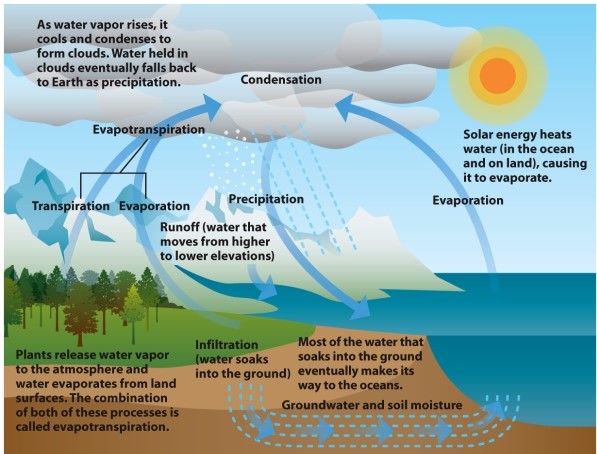
Why is deforestation a problem in regards to the Earth's freshwater supply?
Why is deforestation a problem in regards to the Earth's freshwater supply?

Question
Question
Question
Question
Question
Question
Infographic 14.1.
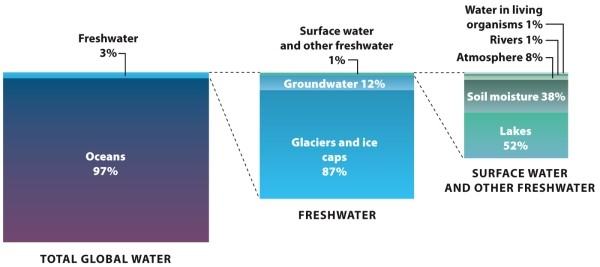
Refer to Infographic 14.1. Which of the following contains the most surface freshwater?
A) groundwater
B) glaciers and ice caps
C) soil moisture
D) rivers
E) lakes
Refer to Infographic 14.1. Which of the following contains the most surface freshwater?
A) groundwater
B) glaciers and ice caps
C) soil moisture
D) rivers
E) lakes
Question
Question
Question
Question
Question
Infographic 14.2.
Refer to Infographic 14.2. Explain the steps and processes in the water cycle as water moves from the ocean to the atmosphere to land and back to the ocean.
Refer to Infographic 14.2. Explain the steps and processes in the water cycle as water moves from the ocean to the atmosphere to land and back to the ocean.
Question
Question
Infographic 14.2.
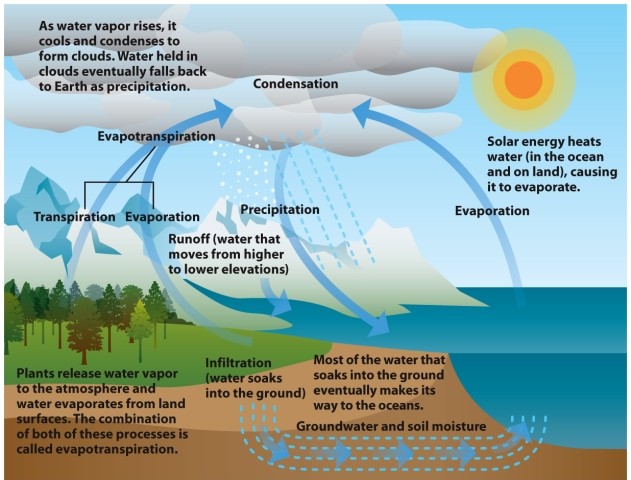
Refer to Infographic 14.2. Explain how salty ocean water can be recycled to become usable freshwater.
Refer to Infographic 14.2. Explain how salty ocean water can be recycled to become usable freshwater.
Question
Question
Question
Question
Question
Infographic 14.1.
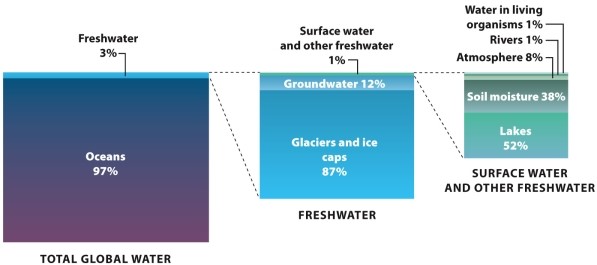
Refer to Infographic 14.1. Even though the planet is 75% water, only _________ of this water is freshwater.
A) 10%
B) 20%
C) less than 1/100th of 1%
D) 3%
E) 5%
Refer to Infographic 14.1. Even though the planet is 75% water, only _________ of this water is freshwater.
A) 10%
B) 20%
C) less than 1/100th of 1%
D) 3%
E) 5%
Question
Question
Question
Question
Question
Question
Question
Question
Question
Question
Question
Question
Question
Question
Question
Question
Question
Question
Question
Question
Question
Question
Question
Question
Question
Infographic 14.4.
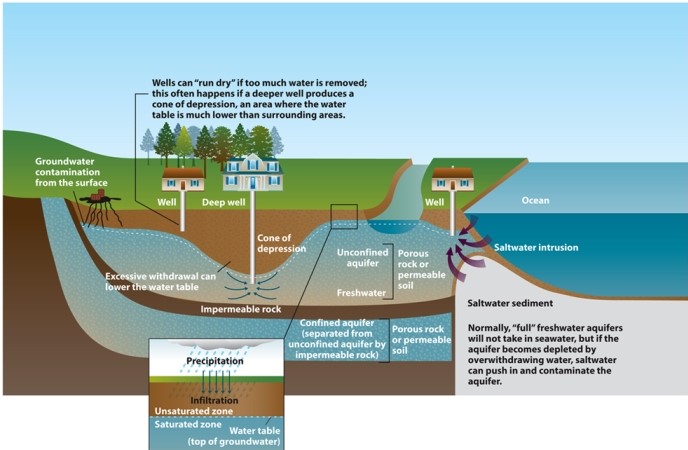
Refer to Infographic 14.4. Explain the relationships between the saturated and unsaturated zones, precipitation and infiltration, and the water table.
Refer to Infographic 14.4. Explain the relationships between the saturated and unsaturated zones, precipitation and infiltration, and the water table.
Question
Question
Infographic 14.4.
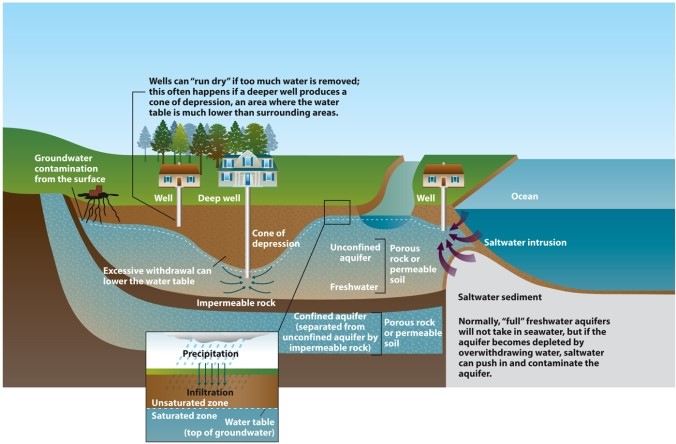
Refer to Infographic 14.4. Explain how the deeper well to the larger house affects the water supply to each of the smaller houses.
Refer to Infographic 14.4. Explain how the deeper well to the larger house affects the water supply to each of the smaller houses.
Question
Question
Question
Question
Question
Question
Question
Question
Question
Question
Question
Infographic 14.6.
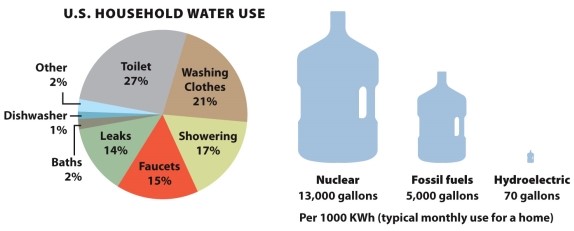
Refer to Infographic 14.6. Which of the following represents the largest single use of water in a typical U.S. household?
A) leaks
B) baths
C) showering
D) washing clothes
E) toilets
Refer to Infographic 14.6. Which of the following represents the largest single use of water in a typical U.S. household?
A) leaks
B) baths
C) showering
D) washing clothes
E) toilets
Question
Question
Infographic 14.4.
How did the Orange County Water District solve the problem of saltwater intrusion into unconfined coastal aquifers?
A) It built a dam to block the seepage of saltwater into the aquifers.
B) It stopped using those aquifers as public water supplies.
C) It installed desalination plants to purify the water coming out of the aquifers.
D) It began to pump highly treated sewage wastewater into infiltrated wells.
E) It built sea walls along coastal areas to keep out advancing waves.
How did the Orange County Water District solve the problem of saltwater intrusion into unconfined coastal aquifers?
A) It built a dam to block the seepage of saltwater into the aquifers.
B) It stopped using those aquifers as public water supplies.
C) It installed desalination plants to purify the water coming out of the aquifers.
D) It began to pump highly treated sewage wastewater into infiltrated wells.
E) It built sea walls along coastal areas to keep out advancing waves.
Question
Question
Question
Question
Question
Question
Question
Question
Question
Question
Table 14.1.
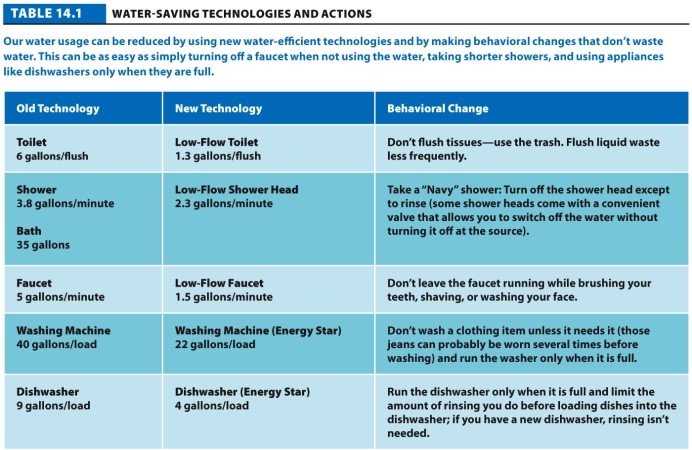
Refer to Table 14.1. List two conservation strategies that individuals can use to reduce their water use, and provide examples. Why are small changes important?
Refer to Table 14.1. List two conservation strategies that individuals can use to reduce their water use, and provide examples. Why are small changes important?
Question
Table 14.1.
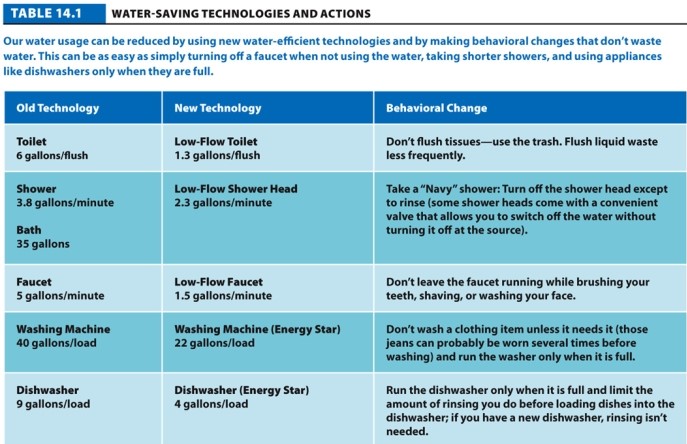
Refer to Table 14.1. Explain how using less energy saves water.
Refer to Table 14.1. Explain how using less energy saves water.
Question

Unlock Deck
Sign up to unlock the cards in this deck!
Unlock Deck
Unlock Deck
1/71

Play

Full screen (f)
Deck 14: Freshwater Resources- Toilet to Tap: a California County Is Employing a Controversial Method to - Supply Drinking Water
1
Infographic 14.2.
Why is deforestation a problem in regards to the Earth's freshwater supply?
Why is deforestation a problem in regards to the Earth's freshwater supply?
Deforestation cuts down acres and acres of trees and other plants. As we know from the water cycle, plants, especially large trees, take up water from underground reserves (transpiration) and release it back into the atmosphere (evaporation). If these plants were no longer present and able to do this process, the water cycle would be broken and less freshwater would fall from the clouds to the Earth's surface, resulting in lower ground water supplies in more areas.
2
Which of the following continents has the greatest water scarcity?
A) North America
B) South America
C) Africa
D) Antarctica
E) Europe
A) North America
B) South America
C) Africa
D) Antarctica
E) Europe
Africa
3
The action by which plant roots pull water from the soil and then release some of it into the atmosphere is known as _______________.
A) evaporation
B) transpiration
C) evapotranspiration
D) infiltration
E) condensation
A) evaporation
B) transpiration
C) evapotranspiration
D) infiltration
E) condensation
transpiration
4
Not having access to enough clean water supplies is known as _______________.
A) drought
B) freshwater debt
C) groundwater depletion
D) water scarcity
E) none of these answers
A) drought
B) freshwater debt
C) groundwater depletion
D) water scarcity
E) none of these answers
Unlock Deck
Unlock for access to all 71 flashcards in this deck.
Unlock Deck
k this deck
5
Which of the following lists the path of water correctly?
A) surface -> soil -> water table -> aquifer
B) surface -> saturated zone -> soil -> aquifer -> water table
C) surface -> water table -> soil
D) lake -> soil -> aquifer -> water table
E) infiltration -> soil -> aquifer -> water table
A) surface -> soil -> water table -> aquifer
B) surface -> saturated zone -> soil -> aquifer -> water table
C) surface -> water table -> soil
D) lake -> soil -> aquifer -> water table
E) infiltration -> soil -> aquifer -> water table
Unlock Deck
Unlock for access to all 71 flashcards in this deck.
Unlock Deck
k this deck
6
Which statement about water use is incorrect?
A) The World Health Organization estimates that one in three people lack sufficient access to clean water.
B) As the population increases, water scarcity and sanitation issues will also increase.
C) Because of their unsustainable practices, per capita water use in developing countries is far greater than in developed nations.
D) In some areas of the world, there is enough water, but people do not have enough money to purchase or dig wells to access it.
E) Middle Eastern nations are among the most water-stressed countries in the world.
A) The World Health Organization estimates that one in three people lack sufficient access to clean water.
B) As the population increases, water scarcity and sanitation issues will also increase.
C) Because of their unsustainable practices, per capita water use in developing countries is far greater than in developed nations.
D) In some areas of the world, there is enough water, but people do not have enough money to purchase or dig wells to access it.
E) Middle Eastern nations are among the most water-stressed countries in the world.
Unlock Deck
Unlock for access to all 71 flashcards in this deck.
Unlock Deck
k this deck
7
Infographic 14.1.
Refer to Infographic 14.1. Which of the following contains the most surface freshwater?
A) groundwater
B) glaciers and ice caps
C) soil moisture
D) rivers
E) lakes
Refer to Infographic 14.1. Which of the following contains the most surface freshwater?
A) groundwater
B) glaciers and ice caps
C) soil moisture
D) rivers
E) lakes
Unlock Deck
Unlock for access to all 71 flashcards in this deck.
Unlock Deck
k this deck
8
Which of the following contribute to the formation of precipitation?
A) cold air in the upper atmosphere
B) solar energy
C) the movement of groundwater
D) evaporation
E) all of these answers
A) cold air in the upper atmosphere
B) solar energy
C) the movement of groundwater
D) evaporation
E) all of these answers
Unlock Deck
Unlock for access to all 71 flashcards in this deck.
Unlock Deck
k this deck
9
Of all the freshwater on the Earth, approximately ________________ is trapped as ice.
A) 10%
B) 80%
C) 50%
D) 8%
E) 60%
A) 10%
B) 80%
C) 50%
D) 8%
E) 60%
Unlock Deck
Unlock for access to all 71 flashcards in this deck.
Unlock Deck
k this deck
10
Which practice requires the greatest amount of water input?
A) flushing the toilet
B) taking a shower
C) making a cotton T-shirt
D) washing dishes
E) producing 1 pound of beef
A) flushing the toilet
B) taking a shower
C) making a cotton T-shirt
D) washing dishes
E) producing 1 pound of beef
Unlock Deck
Unlock for access to all 71 flashcards in this deck.
Unlock Deck
k this deck
11
Desalination, the process that removes ________________ from water, is _______________.
A) bacteria; cheap
B) salt and other minerals; expensive
C) pollution; a biomimicry process
D) sewage; mandated by the federal government
E) organic matter; facilitated by reverse osmosis
A) bacteria; cheap
B) salt and other minerals; expensive
C) pollution; a biomimicry process
D) sewage; mandated by the federal government
E) organic matter; facilitated by reverse osmosis
Unlock Deck
Unlock for access to all 71 flashcards in this deck.
Unlock Deck
k this deck
12
Infographic 14.2.
Refer to Infographic 14.2. Explain the steps and processes in the water cycle as water moves from the ocean to the atmosphere to land and back to the ocean.
Refer to Infographic 14.2. Explain the steps and processes in the water cycle as water moves from the ocean to the atmosphere to land and back to the ocean.
Unlock Deck
Unlock for access to all 71 flashcards in this deck.
Unlock Deck
k this deck
13
Out of all of the water on Earth, how much is usable by humans?
A) 50%
B) 10%
C) 5%
D) 1%
E) less than 1%
A) 50%
B) 10%
C) 5%
D) 1%
E) less than 1%
Unlock Deck
Unlock for access to all 71 flashcards in this deck.
Unlock Deck
k this deck
14
Infographic 14.2.
Refer to Infographic 14.2. Explain how salty ocean water can be recycled to become usable freshwater.
Refer to Infographic 14.2. Explain how salty ocean water can be recycled to become usable freshwater.
Unlock Deck
Unlock for access to all 71 flashcards in this deck.
Unlock Deck
k this deck
15
Water that has a low level of dissolved ions in it can be found in ____________.
A) glaciers
B) streams
C) lakes
D) groundwater
E) all of these answers
A) glaciers
B) streams
C) lakes
D) groundwater
E) all of these answers
Unlock Deck
Unlock for access to all 71 flashcards in this deck.
Unlock Deck
k this deck
16
Gravity "powers" all of the following processes of the hydrological cycle except ________________.
A) runoff
B) infiltration
C) precipitation
D) transpiration
E) all of these answers
A) runoff
B) infiltration
C) precipitation
D) transpiration
E) all of these answers
Unlock Deck
Unlock for access to all 71 flashcards in this deck.
Unlock Deck
k this deck
17
Our per capita use of water is known as our ________________.
A) water footprint
B) ecological footprint
C) water scarcity
D) aquifer
E) ecosystem service
A) water footprint
B) ecological footprint
C) water scarcity
D) aquifer
E) ecosystem service
Unlock Deck
Unlock for access to all 71 flashcards in this deck.
Unlock Deck
k this deck
18
The largest potential source of freshwater is found in ________________.
A) groundwater
B) lakes
C) oceans
D) polar ice caps and glaciers
E) rivers
A) groundwater
B) lakes
C) oceans
D) polar ice caps and glaciers
E) rivers
Unlock Deck
Unlock for access to all 71 flashcards in this deck.
Unlock Deck
k this deck
19
Infographic 14.1.
Refer to Infographic 14.1. Even though the planet is 75% water, only _________ of this water is freshwater.
A) 10%
B) 20%
C) less than 1/100th of 1%
D) 3%
E) 5%
Refer to Infographic 14.1. Even though the planet is 75% water, only _________ of this water is freshwater.
A) 10%
B) 20%
C) less than 1/100th of 1%
D) 3%
E) 5%
Unlock Deck
Unlock for access to all 71 flashcards in this deck.
Unlock Deck
k this deck
20
In the southwestern United States, the use of water is approaching or exceeding sustainable limits. This is a good example of _______________.
A) economic water scarcity
B) physical water scarcity
C) inadequate sanitation
D) all of these answers
E) none of these answers
A) economic water scarcity
B) physical water scarcity
C) inadequate sanitation
D) all of these answers
E) none of these answers
Unlock Deck
Unlock for access to all 71 flashcards in this deck.
Unlock Deck
k this deck
21
What are some potential impacts of global warming on aquifers?
Unlock Deck
Unlock for access to all 71 flashcards in this deck.
Unlock Deck
k this deck
22
How might global warming and climate change affect water scarcity in the future?
Unlock Deck
Unlock for access to all 71 flashcards in this deck.
Unlock Deck
k this deck
23
Predict whether the water table would be higher or lower in New Mexico at the height of summer.
A) higher
B) lower
A) higher
B) lower
Unlock Deck
Unlock for access to all 71 flashcards in this deck.
Unlock Deck
k this deck
24
Groundwater in aquifers is naturally replenished by _____________.
A) runoff
B) transpiration
C) infiltration
D) seepage from sewers
E) evaporation
A) runoff
B) transpiration
C) infiltration
D) seepage from sewers
E) evaporation
Unlock Deck
Unlock for access to all 71 flashcards in this deck.
Unlock Deck
k this deck
25
What is an aquifer?
A) when saltwater intrudes on freshwater supplies
B) a species of conifer that can live underwater
C) an underground region of permeable soil or rock saturated with water
D) the very top region of an underground water reservoir
E) a manmade underground water reservoir system
A) when saltwater intrudes on freshwater supplies
B) a species of conifer that can live underwater
C) an underground region of permeable soil or rock saturated with water
D) the very top region of an underground water reservoir
E) a manmade underground water reservoir system
Unlock Deck
Unlock for access to all 71 flashcards in this deck.
Unlock Deck
k this deck
26
What is one way you can help protect, or advise others in order to protect, your local aquifer?
Unlock Deck
Unlock for access to all 71 flashcards in this deck.
Unlock Deck
k this deck
27
What is a consequence of too much water being removed from an aquifer?
A) saltwater intrusion
B) dry wells
C) cones of depression
D) lowered water table levels
E) all of these answers
A) saltwater intrusion
B) dry wells
C) cones of depression
D) lowered water table levels
E) all of these answers
Unlock Deck
Unlock for access to all 71 flashcards in this deck.
Unlock Deck
k this deck
28
Which of the following is the closest to the World Health Organization's estimates for those without access to clean water?
A) 10%
B) 18%
C) 33%
D) 53%
E) none of these answers
A) 10%
B) 18%
C) 33%
D) 53%
E) none of these answers
Unlock Deck
Unlock for access to all 71 flashcards in this deck.
Unlock Deck
k this deck
29
What happens when the water table drops below sea level in aquifers near the ocean?
A) saltwater intrusion
B) seawater conversion to freshwater
C) freshwater intrusion
D) contamination of the entire aquifer with saltwater
E) There is no consequence to this.
A) saltwater intrusion
B) seawater conversion to freshwater
C) freshwater intrusion
D) contamination of the entire aquifer with saltwater
E) There is no consequence to this.
Unlock Deck
Unlock for access to all 71 flashcards in this deck.
Unlock Deck
k this deck
30
Problems associated with poor sanitation include _______________.
A) disease transmission
B) exposure to toxins
C) dehydration
D) premature death
E) all of these answers
A) disease transmission
B) exposure to toxins
C) dehydration
D) premature death
E) all of these answers
Unlock Deck
Unlock for access to all 71 flashcards in this deck.
Unlock Deck
k this deck
31
What is the most likely reason that more communities do not use the potable water stored in confined aquifers?
A) It is usually contaminated with salt water.
B) It is impossible to access.
C) Bacteria are not filtered out of this water.
D) It is too expensive to reach and pump out.
E) Most aquifers are unconfined.
A) It is usually contaminated with salt water.
B) It is impossible to access.
C) Bacteria are not filtered out of this water.
D) It is too expensive to reach and pump out.
E) Most aquifers are unconfined.
Unlock Deck
Unlock for access to all 71 flashcards in this deck.
Unlock Deck
k this deck
32
Water scarcity can lead to _______________.
A) a short life span
B) malnutrition
C) conflict over water rights
D) cultural turmoil
E) all of these answers
A) a short life span
B) malnutrition
C) conflict over water rights
D) cultural turmoil
E) all of these answers
Unlock Deck
Unlock for access to all 71 flashcards in this deck.
Unlock Deck
k this deck
33
An aquifer that is separated by impermeable rock is called a(n) _____________ aquifer.
A) confined
B) unconfirmed
C) confirmed
D) unconfined
E) nonporous
A) confined
B) unconfirmed
C) confirmed
D) unconfined
E) nonporous
Unlock Deck
Unlock for access to all 71 flashcards in this deck.
Unlock Deck
k this deck
34
Which of the following countries has the greatest water footprint?
A) United States
B) Saudi Arabia
C) Sudan
D) Mexico
E) India
A) United States
B) Saudi Arabia
C) Sudan
D) Mexico
E) India
Unlock Deck
Unlock for access to all 71 flashcards in this deck.
Unlock Deck
k this deck
35
Compare and contrast physical and economic water scarcity. How might solutions to water scarcity differ for these two causes?
Unlock Deck
Unlock for access to all 71 flashcards in this deck.
Unlock Deck
k this deck
36
Which of the following countries has the highest Water Stress Index?
A) Iran
B) Iraq
C) India
D) Saudi Arabia
E) Pakistan
A) Iran
B) Iraq
C) India
D) Saudi Arabia
E) Pakistan
Unlock Deck
Unlock for access to all 71 flashcards in this deck.
Unlock Deck
k this deck
37
Which of the following would reduce the amount of infiltration of water into an aquifer?
A) paved roads
B) monoculture lawns
C) cement driveways
D) buildings
E) all of these answers
A) paved roads
B) monoculture lawns
C) cement driveways
D) buildings
E) all of these answers
Unlock Deck
Unlock for access to all 71 flashcards in this deck.
Unlock Deck
k this deck
38
The top of the rain-saturated region that may rise or fall seasonally is called the _____________.
A) unconfined aquifer
B) confined aquifer
C) water table
D) infiltrator
E) porous rock
A) unconfined aquifer
B) confined aquifer
C) water table
D) infiltrator
E) porous rock
Unlock Deck
Unlock for access to all 71 flashcards in this deck.
Unlock Deck
k this deck
39
What is one important quality of an aquifer?
A) Bacteria and other contaminants are filtered out of the water by rocks and soil.
B) The water supply is replenished through infiltration of rain and snowmelt.
C) It is a source of potable water.
D) Individual homes can access the water supply by digging wells into the aquifer.
E) All of these answers are important qualities of aquifers.
A) Bacteria and other contaminants are filtered out of the water by rocks and soil.
B) The water supply is replenished through infiltration of rain and snowmelt.
C) It is a source of potable water.
D) Individual homes can access the water supply by digging wells into the aquifer.
E) All of these answers are important qualities of aquifers.
Unlock Deck
Unlock for access to all 71 flashcards in this deck.
Unlock Deck
k this deck
40
Which of the following areas has the lowest percentage of population with access to improved sanitation?
A) rural Latin America
B) urban East Asia
C) rural sub-Saharan Africa
D) urban South-Central Asia
E) none of these answers
A) rural Latin America
B) urban East Asia
C) rural sub-Saharan Africa
D) urban South-Central Asia
E) none of these answers
Unlock Deck
Unlock for access to all 71 flashcards in this deck.
Unlock Deck
k this deck
41
How much less water do newer Energy Star washing machines use compared with older models?
A) 10%
B) 25%
C) 50%
D) 75%
E) 90%
A) 10%
B) 25%
C) 50%
D) 75%
E) 90%
Unlock Deck
Unlock for access to all 71 flashcards in this deck.
Unlock Deck
k this deck
42
While dams are important, they lose large amounts of water every day due to _____________.
A) infiltration
B) evaporation
C) runoff
D) transpiration
E) all of these answers
A) infiltration
B) evaporation
C) runoff
D) transpiration
E) all of these answers
Unlock Deck
Unlock for access to all 71 flashcards in this deck.
Unlock Deck
k this deck
43
Coliform bacteria indicate the contamination of a water body with ____________.
A) viruses
B) sediments
C) dioxane
D) fecal material
E) none of these answers
A) viruses
B) sediments
C) dioxane
D) fecal material
E) none of these answers
Unlock Deck
Unlock for access to all 71 flashcards in this deck.
Unlock Deck
k this deck
44
Infographic 14.4.
Refer to Infographic 14.4. Explain the relationships between the saturated and unsaturated zones, precipitation and infiltration, and the water table.
Refer to Infographic 14.4. Explain the relationships between the saturated and unsaturated zones, precipitation and infiltration, and the water table.
Unlock Deck
Unlock for access to all 71 flashcards in this deck.
Unlock Deck
k this deck
45
When treatment marshes are used by sewage treatment facilities to treat wastewater, the treatment marsh is acting as a form of ____________ treatment.
A) primary
B) secondary
C) tertiary
D) potable
E) clarifier
A) primary
B) secondary
C) tertiary
D) potable
E) clarifier
Unlock Deck
Unlock for access to all 71 flashcards in this deck.
Unlock Deck
k this deck
46
Infographic 14.4.
Refer to Infographic 14.4. Explain how the deeper well to the larger house affects the water supply to each of the smaller houses.
Refer to Infographic 14.4. Explain how the deeper well to the larger house affects the water supply to each of the smaller houses.
Unlock Deck
Unlock for access to all 71 flashcards in this deck.
Unlock Deck
k this deck
47
__________ treatment is a physical process that removes large particles with a screen.
A) Primary
B) Secondary
C) Tertiary
D) Potable
E) Clarifier
A) Primary
B) Secondary
C) Tertiary
D) Potable
E) Clarifier
Unlock Deck
Unlock for access to all 71 flashcards in this deck.
Unlock Deck
k this deck
48
What could be some of the potential problems using wastewater treatment plants that mimic nature in colder environments?
Unlock Deck
Unlock for access to all 71 flashcards in this deck.
Unlock Deck
k this deck
49
To ensure an ongoing water source, communities construct _____________, which in turn create ______________.
A) wetland sewage filtration systems; reservoirs
B) reservoirs; aquifers
C) dams; reservoirs
D) water tables; aquifers
E) reverse osmosis plants; dams
A) wetland sewage filtration systems; reservoirs
B) reservoirs; aquifers
C) dams; reservoirs
D) water tables; aquifers
E) reverse osmosis plants; dams
Unlock Deck
Unlock for access to all 71 flashcards in this deck.
Unlock Deck
k this deck
50
Wetland filtration systems differ from traditional high-tech filtration systems in that _____________.
A) they create water that is not potable
B) they depend on nature to help purify sewage
C) they require a higher energy input than high-tech methods
D) none of these answers
E) both a and b
A) they create water that is not potable
B) they depend on nature to help purify sewage
C) they require a higher energy input than high-tech methods
D) none of these answers
E) both a and b
Unlock Deck
Unlock for access to all 71 flashcards in this deck.
Unlock Deck
k this deck
51
How do traditional wastewater treatment plants differ from wastewater treatment plants that mimic nature?
Unlock Deck
Unlock for access to all 71 flashcards in this deck.
Unlock Deck
k this deck
52
To make wastewater ___________, or clean enough for consumption, it is put through a process called reverse osmosis.
A) sanitary
B) desalinated
C) effluent
D) intrusive
E) potable
A) sanitary
B) desalinated
C) effluent
D) intrusive
E) potable
Unlock Deck
Unlock for access to all 71 flashcards in this deck.
Unlock Deck
k this deck
53
Why are two sets of marshes used in the Arcata wetland sewage treatment system?
Unlock Deck
Unlock for access to all 71 flashcards in this deck.
Unlock Deck
k this deck
54
Final treatment of wastewater in the United States normally involves treatment with ___________ to make it safe.
A) alcohol
B) radon
C) nitrogen
D) antibiotics
E) chlorine
A) alcohol
B) radon
C) nitrogen
D) antibiotics
E) chlorine
Unlock Deck
Unlock for access to all 71 flashcards in this deck.
Unlock Deck
k this deck
55
Which of the water projects discussed in this chapter was designed to produce potable water?
A) Arcata
B) Orange County
C) Three Gorges Dam
D) both a and b
E) none of these answers
A) Arcata
B) Orange County
C) Three Gorges Dam
D) both a and b
E) none of these answers
Unlock Deck
Unlock for access to all 71 flashcards in this deck.
Unlock Deck
k this deck
56
_____________ treatment is a biological process that uses microorganisms to break down organic matter.
A) Primary
B) Secondary
C) Tertiary
D) Potable
E) Clarifier
A) Primary
B) Secondary
C) Tertiary
D) Potable
E) Clarifier
Unlock Deck
Unlock for access to all 71 flashcards in this deck.
Unlock Deck
k this deck
57
Infographic 14.6.
Refer to Infographic 14.6. Which of the following represents the largest single use of water in a typical U.S. household?
A) leaks
B) baths
C) showering
D) washing clothes
E) toilets
Refer to Infographic 14.6. Which of the following represents the largest single use of water in a typical U.S. household?
A) leaks
B) baths
C) showering
D) washing clothes
E) toilets
Unlock Deck
Unlock for access to all 71 flashcards in this deck.
Unlock Deck
k this deck
58
One of the first steps in the Orange County project for cleaning up water supplies relied upon _______________.
A) wetlands
B) microfiltration
C) reverse osmosis
D) UV exposure
E) none of these answers
A) wetlands
B) microfiltration
C) reverse osmosis
D) UV exposure
E) none of these answers
Unlock Deck
Unlock for access to all 71 flashcards in this deck.
Unlock Deck
k this deck
59
Infographic 14.4.
How did the Orange County Water District solve the problem of saltwater intrusion into unconfined coastal aquifers?
A) It built a dam to block the seepage of saltwater into the aquifers.
B) It stopped using those aquifers as public water supplies.
C) It installed desalination plants to purify the water coming out of the aquifers.
D) It began to pump highly treated sewage wastewater into infiltrated wells.
E) It built sea walls along coastal areas to keep out advancing waves.
How did the Orange County Water District solve the problem of saltwater intrusion into unconfined coastal aquifers?
A) It built a dam to block the seepage of saltwater into the aquifers.
B) It stopped using those aquifers as public water supplies.
C) It installed desalination plants to purify the water coming out of the aquifers.
D) It began to pump highly treated sewage wastewater into infiltrated wells.
E) It built sea walls along coastal areas to keep out advancing waves.
Unlock Deck
Unlock for access to all 71 flashcards in this deck.
Unlock Deck
k this deck
60
One of the ways wastewater in Orange County is treated is by using reverse osmosis, UV light, and hydrogen peroxide. What does each process do in the treatment of wastewater?
Unlock Deck
Unlock for access to all 71 flashcards in this deck.
Unlock Deck
k this deck
61
Switching to water-saving irrigation methods not only saves water but also _______________.
A) limits water loss to evaporation
B) reduces runoff
C) protects surface water
D) prevents soil salinization
E) all of these answers
A) limits water loss to evaporation
B) reduces runoff
C) protects surface water
D) prevents soil salinization
E) all of these answers
Unlock Deck
Unlock for access to all 71 flashcards in this deck.
Unlock Deck
k this deck
62
Many countries have constructed dams and reservoirs as a method to solve water shortages. What are some of the problems associated with dams and reservoirs?
Unlock Deck
Unlock for access to all 71 flashcards in this deck.
Unlock Deck
k this deck
63
Your job is to help households improve water conservation. What are some of the recommendations you would make?
Unlock Deck
Unlock for access to all 71 flashcards in this deck.
Unlock Deck
k this deck
64
Which of the following is a cheap way to maintain water supplies?
A) not waste so much water
B) use water-saving irrigation methods
C) create groundwater replenishment systems
D) install high-tech water filtration systems
E) both A and B
A) not waste so much water
B) use water-saving irrigation methods
C) create groundwater replenishment systems
D) install high-tech water filtration systems
E) both A and B
Unlock Deck
Unlock for access to all 71 flashcards in this deck.
Unlock Deck
k this deck
65
Explain how the choice of crops or ornamental plants to plant can help conserve waters.
Unlock Deck
Unlock for access to all 71 flashcards in this deck.
Unlock Deck
k this deck
66
In January 2008, Orange County implemented the Groundwater Replenishment System that reclaimed water that normally would have been wasted as ____________.
A) evaporation
B) runoff
C) ocean
D) landfill
E) all of these answers
A) evaporation
B) runoff
C) ocean
D) landfill
E) all of these answers
Unlock Deck
Unlock for access to all 71 flashcards in this deck.
Unlock Deck
k this deck
67
Currently, several states are using recycled water for nonpotable uses, including _______________.
A) irrigating landscapes
B) irrigating crops
C) filling fountains
D) flushing toilets
E) all of these answers
A) irrigating landscapes
B) irrigating crops
C) filling fountains
D) flushing toilets
E) all of these answers
Unlock Deck
Unlock for access to all 71 flashcards in this deck.
Unlock Deck
k this deck
68
Which statement about recycled water projects is true?
A) Public perception of recycled water projects is, for the majority, negative.
B) Public perception of recycled water projects depends on how plagued a community is by water-scarcity issues.
C) When it comes to citizens understanding, the "toilet to tap" phrase is the best explanation of recycled water projects.
D) Most recycled water projects are unsuccessful.
E) A statewide survey in Arizona, a drought-stricken state, found that residents did not support recycled water projects.
A) Public perception of recycled water projects is, for the majority, negative.
B) Public perception of recycled water projects depends on how plagued a community is by water-scarcity issues.
C) When it comes to citizens understanding, the "toilet to tap" phrase is the best explanation of recycled water projects.
D) Most recycled water projects are unsuccessful.
E) A statewide survey in Arizona, a drought-stricken state, found that residents did not support recycled water projects.
Unlock Deck
Unlock for access to all 71 flashcards in this deck.
Unlock Deck
k this deck
69
Table 14.1.
Refer to Table 14.1. List two conservation strategies that individuals can use to reduce their water use, and provide examples. Why are small changes important?
Refer to Table 14.1. List two conservation strategies that individuals can use to reduce their water use, and provide examples. Why are small changes important?
Unlock Deck
Unlock for access to all 71 flashcards in this deck.
Unlock Deck
k this deck
70
Table 14.1.
Refer to Table 14.1. Explain how using less energy saves water.
Refer to Table 14.1. Explain how using less energy saves water.
Unlock Deck
Unlock for access to all 71 flashcards in this deck.
Unlock Deck
k this deck
71
Explain why it is cheaper to conserve water than it is to purify it or build a dam.
Unlock Deck
Unlock for access to all 71 flashcards in this deck.
Unlock Deck
k this deck
Unlock Deck
Unlock for access to all 71 flashcards in this deck.






