







 Chat with AI

Deck 16: Feeding the World - a Gene Revolution: Can Genetically Engineered Food Help End Hunger
Full screen (f)

Question

Question
Question
Question
Question
Question
Question
Question
Question
Question
Question
Question
Question
Question
Question
Question
Question
Question
Question
Question
Question
Question
Question
Question
Question
Question
Question
Question
Question
Question
Infographic 16.4. 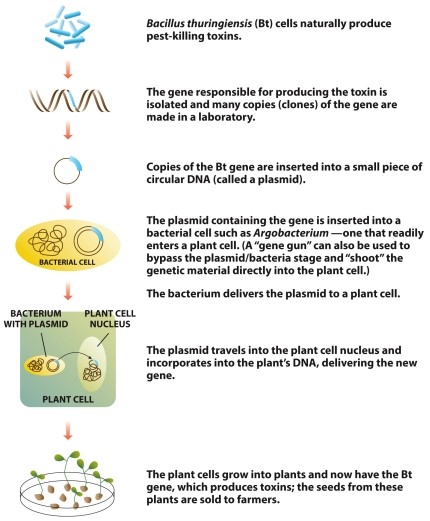
Refer to Infographic 16.4. Use the infographic to explain step by step how a gene from Bacillus thuringiensis (Bt) is inserted into a plant. In your own words, describe how this happens and how a bacterial gene can be beneficial to a plant.
Refer to Infographic 16.4. Use the infographic to explain step by step how a gene from Bacillus thuringiensis (Bt) is inserted into a plant. In your own words, describe how this happens and how a bacterial gene can be beneficial to a plant.
Question
Question
Question
Question
Question
Question
Question
Question
Question
Question
Question
Question
Question
Question
Question
Question
Question
Question
Question
Question
Question
Question
Question
Infographic 16.5.

Refer to Infographic 16.5. When looking at the advantages and disadvantages of using GMO crops as food sources, do you think the pros outweigh the cons? Now imagine if you were a member of a community in West Africa. Would your opinion about the value of GMO crops change?
Refer to Infographic 16.5. When looking at the advantages and disadvantages of using GMO crops as food sources, do you think the pros outweigh the cons? Now imagine if you were a member of a community in West Africa. Would your opinion about the value of GMO crops change?
Question
Question
Question

Unlock Deck
Sign up to unlock the cards in this deck!
Unlock Deck
Unlock Deck
1/56

Play

Full screen (f)
Deck 16: Feeding the World - a Gene Revolution: Can Genetically Engineered Food Help End Hunger
1
Why is 98% of the world's underfed population found in developing nations?
A) war
B) political unrest
C) inability to recover from natural disasters
D) lack of economic means to affect infrastructure solutions
E) all of these answers
A) war
B) political unrest
C) inability to recover from natural disasters
D) lack of economic means to affect infrastructure solutions
E) all of these answers
all of these answers
2
What caused the lack of food and resulting riots in 2008?
A) extreme weather events
B) the rising cost of oil
C) the growing demand for meat
D) increased production of biofuels
E) all of these answers likely contributed, with other factors as well
A) extreme weather events
B) the rising cost of oil
C) the growing demand for meat
D) increased production of biofuels
E) all of these answers likely contributed, with other factors as well
all of these answers likely contributed, with other factors as well
3
What is a con of high-yield varieties of crops introduced globally during the Green Revolution?
A) faster growth cycle
B) not as much grain production as traditional varieties
C) increased vulnerability to pests
D) genetically diverse
E) None of these answers are negative attributes of high-yield crops.
A) faster growth cycle
B) not as much grain production as traditional varieties
C) increased vulnerability to pests
D) genetically diverse
E) None of these answers are negative attributes of high-yield crops.
increased vulnerability to pests
4
What is a known problem associated with industrial agriculture?
A) greenhouse gas emission
B) water pollution
C) pesticide-resistant pests
D) the disappearance of local, small, family-owned farms
E) All are these answers known problems.
A) greenhouse gas emission
B) water pollution
C) pesticide-resistant pests
D) the disappearance of local, small, family-owned farms
E) All are these answers known problems.
Unlock Deck
Unlock for access to all 56 flashcards in this deck.
Unlock Deck
k this deck
5
Which scenario would be found in a population that is food secure?
A) The only local food source is many miles away.
B) Regardless of income, members of the community have access to high-quality food.
C) The highest quality and quantity of food is given to those in positions of power.
D) The cost of high-quality food is prohibitive to many in the community.
E) The lowest grade of meat is sold only in stores in lower-income neighborhoods.
A) The only local food source is many miles away.
B) Regardless of income, members of the community have access to high-quality food.
C) The highest quality and quantity of food is given to those in positions of power.
D) The cost of high-quality food is prohibitive to many in the community.
E) The lowest grade of meat is sold only in stores in lower-income neighborhoods.
Unlock Deck
Unlock for access to all 56 flashcards in this deck.
Unlock Deck
k this deck
6
How did subsidies for American farmers contribute to the level of food security in some African countries?
A) American farmers were able to produce vast quantities of food and sell it cheaply. This outcompeted local African farms selling the same products. To compensate, the African farms switched to cash crops and ultimately made their country dependent on foreign food supplies, decreasing their food security.
B) Since American farmers were able to produce vast quantities of food and sell it cheaply, this allowed African farmers to grow cash crops and thus bring more economic stability to the community as a whole, increasing their food security.
C) American farmers were able to take advantage of the subsidies and produce more food, which made America less dependent on food supplies imported from African farmers. Since the African farmers were unable to sell their crops, the farms failed and decreased their community's level of food security.
D) Subsidies on American farms decreased the amount of crops that could economically be harvested. This decreased the overall world supply of food and resulted in African countries being unable to import enough food to feed their communities, thus decreasing their food security.
E) American farm subsidies did not have any effect, positive or negative, on food security in African countries.
A) American farmers were able to produce vast quantities of food and sell it cheaply. This outcompeted local African farms selling the same products. To compensate, the African farms switched to cash crops and ultimately made their country dependent on foreign food supplies, decreasing their food security.
B) Since American farmers were able to produce vast quantities of food and sell it cheaply, this allowed African farmers to grow cash crops and thus bring more economic stability to the community as a whole, increasing their food security.
C) American farmers were able to take advantage of the subsidies and produce more food, which made America less dependent on food supplies imported from African farmers. Since the African farmers were unable to sell their crops, the farms failed and decreased their community's level of food security.
D) Subsidies on American farms decreased the amount of crops that could economically be harvested. This decreased the overall world supply of food and resulted in African countries being unable to import enough food to feed their communities, thus decreasing their food security.
E) American farm subsidies did not have any effect, positive or negative, on food security in African countries.
Unlock Deck
Unlock for access to all 56 flashcards in this deck.
Unlock Deck
k this deck
7
Which of the following choices was NOT introduced with the Green Revolution?
A) chemical pesticides
B) sophisticated irrigation systems
C) synthetic nitrogen fertilizer
D) high-yield variety crops
E) organic farming techniques
A) chemical pesticides
B) sophisticated irrigation systems
C) synthetic nitrogen fertilizer
D) high-yield variety crops
E) organic farming techniques
Unlock Deck
Unlock for access to all 56 flashcards in this deck.
Unlock Deck
k this deck
8
How might the recent Ebola outbreaks in Africa affect the food security of affected countries?
Unlock Deck
Unlock for access to all 56 flashcards in this deck.
Unlock Deck
k this deck
9
What is a pro of high-yield varieties of crops introduced globally during the Green Revolution?
A) more grain produced
B) less nitrogen required
C) less mechanical dependence to harvest crops
D) environmentally friendly
E) None of these answers are beneficial attributes of high-yield crops.
A) more grain produced
B) less nitrogen required
C) less mechanical dependence to harvest crops
D) environmentally friendly
E) None of these answers are beneficial attributes of high-yield crops.
Unlock Deck
Unlock for access to all 56 flashcards in this deck.
Unlock Deck
k this deck
10
Efforts from the Green Revolution resulted in enough food to feed every human on Earth.
Unlock Deck
Unlock for access to all 56 flashcards in this deck.
Unlock Deck
k this deck
11
A person who eats 5,000 calories a day can be malnourished.
Unlock Deck
Unlock for access to all 56 flashcards in this deck.
Unlock Deck
k this deck
12
What is obesity and type 2 diabetes typically the result of?
A) food insecurity
B) kwashiorkor
C) vitamin deficiencies
D) wasting
E) malnutrition
A) food insecurity
B) kwashiorkor
C) vitamin deficiencies
D) wasting
E) malnutrition
Unlock Deck
Unlock for access to all 56 flashcards in this deck.
Unlock Deck
k this deck
13
Many factors can contribute to the inability of a country to be food self-sufficient. Which of the following choices is NOT one of those factors?
A) the use of high-yield crop varieties
B) armed conflict
C) degraded land
D) natural disasters
E) poor food distribution
A) the use of high-yield crop varieties
B) armed conflict
C) degraded land
D) natural disasters
E) poor food distribution
Unlock Deck
Unlock for access to all 56 flashcards in this deck.
Unlock Deck
k this deck
14
The coordinated global effort to eliminate hunger by improving crop performance using modern agricultural technologies in developing countries is called _______.
A) organic farming
B) the Green Revolution
C) eutrophication
D) the Food Act
E) None of these answers fits the description.
A) organic farming
B) the Green Revolution
C) eutrophication
D) the Food Act
E) None of these answers fits the description.
Unlock Deck
Unlock for access to all 56 flashcards in this deck.
Unlock Deck
k this deck
15
Choose the correct pairing of nutrient deficiency with its resulting disease.
A) vitamin B₁₂ deficiency: anemia
B) vitamin A deficiency: kwashiorkor
C) iron deficiency: blindness
D) kwashiorkor: marasmus
E) vitamin C deficiency: marasmus
A) vitamin B₁₂ deficiency: anemia
B) vitamin A deficiency: kwashiorkor
C) iron deficiency: blindness
D) kwashiorkor: marasmus
E) vitamin C deficiency: marasmus
Unlock Deck
Unlock for access to all 56 flashcards in this deck.
Unlock Deck
k this deck
16
According to the United Nations Food and Agriculture Organization, the world produces enough food to feed everyone more than _________ calories a day.
A) 500
B) 1,800
C) 2,000
D) 2,800
E) There is still not enough food to feed everyone.
A) 500
B) 1,800
C) 2,000
D) 2,800
E) There is still not enough food to feed everyone.
Unlock Deck
Unlock for access to all 56 flashcards in this deck.
Unlock Deck
k this deck
17
Efforts from the Green Revolution resulted in every human on Earth being fed a life-sustaining diet.
Unlock Deck
Unlock for access to all 56 flashcards in this deck.
Unlock Deck
k this deck
18
What percentage of the global population is undernourished?
A) 2%, 140 million people
B) 8%, 561 million people
C) 12%, 842 million people
D) 19%, 1.3 billion people
E) 23%, 1.6 billion people
A) 2%, 140 million people
B) 8%, 561 million people
C) 12%, 842 million people
D) 19%, 1.3 billion people
E) 23%, 1.6 billion people
Unlock Deck
Unlock for access to all 56 flashcards in this deck.
Unlock Deck
k this deck
19
What is the relationship between the Green Revolution and industrial agriculture?
A) The Green Revolution focuses on sustainable, organic farming methods while industrial agriculture focuses on chemicals and technology.
B) The Green Revolution increased food production in less developed nations while industrial agriculture increased food production in more developed nations.
C) The Green Revolution focuses only on naturally available crops while industrial agriculture focuses on high-yield varieties of crops.
D) The Green Revolution took practices from industrial agriculture-like pesticide use, irrigation technologies, and high-yield crops-and brought them to developing nations like China and India.
E) The Green Revolution focuses on small-scale, family-owned farms while industrial agriculture focuses on multi-farm corporate companies.
A) The Green Revolution focuses on sustainable, organic farming methods while industrial agriculture focuses on chemicals and technology.
B) The Green Revolution increased food production in less developed nations while industrial agriculture increased food production in more developed nations.
C) The Green Revolution focuses only on naturally available crops while industrial agriculture focuses on high-yield varieties of crops.
D) The Green Revolution took practices from industrial agriculture-like pesticide use, irrigation technologies, and high-yield crops-and brought them to developing nations like China and India.
E) The Green Revolution focuses on small-scale, family-owned farms while industrial agriculture focuses on multi-farm corporate companies.
Unlock Deck
Unlock for access to all 56 flashcards in this deck.
Unlock Deck
k this deck
20
Even though it is counterintuitive, how can overnutrition, the consumption of too many calories, be a problem for people of lower economic means?
Unlock Deck
Unlock for access to all 56 flashcards in this deck.
Unlock Deck
k this deck
21
_________ are organisms that have had their genetic information modified in a way that does not occur naturally.
A) HMOs
B) PMOs
C) GMOs
D) AMOs
E) Hybrids
A) HMOs
B) PMOs
C) GMOs
D) AMOs
E) Hybrids
Unlock Deck
Unlock for access to all 56 flashcards in this deck.
Unlock Deck
k this deck
22
What was the Green Revolution, and was it successful? Discuss pros and cons of this approach on the environment.
Unlock Deck
Unlock for access to all 56 flashcards in this deck.
Unlock Deck
k this deck
23
A(n) _______ organism is one that contains genes from another species.
A) hybrid
B) transgenic
C) diploid
D) asexual
E) native
A) hybrid
B) transgenic
C) diploid
D) asexual
E) native
Unlock Deck
Unlock for access to all 56 flashcards in this deck.
Unlock Deck
k this deck
24
Which of the following is an INCORRECT statement regarding GMOs?
A) GMOs are patented by a few corporations and are generally expensive.
B) Certain countries have banned GMOs.
C) Some people are concerned about health impacts and environmental consequences that could be associated with GMOs.
D) GMOs have been exhaustively shown to not pose a threat to living organisms, including humans.
E) All of these answers are true statements about GMOs.
A) GMOs are patented by a few corporations and are generally expensive.
B) Certain countries have banned GMOs.
C) Some people are concerned about health impacts and environmental consequences that could be associated with GMOs.
D) GMOs have been exhaustively shown to not pose a threat to living organisms, including humans.
E) All of these answers are true statements about GMOs.
Unlock Deck
Unlock for access to all 56 flashcards in this deck.
Unlock Deck
k this deck
25
How could planting Bt corn lead to even more pesticide use?
A) Bt-resistant pests thrive when Bt-susceptible pests are no longer competition, so it takes more pesticide to get rid of them.
B) Bt corn doesn't actually produce Bt-it just means that the plants are Bt resistant-so farmers still have to use the pesticide to rid the corn of pests.
C) Bt corn repels beneficial insects, which usually kill all of the pests, so now farmers must use pesticide.
D) Bt corn actually depends on pesticide use to grow and survive.
E) Bt corn does not lead to more pesticide use, as the Bt toxin produced by the plant is sufficient to kill all natural pests.
A) Bt-resistant pests thrive when Bt-susceptible pests are no longer competition, so it takes more pesticide to get rid of them.
B) Bt corn doesn't actually produce Bt-it just means that the plants are Bt resistant-so farmers still have to use the pesticide to rid the corn of pests.
C) Bt corn repels beneficial insects, which usually kill all of the pests, so now farmers must use pesticide.
D) Bt corn actually depends on pesticide use to grow and survive.
E) Bt corn does not lead to more pesticide use, as the Bt toxin produced by the plant is sufficient to kill all natural pests.
Unlock Deck
Unlock for access to all 56 flashcards in this deck.
Unlock Deck
k this deck
26
Why is the decreased biodiversity of high-yield varieties of crops a concern?
Unlock Deck
Unlock for access to all 56 flashcards in this deck.
Unlock Deck
k this deck
27
In transgenic organisms, what step(s) would a gene gun replace?
A) isolation and replication of a desired gene
B) insertion of a desired gene into a plasmid
C) plasmid delivering a desired gene to the host nucleus
D) A, B, and C
E) B and C
A) isolation and replication of a desired gene
B) insertion of a desired gene into a plasmid
C) plasmid delivering a desired gene to the host nucleus
D) A, B, and C
E) B and C
Unlock Deck
Unlock for access to all 56 flashcards in this deck.
Unlock Deck
k this deck
28
By 2050, the human population is estimated to reach 10 billion. While the ability to produce food has risen with population growth so far, increasing production for another 3 billion humans poses a tremendous challenge. Discuss how the gene revolution will likely be part of the solution to meeting future food demands.
Unlock Deck
Unlock for access to all 56 flashcards in this deck.
Unlock Deck
k this deck
29
In making a transgenic organism, what is typically the role of the bacterium?
A) to donate the desired gene
B) to mutate and create the desired gene
C) to transport the desired gene
D) to express the desired gene
E) Bacteria are not involved in the creation of transgenic organisms.
A) to donate the desired gene
B) to mutate and create the desired gene
C) to transport the desired gene
D) to express the desired gene
E) Bacteria are not involved in the creation of transgenic organisms.
Unlock Deck
Unlock for access to all 56 flashcards in this deck.
Unlock Deck
k this deck
30
Infographic 16.4.
Refer to Infographic 16.4. Use the infographic to explain step by step how a gene from Bacillus thuringiensis (Bt) is inserted into a plant. In your own words, describe how this happens and how a bacterial gene can be beneficial to a plant.
Refer to Infographic 16.4. Use the infographic to explain step by step how a gene from Bacillus thuringiensis (Bt) is inserted into a plant. In your own words, describe how this happens and how a bacterial gene can be beneficial to a plant.
Unlock Deck
Unlock for access to all 56 flashcards in this deck.
Unlock Deck
k this deck
31
The Green Revolution 2.0 is __________________.
A) a movement that focuses on the production of genetically modified organisms to increase crop productivity
B) associated with feed conversion rates
C) a movement focused on recycling
D) a plant-breeding program that dramatically increased crop yields and led the way for mechanized, large-scale agriculture
E) a program used by modern farmers to spread the use of organic agriculture
A) a movement that focuses on the production of genetically modified organisms to increase crop productivity
B) associated with feed conversion rates
C) a movement focused on recycling
D) a plant-breeding program that dramatically increased crop yields and led the way for mechanized, large-scale agriculture
E) a program used by modern farmers to spread the use of organic agriculture
Unlock Deck
Unlock for access to all 56 flashcards in this deck.
Unlock Deck
k this deck
32
_______ is an(are) organism(s) or product(s) that contains genes from another species.
A) Transgenic organisms
B) Bt corn plants
C) Roundup tolerant cotton
D) Golden rice
E) all of these answers
A) Transgenic organisms
B) Bt corn plants
C) Roundup tolerant cotton
D) Golden rice
E) all of these answers
Unlock Deck
Unlock for access to all 56 flashcards in this deck.
Unlock Deck
k this deck
33
Giant ragweed and pigweed are examples of super weeds. These weeds have acquired the gene for _______, which makes them tolerant to all herbicides.
A) Wt
B) Bt
C) Ct
D) Ht
E) Pt
A) Wt
B) Bt
C) Ct
D) Ht
E) Pt
Unlock Deck
Unlock for access to all 56 flashcards in this deck.
Unlock Deck
k this deck
34
Describe how traditional selective breeding, where farmers attempt to produce offspring with valuable traits by breeding parents with those traits, is different from creating organisms with valuable traits using genetic engineering.
Unlock Deck
Unlock for access to all 56 flashcards in this deck.
Unlock Deck
k this deck
35
Given what you know about industrial agriculture and the Green Revolution, why is world hunger considered a "wicked problem"?
Unlock Deck
Unlock for access to all 56 flashcards in this deck.
Unlock Deck
k this deck
36
Which of the following is a TRUE statement?
A) In the United States, GMOs are limited to a few corn products.
B) GMOs will almost certainly be part of the solution to meeting future food demands as the global population swells.
C) GMOs are cheap and therefore a popular option for developing countries.
D) Since DNA is unique for each species, it is not possible to move genes from one species to another.
E) In the United States, less than 1% of processed foods contain GMOs.
A) In the United States, GMOs are limited to a few corn products.
B) GMOs will almost certainly be part of the solution to meeting future food demands as the global population swells.
C) GMOs are cheap and therefore a popular option for developing countries.
D) Since DNA is unique for each species, it is not possible to move genes from one species to another.
E) In the United States, less than 1% of processed foods contain GMOs.
Unlock Deck
Unlock for access to all 56 flashcards in this deck.
Unlock Deck
k this deck
37
When making a transgenic organism, where do the desired genes come from?
A) insects
B) bacteria
C) fish
D) corn
E) All of these answers are possible donors.
A) insects
B) bacteria
C) fish
D) corn
E) All of these answers are possible donors.
Unlock Deck
Unlock for access to all 56 flashcards in this deck.
Unlock Deck
k this deck
38
Genetic engineering involves the transfer of genes for desirable characteristics, including ___________.
A) drought resistance
B) pest resistance
C) increased nutrient production
D) herbicide tolerance
E) all of these answers
A) drought resistance
B) pest resistance
C) increased nutrient production
D) herbicide tolerance
E) all of these answers
Unlock Deck
Unlock for access to all 56 flashcards in this deck.
Unlock Deck
k this deck
39
__________ is the driving force behind the Green Revolution 2.0, or gene revolution.
A) Cross pollination
B) Cross breeding
C) Genetic engineering
D) Organic farming
E) Sustainable farming
A) Cross pollination
B) Cross breeding
C) Genetic engineering
D) Organic farming
E) Sustainable farming
Unlock Deck
Unlock for access to all 56 flashcards in this deck.
Unlock Deck
k this deck
40
What are some potential drawbacks of using pest-resistant crops?
A) water pollution
B) the creation of pest-resistant weeds
C) the creation of pesticide-resistant pests
D) the repelling of beneficial insects
E) All of these answers are potential drawbacks of using pest-resistant crops.
A) water pollution
B) the creation of pest-resistant weeds
C) the creation of pesticide-resistant pests
D) the repelling of beneficial insects
E) All of these answers are potential drawbacks of using pest-resistant crops.
Unlock Deck
Unlock for access to all 56 flashcards in this deck.
Unlock Deck
k this deck
41
Why are low-tech farming methods more accessible to women farmers?
Unlock Deck
Unlock for access to all 56 flashcards in this deck.
Unlock Deck
k this deck
42
Do GMOs raise or lower the overall crop biodiversity?
A) raise
B) lower
C) Biodiversity remains the same.
A) raise
B) lower
C) Biodiversity remains the same.
Unlock Deck
Unlock for access to all 56 flashcards in this deck.
Unlock Deck
k this deck
43
Like the Green Revolution, low-tech farming methods in Africa have:
A) revolutionized the way people farm all over the world.
B) increased grain production in less developed communities.
C) introduced the use of GMOs and industrial agriculture methods.
D) decreased the cost of farming for the typical farmer.
E) led to a decrease in environmental problems caused by farming.
A) revolutionized the way people farm all over the world.
B) increased grain production in less developed communities.
C) introduced the use of GMOs and industrial agriculture methods.
D) decreased the cost of farming for the typical farmer.
E) led to a decrease in environmental problems caused by farming.
Unlock Deck
Unlock for access to all 56 flashcards in this deck.
Unlock Deck
k this deck
44
What is the process of microfertilization?
A) the specific fertilization of microbes that provide nutrients to growing plants
B) the application of a small amount of fertilizer to the area directly around the seed
C) the use of only natural, non-synthetic fertilizers
D) the intentional overuse of fertilizer to prepare the soil for next year's planting
E) the use of GM organic matter that enhances plant growth
A) the specific fertilization of microbes that provide nutrients to growing plants
B) the application of a small amount of fertilizer to the area directly around the seed
C) the use of only natural, non-synthetic fertilizers
D) the intentional overuse of fertilizer to prepare the soil for next year's planting
E) the use of GM organic matter that enhances plant growth
Unlock Deck
Unlock for access to all 56 flashcards in this deck.
Unlock Deck
k this deck
45
How could governments support efforts to increase a community's food security?
A) repair roads leading to markets
B) support women farmers
C) subsidize crops for local food supplies
D) create a local seed bank
E) all of these answers
A) repair roads leading to markets
B) support women farmers
C) subsidize crops for local food supplies
D) create a local seed bank
E) all of these answers
Unlock Deck
Unlock for access to all 56 flashcards in this deck.
Unlock Deck
k this deck
46
What is another low-tech farming method employed by some farms in Africa?
A) herbicide resistant crops
B) use of synthetic nitrogen fertilizer
C) only growing cash crops
D) planting trees around the farm plot
E) diverting rivers to flow through farm plots
A) herbicide resistant crops
B) use of synthetic nitrogen fertilizer
C) only growing cash crops
D) planting trees around the farm plot
E) diverting rivers to flow through farm plots
Unlock Deck
Unlock for access to all 56 flashcards in this deck.
Unlock Deck
k this deck
47
Low-tech farming methods are used on African farms because GMOs and other industrial agriculture techniques would not work.
Unlock Deck
Unlock for access to all 56 flashcards in this deck.
Unlock Deck
k this deck
48
Why is there no clear answer to the problem of malnutrition in Africa?
Unlock Deck
Unlock for access to all 56 flashcards in this deck.
Unlock Deck
k this deck
49
Why are many European countries opposed to the use of GMOs?
Unlock Deck
Unlock for access to all 56 flashcards in this deck.
Unlock Deck
k this deck
50
Would a GMO crop bred to be herbicide resistant be more or less likely to withstand the effects of global climate change?
A) more
B) less
C) It would not be more or less suited.
A) more
B) less
C) It would not be more or less suited.
Unlock Deck
Unlock for access to all 56 flashcards in this deck.
Unlock Deck
k this deck
51
Why does microfertilization reduce the amount of water pollution from farms that employ this technique?
A) Since no fertilizer is used, there is no contamination by fertilizer from water runoff of the farm.
B) Microfertilization employs a biodegradable nitrogen source that does not pollute water sources.
C) Since only a small amount of fertilizer is used, less will end up in the local water supply.
D) With this technique, all of the fertilizer applied is used by the plant; thus there isn't a chance for it to end up in the water supply.
E) Microfertilization actually increases the amount of water pollution seen in local sources.
A) Since no fertilizer is used, there is no contamination by fertilizer from water runoff of the farm.
B) Microfertilization employs a biodegradable nitrogen source that does not pollute water sources.
C) Since only a small amount of fertilizer is used, less will end up in the local water supply.
D) With this technique, all of the fertilizer applied is used by the plant; thus there isn't a chance for it to end up in the water supply.
E) Microfertilization actually increases the amount of water pollution seen in local sources.
Unlock Deck
Unlock for access to all 56 flashcards in this deck.
Unlock Deck
k this deck
52
What are some of the major concerns associated with genetically modified organisms (GMOs)?
Unlock Deck
Unlock for access to all 56 flashcards in this deck.
Unlock Deck
k this deck
53
Infographic 16.5.
Refer to Infographic 16.5. When looking at the advantages and disadvantages of using GMO crops as food sources, do you think the pros outweigh the cons? Now imagine if you were a member of a community in West Africa. Would your opinion about the value of GMO crops change?
Refer to Infographic 16.5. When looking at the advantages and disadvantages of using GMO crops as food sources, do you think the pros outweigh the cons? Now imagine if you were a member of a community in West Africa. Would your opinion about the value of GMO crops change?
Unlock Deck
Unlock for access to all 56 flashcards in this deck.
Unlock Deck
k this deck
54
Which of the following farming techniques is considered non-GMO and non-industrial?
A) Bt corn
B) Zaï pit
C) high-yield varieties
D) irrigation systems
E) synthetic fertilizer
A) Bt corn
B) Zaï pit
C) high-yield varieties
D) irrigation systems
E) synthetic fertilizer
Unlock Deck
Unlock for access to all 56 flashcards in this deck.
Unlock Deck
k this deck
55
Why are some people supportive of low-tech farming methods over industrial agricultural methods?
A) Low-tech farming methods produce more food.
B) Low-tech farming methods are strictly organic.
C) Industrial agriculture methods do not produce actual food crops.
D) Even though low-tech farming methods are more expensive, they do not use GMOs.
E) Low-tech farming methods are typically less harmful to the environment.
A) Low-tech farming methods produce more food.
B) Low-tech farming methods are strictly organic.
C) Industrial agriculture methods do not produce actual food crops.
D) Even though low-tech farming methods are more expensive, they do not use GMOs.
E) Low-tech farming methods are typically less harmful to the environment.
Unlock Deck
Unlock for access to all 56 flashcards in this deck.
Unlock Deck
k this deck
56
What are some potential concerns about eating GMO foods?
A) allergic reactions
B) the decline of nutritional quality
C) the presence of toxins, like Bt, in consumer foods
D) in the United States, there are no labels indicating that the product came from GMOs
E) all of the above
A) allergic reactions
B) the decline of nutritional quality
C) the presence of toxins, like Bt, in consumer foods
D) in the United States, there are no labels indicating that the product came from GMOs
E) all of the above
Unlock Deck
Unlock for access to all 56 flashcards in this deck.
Unlock Deck
k this deck
Unlock Deck
Unlock for access to all 56 flashcards in this deck.






