







 Chat with AI

Deck 10: Labor Markets, Income Distribution, and Poverty
Full screen (f)

Question

Question
Question
Question
Question
Question
Question
Question
Question
Question
Question
Question
Question
Question
Question
Question
Question
Question
Question
Question
Question
Question
Question
Question
Question
Table 10-2 shows the output produced by a competitive firm by employing different numbers of workers at a fixed wage rate. Based on the table below, the firm will employ _____ in order to maximize profits.Table 10-2 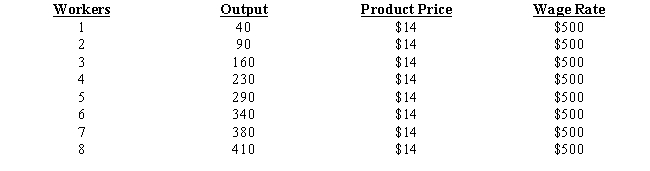
A)4
B)5
C)6
D)7
E)8
A)4
B)5
C)6
D)7
E)8
Question
Question
Question
Question
Question
Question
Question
Question
Question
Question
Question
Question
Question
Table 10-1 shows the output produced by a competitive firm by employing different numbers of workers at a fixed wage rate. Based on the table below, the firm will employ _____ workers to maximize its profitsTable 10-1 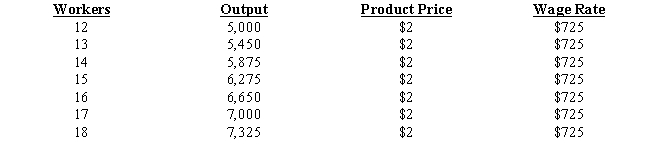
A)14
B)15
C)16
D)17
E)18
A)14
B)15
C)16
D)17
E)18
Question
Question
Question
Figure 10-1 shows shifts in the market labor supply curves. Which of the following situations is illustrated by Case A?Figure 10-1 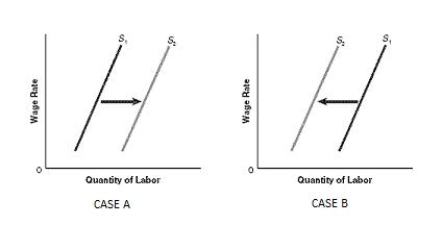
A)Increases in income from sources other than employment
B)Deteriorating job amenities
C)People becoming willing to work fewer hours at a given wage
D)People becoming willing to work fewer hours at a given wage.
E)Many workers leaving the labor force
A)Increases in income from sources other than employment
B)Deteriorating job amenities
C)People becoming willing to work fewer hours at a given wage
D)People becoming willing to work fewer hours at a given wage.
E)Many workers leaving the labor force
Question
Question
Figure 10-1 shows shifts in the market labor supply curves. Which of the following situations is illustrated by Case B?Figure 10-1 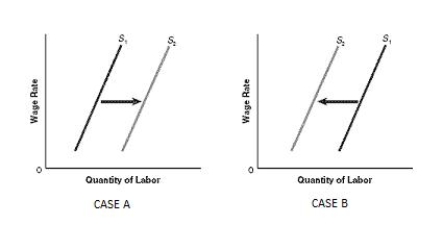
A)New workers entering the labor force
B)Increases in income from sources other than employment
C)Improvements in amenities associated with a job or location
D)People becoming willing to work more hours at a given wage
E)Decreases in income from sources other than employment
A)New workers entering the labor force
B)Increases in income from sources other than employment
C)Improvements in amenities associated with a job or location
D)People becoming willing to work more hours at a given wage
E)Decreases in income from sources other than employment
Question
Question
Question
Question
Figure 10-2 shows the impact of labor unions on a labor market. In the figure, when unions successfully increase the wages of its members, the supply curve in the union sector shifts from _____ and _____ workers lose their jobs as a result.Figure 10-2 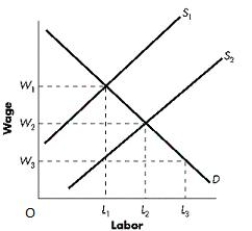
A)S1 to S2; L3 ─ L1
B)S2 to S1; L3 ─ L1
C)S1 to S2; L2 ─ L1
D)S2 to S1; L2 ─ L1
E)S2 to S1; L3 ─ L1 .
A)S1 to S2; L3 ─ L1
B)S2 to S1; L3 ─ L1
C)S1 to S2; L2 ─ L1
D)S2 to S1; L2 ─ L1
E)S2 to S1; L3 ─ L1 .
Question
Question
Question
Question
Question
Question
Question
Question
Question
Question
Question
Question
Question
Question
Question
Question
Question
Question
Question
Question
Question
Question
Question
Question
Question
Question
Question
Question
Question
Question
Question
Question
Question

Unlock Deck
Sign up to unlock the cards in this deck!
Unlock Deck
Unlock Deck
1/100

Play

Full screen (f)
Deck 10: Labor Markets, Income Distribution, and Poverty
1
The marginal resource cost of labor is the amount that an extra unit of labor adds to the firm's average costs
False
2
Labor unions create barriers to entry in certain work settings.
True
3
Police officers earn higher wages in part because of the dangers associated with their profession.
True
4
Many economists conclude that in-kind income programs have served to reduce levels of inequality significantly from the levels suggested by aggregate income statistics
Unlock Deck
Unlock for access to all 100 flashcards in this deck.
Unlock Deck
k this deck
5
The law of diminishing marginal product is a reason why the demand curve for labor is downward sloping
Unlock Deck
Unlock for access to all 100 flashcards in this deck.
Unlock Deck
k this deck
6
Other things equal, an increase in labor productivity will shift the labor demand curve to the left.
Unlock Deck
Unlock for access to all 100 flashcards in this deck.
Unlock Deck
k this deck
7
If the demand for opera singers increases faster than the supply increases, wages will rise.
Unlock Deck
Unlock for access to all 100 flashcards in this deck.
Unlock Deck
k this deck
8
The intersection of a firm's demand curve for labor and an individual worker's supply curve of labor determines the equilibrium wage rate.
Unlock Deck
Unlock for access to all 100 flashcards in this deck.
Unlock Deck
k this deck
9
Increases in income from sources other than employment can cause the labor supply curve to shift to the left.
Unlock Deck
Unlock for access to all 100 flashcards in this deck.
Unlock Deck
k this deck
10
Labor unions can ensure full employment for union workers along with a wage that is higher than the competitive wage.
Unlock Deck
Unlock for access to all 100 flashcards in this deck.
Unlock Deck
k this deck
11
The concept of derived demand indicates that the demand for a final good or service is determined by the price of the inputs used to produce that final good or service.
Unlock Deck
Unlock for access to all 100 flashcards in this deck.
Unlock Deck
k this deck
12
A progressive tax system imposes higher marginal tax rates on lower incomes.
Unlock Deck
Unlock for access to all 100 flashcards in this deck.
Unlock Deck
k this deck
13
Skilled workers earn more than unskilled workers because they invested more in acquiring their skills.
Unlock Deck
Unlock for access to all 100 flashcards in this deck.
Unlock Deck
k this deck
14
A decrease in the productivity of labor will shift the demand curve for labor to the right, other things equal.
Unlock Deck
Unlock for access to all 100 flashcards in this deck.
Unlock Deck
k this deck
15
Middle-aged people have lower incomes than older people because older people are more experienced.
Unlock Deck
Unlock for access to all 100 flashcards in this deck.
Unlock Deck
k this deck
16
Other things equal, if the quantity of labor supplied is less than the quantity of labor demanded, wages will tend to fall.
Unlock Deck
Unlock for access to all 100 flashcards in this deck.
Unlock Deck
k this deck
17
Income inequality is greater within nations than among nations
Unlock Deck
Unlock for access to all 100 flashcards in this deck.
Unlock Deck
k this deck
18
Any wage increase won by unionized workers is shared with nonunion unskilled workers.
Unlock Deck
Unlock for access to all 100 flashcards in this deck.
Unlock Deck
k this deck
19
The salaries of college professors are partly determined by the demand for college education.
Unlock Deck
Unlock for access to all 100 flashcards in this deck.
Unlock Deck
k this deck
20
An increase in the price of a firm's output will shift the firm's demand curve for labor to the right, other things equal
Unlock Deck
Unlock for access to all 100 flashcards in this deck.
Unlock Deck
k this deck
21
In the labor market, employers hire workers as long as the:
A)wage rate equals the average product of labor.
B)wage rate is below the marginal revenue product of labor.
C)average product of labor is zero.
D)marginal product of labor is zero
E)wage rate exceeds the marginal revenue product of labor.
A)wage rate equals the average product of labor.
B)wage rate is below the marginal revenue product of labor.
C)average product of labor is zero.
D)marginal product of labor is zero
E)wage rate exceeds the marginal revenue product of labor.
Unlock Deck
Unlock for access to all 100 flashcards in this deck.
Unlock Deck
k this deck
22
The market labor supply curve shows the relationship between:
A)the wage rate and the number of employees firms are willing to hire.
B)the price of output and the number of employees firms are willing to hire.
C)the wage rate and the quantity of labor that workers are willing to supply
D)the price of output and the quantity of labor that workers are willing to supply.
E)the marginal cost of output and the quantity of labor that workers are willing to supply.
A)the wage rate and the number of employees firms are willing to hire.
B)the price of output and the number of employees firms are willing to hire.
C)the wage rate and the quantity of labor that workers are willing to supply
D)the price of output and the quantity of labor that workers are willing to supply.
E)the marginal cost of output and the quantity of labor that workers are willing to supply.
Unlock Deck
Unlock for access to all 100 flashcards in this deck.
Unlock Deck
k this deck
23
The market demand curve for labor slopes downward because:
A)the supply of labor is infinite in a competitive labor market.
B)workers are more willing to supply labor at lower wage rates.
C)of the law of diminishing marginal product.
D)of the law of diminishing marginal resource cost.
E)of the law of diminishing returns to scale.
A)the supply of labor is infinite in a competitive labor market.
B)workers are more willing to supply labor at lower wage rates.
C)of the law of diminishing marginal product.
D)of the law of diminishing marginal resource cost.
E)of the law of diminishing returns to scale.
Unlock Deck
Unlock for access to all 100 flashcards in this deck.
Unlock Deck
k this deck
24
Economists refer to expenditures on training, education, and skill development designed to increase the productivity of an individual as:
A)overhead expenditures.
B)investment in human capital.
C)marginal revenue product.
D)investment in social capital.
E)marginal resource cost.
A)overhead expenditures.
B)investment in human capital.
C)marginal revenue product.
D)investment in social capital.
E)marginal resource cost.
Unlock Deck
Unlock for access to all 100 flashcards in this deck.
Unlock Deck
k this deck
25
Table 10-2 shows the output produced by a competitive firm by employing different numbers of workers at a fixed wage rate. Based on the table below, the firm will employ _____ in order to maximize profits.Table 10-2
A)4
B)5
C)6
D)7
E)8
A)4
B)5
C)6
D)7
E)8
Unlock Deck
Unlock for access to all 100 flashcards in this deck.
Unlock Deck
k this deck
26
Demand for inputs is a derived demand because:
A)it is derived from the need for income.
B)it corresponds to the derived supply of the inputs.
C)the demand for output leads producers to demand inputs.
D)of the diminishing marginal product of inputs.
E)of the diminishing returns to scale in production.
A)it is derived from the need for income.
B)it corresponds to the derived supply of the inputs.
C)the demand for output leads producers to demand inputs.
D)of the diminishing marginal product of inputs.
E)of the diminishing returns to scale in production.
Unlock Deck
Unlock for access to all 100 flashcards in this deck.
Unlock Deck
k this deck
27
The marginal revenue product (MRP) curve for labor:
A)is the same as the demand curve for labor in a competitive market
B)is the same as the supply curve of labor in a monopolistic market.
C)will shift up if the market wage increases.
D)will become steeper if the market wage increases
E)will become flatter if the market wage decreases.
A)is the same as the demand curve for labor in a competitive market
B)is the same as the supply curve of labor in a monopolistic market.
C)will shift up if the market wage increases.
D)will become steeper if the market wage increases
E)will become flatter if the market wage decreases.
Unlock Deck
Unlock for access to all 100 flashcards in this deck.
Unlock Deck
k this deck
28
Improvements in the productivity of labor will tend to:
A)increase the supply of labor.
B)increase the demand for labor.
C)decrease the supply of labor
D)decrease the demand for labor.
E)decrease the total output of the industry.
A)increase the supply of labor.
B)increase the demand for labor.
C)decrease the supply of labor
D)decrease the demand for labor.
E)decrease the total output of the industry.
Unlock Deck
Unlock for access to all 100 flashcards in this deck.
Unlock Deck
k this deck
29
If labor is the only variable input, an additional worker increases output from 72 units to 78 units, and the product price is $6, the marginal revenue product from an additional worker is equal to:
A)$6
B)$36.
C)$78.
D)$432.
E)$72
A)$6
B)$36.
C)$78.
D)$432.
E)$72
Unlock Deck
Unlock for access to all 100 flashcards in this deck.
Unlock Deck
k this deck
30
Which of the following will result in a leftward shift of the market labor supply curve?
A)An increase in immigration
B)A decrease in labor productivity
C)An increase in the working-age population
D)An increase in nonwage income
E)A decrease in nonwage income
A)An increase in immigration
B)A decrease in labor productivity
C)An increase in the working-age population
D)An increase in nonwage income
E)A decrease in nonwage income
Unlock Deck
Unlock for access to all 100 flashcards in this deck.
Unlock Deck
k this deck
31
Which of the following most clearly illustrates the concept of derived demand?
A)An increase in the price of steak causes the demand for poultry to increase.
B)An increase in the demand for new houses leads to an increase in the demand for construction workers.
C)An increase in consumer income leads to an increase in the demand for services provided by the government.
D)An increase in the demand for motorbikes leads to an increase in the demand for gasoline.
E)An increase in the demand for motorbikes leads to an increase in the demand for gasoline
A)An increase in the price of steak causes the demand for poultry to increase.
B)An increase in the demand for new houses leads to an increase in the demand for construction workers.
C)An increase in consumer income leads to an increase in the demand for services provided by the government.
D)An increase in the demand for motorbikes leads to an increase in the demand for gasoline.
E)An increase in the demand for motorbikes leads to an increase in the demand for gasoline
Unlock Deck
Unlock for access to all 100 flashcards in this deck.
Unlock Deck
k this deck
32
The contribution of an additional worker to a competitive firm's _____ is the worker's contribution to revenue minus the worker's _____.
A)profit; wage
B)output; wage
C)profit; marginal product
D)output; marginal product
E)output; average product
A)profit; wage
B)output; wage
C)profit; marginal product
D)output; marginal product
E)output; average product
Unlock Deck
Unlock for access to all 100 flashcards in this deck.
Unlock Deck
k this deck
33
Poverty rates tend to be substantially higher for families headed by females than for those headed by married couples.
Unlock Deck
Unlock for access to all 100 flashcards in this deck.
Unlock Deck
k this deck
34
Which of the following best illustrates the concept of derived demand?
A)An increase in the wages of autoworkers leads to an increase in the demand for robots in
B)An auto firm decides to supply more minivans when there is a decrease in the demand for station wagons.
C)An increase in the price of gasoline leads to an increase in the demand for small cars.
D)An automobile firm faces an increase in the demand for the cars it supplies to the market, leading to an increase in the demand for autoworkers.
E)A change in the emission standards increases the demand for small cars.
A)An increase in the wages of autoworkers leads to an increase in the demand for robots in
B)An auto firm decides to supply more minivans when there is a decrease in the demand for station wagons.
C)An increase in the price of gasoline leads to an increase in the demand for small cars.
D)An automobile firm faces an increase in the demand for the cars it supplies to the market, leading to an increase in the demand for autoworkers.
E)A change in the emission standards increases the demand for small cars.
Unlock Deck
Unlock for access to all 100 flashcards in this deck.
Unlock Deck
k this deck
35
The equilibrium wage and quantity in competitive markets for labor are determined by:
A)the government
B)labor unions.
C)the interaction of the demand and the supply of a good
D)the supply of the fixed resources of production.
E)the intersection of the labor demand and labor supply curves.
A)the government
B)labor unions.
C)the interaction of the demand and the supply of a good
D)the supply of the fixed resources of production.
E)the intersection of the labor demand and labor supply curves.
Unlock Deck
Unlock for access to all 100 flashcards in this deck.
Unlock Deck
k this deck
36
When labor is a firm's only variable input in its production process, a profit-maximizing firm will continue to employ additional workers as long as:
A)the marginal product of labor exceeds zero
B)the marginal revenue product of labor is less than the marginal resource cost.
C)the marginal revenue product of labor exceeds the marginal resource cost.
D)the marginal product of labor exceeds the marginal resource cost.
E)the marginal product of labor is less than the marginal resource cost.
A)the marginal product of labor exceeds zero
B)the marginal revenue product of labor is less than the marginal resource cost.
C)the marginal revenue product of labor exceeds the marginal resource cost.
D)the marginal product of labor exceeds the marginal resource cost.
E)the marginal product of labor is less than the marginal resource cost.
Unlock Deck
Unlock for access to all 100 flashcards in this deck.
Unlock Deck
k this deck
37
The wage of a unit of labor used in the production of a good or service is:
A)inversely related to the demand for the final good or service.
B)directly related to the demand for the final good or service.
C)not related to the demand for the final good or service.
D)inversely related to the supply of the final good or service.
E)not related to the supply of the final good or service.
A)inversely related to the demand for the final good or service.
B)directly related to the demand for the final good or service.
C)not related to the demand for the final good or service.
D)inversely related to the supply of the final good or service.
E)not related to the supply of the final good or service.
Unlock Deck
Unlock for access to all 100 flashcards in this deck.
Unlock Deck
k this deck
38
Table 10-1 shows the output produced by a competitive firm by employing different numbers of workers at a fixed wage rate. Based on the table below, the firm will employ _____ workers to maximize its profitsTable 10-1
A)14
B)15
C)16
D)17
E)18
A)14
B)15
C)16
D)17
E)18
Unlock Deck
Unlock for access to all 100 flashcards in this deck.
Unlock Deck
k this deck
39
An individual firm in a perfectly competitive labor market faces:
A)a downward-sloping labor demand curve and an upward-sloping labor supply curve.
B)a horizontal labor supply curve and a vertical labor demand curve
C)a horizontal labor supply curve and a downward-sloping labor demand curve.
D)an upward-sloping labor supply curve and a horizontal labor demand curve.
E)a vertical labor supply curve and a horizontal labor demand curve.
A)a downward-sloping labor demand curve and an upward-sloping labor supply curve.
B)a horizontal labor supply curve and a vertical labor demand curve
C)a horizontal labor supply curve and a downward-sloping labor demand curve.
D)an upward-sloping labor supply curve and a horizontal labor demand curve.
E)a vertical labor supply curve and a horizontal labor demand curve.
Unlock Deck
Unlock for access to all 100 flashcards in this deck.
Unlock Deck
k this deck
40
The marginal product of labor measures:
A)the total amount of output produced by all workers combined.
B)the quantity of an input that is combined with labor to produce output.
C)the amount of output an additional worker contributes to a firm's total output.
D)the average productivity of workers hired by a firm.
E)the cost of hiring workers to produce a certain amount of output.
A)the total amount of output produced by all workers combined.
B)the quantity of an input that is combined with labor to produce output.
C)the amount of output an additional worker contributes to a firm's total output.
D)the average productivity of workers hired by a firm.
E)the cost of hiring workers to produce a certain amount of output.
Unlock Deck
Unlock for access to all 100 flashcards in this deck.
Unlock Deck
k this deck
41
Figure 10-1 shows shifts in the market labor supply curves. Which of the following situations is illustrated by Case A?Figure 10-1
A)Increases in income from sources other than employment
B)Deteriorating job amenities
C)People becoming willing to work fewer hours at a given wage
D)People becoming willing to work fewer hours at a given wage.
E)Many workers leaving the labor force
A)Increases in income from sources other than employment
B)Deteriorating job amenities
C)People becoming willing to work fewer hours at a given wage
D)People becoming willing to work fewer hours at a given wage.
E)Many workers leaving the labor force
Unlock Deck
Unlock for access to all 100 flashcards in this deck.
Unlock Deck
k this deck
42
Which of the following will shift an individual's labor supply curve to the left?
A)Winning a lottery
B)A decrease in nonwage income
C)High wage rates
D)A decrease in derived demand
E)An increase in the number of leaves of absence in a job
A)Winning a lottery
B)A decrease in nonwage income
C)High wage rates
D)A decrease in derived demand
E)An increase in the number of leaves of absence in a job
Unlock Deck
Unlock for access to all 100 flashcards in this deck.
Unlock Deck
k this deck
43
Figure 10-1 shows shifts in the market labor supply curves. Which of the following situations is illustrated by Case B?Figure 10-1
A)New workers entering the labor force
B)Increases in income from sources other than employment
C)Improvements in amenities associated with a job or location
D)People becoming willing to work more hours at a given wage
E)Decreases in income from sources other than employment
A)New workers entering the labor force
B)Increases in income from sources other than employment
C)Improvements in amenities associated with a job or location
D)People becoming willing to work more hours at a given wage
E)Decreases in income from sources other than employment
Unlock Deck
Unlock for access to all 100 flashcards in this deck.
Unlock Deck
k this deck
44
According to Harvard economists Richard Freeman and James Medoff, the effect of unions is to:
A)increase output in the union sector and in the nonunion sector.
B)increase output in the union sector and decrease output in the nonunion sector.
C)decrease output in the union sector and increase output in the nonunion sector.
D)decrease output in the union sector and in the nonunion sector.
E)decrease output in the union sector and have no impact on output in the nonunion sector.
A)increase output in the union sector and in the nonunion sector.
B)increase output in the union sector and decrease output in the nonunion sector.
C)decrease output in the union sector and increase output in the nonunion sector.
D)decrease output in the union sector and in the nonunion sector.
E)decrease output in the union sector and have no impact on output in the nonunion sector.
Unlock Deck
Unlock for access to all 100 flashcards in this deck.
Unlock Deck
k this deck
45
An increase in workplace amenities, such as increased health care and more generous vacation options, without any change in the demand for labor would:
A)increase the slope of the labor supply curve.
B)decrease the slope of the labor supply curve.
C)shift the labor supply curve to the left, decreasing wages
D)shift the labor supply curve to the right, decreasing wages.
E)increase the slope of the labor demand curve.
A)increase the slope of the labor supply curve.
B)decrease the slope of the labor supply curve.
C)shift the labor supply curve to the left, decreasing wages
D)shift the labor supply curve to the right, decreasing wages.
E)increase the slope of the labor demand curve.
Unlock Deck
Unlock for access to all 100 flashcards in this deck.
Unlock Deck
k this deck
46
Labor unions:
A)decrease employment in the nonunion sector.
B)increase employment in the union sector.
C)increase nonunion wages.
D)increase union wages.
E)decrease productivity in the union sector.
A)decrease employment in the nonunion sector.
B)increase employment in the union sector.
C)increase nonunion wages.
D)increase union wages.
E)decrease productivity in the union sector.
Unlock Deck
Unlock for access to all 100 flashcards in this deck.
Unlock Deck
k this deck
47
Figure 10-2 shows the impact of labor unions on a labor market. In the figure, when unions successfully increase the wages of its members, the supply curve in the union sector shifts from _____ and _____ workers lose their jobs as a result.Figure 10-2
A)S1 to S2; L3 ─ L1
B)S2 to S1; L3 ─ L1
C)S1 to S2; L2 ─ L1
D)S2 to S1; L2 ─ L1
E)S2 to S1; L3 ─ L1 .
A)S1 to S2; L3 ─ L1
B)S2 to S1; L3 ─ L1
C)S1 to S2; L2 ─ L1
D)S2 to S1; L2 ─ L1
E)S2 to S1; L3 ─ L1 .
Unlock Deck
Unlock for access to all 100 flashcards in this deck.
Unlock Deck
k this deck
48
Which of the following is likely to increase the supply of labor?
A)A decrease in the population
B)A relaxation of restrictions on immigration
C)A decrease in fringe benefits
D)An increase in the value placed on leisure
E)An increase in the nonwage income of workers
A)A decrease in the population
B)A relaxation of restrictions on immigration
C)A decrease in fringe benefits
D)An increase in the value placed on leisure
E)An increase in the nonwage income of workers
Unlock Deck
Unlock for access to all 100 flashcards in this deck.
Unlock Deck
k this deck
49
Which of the following is likely to happen if some workers form a union in a competitive labor market and negotiate a higher wage for themselves?
A)Competition will force the wage rate in the nonunion sector to increase to the level of the union wage.
B)The marginal product of labor will increase in the unionized sector.
C)Workers will move from the union to the nonunion sector over time.
D)Employment will increase in the union sector because workers will be attracted by the higher union wage.
E)Total output produced by labor will decrease substantially.
A)Competition will force the wage rate in the nonunion sector to increase to the level of the union wage.
B)The marginal product of labor will increase in the unionized sector.
C)Workers will move from the union to the nonunion sector over time.
D)Employment will increase in the union sector because workers will be attracted by the higher union wage.
E)Total output produced by labor will decrease substantially.
Unlock Deck
Unlock for access to all 100 flashcards in this deck.
Unlock Deck
k this deck
50
Labor unions:
A)have no influence over wages.
B)can influence wages by restricting labor supply.
C)are illegal in the United States.
D)have significantly increased their membership in the last two decades.
E)can influence wages by increasing labor demand
A)have no influence over wages.
B)can influence wages by restricting labor supply.
C)are illegal in the United States.
D)have significantly increased their membership in the last two decades.
E)can influence wages by increasing labor demand
Unlock Deck
Unlock for access to all 100 flashcards in this deck.
Unlock Deck
k this deck
51
At a wage below the equilibrium level, the:
A)quantity of labor supplied exceeds the quantity of labor demanded, resulting in a labor shortage.
B)quantity of labor demanded exceeds the quantity of labor supplied, resulting in a labor surplus
C)quantity of labor supplied exceeds the quantity of labor demanded, resulting in a labor surplus.
D)quantity of labor demanded and the quantity of labor supplied remains constant, decreasing the wage rate.
E)quantity of labor demanded exceeds the quantity of labor supplied, resulting in a labor shortage.
A)quantity of labor supplied exceeds the quantity of labor demanded, resulting in a labor shortage.
B)quantity of labor demanded exceeds the quantity of labor supplied, resulting in a labor surplus
C)quantity of labor supplied exceeds the quantity of labor demanded, resulting in a labor surplus.
D)quantity of labor demanded and the quantity of labor supplied remains constant, decreasing the wage rate.
E)quantity of labor demanded exceeds the quantity of labor supplied, resulting in a labor shortage.
Unlock Deck
Unlock for access to all 100 flashcards in this deck.
Unlock Deck
k this deck
52
If the demand for software engineers _____ more slowly than the supply increases, the wages of software engineers will _____.
A)increases; remain constant
B)increases, rise
C)increases; fall
D)decreases; fall
E)decreases; remain constant
A)increases; remain constant
B)increases, rise
C)increases; fall
D)decreases; fall
E)decreases; remain constant
Unlock Deck
Unlock for access to all 100 flashcards in this deck.
Unlock Deck
k this deck
53
Unionization provides _____ in certain occupations, and, as a result, wage rates in these occupations have a tendency to _____.
A)barriers to entry; decrease
B)barriers to entry; increase
C)ease of entry; decrease
D)ease of entry; increase
E)higher level of employment; decrease
A)barriers to entry; decrease
B)barriers to entry; increase
C)ease of entry; decrease
D)ease of entry; increase
E)higher level of employment; decrease
Unlock Deck
Unlock for access to all 100 flashcards in this deck.
Unlock Deck
k this deck
54
In a labor market that is influenced by a union, _____.
A)workers with identical skills earn identical wages
B)workers with identical skills may earn different wages
C)all the workers earn equal wages irrespective of their skills
D)every worker is employed at a given point of time
E)the risk of economic cycles is negligible
A)workers with identical skills earn identical wages
B)workers with identical skills may earn different wages
C)all the workers earn equal wages irrespective of their skills
D)every worker is employed at a given point of time
E)the risk of economic cycles is negligible
Unlock Deck
Unlock for access to all 100 flashcards in this deck.
Unlock Deck
k this deck
55
Other things being equal, an increase in the labor force resulting from increased immigration tends to:
A)increase wages
B)decrease wages.
C)decrease the demand for labor.
D)increase the demand for labor.
E)decrease the supply of labor.
A)increase wages
B)decrease wages.
C)decrease the demand for labor.
D)increase the demand for labor.
E)decrease the supply of labor.
Unlock Deck
Unlock for access to all 100 flashcards in this deck.
Unlock Deck
k this deck
56
Since 1935, the proportion of income received by the top 5 percent of Americans has:
A)increased substantially.
B)increased minimally.
C)decreased minimally
D)decreased substantially.
E)not changed considerably
A)increased substantially.
B)increased minimally.
C)decreased minimally
D)decreased substantially.
E)not changed considerably
Unlock Deck
Unlock for access to all 100 flashcards in this deck.
Unlock Deck
k this deck
57
Collective bargaining refers to negotiations between:
A)representatives of employers and unions.
B)unions and government regulators
C)consumers and producers.
D)employers and consumers.
E)unions and consumers.
A)representatives of employers and unions.
B)unions and government regulators
C)consumers and producers.
D)employers and consumers.
E)unions and consumers.
Unlock Deck
Unlock for access to all 100 flashcards in this deck.
Unlock Deck
k this deck
58
Unions tend to:
A)shift labor from the union sector to the nonunion sector of an economy.
B)shift labor from the nonunion sector to the union sector of an economy.
C)decrease wages in the union sector.
D)increase wages in the nonunion sector.
E)increase the level of employment in the union sector.
A)shift labor from the union sector to the nonunion sector of an economy.
B)shift labor from the nonunion sector to the union sector of an economy.
C)decrease wages in the union sector.
D)increase wages in the nonunion sector.
E)increase the level of employment in the union sector.
Unlock Deck
Unlock for access to all 100 flashcards in this deck.
Unlock Deck
k this deck
59
As a significant number of skilled workers seek work in the nonunion sector, the supply curve of nonunion labor shifts to the:
A)right, reducing wages for nonunion workers.
B)left, reducing wages for nonunion workers.
C)right, increasing wages for nonunion workers.
D)left, increasing wages for nonunion workers.
E)left, leaving wages for nonunion workers unaffected.
A)right, reducing wages for nonunion workers.
B)left, reducing wages for nonunion workers.
C)right, increasing wages for nonunion workers.
D)left, increasing wages for nonunion workers.
E)left, leaving wages for nonunion workers unaffected.
Unlock Deck
Unlock for access to all 100 flashcards in this deck.
Unlock Deck
k this deck
60
Through collective bargaining, a labor union can:
A)increase wages and employment in the union sector.
B)increase wages and decrease employment in the union sector.
C)increase wages and employment in the nonunion sector.
D)increase wages and decrease employment in the nonunion sector.
E)decrease wages and increase employment in the union sector.
A)increase wages and employment in the union sector.
B)increase wages and decrease employment in the union sector.
C)increase wages and employment in the nonunion sector.
D)increase wages and decrease employment in the nonunion sector.
E)decrease wages and increase employment in the union sector.
Unlock Deck
Unlock for access to all 100 flashcards in this deck.
Unlock Deck
k this deck
61
International comparisons of income inequality indicate that the degree of inequality is:
A)the highest in developing countries.
B)the highest in developed countries.
C)the lowest in developing countries.
D)the same in both developed and developing countries.
E)zero in developed countries.
A)the highest in developing countries.
B)the highest in developed countries.
C)the lowest in developing countries.
D)the same in both developed and developing countries.
E)zero in developed countries.
Unlock Deck
Unlock for access to all 100 flashcards in this deck.
Unlock Deck
k this deck
62
A typical 50-year-old male earns approximately _____ as a male in his early 20s in the United States.
A)twice as much
B)the same
C)half as much
D)one-third as much
E)one-fourth as much
A)twice as much
B)the same
C)half as much
D)one-third as much
E)one-fourth as much
Unlock Deck
Unlock for access to all 100 flashcards in this deck.
Unlock Deck
k this deck
63
In which of the following years was the poverty rate in the United States the highest since 1993?
A)1994-95
B)2000-01.
C)2004-05.
D)2008-09.
E)2011-12.
A)1994-95
B)2000-01.
C)2004-05.
D)2008-09.
E)2011-12.
Unlock Deck
Unlock for access to all 100 flashcards in this deck.
Unlock Deck
k this deck
64
An example of an in-kind transfer is
A)a welfare payment.
B)a cash grant.
C)a housing subsidy.
D)an unemployment check.
E)a state-subsidized high school.
A)a welfare payment.
B)a cash grant.
C)a housing subsidy.
D)an unemployment check.
E)a state-subsidized high school.
Unlock Deck
Unlock for access to all 100 flashcards in this deck.
Unlock Deck
k this deck
65
If every individual earned the same total income over his or her lifetime, there would still be observed inequality because:
A)people earn more in their youth
B)people earn more in middle age.
C)people earn more when they are old.
D)people of different age groups need to pay different percentage of taxes.
E)some people tend to spend more than others.
A)people earn more in their youth
B)people earn more in middle age.
C)people earn more when they are old.
D)people of different age groups need to pay different percentage of taxes.
E)some people tend to spend more than others.
Unlock Deck
Unlock for access to all 100 flashcards in this deck.
Unlock Deck
k this deck
66
Firefighters are generally paid higher wages than those with comparable skills because:
A)firefighting is dangerous work.
B)firefighters work more hours each month than do workers in most other professions.
C)firefighters value leisure less than the average person does.
D)firefighters, on average, spend more years receiving training than individuals in other professions.
E)firefighters need to travel long distances to complete their tasks.
A)firefighting is dangerous work.
B)firefighters work more hours each month than do workers in most other professions.
C)firefighters value leisure less than the average person does.
D)firefighters, on average, spend more years receiving training than individuals in other professions.
E)firefighters need to travel long distances to complete their tasks.
Unlock Deck
Unlock for access to all 100 flashcards in this deck.
Unlock Deck
k this deck
67
On average, middle-aged people tend to have higher incomes than younger or older people do because:
A)they receive more money from the government than the younger or older people do.
B)they are at an age where their productivity is at its peak.
C)they participate in the labor force to a lesser extent than do the young or the old.
D)they are subject to lower rates of taxation than the younger or older workers.
E)they have more number of dependents to look after than the younger and older people.
A)they receive more money from the government than the younger or older people do.
B)they are at an age where their productivity is at its peak.
C)they participate in the labor force to a lesser extent than do the young or the old.
D)they are subject to lower rates of taxation than the younger or older workers.
E)they have more number of dependents to look after than the younger and older people.
Unlock Deck
Unlock for access to all 100 flashcards in this deck.
Unlock Deck
k this deck
68
A set of money income thresholds, established by the federal government, that vary by family size is called:
A)the poverty rate
B)the federal tax system.
C)the poverty line.
D)a transfer payment.
E)an in-kind transfer program.
A)the poverty rate
B)the federal tax system.
C)the poverty line.
D)a transfer payment.
E)an in-kind transfer program.
Unlock Deck
Unlock for access to all 100 flashcards in this deck.
Unlock Deck
k this deck
69
Which of the following government programs is likely to aid the poor more than those in the upper income bracket?
A)Subsidies to museums
B)State-subsidized higher education benefits
C)School lunch programs
D)Government subsidies to airports
E)Subsidies on the import of antiques
A)Subsidies to museums
B)State-subsidized higher education benefits
C)School lunch programs
D)Government subsidies to airports
E)Subsidies on the import of antiques
Unlock Deck
Unlock for access to all 100 flashcards in this deck.
Unlock Deck
k this deck
70
The poverty rate is:
A)the percentage of the population that falls below the poverty line.
B)the cost of providing a nutritionally adequate diet for one person.
C)the percentage of the population that lies above the poverty line.
D)the rate at which poverty is eradicated from a country.
E)the rate at which the poverty-stricken population grows in a country.
A)the percentage of the population that falls below the poverty line.
B)the cost of providing a nutritionally adequate diet for one person.
C)the percentage of the population that lies above the poverty line.
D)the rate at which poverty is eradicated from a country.
E)the rate at which the poverty-stricken population grows in a country.
Unlock Deck
Unlock for access to all 100 flashcards in this deck.
Unlock Deck
k this deck
71
Which of the following statements is true?
A)Developed countries have higher income inequality than developing countries.
B)A relatively low inequality of income in a country indicates that the per capita income of the country is also low.
C)A majority of income inequality in the world reflects differences in living standards among countries rather than disparities within nations
D)A majority of income inequality in the world reflects differences in living standards within countries rather than disparities among nations.
E)A relatively high inequality of income in a country indicates that the per capita income of the country is also high.
A)Developed countries have higher income inequality than developing countries.
B)A relatively low inequality of income in a country indicates that the per capita income of the country is also low.
C)A majority of income inequality in the world reflects differences in living standards among countries rather than disparities within nations
D)A majority of income inequality in the world reflects differences in living standards within countries rather than disparities among nations.
E)A relatively high inequality of income in a country indicates that the per capita income of the country is also high.
Unlock Deck
Unlock for access to all 100 flashcards in this deck.
Unlock Deck
k this deck
72
Which of the following is likely to improve the income of a community?
A)An increase in the average age of the community
B)A decrease in human capital investment
C)A recent increase in the divorce rate
D)An increase in the tax rate by the government
E)An increase in the productivity of the workforce
A)An increase in the average age of the community
B)A decrease in human capital investment
C)A recent increase in the divorce rate
D)An increase in the tax rate by the government
E)An increase in the productivity of the workforce
Unlock Deck
Unlock for access to all 100 flashcards in this deck.
Unlock Deck
k this deck
73
Which of the following state-subsidized programs have benefited the middle- and upper-income quintiles more than the poor?
A)Food stamps
B)Housing subsidies
C)Higher education
D)Medicaid
E)School lunch
A)Food stamps
B)Housing subsidies
C)Higher education
D)Medicaid
E)School lunch
Unlock Deck
Unlock for access to all 100 flashcards in this deck.
Unlock Deck
k this deck
74
A typical 50-year-old male earns:
A)one-third more than a male in his early 20s in the United States.
B)nearly three times the income of a male in his early 20s in the United States.
C)one-third less than workers over 65 in the United States.
D)nearly twice the income of workers over 65 in the United States.
E)almost one-third more than workers over 65 in the United States.
A)one-third more than a male in his early 20s in the United States.
B)nearly three times the income of a male in his early 20s in the United States.
C)one-third less than workers over 65 in the United States.
D)nearly twice the income of workers over 65 in the United States.
E)almost one-third more than workers over 65 in the United States.
Unlock Deck
Unlock for access to all 100 flashcards in this deck.
Unlock Deck
k this deck
75
The official poverty rate for the United States is currently set by multiplying the cost of providing a nutritionally adequate diet by:
A)two
B)three.
C)five.
D)eight
E)seven.
A)two
B)three.
C)five.
D)eight
E)seven.
Unlock Deck
Unlock for access to all 100 flashcards in this deck.
Unlock Deck
k this deck
76
Garbage collectors are paid a higher wage than many others with comparable skills because:
A)there are dangers associated with collecting trash.
B)garbage collectors work much longer hours on average than do those in other jobs.
C)there is unpleasantness associated with trash collection.
D)garbage collectors possess skills that are in relatively high demand
E)it takes a considerably longer time to acquire the skills.
A)there are dangers associated with collecting trash.
B)garbage collectors work much longer hours on average than do those in other jobs.
C)there is unpleasantness associated with trash collection.
D)garbage collectors possess skills that are in relatively high demand
E)it takes a considerably longer time to acquire the skills.
Unlock Deck
Unlock for access to all 100 flashcards in this deck.
Unlock Deck
k this deck
77
Differences in income can be accounted for by differences in:
A)age.
B)race.
C)ethnicity.
D)gender.
E)nationality.
A)age.
B)race.
C)ethnicity.
D)gender.
E)nationality.
Unlock Deck
Unlock for access to all 100 flashcards in this deck.
Unlock Deck
k this deck
78
From 1935 to 2010, the proportion of income received by the poorest 20 percent of Americans has:
A)increased substantially due to the government's efforts
B)decreased sharply due to the impact of the Second World War.
C)slightly decreased due to the impact of the Great Depression.
D)increased from 12 percent to 14 percent.
E)remained virtually unchanged.
A)increased substantially due to the government's efforts
B)decreased sharply due to the impact of the Second World War.
C)slightly decreased due to the impact of the Great Depression.
D)increased from 12 percent to 14 percent.
E)remained virtually unchanged.
Unlock Deck
Unlock for access to all 100 flashcards in this deck.
Unlock Deck
k this deck
79
The official definition of poverty _____ the level of poverty because it does not include _____.
A)overstates; cash benefits
B)overstates; noncash benefits
C)understates; cash benefits
D)understates; noncash benefits
E)understates; double taxation
A)overstates; cash benefits
B)overstates; noncash benefits
C)understates; cash benefits
D)understates; noncash benefits
E)understates; double taxation
Unlock Deck
Unlock for access to all 100 flashcards in this deck.
Unlock Deck
k this deck
80
Which of the following government programs is likely to aid the rich more than the poor?
A)Food stamps
B)School lunch programs
C)Subsidies to art museums
D)Public housing subsidies
E)Medicaid
A)Food stamps
B)School lunch programs
C)Subsidies to art museums
D)Public housing subsidies
E)Medicaid
Unlock Deck
Unlock for access to all 100 flashcards in this deck.
Unlock Deck
k this deck
Unlock Deck
Unlock for access to all 100 flashcards in this deck.






