







 Chat with AI

Deck 8: Economic Growth II
Full screen (f)

Question

Question
Question
Question
Question
Question
Question
Question
Question
Question
Question
Question
Question
Question
Question
Question
Question
Question
Question
Question
Question
Question
Question
Question
Question
Question
Question
Question
Question
Question
Question
Question
Question
Question
Question
Question
Question
Question
Question
Question
Question
Question
Question
Question
Question
Question
Question
Question
Question
Question
Question
Question
Question
Question
Question
Question
Question
Question
Question
Question
Question
Question
Question
Question
Question
Question
Exhibit: Factors of Production Data
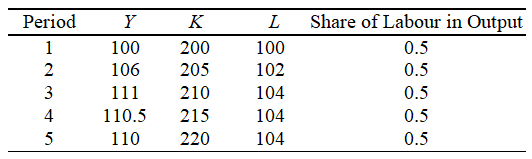
Use the data in the exhibit to complete a and b.
a.Compute and report the value of growth in total factor productivity
((At - At-1)/At-1)in each period from periods 2 through 5.If the value of A is 1.000 in period 1,also report the value of A in each period.
b.Does the value of A rise in each period? If it declines,do you think this decline is because technological progress works backwards? If so,explain your answer.If not,provide another explanation.
Use the data in the exhibit to complete a and b.
a.Compute and report the value of growth in total factor productivity
((At - At-1)/At-1)in each period from periods 2 through 5.If the value of A is 1.000 in period 1,also report the value of A in each period.
b.Does the value of A rise in each period? If it declines,do you think this decline is because technological progress works backwards? If so,explain your answer.If not,provide another explanation.
Question
Question
Question
Question
Question
Question
Question
Question
Question
Question
Question
Question
Question
Question

Unlock Deck
Sign up to unlock the cards in this deck!
Unlock Deck
Unlock Deck
1/94

Play

Full screen (f)
Deck 8: Economic Growth II
1
Assuming that technological progress increases the efficiency of labour at a constant rate is called:
A) endogenous technological progress.
B) the efficiency-wage model of economic growth.
C) labour-augmenting technological progress.
D) the Golden Rule model of economic growth.
A) endogenous technological progress.
B) the efficiency-wage model of economic growth.
C) labour-augmenting technological progress.
D) the Golden Rule model of economic growth.
labour-augmenting technological progress.
2
The efficiency of labour is a term that does not reflect the:
A) high output that comes from labour cooperating with a large amount of capital.
B) health of the labour force.
C) education of the labour force.
D) skills of the labour force acquired through on-the-job training.
A) high output that comes from labour cooperating with a large amount of capital.
B) health of the labour force.
C) education of the labour force.
D) skills of the labour force acquired through on-the-job training.
high output that comes from labour cooperating with a large amount of capital.
3
The balanced-growth property of the Solow growth model with population growth and technological progress predicts which of the following sets of variables will grow at the same rate in the steady state?
A) output per effective worker,capital per effective worker,real wage
B) output per worker,capital per worker,real wage
C) real rental price of capital,real wage,output per worker
D) capital-output ratio,output per worker,capital per worker
A) output per effective worker,capital per effective worker,real wage
B) output per worker,capital per worker,real wage
C) real rental price of capital,real wage,output per worker
D) capital-output ratio,output per worker,capital per worker
output per worker,capital per worker,real wage
4
The rate of labour-augmenting technological progress (g)is the growth rate of:
A) labour.
B) the efficiency of labour.
C) capital.
D) output.
A) labour.
B) the efficiency of labour.
C) capital.
D) output.
Unlock Deck
Unlock for access to all 94 flashcards in this deck.
Unlock Deck
k this deck
5
In a steady-state economy with a saving rate s,population growth n,and labour-augmenting technological progress g,the formula for the steady-state ratio of capital per effective worker (k*),in terms of output per effective worker (f(k*)),is (denoting the depreciation rate by
):
A) sf(k)/( + n + g).
B) s/((f(k))( + n + g)).
C) f(k)/((s)( + n + g)).
D) (s - f(k))/( + n + g).
):
A) sf(k)/( + n + g).
B) s/((f(k))( + n + g)).
C) f(k)/((s)( + n + g)).
D) (s - f(k))/( + n + g).
Unlock Deck
Unlock for access to all 94 flashcards in this deck.
Unlock Deck
k this deck
6
In the Solow growth model with population growth and technological change,the break-even level of investment must cover:
A) depreciating capital.
B) depreciating capital and capital for new workers.
C) depreciating capital and capital for new effective workers.
D) depreciating capital,capital for new workers,and capital for new effective workers.
A) depreciating capital.
B) depreciating capital and capital for new workers.
C) depreciating capital and capital for new effective workers.
D) depreciating capital,capital for new workers,and capital for new effective workers.
Unlock Deck
Unlock for access to all 94 flashcards in this deck.
Unlock Deck
k this deck
7
According to the Solow model,persistently rising per-capita living standards can only be explained by:
A) population growth.
B) capital accumulation.
C) saving rates.
D) technological progress.
A) population growth.
B) capital accumulation.
C) saving rates.
D) technological progress.
Unlock Deck
Unlock for access to all 94 flashcards in this deck.
Unlock Deck
k this deck
8
International data suggest that economies of countries with different steady states will converge to:
A) the same steady state.
B) their own steady state.
C) the Golden Rule steady state.
D) steady states below the Golden Rule level.
A) the same steady state.
B) their own steady state.
C) the Golden Rule steady state.
D) steady states below the Golden Rule level.
Unlock Deck
Unlock for access to all 94 flashcards in this deck.
Unlock Deck
k this deck
9
In a steady-state economy with population growth n and labour-augmenting technological progress g,persistent increases in standard of living are possible because the:
A) capital stock grows faster than does the labour force.
B) capital stock grows faster than does the number of effective workers.
C) capital stock grows faster than does depreciation.
D) saving rate constantly increases.
A) capital stock grows faster than does the labour force.
B) capital stock grows faster than does the number of effective workers.
C) capital stock grows faster than does depreciation.
D) saving rate constantly increases.
Unlock Deck
Unlock for access to all 94 flashcards in this deck.
Unlock Deck
k this deck
10
In the Solow growth model,the steady-state growth rate of output per effective worker is ______,and the steady-state growth rate of output per worker is ______.
A) the sum of the rate of technological progress plus the rate of population growth; zero
B) zero; the rate of technological progress
C) zero; zero
D) the rate of technological progress; the rate of population growth
A) the sum of the rate of technological progress plus the rate of population growth; zero
B) zero; the rate of technological progress
C) zero; zero
D) the rate of technological progress; the rate of population growth
Unlock Deck
Unlock for access to all 94 flashcards in this deck.
Unlock Deck
k this deck
11
The number of effective workers takes into account the number of workers and the:
A) amount of capital available to each worker.
B) rate of growth of the number of workers.
C) efficiency of each worker.
D) saving rate of each worker.
A) amount of capital available to each worker.
B) rate of growth of the number of workers.
C) efficiency of each worker.
D) saving rate of each worker.
Unlock Deck
Unlock for access to all 94 flashcards in this deck.
Unlock Deck
k this deck
12
The efficiency of labour:
A) is the marginal product of labour.
B) is the rate of growth of the labour force.
C) includes the knowledge,health,and skills of labour.
D) equals output per worker.
A) is the marginal product of labour.
B) is the rate of growth of the labour force.
C) includes the knowledge,health,and skills of labour.
D) equals output per worker.
Unlock Deck
Unlock for access to all 94 flashcards in this deck.
Unlock Deck
k this deck
13
In the Solow growth model with population growth and technological change,the steady-state growth rate of income per person depends on:
A) the rate of population growth.
B) the saving rate.
C) the rate of technological progress.
D) the rate of population growth plus the rate of technological progress.
A) the rate of population growth.
B) the saving rate.
C) the rate of technological progress.
D) the rate of population growth plus the rate of technological progress.
Unlock Deck
Unlock for access to all 94 flashcards in this deck.
Unlock Deck
k this deck
14
The Solow model predicts that two economies will converge if the economies start with the same:
A) capital stocks.
B) populations.
C) steady states.
D) production functions.
A) capital stocks.
B) populations.
C) steady states.
D) production functions.
Unlock Deck
Unlock for access to all 94 flashcards in this deck.
Unlock Deck
k this deck
15
With population growth at rate n and labour-augmenting technological progress at rate g,the Golden Rule steady state requires that the marginal product of capital (MPK):
A) net of depreciation be equal to n + g.
B) net of depreciation be equal to the depreciation rate plus n + g.
C) plus n be equal to the depreciation rate plus g.
D) plus g be equal to the depreciation rate plus n.
A) net of depreciation be equal to n + g.
B) net of depreciation be equal to the depreciation rate plus n + g.
C) plus n be equal to the depreciation rate plus g.
D) plus g be equal to the depreciation rate plus n.
Unlock Deck
Unlock for access to all 94 flashcards in this deck.
Unlock Deck
k this deck
16
Conditional convergence occurs when economies converge to:
A) the same steady state as other economies.
B) the Golden Rule steady state.
C) the balanced-growth steady state.
D) their own,individual steady states.
A) the same steady state as other economies.
B) the Golden Rule steady state.
C) the balanced-growth steady state.
D) their own,individual steady states.
Unlock Deck
Unlock for access to all 94 flashcards in this deck.
Unlock Deck
k this deck
17
If the labour force is growing at a 3 percent rate and the efficiency of a unit of labour is growing at a 2 percent rate,then the number of effective workers is growing at a rate of:
A) 2 percent.
B) 3 percent.
C) 5 percent.
D) 6 percent.
A) 2 percent.
B) 3 percent.
C) 5 percent.
D) 6 percent.
Unlock Deck
Unlock for access to all 94 flashcards in this deck.
Unlock Deck
k this deck
18
Over the past 50 years in the United States:
A) output per worker hour,capital stock per worker hour,the real wage,and the real rental price of capital have all increased about 2 percent per year.
B) output per worker hour,the real wage,and the real rental price of capital have all increased about 2 percent per year,whereas capital stock per worker hour has increased faster.
C) output per worker hour and the real wage have both increased about 2 percent per year,whereas capital stock per worker hour has increased faster and the real rental price of capital has remained about the same.
D) output per worker hour,the real wage,and capital stock per worker hour have all increased about 2 percent per year,whereas the real rental price of capital has remained about the same.
A) output per worker hour,capital stock per worker hour,the real wage,and the real rental price of capital have all increased about 2 percent per year.
B) output per worker hour,the real wage,and the real rental price of capital have all increased about 2 percent per year,whereas capital stock per worker hour has increased faster.
C) output per worker hour and the real wage have both increased about 2 percent per year,whereas capital stock per worker hour has increased faster and the real rental price of capital has remained about the same.
D) output per worker hour,the real wage,and capital stock per worker hour have all increased about 2 percent per year,whereas the real rental price of capital has remained about the same.
Unlock Deck
Unlock for access to all 94 flashcards in this deck.
Unlock Deck
k this deck
19
In the Solow model with technological change,the Golden Rule level of capital is the steady state that maximizes:
A) output per worker.
B) output per effective worker.
C) consumption per worker.
D) consumption per effective worker.
A) output per worker.
B) output per effective worker.
C) consumption per worker.
D) consumption per effective worker.
Unlock Deck
Unlock for access to all 94 flashcards in this deck.
Unlock Deck
k this deck
20
In the Solow model with technological progress,by increasing the efficiency of labour at rate g:
A) the real wage and the real rental price of capital both grow at rate g.
B) the real wage grows at rate g,but the real rental price of capital is constant.
C) the real wage is constant,but the real rental price of capital grows at rate g.
D) both the real wage and the real rental price of capital are constant.
A) the real wage and the real rental price of capital both grow at rate g.
B) the real wage grows at rate g,but the real rental price of capital is constant.
C) the real wage is constant,but the real rental price of capital grows at rate g.
D) both the real wage and the real rental price of capital are constant.
Unlock Deck
Unlock for access to all 94 flashcards in this deck.
Unlock Deck
k this deck
21
If two economies are identical (including having the population growth rates and efficiency of labour),but one economy has a lower saving rate,then the steady-state level of income per worker in the economy with the lower saving rate will be:
A) at a lower level than the steady state of the high-saving economy.
B) at a higher level than the steady state of the high-saving economy.
C) at the same level as the steady state of the high-saving economy.
D) proportional to the ratio of the capital stocks in the two economies.
A) at a lower level than the steady state of the high-saving economy.
B) at a higher level than the steady state of the high-saving economy.
C) at the same level as the steady state of the high-saving economy.
D) proportional to the ratio of the capital stocks in the two economies.
Unlock Deck
Unlock for access to all 94 flashcards in this deck.
Unlock Deck
k this deck
22
The type of legal system in a country and the level of corruption in a country have been found to be:
A) unrelated to the rate of economic growth in a country.
B) significant determinants of the rate of economic growth in a country.
C) important topics for political discussion,but not economic explanations of growth.
D) important variables explaining the Golden Rule level of capital.
A) unrelated to the rate of economic growth in a country.
B) significant determinants of the rate of economic growth in a country.
C) important topics for political discussion,but not economic explanations of growth.
D) important variables explaining the Golden Rule level of capital.
Unlock Deck
Unlock for access to all 94 flashcards in this deck.
Unlock Deck
k this deck
23
Empirical investigations into whether differences in income per person are the result of differences in the quantities of the factors of production available or differences in the efficiency with which the factors are employed typically find:
A) a negative correlation between the quantity of factors and the efficiency of use.
B) a positive correlation between the quantity of factors and the efficiency of use.
C) no correlation between the quantity of factors and the efficiency of use.
D) large gaps between the quantity of factors accumulated and the efficiency of use.
A) a negative correlation between the quantity of factors and the efficiency of use.
B) a positive correlation between the quantity of factors and the efficiency of use.
C) no correlation between the quantity of factors and the efficiency of use.
D) large gaps between the quantity of factors accumulated and the efficiency of use.
Unlock Deck
Unlock for access to all 94 flashcards in this deck.
Unlock Deck
k this deck
24
Economic research shows that ______ in explaining international differences in living standards.
A) physical capital is more important than is human capital
B) human capital is at least as important as is physical capital
C) human capital is much more important than is physical capital
D) infrastructure is the most important factor
A) physical capital is more important than is human capital
B) human capital is at least as important as is physical capital
C) human capital is much more important than is physical capital
D) infrastructure is the most important factor
Unlock Deck
Unlock for access to all 94 flashcards in this deck.
Unlock Deck
k this deck
25
The Canada/Quebec pension plans are best described as:
A) fully funded.
B) privatized.
C) endogenous.
D) pay-as-you-go.
A) fully funded.
B) privatized.
C) endogenous.
D) pay-as-you-go.
Unlock Deck
Unlock for access to all 94 flashcards in this deck.
Unlock Deck
k this deck
26
Other things being equal,all of the following government policies are likely to increase national saving except:
A) decreasing taxes on savings accounts.
B) running a budget deficit.
C) running a budget surplus.
D) retiring part of the national debt.
A) decreasing taxes on savings accounts.
B) running a budget deficit.
C) running a budget surplus.
D) retiring part of the national debt.
Unlock Deck
Unlock for access to all 94 flashcards in this deck.
Unlock Deck
k this deck
27
Public policies in Canada designed to stimulate technological progress do not include:
A) tax breaks for capital gains on investment in the stock market.
B) the temporary monopoly granted by the patent system.
C) tax breaks for research and development.
D) government grants to cover part of university students' tuition.
A) tax breaks for capital gains on investment in the stock market.
B) the temporary monopoly granted by the patent system.
C) tax breaks for research and development.
D) government grants to cover part of university students' tuition.
Unlock Deck
Unlock for access to all 94 flashcards in this deck.
Unlock Deck
k this deck
28
Empirical evidence supports the theory that free trade:
A) increases economic growth.
B) decreases economic growth.
C) increases imports,but decreases exports because of greater global competition.
D) increases both imports and exports,but does not contribute to overall economic growth.
A) increases economic growth.
B) decreases economic growth.
C) increases imports,but decreases exports because of greater global competition.
D) increases both imports and exports,but does not contribute to overall economic growth.
Unlock Deck
Unlock for access to all 94 flashcards in this deck.
Unlock Deck
k this deck
29
Which of the following changes would bring the Canadian capital stock,currently below the Golden Rule level,closer to the steady-state,consumption-maximizing level?
A) increasing the population growth rate
B) increasing the rate of capital depreciation
C) increasing the rate of technological progress
D) increasing the saving rate
A) increasing the population growth rate
B) increasing the rate of capital depreciation
C) increasing the rate of technological progress
D) increasing the saving rate
Unlock Deck
Unlock for access to all 94 flashcards in this deck.
Unlock Deck
k this deck
30
Hypotheses to explain the positive correlation between factor accumulation and production efficiency include all of the following except:
A) the quality of a nation's institutions influences both factor accumulation and production efficiency.
B) capital accumulation causes greater production efficiency.
C) efficient economies make capital accumulation unnecessary.
D) an efficient economy encourages capital (including human capital)accumulation.
A) the quality of a nation's institutions influences both factor accumulation and production efficiency.
B) capital accumulation causes greater production efficiency.
C) efficient economies make capital accumulation unnecessary.
D) an efficient economy encourages capital (including human capital)accumulation.
Unlock Deck
Unlock for access to all 94 flashcards in this deck.
Unlock Deck
k this deck
31
If the marginal product of capital net depreciation equals 8 percent,the rate of growth of population equals 2 percent,and the rate of labour-augmenting technical progress equals 2 percent,to reach the Golden Rule level of the capital stock the ____ rate in this economy must be _____.
A) saving; increased.
B) population growth; decreased
C) depreciation; decreased
D) total output growth; decreased
A) saving; increased.
B) population growth; decreased
C) depreciation; decreased
D) total output growth; decreased
Unlock Deck
Unlock for access to all 94 flashcards in this deck.
Unlock Deck
k this deck
32
If the marginal product of capital net of depreciation equals 10 percent and the rate of population growth equals 2 percent,then this economy will be at the Golden Rule steady state if the rate of technological progress equals _____ percent.
A) 0
B) 2
C) 8
D) 10
A) 0
B) 2
C) 8
D) 10
Unlock Deck
Unlock for access to all 94 flashcards in this deck.
Unlock Deck
k this deck
33
Differences in factor accumulation and/or differences in production efficiency must account for all international differences in:
A) human capital and physical capital.
B) saving rates and population growth rates.
C) income per person.
D) labour efficiency.
A) human capital and physical capital.
B) saving rates and population growth rates.
C) income per person.
D) labour efficiency.
Unlock Deck
Unlock for access to all 94 flashcards in this deck.
Unlock Deck
k this deck
34
A possible externality associated with the process of accumulating new capital is that:
A) a reduction in labour productivity may occur.
B) new production processes may be devised.
C) old capital may be made more productive.
D) the government may need to adopt an industrial policy.
A) a reduction in labour productivity may occur.
B) new production processes may be devised.
C) old capital may be made more productive.
D) the government may need to adopt an industrial policy.
Unlock Deck
Unlock for access to all 94 flashcards in this deck.
Unlock Deck
k this deck
35
International differences in income per person in accounting terms must be attributed to differences in either ______ and/or ______.
A) factor accumulation; production efficiency
B) constant returns to scale; the marginal product of capital
C) unemployment rates; depreciation rates
D) consumption; interest rates
A) factor accumulation; production efficiency
B) constant returns to scale; the marginal product of capital
C) unemployment rates; depreciation rates
D) consumption; interest rates
Unlock Deck
Unlock for access to all 94 flashcards in this deck.
Unlock Deck
k this deck
36
English-style legal systems give ______ protections to shareholders and creditors than French Napoleonic Codes,typically resulting in ______ capital markets and faster rates of economic growth.
A) greater; more developed
B) greater; more corrupt
C) less; more developed
D) less; less corrupt
A) greater; more developed
B) greater; more corrupt
C) less; more developed
D) less; less corrupt
Unlock Deck
Unlock for access to all 94 flashcards in this deck.
Unlock Deck
k this deck
37
One explanation for greater economic development in moderate versus tropical climates is that institutions established by colonial settlers in moderate climates ______,while institutions established by colonists in tropical climates ______.
A) were based on English common law; were based on the Napoleonic Code
B) were based on the Napoleonic Code; were based on English common law
C) protected property rights; were extractive and authoritarian
D) were extractive and authoritarian; protected property rights
A) were based on English common law; were based on the Napoleonic Code
B) were based on the Napoleonic Code; were based on English common law
C) protected property rights; were extractive and authoritarian
D) were extractive and authoritarian; protected property rights
Unlock Deck
Unlock for access to all 94 flashcards in this deck.
Unlock Deck
k this deck
38
The analysis in Chapter 8 of the current capital stock in Canada versus the Golden Rule level of capital stock shows that the capital stock in Canada is:
A) well above the Golden Rule level.
B) about equal to the Golden Rule level.
C) well below the Golden Rule level.
D) slightly above the Golden Rule level.
A) well above the Golden Rule level.
B) about equal to the Golden Rule level.
C) well below the Golden Rule level.
D) slightly above the Golden Rule level.
Unlock Deck
Unlock for access to all 94 flashcards in this deck.
Unlock Deck
k this deck
39
If two economies are identical (including having the same saving rates,population growth rates,and efficiency of labour),but one economy has a smaller capital stock,then the steady-state level of income per worker in the economy with the smaller capital stock will be:
A) at a lower level than the steady state of the high capital economy.
B) at a higher level than the steady state of the high capital economy.
C) at the same level as the steady state of the high capital economy.
D) proportional to the ratio of the capital stocks in the two economies.
A) at a lower level than the steady state of the high capital economy.
B) at a higher level than the steady state of the high capital economy.
C) at the same level as the steady state of the high capital economy.
D) proportional to the ratio of the capital stocks in the two economies.
Unlock Deck
Unlock for access to all 94 flashcards in this deck.
Unlock Deck
k this deck
40
The preponderance of empirical evidence supports the hypothesis that economies that are open to trade ______ than comparable closed economies.
A) grow more rapidly
B) have lower steady-state levels of income per worker due to foreign competition
C) have faster rates of population growth and technological progress
D) converge more slowly to a steady-state equilibrium
A) grow more rapidly
B) have lower steady-state levels of income per worker due to foreign competition
C) have faster rates of population growth and technological progress
D) converge more slowly to a steady-state equilibrium
Unlock Deck
Unlock for access to all 94 flashcards in this deck.
Unlock Deck
k this deck
41
If the Canadian production function is Cobb-Douglas with capital share 0.3,output growth is 3 percent per year,depreciation is 4 percent per year,and the capital-output ratio is 2.5,the saving rate that is consistent with steady-state growth is:
A) 12.5 percent.
B) 14 percent.
C) 17.5 percent.
D) 20 percent.
A) 12.5 percent.
B) 14 percent.
C) 17.5 percent.
D) 20 percent.
Unlock Deck
Unlock for access to all 94 flashcards in this deck.
Unlock Deck
k this deck
42
If the production function is y = k1/2,the steady-state value of y is:
A) y = ((s + g)/( + n))1/2.
B) y = (s + g)/( + n).
C) y = (2/( + n + g))1/2.
D) y = s/( + n + g).
A) y = ((s + g)/( + n))1/2.
B) y = (s + g)/( + n).
C) y = (2/( + n + g))1/2.
D) y = s/( + n + g).
Unlock Deck
Unlock for access to all 94 flashcards in this deck.
Unlock Deck
k this deck
43
The recent worldwide slowdown in economic growth began in the early:
A) 1960s.
B) 1970s.
C) 1980s.
D) 1990s.
A) 1960s.
B) 1970s.
C) 1980s.
D) 1990s.
Unlock Deck
Unlock for access to all 94 flashcards in this deck.
Unlock Deck
k this deck
44
In a steady state with population growth and technological progress:
A) the real rental price of capital is constant,and the real wage grows at the rate of technological progress.
B) the real rental price of capital grows at the rate of technological progress,and the real wage is constant.
C) both the real rental price of capital and the real wage grow at the rate of technological progress.
D) both the real rental price of capital and the real wage are constant.
A) the real rental price of capital is constant,and the real wage grows at the rate of technological progress.
B) the real rental price of capital grows at the rate of technological progress,and the real wage is constant.
C) both the real rental price of capital and the real wage grow at the rate of technological progress.
D) both the real rental price of capital and the real wage are constant.
Unlock Deck
Unlock for access to all 94 flashcards in this deck.
Unlock Deck
k this deck
45
Endogenous growth theory rejects the assumption of exogenous:
A) production functions.
B) rates of depreciation.
C) population growth rates.
D) technological change.
A) production functions.
B) rates of depreciation.
C) population growth rates.
D) technological change.
Unlock Deck
Unlock for access to all 94 flashcards in this deck.
Unlock Deck
k this deck
46
In the two-sector endogenous growth model,the fraction of labour in universities (u)affects the steady-state:
A) level of income.
B) growth rate of income.
C) level of income and growth rate of income.
D) level of income,growth rate of income,and growth rate of the stock of knowledge.
A) level of income.
B) growth rate of income.
C) level of income and growth rate of income.
D) level of income,growth rate of income,and growth rate of the stock of knowledge.
Unlock Deck
Unlock for access to all 94 flashcards in this deck.
Unlock Deck
k this deck
47
In the two-sector endogenous growth model,income growth persists because:
A) the production function shifts exogenously.
B) the saving rate exceeds the rate of depreciation.
C) the creation of knowledge in universities never slows down.
D) the fraction of the labour force in universities is large.
A) the production function shifts exogenously.
B) the saving rate exceeds the rate of depreciation.
C) the creation of knowledge in universities never slows down.
D) the fraction of the labour force in universities is large.
Unlock Deck
Unlock for access to all 94 flashcards in this deck.
Unlock Deck
k this deck
48
Empirical studies indicate that the rate of social return from positive "standing on shoulders" externalities of research ______ the negative "stepping on toes" externalities of research.
A) greatly exceed
B) approximately equal
C) are substantially less than
D) are only slightly less than
A) greatly exceed
B) approximately equal
C) are substantially less than
D) are only slightly less than
Unlock Deck
Unlock for access to all 94 flashcards in this deck.
Unlock Deck
k this deck
49
In the Solow growth model,capital exhibits ______ returns.In a basic endogenous growth model,capital exhibits ______ returns.
A) constant; diminishing
B) constant; constant
C) diminishing; constant
D) diminishing; diminishing
A) constant; diminishing
B) constant; constant
C) diminishing; constant
D) diminishing; diminishing
Unlock Deck
Unlock for access to all 94 flashcards in this deck.
Unlock Deck
k this deck
50
If Y is output,K is capital,u is the fraction of the labour force in universities,L is labour,and E is the stock of knowledge,and the production Y = F(K,(1- u)EL)exhibits constant returns to scale,then output (Y)will double if:
A) K is doubled.
B) K and u are doubled.
C) K and E are doubled.
D) L is doubled.
A) K is doubled.
B) K and u are doubled.
C) K and E are doubled.
D) L is doubled.
Unlock Deck
Unlock for access to all 94 flashcards in this deck.
Unlock Deck
k this deck
51
In a steady state with population growth and technological progress:
A) the capital share of income increases.
B) the labour share of income increases.
C) in some cases the capital share of income increases and sometimes the labour share increases.
D) the capital and labour shares of income are constant.
A) the capital share of income increases.
B) the labour share of income increases.
C) in some cases the capital share of income increases and sometimes the labour share increases.
D) the capital and labour shares of income are constant.
Unlock Deck
Unlock for access to all 94 flashcards in this deck.
Unlock Deck
k this deck
52
Schumpeter's thesis of "creative destruction" is an explanation of economic progress resulting from:
A) using up scarce natural resources to create new products.
B) breaking down barriers to trade and development.
C) new product producers driving incumbent producers out of business.
D) creating new methods to destroy the environment.
A) using up scarce natural resources to create new products.
B) breaking down barriers to trade and development.
C) new product producers driving incumbent producers out of business.
D) creating new methods to destroy the environment.
Unlock Deck
Unlock for access to all 94 flashcards in this deck.
Unlock Deck
k this deck
53
In the Solow growth model,technological change is ______,whereas in endogenous growth theories,technological change is ______.
A) assumed; explained
B) explained; assumed
C) persistent; constant
D) constant; persistent
A) assumed; explained
B) explained; assumed
C) persistent; constant
D) constant; persistent
Unlock Deck
Unlock for access to all 94 flashcards in this deck.
Unlock Deck
k this deck
54
In the basic endogenous growth model,income can grow forever-even without exogenous technological progress-because:
A) the saving rate equals the rate of depreciation.
B) the saving rate exceeds the rate of depreciation.
C) capital does not exhibit diminishing returns.
D) capital exhibits diminishing returns.
A) the saving rate equals the rate of depreciation.
B) the saving rate exceeds the rate of depreciation.
C) capital does not exhibit diminishing returns.
D) capital exhibits diminishing returns.
Unlock Deck
Unlock for access to all 94 flashcards in this deck.
Unlock Deck
k this deck
55
Empirical results justify substantial government subsidies to research based on the finding that the private return to research:
A) is greater than the social return to research.
B) is approximately equal to the social return to research.
C) is less than the social return to research.
D) is positive,but the social return to research is negative.
A) is greater than the social return to research.
B) is approximately equal to the social return to research.
C) is less than the social return to research.
D) is positive,but the social return to research is negative.
Unlock Deck
Unlock for access to all 94 flashcards in this deck.
Unlock Deck
k this deck
56
If productivity growth in Canada had remained at its level before the recent productivity slowdown,real income today would be more than ______ percent higher.
A) 15
B) 25
C) 35
D) 45
A) 15
B) 25
C) 35
D) 45
Unlock Deck
Unlock for access to all 94 flashcards in this deck.
Unlock Deck
k this deck
57
The endogenous growth model's assumption of constant returns to capital is more plausible if capital is defined to include:
A) plant and equipment.
B) knowledge.
C) depreciation.
D) technology.
A) plant and equipment.
B) knowledge.
C) depreciation.
D) technology.
Unlock Deck
Unlock for access to all 94 flashcards in this deck.
Unlock Deck
k this deck
58
In the two-sector endogenous growth model,the steady-state stock of physical capital is determined by ______ and the growth in the stock of knowledge is determined by ______.
A) the fraction of labour in universities; the saving rate
B) the efficiency of labour; the saving rate
C) the production function; the efficiency of labour
D) the saving rate; the fraction of labour in universities
A) the fraction of labour in universities; the saving rate
B) the efficiency of labour; the saving rate
C) the production function; the efficiency of labour
D) the saving rate; the fraction of labour in universities
Unlock Deck
Unlock for access to all 94 flashcards in this deck.
Unlock Deck
k this deck
59
In the two-sector endogenous growth model,the saving rate (s)affects the steady-state:
A) level of income.
B) growth rate of income.
C) level of income and growth rate of income.
D) growth rate of the stock of knowledge.
A) level of income.
B) growth rate of income.
C) level of income and growth rate of income.
D) growth rate of the stock of knowledge.
Unlock Deck
Unlock for access to all 94 flashcards in this deck.
Unlock Deck
k this deck
60
The productivity slowdown that began in the 1970s has been attributed,at least partly,to all of the following except:
A) running out of new ideas about how to produce.
B) a deterioration in the quality of education.
C) a decline in the number of workers in the labour force.
D) a lower average level of experience among workers.
A) running out of new ideas about how to produce.
B) a deterioration in the quality of education.
C) a decline in the number of workers in the labour force.
D) a lower average level of experience among workers.
Unlock Deck
Unlock for access to all 94 flashcards in this deck.
Unlock Deck
k this deck
61
If the per-worker production function is y = Ak,where A is a positive constant,then the marginal product of capital:
A) increases as k increases.
B) is constant as k increases.
C) decreases as k increases.
D) cannot be measured in this case.
A) increases as k increases.
B) is constant as k increases.
C) decreases as k increases.
D) cannot be measured in this case.
Unlock Deck
Unlock for access to all 94 flashcards in this deck.
Unlock Deck
k this deck
62
Changes that can increase measured total factor productivity include:
A) increased expenditures on education.
B) regulations requiring reductions in pollution.
C) regulations requiring increases in worker safety.
D) increases in the capital-labour ratio.
A) increased expenditures on education.
B) regulations requiring reductions in pollution.
C) regulations requiring increases in worker safety.
D) increases in the capital-labour ratio.
Unlock Deck
Unlock for access to all 94 flashcards in this deck.
Unlock Deck
k this deck
63
If capital grows at 3 percent per year and labour grows at 1 percent per year,and capital's share is 1/3 while labour's share is 2/3,if there is no technological progress and the neoclassical assumptions hold,the growth rate of output will be:
A) 1 1/3 percent per year.
B) 1 2/3 percent per year.
C) 3 percent per year.
D) 2 1/3 percent per year.
A) 1 1/3 percent per year.
B) 1 2/3 percent per year.
C) 3 percent per year.
D) 2 1/3 percent per year.
Unlock Deck
Unlock for access to all 94 flashcards in this deck.
Unlock Deck
k this deck
64
When capital increases by
K units,output increases by:
A) L units.
B) MPL x L units.
C) K units.
D) MPK x K units.
K units,output increases by:
A) L units.
B) MPL x L units.
C) K units.
D) MPK x K units.
Unlock Deck
Unlock for access to all 94 flashcards in this deck.
Unlock Deck
k this deck
65
If the production function is Y = AK2/3L1/3 in the land of Solovia,and the labour force increases by 5 percent while capital is constant,labour productivity will:
A) increase by 3.33 percent.
B) increase by 1.67 percent.
C) decrease by 1.67 percent.
D) decrease by 3.33 percent.
A) increase by 3.33 percent.
B) increase by 1.67 percent.
C) decrease by 1.67 percent.
D) decrease by 3.33 percent.
Unlock Deck
Unlock for access to all 94 flashcards in this deck.
Unlock Deck
k this deck
66
Exhibit: Factors of Production Data
Use the data in the exhibit to complete a and b.
a.Compute and report the value of growth in total factor productivity
((At - At-1)/At-1)in each period from periods 2 through 5.If the value of A is 1.000 in period 1,also report the value of A in each period.
b.Does the value of A rise in each period? If it declines,do you think this decline is because technological progress works backwards? If so,explain your answer.If not,provide another explanation.
Use the data in the exhibit to complete a and b.
a.Compute and report the value of growth in total factor productivity
((At - At-1)/At-1)in each period from periods 2 through 5.If the value of A is 1.000 in period 1,also report the value of A in each period.
b.Does the value of A rise in each period? If it declines,do you think this decline is because technological progress works backwards? If so,explain your answer.If not,provide another explanation.
Unlock Deck
Unlock for access to all 94 flashcards in this deck.
Unlock Deck
k this deck
67
Labour hoarding refers to:
A) keeping workers in low-wage jobs in order to reduce labour costs.
B) using less capital in production so that more workers will have jobs.
C) continuing to employ workers during a recession to ensure they will be available in the recovery.
D) contractually preventing workers from obtaining jobs with competing firms.
A) keeping workers in low-wage jobs in order to reduce labour costs.
B) using less capital in production so that more workers will have jobs.
C) continuing to employ workers during a recession to ensure they will be available in the recovery.
D) contractually preventing workers from obtaining jobs with competing firms.
Unlock Deck
Unlock for access to all 94 flashcards in this deck.
Unlock Deck
k this deck
68
A recent study suggests that the spectacular growth rates experienced by Hong Kong,Singapore,South Korea,and Taiwan are largely due to:
A) rapid growth in total factor productivity.
B) increases in factor inputs.
C) high rates of saving.
D) low rates of capital depreciation.
A) rapid growth in total factor productivity.
B) increases in factor inputs.
C) high rates of saving.
D) low rates of capital depreciation.
Unlock Deck
Unlock for access to all 94 flashcards in this deck.
Unlock Deck
k this deck
69
Total factor productivity may be measured by:
A) subtracting the rate of growth of capital input and the rate of growth of labour input from the rate of growth of output.
B) subtracting the rate of growth of capital input,multiplied by capital's share of output,plus the rate of growth of labour input,multiplied by labour's share of output,from the rate of growth of output.
C) adding the rate of growth of capital input to the rate of growth of labour input.
D) adding the rate of growth of capital input,multiplied by capital's share of output,to the rate of growth of labour input,multiplied by labour's share of output.
A) subtracting the rate of growth of capital input and the rate of growth of labour input from the rate of growth of output.
B) subtracting the rate of growth of capital input,multiplied by capital's share of output,plus the rate of growth of labour input,multiplied by labour's share of output,from the rate of growth of output.
C) adding the rate of growth of capital input to the rate of growth of labour input.
D) adding the rate of growth of capital input,multiplied by capital's share of output,to the rate of growth of labour input,multiplied by labour's share of output.
Unlock Deck
Unlock for access to all 94 flashcards in this deck.
Unlock Deck
k this deck
70
If the per-worker production function is y = Ak,where A is a positive constant,in the steady state,a:
A) lower saving rate does not affect the growth rate.
B) higher saving rate does not affect the growth rate.
C) lower saving rate leads to a higher growth rate.
D) higher saving rate leads to a higher growth rate.
A) lower saving rate does not affect the growth rate.
B) higher saving rate does not affect the growth rate.
C) lower saving rate leads to a higher growth rate.
D) higher saving rate leads to a higher growth rate.
Unlock Deck
Unlock for access to all 94 flashcards in this deck.
Unlock Deck
k this deck
71
Prescott interpreted fluctuations in the Solow residual as evidence that:
A) technology shocks are an important source of short-run economic fluctuations.
B) the Solow growth model does not converge to a steady-state equilibrium.
C) endogenous growth models are better explanations of growth than the Solow model.
D) the marginal product of labour fluctuates more than the marginal product of capital.
A) technology shocks are an important source of short-run economic fluctuations.
B) the Solow growth model does not converge to a steady-state equilibrium.
C) endogenous growth models are better explanations of growth than the Solow model.
D) the marginal product of labour fluctuates more than the marginal product of capital.
Unlock Deck
Unlock for access to all 94 flashcards in this deck.
Unlock Deck
k this deck
72
The rate of growth of labour productivity (Y/L)may be expressed as the rate of growth of total factor productivity:
A) plus the capital share multiplied by the rate of growth of the capital-labour ratio.
B) minus the capital share multiplied by the rate of growth of the capital-labour ratio.
C) plus the rate of growth of capital productivity.
D) minus the rate of growth of capital productivity.
A) plus the capital share multiplied by the rate of growth of the capital-labour ratio.
B) minus the capital share multiplied by the rate of growth of the capital-labour ratio.
C) plus the rate of growth of capital productivity.
D) minus the rate of growth of capital productivity.
Unlock Deck
Unlock for access to all 94 flashcards in this deck.
Unlock Deck
k this deck
73
When capital increases by K units and labour increases by L units,output ( Y)increases by:
A) K + L units.
B) MPL + MPK units.
C) (MPK × K)+ (MPL × L)units.
D) (MPL × K)+ (MPK × K)units.
A) K + L units.
B) MPL + MPK units.
C) (MPK × K)+ (MPL × L)units.
D) (MPL × K)+ (MPK × K)units.
Unlock Deck
Unlock for access to all 94 flashcards in this deck.
Unlock Deck
k this deck
74
In year one,capital stock was 6,labour input was 3,and output was 12.In year two,capital was 7,labour was 4,and output was 14.If shares of labour and capital were each 1/2,between the two years,total factor productivity:
A) increased by 1/12.
B) increased by 1/18.
C) decreased by 1/12.
D) decreased by 1/18.
A) increased by 1/12.
B) increased by 1/18.
C) decreased by 1/12.
D) decreased by 1/18.
Unlock Deck
Unlock for access to all 94 flashcards in this deck.
Unlock Deck
k this deck
75
The Solow residual will fall even if technology has not changed if there is:
A) population growth.
B) endogenous growth.
C) labour hoarding.
D) balanced growth.
A) population growth.
B) endogenous growth.
C) labour hoarding.
D) balanced growth.
Unlock Deck
Unlock for access to all 94 flashcards in this deck.
Unlock Deck
k this deck
76
An alternative to Prescott's explanation of the cyclical behaviour of the Solow residual is that it is the result of:
A) labour hoarding in recession and cyclical mismeasurement of output.
B) bad weather,strict environmental regulations,and oil shocks.
C) declines in capital utilization and labour force participation.
D) technology shocks.
A) labour hoarding in recession and cyclical mismeasurement of output.
B) bad weather,strict environmental regulations,and oil shocks.
C) declines in capital utilization and labour force participation.
D) technology shocks.
Unlock Deck
Unlock for access to all 94 flashcards in this deck.
Unlock Deck
k this deck
77
In comparing two countries with different levels of education but the same saving rate,rate of population growth,and rate of technological progress,one would expect the more highly educated country to have:
A) a higher growth rate of total income and a higher real wage.
B) a higher growth rate of total income and the same real wage.
C) the same growth rate of total income and a higher real wage.
D) the same growth rate of total income and the same real wage.
A) a higher growth rate of total income and a higher real wage.
B) a higher growth rate of total income and the same real wage.
C) the same growth rate of total income and a higher real wage.
D) the same growth rate of total income and the same real wage.
Unlock Deck
Unlock for access to all 94 flashcards in this deck.
Unlock Deck
k this deck
78
Assume that an economy described by the Solow model is in a steady state with output and capital growing at 3 percent,labour growing at 1 percent,and technological progress growing at 2 percent.The capital share is 0.3.The growth-accounting equation indicates that the contributions to growth of capital,labour,and total factor productivity are:
A) 0 percent,1 percent,and 2 percent,respectively.
B) 0.3 percent,0.7 percent,and 2 percent,respectively.
C) 0.9 percent,0.7 percent,and 1.4 percent,respectively.
D) 1.8 percent,0.3 percent,and 0.9 percent,respectively.
A) 0 percent,1 percent,and 2 percent,respectively.
B) 0.3 percent,0.7 percent,and 2 percent,respectively.
C) 0.9 percent,0.7 percent,and 1.4 percent,respectively.
D) 1.8 percent,0.3 percent,and 0.9 percent,respectively.
Unlock Deck
Unlock for access to all 94 flashcards in this deck.
Unlock Deck
k this deck
79
The Solow residual equals the percentage change in output:
A) plus the percentage change in inputs.
B) minus the percentage change in prices.
C) minus the percentage change in inputs.
D) plus the percentage change in costs.
A) plus the percentage change in inputs.
B) minus the percentage change in prices.
C) minus the percentage change in inputs.
D) plus the percentage change in costs.
Unlock Deck
Unlock for access to all 94 flashcards in this deck.
Unlock Deck
k this deck
80
The Solow residual measures the portion of output growth that cannot be explained by growth in:
A) capital and labour.
B) technology.
C) the money supply.
D) the saving rate.
A) capital and labour.
B) technology.
C) the money supply.
D) the saving rate.
Unlock Deck
Unlock for access to all 94 flashcards in this deck.
Unlock Deck
k this deck
Unlock Deck
Unlock for access to all 94 flashcards in this deck.






