







 Chat with AI

Deck 45: Assessing the Eye and Ear
Full screen (f)

Question

Question
Question
Question
Question
Question
Question
Question
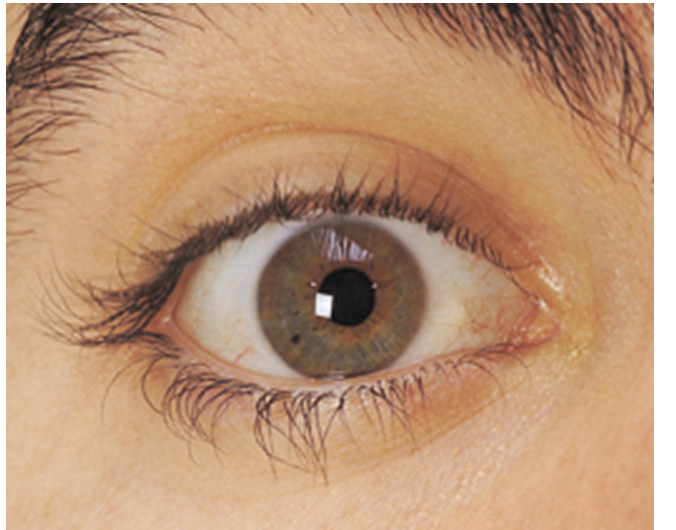
When assessing the external features of the eye, the nurse should be able to identify each accessory and structure of the eye. Identify the sclera.
Question
Question
Question
Question
Question
Question
Question
Question
Question
Question
Question
Question
Question
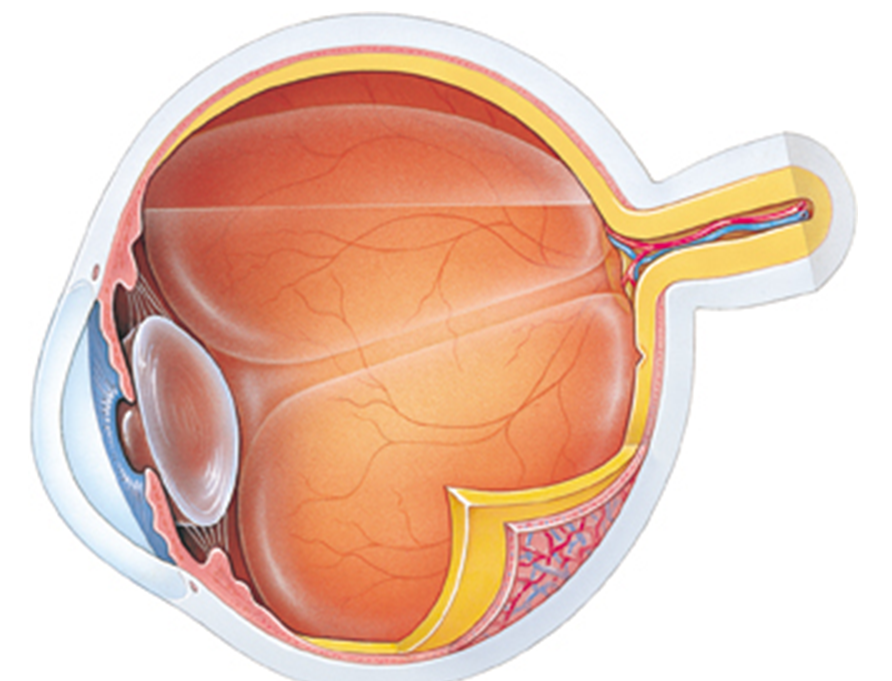
The nurse is preparing to assess the patient's corneal reflex. Place an X on the site where the nurse may lightly touch with a wisp of cotton.
Question
Question
Question
Performing the Weber test for hearing assessment may identify which abnormalities? Select all that apply. 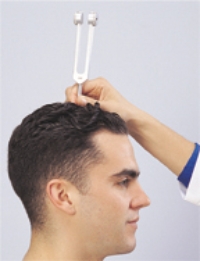 Select all that apply.
A)conductive hearing loss
B)sensoirneural hearing loss
C)otitis media
D)degree of hearing loss
E)tumor of the middle ear
Select all that apply.A)conductive hearing loss
B)sensoirneural hearing loss
C)otitis media
D)degree of hearing loss
E)tumor of the middle ear
Question
Question
Question
Question
Question
Question
Question
Question
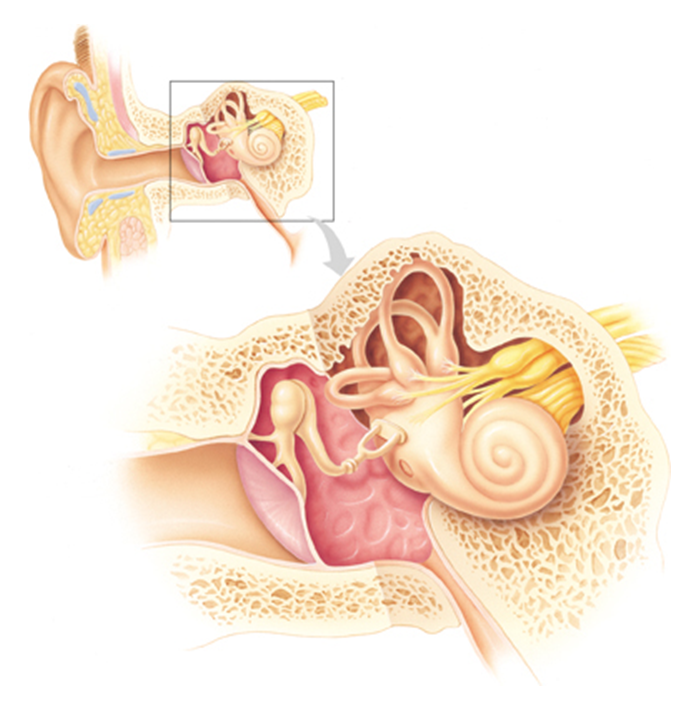
The patient has come to the outpatient clinic with complaints of dizziness. The patient states, "When I'm walking through our house, there have been times that I have had to hold onto furniture to keep from falling." The physician has identified that the patient has an ear disorder. Place an "X" over the area of the ear that is most likely responsible for the patient's symptom.
Question
Question
Question
Question
The hearing assessment demonstrated in the accompanying image is known as which of the following? 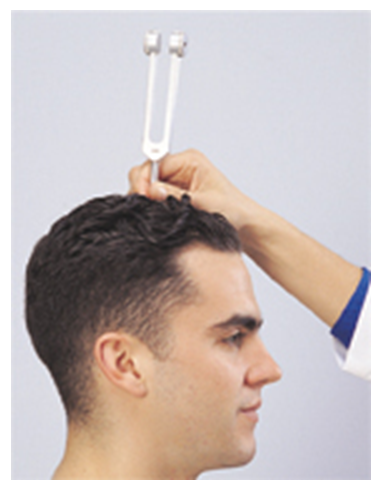
A)Rinne test
B)tympanogram
C)auditory precision test
D)Weber test
A)Rinne test
B)tympanogram
C)auditory precision test
D)Weber test
Question
Question
Question
Question
Question

Unlock Deck
Sign up to unlock the cards in this deck!
Unlock Deck
Unlock Deck
1/41

Play

Full screen (f)
Deck 45: Assessing the Eye and Ear
1
A patient with a right eye injury has received an eye patch. The nurse realizes that this patient might experience difficulty with
A)depth perception.
B)reading.
C)light perception.
D)color perception.
A)depth perception.
B)reading.
C)light perception.
D)color perception.
depth perception.
2
During the assessment of a patient's outer eyes, the nurse suspects that the patient has a hair follicle infection and elevated lipid levels. Which of the following did the nurse most likely assess in this patient? Select all that apply.
A)xanthelasma
B)ptosis
C)exophthalmos
D)sty
E)yellow sclera
A)xanthelasma
B)ptosis
C)exophthalmos
D)sty
E)yellow sclera
xanthelasma
sty
sty
3
The nurse is assessing a patient's visual fields by covering the patient's right eye with an opaque covering. The nurse should then do which of the following?
A)Cover own right eye.
B)Cover own left eye.
C)Keep both eyes uncovered.
D)Turn the lights on in the room before conducting this examination.
A)Cover own right eye.
B)Cover own left eye.
C)Keep both eyes uncovered.
D)Turn the lights on in the room before conducting this examination.
Cover own left eye.
4
The patient assessment reveals absence of the fovea centralis. The next examination that may be anticipated by the nurse is
A)inspection of the red reflex.
B)inspection of the retina.
C)inspection of the macula.
D)inspection of the optic disc.
A)inspection of the red reflex.
B)inspection of the retina.
C)inspection of the macula.
D)inspection of the optic disc.
Unlock Deck
Unlock for access to all 41 flashcards in this deck.
Unlock Deck
k this deck
5
A patient is found to need corrective lenses. Which of the following diagnostic tests was most likely used to determine this finding?
A)computed tomography (CT) scan
B)tonometry
C)refractometry
D)response to atropine eye drops
A)computed tomography (CT) scan
B)tonometry
C)refractometry
D)response to atropine eye drops
Unlock Deck
Unlock for access to all 41 flashcards in this deck.
Unlock Deck
k this deck
6
During a Weber test, a patient is found to have increased hearing in the right ear. The nurse realizes that this finding is consistent with
A)normal aging.
B)conductive hearing loss in the left ear.
C)possible buildup of cerumen or otitis media in the right ear.
D)perforated left ear drum.
A)normal aging.
B)conductive hearing loss in the left ear.
C)possible buildup of cerumen or otitis media in the right ear.
D)perforated left ear drum.
Unlock Deck
Unlock for access to all 41 flashcards in this deck.
Unlock Deck
k this deck
7
An elderly patient says, "I seem to be talking so much louder these days and I don't know why!" The nurse realizes that this patient is experiencing
A)loss of hair cells in the middle ear.
B)cochlea atrophy.
C)impacted cerumen.
D)stiffening of the middle ear structures.
A)loss of hair cells in the middle ear.
B)cochlea atrophy.
C)impacted cerumen.
D)stiffening of the middle ear structures.
Unlock Deck
Unlock for access to all 41 flashcards in this deck.
Unlock Deck
k this deck
8
When assessing the external features of the eye, the nurse should be able to identify each accessory and structure of the eye. Identify the sclera.
Unlock Deck
Unlock for access to all 41 flashcards in this deck.
Unlock Deck
k this deck
9
A patient has sustained an injury to the inner layer of his left retina. The nurse realizes that this patient will have difficulty with
A)tear production.
B)blinking.
C)reading.
D)peripheral vision and color perception.
A)tear production.
B)blinking.
C)reading.
D)peripheral vision and color perception.
Unlock Deck
Unlock for access to all 41 flashcards in this deck.
Unlock Deck
k this deck
10
A patient is found to have small, raised lesions on the rim of the ear. This finding is consistent with which of the following?
A)hypertension
B)gout
C)heart disease
D)kidneykidney failure
A)hypertension
B)gout
C)heart disease
D)kidneykidney failure
Unlock Deck
Unlock for access to all 41 flashcards in this deck.
Unlock Deck
k this deck
11
A patient who is using atropine eye drops is found to have a poor consensual light response. The nurse realizes that this finding is considered
A)abnormal and should be reported to the physician.
B)normal because of the eye drops.
C)evidence of retinal degeneration.
D)evidence of optic nerve damage.
A)abnormal and should be reported to the physician.
B)normal because of the eye drops.
C)evidence of retinal degeneration.
D)evidence of optic nerve damage.
Unlock Deck
Unlock for access to all 41 flashcards in this deck.
Unlock Deck
k this deck
12
A patient with a sore throat is complaining of "trouble with hearing." The nurse realizes that this patient might be experiencing
A)a sinus infection.
B)a middle ear infection.
C)infected tonsils.
D)an inner ear infection.
A)a sinus infection.
B)a middle ear infection.
C)infected tonsils.
D)an inner ear infection.
Unlock Deck
Unlock for access to all 41 flashcards in this deck.
Unlock Deck
k this deck
13
During an eye examination, the nurse positions the patient. After repeated attempts, the patient is able to read all of the letters on the Snellen chart without difficulty at a distance of 15 feet. From this finding the nurse can determine that the patient
A)has normal 20/20 vision.
B)has normal reading vision.
C)has visual impairments.
D)has a normal pupillary reflex.
A)has normal 20/20 vision.
B)has normal reading vision.
C)has visual impairments.
D)has a normal pupillary reflex.
Unlock Deck
Unlock for access to all 41 flashcards in this deck.
Unlock Deck
k this deck
14
While exiting a burning building, a patient's eyebrows and lashes were burned. The nurse realizes that this patient might experience
A)wound infections.
B)fluid and electrolyte imbalance.
C)foreign bodies in the eyes.
D)itchiness as the hair grows back.
A)wound infections.
B)fluid and electrolyte imbalance.
C)foreign bodies in the eyes.
D)itchiness as the hair grows back.
Unlock Deck
Unlock for access to all 41 flashcards in this deck.
Unlock Deck
k this deck
15
The nurse notes that a patient's left eye deviates inward while focusing on an object. This finding is consistent with which of the following?
A)presbyopia
B)hyperopia
C)strabismus
D)myopia
A)presbyopia
B)hyperopia
C)strabismus
D)myopia
Unlock Deck
Unlock for access to all 41 flashcards in this deck.
Unlock Deck
k this deck
16
A patient receiving an eye exam has to stand 20 feet from the chart to read a line that a person with normal vision could read 100 feet from the chart. The nurse would document this as ______ vision.
Unlock Deck
Unlock for access to all 41 flashcards in this deck.
Unlock Deck
k this deck
17
A patient is scheduled for diagnostic tests to determine the cause of his hearing and balance disorder. The diagnostic tests that could be used to help this patient include which of the following? Select all that apply.
A)tonometry
B)computed tomography (CT) scan
C)caloric test
D)auditory evoked potentials (AEP)
E)auditory brainstem response (ABR)
A)tonometry
B)computed tomography (CT) scan
C)caloric test
D)auditory evoked potentials (AEP)
E)auditory brainstem response (ABR)
Unlock Deck
Unlock for access to all 41 flashcards in this deck.
Unlock Deck
k this deck
18
A 20-year-old patient is demonstrating difficulty with near vision. The nurse realizes that this finding is
A)consistent with the aging process.
B)normal in a 20-year-old patient.
C)evidence of presbyopia.
D)evidence of hyperopia.
A)consistent with the aging process.
B)normal in a 20-year-old patient.
C)evidence of presbyopia.
D)evidence of hyperopia.
Unlock Deck
Unlock for access to all 41 flashcards in this deck.
Unlock Deck
k this deck
19
A patient, recovering from a stroke, is demonstrating vision changes. The nurse realizes that this is because
A)the stroke occurred in the optic region of the patient's brain.
B)the brain interprets information received through the eyes.
C)the patient is experiencing another stroke.
D)the patient is unable to talk because of the stroke.
A)the stroke occurred in the optic region of the patient's brain.
B)the brain interprets information received through the eyes.
C)the patient is experiencing another stroke.
D)the patient is unable to talk because of the stroke.
Unlock Deck
Unlock for access to all 41 flashcards in this deck.
Unlock Deck
k this deck
20
The nurse is preparing to perform an otoscopic exam of the ear. The patient is restless but has agreed to the exam. List in priority how the nurse would perform the exam. Click and drag the options below to move them up or down.
A)Explain the procedure to the patient.
B)Grasp the superior portion of the auricle and pull up, out, and back to straighten the auditory canal.
C)Hold the handle of the otoscope in your dominant hand, otoscope handle upward.Choice
D)Wash your hands.
E)Turn on the otoscope light.
F)Rest the hand, holding the otoscope, against the patient's head.
A)Explain the procedure to the patient.
B)Grasp the superior portion of the auricle and pull up, out, and back to straighten the auditory canal.
C)Hold the handle of the otoscope in your dominant hand, otoscope handle upward.Choice
D)Wash your hands.
E)Turn on the otoscope light.
F)Rest the hand, holding the otoscope, against the patient's head.
Unlock Deck
Unlock for access to all 41 flashcards in this deck.
Unlock Deck
k this deck
21
The nurse is preparing to assess the patient's corneal reflex. Place an X on the site where the nurse may lightly touch with a wisp of cotton.
Unlock Deck
Unlock for access to all 41 flashcards in this deck.
Unlock Deck
k this deck
22
What function is provided by the inner ear? Select all that apply.
A)coordinates visual pathways
B)integrates efferent neuron messages
C)provides information about head position
D)maintains middle ear structure and function
E)sound conduction
A)coordinates visual pathways
B)integrates efferent neuron messages
C)provides information about head position
D)maintains middle ear structure and function
E)sound conduction
Unlock Deck
Unlock for access to all 41 flashcards in this deck.
Unlock Deck
k this deck
23
When assessing an older adult, the nurse should review the age-related changes (see accompanying box). After review of the age-related changes, the nurse recognizes that which of the following would be a priority of concern for the older adult with vestibular degeneration?
A)skin breakdown
B)fall prevention
C)nausea
D)low night vision
A)skin breakdown
B)fall prevention
C)nausea
D)low night vision
Unlock Deck
Unlock for access to all 41 flashcards in this deck.
Unlock Deck
k this deck
24
Performing the Weber test for hearing assessment may identify which abnormalities? Select all that apply. Select all that apply.
A)conductive hearing loss
B)sensoirneural hearing loss
C)otitis media
D)degree of hearing loss
E)tumor of the middle ear
Select all that apply.A)conductive hearing loss
B)sensoirneural hearing loss
C)otitis media
D)degree of hearing loss
E)tumor of the middle ear
Unlock Deck
Unlock for access to all 41 flashcards in this deck.
Unlock Deck
k this deck
25
A patient receiving an eye exam has to stand 20 feet from the chart to read a line that a person with normal vision could read 100 feet from the chart. The nurse would document this as ______ vision.
Unlock Deck
Unlock for access to all 41 flashcards in this deck.
Unlock Deck
k this deck
26
When assessing for a possible conductive hearing loss, which should the nurse perform first?
A)external ear exam
B)Weber test
C)Rinne test
D)tympanogram
A)external ear exam
B)Weber test
C)Rinne test
D)tympanogram
Unlock Deck
Unlock for access to all 41 flashcards in this deck.
Unlock Deck
k this deck
27
A patient has tonometer test results of 28 mmHg. Which explanation by the nurse of tonometer pressure readings is most accurate?
A)The pressure in the posterior chamber of the eye is measured, which is too low and requires medication to increase the pressure to prevent blindness from retinal damage.
B)The pressure in the inner ear is measured to evaluate the semicircular canals functions related to nerve damage, and is within the normal range.
C)The pressure in the middle ear that builds up with mastoiditis is measured and needs to be treated with surgical insertion of tubes to drain the fluid behind the tympanic membrane.
D)The pressure in the anterior chamber of the eye is measured and could lead to possible retinal changes due to above-normal pressures if not treated.
A)The pressure in the posterior chamber of the eye is measured, which is too low and requires medication to increase the pressure to prevent blindness from retinal damage.
B)The pressure in the inner ear is measured to evaluate the semicircular canals functions related to nerve damage, and is within the normal range.
C)The pressure in the middle ear that builds up with mastoiditis is measured and needs to be treated with surgical insertion of tubes to drain the fluid behind the tympanic membrane.
D)The pressure in the anterior chamber of the eye is measured and could lead to possible retinal changes due to above-normal pressures if not treated.
Unlock Deck
Unlock for access to all 41 flashcards in this deck.
Unlock Deck
k this deck
28
The nurse suspects that a bone-conductive hearing loss is present in the patient. Which diagnostic would best differentiate between bone conduction loss and air conduction loss?
A)Rinne test
B)Weber test
C)assessment of balance and body position
D)palpation of mastoid process
A)Rinne test
B)Weber test
C)assessment of balance and body position
D)palpation of mastoid process
Unlock Deck
Unlock for access to all 41 flashcards in this deck.
Unlock Deck
k this deck
29
When performing the caloric test, nystagmus develops in the left eye while irrigating the right ear. The nurse evaluates the patient further for which condition that contributes to these results?
A)alcohol, CNS depression, or barbiturate use
B)increased anterior pressure in the left eye
C)nothing, since nerves are intact in the inner ear
D)increased pressure from brain lesions
A)alcohol, CNS depression, or barbiturate use
B)increased anterior pressure in the left eye
C)nothing, since nerves are intact in the inner ear
D)increased pressure from brain lesions
Unlock Deck
Unlock for access to all 41 flashcards in this deck.
Unlock Deck
k this deck
30
When teaching a community health class about eye safety, which statement by one of the participants would reflect a need for additional teaching by the nurse?
A)"I will wear goggles whenever I work around equipment such as lawnmowers, saws, and trimmers."
B)"When I play sports, I should wear protective eyewear to minimize risks of eye injury."
C)"When working with chemicals, if a splash occurs, I should first call 911 and then go to the emergency facility."
D)"When working or playing in the outdoors, I should wear shades that have UV protection even if the day is cloudy."
A)"I will wear goggles whenever I work around equipment such as lawnmowers, saws, and trimmers."
B)"When I play sports, I should wear protective eyewear to minimize risks of eye injury."
C)"When working with chemicals, if a splash occurs, I should first call 911 and then go to the emergency facility."
D)"When working or playing in the outdoors, I should wear shades that have UV protection even if the day is cloudy."
Unlock Deck
Unlock for access to all 41 flashcards in this deck.
Unlock Deck
k this deck
31
Of the following ear assessments, which may be used to assess the ability to hear in the older adult patient? Select all that apply.
A)whisper test
B)Rinne test
C)Weber test
D)audiometer
E)caloric test
A)whisper test
B)Rinne test
C)Weber test
D)audiometer
E)caloric test
Unlock Deck
Unlock for access to all 41 flashcards in this deck.
Unlock Deck
k this deck
32
The patient has come to the outpatient clinic with complaints of dizziness. The patient states, "When I'm walking through our house, there have been times that I have had to hold onto furniture to keep from falling." The physician has identified that the patient has an ear disorder. Place an "X" over the area of the ear that is most likely responsible for the patient's symptom.
Unlock Deck
Unlock for access to all 41 flashcards in this deck.
Unlock Deck
k this deck
33
When planning home management for a patient who recently lost vision after eye trauma, what question would be most appropriate to evaluate the emotional status of the patient?
A)"Do you feel depressed about your vision loss?"
B)"Tell me how your change in vision has affected how you feel about yourself."
C)"Have you made arrangements for someone to help you around the house?"
D)"A lot of people do very well with little help once they get home."
A)"Do you feel depressed about your vision loss?"
B)"Tell me how your change in vision has affected how you feel about yourself."
C)"Have you made arrangements for someone to help you around the house?"
D)"A lot of people do very well with little help once they get home."
Unlock Deck
Unlock for access to all 41 flashcards in this deck.
Unlock Deck
k this deck
34
The nurse is assessing the patient's ears. The patient is from East India. Which of the following findings are abnormal?
A)During the Rinne test, the patient hears the sound by air conduction for an equal amount of time as bone conduction.
B)During the whisper test, the patient can hear the nurse whisper from sixsix inches away.
C)The results of the tympanogram indicate that the patient's middle ear pressure is 200 daPa.
D)The patient's cerumen is dark gray.
E)The patient's tympanic membrane is pearly gray.
A)During the Rinne test, the patient hears the sound by air conduction for an equal amount of time as bone conduction.
B)During the whisper test, the patient can hear the nurse whisper from sixsix inches away.
C)The results of the tympanogram indicate that the patient's middle ear pressure is 200 daPa.
D)The patient's cerumen is dark gray.
E)The patient's tympanic membrane is pearly gray.
Unlock Deck
Unlock for access to all 41 flashcards in this deck.
Unlock Deck
k this deck
35
The nurse is performing an assessment of the patient's eyes. The patient is 82 years old. Which of the following statements are expected based upon the patient's age? Select all that apply.
A)"I've been having some drainage from the inside corner of my eye."
B)"My eyes feel so dry most of the time."
C)"I have almost fallen several times at home going down our basement stairs."
D)"My vision is a little blurry."
E)"I have a hard time driving at night."
A)"I've been having some drainage from the inside corner of my eye."
B)"My eyes feel so dry most of the time."
C)"I have almost fallen several times at home going down our basement stairs."
D)"My vision is a little blurry."
E)"I have a hard time driving at night."
Unlock Deck
Unlock for access to all 41 flashcards in this deck.
Unlock Deck
k this deck
36
The hearing assessment demonstrated in the accompanying image is known as which of the following?
A)Rinne test
B)tympanogram
C)auditory precision test
D)Weber test
A)Rinne test
B)tympanogram
C)auditory precision test
D)Weber test
Unlock Deck
Unlock for access to all 41 flashcards in this deck.
Unlock Deck
k this deck
37
Which nursing diagnosis is the top priority for a patient complaining of dizziness and disequilibrium with head movements?
A)Fluid Volume Deficit
B)Impaired Adjustment
C)Ineffective Coping
D)Risk for Falls
A)Fluid Volume Deficit
B)Impaired Adjustment
C)Ineffective Coping
D)Risk for Falls
Unlock Deck
Unlock for access to all 41 flashcards in this deck.
Unlock Deck
k this deck
38
When assessing a 75-year-old patient, which statement would require immediate action by the nurse?
A)floaters being present at times
B)additional light and reading glasses being needed more often
C)the development of a white circle around the iris
D)frequent falls from tripping over items in the floor
A)floaters being present at times
B)additional light and reading glasses being needed more often
C)the development of a white circle around the iris
D)frequent falls from tripping over items in the floor
Unlock Deck
Unlock for access to all 41 flashcards in this deck.
Unlock Deck
k this deck
39
When the nurse was assessing a patient for neurological changes from a head trauma, which eye assessments are included? Select all that apply.
A)ptosis
B)extraocular movements
C)accommodation
D)color of iris
E)nystagmus
A)ptosis
B)extraocular movements
C)accommodation
D)color of iris
E)nystagmus
Unlock Deck
Unlock for access to all 41 flashcards in this deck.
Unlock Deck
k this deck
40
Which health history Select all that apply.
A)"Do you have any pain in your ears?"
B)"Have you experienced any ringing in your ears?"
C)"Have you ever had drainage from your ears?"
D)"Does anyone in your family have congenital deafness?"
E)"Have you noticed a change in your hearing, such as muffling of sounds?"
A)"Do you have any pain in your ears?"
B)"Have you experienced any ringing in your ears?"
C)"Have you ever had drainage from your ears?"
D)"Does anyone in your family have congenital deafness?"
E)"Have you noticed a change in your hearing, such as muffling of sounds?"
Unlock Deck
Unlock for access to all 41 flashcards in this deck.
Unlock Deck
k this deck
41
What is a high-priority risk for the older adult with age-related changes in the vestibular structures of the ear? Select all that apply.
A)infection
B)falls
C)medication errors
D)food intolerance
E)problems communicating
A)infection
B)falls
C)medication errors
D)food intolerance
E)problems communicating
Unlock Deck
Unlock for access to all 41 flashcards in this deck.
Unlock Deck
k this deck
Unlock Deck
Unlock for access to all 41 flashcards in this deck.






