







 Chat with AI

Deck 29: Assessing the Cardiovascular System
Full screen (f)

Question

Question
Question
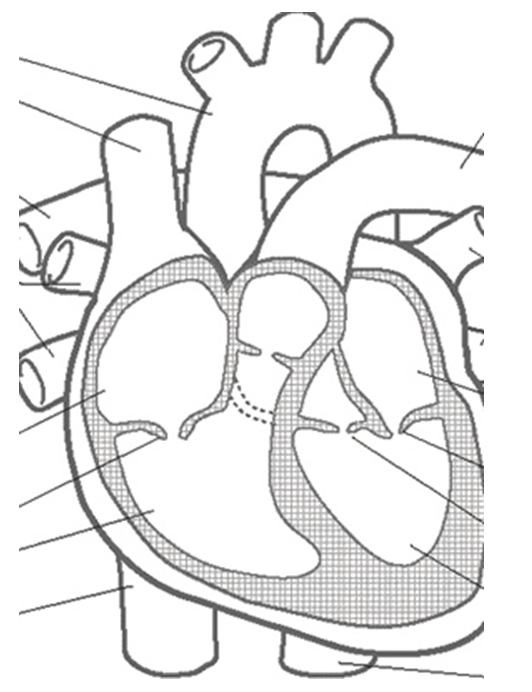
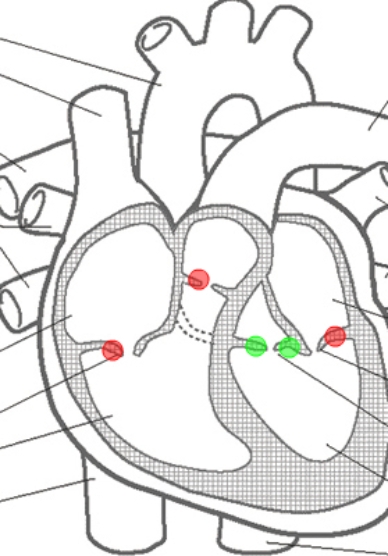
The S1 heart sound corresponds to the closure of which heart valves? Place an "X" over the location of these valves on the diagram below.
Question
Question
Question
Question
Question
Question
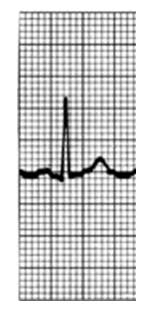
Place an "X" at the location of the T wave in the electrocardiogram diagram below.
Question
Question
Question
Question
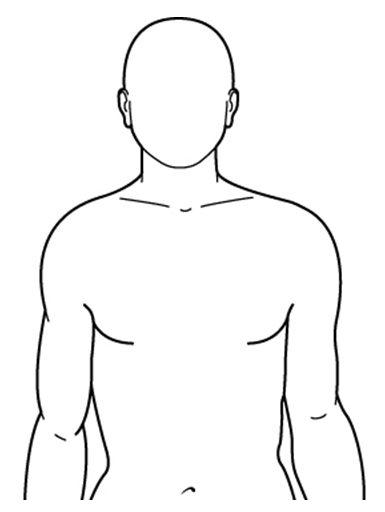
Place an "X" on the diagram below at the site where the S2 heart sound is loudest upon auscultation.
Question
Question
Question
Question
Question
Question
Question
Question
Question
Question
Question
Question
Question
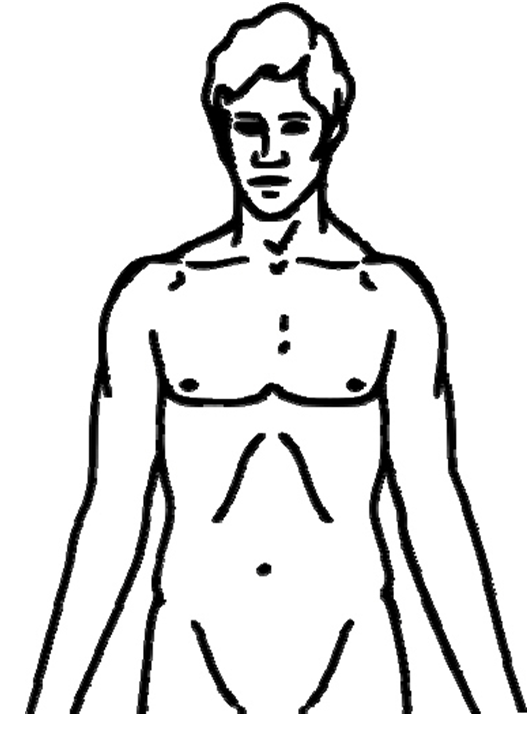
The nurse is instructing the patient who is having a left cardiac catheterization and explains where the catheter will be inserted. Place an "X" over the insertion site on the diagram below.
Question
Question
Question
Question
Question
Question
Question
Question
Question
Question
Question
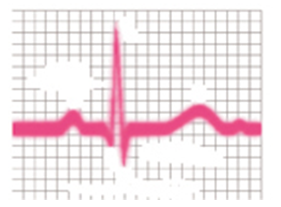
Analyze the electrocardiogram strip (see below) and place an "X" over the location of the segment that represents atrial depolarization and contraction.
Question
Question
Question
Question
Question
Question
Question
Question
Question
Question
Question

Unlock Deck
Sign up to unlock the cards in this deck!
Unlock Deck
Unlock Deck
1/48

Play

Full screen (f)
Deck 29: Assessing the Cardiovascular System
1
The nurse is reviewing an electrocardiogram (ECG) rhythm strip. The P waves and QRS complexes are regular. The PR interval is 0.16 second and QRS complexes measure 0.06 second. The overall heart rate is 64 beats/minute. Which of the following would be a correct interpretation based on these characteristics?
A)normal sinus rhythm
B)sick sinus syndrome
C)sinus bradycardia
D)first-degree heart block
A)normal sinus rhythm
B)sick sinus syndrome
C)sinus bradycardia
D)first-degree heart block
normal sinus rhythm
2
A male patient had a lipid profile completed at a community health fair and the nurse is reviewing the results with the patient. (See lipid profile results above.) What is the nurse's best response?
A)The results are outside the acceptable normal values indicating the patient is at increased risk for coronary artery disease (CAD).
B)The patient's HDL is elevated indicating the patient is at increased risk for coronary artery disease (CAD).
C)The results are within normal range with the exception of the LDL which is slightly elevated.
D)Triglycerides are elevated therefore the patient is advised to review his fat intake and reduce the amount of unsaturated fat in his diet.
A)The results are outside the acceptable normal values indicating the patient is at increased risk for coronary artery disease (CAD).
B)The patient's HDL is elevated indicating the patient is at increased risk for coronary artery disease (CAD).
C)The results are within normal range with the exception of the LDL which is slightly elevated.
D)Triglycerides are elevated therefore the patient is advised to review his fat intake and reduce the amount of unsaturated fat in his diet.
The results are outside the acceptable normal values indicating the patient is at increased risk for coronary artery disease (CAD).
3
The S1 heart sound corresponds to the closure of which heart valves? Place an "X" over the location of these valves on the diagram below.
4
A patient being evaluated for cardiac pathology asks the nurse why sodium, calcium, and potassium are so important in his diet. What is the nurse's best response?
A)"The action potentials of the heart muscle cells are dependent upon the diffusion of sodium, potassium and calcium across the cell membrane."
B)"Because you are on potassium supplements, it is important to monitor electrolytes."
C)"Heart rate is affected by the oxygen levels in your body, which involves the attachment of oxygen molecules to these electrolytes."
D)"It is the pacemaker of your heart that is responsible for the heart beat."
A)"The action potentials of the heart muscle cells are dependent upon the diffusion of sodium, potassium and calcium across the cell membrane."
B)"Because you are on potassium supplements, it is important to monitor electrolytes."
C)"Heart rate is affected by the oxygen levels in your body, which involves the attachment of oxygen molecules to these electrolytes."
D)"It is the pacemaker of your heart that is responsible for the heart beat."
Unlock Deck
Unlock for access to all 48 flashcards in this deck.
Unlock Deck
k this deck
5
At which location will S1 be heard the loudest?
A)left midclavicular line at the fifth intercostal space
B)left sternal border at the fifth intercostal space
C)right midclavicular line at the fifth intercostal space
D)right sternal border at the third intercostal space
A)left midclavicular line at the fifth intercostal space
B)left sternal border at the fifth intercostal space
C)right midclavicular line at the fifth intercostal space
D)right sternal border at the third intercostal space
Unlock Deck
Unlock for access to all 48 flashcards in this deck.
Unlock Deck
k this deck
6
Which of the following would be an example of the term cardiac reserve?
A)getting on a treadmill and gradually increasing the pace of walking
B)breathing in through the nose and out the mouth while sitting quietly
C)sitting in a chair, to cool down, after having completed an exercise routine
D)at the end of systole, approximately 50 mL of blood remains in the ventricles
A)getting on a treadmill and gradually increasing the pace of walking
B)breathing in through the nose and out the mouth while sitting quietly
C)sitting in a chair, to cool down, after having completed an exercise routine
D)at the end of systole, approximately 50 mL of blood remains in the ventricles
Unlock Deck
Unlock for access to all 48 flashcards in this deck.
Unlock Deck
k this deck
7
In the patient with hypovolemic shock, the nurse realizes that the heart sounds will change in which of the following ways?
A)diminished S2 and accentuated
B)accentuated S2 and diminished S1
C)S1diminished S1 and S2
D)no change in S1 or S2
A)diminished S2 and accentuated
B)accentuated S2 and diminished S1
C)S1diminished S1 and S2
D)no change in S1 or S2
Unlock Deck
Unlock for access to all 48 flashcards in this deck.
Unlock Deck
k this deck
8
The patient's ECG shows the following characteristics: PR interval .08, QRS .08, and isoelectric ST segment. The nurse realizes that these characteristics indicate which of the following?
A)faster than normal conduction from the SA node to the ventricles, normal conduction through the ventricles and normal ST segment
B)faster than normal conduction from the SA node to the ventricles, faster than normal conduction through the ventricles and normal ST segment
C)normal conduction from the SA node to the ventricles, normal conduction through the ventricles and normal ST segment
D)normal conduction from the SA node to the ventricles, normal conduction through the ventricles and abnormal ST segment
A)faster than normal conduction from the SA node to the ventricles, normal conduction through the ventricles and normal ST segment
B)faster than normal conduction from the SA node to the ventricles, faster than normal conduction through the ventricles and normal ST segment
C)normal conduction from the SA node to the ventricles, normal conduction through the ventricles and normal ST segment
D)normal conduction from the SA node to the ventricles, normal conduction through the ventricles and abnormal ST segment
Unlock Deck
Unlock for access to all 48 flashcards in this deck.
Unlock Deck
k this deck
9
Place an "X" at the location of the T wave in the electrocardiogram diagram below.
Unlock Deck
Unlock for access to all 48 flashcards in this deck.
Unlock Deck
k this deck
10
The patient is being evaluated for left atrium thrombus due to a dysrhythmia (altered heart rhythm). Which of the following cardiac tests will be ordered to assess for thrombus?
A)transesophageal echocardiography (TEE)
B)pericardiocentesis
C)cardiac catheterization
D)computed tomography (CT)
A)transesophageal echocardiography (TEE)
B)pericardiocentesis
C)cardiac catheterization
D)computed tomography (CT)
Unlock Deck
Unlock for access to all 48 flashcards in this deck.
Unlock Deck
k this deck
11
What physical assessment data is necessary to calculate a patient's cardiac index (CI)?
A)weight and height
B)weight only
C)weight and waist measurement
D)waist measurement and height
A)weight and height
B)weight only
C)weight and waist measurement
D)waist measurement and height
Unlock Deck
Unlock for access to all 48 flashcards in this deck.
Unlock Deck
k this deck
12
The primary factor regulating blood flow through the coronary arteries is which of the following?
A)blood pressure in the aorta
B)blood vessel dilation
C)the low pressure systemic circulation
D)the draining of blood into the coronary sinus by the coronary veins
A)blood pressure in the aorta
B)blood vessel dilation
C)the low pressure systemic circulation
D)the draining of blood into the coronary sinus by the coronary veins
Unlock Deck
Unlock for access to all 48 flashcards in this deck.
Unlock Deck
k this deck
13
Place an "X" on the diagram below at the site where the S2 heart sound is loudest upon auscultation.
Unlock Deck
Unlock for access to all 48 flashcards in this deck.
Unlock Deck
k this deck
14
The nurse is caring for a patient admitted with a grade III heart murmur heard during midsystole. The nurse realizes that the following cardiac conditions could result in which assessment finding? Select all that apply.
A)aortic stenosis
B)cardiomyopathy
C)atrioventricular (AV) valve disease
D)mitral valve prolaps
A)aortic stenosis
B)cardiomyopathy
C)atrioventricular (AV) valve disease
D)mitral valve prolaps
Unlock Deck
Unlock for access to all 48 flashcards in this deck.
Unlock Deck
k this deck
15
Place the following steps in the correct order for interpreting an electrocardiogram (ECG) rhythm strip. Click and drag the options below to move them up or down.
A)Determine rate.
B)Determine regularity.
C)Assess P wave.
D)Assess P to QRS relationship.
E)Determine interval durations.
F)Identify abnormalities.
A)Determine rate.
B)Determine regularity.
C)Assess P wave.
D)Assess P to QRS relationship.
E)Determine interval durations.
F)Identify abnormalities.
Unlock Deck
Unlock for access to all 48 flashcards in this deck.
Unlock Deck
k this deck
16
Place the following terms in the correct order (from outer to inner) to describe the coverings and layers of the heart. Click and drag the options below to move them up or down.
A)fibrous pericardium
B)parietal layer of serous pericardium
C)pericardial cavity
D)epicardium
E)myocardium
F)endocardium
A)fibrous pericardium
B)parietal layer of serous pericardium
C)pericardial cavity
D)epicardium
E)myocardium
F)endocardium
Unlock Deck
Unlock for access to all 48 flashcards in this deck.
Unlock Deck
k this deck
17
The patient is having a treadmill test. Which of the following is an important teaching point?
A)Comfortable clothing and shoes should be worn for the test.
B)A patient gown and slippers should be worn for the test.
C)Smoking is permitted up until the time of the test.
D)There are no restrictions prior to the test in the foods eaten as long as small meals are planned the day of the test.
A)Comfortable clothing and shoes should be worn for the test.
B)A patient gown and slippers should be worn for the test.
C)Smoking is permitted up until the time of the test.
D)There are no restrictions prior to the test in the foods eaten as long as small meals are planned the day of the test.
Unlock Deck
Unlock for access to all 48 flashcards in this deck.
Unlock Deck
k this deck
18
A patient comes into the health clinic asking for advice on lowering the individual's risk of heart disease. The nurse's best response is to do which of the following?
A)Conduct a health history and physical exam to determine the patient's area of risks and then educate the patient based upon these findings.
B)Conduct a physical exam of the patient and discuss the findings.
C)Determine the patient's risks based upon a prior chart for the patient.
D)Discuss the patient's perceived area of health risks.
A)Conduct a health history and physical exam to determine the patient's area of risks and then educate the patient based upon these findings.
B)Conduct a physical exam of the patient and discuss the findings.
C)Determine the patient's risks based upon a prior chart for the patient.
D)Discuss the patient's perceived area of health risks.
Unlock Deck
Unlock for access to all 48 flashcards in this deck.
Unlock Deck
k this deck
19
When listening to heart sounds, the nurse expects to hear S1 and S2.The presence of an additional sound immediately following S2 is called _____, which can result from _____.
A)S3, ventricular volume overload
B)S4, increased resistance to ventricular filling
C)S4, inflammation of the pericardial sac
D)S3, a stenotic mitral valve
A)S3, ventricular volume overload
B)S4, increased resistance to ventricular filling
C)S4, inflammation of the pericardial sac
D)S3, a stenotic mitral valve
Unlock Deck
Unlock for access to all 48 flashcards in this deck.
Unlock Deck
k this deck
20
A patient is scheduled for a cardiac ejection fraction (EF) study. Correct facts that guide patient teaching include which of the following? Select all that apply.
A)Stroke volume times heart rate equals cardiac output.
B)The effectiveness of the pumping action of the heart is evaluated.
C)The study measures the percentage of blood in the ventricle ejected during a heartbeat.
D)The normal ejection fraction is 95-100%.
E)The study identifies the ischemic areas of the heart.
A)Stroke volume times heart rate equals cardiac output.
B)The effectiveness of the pumping action of the heart is evaluated.
C)The study measures the percentage of blood in the ventricle ejected during a heartbeat.
D)The normal ejection fraction is 95-100%.
E)The study identifies the ischemic areas of the heart.
Unlock Deck
Unlock for access to all 48 flashcards in this deck.
Unlock Deck
k this deck
21
A patient returns to the unit following a cardiac catheterization. Which are appropriate nursing interventions for this patient? Select all that apply.
A)Assess cardiac rhythm and rate.
B)Assess patient for complaints of shortness of breath.
C)Maintain bed rest as ordered.
D)Assess pulses proximal to the insertion site.
E)Maintain fluid restriction.
A)Assess cardiac rhythm and rate.
B)Assess patient for complaints of shortness of breath.
C)Maintain bed rest as ordered.
D)Assess pulses proximal to the insertion site.
E)Maintain fluid restriction.
Unlock Deck
Unlock for access to all 48 flashcards in this deck.
Unlock Deck
k this deck
22
The nurse is caring for a patient who has just undergone cardiac catheterization. The catheter insertion site is free from bleeding or signs of hematoma. Vital signs and distal pulses remain within normal range. Intravenous fluids were discontinued. The patient denies hunger or thirst and refuses food or fluids, asking to be left alone. Which of the following is the best response by the nurse?
A)"It is important that you drink fluids after the procedure to protect kidney function.I will bring you some fresh water."
B)"It is important that you ambulate, so I will return in 30 minutes to walk with you."
C)"You are recovering well from the procedure and rest is a good idea."
D)"You need to do the leg exercises that you practiced before the procedure to maintain good circulation to your legs.After your exercises, you can rest."
A)"It is important that you drink fluids after the procedure to protect kidney function.I will bring you some fresh water."
B)"It is important that you ambulate, so I will return in 30 minutes to walk with you."
C)"You are recovering well from the procedure and rest is a good idea."
D)"You need to do the leg exercises that you practiced before the procedure to maintain good circulation to your legs.After your exercises, you can rest."
Unlock Deck
Unlock for access to all 48 flashcards in this deck.
Unlock Deck
k this deck
23
Determine the ejection fraction (EF) of a patient whose stroke volume (SV) is 75 mL/beat and whose end-diastolic volume is 120 mL. Round to the nearest whole number and place the answer below. ____
Unlock Deck
Unlock for access to all 48 flashcards in this deck.
Unlock Deck
k this deck
24
When completing the health history of a patient with a suspected cardiac disorder, which of the following childhood illnesses should the nurse ask about?
A)rheumatic fever and strep throat infections
B)rubella and chicken pox
C)asthma and bronchitis
D)otitis media and respiratory syncytial virus (RSV)
A)rheumatic fever and strep throat infections
B)rubella and chicken pox
C)asthma and bronchitis
D)otitis media and respiratory syncytial virus (RSV)
Unlock Deck
Unlock for access to all 48 flashcards in this deck.
Unlock Deck
k this deck
25
The S1 heart sound corresponds to which of the following physiological events?
A)closure of the AV valves
B)closure of the semilunar valves
C)ejection of blood from the atria
D)the onset of relaxation
A)closure of the AV valves
B)closure of the semilunar valves
C)ejection of blood from the atria
D)the onset of relaxation
Unlock Deck
Unlock for access to all 48 flashcards in this deck.
Unlock Deck
k this deck
26
The nurse is instructing the patient who is having a left cardiac catheterization and explains where the catheter will be inserted. Place an "X" over the insertion site on the diagram below.
Unlock Deck
Unlock for access to all 48 flashcards in this deck.
Unlock Deck
k this deck
27
An important nutritional-metabolic interview question to ask patients who are being evaluated for heart conditions is which of the following?
A)"Have you had a recent weight gain or loss?"
B)"Is there any change in your usual bowel elimination?"
C)"Has there been a change in your usual daily activities?"
D)"Have you experienced chest pain in the last week?"
A)"Have you had a recent weight gain or loss?"
B)"Is there any change in your usual bowel elimination?"
C)"Has there been a change in your usual daily activities?"
D)"Have you experienced chest pain in the last week?"
Unlock Deck
Unlock for access to all 48 flashcards in this deck.
Unlock Deck
k this deck
28
Determine the cardiac output (CO) of a patient whose stroke volume (SV) is 80 mL/beat and whose heart rate (HR) is 75 beats/minute. Round to the nearest whole number and place the answer below. _______
Unlock Deck
Unlock for access to all 48 flashcards in this deck.
Unlock Deck
k this deck
29
Which of the following diagrams represents the appropriate location and sequence for auscultating heart sounds?
A) 11ea992e_0a30_3c18_9f38_9bc47c7b2638
B) 11ea992e_0a30_3c19_9f38_11412709a674
C) 11ea992e_0a30_3c1a_9f38_41e7555a0a98
D) 11ea992e_0a30_632b_9f38_ab2c5e4e332a
A) 11ea992e_0a30_3c18_9f38_9bc47c7b2638
B) 11ea992e_0a30_3c19_9f38_11412709a674
C) 11ea992e_0a30_3c1a_9f38_41e7555a0a98
D) 11ea992e_0a30_632b_9f38_ab2c5e4e332a
Unlock Deck
Unlock for access to all 48 flashcards in this deck.
Unlock Deck
k this deck
30
A female patient is returning to the clinic to discuss the results of her lipid profile (see above). The nurse explains that 11ea992e_0a30_d85e_9f38_056dcc177cf4
A)all results are above normal.
B)triglyceride level is elevated but other results are within normal range.
C)cholesterol and LDL levels are elevated but other results are within normal range.
D)only the cholesterol is above normal.
A)all results are above normal.
B)triglyceride level is elevated but other results are within normal range.
C)cholesterol and LDL levels are elevated but other results are within normal range.
D)only the cholesterol is above normal.
Unlock Deck
Unlock for access to all 48 flashcards in this deck.
Unlock Deck
k this deck
31
The patient is admitted to the hospital for evaluation and diagnosis of cardiovascular pathology. The patient is scheduled for an ejection fraction study. Correct facts that will guide patient teaching include which of the following? Select all that apply.
A)An ejection fraction (EF) study will measure the percentage of total blood in the ventricle ejected from the heart with each beat.
B)An ejection fraction (EF) provides information about how effectively the heart is pumping.
C)Stroke volume times heart rate equals cardiac output.
D)The normal ejection fraction is 95-100%.
A)An ejection fraction (EF) study will measure the percentage of total blood in the ventricle ejected from the heart with each beat.
B)An ejection fraction (EF) provides information about how effectively the heart is pumping.
C)Stroke volume times heart rate equals cardiac output.
D)The normal ejection fraction is 95-100%.
Unlock Deck
Unlock for access to all 48 flashcards in this deck.
Unlock Deck
k this deck
32
The patient is being interviewed by the nurse. Which functional health pattern is related to asking the patient if she has had tests to check the function of her heart?
A)health perception-health management
B)cognitive-perceptual
C)nutritional-metabolic
D)activity-exercise
A)health perception-health management
B)cognitive-perceptual
C)nutritional-metabolic
D)activity-exercise
Unlock Deck
Unlock for access to all 48 flashcards in this deck.
Unlock Deck
k this deck
33
When palpating a thrill on the precordium, the nurse recognizes this sign as being associated with which of the following cardiac conditions?
A)severe valve stenosis
B)an enlarged heart
C)stenosis of the carotid arteries
D)aortic aneurysm
A)severe valve stenosis
B)an enlarged heart
C)stenosis of the carotid arteries
D)aortic aneurysm
Unlock Deck
Unlock for access to all 48 flashcards in this deck.
Unlock Deck
k this deck
34
When assessing the adult heart, the nurse expects to hear the following normal heart sounds:
A)S1 then S2
B)S2 then S3
C)S3 then S4
D)S2 then S1
A)S1 then S2
B)S2 then S3
C)S3 then S4
D)S2 then S1
Unlock Deck
Unlock for access to all 48 flashcards in this deck.
Unlock Deck
k this deck
35
Place the following statement regarding cardiac catheterization in the correct order. Click and drag the options below to move them up or down.
A)Peripheral IV insertion.
B)Catheter insertion in the leg.
C)Thread catheter to heart chamber.
D)Inject contrast.
E)Heart activity is filmed.
A)Peripheral IV insertion.
B)Catheter insertion in the leg.
C)Thread catheter to heart chamber.
D)Inject contrast.
E)Heart activity is filmed.
Unlock Deck
Unlock for access to all 48 flashcards in this deck.
Unlock Deck
k this deck
36
Pericardiocentesis would be utilized in which of the following patient situations?
A)cardiac tamponade
B)slow heart rhythm
C)chest pain
D)suspected damage to a heart valve
A)cardiac tamponade
B)slow heart rhythm
C)chest pain
D)suspected damage to a heart valve
Unlock Deck
Unlock for access to all 48 flashcards in this deck.
Unlock Deck
k this deck
37
Analyze the electrocardiogram strip (see below) and place an "X" over the location of the segment that represents atrial depolarization and contraction.
Unlock Deck
Unlock for access to all 48 flashcards in this deck.
Unlock Deck
k this deck
38
The nurse is analyzing an electrocardiogram strip (ECG). Identify the correct order of the steps in this analyzing. Click and drag the options below to move them up or down.
A)Determine heart rate.
B)Determine regularity of the rhythm.
C)Assess P wave.
D)Assess P to QRS relationship.
E)Determine interval durations.
F)Identify abnormalities.
A)Determine heart rate.
B)Determine regularity of the rhythm.
C)Assess P wave.
D)Assess P to QRS relationship.
E)Determine interval durations.
F)Identify abnormalities.
Unlock Deck
Unlock for access to all 48 flashcards in this deck.
Unlock Deck
k this deck
39
The nurse reviews an ECG tracing and determines that it is not a high quality tracing. Which of the following factors can negatively influence an ECG tracing? Select all that apply.
A)patient movement during recording
B)history of COPD
C)incorrect positioning of leads
D)morbid obesity
E)leads in firm contact with the skin
A)patient movement during recording
B)history of COPD
C)incorrect positioning of leads
D)morbid obesity
E)leads in firm contact with the skin
Unlock Deck
Unlock for access to all 48 flashcards in this deck.
Unlock Deck
k this deck
40
When auscultating heart sounds, the patient is asked to lie on the left side, then sit up and lean forward. What is the rationale for this action?
A)The heart is closer to the chest wall.
B)It diminishes the effect of respiratory sounds during auscultation.
C)Use of the stethoscope diaphragm improves auscultation of high pitched murmurs.
D)Use of the bell side of the stethoscope allows low pitched sounds to be readily identified.
A)The heart is closer to the chest wall.
B)It diminishes the effect of respiratory sounds during auscultation.
C)Use of the stethoscope diaphragm improves auscultation of high pitched murmurs.
D)Use of the bell side of the stethoscope allows low pitched sounds to be readily identified.
Unlock Deck
Unlock for access to all 48 flashcards in this deck.
Unlock Deck
k this deck
41
At which location will S1 be heard the loudest?
A)left midclavicular line at the fifth intercostal space
B)left sternal border at the fifth intercostal space
C)right sternal border at the third intercostal space
D)right midclavicular line at the fifth intercostal space
A)left midclavicular line at the fifth intercostal space
B)left sternal border at the fifth intercostal space
C)right sternal border at the third intercostal space
D)right midclavicular line at the fifth intercostal space
Unlock Deck
Unlock for access to all 48 flashcards in this deck.
Unlock Deck
k this deck
42
In the patient with hypovolemic shock, the nurse realizes that the heart sounds will change in the which of the following ways?
A)diminished S2 and accentuated S1
B)diminished S1 and S2
C)accentuated S2 and diminished S1
D)no change in S1 or S2
A)diminished S2 and accentuated S1
B)diminished S1 and S2
C)accentuated S2 and diminished S1
D)no change in S1 or S2
Unlock Deck
Unlock for access to all 48 flashcards in this deck.
Unlock Deck
k this deck
43
At what location will S2 be heard the loudest?
A)right sternal border at the second intercostal space
B)left sternal border at the fifth intercostal space
C)right midclavicular line at the third intercostal space
D)left midclavicular line at the fifth intercostal space
A)right sternal border at the second intercostal space
B)left sternal border at the fifth intercostal space
C)right midclavicular line at the third intercostal space
D)left midclavicular line at the fifth intercostal space
Unlock Deck
Unlock for access to all 48 flashcards in this deck.
Unlock Deck
k this deck
44
When the nurse assesses an apical heart rate and hears _____, it is called tachycardia.
A)greater than 100 beats per minute
B)less than 60 beats per minute
C)60-90 beats per minute
D)90 beats per minute
A)greater than 100 beats per minute
B)less than 60 beats per minute
C)60-90 beats per minute
D)90 beats per minute
Unlock Deck
Unlock for access to all 48 flashcards in this deck.
Unlock Deck
k this deck
45
When auscultating the chest of a 75-year-old patient who recently experienced a myocardial infarction (MI), the nurse hears an S3 heart sound immediately following S2. Because of these findings, the nurse would assess for which other condition?
A)heart failure
B)extension of the MI
C)renal failure
D)liver failure
A)heart failure
B)extension of the MI
C)renal failure
D)liver failure
Unlock Deck
Unlock for access to all 48 flashcards in this deck.
Unlock Deck
k this deck
46
When listening to heart sounds, the nurse expects to hear S1 and S2. The presence of an additional sound immediately following S2 is called _______, which can result from ______.
A)S3, ventricular volume overload
B)S4, increased resistance to ventricular filling
C)S4, inflammation of the pericardial sac
D)S3, a stenotic mitral valve
A)S3, ventricular volume overload
B)S4, increased resistance to ventricular filling
C)S4, inflammation of the pericardial sac
D)S3, a stenotic mitral valve
Unlock Deck
Unlock for access to all 48 flashcards in this deck.
Unlock Deck
k this deck
47
The nurse is caring for a patient admitted with a grade III heart murmur heard during midsystole. The nurse realizes that the following cardiac conditions could result in which assessment finding? Select all that apply.
A)aortic stenosis
B)pulmonary stenosis
C)cardiomyopathy
D)atrioventricular (AV) valve disease
E)mitral valve prolapse
A)aortic stenosis
B)pulmonary stenosis
C)cardiomyopathy
D)atrioventricular (AV) valve disease
E)mitral valve prolapse
Unlock Deck
Unlock for access to all 48 flashcards in this deck.
Unlock Deck
k this deck
48
When the nurse assesses apical heart rate and hears _____, it is called bradycardia.
A)less than 60 beats per minute
B)60-90 beats per minute
C)greater than 100 beats per minute
D)greater than 150 beats per minute
A)less than 60 beats per minute
B)60-90 beats per minute
C)greater than 100 beats per minute
D)greater than 150 beats per minute
Unlock Deck
Unlock for access to all 48 flashcards in this deck.
Unlock Deck
k this deck
Unlock Deck
Unlock for access to all 48 flashcards in this deck.






