







 Chat with AI

Deck 10: Radical Reactions
Full screen (f)

Question
For which of the following reactions would the transition state most resemble the products? The following bond dissociation energies may be useful. (CH3)2CH-H CH3CH2CH2-H H-F
(413 kJ mol-1) (423 kJ mol-1) (570 kJ mol-1)
H-Cl H-Br
(432 kJ mol-1) (366 kJ mol-1)
A)

B) CH3CH2CH3 + F· CH3CH2CH2· + HF
C)

D) CH3CH2CH3 + Cl· CH3CH2CH2· + HCl
E) CH3CH2CH3 + Br· CH3CH2CH2· + HBr
(413 kJ mol-1) (423 kJ mol-1) (570 kJ mol-1)
H-Cl H-Br
(432 kJ mol-1) (366 kJ mol-1)
A)
B) CH3CH2CH3 + F· CH3CH2CH2· + HF
C)
D) CH3CH2CH3 + Cl· CH3CH2CH2· + HCl
E) CH3CH2CH3 + Br· CH3CH2CH2· + HBr

Question
Question
Question
Question
Question
The bond dissociation energies for the relevant bonds are given below each of the species involved in the following reaction.Calculate the overall H° for the reaction. 
A) +437 kJ / mol
B) -437 kJ / mol
C) -411 kJ / mol
D) +26 kJ / mol
E) -1581 kJ / mol
A) +437 kJ / mol
B) -437 kJ / mol
C) -411 kJ / mol
D) +26 kJ / mol
E) -1581 kJ / mol
Question
Which of the following free radicals is the most stable?
A)
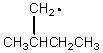
B)
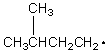
C)
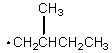
D)

E)

A)
B)
C)
D)
E)
Question
Question
The reaction of Cl2 with a methyl radical has a positive H°.Which of these drawings is the best representation of the transition state of this reaction?
A)
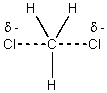
B)
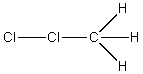
C)
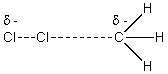
D)
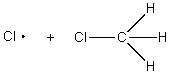
E)
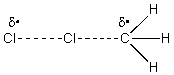
A)
B)
C)
D)
E)
Question
The bond dissociation energies for the relevant bonds are given below each of the species involved in the following reaction.Calculate the overall H° for the reaction. 
A) +243 kJ / mol
B) -138 kJ / mol
C) +138 kJ / mol
D) -781 kJ / mol
E) +781 kJ / mol
A) +243 kJ / mol
B) -138 kJ / mol
C) +138 kJ / mol
D) -781 kJ / mol
E) +781 kJ / mol
Question
Question
The bond dissociation energies for the relevant bonds are given below each of the species involved in the following reaction.Calculate the overall H° for the reaction. 
A) -121 kJ / mol
B) +121 kJ / mol
C) +243 kJ / mol
D) +664 kJ / mol
E) -785 kJ / mol
A) -121 kJ / mol
B) +121 kJ / mol
C) +243 kJ / mol
D) +664 kJ / mol
E) -785 kJ / mol
Question
The bond dissociation energies for the relevant bonds are given below each of the species involved in the following reaction.Calculate the overall H° for the reaction. 
A) +616 kJ / mol
B) -101 kJ / mol
C) -173 kJ / mol
D) +57 kJ kJ / mol
E) -44 kJ / mol
A) +616 kJ / mol
B) -101 kJ / mol
C) -173 kJ / mol
D) +57 kJ kJ / mol
E) -44 kJ / mol
Question
Question
Question
Question
Question
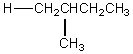
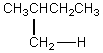
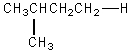
The H° value is expected to be least for which indicated C-H bond of isopentane?
A)
B)
C)

D)

E)
A)
B)
C)
D)
E)
Question
Question
Question
Question
Question
Which of the following reactions would have the smallest energy of activation?
A)

B)

C)

D)

E)

A)
B)
C)
D)
E)
Question
Question
Question
Question
Select the structure of the major product formed in the following reaction. 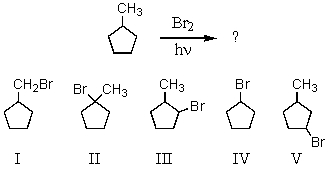
A) I
B) II
C) III
D) IV
E) V
A) I
B) II
C) III
D) IV
E) V
Question
What feature would you expect to see in the 1H NMR spectrum of B after subjecting A to the following reaction? 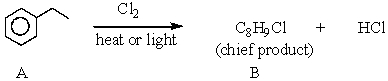
A) There would be only 4 aromatic protons at low field.
B) The signal for the protons on the benzylic carbon would be a doublet.
C) The signal for the methyl protons would be a triplet.
D) The signal for the methyl protons would be a doublet.
E) The signal for the methyl protons would integrate for only 2 hydrogens.
A) There would be only 4 aromatic protons at low field.
B) The signal for the protons on the benzylic carbon would be a doublet.
C) The signal for the methyl protons would be a triplet.
D) The signal for the methyl protons would be a doublet.
E) The signal for the methyl protons would integrate for only 2 hydrogens.
Question
Question
Question
Question
Question
Which of the following reactions would have the smallest energy of activation?
A) CH4 + Br· CH3· + HBr
B) CH3CH3 + Br· CH3CH2· + HBr
C)

D)

E)

A) CH4 + Br· CH3· + HBr
B) CH3CH3 + Br· CH3CH2· + HBr
C)
D)
E)
Question
Question
Question
Mono-bromination of the following alkane, 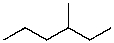 , (using Br2 with light)would be?
A) I
B) II
C) III
D) IV
E) V
, (using Br2 with light)would be? A) I
B) II
C) III
D) IV
E) V
Question
Which of the following reactions should have the smallest energy of activation?
A) CH4 + Cl· CH3· + HCl
B) CH3CH3 + Cl· CH3CH2· + HCl
C)

D)

E)

A) CH4 + Cl· CH3· + HCl
B) CH3CH3 + Cl· CH3CH2· + HCl
C)
D)
E)
Question
Question
Mono-bromination of the following alkane,  , (using Br2 with light)would be?
A) I
B) II
C) III
D) IV
E) V
, (using Br2 with light)would be? A) I
B) II
C) III
D) IV
E) V
Question
Question
For which reaction would the transition state be most product-like?
A) CH4 + Br· CH3· + HBr
B) CH3CH3 + Br· CH3CH2· + HBr
C)

D)

E)

A) CH4 + Br· CH3· + HBr
B) CH3CH3 + Br· CH3CH2· + HBr
C)
D)
E)
Question
What is the product for the following three-step reaction sequence? 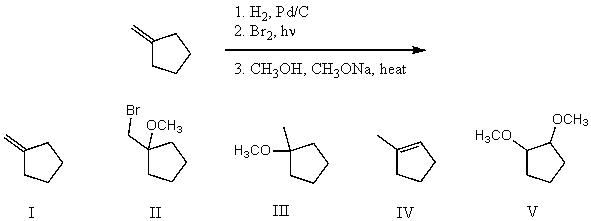
A) I
B) II
C) III
D) IV
E) V
A) I
B) II
C) III
D) IV
E) V
Question
Which hydrogen would be abstracted first when mono-brominating with Br2 and light? 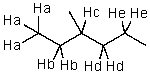
A) Ha
B) Hb
C) Hc
D) Hd
E) He
A) Ha
B) Hb
C) Hc
D) Hd
E) He
Question
Question
Mono-bromination of the following alkane,  , (using Br2 with light)would be?
A) I
B) II
C) III
D) IV
E) V
, (using Br2 with light)would be? A) I
B) II
C) III
D) IV
E) V
Question
Mono-bromination of the following alkane,  , (using Br2 with light)would be?
A) I
B) II
C) III
D) IV
E) V
, (using Br2 with light)would be? A) I
B) II
C) III
D) IV
E) V
Question
What is the product for the following three-step reaction sequence? 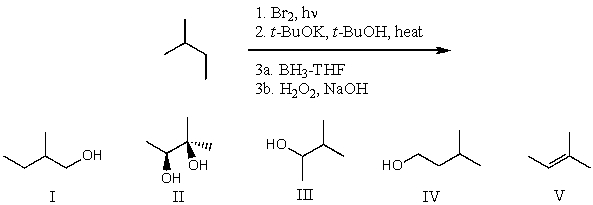
A) I
B) II
C) III
D) IV
E) V
A) I
B) II
C) III
D) IV
E) V
Question
Which hydrogen would be abstracted first when mono-brominating with Br2 and light? 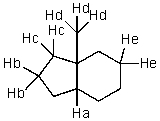
A) Ha
B) Hb
C) Hc
D) Hd
E) He
A) Ha
B) Hb
C) Hc
D) Hd
E) He
Question
What is the final product,C,obtained via the following reaction sequence? 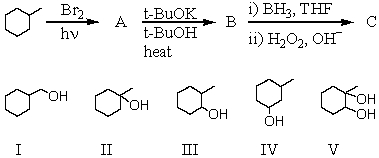
A) I
B) II
C) III
D) IV
E) V
A) I
B) II
C) III
D) IV
E) V
Question
Which hydrogen would be abstracted first when mono-brominating with Br2 and light? 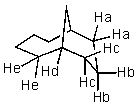
A) Ha
B) Hb
C) Hc
D) Hd
E) He
A) Ha
B) Hb
C) Hc
D) Hd
E) He
Question
Mono-bromination of the following alkane,  , (using Br2 with light)would be?
A) I
B) II
C) III
D) IV
E) V
, (using Br2 with light)would be? A) I
B) II
C) III
D) IV
E) V
Question
What is the product for the following three-step reaction sequence? 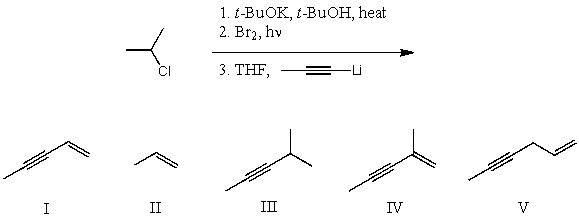
A) I
B) II
C) III
D) IV
E) V
A) I
B) II
C) III
D) IV
E) V
Question
What is the product for the following three-step reaction sequence? 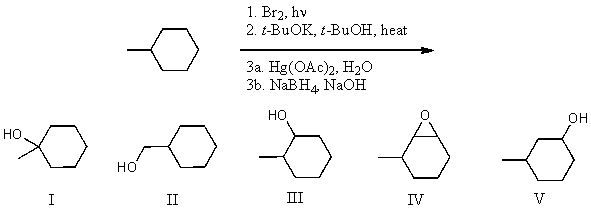
A) I
B) II
C) III
D) IV
E) V
A) I
B) II
C) III
D) IV
E) V
Question
What is the product for the following three-step reaction sequence? 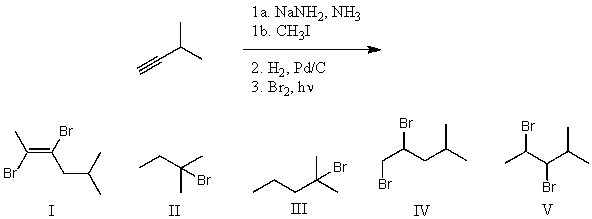
A) I
B) II
C) III
D) IV
E) V
A) I
B) II
C) III
D) IV
E) V
Question
What is the product for the following reaction sequence? 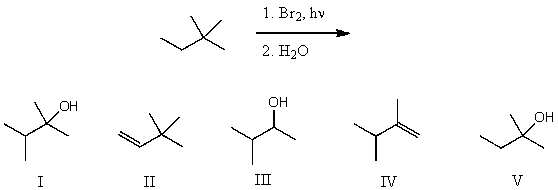
A) I
B) II
C) III
D) IV
E) V
A) I
B) II
C) III
D) IV
E) V
Question
Which hydrogen would be abstracted first when mono-brominating with Br2 and light? 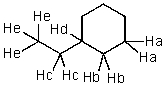
A) Ha
B) Hb
C) Hc
D) Hd
E) He
A) Ha
B) Hb
C) Hc
D) Hd
E) He
Question
Mono-bromination of the following alkane,  , (using Br2 with light)would be?
A) I
B) II
C) III
D) IV
E) V
, (using Br2 with light)would be? A) I
B) II
C) III
D) IV
E) V
Question
What is the product for the following three-step reaction sequence? 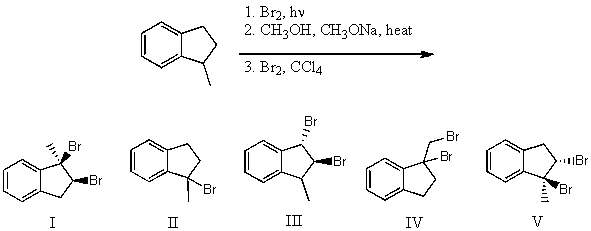
A) I
B) II
C) III
D) IV
E) V
A) I
B) II
C) III
D) IV
E) V
Question
Which hydrogen would be abstracted first when mono-brominating with Br2 and light? 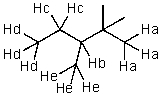
A) Ha
B) Hb
C) Hc
D) Hd
E) He
A) Ha
B) Hb
C) Hc
D) Hd
E) He
Question
What is the product for the following three-step reaction sequence? 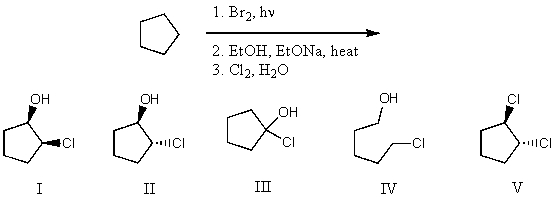
A) I
B) II
C) III
D) IV
E) V
A) I
B) II
C) III
D) IV
E) V
Question
Question
Question
Question
Question
What product would result from the following reaction? 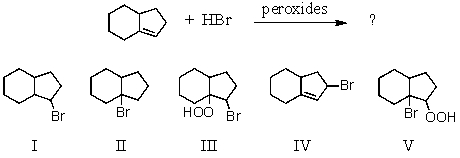
A) I
B) II
C) III
D) IV
E) V
A) I
B) II
C) III
D) IV
E) V
Question
Question
What is the product for the following three-step reaction sequence? 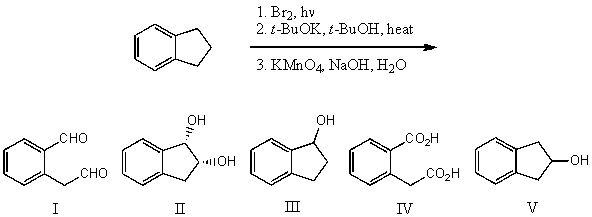
A) I
B) II
C) III
D) IV
E) V
A) I
B) II
C) III
D) IV
E) V
Question
Question
What is the product for the following three-step reaction sequence? 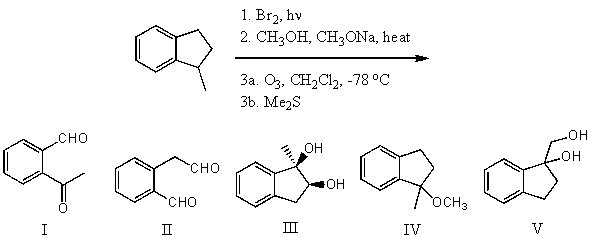
A) I
B) II
C) III
D) IV
E) V
A) I
B) II
C) III
D) IV
E) V
Question
What is the product for the following three-step reaction sequence? 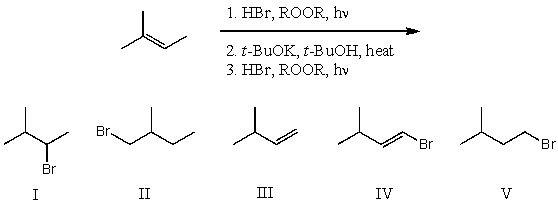
A) I
B) II
C) III
D) IV
E) V
A) I
B) II
C) III
D) IV
E) V
Question
Question
What is the product for the following three-step reaction sequence? 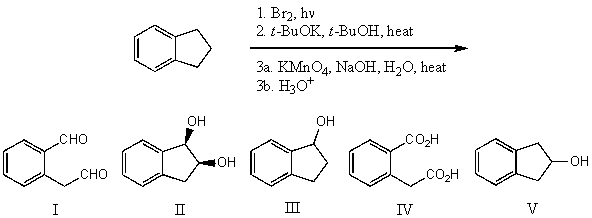
A) I
B) II
C) III
D) IV
E) V
A) I
B) II
C) III
D) IV
E) V
Question
Question
What is the product for the following three-step reaction sequence? 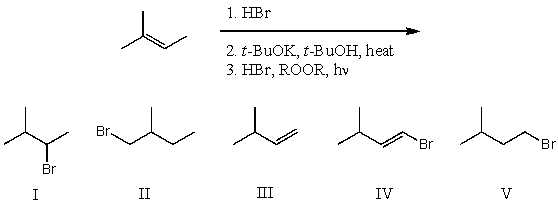
A) I
B) II
C) III
D) IV
E) V
A) I
B) II
C) III
D) IV
E) V
Question
What is the product for the following three-step reaction sequence? 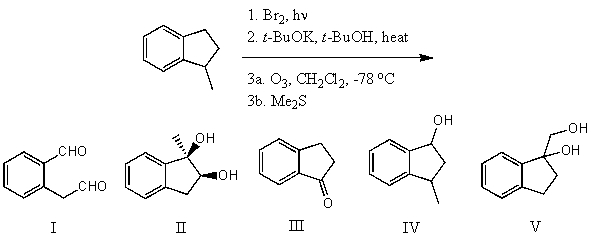
A) I
B) II
C) III
D) IV
E) V
A) I
B) II
C) III
D) IV
E) V
Question
Which of the following would serve as the best synthesis of 2-bromohexane?
A)

B)

C)

D)

E) All of the above would be equally suitable.
A)
B)
C)
D)
E) All of the above would be equally suitable.
Question
Question
Question
Question

Unlock Deck
Sign up to unlock the cards in this deck!
Unlock Deck
Unlock Deck
1/114

Play

Full screen (f)
Deck 10: Radical Reactions
1
For which of the following reactions would the transition state most resemble the products? The following bond dissociation energies may be useful. (CH3)2CH-H CH3CH2CH2-H H-F
(413 kJ mol-1) (423 kJ mol-1) (570 kJ mol-1)
H-Cl H-Br
(432 kJ mol-1) (366 kJ mol-1)
A)
B) CH3CH2CH3 + F· CH3CH2CH2· + HF
C)
D) CH3CH2CH3 + Cl· CH3CH2CH2· + HCl
E) CH3CH2CH3 + Br· CH3CH2CH2· + HBr
(413 kJ mol-1) (423 kJ mol-1) (570 kJ mol-1)
H-Cl H-Br
(432 kJ mol-1) (366 kJ mol-1)
A)
B) CH3CH2CH3 + F· CH3CH2CH2· + HF
C)
D) CH3CH2CH3 + Cl· CH3CH2CH2· + HCl
E) CH3CH2CH3 + Br· CH3CH2CH2· + HBr
CH3CH2CH3 + Br· CH3CH2CH2· + HBr
2
Which of the reactions listed below would be exothermic?
A) CH3-CH3 2CH3·
B) CH3· + CH4 CH4 + CH3·
C) 2(CH3)2CH· (CH3)2CH-CH(CH3)2
D) H· + (CH3)3CH (CH3)3CH + H·
E) None of the above
A) CH3-CH3 2CH3·
B) CH3· + CH4 CH4 + CH3·
C) 2(CH3)2CH· (CH3)2CH-CH(CH3)2
D) H· + (CH3)3CH (CH3)3CH + H·
E) None of the above
2(CH3)2CH· (CH3)2CH-CH(CH3)2
3
How many different monochlorobutanes (including stereoisomers)are formed in the free radical chlorination of butane?
A) 1
B) 2
C) 3
D) 4
E) 5
A) 1
B) 2
C) 3
D) 4
E) 5
3
4
A chain reaction is one that:
A) involves a series of steps.
B) involves two steps of equal activation energy.
C) is one that can be initiated by light.
D) involves a series of steps,each of which generates a reactive intermediate that brings about the next step.
E) involves free radicals that have an unusual stability and thereby cause a large quantum yield.
A) involves a series of steps.
B) involves two steps of equal activation energy.
C) is one that can be initiated by light.
D) involves a series of steps,each of which generates a reactive intermediate that brings about the next step.
E) involves free radicals that have an unusual stability and thereby cause a large quantum yield.
Unlock Deck
Unlock for access to all 114 flashcards in this deck.
Unlock Deck
k this deck
5
Which of the reactions listed below would have a value of H° equal to zero?
A) H-H 2H·
B) H· + CH3-H CH3-H + H·
C) CH3· + CH3· CH3-CH3
D) CH3· + CH3-H CH3-H + CH3·
E) Reactions (B)and (D)
A) H-H 2H·
B) H· + CH3-H CH3-H + H·
C) CH3· + CH3· CH3-CH3
D) CH3· + CH3-H CH3-H + CH3·
E) Reactions (B)and (D)
Unlock Deck
Unlock for access to all 114 flashcards in this deck.
Unlock Deck
k this deck
6
The bond dissociation energies for the relevant bonds are given below each of the species involved in the following reaction.Calculate the overall H° for the reaction.
A) +437 kJ / mol
B) -437 kJ / mol
C) -411 kJ / mol
D) +26 kJ / mol
E) -1581 kJ / mol
A) +437 kJ / mol
B) -437 kJ / mol
C) -411 kJ / mol
D) +26 kJ / mol
E) -1581 kJ / mol
Unlock Deck
Unlock for access to all 114 flashcards in this deck.
Unlock Deck
k this deck
7
Which of the following free radicals is the most stable?
A)
B)
C)
D)
E)
A)
B)
C)
D)
E)
Unlock Deck
Unlock for access to all 114 flashcards in this deck.
Unlock Deck
k this deck
8
Which of these molecules is not expected to arise as a product of the high temperature chlorination of methane?
A) CCl4
B) HCCl3
C) CH2Cl2
D) CH3CH3
E) CH2=CH2
A) CCl4
B) HCCl3
C) CH2Cl2
D) CH3CH3
E) CH2=CH2
Unlock Deck
Unlock for access to all 114 flashcards in this deck.
Unlock Deck
k this deck
9
The reaction of Cl2 with a methyl radical has a positive H°.Which of these drawings is the best representation of the transition state of this reaction?
A)
B)
C)
D)
E)
A)
B)
C)
D)
E)
Unlock Deck
Unlock for access to all 114 flashcards in this deck.
Unlock Deck
k this deck
10
The bond dissociation energies for the relevant bonds are given below each of the species involved in the following reaction.Calculate the overall H° for the reaction.
A) +243 kJ / mol
B) -138 kJ / mol
C) +138 kJ / mol
D) -781 kJ / mol
E) +781 kJ / mol
A) +243 kJ / mol
B) -138 kJ / mol
C) +138 kJ / mol
D) -781 kJ / mol
E) +781 kJ / mol
Unlock Deck
Unlock for access to all 114 flashcards in this deck.
Unlock Deck
k this deck
11
If chlorocyclopentane were chlorinated to form all possible dichloro compounds and the product mixture subjected to precise fractional distillation,how many fractions would be obtained (ideally)?
A) 3
B) 4
C) 5
D) 7
E) 9
A) 3
B) 4
C) 5
D) 7
E) 9
Unlock Deck
Unlock for access to all 114 flashcards in this deck.
Unlock Deck
k this deck
12
The bond dissociation energies for the relevant bonds are given below each of the species involved in the following reaction.Calculate the overall H° for the reaction.
A) -121 kJ / mol
B) +121 kJ / mol
C) +243 kJ / mol
D) +664 kJ / mol
E) -785 kJ / mol
A) -121 kJ / mol
B) +121 kJ / mol
C) +243 kJ / mol
D) +664 kJ / mol
E) -785 kJ / mol
Unlock Deck
Unlock for access to all 114 flashcards in this deck.
Unlock Deck
k this deck
13
The bond dissociation energies for the relevant bonds are given below each of the species involved in the following reaction.Calculate the overall H° for the reaction.
A) +616 kJ / mol
B) -101 kJ / mol
C) -173 kJ / mol
D) +57 kJ kJ / mol
E) -44 kJ / mol
A) +616 kJ / mol
B) -101 kJ / mol
C) -173 kJ / mol
D) +57 kJ kJ / mol
E) -44 kJ / mol
Unlock Deck
Unlock for access to all 114 flashcards in this deck.
Unlock Deck
k this deck
14
Which of the following gas-phase reactions is a possible chain-terminating step in the light-initiated chlorination of methane?
A) Cl-Cl 2Cl·
B) Cl· + CH4 CH3· + H-Cl
C) CH3· + CH3· CH3-CH3
D) CH3· + Cl-Cl CH3Cl + Cl·
E) More than one of the above
A) Cl-Cl 2Cl·
B) Cl· + CH4 CH3· + H-Cl
C) CH3· + CH3· CH3-CH3
D) CH3· + Cl-Cl CH3Cl + Cl·
E) More than one of the above
Unlock Deck
Unlock for access to all 114 flashcards in this deck.
Unlock Deck
k this deck
15
Which of the reactions listed below would be exothermic?
A) H-H 2H·
B) H· + CH3-H CH3-H + H·
C) CH3· + CH3· CH3-CH3
D) CH3· + CH3-H CH3-H + CH3·
E) All of the above
A) H-H 2H·
B) H· + CH3-H CH3-H + H·
C) CH3· + CH3· CH3-CH3
D) CH3· + CH3-H CH3-H + CH3·
E) All of the above
Unlock Deck
Unlock for access to all 114 flashcards in this deck.
Unlock Deck
k this deck
16
The reaction of 2-methylbutane with chlorine would yield how many monochloro derivatives? (include stereoisomers)
A) 2
B) 3
C) 4
D) 5
E) 6
A) 2
B) 3
C) 4
D) 5
E) 6
Unlock Deck
Unlock for access to all 114 flashcards in this deck.
Unlock Deck
k this deck
17
In the presence of light,ethane (1 mol)reacts with chlorine (1 mol)to form which product(s)?
A) CH2ClCHCl2
B) CH3CHCl2
C) CH3CH2Cl
D) ClCH2CH2Cl
E) All of these
A) CH2ClCHCl2
B) CH3CHCl2
C) CH3CH2Cl
D) ClCH2CH2Cl
E) All of these
Unlock Deck
Unlock for access to all 114 flashcards in this deck.
Unlock Deck
k this deck
18
The H° value is expected to be least for which indicated C-H bond of isopentane?
A)
B)
C)
D)
E)
A)
B)
C)
D)
E)
Unlock Deck
Unlock for access to all 114 flashcards in this deck.
Unlock Deck
k this deck
19
Hydrogen atom abstraction from which position would yield the most stable free radical intermediate during the reaction of bromine with 2,2,3-trimethylpentane?
A) C1
B) C2
C) C3
D) C4
E) C5
A) C1
B) C2
C) C3
D) C4
E) C5
Unlock Deck
Unlock for access to all 114 flashcards in this deck.
Unlock Deck
k this deck
20
An alternate mechanism for the chlorination of methane is: Cl2 2Cl·
Cl-Cl, H° = 243 kJ mol-1
Cl· + CH4 CH3Cl + H·
CH3-H, H° = 440 kJ mol-1
H· + Cl2 HCl + Cl·
CH3-Cl, H° = 352 kJ mol-1
H-Cl, H° = 432 kJ mol -1
This mechanism is unlikely because:
A) The overall H° is highly endothermic.
B) The probability factor is low.
C) One of the chain propagating steps is non-productive.
D) One of the chain propagating steps has a very high Eact.
E) One of the chain propagating steps is highly exothermic.
Cl-Cl, H° = 243 kJ mol-1
Cl· + CH4 CH3Cl + H·
CH3-H, H° = 440 kJ mol-1
H· + Cl2 HCl + Cl·
CH3-Cl, H° = 352 kJ mol-1
H-Cl, H° = 432 kJ mol -1
This mechanism is unlikely because:
A) The overall H° is highly endothermic.
B) The probability factor is low.
C) One of the chain propagating steps is non-productive.
D) One of the chain propagating steps has a very high Eact.
E) One of the chain propagating steps is highly exothermic.
Unlock Deck
Unlock for access to all 114 flashcards in this deck.
Unlock Deck
k this deck
21
In the presence of light at 25°C,isobutane (1 mol)and bromine (1 mol)yield which monobromo product(s)?
A) 2-Methyl-1-bromopropane (almost exclusively)
B) 2-Methyl-2-bromopropane (almost exclusively)
C) A mixture of 50% (A)and 50% (B)
D) A mixture of 90% (A)and 10% (B)
E) Butyl bromide
A) 2-Methyl-1-bromopropane (almost exclusively)
B) 2-Methyl-2-bromopropane (almost exclusively)
C) A mixture of 50% (A)and 50% (B)
D) A mixture of 90% (A)and 10% (B)
E) Butyl bromide
Unlock Deck
Unlock for access to all 114 flashcards in this deck.
Unlock Deck
k this deck
22
Which of the following reactions would have an activation energy equal to zero?
A) H-H 2H·
B) H· + CH3-H CH3--H + H·
C) CH3· + CH3· CH3-CH3
D) CH3· + CH3-H CH3-H + CH3·
E) All of the above
A) H-H 2H·
B) H· + CH3-H CH3--H + H·
C) CH3· + CH3· CH3-CH3
D) CH3· + CH3-H CH3-H + CH3·
E) All of the above
Unlock Deck
Unlock for access to all 114 flashcards in this deck.
Unlock Deck
k this deck
23
Which of the following reactions would have the smallest energy of activation?
A)
B)
C)
D)
E)
A)
B)
C)
D)
E)
Unlock Deck
Unlock for access to all 114 flashcards in this deck.
Unlock Deck
k this deck
24
Which of the following statements is true when used to compare the reaction of fluorine with 2-methylhexane and the reaction of bromine with 2-methylhexane?
A) Bromine is the less reactive and the less selective,giving 2-bromo-2-methyl hexane as one of several products.
B) Fluorine is the less reactive and the more selective,giving 2-fluoro-2-methyl hexane as the major product.
C) Fluorine is the more reactive and less selective,giving 2-fluoro-2-methyl hexane as one of several products.
D) Bromine is the more reactive and the more selective,giving 2-bromo-2-methyl hexane as the major product.
E) More than one of the above statements is true.
A) Bromine is the less reactive and the less selective,giving 2-bromo-2-methyl hexane as one of several products.
B) Fluorine is the less reactive and the more selective,giving 2-fluoro-2-methyl hexane as the major product.
C) Fluorine is the more reactive and less selective,giving 2-fluoro-2-methyl hexane as one of several products.
D) Bromine is the more reactive and the more selective,giving 2-bromo-2-methyl hexane as the major product.
E) More than one of the above statements is true.
Unlock Deck
Unlock for access to all 114 flashcards in this deck.
Unlock Deck
k this deck
25
For which of the following gas-phase reactions would the Eact be equal to H°?
A) Cl-Cl 2Cl·
B) 2 Cl· Cl-Cl
C) Cl· + CH4 CH3· + H-Cl
D) CH3· + CH3· CH3-CH3
E) CH3· + Cl-Cl CH3-Cl + Cl·
A) Cl-Cl 2Cl·
B) 2 Cl· Cl-Cl
C) Cl· + CH4 CH3· + H-Cl
D) CH3· + CH3· CH3-CH3
E) CH3· + Cl-Cl CH3-Cl + Cl·
Unlock Deck
Unlock for access to all 114 flashcards in this deck.
Unlock Deck
k this deck
26
Which of the following reactions would have an activation energy equal to zero?
A) CH3-CH3 -- 2CH3·
B) H· + CH3CH3 -- CH3CH3 + H·
C) 2CH3CH2· -- CH3CH2CH2CH3
D) CH3· + CH3CH3 -- CH3CH3 + CH3·
E) None of the above
A) CH3-CH3 -- 2CH3·
B) H· + CH3CH3 -- CH3CH3 + H·
C) 2CH3CH2· -- CH3CH2CH2CH3
D) CH3· + CH3CH3 -- CH3CH3 + CH3·
E) None of the above
Unlock Deck
Unlock for access to all 114 flashcards in this deck.
Unlock Deck
k this deck
27
Select the structure of the major product formed in the following reaction.
A) I
B) II
C) III
D) IV
E) V
A) I
B) II
C) III
D) IV
E) V
Unlock Deck
Unlock for access to all 114 flashcards in this deck.
Unlock Deck
k this deck
28
What feature would you expect to see in the 1H NMR spectrum of B after subjecting A to the following reaction?
A) There would be only 4 aromatic protons at low field.
B) The signal for the protons on the benzylic carbon would be a doublet.
C) The signal for the methyl protons would be a triplet.
D) The signal for the methyl protons would be a doublet.
E) The signal for the methyl protons would integrate for only 2 hydrogens.
A) There would be only 4 aromatic protons at low field.
B) The signal for the protons on the benzylic carbon would be a doublet.
C) The signal for the methyl protons would be a triplet.
D) The signal for the methyl protons would be a doublet.
E) The signal for the methyl protons would integrate for only 2 hydrogens.
Unlock Deck
Unlock for access to all 114 flashcards in this deck.
Unlock Deck
k this deck
29
At some temperatures,the relative reactivities of 3°,2° and 1° alkane hydrogens in free radical chlorination are in the ratio of 5:3:1.Thus,monochlorination of isopentane should produce these percentages of 2-chloro-2-methylbutane (A),combined 1-chloro-2-methylbutane and 1-chloro-3-methylbutane (B),and 2-chloro-3-methylbutane (C):
A) 8% A,75% B,17% C
B) 25% A,45% B,30% C
C) 29% A,44% B,18% C
D) 30% A,35% B,35% C
E) 36% A,43% B,21% C
A) 8% A,75% B,17% C
B) 25% A,45% B,30% C
C) 29% A,44% B,18% C
D) 30% A,35% B,35% C
E) 36% A,43% B,21% C
Unlock Deck
Unlock for access to all 114 flashcards in this deck.
Unlock Deck
k this deck
30
Which reaction would you expect to have the smallest energy of activation? H°(kJ mol-1)
A) CH3· + CH3· -- CH3CH3 -378
B) CH4 + F· -- CH3· + HF -130
C) CH4 + I· -- CH3· + HI +142
D) CH4 + Br· -- CH3· + HBr +104
E) CH4 + Cl· -- CH3· + HCl +8
A) CH3· + CH3· -- CH3CH3 -378
B) CH4 + F· -- CH3· + HF -130
C) CH4 + I· -- CH3· + HI +142
D) CH4 + Br· -- CH3· + HBr +104
E) CH4 + Cl· -- CH3· + HCl +8
Unlock Deck
Unlock for access to all 114 flashcards in this deck.
Unlock Deck
k this deck
31
An example of a reaction having an Eact = 0 would be:
A) Br· + Br-Br -- Br-Br + Br·
B) F· + CH4 -- H-F + CH3·
C) CH3· + Cl· -- CH3Cl
D) More than one of these
E) None of these
A) Br· + Br-Br -- Br-Br + Br·
B) F· + CH4 -- H-F + CH3·
C) CH3· + Cl· -- CH3Cl
D) More than one of these
E) None of these
Unlock Deck
Unlock for access to all 114 flashcards in this deck.
Unlock Deck
k this deck
32
What sequence of reactions could be used to prepare cis-1,2-cyclopentanediol from cyclopentane?
A) (1)Cl2,h ; (2)t-BuOK/t-BuOH; (3)OsO4; (4)NaHSO3/H2O
B) (1)t-BuOK/t-BuOH; (2)Cl2,h ; (3)NaOH/H2O
C) (1)Cl2,h ; (2)t-BuOK/t-BuOH; (3)H2O2
D) (1)NaOH/H2O; (2)Br2; (3)NaNH2(2eq. )/liq.NH3; (4)KMnO4,NaOH/H2O,5°C
E) (1)Cl2,h ; (2)t-BuOK/t-BuOH; (3)Hg(OAc)2,H2O (4)NaBH4,H3O+
A) (1)Cl2,h ; (2)t-BuOK/t-BuOH; (3)OsO4; (4)NaHSO3/H2O
B) (1)t-BuOK/t-BuOH; (2)Cl2,h ; (3)NaOH/H2O
C) (1)Cl2,h ; (2)t-BuOK/t-BuOH; (3)H2O2
D) (1)NaOH/H2O; (2)Br2; (3)NaNH2(2eq. )/liq.NH3; (4)KMnO4,NaOH/H2O,5°C
E) (1)Cl2,h ; (2)t-BuOK/t-BuOH; (3)Hg(OAc)2,H2O (4)NaBH4,H3O+
Unlock Deck
Unlock for access to all 114 flashcards in this deck.
Unlock Deck
k this deck
33
Which of the following reactions would have the smallest energy of activation?
A) CH4 + Br· CH3· + HBr
B) CH3CH3 + Br· CH3CH2· + HBr
C)
D)
E)
A) CH4 + Br· CH3· + HBr
B) CH3CH3 + Br· CH3CH2· + HBr
C)
D)
E)
Unlock Deck
Unlock for access to all 114 flashcards in this deck.
Unlock Deck
k this deck
34
An example of a reaction having an Eact = 0 would be:
A) Br· + Br-Br Br-Br + Br·
B) F· + CH4 H-F + CH3·
C) CH3· + CH3CH3 CH4 + CH3CH2·
D) Br· + H-Br H-Br + Br·
E) CH3· + CH3· CH3-CH3
A) Br· + Br-Br Br-Br + Br·
B) F· + CH4 H-F + CH3·
C) CH3· + CH3CH3 CH4 + CH3CH2·
D) Br· + H-Br H-Br + Br·
E) CH3· + CH3· CH3-CH3
Unlock Deck
Unlock for access to all 114 flashcards in this deck.
Unlock Deck
k this deck
35
Which reaction would you expect to have the largest energy of activation? H° (kJ mol-1)
A) CH3· + CH3· CH3CH3 -378
B) CH3· + Br· CH3Br -130
C) CH4 + I· CH3· + HI +142
D) CH4 + Br· CH3· + HBr +104
E) CH4 + Cl· CH3· + HCl +8
A) CH3· + CH3· CH3CH3 -378
B) CH3· + Br· CH3Br -130
C) CH4 + I· CH3· + HI +142
D) CH4 + Br· CH3· + HBr +104
E) CH4 + Cl· CH3· + HCl +8
Unlock Deck
Unlock for access to all 114 flashcards in this deck.
Unlock Deck
k this deck
36
Mono-bromination of the following alkane, , (using Br2 with light)would be?
A) I
B) II
C) III
D) IV
E) V
, (using Br2 with light)would be? A) I
B) II
C) III
D) IV
E) V
Unlock Deck
Unlock for access to all 114 flashcards in this deck.
Unlock Deck
k this deck
37
Which of the following reactions should have the smallest energy of activation?
A) CH4 + Cl· CH3· + HCl
B) CH3CH3 + Cl· CH3CH2· + HCl
C)
D)
E)
A) CH4 + Cl· CH3· + HCl
B) CH3CH3 + Cl· CH3CH2· + HCl
C)
D)
E)
Unlock Deck
Unlock for access to all 114 flashcards in this deck.
Unlock Deck
k this deck
38
When an alkane in which all hydrogen atoms are not equivalent is monosubstituted,use of this halogen produces a ratio of isomers which is essentially statistical,i.e. ,dependent only on the number of each type of hydrogen.
A) F2
B) Cl2
C) Br2
D) I2
E) All of the above
A) F2
B) Cl2
C) Br2
D) I2
E) All of the above
Unlock Deck
Unlock for access to all 114 flashcards in this deck.
Unlock Deck
k this deck
39
Mono-bromination of the following alkane, , (using Br2 with light)would be?
A) I
B) II
C) III
D) IV
E) V
, (using Br2 with light)would be? A) I
B) II
C) III
D) IV
E) V
Unlock Deck
Unlock for access to all 114 flashcards in this deck.
Unlock Deck
k this deck
40
Which is true for a chain-terminating step?
A) "A new free radical is formed."
B) "The process is endothermic."
C) "Eact = 0."
D) " H° is positive."
E) "A product is formed which is immune to further reaction."
A) "A new free radical is formed."
B) "The process is endothermic."
C) "Eact = 0."
D) " H° is positive."
E) "A product is formed which is immune to further reaction."
Unlock Deck
Unlock for access to all 114 flashcards in this deck.
Unlock Deck
k this deck
41
For which reaction would the transition state be most product-like?
A) CH4 + Br· CH3· + HBr
B) CH3CH3 + Br· CH3CH2· + HBr
C)
D)
E)
A) CH4 + Br· CH3· + HBr
B) CH3CH3 + Br· CH3CH2· + HBr
C)
D)
E)
Unlock Deck
Unlock for access to all 114 flashcards in this deck.
Unlock Deck
k this deck
42
What is the product for the following three-step reaction sequence?
A) I
B) II
C) III
D) IV
E) V
A) I
B) II
C) III
D) IV
E) V
Unlock Deck
Unlock for access to all 114 flashcards in this deck.
Unlock Deck
k this deck
43
Which hydrogen would be abstracted first when mono-brominating with Br2 and light?
A) Ha
B) Hb
C) Hc
D) Hd
E) He
A) Ha
B) Hb
C) Hc
D) Hd
E) He
Unlock Deck
Unlock for access to all 114 flashcards in this deck.
Unlock Deck
k this deck
44
Free radical mono-halogenation of an alkane is typically conducted using bromine versus chlorine because
A) the bromine radical is more reactive and therefore more selective.
B) the chlorine radical is more reactive and therefore more selective.
C) the chlorine radical is less reactive and therefore more selective.
D) the bromine radical is less reactive and therefore more selective.
E) None of the above
A) the bromine radical is more reactive and therefore more selective.
B) the chlorine radical is more reactive and therefore more selective.
C) the chlorine radical is less reactive and therefore more selective.
D) the bromine radical is less reactive and therefore more selective.
E) None of the above
Unlock Deck
Unlock for access to all 114 flashcards in this deck.
Unlock Deck
k this deck
45
Mono-bromination of the following alkane, , (using Br2 with light)would be?
A) I
B) II
C) III
D) IV
E) V
, (using Br2 with light)would be? A) I
B) II
C) III
D) IV
E) V
Unlock Deck
Unlock for access to all 114 flashcards in this deck.
Unlock Deck
k this deck
46
Mono-bromination of the following alkane, , (using Br2 with light)would be?
A) I
B) II
C) III
D) IV
E) V
, (using Br2 with light)would be? A) I
B) II
C) III
D) IV
E) V
Unlock Deck
Unlock for access to all 114 flashcards in this deck.
Unlock Deck
k this deck
47
What is the product for the following three-step reaction sequence?
A) I
B) II
C) III
D) IV
E) V
A) I
B) II
C) III
D) IV
E) V
Unlock Deck
Unlock for access to all 114 flashcards in this deck.
Unlock Deck
k this deck
48
Which hydrogen would be abstracted first when mono-brominating with Br2 and light?
A) Ha
B) Hb
C) Hc
D) Hd
E) He
A) Ha
B) Hb
C) Hc
D) Hd
E) He
Unlock Deck
Unlock for access to all 114 flashcards in this deck.
Unlock Deck
k this deck
49
What is the final product,C,obtained via the following reaction sequence?
A) I
B) II
C) III
D) IV
E) V
A) I
B) II
C) III
D) IV
E) V
Unlock Deck
Unlock for access to all 114 flashcards in this deck.
Unlock Deck
k this deck
50
Which hydrogen would be abstracted first when mono-brominating with Br2 and light?
A) Ha
B) Hb
C) Hc
D) Hd
E) He
A) Ha
B) Hb
C) Hc
D) Hd
E) He
Unlock Deck
Unlock for access to all 114 flashcards in this deck.
Unlock Deck
k this deck
51
Mono-bromination of the following alkane, , (using Br2 with light)would be?
A) I
B) II
C) III
D) IV
E) V
, (using Br2 with light)would be? A) I
B) II
C) III
D) IV
E) V
Unlock Deck
Unlock for access to all 114 flashcards in this deck.
Unlock Deck
k this deck
52
What is the product for the following three-step reaction sequence?
A) I
B) II
C) III
D) IV
E) V
A) I
B) II
C) III
D) IV
E) V
Unlock Deck
Unlock for access to all 114 flashcards in this deck.
Unlock Deck
k this deck
53
What is the product for the following three-step reaction sequence?
A) I
B) II
C) III
D) IV
E) V
A) I
B) II
C) III
D) IV
E) V
Unlock Deck
Unlock for access to all 114 flashcards in this deck.
Unlock Deck
k this deck
54
What is the product for the following three-step reaction sequence?
A) I
B) II
C) III
D) IV
E) V
A) I
B) II
C) III
D) IV
E) V
Unlock Deck
Unlock for access to all 114 flashcards in this deck.
Unlock Deck
k this deck
55
What is the product for the following reaction sequence?
A) I
B) II
C) III
D) IV
E) V
A) I
B) II
C) III
D) IV
E) V
Unlock Deck
Unlock for access to all 114 flashcards in this deck.
Unlock Deck
k this deck
56
Which hydrogen would be abstracted first when mono-brominating with Br2 and light?
A) Ha
B) Hb
C) Hc
D) Hd
E) He
A) Ha
B) Hb
C) Hc
D) Hd
E) He
Unlock Deck
Unlock for access to all 114 flashcards in this deck.
Unlock Deck
k this deck
57
Mono-bromination of the following alkane, , (using Br2 with light)would be?
A) I
B) II
C) III
D) IV
E) V
, (using Br2 with light)would be? A) I
B) II
C) III
D) IV
E) V
Unlock Deck
Unlock for access to all 114 flashcards in this deck.
Unlock Deck
k this deck
58
What is the product for the following three-step reaction sequence?
A) I
B) II
C) III
D) IV
E) V
A) I
B) II
C) III
D) IV
E) V
Unlock Deck
Unlock for access to all 114 flashcards in this deck.
Unlock Deck
k this deck
59
Which hydrogen would be abstracted first when mono-brominating with Br2 and light?
A) Ha
B) Hb
C) Hc
D) Hd
E) He
A) Ha
B) Hb
C) Hc
D) Hd
E) He
Unlock Deck
Unlock for access to all 114 flashcards in this deck.
Unlock Deck
k this deck
60
What is the product for the following three-step reaction sequence?
A) I
B) II
C) III
D) IV
E) V
A) I
B) II
C) III
D) IV
E) V
Unlock Deck
Unlock for access to all 114 flashcards in this deck.
Unlock Deck
k this deck
61
The free radical chlorination of pentane produces this number of monochloro compounds,including stereoisomers.
A) 2
B) 3
C) 4
D) 5
E) 6
A) 2
B) 3
C) 4
D) 5
E) 6
Unlock Deck
Unlock for access to all 114 flashcards in this deck.
Unlock Deck
k this deck
62
The free radical chlorination of 3-chloropentane forms a mixture of dichloropentanes which,on precise fractional distillation,affords these fractions:
A) 4 fractions,none optically active
B) 4 fractions,2 optically active
C) 7 fractions,4 optically active
D) 7 fractions,6 optically active
E) 7 fractions,all optically active
A) 4 fractions,none optically active
B) 4 fractions,2 optically active
C) 7 fractions,4 optically active
D) 7 fractions,6 optically active
E) 7 fractions,all optically active
Unlock Deck
Unlock for access to all 114 flashcards in this deck.
Unlock Deck
k this deck
63
More than one monochloro compound can be obtained from the free radical chlorination of:
A) Cyclopentane
B) Neopentane
C) Isobutane
D) Ethane
E) Methane
A) Cyclopentane
B) Neopentane
C) Isobutane
D) Ethane
E) Methane
Unlock Deck
Unlock for access to all 114 flashcards in this deck.
Unlock Deck
k this deck
64
The p-orbital of a methyl radical carbon,CH3·,contains how many electrons?
A) 1
B) 2
C) 3
D) 4
E) 0
A) 1
B) 2
C) 3
D) 4
E) 0
Unlock Deck
Unlock for access to all 114 flashcards in this deck.
Unlock Deck
k this deck
65
What product would result from the following reaction?
A) I
B) II
C) III
D) IV
E) V
A) I
B) II
C) III
D) IV
E) V
Unlock Deck
Unlock for access to all 114 flashcards in this deck.
Unlock Deck
k this deck
66
What is the total number of trichloropropanes which can be produced by free radical chlorination of propane? Include all stereoisomers.
A) 4
B) 5
C) 6
D) 7
E) 8
A) 4
B) 5
C) 6
D) 7
E) 8
Unlock Deck
Unlock for access to all 114 flashcards in this deck.
Unlock Deck
k this deck
67
What is the product for the following three-step reaction sequence?
A) I
B) II
C) III
D) IV
E) V
A) I
B) II
C) III
D) IV
E) V
Unlock Deck
Unlock for access to all 114 flashcards in this deck.
Unlock Deck
k this deck
68
Free radical chlorination of hexane produces this number of monochloro derivatives (including stereoisomers):
A) 3
B) 4
C) 5
D) 7
E) 8
A) 3
B) 4
C) 5
D) 7
E) 8
Unlock Deck
Unlock for access to all 114 flashcards in this deck.
Unlock Deck
k this deck
69
What is the product for the following three-step reaction sequence?
A) I
B) II
C) III
D) IV
E) V
A) I
B) II
C) III
D) IV
E) V
Unlock Deck
Unlock for access to all 114 flashcards in this deck.
Unlock Deck
k this deck
70
What is the product for the following three-step reaction sequence?
A) I
B) II
C) III
D) IV
E) V
A) I
B) II
C) III
D) IV
E) V
Unlock Deck
Unlock for access to all 114 flashcards in this deck.
Unlock Deck
k this deck
71
How many monochloro derivatives,including stereoisomers,can be formed in the chlorination of 1-bromobutane?
A) 4
B) 5
C) 6
D) 7
E) 8
A) 4
B) 5
C) 6
D) 7
E) 8
Unlock Deck
Unlock for access to all 114 flashcards in this deck.
Unlock Deck
k this deck
72
What is the product for the following three-step reaction sequence?
A) I
B) II
C) III
D) IV
E) V
A) I
B) II
C) III
D) IV
E) V
Unlock Deck
Unlock for access to all 114 flashcards in this deck.
Unlock Deck
k this deck
73
The reaction of 1-butene with HBr in the presence of peroxides yields 1-bromobutane.The mechanism for the reaction involves:
A) attack on the alkene by a Br+ ion.
B) attack on the alkene by a H+ ion.
C) attack on the alkene by a bromine atom,Br·.
D) attack on the alkene by a hydrogen atom,H·.
E) isomerization of the 2-bromobutane produced initially.
A) attack on the alkene by a Br+ ion.
B) attack on the alkene by a H+ ion.
C) attack on the alkene by a bromine atom,Br·.
D) attack on the alkene by a hydrogen atom,H·.
E) isomerization of the 2-bromobutane produced initially.
Unlock Deck
Unlock for access to all 114 flashcards in this deck.
Unlock Deck
k this deck
74
What is the product for the following three-step reaction sequence?
A) I
B) II
C) III
D) IV
E) V
A) I
B) II
C) III
D) IV
E) V
Unlock Deck
Unlock for access to all 114 flashcards in this deck.
Unlock Deck
k this deck
75
What is the product for the following three-step reaction sequence?
A) I
B) II
C) III
D) IV
E) V
A) I
B) II
C) III
D) IV
E) V
Unlock Deck
Unlock for access to all 114 flashcards in this deck.
Unlock Deck
k this deck
76
Which of the following would serve as the best synthesis of 2-bromohexane?
A)
B)
C)
D)
E) All of the above would be equally suitable.
A)
B)
C)
D)
E) All of the above would be equally suitable.
Unlock Deck
Unlock for access to all 114 flashcards in this deck.
Unlock Deck
k this deck
77
The free radical chlorination of (R)-2-chloropentane forms a mixture of dichloropentanes which includes:
A) three optically active compounds.
B) two achiral compounds.
C) two meso compounds.
D) one pair of diastereomers.
E) one racemic mixture.
A) three optically active compounds.
B) two achiral compounds.
C) two meso compounds.
D) one pair of diastereomers.
E) one racemic mixture.
Unlock Deck
Unlock for access to all 114 flashcards in this deck.
Unlock Deck
k this deck
78
Consider the light-initiated chlorination of (S)-2-chlorobutane followed by careful fractional distillation (or separation by GLC)of all of the products with the formula C4H8Cl2.How many fractions (in total)would be obtained and how many of these fractions would be optically active?
A) Three fractions total;all optically active
B) Four fractions total;three fractions optically active
C) Five fractions total;all optically active
D) Five fractions total;four fractions optically active
E) Five fractions total;three fractions optically active
A) Three fractions total;all optically active
B) Four fractions total;three fractions optically active
C) Five fractions total;all optically active
D) Five fractions total;four fractions optically active
E) Five fractions total;three fractions optically active
Unlock Deck
Unlock for access to all 114 flashcards in this deck.
Unlock Deck
k this deck
79
Free radical chlorination will produce but one monochloro derivative in the case of:
A) Propane
B) Butane
C) Isobutane
D) Isopentane
E) Neopentane
A) Propane
B) Butane
C) Isobutane
D) Isopentane
E) Neopentane
Unlock Deck
Unlock for access to all 114 flashcards in this deck.
Unlock Deck
k this deck
80
Which of the following combinations of reactants can provide a demonstrable example of anti-Markovnikov addition?
A) CH2=CHCH3 + HCl + ROOR
B) CH3CH=CH2 + H2O + Cl2
C) CH3CH=CHCH3 + HBr + ROOR
D) CH3CH2CH=CH2 + HBr + ROOR
E) CH3CH2CH=CH2 + Br2 + ROOR
A) CH2=CHCH3 + HCl + ROOR
B) CH3CH=CH2 + H2O + Cl2
C) CH3CH=CHCH3 + HBr + ROOR
D) CH3CH2CH=CH2 + HBr + ROOR
E) CH3CH2CH=CH2 + Br2 + ROOR
Unlock Deck
Unlock for access to all 114 flashcards in this deck.
Unlock Deck
k this deck
Unlock Deck
Unlock for access to all 114 flashcards in this deck.






