







 Chat with AI

Deck 17: Aldehydes and Ketones Ii Aldol Reactions
Full screen (f)

Question
Which of the following structures is N-benzyl-N-propyl-2,3-dimethylbutanamide? 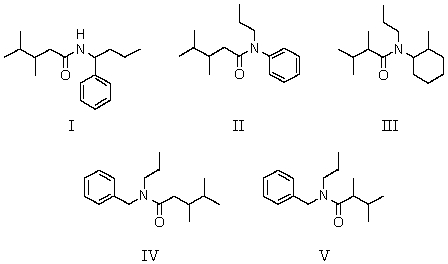
A) I
B) II
C) III
D) IV
E) V
A) I
B) II
C) III
D) IV
E) V

Question
Question
What is the IUPAC name for 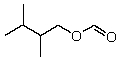
A) "2,3-0Dimethylbutyl acetate"
B) "2,3-Dimethyl-4-oxoethanal"
C) "2,3-Dimethylbutyl methanoate"
D) "2,3-Dimethylbutyl methylate"
E) "2,3-Dimethylbutyl formylate"
A) "2,3-0Dimethylbutyl acetate"
B) "2,3-Dimethyl-4-oxoethanal"
C) "2,3-Dimethylbutyl methanoate"
D) "2,3-Dimethylbutyl methylate"
E) "2,3-Dimethylbutyl formylate"
Question
Question
Question
Which of the following would be the strongest acid? 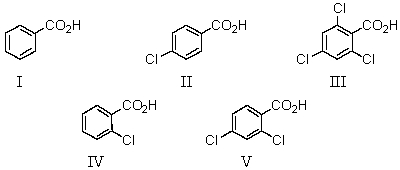
A) I
B) II
C) III
D) IV
E) V
A) I
B) II
C) III
D) IV
E) V
Question
Which of the following would be the strongest acid? 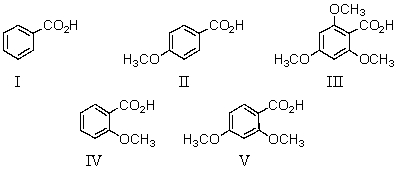
A) I
B) II
C) III
D) IV
E) V
A) I
B) II
C) III
D) IV
E) V
Question
What is the IUPAC name for 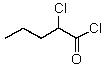
A) " -Chlorovaleryl chloride"
B) "2-Chloropentanoyl chloride"
C) "1-Chloropentanoyl chloride"
D) "1,2-Dichloropentanal"
E) "1-Chloro-1-butanecarbonyl chloride"
A) " -Chlorovaleryl chloride"
B) "2-Chloropentanoyl chloride"
C) "1-Chloropentanoyl chloride"
D) "1,2-Dichloropentanal"
E) "1-Chloro-1-butanecarbonyl chloride"
Question
Which of the following would be the strongest acid? 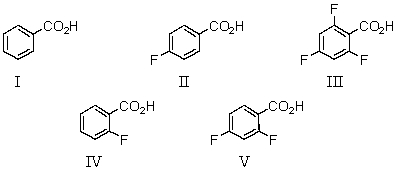
A) I
B) II
C) III
D) IV
E) V
A) I
B) II
C) III
D) IV
E) V
Question
Which of the following would be the weakest acid? 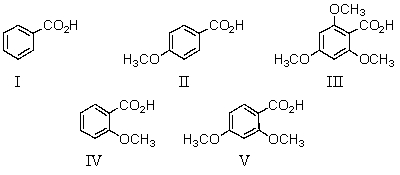
A) I
B) II
C) III
D) IV
E) V
A) I
B) II
C) III
D) IV
E) V
Question
Question
Question
Which of the following would be the weakest acid? 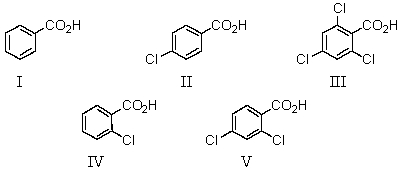
A) I
B) II
C) III
D) IV
E) V
A) I
B) II
C) III
D) IV
E) V
Question
Which of the following would be the strongest acid? 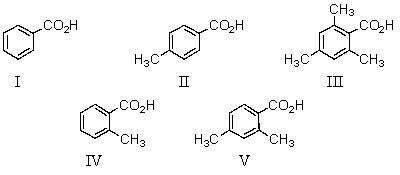
A) I
B) II
C) III
D) IV
E) V
A) I
B) II
C) III
D) IV
E) V
Question
Which of the following would be the strongest acid? 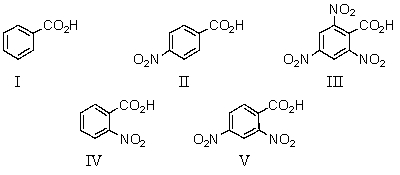
A) I
B) II
C) III
D) IV
E) V
A) I
B) II
C) III
D) IV
E) V
Question
Which of the following would be the strongest acid? 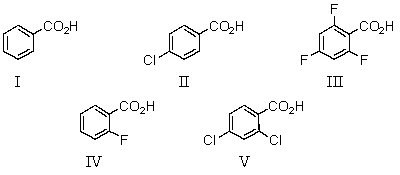
A) I
B) II
C) III
D) IV
E) V
A) I
B) II
C) III
D) IV
E) V
Question
Which of the following is the best name for the following compound? 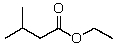
A) Isobutyl ethanoate
B) Ethyl isopropanoate
C) 3-methylbutyl ethanoate
D) Ethoxy isobutyl ketone
E) Ethyl 3-methylbutanoate
A) Isobutyl ethanoate
B) Ethyl isopropanoate
C) 3-methylbutyl ethanoate
D) Ethoxy isobutyl ketone
E) Ethyl 3-methylbutanoate
Question
The correct structure for ethyl 3-methylbutanoate is: 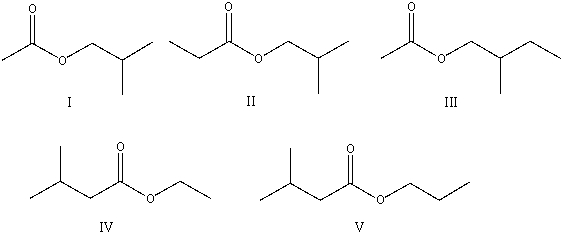
A)I
B)II
C)III
D)IV
E)V
A)I
B)II
C)III
D)IV
E)V
Question
Question
Question
Question
Question
Question
Question
Question
A compound has the molecular formula C8H14O4.Its IR spectrum shows a strong absorption band near 1740 cm-1.Its 1H NMR spectrum consists of: triplet,
1.3
Singlet,
2.6
Quartet,
4.2
The most likely structure for the compound is: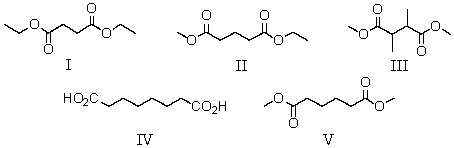
A) I
B) II
C) III
D) IV
E) V
1.3
Singlet,
2.6
Quartet,
4.2
The most likely structure for the compound is:
A) I
B) II
C) III
D) IV
E) V
Question
A compound has the molecular formula,C6H12O2.Its IR spectrum shows a strong absorption band near 1740 cm-1;its 1H NMR spectrum consists of two singlets,at 1.4 and 2.0.The most likely structure for this compound is: 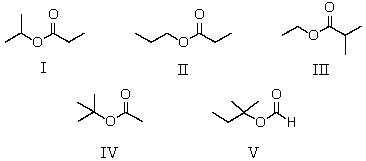
A) I
B) II
C) III
D) IV
E) V
A) I
B) II
C) III
D) IV
E) V
Question
Question
A compound with the molecular formula C18H18O4 has a 1H NMR spectrum that consists of: singlet,
2.7
Singlet,
3.1
Multiplet,
7.3
The IR spectrum shows a strong absorption band near 1750 cm-1.The most likely structure for the compound is:
A)
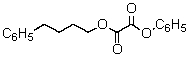
B)
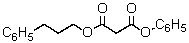
C)
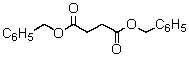
D)
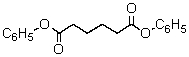
E)
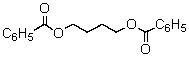
2.7
Singlet,
3.1
Multiplet,
7.3
The IR spectrum shows a strong absorption band near 1750 cm-1.The most likely structure for the compound is:
A)
B)
C)
D)
E)
Question
Predict the major organic product of the reaction sequence below: 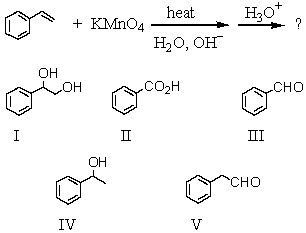
A) I
B) II
C) III
D) IV
E) V
A) I
B) II
C) III
D) IV
E) V
Question
Question
A compound has the molecular formula,C6H12O2.Its IR spectrum shows a strong absorption band near 1740 cm-1;its 1H NMR spectrum consists of two singlets,at 1.2 and 3.6.The most likely structure for this compound is: 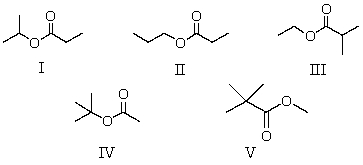
A) I
B) II
C) III
D) IV
E) V
A) I
B) II
C) III
D) IV
E) V
Question
Which of the following would be the weakest acid? 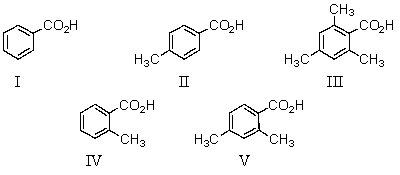
A) I
B) II
C) III
D) IV
E) V
A) I
B) II
C) III
D) IV
E) V
Question
What is the reactant of the following reaction sequence? 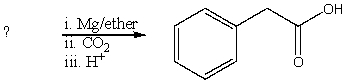
A) HCO2CH2C6H5
B) C6H5CH2COOH
C) C6H5CH2Cl
D) C6H5CHClCOOH
E) O=C(CH2C6H5)2
A) HCO2CH2C6H5
B) C6H5CH2COOH
C) C6H5CH2Cl
D) C6H5CHClCOOH
E) O=C(CH2C6H5)2
Question
A compound with the molecular formula C5H10O2 gave the following 1H NMR spectrum: triplet,
0.90
Multiplet,
1.60
Singlet,
1.95
Triplet,
3.95
The IR spectrum showed a strong absorption band near 1740 cm-1.The most likely structure for the compound is:
A)

B)

C)

D)

E)

0.90
Multiplet,
1.60
Singlet,
1.95
Triplet,
3.95
The IR spectrum showed a strong absorption band near 1740 cm-1.The most likely structure for the compound is:
A)
B)
C)
D)
E)
Question
Question
Question
Which compound would be most acidic?
A)

B)

C)
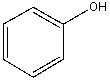
D)

E)

A)
B)
C)
D)
E)
Question
Question
What is the expected product,A,of the following reaction sequence? 
A) HCO2CH2C6H5
B) C6H5CH2COOH
C) C6H5CH2OSO3H
D) C6H5CHClCOOH
E) O=C(CH2C6H5)2
A) HCO2CH2C6H5
B) C6H5CH2COOH
C) C6H5CH2OSO3H
D) C6H5CHClCOOH
E) O=C(CH2C6H5)2
Question
What would be the final organic product of the following reaction? 
A) C6H5CH2CH2CO2H
B) C6H5CH2CH2NH2
C) C6H5CH2CH(CH3)CN
D) C6H5CH2CH=NH
E) C6H5CH2NH2
A) C6H5CH2CH2CO2H
B) C6H5CH2CH2NH2
C) C6H5CH2CH(CH3)CN
D) C6H5CH2CH=NH
E) C6H5CH2NH2
Question
What is the expected product,A,of the following reaction sequence? 
A) Benzyl formate
B) Phenylacetic acid
C) Benzenesulfonic acid
D) 1-chloro-1-phenyl acetic acid
E) Dibenzylketone
A) Benzyl formate
B) Phenylacetic acid
C) Benzenesulfonic acid
D) 1-chloro-1-phenyl acetic acid
E) Dibenzylketone
Question
Reasoning by analogy,one would predict that the reaction of carbon disulfide with sec-butylmagnesium bromide should yield which of the following (after acidification)? 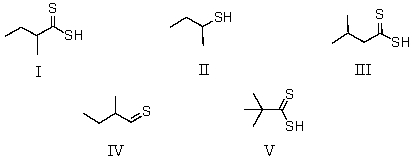
A) I
B) II
C) III
D) IV
E) V
A) I
B) II
C) III
D) IV
E) V
Question
Question
What would be the final product,F,of the following sequence of reactions? 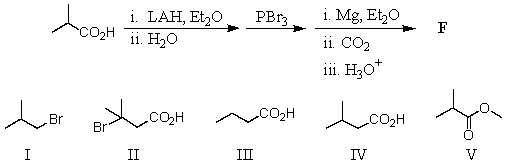
A) I
B) II
C) III
D) IV
E) V
A) I
B) II
C) III
D) IV
E) V
Question
What would be the product of the following reaction ? 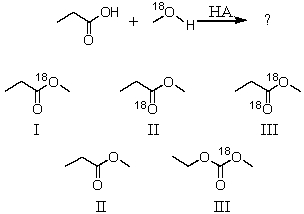 \
\
A) I
B) II
C) III
D) IV
E) V
\A) I
B) II
C) III
D) IV
E) V
Question
Question
Question
What is the reactant of the following reaction sequence? 
A) BrCH2C6H5
B) C6H5CH2COOH
C) C6H5CH2OH
D) C6H5CH2CH2COOH
E) O=C(CH2C6H5)2
A) BrCH2C6H5
B) C6H5CH2COOH
C) C6H5CH2OH
D) C6H5CH2CH2COOH
E) O=C(CH2C6H5)2
Question
What would be the final product,F,of the following sequence of reactions? 
A) 1-Bromo-2-methyl propane
B) 3-Bromo-3-methylbutanoic acid
C) Butanoic acid
D) 3-Methylbutanoic acid
E) Methyl 2-methylproanoate
A) 1-Bromo-2-methyl propane
B) 3-Bromo-3-methylbutanoic acid
C) Butanoic acid
D) 3-Methylbutanoic acid
E) Methyl 2-methylproanoate
Question
What is the expected product,A,of the following reaction sequence? 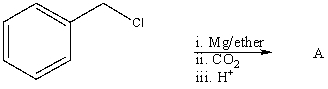
A) HCO2CH2C6H5
B) C6H5CH2COOH
C) C6H5CH2OSO3H
D) C6H5CHClCOOH
E) O=C(CH2C6H5)2
A) HCO2CH2C6H5
B) C6H5CH2COOH
C) C6H5CH2OSO3H
D) C6H5CHClCOOH
E) O=C(CH2C6H5)2
Question
What would be the final organic product of the following reaction? 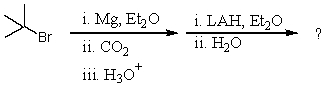
A) 2,2-Dimethylpropanoic acid
B) Methyl 2,2-dimethylpropanoate
C) 2,2-Dimethyl-1-propanol
D) t-Butyl methyl ether
E) 3,3-Dimethyl-2-butanone
A) 2,2-Dimethylpropanoic acid
B) Methyl 2,2-dimethylpropanoate
C) 2,2-Dimethyl-1-propanol
D) t-Butyl methyl ether
E) 3,3-Dimethyl-2-butanone
Question
Question
Question
Question
Question
What would be the final organic product of the following reaction? 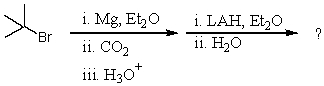
A) (CH3)3CCO2H
B) (CH3)3CCOCH3
C) (CH3)3CCH2OH
D) (CH3)3COCH3
E) (CH3)3CCO2CH3
A) (CH3)3CCO2H
B) (CH3)3CCOCH3
C) (CH3)3CCH2OH
D) (CH3)3COCH3
E) (CH3)3CCO2CH3
Question
What would be the final product,F,of the following sequence of reactions? 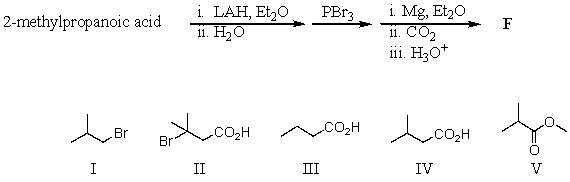
A) I
B) II
C) III
D) IV
E) V
A) I
B) II
C) III
D) IV
E) V
Question
Question
Question
What would be the final organic product of the following reaction? 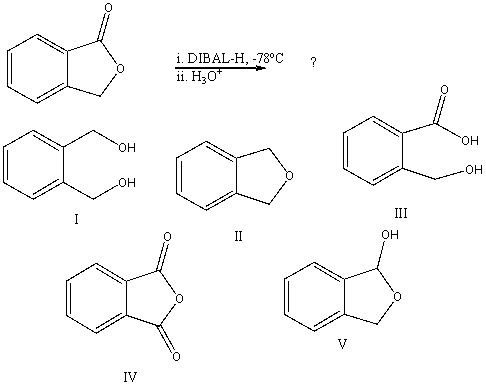
A) I
B) II
C) III
D) IV
E) V
A) I
B) II
C) III
D) IV
E) V
Question
The product of the following reaction is: 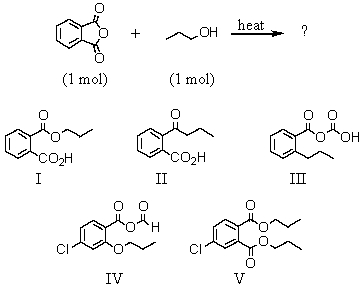
A) I
B) II
C) III
D) IV
E) V
A) I
B) II
C) III
D) IV
E) V
Question
Predict the major organic product of the reaction sequence, 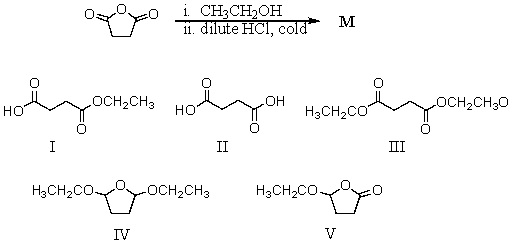
A) I
B) II
C) III
D) IV
E) V
A) I
B) II
C) III
D) IV
E) V
Question
Question
The product,Z,of the following sequence of reactions is which compound? 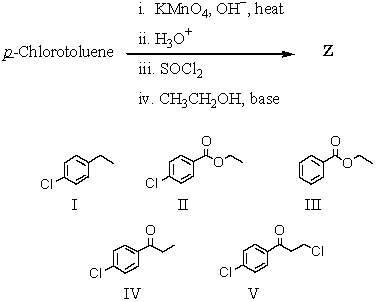
A) I
B) II
C) III
D) IV
E) V
A) I
B) II
C) III
D) IV
E) V
Question
Question
Question
What would be the final organic product of the following reaction? 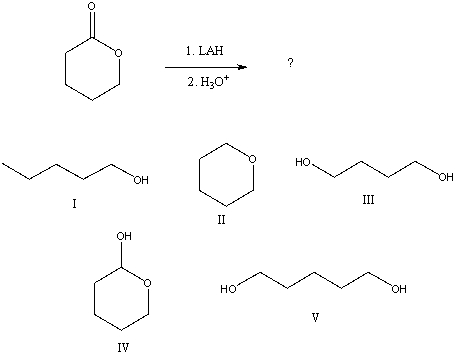
A) I
B) II
C) III
D) IV
E) V
A) I
B) II
C) III
D) IV
E) V
Question
Choose the reagent(s)that would bring about the following reaction: CH3CH2CH2CO2CH3 -- CH3CH2CH2CHO
A) H2/Ni
B) Li/liq NH3
C)

D) NaBH4,CH3OH
E) LiAlH4,ether
A) H2/Ni
B) Li/liq NH3
C)
D) NaBH4,CH3OH
E) LiAlH4,ether
Question
Question
Which of the following would serve as a reasonable synthesis of ethyl benzoate?
A)

B)

C)

D) All of the above
E) None of the above
A)
B)
C)
D) All of the above
E) None of the above
Question
What is the product of this reaction? 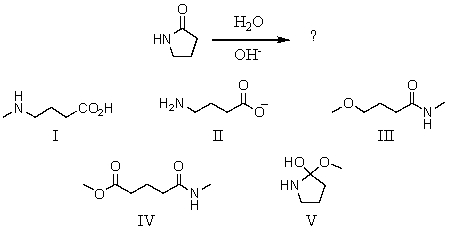
A) I
B) II
C) III
D) IV
E) V
A) I
B) II
C) III
D) IV
E) V
Question
Which of the following reactions would constitute a reasonable synthesis of propyl acetate?
A)

B)

C)

D) All of these
E) None of these
A)
B)
C)
D) All of these
E) None of these
Question
Which of the following combinations of reagents would not produce an ester?
A)

B)

C)

D)

E)

A)
B)
C)
D)
E)
Question
Which of the following would yield (S)-2-butanol?
A)

B)

C)

D) All of these
E) None of these
A)
B)
C)
D) All of these
E) None of these
Question
Predict the major organic product,P,of the following sequence of reactions: 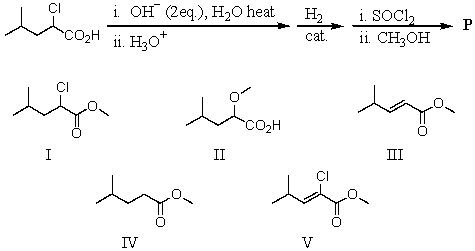
A) I
B) II
C) III
D) IV
E) V
A) I
B) II
C) III
D) IV
E) V
Question
What would be the final organic product of the following reaction? 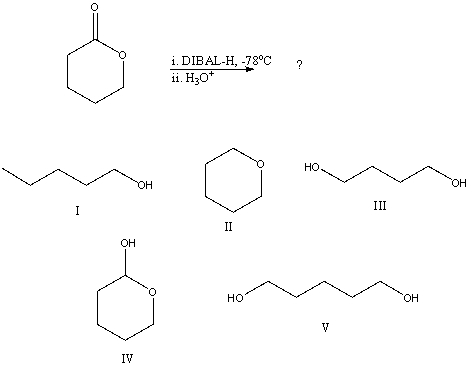
A) I
B) II
C) III
D) IV
E) V
A) I
B) II
C) III
D) IV
E) V
Question
Question
What is the product of this reaction? 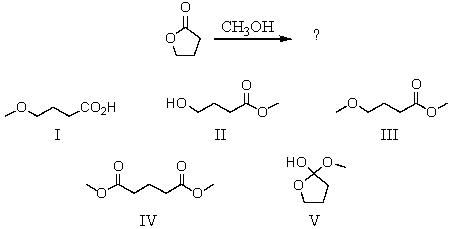
A) I
B) II
C) III
D) IV
E) V
A) I
B) II
C) III
D) IV
E) V
Question
What would be the final organic product of the following reaction? 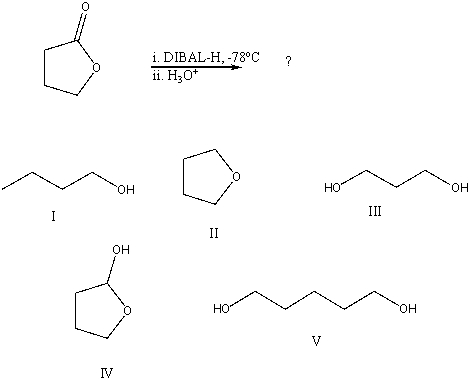
A) I
B) II
C) III
D) IV
E) V
A) I
B) II
C) III
D) IV
E) V

Unlock Deck
Sign up to unlock the cards in this deck!
Unlock Deck
Unlock Deck
1/131

Play

Full screen (f)
Deck 17: Aldehydes and Ketones Ii Aldol Reactions
1
Which of the following structures is N-benzyl-N-propyl-2,3-dimethylbutanamide?
A) I
B) II
C) III
D) IV
E) V
A) I
B) II
C) III
D) IV
E) V
V
2
Which compound would be the weakest acid?
A) CHCl2CH2CH2CO2H
B) ClCH2CHClCH2CO2H
C) CH3CCl2CH2CO2H
D) CH3CHClCHClCO2H
E) CH3CH2CCl2CO2H
A) CHCl2CH2CH2CO2H
B) ClCH2CHClCH2CO2H
C) CH3CCl2CH2CO2H
D) CH3CHClCHClCO2H
E) CH3CH2CCl2CO2H
CHCl2CH2CH2CO2H
3
What is the IUPAC name for
A) "2,3-0Dimethylbutyl acetate"
B) "2,3-Dimethyl-4-oxoethanal"
C) "2,3-Dimethylbutyl methanoate"
D) "2,3-Dimethylbutyl methylate"
E) "2,3-Dimethylbutyl formylate"
A) "2,3-0Dimethylbutyl acetate"
B) "2,3-Dimethyl-4-oxoethanal"
C) "2,3-Dimethylbutyl methanoate"
D) "2,3-Dimethylbutyl methylate"
E) "2,3-Dimethylbutyl formylate"
"2,3-Dimethylbutyl methanoate"
4
Which compound would be the strongest acid?
A) CHCl2CH2CH2CO2H
B) ClCH2CHClCH2CO2H
C) CH3CCl2CH2CO2H
D) CH3CHClCHClCO2H
E) CH3CH2CCl2CO2H
A) CHCl2CH2CH2CO2H
B) ClCH2CHClCH2CO2H
C) CH3CCl2CH2CO2H
D) CH3CHClCHClCO2H
E) CH3CH2CCl2CO2H
Unlock Deck
Unlock for access to all 131 flashcards in this deck.
Unlock Deck
k this deck
5
The IR spectrum of a compound exhibits a broad absorption band at 2500-3000 cm-1 and a sharp band at 1710 cm-1.Which of these compounds could it be?
A) 1-Butanol
B) Propyl acetate
C) Butanoic acid
D) Acetyl chloride
E) Acetic anhydride
A) 1-Butanol
B) Propyl acetate
C) Butanoic acid
D) Acetyl chloride
E) Acetic anhydride
Unlock Deck
Unlock for access to all 131 flashcards in this deck.
Unlock Deck
k this deck
6
Which of the following would be the strongest acid?
A) I
B) II
C) III
D) IV
E) V
A) I
B) II
C) III
D) IV
E) V
Unlock Deck
Unlock for access to all 131 flashcards in this deck.
Unlock Deck
k this deck
7
Which of the following would be the strongest acid?
A) I
B) II
C) III
D) IV
E) V
A) I
B) II
C) III
D) IV
E) V
Unlock Deck
Unlock for access to all 131 flashcards in this deck.
Unlock Deck
k this deck
8
What is the IUPAC name for
A) " -Chlorovaleryl chloride"
B) "2-Chloropentanoyl chloride"
C) "1-Chloropentanoyl chloride"
D) "1,2-Dichloropentanal"
E) "1-Chloro-1-butanecarbonyl chloride"
A) " -Chlorovaleryl chloride"
B) "2-Chloropentanoyl chloride"
C) "1-Chloropentanoyl chloride"
D) "1,2-Dichloropentanal"
E) "1-Chloro-1-butanecarbonyl chloride"
Unlock Deck
Unlock for access to all 131 flashcards in this deck.
Unlock Deck
k this deck
9
Which of the following would be the strongest acid?
A) I
B) II
C) III
D) IV
E) V
A) I
B) II
C) III
D) IV
E) V
Unlock Deck
Unlock for access to all 131 flashcards in this deck.
Unlock Deck
k this deck
10
Which of the following would be the weakest acid?
A) I
B) II
C) III
D) IV
E) V
A) I
B) II
C) III
D) IV
E) V
Unlock Deck
Unlock for access to all 131 flashcards in this deck.
Unlock Deck
k this deck
11
In which of the following sequences are the compounds listed in order of decreasing acidity?
A) PhCOOH > H2O > PhOH > PhCH2OH > PhH
B) PhCOOH > PhOH > H2O > PhCH2OH > PhH
C) PhH > H2O > PhOH > PhCH2OH > PhCOOH
D) PhOH > H2O > PhCOOH > PhCH2OH > PhH
E) PhCOOH > H2O > PhOH > PhH > PhCH2OH
A) PhCOOH > H2O > PhOH > PhCH2OH > PhH
B) PhCOOH > PhOH > H2O > PhCH2OH > PhH
C) PhH > H2O > PhOH > PhCH2OH > PhCOOH
D) PhOH > H2O > PhCOOH > PhCH2OH > PhH
E) PhCOOH > H2O > PhOH > PhH > PhCH2OH
Unlock Deck
Unlock for access to all 131 flashcards in this deck.
Unlock Deck
k this deck
12
In which of the following sequences are the compounds listed in order of increasing acidity?
A) NH3 < HC CH < CH3CH2OH < H2O < CH3COOH
B) CH3CH2OH < NH3 < H2O < HC CH < CH3COOH
C) CH3COOH < CH3CH2OH < H2O < NH3 < HC CH
D) H2O < CH3COOH < CH3CH2OH < HC CH < NH3
E) NH3 < H2O < CH3COOH < HC CH < CH3CH2OH
A) NH3 < HC CH < CH3CH2OH < H2O < CH3COOH
B) CH3CH2OH < NH3 < H2O < HC CH < CH3COOH
C) CH3COOH < CH3CH2OH < H2O < NH3 < HC CH
D) H2O < CH3COOH < CH3CH2OH < HC CH < NH3
E) NH3 < H2O < CH3COOH < HC CH < CH3CH2OH
Unlock Deck
Unlock for access to all 131 flashcards in this deck.
Unlock Deck
k this deck
13
Which of the following would be the weakest acid?
A) I
B) II
C) III
D) IV
E) V
A) I
B) II
C) III
D) IV
E) V
Unlock Deck
Unlock for access to all 131 flashcards in this deck.
Unlock Deck
k this deck
14
Which of the following would be the strongest acid?
A) I
B) II
C) III
D) IV
E) V
A) I
B) II
C) III
D) IV
E) V
Unlock Deck
Unlock for access to all 131 flashcards in this deck.
Unlock Deck
k this deck
15
Which of the following would be the strongest acid?
A) I
B) II
C) III
D) IV
E) V
A) I
B) II
C) III
D) IV
E) V
Unlock Deck
Unlock for access to all 131 flashcards in this deck.
Unlock Deck
k this deck
16
Which of the following would be the strongest acid?
A) I
B) II
C) III
D) IV
E) V
A) I
B) II
C) III
D) IV
E) V
Unlock Deck
Unlock for access to all 131 flashcards in this deck.
Unlock Deck
k this deck
17
Which of the following is the best name for the following compound?
A) Isobutyl ethanoate
B) Ethyl isopropanoate
C) 3-methylbutyl ethanoate
D) Ethoxy isobutyl ketone
E) Ethyl 3-methylbutanoate
A) Isobutyl ethanoate
B) Ethyl isopropanoate
C) 3-methylbutyl ethanoate
D) Ethoxy isobutyl ketone
E) Ethyl 3-methylbutanoate
Unlock Deck
Unlock for access to all 131 flashcards in this deck.
Unlock Deck
k this deck
18
The correct structure for ethyl 3-methylbutanoate is:
A)I
B)II
C)III
D)IV
E)V
A)I
B)II
C)III
D)IV
E)V
Unlock Deck
Unlock for access to all 131 flashcards in this deck.
Unlock Deck
k this deck
19
In which of the following sequences are the compounds listed in order of decreasing acidity?
A) CH3COOH > H2O > CH3CH2OH > HC CH > NH3
B) CH3CH2OH > CH3COOH > H2O > HC CH > NH3
C) CH3COOH > CH3CH2OH > H2O > NH3 > HC CH
D) H2O > CH3COOH > CH3CH2OH > HC CH > NH3
E) CH3CH2OH > H2O > CH3COOH > HC CH > NH3
A) CH3COOH > H2O > CH3CH2OH > HC CH > NH3
B) CH3CH2OH > CH3COOH > H2O > HC CH > NH3
C) CH3COOH > CH3CH2OH > H2O > NH3 > HC CH
D) H2O > CH3COOH > CH3CH2OH > HC CH > NH3
E) CH3CH2OH > H2O > CH3COOH > HC CH > NH3
Unlock Deck
Unlock for access to all 131 flashcards in this deck.
Unlock Deck
k this deck
20
In which of the following sequences are the compounds listed in order of decreasing acidity?
A) CH3COOH > H2O > PhOH > HC CH > NH3
B) PhOH > CH3COOH > H2O > HC CH > NH3
C) CH3COOH > PhOH > H2O > HC CH > NH3
D) H2O > CH3COOH > PhOH > HC CH > NH3
E) PhOH > H2O > CH3COOH > HC CH > NH3
A) CH3COOH > H2O > PhOH > HC CH > NH3
B) PhOH > CH3COOH > H2O > HC CH > NH3
C) CH3COOH > PhOH > H2O > HC CH > NH3
D) H2O > CH3COOH > PhOH > HC CH > NH3
E) PhOH > H2O > CH3COOH > HC CH > NH3
Unlock Deck
Unlock for access to all 131 flashcards in this deck.
Unlock Deck
k this deck
21
Which of the following acids would have the smallest value for pKa1?
A) HOOCCH2CH2CH2CH2CH2COOH
B) HOOCCH2CH2CH2CH2COOH
C) HOOCCH2CH2CH2COOH
D) HOOCCH2CH2COOH
E) HOOCCH2COOH
A) HOOCCH2CH2CH2CH2CH2COOH
B) HOOCCH2CH2CH2CH2COOH
C) HOOCCH2CH2CH2COOH
D) HOOCCH2CH2COOH
E) HOOCCH2COOH
Unlock Deck
Unlock for access to all 131 flashcards in this deck.
Unlock Deck
k this deck
22
Which of the following would be the strongest acid?
A) Benzoic acid
B) 4-Nitrobenzoic acid
C) 4-Methylbenzoic acid
D) 4-Methoxybenzoic acid
E) 4-Iodobenzoic acid
A) Benzoic acid
B) 4-Nitrobenzoic acid
C) 4-Methylbenzoic acid
D) 4-Methoxybenzoic acid
E) 4-Iodobenzoic acid
Unlock Deck
Unlock for access to all 131 flashcards in this deck.
Unlock Deck
k this deck
23
Which of the following would be the strongest acid?
A) 2,3-Dimethylhexanoic acid
B) 3,3-Diiodopentanoic acid
C) 3-Iodo-4-bromopentanoic acid
D) 3-Chloro-4-bromohexanoic acid
E) 2-Fluoro-4-bromopentanoic acid
A) 2,3-Dimethylhexanoic acid
B) 3,3-Diiodopentanoic acid
C) 3-Iodo-4-bromopentanoic acid
D) 3-Chloro-4-bromohexanoic acid
E) 2-Fluoro-4-bromopentanoic acid
Unlock Deck
Unlock for access to all 131 flashcards in this deck.
Unlock Deck
k this deck
24
Which of the following acids would have the largest value for pKa?
A) BrCH2CH2CH2COOH
B) ClCH2CH2CH2COOH
C) Cl2CHCH2CH2COOH
D) ICHBrCH2CH2COOH
E) BrCCl2CH2CH2COOH
A) BrCH2CH2CH2COOH
B) ClCH2CH2CH2COOH
C) Cl2CHCH2CH2COOH
D) ICHBrCH2CH2COOH
E) BrCCl2CH2CH2COOH
Unlock Deck
Unlock for access to all 131 flashcards in this deck.
Unlock Deck
k this deck
25
Which compound would be most acidic?
A) Acetic acid
B) Ethanol
C) Phenol
D) Acetone
E) Water
A) Acetic acid
B) Ethanol
C) Phenol
D) Acetone
E) Water
Unlock Deck
Unlock for access to all 131 flashcards in this deck.
Unlock Deck
k this deck
26
A compound has the molecular formula C8H14O4.Its IR spectrum shows a strong absorption band near 1740 cm-1.Its 1H NMR spectrum consists of: triplet,
1.3
Singlet,
2.6
Quartet,
4.2
The most likely structure for the compound is:
A) I
B) II
C) III
D) IV
E) V
1.3
Singlet,
2.6
Quartet,
4.2
The most likely structure for the compound is:
A) I
B) II
C) III
D) IV
E) V
Unlock Deck
Unlock for access to all 131 flashcards in this deck.
Unlock Deck
k this deck
27
A compound has the molecular formula,C6H12O2.Its IR spectrum shows a strong absorption band near 1740 cm-1;its 1H NMR spectrum consists of two singlets,at 1.4 and 2.0.The most likely structure for this compound is:
A) I
B) II
C) III
D) IV
E) V
A) I
B) II
C) III
D) IV
E) V
Unlock Deck
Unlock for access to all 131 flashcards in this deck.
Unlock Deck
k this deck
28
Which of the following acids would have the smallest value for pKa?
A) BrCH2CH2CH2COOH
B) ClCH2CH2CH2COOH
C) Cl2CHCH2CH2COOH
D) ICHBrCH2CH2COOH
E) BrCCl2CH2CH2COOH
A) BrCH2CH2CH2COOH
B) ClCH2CH2CH2COOH
C) Cl2CHCH2CH2COOH
D) ICHBrCH2CH2COOH
E) BrCCl2CH2CH2COOH
Unlock Deck
Unlock for access to all 131 flashcards in this deck.
Unlock Deck
k this deck
29
A compound with the molecular formula C18H18O4 has a 1H NMR spectrum that consists of: singlet,
2.7
Singlet,
3.1
Multiplet,
7.3
The IR spectrum shows a strong absorption band near 1750 cm-1.The most likely structure for the compound is:
A)
B)
C)
D)
E)
2.7
Singlet,
3.1
Multiplet,
7.3
The IR spectrum shows a strong absorption band near 1750 cm-1.The most likely structure for the compound is:
A)
B)
C)
D)
E)
Unlock Deck
Unlock for access to all 131 flashcards in this deck.
Unlock Deck
k this deck
30
Predict the major organic product of the reaction sequence below:
A) I
B) II
C) III
D) IV
E) V
A) I
B) II
C) III
D) IV
E) V
Unlock Deck
Unlock for access to all 131 flashcards in this deck.
Unlock Deck
k this deck
31
Which of the following would be the weakest acid?
A) Benzoic acid
B) 4-Nitrobenzoic acid
C) 4-Methylbenzoic acid
D) 4-Methoxybenzoic acid
E) 4-Iodobenzoic acid
A) Benzoic acid
B) 4-Nitrobenzoic acid
C) 4-Methylbenzoic acid
D) 4-Methoxybenzoic acid
E) 4-Iodobenzoic acid
Unlock Deck
Unlock for access to all 131 flashcards in this deck.
Unlock Deck
k this deck
32
A compound has the molecular formula,C6H12O2.Its IR spectrum shows a strong absorption band near 1740 cm-1;its 1H NMR spectrum consists of two singlets,at 1.2 and 3.6.The most likely structure for this compound is:
A) I
B) II
C) III
D) IV
E) V
A) I
B) II
C) III
D) IV
E) V
Unlock Deck
Unlock for access to all 131 flashcards in this deck.
Unlock Deck
k this deck
33
Which of the following would be the weakest acid?
A) I
B) II
C) III
D) IV
E) V
A) I
B) II
C) III
D) IV
E) V
Unlock Deck
Unlock for access to all 131 flashcards in this deck.
Unlock Deck
k this deck
34
What is the reactant of the following reaction sequence?
A) HCO2CH2C6H5
B) C6H5CH2COOH
C) C6H5CH2Cl
D) C6H5CHClCOOH
E) O=C(CH2C6H5)2
A) HCO2CH2C6H5
B) C6H5CH2COOH
C) C6H5CH2Cl
D) C6H5CHClCOOH
E) O=C(CH2C6H5)2
Unlock Deck
Unlock for access to all 131 flashcards in this deck.
Unlock Deck
k this deck
35
A compound with the molecular formula C5H10O2 gave the following 1H NMR spectrum: triplet,
0.90
Multiplet,
1.60
Singlet,
1.95
Triplet,
3.95
The IR spectrum showed a strong absorption band near 1740 cm-1.The most likely structure for the compound is:
A)
B)
C)
D)
E)
0.90
Multiplet,
1.60
Singlet,
1.95
Triplet,
3.95
The IR spectrum showed a strong absorption band near 1740 cm-1.The most likely structure for the compound is:
A)
B)
C)
D)
E)
Unlock Deck
Unlock for access to all 131 flashcards in this deck.
Unlock Deck
k this deck
36
In which of these species are all the carbon-oxygen bonds of equal length?
A) Diethyl carbonate
B) Methyl butanoate
C) Lithium acetate
D) Propionic anhydride
E) Pentanoic acid
A) Diethyl carbonate
B) Methyl butanoate
C) Lithium acetate
D) Propionic anhydride
E) Pentanoic acid
Unlock Deck
Unlock for access to all 131 flashcards in this deck.
Unlock Deck
k this deck
37
In which of the following are the compounds listed in order of decreasing acidity?
A) CH3CO2H > CH3CH2OH > C6H5OH > H2O
B) C6H5OH > CH3CO2H > H2O > CH3CH2OH
C) CH3CO2H > H2O > C6H5OH > CH3CH2OH
D) H2O > CH3CO2H > C6H5OH > CH3CH2OH
E) None of the above
A) CH3CO2H > CH3CH2OH > C6H5OH > H2O
B) C6H5OH > CH3CO2H > H2O > CH3CH2OH
C) CH3CO2H > H2O > C6H5OH > CH3CH2OH
D) H2O > CH3CO2H > C6H5OH > CH3CH2OH
E) None of the above
Unlock Deck
Unlock for access to all 131 flashcards in this deck.
Unlock Deck
k this deck
38
Which compound would be most acidic?
A)
B)
C)
D)
E)
A)
B)
C)
D)
E)
Unlock Deck
Unlock for access to all 131 flashcards in this deck.
Unlock Deck
k this deck
39
In which of the following are the compounds listed in order of decreasing acidity?
A) CH3CO2H > CH3CH2OH > C6H5OH > H2O
B) C6H5OH > CH3CO2H > H2O > CH3CH2OH
C) CH3CO2H > H2O > C6H5OH > CH3CH2OH
D) H2O > CH3CO2H > C6H5OH > CH3CH2OH
E) CH3CO2H > C6H5OH > CH3CH2OH > H2O
A) CH3CO2H > CH3CH2OH > C6H5OH > H2O
B) C6H5OH > CH3CO2H > H2O > CH3CH2OH
C) CH3CO2H > H2O > C6H5OH > CH3CH2OH
D) H2O > CH3CO2H > C6H5OH > CH3CH2OH
E) CH3CO2H > C6H5OH > CH3CH2OH > H2O
Unlock Deck
Unlock for access to all 131 flashcards in this deck.
Unlock Deck
k this deck
40
What is the expected product,A,of the following reaction sequence?
A) HCO2CH2C6H5
B) C6H5CH2COOH
C) C6H5CH2OSO3H
D) C6H5CHClCOOH
E) O=C(CH2C6H5)2
A) HCO2CH2C6H5
B) C6H5CH2COOH
C) C6H5CH2OSO3H
D) C6H5CHClCOOH
E) O=C(CH2C6H5)2
Unlock Deck
Unlock for access to all 131 flashcards in this deck.
Unlock Deck
k this deck
41
What would be the final organic product of the following reaction?
A) C6H5CH2CH2CO2H
B) C6H5CH2CH2NH2
C) C6H5CH2CH(CH3)CN
D) C6H5CH2CH=NH
E) C6H5CH2NH2
A) C6H5CH2CH2CO2H
B) C6H5CH2CH2NH2
C) C6H5CH2CH(CH3)CN
D) C6H5CH2CH=NH
E) C6H5CH2NH2
Unlock Deck
Unlock for access to all 131 flashcards in this deck.
Unlock Deck
k this deck
42
What is the expected product,A,of the following reaction sequence?
A) Benzyl formate
B) Phenylacetic acid
C) Benzenesulfonic acid
D) 1-chloro-1-phenyl acetic acid
E) Dibenzylketone
A) Benzyl formate
B) Phenylacetic acid
C) Benzenesulfonic acid
D) 1-chloro-1-phenyl acetic acid
E) Dibenzylketone
Unlock Deck
Unlock for access to all 131 flashcards in this deck.
Unlock Deck
k this deck
43
Reasoning by analogy,one would predict that the reaction of carbon disulfide with sec-butylmagnesium bromide should yield which of the following (after acidification)?
A) I
B) II
C) III
D) IV
E) V
A) I
B) II
C) III
D) IV
E) V
Unlock Deck
Unlock for access to all 131 flashcards in this deck.
Unlock Deck
k this deck
44
Alkaline hydrolysis of an ester involves initial attack by hydroxide ion on the carbonyl carbon.The presence of substituents on the aromatic ring of ethyl benzoate may be expected to increase/decrease the rate of hydrolysis of this ester.In what order should the five substituents below be arranged to represent the decreasing order of the rates of hydrolysis when these substituents are present in the para- position of the aromatic ring in ethyl benzoate?
A) -NO2 > -H > -Cl > -CH3 > -OCH3
B) -NO2 > -Cl > -H > -CH3 > -OCH3
C) -OCH3 > -CH3 > -Cl > -H > -NO2
D) -Cl > -NO2 > -H > -OCH3 > -CH3
E) -H > -Cl > -CH3 > -OCH3 > -NO2
A) -NO2 > -H > -Cl > -CH3 > -OCH3
B) -NO2 > -Cl > -H > -CH3 > -OCH3
C) -OCH3 > -CH3 > -Cl > -H > -NO2
D) -Cl > -NO2 > -H > -OCH3 > -CH3
E) -H > -Cl > -CH3 > -OCH3 > -NO2
Unlock Deck
Unlock for access to all 131 flashcards in this deck.
Unlock Deck
k this deck
45
What would be the final product,F,of the following sequence of reactions?
A) I
B) II
C) III
D) IV
E) V
A) I
B) II
C) III
D) IV
E) V
Unlock Deck
Unlock for access to all 131 flashcards in this deck.
Unlock Deck
k this deck
46
What would be the product of the following reaction ? \
A) I
B) II
C) III
D) IV
E) V
\A) I
B) II
C) III
D) IV
E) V
Unlock Deck
Unlock for access to all 131 flashcards in this deck.
Unlock Deck
k this deck
47
An acid chloride is prepared from the related carboxylic acid by reaction with which of these?
A) HCl
B) Cl2
C) SOCl2
D) HOCl
E) AlCl3
A) HCl
B) Cl2
C) SOCl2
D) HOCl
E) AlCl3
Unlock Deck
Unlock for access to all 131 flashcards in this deck.
Unlock Deck
k this deck
48
Which compound would be most reactive toward nucleophilic acyl addition-elimination?
A) CH3CO2Na
B) CH3COCl
C) (CH3CO)2O
D) CH3CONH2
E) CH3CO2CH3
A) CH3CO2Na
B) CH3COCl
C) (CH3CO)2O
D) CH3CONH2
E) CH3CO2CH3
Unlock Deck
Unlock for access to all 131 flashcards in this deck.
Unlock Deck
k this deck
49
What is the reactant of the following reaction sequence?
A) BrCH2C6H5
B) C6H5CH2COOH
C) C6H5CH2OH
D) C6H5CH2CH2COOH
E) O=C(CH2C6H5)2
A) BrCH2C6H5
B) C6H5CH2COOH
C) C6H5CH2OH
D) C6H5CH2CH2COOH
E) O=C(CH2C6H5)2
Unlock Deck
Unlock for access to all 131 flashcards in this deck.
Unlock Deck
k this deck
50
What would be the final product,F,of the following sequence of reactions?
A) 1-Bromo-2-methyl propane
B) 3-Bromo-3-methylbutanoic acid
C) Butanoic acid
D) 3-Methylbutanoic acid
E) Methyl 2-methylproanoate
A) 1-Bromo-2-methyl propane
B) 3-Bromo-3-methylbutanoic acid
C) Butanoic acid
D) 3-Methylbutanoic acid
E) Methyl 2-methylproanoate
Unlock Deck
Unlock for access to all 131 flashcards in this deck.
Unlock Deck
k this deck
51
What is the expected product,A,of the following reaction sequence?
A) HCO2CH2C6H5
B) C6H5CH2COOH
C) C6H5CH2OSO3H
D) C6H5CHClCOOH
E) O=C(CH2C6H5)2
A) HCO2CH2C6H5
B) C6H5CH2COOH
C) C6H5CH2OSO3H
D) C6H5CHClCOOH
E) O=C(CH2C6H5)2
Unlock Deck
Unlock for access to all 131 flashcards in this deck.
Unlock Deck
k this deck
52
What would be the final organic product of the following reaction?
A) 2,2-Dimethylpropanoic acid
B) Methyl 2,2-dimethylpropanoate
C) 2,2-Dimethyl-1-propanol
D) t-Butyl methyl ether
E) 3,3-Dimethyl-2-butanone
A) 2,2-Dimethylpropanoic acid
B) Methyl 2,2-dimethylpropanoate
C) 2,2-Dimethyl-1-propanol
D) t-Butyl methyl ether
E) 3,3-Dimethyl-2-butanone
Unlock Deck
Unlock for access to all 131 flashcards in this deck.
Unlock Deck
k this deck
53
Which of the following will not undergo hydrolysis,whether acid or base is present?
A) CH3COCl
B) CH3CONH2
C) (CH3CO)2O
D) CH3CO2CH2CH3
E) CH3COCH2CH2CH3
A) CH3COCl
B) CH3CONH2
C) (CH3CO)2O
D) CH3CO2CH2CH3
E) CH3COCH2CH2CH3
Unlock Deck
Unlock for access to all 131 flashcards in this deck.
Unlock Deck
k this deck
54
The relative reactivity of acyl compounds toward nucleophilic acyl addition-elimination is:
A) Amide > ester > acid anhydride > acyl chloride
B) Acyl chloride > ester > acid anhydride > amide
C) Ester > acyl chloride > acid anhydride > amide
D) Acyl chloride > acid anhydride > ester > amide
E) Acid anhydride > acyl chloride > ester > amide
A) Amide > ester > acid anhydride > acyl chloride
B) Acyl chloride > ester > acid anhydride > amide
C) Ester > acyl chloride > acid anhydride > amide
D) Acyl chloride > acid anhydride > ester > amide
E) Acid anhydride > acyl chloride > ester > amide
Unlock Deck
Unlock for access to all 131 flashcards in this deck.
Unlock Deck
k this deck
55
Which of these combinations will not produce benzoic acid?
A) C6H5CH2OH + KMnO4/OH - /H2O,heat;then H3O+
B) C6H5CH3 + KMnO4/OH - /H2O,heat;then H3O+
C) C6H6 + CO2,high pressure
D) C6H5COCH3 + Cl2/OH - /H2O;then H3O+
E) C6H5COCl + OH - /H2O;then H3O+
A) C6H5CH2OH + KMnO4/OH - /H2O,heat;then H3O+
B) C6H5CH3 + KMnO4/OH - /H2O,heat;then H3O+
C) C6H6 + CO2,high pressure
D) C6H5COCH3 + Cl2/OH - /H2O;then H3O+
E) C6H5COCl + OH - /H2O;then H3O+
Unlock Deck
Unlock for access to all 131 flashcards in this deck.
Unlock Deck
k this deck
56
Choose the reagent(s)that would bring about the following reaction: CH3CH2CH2COCl -- CH3CH2CH2CHO
A) H2/Ni
B) Li/liq NH3
C) LiAl(OC(CH3)3)3H
D) NaBH4,CH3OH
E) LiAlH4,ether
A) H2/Ni
B) Li/liq NH3
C) LiAl(OC(CH3)3)3H
D) NaBH4,CH3OH
E) LiAlH4,ether
Unlock Deck
Unlock for access to all 131 flashcards in this deck.
Unlock Deck
k this deck
57
What would be the final organic product of the following reaction?
A) (CH3)3CCO2H
B) (CH3)3CCOCH3
C) (CH3)3CCH2OH
D) (CH3)3COCH3
E) (CH3)3CCO2CH3
A) (CH3)3CCO2H
B) (CH3)3CCOCH3
C) (CH3)3CCH2OH
D) (CH3)3COCH3
E) (CH3)3CCO2CH3
Unlock Deck
Unlock for access to all 131 flashcards in this deck.
Unlock Deck
k this deck
58
What would be the final product,F,of the following sequence of reactions?
A) I
B) II
C) III
D) IV
E) V
A) I
B) II
C) III
D) IV
E) V
Unlock Deck
Unlock for access to all 131 flashcards in this deck.
Unlock Deck
k this deck
59
Which of these compounds could not be formed by nucleophilic attack by an appropriate reagent on acetyl chloride?
A) CH3CONH2
B) CH3CO2CH2CH3
C) ClCH2COCl
D) CH3CO2H
E) (CH3CO)2O
A) CH3CONH2
B) CH3CO2CH2CH3
C) ClCH2COCl
D) CH3CO2H
E) (CH3CO)2O
Unlock Deck
Unlock for access to all 131 flashcards in this deck.
Unlock Deck
k this deck
60
Which of these combinations will not produce benzoic acid?
A) C6H5CH2OH + KMnO4/OH - /H2O,heat;then H3O+
B) C6H5CH3 + KMnO4/OH - /H2O,heat;then H3O+
C) C6H6 + CO2,high pressure
D) C6H5COCH3 + I2/OH - /H2O;then H3O+
E) C6H5COCl + OH - /H2O;then H3O+
A) C6H5CH2OH + KMnO4/OH - /H2O,heat;then H3O+
B) C6H5CH3 + KMnO4/OH - /H2O,heat;then H3O+
C) C6H6 + CO2,high pressure
D) C6H5COCH3 + I2/OH - /H2O;then H3O+
E) C6H5COCl + OH - /H2O;then H3O+
Unlock Deck
Unlock for access to all 131 flashcards in this deck.
Unlock Deck
k this deck
61
What would be the final organic product of the following reaction?
A) I
B) II
C) III
D) IV
E) V
A) I
B) II
C) III
D) IV
E) V
Unlock Deck
Unlock for access to all 131 flashcards in this deck.
Unlock Deck
k this deck
62
The product of the following reaction is:
A) I
B) II
C) III
D) IV
E) V
A) I
B) II
C) III
D) IV
E) V
Unlock Deck
Unlock for access to all 131 flashcards in this deck.
Unlock Deck
k this deck
63
Predict the major organic product of the reaction sequence,
A) I
B) II
C) III
D) IV
E) V
A) I
B) II
C) III
D) IV
E) V
Unlock Deck
Unlock for access to all 131 flashcards in this deck.
Unlock Deck
k this deck
64
Which of the following compounds is capable of forming a -lactone?
A) 5-Hydroxypentanoic acid
B) Pentanedioic acid
C) 4-Hydroxypentanoic acid
D) 3-Hydroxypentanoic acid
E) 2-Hydroxypentanoic acid
A) 5-Hydroxypentanoic acid
B) Pentanedioic acid
C) 4-Hydroxypentanoic acid
D) 3-Hydroxypentanoic acid
E) 2-Hydroxypentanoic acid
Unlock Deck
Unlock for access to all 131 flashcards in this deck.
Unlock Deck
k this deck
65
The product,Z,of the following sequence of reactions is which compound?
A) I
B) II
C) III
D) IV
E) V
A) I
B) II
C) III
D) IV
E) V
Unlock Deck
Unlock for access to all 131 flashcards in this deck.
Unlock Deck
k this deck
66
Predict the final product likely to be obtained when (S)-2-methyl-3-pentanol is subjected to the following sequence of reactions: i)benzoyl chloride;ii)NaOH (aq),heat .
A) (S)-2-methyl-3-pentanol
B) (R)-2-methyl-3-pentanol
C) (R,S)-2-methyl-3-pentanol
D) 2-Methyl-2-pentene
E) (R,S)-2-methyl-3-pentanol and 2-methyl-2-pentene in more or less equal amounts
A) (S)-2-methyl-3-pentanol
B) (R)-2-methyl-3-pentanol
C) (R,S)-2-methyl-3-pentanol
D) 2-Methyl-2-pentene
E) (R,S)-2-methyl-3-pentanol and 2-methyl-2-pentene in more or less equal amounts
Unlock Deck
Unlock for access to all 131 flashcards in this deck.
Unlock Deck
k this deck
67
Intramolecular dehydration to form a cyclic monoester is most likely to occur when which of the following is heated with acid?
A) CH3CH2CH2CHOHCO2H
B) CH3CH2CHOHCH2CO2H
C) CH3CH2CH2CH2CO2H
D) CH3CHOHCH2CH2CO2H
E) HO2CCH2CH2CO2H
A) CH3CH2CH2CHOHCO2H
B) CH3CH2CHOHCH2CO2H
C) CH3CH2CH2CH2CO2H
D) CH3CHOHCH2CH2CO2H
E) HO2CCH2CH2CO2H
Unlock Deck
Unlock for access to all 131 flashcards in this deck.
Unlock Deck
k this deck
68
What would be the final organic product of the following reaction?
A) I
B) II
C) III
D) IV
E) V
A) I
B) II
C) III
D) IV
E) V
Unlock Deck
Unlock for access to all 131 flashcards in this deck.
Unlock Deck
k this deck
69
Choose the reagent(s)that would bring about the following reaction: CH3CH2CH2CO2CH3 -- CH3CH2CH2CHO
A) H2/Ni
B) Li/liq NH3
C)
D) NaBH4,CH3OH
E) LiAlH4,ether
A) H2/Ni
B) Li/liq NH3
C)
D) NaBH4,CH3OH
E) LiAlH4,ether
Unlock Deck
Unlock for access to all 131 flashcards in this deck.
Unlock Deck
k this deck
70
Which of the following is not a method for preparing butanoic acid?
A) CH3CH2CH2Br + NaCN;then H3O+,reflux
B) CH3CH2CH2MgBr + CO2;then H3O+
C) CH3CH2CH2OH + CO
D) CH3CH2CH2CO2Et + OH - /H2O;then H3O+
E) CH3CH2CH2CH2OH + KMnO4/OH - /H2O/heat;then H3O+
A) CH3CH2CH2Br + NaCN;then H3O+,reflux
B) CH3CH2CH2MgBr + CO2;then H3O+
C) CH3CH2CH2OH + CO
D) CH3CH2CH2CO2Et + OH - /H2O;then H3O+
E) CH3CH2CH2CH2OH + KMnO4/OH - /H2O/heat;then H3O+
Unlock Deck
Unlock for access to all 131 flashcards in this deck.
Unlock Deck
k this deck
71
Which of the following would serve as a reasonable synthesis of ethyl benzoate?
A)
B)
C)
D) All of the above
E) None of the above
A)
B)
C)
D) All of the above
E) None of the above
Unlock Deck
Unlock for access to all 131 flashcards in this deck.
Unlock Deck
k this deck
72
What is the product of this reaction?
A) I
B) II
C) III
D) IV
E) V
A) I
B) II
C) III
D) IV
E) V
Unlock Deck
Unlock for access to all 131 flashcards in this deck.
Unlock Deck
k this deck
73
Which of the following reactions would constitute a reasonable synthesis of propyl acetate?
A)
B)
C)
D) All of these
E) None of these
A)
B)
C)
D) All of these
E) None of these
Unlock Deck
Unlock for access to all 131 flashcards in this deck.
Unlock Deck
k this deck
74
Which of the following combinations of reagents would not produce an ester?
A)
B)
C)
D)
E)
A)
B)
C)
D)
E)
Unlock Deck
Unlock for access to all 131 flashcards in this deck.
Unlock Deck
k this deck
75
Which of the following would yield (S)-2-butanol?
A)
B)
C)
D) All of these
E) None of these
A)
B)
C)
D) All of these
E) None of these
Unlock Deck
Unlock for access to all 131 flashcards in this deck.
Unlock Deck
k this deck
76
Predict the major organic product,P,of the following sequence of reactions:
A) I
B) II
C) III
D) IV
E) V
A) I
B) II
C) III
D) IV
E) V
Unlock Deck
Unlock for access to all 131 flashcards in this deck.
Unlock Deck
k this deck
77
What would be the final organic product of the following reaction?
A) I
B) II
C) III
D) IV
E) V
A) I
B) II
C) III
D) IV
E) V
Unlock Deck
Unlock for access to all 131 flashcards in this deck.
Unlock Deck
k this deck
78
- And -hydroxy acids can be esterified intramolecularly to form compounds known as which of these?
A) Anhydrides
B) Cycloalkenes
C) Lactones
D) Lactams
E) Cyclic ketones
A) Anhydrides
B) Cycloalkenes
C) Lactones
D) Lactams
E) Cyclic ketones
Unlock Deck
Unlock for access to all 131 flashcards in this deck.
Unlock Deck
k this deck
79
What is the product of this reaction?
A) I
B) II
C) III
D) IV
E) V
A) I
B) II
C) III
D) IV
E) V
Unlock Deck
Unlock for access to all 131 flashcards in this deck.
Unlock Deck
k this deck
80
What would be the final organic product of the following reaction?
A) I
B) II
C) III
D) IV
E) V
A) I
B) II
C) III
D) IV
E) V
Unlock Deck
Unlock for access to all 131 flashcards in this deck.
Unlock Deck
k this deck
Unlock Deck
Unlock for access to all 131 flashcards in this deck.






