







 Chat with AI

Deck 13: The Brain, cranial Nerves, and Sensory and Motor Pathways
Full screen (f)

Question

Question
Question
Question
Question
Question
Question
Question
Question
Question
Question
Question
Question
Question
Question
Question
Question
Question
Question
Question
Question
Question
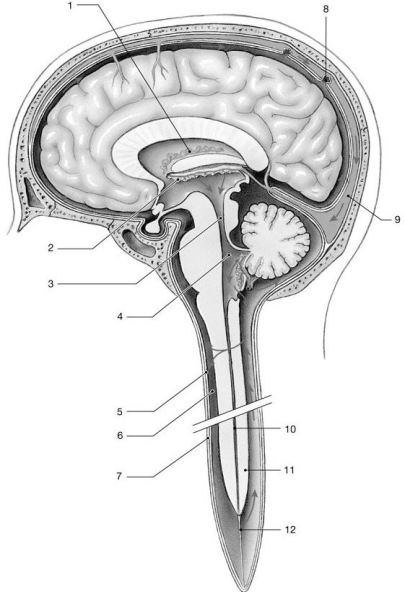 Figure 13-1
Identify the structure labeled "8."
A)pia mater
B)dura mater
C)corpus callosum
D)ventricles
E)arachnoid granulation
Question
Question
Figure 13-1Identify the structure labeled "3."
A)arbor vitae
B)corpora quadrigemina
C)cerebral aqueduct
D)pons
E)diencephalon
Question
Question
Question
Figure 13-1What is produced by the structure labeled "2"?
A)cerebrospinal fluid
B)neurotransmitters
C)white matter
D)hormones
E)blood
Question
Question
Question
Question
Question
Figure 13-1Identify the structure labeled "7."
A)dura mater
B)lateral ventricle
C)fourth ventricle
D)subarachnoid space
E)filum terminale
Question
Question
Question
Question
Question
Question
Question
Figure 13-1Identify the structure labeled "10."
A)arbor vitae
B)central canal
C)corpus callosum
D)pons
E)diencephalon
Question
Question
Question
Question
Question
Question
Question
Question
Question
Question
Question
Question
Question
Question
Question
Question
Question
Question
Question
Question
Question
Question
Question
Question
Question
Question
Question
Question
Question
Question
Question
Question
Question
Question
Question
Question
Question
Question
Question
Question
Question

Unlock Deck
Sign up to unlock the cards in this deck!
Unlock Deck
Unlock Deck
1/317

Play

Full screen (f)
Deck 13: The Brain, cranial Nerves, and Sensory and Motor Pathways
1
Autonomic centers that control blood pressure,heart rate,and digestion are located in the
A)medulla oblongata.
B)pons.
C)midbrain.
D)diencephalon.
E)cerebellum.
A)medulla oblongata.
B)pons.
C)midbrain.
D)diencephalon.
E)cerebellum.
A
2
Which of the following lies between the cerebrum and the brainstem?
A)medulla oblongata
B)pons
C)midbrain
D)diencephalon
E)cerebellum
A)medulla oblongata
B)pons
C)midbrain
D)diencephalon
E)cerebellum
D
3
The adult human brain contains almost ________ of the body's neural tissue.
A)15 percent
B)25 percent
C)68 percent
D)97 percent
E)100 percent
A)15 percent
B)25 percent
C)68 percent
D)97 percent
E)100 percent
D
4
Male brains are typically ________ compared to female brains.
A)larger
B)smaller
C)the same size
D)very smooth
E)more convoluted
A)larger
B)smaller
C)the same size
D)very smooth
E)more convoluted
Unlock Deck
Unlock for access to all 317 flashcards in this deck.
Unlock Deck
k this deck
5
The third and fourth ventricles are linked by a slender canal designated as the
A)central canal.
B)tentorium cerebelli.
C)cerebral aqueduct.
D)interventricular foramina.
E)septum pellucidum.
A)central canal.
B)tentorium cerebelli.
C)cerebral aqueduct.
D)interventricular foramina.
E)septum pellucidum.
Unlock Deck
Unlock for access to all 317 flashcards in this deck.
Unlock Deck
k this deck
6
The cells that cover the outer surfaces of CNS capillaries cells are the
A)microglia.
B)astrocytes.
C)monocytes.
D)leukocytes.
E)lymphocytes.
A)microglia.
B)astrocytes.
C)monocytes.
D)leukocytes.
E)lymphocytes.
Unlock Deck
Unlock for access to all 317 flashcards in this deck.
Unlock Deck
k this deck
7
Two large venous sinuses,the sagittal sinuses,lie within a dural fold called the
A)tentorium cerebelli.
B)falx cerebelli.
C)lateral aperture.
D)falx cerebri.
E)arachnoid granulations.
A)tentorium cerebelli.
B)falx cerebelli.
C)lateral aperture.
D)falx cerebri.
E)arachnoid granulations.
Unlock Deck
Unlock for access to all 317 flashcards in this deck.
Unlock Deck
k this deck
8
Which of the following is improperly paired?
A)falx cerebri - a fold of dura mater between the cerebral hemispheres
B)septum pellucidum - a thin partition that separates the two lateral ventricles
C)corpus callosum - thick tract of gray matter that connects the two cerebral hemispheres
D)interventricular foramen - the opening between the lateral ventricles and the third ventricle
E)cerebral aqueduct - slender canal that connects the third and fourth ventricle
A)falx cerebri - a fold of dura mater between the cerebral hemispheres
B)septum pellucidum - a thin partition that separates the two lateral ventricles
C)corpus callosum - thick tract of gray matter that connects the two cerebral hemispheres
D)interventricular foramen - the opening between the lateral ventricles and the third ventricle
E)cerebral aqueduct - slender canal that connects the third and fourth ventricle
Unlock Deck
Unlock for access to all 317 flashcards in this deck.
Unlock Deck
k this deck
9
Each lateral ventricle communicates with the third ventricle through a(n)
A)septum pellucidum.
B)cerebral aqueduct.
C)aqueduct of midbrain.
D)interventricular foramen.
E)medulla oblongata.
A)septum pellucidum.
B)cerebral aqueduct.
C)aqueduct of midbrain.
D)interventricular foramen.
E)medulla oblongata.
Unlock Deck
Unlock for access to all 317 flashcards in this deck.
Unlock Deck
k this deck
10
Sensory information is processed and relayed to the cerebrum by the
A)medulla oblongata.
B)pons.
C)midbrain.
D)thalamus.
E)cerebellum.
A)medulla oblongata.
B)pons.
C)midbrain.
D)thalamus.
E)cerebellum.
Unlock Deck
Unlock for access to all 317 flashcards in this deck.
Unlock Deck
k this deck
11
During embryonic development,which of the following secondary brain vesicles will form the cerebrum?
A)telencephalon
B)diencephalon
C)midbrain
D)metencephalon
E)myelencephalon
A)telencephalon
B)diencephalon
C)midbrain
D)metencephalon
E)myelencephalon
Unlock Deck
Unlock for access to all 317 flashcards in this deck.
Unlock Deck
k this deck
12
The tracts that connect the cerebellum to the brainstem are located in the
A)medulla oblongata.
B)pons.
C)midbrain.
D)diencephalon.
E)thalamus.
A)medulla oblongata.
B)pons.
C)midbrain.
D)diencephalon.
E)thalamus.
Unlock Deck
Unlock for access to all 317 flashcards in this deck.
Unlock Deck
k this deck
13
Which of the following is improperly paired?
A)telencephalon - will form the cerebrum
B)diencephalon - becomes the ventricle
C)mesencephalon - also called the midbrain
D)metencephalon - will form the cerebellum and pons
E)myelencephalon - will form the medullar oblongata
A)telencephalon - will form the cerebrum
B)diencephalon - becomes the ventricle
C)mesencephalon - also called the midbrain
D)metencephalon - will form the cerebellum and pons
E)myelencephalon - will form the medullar oblongata
Unlock Deck
Unlock for access to all 317 flashcards in this deck.
Unlock Deck
k this deck
14
The ventricle associated with the pons and upper medulla is the
A)first.
B)second.
C)third.
D)fourth.
E)lateral.
A)first.
B)second.
C)third.
D)fourth.
E)lateral.
Unlock Deck
Unlock for access to all 317 flashcards in this deck.
Unlock Deck
k this deck
15
The dural sinuses are located in the
A)paranasal cavity.
B)arachnoid mater.
C)pia mater.
D)dural folds.
E)tentorium cerebelli.
A)paranasal cavity.
B)arachnoid mater.
C)pia mater.
D)dural folds.
E)tentorium cerebelli.
Unlock Deck
Unlock for access to all 317 flashcards in this deck.
Unlock Deck
k this deck
16
Which of the following is not one of the main divisions of the adult brain?
A)cerebrum
B)diencephalon
C)prosencephalon
D)midbrain
E)pons
A)cerebrum
B)diencephalon
C)prosencephalon
D)midbrain
E)pons
Unlock Deck
Unlock for access to all 317 flashcards in this deck.
Unlock Deck
k this deck
17
What structure is covered by many blood vessels and adheres tightly to the surface of the brain?
A)pia mater
B)arachnoid mater
C)dura mater
D)falx cerebelli
E)choroid plexus
A)pia mater
B)arachnoid mater
C)dura mater
D)falx cerebelli
E)choroid plexus
Unlock Deck
Unlock for access to all 317 flashcards in this deck.
Unlock Deck
k this deck
18
The dural fold that projects into the longitudinal fissure between cerebral hemispheres is called the
A)dural sinus.
B)falx cerebri.
C)tentorium cerebelli.
D)falx cerebelli.
E)choroid plexus.
A)dural sinus.
B)falx cerebri.
C)tentorium cerebelli.
D)falx cerebelli.
E)choroid plexus.
Unlock Deck
Unlock for access to all 317 flashcards in this deck.
Unlock Deck
k this deck
19
The floor of the diencephalon is formed by the
A)hypothalamus.
B)thalamus.
C)brainstem.
D)midbrain.
E)myelencephalon.
A)hypothalamus.
B)thalamus.
C)brainstem.
D)midbrain.
E)myelencephalon.
Unlock Deck
Unlock for access to all 317 flashcards in this deck.
Unlock Deck
k this deck
20
________ are chambers within the brain that contain cerebrospinal fluid.
A)Lobes
B)Ventricles
C)Nuclei
D)Fissures
E)Gyri
A)Lobes
B)Ventricles
C)Nuclei
D)Fissures
E)Gyri
Unlock Deck
Unlock for access to all 317 flashcards in this deck.
Unlock Deck
k this deck
21
Which of the following is not a function of cerebrospinal fluid?
A)provides cushioning for delicate neural tissues
B)provides buoyant support for the brain
C)acts as a transport medium for nutrients
D)provides ATP for impulse transmission
E)acts as a transport medium for waste products
A)provides cushioning for delicate neural tissues
B)provides buoyant support for the brain
C)acts as a transport medium for nutrients
D)provides ATP for impulse transmission
E)acts as a transport medium for waste products
Unlock Deck
Unlock for access to all 317 flashcards in this deck.
Unlock Deck
k this deck
22
Figure 13-1Identify the structure labeled "8."
A)pia mater
B)dura mater
C)corpus callosum
D)ventricles
E)arachnoid granulation
Unlock Deck
Unlock for access to all 317 flashcards in this deck.
Unlock Deck
k this deck
23
Absorption at the arachnoid granulations returns CSF to the
A)third ventricle.
B)arterial circulation.
C)venous circulation.
D)fourth ventricle.
E)central canal.
A)third ventricle.
B)arterial circulation.
C)venous circulation.
D)fourth ventricle.
E)central canal.
Unlock Deck
Unlock for access to all 317 flashcards in this deck.
Unlock Deck
k this deck
24
Figure 13-1Identify the structure labeled "3."
A)arbor vitae
B)corpora quadrigemina
C)cerebral aqueduct
D)pons
E)diencephalon
Unlock Deck
Unlock for access to all 317 flashcards in this deck.
Unlock Deck
k this deck
25
All of the following help(s)to directly protect the brain except
A)the blood-brain barrier.
B)the bones of the skull.
C)the cranial meninges.
D)the CSF.
E)the neural tubes.
A)the blood-brain barrier.
B)the bones of the skull.
C)the cranial meninges.
D)the CSF.
E)the neural tubes.
Unlock Deck
Unlock for access to all 317 flashcards in this deck.
Unlock Deck
k this deck
26
What contains a spider web-like network of cells and fibers through which cerebrospinal fluid flows?
A)subdural space
B)dural sinus
C)falx cerebri
D)subarachnoid space
E)pia mater
A)subdural space
B)dural sinus
C)falx cerebri
D)subarachnoid space
E)pia mater
Unlock Deck
Unlock for access to all 317 flashcards in this deck.
Unlock Deck
k this deck
27
Figure 13-1What is produced by the structure labeled "2"?
A)cerebrospinal fluid
B)neurotransmitters
C)white matter
D)hormones
E)blood
Unlock Deck
Unlock for access to all 317 flashcards in this deck.
Unlock Deck
k this deck
28
The choroid plexuses produces CSF at a rate of about
A)500 mL/day.
B)250 mL/day.
C)50 mL/day.
D)1000 mL/day.
E)150 mL/day.
A)500 mL/day.
B)250 mL/day.
C)50 mL/day.
D)1000 mL/day.
E)150 mL/day.
Unlock Deck
Unlock for access to all 317 flashcards in this deck.
Unlock Deck
k this deck
29
All of the following are properly paired except
A)reticular formation - located in the medulla oblongata.
B)gracile nucleus - relays somatic sensory information to the thalamus.
C)ascending tracts - carry motor information to the thalamus.
D)cuneate nucleus - relays somatic sensory information to the thalamus.
E)inferior olivary complex - relays information from the red nucleus.
A)reticular formation - located in the medulla oblongata.
B)gracile nucleus - relays somatic sensory information to the thalamus.
C)ascending tracts - carry motor information to the thalamus.
D)cuneate nucleus - relays somatic sensory information to the thalamus.
E)inferior olivary complex - relays information from the red nucleus.
Unlock Deck
Unlock for access to all 317 flashcards in this deck.
Unlock Deck
k this deck
30
Which of these is mismatched with its location?
A)falx cerebri; between cerebral hemispheres
B)tentorium cerebelli; between cerebral hemispheres and cerebellum
C)falx cerebelli; between cerebellar hemispheres
D)superior sagittal sinus; runs along superior edge of the corpus callosum
E)dural venous sinuses; large collecting veins located within the dural folds
A)falx cerebri; between cerebral hemispheres
B)tentorium cerebelli; between cerebral hemispheres and cerebellum
C)falx cerebelli; between cerebellar hemispheres
D)superior sagittal sinus; runs along superior edge of the corpus callosum
E)dural venous sinuses; large collecting veins located within the dural folds
Unlock Deck
Unlock for access to all 317 flashcards in this deck.
Unlock Deck
k this deck
31
As CSF circulates,________ between it and the interstitial fluid of the CNS is unrestricted between and across the ependymal cells.
A)osmosis
B)perfusion
C)diffusion
D)convection
E)conduction
A)osmosis
B)perfusion
C)diffusion
D)convection
E)conduction
Unlock Deck
Unlock for access to all 317 flashcards in this deck.
Unlock Deck
k this deck
32
Figure 13-1Identify the structure labeled "7."
A)dura mater
B)lateral ventricle
C)fourth ventricle
D)subarachnoid space
E)filum terminale
Unlock Deck
Unlock for access to all 317 flashcards in this deck.
Unlock Deck
k this deck
33
Cerebrospinal fluid enters the blood circulation at the
A)jugular veins.
B)dural drain.
C)superior sagittal sinus.
D)tentorium cerebelli.
E)frontal sinus.
A)jugular veins.
B)dural drain.
C)superior sagittal sinus.
D)tentorium cerebelli.
E)frontal sinus.
Unlock Deck
Unlock for access to all 317 flashcards in this deck.
Unlock Deck
k this deck
34
Cerebrospinal fluid
A)is secreted by ependymal cells.
B)is formed by a passive process.
C)is normally produced twice as fast as it is removed.
D)has almost the same composition as blood plasma.
E)is formed by a passive process and has almost the same composition as blood plasma.
A)is secreted by ependymal cells.
B)is formed by a passive process.
C)is normally produced twice as fast as it is removed.
D)has almost the same composition as blood plasma.
E)is formed by a passive process and has almost the same composition as blood plasma.
Unlock Deck
Unlock for access to all 317 flashcards in this deck.
Unlock Deck
k this deck
35
The layer of the meninges that closely follows every gyrus and sulcus is the
A)pia mater.
B)dura mater.
C)arachnoid mater.
D)subarachnoid space.
E)subarachnoid mater.
A)pia mater.
B)dura mater.
C)arachnoid mater.
D)subarachnoid space.
E)subarachnoid mater.
Unlock Deck
Unlock for access to all 317 flashcards in this deck.
Unlock Deck
k this deck
36
The cardiovascular reflexes are based in the
A)cerebrum.
B)midbrain.
C)cerebellum.
D)medulla oblongata.
E)spinal cord.
A)cerebrum.
B)midbrain.
C)cerebellum.
D)medulla oblongata.
E)spinal cord.
Unlock Deck
Unlock for access to all 317 flashcards in this deck.
Unlock Deck
k this deck
37
Specialized ________ cells form the secretory component of the choroid plexus.
A)astrocyte
B)ependymal
C)neuron
D)microglia
E)oligodendrocyte
A)astrocyte
B)ependymal
C)neuron
D)microglia
E)oligodendrocyte
Unlock Deck
Unlock for access to all 317 flashcards in this deck.
Unlock Deck
k this deck
38
Cerebrospinal fluid enters the subarachnoid space through the
A)interventricular foramina.
B)cerebral aqueduct.
C)dural sinus.
D)lateral and median apertures.
E)falx cerebri.
A)interventricular foramina.
B)cerebral aqueduct.
C)dural sinus.
D)lateral and median apertures.
E)falx cerebri.
Unlock Deck
Unlock for access to all 317 flashcards in this deck.
Unlock Deck
k this deck
39
Figure 13-1Identify the structure labeled "10."
A)arbor vitae
B)central canal
C)corpus callosum
D)pons
E)diencephalon
Unlock Deck
Unlock for access to all 317 flashcards in this deck.
Unlock Deck
k this deck
40
The neural tissue is isolated from the general circulation by the
A)dura mater.
B)choroid plexuses.
C)arachnoid granulations.
D)meninges.
E)blood-brain barrier.
A)dura mater.
B)choroid plexuses.
C)arachnoid granulations.
D)meninges.
E)blood-brain barrier.
Unlock Deck
Unlock for access to all 317 flashcards in this deck.
Unlock Deck
k this deck
41
The shallow folds of the surface of the cerebellum are called
A)folia.
B)fissures.
C)gyri.
D)sulci.
E)arbor vitae.
A)folia.
B)fissures.
C)gyri.
D)sulci.
E)arbor vitae.
Unlock Deck
Unlock for access to all 317 flashcards in this deck.
Unlock Deck
k this deck
42
The control of heart rate and blood pressure is based in the
A)cerebrum.
B)cerebellum.
C)diencephalon.
D)medulla oblongata.
E)heart.
A)cerebrum.
B)cerebellum.
C)diencephalon.
D)medulla oblongata.
E)heart.
Unlock Deck
Unlock for access to all 317 flashcards in this deck.
Unlock Deck
k this deck
43
The pons contains all of the following structures except the
A)sensory and motor nuclei for cranial nerves V,VI,VII,and VIII.
B)nuclei concerned with the control of respiration.
C)tracts that link the cerebellum with the brainstem.
D)transverse fibers that link the pons with the cerebellum.
E)pyramids that contain motor tracts originating in the cerebral cortex.
A)sensory and motor nuclei for cranial nerves V,VI,VII,and VIII.
B)nuclei concerned with the control of respiration.
C)tracts that link the cerebellum with the brainstem.
D)transverse fibers that link the pons with the cerebellum.
E)pyramids that contain motor tracts originating in the cerebral cortex.
Unlock Deck
Unlock for access to all 317 flashcards in this deck.
Unlock Deck
k this deck
44
The tectum of the midbrain contains the
A)substantia nigra.
B)red nuclei.
C)superior and inferior colliculi.
D)cerebral peduncles.
E)basal ganglia.
A)substantia nigra.
B)red nuclei.
C)superior and inferior colliculi.
D)cerebral peduncles.
E)basal ganglia.
Unlock Deck
Unlock for access to all 317 flashcards in this deck.
Unlock Deck
k this deck
45
A cortex is found on the surface of both the
A)cerebral hemispheres and pons.
B)pons and cerebellum.
C)cerebellum and medulla oblongata.
D)cerebellum and cerebral hemispheres.
E)pons and medullar oblongata.
A)cerebral hemispheres and pons.
B)pons and cerebellum.
C)cerebellum and medulla oblongata.
D)cerebellum and cerebral hemispheres.
E)pons and medullar oblongata.
Unlock Deck
Unlock for access to all 317 flashcards in this deck.
Unlock Deck
k this deck
46
The white matter of the cerebellum forms a branching array called the
A)cortex.
B)medulla.
C)fourth ventricle.
D)vermis.
E)arbor vitae.
A)cortex.
B)medulla.
C)fourth ventricle.
D)vermis.
E)arbor vitae.
Unlock Deck
Unlock for access to all 317 flashcards in this deck.
Unlock Deck
k this deck
47
The regions of the midbrain that issue subconscious motor commands that affect upper limb position and background muscle tone are the
A)tecta.
B)red nuclei.
C)cerebral peduncles.
D)superior colliculi.
E)inferior colliculi.
A)tecta.
B)red nuclei.
C)cerebral peduncles.
D)superior colliculi.
E)inferior colliculi.
Unlock Deck
Unlock for access to all 317 flashcards in this deck.
Unlock Deck
k this deck
48
The respiratory rhythmicity center is located in the
A)reticular formation of the pons.
B)left cerebral hemisphere.
C)reflex centers of the medulla oblongata.
D)arbor vitae of the cerebellum.
E)substantia nigra of the midbrain.
A)reticular formation of the pons.
B)left cerebral hemisphere.
C)reflex centers of the medulla oblongata.
D)arbor vitae of the cerebellum.
E)substantia nigra of the midbrain.
Unlock Deck
Unlock for access to all 317 flashcards in this deck.
Unlock Deck
k this deck
49
The cerebellar hemispheres are separated by a worm-shaped band of cortex called the
A)cerebellar peduncles.
B)arbor vitae.
C)folia.
D)vermis.
E)pyramid.
A)cerebellar peduncles.
B)arbor vitae.
C)folia.
D)vermis.
E)pyramid.
Unlock Deck
Unlock for access to all 317 flashcards in this deck.
Unlock Deck
k this deck
50
The white matter of the cerebellum forms the
A)cerebellar peduncles.
B)arbor vitae.
C)folia.
D)vermis.
E)pyramid.
A)cerebellar peduncles.
B)arbor vitae.
C)folia.
D)vermis.
E)pyramid.
Unlock Deck
Unlock for access to all 317 flashcards in this deck.
Unlock Deck
k this deck
51
Stimulation of the reticular formation results in
A)increased consciousness.
B)sleep.
C)coma.
D)decreased cerebral function.
E)All of the above.
A)increased consciousness.
B)sleep.
C)coma.
D)decreased cerebral function.
E)All of the above.
Unlock Deck
Unlock for access to all 317 flashcards in this deck.
Unlock Deck
k this deck
52
Descending nerve fiber bundles on the ventrolateral surface of the midbrain are the
A)tegmenta.
B)corpora quadrigemina.
C)cerebral peduncles.
D)superior colliculi.
E)inferior colliculi.
A)tegmenta.
B)corpora quadrigemina.
C)cerebral peduncles.
D)superior colliculi.
E)inferior colliculi.
Unlock Deck
Unlock for access to all 317 flashcards in this deck.
Unlock Deck
k this deck
53
Overseeing the postural muscles of the body and making rapid adjustments to maintain balance and equilibrium are functions of the
A)cerebrum.
B)midbrain.
C)cerebellum.
D)pons.
E)medulla oblongata.
A)cerebrum.
B)midbrain.
C)cerebellum.
D)pons.
E)medulla oblongata.
Unlock Deck
Unlock for access to all 317 flashcards in this deck.
Unlock Deck
k this deck
54
The reflex movement of the head toward a loud noise is directed by the midbrain.Which nuclei accomplish this?
A)substantia nigra
B)red nuclei
C)tectum
D)superior colliculi
E)inferior colliculi
A)substantia nigra
B)red nuclei
C)tectum
D)superior colliculi
E)inferior colliculi
Unlock Deck
Unlock for access to all 317 flashcards in this deck.
Unlock Deck
k this deck
55
Which of the following is not found in the medulla oblongata?
A)reticular formation.
B)respiratory rhythmicity centers.
C)solitary nucleus.
D)nuclei for CN V,VI,and VII.
E)olivary nucleus.
A)reticular formation.
B)respiratory rhythmicity centers.
C)solitary nucleus.
D)nuclei for CN V,VI,and VII.
E)olivary nucleus.
Unlock Deck
Unlock for access to all 317 flashcards in this deck.
Unlock Deck
k this deck
56
The tract that links the cerebellum with the pons is the
A)superior cerebellar peduncle.
B)inferior cerebellar peduncle.
C)middle cerebellar peduncle.
D)longitudinal fibers.
E)obverse fibers.
A)superior cerebellar peduncle.
B)inferior cerebellar peduncle.
C)middle cerebellar peduncle.
D)longitudinal fibers.
E)obverse fibers.
Unlock Deck
Unlock for access to all 317 flashcards in this deck.
Unlock Deck
k this deck
57
________ is the term used to describe the crossing over of a tract to the side of the nervous system opposite to where the axons originated.
A)Ascending
B)Descending
C)Decussation
D)Relaying
E)Coordinating
A)Ascending
B)Descending
C)Decussation
D)Relaying
E)Coordinating
Unlock Deck
Unlock for access to all 317 flashcards in this deck.
Unlock Deck
k this deck
58
The presence of many large,highly-branched Purkinje cells in a sample of brain tissue indicates that it came from the
A)pons.
B)medulla.
C)cerebral cortex.
D)cerebellar cortex.
E)arbor vitae.
A)pons.
B)medulla.
C)cerebral cortex.
D)cerebellar cortex.
E)arbor vitae.
Unlock Deck
Unlock for access to all 317 flashcards in this deck.
Unlock Deck
k this deck
59
The medulla oblongata relays auditory information to the
A)substantia nigra.
B)red nuclei.
C)cerebral peduncles.
D)superior colliculi.
E)inferior colliculi.
A)substantia nigra.
B)red nuclei.
C)cerebral peduncles.
D)superior colliculi.
E)inferior colliculi.
Unlock Deck
Unlock for access to all 317 flashcards in this deck.
Unlock Deck
k this deck
60
The cerebellum adjusts motor activity in response to all of the following except
A)tactile sensations.
B)visual information.
C)equilibrium-related sensations.
D)gustatory information.
E)proprioceptor information.
A)tactile sensations.
B)visual information.
C)equilibrium-related sensations.
D)gustatory information.
E)proprioceptor information.
Unlock Deck
Unlock for access to all 317 flashcards in this deck.
Unlock Deck
k this deck
61
All of the following are a function of the hypothalamus except
A)coordinating day-night cycles of activity/inactivity.
B)controlling autonomic centers.
C)regulating body temperature.
D)secreting hormones.
E)projecting visual information to the visual cortex.
A)coordinating day-night cycles of activity/inactivity.
B)controlling autonomic centers.
C)regulating body temperature.
D)secreting hormones.
E)projecting visual information to the visual cortex.
Unlock Deck
Unlock for access to all 317 flashcards in this deck.
Unlock Deck
k this deck
62
The ventral nuclei of the thalamus perform all of the following functions except
A)relaying input from basal ganglia to the motor areas of the cerebral cortex.
B)relaying input from cerebellum to the motor areas of the cerebral cortex.
C)relaying general sensory input to the primary sensory cortex.
D)projecting visual and auditory information to the visual and auditory cortices.
A)relaying input from basal ganglia to the motor areas of the cerebral cortex.
B)relaying input from cerebellum to the motor areas of the cerebral cortex.
C)relaying general sensory input to the primary sensory cortex.
D)projecting visual and auditory information to the visual and auditory cortices.
Unlock Deck
Unlock for access to all 317 flashcards in this deck.
Unlock Deck
k this deck
63
The superior colliculi receive visual input from the lateral geniculate nuclei via the
A)substantia nigra.
B)red nuclei.
C)cerebral peduncles.
D)optic tract.
E)inferior colliculi.
A)substantia nigra.
B)red nuclei.
C)cerebral peduncles.
D)optic tract.
E)inferior colliculi.
Unlock Deck
Unlock for access to all 317 flashcards in this deck.
Unlock Deck
k this deck
64
Which of the following is a function of the thalamus?
A)secretes cerebrospinal fluid
B)secretes melatonin
C)processes sensory information and relays it to the cerebrum
D)stores memories
E)regulates food intake
A)secretes cerebrospinal fluid
B)secretes melatonin
C)processes sensory information and relays it to the cerebrum
D)stores memories
E)regulates food intake
Unlock Deck
Unlock for access to all 317 flashcards in this deck.
Unlock Deck
k this deck
65
Which of the following is incorrect?
A)pulvinar nuclei - integrates sensory information for projection to the association areas of the cerebral cortex
B)lateral geniculate nuclei - projects visual information to primary visual cortex
C)medial geniculate nuclei - projects auditory information to primary auditory cortex
D)preoptic area - regulates body temperature
E)suprachiasmatic nuclei - secretes ADH
A)pulvinar nuclei - integrates sensory information for projection to the association areas of the cerebral cortex
B)lateral geniculate nuclei - projects visual information to primary visual cortex
C)medial geniculate nuclei - projects auditory information to primary auditory cortex
D)preoptic area - regulates body temperature
E)suprachiasmatic nuclei - secretes ADH
Unlock Deck
Unlock for access to all 317 flashcards in this deck.
Unlock Deck
k this deck
66
The ________ filters and relays sensory information to the cerebral cortex.
A)cerebrum
B)thalamus
C)pons
D)medulla oblongata
E)cerebellum
A)cerebrum
B)thalamus
C)pons
D)medulla oblongata
E)cerebellum
Unlock Deck
Unlock for access to all 317 flashcards in this deck.
Unlock Deck
k this deck
67
The medial nuclei of the thalamus
A)are part of the limbic system.
B)integrate sensory information for relay to the frontal lobes.
C)produce the hormone oxytocin.
D)process visual information.
E)receive sensory information from the cerebellum.
A)are part of the limbic system.
B)integrate sensory information for relay to the frontal lobes.
C)produce the hormone oxytocin.
D)process visual information.
E)receive sensory information from the cerebellum.
Unlock Deck
Unlock for access to all 317 flashcards in this deck.
Unlock Deck
k this deck
68
The ________ provides the principal link between the nervous and endocrine systems.
A)cerebellum
B)medulla oblongata
C)cerebrum
D)pons
E)hypothalamus
A)cerebellum
B)medulla oblongata
C)cerebrum
D)pons
E)hypothalamus
Unlock Deck
Unlock for access to all 317 flashcards in this deck.
Unlock Deck
k this deck
69
The posterior nuclei of the thalamus include all of the following areas except
A)pulvinar.
B)lateral geniculate.
C)medial geniculate.
D)mammillary bodies.
A)pulvinar.
B)lateral geniculate.
C)medial geniculate.
D)mammillary bodies.
Unlock Deck
Unlock for access to all 317 flashcards in this deck.
Unlock Deck
k this deck
70
The ________ relay(s)auditory information to the auditory cortex.
A)pulvinar nuclei
B)lateral geniculate nuclei
C)medial geniculate nuclei
D)preoptic area
E)suprachiasmatic nuclei
A)pulvinar nuclei
B)lateral geniculate nuclei
C)medial geniculate nuclei
D)preoptic area
E)suprachiasmatic nuclei
Unlock Deck
Unlock for access to all 317 flashcards in this deck.
Unlock Deck
k this deck
71
The optic tracts carry visual information from the retina to the
A)pulvinar nuclei.
B)lateral geniculate nuclei.
C)medial geniculate nuclei.
D)preoptic area.
E)suprachiasmatic nuclei.
A)pulvinar nuclei.
B)lateral geniculate nuclei.
C)medial geniculate nuclei.
D)preoptic area.
E)suprachiasmatic nuclei.
Unlock Deck
Unlock for access to all 317 flashcards in this deck.
Unlock Deck
k this deck
72
The midbrain contains the headquarters of the ________,a specialized component of the reticular formation that controls alertness and attention.
A)cardiovascular control center
B)reticular activating system
C)respiratory rhythmicity center
D)tectum
E)tegmentum
A)cardiovascular control center
B)reticular activating system
C)respiratory rhythmicity center
D)tectum
E)tegmentum
Unlock Deck
Unlock for access to all 317 flashcards in this deck.
Unlock Deck
k this deck
73
Damage to the superior colliculi would interfere with the reflex ability to
A)express rage.
B)voluntarily move the arm.
C)react to a bright light.
D)react to loud noises.
E)maintain proper posture.
A)express rage.
B)voluntarily move the arm.
C)react to a bright light.
D)react to loud noises.
E)maintain proper posture.
Unlock Deck
Unlock for access to all 317 flashcards in this deck.
Unlock Deck
k this deck
74
Which of the following hypothalamic functions is incorrect?
A)regulate lactation - preoptic region
B)secrete oxytocin - paraventricular nucleus
C)control feeding reflexes - mammillary bodies
D)control heart rate and blood pressure - autonomic centers
E)secrete antidiuretic hormone - supra-optic nucleus
A)regulate lactation - preoptic region
B)secrete oxytocin - paraventricular nucleus
C)control feeding reflexes - mammillary bodies
D)control heart rate and blood pressure - autonomic centers
E)secrete antidiuretic hormone - supra-optic nucleus
Unlock Deck
Unlock for access to all 317 flashcards in this deck.
Unlock Deck
k this deck
75
The ________,a narrow stalk,connects the hypothalamus to the pituitary gland.
A)thalamus
B)infundibulum
C)brain stem
D)mammillary body
E)anterior commissure
A)thalamus
B)infundibulum
C)brain stem
D)mammillary body
E)anterior commissure
Unlock Deck
Unlock for access to all 317 flashcards in this deck.
Unlock Deck
k this deck
76
Damage to the corpora quadrigemina would interfere with
A)control of muscle tone.
B)regulation of body temperature.
C)visual and auditory reflex movements of the head and neck.
D)subconscious control of skeletal muscles of the upper limbs.
E)control of breathing.
A)control of muscle tone.
B)regulation of body temperature.
C)visual and auditory reflex movements of the head and neck.
D)subconscious control of skeletal muscles of the upper limbs.
E)control of breathing.
Unlock Deck
Unlock for access to all 317 flashcards in this deck.
Unlock Deck
k this deck
77
Which of the following is a property of the mammillary bodies?
A)controls feeding reflexes like swallowing and licking
B)responsible for auditory reflexes
C)located posterior to the pons
D)connects the hypothalamus to the pituitary gland
E)secretes melatonin
A)controls feeding reflexes like swallowing and licking
B)responsible for auditory reflexes
C)located posterior to the pons
D)connects the hypothalamus to the pituitary gland
E)secretes melatonin
Unlock Deck
Unlock for access to all 317 flashcards in this deck.
Unlock Deck
k this deck
78
Damage to the preoptic area of the hypothalamus leads to which problem?
A)an intense thirst
B)an uncontrolled sex drive
C)reduced ability to regulate body temperature
D)an insatiable appetite
E)production of a large volume of urine
A)an intense thirst
B)an uncontrolled sex drive
C)reduced ability to regulate body temperature
D)an insatiable appetite
E)production of a large volume of urine
Unlock Deck
Unlock for access to all 317 flashcards in this deck.
Unlock Deck
k this deck
79
Examination of a tissue sample from the central nervous system reveals many darkly pigmented cells.This tissue probably came from the
A)nucleus gracilis.
B)nucleus cuneatus.
C)motor cortex.
D)substantia nigra.
E)red nucleus.
A)nucleus gracilis.
B)nucleus cuneatus.
C)motor cortex.
D)substantia nigra.
E)red nucleus.
Unlock Deck
Unlock for access to all 317 flashcards in this deck.
Unlock Deck
k this deck
80
The anterior nuclei of the thalamus
A)are part of the limbic system.
B)secrete pituitary hormones.
C)secrete melatonin.
D)receive axon collaterals from the optic nerve.
E)control feeding reflexes like licking and swallowing.
A)are part of the limbic system.
B)secrete pituitary hormones.
C)secrete melatonin.
D)receive axon collaterals from the optic nerve.
E)control feeding reflexes like licking and swallowing.
Unlock Deck
Unlock for access to all 317 flashcards in this deck.
Unlock Deck
k this deck
Unlock Deck
Unlock for access to all 317 flashcards in this deck.






