







 Chat with AI

Deck 29: Assessing the Cardiovascular and Lymphatic Systems
Full screen (f)

Question
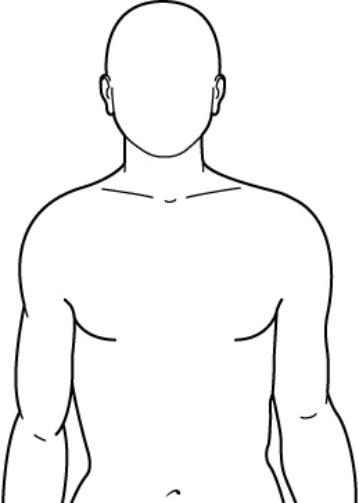
The nurse is preparing to auscultate a patient's heart sounds. Where should the nurse place the stethoscope to hear the S2 sound most loudly? Place an "X" on the diagram.

Question
Question
Question
Question
Question
Question
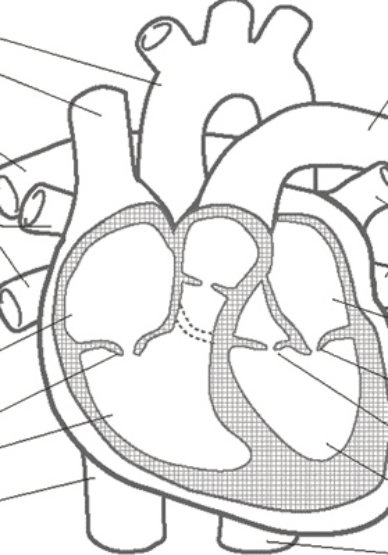
The nurse is preparing to auscultate a patient's S1 heart sound. Which heart valves should the nurse identify as creating this heart sound? Place an "X" over the location of these valves on the diagram.
Question
Question
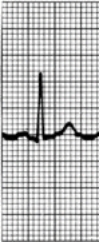
The nurse is reviewing the parts of a cardiac rhythm tracing with a patient scheduled for pacemaker insertion. Which wave should the nurse identify as the T wave? Place an "X" at the location of the T wave in the diagram.
Question
Question
Question
Question
Question
Question
Question
Question
Question
Question
Question
Question
Question
Question
Question
Question
Question
Question
Question
Question
Question
Question
The nurse is preparing to auscultate a patient's heart sounds. In which order should the nurse make this assessment?
A)
B)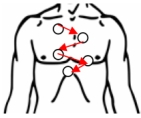
C)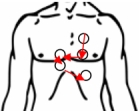
D)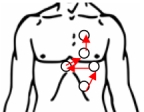
A)
B)
C)
D)
Question
Question
Question
Question
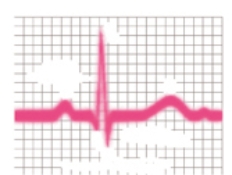
The nurse is analyzing a patient's electrocardiogram. On which area should the nurse focus to analyze the atrial depolarization and contraction? Place an X over the location on the rhythm strip.
Question
Question
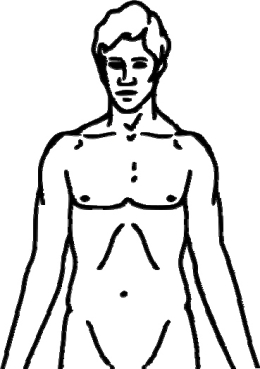
The nurse is instructing a patient who is having a left cardiac catheterization. The nurse explains that the catheter will be inserted? Place an "X" over the insertion site on the diagram below.
Question
Question
Question
Question
Question
Question

Unlock Deck
Sign up to unlock the cards in this deck!
Unlock Deck
Unlock Deck
1/43

Play

Full screen (f)
Deck 29: Assessing the Cardiovascular and Lymphatic Systems
1
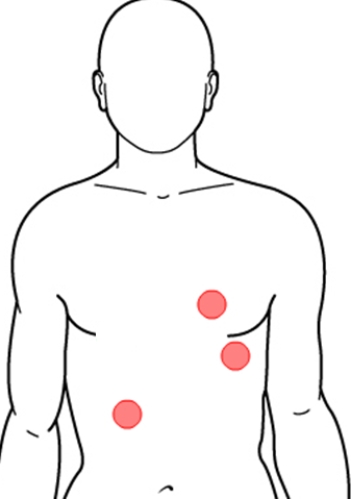
The nurse is preparing to auscultate a patient's heart sounds. Where should the nurse place the stethoscope to hear the S2 sound most loudly? Place an "X" on the diagram.
2
The nurse is reviewing the layers of the heart with a patient with endocarditis. From outermost to innermost, in which order should the nurse review these layers? Standard Text: Click and drag the options below to move them up or down.
A) epicardium
B) myocardium
C) endocardium
D) pericardial cavity
E) fibrous pericardium
F) parietal layer of serous pericardium
A) epicardium
B) myocardium
C) endocardium
D) pericardial cavity
E) fibrous pericardium
F) parietal layer of serous pericardium
E,F,D,A,B,C
3
The nurse is reviewing an electrocardiogram (ECG) rhythm strip. The P waves and QRS complexes are regular. The PR interval is 0.16 second and QRS complexes measure 0.06 second. The overall heart rate is 64 beats/minute. What should the nurse interpret these findings as indicating?
A) normal heart function
B) sick sinus syndrome
C) sinus bradycardia
D) first-degree heart block
A) normal heart function
B) sick sinus syndrome
C) sinus bradycardia
D) first-degree heart block
normal heart function
4
The patient's ECG shows the following characteristics: PR interval .08, QRS .08, and isoelectric ST segment. The nurse realizes that these characteristics indicate which finding?
A) faster than normal conduction from the SA node to the ventricles, normal conduction through the ventricles, and normal ST segment
B) faster than normal conduction from the SA node to the ventricles, faster than normal conduction through the ventricles, and normal ST segment
C) normal conduction from the SA node to the ventricles, normal conduction through the ventricles, and normal ST segment
D) normal conduction from the SA node to the ventricles, normal conduction through the ventricles, and abnormal ST segment
A) faster than normal conduction from the SA node to the ventricles, normal conduction through the ventricles, and normal ST segment
B) faster than normal conduction from the SA node to the ventricles, faster than normal conduction through the ventricles, and normal ST segment
C) normal conduction from the SA node to the ventricles, normal conduction through the ventricles, and normal ST segment
D) normal conduction from the SA node to the ventricles, normal conduction through the ventricles, and abnormal ST segment
Unlock Deck
Unlock for access to all 43 flashcards in this deck.
Unlock Deck
k this deck
5
The nurse is preparing to analyze a patient's electrocardiogram (ECG) rhythm strip. In which order should the nurse complete this analysis? Place the six steps in the correct order.
A) Determine rate.
B) Assess P wave.
C) Determine regularity.
D) Identify abnormalities.
E) Assess P-to-QRS relationship.
F) Determine interval durations.
G) non of the above.
A) Determine rate.
B) Assess P wave.
C) Determine regularity.
D) Identify abnormalities.
E) Assess P-to-QRS relationship.
F) Determine interval durations.
G) non of the above.
Unlock Deck
Unlock for access to all 43 flashcards in this deck.
Unlock Deck
k this deck
6
When listening to heart sounds, the nurse hears an S3 sound after S
A) ventricular volume overload
B) What should the nurse suspect is occurring with this patient?
C) increased resistance to ventricular filling
D) inflammation of the pericardial sac
E) stenotic mitral valve
A) ventricular volume overload
B) What should the nurse suspect is occurring with this patient?
C) increased resistance to ventricular filling
D) inflammation of the pericardial sac
E) stenotic mitral valve
Unlock Deck
Unlock for access to all 43 flashcards in this deck.
Unlock Deck
k this deck
7
The nurse is preparing to auscultate a patient's S1 heart sound. Which heart valves should the nurse identify as creating this heart sound? Place an "X" over the location of these valves on the diagram.
Unlock Deck
Unlock for access to all 43 flashcards in this deck.
Unlock Deck
k this deck
8
The patient is being evaluated for left atrium thrombus due to a dysrhythmia. Which diagnostic test should the nurse expect to be prescribed for this patient?
A) transesophageal echocardiography (TEE)
B) pericardiocentesis
C) cardiac catheterization
D) computed tomography (CT)
A) transesophageal echocardiography (TEE)
B) pericardiocentesis
C) cardiac catheterization
D) computed tomography (CT)
Unlock Deck
Unlock for access to all 43 flashcards in this deck.
Unlock Deck
k this deck
9
The nurse is reviewing the parts of a cardiac rhythm tracing with a patient scheduled for pacemaker insertion. Which wave should the nurse identify as the T wave? Place an "X" at the location of the T wave in the diagram.
Unlock Deck
Unlock for access to all 43 flashcards in this deck.
Unlock Deck
k this deck
10
The nurse is reviewing the anatomy of the heart with a patient scheduled for a cardiac catheterization. What should the nurse explain as the primary factor that regulates blood flow through the coronary arteries?
A) blood pressure in the aorta
B) blood vessel dilation
C) low-pressure systemic circulation
D) draining of blood into the coronary sinus by the coronary veins
A) blood pressure in the aorta
B) blood vessel dilation
C) low-pressure systemic circulation
D) draining of blood into the coronary sinus by the coronary veins
Unlock Deck
Unlock for access to all 43 flashcards in this deck.
Unlock Deck
k this deck
11
A male patient had a lipid profile completed at a community health fair, and the nurse is reviewing the results with the patient. (See lipid profile results.) What is the nurse's best response?
A) "The results for cholesterol, triglycerides, and LDL are outside the acceptable normal values."
B) "The HDL is elevated, indicating you are at risk for a lipid-associated illness."
C) "The results are within normal range."
D) "The LDL is too low."
A) "The results for cholesterol, triglycerides, and LDL are outside the acceptable normal values."
B) "The HDL is elevated, indicating you are at risk for a lipid-associated illness."
C) "The results are within normal range."
D) "The LDL is too low."
Unlock Deck
Unlock for access to all 43 flashcards in this deck.
Unlock Deck
k this deck
12
The nurse is caring for a patient admitted with a grade III heart murmur heard at midsystole. The nurse recognizes that which cardiac conditions could cause this assessment finding?
A) aortic stenosis
B) cardiomyopathy
C) atrioventricular (AV) valve disease
D) mitral valve prolapse (MVP)
E) ventricular septal defect
A) aortic stenosis
B) cardiomyopathy
C) atrioventricular (AV) valve disease
D) mitral valve prolapse (MVP)
E) ventricular septal defect
Unlock Deck
Unlock for access to all 43 flashcards in this deck.
Unlock Deck
k this deck
13
The nurse is planning to calculate a patient's cardiac index (CI). What physical assessment data does the nurse need to make this calculation?
A) weight and height
B) weight only
C) weight and waist measurement
D) waist measurement and height
A) weight and height
B) weight only
C) weight and waist measurement
D) waist measurement and height
Unlock Deck
Unlock for access to all 43 flashcards in this deck.
Unlock Deck
k this deck
14
The nurse is preparing to auscultate a patient's heart sounds. At which location will S1 be heard the loudest?
A) left midclavicular line at the fifth intercostal space
B) left sternal border at the fifth intercostal space
C) right midclavicular line at the fifth intercostal space
D) right sternal border at the third intercostal space
A) left midclavicular line at the fifth intercostal space
B) left sternal border at the fifth intercostal space
C) right midclavicular line at the fifth intercostal space
D) right sternal border at the third intercostal space
Unlock Deck
Unlock for access to all 43 flashcards in this deck.
Unlock Deck
k this deck
15
The patient is performing a treadmill test. What should the nurse instruct the patient about this test?
A) The patient should wear comfortable shoes.
B) The patient should wear a patient gown and slippers.
C) Smoking is permitted until the time of the test.
D) There are no dietary restrictions prior to the test as long as small meals are planned for the day of the test.
A) The patient should wear comfortable shoes.
B) The patient should wear a patient gown and slippers.
C) Smoking is permitted until the time of the test.
D) There are no dietary restrictions prior to the test as long as small meals are planned for the day of the test.
Unlock Deck
Unlock for access to all 43 flashcards in this deck.
Unlock Deck
k this deck
16
The nurse is caring for a patient with hypovolemic shock. The nurse should realize that this patient's heart sounds will change in which way?
A) diminished S2
B) accentuated S2
C) diminished S1 and S2
D) no change in S1 or S2
A) diminished S2
B) accentuated S2
C) diminished S1 and S2
D) no change in S1 or S2
Unlock Deck
Unlock for access to all 43 flashcards in this deck.
Unlock Deck
k this deck
17
The nurse is explaining cardiac reserve to a patient recovering from a myocardial infarction. Which example should the nurse use to explain this term?
A) getting on a treadmill and gradually increasing the pace of walking
B) breathing in through the nose and out the mouth while sitting quietly
C) sitting in a chair to cool down after completing an exercise routine
D) at the end of systole, approximately 50 mL of blood remaining in the ventricles
A) getting on a treadmill and gradually increasing the pace of walking
B) breathing in through the nose and out the mouth while sitting quietly
C) sitting in a chair to cool down after completing an exercise routine
D) at the end of systole, approximately 50 mL of blood remaining in the ventricles
Unlock Deck
Unlock for access to all 43 flashcards in this deck.
Unlock Deck
k this deck
18
A patient is scheduled for a cardiac catheterization. In which order should the nurse describe the events in this diagnostic test?
A) Contrast dye is injected.
B) Heart activity is filmed.
C) A catheter is inserted into a vein or artery in the leg.
D) The catheter is threaded to the heart chamber.
E) non of the above.
A) Contrast dye is injected.
B) Heart activity is filmed.
C) A catheter is inserted into a vein or artery in the leg.
D) The catheter is threaded to the heart chamber.
E) non of the above.
Unlock Deck
Unlock for access to all 43 flashcards in this deck.
Unlock Deck
k this deck
19
A patient is scheduled for a pericardiocentesis. Which health problem is the patient likely experiencing?
A) cardiac tamponade
B) slow heart rhythm
C) chest pain
D) suspected damage to a heart valve
A) cardiac tamponade
B) slow heart rhythm
C) chest pain
D) suspected damage to a heart valve
Unlock Deck
Unlock for access to all 43 flashcards in this deck.
Unlock Deck
k this deck
20
A patient being evaluated for cardiac pathology asks the nurse why sodium, calcium, and potassium are so important in the diet. What is the nurse's best response?
A) "The action potentials of the heart muscle cells are dependent on the diffusion of sodium, potassium, and calcium across the cell membrane."
B) "Because you are on potassium supplements, it is important to monitor electrolytes."
C) "Heart rate is affected by the oxygen levels in your body, which involves the attachment of oxygen molecules to these electrolytes."
D) "It is the pacemaker of your heart that is responsible for the heartbeat."
A) "The action potentials of the heart muscle cells are dependent on the diffusion of sodium, potassium, and calcium across the cell membrane."
B) "Because you are on potassium supplements, it is important to monitor electrolytes."
C) "Heart rate is affected by the oxygen levels in your body, which involves the attachment of oxygen molecules to these electrolytes."
D) "It is the pacemaker of your heart that is responsible for the heartbeat."
Unlock Deck
Unlock for access to all 43 flashcards in this deck.
Unlock Deck
k this deck
21
An 85-year-old patient asks why she always feels so cold. What should the nurse's response include?
A) "Heat sensors in the blood vessels lose sensitivity with aging."
B) "Your body metabolism is slowing the amount of blood flow."
C) "Blood vessels don't constrict as quickly with aging."
D) "Aging causes a layer of the blood vessels to stiffen."
E) "One layer of the blood vessels gets thinner with aging."
A) "Heat sensors in the blood vessels lose sensitivity with aging."
B) "Your body metabolism is slowing the amount of blood flow."
C) "Blood vessels don't constrict as quickly with aging."
D) "Aging causes a layer of the blood vessels to stiffen."
E) "One layer of the blood vessels gets thinner with aging."
Unlock Deck
Unlock for access to all 43 flashcards in this deck.
Unlock Deck
k this deck
22
The nurse is planning care for an older patient who exhibits low blood pressure. What should the nurse include in this plan that addresses age-related vascular changes?
A) monitoring hemoglobin level
B) monitoring the effects of medications
C) encouraging frequent position changes
D) monitoring lower extremities for edema
E) assessing skin for evidence of inflammation
A) monitoring hemoglobin level
B) monitoring the effects of medications
C) encouraging frequent position changes
D) monitoring lower extremities for edema
E) assessing skin for evidence of inflammation
Unlock Deck
Unlock for access to all 43 flashcards in this deck.
Unlock Deck
k this deck
23
The nurse determines that a patient has tachycardia. What does this information suggest about the patient's heart rate?
A) greater than 100 beats per minute
B) less than 60 beats per minute
C) 60-90 beats per minute
D) 90 beats per minute
A) greater than 100 beats per minute
B) less than 60 beats per minute
C) 60-90 beats per minute
D) 90 beats per minute
Unlock Deck
Unlock for access to all 43 flashcards in this deck.
Unlock Deck
k this deck
24
The nurse is participating in a health fair in a major metropolitan city park. For which community members should screening for thalassemia be suggested?
A) 21-year-old male from Hong Kong
B) 55-year-old female who recently visited India
C) 32-year-old male who emigrated from Nigeria
D) 45-year-old female whose mother is from Italy
E) 68-year-old female returning from a trip to Croatia
A) 21-year-old male from Hong Kong
B) 55-year-old female who recently visited India
C) 32-year-old male who emigrated from Nigeria
D) 45-year-old female whose mother is from Italy
E) 68-year-old female returning from a trip to Croatia
Unlock Deck
Unlock for access to all 43 flashcards in this deck.
Unlock Deck
k this deck
25
When completing the health history of a patient with a suspected cardiac disorder, about which childhood illnesses should the nurse ask?
A) rheumatic fever and strep throat infections
B) rubella and chickenpox
C) asthma and bronchitis
D) otitis media and respiratory syncytial virus (RSV)
A) rheumatic fever and strep throat infections
B) rubella and chickenpox
C) asthma and bronchitis
D) otitis media and respiratory syncytial virus (RSV)
Unlock Deck
Unlock for access to all 43 flashcards in this deck.
Unlock Deck
k this deck
26
A patient returns to the unit following a cardiac catheterization. Which nursing interventions are appropriate for this patient?
A) Assess cardiac rhythm and rate.
B) Assess patient for complaints of shortness of breath.
C) Maintain bed rest as ordered.
D) Assess pulses proximal to the insertion site.
E) Maintain fluid restriction.
A) Assess cardiac rhythm and rate.
B) Assess patient for complaints of shortness of breath.
C) Maintain bed rest as ordered.
D) Assess pulses proximal to the insertion site.
E) Maintain fluid restriction.
Unlock Deck
Unlock for access to all 43 flashcards in this deck.
Unlock Deck
k this deck
27
The nurse is preparing to assess a patient with Gaucher disease. What findings should the nurse expect when assessing this patient?
A) pain
B) nausea
C) fatigue
D) jaundice
E) hypotension
A) pain
B) nausea
C) fatigue
D) jaundice
E) hypotension
Unlock Deck
Unlock for access to all 43 flashcards in this deck.
Unlock Deck
k this deck
28
The nurse is listening to the heart of a healthy young adult. How many beats per minute should the nurse expect to assess in this patient?
A) 60-100
B) 30-60
C) 100-130
D) 130-160
A) 60-100
B) 30-60
C) 100-130
D) 130-160
Unlock Deck
Unlock for access to all 43 flashcards in this deck.
Unlock Deck
k this deck
29
A patient recovering from a cardiac catheterization asks to be left alone. What should the nurse explain to this patient?
A) "It is important that you drink fluids after the procedure to protect kidney function. I will bring you some fresh water."
B) "It is important that you ambulate, so I will return in 30 minutes to walk with you."
C) "You are recovering well from the procedure, and rest is a good idea."
D) "You need to do the leg exercises that you practiced before the procedure to maintain good circulation to your legs. After your exercises, you can rest."
A) "It is important that you drink fluids after the procedure to protect kidney function. I will bring you some fresh water."
B) "It is important that you ambulate, so I will return in 30 minutes to walk with you."
C) "You are recovering well from the procedure, and rest is a good idea."
D) "You need to do the leg exercises that you practiced before the procedure to maintain good circulation to your legs. After your exercises, you can rest."
Unlock Deck
Unlock for access to all 43 flashcards in this deck.
Unlock Deck
k this deck
30
The nurse palpates a thrill on a patient's precordium. With which health problem should the nurse associate this finding?
A) severe valve stenosis
B) enlarged heart
C) stenosis of the carotid arteries
D) aortic aneurysm
A) severe valve stenosis
B) enlarged heart
C) stenosis of the carotid arteries
D) aortic aneurysm
Unlock Deck
Unlock for access to all 43 flashcards in this deck.
Unlock Deck
k this deck
31
The nurse is preparing to auscultate a patient's heart sounds. In which order should the nurse make this assessment?
A)
B)
C)
D)
A)
B)
C)
D)
Unlock Deck
Unlock for access to all 43 flashcards in this deck.
Unlock Deck
k this deck
32
When auscultating heart sounds, the nurse asks the patient to lie on the left side, then sit up and lean forward. Why is the patient asked to move into these positions?
A) The heart is closer to the chest wall.
B) They diminish the effect of respiratory sounds during auscultation.
C) Use of the stethoscope diaphragm improves auscultation of high-pitched murmurs.
D) Use of the bell side of the stethoscope allows low-pitched sounds to be readily identified.
A) The heart is closer to the chest wall.
B) They diminish the effect of respiratory sounds during auscultation.
C) Use of the stethoscope diaphragm improves auscultation of high-pitched murmurs.
D) Use of the bell side of the stethoscope allows low-pitched sounds to be readily identified.
Unlock Deck
Unlock for access to all 43 flashcards in this deck.
Unlock Deck
k this deck
33
A patient has a stroke volume (SV) of 80 mL/beat and a heart rate (HR) of 75 beats/minute. What should the nurse calculate this patient's cardiac output to be? ________ mL
Unlock Deck
Unlock for access to all 43 flashcards in this deck.
Unlock Deck
k this deck
34
The nurse is assessing an adult patient's heart sounds. In which order should the nurse hear the sounds?
A) S1, then S2
B) S2, then S3
C) S3, then S4
D) S2, then S1
A) S1, then S2
B) S2, then S3
C) S3, then S4
D) S2, then S1
Unlock Deck
Unlock for access to all 43 flashcards in this deck.
Unlock Deck
k this deck
35
The nurse is analyzing a patient's electrocardiogram. On which area should the nurse focus to analyze the atrial depolarization and contraction? Place an X over the location on the rhythm strip.
Unlock Deck
Unlock for access to all 43 flashcards in this deck.
Unlock Deck
k this deck
36
Through genetic testing, parents learn that their adolescent child has long QT syndrome. What instructions regarding health protection should the nurse provide to this family?
A) Avoid loud music.
B) Limit the intake of citrus fruits.
C) Avoid foods with extra sodium.
D) Practice caution when exercising.
E) Restrict the intake of dairy products.
A) Avoid loud music.
B) Limit the intake of citrus fruits.
C) Avoid foods with extra sodium.
D) Practice caution when exercising.
E) Restrict the intake of dairy products.
Unlock Deck
Unlock for access to all 43 flashcards in this deck.
Unlock Deck
k this deck
37
The nurse is instructing a patient who is having a left cardiac catheterization. The nurse explains that the catheter will be inserted? Place an "X" over the insertion site on the diagram below.
Unlock Deck
Unlock for access to all 43 flashcards in this deck.
Unlock Deck
k this deck
38
A patient has a stroke volume (SV) of 75 mL/beat and end-diastolic volume of 120 mL. What should the nurse calculate this patient's ejection fraction to be? _______ %
Unlock Deck
Unlock for access to all 43 flashcards in this deck.
Unlock Deck
k this deck
39
During an assessment the nurse determines that a 93-year-old patient is demonstrating age-related changes in the tunica intima layer of the vascular system. What did the nurse assess to make this clinical determination?
A) tachycardia
B) postural hypotension
C) weak peripheral pulses
D) prominent neck and hand veins
E) elevated systolic blood pressure
A) tachycardia
B) postural hypotension
C) weak peripheral pulses
D) prominent neck and hand veins
E) elevated systolic blood pressure
Unlock Deck
Unlock for access to all 43 flashcards in this deck.
Unlock Deck
k this deck
40
An 87-year-old patient is being treated for sepsis. What interventions should the nurse include in this patient's plan of care to adjust for age-related changes in cardiovascular status?
A) restricting fluids
B) monitoring for tachycardia
C) encouraging increased physical activity
D) planning rest periods between physical activities
E) maintaining the head of the bed at a 30-degree angle
A) restricting fluids
B) monitoring for tachycardia
C) encouraging increased physical activity
D) planning rest periods between physical activities
E) maintaining the head of the bed at a 30-degree angle
Unlock Deck
Unlock for access to all 43 flashcards in this deck.
Unlock Deck
k this deck
41
While assessing a patient's lymph nodes, the nurse suspects that the patient has a malignancy. What did the nurse assess to make this clinical decision?
A) painful nodes in the neck
B) lymph nodes adhering to the chest wall
C) rubbery lymph nodes in the femoral region
D) hard, nodular lymph nodes in the axillary region
E) warm lymph nodes along the upper chest
A) painful nodes in the neck
B) lymph nodes adhering to the chest wall
C) rubbery lymph nodes in the femoral region
D) hard, nodular lymph nodes in the axillary region
E) warm lymph nodes along the upper chest
Unlock Deck
Unlock for access to all 43 flashcards in this deck.
Unlock Deck
k this deck
42
While conducting an abdominal assessment, the nurse percusses a dull sound below the tenth rib at the left midaxillary line. What should the nurse suspect is occurring with this patient?
A) cancer
B) hemophilia
C) viral infection
D) blood dyscrasia
E) bacterial infection
A) cancer
B) hemophilia
C) viral infection
D) blood dyscrasia
E) bacterial infection
Unlock Deck
Unlock for access to all 43 flashcards in this deck.
Unlock Deck
k this deck
43
While conducting a physical assessment the nurse detects atrophic changes on a patient's lower extremities. What physical findings did the nurse assess in this patient?
A) thick toenails
B) skin ulcerations
C) dilated leg veins
D) skin discolorations
E) absence of hair on the lower legs
A) thick toenails
B) skin ulcerations
C) dilated leg veins
D) skin discolorations
E) absence of hair on the lower legs
Unlock Deck
Unlock for access to all 43 flashcards in this deck.
Unlock Deck
k this deck
Unlock Deck
Unlock for access to all 43 flashcards in this deck.






